

ISO 21013-1:2021
(Main)Cryogenic vessels — Pressure-relief accessories for cryogenic service — Part 1: Reclosable pressure-relief valves
General Information
- Abstract
This document specifies the requirements for the design, manufacture and testing of pressure relief valves for cryogenic service, i.e. for operation with cryogenic fluids below −10 °C in addition to operation at ambient temperatures from ambient to cryogenic. This document is applicable to valves not exceeding a size of DN 150 designed to relieve single-phase vapours or gases. A valve can be specified, constructed and tested such that it is suitable for use with more than one gas or with mixtures of gases. NOTE This document does not provide methods for determining the capacity of relief valve(s) for a particular cryogenic vessel. Such methods are provided in ISO 21013-3.
- Status
- Published
- Publication Date
- 19-Dec-2021
- Technical Committee
- ISO/TC 220 - Cryogenic vessels
- Drafting Committee
- ISO/TC 220/WG 3 - Supporting standards
- Current Stage
- 6060 - International Standard published
- Start Date
- 20-Dec-2021
- Due Date
- 28-Jun-2021
- Completion Date
- 20-Dec-2021
Buy Documents

ISO 21013-1:2021 - Cryogenic vessels -- Pressure-relief accessories for cryogenic service

ISO 21013-1:2021 - Cryogenic vessels — Pressure-relief accessories for cryogenic service — Part 1: Reclosable pressure-relief valves/20/2021
Overview
ISO 21013-1:2021 - "Cryogenic vessels - Pressure‑relief accessories for cryogenic service - Part 1: Reclosable pressure‑relief valves" specifies requirements for the design, manufacture and testing of reclosable pressure‑relief valves used with cryogenic fluids (below −10 °C) and at ambient temperatures up to their rated minimum temperature through +65 °C. It applies to valves up to DN 150 intended to relieve single‑phase vapours or gases. Note: methods to determine relief valve capacity for a vessel are given separately in ISO 21013‑3.
Key topics and technical requirements
- Scope and applicability: Valves for cryogenic service, multiple gases and gas mixtures, size limit DN 150.
- Design requirements:
- Operation across the full cryogenic-to-ambient temperature range (rated minimum temperature to +65 °C).
- Drainage and stem guiding to prevent water accumulation and freezing‑related malfunctions.
- Special provisions for sublimating fluids (e.g., CO2) to avoid solid deposition inside the valve.
- Use of soft inserts designed to resist cold‑flow and maintain seat tightness.
- Electrical continuity requirement for oxidising/flammable services: maximum resistance 1 000 Ω with ≤28 V between ports to avoid static build‑up.
- Set pressure must not exceed the valve’s PS (maximum allowable pressure).
- Minimum shell thickness referenced to ISO 15761 or ASME B16.34 (or equivalent calculation methods).
- Materials and compatibility: Metallic and non‑metallic material selection per recognized standards and gas/material compatibility (see ISO 21010); consider corrosion, galling, oxygen compatibility.
- Qualification and testing:
- Type approval, ambient and cryogenic tests, alternate cryogenic tests and production testing.
- Tests include seat‑tightness and re‑seating pressure verification; determination of the certified discharge coefficient.
- Manufacturing controls: Cleanliness, marking, sealing and production inspection requirements are specified.
Applications and users
This standard is essential for:
- Valve manufacturers designing and certifying reclosable pressure‑relief valves for cryogenic service
- Cryogenic vessel designers and integrators selecting safety accessories
- Test laboratories performing ambient and cryogenic qualification tests
- Plant engineers, safety officers and procurement professionals in LNG, industrial gas, medical gas, and cryogenic storage/transport sectors
- Regulatory bodies and inspectors assessing compliance for pressure‑relief systems
Related standards
- ISO 21013‑3 (relief capacity methods)
- ISO 4126‑1 (safety valves)
- ISO 21009‑1, ISO 20421‑1, ISO 21010 (cryogenic vessel design & compatibility)
- ISO 15761, ASME B16.34 (valve body thickness/design references)
- ISO 23208 (cleanliness for cryogenic service)
ISO 21013-1:2021 provides the practical framework to ensure safe, reliable, and compliant reclosable pressure‑relief valves for cryogenic applications.
Relations
- Effective Date
- 18-Jun-2022
- Effective Date
- 07-Jul-2018
Buy Documents
ISO 21013-1:2021 - Cryogenic vessels -- Pressure-relief accessories for cryogenic service
ISO 21013-1:2021 - Cryogenic vessels — Pressure-relief accessories for cryogenic service — Part 1: Reclosable pressure-relief valves/20/2021
Get Certified
Connect with accredited certification bodies for this standard

Institut za varilstvo d.o.o. (Welding Institute)
Slovenia's leading welding institute since 1952. ISO 3834, EN 1090, pressure equipment certification, NDT personnel, welder qualification. Only IIW Au
Sponsored listings
Frequently Asked Questions
ISO 21013-1:2021 is a standard published by the International Organization for Standardization (ISO). Its full title is "Cryogenic vessels — Pressure-relief accessories for cryogenic service — Part 1: Reclosable pressure-relief valves". This standard covers: This document specifies the requirements for the design, manufacture and testing of pressure relief valves for cryogenic service, i.e. for operation with cryogenic fluids below −10 °C in addition to operation at ambient temperatures from ambient to cryogenic. This document is applicable to valves not exceeding a size of DN 150 designed to relieve single-phase vapours or gases. A valve can be specified, constructed and tested such that it is suitable for use with more than one gas or with mixtures of gases. NOTE This document does not provide methods for determining the capacity of relief valve(s) for a particular cryogenic vessel. Such methods are provided in ISO 21013-3.
This document specifies the requirements for the design, manufacture and testing of pressure relief valves for cryogenic service, i.e. for operation with cryogenic fluids below −10 °C in addition to operation at ambient temperatures from ambient to cryogenic. This document is applicable to valves not exceeding a size of DN 150 designed to relieve single-phase vapours or gases. A valve can be specified, constructed and tested such that it is suitable for use with more than one gas or with mixtures of gases. NOTE This document does not provide methods for determining the capacity of relief valve(s) for a particular cryogenic vessel. Such methods are provided in ISO 21013-3.
ISO 21013-1:2021 is classified under the following ICS (International Classification for Standards) categories: 23.020.40 - Cryogenic vessels. The ICS classification helps identify the subject area and facilitates finding related standards.
ISO 21013-1:2021 has the following relationships with other standards: It is inter standard links to ISO 21013-1:2021/Amd 1:2024, ISO 21013-1:2008. Understanding these relationships helps ensure you are using the most current and applicable version of the standard.
ISO 21013-1:2021 is available in PDF format for immediate download after purchase. The document can be added to your cart and obtained through the secure checkout process. Digital delivery ensures instant access to the complete standard document.
Standards Content (Sample)
INTERNATIONAL ISO
STANDARD 21013-1
Second edition
2021-12
Cryogenic vessels — Pressure-relief
accessories for cryogenic service —
Part 1:
Reclosable pressure-relief valves
Récipients cryogéniques — Dispositifs de sécurité pour le service
cryogénique —
Partie 1: Soupapes de sûreté pour service cryogénique
Reference number
© ISO 2021
All rights reserved. Unless otherwise specified, or required in the context of its implementation, no part of this publication may
be reproduced or utilized otherwise in any form or by any means, electronic or mechanical, including photocopying, or posting on
the internet or an intranet, without prior written permission. Permission can be requested from either ISO at the address below
or ISO’s member body in the country of the requester.
ISO copyright office
CP 401 • Ch. de Blandonnet 8
CH-1214 Vernier, Geneva
Phone: +41 22 749 01 11
Email: copyright@iso.org
Website: www.iso.org
Published in Switzerland
ii
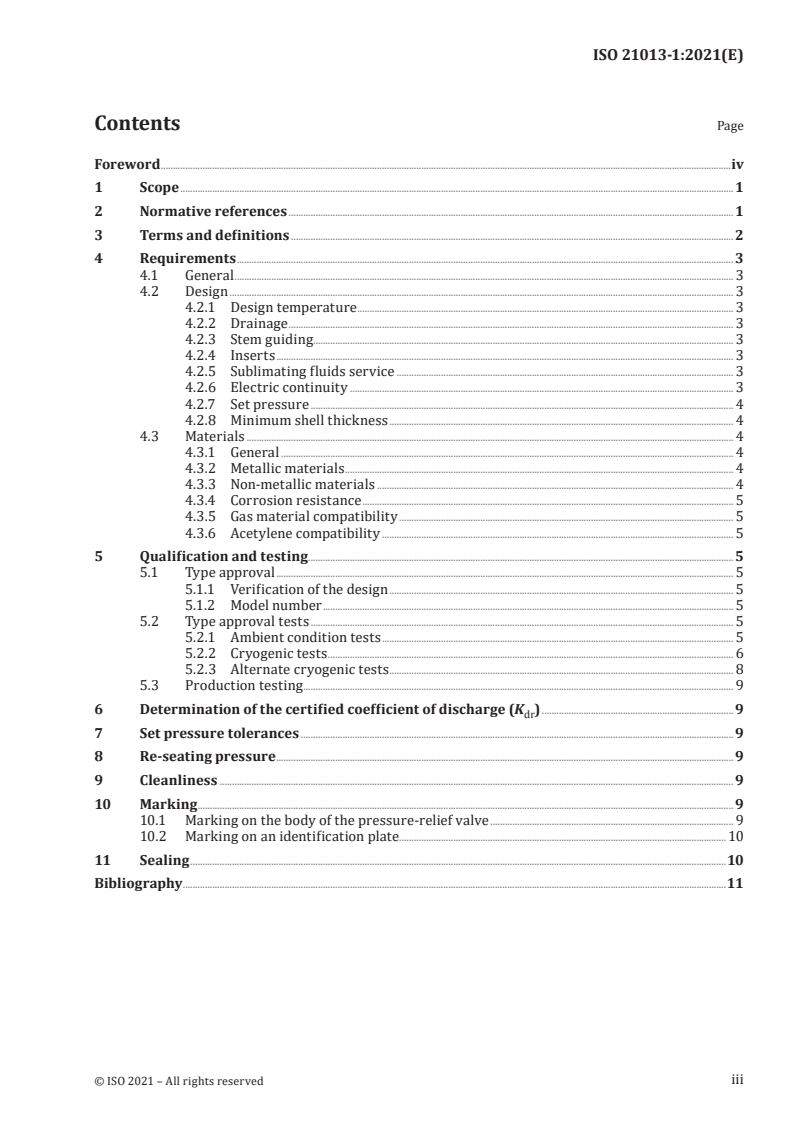
Contents Page
Foreword .iv
1 Scope . 1
2 Normative references . 1
3 Terms and definitions . 2
4 Requirements . 3
4.1 General . 3
4.2 Design . 3
4.2.1 Design temperature . 3
4.2.2 Drainage . 3
4.2.3 Stem guiding. 3
4.2.4 Inserts . 3
4.2.5 Sublimating fluids service . 3
4.2.6 Electric continuity . 3
4.2.7 Set pressure . 4
4.2.8 Minimum shell thickness . 4
4.3 Materials . 4
4.3.1 General . 4
4.3.2 Metallic materials . 4
4.3.3 Non-metallic materials . 4
4.3.4 Corrosion resistance . 5
4.3.5 Gas material compatibility . 5
4.3.6 Acetylene compatibility . 5
5 Qualification and testing . .5
5.1 Type approval . 5
5.1.1 Verification of the design . 5
5.1.2 Model number . 5
5.2 Type approval tests . 5
5.2.1 Ambient condition tests . 5
5.2.2 Cryogenic tests . 6
5.2.3 Alternate cryogenic tests . . 8
5.3 Production testing . 9
6 Determination of the certified coefficient of discharge (K ) . 9
dr
7 Set pressure tolerances .9
8 Re-seating pressure .9
9 Cleanliness . 9
10 Marking . . 9
10.1 Marking on the body of the pressure-relief valve . 9
10.2 Marking on an identification plate. 10
11 Sealing .10
Bibliography .11
iii
Foreword
ISO (the International Organization for Standardization) is a worldwide federation of national standards
bodies (ISO member bodies). The work of preparing International Standards is normally carried out
through ISO technical committees. Each member body interested in a subject for which a technical
committee has been established has the right to be represented on that committee. International
organizations, governmental and non-governmental, in liaison with ISO, also take part in the work.
ISO collaborates closely with the International Electrotechnical Commission (IEC) on all matters of
electrotechnical standardization.
The procedures used to develop this document and those intended for its further maintenance are
described in the ISO/IEC Directives, Part 1. In particular, the different approval criteria needed for the
different types of ISO documents should be noted. This document was drafted in accordance with the
editorial rules of the ISO/IEC Directives, Part 2 (see www.iso.org/directives).
Attention is drawn to the possibility that some of the elements of this document may be the subject of
patent rights. ISO shall not be held responsible for identifying any or all such patent rights. Details of
any patent rights identified during the development of the document will be in the Introduction and/or
on the ISO list of patent declarations received (see www.iso.org/patents).
Any trade name used in this document is information given for the convenience of users and does not
constitute an endorsement.
For an explanation of the voluntary nature of standards, the meaning of ISO specific terms and
expressions related to conformity assessment, as well as information about ISO's adherence to
the World Trade Organization (WTO) principles in the Technical Barriers to Trade (TBT), see
www.iso.org/iso/foreword.html.
This document was prepared by Technical Committee ISO/TC 220, Cryogenic vessels.
This second edition cancels and replaces the first edition (ISO 21013-1:2008), which has been technically
revised.
The main changes are as follows:
— update of the terms and definitions;
— revision of cryogenic tests, in particular, the test setup.
A list of all parts in the ISO 21013 series can be found on the ISO website.
Any feedback or questions on this document should be directed to the user’s national standards body. A
complete listing of these bodies can be found at www.iso.org/members.html.
iv
INTERNATIONAL STANDARD ISO 21013-1:2021(E)
Cryogenic vessels — Pressure-relief accessories for
cryogenic service —
Part 1:
Reclosable pressure-relief valves
1 Scope
This document specifies the requirements for the design, manufacture and testing of pressure relief
valves for cryogenic service, i.e. for operation with cryogenic fluids below −10 °C in addition to operation
at ambient temperatures from ambient to cryogenic.
This document is applicable to valves not exceeding a size of DN 150 designed to relieve
single-phase vapours or gases. A valve can be specified, constructed and tested such that it is suitable
for use with more than one gas or with mixtures of gases.
NOTE This document does not provide methods for determining the capacity of relief valve(s) for a particular
cryogenic vessel. Such methods are provided in ISO 21013-3.
2 Normative references
The following documents are referred to in the text in such a way that some or all of their content
constitutes requirements of this document. For dated references, only the edition cited applies. For
undated references, the latest edition of the referenced document (including any amendments) applies.
ISO 4126-1:2013, Safety devices for protection against excessive pressure — Part 1: Safety valves
ISO 11114-1, Gas cylinders — Compatibility of cylinder and valve materials with gas contents — Part 1:
Metallic materials
ISO 11114-2, Gas cylinders — Compatibility of cylinder and valve materials with gas contents — Part 2:
Non-metallic materials
ISO 15761, Steel gate, globe and check valves for sizes DN 100 and smaller, for the petroleum and natural
gas industries
ISO 20421-1:2019, Cryogenic vessels — Large transportable vacuum-insulated vessels — Part 1: Design,
fabrication, inspection and testing
ISO 21009-1:2008, Cryogenic vessels — Static vacuum-insulated vessels — Part 1: Design, fabrication,
inspection, and tests
ISO 21010, Cryogenic vessels — Gas/material compatibility
ISO 21028-1, Cryogenic vessels — Toughness requirements for materials at cryogenic temperature — Part
1: Temperatures below -80 degrees C
ISO 21028-2, Cryogenic vessels — Toughness requirements for materials at cryogenic temperature — Part
2: Temperatures between -80 degrees C and -20 degrees C
ISO 21029-1:2018, Cryogenic vessels — Transportable vacuum insulated vessels of not more than
1 000 litres volume — Part 1: Design, fabrication, inspection and tests
ISO 23208, Cryogenic vessels — Cleanliness for cryogenic service
ASME B16.34: 2017, Valves — Flanged, Threaded, and Welding end
3 Terms and definitions
For the purposes of this document, the following terms and definitions apply.
ISO and IEC maintain terminology databases for use in standardization at the following addresses:
— ISO Online browsing platform: available at https:// www .iso .org/ obp
— IEC Electropedia: available at https:// www .electropedia .org/
3.1
DN
nominal size
alphanumeric designation of size for components of a pipe work system, which is used for reference
purposes
Note 1 to entry: It comprises the letters DN followed by a dimensionless whole number which is indirectly related
to the physical size, in millimetres, of the bore or outside diameter of the end connections.
[SOURCE: ISO 6708:1995, 2.1, modified — Moved additional information from the definition into a Note
1 to entry and deleted the previous two Notes to entry.]
3.2
pressure
gauge pressure
pressure for which the value is equal to the algebraic difference between the absolute pressure and the
atmospheric pressure
3.3
rated minimum temperature
lowest temperature for which the pressure relief valve is rated by the manufacturer
3.4
category A valve
relief valve which can be expected to relieve pressure during normal operation of the cryogenic vessel
Note 1 to entry: The procedure for the seat-tightness test is described in 5.2.1.2.
3.5
category B valve
relief valve which is not expected to relieve pressure during normal operation due to the provision of
an alternative relieving or control device, e.g. a pressure regulating vent valve designed for frequent
operation
Note 1 to entry: The procedure for the seat-tightness test is described in 5.2.1.2.
3.6
cryogenic fluid
refrigerated liquefied gas
gas which is partially liquid because of its cold temperature
Note 1 to entry: This includes totally evaporated liquids and supercritical fluids.
3.7
PS
maximum allowable pressure
maximum pressure for which the equipment is designed as specified by the manufacturer
Note 1 to entry: Overpressure and relieving pressure are defined in ISO 4126-1.
3.8
rated pressure
PR
maximum pressure difference between the inside and outside of any pressure retaining boundary for
which the boundary is designed to be operated at 20 °C
Note 1 to entry: The PR of the relief valve is the lowest PR of any component of the relief valve.
4 Requirements
4.1 General
The valve shall satisfy all the requirements of ISO 4126-1 except in the event of different requirements,
where this document takes precedence.
In the context of this document, for cryogenic fluids and mixtures of them, the user shall refer to the
list of cryogenic fluids in ISO 21029-1:2018, Table 1 or ISO 21009-1:2008, Table 1 or ISO 20421-1:2019,
Table K.1.
4.2 Design
4.2.1 Design temperature
The valve shall be suitable for operation at all temperatures between the rated minimum temperature
and +65 °C within the intended pressure range.
4.2.2 Drainage
Unless otherwise specified in the purchase order, the valve shall avoid accumulation of water within it,
even when the expected outlet connection is fitted.
4.2.3 Stem guiding
The design of guiding shall avoid malfunction of the valve due to deposition and freezing of atmospheric
moisture on and within the valve during normal operation. The valve shall be sufficiently robust such
that the effectiveness of the guiding cannot be defeated by normal handling.
4.2.4 Inserts
Where a disc soft-insert is used to ensure leak-tight shut off, the design shall be such as to prevent cold
flow of the insert to a degree that results in the valve failing to operate correctly.
4.2.5 Sublimating fluids service
Where the valve is specified as suitable for service with products that, when vented at valve operating
conditions, condense from gas or vapour directly to solid, e.g. carbon dioxide (CO ), the design shall be
such as to avoid the valve failing to operate correctly due to deposition of solid product within the valve
body or its outlet.
4.2.6 Electric continuity
For valves in oxidising and flammable fluids service, the maximum electrical resistance shall not exceed
1 000 Ω with no more than 28 V between the ports in order to ensure ele
...
INTERNATIONAL ISO
STANDARD 21013-1
Second edition
2021-12
Cryogenic vessels — Pressure-relief
accessories for cryogenic service —
Part 1:
Reclosable pressure-relief valves
Récipients cryogéniques — Dispositifs de sécurité pour le service
cryogénique —
Partie 1: Soupapes de sûreté pour service cryogénique
Reference number
© ISO 2021
All rights reserved. Unless otherwise specified, or required in the context of its implementation, no part of this publication may
be reproduced or utilized otherwise in any form or by any means, electronic or mechanical, including photocopying, or posting on
the internet or an intranet, without prior written permission. Permission can be requested from either ISO at the address below
or ISO’s member body in the country of the requester.
ISO copyright office
CP 401 • Ch. de Blandonnet 8
CH-1214 Vernier, Geneva
Phone: +41 22 749 01 11
Email: copyright@iso.org
Website: www.iso.org
Published in Switzerland
ii
Contents Page
Foreword .iv
1 Scope . 1
2 Normative references . 1
3 Terms and definitions . 2
4 Requirements . 3
4.1 General . 3
4.2 Design . 3
4.2.1 Design temperature . 3
4.2.2 Drainage . 3
4.2.3 Stem guiding. 3
4.2.4 Inserts . 3
4.2.5 Sublimating fluids service . 3
4.2.6 Electric continuity . 3
4.2.7 Set pressure . 4
4.2.8 Minimum shell thickness . 4
4.3 Materials . 4
4.3.1 General . 4
4.3.2 Metallic materials . 4
4.3.3 Non-metallic materials . 4
4.3.4 Corrosion resistance . 5
4.3.5 Gas material compatibility . 5
4.3.6 Acetylene compatibility . 5
5 Qualification and testing . .5
5.1 Type approval . 5
5.1.1 Verification of the design . 5
5.1.2 Model number . 5
5.2 Type approval tests . 5
5.2.1 Ambient condition tests . 5
5.2.2 Cryogenic tests . 6
5.2.3 Alternate cryogenic tests . . 8
5.3 Production testing . 9
6 Determination of the certified coefficient of discharge (K ) . 9
dr
7 Set pressure tolerances .9
8 Re-seating pressure .9
9 Cleanliness . 9
10 Marking . . 9
10.1 Marking on the body of the pressure-relief valve . 9
10.2 Marking on an identification plate. 10
11 Sealing .10
Bibliography .11
iii
Foreword
ISO (the International Organization for Standardization) is a worldwide federation of national standards
bodies (ISO member bodies). The work of preparing International Standards is normally carried out
through ISO technical committees. Each member body interested in a subject for which a technical
committee has been established has the right to be represented on that committee. International
organizations, governmental and non-governmental, in liaison with ISO, also take part in the work.
ISO collaborates closely with the International Electrotechnical Commission (IEC) on all matters of
electrotechnical standardization.
The procedures used to develop this document and those intended for its further maintenance are
described in the ISO/IEC Directives, Part 1. In particular, the different approval criteria needed for the
different types of ISO documents should be noted. This document was drafted in accordance with the
editorial rules of the ISO/IEC Directives, Part 2 (see www.iso.org/directives).
Attention is drawn to the possibility that some of the elements of this document may be the subject of
patent rights. ISO shall not be held responsible for identifying any or all such patent rights. Details of
any patent rights identified during the development of the document will be in the Introduction and/or
on the ISO list of patent declarations received (see www.iso.org/patents).
Any trade name used in this document is information given for the convenience of users and does not
constitute an endorsement.
For an explanation of the voluntary nature of standards, the meaning of ISO specific terms and
expressions related to conformity assessment, as well as information about ISO's adherence to
the World Trade Organization (WTO) principles in the Technical Barriers to Trade (TBT), see
www.iso.org/iso/foreword.html.
This document was prepared by Technical Committee ISO/TC 220, Cryogenic vessels.
This second edition cancels and replaces the first edition (ISO 21013-1:2008), which has been technically
revised.
The main changes are as follows:
— update of the terms and definitions;
— revision of cryogenic tests, in particular, the test setup.
A list of all parts in the ISO 21013 series can be found on the ISO website.
Any feedback or questions on this document should be directed to the user’s national standards body. A
complete listing of these bodies can be found at www.iso.org/members.html.
iv
INTERNATIONAL STANDARD ISO 21013-1:2021(E)
Cryogenic vessels — Pressure-relief accessories for
cryogenic service —
Part 1:
Reclosable pressure-relief valves
1 Scope
This document specifies the requirements for the design, manufacture and testing of pressure relief
valves for cryogenic service, i.e. for operation with cryogenic fluids below −10 °C in addition to operation
at ambient temperatures from ambient to cryogenic.
This document is applicable to valves not exceeding a size of DN 150 designed to relieve
single-phase vapours or gases. A valve can be specified, constructed and tested such that it is suitable
for use with more than one gas or with mixtures of gases.
NOTE This document does not provide methods for determining the capacity of relief valve(s) for a particular
cryogenic vessel. Such methods are provided in ISO 21013-3.
2 Normative references
The following documents are referred to in the text in such a way that some or all of their content
constitutes requirements of this document. For dated references, only the edition cited applies. For
undated references, the latest edition of the referenced document (including any amendments) applies.
ISO 4126-1:2013, Safety devices for protection against excessive pressure — Part 1: Safety valves
ISO 11114-1, Gas cylinders — Compatibility of cylinder and valve materials with gas contents — Part 1:
Metallic materials
ISO 11114-2, Gas cylinders — Compatibility of cylinder and valve materials with gas contents — Part 2:
Non-metallic materials
ISO 15761, Steel gate, globe and check valves for sizes DN 100 and smaller, for the petroleum and natural
gas industries
ISO 20421-1:2019, Cryogenic vessels — Large transportable vacuum-insulated vessels — Part 1: Design,
fabrication, inspection and testing
ISO 21009-1:2008, Cryogenic vessels — Static vacuum-insulated vessels — Part 1: Design, fabrication,
inspection, and tests
ISO 21010, Cryogenic vessels — Gas/material compatibility
ISO 21028-1, Cryogenic vessels — Toughness requirements for materials at cryogenic temperature — Part
1: Temperatures below -80 degrees C
ISO 21028-2, Cryogenic vessels — Toughness requirements for materials at cryogenic temperature — Part
2: Temperatures between -80 degrees C and -20 degrees C
ISO 21029-1:2018, Cryogenic vessels — Transportable vacuum insulated vessels of not more than
1 000 litres volume — Part 1: Design, fabrication, inspection and tests
ISO 23208, Cryogenic vessels — Cleanliness for cryogenic service
ASME B16.34: 2017, Valves — Flanged, Threaded, and Welding end
3 Terms and definitions
For the purposes of this document, the following terms and definitions apply.
ISO and IEC maintain terminology databases for use in standardization at the following addresses:
— ISO Online browsing platform: available at https:// www .iso .org/ obp
— IEC Electropedia: available at https:// www .electropedia .org/
3.1
DN
nominal size
alphanumeric designation of size for components of a pipe work system, which is used for reference
purposes
Note 1 to entry: It comprises the letters DN followed by a dimensionless whole number which is indirectly related
to the physical size, in millimetres, of the bore or outside diameter of the end connections.
[SOURCE: ISO 6708:1995, 2.1, modified — Moved additional information from the definition into a Note
1 to entry and deleted the previous two Notes to entry.]
3.2
pressure
gauge pressure
pressure for which the value is equal to the algebraic difference between the absolute pressure and the
atmospheric pressure
3.3
rated minimum temperature
lowest temperature for which the pressure relief valve is rated by the manufacturer
3.4
category A valve
relief valve which can be expected to relieve pressure during normal operation of the cryogenic vessel
Note 1 to entry: The procedure for the seat-tightness test is described in 5.2.1.2.
3.5
category B valve
relief valve which is not expected to relieve pressure during normal operation due to the provision of
an alternative relieving or control device, e.g. a pressure regulating vent valve designed for frequent
operation
Note 1 to entry: The procedure for the seat-tightness test is described in 5.2.1.2.
3.6
cryogenic fluid
refrigerated liquefied gas
gas which is partially liquid because of its cold temperature
Note 1 to entry: This includes totally evaporated liquids and supercritical fluids.
3.7
PS
maximum allowable pressure
maximum pressure for which the equipment is designed as specified by the manufacturer
Note 1 to entry: Overpressure and relieving pressure are defined in ISO 4126-1.
3.8
rated pressure
PR
maximum pressure difference between the inside and outside of any pressure retaining boundary for
which the boundary is designed to be operated at 20 °C
Note 1 to entry: The PR of the relief valve is the lowest PR of any component of the relief valve.
4 Requirements
4.1 General
The valve shall satisfy all the requirements of ISO 4126-1 except in the event of different requirements,
where this document takes precedence.
In the context of this document, for cryogenic fluids and mixtures of them, the user shall refer to the
list of cryogenic fluids in ISO 21029-1:2018, Table 1 or ISO 21009-1:2008, Table 1 or ISO 20421-1:2019,
Table K.1.
4.2 Design
4.2.1 Design temperature
The valve shall be suitable for operation at all temperatures between the rated minimum temperature
and +65 °C within the intended pressure range.
4.2.2 Drainage
Unless otherwise specified in the purchase order, the valve shall avoid accumulation of water within it,
even when the expected outlet connection is fitted.
4.2.3 Stem guiding
The design of guiding shall avoid malfunction of the valve due to deposition and freezing of atmospheric
moisture on and within the valve during normal operation. The valve shall be sufficiently robust such
that the effectiveness of the guiding cannot be defeated by normal handling.
4.2.4 Inserts
Where a disc soft-insert is used to ensure leak-tight shut off, the design shall be such as to prevent cold
flow of the insert to a degree that results in the valve failing to operate correctly.
4.2.5 Sublimating fluids service
Where the valve is specified as suitable for service with products that, when vented at valve operating
conditions, condense from gas or vapour directly to solid, e.g. carbon dioxide (CO ), the design shall be
such as to avoid the valve failing to operate correctly due to deposition of solid product within the valve
body or its outlet.
4.2.6 Electric continuity
For valves in oxidising and flammable fluids service, the maximum electrical resistance shall not exceed
1 000 Ω with no more than 28 V between the ports in order to ensure ele
...