


ISO/IEC 10373-3:2001
(Main)Identification cards — Test methods — Part 3: Integrated circuit(s) cards with contacts and related interface devices
Identification cards — Test methods — Part 3: Integrated circuit(s) cards with contacts and related interface devices
Cartes d'identification — Méthodes d'essai — Partie 3: Cartes à circuit(s) intégré(s) à contacts et dispositifs d'interface assimilés
General Information
- Status
- Withdrawn
- Publication Date
- 07-Feb-2001
- Withdrawal Date
- 07-Feb-2001
- Technical Committee
- ISO/IEC JTC 1/SC 17 - Cards and security devices for personal identification
- Current Stage
- 9599 - Withdrawal of International Standard
- Start Date
- 29-Sep-2010
- Completion Date
- 12-Feb-2026
Relations
- Effective Date
- 06-Jun-2022
- Effective Date
- 15-Apr-2008
Get Certified
Connect with accredited certification bodies for this standard

BSI Group
BSI (British Standards Institution) is the business standards company that helps organizations make excellence a habit.

NYCE
Mexican standards and certification body.
Sponsored listings
Frequently Asked Questions
ISO/IEC 10373-3:2001 is a standard published by the International Organization for Standardization (ISO). Its full title is "Identification cards — Test methods — Part 3: Integrated circuit(s) cards with contacts and related interface devices". This standard covers: Identification cards — Test methods — Part 3: Integrated circuit(s) cards with contacts and related interface devices
Identification cards — Test methods — Part 3: Integrated circuit(s) cards with contacts and related interface devices
ISO/IEC 10373-3:2001 is classified under the following ICS (International Classification for Standards) categories: 35.240.15 - Identification cards. Chip cards. Biometrics. The ICS classification helps identify the subject area and facilitates finding related standards.
ISO/IEC 10373-3:2001 has the following relationships with other standards: It is inter standard links to ISO 21809-5:2010, ISO/IEC 10373-3:2010. Understanding these relationships helps ensure you are using the most current and applicable version of the standard.
ISO/IEC 10373-3:2001 is available in PDF format for immediate download after purchase. The document can be added to your cart and obtained through the secure checkout process. Digital delivery ensures instant access to the complete standard document.
Standards Content (Sample)
INTERNATIONAL ISO/IEC
STANDARD 10373-3
First edition
2001-02-15
Identification cards — Test methods —
Part 3:
Integrated circuit(s) cards with contacts
and related interface devices
Cartes d'identification — Méthodes d'essai —
Partie 3: Cartes à circuit(s) intégré(s) à contacts et dispositifs d'interface
assimilés
Reference number
©
ISO/IEC 2001
PDF disclaimer
This PDF file may contain embedded typefaces. In accordance with Adobe's licensing policy, this file may be printed or viewed but shall not
be edited unless the typefaces which are embedded are licensed to and installed on the computer performing the editing. In downloading this
file, parties accept therein the responsibility of not infringing Adobe's licensing policy. The ISO Central Secretariat accepts no liability in this
area.
Adobe is a trademark of Adobe Systems Incorporated.
Details of the software products used to create this PDF file can be found in the General Info relative to the file; the PDF-creation parameters
were optimized for printing. Every care has been taken to ensure that the file is suitable for use by ISO member bodies. In the unlikely event
that a problem relating to it is found, please inform the Central Secretariat at the address given below.
© ISO/IEC 2001
All rights reserved. Unless otherwise specified, no part of this publication may be reproduced or utilized in any form or by any means, electronic
or mechanical, including photocopying and microfilm, without permission in writing from either ISO at the address below or ISO's member body
in the country of the requester.
ISO copyright office
Case postale 56 � CH-1211 Geneva 20
Tel. + 41 22 749 01 11
Fax + 41 22 749 09 47
E-mail copyright@iso.ch
Web www.iso.ch
Printed in Switzerland
ii © ISO/IEC 2001 – All rights reserved
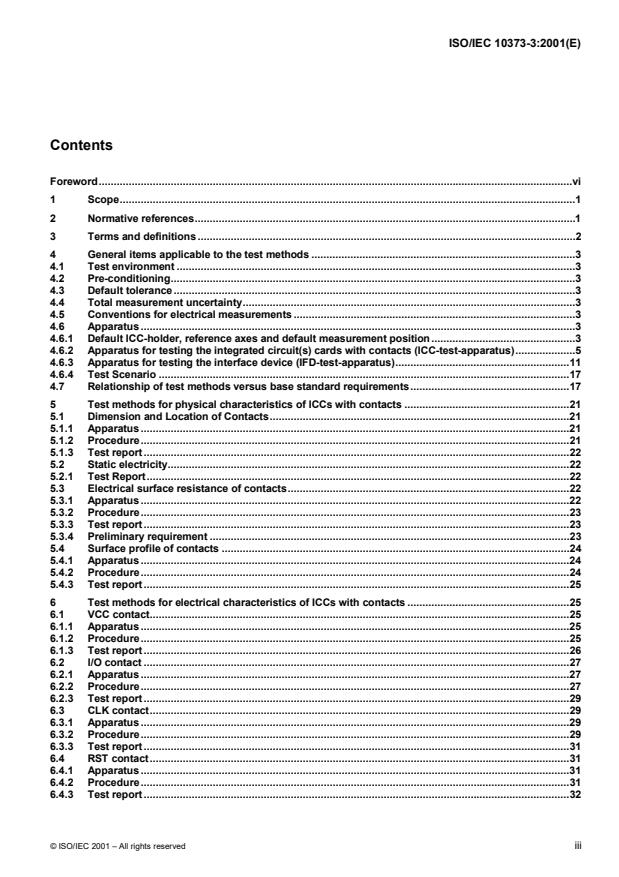
Contents
Foreword.vi
1 Scope.1
2 Normative references.1
3 Terms and definitions .2
4 General items applicable to the test methods .3
4.1 Test environment .3
4.2 Pre-conditioning.3
4.3 Default tolerance.3
4.4 Total measurement uncertainty.3
4.5 Conventions for electrical measurements .3
4.6 Apparatus .3
4.6.1 Default ICC-holder, reference axes and default measurement position.3
4.6.2 Apparatus for testing the integrated circuit(s) cards with contacts (ICC-test-apparatus).5
4.6.3 Apparatus for testing the interface device (IFD-test-apparatus).11
4.6.4 Test Scenario .17
4.7 Relationship of test methods versus base standard requirements.17
5 Test methods for physical characteristics of ICCs with contacts .21
5.1 Dimension and Location of Contacts.21
5.1.1 Apparatus .21
5.1.2 Procedure.21
5.1.3 Test report.22
5.2 Static electricity.22
5.2.1 Test Report.22
5.3 Electrical surface resistance of contacts.22
5.3.1 Apparatus .22
5.3.2 Procedure.23
5.3.3 Test report.23
5.3.4 Preliminary requirement .23
5.4 Surface profile of contacts .24
5.4.1 Apparatus .24
5.4.2 Procedure.24
5.4.3 Test report.25
6 Test methods for electrical characteristics of ICCs with contacts .25
6.1 VCC contact.25
6.1.1 Apparatus .25
6.1.2 Procedure.25
6.1.3 Test report.26
6.2 I/O contact .27
6.2.1 Apparatus .27
6.2.2 Procedure.27
6.2.3 Test report.29
6.3 CLK contact.29
6.3.1 Apparatus .29
6.3.2 Procedure.29
6.3.3 Test report.31
6.4 RST contact.31
6.4.1 Apparatus .31
6.4.2 Procedure.31
6.4.3 Test report.32
© ISO/IEC 2001 – All rights reserved iii
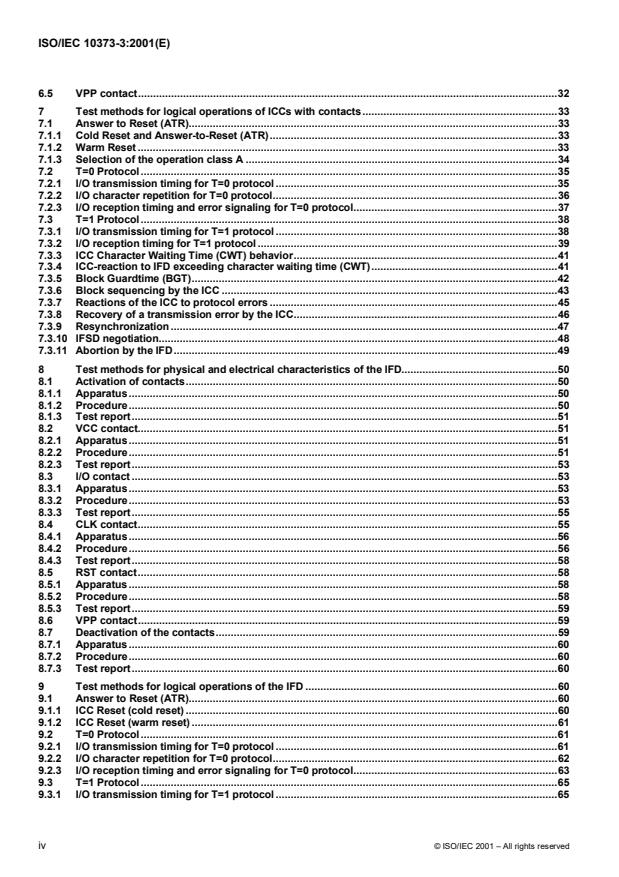
6.5 VPP contact.32
7 Test methods for logical operations of ICCs with contacts.33
7.1 Answer to Reset (ATR).33
7.1.1 Cold Reset and Answer-to-Reset (ATR).33
7.1.2 Warm Reset .33
7.1.3 Selection of the operation class A .34
7.2 T=0 Protocol .35
7.2.1 I/O transmission timing for T=0 protocol .35
7.2.2 I/O character repetition for T=0 protocol.36
7.2.3 I/O reception timing and error signaling for T=0 protocol.37
7.3 T=1 Protocol .38
7.3.1 I/O transmission timing for T=1 protocol .38
7.3.2 I/O reception timing for T=1 protocol.39
7.3.3 ICC Character Waiting Time (CWT) behavior.41
7.3.4 ICC-reaction to IFD exceeding character waiting time (CWT).41
7.3.5 Block Guardtime (BGT).42
7.3.6 Block sequencing by the ICC .43
7.3.7 Reactions of the ICC to protocol errors .45
7.3.8 Recovery of a transmission error by the ICC.46
7.3.9 Resynchronization.47
7.3.10 IFSD negotiation.48
7.3.11 Abortion by the IFD.49
8 Test methods for physical and electrical characteristics of the IFD.50
8.1 Activation of contacts.50
8.1.1 Apparatus .50
8.1.2 Procedure.50
8.1.3 Test report.51
8.2 VCC contact.51
8.2.1 Apparatus.51
8.2.2 Procedure.51
8.2.3 Test report.53
8.3 I/O contact .53
8.3.1 Apparatus.53
8.3.2 Procedure.53
8.3.3 Test report.55
8.4 CLK contact.55
8.4.1 Apparatus.56
8.4.2 Procedure.56
8.4.3 Test report.58
8.5 RST contact.58
8.5.1 Apparatus.58
8.5.2 Procedure.58
8.5.3 Test report.59
8.6 VPP contact.59
8.7 Deactivation of the contacts.59
8.7.1 Apparatus.60
8.7.2 Procedure.60
8.7.3 Test report.60
9 Test methods for logical operations of the IFD .60
9.1 Answer to Reset (ATR).60
9.1.1 ICC Reset (cold reset) .60
9.1.2 ICC Reset (warm reset) .61
9.2 T=0 Protocol .61
9.2.1 I/O transmission timing for T=0 protocol .61
9.2.2 I/O character repetition for T=0 protocol.62
9.2.3 I/O reception timing and error signaling for T=0 protocol.63
9.3 T=1 Protocol .65
9.3.1 I/O transmission timing for T=1 protocol .65
iv © ISO/IEC 2001 – All rights reserved
9.3.2 I/O reception timing for T=1 protocol .66
9.3.3 IFD Character Waiting Time (CWT) behavior .67
9.3.4 IFD-reaction to ICC exceeding CWT .68
9.3.5 Block Guardtime (BGT).68
9.3.6 Block sequencing by the IFD.69
9.3.7 Recovery of a transmission error by the IFD.73
9.3.8 IFSC negotiation.73
9.3.9 Abortion by the ICC.74
Annex A (informative) Additional Test Methods .76
A.1 ICC — Mechanical strength: 3 wheel test .76
A.1.1 Apparatus .76
A.1.2 Method.78
A.1.3 Test Report.79
A.2 IFD — Reaction of the IFD to invalid PCBs .79
A.2.1 Apparatus .79
A.2.2 Procedure.79
A.2.3 Test report.80
© ISO/IEC 2001 – All rights reserved v
Foreword
ISO (the International Organization for Standardization) and IEC (the International Electrotechnical Commission)
form the specialized system for worldwide standardization. National bodies that are members of ISO or IEC
participate in the development of International Standards through technical committees established by the
respective organization to deal with particular fields of technical activity. ISO and IEC technical committees
collaborate in fields of mutual interest. Other international organizations, governmental and non-governmental, in
liaison with ISO and IEC, also take part in the work.
International Standards are drafted in accordance with the rules given in the ISO/IEC Directives, Part 3.
In the field of information technology, ISO and IEC have established a joint technical committee, ISO/IEC JTC 1.
Draft International Standards adopted by the joint technical committee are circulated to national bodies for voting.
Publication as an International Standard requires approval by at least 75 % of the national bodies casting a vote.
Attention is drawn to the possibility that some of the elements of this part of ISO/IEC 10373 may be the subject of
patent rights. ISO and IEC shall not be held responsible for identifying any or all such patent rights.
International Standard ISO/IEC 10373-3 was prepared by Joint Technical Committee ISO/IEC JTC 1, Information
technology, Subcommittee SC 17, Identification cards and related devices.
ISO/IEC 10373 consists of the following parts, under the general title Identification cards — Test methods:
Part 1: General characteristics tests
Part 2: Cards with magnetic stripes
Part 3: Integrated circuit(s) cards with contacts and related interface devices
Part 4: Contactless integrated circuit cards
Part 5: Optical memory cards
Part 6: Proximity cards
Part 7: Vicinity cards
Annex A of this part of ISO/IEC 10373 is for information only.
vi © ISO/IEC 2001 – All rights reserved
INTERNATIONAL STANDARD ISO/IEC 10373-3:2001(E)
Identification cards — Test methods —
Part 3:
Integrated circuit(s) cards with contacts and related interface
devices
1 Scope
This part of ISO/IEC 10373 defines test methods for characteristics of integrated circuit(s) cards with contacts and
related interface devices according to the definition given in ISO/IEC 7816. Each test method is cross-referenced to
one or more base standards, which may be ISO/IEC 7810 or one or more of the supplementary standards that
define the information storage technologies employed in identification card applications.
NOTE 1 Criteria for acceptability do not form part of this International Standard but will be found in the International
Standards mentioned above.
This part of ISO/IEC 10373 deals with test methods, which are specific to integrated circuit technology with
contacts. ISO/IEC 10373-1 deals with test methods which are common to one or more card technologies and other
parts deal with other technology-specific tests.
Test methods described in this part of ISO/IEC 10373 are intended to be performed separately and independently.
A given card is not required to pass through all the tests sequentially. The test methods described in this part of
ISO/IEC 10373 are based on specifications defined or to be defined in ISO/IEC 7816.
Conformance of ICCs and IFDs determined using the test methods defined in this part of ISO/IEC 10373 do not
preclude failures in the field. Reliability testing is outside the scope of this part of ISO/IEC 10373.
2 Normative references
The following normative documents contain provisions which, through reference in this text, constitute provisions of
this part of ISO/IEC 10373. For dated references, subsequent amendments to, or revisions of, any of these
publications do not apply. However, parties to agreements based on this part of ISO/IEC 10373 are encouraged to
investigate the possibility of applying the most recent editions of the normative documents indicated below. For
undated references, the latest edition of the normative document referred to applies. Members of ISO and IEC
maintain registers of currently valid International Standards.
ISO/IEC 7810:1995, Identification cards — Physical characteristics.
ISO/IEC 7816-1:1998, Identification cards — Integrated circuit(s) cards with contacts — Part 1: Physical
characteristics.
ISO/IEC 7816-2:1999, Information technology — Identification cards — Integrated circuit(s) cards with contacts —
Part 2: Dimensions and location of the contacts.
ISO/IEC 7816-3:1997, Information technology — Identification cards — Integrated circuit(s) cards with contacts —
Part 3: Electronic signals and transmission protocols.
ISO/IEC 7816-4:1995, Information technology — Identification cards — Integrated circuit(s) cards with contacts —
Part 4: Interindustry commands for interchange.
ISO/IEC 10373-1:1998, Identification cards — Test methods — Part 1: General characteristics tests.
© ISO/IEC 2001 – All rights reserved 1
United States of America, Department of Defense, Test Method Standard, Microcircuits, MIL-STD-883, Version E,
31 December 1996, Method 3015.7 ‘Electrostatic discharge sensitivity classification’.
3 Terms and definitions
For the purposes of this part of ISO/IEC 10373, the following terms and definitions apply.
3.1
test method
method for testing characteristics of identification cards and related interface devices for the purpose of confirming
their compliance with International Standards
3.2
testably functional
has survived the action of some potentially destructive influence to the extent that:
a) any magnetic stripe present on the card shows a relationship between signal amplitudes before and after
exposure that is in accordance with the base standard;
b) any integrated circuit(s) present in the card continues to show an Answer to Reset response which conforms
to the base standard;
c) any contacts associated with any integrated circuit(s) present in the card continue to show electrical resistance
which conforms to the base standard;
d) any optical memory present in the card continue to show optical characteristics which conform to the base
standard
3.3
normal use
use as an Identification card (see clause 4 of ISO/IEC 7810:1995), involving equipment processes appropriate to
the card technology and storage as a personal document between equipment processes
3.4
ICC
integrated circuit(s) card with contacts as defined in the ISO/IEC 7816 series of standards
3.5
IFD
interface device related to integrated circuit(s) cards with contacts as defined in the ISO/IEC 7816 series of
standards
3.6
DUT
device under test; within the scope of this document the ICC or the IFD subject to testing
This part of ISO/IEC 10373 does not define any test to establish the complete functioning of integrated circuit(s) cards. The
test methods require only that the minimum functionality (testably functional) be verified. This may, in appropriate
circumstances, be supplemented by further, application specific functionality criteria which are not available in the general case.
2 © ISO/IEC 2001 – All rights reserved
3.7
typical protocol and application specific communication
any communication between a DUT and the corresponding test-apparatus based on protocol and application
implemented in the DUT and representing its normal use
3.8
Test Scenario
a defined typical protocol and application specific communication to be used with the test methods defined in this
document
4 General items applicable to the test methods
4.1 Test environment
Unless otherwise specified, testing of physical, electrical and logical characteristics shall take place in an
environment of temperature 23 °C ± 3 °C, of relative humidity 40 % to 60 %.
4.2 Pre-conditioning
Where pre-conditioning is required by the test method, the identification cards to be tested shall be conditioned to
the test environment for a period of 24 h before testing unless otherwise specified.
4.3 Default tolerance
Unless otherwise specified, a default tolerance of ± 5 % shall be applied to the quantity values given to specify the
characteristics of the test equipment (e.g. linear dimensions) and the test method procedures (e.g. test equipment
adjustments).
4.4 Total measurement uncertainty
The total measurement uncertainty for each quantity determined by these test methods shall be stated in the test
report.
4.5 Conventions for electrical measurements
Potential differences are defined with respect to the GND contact of the ICC and currents flowing to the ICC are
considered positive.
4.6 Apparatus
4.6.1 Default ICC-holder, reference axes and default measurement position
When required by the test-method, the ICC shall be positioned in the default measurement position as
subsequently defined.
The default measurement position requires the ICC to be positioned in an ICC-holder and flattened by a flattening
plate. All Measurements using this default measurement position shall be relative to the reference axes defined in
Figure 1.
© ISO/IEC 2001 – All rights reserved 3
4.6.1.1 Default ICC-holder and reference axes:
The default ICC holder shall comply with Figure 1:
Dimensions in millimetres
All Tolerances ± 0,01 mm
71,25
O X-Axis
11,25
Reference Reference
T1 T2
L
Y-Axis
Reference
L, T1 and T2 shall be metal cylinders, having a diameter of 5 mm ± 0,1 mm, a surface roughness
R < 5 μm, mounted on a level rigid plate with a surface roughness R < 5 μm.
a a
Figure 1 — ICC-holder
4.6.1.2 Flattening Plate
The flattening plate shall comply with Figure 2:
Dimensions in mm
All Tolerances ± 0,1 mm
50,0
The surface roughness of the flattening plate shall be R < 5 μm.
a
Figure 2 — Flattening plate
4 © ISO/IEC 2001 – All rights reserved
27,00
27,0
4.6.1.3 Default Measurement Position
The ICC and the flattening plate shall be mounted on the ICC-holder as shown in Figure 3:
(30 ± 1) mm Top card edge X-Axis
Reference
T1 T2
L
F = 1 N to 2 N
Front Side
Left card edge
F = 2 N to 4 N
Y-Axis 2
Reference
F and F are forces applied to the center of the right and the bottom edge of the card respectively to fix
1 2
the card in the card-holder.
The flattening plate shall apply a force of 2,2 N ± 0,2 N to the surface of the card
Figure 3 — Position of ICC and flattening plate on ICC-holder
4.6.2 Apparatus for testing the integrated circuit(s) cards with contacts (ICC-test-apparatus)
4.6.2.1 General
All relative voltage definitions (e.g. 0,7 × V , 0,15 × V or V + 0,3 V) shall be determined relative to GND and
CC CC CC
checked against the simultaneously measured value of V .
CC
4.6.2.2 Generating the VCC voltage (V ) and timing
CC
Parameter ICC class Range Accuracy
Class A -1 V to 6 V ± 50 mV
V
CC
Class B -1 V to 4 V
± 30 mV
t , t Class A, Class B 500 μs ± 100 μs
R F
© ISO/IEC 2001 – All rights reserved 5
(1 ± 1) mm
4.6.2.3 Measuring the VCC current (I )
CC
Characteristic Mode Range Accuracy Resolution
Spike Measurement 0 mA to 200 mA ± 2 mA 20 ns
I Active mode 0 mA to 100 mA Averaged over 1 ms
± 1 mA
CC
Clock stop 0 mA to 1 mA ± 10 μA Averaged over 1 ms
4.6.2.4 Generating the VPP voltage (V ) and timing
PP
Parameter ICC class Range Accuracy Resolution
V Class A -1 V to 26 V 20 ns
± 50 mV
PP
t , t Class A 1 μs to 220 μs ± 1 μs
R F
NOTE 1 t and t are measured between 10% and 90% of V min and V max values.
R F H L
NOTE 2 Certain functionality may not be implemented into the application in the ICC, hence in such circumstances
the ICC-test-apparatus is not required to have the corresponding test-capability (e.g. V )
PP
4.6.2.5 Measuring the VPP current (I )
PP
Characteristic Mode Range Accuracy Resolution
active (Programming
0 mA to 100 mA ±1 mA 100 ns
State)
I
PP
inactive (Pause) 0 mA to 100 mA ±1 mA 100 ns
NOTE Certain functionality may not be implemented into the application in the ICC, hence in such circumstances
the ICC-test-apparatus is not required to have the corresponding test-capability (e.g. I ).
PP
6 © ISO/IEC 2001 – All rights reserved
4.6.2.6 Generating the RST voltage and timing
Parameter ICC class Range Accuracy
Class A 2 V to 6 V ± 50 mV
V
IH
Class B 2 V to 4 V
± 30 mV
Class A -1 V to 2 V ± 50 mV
V
IL
Class B -1 V to 2 V
± 30 mV
t , t 0 μs to 2 μs
± 20 ns
R F
NOTE t and t are generated between 10% and 90% of V min and V max values.
R F H L
4.6.2.7 Measuring the RST current
Characteristic Mode Range Accuracy Resolution
I Active -30 μA to 200 μA ± 10 μA 100 ns
IH
I Active -250 μA to 30 μA 100 ns
± 10 μA
IL
4.6.2.8 Generating the I/O voltage and timing in reception mode
Parameter Mode ICC class Range Accuracy
Class A 2 V to 6 V
± 50 mV
ICC: Reception,
Apparatus:
V
IH
Transmission
Class B 2 V to 4 V ± 30 mV
Class A -1 V to 2 V
± 50 mV
ICC: Reception,
V Apparatus:
IL
Transmission
Class B -1 V to 2 V ± 30 mV
ICC: Reception,
t , t Apparatus: 0 μs to 2 μs ± 100 ns
R F
Transmission
NOTE t and t are generated between 10% and 90% of V min and V max values.
R F H L
© ISO/IEC 2001 – All rights reserved 7
4.6.2.9 Measuring the I/O current in reception mode
Parameter Mode Range Accuracy Resolution
ICC: Reception,
I Apparatus: -350 μA to 30 μA ± 1 μA 100 ns
IH
Transmission
ICC: Reception,
I Apparatus: -1,5 mA to 30 μA 100 ns
± 10 μA
IL
Transmission
4.6.2.10 Generating the I/O current
Stabilization time
Parameter Mode Range Accuracy after level is
reached
20 kΩ pull-up to
ICC: Transmission
I
VCC or equivalent ± 200 Ω
OH
Apparatus: Reception
circuit
ICC: Transmission
I 0 mA to 1,5 mA ± 10 μA < 100 ns
OL
Apparatus: Reception
4.6.2.11 Measuring the I/O voltage and timing
Characteristic ICC class Range Accuracy Resolution
V , V Class A -1 V to 6 V ± 50 mV 20 ns
IH IL
V , V Class B -1 V to 4 V 20 ns
± 30 mV
IH IL
t , t 0 μs to 2 μs ± 20 ns
R F
NOTE t and t are measured between 10% and 90% of V min and V max values.
R F H L
8 © ISO/IEC 2001 – All rights reserved
4.6.2.12 Generating the CLK-voltage
Parameter ICC class Range Accuracy Resolution
Class A 2 V to 6 V ± 50 mV 20 ns
V
IH
Class B 2 V to 4 V 20 ns
± 30 mV
Class A -1 V to 2 V ± 50 mV 20 ns
V
IL
Class B -1 V to 2 V ± 30 mV 20 ns
4.6.2.13 Generating the CLK-waveforms (single cycle measurement)
Parameter Range Accuracy
Duty cycle 35 % to 65 % of period
± 5 ns
Frequency 0,5 MHz to 5,5 MHz ± 5 kHz
Frequency 5 MHz to 20,5 MHz
± 50 kHz
t , t 1 % to 10 % of period ± 5 ns
R F
NOTE t and t are generated between 10% and 90% of V (100%) min and V (0%) max.
R F H L
4.6.2.14 Measuring the CLK current
Characteristic Mode Range Accuracy Resolution
I active -30 μA to 150 μA ± 10 μA 20 ns
IH
I active -150 μA to 30 μA 20 ns
± 10 μA
IL
4.6.2.15 Measuring the contact capacitance of RST, CLK and I/O
Characteristic Range Accuracy
C 0 pF to 50 pF ± 5 pF
The contact capacitance of a contact shall be measured
between the contact and the GND contact.
© ISO/IEC 2001 – All rights reserved 9
4.6.2.16 Generating the sequence of the activation and deactivation of the contacts
Range of switching the
Accuracy
signals
0 s to 1 s ± 200 ns (or 1 clk period, whichever is smaller)
4.6.2.17 Emulating the I/O protocol
The ICC-test-apparatus shall be able to emulate the protocol T=0 and T=1 and IFD applications which are required
to run the typical application specific communications corresponding to the ICC applications.
NOTE Certain functionality may not be implemented into the application in the ICC, hence in such circumstances the ICC-
test-apparatus is not required to have the corresponding test-capability (e.g. T=1 protocol not implemented in the ICC)
4.6.2.18 Generating the I/O character timing in reception mode
The ICC-test-apparatus shall be able to generate the I/O bit stream according to ISO/IEC 7816-3:1997.
All timing parameters like start bit length, guardtime, error signaling etc. shall be configurable.
Parameter Accuracy
all timing parameters ± 4 CLK cycles
4.6.2.19 Measuring and monitoring the I/O protocol
The ICC-test-apparatus shall be able to measure and monitor the timing of the logical low and high states of the
I/O-line relative to the CLK-frequency.
Characteristic Accuracy
all timing characteristics ± 2 CLK cycles
4.6.2.20 Protocol Analysis
The ICC-test-apparatus shall be able to analyze the I/O-bit stream in accordance to T=0 and T=1 protocol
according to ISO/IEC 7816-3:1997 and extract the logical data flow for further protocol and application verifications.
NOTE Certain functionality may not be implemented into the application in the ICC, hence in such circumstances the ICC-
test-apparatus is not required to have the corresponding test-capability (e.g. T=1 protocol not implemented in the ICC).
Conversely, an apparatus may need extended capabilities, e.g. being able to generate any case 2 command (see ISO/IEC
7816-4:1995) if an ICC does not support the standard READ BINARY.
10 © ISO/IEC 2001 – All rights reserved
4.6.3 Apparatus for testing the interface device (IFD-test-apparatus)
4.6.3.1 General
All relative voltage definitions (e.g. 0,7 × V , 0,15 × V or V + 0,3 V) shall be determined relative to GND and
CC CC CC
checked against the simultaneously measured value of V .
CC
4.6.3.2 Generating the VCC current (I )
CC
Stabilization time
Parameter Mode Range Accuracy after level is
reached
b
Spike Generation 0 mA to 120 mA < 100 ns
± 2 mA
Active mode 0 mA to 70 mA ± 1 mA < 100 ns
I
CC
Idle mode (clk-Stop) 0 mA to 1,2 mA < 100 ns
± 10 μA
a
Inactive -1,2 mA to 0 mA ± 10 μA < 100 ns
t , t 100 ns ± 50 ns
R F
pulse length 100 ns to 500 ns
± 50 ns
pause length
100 ns to 1000 ns ± 50 ns
frequently
pause length
10 μs to 2000 μs ± 1 μs
randomly
a
The maximum output voltage shall be limited to 5 V.
b
Dynamic conditions for Spike generation.
4.6.3.3 Measuring the VCC voltage (V ) and timing
CC
Characteristic ICC class Range Accuracy Resolution
Class A - 1 V to 6 V 20 ns
± 50 mV
V
CC
Class B - 1 V to 4 V ± 30 mV 20 ns
© ISO/IEC 2001 – All rights reserved 11
4.6.3.4 Generating the VPP current (I )
PP
Stabilization time
Parameter Mode Range Accuracy after level is
reached
active 0 mA to 100 mA < 100 ns
± 1 mA
I
PP
a
inactive - 1,2 mA to 0 mA ± 10 μA < 100 ns
a
The output voltage shall be limited from - 0,5 V to V
PP
4.6.3.5 Measuring the VPP voltage (V ) and timing
PP
Characteristic ICC class Voltage range Accuracy Resolution
V Class A - 1 V to 25 V ± 50 mV 20 ns
PP
t , t Class A 1 μs to 220 μs
± 1 μs
R F
NOTE t and t are measured between 10% and 90% of V min and V max values.
R F H L
4.6.3.6 Generating the RST current
Stabilization time
Parameter Mode Range Accuracy after level is
reached
I active - 30 μA to 200 μA ± 10 μA < 100 ns
IH
I active - 250 μA to 30 μA < 100 ns
± 10 μA
IL
a
inactive - 1,2 mA to 0 mA ± 10 μA < 100 ns
I
a
The output voltage shall be limited from -0,5 V to 5,5 V.
12 © ISO/IEC 2001 – All rights reserved
4.6.3.7 Measuring RST voltage and timing
Characteristic ICC class Range Accuracy Resolution
Class A 2 V to 6 V ± 50 mV 20 ns
V
IH
Class B 2 V to 4 V 20 ns
± 30 mV
Class A - 1 V to 2 V ± 50 mV 20 ns
V
IL
Class B - 1 V to 2 V 20 ns
± 30 mV
t , t 0 μs to 2 μs
± 20 ns
R F
NOTE t and t are measured between 10% and 90% of V min and V max values.
R F H L
4.6.3.8 Generating the I/O currents
Stabilization time
Parameter Mode Range Accuracy after level is
reached
Apparatus: Reception
and Transmission
I , I -400 μA to 50 μA ± 5 μA < 100 ns
IH OH
IFD: Transmission and
Reception
Apparatus: Reception
I IFD: Transmission and 0 mA to 1,5 mA ± 10 μA < 100 ns
IL
Reception
I IFD: Reception 0 μA to 1200 μA ± 10 μA < 100 ns
OL
a
Inactive - 1,2 mA to 0 mA < 100 ns
I ± 10 μA
a
The output voltage shall be limited to -0,5 V to 5,5 V.
© ISO/IEC 2001 – All rights reserved 13
4.6.3.9 Measuring the I/O voltage and timing
Characteristic ICC class Range Accuracy Resolution
Class A 2 V to 6 V ± 50 mV 20 ns
V
IH
Class B 2 V to 4 V 20 ns
± 30 mV
Class A - 1 V to 2 V ± 50 mV 20 ns
V
IL
Class B - 1 V to 2 V 20 ns
± 30 mV
t , t 0 μs to 2 μs
± 20 ns
R F
NOTE t and t are measured between 10% and 90% of V min and V max values.
R F H L
4.6.3.10 Generating the I/O voltage and timing in transmission mode
Parameter ICC class Range Accuracy
Class A 2 V to 6 V ± 50 mV
V
OH
Class B 2 V to 4 V ± 30 mV
Class A - 1 V to 2 V
± 50 mV
V
OL
Class B - 1 V to 2 V
± 30 mV
t , t 0 μs to 2 μs ± 20 ns
R F
NOTE 1 V only needs to be generated because of the rising edge generation
OH
mechanism and shall be switched off at least 10 μs after the rising edge.
NOTE 2 t and t are generated between 10% and 90% of V min and V max values.
R F H L
4.6.3.11 Measuring the I/O current in transmission mode
Parameter Mode Range Accuracy Resolution
I Transmission 0 μA to 1200 μA 20 ns
± 10 μA
OL
a
I Inactive 0 mA to 1,2 mA ± 10 μA 20 ns
a
The output voltage shall be limited to - 0,5 V to 5,5 V.
14 © ISO/IEC 2001 – All rights reserved
4.6.3.12 Generating the CLK current
Stabilization time
Parameter Mode Range Accuracy after level is
reached
I active -30 μA to 150 μA < 20 ns
IH ± 10 μA
I active -150 μA to 30 μA ± 10 μA < 20 ns
IL
a
inactive -1,2 mA to 0 mA < 100 ns
I ± 10 μA
a
The output voltage shall be limited to -0,5 V to 5,5 V.
4.6.3.13 Measuring the CLK-voltage and timing
Characteristic ICC class Range Accuracy Resolution
Class A 2 V to 6 V 20 ns
± 50 mV
V
IH
Class B 2 V to 4 V ± 30 mV 20 ns
Class A -1 V to 2 V 20 ns
± 50 mV
V
IL
Class B -1 V to 2 V ± 30 mV 20 ns
4.6.3.14 Measuring the CLK-waveforms (single cycle measurement)
Characteristic Range Accuracy
a
Duty cycle 35 % to 65 % of period ± 2,5 % of period
b
Frequency 0,5 MHz to 20,5 MHz ± 2,5 % of period
c
t , t 1 % to 10 % of period ± 2,5 % of period
R F
The IFD-test-apparatus shall be able to check every cycle during the measurement.
a
Duty cycle shall be measured from 50% to 50% of V min (100%) and V max (0%) rising edge to rising edge.
H L
b
Frequency shall be measured from 50% to 50% of the leading edges of two adjacent clock-cycles of V min
H
(100%) and V max (0%) rising edge to rising edge.
L
c
t and t shall be measured between 10% and 90% of V (100%) min and V (0%) max.
R F H L
© ISO/IEC 2001 – All rights reserved 15
4.6.3.15 Measuring the contact capacitance between GND and I/O
Characteristic Range Accuracy
C 0 pF to 50 pF ± 5 pF
4.6.3.16 Emulating the I/O protocol
The IFD-test-apparatus shall be able to emulate the protocol T=0 and T=1 and ICC applications which are required
to run the Test Scenario.
NOTE Certain functionality may not be implemented into the application in the ICC, hence in such circumstances the IFD
...
Questions, Comments and Discussion
Ask us and Technical Secretary will try to provide an answer. You can facilitate discussion about the standard in here.
Loading comments...