

ISO 15706-1:2023
(Main)Information and documentation — International Standard Audiovisual Number (ISAN) — Part 1: Audiovisual work identifier
General Information
- Abstract
This document establishes and defines a voluntary standard numbering system for the unique and international identification of audiovisual works (as defined in 3.1). An International Standard Audiovisual Number (ISAN) identifies an audiovisual work throughout its life and is intended for use wherever precise and unique identification of an audiovisual work would be desirable. As an identifier, it can be used for various purposes, such as to assist allocation of royalties among right holders, to track the use of audiovisual works, for information retrieval and for anti-piracy purposes, such as verifying title registrations. The ISAN can also provide a basis for supplementary identification systems when version or product information is required (e.g. for applications such as broadcast automation and automated storage and retrieval systems). An ISAN is applied to the audiovisual work itself. It is not related to the physical medium of such an audiovisual work, or the identification of that medium. Annex A specifies examples of audiovisual works for which an ISAN can be issued and examples of works for which ISAN are not issued. The issuance of an ISAN is in no way related to any process of copyright registration, nor does the issuance of an ISAN provide evidence of the ownership of rights in an audiovisual work.
- Status
- Published
- Publication Date
- 24-Jan-2023
- Technical Committee
- ISO/TC 46/SC 9 - Identification and description
- Drafting Committee
- ISO/TC 46/SC 9 - Identification and description
- Current Stage
- 6060 - International Standard published
- Start Date
- 25-Jan-2023
- Due Date
- 03-Jun-2023
- Completion Date
- 25-Jan-2023
Buy Documents

ISO 15706-1:2023 - Information and documentation — International Standard Audiovisual Number (ISAN) — Part 1: Audiovisual work identifier Released:25. 01. 2023
ISO 15706-1:2023 - Information and documentation — International Standard Audiovisual Number (ISAN) — Part 1: Audiovisual work identifier Released:25. 01. 2023
Overview
ISO 15706-1:2023 - Information and documentation - International Standard Audiovisual Number (ISAN) - Part 1: Audiovisual work identifier defines a voluntary, international numbering system for uniquely identifying audiovisual works. The standard specifies the ISAN format, issuance rules, display/affixing requirements and administration by a Registration Authority. ISANs identify a work throughout its life for purposes such as royalty allocation, usage tracking, information retrieval and anti‑piracy verification, and provide a stable basis for supplementary version or product identifiers (e.g., for broadcast automation or storage/retrieval systems).
Key topics and technical requirements
- Identifier format: ISAN is a 64‑bit value presented as 16 hexadecimal digits grouped as a 12‑digit root segment plus a 4‑digit episode/part segment (human‑readable example: RRRR‑RRRR‑RRRR‑EEEE). A check character (defined in Annex B and based on ISO/IEC 7064) is appended for human display.
- “Dumb” number principle: ISAN contains no embedded semantic codes beyond the root and episode segments.
- Uniqueness and permanence: Each ISAN is issued once to a single audiovisual work, is permanent, and must never be altered, reused or reissued.
- Issuance and administration: ISANs are allocated from a central register by the ISAN Registration Authority (RA). Registrants (producers or authorised proxies) supply descriptive metadata as required (see Annex D). Reasonable fees may apply.
- Affixing & display: When displayed, the ISAN must be preceded by “ISAN”, include the correct check character, use uppercase A–F for readability, and be grouped in four blocks separated by hyphens or spaces (examples in Clause 6).
- Encodings & integration: Annex E and Annex F specify binary and XML encodings to support system integration and metadata exchange.
Applications and who uses it
- Rights holders & collective management organisations: Accurate allocation of royalties and claims processing.
- Broadcasters, OTT platforms and distributors: Program scheduling, broadcast automation, catalogue management and version control.
- Content aggregators & metadata services: Reliable linking, search and discovery across systems.
- Anti‑piracy and compliance teams: Title verification, tracking unauthorized distribution and verifying registrations.
- Archives, libraries and production houses: Long‑term preservation, cataloguing and provenance tracking.
Related standards
- ISO/IEC 7064 (check character systems) - referenced for the ISAN check character algorithm.
- ISO 15706 series (other parts, e.g., version identifiers) and registry guidance (Registration Authority details available via ISO’s website).
- Annexes provide administrative rules, examples of acceptable/ non‑eligible works, and technical encodings (binary/XML) to aid implementation.
Keywords: ISO 15706-1:2023, ISAN, International Standard Audiovisual Number, audiovisual work identifier, ISAN Registration Authority, ISAN format, ISAN XML, royalty allocation, anti‑piracy, broadcast automation.
Relations
- Effective Date
- 26-Nov-2021
- Effective Date
- 26-Nov-2021
Buy Documents
ISO 15706-1:2023 - Information and documentation — International Standard Audiovisual Number (ISAN) — Part 1: Audiovisual work identifier Released:25. 01. 2023
ISO 15706-1:2023 - Information and documentation — International Standard Audiovisual Number (ISAN) — Part 1: Audiovisual work identifier Released:25. 01. 2023
Frequently Asked Questions
ISO 15706-1:2023 is a standard published by the International Organization for Standardization (ISO). Its full title is "Information and documentation — International Standard Audiovisual Number (ISAN) — Part 1: Audiovisual work identifier". This standard covers: This document establishes and defines a voluntary standard numbering system for the unique and international identification of audiovisual works (as defined in 3.1). An International Standard Audiovisual Number (ISAN) identifies an audiovisual work throughout its life and is intended for use wherever precise and unique identification of an audiovisual work would be desirable. As an identifier, it can be used for various purposes, such as to assist allocation of royalties among right holders, to track the use of audiovisual works, for information retrieval and for anti-piracy purposes, such as verifying title registrations. The ISAN can also provide a basis for supplementary identification systems when version or product information is required (e.g. for applications such as broadcast automation and automated storage and retrieval systems). An ISAN is applied to the audiovisual work itself. It is not related to the physical medium of such an audiovisual work, or the identification of that medium. Annex A specifies examples of audiovisual works for which an ISAN can be issued and examples of works for which ISAN are not issued. The issuance of an ISAN is in no way related to any process of copyright registration, nor does the issuance of an ISAN provide evidence of the ownership of rights in an audiovisual work.
This document establishes and defines a voluntary standard numbering system for the unique and international identification of audiovisual works (as defined in 3.1). An International Standard Audiovisual Number (ISAN) identifies an audiovisual work throughout its life and is intended for use wherever precise and unique identification of an audiovisual work would be desirable. As an identifier, it can be used for various purposes, such as to assist allocation of royalties among right holders, to track the use of audiovisual works, for information retrieval and for anti-piracy purposes, such as verifying title registrations. The ISAN can also provide a basis for supplementary identification systems when version or product information is required (e.g. for applications such as broadcast automation and automated storage and retrieval systems). An ISAN is applied to the audiovisual work itself. It is not related to the physical medium of such an audiovisual work, or the identification of that medium. Annex A specifies examples of audiovisual works for which an ISAN can be issued and examples of works for which ISAN are not issued. The issuance of an ISAN is in no way related to any process of copyright registration, nor does the issuance of an ISAN provide evidence of the ownership of rights in an audiovisual work.
ISO 15706-1:2023 is classified under the following ICS (International Classification for Standards) categories: 01.140.20 - Information sciences. The ICS classification helps identify the subject area and facilitates finding related standards.
ISO 15706-1:2023 has the following relationships with other standards: It is inter standard links to ISO 15706-1:2002/Amd 1:2008, ISO 15706-1:2002. Understanding these relationships helps ensure you are using the most current and applicable version of the standard.
ISO 15706-1:2023 is available in PDF format for immediate download after purchase. The document can be added to your cart and obtained through the secure checkout process. Digital delivery ensures instant access to the complete standard document.
Standards Content (Sample)
SLOVENSKI STANDARD
01-oktober-2024
Nadomešča:
SIST ISO 15706-1:2005
SIST ISO 15706-1:2005/Amd 1:2008
Informatika in dokumentacija - Mednarodna standardna številka avdiovizualnih
gradiv (ISAN) - 1. del: Avdiovizualni identifikator dela
Information and documentation -- International Standard Audiovisual Number (ISAN) -
Part 1: Audiovisual work identifier
Information et documentation -- Numéro international normalisé d'oeuvre audiovisuelle
(ISAN) - Partie 1: Identifiant d'oeuvre audiovisuelle
Ta slovenski standard je istoveten z: ISO 15706-1:2023
ICS:
01.140.20 Informacijske vede Information sciences
2003-01.Slovenski inštitut za standardizacijo. Razmnoževanje celote ali delov tega standarda ni dovoljeno.
INTERNATIONAL ISO
STANDARD 15706-1
Second edition
2023-01
Information and documentation —
International Standard Audiovisual
Number (ISAN) —
Part 1:
Audiovisual work identifier
Information et documentation — Numéro international normalisé
d'oeuvre audiovisuelle (ISAN) —
Partie 1: Identifiant d'oeuvre audiovisuelle
Reference number
© ISO 2023
All rights reserved. Unless otherwise specified, or required in the context of its implementation, no part of this publication may
be reproduced or utilized otherwise in any form or by any means, electronic or mechanical, including photocopying, or posting on
the internet or an intranet, without prior written permission. Permission can be requested from either ISO at the address below
or ISO’s member body in the country of the requester.
ISO copyright office
CP 401 • Ch. de Blandonnet 8
CH-1214 Vernier, Geneva
Phone: +41 22 749 01 11
Email: copyright@iso.org
Website: www.iso.org
Published in Switzerland
ii
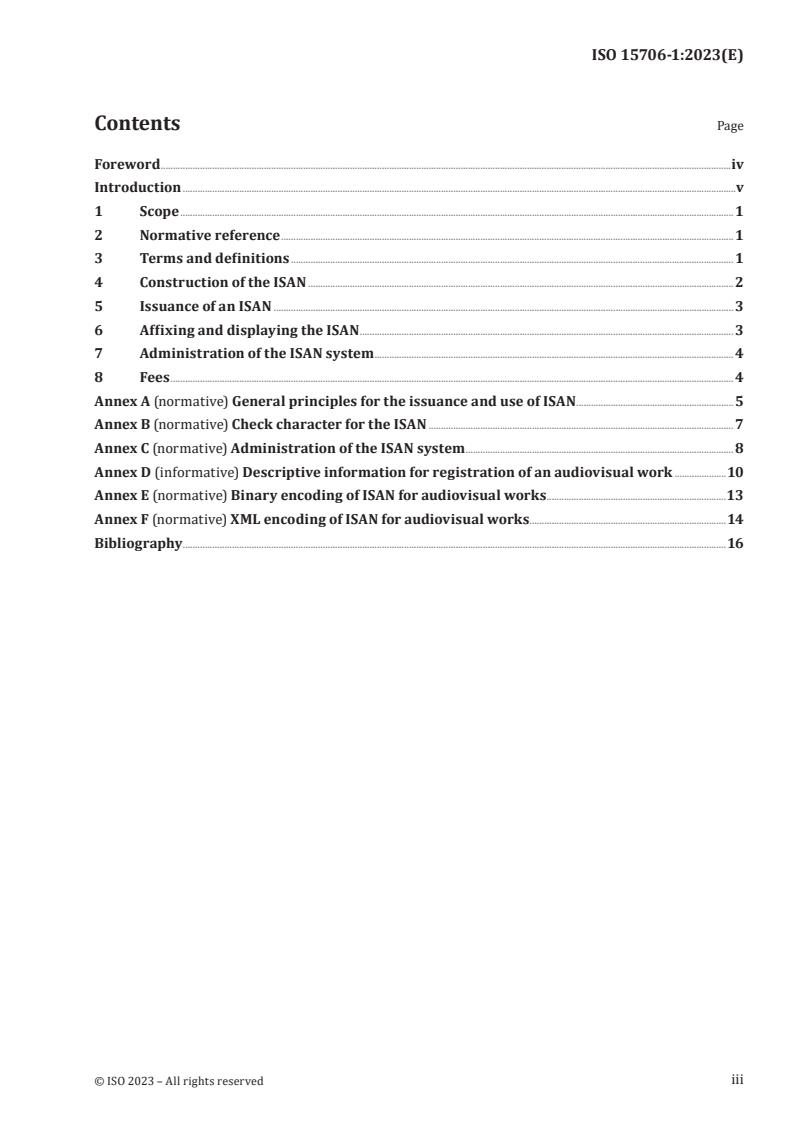
Contents Page
Foreword .iv
Introduction .v
1 Scope . 1
2 Normative reference .1
3 Terms and definitions . 1
4 Construction of the ISAN .2
5 Issuance of an ISAN .3
6 Affixing and displaying the ISAN . 3
7 Administration of the ISAN system . 4
8 Fees . 4
Annex A (normative) General principles for the issuance and use of ISAN .5
Annex B (normative) Check character for the ISAN . 7
Annex C (normative) Administration of the ISAN system . 8
Annex D (informative) Descriptive information for registration of an audiovisual work .10
Annex E (normative) Binary encoding of ISAN for audiovisual works .13
Annex F (normative) XML encoding of ISAN for audiovisual works.14
Bibliography .16
iii
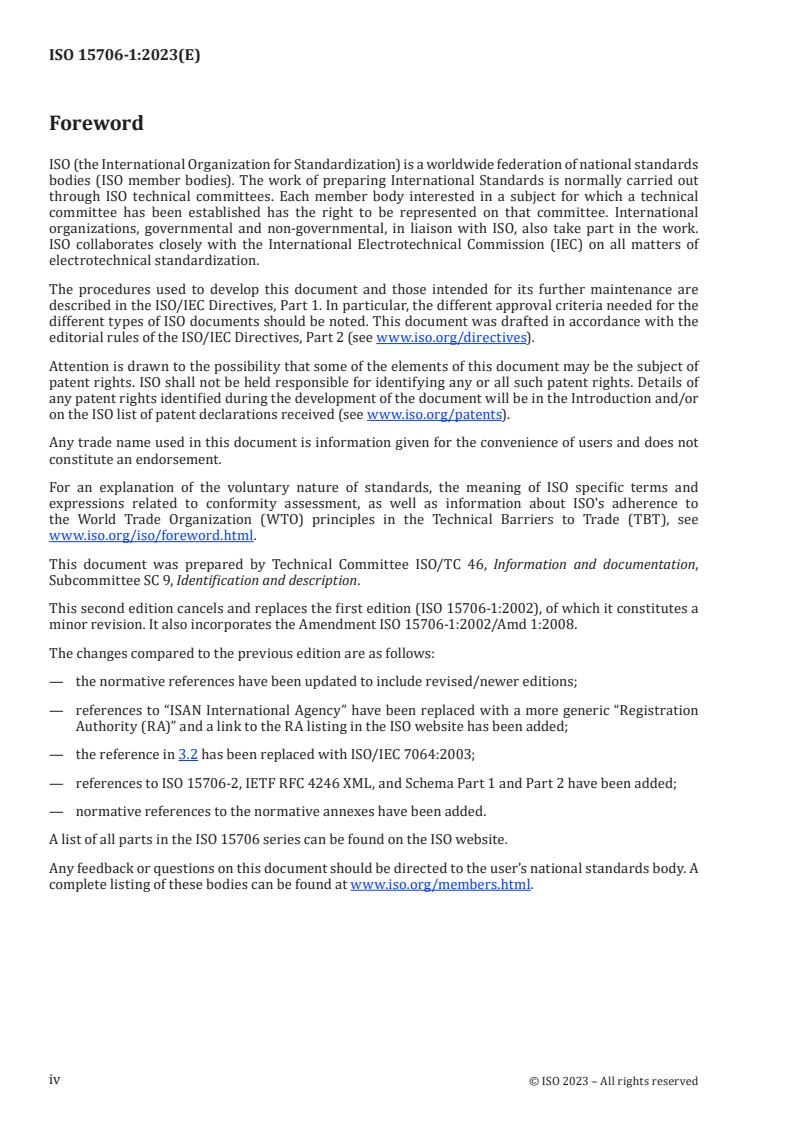
Foreword
ISO (the International Organization for Standardization) is a worldwide federation of national standards
bodies (ISO member bodies). The work of preparing International Standards is normally carried out
through ISO technical committees. Each member body interested in a subject for which a technical
committee has been established has the right to be represented on that committee. International
organizations, governmental and non-governmental, in liaison with ISO, also take part in the work.
ISO collaborates closely with the International Electrotechnical Commission (IEC) on all matters of
electrotechnical standardization.
The procedures used to develop this document and those intended for its further maintenance are
described in the ISO/IEC Directives, Part 1. In particular, the different approval criteria needed for the
different types of ISO documents should be noted. This document was drafted in accordance with the
editorial rules of the ISO/IEC Directives, Part 2 (see www.iso.org/directives).
Attention is drawn to the possibility that some of the elements of this document may be the subject of
patent rights. ISO shall not be held responsible for identifying any or all such patent rights. Details of
any patent rights identified during the development of the document will be in the Introduction and/or
on the ISO list of patent declarations received (see www.iso.org/patents).
Any trade name used in this document is information given for the convenience of users and does not
constitute an endorsement.
For an explanation of the voluntary nature of standards, the meaning of ISO specific terms and
expressions related to conformity assessment, as well as information about ISO's adherence to
the World Trade Organization (WTO) principles in the Technical Barriers to Trade (TBT), see
www.iso.org/iso/foreword.html.
This document was prepared by Technical Committee ISO/TC 46, Information and documentation,
Subcommittee SC 9, Identification and description.
This second edition cancels and replaces the first edition (ISO 15706-1:2002), of which it constitutes a
minor revision. It also incorporates the Amendment ISO 15706-1:2002/Amd 1:2008.
The changes compared to the previous edition are as follows:
— the normative references have been updated to include revised/newer editions;
— references to “ISAN International Agency” have been replaced with a more generic “Registration
Authority (RA)” and a link to the RA listing in the ISO website has been added;
— the reference in 3.2 has been replaced with ISO/IEC 7064:2003;
— references to ISO 15706-2, IETF RFC 4246 XML, and Schema Part 1 and Part 2 have been added;
— normative references to the normative annexes have been added.
A list of all parts in the ISO 15706 series can be found on the ISO website.
Any feedback or questions on this document should be directed to the user’s national standards body. A
complete listing of these bodies can be found at www.iso.org/members.html.
iv
Introduction
The ISAN project was administered by the International Federation of Film Producers Associations
(FIAPF) in association with the Association of International Collective Management of Audiovisual
Works (AGICOA), and the International Confederation of Societies of Authors and Composers (CISAC).
v
INTERNATIONAL STANDARD ISO 15706-1:2023(E)
Information and documentation — International Standard
Audiovisual Number (ISAN) —
Part 1:
Audiovisual work identifier
1 Scope
This document establishes and defines a voluntary standard numbering system for the unique and
international identification of audiovisual works (as defined in 3.1).
An International Standard Audiovisual Number (ISAN) identifies an audiovisual work throughout its
life and is intended for use wherever precise and unique identification of an audiovisual work would be
desirable. As an identifier, it can be used for various purposes, such as to assist allocation of royalties
among right holders, to track the use of audiovisual works, for information retrieval and for anti-piracy
purposes, such as verifying title registrations. The ISAN can also provide a basis for supplementary
identification systems when version or product information is required (e.g. for applications such as
broadcast automation and automated storage and retrieval systems).
An ISAN is applied to the audiovisual work itself. It is not related to the physical medium of such an
audiovisual work, or the identification of that medium. Annex A specifies examples of audiovisual
works for which an ISAN can be issued and examples of works for which ISAN are not issued.
The issuance of an ISAN is in no way related to any process of copyright registration, nor does the
issuance of an ISAN provide evidence of the ownership of rights in an audiovisual work.
2 Normative reference
The following documents are referred to in the text in such a way that some or all of their content
constitutes requirements of this document. For dated references, only the edition cited applies. For
undated references, the latest edition of the referenced document (including any amendments) applies.
ISO/IEC 7064, Information technology — Security techniques — Check character systems
3 Terms and definitions
For the purposes of this document, the following terms and definitions apply.
ISO and IEC maintain terminological databases for use in standardization at the following addresses:
— ISO Online browsing platform: available at https:// www .iso .org/ obp
— IEC Electropedia: available at https:// www .electropedia .org/
3.1
audiovisual work
work consisting of a sequence of related images, with or without accompanying sound, which is
intended to be made visible as a moving image through the use of devices, regardless of the medium of
initial or subsequent fixation
3.2
check character
added character which may be used to verify the accuracy of the string through a mathematical
relationship to that string
[SOURCE: ISO/IEC 7064:2003]
3.3
composite audiovisual work
audiovisual work (3.1) which contains one or more other audiovisual works or parts of audiovisual
works, each of which is insubstantial in relation to the entire composite audiovisual work
EXAMPLE A feature film which contains parts of animated cartoons or other film clips; a television program
that contains footage from previously produced feature films, from episodes of television series, or from other
audiovisual works.
3.4
registrant
producer of an audiovisual work, authorized proxy of such a producer, or other such entity or individual,
registered within the ISAN system for the purposes of obtaining an ISAN for audiovisual works
Note 1 to entry: The term registrant as used in this part of ISO 15706 denotes an ISAN registrant for audiovisual
works only. ISO 15706-2 deals with registrants for versions of audiovisual works.
3.5
serial audiovisual work
audiovisual work (3.1) produced in individual episodes or parts which bear a relationship to each other
and, usually, a common title for the whole series
4 Construction of the ISAN
4.1 An ISAN for an audiovisual work shall consist of a 64-bit number which when presented in
human-readable form (i.e. a form meant primarily to be read or written by a person, in contrast to a
form primarily meant to be used by data processing equipment) shall be represented as 16 hexadecimal
digits using Arabic numerals 0 to 9 and letters A to F of the Latin alphabet. An ISAN for an audiovisual
work shall be divided into two segments consisting of a 12-digit root segment followed by a 4-digit
segment for the identification of episodes or parts of a serial audiovisual work (see A.11). A check
character, in accordance with Annex B, shall be appended whenever an ISAN is presented in human-
readable form.
EXAMPLE ISAN RRRR-RRRR-RRRR-EEEE-X
Additional encodings of ISAN shall be as specified in Annexes E and F.
4.2 When the work being registered is not an episode or part of a serial audiovisual work, four zeros
(0000) shall be used as fill characters in the episode segment of the ISAN.
EXAMPLE ISAN 2B1A-FF17-3E20-0000-S
4.3 To avoid the possibility of duplication, any ISAN assigned to episodes or parts of a serial
audiovisual work shall not contain an episode segment consisting of four zeros (0000).
EXAMPLE ISAN 0123-1230-3210-2310-J
4.4 The ISAN shall be a “dumb” number (i.e. it shall not contain any codes or meaningful components
apart from the two segments specified in 4.1).
5 Issuance of an ISAN
5.1 An ISAN shall be allocated by the Registration Authority from the central register of the ISAN
system upon application by a registrant.
5.2 Each ISAN shall be issued to only one audiovisual work and each audiovisual work shall be
assigned only one ISAN.
5.3 An ISAN is permanently issued to an audiovisual work, and shall never be altered, replaced or
reused.
5.4 Further specifications for the issuance and use of ISAN shall be in accordance with Annex A.
6 Affixing and displaying the ISAN
6.1 The ISAN shall be permanently incorporated in, or affixed to, the audiovisual work in all formats
(digital or analogue) and in all of the physical media in which the work is made available (e.g. celluloid
film or optical disc) to the extent that it is technically feasible to do so.
6.2 The ISAN should be included in the documentation, advertising, and packaging for an audiovisual
work.
6.3 When an ISAN is printed or otherwise displayed in human-readable form (e.g. on labels, physical
carriers, technical documentation, etc.), it shall be preceded by the letters ISAN and its correct check
character, in accordance with Annex B, shall be added at the end of the ISAN character string.
6.4 As an aid to accurate transcription of ISAN in human-readable form, an ISAN should be presented
as four groups of four hexadecimal characters each, followed by the check character. Each of these four
groups and the check character shall be separated from each other by a hyphen or space. No internal
meaning shall be ascribed to any combination of digits within these groups.
EXAMPLES
ISAN 1881 66C7 3420 6541 Y
ISAN 1181-66C7-3420-6541-Y
6.5 The characters A to F appearing in an ISAN and A to Z appearing in its check digit should be
displayed in upper-case letters when the ISAN is presented in human-readable form. However, the
lower-case and upper-case forms of these characters shall be treated as equivalent.
6.6 If a product number (e.g. an ISBN, a Universal Product Code, etc.) has been assigned to a particular
format in which the audiovisual work is issued, the ISAN for the work should be displayed on the
container and/or packaging immediately below and clearly distinguished from any standard number
assigned to the physical product.
6.7 Further details regarding methods of affixing ISAN to audiovisual works are explained in the
1)
users’ guide, which is available from the Registration Authority .
1) https:// www .iso .org/ mara
7 Administration of the ISAN system
The ISAN system shall be supervised, coordinated and administered by the ISAN Registration
Authority. The name and contact information of the Registration Authority for this document can be
found at https:// www .iso .org/ mara.
The principal tasks of the Registration Authority shall be as specified in Annex C.
8 Fees
Reasonable fees can be charged for services which the Registration Authority may provide, subject to
review and approval.
Annex A
(normative)
General principles for the issuance and use of ISAN
A.1 An ISAN shall only be issued to applicants that are recognized as registrants by the Registration
2)
Authority . The requirements and procedures for registration of registrants are explained in the users’
guide available from the Registration Authority.
A.2 A unique ISAN shall be issued to an audiovisual work from a central register of available ISAN,
upon application to and acceptance by the Registration Authority.
A.3 Once an ISAN is issued to an audiovisual work, it shall not be issued to any other audiovisual
work.
A.4 Registrants shall supply descriptive information about the audiovisual work being registered for
an ISAN (see Annex D).
A.5 Subject to provision of the required descriptive information (see Annex D), a registrant may apply
for the issuance of an ISAN at any time during or after the production of the audiovisual work. ISAN
may also be issued retroactively to works produced prior to the implementation of this document.
A.6 The issuance of an ISAN does not provide evidence of ownership of an audiovisual work. The ISAN
shall remain the same, irrespective of changes in ownership.
A.7 Some examples of audiovisual works to which an ISAN may be issued are
— motion pictures (e.g. a feature film),
— short films,
— trailers (i.e. previews),
— productions for television or other means of delivery, including individual episodes of serial
audiovisual works such as television series,
— industrial, educational and training films,
— commercials,
— broadcasts and recordings of live events such as sports events and newscasts, and
— composite and multimedia works if they contain a significant audiovisual component, including
non-linear (e.g. interactive) audiovisual components.
A.8 Some examples of works to which an ISAN shall not be issued are
— any non-audiovisual element of an audiovisual work (e.g. the soundtrack, the screenplay, or a single
image from an audiovisual work),
— sound recordings,
2) Registration Authority details can be found at https:// www .iso .org/ mara.
...
INTERNATIONAL ISO
STANDARD 15706-1
Second edition
2023-01
Information and documentation —
International Standard Audiovisual
Number (ISAN) —
Part 1:
Audiovisual work identifier
Information et documentation — Numéro international normalisé
d'oeuvre audiovisuelle (ISAN) —
Partie 1: Identifiant d'oeuvre audiovisuelle
Reference number
© ISO 2023
All rights reserved. Unless otherwise specified, or required in the context of its implementation, no part of this publication may
be reproduced or utilized otherwise in any form or by any means, electronic or mechanical, including photocopying, or posting on
the internet or an intranet, without prior written permission. Permission can be requested from either ISO at the address below
or ISO’s member body in the country of the requester.
ISO copyright office
CP 401 • Ch. de Blandonnet 8
CH-1214 Vernier, Geneva
Phone: +41 22 749 01 11
Email: copyright@iso.org
Website: www.iso.org
Published in Switzerland
ii
Contents Page
Foreword .iv
Introduction .v
1 Scope . 1
2 Normative reference .1
3 Terms and definitions . 1
4 Construction of the ISAN .2
5 Issuance of an ISAN .3
6 Affixing and displaying the ISAN . 3
7 Administration of the ISAN system . 4
8 Fees . 4
Annex A (normative) General principles for the issuance and use of ISAN .5
Annex B (normative) Check character for the ISAN . 7
Annex C (normative) Administration of the ISAN system . 8
Annex D (informative) Descriptive information for registration of an audiovisual work .10
Annex E (normative) Binary encoding of ISAN for audiovisual works .13
Annex F (normative) XML encoding of ISAN for audiovisual works.14
Bibliography .16
iii
Foreword
ISO (the International Organization for Standardization) is a worldwide federation of national standards
bodies (ISO member bodies). The work of preparing International Standards is normally carried out
through ISO technical committees. Each member body interested in a subject for which a technical
committee has been established has the right to be represented on that committee. International
organizations, governmental and non-governmental, in liaison with ISO, also take part in the work.
ISO collaborates closely with the International Electrotechnical Commission (IEC) on all matters of
electrotechnical standardization.
The procedures used to develop this document and those intended for its further maintenance are
described in the ISO/IEC Directives, Part 1. In particular, the different approval criteria needed for the
different types of ISO documents should be noted. This document was drafted in accordance with the
editorial rules of the ISO/IEC Directives, Part 2 (see www.iso.org/directives).
Attention is drawn to the possibility that some of the elements of this document may be the subject of
patent rights. ISO shall not be held responsible for identifying any or all such patent rights. Details of
any patent rights identified during the development of the document will be in the Introduction and/or
on the ISO list of patent declarations received (see www.iso.org/patents).
Any trade name used in this document is information given for the convenience of users and does not
constitute an endorsement.
For an explanation of the voluntary nature of standards, the meaning of ISO specific terms and
expressions related to conformity assessment, as well as information about ISO's adherence to
the World Trade Organization (WTO) principles in the Technical Barriers to Trade (TBT), see
www.iso.org/iso/foreword.html.
This document was prepared by Technical Committee ISO/TC 46, Information and documentation,
Subcommittee SC 9, Identification and description.
This second edition cancels and replaces the first edition (ISO 15706-1:2002), of which it constitutes a
minor revision. It also incorporates the Amendment ISO 15706-1:2002/Amd 1:2008.
The changes compared to the previous edition are as follows:
— the normative references have been updated to include revised/newer editions;
— references to “ISAN International Agency” have been replaced with a more generic “Registration
Authority (RA)” and a link to the RA listing in the ISO website has been added;
— the reference in 3.2 has been replaced with ISO/IEC 7064:2003;
— references to ISO 15706-2, IETF RFC 4246 XML, and Schema Part 1 and Part 2 have been added;
— normative references to the normative annexes have been added.
A list of all parts in the ISO 15706 series can be found on the ISO website.
Any feedback or questions on this document should be directed to the user’s national standards body. A
complete listing of these bodies can be found at www.iso.org/members.html.
iv
Introduction
The ISAN project was administered by the International Federation of Film Producers Associations
(FIAPF) in association with the Association of International Collective Management of Audiovisual
Works (AGICOA), and the International Confederation of Societies of Authors and Composers (CISAC).
v
INTERNATIONAL STANDARD ISO 15706-1:2023(E)
Information and documentation — International Standard
Audiovisual Number (ISAN) —
Part 1:
Audiovisual work identifier
1 Scope
This document establishes and defines a voluntary standard numbering system for the unique and
international identification of audiovisual works (as defined in 3.1).
An International Standard Audiovisual Number (ISAN) identifies an audiovisual work throughout its
life and is intended for use wherever precise and unique identification of an audiovisual work would be
desirable. As an identifier, it can be used for various purposes, such as to assist allocation of royalties
among right holders, to track the use of audiovisual works, for information retrieval and for anti-piracy
purposes, such as verifying title registrations. The ISAN can also provide a basis for supplementary
identification systems when version or product information is required (e.g. for applications such as
broadcast automation and automated storage and retrieval systems).
An ISAN is applied to the audiovisual work itself. It is not related to the physical medium of such an
audiovisual work, or the identification of that medium. Annex A specifies examples of audiovisual
works for which an ISAN can be issued and examples of works for which ISAN are not issued.
The issuance of an ISAN is in no way related to any process of copyright registration, nor does the
issuance of an ISAN provide evidence of the ownership of rights in an audiovisual work.
2 Normative reference
The following documents are referred to in the text in such a way that some or all of their content
constitutes requirements of this document. For dated references, only the edition cited applies. For
undated references, the latest edition of the referenced document (including any amendments) applies.
ISO/IEC 7064, Information technology — Security techniques — Check character systems
3 Terms and definitions
For the purposes of this document, the following terms and definitions apply.
ISO and IEC maintain terminological databases for use in standardization at the following addresses:
— ISO Online browsing platform: available at https:// www .iso .org/ obp
— IEC Electropedia: available at https:// www .electropedia .org/
3.1
audiovisual work
work consisting of a sequence of related images, with or without accompanying sound, which is
intended to be made visible as a moving image through the use of devices, regardless of the medium of
initial or subsequent fixation
3.2
check character
added character which may be used to verify the accuracy of the string through a mathematical
relationship to that string
[SOURCE: ISO/IEC 7064:2003]
3.3
composite audiovisual work
audiovisual work (3.1) which contains one or more other audiovisual works or parts of audiovisual
works, each of which is insubstantial in relation to the entire composite audiovisual work
EXAMPLE A feature film which contains parts of animated cartoons or other film clips; a television program
that contains footage from previously produced feature films, from episodes of television series, or from other
audiovisual works.
3.4
registrant
producer of an audiovisual work, authorized proxy of such a producer, or other such entity or individual,
registered within the ISAN system for the purposes of obtaining an ISAN for audiovisual works
Note 1 to entry: The term registrant as used in this part of ISO 15706 denotes an ISAN registrant for audiovisual
works only. ISO 15706-2 deals with registrants for versions of audiovisual works.
3.5
serial audiovisual work
audiovisual work (3.1) produced in individual episodes or parts which bear a relationship to each other
and, usually, a common title for the whole series
4 Construction of the ISAN
4.1 An ISAN for an audiovisual work shall consist of a 64-bit number which when presented in
human-readable form (i.e. a form meant primarily to be read or written by a person, in contrast to a
form primarily meant to be used by data processing equipment) shall be represented as 16 hexadecimal
digits using Arabic numerals 0 to 9 and letters A to F of the Latin alphabet. An ISAN for an audiovisual
work shall be divided into two segments consisting of a 12-digit root segment followed by a 4-digit
segment for the identification of episodes or parts of a serial audiovisual work (see A.11). A check
character, in accordance with Annex B, shall be appended whenever an ISAN is presented in human-
readable form.
EXAMPLE ISAN RRRR-RRRR-RRRR-EEEE-X
Additional encodings of ISAN shall be as specified in Annexes E and F.
4.2 When the work being registered is not an episode or part of a serial audiovisual work, four zeros
(0000) shall be used as fill characters in the episode segment of the ISAN.
EXAMPLE ISAN 2B1A-FF17-3E20-0000-S
4.3 To avoid the possibility of duplication, any ISAN assigned to episodes or parts of a serial
audiovisual work shall not contain an episode segment consisting of four zeros (0000).
EXAMPLE ISAN 0123-1230-3210-2310-J
4.4 The ISAN shall be a “dumb” number (i.e. it shall not contain any codes or meaningful components
apart from the two segments specified in 4.1).
5 Issuance of an ISAN
5.1 An ISAN shall be allocated by the Registration Authority from the central register of the ISAN
system upon application by a registrant.
5.2 Each ISAN shall be issued to only one audiovisual work and each audiovisual work shall be
assigned only one ISAN.
5.3 An ISAN is permanently issued to an audiovisual work, and shall never be altered, replaced or
reused.
5.4 Further specifications for the issuance and use of ISAN shall be in accordance with Annex A.
6 Affixing and displaying the ISAN
6.1 The ISAN shall be permanently incorporated in, or affixed to, the audiovisual work in all formats
(digital or analogue) and in all of the physical media in which the work is made available (e.g. celluloid
film or optical disc) to the extent that it is technically feasible to do so.
6.2 The ISAN should be included in the documentation, advertising, and packaging for an audiovisual
work.
6.3 When an ISAN is printed or otherwise displayed in human-readable form (e.g. on labels, physical
carriers, technical documentation, etc.), it shall be preceded by the letters ISAN and its correct check
character, in accordance with Annex B, shall be added at the end of the ISAN character string.
6.4 As an aid to accurate transcription of ISAN in human-readable form, an ISAN should be presented
as four groups of four hexadecimal characters each, followed by the check character. Each of these four
groups and the check character shall be separated from each other by a hyphen or space. No internal
meaning shall be ascribed to any combination of digits within these groups.
EXAMPLES
ISAN 1881 66C7 3420 6541 Y
ISAN 1181-66C7-3420-6541-Y
6.5 The characters A to F appearing in an ISAN and A to Z appearing in its check digit should be
displayed in upper-case letters when the ISAN is presented in human-readable form. However, the
lower-case and upper-case forms of these characters shall be treated as equivalent.
6.6 If a product number (e.g. an ISBN, a Universal Product Code, etc.) has been assigned to a particular
format in which the audiovisual work is issued, the ISAN for the work should be displayed on the
container and/or packaging immediately below and clearly distinguished from any standard number
assigned to the physical product.
6.7 Further details regarding methods of affixing ISAN to audiovisual works are explained in the
1)
users’ guide, which is available from the Registration Authority .
1) https:// www .iso .org/ mara
7 Administration of the ISAN system
The ISAN system shall be supervised, coordinated and administered by the ISAN Registration
Authority. The name and contact information of the Registration Authority for this document can be
found at https:// www .iso .org/ mara.
The principal tasks of the Registration Authority shall be as specified in Annex C.
8 Fees
Reasonable fees can be charged for services which the Registration Authority may provide, subject to
review and approval.
Annex A
(normative)
General principles for the issuance and use of ISAN
A.1 An ISAN shall only be issued to applicants that are recognized as registrants by the Registration
2)
Authority . The requirements and procedures for registration of registrants are explained in the users’
guide available from the Registration Authority.
A.2 A unique ISAN shall be issued to an audiovisual work from a central register of available ISAN,
upon application to and acceptance by the Registration Authority.
A.3 Once an ISAN is issued to an audiovisual work, it shall not be issued to any other audiovisual
work.
A.4 Registrants shall supply descriptive information about the audiovisual work being registered for
an ISAN (see Annex D).
A.5 Subject to provision of the required descriptive information (see Annex D), a registrant may apply
for the issuance of an ISAN at any time during or after the production of the audiovisual work. ISAN
may also be issued retroactively to works produced prior to the implementation of this document.
A.6 The issuance of an ISAN does not provide evidence of ownership of an audiovisual work. The ISAN
shall remain the same, irrespective of changes in ownership.
A.7 Some examples of audiovisual works to which an ISAN may be issued are
— motion pictures (e.g. a feature film),
— short films,
— trailers (i.e. previews),
— productions for television or other means of delivery, including individual episodes of serial
audiovisual works such as television series,
— industrial, educational and training films,
— commercials,
— broadcasts and recordings of live events such as sports events and newscasts, and
— composite and multimedia works if they contain a significant audiovisual component, including
non-linear (e.g. interactive) audiovisual components.
A.8 Some examples of works to which an ISAN shall not be issued are
— any non-audiovisual element of an audiovisual work (e.g. the soundtrack, the screenplay, or a single
image from an audiovisual work),
— sound recordings,
2) Registration Authority details can be found at https:// www .iso .org/ mara.
— still photographs, slide sets and similar static images, and
— multimedia works that do not contain a significant audiovisual component.
A.9 Versions of an audiovisual work may be identified as such by using a supplementary identifier or
3)
code in conjunction with the ISAN for the audiovisual work.
Some examples of versions and other kinds of changes for which a new ISAN shall not be assigned are
— different language versions, whether subtitled or dubbed,
— a change in t
...
NORME ISO
INTERNATIONALE 15706-1
Deuxième édition
2023-01
Information et documentation —
Numéro international normalisé
d'oeuvre audiovisuelle (ISAN) —
Partie 1:
Identifiant d'oeuvre audiovisuelle
Information and documentation — International Standard
Audiovisual Number (ISAN) —
Part 1: Audiovisual work identifier
Numéro de référence
DOCUMENT PROTÉGÉ PAR COPYRIGHT
© ISO 2023
Tous droits réservés. Sauf prescription différente ou nécessité dans le contexte de sa mise en œuvre, aucune partie de cette
publication ne peut être reproduite ni utilisée sous quelque forme que ce soit et par aucun procédé, électronique ou mécanique,
y compris la photocopie, ou la diffusion sur l’internet ou sur un intranet, sans autorisation écrite préalable. Une autorisation peut
être demandée à l’ISO à l’adresse ci-après ou au comité membre de l’ISO dans le pays du demandeur.
ISO copyright office
Case postale 401 • Ch. de Blandonnet 8
CH-1214 Vernier, Genève
Tél.: +41 22 749 01 11
E-mail: copyright@iso.org
Web: www.iso.org
Publié en Suisse
ii
Sommaire Page
Avant-propos .iv
Introduction .v
1 Domaine d'application .1
2 Références normatives .1
3 Termes et définitions . 1
4 Construction de l'ISAN .2
5 Attribution d'un ISAN .3
6 Fixation et mention de l'ISAN .3
7 Administration du système ISAN .4
8 Frais de participation . 4
Annexe A (normative) Principes généraux de l'attribution et de l'usage de l'ISAN.5
Annexe B (normative) Caractère de contrôle de l'ISAN . 7
Annexe C (normative) Administration du système ISAN . 8
Annexe D (informative) Éléments d'information documentaire pour l'enregistrement
d'une œuvre audiovisuelle .10
Annexe E (normative) Encodage binaire de l'ISAN pour les œuvres audiovisuelles .13
Annexe F (normative) Encodage XML de l'ISAN pour les œuvres audiovisuelles .14
Bibliographie .16
iii
Avant-propos
L'ISO (Organisation internationale de normalisation) est une fédération mondiale d'organismes
nationaux de normalisation (comités membres de l'ISO). L'élaboration des Normes internationales est
en général confiée aux comités techniques de l'ISO. Chaque comité membre intéressé par une étude
a le droit de faire partie du comité technique créé à cet effet. Les organisations internationales,
gouvernementales et non gouvernementales, en liaison avec l'ISO participent également aux travaux.
L'ISO collabore étroitement avec la Commission électrotechnique internationale (IEC) en ce qui
concerne la normalisation électrotechnique.
Les procédures utilisées pour élaborer le présent document et celles destinées à sa mise à jour sont
décrites dans les Directives ISO/IEC, Partie 1. Il convient, en particulier, de prendre note des différents
critères d'approbation requis pour les différents types de documents ISO. Le présent document a
été rédigé conformément aux règles de rédaction données dans les Directives ISO/IEC, Partie 2 (voir
www.iso.org/directives).
L'attention est attirée sur le fait que certains des éléments du présent document peuvent faire l'objet de
droits de propriété intellectuelle ou de droits analogues. L'ISO ne saurait être tenue pour responsable
de ne pas avoir identifié de tels droits de propriété et averti de leur existence. Les détails concernant
les références aux droits de propriété intellectuelle ou autres droits analogues identifiés lors de
l'élaboration du document sont indiqués dans l'Introduction et/ou dans la liste des déclarations de
brevets reçues par l'ISO (voir www.iso.org/brevets).
Les appellations commerciales éventuellement mentionnées dans le présent document sont données
pour information, par souci de commodité, à l’intention des utilisateurs et ne sauraient constituer un
engagement.
Pour une explication de la nature volontaire des normes, la signification des termes et expressions
spécifiques de l'ISO liés à l'évaluation de la conformité, ou pour toute information au sujet de l'adhésion
de l'ISO aux principes de l’Organisation mondiale du commerce (OMC) concernant les obstacles
techniques au commerce (OTC), voir www.iso.org/avant-propos.
Le présent document a été élaboré par le comité technique ISO/TC 46, Information et documentation,
sous-comité SC 9, Identification et description.
Cette deuxième édition annule et remplace la première édition (ISO 15706-1:2002), dont elle constitue
une révision mineure. Elle incorpore également l'Amendement ISO 15706−1:2002/Amd 1:2008.
Les modifications par rapport à l'édition précédente sont les suivantes:
— les références normatives ont été mises à jour pour inclure les éditions révisées/plus récentes;
— les références à l'«Agence internationale ISAN» ont été remplacées par un terme plus générique
«Autorité d'enregistrement (AE)» et un lien a été ajouté vers la liste des AE sur le site web de l'ISO;
— la référence du 3.2 a été remplacée par l'ISO/IEC 7064:2003;
— des références à l'ISO 15706-2, l'IETF RFC 4246 XML, et au Schéma Partie 1 et Partie 2 ont été
ajoutées;
— des références normatives aux annexes normatives ont été ajoutées.
Une liste de toutes les parties de la série ISO 15706 se trouve sur le site web de l'ISO.
Il convient que l’utilisateur adresse tout retour d’information ou toute question concernant le présent
document à l’organisme national de normalisation de son pays. Une liste exhaustive desdits organismes
se trouve à l’adresse www.iso.org/fr/members.html.
iv
Introduction
Le projet ISAN a été conduit par la Fédération Internationale des Associations des Producteurs
de Films (FIAPF), en association avec l'Association de Gestion Internationale Collective des
Œuvres Audiovisuelles (AGICOA) et avec la Confédération Internationale des Sociétés d'Auteurs
et Compositeurs (CISAC).
v
NORME INTERNATIONALE ISO 15706-1:2023(F)
Information et documentation — Numéro international
normalisé d'oeuvre audiovisuelle (ISAN) —
Partie 1:
Identifiant d'oeuvre audiovisuelle
1 Domaine d'application
Le présent document établit et définit un système normalisé volontaire de numérotation permettant
d'identifier de manière unique, au plan international, les œuvres audiovisuelles (telles que définies
en 3.1).
Un Numéro international normalisé d'œuvre audiovisuelle (ISAN) identifie une œuvre audiovisuelle
pendant toute sa durée d'existence, et a pour but d'être utilisé lorsque l'identification précise et unique
d'une œuvre audiovisuelle est souhaitable. Ce numéro peut servir, en tant qu'identificateur, à des
buts divers tels que l'aide à la répartition de droits entre plusieurs ayants droit, le suivi d'exploitation
d'une œuvre audiovisuelle, ainsi qu'à des opérations de lutte contre le piratage, comme le contrôle
d'enregistrement des titres. L'ISAN peut aussi servir de base à des systèmes complémentaires
d'identification en cas de nécessité de définir une version ou un produit (par exemple pour des
applications de télévision automatisées ou des systèmes de stockage et de recherche automatiques).
Un ISAN s'applique à l'œuvre audiovisuelle elle-même. Il ne dépend pas du support physique de cette
œuvre audiovisuelle ni de l'identification de ce support. L'Annexe A présente des exemples d'œuvres
audiovisuelles pour lesquelles un ISAN peut être attribué, ainsi que des exemples d'œuvres pour
lesquelles l'ISAN n'est pas attribué.
L'attribution d'un ISAN n'est assimilée en aucun cas à un quelconque processus d'enregistrement de
copyright ni ne sert à attester la propriété de droits attachés à une œuvre audiovisuelle.
2 Références normatives
Les documents suivants sont cités dans le texte de sorte qu’ils constituent, pour tout ou partie de leur
contenu, des exigences du présent document. Pour les références datées, seule l’édition citée s’applique.
Pour les références non datées, la dernière édition du document de référence s'applique (y compris les
éventuels amendements).
ISO/IEC 7064, Technologies de l'information — Techniques de sécurité — Systèmes de caractères de
contrôle
3 Termes et définitions
Pour les besoins du présent document, les termes et définitions suivants s'appliquent.
L'ISO et l'IEC tiennent à jour des bases de données terminologiques destinées à être utilisées en
normalisation, consultables aux adresses suivantes:
— ISO Online browsing platform: disponible à l'adresse https:// www .iso .org/ obp
— IEC Electropedia: disponible à l'adresse https:// www .electropedia .org/
3.1
œuvre audiovisuelle
séquence d'images liées entre elles, accompagnées ou non de son, et destinée à être perçue sous forme
d'image animée, sonore ou non, en utilisant des dispositifs appropriés, indépendamment du support
employé à l'origine ou ultérieurement
3.2
caractère de contrôle
caractère, annexé à une chaîne, qui peut être utilisé pour vérifier l'exactitude de la chaîne à l'aide d'une
relation mathématique avec cette chaîne
[SOURCE: ISO/IEC 7064:2003]
3.3
œuvre audiovisuelle composite
œuvre audiovisuelle (3.1) contenant une ou plusieurs autres œuvres ou parties d'œuvres audiovisuelles,
aucune d'entre elles ne constituant une part majeure de l'œuvre audiovisuelle composite, prise dans sa
totalité
EXEMPLE Long métrage contenant des extraits de dessins animés ou d'autres films; programme télévisé
contenant des extraits de longs métrages, des épisodes de série télévisée ou d'autres œuvres audiovisuelles dont
la production a eu lieu antérieurement.
3.4
déclarant
producteur d'une œuvre audiovisuelle, ou intermédiaire mandaté par ce producteur, ou toute
autre entité ou personne, enregistré dans le système ISAN pour obtenir l'ISAN au profit d'œuvres
audiovisuelles
Note 1 à l'article: Le terme déclarant utilisé dans la présente partie de l'ISO 15706 vise uniquement un
déclarant ISAN d'œuvres audiovisuelles. L'ISO 15706-2 traite les déclarants de versions d'œuvres audiovisuelles.
3.5
œuvre audiovisuelle en série
œuvre audiovisuelle (3.1) produite sous forme de parties ou d'épisodes individuels liés entre eux et
possédant la plupart du temps un titre commun à la série complète
4 Construction de l'ISAN
4.1 L'ISAN d'une œuvre audiovisuelle doit consister en un numéro de 64 bits qui, présenté sous une
forme lisible par l'œil humain (c'est-à-dire sous une forme destinée à être lue ou écrite par une personne,
à la différence d'une forme principalement destinée à être utilisée par un équipement de traitement
automatique des données), doit être représenté par 16 chiffres hexadécimaux utilisant les chiffres
arabes de 0 à 9 et les lettres A à F de l'alphabet latin. L'ISAN d'une œuvre audiovisuelle doit être divisé
en deux segments constitués d'un segment racine de 12 chiffres, suivi d'un segment de 4 chiffres pour
l'identification d'épisodes ou de parties d'une œuvre audiovisuelle en série (voir A.11). Un caractère de
contrôle, conformément l'Annexe B, doit être ajouté lorsqu'un ISAN est présenté sous une forme lisible
par l'œil humain.
EXEMPLE ISAN RRRR-RRRR-RRRR-EEEE-X
Des encodages complémentaires de l'ISAN doivent être spécifiés dans les Annexes E et F.
4.2 Quand l'œuvre enregistrée n'est ni un épisode ni une partie d'œuvre audiovisuelle en série, quatre
zéros (0000) doivent être utilisés comme caractères de remplissage dans le segment épisode de l'ISAN.
EXEMPLE ISAN 2B1A-FF17-3E20-0000-S
4.3 Afin d'éviter les risques de doublons, aucun ISAN attribué aux épisodes ou parties d'une œuvre
audiovisuelle en série ne doit contenir de segment épisode composé uniquement de quatre zéros (0000).
EXEMPLE ISAN 0123-1230-3210-2310-J
4.4 L'ISAN doit être un numéro «muet» (en ce sens qu'il ne doit contenir aucun élément ou code
porteur de signification, hormis les deux segments définis en 4.1).
5 Attribution d'un ISAN
5.1 L'ISAN doit être attribué par l'Autorité d'enregistrement, à partir du registre central du
système ISAN, à la requête d'un déclarant.
5.2 À chaque ISAN ne doit correspondre qu'une seule œuvre audiovisuelle et à chaque œuvre
audiovisuelle n'est attribué qu'un seul ISAN.
5.3 Un ISAN est attribué à une œuvre audiovisuelle de manière définitive et ne doit jamais être
modifié, remplacé ni réutilisé.
5.4 Les spécifications complémentaires relatives à l'attribution et à l'usage de l'ISAN doivent être
conformes à l'Annexe A.
6 Fixation et mention de l'ISAN
6.1 L'ISAN doit être incorporé ou fixé à l'œuvre audiovisuelle de manière permanente, quels qu'en
soient le format, numérique ou analogique, et le support physique de mise en circulation (par exemple
pellicule de film ou disque optique), dans la mesure où cela est techniquement possible.
6.2 Il convient d'inclure l'ISAN à toute documentation et publicité, ainsi qu'à tout conditionnement de
l'œuvre audiovisuelle.
6.3 Lorsqu'un ISAN est imprimé ou affiché sous une forme lisible par l'œil humain (par exemple sur
des étiquettes, des supports physiques, de la documentation technique, etc.), il doit être introduit par
les lettres ISAN, et un caractère de contrôle correct, conformément à l'Annexe B, doit être ajouté à la fin
de la chaîne de caractères de l'ISAN.
6.4 Pour assurer la transcription exacte de l'ISAN sous une forme lisible par l'œil humain, il convient
de le présenter en quatre groupes de quatre caractères hexadécimaux, suivis du caractère de contrôle.
Chacun de ces quatre groupes, de même que le caractère de contrôle, doit être séparé des autres par un
espace ou un tiret. Aucune signification intrinsèque ne doit être attachée à la combinaison des chiffres
constituant chacun de ces groupes.
EXEMPLES
ISAN 1881 66C7 3420 6541 Y
ISAN 1181-66C7-3420-6541-Y
6.5 Il convient d'afficher les caractères A à F qui figurent dans un ISAN, et A à Z qui figurent dans
son caractère de contrôle, en lettres majuscules lorsque l'ISAN est présenté sous une forme lisible par
l'œil humain. Cependant les formes majuscules et minuscules de ces caractères doivent être traitées
indifféremment.
6.6 Si un numéro de publication (par exemple un ISBN, un Universal Product Code, etc.) a été attribué
au format de publication particulier de cette œuvre audiovisuelle, il convient de faire figurer l'ISAN
de cette œuvre sur le conditionnement de façon bien distincte, et juste en dessous de tout numéro
normalisé attribué à la publication physique.
6.7 Des informations plus détaillées sur les méthodes de fixation de l'ISAN aux œuvres audiovisuelles
1)
sont fournies dans le guide d'utilisation disponible auprès de l'Autorité d'enregistrement .
7 Administration du système ISAN
Le système ISAN doit être supervisé, coordonné et administré par l'Autorité d'enregistrement ISAN.
Le nom et les coordonnées de l'Autorité d'enregistrement relatives au présent document se trouvent à
l'adresse https:// www .iso .org/ mara.
Les fonctions principales de l'Autorité d'enregistrement doivent être telles que spécifiées à l'Annexe C.
8 Frais de participation
Des sommes raisonnables peuvent être facturées pour les services fournis par l'Autorité
d'enregistrement, sommes dont le montant est soumis à examen et approbation.
1) https:// www .iso .org/ mara
Annexe A
(normative)
Principes généraux de l'attribution et de l'usage de l'ISAN
A.1 Un ISAN doit être attribué uniquement aux demandeurs reconnus comme déclarants par l'Autorité
2)
d'enregistrement . Les prescriptions et procédures d'inscription des déclarants sont expliquées dans
le guide d'utilisation disponible auprès de l'Autorité d'enregistrement.
A.2 Une œuvre audiovisuelle doit donner lieu à l'attribution d'un ISAN unique depuis le registre central
des numéros ISAN disponibles, sur demande soumise à l'approbation de l'Autorité d'enregistrement.
A.3 Lorsqu'un ISAN a été attribué à une œuvre audiovisuelle, il ne doit être attribué à aucune autre
œuvre audiovisuelle.
A.4 Les déclarants doivent fournir des éléments d'information documentaire sur l'œuvre audiovisuelle
lors de chaque demande d'ISAN (voir Annexe D).
A.5 Sous réserve de fournir les éléments d'information documentaire requis (voir Annexe D), un
déclarant peut demander l'attribution d'un ISAN à tout moment, pendant et après la production de
l'œuvre audiovisuelle. L'ISAN peut aussi être attribué rétroactivement à des œuvres produites avant la
mise en application du présent document.
A.6 L'attribution d'un ISAN n'atteste pas de la propriété d'une œuvre audiovisuelle. L'ISAN doit
demeurer le même, quels que soient les changements de propriété.
A.7 À titre d'exemples d'œuvres audiovisuelles pour lesquelles un ISAN peut être attribué, on peut
citer:
— les films cinématographiques (par exemple un long métrage);
— les courts métrages;
— les bandes-annonces;
— les productions destinées à la télévision ou à d'autres moyens de diffusion, y compris les épisodes
individuels d'une œuvre audiovisuelle en série, telle qu'une série télévisée;
— les films d'entreprise, d'éducation et de formation;
— les films publicitaires;
— les diffusions et enregistrements audiovisuels d'événements en direct, tels que des événements
sportifs ou des actualités;
— les œuvres composites et multimédia, lorsque celles-ci ont une composante audiovisuelle
significative, y compris les composants audiovisuels non linéaires (par exemple interactifs).
A.8 À titre d'exemples d'œuvres pour lesquelles un ISAN ne doit pas être attribué, on peut citer:
— les éléments autres qu'audiovisuels d'une œuvre audiovisuelle (par exemple la bande-son, le
scénario, une image extraite d'une œuvre audiovisuelle);
2) Les détails relatifs à l'Autorité d'enregistrement se trouvent à l'adresse https:// www .iso .org/ mara.
— les enregistrements sonores;
— les photographies, jeux de diapositives et autres images fixes; et
— les œuvres multimédia qui ne contiennent aucune composante audiovisuelle significative.
A.9 Les versions d'une œuvre audiovisuelle peuvent être identifiées par le recours à un identifiant ou
3)
un code complémentaire et compatible avec l'ISAN de cette œuvre audiovisuelle .
À titre d'exemples de versions ou de modifications pour lesquelles on ne doit pas attribuer de
nouvel ISAN, on peut citer:
— les versions dans d'autres langues, qu’elles soient sous-titrées ou doublées;
— une modification dans les droits et les ayants droit d'une œuvre audiovisuelle;
— les différ
...