

ISO 5286:2023
(Main)Flight performance of civil small and light fixed-wing unmanned aircraft systems (UAS) — Test methods
General Information
- Abstract
This document specifies the test requirements and methods for verifying the specified flight performance items of civil fixed-wing unmanned aircraft systems (UAS). This document is applicable to the category of civil small and light fixed-wing UAS, which applies to maximum take-off mass (MTOM) level I through V according to ISO 21895.
- Status
- Published
- Publication Date
- 22-Oct-2023
- Technical Committee
- ISO/TC 20/SC 16 - Unmanned aircraft systems
- Drafting Committee
- ISO/TC 20/SC 16/WG 5 - Testing and evaluation
- Current Stage
- 6060 - International Standard published
- Start Date
- 23-Oct-2023
- Due Date
- 12-Sep-2023
- Completion Date
- 23-Oct-2023
Overview
ISO 5286:2023 - "Flight performance of civil small and light fixed‑wing unmanned aircraft systems (UAS) - Test methods" defines standardized test requirements and methods to verify declared flight performance of civil fixed‑wing UAS. It applies to small and light fixed‑wing UAS with maximum take‑off mass (MTOM) levels I–V per ISO 21895. The standard focuses on harmonizing flight test procedures so manufacturers, test labs and regulators can consistently validate performance claims.
Key topics and requirements
- Scope and applicability: Civil small and light fixed‑wing UAS, MTOM levels I–V (ISO 21895).
- Test planning: Prepare a test outline including test basis, objectives, flight plan, instrumentation, environmental/acceptance criteria and data processing principles.
- Test articles and apparatus: Tests must cover the range of centre‑of‑gravity and mass envelopes; flight control systems and sensors must be calibrated; measuring devices must be within calibration validity.
- Personnel: Test teams should have training and experience in accordance with ISO 23665.
- Environmental conditions: Flight data must be corrected to standard atmospheric conditions (ISO 2533); tests require suitable test field, clear communications and minimal electromagnetic interference.
- Data, records and reporting: Test records and reports must document test purpose, conditions, instrumentation, deviations, results and analysis.
- Termination/resumption criteria: Specifies when to stop tests (e.g., ineligible key indicators, unrepairable faults, unacceptable environmental changes) and when repeat testing is required.
- Test items and procedures: The standard defines procedures for ten core performance items:
- Launch/take‑off performance (horizontal, vertical, catapult, manual) - minimum of 5 tests for take‑off
- Maximum take‑off mass verification
- Climb performance (tests at ≥3 heights; multiple speeds around best climb rate)
- Maximum achievable height
- Maximum and minimum horizontal speeds
- Maximum flight endurance
- Turning performance (non‑straight flight)
- Recovery/landing performance
- Gliding performance
- Flight mode: Tests are generally conducted in straight‑line flight except turning performance.
Applications and users
ISO 5286:2023 is practical for:
- UAS manufacturers validating design and verifying declared performance
- Flight test laboratories conducting acceptance and qualification testing
- Certification bodies and regulators seeking harmonized test evidence (note: ISO 5286 provides methods but does not set acceptance thresholds)
- Operators and procurement teams assessing platform suitability for missions (surveying, agriculture, inspection, public safety)
- R&D teams comparing design iterations under consistent test methods
Related standards
- ISO 21895 - MTOM classification referenced for applicability levels I–V
- ISO 21384‑4 - UAS vocabulary and terms used by the standard
- ISO 23665 - Training requirements for personnel involved in UAS operations
- ISO 2533 - Standard atmosphere used for data correction
Keywords: ISO 5286:2023, flight performance, fixed‑wing UAS test methods, small and light UAS, MTOM levels I–V, launch performance, climb performance, endurance testing, UAS verification.
Relations
- Effective Date
- 05-Apr-2025
Get Certified
Connect with accredited certification bodies for this standard

BSI Group
BSI (British Standards Institution) is the business standards company that helps organizations make excellence a habit.

Bureau Veritas
Bureau Veritas is a world leader in laboratory testing, inspection and certification services.

DNV
DNV is an independent assurance and risk management provider.
Sponsored listings
Frequently Asked Questions
ISO 5286:2023 is a standard published by the International Organization for Standardization (ISO). Its full title is "Flight performance of civil small and light fixed-wing unmanned aircraft systems (UAS) — Test methods". This standard covers: This document specifies the test requirements and methods for verifying the specified flight performance items of civil fixed-wing unmanned aircraft systems (UAS). This document is applicable to the category of civil small and light fixed-wing UAS, which applies to maximum take-off mass (MTOM) level I through V according to ISO 21895.
This document specifies the test requirements and methods for verifying the specified flight performance items of civil fixed-wing unmanned aircraft systems (UAS). This document is applicable to the category of civil small and light fixed-wing UAS, which applies to maximum take-off mass (MTOM) level I through V according to ISO 21895.
ISO 5286:2023 is classified under the following ICS (International Classification for Standards) categories: 49.020 - Aircraft and space vehicles in general. The ICS classification helps identify the subject area and facilitates finding related standards.
ISO 5286:2023 has the following relationships with other standards: It is inter standard links to ISO 182-3:2025. Understanding these relationships helps ensure you are using the most current and applicable version of the standard.
ISO 5286:2023 is available in PDF format for immediate download after purchase. The document can be added to your cart and obtained through the secure checkout process. Digital delivery ensures instant access to the complete standard document.
Standards Content (Sample)
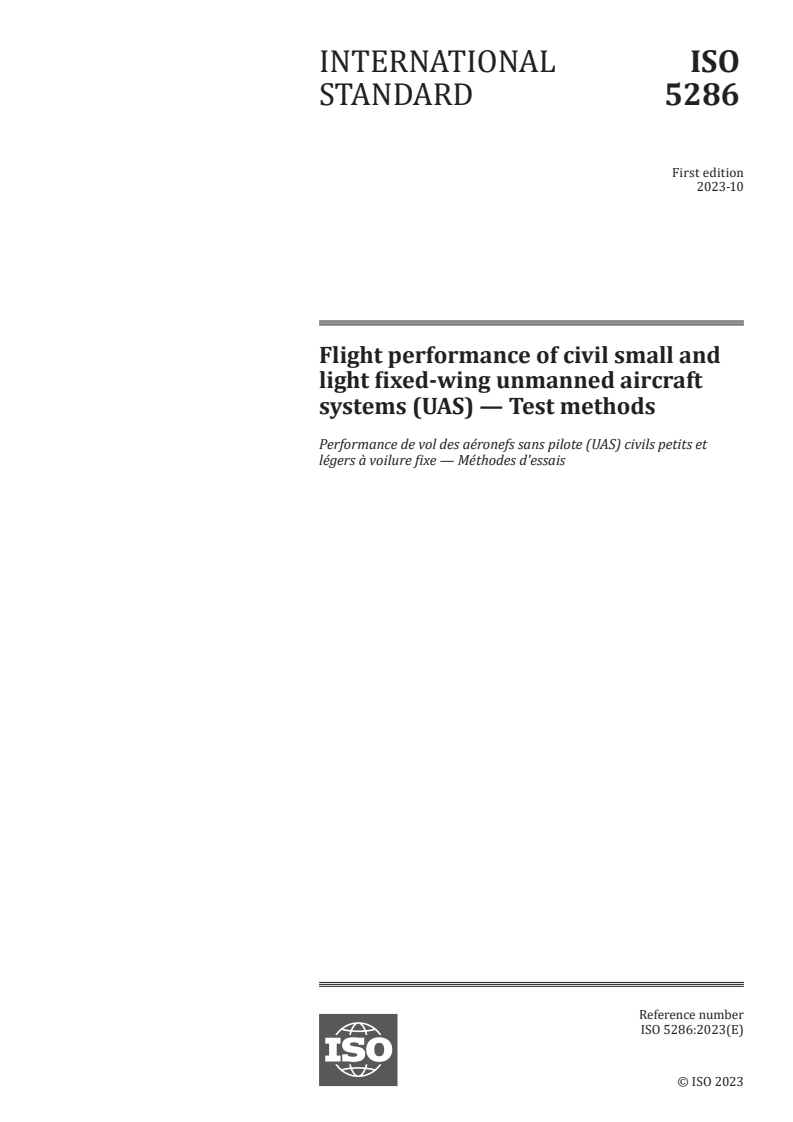
INTERNATIONAL ISO
STANDARD 5286
First edition
2023-10
Flight performance of civil small and
light fixed-wing unmanned aircraft
systems (UAS) — Test methods
Performance de vol des aéronefs sans pilote (UAS) civils petits et
légers à voilure fixe — Méthodes d'essais
Reference number
© ISO 2023
All rights reserved. Unless otherwise specified, or required in the context of its implementation, no part of this publication may
be reproduced or utilized otherwise in any form or by any means, electronic or mechanical, including photocopying, or posting on
the internet or an intranet, without prior written permission. Permission can be requested from either ISO at the address below
or ISO’s member body in the country of the requester.
ISO copyright office
CP 401 • Ch. de Blandonnet 8
CH-1214 Vernier, Geneva
Phone: +41 22 749 01 11
Email: copyright@iso.org
Website: www.iso.org
Published in Switzerland
ii
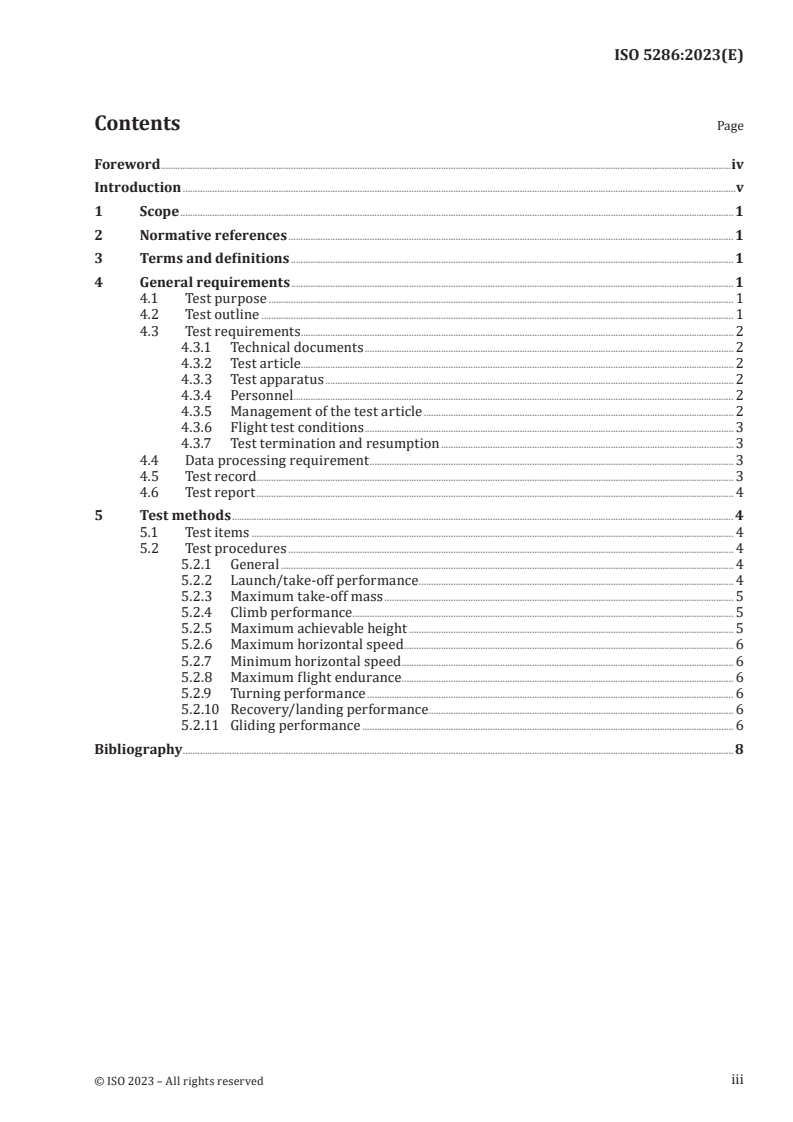
Contents Page
Foreword .iv
Introduction .v
1 Scope . 1
2 Normative references . 1
3 Terms and definitions . 1
4 General requirements . 1
4.1 Test purpose . 1
4.2 Test outline . 1
4.3 Test requirements. 2
4.3.1 Technical documents . 2
4.3.2 Test article . . 2
4.3.3 Test apparatus . 2
4.3.4 Personnel . 2
4.3.5 Management of the test article . 2
4.3.6 Flight test conditions . 3
4.3.7 Test termination and resumption . 3
4.4 Data processing requirement . 3
4.5 Test record. 3
4.6 Test report . 4
5 Test methods . 4
5.1 Test items . 4
5.2 Test procedures . 4
5.2.1 General . 4
5.2.2 Launch/take-off performance . 4
5.2.3 Maximum take-off mass . 5
5.2.4 Climb performance . 5
5.2.5 Maximum achievable height . 5
5.2.6 Maximum horizontal speed . 6
5.2.7 Minimum horizontal speed . 6
5.2.8 Maximum flight endurance . 6
5.2.9 Turning performance . 6
5.2.10 Recovery/landing performance . 6
5.2.11 Gliding performance . 6
Bibliography . 8
iii
Foreword
ISO (the International Organization for Standardization) is a worldwide federation of national standards
bodies (ISO member bodies). The work of preparing International Standards is normally carried out
through ISO technical committees. Each member body interested in a subject for which a technical
committee has been established has the right to be represented on that committee. International
organizations, governmental and non-governmental, in liaison with ISO, also take part in the work.
ISO collaborates closely with the International Electrotechnical Commission (IEC) on all matters of
electrotechnical standardization.
The procedures used to develop this document and those intended for its further maintenance are
described in the ISO/IEC Directives, Part 1. In particular, the different approval criteria needed for the
different types of ISO document should be noted. This document was drafted in accordance with the
editorial rules of the ISO/IEC Directives, Part 2 (see www.iso.org/directives).
ISO draws attention to the possibility that the implementation of this document may involve the use
of (a) patent(s). ISO takes no position concerning the evidence, validity or applicability of any claimed
patent rights in respect thereof. As of the date of publication of this document, ISO had not received
notice of (a) patent(s) which may be required to implement this document. However, implementers are
cautioned that this may not represent the latest information, which may be obtained from the patent
database available at www.iso.org/patents. ISO shall not be held responsible for identifying any or all
such patent rights.
Any trade name used in this document is information given for the convenience of users and does not
constitute an endorsement.
For an explanation of the voluntary nature of standards, the meaning of ISO specific terms and
expressions related to conformity assessment, as well as information about ISO's adherence to
the World Trade Organization (WTO) principles in the Technical Barriers to Trade (TBT), see
www.iso.org/iso/foreword.html.
This document was prepared by Technical Committee ISO/TC 20, Aircraft and space vehicles,
Subcommittee SC 16, Unmanned aircraft systems.
Any feedback or questions on this document should be directed to the user’s national standards body. A
complete listing of these bodies can be found at www.iso.org/members.html.
iv
Introduction
Fixed-wing unmanned aircraft systems (UAS) have rapidly increased and are widely used in agriculture,
surveying, monitoring, public security, and so on. However, the test methods for the flight performance
of fixed-wing UAS vary worldwide and are yet to be harmonized.
This document provides flight performance test methods of civil fixed-wing UAS to verify the
manufacturer’s declared specifications. The test items selected in this document are those considered
to affect fixed-wing flight performance significantly. Acceptance criteria are not included due to
consideration that regulations can vary in different countries.
v
INTERNATIONAL STANDARD ISO 5286:2023(E)
Flight performance of civil small and light fixed-wing
unmanned aircraft systems (UAS) — Test methods
1 Scope
This document specifies the test requirements and methods for verifying the specified flight
performance items of civil fixed-wing unmanned aircraft systems (UAS).
This document is applicable to the category of civil small and light fixed-wing UAS, which applies to
maximum take-off mass (MTOM) level I through V according to ISO 21895.
2 Normative references
The following documents are referred to in the text in such a way that some or all of their content
constitutes requirements of this document. For dated references, only the edition cited applies. For
undated references, the latest edition of the referenced document (including any amendments) applies.
ISO 21384-4, Unmanned aircraft systems — Part 4: Vocabulary
ISO 23665, Unmanned aircraft systems — Training for personnel involved in UAS operations
ISO 2533, Standard Atmosphere
3 Terms and definitions
For the purposes of this document, the terms and definitions given in ISO 21384-4 apply.
ISO and IEC maintain terminology databases for use in standardization at the following addresses:
— ISO Online browsing platform: available at https:// www .iso .org/ obp
— IEC Electropedia: available at https:// www .electropedia .org/
4 General requirements
4.1 Test purpose
This test aims to verify that a fixed-wing UAS’s flight performance indicators satisfy its design
specifications
...