

ISO 22192:2021
(Main)Bunkering of marine fuel using the Coriolis mass flow meter (MFM) system
General Information
- Abstract
This document specifies procedures and requirements for the transfer of bunkers to vessels by bunker tankers using the Coriolis mass flow meter (MFM) system. It encompasses the process leading to the approval of the MFM system as installed on bunker tankers and post-approval bunkering operation. It covers terminology, specifications, requirements and procedures on metrology, system integrity, metering system selection and installation, MFM system verification, bunker delivery and dispute handling. NOTE Local and international regulations, such as the International Convention for the Prevention of Pollution from Ships (MARPOL) can apply.
- Status
- Published
- Publication Date
- 14-Jan-2021
- Technical Committee
- ISO/TC 28/SC 2 - Measurement of petroleum and related products
- Drafting Committee
- ISO/TC 28/SC 2/WG 13 - Marine bunkering
- Current Stage
- 9092 - International Standard to be revised
- Start Date
- 17-Mar-2025
- Completion Date
- 29-Aug-2026
Buy Documents


ISO 22192:2021 - Bunkering of marine fuel using the Coriolis mass flow meter (MFM) system

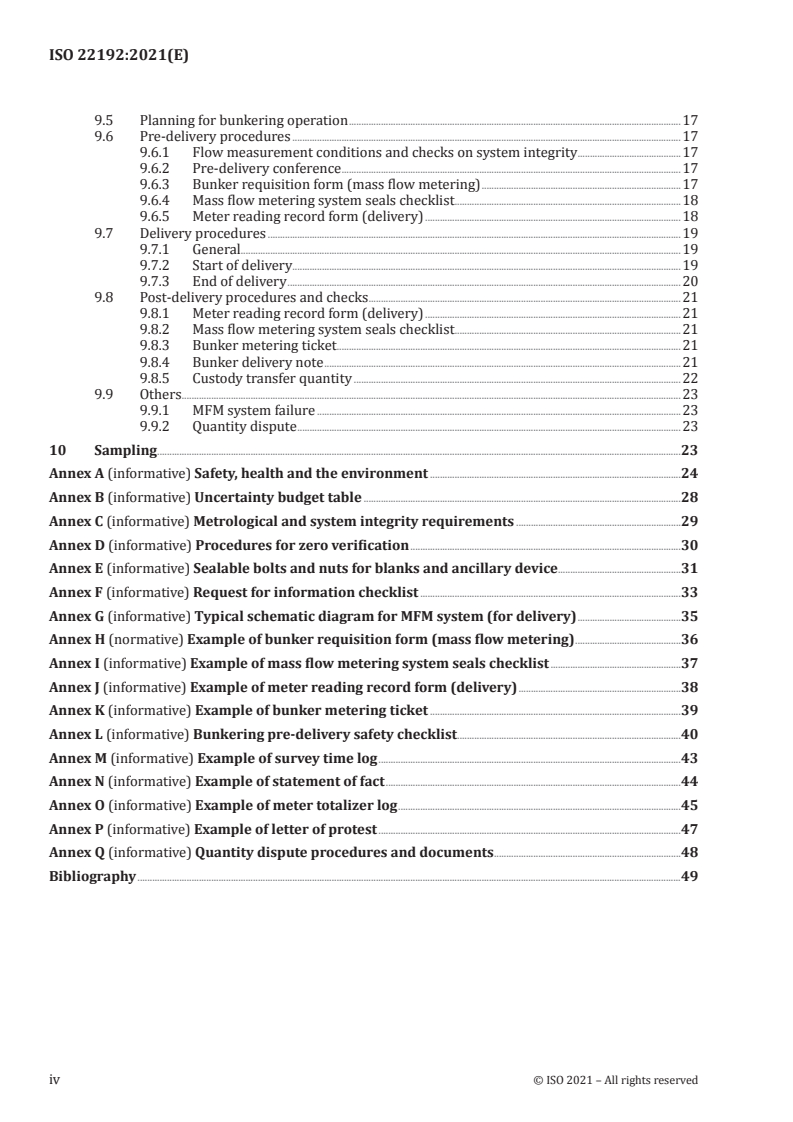
ISO 22192:2021 - Bunkering of marine fuel using the Coriolis mass flow meter (MFM) system/15/2021
Overview
ISO 22192:2021 - "Bunkering of marine fuel using the Coriolis mass flow meter (MFM) system" - specifies international procedures and requirements for transferring bunkers to vessels using Coriolis mass flow meters (MFM). Published by ISO in 2021, the standard covers the entire bunkering lifecycle on bunker tankers: approval of installed MFM systems, metrological controls, installation and commissioning, operational checks, post-delivery documentation and dispute handling. It is intended to improve measurement accuracy, system integrity and operational transparency during custody transfer of marine fuel.
Key Topics and Requirements
The standard addresses technical and procedural requirements across these core areas:
- Metrological requirements - meter and system performance expectations, zero verification, verification/calibration frequencies and uncertainty considerations (see Clause 5 and Annex B).
- System integrity and security - documentation, type approval, sealing, software and data security, alarm management, and maintenance (Clause 6; Annex C).
- Meter selection, installation and commissioning - site surveys, selection criteria for Coriolis MFMs, physical installation guidance and commissioning/re‑commissioning procedures (Clause 7).
- Verification and routine checks - in-service verification, meter totalizer logging and meter zero checks (Clauses 5.4, 8).
- Metering procedures and documentation - pre-delivery planning, pre‑/post‑delivery checklists, meter reading records, bunker metering ticket, delivery note and custody transfer quantity calculation (Clause 9; Annexes H–K).
- Operational safety and sampling - safety, health and environmental measures during bunkering and fuel sampling procedures (Clause 4; Clause 10; Annex A).
- Dispute handling - procedures and required documents for quantity disputes and protest handling (Clause 9.9; Annex Q).
Applications and Who Uses It
ISO 22192 is practical for organizations involved in marine fuel custody transfer:
- Shipowners, ship operators and charterers - to ensure accurate bunker receipt and reduce quantity disputes.
- Bunker suppliers and bunker tanker operators - for compliant installation, approval and operation of MFM systems.
- Bunker surveyors and port authorities - to perform verification, sampling and independent custody transfer assessments.
- Manufacturers and metrology labs - for type approval, calibration and conformity assessment of Coriolis MFMs.
The standard supports reliable custody transfer, operational transparency and regulatory compliance (local and international regulations such as MARPOL may also apply).
Related Standards
While ISO 22192 focuses on MFM systems for bunkering, users should consider related ISO/IEC and maritime regulations on metrology, flow measurement and environmental compliance when implementing these procedures.
Buy Documents
ISO 22192:2021 - Bunkering of marine fuel using the Coriolis mass flow meter (MFM) system
ISO 22192:2021 - Bunkering of marine fuel using the Coriolis mass flow meter (MFM) system/15/2021
Get Certified
Connect with accredited certification bodies for this standard

Element Materials Technology
Materials testing and product certification.

ABS Group Brazil
ABS Group certification services in Brazil.

ABS Quality Evaluations Inc.
American Bureau of Shipping quality certification.
Sponsored listings
Frequently Asked Questions
ISO 22192:2021 is a standard published by the International Organization for Standardization (ISO). Its full title is "Bunkering of marine fuel using the Coriolis mass flow meter (MFM) system". This standard covers: This document specifies procedures and requirements for the transfer of bunkers to vessels by bunker tankers using the Coriolis mass flow meter (MFM) system. It encompasses the process leading to the approval of the MFM system as installed on bunker tankers and post-approval bunkering operation. It covers terminology, specifications, requirements and procedures on metrology, system integrity, metering system selection and installation, MFM system verification, bunker delivery and dispute handling. NOTE Local and international regulations, such as the International Convention for the Prevention of Pollution from Ships (MARPOL) can apply.
This document specifies procedures and requirements for the transfer of bunkers to vessels by bunker tankers using the Coriolis mass flow meter (MFM) system. It encompasses the process leading to the approval of the MFM system as installed on bunker tankers and post-approval bunkering operation. It covers terminology, specifications, requirements and procedures on metrology, system integrity, metering system selection and installation, MFM system verification, bunker delivery and dispute handling. NOTE Local and international regulations, such as the International Convention for the Prevention of Pollution from Ships (MARPOL) can apply.
ISO 22192:2021 is classified under the following ICS (International Classification for Standards) categories: 75.180.30 - Volumetric equipment and measurements. The ICS classification helps identify the subject area and facilitates finding related standards.
ISO 22192:2021 is available in PDF format for immediate download after purchase. The document can be added to your cart and obtained through the secure checkout process. Digital delivery ensures instant access to the complete standard document.
Standards Content (Sample)
INTERNATIONAL ISO
STANDARD 22192
First edition
2021-01
Bunkering of marine fuel using the
Coriolis mass flow meter (MFM) system
Soutage de fioul marin à l’aide d’un débitmètre massique (MFM) selon
le principe de Coriolis
Reference number
©
ISO 2021
© ISO 2021
All rights reserved. Unless otherwise specified, or required in the context of its implementation, no part of this publication may
be reproduced or utilized otherwise in any form or by any means, electronic or mechanical, including photocopying, or posting
on the internet or an intranet, without prior written permission. Permission can be requested from either ISO at the address
below or ISO’s member body in the country of the requester.
ISO copyright office
CP 401 • Ch. de Blandonnet 8
CH-1214 Vernier, Geneva
Phone: +41 22 749 01 11
Email: copyright@iso.org
Website: www.iso.org
Published in Switzerland
ii © ISO 2021 – All rights reserved
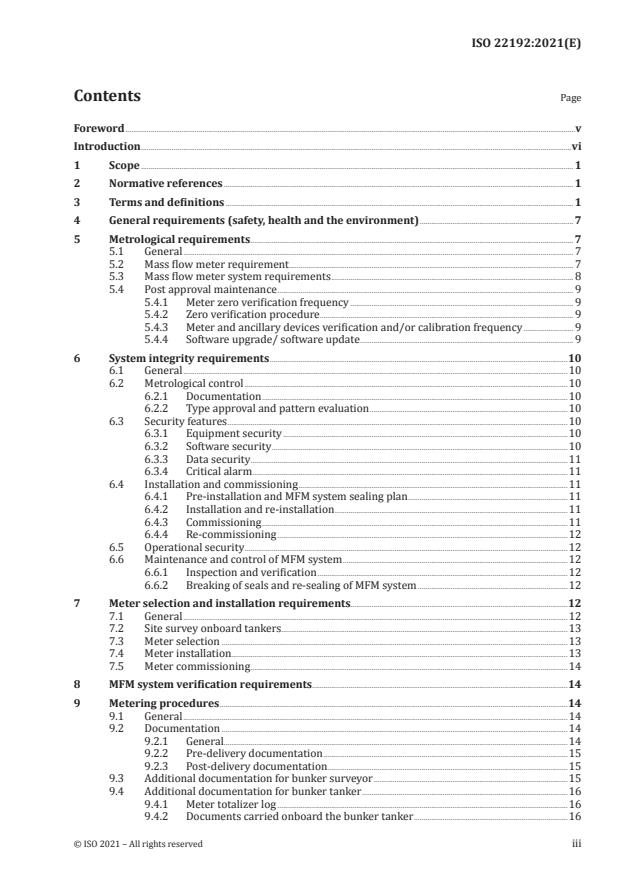
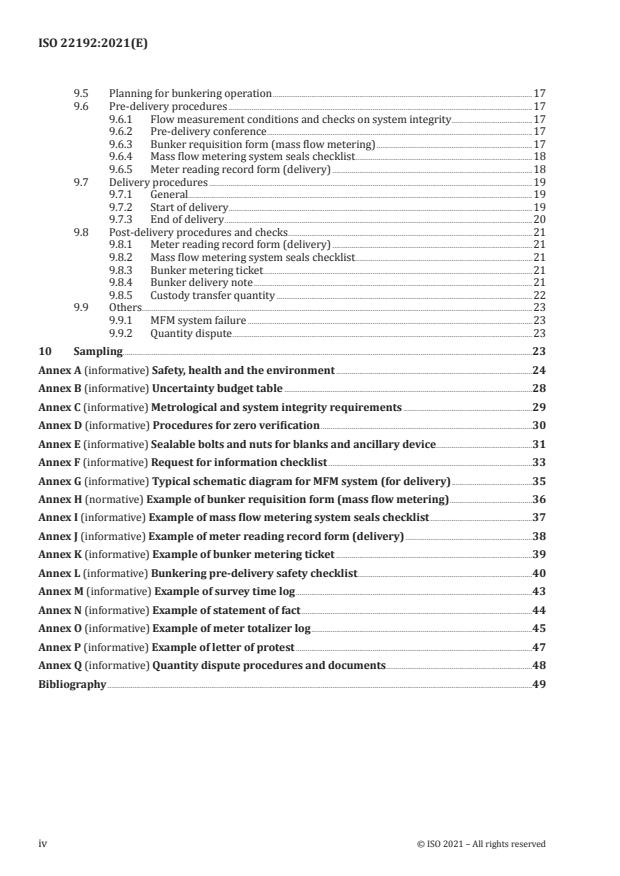
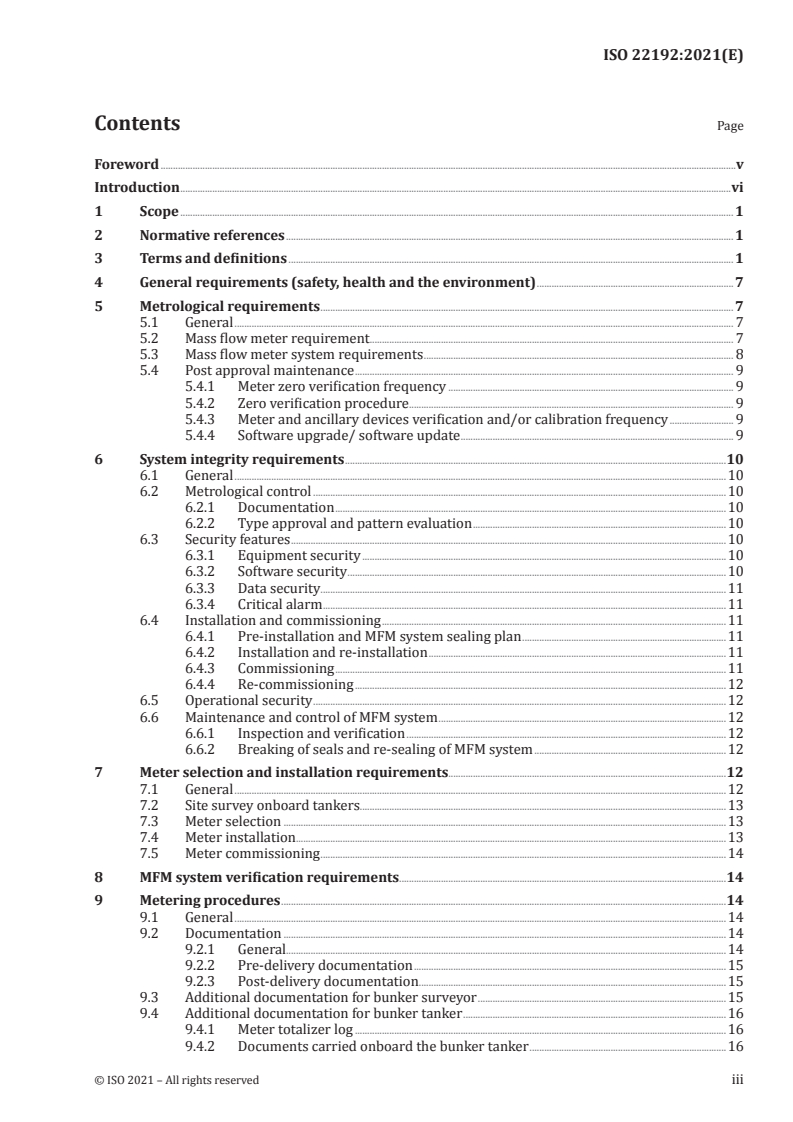
Contents Page
Foreword .v
Introduction .vi
1 Scope . 1
2 Normative references . 1
3 Terms and definitions . 1
4 General requirements (safety, health and the environment) . 7
5 Metrological requirements . 7
5.1 General . 7
5.2 Mass flow meter requirement. 7
5.3 Mass flow meter system requirements . 8
5.4 Post approval maintenance . 9
5.4.1 Meter zero verification frequency . 9
5.4.2 Zero verification procedure . 9
5.4.3 Meter and ancillary devices verification and/or calibration frequency . 9
5.4.4 Software upgrade/ software update . 9
6 System integrity requirements .10
6.1 General .10
6.2 Metrological control .10
6.2.1 Documentation .10
6.2.2 Type approval and pattern evaluation .10
6.3 Security features .10
6.3.1 Equipment security .10
6.3.2 Software security .10
6.3.3 Data security . .11
6.3.4 Critical alarm .11
6.4 Installation and commissioning .11
6.4.1 Pre-installation and MFM system sealing plan .11
6.4.2 Installation and re-installation .11
6.4.3 Commissioning .11
6.4.4 Re-commissioning .12
6.5 Operational security .12
6.6 Maintenance and control of MFM system .12
6.6.1 Inspection and verification .12
6.6.2 Breaking of seals and re-sealing of MFM system .12
7 Meter selection and installation requirements.12
7.1 General .12
7.2 Site survey onboard tankers.13
7.3 Meter selection .13
7.4 Meter installation.13
7.5 Meter commissioning .14
8 MFM system verification requirements.14
9 Metering procedures .14
9.1 General .14
9.2 Documentation .14
9.2.1 General.14
9.2.2 Pre-delivery documentation .15
9.2.3 Post-delivery documentation .15
9.3 Additional documentation for bunker surveyor .15
9.4 Additional documentation for bunker tanker .16
9.4.1 Meter totalizer log .16
9.4.2 Documents carried onboard the bunker tanker .16
9.5 Planning f or bunkering operation .17
9.6 Pre-delivery procedures .17
9.6.1 Flow measurement conditions and checks on system integrity .17
9.6.2 Pre-delivery conference .17
9.6.3 Bunker requisition form (mass flow metering) .17
9.6.4 Mass flow metering system seals checklist .18
9.6.5 Meter reading record form (delivery) .18
9.7 Delivery procedures .19
9.7.1 General.19
9.7.2 Start of delivery .19
9.7.3 End of delivery .20
9.8 Post-delivery procedures and checks .21
9.8.1 Meter reading record form (delivery) .21
9.8.2 Mass flow metering system seals checklist .21
9.8.3 Bunker metering ticket.21
9.8.4 Bunker delivery note .21
9.8.5 Custody transfer quantity .22
9.9 Others .23
9.9.1 MFM system failure .23
9.9.2 Quantity dispute .23
10 Sampling .23
Annex A (informative) Safety, health and the environment .24
Annex B (informative) Uncertainty budget table .28
Annex C (informative) Metrological and system integrity requirements .29
Annex D (informative) Procedures for zero verification .30
Annex E (informative) Sealable bolts and nuts for blanks and ancillary device .31
Annex F (informative) Request for information checklist .33
Annex G (informative) Typical schematic diagram for MFM system (for delivery) .35
Annex H (normative) Example of bunker requisition form (mass flow metering) .36
Annex I (informative) Example of mass flow metering system seals checklist .37
Annex J (informative) Example of meter reading record form (delivery) .38
Annex K (informative) Example of bunker metering ticket .39
Annex L (informative) Bunkering pre-delivery safety checklist.40
Annex M (informative) Example of survey time log .43
Annex N (informative) Example of statement of fact .44
Annex O (informative) Example of meter totalizer log .45
Annex P (informative) Example of letter of protest .47
Annex Q (informative) Quantity dispute procedures and documents .48
Bibliography .49
iv © ISO 2021 – All rights reserved
Foreword
ISO (the International Organization for Standardization) is a worldwide federation of national standards
bodies (ISO member bodies). The work of preparing International Standards is normally carried out
through ISO technical committees. Each member body interested in a subject for which a technical
committee has been established has the right to be represented on that committee. International
organizations, governmental and non-governmental, in liaison with ISO, also take part in the work.
ISO collaborates closely with the International Electrotechnical Commission (IEC) on all matters of
electrotechnical standardization.
The procedures used to develop this document and those intended for its further maintenance are
described in the ISO/IEC Directives, Part 1. In particular, the different approval criteria needed for the
different types of ISO documents should be noted. This document was drafted in accordance with the
editorial rules of the ISO/IEC Directives, Part 2 (see www .iso .org/ directives).
Attention is drawn to the possibility that some of the elements of this document may be the subject of
patent rights. ISO shall not be held responsible for identifying any or all such patent rights. Details of
any patent rights identified during the development of the document will be in the Introduction and/or
on the ISO list of patent declarations received (see www .iso .org/ patents).
Any trade name used in this document is information given for the convenience of users and does not
constitute an endorsement.
For an explanation of the voluntary nature of standards, the meaning of ISO specific terms and
expressions related to conformity assessment, as well as information about ISO's adherence to the
World Trade Organization (WTO) principles in the Technical Barriers to Trade (TBT), see www .iso .org/
iso/ foreword .html.
This document was prepared by Technical Committee ISO/TC 28, Petroleum and related products, fuels
and lubricants from natural or synthetic sources, Subcommittee SC 2, Measurement of petroleum and
related products.
Any feedback or questions on this document should be directed to the user’s national standards body. A
complete listing of these bodies can be found at www .iso .org/ members .html.
Introduction
This document was developed for the benefit of the bunker industry comprising ship owners, operators,
charterers, bunker suppliers, bunker craft operators and bunker surveyors and is intended to enhance
the efficiency of bunkering operations and promote best practices in the measurement of bunker fuel
delivered.
This document sets out the international best practices which documents principles, requirements and
procedures in the application of mass flow metering to bunkering.
This document does not alter the contractual obligations of the parties involved in the bunker delivery.
Figure 1 shows the application of MFM bunkering requirements for bunker custody transfer.
Figure 1 — Application of MFM bunkering requirements
vi © ISO 2021 – All rights reserved
INTERNATIONAL STANDARD ISO 22192:2021(E)
Bunkering of marine fuel using the Coriolis mass flow
meter (MFM) system
1 Scope
This document specifies procedures and requirements for the transfer of bunkers to vessels by bunker
tankers using the Coriolis mass flow meter (MFM) system. It encompasses the process leading to the
approval of the MFM system as installed on bunker tankers and post-approval bunkering operation.
It covers terminology, specifications, requirements and procedures on metrology, system integrity,
metering system selection and installation, MFM system verification, bunker delivery and dispute
handling.
NOTE Local and international regulations, such as the International Convention for the Prevention of
Pollution from Ships (MARPOL) can apply.
2 Normative references
The following documents are referred to in the text in such a way that some or all of their content
constitutes requirements of this document. For dated references, only the edition cited applies. For
undated references, the latest edition of the referenced document (including any amendments) applies.
ISO/IEC Guide 98-3, Uncertainty of measurement — Part 3: Guide to the expression of uncertainty in
measurement (GUM: 1995)
ISO 13739, Petroleum products — Procedures for the transfer of bunkers to vessels
ISO/IEC 17025, General requirements for the competence of testing and calibration laboratories
International Recommendation OIML R117-1, Dynamic measuring systems for liquids other than water
3 Terms and definitions
For the purposes of this document, the following terms and definitions apply.
ISO and IEC maintain terminological databases for use in standardization at the following addresses:
— ISO Online browsing platform: available at https:// www .iso .org/ obp
— IEC Electropedia: available at http:// www .electropedia .org/
3.1
accuracy of measurement
closeness of the agreement between the result of a measurement and the conventional, true value of the
measurement
Note 1 to entry: Good accuracy implies small random and systematic errors.
Note 2 to entry: The quantitative expression of accuracy should be in terms of uncertainty of measurement.
3.2
adjustment
set of operations carried out on a measuring system to provide prescribed indications corresponding to
given values of quantity to be measured
Note 1 to entry: Types of adjustment of a measuring system include zero adjustment of a measuring system,
offset adjustment and span adjustment (sometimes called gain adjustment).
Note 2 to entry: Adjustment of a measuring system should not be confused with calibration, which is a
prerequisite for adjustment.
Note 3 to entry: After an adjustment of a measuring system, the measuring system shall be recalibrated.
[SOURCE: JCGM 200]
3.3
air buoyancy correction
correction applied to obtain the conventional mass from true mass to take into account the reduction in
true mass due to the buoyancy effect of air
3.4
ancillary device
device intended to perform a particular function, directly involved in elaborating, transmitting or
displaying measurement results
EXAMPLE Zero adjustment device, repeating indicating device, printing device, memory device, totalising
indicating device, correction device, conversion device, pre-setting device, self-service device.
3.5
bunker(s)
fuel supplied to a vessel (3.47) for its propulsion and/or operation
Note 1 to entry: Fuel with reference to Class F of ISO 8217.
3.6
bunker delivery note
BDN
proprietary document of the bunker supplier (3.9) providing details of the quality and quantity of the
bunker(s) (3.5) delivered by the bunker tanker (3.11) to the vessel (3.47)
3.7
bunker metering ticket
BMT
ticket printed at the end of a bunkering operation (3.8)
3.8
bunkering operation
bunker delivery from bunker tanker (3.11) to vessel (3.47)
3.9
bunker supplier
company which contractually agrees with the buyer to deliver the product
3.10
bunker surveyor
person who inspects, measures, samples, investigates and reports as required on the bunkering
operations
3.11
bunker tanker
bunker tanker supplying bunker(s) to the vessel (3.47)
3.12
bunker tanker operator
company which operates the bunker tanker (3.11)
3.13
bunker tanker representative
individual who represents the bunker supplier (3.9) and is responsible for bunkering operations (3.8)
and documentations
2 © ISO 2021 – All rights reserved
3.14
calibration
operation that, under specified conditions, in a first step, establishes a relation between the quantity
values with measurement uncertainties provided by measurement standards and corresponding
indications with associated measurement uncertainties and, in a second step, uses this information to
establish a relation for obtaining a measurement result from an indication
[SOURCE: JCGM 200]
3.15
calibration factor
numerical factor unique to each sensor derived during sensor calibration (3.14), which when
programmed into the transmitter (3.44) ensures that the meter performs to its stated specification
[SOURCE: ISO 10790:2015,3.1.10, modified — the term has been changed from "calibrating factor" to
"calibration factor" and Note 1 to entry has been merged in the definition.]
3.16
chief engineer
engineer of the vessel (3.47) who is responsible for receiving bunkers and documentation of the
bunkering operation (3.8)
3.17
commissioning
process whereby the critical precision parameters impacting custody transfer are verified and checked
Note 1 to entry: Any setting changes during commissioning or re-commissioning is traceable to factory settings
and justified adjustments (3.2) to meet the measurement uncertainty (3.30) or type classification.
3.18
conformity body
independent party or party accredited by national body that undertake conformity assessment
activities such as verification, testing, inspection and certification
3.19
conventional mass
mass value of a body equal to the mass (3.24) of a standard that balances this body under conventionally
chosen conditions
Note 1 to entry: The unit of a conventional mass is the kilogram. It is also known as mass in air.
[SOURCE: OIML D028]
3.20
custody transfer point
point at which, the bunker (3.5) is defined as being delivered or loaded
3.21
initial zero adjustment
setting of the indication of mass flow rate (3.27) to zero with the flowrate completely stopped and to
fully filled flow meter according to approved procedure, before it is ready for custody transfer usage
3.22
linearity of MFM
linearity of mass flow meter
consistency of change in the scaled output of a Coriolis flow meter, for a related, scaled change in the
input of the flow meter
[SOURCE: ASME MFC-11]
3.23
low flow cut-off
transmitter (3.44) setting which sets the meter output(s) to zero flow if the flow rate falls below a
preset value
Note 1 to entry: This setting inhibits the registration of flow when the flow meter is not properly filled with
subject fluid that can lead to large measurement errors.
3.24
mass
physical quantity which can be ascribed to any material object and which gives a measure of its quantity
of matter
Note 1 to entry: Also known as true mass.
[SOURCE: OIML D028, modified — Note 1 to entry has been added.]
3.25
mass flow meter
MFM
device consisting of a flow sensor (primary device) and a transmitter (3.44) (secondary device)
which primarily measures the mass flow by means of the interaction between a flowing fluid and
the oscillation of a tube or tubes; it may also provide measurements of the density and the process
temperature of the fluid
3.26
mass flow meter system
MFM system
system that comprises the mass flow meter (3.25), its ancillary devices (3.4), pipelines and sealing points
between the pump suction and the custody transfer point (3.20)
3.27
mass flow rate
flow rate at which the quantity of fluid which passes the MFM (3.25) is expressed as mass and
denoted in MT/h
3.28
master
person in charge of the bunker tanker (3.11) or the vessel receiving bunker(s) as the case can be
3.29
maximum mass flow rate
Q
max
maximum flow rate, up to which, the MFM system (3.26) has been qualified to operate in compliance
with the required accuracy (3.1)Note 1 to entry: The maximum value is normally determined by the
application
3.30
measurement uncertainty
non-negative parameter characterizing the dispersion of the quantity values being attributed to a
measurand, based on the information used
[SOURCE: JCGM 200]
3.31
meter reading
value obtained from the non-resettable totalizer(s) (3.37)
4 © ISO 2021 – All rights reserved
3.32
meter stability
property of a measuring instrument, whereby, its metrological properties remain constant over time
Note 1 to entry: Stability may be quantified in several ways:
— in terms of the duration of a time interval over which a metrological property changes by a stated amount;
— in terms of the change of a property over a stated time.
[SOURCE: JCGM 200]
3.33
metering
measurement of quantity by the MFM system (3.26)
3.34
metering profile
graphical overview of the process parameters recorded during a bunkering operation (3.8) and retained
for purpose of providing transparent assessment
3.35
minimum mass flow rate
Q
min
lowest flow rate required to which the metering system has been qualified to operate, in compliance
with the required accuracy (3.1)
Note 1 to entry: The minimum value is normally determined by the flow metering system.
3.36
minimum measured quantity
MMQ
smallest quantity of liquid for which the measurement is metrologically acceptable for that system
or element
3.37
non-resettable totalizer
device that indicates the total cumulated flow quantity through the MFM (3.25) after it is secured for
use in custody transfer such that its value is not resettable to zero or to other values
3.38
quantity delivered
cumulative mass quantity measured between the start of delivery and end of delivery and transferred
to the vessel (3.47)
3.39
repeatability
proximity of a match among a series of results obtained with the same method on identical test material,
under the same conditions (same operator, same apparatus, same laboratory and short intervals of time)
3.40
resettable totalizer
device that indicates total flow quantity through the MFM (3.25) from the start to the end of each batch
and its value can be reset to zero
3.41
sample
bunker (3.5) specimen defined by time, location and method of sampling
3.42
stored zero value
value stored in the electronics after the zero-adjustment procedure
Note 1 to entry: Stored zero value is recorded during every zero-offset determination. Depending on
manufacturer, the stored zero value can be in flow rate units or in time units or in % units.
3.43
traceability
metrological property of a measurement result, whereby the result can be related to a reference
through a documented unbroken chain of calibrations verified by a national metrology institute, each
contributing to the measurement uncertainty (3.30)
[SOURCE: JCGM 200]
3.44
transmitter
electronic control system that provides the drive and transforming the signals from the flow sensor, to
give output(s) of measured and inferred parameters, and that also provides corrections derived from
parameters such as temperature
3.45
update
installation of new system components, hardware or software, which have no significant effect on the
metering result
Note 1 to entry: No testing is required after installation.
3.46
upgrade
installation of new system components, hardware or software, which can have a significant effect on
the metering result
Note 1 to entry: New certification testing is required after installation.
3.47
vessel
ship that receives the bunker(s) (3.5)
3.48
zero offset
measurement output indicated under zero flow conditions
Note 1 to entry: A zero offset might be caused by stress being applied to the oscillating tubes by the surrounding
pipework and by process conditions.
Note 2 to entry: A zero offset can be reduced by means of a zero-adjustment procedure.
3.49
zero offset limit
maximum allowable observed zero offset (3.48) in relation to the stored zero value, used to determine
when to re-zero the flow meter, generally defined by the manufacturer
[SOURCE: API MPMS 5.6]
6 © ISO 2021 – All rights reserved
3.50
zero stability
magnitude of the meter output deviation from the stored zero value at zero flow after the zero
adjustment procedure has been completed, expressed by the manufacturer as an absolute value in mass
per unit time
Note 1 to entry: The stated value for zero stability is valid for stable conditions where the fluid is free of bubbles
and sediment.
3.51
zero verification procedure
procedure to verify that the zero offset (3.48) does not exceed the zero offset limit (3.49)
4 General requirements (safety, health and the environment)
4.1 The requirements to be observed by all personnel for the safe transfer of bunker in port are set
out in Annex A. Internationally accepted safety standards, as appropriate, shall also be observed by the
personnel of both the bunker tanker and the vessel and also the bunker surveyor (when engaged) for the
safe transfer of bunkers in port.
NOTE Local requirements can also apply.
4.2 The respective masters of the bunker tanker and the vessel shall remain responsible for the safety
of their vessel, crew, cargo and equipment at all times and should not permit safety to be prejudiced by
the actions of others.
4.3 All parties involved in the bunkering processes shall equip themselves with the following minimum
safety items:
— safety helmet;
— safety shoes;
— gloves;
— life jacket.
They shall wear personal protective equipment at all times while on board the vessel and the bunker
tanker. They shall equip themselves with H S and O monitors and use them throughout the operation.
2 2
4.4 All parties involved in the bunkering operation shall be free from the influence of any alcohol, drugs
or other substances which impairs the safe and efficient execution of their work and personal health.
5 Metrological requirements
5.1 General
Clause 5 specifies the MFM’s metrological traceability, calibration and re-calibration requirements for
the approval and performance of the MFM system applicable to custody transfer bunkering. The MFM
system shall be operated within rated conditions as set out in these requirements to meet the 0,5 %
expanded measurement uncertainty.
5.2 Mass flow meter requirement
5.2.1 Every MFM shall be calibrated before custody transfer use for bunkering and shall include its
adjustment device(s) and ancillary device(s).
5.2.2 The calibration should be done using bunker fuel or equivalent fluid once the primary calibration
facilities are available to meet the traceability and calibration uncertainty requirements. Until the
requirements in this subclause are fulfilled, the calibration requirements as stated in 5.2.3 and 5.2.4 shall
apply for every MFM before approval for custody transfer use.
5.2.3 For water calibration (level 1) with direct traceability to S.I. unit of mass, the maximum error of
MFM shall not more than 0,1 % of reading. The calibration shall be carried out by a laboratory meeting
the requirements of ISO/IEC 17025.
5.2.4 There shall be a letter, accompanied by relevant supporting documents, declaring that the meter
performance meets the requirement of maximum measurement uncertainty for bunker fuel fluid flow
measurement to be not more than 0,2 % (level 2).
NOTE Supporting documents are inclusive but not limited to type evaluation certificates for regional
directives (e.g. EC/EU type examination), and reports of tests conducted as part of the process in obtaining these
type evaluation certificates.
The report(s), supporting documents and letter shall be issued by either:
a) a national metrology institute; or
b) an appointed International Organization of Legal Metrology (OIML) issuing authority in accordance
with the relevant OIML recommendations.
5.2.5 The MFM calibration report shall comprise the following details in addition to what is in
ISO/IEC 17025:
a) expanded measurement uncertainty;
b) meter errors across the measurement range between the minimum mass flow rate, Q and the
min,
maximum mass flow rate, Q ;
max
c) configuration and parameter setting values, including calibration factors to a specific MFM such as
serial number and stored zero value.
5.2.6 The MFM used for bi-directional measurements shall be calibrated at forward and reverse flow
directions with at least five evenly spaced flowrates in each direction across the measurement range
between Q and Q of the MFM. Each flowrate shall have at least 3 runs.
min max
5.2.7 The MFM shall also be tested to prove the meter stability periodically. MFM shall be re-calibrated
if the requirement 5.3.7 is not met.
5.3 Mass flow meter system requirements
5.3.1 The expanded measurement uncertainty of overall performance of the MFM system shall be not
more than 0,5 %. It should take into consideration the following uncertainty sources influenced by:
— meter calibration;
— product condition e.g. viscosity and density;
— process flow condition e.g. aeration flow and flow turbulences;
— piping line system configuration and meter installation which can affect measurement
conditions; and
— any other source that may influence the mass flow measurement.
8 © ISO 2021 – All rights reserved
5.3.2 The expanded measurement uncertainty should include all the uncertainty components outlined
in Annex B.
5.3.3 The measurement uncertainty shall be assessed and evaluated in accordance with
ISO/IEC Guide 98-3.
5.3.4 The requirements of zero offset limit and zero verification include the following:
a) Maximum permissible zero offset shall be not more than 0,2 % of Q .
min
b) Zero setting and zero verification are required during commissioning. These operations shall be
performed by conformity body.
c) Zero setting is done through measuring and storing the zero offset during no flow condition, so
that a new base line is formed for the measured mass flow when particular criteria (depending on
meter type used) are met.
d) Periodical check on zero stability is required according to zero verification procedure. See 5.4 and
Annex D.
e) To achieve a proper zero adjustment/verification procedure, the status of the Coriolis meter during
no flow should be representative of single-phase flow conditions.
5.3.5 The low flow cut-off setting value shall be not more than 12 % of Q .
min
5.3.6 The operating mass flow rate for custody transfer shall not be less than Q and not more
min
than Q . In addition, the transferred quantity shall not be less than the minimum measured quantity
max
(MMQ) in order to achieve the requirement of 0,5 % overall expanded measurement uncertainty of the
metering system.
5.3.7 The meter-long term stability shall be not more than a variance of ± 0,2 %.
5.3.8 The flow measurement error due to aeration effects shall not cause the overall expanded
measurement uncertainty of the MFM system to exceed 0,5 %.
5.4 Post approval maintenance
5.4.1 Meter zero verification frequency
Zero verification shall be done quarterly in the first year and every six months thereafter. Certified and
authentic copies of the latest zero verification report shall be kept on board the bunker tanker.
5.4.2 Zero verification procedure
Zero verification shall be carried out during a forward flow by filling the flow sensor with non-aerated
bunker fuel. Refer to Annex D for the procedures of zero verification.
5.4.3 Meter and ancillary devices verification and/or calibration frequency
The meter shall be verified and/or calibrated periodically. The ancillary devices shall be verified or
calibrated periodically if required.
5.4.4 Software upgrade/ software update
In the event that upgrade/update of software is required for the MFM system, verification shall be
carried out to confirm that the performance of the MFM system meets the metrological requirements.
6 System integrity requirements
6.1 General
6.1.1 Clause 6 shall be read in conjunction with Clauses 5, 7, 8 and 9.
6.1.2 System integrity aims to ensure that:
a) MFM system is set up and approved for bunkering operations in accordance with the system
integrity requirements specified in this International Standard and
b) MFM system’s measurement is secured against any interference before, during or after bunkering
operations and the bunker quantity as measured is delivered to the receiving vessel.
This clause specifies the requirements and procedures to ensure the system integrity of a MFM system.
It includes documentation, equipment checks for mechanical, software, electrical and operational
security. It covers the stages of pre-installation, installation, commissioning, operations and
maintenance as well as controls. See Annex C for metrological and system integrity requirements at
each stage.
6.2 Metrological control
6.2.1 Documentation
MFM intended for the measurement of bunker fuel is subject to type or pattern evaluation testing to
ensure compliance with the OIML Recommendations. Type evaluation ensures the reliability of the
instruments by prescribing the metrological, technical and construction requirements on the design of
the type of instruments.
6.2.2 Type approval and pattern evaluation
The MFM shall be subjected to evaluation in accordance with the OIML R117-1 by OIML’s recognized
testing bodies and appointed issuing authorities and examination programs or equivalent to ensure the
following:
a) Hardware and software integrity in regard to requirement set-out in OIML R117-1;
b) Appropriate for trade use;
c) Applicable for bunkering application with characteristics and specifications;
d) Rated operating conditions.
6.3 Security features
6.3.1 Equipment security
The MFM system shall be sealed against unauthorised adjustment, tampering or dismantling. Bunker
tanker owner/operator shall ensure that the seals of the MFM system remain intact and secured at
all times.
6.3.2 Software security
All MFM system software shall be protected to meet the requirements for custody transfer
measurement. This is to prevent any unauthorised changes to the software and parameter settings. Any
changes to the configuration of the software that affects measurement integrity shall be authorized
by the accredited body and properly documented. The MFM system shall be able to trace any changes
affecting the custody transfer measurement.
10 © ISO 2021 – All rights reserved
6.3.3 Data security
All MFM system shall be installed with a data logger to record all data obtained from the MFM system.
The records shall include history of operations, batches and critical alarms for future reference. These
data are required to be kept on board for a minimum of 3 months. Any data interface shall be secured.
The data logger is an integral part of the custody transfer and as such it should be secured to prevent
tampering.
6.3.4 Critical alarm
A critical alarm is activated under the following conditions:
— power failure;
— equipment communication failure;
— meter failure (include bunkering computer).
Refer to 9.8.1 for the required actions.
6.4 Installation and commissioning
6.4.1 Pre-installation and MFM system sealing plan
MFM system pipeline shall be designed or modified to ensure proper system integrity.
All MFM and its ancillary devices together with the blanks and flanges are to be clearly labelled and
sealed by a party approved by the accredited body. Prior to the sealing of the blank or the flange, it is
also important to know and identify the required sealing points. Refer to Annex E on sealing points.
Identification of the sealing points shall be carried out by the bunker tanke
...
INTERNATIONAL ISO
STANDARD 22192
First edition
2021-01
Bunkering of marine fuel using the
Coriolis mass flow meter (MFM) system
Soutage de fioul marin à l’aide d’un débitmètre massique (MFM) selon
le principe de Coriolis
Reference number
©
ISO 2021
© ISO 2021
All rights reserved. Unless otherwise specified, or required in the context of its implementation, no part of this publication may
be reproduced or utilized otherwise in any form or by any means, electronic or mechanical, including photocopying, or posting
on the internet or an intranet, without prior written permission. Permission can be requested from either ISO at the address
below or ISO’s member body in the country of the requester.
ISO copyright office
CP 401 • Ch. de Blandonnet 8
CH-1214 Vernier, Geneva
Phone: +41 22 749 01 11
Email: copyright@iso.org
Website: www.iso.org
Published in Switzerland
ii © ISO 2021 – All rights reserved
Contents Page
Foreword .v
Introduction .vi
1 Scope . 1
2 Normative references . 1
3 Terms and definitions . 1
4 General requirements (safety, health and the environment) . 7
5 Metrological requirements . 7
5.1 General . 7
5.2 Mass flow meter requirement. 7
5.3 Mass flow meter system requirements . 8
5.4 Post approval maintenance . 9
5.4.1 Meter zero verification frequency . 9
5.4.2 Zero verification procedure . 9
5.4.3 Meter and ancillary devices verification and/or calibration frequency . 9
5.4.4 Software upgrade/ software update . 9
6 System integrity requirements .10
6.1 General .10
6.2 Metrological control .10
6.2.1 Documentation .10
6.2.2 Type approval and pattern evaluation .10
6.3 Security features .10
6.3.1 Equipment security .10
6.3.2 Software security .10
6.3.3 Data security . .11
6.3.4 Critical alarm .11
6.4 Installation and commissioning .11
6.4.1 Pre-installation and MFM system sealing plan .11
6.4.2 Installation and re-installation .11
6.4.3 Commissioning .11
6.4.4 Re-commissioning .12
6.5 Operational security .12
6.6 Maintenance and control of MFM system .12
6.6.1 Inspection and verification .12
6.6.2 Breaking of seals and re-sealing of MFM system .12
7 Meter selection and installation requirements.12
7.1 General .12
7.2 Site survey onboard tankers.13
7.3 Meter selection .13
7.4 Meter installation.13
7.5 Meter commissioning .14
8 MFM system verification requirements.14
9 Metering procedures .14
9.1 General .14
9.2 Documentation .14
9.2.1 General.14
9.2.2 Pre-delivery documentation .15
9.2.3 Post-delivery documentation .15
9.3 Additional documentation for bunker surveyor .15
9.4 Additional documentation for bunker tanker .16
9.4.1 Meter totalizer log .16
9.4.2 Documents carried onboard the bunker tanker .16
9.5 Planning f or bunkering operation .17
9.6 Pre-delivery procedures .17
9.6.1 Flow measurement conditions and checks on system integrity .17
9.6.2 Pre-delivery conference .17
9.6.3 Bunker requisition form (mass flow metering) .17
9.6.4 Mass flow metering system seals checklist .18
9.6.5 Meter reading record form (delivery) .18
9.7 Delivery procedures .19
9.7.1 General.19
9.7.2 Start of delivery .19
9.7.3 End of delivery .20
9.8 Post-delivery procedures and checks .21
9.8.1 Meter reading record form (delivery) .21
9.8.2 Mass flow metering system seals checklist .21
9.8.3 Bunker metering ticket.21
9.8.4 Bunker delivery note .21
9.8.5 Custody transfer quantity .22
9.9 Others .23
9.9.1 MFM system failure .23
9.9.2 Quantity dispute .23
10 Sampling .23
Annex A (informative) Safety, health and the environment .24
Annex B (informative) Uncertainty budget table .28
Annex C (informative) Metrological and system integrity requirements .29
Annex D (informative) Procedures for zero verification .30
Annex E (informative) Sealable bolts and nuts for blanks and ancillary device .31
Annex F (informative) Request for information checklist .33
Annex G (informative) Typical schematic diagram for MFM system (for delivery) .35
Annex H (normative) Example of bunker requisition form (mass flow metering) .36
Annex I (informative) Example of mass flow metering system seals checklist .37
Annex J (informative) Example of meter reading record form (delivery) .38
Annex K (informative) Example of bunker metering ticket .39
Annex L (informative) Bunkering pre-delivery safety checklist.40
Annex M (informative) Example of survey time log .43
Annex N (informative) Example of statement of fact .44
Annex O (informative) Example of meter totalizer log .45
Annex P (informative) Example of letter of protest .47
Annex Q (informative) Quantity dispute procedures and documents .48
Bibliography .49
iv © ISO 2021 – All rights reserved
Foreword
ISO (the International Organization for Standardization) is a worldwide federation of national standards
bodies (ISO member bodies). The work of preparing International Standards is normally carried out
through ISO technical committees. Each member body interested in a subject for which a technical
committee has been established has the right to be represented on that committee. International
organizations, governmental and non-governmental, in liaison with ISO, also take part in the work.
ISO collaborates closely with the International Electrotechnical Commission (IEC) on all matters of
electrotechnical standardization.
The procedures used to develop this document and those intended for its further maintenance are
described in the ISO/IEC Directives, Part 1. In particular, the different approval criteria needed for the
different types of ISO documents should be noted. This document was drafted in accordance with the
editorial rules of the ISO/IEC Directives, Part 2 (see www .iso .org/ directives).
Attention is drawn to the possibility that some of the elements of this document may be the subject of
patent rights. ISO shall not be held responsible for identifying any or all such patent rights. Details of
any patent rights identified during the development of the document will be in the Introduction and/or
on the ISO list of patent declarations received (see www .iso .org/ patents).
Any trade name used in this document is information given for the convenience of users and does not
constitute an endorsement.
For an explanation of the voluntary nature of standards, the meaning of ISO specific terms and
expressions related to conformity assessment, as well as information about ISO's adherence to the
World Trade Organization (WTO) principles in the Technical Barriers to Trade (TBT), see www .iso .org/
iso/ foreword .html.
This document was prepared by Technical Committee ISO/TC 28, Petroleum and related products, fuels
and lubricants from natural or synthetic sources, Subcommittee SC 2, Measurement of petroleum and
related products.
Any feedback or questions on this document should be directed to the user’s national standards body. A
complete listing of these bodies can be found at www .iso .org/ members .html.
Introduction
This document was developed for the benefit of the bunker industry comprising ship owners, operators,
charterers, bunker suppliers, bunker craft operators and bunker surveyors and is intended to enhance
the efficiency of bunkering operations and promote best practices in the measurement of bunker fuel
delivered.
This document sets out the international best practices which documents principles, requirements and
procedures in the application of mass flow metering to bunkering.
This document does not alter the contractual obligations of the parties involved in the bunker delivery.
Figure 1 shows the application of MFM bunkering requirements for bunker custody transfer.
Figure 1 — Application of MFM bunkering requirements
vi © ISO 2021 – All rights reserved
INTERNATIONAL STANDARD ISO 22192:2021(E)
Bunkering of marine fuel using the Coriolis mass flow
meter (MFM) system
1 Scope
This document specifies procedures and requirements for the transfer of bunkers to vessels by bunker
tankers using the Coriolis mass flow meter (MFM) system. It encompasses the process leading to the
approval of the MFM system as installed on bunker tankers and post-approval bunkering operation.
It covers terminology, specifications, requirements and procedures on metrology, system integrity,
metering system selection and installation, MFM system verification, bunker delivery and dispute
handling.
NOTE Local and international regulations, such as the International Convention for the Prevention of
Pollution from Ships (MARPOL) can apply.
2 Normative references
The following documents are referred to in the text in such a way that some or all of their content
constitutes requirements of this document. For dated references, only the edition cited applies. For
undated references, the latest edition of the referenced document (including any amendments) applies.
ISO/IEC Guide 98-3, Uncertainty of measurement — Part 3: Guide to the expression of uncertainty in
measurement (GUM: 1995)
ISO 13739, Petroleum products — Procedures for the transfer of bunkers to vessels
ISO/IEC 17025, General requirements for the competence of testing and calibration laboratories
International Recommendation OIML R117-1, Dynamic measuring systems for liquids other than water
3 Terms and definitions
For the purposes of this document, the following terms and definitions apply.
ISO and IEC maintain terminological databases for use in standardization at the following addresses:
— ISO Online browsing platform: available at https:// www .iso .org/ obp
— IEC Electropedia: available at http:// www .electropedia .org/
3.1
accuracy of measurement
closeness of the agreement between the result of a measurement and the conventional, true value of the
measurement
Note 1 to entry: Good accuracy implies small random and systematic errors.
Note 2 to entry: The quantitative expression of accuracy should be in terms of uncertainty of measurement.
3.2
adjustment
set of operations carried out on a measuring system to provide prescribed indications corresponding to
given values of quantity to be measured
Note 1 to entry: Types of adjustment of a measuring system include zero adjustment of a measuring system,
offset adjustment and span adjustment (sometimes called gain adjustment).
Note 2 to entry: Adjustment of a measuring system should not be confused with calibration, which is a
prerequisite for adjustment.
Note 3 to entry: After an adjustment of a measuring system, the measuring system shall be recalibrated.
[SOURCE: JCGM 200]
3.3
air buoyancy correction
correction applied to obtain the conventional mass from true mass to take into account the reduction in
true mass due to the buoyancy effect of air
3.4
ancillary device
device intended to perform a particular function, directly involved in elaborating, transmitting or
displaying measurement results
EXAMPLE Zero adjustment device, repeating indicating device, printing device, memory device, totalising
indicating device, correction device, conversion device, pre-setting device, self-service device.
3.5
bunker(s)
fuel supplied to a vessel (3.47) for its propulsion and/or operation
Note 1 to entry: Fuel with reference to Class F of ISO 8217.
3.6
bunker delivery note
BDN
proprietary document of the bunker supplier (3.9) providing details of the quality and quantity of the
bunker(s) (3.5) delivered by the bunker tanker (3.11) to the vessel (3.47)
3.7
bunker metering ticket
BMT
ticket printed at the end of a bunkering operation (3.8)
3.8
bunkering operation
bunker delivery from bunker tanker (3.11) to vessel (3.47)
3.9
bunker supplier
company which contractually agrees with the buyer to deliver the product
3.10
bunker surveyor
person who inspects, measures, samples, investigates and reports as required on the bunkering
operations
3.11
bunker tanker
bunker tanker supplying bunker(s) to the vessel (3.47)
3.12
bunker tanker operator
company which operates the bunker tanker (3.11)
3.13
bunker tanker representative
individual who represents the bunker supplier (3.9) and is responsible for bunkering operations (3.8)
and documentations
2 © ISO 2021 – All rights reserved
3.14
calibration
operation that, under specified conditions, in a first step, establishes a relation between the quantity
values with measurement uncertainties provided by measurement standards and corresponding
indications with associated measurement uncertainties and, in a second step, uses this information to
establish a relation for obtaining a measurement result from an indication
[SOURCE: JCGM 200]
3.15
calibration factor
numerical factor unique to each sensor derived during sensor calibration (3.14), which when
programmed into the transmitter (3.44) ensures that the meter performs to its stated specification
[SOURCE: ISO 10790:2015,3.1.10, modified — the term has been changed from "calibrating factor" to
"calibration factor" and Note 1 to entry has been merged in the definition.]
3.16
chief engineer
engineer of the vessel (3.47) who is responsible for receiving bunkers and documentation of the
bunkering operation (3.8)
3.17
commissioning
process whereby the critical precision parameters impacting custody transfer are verified and checked
Note 1 to entry: Any setting changes during commissioning or re-commissioning is traceable to factory settings
and justified adjustments (3.2) to meet the measurement uncertainty (3.30) or type classification.
3.18
conformity body
independent party or party accredited by national body that undertake conformity assessment
activities such as verification, testing, inspection and certification
3.19
conventional mass
mass value of a body equal to the mass (3.24) of a standard that balances this body under conventionally
chosen conditions
Note 1 to entry: The unit of a conventional mass is the kilogram. It is also known as mass in air.
[SOURCE: OIML D028]
3.20
custody transfer point
point at which, the bunker (3.5) is defined as being delivered or loaded
3.21
initial zero adjustment
setting of the indication of mass flow rate (3.27) to zero with the flowrate completely stopped and to
fully filled flow meter according to approved procedure, before it is ready for custody transfer usage
3.22
linearity of MFM
linearity of mass flow meter
consistency of change in the scaled output of a Coriolis flow meter, for a related, scaled change in the
input of the flow meter
[SOURCE: ASME MFC-11]
3.23
low flow cut-off
transmitter (3.44) setting which sets the meter output(s) to zero flow if the flow rate falls below a
preset value
Note 1 to entry: This setting inhibits the registration of flow when the flow meter is not properly filled with
subject fluid that can lead to large measurement errors.
3.24
mass
physical quantity which can be ascribed to any material object and which gives a measure of its quantity
of matter
Note 1 to entry: Also known as true mass.
[SOURCE: OIML D028, modified — Note 1 to entry has been added.]
3.25
mass flow meter
MFM
device consisting of a flow sensor (primary device) and a transmitter (3.44) (secondary device)
which primarily measures the mass flow by means of the interaction between a flowing fluid and
the oscillation of a tube or tubes; it may also provide measurements of the density and the process
temperature of the fluid
3.26
mass flow meter system
MFM system
system that comprises the mass flow meter (3.25), its ancillary devices (3.4), pipelines and sealing points
between the pump suction and the custody transfer point (3.20)
3.27
mass flow rate
flow rate at which the quantity of fluid which passes the MFM (3.25) is expressed as mass and
denoted in MT/h
3.28
master
person in charge of the bunker tanker (3.11) or the vessel receiving bunker(s) as the case can be
3.29
maximum mass flow rate
Q
max
maximum flow rate, up to which, the MFM system (3.26) has been qualified to operate in compliance
with the required accuracy (3.1)Note 1 to entry: The maximum value is normally determined by the
application
3.30
measurement uncertainty
non-negative parameter characterizing the dispersion of the quantity values being attributed to a
measurand, based on the information used
[SOURCE: JCGM 200]
3.31
meter reading
value obtained from the non-resettable totalizer(s) (3.37)
4 © ISO 2021 – All rights reserved
3.32
meter stability
property of a measuring instrument, whereby, its metrological properties remain constant over time
Note 1 to entry: Stability may be quantified in several ways:
— in terms of the duration of a time interval over which a metrological property changes by a stated amount;
— in terms of the change of a property over a stated time.
[SOURCE: JCGM 200]
3.33
metering
measurement of quantity by the MFM system (3.26)
3.34
metering profile
graphical overview of the process parameters recorded during a bunkering operation (3.8) and retained
for purpose of providing transparent assessment
3.35
minimum mass flow rate
Q
min
lowest flow rate required to which the metering system has been qualified to operate, in compliance
with the required accuracy (3.1)
Note 1 to entry: The minimum value is normally determined by the flow metering system.
3.36
minimum measured quantity
MMQ
smallest quantity of liquid for which the measurement is metrologically acceptable for that system
or element
3.37
non-resettable totalizer
device that indicates the total cumulated flow quantity through the MFM (3.25) after it is secured for
use in custody transfer such that its value is not resettable to zero or to other values
3.38
quantity delivered
cumulative mass quantity measured between the start of delivery and end of delivery and transferred
to the vessel (3.47)
3.39
repeatability
proximity of a match among a series of results obtained with the same method on identical test material,
under the same conditions (same operator, same apparatus, same laboratory and short intervals of time)
3.40
resettable totalizer
device that indicates total flow quantity through the MFM (3.25) from the start to the end of each batch
and its value can be reset to zero
3.41
sample
bunker (3.5) specimen defined by time, location and method of sampling
3.42
stored zero value
value stored in the electronics after the zero-adjustment procedure
Note 1 to entry: Stored zero value is recorded during every zero-offset determination. Depending on
manufacturer, the stored zero value can be in flow rate units or in time units or in % units.
3.43
traceability
metrological property of a measurement result, whereby the result can be related to a reference
through a documented unbroken chain of calibrations verified by a national metrology institute, each
contributing to the measurement uncertainty (3.30)
[SOURCE: JCGM 200]
3.44
transmitter
electronic control system that provides the drive and transforming the signals from the flow sensor, to
give output(s) of measured and inferred parameters, and that also provides corrections derived from
parameters such as temperature
3.45
update
installation of new system components, hardware or software, which have no significant effect on the
metering result
Note 1 to entry: No testing is required after installation.
3.46
upgrade
installation of new system components, hardware or software, which can have a significant effect on
the metering result
Note 1 to entry: New certification testing is required after installation.
3.47
vessel
ship that receives the bunker(s) (3.5)
3.48
zero offset
measurement output indicated under zero flow conditions
Note 1 to entry: A zero offset might be caused by stress being applied to the oscillating tubes by the surrounding
pipework and by process conditions.
Note 2 to entry: A zero offset can be reduced by means of a zero-adjustment procedure.
3.49
zero offset limit
maximum allowable observed zero offset (3.48) in relation to the stored zero value, used to determine
when to re-zero the flow meter, generally defined by the manufacturer
[SOURCE: API MPMS 5.6]
6 © ISO 2021 – All rights reserved
3.50
zero stability
magnitude of the meter output deviation from the stored zero value at zero flow after the zero
adjustment procedure has been completed, expressed by the manufacturer as an absolute value in mass
per unit time
Note 1 to entry: The stated value for zero stability is valid for stable conditions where the fluid is free of bubbles
and sediment.
3.51
zero verification procedure
procedure to verify that the zero offset (3.48) does not exceed the zero offset limit (3.49)
4 General requirements (safety, health and the environment)
4.1 The requirements to be observed by all personnel for the safe transfer of bunker in port are set
out in Annex A. Internationally accepted safety standards, as appropriate, shall also be observed by the
personnel of both the bunker tanker and the vessel and also the bunker surveyor (when engaged) for the
safe transfer of bunkers in port.
NOTE Local requirements can also apply.
4.2 The respective masters of the bunker tanker and the vessel shall remain responsible for the safety
of their vessel, crew, cargo and equipment at all times and should not permit safety to be prejudiced by
the actions of others.
4.3 All parties involved in the bunkering processes shall equip themselves with the following minimum
safety items:
— safety helmet;
— safety shoes;
— gloves;
— life jacket.
They shall wear personal protective equipment at all times while on board the vessel and the bunker
tanker. They shall equip themselves with H S and O monitors and use them throughout the operation.
2 2
4.4 All parties involved in the bunkering operation shall be free from the influence of any alcohol, drugs
or other substances which impairs the safe and efficient execution of their work and personal health.
5 Metrological requirements
5.1 General
Clause 5 specifies the MFM’s metrological traceability, calibration and re-calibration requirements for
the approval and performance of the MFM system applicable to custody transfer bunkering. The MFM
system shall be operated within rated conditions as set out in these requirements to meet the 0,5 %
expanded measurement uncertainty.
5.2 Mass flow meter requirement
5.2.1 Every MFM shall be calibrated before custody transfer use for bunkering and shall include its
adjustment device(s) and ancillary device(s).
5.2.2 The calibration should be done using bunker fuel or equivalent fluid once the primary calibration
facilities are available to meet the traceability and calibration uncertainty requirements. Until the
requirements in this subclause are fulfilled, the calibration requirements as stated in 5.2.3 and 5.2.4 shall
apply for every MFM before approval for custody transfer use.
5.2.3 For water calibration (level 1) with direct traceability to S.I. unit of mass, the maximum error of
MFM shall not more than 0,1 % of reading. The calibration shall be carried out by a laboratory meeting
the requirements of ISO/IEC 17025.
5.2.4 There shall be a letter, accompanied by relevant supporting documents, declaring that the meter
performance meets the requirement of maximum measurement uncertainty for bunker fuel fluid flow
measurement to be not more than 0,2 % (level 2).
NOTE Supporting documents are inclusive but not limited to type evaluation certificates for regional
directives (e.g. EC/EU type examination), and reports of tests conducted as part of the process in obtaining these
type evaluation certificates.
The report(s), supporting documents and letter shall be issued by either:
a) a national metrology institute; or
b) an appointed International Organization of Legal Metrology (OIML) issuing authority in accordance
with the relevant OIML recommendations.
5.2.5 The MFM calibration report shall comprise the following details in addition to what is in
ISO/IEC 17025:
a) expanded measurement uncertainty;
b) meter errors across the measurement range between the minimum mass flow rate, Q and the
min,
maximum mass flow rate, Q ;
max
c) configuration and parameter setting values, including calibration factors to a specific MFM such as
serial number and stored zero value.
5.2.6 The MFM used for bi-directional measurements shall be calibrated at forward and reverse flow
directions with at least five evenly spaced flowrates in each direction across the measurement range
between Q and Q of the MFM. Each flowrate shall have at least 3 runs.
min max
5.2.7 The MFM shall also be tested to prove the meter stability periodically. MFM shall be re-calibrated
if the requirement 5.3.7 is not met.
5.3 Mass flow meter system requirements
5.3.1 The expanded measurement uncertainty of overall performance of the MFM system shall be not
more than 0,5 %. It should take into consideration the following uncertainty sources influenced by:
— meter calibration;
— product condition e.g. viscosity and density;
— process flow condition e.g. aeration flow and flow turbulences;
— piping line system configuration and meter installation which can affect measurement
conditions; and
— any other source that may influence the mass flow measurement.
8 © ISO 2021 – All rights reserved
5.3.2 The expanded measurement uncertainty should include all the uncertainty components outlined
in Annex B.
5.3.3 The measurement uncertainty shall be assessed and evaluated in accordance with
ISO/IEC Guide 98-3.
5.3.4 The requirements of zero offset limit and zero verification include the following:
a) Maximum permissible zero offset shall be not more than 0,2 % of Q .
min
b) Zero setting and zero verification are required during commissioning. These operations shall be
performed by conformity body.
c) Zero setting is done through measuring and storing the zero offset during no flow condition, so
that a new base line is formed for the measured mass flow when particular criteria (depending on
meter type used) are met.
d) Periodical check on zero stability is required according to zero verification procedure. See 5.4 and
Annex D.
e) To achieve a proper zero adjustment/verification procedure, the status of the Coriolis meter during
no flow should be representative of single-phase flow conditions.
5.3.5 The low flow cut-off setting value shall be not more than 12 % of Q .
min
5.3.6 The operating mass flow rate for custody transfer shall not be less than Q and not more
min
than Q . In addition, the transferred quantity shall not be less than the minimum measured quantity
max
(MMQ) in order to achieve the requirement of 0,5 % overall expanded measurement uncertainty of the
metering system.
5.3.7 The meter-long term stability shall be not more than a variance of ± 0,2 %.
5.3.8 The flow measurement error due to aeration effects shall not cause the overall expanded
measurement uncertainty of the MFM system to exceed 0,5 %.
5.4 Post approval maintenance
5.4.1 Meter zero verification frequency
Zero verification shall be done quarterly in the first year and every six months thereafter. Certified and
authentic copies of the latest zero verification report shall be kept on board the bunker tanker.
5.4.2 Zero verification procedure
Zero verification shall be carried out during a forward flow by filling the flow sensor with non-aerated
bunker fuel. Refer to Annex D for the procedures of zero verification.
5.4.3 Meter and ancillary devices verification and/or calibration frequency
The meter shall be verified and/or calibrated periodically. The ancillary devices shall be verified or
calibrated periodically if required.
5.4.4 Software upgrade/ software update
In the event that upgrade/update of software is required for the MFM system, verification shall be
carried out to confirm that the performance of the MFM system meets the metrological requirements.
6 System integrity requirements
6.1 General
6.1.1 Clause 6 shall be read in conjunction with Clauses 5, 7, 8 and 9.
6.1.2 System integrity aims to ensure that:
a) MFM system is set up and approved for bunkering operations in accordance with the system
integrity requirements specified in this International Standard and
b) MFM system’s measurement is secured against any interference before, during or after bunkering
operations and the bunker quantity as measured is delivered to the receiving vessel.
This clause specifies the requirements and procedures to ensure the system integrity of a MFM system.
It includes documentation, equipment checks for mechanical, software, electrical and operational
security. It covers the stages of pre-installation, installation, commissioning, operations and
maintenance as well as controls. See Annex C for metrological and system integrity requirements at
each stage.
6.2 Metrological control
6.2.1 Documentation
MFM intended for the measurement of bunker fuel is subject to type or pattern evaluation testing to
ensure compliance with the OIML Recommendations. Type evaluation ensures the reliability of the
instruments by prescribing the metrological, technical and construction requirements on the design of
the type of instruments.
6.2.2 Type approval and pattern evaluation
The MFM shall be subjected to evaluation in accordance with the OIML R117-1 by OIML’s recognized
testing bodies and appointed issuing authorities and examination programs or equivalent to ensure the
following:
a) Hardware and software integrity in regard to requirement set-out in OIML R117-1;
b) Appropriate for trade use;
c) Applicable for bunkering application with characteristics and specifications;
d) Rated operating conditions.
6.3 Security features
6.3.1 Equipment security
The MFM system shall be sealed against unauthorised adjustment, tampering or dismantling. Bunker
tanker owner/operator shall ensure that the seals of the MFM system remain intact and secured at
all times.
6.3.2 Software security
All MFM system software shall be protected to meet the requirements for custody transfer
measurement. This is to prevent any unauthorised changes to the software and parameter settings. Any
changes to the configuration of the software that affects measurement integrity shall be authorized
by the accredited body and properly documented. The MFM system shall be able to trace any changes
affecting the custody transfer measurement.
10 © ISO 2021 – All rights reserved
6.3.3 Data security
All MFM system shall be installed with a data logger to record all data obtained from the MFM system.
The records shall include history of operations, batches and critical alarms for future reference. These
data are required to be kept on board for a minimum of 3 months. Any data interface shall be secured.
The data logger is an integral part of the custody transfer and as such it should be secured to prevent
tampering.
6.3.4 Critical alarm
A critical alarm is activated under the following conditions:
— power failure;
— equipment communication failure;
— meter failure (include bunkering computer).
Refer to 9.8.1 for the required actions.
6.4 Installation and commissioning
6.4.1 Pre-installation and MFM system sealing plan
MFM system pipeline shall be designed or modified to ensure proper system integrity.
All MFM and its ancillary devices together with the blanks and flanges are to be clearly labelled and
sealed by a party approved by the accredited body. Prior to the sealing of the blank or the flange, it is
also important to know and identify the required sealing points. Refer to Annex E on sealing points.
Identification of the sealing points shall be carried out by the bunker tanke
...