

ISO 22484:2024
(Main)Displacement and dynamic compressors — Performance test code for electric driven low-pressure air compressor packages
General Information
- Abstract
This document specifies the performance test method of electrically driven low-pressure air compressor packages, where the compression is performed by positive displacement or dynamic compression; utilising atmospheric air as the compression gas. Low-pressure air compressor packages are often referred to as “blowers”. NOTE Throughout this document, the term ‘low-pressure compressor’ is used to describe a low-pressure air compressor (“blower”) package Low-pressure compressors with and without means of controlling flow (control may be electrical (e.g. with a variable frequency drive) or mechanical or both) are covered. This document applies to low-pressure compressors meeting all the following limits: — Atmospheric inlet air pressure between 0,5 bar and 1,1 bar. — Discharge vs inlet pressure differential between 0,1 bar and 2,5 bar. — Discharge vs inlet pressure ratio between 1,1 and 3,5. This document is not applicable to: — positive displacement low-pressure compressors with a liquid in the compression element (such as liquid ring pumps and liquid injected low-pressure compressor of screw type) — multi-stage low-pressure compressors other than multistage centrifugal compressors comprised of multiple, identical or very similar uncooled sections along a single shaft (repeating stages). — single shaft, multistage centrifugal compressors are treated from the point of measurement and calculation as a single stage
- Status
- Published
- Publication Date
- 31-Oct-2024
- Technical Committee
- ISO/TC 118/SC 6 - Air compressors and compressed air systems
- Drafting Committee
- ISO/TC 118/SC 6 - Air compressors and compressed air systems
- Current Stage
- 6060 - International Standard published
- Start Date
- 01-Nov-2024
- Due Date
- 21-Jul-2024
- Completion Date
- 01-Nov-2024

Overview
ISO 22484:2024 - "Displacement and dynamic compressors - Performance test code for electric driven low-pressure air compressor packages" - defines a standardized, wire-to-air performance test method for electrically driven low-pressure air compressor packages (commonly called blowers). It covers both positive displacement and dynamic (centrifugal) compression types using atmospheric air, and applies to packaged units with or without flow control (electrical or mechanical).
Key scope limits:
- Atmospheric inlet pressure: 0.5 to 1.1 bar
- Discharge vs inlet pressure differential: 0.1 to 2.5 bar
- Discharge vs inlet pressure ratio: 1.1 to 3.5
Exclusions include liquid-filled compression elements (e.g., liquid ring pumps or liquid-injected screw types) and most multi-stage compressors except repeating-stage centrifugal designs; single-shaft multistage centrifugal compressors are treated as a single stage for measurement purposes.
Key topics and requirements
ISO 22484:2024 establishes test procedures, measurement methods and result corrections to ensure repeatable, comparable performance data. Major technical topics include:
- Test scope and preconditions: packaged compressor definition, guarantee conditions, and required pre-test information.
- Instrumentation and accuracy: measurement of pressure, temperature, humidity, rotational frequency, flow rate, external coolant flow and electrical power; and calibration requirements.
- Test procedures: allowed deviations for speed, ambient conditions, flow selection, pressure selection, steady-state criteria, two-speed tests and test validity checks.
- Result corrections and calculations: corrections for flow, pressure and specific energy demand; corrected package power; isentropic efficiency calculations; and comparison with guaranteed values.
- Reporting: mandatory test-report content, summaries and example acceptance reports.
- Ancillary material: equipment checklist, test result templates, calculation examples and thermodynamic background.
Applications and who should use it
This standard is aimed at stakeholders involved in design, testing, procurement and commissioning of low-pressure air compressor packages, including:
- Compressor and blower manufacturers and OEMs
- Independent test laboratories and quality assurance teams
- System integrators and end-users in industries using blowers (ventilation, wastewater aeration, pneumatic conveying, process air)
- Procurement, commissioning and maintenance engineers who require verified, comparable performance guarantees
Using ISO 22484 helps ensure consistent, traceable performance verification, fair acceptance testing, and reliable specification of package guarantees.
Related standards
- ISO 1217 (compressor performance testing) - legacy reference for positive displacement compressors
- ISO 5389, ISO 18740 - existing compressor standards noted in the introduction for context
Keywords: ISO 22484:2024, low-pressure air compressor, blower, performance test, electric driven, positive displacement, dynamic compressor, test code, packaged compressor, VFD, isentropic efficiency.
Get Certified
Connect with accredited certification bodies for this standard

Institut za varilstvo d.o.o. (Welding Institute)
Slovenia's leading welding institute since 1952. ISO 3834, EN 1090, pressure equipment certification, NDT personnel, welder qualification. Only IIW Au
Sponsored listings
Frequently Asked Questions
ISO 22484:2024 is a standard published by the International Organization for Standardization (ISO). Its full title is "Displacement and dynamic compressors — Performance test code for electric driven low-pressure air compressor packages". This standard covers: This document specifies the performance test method of electrically driven low-pressure air compressor packages, where the compression is performed by positive displacement or dynamic compression; utilising atmospheric air as the compression gas. Low-pressure air compressor packages are often referred to as “blowers”. NOTE Throughout this document, the term ‘low-pressure compressor’ is used to describe a low-pressure air compressor (“blower”) package Low-pressure compressors with and without means of controlling flow (control may be electrical (e.g. with a variable frequency drive) or mechanical or both) are covered. This document applies to low-pressure compressors meeting all the following limits: — Atmospheric inlet air pressure between 0,5 bar and 1,1 bar. — Discharge vs inlet pressure differential between 0,1 bar and 2,5 bar. — Discharge vs inlet pressure ratio between 1,1 and 3,5. This document is not applicable to: — positive displacement low-pressure compressors with a liquid in the compression element (such as liquid ring pumps and liquid injected low-pressure compressor of screw type) — multi-stage low-pressure compressors other than multistage centrifugal compressors comprised of multiple, identical or very similar uncooled sections along a single shaft (repeating stages). — single shaft, multistage centrifugal compressors are treated from the point of measurement and calculation as a single stage
This document specifies the performance test method of electrically driven low-pressure air compressor packages, where the compression is performed by positive displacement or dynamic compression; utilising atmospheric air as the compression gas. Low-pressure air compressor packages are often referred to as “blowers”. NOTE Throughout this document, the term ‘low-pressure compressor’ is used to describe a low-pressure air compressor (“blower”) package Low-pressure compressors with and without means of controlling flow (control may be electrical (e.g. with a variable frequency drive) or mechanical or both) are covered. This document applies to low-pressure compressors meeting all the following limits: — Atmospheric inlet air pressure between 0,5 bar and 1,1 bar. — Discharge vs inlet pressure differential between 0,1 bar and 2,5 bar. — Discharge vs inlet pressure ratio between 1,1 and 3,5. This document is not applicable to: — positive displacement low-pressure compressors with a liquid in the compression element (such as liquid ring pumps and liquid injected low-pressure compressor of screw type) — multi-stage low-pressure compressors other than multistage centrifugal compressors comprised of multiple, identical or very similar uncooled sections along a single shaft (repeating stages). — single shaft, multistage centrifugal compressors are treated from the point of measurement and calculation as a single stage
ISO 22484:2024 is classified under the following ICS (International Classification for Standards) categories: 23.140 - Compressors and pneumatic machines. The ICS classification helps identify the subject area and facilitates finding related standards.
ISO 22484:2024 is available in PDF format for immediate download after purchase. The document can be added to your cart and obtained through the secure checkout process. Digital delivery ensures instant access to the complete standard document.
Standards Content (Sample)
International
Standard
ISO 22484
First edition
Displacement and dynamic
2024-11
compressors — Performance
test code for electric driven low-
pressure air compressor packages
Compresseurs volumétriques et turbocompresseurs — Code
d'essai de performance des ensembles de compresseurs à air
basse pression à entraînement électrique
Reference number
© ISO 2024
All rights reserved. Unless otherwise specified, or required in the context of its implementation, no part of this publication may
be reproduced or utilized otherwise in any form or by any means, electronic or mechanical, including photocopying, or posting on
the internet or an intranet, without prior written permission. Permission can be requested from either ISO at the address below
or ISO’s member body in the country of the requester.
ISO copyright office
CP 401 • Ch. de Blandonnet 8
CH-1214 Vernier, Geneva
Phone: +41 22 749 01 11
Email: copyright@iso.org
Website: www.iso.org
Published in Switzerland
ii
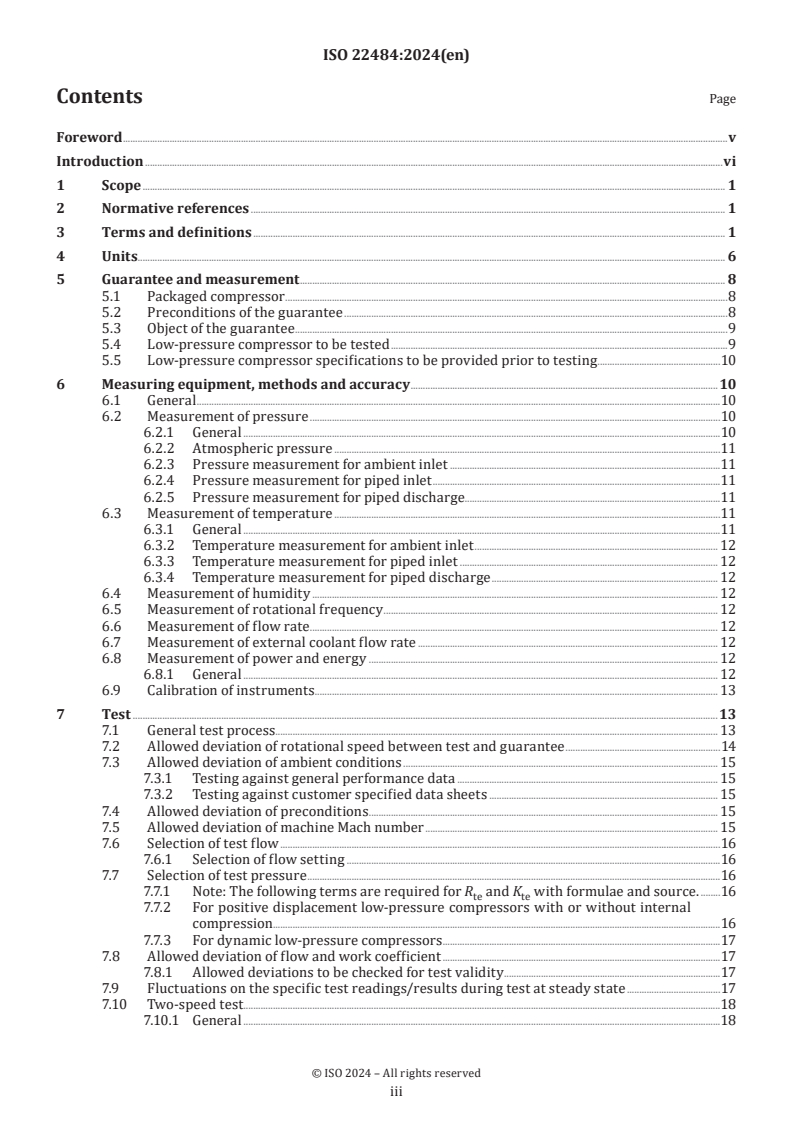
Contents Page
Foreword .v
Introduction .vi
1 Scope . 1
2 Normative references . 1
3 Terms and definitions . 1
4 Units. 6
5 Guarantee and measurement . 8
5.1 Packaged compressor .8
5.2 Preconditions of the guarantee .8
5.3 Object of the guarantee .9
5.4 Low-pressure compressor to be tested .9
5.5 Low-pressure compressor specifications to be provided prior to testing .10
6 Measuring equipment, methods and accuracy . 10
6.1 General .10
6.2 Measurement of pressure .10
6.2.1 General .10
6.2.2 Atmospheric pressure .11
6.2.3 Pressure measurement for ambient inlet .11
6.2.4 Pressure measurement for piped inlet .11
6.2.5 Pressure measurement for piped discharge.11
6.3 Measurement of temperature .11
6.3.1 General .11
6.3.2 Temperature measurement for ambient inlet . 12
6.3.3 Temperature measurement for piped inlet . 12
6.3.4 Temperature measurement for piped discharge . 12
6.4 Measurement of humidity . 12
6.5 Measurement of rotational frequency . 12
6.6 Measurement of flow rate . 12
6.7 Measurement of external coolant flow rate . 12
6.8 Measurement of power and energy . 12
6.8.1 General . 12
6.9 Calibration of instruments. 13
7 Test .13
7.1 General test process . . 13
7.2 Allowed deviation of rotational speed between test and guarantee .14
7.3 Allowed deviation of ambient conditions . 15
7.3.1 Testing against general performance data . 15
7.3.2 Testing against customer specified data sheets . 15
7.4 Allowed deviation of preconditions . . 15
7.5 Allowed deviation of machine Mach number . 15
7.6 Selection of test flow .16
7.6.1 Selection of flow setting .16
7.7 Selection of test pressure .16
7.7.1 Note: The following terms are required for R and K with formulae and source. .16
te te
7.7.2 For positive displacement low-pressure compressors with or without internal
compression . . .16
7.7.3 For dynamic low-pressure compressors .17
7.8 Allowed deviation of flow and work coefficient .17
7.8.1 Allowed deviations to be checked for test validity .17
7.9 Fluctuations on the specific test readings/results during test at steady state .17
7.10 Two-speed test.18
7.10.1 General .18
iii
7.10.2 First test .18
7.10.3 Second test .18
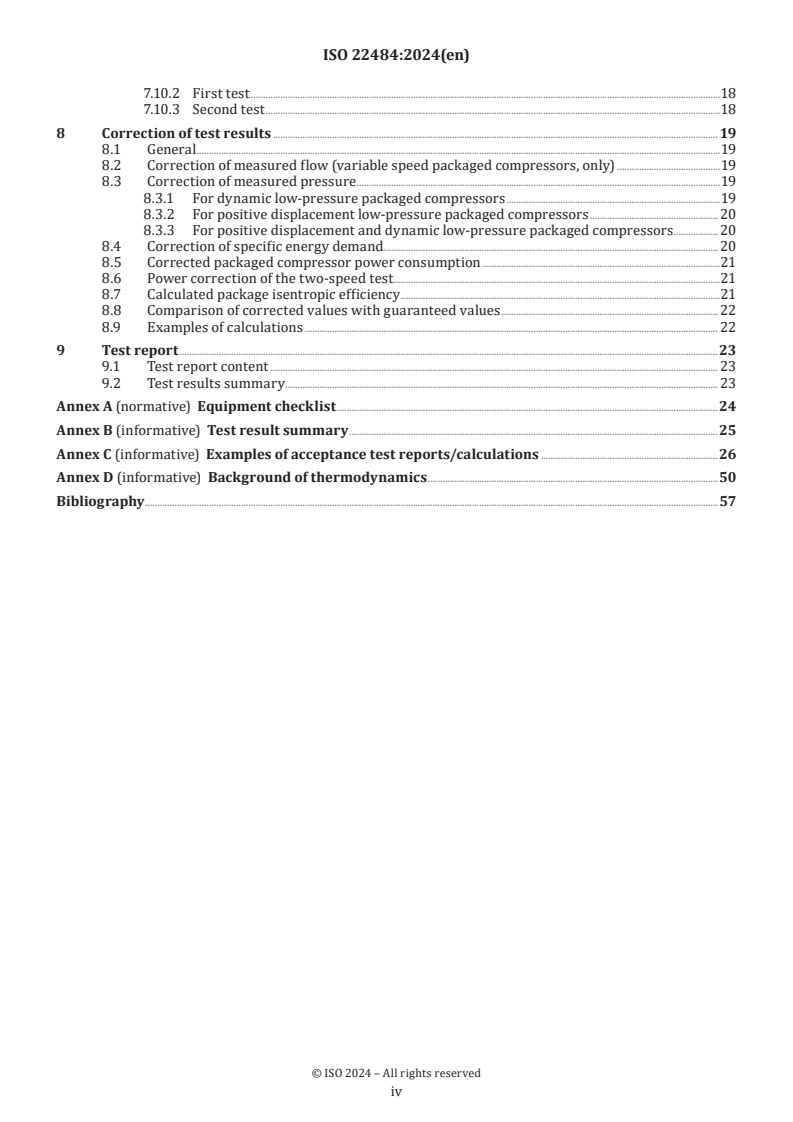
8 Correction of test results . 19
8.1 General .19
8.2 Correction of measured flow (variable speed packaged compressors, only) .19
8.3 Correction of measured pressure . .19
8.3.1 For dynamic low-pressure packaged compressors .19
8.3.2 For positive displacement low-pressure packaged compressors . 20
8.3.3 For positive displacement and dynamic low-pressure packaged compressors . 20
8.4 Correction of specific energy demand . 20
8.5 Corrected packaged compressor power consumption .21
8.6 Power correction of the two-speed test.21
8.7 Calculated package isentropic efficiency .21
8.8 Comparison of corrected values with guaranteed values . 22
8.9 Examples of calculations . 22
9 Test report .23
9.1 Test report content . 23
9.2 Test results summary . . 23
Annex A (normative) Equipment checklist .24
Annex B (informative) Test result summary .25
Annex C (informative) Examples of acceptance test reports/calculations .26
Annex D (informative) Background of thermodynamics .50
Bibliography .57
iv
Foreword
ISO (the International Organization for Standardization) is a worldwide federation of national standards
bodies (ISO member bodies). The work of preparing International Standards is normally carried out through
ISO technical committees. Each member body interested in a subject for which a technical committee
has been established has the right to be represented on that committee. International organizations,
governmental and non-governmental, in liaison with ISO, also take part in the work. ISO collaborates closely
with the International Electrotechnical Commission (IEC) on all matters of electrotechnical standardization.
The procedures used to develop this document and those intended for its further maintenance are described
in the ISO/IEC Directives, Part 1. In particular, the different approval criteria needed for the different types
of ISO document should be noted. This document was drafted in accordance with the editorial rules of the
ISO/IEC Directives, Part 2 (see www.iso.org/directives).
ISO draws attention to the possibility that the implementation of this document may involve the use of (a)
patent(s). ISO takes no position concerning the evidence, validity or applicability of any claimed patent
rights in respect thereof. As of the date of publication of this document, ISO had not received notice of (a)
patent(s) which may be required to implement this document. However, implementers are cautioned that
this may not represent the latest information, which may be obtained from the patent database available at
www.iso.org/patents. ISO shall not be held responsible for identifying any or all such patent rights.
Any trade name used in this document is information given for the convenience of users and does not
constitute an endorsement.
For an explanation of the voluntary nature of standards, the meaning of ISO specific terms and expressions
related to conformity assessment, as well as information about ISO's adherence to the World Trade
Organization (WTO) principles in the Technical Barriers to Trade (TBT), see www.iso.org/iso/foreword.html.
This document was prepared by Technical Committee ISO/TC 118, Compressors and pneumatic tools,
machines and equipment, Subcommittee SC 6 Air compressors and compressed air systems.
Any feedback or questions on this document should be directed to the user’s national standards body. A
complete listing of these bodies can be found at www.iso.org/members.html.
v
Introduction
This document was developed in response to a recognized need to provide a methodology to correct
performance of a low-pressure air compressor to guarantee conditions for positive displacement and
dynamic compression types.
1)
In dynamic compression, air is drawn between the blades on a rapid rotating compression impeller and
accelerates to high velocity. The gas is then discharged through a diffuser, where the kinetic energy is
transformed into static pressure. Dynamic low-pressure compressors are of a radial flow design, with the
following typical examples:
— single-stage centrifugal (aka high speed “turbo”) compressors;
— multi-stage centrifugal compressors without intercooling.
Positive displacement low-pressure compressors work on the principle of trapping a volume of air and
reducing its volume, internally or externally. Two basic types are typical, as follows:
— Rotary screw positive displacement compressor where air is drawn into a compression chamber formed
by intermeshing rotors . As the rotors turn, the cavity between the rotors becomes smaller, reducing the
volume of the trapped air and increasing its pressure;
— Rotary lobe positive displacement compressor where air is drawn into the case and is trapped between
the rotor and the case wall. These air pockets are progressively moved to the discharge port. At the
discharge port, a back flow of air into the pocket from the higher-pressure discharge line produces a
constant volume pressure rise.
Existing standards (e.g. ISO 1217, ISO 5389, ISO 18740) for positive displacement compressors and dynamic
compressors, do not provide clear and concise means of comparing different technologies.
This document provides simplified wire to air performance test methods that measure true performance of
low-pressure air compressor packages.
1) In this document the terms “rotor” and “impeller” are used to describe the rotating element(s) which cause(s)
compression, and can be considered to be interchangeable.
vi
International Standard ISO 22484:2024(en)
Displacement and dynamic compressors — Performance
test code for electric driven low-pressure air compressor
packages
1 Scope
This document specifies the performance test method of electrically driven low-pressure air compressor
packages, where the compression is performed by positive displacement or dynamic compression; utilising
atmospheric air as the compression gas. Low-pressure air compressor packages are often referred to as
“blowers”.
NOTE Throughout this document, the term ‘low-pressure compressor’ is used to describe a low-pressure air
compressor (“blower”) package
Low-pressure compressors with and without means of controlling flow (control may be electrical (e.g. with
a variable frequency drive) or mechanical or both) are covered.
This document applies to low-pressure compressors meeting all the following limits:
— Atmospheric inlet air pressure between 0,5 bar and 1,1 bar.
— Discharge vs inlet pressure differential between 0,1 bar and 2,5 bar.
— Discharge vs inlet pressure ratio between 1,1 and 3,5.
This document is not applicable to:
— positive displacement low-pressure compressors with a liquid in the compression element (such as liquid
ring pumps and liquid injected low-pressure compressor of screw type)
— multi-stage low-pressure compressors other than multistage centrifugal compressors comprised of
multiple, identical or very similar uncooled sections along a single shaft (repeating stages).
— single shaft, multistage centrifugal compressors are treated from the point of measurement and
calculation as a single stage
2 Normative references
The following documents are referred to in the text in such a way that some or all of their content constitutes
requirements of this document. For dated references, only the edition cited applies. For undated references,
the latest edition of the referenced document (including any amendments) applies.
ISO 5167-1, Measurement of fluid flow by means of pressure differential devices inserted in circular cross-section
conduits running full — Part 1: General principles and requirements
ISO 9300, Measurement of gas flow by means of critical flow nozzles
ISO 17089-1, Measurement of fluid flow in closed conduits — Ultrasonic meters for gas — Part 1: Meters for
custody transfer and allocation measurement
3 Terms and definitions
For the purposes of this document, the following terms and definitions apply.
ISO and IEC maintain terminology databases for use in standardization at the following addresses:
— ISO Online browsing platform: available at https:// www .iso .org/ obp
— IEC Electropedia: available at https:// www .electropedia .org/
3.1
acceptance test
performance test carried out in accordance with this document
Note 1 to entry: See Annex C for an example of acceptance test report.
3.2
displacement compressor
packaged compressor where a static pressure rise is obtained by allowing successive volumes of gas to be
aspired into and exhausted out of a closed space by means of the displacement of a moving member
[SOURCE: ISO 5390:1977, 3.1]
3.3
dynamic compressor
packaged compressor in which the fluid pressure increase is obtained by transformation of kinetic energy
into potential energy with continuous flow from intake point to discharge point
[SOURCE: ISO 5390:1977, 3.2]
3.4
external coolant
medium externally supplied to the compressor to which the generated heat is finally rejected
Note 1 to entry: This is usually ambient air or cooling water
[SOURCE: ISO 1217:2009, 3.1.7]
3.5
packaged compressor
compressor with prime mover, transmission, fully piped and wired internally, including ancillary and
auxiliary items of equipment where these are within the scope of supply
[SOURCE: ISO 1217:2009, 3.1.13]
3.6
isentropic compression
idealized (i.e. reversible) adiabatic thermodynamic compression process that occurs without transfer of
heat into or out of a system
3.7
rotational speed
number of revolutions of the compressor drive shaft per unit of time
[SOURCE: ISO 1217:2009, 3.1.18]
3.8
process air inlet point
point upstream of any technically required component
Note 1 to entry: In the case in which a technically required component is not physically present during the test the
impact of the component on performance shall be accounted for
3.9
process air discharge point
point downstream of any technically required component
Note 1 to entry: In the case in which a technically required component is not physically present during the test the
impact of the component on performance shall be accounted for
3.10
guarantee conditions
site conditions for which the equipment is expected to perform. Typically, this will include atmospheric
pressure and ambient temperature
3.11
absolute pressure
pressure with reference to absolute zero, i.e. with reference to an absolute vacuum
Note 1 to entry: It equals the algebraic sum of atmospheric pressure and gauge pressure (static pressure or total
pressure).
[SOURCE: ISO 3857-1:1977, 1.3, modified — The second sentence was moved as a note.]
3.12
ambient pressure
absolute pressure (3.11) of the atmospheric air measured in the vicinity of the compressor
[SOURCE: ISO 1217:2009, 3.2.2]
3.13
atmospheric pressure
absolute pressure (3.11) of the atmospheric air measured at the test place
[SOURCE: ISO 1217:2009, 3.2.3]
3.14
discharge pressure
total mean absolute pressure (3.11) at the process air discharge point (3.9)
3.15
inlet pressure
total mean absolute pressure (3.11) at the standard process air inlet point (3.8)
3.16
total pressure
pressure measured at the stagnation point when a gas stream is brought to rest and its kinetic energy is
converted by an isentropic compression (3.6) from the flow condition to the stagnation condition
[SOURCE: ISO 1217:2009, 3.2.9]
3.17
ambient temperature
total temperature (3.20) of the atmospheric air in the vicinity of the compressor, but unaffected by it
[SOURCE: ISO 1217:2009, 3.3.1]
3.18
discharge temperature
total temperature (3.20) at the process air discharge point (3.9)
3.19
inlet temperature
total temperature (3.21) at the standard process air inlet point (3.8)
3.20
total temperature
temperature that would be measured at the stagnation point if a gas stream were brought to rest and
its kinetic energy converted by an isentropic compression (3.6) from the flow condition to the stagnation
condition
[SOURCE: ISO 1217:2009, 3.3.4]
3.21
relative humidity
ratio, in humid air, expressed as a percentage, of the water vapour actual pressure to the saturated vapour
pressure at the same dry bulb temperature
p
ϕ=
p
sat
where p is partial pressure (ISO 80000-4:2019, item 4-14.1) of vapour and p is its partial pressure at
sat
saturation (at the same temperature)
[SOURCE: ISO 80000-5:2019, 5-33]
3.22
isentropic exponent
ratio of the specific heat at constant pressure to the specific heat at constant volume
3.23
actual volume flow rate
volume flow rate of air, compressed and delivered at the standard discharge point, referred to conditions of
total temperature (3.20), total pressure and composition prevailing at the standard inlet point
3.24
isentropic power
power that is theoretically required to compress an ideal gas under constant entropy, from given inlet
conditions to a given discharge pressure (3.14)
Note 1 to entry: The term “ideal gas” is used to indicate any gas in a condition or state so that it follows closely the
ideal gas law
[SOURCE: ISO 1217:2009/Amd.1:2016, 3.5.1]
3.25
isentropic efficiency
ratio of the required isentropic power (3.24) to measured power for the same specified boundaries with the
same gas and the same inlet conditions and discharge pressure (3.14)
P
isen
η =
isen
P
real
[SOURCE: ISO 1217:2009/Amd.1:2016, 3.6.1]
3.26
power input
sum of the electrical power inputs to the prime mover and any ancillaries and auxiliaries driven from
the compressor shaft or by a separate prime mover at rated supply conditions, including the effect of all
equipment included in the packaged compressor (3.5)
Note 1 to entry: Auxiliaries include oil pump, cooling fan and integral compressed air dryer
Note 2 to entry: Rated supply conditions refer to phase, voltage, frequency and ampere capability
[SOURCE: ISO 1217:2009, 3.5.3]
3.27
specific energy requirement
power input (3.26) per unit of compressor actual volume flow rate
[SOURCE: ISO 1217:2009, 3.7.2]
3.28
specific isentropic compression work
work expressed as energy per unit mass of air during isentropic compression (3.6)
3.29
specific isochoric compression work
work expressed as energy per unit mass of air during isochoric compression
3.30
specific combined compression work
sum of the specific isentropic compression work (3.28) and specific isochoric compression work (3.29), weighted
by the internal volume ratio
3.31
internal volume ratio
ratio of the enclosed volume at moment of closure of the inlet port to the enclosed volume at the moment of
opening of the discharge port for a positive displacement compressor (3.2)
3.32
rotor tip speed
peripheral speed at the largest rotor/impeller tip diameter
3.33
machine Mach number
ratio of the rotor tip speed to the speed of sound of the fluid inlet state at inlet conditions
3.34
accounted for value
means (measured/estimated/calculated/corrected) – a simulated or calculated substitute characteristic of
components not available for the test, for example; the pressure drop of a remote air filter
3.35
idle power consumption
total consumed power when the packaged compressor (3.5) is not producing flow to the discharge but is
rotating at significant speed. i.e. for packaged compressor (3.5) equipped with idling functionality
3.36
standby power consumption
power required to keep the packaged compressor (3.5) ready for immediate start from non-rotating state
3.37
flow coefficient
flow velocity formed from the inlet volume flow and an impeller cross-section area and rendered
dimensionless by the tip speed of the impeller
3.38
work coefficient
specific compression work of the reference process rendered dimensionless by the kinetic energy of tip speed
3.39
reduced speed
alternate test speed used to achieve ratio of Mach number for contract to test equal to one
3.40
two speed test
combination of one test to determine the thermodynamic performance and one test to determine the
electromechanical performance
3.41
package motor
item(s) that is a part of the packaged compressor (3.5) including any additional drive train components
3.42
test motor
item(s) that replaces the package motor (3.41) for testing
3.43
shaft power
mechanical input power at the rotor/impeller
3.44
electromechanical
part of the total losses, total power consumption or total efficiency, that is not the result of the compression
work on the gas
Note 1 to entry: This shall include the impact on said values from motor(s), control(s), gear(s), bearing(s), seal(s) and
all auxiliaries (e.g. fans and pumps), whether said components are mounted on or related to the driver(s), compression
element(s) or part of the package.
4 Units
General use of SI units (see ISO 80000-1) as given throughout this document is recommended, see Table 1
and Table 2. However, in agreement with accepted practice in the pneumatic industry sector, some non-
preferred SI units, accepted by ISO, are also used, see
Table 1 — List of symbols
Symbol Term SI unit
c sonic velocity m/s
c specific heat capacity J/(kg·K)
p
D the largest rotor/impeller tip diameter m
e specific energy J/m
h specific enthalpy J/kg
Ma machine Mach number —
M molar mass kg/mol
m mass kg
q mass flow kg/s
m
n rotational speed 1/s
P power W
p pressure Pa
R specific gas constant J/(kg·K)
Re Reynolds number —
s specific entropy J/(kg·K)
T thermodynamic temperature K
t Celsius temperature °C
U supply voltage V
u tip speed m/s
TTabablele 1 1 ((ccoonnttiinnueuedd))
Symbol Term SI unit
v specific volume m /kg
v internal volume ratio —
i
V volume m
q volume flow m /s
V
X ratio of reduced speeds of rotation —
n
x mass ratio of water vapour to dry gas kg/kg
y specific compression work J/kg
Δ difference —
η efficiency —
ϑ ratio of (RZ1 T1) values —
κ ratio of specific heat capacities (isentropic exponent) —
π pressure ratio —
ρ density kg/m
ϕ ratio of volume flow rate ratios —
φ flow coefficient —
φ relative humidity —
rel
ψ work coefficient —
σ standard deviation —
Table 2 — List of subscripts used in this document
Subscript Term
0 ambient
1 inlet (suction side)
2 discharge (discharge side)
air dry air
abs absolute (pressure)
amb ambient (air, temperature)
co corrected to guarantee conditions
cog corrected to the pressure ratio and inlet volume flow of the guarantee point
comb combined
cool coolant
d dynamic
em electromechanical
dry dry
g guarantee conditions or performance data at guarantee conditions
i internal or intermediate
isoc isochoric
ideal according to an ideal thermodynamic process
out output
pack Packaged compressor boundary
Pr reference or standard process
red reduced speed
ref reference value
rel relative
TTabablele 2 2 ((ccoonnttiinnueuedd))
Subscript Term
s isentropic
sat saturated
st static
target target
te test result
te1 first test in 2-speed testing
te2 second test in 2-speed testing
tol permissible deviation
tot total
u tip or peripheral
vap vapour, vapor, steam
wet moist
idle idle
standby standby
5 Guarantee and measurement
5.1 Packaged compressor
The packaged compressor shall comprise all components that are necessary for the long-term functioning of
the low-pressure compressor under guarantee conditions and are needed to fulfil the object of the guarantee
and the preconditions of the guarantee:
— low-pressure compressor with drive system;
— variable frequency drive (as applicable);
— cooling/lubrication system;
— inlet filter;
— inlet valve/guide vanes (as applicable);
— bearing power supply (as applicable);
— fully piped and wired internally;
— including ancillary and auxiliary items of equipment and all power devices that affect power consumption.
5.2 Preconditions of the guarantee
If no preconditions are defined in the contract, the preconditions of the guarantee shall be applied in
accordance with Table 3 below.
For testing to be possible, at least the following shall be specified as the preconditions of the guarantee:
— air inlet pressure;
— air inlet temperature;
— air inlet humidity;
— coolant inlet temperature;
— coolant flow;
— supply voltage;
— supply frequency.
NOTE Air inlet pressure, air inlet temperature, air inlet humidity and coolant inlet temperature can be taken from
the default conditions in Table 3.
Table 3 — Reference conditions
Default inlet condition Value
a
Inlet air pressure 100 kPa
Inlet air temperature 20 °C
Inlet relative humidity 0 %
Temperature of the coolants at package inlet 20 °C
a
1 bar.
Additional limits can be specified, such as:
— electromagnetic compatibility standard to be fulfilled;
— specified maximum noise level outside the packaged compressor;
— total harmonics distortion on the electrical supply;
— input current supply;
— minimum permissible starts/hour;
— minimum permissible unload cycles/hour;
— allowable pulsation level at the discharge of the packaged compressor;
— filtration grade of the air inlet filter.
5.3 Object of the guarantee
The object of the guarantee is the set of values to be guaranteed within the defined preconditions:
— inlet volume flow rate;
— discharge pressure at the discharge of the packaged compressor;
— specific energy of the packaged compressor for the delivered flow at the guaranteed discharge pressure;
— isentropic efficiency of the packaged compressor for the delivered flow at the guaranteed discharge
pressure;
— idle power consumption;
— standby power consumption.
5.4 Low-pressure compressor to be tested
The low-pressure compressor configuration to be tested shall include all components required to fulfil all
the preconditions.
As a general rule, the configuration of the unit under test shall be identical to the configuration of the unit to
be delivered.
A packaged compressor checklist, such as given in Annex A, shall be completed by the manufacturer and
shall be part of each low-pressure compressor test report. The checklist shall be used to ensure that the
tested packaged compressor matches that specified.
The checklist shall indicate which components and their performance related characteristics are included,
excluded, accounted for value, or not applicable for normal functioning at guarantee conditions.
If any required components are not installed in the test configuration, the correction calculations for these
components shall be shown in conjunction with the checklist.
Ancillaries required for the sustainable operation of the low-pressure packaged compressor, excluding
stand-by ancillaries, are to be in operation.
5.5 Low-pressure compressor specifications to be provided prior to testing
The low-pressure compressor is tested against a specified discharge pressure (at the discharge of the
packaged compressor).
In addition to the preconditions, the reference inlet conditions (or the guarantee inlet conditions) and the
checklist, certain data needs to be provided by the manufacturer before the test event, typically with a
tender to provide the equipment:
— rotational speed at guarantee conditions when the machine is fulfilling the object of the guarantee (for
variable speed machines or if the motor in testing a fixed speed machine can differ from the one to be
used at the site of assembly);
— internal volume ratio for positive displacement low-pressure compressor;
— variable geometry settings (if applicable) for the low-pressure compressor.
6 Measuring equipment, methods and accuracy
6.1 General
The equipment and methods given in this document are not intended to restrict the use of other equipment
and methods with the same or better accuracy. Where an international standard relating to a particular
measurement or type of instrument exists, any measurements carried out or instruments used shall be in
accordance with such an international standard.
All inspection, measuring, test equipment and devices that can affect the test shall be calibrated and adjusted
at prescribed intervals, or prior to use, against certified equipment having a known valid relationship to
nationally recognized standards. The use of data acquisition systems shall be allowed and the test logs may
be print outs resulting from the system.
No measurement uncertainty tolerances are to be taken into account in corrections or acceptance. For
guarantee acceptance, as tested results are treated as measured in comparison to Table 5 without additional
uncertainty tolerances applied.
6.2 Measurement of pressure
6.2.1 General
Pressure taps in the pipe or receiver shall be normal to, and flush with, the inside wall. A minimum of two
static or total pressure-measuring instruments shall be utilized for each measurement location spaced at
180° intervals around the pipe circumference, and 90° to temperature instrumentation
NOTE For low pressures or high flow velocities, minor irregularities such as burrs can lead to serious error.
Connecting piping shall be leak-free, as short as possible, of sufficient diameter and arranged to avoid
blockage by dirt or condensed liquid. For measurement of liquid pressure or pressure of liquid-gas mixtures,
the instrument shall be mounted at the same height as the measuring point and the connecting piping shall
be arranged so that the height of liquid columns in the piping exerts no influence. Otherwise, account shall
be taken of the difference in height.
Instruments shall be mounted so that they are not susceptible to disturbing vibrations.
The measuring instrument (analogue or digital) shall have an accuracy of ±1 % at the measured value.
The pressure measurement shall be a total measurement, or static measurement corrected to total
conditions.
For definitions of static, dynamic and total measurements refer to ISO 5389:2005, 5.2 and 5.3.
6.2.2 Atmospheric pressure
The absolute atmospheric pressure shall be measured with a barometer having an accuracy better than
±0,15 %.
6.2.3 Pressure measurement for ambient inlet
The compressor package inlet pressure, p , is the atmospheric pressure measured by a barometer near the
compressor package where the velocity is zero.
6.2.4 Pressure measurement for piped inlet
The pressure is the total pressure, p , measured at the process air inlet point. The pressure shall be measured
at a location at least one pipe diameter upstream of the inlet.
6.2.5 Pressure measurement for piped discharge
The pressure is the total pressure, p , measured at the process air discharge point. The pressure shall be
measured at a location at least two pipe diameters downstream of the discharge.
6.3 Measurement of temperature
6.3.1 General
Temperature shall be measured by certified or calibrated instruments such as thermometers, thermo-
electrical instruments, resistance thermometers or thermistors having an accuracy of ±0,5 K inserted into
the pipe or into pockets.
A minimum of two temperature-measuring instruments shall be used for each measurement location. For
measurements made on piping these shall be spaced at 180° intervals around the pipe circumference.
Thermometer pockets shall be as thin, and their diameters as small, as is practical, with their outside surface
substantially free from corrosion or oxide. The pocket shall be partially filled with a suitable liquid.
The thermometers or the pockets shall extend into the pipe to a distance of 100 mm, or one third the
diameter of the pipe, whichever is less.
When taking readings, the thermometer shall not be lifted out of the medium being measured nor out of the
pocket when one is used.
Precautions shall be taken to ensure that the:
— immediate vicinity of the insertion point and the projecting parts of the connection are well insulated so
that the pocket is virtually at the same temperature as the medium being observed;
— sensor of any temperature measuring device or thermometer pocket is well swept by the medium
(the sensor or thermometer pocket shall point against the gas stream; in extreme cases a position
perpendicular to the gas stream may be used);
— thermometer pocket does not disturb the normal flow.
6.3.2 Temperature measurement for ambient inlet
The packaged compressor ambient temperature is the atmospheric temperature measured at the packaged
compressor in the plane of the intake system.
6.3.3 Temperature measurement for piped inlet
The inlet temperature is the total temperature, T , measured at the process air inlet point. The temperature
instrumentation shall be located at half of one pipe diameter upstream of the inlet.
6.3.4 Temperature measurement for piped discharge
The discharge temperature is the total temperature, T , measured at the process air discharge point. The
temperature instrumentation shall be located one pipe diameter downstream of the discharge and 90°
relatively rotated to the pressure measurement.
6.4 Measurement of humidity
If the gas contains moisture, the humidity shall be checked during the test. The humidity shall be measured
at the process air inlet point with an instrument having an accuracy of ±3 % or better.
6.5 Measurement of rotational frequency
Rotational speed shall be determined by using methods that have an accuracy of ±0,2 % or better.
6.6 Measurement of flow rate
The actual volume flow rate is the net mass flow rate through the process connection of the packaged
compressor discharge. All seal losses and side streams not delivered to the process piping connection of the
packaged compressor shall be
...