


ISO/FDIS 14644-15
(Main)Cleanrooms and associated controlled environments — Part 15: Assessment of suitability for use of equipment and materials by airborne chemical concentration
Cleanrooms and associated controlled environments — Part 15: Assessment of suitability for use of equipment and materials by airborne chemical concentration
ISO 14644-15:2017 provides requirements and guidelines for assessing the chemical airborne cleanliness of equipment and materials which are foreseen to be used in cleanrooms and associated controlled environments which are linked to the ISO standard for cleanliness classes by chemical concentration (see ISO 14644‑8). The following are outside the scope of ISO 14644-15:2017: - health and safety requirements; - compatibility with cleaning agents and techniques; - cleanability; - biocontamination; - specific requirements of equipment and materials for processes and products; - design details of equipment.
Salles propres et environnements maîtrisés apparentés — Partie 15: Évaluation de l'aptitude à l'emploi des équipements et des matériaux par la détermination de la concentration chimique aéroportée
L'ISO 146444-15 :2017 fournit des exigences et des lignes directrices relatives à l'évaluation de la propreté chimique de l'air d'équipements et de matériaux destinés à être utilisés dans des salles propres et des environnements maîtrisés apparentés. Ces exigences et lignes directrices sont liées à la norme ISO relative aux classes de propreté chimique (voir l'ISO 14644‑8). Les aspects suivants ne font pas partie du domaine d'application: - exigences de santé et de sécurité; - compatibilité avec les agents et les techniques de nettoyage; - nettoyabilité; - biocontamination; - exigences spécifiques applicables aux équipements et matériaux en ce qui concerne des procédés et des produits; - détails de la conception des équipements.
General Information
- Status
- Not Published
- Technical Committee
- ISO/TC 209 - Cleanrooms and associated controlled environments
- Drafting Committee
- ISO/TC 209 - Cleanrooms and associated controlled environments
- Current Stage
- 5060 - Close of voting Proof returned by Secretariat
- Start Date
- 07-Feb-2026
- Completion Date
- 06-Feb-2026
Relations
- Effective Date
- 12-Feb-2026
- Effective Date
- 12-Apr-2025
- Effective Date
- 15-Mar-2025
Overview
ISO/FDIS 14644-15 (ISO 14644‑15) specifies requirements and guidelines for assessing the suitability of equipment and materials for use in cleanrooms and associated controlled environments by measuring airborne chemical concentration (ACC). It is intended to support the ISO 14644 series' approach to chemical cleanliness and is linked directly to ISO 14644‑8 (assessment of air cleanliness by chemical concentration). The standard defines test setups, measurement and calculation methods, and documentation needed to determine whether a given item will meet the ACC requirements of a cleanroom or controlled zone.
Key topics and requirements
- Scope and exclusions: Covers assessment of chemical airborne cleanliness of equipment and materials. explicitly excludes health & safety, compatibility with cleaning agents/techniques, cleanability, biocontamination, product/process‑specific requirements, and equipment design details.
- Test setup and modes: Describes general testing configurations for closed and open designs and how to select a representative operating mode for equipment or a representative condition for materials.
- Visual inspection: Defines visual checks to identify obvious contamination sources prior to testing.
- Measurement and calculations:
- Procedures for measuring airborne concentrations of non‑particulate chemical species.
- Calculation of measured concentrations and specific emission rate for closed and open designs.
- Method to calculate the impact of emissions on an existing or planned cleanroom/controlled zone.
- Assessment criteria: Guidance to determine suitability for use based on ACC levels and the effect of emissions on the target cleanliness level.
- Documentation: Required records for test conditions, results, calculations and visual inspection. Annexes provide worked example calculations for equipment, wall and floor materials, and combined scenarios.
Applications and users
Practical applications include selecting, qualifying and accepting equipment and building materials for contamination‑sensitive environments in industries such as:
- Microelectronics and semiconductor manufacturing
- Pharmaceuticals and medical device production
- Optics, aerospace, nuclear, and life sciences Users who benefit from ISO 14644‑15:
- Cleanroom validation and QA engineers
- Facilities and contamination control engineers
- Purchasing/procurement teams evaluating supplier materials
- Material and equipment manufacturers providing cleanroom‑compatible products
- Regulatory and compliance professionals documenting suitability
Related standards
- ISO 14644‑8 - Assessment of air cleanliness by chemical concentration (ACC): primary companion standard for chemical cleanliness criteria.
- Other parts of the ISO 14644 series, which address particulate cleanliness, testing, and cleanroom design/operation.
Keywords: ISO 14644‑15, cleanrooms, airborne chemical concentration, ACC, equipment suitability assessment, specific emission rate, ISO 14644‑8, cleanroom contamination control.

ISO/FDIS 14644-15 - Cleanrooms and associated controlled environments — Part 15: Assessment of suitability for use of equipment and materials by airborne chemical concentration Released:31. 10. 2025


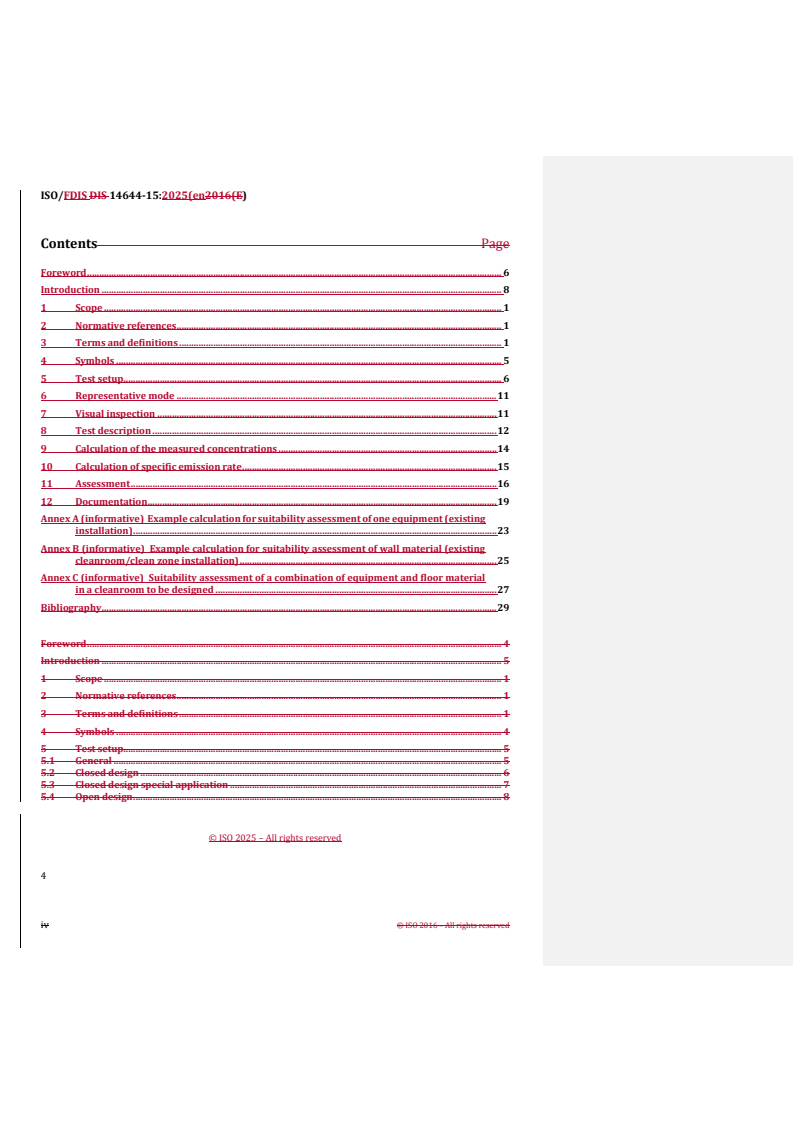
REDLINE ISO/FDIS 14644-15 - Cleanrooms and associated controlled environments — Part 15: Assessment of suitability for use of equipment and materials by airborne chemical concentration Released:31. 10. 2025
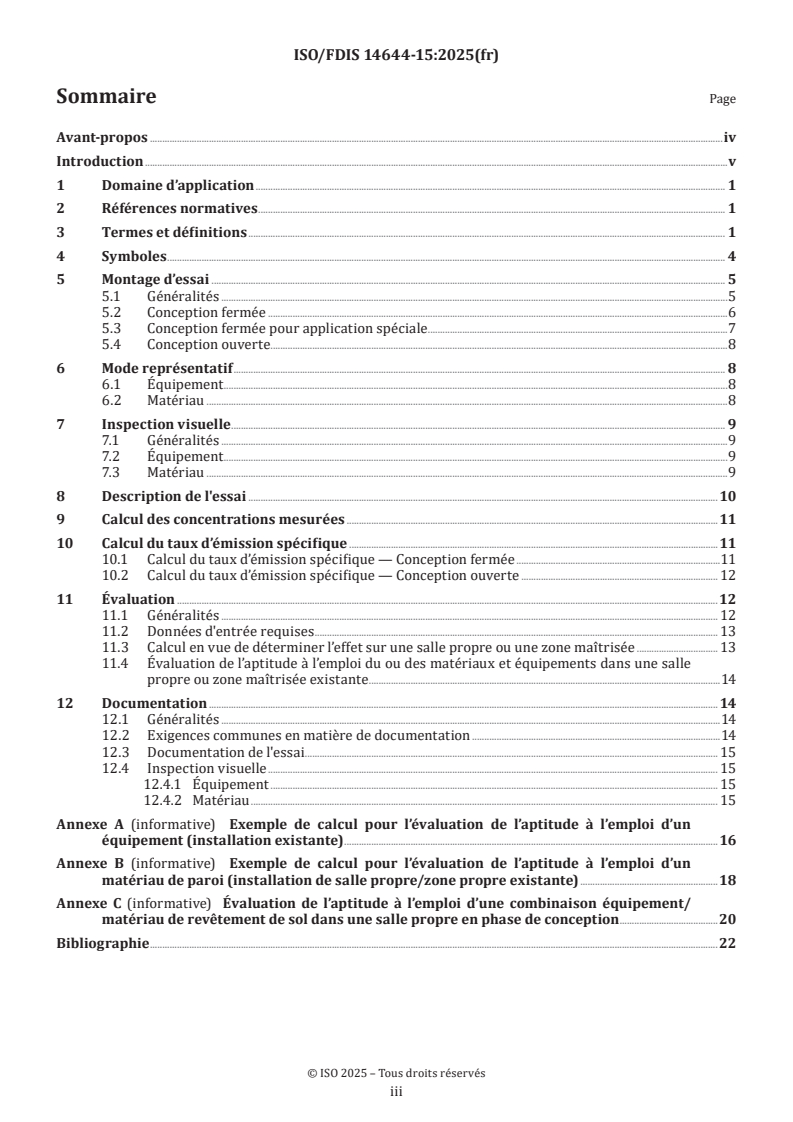
ISO/FDIS 14644-15 - Salles propres et environnements maîtrisés apparentés — Partie 15: Évaluation de l'aptitude à l'emploi des équipements et des matériaux par la détermination de la concentration chimique aéroportée Released:11/25/2025
Get Certified
Connect with accredited certification bodies for this standard

NSF International
Global independent organization facilitating standards development and certification.

CIS Institut d.o.o.
Personal Protective Equipment (PPE) certification body. Notified Body NB-2890 for EU Regulation 2016/425 PPE.

Kiwa BDA Testing
Building and construction product certification.
Sponsored listings
Frequently Asked Questions
ISO/FDIS 14644-15 is a draft published by the International Organization for Standardization (ISO). Its full title is "Cleanrooms and associated controlled environments — Part 15: Assessment of suitability for use of equipment and materials by airborne chemical concentration". This standard covers: ISO 14644-15:2017 provides requirements and guidelines for assessing the chemical airborne cleanliness of equipment and materials which are foreseen to be used in cleanrooms and associated controlled environments which are linked to the ISO standard for cleanliness classes by chemical concentration (see ISO 14644‑8). The following are outside the scope of ISO 14644-15:2017: - health and safety requirements; - compatibility with cleaning agents and techniques; - cleanability; - biocontamination; - specific requirements of equipment and materials for processes and products; - design details of equipment.
ISO 14644-15:2017 provides requirements and guidelines for assessing the chemical airborne cleanliness of equipment and materials which are foreseen to be used in cleanrooms and associated controlled environments which are linked to the ISO standard for cleanliness classes by chemical concentration (see ISO 14644‑8). The following are outside the scope of ISO 14644-15:2017: - health and safety requirements; - compatibility with cleaning agents and techniques; - cleanability; - biocontamination; - specific requirements of equipment and materials for processes and products; - design details of equipment.
ISO/FDIS 14644-15 is classified under the following ICS (International Classification for Standards) categories: 13.040.35 - Cleanrooms and associated controlled environments. The ICS classification helps identify the subject area and facilitates finding related standards.
ISO/FDIS 14644-15 has the following relationships with other standards: It is inter standard links to prEN ISO 14644-15, ISO 5712:2022, ISO 14644-15:2017. Understanding these relationships helps ensure you are using the most current and applicable version of the standard.
ISO/FDIS 14644-15 is available in PDF format for immediate download after purchase. The document can be added to your cart and obtained through the secure checkout process. Digital delivery ensures instant access to the complete standard document.
Standards Content (Sample)
FINAL DRAFT
International
Standard
ISO/TC 209
Cleanrooms and associated
Secretariat: ANSI
controlled environments —
Voting begins on:
Part 15:
2025-11-14
Assessment of suitability for use
Voting terminates on:
of equipment and materials by
2026-02-06
airborne chemical concentration
Salles propres et environnements maîtrisés apparentés —
Partie 15: Évaluation de l'aptitude à l'emploi des équipements et
des matériaux par la détermination de la concentration chimique
aéroportée
RECIPIENTS OF THIS DRAFT ARE INVITED TO SUBMIT,
WITH THEIR COMMENTS, NOTIFICATION OF ANY
RELEVANT PATENT RIGHTS OF WHICH THEY ARE AWARE
AND TO PROVIDE SUPPOR TING DOCUMENTATION.
IN ADDITION TO THEIR EVALUATION AS
BEING ACCEPTABLE FOR INDUSTRIAL, TECHNO-
ISO/CEN PARALLEL PROCESSING LOGICAL, COMMERCIAL AND USER PURPOSES, DRAFT
INTERNATIONAL STANDARDS MAY ON OCCASION HAVE
TO BE CONSIDERED IN THE LIGHT OF THEIR POTENTIAL
TO BECOME STAN DARDS TO WHICH REFERENCE MAY BE
MADE IN NATIONAL REGULATIONS.
Reference number
FINAL DRAFT
International
Standard
ISO/TC 209
Cleanrooms and associated
Secretariat: ANSI
controlled environments —
Voting begins on:
Part 15:
Assessment of suitability for use
Voting terminates on:
of equipment and materials by
airborne chemical concentration
Salles propres et environnements maîtrisés apparentés —
Partie 15: Évaluation de l'aptitude à l'emploi des équipements et
des matériaux par la détermination de la concentration chimique
aéroportée
RECIPIENTS OF THIS DRAFT ARE INVITED TO SUBMIT,
WITH THEIR COMMENTS, NOTIFICATION OF ANY
RELEVANT PATENT RIGHTS OF WHICH THEY ARE AWARE
AND TO PROVIDE SUPPOR TING DOCUMENTATION.
© ISO 2025
IN ADDITION TO THEIR EVALUATION AS
All rights reserved. Unless otherwise specified, or required in the context of its implementation, no part of this publication may
BEING ACCEPTABLE FOR INDUSTRIAL, TECHNO-
ISO/CEN PARALLEL PROCESSING
LOGICAL, COMMERCIAL AND USER PURPOSES, DRAFT
be reproduced or utilized otherwise in any form or by any means, electronic or mechanical, including photocopying, or posting on
INTERNATIONAL STANDARDS MAY ON OCCASION HAVE
the internet or an intranet, without prior written permission. Permission can be requested from either ISO at the address below
TO BE CONSIDERED IN THE LIGHT OF THEIR POTENTIAL
or ISO’s member body in the country of the requester.
TO BECOME STAN DARDS TO WHICH REFERENCE MAY BE
MADE IN NATIONAL REGULATIONS.
ISO copyright office
CP 401 • Ch. de Blandonnet 8
CH-1214 Vernier, Geneva
Phone: +41 22 749 01 11
Email: copyright@iso.org
Website: www.iso.org
Published in Switzerland Reference number
ii
Contents Page
Foreword .iv
Introduction .v
1 Scope . 1
2 Normative references . 1
3 Terms and definitions . 1
4 Symbols . 4
5 Test setup . 4
5.1 General .4
5.2 Closed design .5
5.3 Closed design special application .6
5.4 Open design .7
6 Representative mode . 7
6.1 Equipment .7
6.2 Material .7
7 Visual inspection . 8
7.1 General .8
7.2 Equipment .8
7.3 Material .8
8 Test description . 9
9 Calculation of the measured concentrations . 9
10 Calculation of specific emission rate . 10
10.1 Calculation of specific emission rate — Closed design.10
10.2 Calculation of specific emission rate — Open design .10
11 Assessment . .11
11.1 General .11
11.2 Required input data .11
11.3 Calculation to determine the effect on a cleanroom or controlled zone . 12
11.4 Assessment of the suitability of material(s) or equipment for an existing cleanroom or
controlled zone . 12
12 Documentation .12
12.1 General . 12
12.2 Common documentation requirements . 13
12.3 Test documentation . . 13
12.4 Visual inspection . 13
12.4.1 Equipment . 13
12.4.2 Materials . 13
Annex A (informative) Example calculation for suitability assessment of one equipment
(existing installation) . 14
Annex B (informative) Example calculation for suitability assessment of wall material (existing
cleanroom/clean zone installation) .16
Annex C (informative) Suitability assessment of a combination of equipment and floor material
in a cleanroom to be designed . 17
Bibliography . 19
iii
Foreword
ISO (the International Organization for Standardization) is a worldwide federation of national standards
bodies (ISO member bodies). The work of preparing International Standards is normally carried out through
ISO technical committees. Each member body interested in a subject for which a technical committee
has been established has the right to be represented on that committee. International organizations,
governmental and non-governmental, in liaison with ISO, also take part in the work. ISO collaborates closely
with the International Electrotechnical Commission (IEC) on all matters of electrotechnical standardization.
The procedures used to develop this document and those intended for its further maintenance are described
in the ISO/IEC Directives, Part 1. In particular, the different approval criteria needed for the different types
of ISO document should be noted. This document was drafted in accordance with the editorial rules of the
ISO/IEC Directives, Part 2 (see www.iso.org/directives).
ISO draws attention to the possibility that the implementation of this document may involve the use of (a)
patent(s). ISO takes no position concerning the evidence, validity or applicability of any claimed patent
rights in respect thereof. As of the date of publication of this document, ISO had not received notice of (a)
patent(s) which may be required to implement this document. However, implementers are cautioned that
this may not represent the latest information, which may be obtained from the patent database available at
www.iso.org/patents. ISO shall not be held responsible for identifying any or all such patent rights.
Any trade name used in this document is information given for the convenience of users and does not
constitute an endorsement.
For an explanation of the voluntary nature of standards, the meaning of ISO specific terms and expressions
related to conformity assessment, as well as information about ISO's adherence to the World Trade
Organization (WTO) principles in the Technical Barriers to Trade (TBT), see www.iso.org/iso/foreword.html.
This document was prepared by Technical Committee ISO/TC 209, Cleanrooms and associated controlled
environments, in collaboration with the European Committee for Standardization (CEN) Technical Committee
CEN/TC 243, Cleanroom technology,in accordance with the Agreement on technical cooperation between ISO
and CEN (Vienna Agreement).
This second edition cancels and replaces the first edition (ISO 14644-15:2017), of which it constitutes a
minor revision. The changes are as follows:
— term class (classification, classified) changed to level or assessment where appropriate and Introduction
reworded to accommodate the change;
— phrase “has to be” changed to “shall be”;
— updated ‘document titles’ and ‘Source’ dates where appropriate;
— removed references not mentioned in the text from the bibliography;
— minor editorial changes.
A list of all parts in the ISO 14644 series can be found on the ISO website.
Any feedback or questions on this document should be directed to the user’s national standards body. A
complete listing of these bodies can be found at www.iso.org/members.html.
iv
Introduction
Cleanrooms and associated controlled environments provide for the control of contamination to levels
appropriate for accomplishing contamination-sensitive activities. Products and processes that benefit from
the control of contamination include those in industries such as aerospace, microelectronics, optics, nuclear,
and life sciences (pharmaceuticals, medical devices, food, healthcare).
The assessment of suitability of equipment for use in cleanrooms and associated controlled environments
is related to the assessment of air cleanliness for chemical contamination. Examples and suitability
assessments are given in Annexes A, B and C.
v
FINAL DRAFT International Standard ISO/FDIS 14644-15:2025(en)
Cleanrooms and associated controlled environments —
Part 15:
Assessment of suitability for use of equipment and materials
by airborne chemical concentration
1 Scope
This document specifies requirements and guidelines for assessing the chemical airborne cleanliness
of equipment and materials which are foreseen to be used in cleanrooms and associated controlled
environments that are linked to the ISO standard for air cleanliness by chemical concentration (see
ISO 14644-8).
This document does not apply to the following:
— health and safety requirements;
— compatibility with cleaning agents and techniques;
— cleanability;
— biocontamination;
— specific requirements of equipment and materials for processes and products;
— design details of equipment.
2 Normative references
The following documents are referred to in the text in such a way that some or all of their content constitutes
requirements of this document. For dated references, only the edition cited applies. For undated references,
the latest edition of the referenced document (including any amendments) applies.
ISO 14644-8:2022, Cleanrooms and associated controlled environments — Part 8: Assessment of air cleanliness
by chemical concentration (ACC)
3 Terms and definitions
For the purposes of this document, the following terms and definitions apply.
ISO and IEC maintain terminology databases for use in standardization at the following addresses:
— ISO Online browsing platform: available at https:// www .iso .org/ obp
— IEC Electropedia: available at https:// www .electropedia .org/
3.1
air cleanliness by chemical concentration
ACC
quantity of chemicals detected in the air, expressed in terms of an ISO-ACC level N, which represents the
maximum allowable concentration of a given chemical species or a group of chemical species, expressed in
grams per cubic metre
Note 1 to entry: This definition does not include macromolecules of biological origin, which are judged to be particles.
[SOURCE: ISO 14644-8:2022, 3.1.2]
3.2
breakthrough volume
maximum purge gas (3.12) volume that can be drawn through a trapping system without loss of analyte at a
specific temperature
3.3
chemical contamination
non-particulate substances that can have a deleterious effect on the product, process or equipment
[SOURCE: ISO 14644-8:2022, 3.1.1]
3.4
cleanliness
condition not exceeding a specified level of contamination
3.5
cleanroom
room within which the number concentration of airborne particles is controlled and classified, and which
is designed, constructed and operated in a manner to control the introduction, generation, and retention of
particles inside the room
Note 1 to entry: The class of airborne particle concentration is specified.
Note 2 to entry: Levels of other cleanliness attributes such as chemical, viable or nanoscale concentrations in the air,
and also surface cleanliness in terms of particle, nanoscale, chemical and viable concentrations may also be specified
and controlled.
Note 3 to entry: Other relevant physical parameters may also be controlled as required, e.g. temperature, humidity,
pressure, vibration and electrostatic.
[SOURCE: ISO 14644-1:2015, 3.1.1]
3.6
clean zone
defined space within which the number concentration of airborne particles is controlled and classified, and
which is constructed and operated in a manner to control the introduction, generation, and retention of
contaminants inside the space
Note 1 to entry: The class of airborne particle concentration is specified.
Note 2 to entry: Levels of other cleanliness attributes such as chemical, viable or nanoscale concentrations in the air,
and also surface cleanliness in terms of particle, nanoscale, chemical and viable concentrations may also be specified
and controlled.
Note 3 to entry: A clean zone(s) may be a defined space within a cleanroom or may be achieved by a separative device.
Such a device may be located inside or outside a cleanroom.
Note 4 to entry: Other relevant physical parameters may also be controlled as required, e.g. temperature, humidity,
pressure, vibration and electrostatic.
[SOURCE: ISO 14644-1:2015, 3.1.2]
3.7
controlled zone
designated space in which the concentration of at least one contamination category (particles, chemical,
biocontamination) in air and/or on surfaces is controlled and specified and which is constructed and used in
a manner to minimize the introduction and impact of contamination
Note 1 to entry: Levels of cleanliness attributes such as chemical and viable concentrations in the air or cleanliness in
terms of particle, chemical and viable concentrations on surfaces may be specified by class(es).
Note 2 to entry: Other relevant parameters may also be controlled as necessary, e.g. temperature, humidity and
pressure, vibration and electrostatic.
Note 3 to entry: A controlled zone can be a defined space within a cleanroom or may be achieved by a separative
device. Such a device may be located inside or outside a cleanroom.
3.8
emission
contaminants that are discharged into the environment
[SOURCE: ISO 2889:2023, 3.30]
Note 1 to entry: For the purposes of this document, only chemical emission is considered.
3.9
emission rate
rate describing the mass of one or more volatile chemical(s) emitted from the equipment or material per
time unit
3.10
equipment
system designed for specific function(s), integrating materials, components and/or controls
EXAMPLE Testing and manufacturing equipment and machinery; equipment for transport and handling; storage
units; tools; furniture; doors; ceilings; IT hardware; handling robots.
[SOURCE: ISO 14644-14:2025, 3.6]
3.11
material
single substance or composite
Note 1 to entry: It might be necessary to provide material in a representative form to enable testing.
3.12
purge gas
gas or gas mixture to carry contaminant to a defined outlet
Note 1 to entry: In a controlled or clean zone (3.6) or a cleanroom (3.5), filtered air might be used as purge gas.
Note 2 to entry: A test environment (3.16) might be purged with air or other gases or gas mixtures to carry the
contaminant to a trapping system or measurement device.
3.13
representative form
material sample produced to represent the intrinsic physical and chemical properties of an object
3.14
representative mode
mode of operation that reflects the intended use of the equipment
3.15
specific emission rate
normalized mass flow of chemical contaminants emitted from a test object
Note 1 to entry: Material-specific emission rate (3.9) is based on surface area.
Note 2 to entry: Equipment-specific emission rate is based on one single unit of equipment.
3.16
test environment
space in which the test is carried out, described by a set of parameters
[SOURCE: ISO 14644-14:2025, 3.7]
4 Symbols
Symbol Meaning Unit
p Background concentration in the test environment without the test g/m
b
object
p Concentration in the test environment with the test object g/m
o
p Chemical mass concentration in the cleanroom/controlled zone g/m
c
p Chemical mass concentration of the make up air g/m
m
F Sampling flow rate background measurement m /s
b
F Sampling flow rate object measurement m /s
o
m Total sampled mass emitted from the test environment with test g
o
object
m Total sampled mass emitted from the test environment without test g
b
object
t Sampling duration object measurement s
o
t Sampling duration background measurement s
b
x Specific metric related to the test object m for materials
“unit” for equipment
x Quantity related to the assessed object m for materials
“unit” for equipment
q Specific emission rate of the test object g/(m s) or g/(unit · s)
o
n Air change rate through the test environment 1/s
t
n Make up air change rate 1/s
m
n Recirculated air change rate 1/s
r
V Volume of air in the cleanroom/ controlled zone m
c
V Volume of the test environment m
t
α Specified efficiency of the chemical filtration system —
5 Test setup
5.1 General
The test setup shall be designed for collecting representative samples of contaminants within the test
environment in order to assess specific emission rates from equipment and/or materials. It can be designed
as closed (see Figure 1), closed special application (see Figure 2) or open (see Figure 3).
Closed design is used for low specific emission rates and is the preferred method. Larger test objects and
equipment in operation may require the use of an open design test setup (see 5.4).
The tolerance of the temperature sensor shall be ±2 °C.
The tolerance of the flow meter shall be ±5 %.
The humidity of the purge gas shall be specified and controlled.
The sampling of ACC-emissions is performed by purging a defined gas volume onto a suitable trapping
system, e.g. an adsorber. Multiple trapping systems can be used to collect different species of contaminants.
ISO 14644-8:2022, Annex C gives an overview regarding trapping and measuring tech
...
ISO/TC 209
ISO/TC 209/SC
Date: 2025-10
ISO 14644-15:2017(E)
ISO/TC 209/SC /WG 11
Secretariat: ANSI ANSI
Cleanrooms and associated controlled environments —
Part 15:
Assessment of suitability for use of equipment and materials by
airborne chemical concentration
Salles propres et environnements maîtrisés apparentés —
Partie 15: Évaluation de l'aptitude à l'emploi des équipements et des matériaux par la détermination de la
concentration chimique aéroportée
FDIS stage
Cleanrooms and associated controlled environments — Part 15:
Assessment of suitability for use of equipment and materials by airborne
chemical concentration
Document type: International Standard
Document subtype:
Document stage: (50) Approval
Document language: E
G:\My Drive\aaNew Google Drive Folders\Documents\ISO TC 209\14644-15\FDIS 2025\ISO 14644-15
resolution 10 edit_trackchanges.docx STD Version 2.8l
ISO/FDIS 14644-15:2025(en2024(E)
All rights reserved. Unless otherwise specified, or required in the context of its implementation, no part
of this publication may be reproduced or utilized otherwise in any form or by any means, electronic or
mechanical, including photocopying, or posting on the internet or an intranet, without prior written
permission. Permission can be requested from either ISO at the address below or ISO’s member body in
the country of the requester.
ISO copyright office
CP 401 • Ch. de Blandonnet 8 • CP 401
CH-1214 Vernier, Geneva, Switzerland
Phone: Tel. + 41 22 749 01 11
E-mail: Fax + 41 22 749 09 47
copyright@iso.org
www.iso.org
Website: www.iso.org
Published in Switzerland
ISO/FDIS DIS 14644-15:2025(en2016(E)
Contents Page
Foreword . 6
Introduction . 8
1 Scope . 1
2 Normative references . 1
3 Terms and definitions . 1
4 Symbols . 5
5 Test setup. 6
6 Representative mode . 11
7 Visual inspection . 11
8 Test description . 12
9 Calculation of the measured concentrations . 14
10 Calculation of specific emission rate . 15
11 Assessment . 16
12 Documentation . 19
Annex A (informative) Example calculation for suitability assessment of one equipment (existing
installation) . 23
Annex B (informative) Example calculation for suitability assessment of wall material (existing
cleanroom/clean zone installation) . 25
Annex C (informative) Suitability assessment of a combination of equipment and floor material
in a cleanroom to be designed . 27
Bibliography . 29
Foreword . 4
Introduction . 5
1 Scope . 1
2 Normative references . 1
3 Terms and definitions . 1
4 Symbols . 4
5 Test setup. 5
5.1 General . 5
5.2 Closed design . 6
5.3 Closed design special application . 7
5.4 Open design . 8
iv © ISO 2016 – All rights reserved
ISO/FDIS 14644-15:2025(en2024(E)
6 Representative mode . 9
6.1 Equipment . 9
6.2 Material . 9
7 Visual inspection . 9
7.1 General . 9
7.2 Equipment . 9
7.3 Material . 10
8 Test description . 10
9 Calculation of the measured concentrations . 11
10 Calculation of specific emission rate. 11
10.1 Calculation of specific emission rate — Closed design . 11
10.2 Calculation of specific emission rate — Open design . 12
11 Assessment . 12
11.1 General . 12
11.2 Required input data . 13
11.3 Calculation to determine the effect on a cleanroom or controlled zone . 14
11.4 Assessment of the suitability of material(s) or equipment for an existing cleanroom or
controlled zone . 15
12 Documentation . 15
12.1 General . 15
12.2 Common documentation requirements . 15
12.3 Test documentation . 16
12.4 Visual inspection . 16
12.4.1 Equipment . 16
12.4.2 Materials . 16
Annex A (informative) Example calculation for suitability assessment of one equipment (existing
installation) . 17
Annex B (informative) Example calculation for suitability assessment of wall material (existing
cleanroom/clean zone installation) . 19
Annex C (informative) Suitability assessment of a combination of equipment and floor material
in a cleanroom to be designed . 21
Bibliography . 23
ISO/FDIS DIS 14644-15:2025(en2016(E)
Foreword
ISO (the International Organization for Standardization) is a worldwide federation of national standards
bodies (ISO member bodies). The work of preparing International Standards is normally carried out
through ISO technical committees. Each member body interested in a subject for which a technical
committee has been established has the right to be represented on that committee. International
organizations, governmental and non-governmental, in liaison with ISO, also take part in the work. ISO
collaborates closely with the International Electrotechnical Commission (IEC) on all matters of
electrotechnical standardization.
The procedures used to develop this document and those intended for its further maintenance are
described in the ISO/IEC Directives, Part 1. In particular, the different approval criteria needed for the
different types of ISO documentdocuments should be noted. This document was drafted in accordance
Field Code Changed
with the editorial rules of the ISO/IEC Directives, Part 2 (see www.iso.org/directives).
ISO draws attentionAttention is drawn to the possibility that some of the implementationelements of this
document may involvebe the use of (a) patent(s). ISO takes no position concerning the evidence, validity
or applicabilitysubject of any claimed patent rights in respect thereof. As of the date of publication of this
document, ISO had not received notice of (a) patent(s) which may be required to implement this
document. However, implementers are cautioned that this may not represent the latest information,
which may be obtained from the patent database available at www.iso.org/patents. ISO shall not be held
responsible for identifying any or all such patent rights. Details of any patent rights identified during the
development of the document will be in the Introduction and/or on the ISO list of patent declarations
received (see www.iso.org/patents).
Any trade name used in this document is information given for the convenience of users and does not
constitute an endorsement.
For an explanation ofon the voluntary nature of standards, the meaning of ISO specific terms and
expressions related to conformity assessment, as well as information about ISO's adherence to the World
Trade Organization (WTO) principles in the Technical Barriers to Trade (TBT),) see the following URL:
www.iso.org/iso/foreword.html. Field Code Changed
This document was prepared by Technical Committee ISO/TC 209, Cleanrooms and associated controlled
environments, in collaboration with the European Committee for Standardization (CEN) Technical
Committee CEN/TC 243, Cleanroom technology,in accordance with the Agreement on technical
cooperation between ISO and CEN (Vienna Agreement).
This second edition cancels and replaces the first edition (ISO 14644-15:2017), of which it constitutes a
minor revision. The changes are as follows:
— the term class (classification, classified) changed to level or assessment where appropriate and in the
Introduction reworded sentence to accommodate the change;
— the phrase “has to be” changed to “shallshell be”;
vi © ISO 2016 – All rights reserved
ISO/FDIS 14644-15:2025(en2024(E)
— updated ‘document titles’ and ‘Source’ dates where appropriate;
— removed references that are not mentioned in the text from the bibliography;
— minor editorial changes.
A list of all parts in the ISO 14644 series can be found on the ISO website.
Any feedback or questions on this document should be directed to the user’s national standards body. A
complete listing of these bodies can be found at www.iso.org/members.html.
ISO/FDIS DIS 14644-15:2025(en2016(E)
Introduction
Cleanrooms and associated controlled environments provide for the control of contamination to levels
appropriate for accomplishing contamination-sensitive activities. Products and processes that benefit
from the control of contamination include those in such industries such as aerospace, microelectronics,
optics, nuclear, and life sciences (pharmaceuticals, medical devices, food, healthcare).
The assessment of suitability of equipment for use in cleanrooms and associated controlled
environments is related to the assessment of air cleanliness for chemical contamination. Examples and
suitability assessments are given in Annex A, Annex BAnnexes A, B and Annex C.C.
viii © ISO 2016 – All rights reserved
FINAL DRAFT INTERNATIONAL STANDARD ISO 14644-15:2024(E)
Cleanrooms and associated controlled environments —
Part 15:
Assessment of suitability for use of equipment and materials by
airborne chemical concentration
1 Scope
This document specifiesprovides requirements and guidelines for assessing the chemical airborne
cleanliness of equipment and materials which are foreseen to be used in cleanrooms and associated
controlled environments thatwhich are linked to the ISO standard for air cleanliness by chemical
concentration (see ISO 14644--8).
ThisThe following are outside the scope of this document does not apply to the following:
— health and safety requirements;
— compatibility with cleaning agents and techniques;
— cleanability;
— biocontamination;
— specific requirements of equipment and materials for processes and products;
— design details of equipment.
2 Normative references
The following documents are referred to in the text in such a way that some or all of their content
constitutes requirements of this document. For dated references, only the edition cited applies. For
undated references, the latest edition of the referenced document (including any amendments) applies.
ISO 14644-8:2022, Cleanrooms and associated controlled environments — Part 8: Assessment of air
cleanliness by chemical concentration (ACC)
3 Terms and definitions
For the purposes of this document, the following terms and definitions apply.
ISO and IEC maintain terminologyterminological databases for use in standardization at the following
addresses:
— ISO Online browsing platform: available at https://www.iso.org/obphttps://www.iso.org/obp
— IEC Electropedia: available at https://www.electropedia.org/http://www.electropedia.org/
3.1
air chemical contamination
any non-particulate chemical specie(s) in the air that can, by its chemical nature, adversely affect the
product, process or equipment
[SOURCE: ISO 14644-8:2022, 3.1.3, modified — “substance” has been replaced by “non-particulate
chemical specie(s)”.]
3.2
air cleanliness by chemical concentration
ACC
quantity of chemicals detected in the air, expressed in terms of an ISO-ACC level N, which represents the
maximum allowable concentration of a given chemical species or a group of chemical species, expressed
in grams per cubic metre
Note 1 to entry: This definition does not include macromolecules of biological origin, which are judged to be
particles.
[SOURCE: ISO 14644‑-8:2022, 3.1.2]
3.3
breakthrough volume
maximum purge gas (Error! Reference source not found.)(3.14) volume that can be drawn through a
trapping system without loss of analyte at a specific temperature
3.4
chemical contamination
non-particulate substances that can have a deleterious effect on the product, process or equipment
[SOURCE: ISO 14644‑-8:2022, 3.1.1]
3.5
cleanliness
condition not exceeding a specified level of contamination
3.6
cleanroom
room within which the number concentration of airborne particles is controlled and classified, and which
is designed, constructed and operated in a manner to control the introduction, generation, and retention
of particles inside the room
Note 1 to entry: The class of airborne particle concentration is specified.
Note 2 to entry: Levels of other cleanliness attributes such as chemical, viable or nanoscale concentrations in the
air, and also surface cleanliness in terms of particle, nanoscale, chemical and viable concentrations may also be
specified and controlled.
Note 3 to entry: Other relevant physical parameters may also be controlled as required, e.g. temperature, humidity,
pressure, vibration and electrostatic.
[SOURCE: ISO 14644‑-1:2015, 3.1.1]
3.7
cleanroom suitability
ability to maintain the critical control attributes or condition of any clean zone (3.8) when used as
intended
Note 1 to entry: For the purposes of this document, the assessment is based on air chemical concentration.
Note 2 to entry: The definition refers to the use of equipment and materials.
[SOURCE: ISO 14644-14:2025, 3.3, modified — Note 2 has been added.]
3.8
clean zone
defined space within which the number concentration of airborne particles is controlled and classified,
and which is constructed and operated in a manner to control the introduction, generation, and retention
of contaminants inside the space
Note 1 to entry: The class of airborne particle concentration is specified.
Note 2 to entry: Levels of other cleanliness attributes such as chemical, viable or nanoscale concentrations in the
air, and also surface cleanliness in terms of particle, nanoscale, chemical and viable concentrations may also be
specified and controlled.
Note 3 to entry: A clean zone(s) may be a defined space within a cleanroom or may be achieved by a separative
device. Such a device may be located inside or outside a cleanroom.
Note 4 to entry: Other relevant physical parameters may also be controlled as required, e.g. temperature, humidity,
pressure, vibration and electrostatic.
[SOURCE: ISO 14644‑-1:2015, 3.1.2]
3.9
controlled zone
designated space in which the concentration of at least one contamination category (particles, chemical,
biocontamination) in air and/or on surfaces is controlled and specified and which is constructed and used
in a manner to minimize the introduction and impact of contamination
Note 1 to entry: Levels of cleanliness attributes such as chemical and viable concentrations in the air or cleanliness
in terms of particle, chemical and viable concentrations on surfaces may be specified by class(es).
Note 2 to entry: Other relevant parameters may also be controlled as necessary, e.g. temperature, humidity and
pressure, vibration and electrostatic.
Note 3 to entry: A controlled zone can be a defined space within a cleanroom or may be achieved by a separative
device. Such a device may be located inside or outside a cleanroom.
3.10
emission
contaminants that are discharged into the environment
[SOURCE: ISO 2889:20232010, 3.30]
Note 1 to entry: For the purposes of this document, only chemical emission is considered.
3.11
emission rate
rate describing the mass of one or more volatile chemical(s) emitted from the equipment or material per
time unit
3.12
equipment
system designed for specific function(s), integrating materials, components and/or controls
EXAMPLE Testing and manufacturing equipment and machinery; equipment for transport and handling;
storage units; tools; furniture; doors; ceilings; IT hardware; handling robots.
[SOURCE: ISO 14644‑-14:2025, 3.6]
3.13
material
single substance or composite
Note 1 to entry: It might be necessary to provide material in a representative form to enable testing.
3.14
purge gas
gas or gas mixture to carry contaminant to a defined outlet
Note 1 to entry: In a controlled or clean zone (Error! Reference source not found.)(3.8) or a cleanroom (Error!
Reference source not found.),(3.6), filtered air might be used as purge gas.
Note 2 to entry: A test environment (Error! Reference source not found.)(3.18) might be purged with air or other
gases or gas mixtures to carry the contaminant to a trapping system or measurement device.
3.15
representative form
material sample produced to represent the intrinsic physical and chemical properties of an object
3.16
representative mode
mode of operation that reflects the intended use of the equipment
3.17
specific emission rate
normalized mass flow of chemical contaminants emitted from a test object
Note 1 to entry: Material-specific emission rate (Error! Reference source not found.)(3.11) is based on surface
area.
Note 2 to entry: Equipment-specific emission rate is based on one single unit of equipment.
3.18
test environment
space in which the test is carried out, described by a set of parameters
[SOURCE: ISO 14644‑-14:2025, 3.7]
4 Symbols
Symbol Meaning Unit
pb Background concentration in the test environment without the g/m
test object
p Concentration in the test environment with the test object g/m
o
pc Chemical mass concentration in the cleanroom/controlled zone g/m
p Chemical mass concentration of the make up air g/m
m
F Sampling flow rate background measurement m /s
b
Fo Sampling flow rate object measurement m /s
mo Total sampled mass emitted from the test environment with test g
object
mb Total sampled mass emitted from the test environment without g
test object
to Sampling duration object measurement s
tb Sampling duration background measurement s
x Specific metric related to the test object m for materials
“unit” for equipment
x Quantity related to the assessed object m for materials
“unit” for equipment
q Specific emission rate of the test object g/(m s) or g/(unit · s)
o
nt Air change rate through the test environment 1/s
nm Make up air change rate 1/s
n Recirculated air change rate 1/s
r
Vc Volume of air in the cleanroom/ controlled zone m
Vt Volume of the test environment m
α Specified efficiency of the chemical filtration system —
5 Test setup
5.1 General
The test setup shall be designed for collecting representative samples of contaminants within the test
environment in order to assess specific emission rates from equipment and/or materials. It can be
designed as closed (see 0),Figure 1), closed special application (see 0)Figure 2) or open (see 0).Figure 3).
Closed design is used for low specific emission rates and is the preferred method. Larger test objects and
equipment in operation may require the use of an open design test setup (see Error! Reference source
not found.).5.4).
The tolerance of the temperature sensor shall be ±2 °C.
The tolerance of the flow meter shall be ±5 %.
The humidity of the purge gas shall be specified and controlled.
The sampling of ACC-emissions is performed by purging a defined gas volume onto a suitable trapping
system, e.g. an adsorber. Multiple trapping systems can be used to collect different species of
contaminants.
ISO 14644--8:2022, Annex C gives an overview regarding trapping and measuring techniques.
NOTE For considerations regarding VOC-sampling, see ISO 16000--6 and ISO 16017--1.
5.2 Closed design
Key
1 purge gas source
2 valve for purge gas supply
3 connection to chamber
4 test chamber
5 temperature sensor
6 material sample or equipment
7 trapping system(s)
8 flow meter(s)
9 valve(s) for flow control
10 pump (option)
11 mixing device (option)
1 purge gas source 7 trapping system(s)
2 valve for purge gas supply 8 flow meter(s)
3 connection to chamber 9 valve(s) for flow control
4 test chamber 10 pump (option)
5 temperature sensor 11 mixing device (option)
6 material sample or equipment
NOTE Depending on the size of the test environment, a mixing device can be installed to enable homogeneous
mixing.
Figure 1 — Closed design
Using a closed design requires a flow-controlled purge gas supply and a flow meter installed after the
trapping system. The purge gas flow shall be controlled by a valve. In addition, a pump may be used
downstream of the flow meter.
5.3 Closed design special application
Key
1 purge gas source
2 valve for purge gas supply
3 connection to chamber
4 test chamber
5 temperature sensor
6 material sample
7 trapping system(s)
8 flow meter(s)
9 valve(s) for flow control
10 pump (option)
11 mixing device (option)
1 purge gas source 7 trapping system(s)
2 valve for purge gas supply 8 flow meter(s)
3 connection to chamber 9 valve(s) for flow control
4 test chamber 10 pump (option)
5 temperature sensor 11 mixing device (option)
6 material sample
...
PROJET FINAL
Norme
internationale
ISO/TC 209
Salles propres et environnements
Secrétariat: ANSI
maîtrisés apparentés —
Début de vote:
Partie 15:
Évaluation de l'aptitude à l'emploi
Vote clos le:
des équipements et des matériaux
par la détermination de la
concentration chimique aéroportée
Cleanrooms and associated controlled environments —
Part 15: Assessment of suitability for use of equipment and
materials by airborne chemical concentration
LES DESTINATAIRES DU PRÉSENT PROJET SONT
INVITÉS À PRÉSENTER, AVEC LEURS OBSERVATIONS,
NOTIFICATION DES DROITS DE PROPRIÉTÉ DONT ILS
AURAIENT ÉVENTUELLEMENT CONNAISSANCE ET À
FOURNIR UNE DOCUMENTATION EXPLICATIVE.
OUTRE LE FAIT D’ÊTRE EXAMINÉS POUR
ÉTABLIR S’ILS SONT ACCEPTABLES À DES FINS
INDUSTRIELLES, TECHNOLOGIQUES ET COM-MERCIALES,
AINSI QUE DU POINT DE VUE DES UTILISATEURS, LES
PROJETS DE NORMES
TRAITEMENT PARALLÈLE ISO/CEN
INTERNATIONALES DOIVENT PARFOIS ÊTRE CONSIDÉRÉS
DU POINT DE VUE DE LEUR POSSI BILITÉ DE DEVENIR DES
NORMES POUVANT
SERVIR DE RÉFÉRENCE DANS LA RÉGLEMENTATION
NATIONALE.
Numéro de référence
PROJET FINAL
Norme
internationale
ISO/TC 209
Salles propres et environnements
Secrétariat: ANSI
maîtrisés apparentés —
Début de vote:
Partie 15:
Évaluation de l'aptitude à l'emploi
Vote clos le:
des équipements et des matériaux
par la détermination de la
concentration chimique aéroportée
Cleanrooms and associated controlled environments —
Part 15: Assessment of suitability for use of equipment and
materials by airborne chemical concentration
LES DESTINATAIRES DU PRÉSENT PROJET SONT
INVITÉS À PRÉSENTER, AVEC LEURS OBSERVATIONS,
NOTIFICATION DES DROITS DE PROPRIÉTÉ DONT ILS
AURAIENT ÉVENTUELLEMENT CONNAISSANCE ET À
FOURNIR UNE DOCUMENTATION EXPLICATIVE.
DOCUMENT PROTÉGÉ PAR COPYRIGHT
OUTRE LE FAIT D’ÊTRE EXAMINÉS POUR
ÉTABLIR S’ILS SONT ACCEPTABLES À DES FINS
© ISO 2025 INDUSTRIELLES, TECHNOLOGIQUES ET COM-MERCIALES,
AINSI QUE DU POINT DE VUE DES UTILISATEURS, LES
Tous droits réservés. Sauf prescription différente ou nécessité dans le contexte de sa mise en œuvre, aucune partie de cette
PROJETS DE NORMES
TRAITEMENT PARALLÈLE ISO/CEN
INTERNATIONALES DOIVENT PARFOIS ÊTRE CONSIDÉRÉS
publication ne peut être reproduite ni utilisée sous quelque forme que ce soit et par aucun procédé, électronique ou mécanique,
DU POINT DE VUE DE LEUR POSSI BILITÉ DE DEVENIR DES
y compris la photocopie, ou la diffusion sur l’internet ou sur un intranet, sans autorisation écrite préalable. Une autorisation peut
NORMES POUVANT
être demandée à l’ISO à l’adresse ci-après ou au comité membre de l’ISO dans le pays du demandeur.
SERVIR DE RÉFÉRENCE DANS LA RÉGLEMENTATION
NATIONALE.
ISO copyright office
Case postale 401 • Ch. de Blandonnet 8
CH-1214 Vernier, Genève
Tél.: +41 22 749 01 11
E-mail: copyright@iso.org
Web: www.iso.org
Publié en Suisse Numéro de référence
ii
Sommaire Page
Avant-propos .iv
Introduction .v
1 Domaine d’application . 1
2 Références normatives . 1
3 Termes et définitions . 1
4 Symboles . 4
5 Montage d’essai . 5
5.1 Généralités .5
5.2 Conception fermée .6
5.3 Conception fermée pour application spéciale .7
5.4 Conception ouverte.8
6 Mode représentatif . 8
6.1 Équipement .8
6.2 Matériau .8
7 Inspection visuelle . 9
7.1 Généralités .9
7.2 Équipement .9
7.3 Matériau .9
8 Description de l'essai . 10
9 Calcul des concentrations mesurées .11
10 Calcul du taux d’émission spécifique .11
10.1 Calcul du taux d’émission spécifique — Conception fermée .11
10.2 Calcul du taux d’émission spécifique — Conception ouverte . 12
11 Évaluation .12
11.1 Généralités . 12
11.2 Données d'entrée requises . 13
11.3 Calcul en vue de déterminer l’effet sur une salle propre ou une zone maîtrisée . 13
11.4 Évaluation de l’aptitude à l’emploi du ou des matériaux et équipements dans une salle
propre ou zone maîtrisée existante .14
12 Documentation . 14
12.1 Généralités .14
12.2 Exigences communes en matière de documentation .14
12.3 Documentation de l'essai . . 15
12.4 Inspection visuelle . 15
12.4.1 Équipement . 15
12.4.2 Matériau . 15
Annexe A (informative) Exemple de calcul pour l’évaluation de l’aptitude à l’emploi d’un
équipement (installation existante) .16
Annexe B (informative) Exemple de calcul pour l’évaluation de l’aptitude à l’emploi d’un
matériau de paroi (installation de salle propre/zone propre existante) .18
Annexe C (informative) Évaluation de l’aptitude à l’emploi d’une combinaison équipement/
matériau de revêtement de sol dans une salle propre en phase de conception .20
Bibliographie .22
iii
Avant-propos
L’ISO (Organisation internationale de normalisation) est une fédération mondiale d’organismes nationaux
de normalisation (comités membres de l’ISO). L’élaboration des Normes internationales est en général
confiée aux comités techniques de l’ISO. Chaque comité membre intéressé par une étude a le droit de faire
partie du comité technique créé à cet effet. Les organisations internationales, gouvernementales et non
gouvernementales, en liaison avec l’ISO participent également aux travaux. L’ISO collabore étroitement avec
la Commission électrotechnique internationale (IEC) en ce qui concerne la normalisation électrotechnique.
Les procédures utilisées pour élaborer le présent document et celles destinées à sa mise à jour sont
décrites dans les Directives ISO/IEC, Partie 1. Il convient, en particulier, de prendre note des différents
critères d’approbation requis pour les différents types de documents ISO. Le présent document
a été rédigé conformément aux règles de rédaction données dans les Directives ISO/IEC, Partie 2
(voir www.iso.org/directives).
L’ISO attire l’attention sur le fait que la mise en application du présent document peut entraîner l’utilisation
d’un ou de plusieurs brevets. L’ISO ne prend pas position quant à la preuve, à la validité et à l’applicabilité de
tout droit de brevet revendiqué à cet égard. À la date de publication du présent document, l’ISO n’avait pas
reçu notification qu’un ou plusieurs brevets pouvaient être nécessaires à sa mise en application. Toutefois,
il y a lieu d’avertir les responsables de la mise en application du présent document que des informations
plus récentes sont susceptibles de figurer dans la base de données de brevets, disponible à l’adresse
www.iso.org/brevets. L’ISO ne saurait être tenue pour responsable de ne pas avoir identifié tout ou partie de
tels droits de brevet.
Les appellations commerciales éventuellement mentionnées dans le présent document sont données pour
information, par souci de commodité, à l’intention des utilisateurs et ne sauraient constituer un engagement.
Pour une explication de la nature volontaire des normes, la signification des termes et expressions
spécifiques de l’ISO liés à l’évaluation de la conformité, ou pour toute information au sujet de l’adhésion de
l’ISO aux principes de l’Organisation mondiale du commerce (OMC) concernant les obstacles techniques au
commerce (OTC), voir le lien suivant: www.iso.org/avant-propos.
Le présent document a été élaboré par le comité technique ISO/TC 209, Salles propres et environnements
maîtrisés apparentés, en collaboration avec le comité technique CEN/TC 243, Technologie des salles propres,
du Comité européen de normalisation (CEN) conformément à l’Accord de coopération technique entre l’ISO
et le CEN (Accord de Vienne).
La présente deuxième édition annule et remplace la première édition (ISO 14644-15:2017), dont elle
constitue une révision mineure. Les modifications sont les suivantes:
— remplacement du terme «classe» (classification, classé) par «niveau» ou «évaluation», selon le cas et
reformulation de l'Introduction pour tenir compte de ce changement;
— remplacement de «has to be» par «shall» dans la version anglaise;
— mise à jour des dates des titres de documents et des sources, lorsque nécessaire;
— suppression, dans la Bibliographe, des références non mentionnées dans le texte;
— modifications rédactionnelles mineures.
Une liste de toutes les parties de la série ISO 14644 se trouve sur le site web de l’ISO.
Il convient que l’utilisateur adresse tout retour d’information ou toute question concernant le présent
document à l’organisme national de normalisation de son pays. Une liste exhaustive desdits organismes se
trouve à l’adresse www.iso.org/members.html.
iv
Introduction
Les salles propres et environnements maîtrisés apparentés permettent la maîtrise de la contamination à des
niveaux appropriés pour la conduite d’activités sensibles à la contamination. Les produits et procédés qui
bénéficient de cette maîtrise de la contamination sont issus de secteurs industriels tels que l'aérospatiale,
la microélectronique, l’optique, le nucléaire et les sciences de la vie (industrie pharmaceutique, dispositifs
médicaux, agroalimentaire, santé).
L'évaluation de l’aptitude des équipements à l’emploi dans les salles propres et les environnements maîtrisés
apparentés est liée à l'évaluation de la propreté chimique de l’air. Des exemples et évaluations de l’aptitude à
l’emploi sont fournis dans les Annexes A, B et C.
v
PROJET FINAL Norme internationale ISO/FDIS 14644-15:2025(fr)
Salles propres et environnements maîtrisés apparentés —
Partie 15:
Évaluation de l'aptitude à l'emploi des équipements et des
matériaux par la détermination de la concentration chimique
aéroportée
1 Domaine d’application
Le présent document spécifie des exigences et des lignes directrices relatives à l’évaluation de la propreté
chimique de l’air d’équipements et de matériaux destinés à être utilisés dans des salles propres et des
environnements maîtrisés apparentés. Ces exigences et lignes directrices sont liées à la norme ISO relative à
la propreté chimique de l'air (voir l’ISO 14644-8).
Le présent document ne s’applique pas aux aspects suivants:
— exigences de santé et de sécurité;
— compatibilité avec les agents et les techniques de nettoyage;
— nettoyabilité;
— biocontamination;
— exigences spécifiques applicables aux équipements et matériaux en ce qui concerne des procédés et des
produits;
— détails de la conception des équipements.
2 Références normatives
Les documents suivants sont cités dans le texte de sorte qu’ils constituent, pour tout ou partie de leur
contenu, des exigences du présent document. Pour les références datées, seule l'édition citée s'applique. Pour
les références non datées, la dernière édition du document de référence s'applique (y compris les éventuels
amendements).
ISO 14644-8:2022, Salles propres et environnements maîtrisés apparentés — Partie 8: Évaluation de la propreté
chimique de l'air
3 Termes et définitions
Pour les besoins du présent document, les termes et définitions suivants s'appliquent.
L'ISO et l'IEC tiennent à jour des bases de données terminologiques destinées à être utilisées en normalisation,
consultables aux adresses suivantes:
— ISO Online browsing platform: disponible à l’adresse https:// www .iso .org/ obp
— IEC Electropedia: disponible à l'adresse https:// www .electropedia .org/
3.1
propreté chimique de l’air
ACC
quantité de substances chimiques détectées dans l’air, exprimée en termes de niveau ISO-ACC N, lequel
représente la concentration maximale admissible d’une espèce chimique donnée ou d’un groupe d’espèces
chimiques donné, exprimée en grammes par mètre cube
Note 1 à l'article: Cette définition n’inclut pas les macromolécules d’origine biologique, qui sont considérées comme
des particules.
[SOURCE: ISO 14644-8:2022, 3.1.2]
3.2
volume de dépassement
volume maximal de gaz de purge (3.12) qui peut traverser un système de piégeage sans perte d’analyte à une
température spécifique
3.3
contamination chimique
substances non particulaires susceptibles d’avoir un effet dommageable sur le produit, le procédé ou
l’équipement
[SOURCE: ISO 14644-8:2022, 3.1.1]
3.4
propreté
état dans lequel le niveau de contamination spécifié n’est pas dépassé
3.5
salle propre
salle dans laquelle la concentration en nombre des particules en suspension dans l’air est maîtrisée et
classée, et qui est construite et utilisée de façon à minimiser l’introduction, la production et la rétention des
particules à l’intérieur de la pièce
Note 1 à l'article: La classe de propreté particulaire de l’air est spécifiée.
Note 2 à l'article: Le niveau des autres attributs de propreté de l’air tels que les concentrations chimiques, viables
ou nanométriques, ainsi que le niveau de ceux des surfaces tels que les concentrations particulaires, nanométriques,
chimiques et viables pourrait être aussi spécifié et maîtrisé.
Note 3 à l'article: D’autres paramètres physiques pertinents, par exemple la température, l’humidité, la pression, les
vibrations et les propriétés électrostatiques, pourraient être maîtrisés si requis.
[SOURCE: ISO 14644-1:2015, 3.1.1]
3.6
zone propre
espace défini dans lequel la concentration en nombre des particules en suspension dans l’air est maîtrisée
et classée, et qui est construit et utilisé de façon à minimiser l’introduction, la production et la rétention de
particules à l’intérieur de l’espace
Note 1 à l'article: La classe de propreté particulaire de l’air est spécifiée.
Note 2 à l'article: Le niveau des autres attributs de propreté de l’air tels que les concentrations chimiques, viables ou
nanométriques, ainsi que le niveau des concentrations particulaires, nanométriques, chimiques et viables des surfaces
pourraient être aussi spécifiés et maîtrisés.
Note 3 à l'article: La zone propre peut être un espace défini à l’intérieur d’une salle propre, ou peut être concrétisée par
un dispositif séparatif. Un tel dispositif peut être situé à l’intérieur d’une salle propre ou non.
Note 4 à l'article: D’autres paramètres physiques pertinents, par exemple la température, l’humidité, la pression, les
vibrations et les propriétés électrostatiques, pourraient être maîtrisés si requis.
[SOURCE: ISO 14644-1:2015, 3.1.2]
3.7
zone maîtrisée
espace défini dans lequel la concentration d’au moins un type de contamination (particulaire, chimique,
biocontamination) dans l’air et/ou sur les surfaces est maîtrisée et spécifiée, et qui est construit et utilisé de
façon à réduire au minimum l’introduction et l’incidence de la contamination
Note 1 à l'article: Il est permis de spécifier par une ou plusieurs classes le niveau des caractéristiques de propreté de
l’air, telles que les concentrations chimiques et viables, ou le niveau des concentrations particulaires, chimiques et
viables des surfaces.
Note 2 à l'article: D’autres paramètres pertinents, par exemple la température, l’humidité, la pression, les vibrations et
les propriétés électrostatiques, peuvent être maîtrisés si nécessaire.
Note 3 à l'article: Une zone maîtrisée peut être un espace défini à l’intérieur d’une salle propre, ou peut être concrétisée
par un dispositif séparatif. Un tel dispositif peut être situé à l’intérieur d’une salle propre ou non.
3.8
émission
contaminants qui sont rejetés dans l’environnement
[SOURCE: ISO 2889:2023, 3.30 - modifié, le verbe «émettre» est remplacé par le substantif «émission» et la
définition a été reformulée en conséquence]
Note 1 à l'article: Pour les besoins du présent document, seules les émissions chimiques sont prises en compte.
3.9
taux d’émission
taux décrivant la masse d’une ou de plusieurs substances chimiques volatiles émises par l’équipement ou le
matériau par unité de temps
3.10
équipement
système conçu pour remplir une ou plusieurs fonctions précises et intégrant des matériaux, des composants
et/ou des commandes
EXEMPLE Équipements et machines d’essai et de fabrication; équipements pour le transport et la manutention;
unités de stockage; outils; mobilier; portes; plafonds; matériel informatique; robots de manutention.
[SOURCE: ISO 14644-14:2025, 3.6]
3.11
matériau
substance ou composite individuel
Note 1 à l'article: Il peut s’avérer nécessaire de fournir le matériau sous une forme représentative pour permettre
l’essai.
3.12
gaz de purge
gaz ou mélange de gaz permettant de transporter un contaminant vers une sortie définie
Note 1 à l'article: Dans une zone maîtrisée, une zone propre (3.6) ou une salle propre (3.5), de l’air filtré peut être utilisé
comme gaz de purge.
Note 2 à l'article: Un environnement d’essai (3.16) peut être purgé avec de l’air ou d’autres gaz ou mélanges de gaz pour
transporter le contaminant vers un système de piégeage ou un dispositif de mesure.
3.13
forme représentative
échantillon de matériau produit pour représenter les propriétés physiques et chimiques intrinsèques
d’un élément
3.14
mode représentatif
mode de fonctionnement reflétant l’utilisation prévue de l’équipement
3.15
taux d'émission spécifique
débit massique normalisé de contaminants chimiques émis par un élément soumis à essai
Note 1 à l'article: Le taux d’émission (3.9) spécifique d’un matériau est basé sur la valeur de sa surface.
Note 2 à l'article: Le taux d’émission spécifique d’un équipement est basé sur une unité d’équipement individuelle.
3.16
environnement d’essai
espace dans lequel l’essai est effectué, décrit par un ensemble de paramètres
[SOURCE: ISO 14644-14:2025, 3.7]
4 Symboles
Symbole Signification Unité
p concentration de fond dans l’environnement d’essai sans l’élément soumis à g/m
b
essai
p concentration dans l’environnement d’essai avec l’élément soumis à essai g/m
o
p concentration massique en produits chimiques dans la salle propre/zone g/m
c
maîtrisée
p concentration massique en produits chimiques de l’air d’appoint g/m
m
F débit de prélèvement pour le mesurage du fond m /s
b
F débit de prélèvement pour le mesurage de l’élément m /s
o
m masse totale d’émissions prélevée dans l’environnement d’essai avec l’élément g
o
soumis à essai
m masse totale d’émissions prélevée dans l’environnement d’essai sans l’élément g
b
soumis à essai
t durée du prélèvement pour le mesurage de l’élément s
o
t durée du prélèvement pour le mesurage du fond s
b
x métrique spécifique relative à l’élément soumis à essai m pour les matériaux
«unités» pour les équi-
pements
x quantité relative à l’élément évalué m pour les matériaux
«unités» pour les équi-
pements
q taux d’émission spécifique de l’élément soumis à essai g/(m s) ou g/(unité · s)
o
n taux de renouvellement de l’air dans l’environnement d’essai 1/s
t
n taux de renouvellement de l’air d’appoint 1/s
m
n taux de renouvellement de l’air de recirculation 1/s
r
V volume d’air dans la salle propre/zone maîtrisée m
c
V volume de l’environnement d’essai m
t
α efficacité spécifiée du système de filtration chimique —
5 Montage d’essai
5.1 Généralités
Le montage d’essai doit être conçu de façon à prélever des échantillons représentatifs de contaminants dans
l’environnement d’essai, afin d’évaluer les taux d’émissions spécifiques des équipements et/ou matériaux. Il
peut être conçu comme un montage fermé (voir la Figure 1), fermé pour application spéciale (voir la Figure 2)
ou ouvert (voir la Figure 3).
La conception fermée est utilisée pour des taux d’émissions spécifiques bas et constitue la méthode
privilégiée. Les éléments soumis à essai de grandes dimensions et les équipements en fonctionnement
peuvent nécessiter l’utilisation d’un montage d’essai de conception ouverte (voir 5.4).
La tolérance du capteur de température doit être de ±2 °C.
La tolérance du débitmètre doit être de ±5 %.
L’humidité du gaz de purge doit être spécifiée et maîtrisée.
Le prélèvement des émissions liées à la propreté chimique de l’air est effectué par la purge d’un volume de
gaz défini vers un système de piégeage approprié, par exemple un adsorbeur. Plusieurs systèmes de piégeage
peuvent être utilisés pour prélever différentes espèces de contaminants.
L'Annexe C de l'ISO 14644-8:2022 fournit un aperçu des techniques de piégeage et de mesurage.
NOTE Pour les considérations concernant le prélèvement des COV, voir l’ISO 16000-6 et l’ISO 16017-1.
5.2 Conception fermée
Légende
1 source de gaz de purge
2 vanne d’alimentation en gaz de purge
3 raccordement à la chambre
4 chambre d’essai
5 capteur de température
6 échantillon de matériau ou équipement
7 système(s) de piégeage
8 débitmètre(s)
9 vanne(s) de commande du débit
10 pompe (facultative)
11 dispositif de mélange (facultatif)
NOTE Selon le volume de l’environnement d’essai, un dispositif de mélange peut être installé pour permettre un
mélange homogène.
Figure 1 — Conception fermée
L’utilisation d’une conception fermée nécessite une alimentation en gaz de purge à débit contrôlé et un
débitmètre installé en aval du système de piégeage. Le débit de gaz de purge doit être contrôlé par une
vanne. En outre, une pompe peut être utilisée en aval du débitmètre.
5.3 Conception fermée pour application spéciale
Légende
1 source de gaz de purge
2 vanne d’alimentati
...
Questions, Comments and Discussion
Ask us and Technical Secretary will try to provide an answer. You can facilitate discussion about the standard in here.
Loading comments...