

ISO 24356:2022
(Main)General requirements for tethered unmanned aircraft systems
General Information
- Abstract
This document specifies general and manufacturing requirements for tethered unmanned aircraft systems (tUAS), including heavier-than-air tethered unmanned aircraft (tUA), which are powered by equipment on the ground. The specifications are intended for tUAS where the purpose for the tether is to supply power to the tUA as well as to provide a mechanical restraint. Unmanned aircrafts (UAs) that are not receiving power from and only restrained by the tether are referred to ISO 21384-2; however, there are clauses in this document that apply to the tethering equipment (e.g. winches and cables). This document is applicable to the development, manufacturing, industrial applications and delivery of tUAS.
- Status
- Published
- Publication Date
- 31-Jul-2022
- Technical Committee
- ISO/TC 20/SC 16 - Unmanned aircraft systems
- Drafting Committee
- ISO/TC 20/SC 16/WG 2 - Product manufacturing and maintenance
- Current Stage
- 6060 - International Standard published
- Start Date
- 01-Aug-2022
- Due Date
- 19-Nov-2022
- Completion Date
- 01-Aug-2022
Overview
ISO 24356:2022 - General requirements for tethered unmanned aircraft systems (tUAS) - defines general and manufacturing requirements for tethered unmanned aircraft systems, including heavier‑than‑air tethered unmanned aircraft (tUA) that receive power from ground equipment via a tether. The standard addresses tUAS where the tether supplies electrical power and provides mechanical restraint, and it is applicable to development, manufacturing, industrial applications and delivery of tUAS.
Key topics and technical requirements
ISO 24356:2022 covers system architecture, components, safety and documentation. Major technical topics include:
- System composition: minimum components required for a tUAS - tUA (airframe, avionics, propulsion, flight control), command & control link (wireless or wired), communications, mission payloads, remote pilot station (RPS), and ground support equipment (ground power, tethering cable, winches).
- Design for long‑duration reliability: use of proven technologies, simplified designs, minimized power consumption, fault‑tolerant circuits/software, and selection of long‑life components. Includes requirement for high‑precision positioning (e.g., GNSS) and signal‑quality alerts.
- Operator’s manual requirements: mandatory publication of system performance (climb/descent speeds, hover/operational heights, flight time, winch coiling times, dimensions), weight limits (tether, payload, max take‑off weight), electrical characteristics (rated/max power, onboard voltages/currents, emergency power durations) and environmental/storage limits.
- Airborne monitoring system: monitoring functions, monitoring software and wireless data modules for in‑flight telemetry and diagnostics.
- Propulsion and electrical systems: airborne and ground electrical system requirements and interactions with propulsion.
- Power transportation system: specifications and expectations for tethering cables and winches (characteristics, connectors, functional elements, environmental adaptability).
- Remote pilot station (RPS) and test/verification: requirements for control stations and testing procedures to verify performance and safety.
Applications and who uses the standard
ISO 24356:2022 is intended for:
- Manufacturers and system integrators designing or producing tethered unmanned aircraft systems.
- Aerospace and industrial engineering teams developing tUAS for persistent surveillance, communications relay, lighting, or temporary power/monitoring applications.
- Procurement, compliance and quality assurance professionals evaluating tUAS specifications and operator documentation.
- Test laboratories and certification bodies performing verification and acceptance testing.
Practical applications include stationary or semi‑stationary missions requiring long endurance where continuous power via a tethering cable is beneficial (e.g., event surveillance, border security, emergency communications, and industrial site monitoring).
Related standards
ISO 24356 references and complements other standards, notably:
- ISO 21384‑2 / ISO 21384‑4 (UAS components and vocabulary)
- IEC standards on cable conductors and tests (IEC 60228, IEC 60811, IEC 60885‑1)
- Connector standards (IEC 61076, IEC 62197)
- Battery and power safety standards (IEC 62133)
Keywords: ISO 24356:2022, tethered unmanned aircraft systems, tUAS, tethered unmanned aircraft, tethering cable, winch, operator’s manual, remote pilot station, GNSS.
Get Certified
Connect with accredited certification bodies for this standard

BSI Group
BSI (British Standards Institution) is the business standards company that helps organizations make excellence a habit.

Bureau Veritas
Bureau Veritas is a world leader in laboratory testing, inspection and certification services.

DNV
DNV is an independent assurance and risk management provider.
Sponsored listings
Frequently Asked Questions
ISO 24356:2022 is a standard published by the International Organization for Standardization (ISO). Its full title is "General requirements for tethered unmanned aircraft systems". This standard covers: This document specifies general and manufacturing requirements for tethered unmanned aircraft systems (tUAS), including heavier-than-air tethered unmanned aircraft (tUA), which are powered by equipment on the ground. The specifications are intended for tUAS where the purpose for the tether is to supply power to the tUA as well as to provide a mechanical restraint. Unmanned aircrafts (UAs) that are not receiving power from and only restrained by the tether are referred to ISO 21384-2; however, there are clauses in this document that apply to the tethering equipment (e.g. winches and cables). This document is applicable to the development, manufacturing, industrial applications and delivery of tUAS.
This document specifies general and manufacturing requirements for tethered unmanned aircraft systems (tUAS), including heavier-than-air tethered unmanned aircraft (tUA), which are powered by equipment on the ground. The specifications are intended for tUAS where the purpose for the tether is to supply power to the tUA as well as to provide a mechanical restraint. Unmanned aircrafts (UAs) that are not receiving power from and only restrained by the tether are referred to ISO 21384-2; however, there are clauses in this document that apply to the tethering equipment (e.g. winches and cables). This document is applicable to the development, manufacturing, industrial applications and delivery of tUAS.
ISO 24356:2022 is classified under the following ICS (International Classification for Standards) categories: 49.020 - Aircraft and space vehicles in general. The ICS classification helps identify the subject area and facilitates finding related standards.
ISO 24356:2022 is available in PDF format for immediate download after purchase. The document can be added to your cart and obtained through the secure checkout process. Digital delivery ensures instant access to the complete standard document.
Standards Content (Sample)
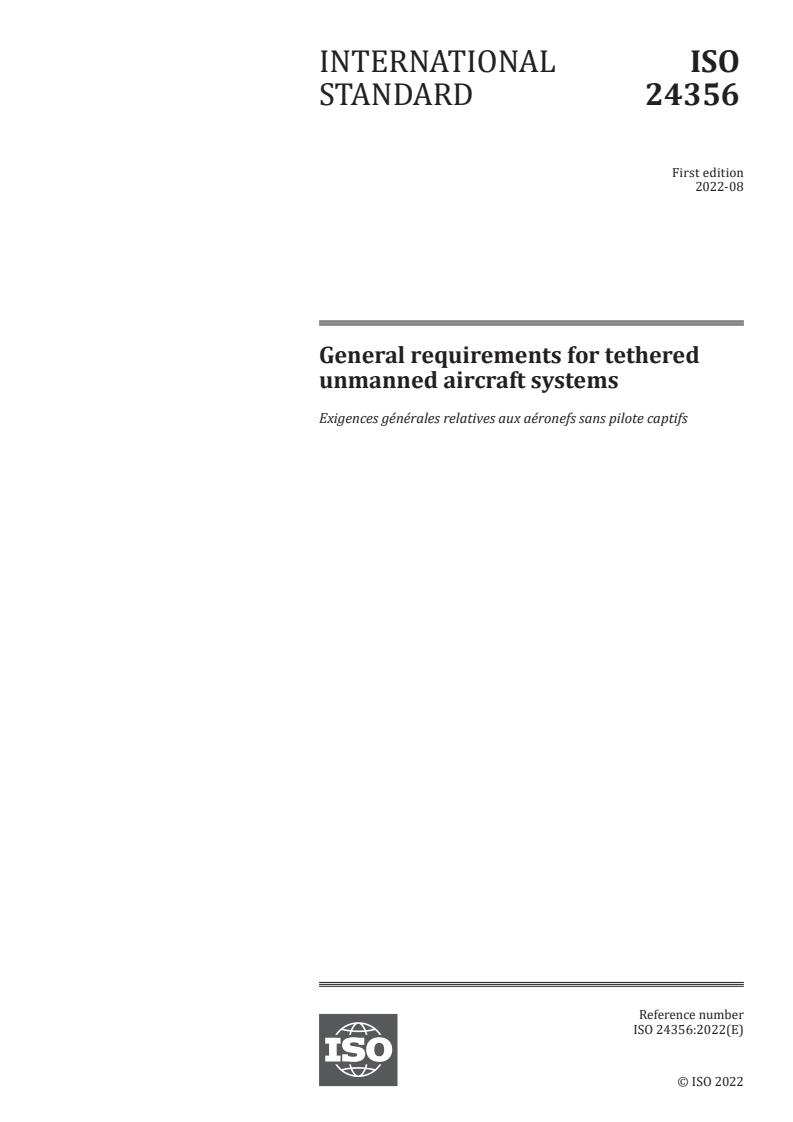
INTERNATIONAL ISO
STANDARD 24356
First edition
2022-08
General requirements for tethered
unmanned aircraft systems
Exigences générales relatives aux aéronefs sans pilote captifs
Reference number
© ISO 2022
All rights reserved. Unless otherwise specified, or required in the context of its implementation, no part of this publication may
be reproduced or utilized otherwise in any form or by any means, electronic or mechanical, including photocopying, or posting on
the internet or an intranet, without prior written permission. Permission can be requested from either ISO at the address below
or ISO’s member body in the country of the requester.
ISO copyright office
CP 401 • Ch. de Blandonnet 8
CH-1214 Vernier, Geneva
Phone: +41 22 749 01 11
Email: copyright@iso.org
Website: www.iso.org
Published in Switzerland
ii
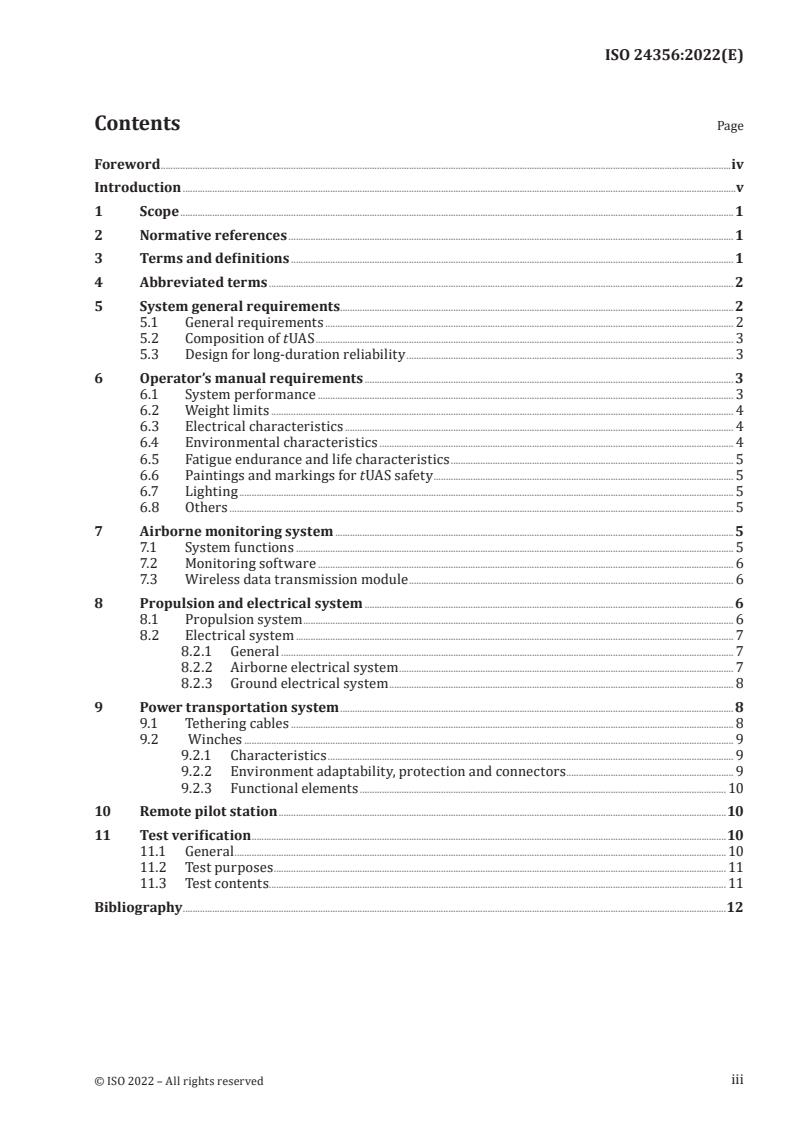
Contents Page
Foreword .iv
Introduction .v
1 Scope . 1
2 Normative references . 1
3 Terms and definitions . 1
4 Abbreviated terms . 2
5 System general requirements.2
5.1 General requirements . 2
5.2 Composition of tUAS . 3
5.3 Design for long-duration reliability . 3
6 Operator’s manual requirements . 3
6.1 System performance . 3
6.2 Weight limits . 4
6.3 Electrical characteristics . 4
6.4 Environmental characteristics . 4
6.5 Fatigue endurance and life characteristics . 5
6.6 Paintings and markings for tUAS safety . 5
6.7 Lighting . 5
6.8 Others . 5
7 Airborne monitoring system .5
7.1 System functions . 5
7.2 Monitoring software . 6
7.3 Wireless data transmission module . 6
8 Propulsion and electrical system .6
8.1 Propulsion system . 6
8.2 Electrical system . 7
8.2.1 General . 7
8.2.2 Airborne electrical system . 7
8.2.3 Ground electrical system . 8
9 Power transportation system . 8
9.1 Tethering cables . 8
9.2 Winches . 9
9.2.1 Characteristics . 9
9.2.2 Environment adaptability, protection and connectors . 9
9.2.3 Functional elements . 10
10 Remote pilot station .10
11 Test verification .10
11.1 General . 10
11.2 Test purposes . 11
11.3 Test contents. 11
Bibliography .12
iii
Foreword
ISO (the International Organization for Standardization) is a worldwide federation of national standards
bodies (ISO member bodies). The work of preparing International Standards is normally carried out
through ISO technical committees. Each member body interested in a subject for which a technical
committee has been established has the right to be represented on that committee. International
organizations, governmental and non-governmental, in liaison with ISO, also take part in the work.
ISO collaborates closely with the International Electrotechnical Commission (IEC) on all matters of
electrotechnical standardization.
The procedures used to develop this document and those intended for its further maintenance are
described in the ISO/IEC Directives, Part 1. In particular, the different approval criteria needed for the
different types of ISO documents should be noted. This document was drafted in accordance with the
editorial rules of the ISO/IEC Directives, Part 2 (see www.iso.org/directives).
Attention is drawn to the possibility that some of the elements of this document may be the subject of
patent rights. ISO shall not be held responsible for identifying any or all such patent rights. Details of
any patent rights identified during the development of the document will be in the Introduction and/or
on the ISO list of patent declarations received (see www.iso.org/patents).
Any trade name used in this document is information given for the convenience of users and does not
constitute an endorsement.
For an explanation of the voluntary nature of standards, the meaning of ISO specific terms and
expressions related to conformity assessment, as well as information about ISO's adherence to the
World Trade Organization (WTO) principles in the Technical Barriers to Trade (TBT), see www.iso.org/
iso/foreword.html.
This document was prepared by Technical Committee ISO/TC 20, Aircraft and space vehicles,
Subcommittee SC 16, Unmanned aircraft systems.
Any feedback or questions on this document should be directed to the user’s national standards body. A
complete listing of these bodies can be found at www.iso.org/members.html.
iv
Introduction
The purpose of this document is to describe a general technical architecture for tethered unmanned
aircraft systems (tUAS). It addresses the general requirements for components and subsystems,
functions and performance. The objective is to promote international trade, provide a technical basis
for related industrial applications, a guidance for development and manufacturing, and to promote safe
operations.
v
INTERNATIONAL STANDARD ISO 24356:2022(E)
General requirements for tethered unmanned aircraft
systems
1 Scope
This document specifies general and manufacturing requirements for tethered unmanned aircraft
systems (tUAS), including heavier-than-air tethered unmanned aircraft (tUA), which are powered by
equipment on the ground. The specifications are intended for tUAS where the purpose for the tether is
to supply power to the tUA as well as to provide a mechanical restraint. Unmanned aircrafts (UAs) that
are not receiving power from and only restrained by the tether are referred to ISO 21384-2; however,
there are clauses in this document that apply to the tethering equipment (e.g. winches and cables).
This document is applicable to the development, manufacturing, industrial applications and delivery of
tUAS.
2 Normative references
The following documents are referred to in the text in such a way that some or all of their content
constitutes requirements of this document. For dated references, only the edition cited applies. For
undated references, the latest edition of the referenced document (including any amendments) applies.
ISO 21384-2, Unmanned aircraft systems — Part 2: UAS components
ISO 21384-4, Unmanned aircraft systems — Part 4: Vocabulary
ISO 23629 (all parts), UAS traffic management (UTM)
IEC 60228, Conductors of insulated cables
IEC 60811, Common test methods for insulating and sheathing materials of electric cables and optical
cables
IEC 60885-1, Electrical test methods for electric cables — Part 1: Electrical tests for cables, cords and wires
for voltages up to and including 450/750 V
IEC 61076-1, Connectors for electronic equipment — Product requirements — Part 1: Generic specification
IEC 61076-2, Connectors for electronic equipment — Product requirements — Part 2: Circular connectors
IEC 62133, Secondary cells and batteries containing alkaline or other non-acid electrolytes — Safety
requirements for portable sealed secondary cells, and for batteries made from them, for use in portable
applications
IEC 62197-1, Connectors for electronic equipment — Product requirements — Part 1: Generic specification
IEC 62197-2, Connectors for electronic equipment — Product requirements — Part 2: Sectional specification
for circular connectors
3 Terms and definitions
For the purposes of this document, the terms and definitions given in ISO 21384-2, ISO 21384-4 and the
following apply.
ISO and IEC maintain terminology databases for use in standardization at the following addresses:
— ISO Online browsing platform: available at https:// www .iso .org/ obp
— IEC Electropedia: available at https:// www .electropedia .org/
3.1
winch
ground device which is able to automatically or manually coil and uncoil the cables
3.2
heavier-than-air tethered unmanned aircraft
heavier-than-air tUA
tUA (3.5), with a take-off weight that is more than the air it displaces
3.3
uninterruptible power supply
UPS
power supply system that provides emergency power to the unmanned aircraft system when the main
power supply is disrupted
3.4
tethering cable
cable that provides power and a mechanical constraint to an unmanned aircraft, and may also be able
to exchange data with the unmanned aircraft
3.5
tethered unmanned aircraft
tUA
unmanned aircraft with range of movement limited by a tethering cable (3.4) and electrical power
supplied by ground equipment conveyed through the tethering cable
3.6
tethered unmanned aircraft system
tUAS
UAS comprised of a tUA (3.5) and associated components (e.g. tethering cable (3.4), winches (3.1),
ground-based electrical system and with a potential for data exchange)
4 Abbreviated terms
GNSS global navigation satellite system
RPS remote pilot station
tUA tethered unmanned aircraft
tUAS tethered unmanned aircraft system
UA unmanned aircraft
UPS uninterruptible power supply
UTM UAS traffic management
5 System general requirements
5.1 General requirements
General requirements for the tUAS shall be consistent with the general requirements for multirotor UAS
given in ISO 21384-2, including but not limited to requirements for avionics, propulsion, navigation,
flight control system, command and control link, RPS and mission payload interface. Additional
requirements are specified in this document.
5.2 Composition of tUAS
A system shall be considered as a tUAS when consisting of a minimum of the following components:
a) tUA, including the airframe, avionics, propulsion, and electrical, navigation and flight control
systems;
b
...