

ISO 20903:2019
(Main)Surface chemical analysis — Auger electron spectroscopy and X-ray photoelectron spectroscopy — Methods used to determine peak intensities and information required when reporting results
General Information
- Abstract
This document specifies the necessary information required in a report of analytical results based on measurements of the intensities of peaks in Auger electron and X-ray photoelectron spectra. Information on methods for the measurement of peak intensities and on uncertainties of derived peak areas is also provided.
- Status
- Published
- Publication Date
- 12-Feb-2019
- Technical Committee
- ISO/TC 201/SC 7 - Electron spectroscopies
- Current Stage
- 9060 - Close of review
- Completion Date
- 02-Sep-2029
Buy Documents



ISO 20903:2019 - Surface chemical analysis -- Auger electron spectroscopy and X-ray photoelectron spectroscopy -- Methods used to determine peak intensities and information required when reporting results

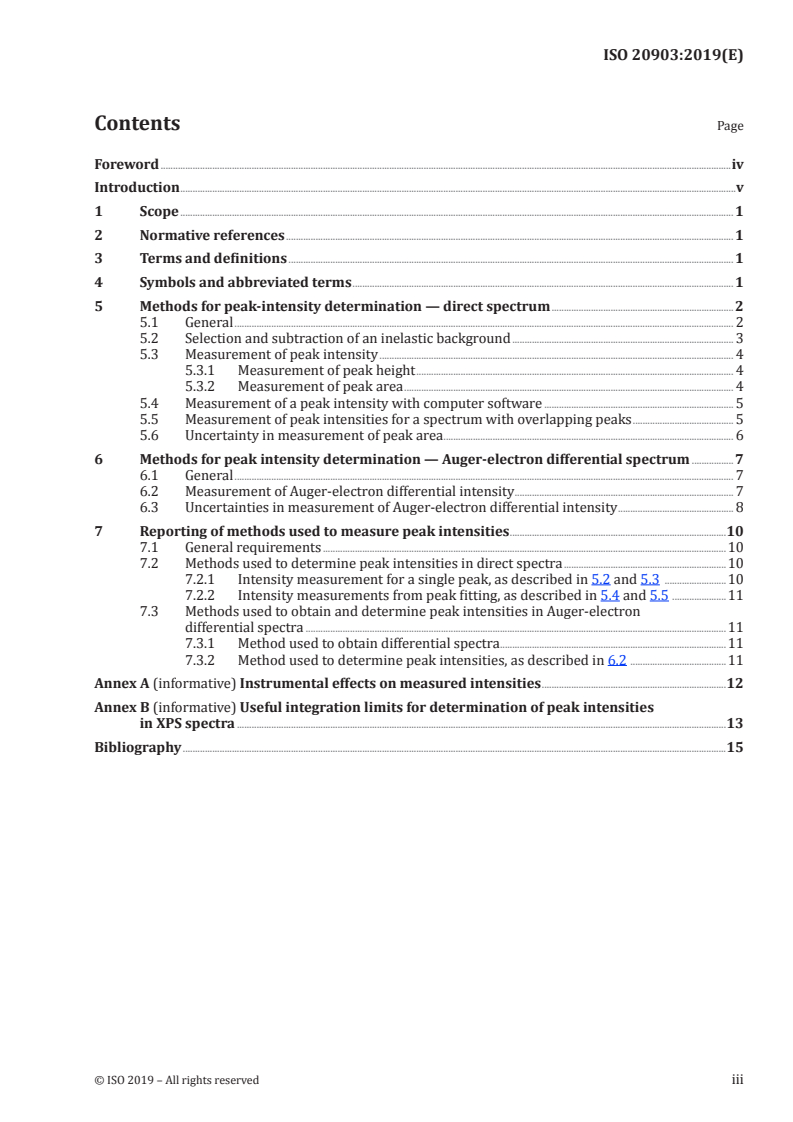

ISO 20903:2019 - Surface chemical analysis — Auger electron spectroscopy and X-ray photoelectron spectroscopy — Methods used to determine peak intensities and information required when reporting results/13/2019
Overview
ISO 20903:2019 specifies what information must be reported and which methods are appropriate when determining peak intensities from Auger electron spectroscopy (AES) and X‑ray photoelectron spectroscopy (XPS) spectra. The standard covers procedures for measuring peak heights and areas, selecting and subtracting inelastic backgrounds, treating overlapping peaks, estimating uncertainties, and reporting the analytical results so they are reproducible and transparent.
Key topics and requirements
- Scope and reporting: Specifies mandatory information to include in analytical reports based on AES/XPS peak-intensity measurements (methods, parameters, uncertainties).
- Background selection and subtraction: Discusses common inelastic-background models - linear, Shirley (integral), and physically based Tougaard and Werner backgrounds - and guidance on choosing endpoints and energy ranges (typical endpoint separations such as ≥10 eV above a peak are discussed).
- Peak measurement methods:
- Peak height: direct readout, baseline-corrected height, or height from fitted analytical shapes (Gaussian, Lorentzian, or mixed).
- Peak area: integrated area after background subtraction; guidance on avoiding smoothing for area determination.
- Computer-assisted fitting: treatment of overlapping peaks and use of fitting software.
- Auger differential spectra: Specific methods for measuring differential AES intensities and associated uncertainty treatment.
- Uncertainty and precision: Factors affecting uncertainty (endpoint selection, baseline averaging, instrumental effects) and references to methods for estimating standard deviation of peak area.
- Data handling practices: Averaging channels to define baselines, limits on smoothing (Savitzky–Golay guidance), and documenting software/algorithms used.
- Informative annexes: Instrumental effects on intensities and suggested integration limits for XPS peaks.
Applications and who uses it
ISO 20903:2019 is essential for professionals performing surface chemical analysis where quantitative or semi-quantitative AES/XPS results are required:
- Surface scientists and analytical chemists characterizing thin films, coatings, corrosion layers, contamination, and semiconductor surfaces.
- Quality control and R&D laboratories that need standardized reporting for traceability and comparability.
- Instrument manufacturers and software developers implementing peak-intensity algorithms.
- Standards bodies and auditors assessing conformity of surface analysis reports.
Related standards
- ISO 18115-1 (Surface chemical analysis - Vocabulary)
- ISO/TR 18392 (referenced guidance on background subtraction and spectral processing)
Keywords: ISO 20903:2019, AES, XPS, peak intensities, peak area, background subtraction, Shirley background, Tougaard background, peak fitting, surface chemical analysis, uncertainty.
Relations
- Effective Date
- 25-Aug-2026
- Effective Date
- 06-Jun-2022
- Effective Date
- 28-Oct-2017
Buy Documents
ISO 20903:2019 - Surface chemical analysis -- Auger electron spectroscopy and X-ray photoelectron spectroscopy -- Methods used to determine peak intensities and information required when reporting results
ISO 20903:2019 - Surface chemical analysis — Auger electron spectroscopy and X-ray photoelectron spectroscopy — Methods used to determine peak intensities and information required when reporting results/13/2019
Get Certified
Connect with accredited certification bodies for this standard

ECOCERT
Organic and sustainability certification.

Eurofins Food Testing Global
Global leader in food, environment, and pharmaceutical product testing.

Intertek Bangladesh
Intertek certification and testing services in Bangladesh.
Sponsored listings
Frequently Asked Questions
ISO 20903:2019 is a standard published by the International Organization for Standardization (ISO). Its full title is "Surface chemical analysis — Auger electron spectroscopy and X-ray photoelectron spectroscopy — Methods used to determine peak intensities and information required when reporting results". This standard covers: This document specifies the necessary information required in a report of analytical results based on measurements of the intensities of peaks in Auger electron and X-ray photoelectron spectra. Information on methods for the measurement of peak intensities and on uncertainties of derived peak areas is also provided.
This document specifies the necessary information required in a report of analytical results based on measurements of the intensities of peaks in Auger electron and X-ray photoelectron spectra. Information on methods for the measurement of peak intensities and on uncertainties of derived peak areas is also provided.
ISO 20903:2019 is classified under the following ICS (International Classification for Standards) categories: 71.040.40 - Chemical analysis. The ICS classification helps identify the subject area and facilitates finding related standards.
ISO 20903:2019 has the following relationships with other standards: It is inter standard links to CEN ISO/TS 23359:2025, ISO/TR 25060:2023, ISO 20903:2011. Understanding these relationships helps ensure you are using the most current and applicable version of the standard.
ISO 20903:2019 is available in PDF format for immediate download after purchase. The document can be added to your cart and obtained through the secure checkout process. Digital delivery ensures instant access to the complete standard document.
Standards Content (Sample)
INTERNATIONAL ISO
STANDARD 20903
Third edition
2019-02
Surface chemical analysis — Auger
electron spectroscopy and X-ray
photoelectron spectroscopy —
Methods used to determine peak
intensities and information required
when reporting results
Analyse chimique des surfaces — Spectroscopie des électrons Auger
et spectroscopie de photoélectrons par rayons X — Méthodes utilisées
pour la détermination de l'intensité des pics et informations requises
pour l'expression des résultats
Reference number
©
ISO 2019
© ISO 2019
All rights reserved. Unless otherwise specified, or required in the context of its implementation, no part of this publication may
be reproduced or utilized otherwise in any form or by any means, electronic or mechanical, including photocopying, or posting
on the internet or an intranet, without prior written permission. Permission can be requested from either ISO at the address
below or ISO’s member body in the country of the requester.
ISO copyright office
CP 401 • Ch. de Blandonnet 8
CH-1214 Vernier, Geneva
Phone: +41 22 749 01 11
Fax: +41 22 749 09 47
Email: copyright@iso.org
Website: www.iso.org
Published in Switzerland
ii © ISO 2019 – All rights reserved
Contents Page
Foreword .iv
Introduction .v
1 Scope . 1
2 Normative references . 1
3 Terms and definitions . 1
4 Symbols and abbreviated terms . 1
5 Methods for peak-intensity determination — direct spectrum .2
5.1 General . 2
5.2 Selection and subtraction of an inelastic background . 3
5.3 Measurement of peak intensity . 4
5.3.1 Measurement of peak height . 4
5.3.2 Measurement of peak area . 4
5.4 Measurement of a peak intensity with computer software . 5
5.5 Measurement of peak intensities for a spectrum with overlapping peaks . 5
5.6 Uncertainty in measurement of peak area . 6
6 Methods for peak intensity determination — Auger-electron differential spectrum .7
6.1 General . 7
6.2 Measurement of Auger-electron differential intensity . 7
6.3 Uncertainties in measurement of Auger-electron differential intensity . 8
7 Reporting of methods used to measure peak intensities .10
7.1 General requirements .10
7.2 Methods used to determine peak intensities in direct spectra .10
7.2.1 Intensity measurement for a single peak, as described in 5.2 and 5.3 .10
7.2.2 Intensity measurements from peak fitting, as described in 5.4 and 5.5 .11
7.3 Methods used to obtain and determine peak intensities in Auger-electron
differential spectra .11
7.3.1 Method used to obtain differential spectra .11
7.3.2 Method used to determine peak intensities, as described in 6.2 .11
Annex A (informative) Instrumental effects on measured intensities .12
Annex B (informative) Useful integration limits for determination of peak intensities
in XPS spectra .13
Bibliography .15
Foreword
ISO (the International Organization for Standardization) is a worldwide federation of national standards
bodies (ISO member bodies). The work of preparing International Standards is normally carried out
through ISO technical committees. Each member body interested in a subject for which a technical
committee has been established has the right to be represented on that committee. International
organizations, governmental and non-governmental, in liaison with ISO, also take part in the work.
ISO collaborates closely with the International Electrotechnical Commission (IEC) on all matters of
electrotechnical standardization.
The procedures used to develop this document and those intended for its further maintenance are
described in the ISO/IEC Directives, Part 1. In particular, the different approval criteria needed for the
different types of ISO documents should be noted. This document was drafted in accordance with the
editorial rules of the ISO/IEC Directives, Part 2 (see www .iso .org/directives).
Attention is drawn to the possibility that some of the elements of this document may be the subject of
patent rights. ISO shall not be held responsible for identifying any or all such patent rights. Details of
any patent rights identified during the development of the document will be in the Introduction and/or
on the ISO list of patent declarations received (see www .iso .org/patents).
Any trade name used in this document is information given for the convenience of users and does not
constitute an endorsement.
For an explanation of the voluntary nature of standards, the meaning of ISO specific terms and
expressions related to conformity assessment, as well as information about ISO's adherence to the
World Trade Organization (WTO) principles in the Technical Barriers to Trade (TBT) see www .iso
.org/iso/foreword .html.
This document was prepared by Technical Committee ISO/TC 201, Surface chemical analysis,
Subcommittee SC 7, Electron spectroscopies.
This third edition cancels and replaces the second edition (ISO 20903:2011), which has been technically
revised. The main changes compared to the previous edition are as follows:
— subclause 6.3 has been replaced to include modern methods for dealing with co-existing
chemical states;
— minor editorial changes have been introduced for clarity.
Any feedback or questions on this document should be directed to the user’s national standards body. A
complete listing of these bodies can be found at www .iso .org/members .html.
iv © ISO 2019 – All rights reserved
Introduction
An important feature of Auger electron spectroscopy (AES) and X-ray photoelectron spectroscopy
(XPS) is the ability to obtain a quantitative analysis of the surface region (≈1 nm to 10 nm) of a solid
sample. Such an analysis requires the determination of the intensities of spectral components.
There are several methods of peak-intensity measurement that are applicable to AES and XPS. In
practice, the choice of method will depend upon the type of sample being analysed, the capabilities of
the instrumentation used, and the methods of data acquisition and treatment available.
INTERNATIONAL STANDARD ISO 20903:2019(E)
Surface chemical analysis — Auger electron spectroscopy
and X-ray photoelectron spectroscopy — Methods used to
determine peak intensities and information required when
reporting results
1 Scope
This document specifies the necessary information required in a report of analytical results based
on measurements of the intensities of peaks in Auger electron and X-ray photoelectron spectra.
Information on methods for the measurement of peak intensities and on uncertainties of derived peak
areas is also provided.
2 Normative references
The following documents are referred to in the text in such a way that some or all of their content
constitutes requirements of this document. For dated references, only the edition cited applies. For
undated references, the latest edition of the referenced document (including any amendments) applies.
ISO 18115-1, Surface chemical analysis — Vocabulary — Part 1: General terms and terms used in
spectroscopy
3 Terms and definitions
For the purposes of this document, the terms and definitions given in ISO 18115-1 apply.
ISO and IEC maintain terminological databases for use in standardization at the following addresses:
— ISO Online browsing platform: available at https: //www .iso .org/obp
— IEC Electropedia: available at http: //www .electropedia .org/
4 Symbols and abbreviated terms
A peak area
AES Auger electron spectroscopy
b number of channels over which intensities are averaged to obtain a baseline
eV electron volts
n number of channels in a spectrum
XPS X-ray photoelectron spectroscopy
y number of counts in the ith channel of a spectrum
i
ΔE channel width (in electron volts)
Δt dwell time per channel (in seconds)
σ(A) standard deviation of calculated peak area
5 Methods for peak-intensity determination — direct spectrum
5.1 General
Figure 1 a) shows a portion of an X-ray photoelectron spectrum in which intensity is plotted as a function
of kinetic energy increasing to the right or of binding energy increasing to the left. The intensity is plotted
usually in units of counts or sometimes in units of counts per second. Intensities may also be plotted as
a digitized voltage; this procedure is often used when the intensity of an Auger differential spectrum is
obtained from an analogue detection system. Energies are commonly expressed in electron volts.
a) XPS peak whose intensity is to be measured, the vertical lines indicate suitable limits for the
construction of a Shirley background
b) XPS peak shown in a) following the subtraction of the inelastic background (the shaded area
indicates the peak area to be measured)
Key
X binding energy (eV)
X kinetic energy (eV)
Y intensity
Figure 1 — Illustration of procedure involved in the determination of the intensity of a single
peak in an X-ray photoelectron spectrum (as described in 5.2 and 5.3).
The intensity of a single peak in an X-ray photoelectron spectrum can be measured by using the
procedure described in 5.2 and 5.3 or by using computer software as described in 5.4. The measurement
of peak intensities for a spectrum containing overlapping peaks is described in 5.5. Information on the
uncertainty of a measured peak area for a single peak is given in 5.6.
The intensity of a single peak in a direct Auger-electron spectrum can be measured by following the
procedure described in 5.2 and 5.3, although it may be necessary first to subtract a secondary-electron
[1][2]
background . Alternatively, computer software can be used to measure the peak intensity as
described in 5.4.
In some cases, the peak of interest may be superimposed on a sloping background. This background
could arise from multiple inelastic scattering of Auger electrons or photoelectrons of initially high
energy, from multiple inelastic scattering of primary electrons (in AES), or from photoemission by
bremsstrahlung radiation (for XPS with an unmonochromated X-ray source). It may be necessary (e.g.
with use of the Tougaard inelastic background described in 5.2) or desirable to subtract this background
from the spectrum in the vicinity of the peak before proceeding with the peak-intensity measurements
described in 5.2 to 5.5. This subtraction can usually be performed by fitting a straight line to the sloping
2 © ISO 2019 – All rights reserved
background at energies between about 10 eV and 30 eV above the peak of interest, extrapolating this
line to lower energies, and subtracting the spectral intensities from this linear background. If a linear
function is judged to be invalid for describing the sloping background over the spectral range of interest
(e.g. for modelling the background of scattered primary electrons in AES), an exponential function can
[3]
be utilized .
5.2 Selection and subtraction of an inelastic background
An appropriate inelastic background shall be selected and subtracted from the measured spectrum.
Three types of inelastic background are in common use:
a) linear background;
[4]
b) integral or Shirley background ;
[5][6][7] [8][9]
c) Tougaard background and Werner background , based on physical models describing
inelastic electron scattering in solids.
Information on procedures and software for determining the Shirley, Tougaard and Werner
[4]-[13] [14]
backgrounds is given in the scientific literature and ISO/TR 18392 .
From a practical viewpoint, the selection of a particular background will depend on (a) whether the
relevant software is conveniently available and (b) the type of sample analysed. For insulators, the
linear background is often satisfactory, while the Shirley background is often employed for metals.
While these two backgrounds are simple and convenient to apply, the limits of these two backgrounds
(the starting and ending points on the energy scale) should be chosen carefully so that the background
is as nearly continuous as possible with the spectrum in the region of overlap.
[5][6][7]
Tougaard's approach, in particular, for background determination and subtraction has found
favour over the Shirley background because it describes the physics of the inelastic-scattering process
[15][16]
more accurately . The Tougaard and the Werner approaches have a further advantage in that they
are insensitive to the precise positions of the starting and ending energy points providing they are
clearly in the spectral region well away from the main peak of interest (typically starting at an energy
at least 10 eV higher than that of the peak of interest and ending at an energy at least 50 eV lower). This
requirement is a disadvantage in that spectra have to be recorded over a larger energy range than if the
linear or Shirley background is used.
As an example, Figure 1 a) shows an XPS peak whose intensity is to be measured. Vertical lines have
been drawn to indicate suitable limits for use of the Shirley background. The spectrum after subtraction
of this background is shown on an expanded energy scale in Figure 1 b). For clarity of display, the
zero of the intensity scale in Figure 1 b) has been placed at 2 % of the ordinate axis. The end points in
Figure 1 b) are at the same positions as those in Figure 1 a).
Averaging over neighbouring channels may be helpful in defining the signal level at the selected end
points, thus improving the precision of peak-height or peak-area measurement. The sets of points to
be averaged may be located inside or outside of the chosen end points or may be symmetrically placed
about the end points. The end points shall be chosen to be sufficiently far from the peak so that the
[17]
averaging process does not include significant peak intensity. Harrison and Hazell have derived an
expression for the estimated uncertainty in a peak-area measurement (see 5.6) and have shown that a
large contribution to this uncertainty comes from uncertainties arising from the choice of end points
and the intensities at these end points.
[18]
Smoothing of a spectrum, using a Savitzky-Golay convolution with a width less than 50 % of the full
width at half-maximum intensity of the peak, may improve the precision of a peak-height determination.
However, smoothing should be avoided for peak-area determination since it cannot improve the
precision and, if over-done, will distort the spectrum.
Annex B gives information on the choice of suitable energy limits for the determination of peak
intensities or areas in XPS spectra.
5.3 Measurement of peak intensity
5.3.1 Measurement of peak height
A peak height is determined (i) by direct measurement from a chart output using a ruler, (ii) by using
computer software to obtain the intensity difference from the baseline to the peak maximum or (iii) by
using computer software to fit an appropriate analytical peak shape (Gaussian, Lorentzian or a mixture
[10][11][12]
of the two ) to the experimental spectrum (that is, the group of data points defining the peak
of interest). The length of the vertical line with arrows in Figure 1 b) is a measure of the peak height in
units defined by the intensity scale (either counts or counts per second).
The use of peak heights in subsequent data processing has advantages arising from the speed of
processing and the ease with which this method can be applied with many instruments. However,
using peak height as a measurement of intensity has several disadvantages: (i) it is insensitive to peak-
shape changes arising from the complex chemistry of an element, (ii) it ignores spectral intensity from
secondary features in the spectrum (such as satellite peaks) and (iii) the measured height is very
dependent on the choice of inelastic background.
Instruments should be operated with settings chosen to avoid significant nonlinearities in the intensity
[19]
scales ; alternatively, corrections should be made for counting losses due to the finite dead time of
[19]
the counting electronics . Spectra should be corrected for the intensity-energy response function of
[20]
the instrument before peak heights are measured . Further information is provided in Annex A.
5.3.2 Measurement of peak area
All modern AES and XPS instruments have computer software that can be used to determine the
peak area (e.g. by summing the counts above the inelastic background or by numerical integration).
Alternatively, the peak area can be calculated from the parameters obtained after fitting the peak
[10][11][12]
with an appropriate analytical function . The shaded area in Figure 1 b) illustrates the peak
area obtained from integration of the peak defined by the end points and subtraction of the inelastic
background in Figure 1 a).
The measured intensity in each channel of an AES or XPS spectrum depends on a number of instrumental
[20]
parameters and settings . For specified instrumental conditions, the measured intensity for each
channel can be simply expressed as a number of counts (or counts/second) per eV; Annex A provides
further information. A peak area (or peak intensity) is then expressed as the total number of counts (or
counts/second) for a specified energy region of summation or integration.
Instruments should be operated with settings chosen to avoid significant nonlinearities in the intensity
[19]
scales ; alternatively, corrections should be made for counting losses due to the finite dead time of
[19]
the counting electronics . Spectra should be corrected for the intensity-energy response function of
[20]
the instrument before peak areas are measured . Further information is provided in Annex A.
In practical AES and XPS, an analyst generally wishes to compare intensities of peaks that were
measured with identical instrumental settings [e.g. analyser mode, pass energy (for the constant-
analyser-energy mode) and retarding ratio (for the constant-retarding-ratio mode)] but differences in
certain other settings (e.g. different energy channel widths or different dwell times). The analyst often
will not know certain parameters that affect the absolute intensities of measured peaks (see Annex A)
since only relative intensities are needed for practical analyses. In such cases, peak intensities can be
determined from simple summations or integrations of measured spectra for the particular conditions,
and these intensities are often expressed in units of counts⋅eV or counts⋅eV/second. Corrections of
peak areas can then be made as needed for different channel widths and dwell times. Annex A provides
further information.
The use of peak intensities derived from measurements of peak areas has some clear advantages over
the use of measurements of peak heights. First, account can be taken in the measurement of peak areas
of any chemical changes that result in reduced peak height and increased peak width (compared to the
corresponding values for the elemental solid). Second, any satellite intensity can be easily included in
the measurement of peak area. However, the uncertainty of a peak-area measurement may increase for
4 © ISO 2019 – All rights reserved
complex specimen materials with many elemental components that could have overlapping spectral
features (as described in 5.5). In such cases, the value of the derived peak area may depend on the
choice and placement of the inelastic background function in 5.2.
5.4 Measurement of a peak intensity with computer software
Computer software can be used to fit a selected analytical function describing the shape of a peak and
[10][11][12]
another function describing the inelastic background to a measured spectrum . This process
essentially combines the steps described in 5.2 and 5.3 into a single procedure. Prior removal of X-ray
satellites from XPS spectra recorded using unmonochromated radiation may be necessary if they
contribute intensity in the region of the spectrum defined by the integration limits (see 5.2).
Peak shapes in AES may be more complex than those in XPS, and analytical functions used to fit XPS
spectra may then be unsatisfactory for similar fits of AES spectra. In such cases, peak intensities can be
derived using spectral addition/subtraction, least-squares analysis with suitable reference spectra, or
[21]
principal-component analysis .
5.5 Measurement of peak intensities for a spectrum with overlapping peaks
In many practical cases, a spectrum in the region of interest may consist of two or more overlapping
peaks because of the presence of chemically shifted peaks from the same element, the presence of peaks
from multiple elements or the presence of peaks arising from X-ray satellites. As an example, Figure 2
shows an X-ray photoelectron spectrum for an oxidized vanadium foil that was measured with an
unmonochromated Al Kα X-ray source. In this spectrum, the more intense peaks arise from vanadium
2p and oxygen 1s photoelectrons; there is also a weaker peak due to oxygen 1s photoelectrons excited by
the Al Kα satellite line that overlaps the vanadium 2p peaks. Correct identification of chemical state
3,4
[22]
requires calibration of the instrumental binding-energy scale and, for non-conductive specimens,
[23]
use of charge-control or charge-correction procedures .
For a spectrum with overlapping peaks, intensities shall be measured from fits of analytical functions
[10][11][12]
to a selected spectral region . Peak heights and peak areas can be determined from values of
the parameters found for each peak.
Key
X binding energy (eV)
Y intensity
1 O(1s) X-ray satellites
Figure 2 — X-ray photoelectron spectrum measured with unmonochromated Al Kα X-rays for
an oxidized vanadium foil
5.6 Uncertainty in measurement of peak area
The uncertainty in the result of a measurement (such as peak area) generally consists of several
components that may be grouped into two categories according to the method used to estimate their
[24]
numerical values :
— type A: those which are evaluated by statistical methods;
— type B: those which are evaluated by other means.
The type A uncertainty indicates the component of uncertainty arising from a random effect while
[24]
the type B uncertainty indicates the component of uncertainty arising from a systematic effect .
For measurements of peak areas, type A uncertainties can arise from counting statistics in the
measurement of a spectrum and the fitting of an inelastic background to the spectrum (see 5.2). Type B
uncertainties typically arise from the choice of the inelastic background function (see 5.2), the selection
of end points (see 5.2), the choice of a function to describe a measured peak shape (see 5.3 and 5.4), the
[25]
choice of computer software used for peak fitting and the choice of initial parameter values in a
nonlinear least-squares fitting algorithm. The total uncertainty of a measurement can be obtained from
[24]
the standard deviation (for the type A uncertainties) and an evaluation of the type B uncertainties .
The standard deviation, σ(A), of the measured peak area, A, of a single peak measured in counts⋅eV/
[
...
INTERNATIONAL ISO
STANDARD 20903
Third edition
2019-02
Surface chemical analysis — Auger
electron spectroscopy and X-ray
photoelectron spectroscopy —
Methods used to determine peak
intensities and information required
when reporting results
Analyse chimique des surfaces — Spectroscopie des électrons Auger
et spectroscopie de photoélectrons par rayons X — Méthodes utilisées
pour la détermination de l'intensité des pics et informations requises
pour l'expression des résultats
Reference number
©
ISO 2019
© ISO 2019
All rights reserved. Unless otherwise specified, or required in the context of its implementation, no part of this publication may
be reproduced or utilized otherwise in any form or by any means, electronic or mechanical, including photocopying, or posting
on the internet or an intranet, without prior written permission. Permission can be requested from either ISO at the address
below or ISO’s member body in the country of the requester.
ISO copyright office
CP 401 • Ch. de Blandonnet 8
CH-1214 Vernier, Geneva
Phone: +41 22 749 01 11
Fax: +41 22 749 09 47
Email: copyright@iso.org
Website: www.iso.org
Published in Switzerland
ii © ISO 2019 – All rights reserved
Contents Page
Foreword .iv
Introduction .v
1 Scope . 1
2 Normative references . 1
3 Terms and definitions . 1
4 Symbols and abbreviated terms . 1
5 Methods for peak-intensity determination — direct spectrum .2
5.1 General . 2
5.2 Selection and subtraction of an inelastic background . 3
5.3 Measurement of peak intensity . 4
5.3.1 Measurement of peak height . 4
5.3.2 Measurement of peak area . 4
5.4 Measurement of a peak intensity with computer software . 5
5.5 Measurement of peak intensities for a spectrum with overlapping peaks . 5
5.6 Uncertainty in measurement of peak area . 6
6 Methods for peak intensity determination — Auger-electron differential spectrum .7
6.1 General . 7
6.2 Measurement of Auger-electron differential intensity . 7
6.3 Uncertainties in measurement of Auger-electron differential intensity . 8
7 Reporting of methods used to measure peak intensities .10
7.1 General requirements .10
7.2 Methods used to determine peak intensities in direct spectra .10
7.2.1 Intensity measurement for a single peak, as described in 5.2 and 5.3 .10
7.2.2 Intensity measurements from peak fitting, as described in 5.4 and 5.5 .11
7.3 Methods used to obtain and determine peak intensities in Auger-electron
differential spectra .11
7.3.1 Method used to obtain differential spectra .11
7.3.2 Method used to determine peak intensities, as described in 6.2 .11
Annex A (informative) Instrumental effects on measured intensities .12
Annex B (informative) Useful integration limits for determination of peak intensities
in XPS spectra .13
Bibliography .15
Foreword
ISO (the International Organization for Standardization) is a worldwide federation of national standards
bodies (ISO member bodies). The work of preparing International Standards is normally carried out
through ISO technical committees. Each member body interested in a subject for which a technical
committee has been established has the right to be represented on that committee. International
organizations, governmental and non-governmental, in liaison with ISO, also take part in the work.
ISO collaborates closely with the International Electrotechnical Commission (IEC) on all matters of
electrotechnical standardization.
The procedures used to develop this document and those intended for its further maintenance are
described in the ISO/IEC Directives, Part 1. In particular, the different approval criteria needed for the
different types of ISO documents should be noted. This document was drafted in accordance with the
editorial rules of the ISO/IEC Directives, Part 2 (see www .iso .org/directives).
Attention is drawn to the possibility that some of the elements of this document may be the subject of
patent rights. ISO shall not be held responsible for identifying any or all such patent rights. Details of
any patent rights identified during the development of the document will be in the Introduction and/or
on the ISO list of patent declarations received (see www .iso .org/patents).
Any trade name used in this document is information given for the convenience of users and does not
constitute an endorsement.
For an explanation of the voluntary nature of standards, the meaning of ISO specific terms and
expressions related to conformity assessment, as well as information about ISO's adherence to the
World Trade Organization (WTO) principles in the Technical Barriers to Trade (TBT) see www .iso
.org/iso/foreword .html.
This document was prepared by Technical Committee ISO/TC 201, Surface chemical analysis,
Subcommittee SC 7, Electron spectroscopies.
This third edition cancels and replaces the second edition (ISO 20903:2011), which has been technically
revised. The main changes compared to the previous edition are as follows:
— subclause 6.3 has been replaced to include modern methods for dealing with co-existing
chemical states;
— minor editorial changes have been introduced for clarity.
Any feedback or questions on this document should be directed to the user’s national standards body. A
complete listing of these bodies can be found at www .iso .org/members .html.
iv © ISO 2019 – All rights reserved
Introduction
An important feature of Auger electron spectroscopy (AES) and X-ray photoelectron spectroscopy
(XPS) is the ability to obtain a quantitative analysis of the surface region (≈1 nm to 10 nm) of a solid
sample. Such an analysis requires the determination of the intensities of spectral components.
There are several methods of peak-intensity measurement that are applicable to AES and XPS. In
practice, the choice of method will depend upon the type of sample being analysed, the capabilities of
the instrumentation used, and the methods of data acquisition and treatment available.
INTERNATIONAL STANDARD ISO 20903:2019(E)
Surface chemical analysis — Auger electron spectroscopy
and X-ray photoelectron spectroscopy — Methods used to
determine peak intensities and information required when
reporting results
1 Scope
This document specifies the necessary information required in a report of analytical results based
on measurements of the intensities of peaks in Auger electron and X-ray photoelectron spectra.
Information on methods for the measurement of peak intensities and on uncertainties of derived peak
areas is also provided.
2 Normative references
The following documents are referred to in the text in such a way that some or all of their content
constitutes requirements of this document. For dated references, only the edition cited applies. For
undated references, the latest edition of the referenced document (including any amendments) applies.
ISO 18115-1, Surface chemical analysis — Vocabulary — Part 1: General terms and terms used in
spectroscopy
3 Terms and definitions
For the purposes of this document, the terms and definitions given in ISO 18115-1 apply.
ISO and IEC maintain terminological databases for use in standardization at the following addresses:
— ISO Online browsing platform: available at https: //www .iso .org/obp
— IEC Electropedia: available at http: //www .electropedia .org/
4 Symbols and abbreviated terms
A peak area
AES Auger electron spectroscopy
b number of channels over which intensities are averaged to obtain a baseline
eV electron volts
n number of channels in a spectrum
XPS X-ray photoelectron spectroscopy
y number of counts in the ith channel of a spectrum
i
ΔE channel width (in electron volts)
Δt dwell time per channel (in seconds)
σ(A) standard deviation of calculated peak area
5 Methods for peak-intensity determination — direct spectrum
5.1 General
Figure 1 a) shows a portion of an X-ray photoelectron spectrum in which intensity is plotted as a function
of kinetic energy increasing to the right or of binding energy increasing to the left. The intensity is plotted
usually in units of counts or sometimes in units of counts per second. Intensities may also be plotted as
a digitized voltage; this procedure is often used when the intensity of an Auger differential spectrum is
obtained from an analogue detection system. Energies are commonly expressed in electron volts.
a) XPS peak whose intensity is to be measured, the vertical lines indicate suitable limits for the
construction of a Shirley background
b) XPS peak shown in a) following the subtraction of the inelastic background (the shaded area
indicates the peak area to be measured)
Key
X binding energy (eV)
X kinetic energy (eV)
Y intensity
Figure 1 — Illustration of procedure involved in the determination of the intensity of a single
peak in an X-ray photoelectron spectrum (as described in 5.2 and 5.3).
The intensity of a single peak in an X-ray photoelectron spectrum can be measured by using the
procedure described in 5.2 and 5.3 or by using computer software as described in 5.4. The measurement
of peak intensities for a spectrum containing overlapping peaks is described in 5.5. Information on the
uncertainty of a measured peak area for a single peak is given in 5.6.
The intensity of a single peak in a direct Auger-electron spectrum can be measured by following the
procedure described in 5.2 and 5.3, although it may be necessary first to subtract a secondary-electron
[1][2]
background . Alternatively, computer software can be used to measure the peak intensity as
described in 5.4.
In some cases, the peak of interest may be superimposed on a sloping background. This background
could arise from multiple inelastic scattering of Auger electrons or photoelectrons of initially high
energy, from multiple inelastic scattering of primary electrons (in AES), or from photoemission by
bremsstrahlung radiation (for XPS with an unmonochromated X-ray source). It may be necessary (e.g.
with use of the Tougaard inelastic background described in 5.2) or desirable to subtract this background
from the spectrum in the vicinity of the peak before proceeding with the peak-intensity measurements
described in 5.2 to 5.5. This subtraction can usually be performed by fitting a straight line to the sloping
2 © ISO 2019 – All rights reserved
background at energies between about 10 eV and 30 eV above the peak of interest, extrapolating this
line to lower energies, and subtracting the spectral intensities from this linear background. If a linear
function is judged to be invalid for describing the sloping background over the spectral range of interest
(e.g. for modelling the background of scattered primary electrons in AES), an exponential function can
[3]
be utilized .
5.2 Selection and subtraction of an inelastic background
An appropriate inelastic background shall be selected and subtracted from the measured spectrum.
Three types of inelastic background are in common use:
a) linear background;
[4]
b) integral or Shirley background ;
[5][6][7] [8][9]
c) Tougaard background and Werner background , based on physical models describing
inelastic electron scattering in solids.
Information on procedures and software for determining the Shirley, Tougaard and Werner
[4]-[13] [14]
backgrounds is given in the scientific literature and ISO/TR 18392 .
From a practical viewpoint, the selection of a particular background will depend on (a) whether the
relevant software is conveniently available and (b) the type of sample analysed. For insulators, the
linear background is often satisfactory, while the Shirley background is often employed for metals.
While these two backgrounds are simple and convenient to apply, the limits of these two backgrounds
(the starting and ending points on the energy scale) should be chosen carefully so that the background
is as nearly continuous as possible with the spectrum in the region of overlap.
[5][6][7]
Tougaard's approach, in particular, for background determination and subtraction has found
favour over the Shirley background because it describes the physics of the inelastic-scattering process
[15][16]
more accurately . The Tougaard and the Werner approaches have a further advantage in that they
are insensitive to the precise positions of the starting and ending energy points providing they are
clearly in the spectral region well away from the main peak of interest (typically starting at an energy
at least 10 eV higher than that of the peak of interest and ending at an energy at least 50 eV lower). This
requirement is a disadvantage in that spectra have to be recorded over a larger energy range than if the
linear or Shirley background is used.
As an example, Figure 1 a) shows an XPS peak whose intensity is to be measured. Vertical lines have
been drawn to indicate suitable limits for use of the Shirley background. The spectrum after subtraction
of this background is shown on an expanded energy scale in Figure 1 b). For clarity of display, the
zero of the intensity scale in Figure 1 b) has been placed at 2 % of the ordinate axis. The end points in
Figure 1 b) are at the same positions as those in Figure 1 a).
Averaging over neighbouring channels may be helpful in defining the signal level at the selected end
points, thus improving the precision of peak-height or peak-area measurement. The sets of points to
be averaged may be located inside or outside of the chosen end points or may be symmetrically placed
about the end points. The end points shall be chosen to be sufficiently far from the peak so that the
[17]
averaging process does not include significant peak intensity. Harrison and Hazell have derived an
expression for the estimated uncertainty in a peak-area measurement (see 5.6) and have shown that a
large contribution to this uncertainty comes from uncertainties arising from the choice of end points
and the intensities at these end points.
[18]
Smoothing of a spectrum, using a Savitzky-Golay convolution with a width less than 50 % of the full
width at half-maximum intensity of the peak, may improve the precision of a peak-height determination.
However, smoothing should be avoided for peak-area determination since it cannot improve the
precision and, if over-done, will distort the spectrum.
Annex B gives information on the choice of suitable energy limits for the determination of peak
intensities or areas in XPS spectra.
5.3 Measurement of peak intensity
5.3.1 Measurement of peak height
A peak height is determined (i) by direct measurement from a chart output using a ruler, (ii) by using
computer software to obtain the intensity difference from the baseline to the peak maximum or (iii) by
using computer software to fit an appropriate analytical peak shape (Gaussian, Lorentzian or a mixture
[10][11][12]
of the two ) to the experimental spectrum (that is, the group of data points defining the peak
of interest). The length of the vertical line with arrows in Figure 1 b) is a measure of the peak height in
units defined by the intensity scale (either counts or counts per second).
The use of peak heights in subsequent data processing has advantages arising from the speed of
processing and the ease with which this method can be applied with many instruments. However,
using peak height as a measurement of intensity has several disadvantages: (i) it is insensitive to peak-
shape changes arising from the complex chemistry of an element, (ii) it ignores spectral intensity from
secondary features in the spectrum (such as satellite peaks) and (iii) the measured height is very
dependent on the choice of inelastic background.
Instruments should be operated with settings chosen to avoid significant nonlinearities in the intensity
[19]
scales ; alternatively, corrections should be made for counting losses due to the finite dead time of
[19]
the counting electronics . Spectra should be corrected for the intensity-energy response function of
[20]
the instrument before peak heights are measured . Further information is provided in Annex A.
5.3.2 Measurement of peak area
All modern AES and XPS instruments have computer software that can be used to determine the
peak area (e.g. by summing the counts above the inelastic background or by numerical integration).
Alternatively, the peak area can be calculated from the parameters obtained after fitting the peak
[10][11][12]
with an appropriate analytical function . The shaded area in Figure 1 b) illustrates the peak
area obtained from integration of the peak defined by the end points and subtraction of the inelastic
background in Figure 1 a).
The measured intensity in each channel of an AES or XPS spectrum depends on a number of instrumental
[20]
parameters and settings . For specified instrumental conditions, the measured intensity for each
channel can be simply expressed as a number of counts (or counts/second) per eV; Annex A provides
further information. A peak area (or peak intensity) is then expressed as the total number of counts (or
counts/second) for a specified energy region of summation or integration.
Instruments should be operated with settings chosen to avoid significant nonlinearities in the intensity
[19]
scales ; alternatively, corrections should be made for counting losses due to the finite dead time of
[19]
the counting electronics . Spectra should be corrected for the intensity-energy response function of
[20]
the instrument before peak areas are measured . Further information is provided in Annex A.
In practical AES and XPS, an analyst generally wishes to compare intensities of peaks that were
measured with identical instrumental settings [e.g. analyser mode, pass energy (for the constant-
analyser-energy mode) and retarding ratio (for the constant-retarding-ratio mode)] but differences in
certain other settings (e.g. different energy channel widths or different dwell times). The analyst often
will not know certain parameters that affect the absolute intensities of measured peaks (see Annex A)
since only relative intensities are needed for practical analyses. In such cases, peak intensities can be
determined from simple summations or integrations of measured spectra for the particular conditions,
and these intensities are often expressed in units of counts⋅eV or counts⋅eV/second. Corrections of
peak areas can then be made as needed for different channel widths and dwell times. Annex A provides
further information.
The use of peak intensities derived from measurements of peak areas has some clear advantages over
the use of measurements of peak heights. First, account can be taken in the measurement of peak areas
of any chemical changes that result in reduced peak height and increased peak width (compared to the
corresponding values for the elemental solid). Second, any satellite intensity can be easily included in
the measurement of peak area. However, the uncertainty of a peak-area measurement may increase for
4 © ISO 2019 – All rights reserved
complex specimen materials with many elemental components that could have overlapping spectral
features (as described in 5.5). In such cases, the value of the derived peak area may depend on the
choice and placement of the inelastic background function in 5.2.
5.4 Measurement of a peak intensity with computer software
Computer software can be used to fit a selected analytical function describing the shape of a peak and
[10][11][12]
another function describing the inelastic background to a measured spectrum . This process
essentially combines the steps described in 5.2 and 5.3 into a single procedure. Prior removal of X-ray
satellites from XPS spectra recorded using unmonochromated radiation may be necessary if they
contribute intensity in the region of the spectrum defined by the integration limits (see 5.2).
Peak shapes in AES may be more complex than those in XPS, and analytical functions used to fit XPS
spectra may then be unsatisfactory for similar fits of AES spectra. In such cases, peak intensities can be
derived using spectral addition/subtraction, least-squares analysis with suitable reference spectra, or
[21]
principal-component analysis .
5.5 Measurement of peak intensities for a spectrum with overlapping peaks
In many practical cases, a spectrum in the region of interest may consist of two or more overlapping
peaks because of the presence of chemically shifted peaks from the same element, the presence of peaks
from multiple elements or the presence of peaks arising from X-ray satellites. As an example, Figure 2
shows an X-ray photoelectron spectrum for an oxidized vanadium foil that was measured with an
unmonochromated Al Kα X-ray source. In this spectrum, the more intense peaks arise from vanadium
2p and oxygen 1s photoelectrons; there is also a weaker peak due to oxygen 1s photoelectrons excited by
the Al Kα satellite line that overlaps the vanadium 2p peaks. Correct identification of chemical state
3,4
[22]
requires calibration of the instrumental binding-energy scale and, for non-conductive specimens,
[23]
use of charge-control or charge-correction procedures .
For a spectrum with overlapping peaks, intensities shall be measured from fits of analytical functions
[10][11][12]
to a selected spectral region . Peak heights and peak areas can be determined from values of
the parameters found for each peak.
Key
X binding energy (eV)
Y intensity
1 O(1s) X-ray satellites
Figure 2 — X-ray photoelectron spectrum measured with unmonochromated Al Kα X-rays for
an oxidized vanadium foil
5.6 Uncertainty in measurement of peak area
The uncertainty in the result of a measurement (such as peak area) generally consists of several
components that may be grouped into two categories according to the method used to estimate their
[24]
numerical values :
— type A: those which are evaluated by statistical methods;
— type B: those which are evaluated by other means.
The type A uncertainty indicates the component of uncertainty arising from a random effect while
[24]
the type B uncertainty indicates the component of uncertainty arising from a systematic effect .
For measurements of peak areas, type A uncertainties can arise from counting statistics in the
measurement of a spectrum and the fitting of an inelastic background to the spectrum (see 5.2). Type B
uncertainties typically arise from the choice of the inelastic background function (see 5.2), the selection
of end points (see 5.2), the choice of a function to describe a measured peak shape (see 5.3 and 5.4), the
[25]
choice of computer software used for peak fitting and the choice of initial parameter values in a
nonlinear least-squares fitting algorithm. The total uncertainty of a measurement can be obtained from
[24]
the standard deviation (for the type A uncertainties) and an evaluation of the type B uncertainties .
The standard deviation, σ(A), of the measured peak area, A, of a single peak measured in counts⋅eV/
[
...