

ISO/DTS 4188
(Main)Magnesium and magnesium alloys — Determination of arsenic — Inductively coupled plasma optical emission spectrometric method
General Information
- Abstract
- Status
- Withdrawn
- Technical Committee
- ISO/TC 79/SC 5 - Magnesium and alloys of cast or wrought magnesium
- Drafting Committee
- ISO/TC 79/SC 5/WG 4 - Analysis of magnesium and magnesium alloys
- Current Stage
- 5098 - Project deleted
- Start Date
- 02-Nov-2023
- Completion Date
- 29-Aug-2026
Overview
ISO/DTS 4188 specifies an ICP‑OES (inductively coupled plasma optical emission spectrometric) method for the determination of arsenic (As) in magnesium and magnesium alloys. Drafted by ISO/TC 79/SC 5 (Secretariat: SAC) in 2023, the document defines the analytical principle, required reagents and apparatus, sample preparation, calibration and result expression for arsenic mass fractions in the range 0.001% to 0.050% (mass fraction). The method is intended for alloys with limited rare‑earth and zirconium contents (e.g., Ce, Gd, Nd, Zr limits given in the standard).
Key topics and technical requirements
- Analytical principle: Dissolution of a prepared test sample in nitric and hydrochloric acids followed by nebulization into an ICP‑OES; measurement of arsenic emission intensity and quantification via a magnesium‑based calibration curve.
- Scope limits: Applicable for arsenic between 0.001% and 0.050% mass fraction; restricted to alloys with specified maximum contents of Ce, Gd, Nd and Zr.
- Reagents and standards: Use of analytical‑grade reagents and Grade 2 water (ISO 3696). The draft lists primary materials including pure magnesium and pure arsenic (purity > 99.99%), hydrochloric and nitric acids, and prepared arsenic standard solutions (examples given: 1 g/L, 0.1 g/L, 0.01 g/L).
- Apparatus requirements: An ICP‑OES instrument with specification of measurement wavelength(s), limit of detection, and calibration linearity criteria (sections dedicated to wavelength selection, LOD, and calibration curve performance).
- Quality and reporting: Sections cover sampling and sample preparation, calibration procedure, measurement steps, method of calculation, precision information, limit of detection (Annex A) and test report requirements. Informative annexes provide precision test details and graphical representation of precision data.
- Normative references: Includes ISO 648, ISO 1042 (laboratory glassware) and ISO 3696 (water for analytical use); related material safety and lab practice references implied.
Practical applications and users
- Who uses it: Analytical chemistry laboratories, metallurgical QC labs, material certification bodies, and manufacturers of magnesium products who require robust arsenic quantification.
- Why it matters: Arsenic is a hazardous impurity that affects health and the environment. This method supports compliance and material safety assessments-particularly for magnesium components intended for food, medical, or other safety‑sensitive applications.
- Use cases: Routine quality control of raw magnesium and alloys, acceptance testing of incoming batches, regulatory testing tied to impurity limits (e.g., the combined Cd/Hg/As/Cr threshold in ISO 8287), and investigative analysis when impurity sources are suspected.
Related standards
- ISO 8287 (impurity limits for Mg alloys)
- ISO 3696 (water for analytical laboratory use)
- ISO 648, ISO 1042 (laboratory glassware)
Keywords: ISO/DTS 4188, magnesium alloys, arsenic determination, ICP‑OES, inductively coupled plasma optical emission spectrometry, limit of detection, calibration curve, sample preparation, magnesium‑based calibration.
Get Certified
Connect with accredited certification bodies for this standard

Element Materials Technology
Materials testing and product certification.

Inštitut za kovinske materiale in tehnologije
Institute of Metals and Technology. Materials testing, metallurgical analysis, NDT.
Sponsored listings
Frequently Asked Questions
ISO/DTS 4188 is a draft published by the International Organization for Standardization (ISO). Its full title is "Magnesium and magnesium alloys — Determination of arsenic — Inductively coupled plasma optical emission spectrometric method". This standard covers: Magnesium and magnesium alloys — Determination of arsenic — Inductively coupled plasma optical emission spectrometric method
Magnesium and magnesium alloys — Determination of arsenic — Inductively coupled plasma optical emission spectrometric method
ISO/DTS 4188 is classified under the following ICS (International Classification for Standards) categories: 77.120.20 - Magnesium and magnesium alloys. The ICS classification helps identify the subject area and facilitates finding related standards.
ISO/DTS 4188 is available in PDF format for immediate download after purchase. The document can be added to your cart and obtained through the secure checkout process. Digital delivery ensures instant access to the complete standard document.
Standards Content (Sample)
1.1.1 ISO TC 79/SC 5
1.1.2 Date: 2023-05
ISO/TC 79/SC 5
Secretariat: SAC
Date: 2023-07-11
Magnesium and magnesium alloys – — Determination of arsenic –— Inductively
coupled plasma optical emission spectrometric method
Magnésium et alliages de magnésium - Détermination de l'arsenic - Méthode par
spectrométrie d'émission atomique avec source à plasma induit
FDIS stage
All rights reserved. Unless otherwise specified, or required in the context of its implementation, no part of this
publication may be reproduced or utilized otherwise in any form or by any means, electronic or mechanical, including
photocopying, or posting on the internet or an intranet, without prior written permission. Permission can be requested
from either ISO at the address below or ISO’s member body in the country of the requester.
ISO copyright office
CP 401 • Ch. de Blandonnet 8
CH-1214 Vernier, Geneva
Phone: + 41 22 749 01 11
E-mail: copyright@iso.org
Website: www.iso.org
Published in Switzerland
©ISO 2018 - All rights reserved
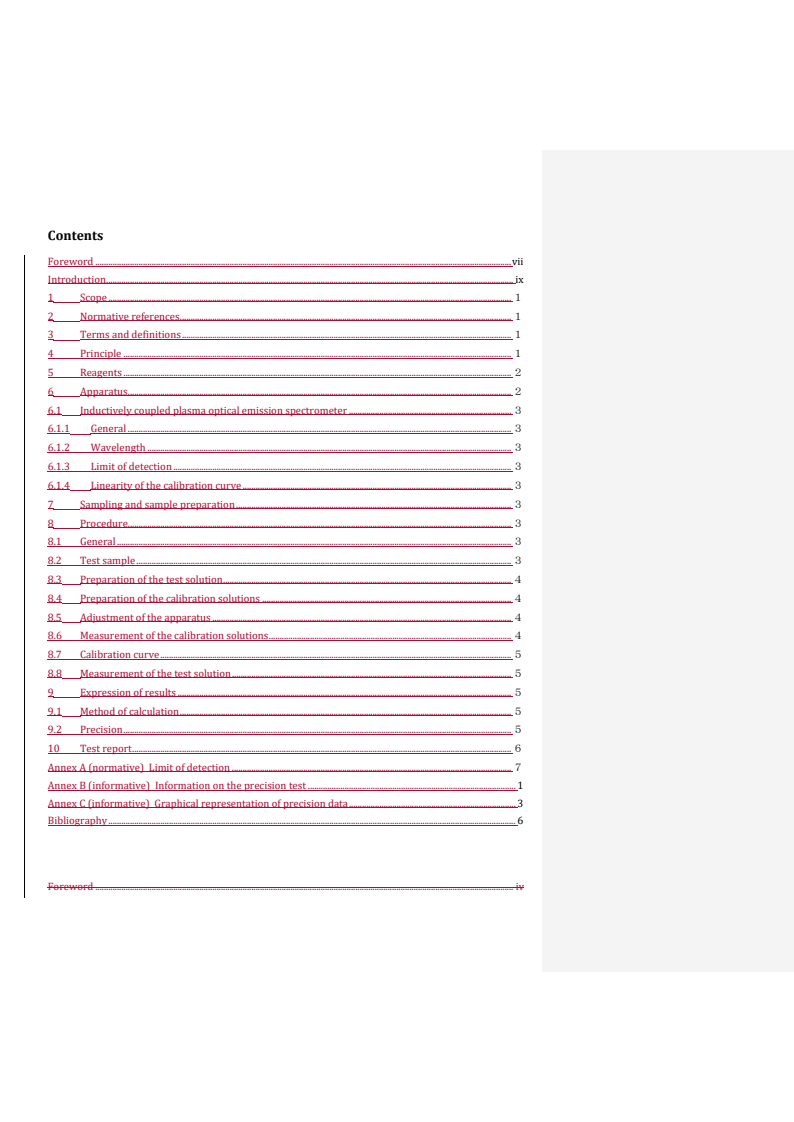
Contents
Foreword . vii
Introduction . ix
1 Scope . 1
2 Normative references . 1
3 Terms and definitions . 1
4 Principle . 1
5 Reagents . 2
6 Apparatus . 2
6.1 Inductively coupled plasma optical emission spectrometer . 3
6.1.1 General . 3
6.1.2 Wavelength . 3
6.1.3 Limit of detection . 3
6.1.4 Linearity of the calibration curve . 3
7 Sampling and sample preparation . 3
8 Procedure. 3
8.1 General . 3
8.2 Test sample . 3
8.3 Preparation of the test solution . 4
8.4 Preparation of the calibration solutions . 4
8.5 Adjustment of the apparatus . 4
8.6 Measurement of the calibration solutions . 4
8.7 Calibration curve . 5
8.8 Measurement of the test solution . 5
9 Expression of results . 5
9.1 Method of calculation . 5
9.2 Precision . 5
10 Test report . 6
Annex A (normative) Limit of detection . 7
Annex B (informative) Information on the precision test . 1
Annex C (informative) Graphical representation of precision data . 3
Bibliography . 6
Foreword . iv
Introduction . v
1 Scope. 1
2 Normative references . 1
3 Terms and definitions . 1
4 Principle . 1
5 Reagent . 1
6 Apparatus . 2
6.1 Inductively coupled plasma optical emission spectrometer . 2
6.1.1 General . 2
6.1.2 Wavelength . 3
6.1.3 Limit of detection . 3
6.1.4 Linearity of the calibration curve . 3
7 Sampling and sample preparation . 3
8 Procedure . 3
8.1 General . 3
8.2 Test sample . 错误!未定义书签。
8.3 Preparation of the test solution . 3
8.4 Preparation of the calibration solutions . 4
8.5 Adjustment of the apparatus . 4
8.6 Measurement of the calibration solutions . 4
8.7 Calibration curve . 4
8.8 Measurement of the test solution . 5
9 Expression of results . 5
9.1 Method of calculation . 5
9.2 Precision . 5
10 Test report . 5
Annex A (normative) Limit of detection . 7
Annex B (normative) Information on the precision test . 8
Annex C (informative) Graphical representation of precision data . 9
Bibliography. 10
©ISO 2018 - All rights reserved
Foreword
ISO (the International Organization for Standardization) is a worldwide federation of national standards
bodies (ISO member bodies). The work of preparing International Standards is normally carried out
through ISO technical committees. Each member body interested in a subject for which a technical
committee has been established has the right to be represented on that committee. International
organizations, governmental and non-governmental, in liaison with ISO, also take part in the work. ISO
collaborates closely with the International Electrotechnical Commission (IEC) on all matters of
electrotechnical standardization.
The procedures used to develop this document and those intended for its further maintenance are
described in the ISO/IEC Directives, Part 1. In particular, the different approval criteria needed for the
different types of ISO documentsdocument should be noted. This document was drafted in accordance with
the editorial rules of the ISO/IEC Directives, Part 2 (see www.iso.org/directives).
Field Code Changed
Attention is drawnISO draws attention to the possibility that some of the elementsimplementation of this
document may beinvolve the subjectuse of (a) patent(s). ISO takes no position concerning the evidence,
validity or applicability of any claimed patent rights. in respect thereof. As of the date of publication of this
document, ISO had not received notice of (a) patent(s) which may be required to implement this document.
However, implementers are cautioned that this may not represent the latest information, which may be
obtained from the patent database available at www.iso.org/patents. ISO shall not be held responsible for
identifying any or all such patent rights. Details of any patent rights identified during the development of
the document will be in the Introduction and/or on the ISO list of patent declarations received (see
www.iso.org/patents).
Any trade name used in this document is information given for the convenience of users and does not
constitute an endorsement.
For an explanation of the voluntary nature of standards, the meaning of ISO specific terms and expressions
related to conformity assessment, as well as information about ISO’sISO's adherence to the World Trade
Organization (WTO) principles in the Technical Barriers to Trade (TBT)), see
www.iso.org/iso/foreword.html.
Field Code Changed
This document was prepared by Technical Committee ISO/TC 79, Light metals and their alloys,
Subcommittee SC 5, Magnesium and alloys of cast or wrought magnesium.
Any feedback or questions on this document should be directed to the user’s national standards body. A
complete listing of these bodies can be found at www.iso.org/members.html.
Field Code Changed
©ISO 2018 - All rights reserved
Introduction
Magnesium and magnesium alloys are one kind of light metallic materials and show several advantageous
properties, such as low density, high specific stiffness and strength, good damping capacity, castability,
weldability and machinability, etc. Arsenic as one of the hazardous impurities has badnegative effects on
the environment and the health, so its content mustand needs to be strictly controlled. The sum of the mass
contents of cadmium (Cd), mercury (Hg), arsenic (As) and chromium (Cr) given in ISO 8287 is defined to
be less than 0,01 % in magnesium and its alloys, which mustneeds to be inspected if used in food and
medicine fields.
©ISO 2018 - All rights reserved ix
...