

ISO 16021:2024
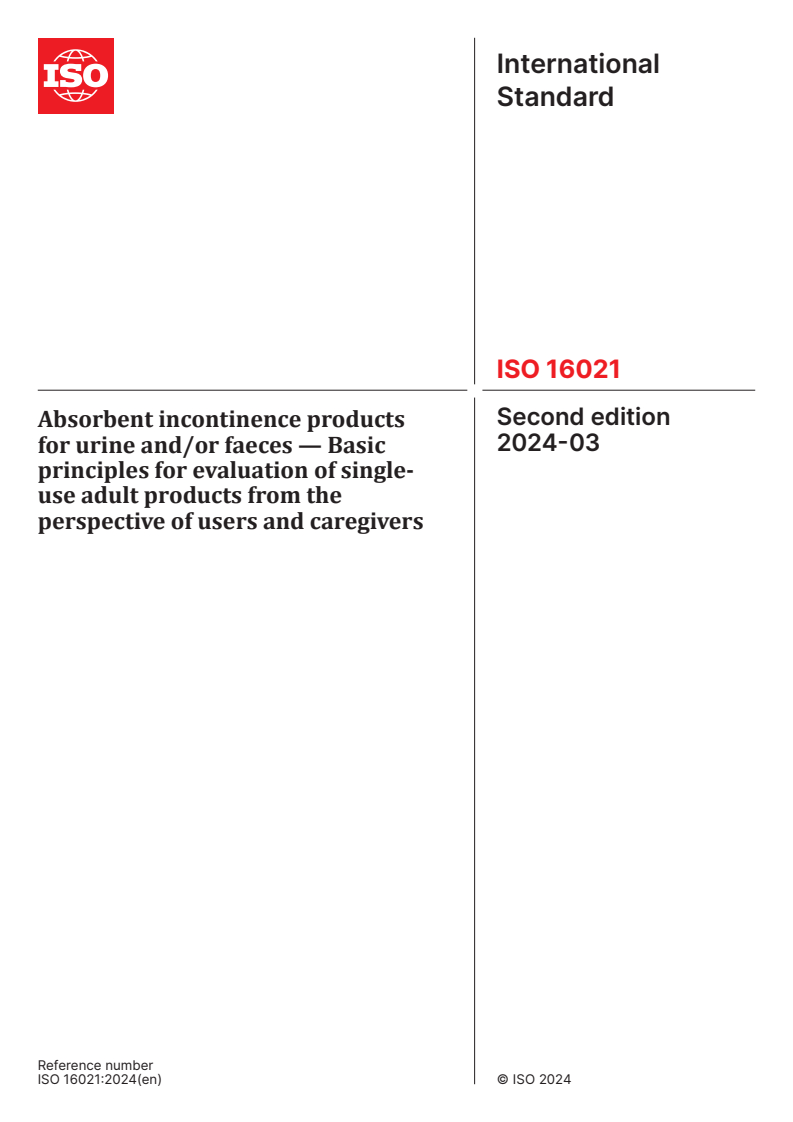
(Main)Absorbent incontinence products for urine and/or faeces — Basic principles for evaluation of single-use adult products from the perspective of users and caregivers
General Information
- Abstract
This document provides guidelines and requirements for designing and conducting an evaluation of single-use adult incontinence absorbing products. It provides guidelines and requirements on creating data collection tools. In particular, it provides a framework for eliciting and recording the views of users and their carers on the acceptability of products. In addition, a product diary is described which can help to quantify some parameters of product use, such as wear times, the mass of urine absorbed by the product and the severity of any leakage from it. This document does not cover direct comparison between products based on statistical parameters, neither does it provide guidelines on measuring the clinical efficacy of products; that is available in ISO 14155.
- Status
- Published
- Publication Date
- 25-Mar-2024
- Technical Committee
- ISO/TC 173/SC 3 - Aids for ostomy and incontinence
- Drafting Committee
- ISO/TC 173/SC 3 - Aids for ostomy and incontinence
- Current Stage
- 6060 - International Standard published
- Start Date
- 26-Mar-2024
- Due Date
- 22-Mar-2025
- Completion Date
- 26-Mar-2024
Buy Documents

ISO 16021:2024 - Absorbent incontinence products for urine and/or faeces — Basic principles for evaluation of single-use adult products from the perspective of users and caregivers Released:26. 03. 2024
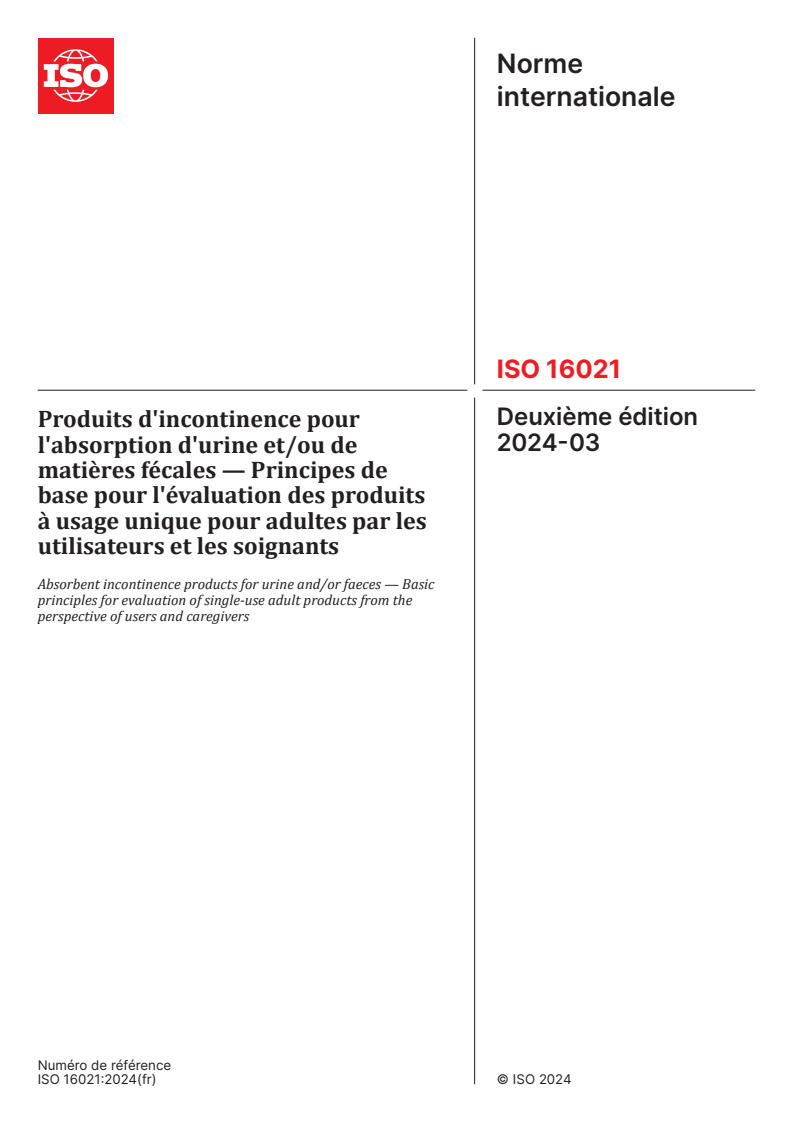

ISO 16021:2024 - Produits d'incontinence pour l'absorption d'urine et/ou de matières fécales — Principes de base pour l'évaluation des produits à usage unique pour adultes par les utilisateurs et les soignants/9/2024


REDLINE ISO 16021:2024 - Produits d'incontinence pour l'absorption d'urine et/ou de matières fécales — Principes de base pour l'évaluation des produits à usage unique pour adultes par les utilisateurs et les soignants/9/2024
Overview
ISO 16021:2024 - "Absorbent incontinence products for urine and/or faeces - Basic principles for evaluation of single-use adult products from the perspective of users and caregivers" - provides guidance for designing and conducting user-centered evaluations of single‑use adult absorbent incontinence products. The standard focuses on eliciting and recording the views of users and caregivers, defines data‑collection tools (questionnaires, product diaries) and sets out principles for recruitment, study duration and documentation. It does not cover direct statistical comparisons between products or clinical efficacy testing (see ISO 14155 for clinical investigations).
Key Topics and Requirements
- Evaluation protocol design
- Use clear inclusion/exclusion criteria, define objectives and record protocol decisions in the evaluation report.
- Consider ethics committee approval where applicable.
- Questionnaires and data‑gathering tools
- Structured product‑evaluation questionnaires to capture acceptability, comfort and handling.
- Demographic and background data (age, mobility, incontinence severity).
- Product diary
- Defined framework to quantify wear times, mass of urine absorbed and severity/frequency of leakage.
- Selection of products and users
- Select products from multiple production batches to reduce batch bias.
- Match product absorbency to user incontinence severity; avoid mixing institutional and home settings or independent and caregiver‑managed users in the same evaluation.
- Sample size and evaluation period
- Choose sample size based on intended use of data and resources; consult a statistician for robust comparative studies.
- Typical evaluation period: one to two weeks per product to allow acclimatization without loss of interest.
- Procedures
- Pilot studies recommended; document preparations, data collection, user withdrawal and final evaluation report content.
Applications and Who Uses It
ISO 16021:2024 is practical for:
- Product developers and manufacturers conducting user acceptability studies for single‑use adult absorbent products.
- Quality assurance and regulatory teams preparing non‑clinical usability evidence.
- Clinical researchers and health‑care providers planning user trials or real‑world evaluations focused on acceptability and caregiver handling.
- Purchasing managers and procurement specialists evaluating products from the perspective of end users and carers.
Practical benefits include improved product design decisions, evidence to support usability claims, and repeatable methods to collect real‑world user feedback.
Related Standards
- ISO 14155 - clinical investigations of medical devices (clinical efficacy).
- ISO 22748 - terminology and product-type guidance for absorbent incontinence products.
- EDANA guidance on diaper evaluation is also referenced for methodological parallels.
Keywords: ISO 16021:2024, absorbent incontinence products, single‑use adult products, user evaluation, caregiver evaluation, product diary, product evaluation questionnaire.
Relations
- Effective Date
- 12-Feb-2026
- Effective Date
- 06-Jun-2022
- Effective Date
- 06-Jun-2022
Buy Documents
ISO 16021:2024 - Absorbent incontinence products for urine and/or faeces — Basic principles for evaluation of single-use adult products from the perspective of users and caregivers Released:26. 03. 2024
ISO 16021:2024 - Produits d'incontinence pour l'absorption d'urine et/ou de matières fécales — Principes de base pour l'évaluation des produits à usage unique pour adultes par les utilisateurs et les soignants/9/2024
REDLINE ISO 16021:2024 - Produits d'incontinence pour l'absorption d'urine et/ou de matières fécales — Principes de base pour l'évaluation des produits à usage unique pour adultes par les utilisateurs et les soignants/9/2024
Get Certified
Connect with accredited certification bodies for this standard

BSI Group
BSI (British Standards Institution) is the business standards company that helps organizations make excellence a habit.

TÜV Rheinland
TÜV Rheinland is a leading international provider of technical services.

TÜV SÜD
TÜV SÜD is a trusted partner of choice for safety, security and sustainability solutions.
Sponsored listings
Frequently Asked Questions
ISO 16021:2024 is a standard published by the International Organization for Standardization (ISO). Its full title is "Absorbent incontinence products for urine and/or faeces — Basic principles for evaluation of single-use adult products from the perspective of users and caregivers". This standard covers: This document provides guidelines and requirements for designing and conducting an evaluation of single-use adult incontinence absorbing products. It provides guidelines and requirements on creating data collection tools. In particular, it provides a framework for eliciting and recording the views of users and their carers on the acceptability of products. In addition, a product diary is described which can help to quantify some parameters of product use, such as wear times, the mass of urine absorbed by the product and the severity of any leakage from it. This document does not cover direct comparison between products based on statistical parameters, neither does it provide guidelines on measuring the clinical efficacy of products; that is available in ISO 14155.
This document provides guidelines and requirements for designing and conducting an evaluation of single-use adult incontinence absorbing products. It provides guidelines and requirements on creating data collection tools. In particular, it provides a framework for eliciting and recording the views of users and their carers on the acceptability of products. In addition, a product diary is described which can help to quantify some parameters of product use, such as wear times, the mass of urine absorbed by the product and the severity of any leakage from it. This document does not cover direct comparison between products based on statistical parameters, neither does it provide guidelines on measuring the clinical efficacy of products; that is available in ISO 14155.
ISO 16021:2024 is classified under the following ICS (International Classification for Standards) categories: 11.180.20 - Aids for incontinence and ostomy. The ICS classification helps identify the subject area and facilitates finding related standards.
ISO 16021:2024 has the following relationships with other standards: It is inter standard links to EN ISO 16021:2024, ISO 17234-1:2020, ISO 16021:2000. Understanding these relationships helps ensure you are using the most current and applicable version of the standard.
ISO 16021:2024 is available in PDF format for immediate download after purchase. The document can be added to your cart and obtained through the secure checkout process. Digital delivery ensures instant access to the complete standard document.
Standards Content (Sample)
International
Standard
ISO 16021
Second edition
Absorbent incontinence products
2024-03
for urine and/or faeces — Basic
principles for evaluation of single-
use adult products from the
perspective of users and caregivers
Reference number
© ISO 2024
All rights reserved. Unless otherwise specified, or required in the context of its implementation, no part of this publication may
be reproduced or utilized otherwise in any form or by any means, electronic or mechanical, including photocopying, or posting on
the internet or an intranet, without prior written permission. Permission can be requested from either ISO at the address below
or ISO’s member body in the country of the requester.
ISO copyright office
CP 401 • Ch. de Blandonnet 8
CH-1214 Vernier, Geneva
Phone: +41 22 749 01 11
Email: copyright@iso.org
Website: www.iso.org
Published in Switzerland
ii
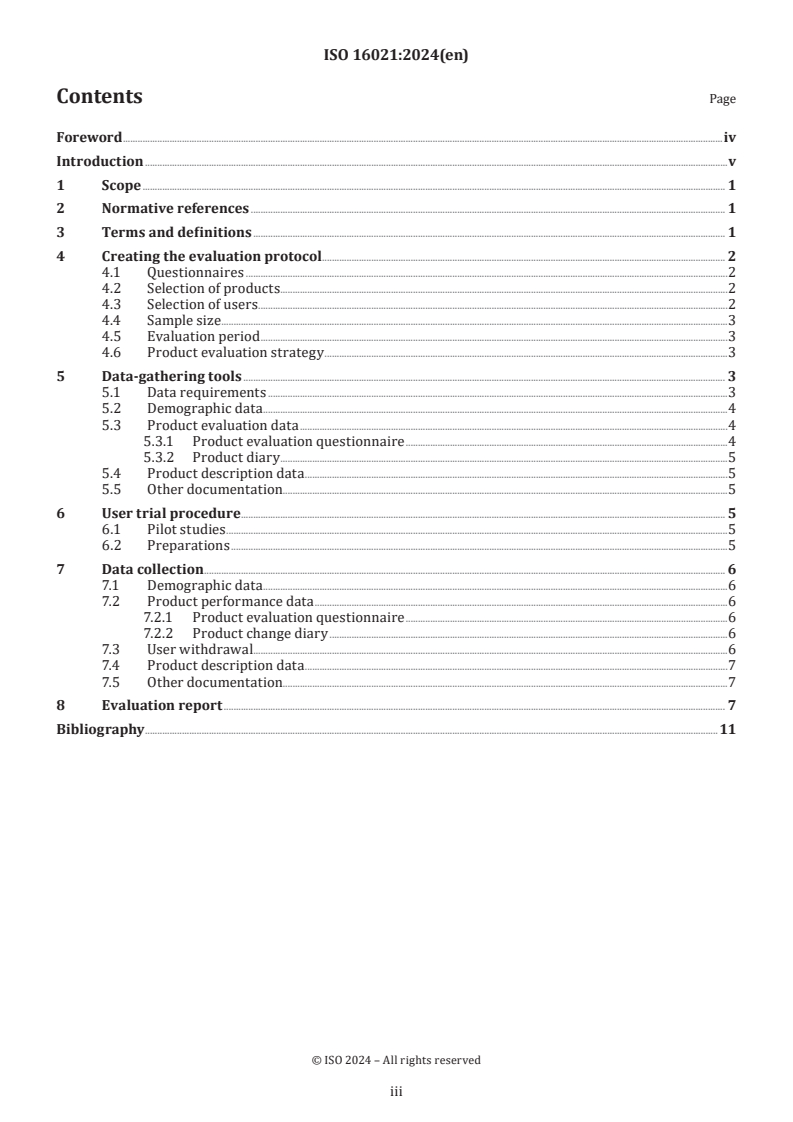
Contents Page
Foreword .iv
Introduction .v
1 Scope . 1
2 Normative references . 1
3 Terms and definitions . 1
4 Creating the evaluation protocol . 2
4.1 Questionnaires .2
4.2 Selection of products.2
4.3 Selection of users .2
4.4 Sample size .3
4.5 E valuation period .3
4.6 Product evaluation strategy .3
5 Data-gathering tools . 3
5.1 Data requirements .3
5.2 Demographic data .4
5.3 Product evaluation data .4
5.3.1 Product evaluation questionnaire .4
5.3.2 Product diary .5
5.4 Product description data .5
5.5 Other documentation.5
6 User trial procedure . . 5
6.1 Pilot studies .5
6.2 Preparations .5
7 Data collection . . 6
7.1 Demographic data .6
7.2 Product performance data .6
7.2.1 Product evaluation questionnaire .6
7.2.2 Product change diary .6
7.3 User withdrawal . .6
7.4 Product description data .7
7.5 Other documentation.7
8 E v a lu at ion r ep or t . 7
Bibliography .11
iii
Foreword
ISO (the International Organization for Standardization) is a worldwide federation of national standards
bodies (ISO member bodies). The work of preparing International Standards is normally carried out through
ISO technical committees. Each member body interested in a subject for which a technical committee
has been established has the right to be represented on that committee. International organizations,
governmental and non-governmental, in liaison with ISO, also take part in the work. ISO collaborates closely
with the International Electrotechnical Commission (IEC) on all matters of electrotechnical standardization.
The procedures used to develop this document and those intended for its further maintenance are described
in the ISO/IEC Directives, Part 1. In particular, the different approval criteria needed for the different types
of ISO document should be noted. This document was drafted in accordance with the editorial rules of the
ISO/IEC Directives, Part 2 (see www.iso.org/directives).
ISO draws attention to the possibility that the implementation of this document may involve the use of (a)
patent(s). ISO takes no position concerning the evidence, validity or applicability of any claimed patent
rights in respect thereof. As of the date of publication of this document, ISO had not received notice of (a)
patent(s) which may be required to implement this document. However, implementers are cautioned that
this may not represent the latest information, which may be obtained from the patent database available at
www.iso.org/patents. ISO shall not be held responsible for identifying any or all such patent rights.
Any trade name used in this document is information given for the convenience of users and does not
constitute an endorsement.
For an explanation of the voluntary nature of standards, the meaning of ISO specific terms and expressions
related to conformity assessment, as well as information about ISO's adherence to the World Trade
Organization (WTO) principles in the Technical Barriers to Trade (TBT), see www.iso.org/iso/foreword.html.
This document was prepared by Technical Committee ISO/TC 173, Assistive products, Subcommittee SC 3,
Aids for ostomy and incontinence, in collaboration with the European Committee for Standardization (CEN)
Technical Committee CEN/TC 293, Assistive products and accessibility, in accordance with the Agreement on
technical cooperation between ISO and CEN (Vienna Agreement).
This second edition cancels and replaces the first edition (ISO 16021:2000), which has been technically
revised.
The main changes are as follows:
— clarified the scope;
— added references to new relevant standards;
— updated reference list;
— terminology has been harmonized with ISO 22748.
Any feedback or questions on this document should be directed to the user’s national standards body. A
complete listing of these bodies can be found at www.iso.org/members.html.
iv
Introduction
This document provides basic principles for conducting user evaluations of single-use, body-worn urine-
absorbing products for adult incontinent users, their caregivers, or both. It gives guidance for users or
caregivers in evaluating products in actual use and can be used for comparing products. EDANA has provided
[4]
useful guidelines on the evaluation of baby diapers many of which apply equally to absorbent products for
adult incontinence. Whether a user evaluation or a clinical investigation is planned, it is important to check
if ethics committee approval will be required.
The comparison of user evaluation data obtained from evaluating several products is statistically complex
and highly dependent upon the information desired from the evaluation, the differences between or among
products, and the size of the user population used in the evaluation, to mention only three important factors.
Direct comparison between products based on statistical parameters is not covered by this document.
This document is based upon an extensive body of data and experimentation on the ways in which evaluation
of incontinence products by users can be done to gain useful information on the acceptability of products for
a variety of purposes. Selected references are given in the Bibliography as an aid to the user of this document
in applying it to particular situations of interest.
v
International Standard ISO 16021:2024(en)
Absorbent incontinence products for urine and/or faeces —
Basic principles for evaluation of single-use adult products
from the perspective of users and caregivers
1 Scope
This document provides guidelines and requirements for designing and conducting an evaluation of single-
use adult incontinence absorbing products. It provides guidelines and requirements on creating data
collection tools. In particular, it provides a framework for eliciting and recording the views of users and
their carers on the acceptability of products. In addition, a product diary is described which can help to
quantify some parameters of product use, such as wear times, the mass of urine absorbed by the product
and the severity of any leakage from it.
This document does not cover direct comparison between products based on statistical parameters, neither
does it provide guidelines on measuring the clinical efficacy of products; that is available in ISO 14155.
2 Normative references
There are no normative references in this document.
3 Terms and definitions
For the purposes of this document, the following terms and definitions apply.
ISO and IEC maintain terminology databases for use in standardization at the following addresses:
— ISO Online browsing platform: available at https:// www .iso .org/ obp
— IEC Electropedia: available at https:// www .electropedia .org/
3.1
caregiver
person who assists user(s) with applying and changing absorbent incontinence products (3.5)
Note 1 to entry: Caregivers can be paid staff or family/friends.
3.2
ethics committee
body whose role is to protect the interests of evaluation subjects ‒ particularly in institutions ‒ by inspecting
proposed evaluation protocols
Note 1 to entry: Ethics committee permission is normally required before an evaluation can begin.
3.3
evaluation centre coordinator
person in charge of the evaluation in a given centre
3.4
principal investigator
person in overall charge of an evaluation
3.5
product
body-worn absorbent product intended to aid incontinent persons
Note 1 to entry: Further information regarding products and product types is given in ISO 22748.
3.6
product type
group of similar products (3.5) provided by a manufacturer or supplier which have similar construction, but
which differ from one another in such details as size or absorbency level
3.7
user
person who wears the product(s) (3.5) subject to evaluation
4 Creating the evaluation protocol
4.1 Questionnaires
This evaluation employs a series of questionnaires designed to collect users'/caregivers' observations and
opinions on aspects of the acceptability of a product, or several products, over an agreed period of time.
Further questionnaires are used to ascertain the age and health of the user, the severity of their incontinence
and other relevant background information.
The information entered on the questionnaires is processed for each user and each product tested at the end
of the evaluation period and is used to produce a report on the acceptability of each product in terms of the
level of satisfaction of the users.
This document does not provide a standard protocol, since objectives for running evaluations, user
populations, evaluation sites, products, and specific data of interest vary widely. Instead, it lists the primary
issues which should be considered in creating a protocol, along with guidelines on how to address them.
A record of the decisions made on these issues should be included in the evaluation report (see Clause 8).
NOTE Lists of issues that can be considered in writing questionnaires and other documentation are provided,
but users of this document are cautioned against using any of them exactly as found here without first verifying their
usefulness for the intended study.
4.2 Selection of products
The products or product types to be evaluated should be selected. Samples should be obtained from multiple
production batches in order to randomize the selection and reduce the impact of atypical results emanating
from e.g. a faulty batch.
4.3 Selection of users
A group of users appropriate to the product to be evaluated should be selected in accordance with the
manufacturers' intended use, as described in their technical documentation.
The severity of users’ incontinence should be matched to the absorbency of the product(s) as declared by the
manufacturer.
NOTE 1 In order to make a good match between users and products it can be useful to establish the absorption
requirements of potential evaluators by weighing their used products over a period of several days. It will usually be
possible to estimate the product absorption capacity an evaluator needs by weighing 10 or more of each user’s used
products.
Sample populations should be of distinct end-user groups. Users should be chosen from either institutions or
home settings, but not both in the same evaluation since practices, requirements and priorities often differ.
It is recommended to select either users who manage their own incontinence or those who rely on the help
of a caregiver(s), but not a mix in the same evaluation.
NOTE 2 Users in their own homes can manage their incontinence independently or rely on help from caregivers.
Clear inclusion and exclusion criteria for recruiting users or caregivers should be written. Such criteria can
include the age and sex of users and levels of mobility, mental acuity and severity of incontinence.
The user selection criteria should be well-defined and strictly adhered to while recruiting.
NOTE 3 Narrow inclusion criteria ensure homogeneous test populations leading to simpler data analysis but they
make recruitment of suitable evaluators (testers) more difficult.
4.4 Sample size
The number of users contributing to the study should be decided after taking into consideration the end-use
of the data and the time and resources available.
NOTE Large numbers will provide more reliable data, but a large study consumes more resources.
Those wishing to make statistically robust comparisons between different products should con
...
Norme
internationale
ISO 16021
Deuxième édition
Produits d'incontinence pour
2024-03
l'absorption d'urine et/ou de
matières fécales — Principes de
base pour l'évaluation des produits
à usage unique pour adultes par les
utilisateurs et les soignants
Absorbent incontinence products for urine and/or faeces — Basic
principles for evaluation of single-use adult products from the
perspective of users and caregivers
Numéro de référence
DOCUMENT PROTÉGÉ PAR COPYRIGHT
© ISO 2024
Tous droits réservés. Sauf prescription différente ou nécessité dans le contexte de sa mise en œuvre, aucune partie de cette
publication ne peut être reproduite ni utilisée sous quelque forme que ce soit et par aucun procédé, électronique ou mécanique,
y compris la photocopie, ou la diffusion sur l’internet ou sur un intranet, sans autorisation écrite préalable. Une autorisation peut
être demandée à l’ISO à l’adresse ci-après ou au comité membre de l’ISO dans le pays du demandeur.
ISO copyright office
Case postale 401 • Ch. de Blandonnet 8
CH-1214 Vernier, Genève
Tél.: +41 22 749 01 11
E-mail: copyright@iso.org
Web: www.iso.org
Publié en Suisse
ii
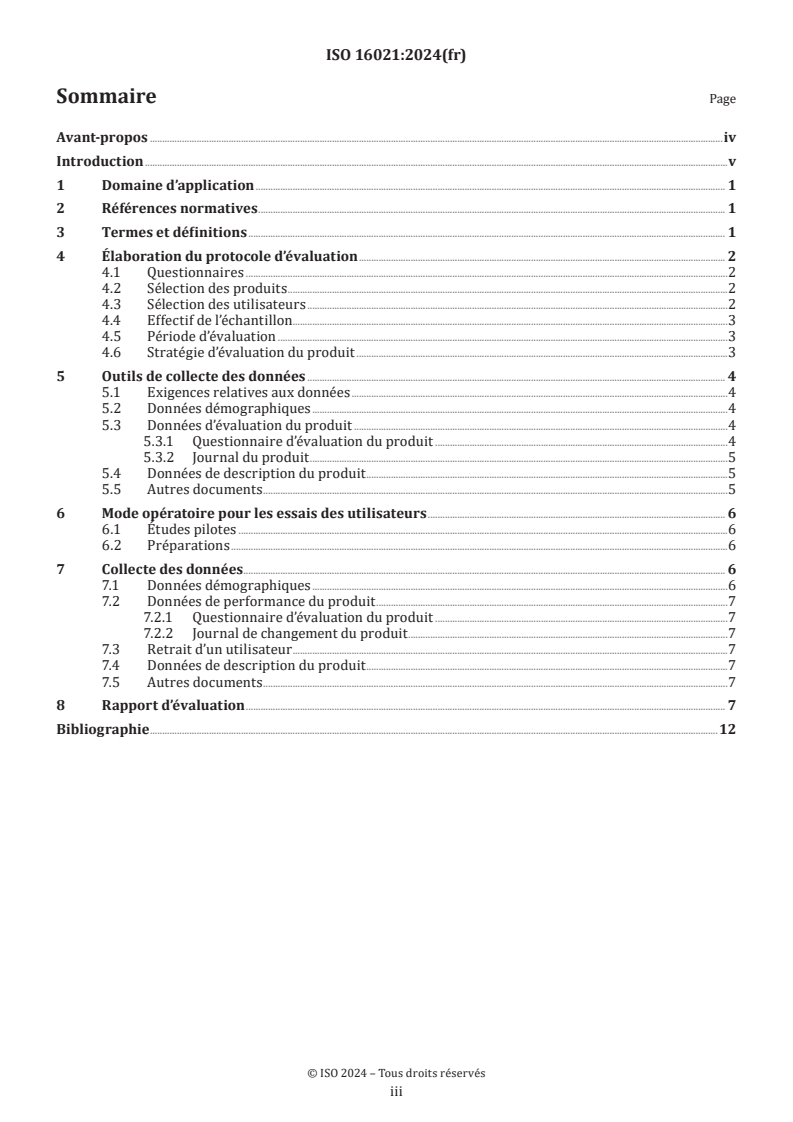
Sommaire Page
Avant-propos .iv
Introduction .v
1 Domaine d’application . 1
2 Références normatives . 1
3 Termes et définitions . 1
4 Élaboration du protocole d’évaluation . 2
4.1 Questionnaires .2
4.2 Sélection des produits .2
4.3 Sélection des utilisateurs .2
4.4 Effectif de l’échantillon . .3
4.5 Période d’évaluation .3
4.6 Stratégie d’évaluation du produit .3
5 Outils de collecte des données . 4
5.1 Exigences relatives aux données .4
5.2 Données démographiques .4
5.3 Données d’évaluation du produit .4
5.3.1 Questionnaire d’évaluation du produit .4
5.3.2 Journal du produit .5
5.4 Données de description du produit .5
5.5 Autres documents .5
6 Mode opératoire pour les essais des utilisateurs . 6
6.1 Études pilotes .6
6.2 Préparations .6
7 Collecte des données . . 6
7.1 Données démographiques .6
7.2 Données de performance du produit .7
7.2.1 Questionnaire d’évaluation du produit .7
7.2.2 Journal de changement du produit .7
7.3 Retrait d’un utilisateur .7
7.4 Données de description du produit .7
7.5 Autres documents .7
8 Rapport d’évaluation . 7
Bibliographie .12
iii
Avant-propos
L’ISO (Organisation internationale de normalisation) est une fédération mondiale d’organismes nationaux
de normalisation (comités membres de l’ISO). L’élaboration des Normes internationales est en général
confiée aux comités techniques de l’ISO. Chaque comité membre intéressé par une étude a le droit de faire
partie du comité technique créé à cet effet. Les organisations internationales, gouvernementales et non
gouvernementales, en liaison avec l’ISO participent également aux travaux. L’ISO collabore étroitement avec
la Commission électrotechnique internationale (IEC) en ce qui concerne la normalisation électrotechnique.
Les procédures utilisées pour élaborer le présent document et celles destinées à sa mise à jour sont
décrites dans les Directives ISO/IEC, Partie 1. Il convient, en particulier, de prendre note des différents
critères d’approbation requis pour les différents types de documents ISO. Le présent document
a été rédigé conformément aux règles de rédaction données dans les Directives ISO/IEC, Partie 2
(voir www.iso.org/directives).
L’ISO attire l’attention sur le fait que la mise en application du présent document peut entraîner l’utilisation
d’un ou de plusieurs brevets. L’ISO ne prend pas position quant à la preuve, à la validité et à l’applicabilité de
tout droit de propriété revendiqué à cet égard. À la date de publication du présent document, l’ISO n’avait pas
reçu notification qu’un ou plusieurs brevets pouvaient être nécessaires à sa mise en application. Toutefois,
il y a lieu d’avertir les responsables de la mise en application du présent document que des informations
plus récentes sont susceptibles de figurer dans la base de données de brevets, disponible à l’adresse
www.iso.org/brevets. L’ISO ne saurait être tenue pour responsable de ne pas avoir identifié tout ou partie de
tels droits de propriété.
Les appellations commerciales éventuellement mentionnées dans le présent document sont données pour
information, par souci de commodité, à l’intention des utilisateurs et ne sauraient constituer un engagement.
Pour une explication de la nature volontaire des normes, la signification des termes et expressions
spécifiques de l’ISO liés à l’évaluation de la conformité, ou pour toute information au sujet de l’adhésion de
l’ISO aux principes de l’Organisation mondiale du commerce (OMC) concernant les obstacles techniques au
commerce (OTC), voir www.iso.org/avant-propos.html.
Le présent document a été élaboré par le comité technique ISO/TC 173, Produits d’assistance, sous-comité
SC 3, Aides pour stomie et incontinence, en collaboration avec le comité technique CEN/TC 293, Aides
techniques pour personnes handicapée, du Comité européen de normalisation (CEN), conformément à l’Accord
de coopération technique entre l’ISO et le CEN (Accord de Vienne).
Cette deuxième édition annule et remplace la première édition (ISO 16021:2000), qui a fait l'objet d'une
révision technique.
Les principales modifications sont les suivantes :
— clarification du domaine d’application ;
— ajout de références à de nouvelles normes pertinentes ;
— mise à jour de la liste de références ;
— mise en conformité de la terminologie avec l’ISO 22748.
Il convient que l’utilisateur adresse tout retour d’information ou toute question concernant le présent
document à l’organisme national de normalisation de son pays. Une liste exhaustive desdits organismes se
trouve à l’adresse www.iso.org/fr/members.html.
iv
Introduction
Le présent document présente les principes de base permettant de procéder à des évaluations de
produits pour l’absorption de l’urine à usage unique, portés à même le corps, par des personnes adultes
incontinentes et/ou leurs soignants. Il donne des recommandations pour les utilisateurs ou les soignants
pour l’évaluation de produits dans le cadre de leur utilisation réelle et peut être utilisé pour comparer des
produits. L’Association internationale des textiles non-tissés et industries associées, EDANA, a fourni des
[4]
lignes directrices utiles sur l’évaluation des couches pour bébé, dont plusieurs appliquent également des
produits absorbants pour l’incontinence des adultes. Si une évaluation par l’utilisateur ou une étude clinique
est prévue, il est important de vérifier si l’approbation du comité d’éthique sera requise.
La comparaison des données d’évaluation obtenues dans le cadre de l’évaluation de plusieurs produits
est complexe sur le plan statistique et dépend fortement de l’information recherchée par l’évaluation, des
différences entre ou parmi les produits et de la taille de la population d’utilisateurs retenue pour l’évaluation,
pour ne nommer que trois facteurs importants. Le présent document ne traite pas de la comparaison directe
entre deux produits à partir de paramètres statistiques.
Le présent document est basé sur un large corpus de données et d’expériences portant sur les différentes
façons possibles de mener une évaluation de produits pour l’incontinence par leurs utilisateurs afin d’obtenir
des informations utiles sur l’acceptabilité des produits à des fins diverses. La bibliographie présente
quelques références choisies, destinées à aider les utilisateurs du présent document lors de son application à
des situations d’étude spécifiques.
v
Norme internationale ISO 16021:2024(fr)
Produits d'incontinence pour l'absorption d'urine et/ou de
matières fécales — Principes de base pour l'évaluation des
produits à usage unique pour adultes par les utilisateurs et
les soignants
1 Domaine d’application
Le présent document donne des lignes directrices et des exigences relatives à la conception et la conduite
d’une évaluation des produits absorbants à usage unique pour l’incontinence des adultes. Il donne des
lignes directrices et des exigences sur la création d’outils de collecte des données. Il propose notamment un
cadre permettant de sélectionner et d’enregistrer les opinions que les utilisateurs et les soignants peuvent
émettre quant à l’acceptabilité des produits. De plus, un journal du produit est décrit. Il permet de quantifier
les paramètres d’utilisation du produit, notamment la durée d’utilisation, la masse d’urine absorbée par le
produit et la gravité des éventuelles fuites.
Le présent document ne couvre pas la comparaison directe entre les produits d’après des paramètres
statistiques. Il ne fournit pas non plus de lignes directrices sur la mesure de l’efficacité clinique des produits.
Celles-ci sont disponibles dans l’ISO 14155.
2 Références normatives
Le présent document ne contient aucune référence normative.
3 Termes et définitions
Pour les besoins du présent document, les termes et définitions suivants s’appliquent.
L’ISO et l’IEC tiennent à jour des bases de données terminologiques destinées à être utilisées en normalisation,
consultables aux adresses suivantes :
— ISO Online browsing platform : disponible à l’adresse https:// www .iso .org/ obp
— IEC Electropedia : disponible à l’adresse https:// www .electropedia .org/
3.1
soignant
personne qui aide l’utilisateur ou les utilisateurs à mettre ou à changer les produits (3.5) absorbants pour
incontinence
Note 1 à l'article: Le soignant peut être un employé rémunéré, un membre de la famille ou un ami.
3.2
comité d’éthique
comité dont le rôle est de défendre les intérêts des sujets de l’évaluation, en particulier au sein d’instituts, en
procédant au contrôle des protocoles d’évaluation proposés
Note 1 à l'article: L’accord du comité d’éthique est normalement requis avant toute évaluation.
3.3
coordinateur du centre d’évaluation
personne chargée de l’évaluation dans un centre donné
3.4
enquêteur principal
personne chargée de superviser l’évaluation
3.5
produit
produit absorbant porté à même le corps ayant pour objectif d’aider les personnes incontinentes
Note 1 à l'article: De plus amples informations relatives aux produits et aux types de produits sont données dans
l’ISO 22748.
3.6
type de produit
ensemble de produits (3.5) de même type fournis par un fabricant ou fournisseur, dont la construction est
similaire, mais dont certains détails varient, comme la dimension ou le niveau d’absorption
3.7
utilisateur
personne portant le ou les produits (3.5) soumis à l’évaluation
4 Élaboration du protocole d’évaluation
4.1 Questionnaires
Cette évaluation comporte une série de questionnaires conçus pour recueillir les observations et les opinions
des utilisateurs et/ou des soignants sur l’acceptabilité d’un ou de plusieurs produits, sur une période
déterminée. D’autres questionnaires sont utilisés pour recueillir l’âge et l’état de santé de l’utilisateur, la
gravité de son état d’incontinence et d’autres informations d’ordre général nécessaires.
Les informations saisies dans le questionnaire sont traitées pour chaque utilisateur et chaque produit
soumis à essai à la fin de la période d’évaluation et sont utilisées pour établir un rapport sur l’acceptabilité
de chaque produit pour ce qui concerne le niveau de satisfaction des utilisateurs.
Le présent document ne contient pas de protocole normalisé, étant donné que les objectifs des évaluations,
les populations d’utilisateurs, les centres d’évaluation, les produits et les données étudiées varient
considérablement. A contrario, il énumère tous les points importants qu’il convient de prendre en compte
pour élaborer un protocole et donne des lignes directrices sur la manière de les traiter.
Il convient d’inclure un enregistrement des décisions prises sur ces questions dans le rapport d’évaluation
(voir Article 8).
NOTE Des listes contenant des questions pouvant être prises en compte dans la rédaction des questionnaires et
des autres documents sont proposées, mais les utilisateurs du présent document sont néanmoins informés du risque
de les utiliser en l’état, sans en vérifier préalablement l’utilité pour l’étude prévue.
4.2 Sélection des produits
Il convient de sélectionner les produits ou types de produits à évaluer. Il convient d’obtenir des échantillons
provenant de plusieurs lots de fabrication afin de pouvoir procéder à une sélection aléatoire et réduire
l’influence des résultats atypiques provenant, par exemple, de lots défectueux.
4.3 Sélection des utilisateurs
Il convient de choisir un groupe d’utilisateurs approprié au produit à évaluer, conformément à l’utilisation
prévue par le fabricant, tel que décrit dans la documentation technique.
Il convient de faire correspondre la gravité de l’incontinence d’un utilisateur avec la capacité d’absorption du
ou des produits déclarée par le fabricant.
NOTE 1 Pour établir une bonne correspondance entre les utilisateurs et les produits, il peut être utile de définir
les exigences d’absorption des évaluateurs potentiels en pesant les produits qu’ils utilisent pendant une période de
plusieurs jours. Il sera généralement possible d’estimer la capacité d’absorption du produit dont un évaluateur a besoin
en pesant au moins 10 produits utilisés par l’utilisateur.
Il convient de distinguer les populations d’échantillon des groupes d’utilisateurs finaux. Il est recommandé
de choisir les utilisateurs soit dans des instituts soit à leur domicile, mais pas dans les deux lors de la même
évaluation, du fait que les pratiques, les exigences et les priorités sont souvent différentes.
Il est recommandé de choisir soit des utilisateurs qui s’occupent seuls de leur incontinence, soit des
utilisateurs qui ont recours aux services d’un soignant, mais de ne pas mélanger ces deux catégories lors de
la même évaluation.
NOTE 2 Les utilisateurs vivant à leur domicile peuvent s’occuper de leur incontinence seuls ou être assistés par un
soignant.
Il convient de stipuler clairement les critères d’acceptation et de rejet des utilisateurs ou des soignants. Ces
critères peuvent comporter notamment l’âge et le sexe des utilisateurs et les niveaux de mobilité, le quotient
intellectuel et la gravité de l’incontinence.
Il convient que les critères de sélection des utilisateurs soient clairement définis et strictement respectés
pendant le recrutement.
NOTE 3 Des critères d’acceptation restreints garantissent des populations d’essai homogènes, permettant d’obtenir
des données d’analyse plus simples, mais ils rendent plus difficile le recrutement d’évaluateurs appropriés.
4.4 Effectif de l’échantillon
Il convient de décider du nombre d’utilisateurs participant à l’étude après avoir pris en compte l’exploitation
finale des données ainsi que le temps et les ressources disponibles.
NOTE Lorsque le nombre est élevé, les données sont plus fiables, mais les études nécessitent plus de ressources.
Pour effectuer des comparaisons basées sur des paramètres statistiques robustes entre différents produits,
il est primordial de s’adresser à un statisticien médical pour obtenir des conseils, par exemple sur le nombre
de sujets qu’il convient de recruter pour l’évaluation et sur l’ordre de présentation aléatoire des différents
produits à évaluer.
4.5 Période d’évaluation
Il convient de définir la période pendant laquelle le produit sera évalué avant de commencer l’évaluation. Il
convient de prévoir une durée suffisante pour que les utilisateurs ou les soignants se familiarisent avec le
produit et puissent formuler un avis sur son acceptabilité. Il convient cependant que la durée ne soit pas trop
longue pour maintenir l’intérêt des participants, notamment lorsque plusieurs produits sont destinés à être
évalués simultanément par le même utilisateur/soignant.
NOTE Une durée d’une semaine à deux semaines constitue une période d’évaluation suffisante.
4.6 Stratégie d’évaluation du produit
Lorsque le
...
Date : Deuxième édition
2024-03
ISO/TC 173/SC 3
Secrétariat : SIS
Date: 2024-03-22
Produits d'incontinence pour l'absorption d'urine et/ou de matières
fécales ― — Principes de base pour l'évaluation des produits à usage
unique pour adultes par les utilisateurs et les soignants
Absorbent incontinence products for urine and/or faeces ― — Basic principles for evaluation of single-use adult
products from the perspective of users and caregivers
NORME INTERNATIONALE ISO 16021:2024(fr)
DOCUMENT PROTÉGÉ PAR COPYRIGHT
Droits de reproductionTous droits réservés. Sauf prescription différente ou nécessité dans le contexte de sa mise en
œuvreoeuvre, aucune partie de cette publication ne peut être reproduite ni utilisée sous quelque forme que ce soit et par
aucun procédé, électronique ou mécanique, y compris la photocopie, ou la diffusion sur l’internet ou sur un intranet, sans
autorisation écrite préalable. Une autorisation peut être demandée à l’ISO à l’adresse ci-après ou au comité membre de
l’ISO dans le pays du demandeur.
ISO copyright office
CP 401 • Ch. de Blandonnet 8 • CP 401
CH-1214 Vernier, Geneva, Switzerland
Tel. Phone: + 41 22 749 01 11
Fax + 41 22 749 09 47
E-mail: copyright@iso.org
Website: www.iso.orgwww.iso.org
Publié en Suisse
@ ISO 2024 ― Tous droits réservés
Sommaire Page
Avant-propos .vi i
Introduction . ix
1 Domaine d’application . 1
2 Références normatives . 1
3 Termes et définitions . 1
4 Élaboration du protocole d’évaluation . 2
4.1 Questionnaires . 2
4.2 Sélection des produits . 2
4.3 Sélection des utilisateurs . 2
4.4 Effectif de l’échantillon . 3
4.5 Période d’évaluation . 3
4.6 Stratégie d’évaluation du produit . 3
5 Outils de collecte des données . 4
5.1 Exigences relatives aux données . 4
5.2 Données démographiques . 4
5.3 Données d’évaluation du produit . 5
5.3.1 Questionnaire d’évaluation du produit . 5
5.3.2 Journal du produit . 5
5.4 Données de description du produit . 6
5.5 Autres documents . 6
6 Mode opératoire pour les essais des utilisateurs . 6
6.1 Études pilotes . 6
6.2 Préparations . 6
7 Collecte des données . 7
7.1 Données démographiques . 7
7.2 Données de performance du produit . 7
7.2.1 Questionnaire d’évaluation du produit . 7
7.2.2 Journal de changement du produit . 7
7.3 Retrait d’un utilisateur . 7
7.4 Données de description du produit . 8
7.5 Autres documents . 8
8 Rapport d’évaluation . 8
Bibliographie . 12
v
@ ISO 2024 ― Tous droits réservés
vi
@ ISO 2024 ― Tous droits réservés
Avant-propos
L’ISO (Organisation internationale de normalisation) est une fédération mondiale d’organismes nationaux de
normalisation (comités membres de l’ISO). L’élaboration des Normes internationales est en général confiée
aux comités techniques de l’ISO. Chaque comité membre intéressé par une étude a le droit de faire partie du
comité technique créé à cet effet. Les organisations internationales, gouvernementales et non
gouvernementales, en liaison avec l’ISO participent également aux travaux. L’ISO collabore étroitement avec
la Commission électrotechnique internationale (IEC) en ce qui concerne la normalisation électrotechnique.
Les procédures utilisées pour élaborer le présent document et celles destinées à sa mise à jour sont décrites
dans les Directives ISO/IEC, Partie 1. Il convient, en particulier, de prendre note des différents critères
d’approbation requis pour les différents types de documents ISO. Le présent document a été rédigé
conformément aux règles de rédaction données dans les Directives ISO/IEC, Partie 2
(voir www.iso.org/directives).
L’ISO attire l’attention sur le fait que la mise en application du présent document peut entraîner l’utilisation
d’un ou de plusieurs brevets. L’ISO ne prend pas position quant à la preuve, à la validité et à l’applicabilité de
tout droit de propriété revendiqué à cet égard. À la date de publication du présent document, l’ISO n’avait pas
reçu notification qu’un ou plusieurs brevets pouvaient être nécessaires à sa mise en application. Toutefois, il
y a lieu d’avertir les responsables de la mise en application du présent document que des informations plus
récentes sont susceptibles de figurer dans la base de données de brevets, disponible à l’adresse
www.iso.org/brevets. L’ISO ne saurait être tenue pour responsable de ne pas avoir identifié tout ou partie de
tels droits de propriété.
Les appellations commerciales éventuellement mentionnées dans le présent document sont données pour
information, par souci de commodité, à l’intention des utilisateurs et ne sauraient constituer un engagement.
Pour une explication de la nature volontaire des normes, la signification des termes et expressions spécifiques
de l’ISO liés à l’évaluation de la conformité, ou pour toute information au sujet de l’adhésion de l’ISO aux
principes de l’Organisation mondiale du commerce (OMC) concernant les obstacles techniques au commerce
(OTC), voir www.iso.org/avant-propos.html.
Le présent document a été élaboré par le comité technique ISO/TC 173, Produits d’assistance, sous-comité
SC 3, Aides pour stomie et incontinence, en collaboration avec le comité technique CEN/TC 293, Produits
d’assistance et accessibilité, du Comité européen de normalisation (CEN), conformément à l’Accord de
coopération technique entre l’ISO et le CEN (Accord de Vienne).
Cette deuxième édition annule et remplace la première édition (ISO 16021:2000), qui a fait l’objet d’unel'objet
d'une révision technique.
Les principales modifications sont les suivantes :
— clarification du domaine d’application ;
— ajout de références à de nouvelles normes pertinentes ;
— mise à jour de la liste de références ;
— mise en conformité de la terminologie avec l’ISO 22748.
vii
@ ISO 2024 ― Tous droits réservés
Il convient que l’utilisateur adresse tout retour d’information ou toute question concernant le présent
document à l’organisme national de normalisation de son pays. Une liste exhaustive desdits organismes se
trouve à l’adresse www.iso.org/fr/members.html.
viii
@ ISO 2024 ― Tous droits réservés
Introduction
Le présent document présente les principes de base permettant de procéder à des évaluations de produits
pour l’absorption de l’urine à usage unique, portés à même le corps, par des personnes adultes incontinentes
et/ou leurs soignants. Il donne des recommandations pour les utilisateurs ou les soignants pour l’évaluation
de produits dans le cadre de leur utilisation réelle et peut être utilisé pour comparer des produits.
L’Association internationale des textiles non-tissés et industries associées, EDANA, a fourni des lignes
[4[4] ]
directrices utiles sur l’évaluation des couches pour bébé, , dont plusieurs appliquent également des
produits absorbants pour l’incontinence des adultes. Si une évaluation par l’utilisateur ou une étude clinique
est prévue, il est important de vérifier si l’approbation du comité d’éthique sera requise.
La comparaison des données d’évaluation obtenues dans le cadre de l’évaluation de plusieurs produits est
complexe sur le plan statistique et dépend fortement de l’information recherchée par l’évaluation, des
différences entre ou parmi les produits et de la taille de la population d’utilisateurs retenue pour l’évaluation,
pour ne nommer que trois facteurs importants. Le présent document ne traite pas de la comparaison directe
entre deux produits à partir de paramètres statistiques.
Le présent document est basé sur un large corpus de données et d’expériences portant sur les différentes
façons possibles de mener une évaluation de produits pour l’incontinence par leurs utilisateurs afin d’obtenir
des informations utiles sur l’acceptabilité des produits à des fins diverses. La bibliographie présente quelques
références choisies, destinées à aider les utilisateurs du présent document lors de son application à des
situations d’étude spécifiques.
ix
@ ISO 2024 ― Tous droits réservés
Produits d'incontinence pour l'absorption d'urine et/ou de matières
fécales ― — Principes de base pour l'évaluation des produits à usage
unique pour adultes par les utilisateurs et les soignants
1 Domaine d’application
Le présent document donne des lignes directrices et des exigences relatives à la conception et la conduite
d’une évaluation des produits absorbants à usage unique pour l’incontinence des adultes. Il donne des lignes
directrices et des exigences sur la création d’outils de collecte des données. Il propose notamment un cadre
permettant de sélectionner et d’enregistrer les opinions que les utilisateurs et les soignants peuvent émettre
quant à l’acceptabilité des produits. De plus, un journal du produit est décrit. Il permet de quantifier les
paramètres d’utilisation du produit, notamment la durée d’utilisation, la masse d’urine absorbée par le produit
et la gravité des éventuelles fuites.
Le présent document ne couvre pas la comparaison directe entre les produits d’après des paramètres
statistiques. Il ne fournit pas non plus de lignes directrices sur la mesure de l’efficacité clinique des produits.
Celles-ci sont disponibles dans l’ISO 14155.
2 Références normatives
Le présent document ne contient aucune référence normative.
3 Termes et définitions
Pour les besoins du présent document, les termes et définitions suivants s’appliquent.
L’ISO et l’IEC tiennent à jour des bases de données terminologiques destinées à être utilisées en normalisation,
consultables aux adresses suivantes :
— ISO Online browsing platform : disponible à l’adresse https://www.iso.org/obp
— IEC Electropedia : disponible à l’adresse https://www.electropedia.org/
3.1
soignant
personne qui aide l’utilisateur ou les utilisateurs à mettre ou à changer les produits (3.5) absorbants pour
incontinence (3.5)
Note 1 à l’article : l'article: Le soignant peut être un employé rémunéré, un membre de la famille ou un ami.
3.2
comité d’éthique
comité dont le rôle est de défendre les intérêts des sujets de l’évaluation, en particulier au sein d’instituts, en
procédant au contrôle des protocoles d’évaluation proposés
Note 1 à l’article : à l'article: L’accord du comité d’éthique est normalement requis avant toute évaluation.
3.3
coordinateur du centre d’évaluation
personne chargée de l’évaluation dans un centre donné
3.4
enquêteur principal
personne chargée de superviser l’évaluation
3.5
produit
produit absorbant porté à même le corps ayant pour objectif d’aider les personnes incontinentes
Note 1 à l’article : à l'article: De plus amples informations relatives aux produits et aux types de produits sont données
dans l’ISO 22748.
3.6
type de produit
ensemble de produits (3.5(3.5)) de même type fournis par un fabricant ou fournisseur, dont la construction
est similaire, mais dont certains détails varient, comme la dimension ou le niveau d’absorption
3.7
utilisateur
personne portant le ou les produits (3.5(3.5)) soumis à l’évaluation
4 Élaboration du protocole d’évaluation
4.1 Questionnaires
Cette évaluation comporte une série de questionnaires conçus pour recueillir les observations et les opinions
des utilisateurs et/ou des soignants sur l’acceptabilité d’un ou de plusieurs produits, sur une période
déterminée. D’autres questionnaires sont utilisés pour recueillir l’âge et l’état de santé de l’utilisateur, la
gravité de son état d’incontinence et d’autres informations d’ordre général nécessaires.
Les informations saisies dans le questionnaire sont traitées pour chaque utilisateur et chaque produit soumis
à essai à la fin de la période d’évaluation et sont utilisées pour établir un rapport sur l’acceptabilité de chaque
produit pour ce qui concerne le niveau de satisfaction des utilisateurs.
Le présent document ne contient pas de protocole normalisé, étant donné que les objectifs des évaluations,
les populations d’utilisateurs, les centres d’évaluation, les produits et les données étudiées varient
considérablement. A contrario, il énumère tous les points importants qu’il convient de prendre en compte
pour élaborer un protocole et donne des lignes directrices sur la manière de les traiter.
Il convient d’inclure un enregistrement des décisions prises sur ces questions dans le rapport d’évaluation
(voir Article 8Article 8).).
NOTE Des listes contenant des questions pouvant être prises en compte dans la rédaction des questionnaires et des
autres documents sont proposées, mais les utilisateurs du présent document sont néanmoins informés du risque de les
utiliser en l’état, sans en vérifier préalablement l’utilité pour l’étude prévue.
4.2 Sélection des produits
Il convient de sélectionner les produits ou types de produits à évaluer. Il convient d’obtenir des échantillons
provenant de plusieurs lots de fabrication afin de pouvoir procéder à une sélection aléatoire et réduire
l’influence des résultats atypiques provenant, par exemple, de lots défectueux.
4.3 Sélection des utilisateurs
Il convient de choisir un groupe d’utilisateurs approprié au produit à évaluer, conformément à l’utilisation
prévue par le fabricant, tel que décrit dans la documentation technique.
Il convient de faire correspondre la gravité de l’incontinence d’un utilisateur avec la capacité d’absorption du
ou des produits déclarée par le fabricant.
NOTE 1 Pour établir une bonne correspondance entre les utilisateurs et les produits, il peut être utile de définir les
exigences d’absorption des évaluateurs potentiels en pesant les produits qu’ils utilisent pendant une période de plusieurs
jours. Il sera généralement possible d’estimer la capacité d’absorption du produit dont un évaluateur a besoin en pesant
au moins 10 produits utilisés par l’utilisateur.
Il convient de distinguer les populations d’échantillon des groupes d’utilisateurs finaux. Il est recommandé de
choisir les utilisateurs soit dans des instituts soit à leur domicile, mais pas dans les deux lors de la même
évaluation, du fait que les pratiques, les exigences et les priorités sont souvent différentes.
Il est recommandé de choisir soit des utilisateurs qui s’occupent seuls de leur incontinence, soit des
utilisateurs qui ont recours aux services d’un soignant, mais de ne pas mélanger ces deux catégories lors de la
même évaluation.
NOTE 2 Les utilisateurs vivant à leur domicile peuvent s’occuper de leur incontinence seuls ou être assistés par un
soignant.
Il convient de stipuler clairement les critères d’acceptation et de rejet des utilisateurs ou des soignants. Ces
critères peuvent comporter notamment l’âge et le sexe des utilisateurs et les niveaux de mobilité, le quotient
intellectuel et la gravité de l’incontinence.
Il convient que les critères de sélection des utilisateurs soient clairement définis et strictement respectés
pendant le recrutement.
NOTE 3 Des critères d’acceptation restreints garantissent des populations d’essai homogènes, permettant d’obtenir
des données d’analyse plus simples, mais ils rendent plus difficile le recrutement d’évaluateurs appropriés.
4.4 Effectif de l’échantillon
Il convient de décider du nombre d’utilisateurs participant à l’étude après avoir pris en compte l’exploitation
finale des données ainsi que le temps et les ressources disponibles.
NOTE Lorsque le nombre est élevé, les données sont plus fiables, mais les études nécessitent plus de ressources.
Pour effectuer des comparaisons basées sur des paramètres statistiques robustes entre différents produits, il
est primordial de s’adresser à un statisticien médical pour obtenir des conseils, par exemple sur le nombre de
sujets qu’il convient de recruter pour l’évaluation et sur l’ordre de présentation aléatoire des différents
produits à évaluer.
4.5 Période d’évaluation
Il convient de définir la période pendant laquelle le produit sera évalué avant de commencer l’évaluation. Il
convient de prévoir une durée suffisante pour que les utilisateurs ou les soignants se familiarisent avec le
produit et puissent formuler un avis sur son acceptabilité. Il convient cependant que la durée ne soit pas trop
longue pour maintenir l’intérêt des participants, notamment lorsque plusieurs produits sont destinés à être
évalués simultanément par le même utilisateur/soignant.
NOTE Une durée d’une semaine à deux semaines constitue une période d’évaluation suffisante.
4.6 Stratégie d’évaluation du produit
Lorsque le nombre de produits destiné à être évalué par un groupe d’utilisateurs choisis est supérieur à un, il
convient d’alterner l’ordre d’essai des produits parmi les participants à l’essai.
...