

ISO 8102-1:2020
(Main)Electrical requirements for lifts, escalators and moving walks — Part 1: Electromagnetic compatibility with regard to emission
General Information
- Abstract
This document specifies the emission limits in relation to electromagnetic disturbances and test conditions for lifts, escalators and moving walks, which are intended to be permanently installed in buildings. It is possible, however, that these limits do not provide full protection against disturbances caused to radio and TV reception when such equipment is used within distances given in Table 1. This document is not applicable for apparatus which are manufactured before the date of its publication
- Status
- Published
- Publication Date
- 17-Jun-2020
- Technical Committee
- ISO/TC 178 - Lifts, escalators and moving walks
- Drafting Committee
- ISO/TC 178/WG 8 - Electrical requirements
- Current Stage
- 9092 - International Standard to be revised
- Start Date
- 17-Jan-2024
- Completion Date
- 29-Aug-2026
Buy Documents

ISO 8102-1:2020 - Electrical requirements for lifts, escalators and moving walks
ISO 8102-1:2020 - Electrical requirements for lifts, escalators and moving walks — Part 1: Electromagnetic compatibility with regard to emission/18/2020
Overview
ISO 8102-1:2020 specifies the electromagnetic compatibility (EMC) emission requirements for permanently installed lifts, escalators, and moving walks. Developed by the International Organization for Standardization (ISO), this standard sets out emission limits and test conditions to minimize electromagnetic disturbances in building-based installation environments. The aim is to ensure these systems operate reliably without causing significant interference to other electronic equipment, particularly radio and television reception.
Adhering to ISO 8102-1:2020 helps manufacturers, installers, and facility managers ensure compliance, improve product safety, and support the effective operation of electrical and electronic equipment within buildings.
Key Topics
- Electromagnetic Emission Limits
The standard defines allowable radio-frequency emissions for enclosure (radiative) and power ports (conductive), helping to reduce disturbances to nearby equipment. - Test Procedures and Set-up
Detailed guidelines for measurement conditions, including operational modes that maximize emissions, environmental factors (temperature, humidity, voltage), and configuration of apparatus. - Applicability and Exemptions
Not all tests are mandatory for every configuration. ISO 8102-1:2020 specifies when certain tests may be omitted, provided the decision is justified and documented. - Harmonics and Voltage Fluctuations
Enforces limitations on harmonic currents and voltage fluctuations in accordance with referenced IEC standards, ensuring electrical network stability. - Documentation Requirements
Installers must receive comprehensive documentation covering assembly, interconnections, cable specifications, commissioning, testing, and best practices for maintaining compliance.
Applications
ISO 8102-1:2020 is applicable to any lifts, escalators, or moving walks intended for permanent installation, including:
- Residential and Commercial Buildings: Ensures reliable lift and escalator operation in homes, offices, hotels, hospitals, and retail spaces, helping to avoid electromagnetic interference with surrounding electronics.
- Public Infrastructure: Establishes electromagnetic emission controls for moving walks and escalators in airports, train stations, malls, and similar public venues.
- Industrial Facilities: Guides deployment in manufacturing plants and warehouses where robust EMC compliance is necessary due to complex electrical environments.
- Design and Engineering: Provides a framework for manufacturers and engineers to design systems that meet stringent EMC requirements, facilitating international market access and regulatory approval.
- Maintenance and Installation: Offers practical instructions for safe installation and ongoing maintenance, supporting long-term compliance and minimizing disturbances during equipment operation.
Related Standards
For comprehensive EMC and safety compliance, ISO 8102-1:2020 should be considered alongside the following standards:
- ISO 8102-2: Electrical requirements for lifts, escalators and moving walks - Part 2: Electromagnetic compatibility with regard to immunity.
- IEC 61000-3-11 / IEC 61000-3-12: Core EMC standards for voltage fluctuations, flicker, and harmonic current emissions.
- CISPR 11 and CISPR 14-1: Measurement methods and limits for industrial, scientific, and household equipment EMC emissions.
- EN 12015: Harmonized standard for electromagnetic compatibility specific to lifts, escalators, and moving walks (emission).
- IEC 61000-6-3/6-4: Generic EMC emission requirements for residential, commercial, light-industrial, and industrial environments.
Keywords: ISO 8102-1:2020, electromagnetic compatibility, EMC emission, lifts, escalators, moving walks, electrical requirements, harmonics, voltage fluctuations, building installations, ISO standard, EMC testing, installation compliance, public infrastructure, product safety.
Relations
- Effective Date
- 01-Jul-2026
- Effective Date
- 06-Jun-2022
- Effective Date
- 20-Jan-2024
- Effective Date
- 28-Jan-2017
Buy Documents
ISO 8102-1:2020 - Electrical requirements for lifts, escalators and moving walks
ISO 8102-1:2020 - Electrical requirements for lifts, escalators and moving walks — Part 1: Electromagnetic compatibility with regard to emission/18/2020
Get Certified
Connect with accredited certification bodies for this standard

DIBt (Deutsches Institut für Bautechnik)
German Institute for Building Technology.
DIN CERTCO
DIN Group product certification.

Aboma Certification B.V.
Specialized in construction, metal, and transport sectors.
Sponsored listings
Frequently Asked Questions
ISO 8102-1:2020 is a standard published by the International Organization for Standardization (ISO). Its full title is "Electrical requirements for lifts, escalators and moving walks — Part 1: Electromagnetic compatibility with regard to emission". This standard covers: This document specifies the emission limits in relation to electromagnetic disturbances and test conditions for lifts, escalators and moving walks, which are intended to be permanently installed in buildings. It is possible, however, that these limits do not provide full protection against disturbances caused to radio and TV reception when such equipment is used within distances given in Table 1. This document is not applicable for apparatus which are manufactured before the date of its publication
This document specifies the emission limits in relation to electromagnetic disturbances and test conditions for lifts, escalators and moving walks, which are intended to be permanently installed in buildings. It is possible, however, that these limits do not provide full protection against disturbances caused to radio and TV reception when such equipment is used within distances given in Table 1. This document is not applicable for apparatus which are manufactured before the date of its publication
ISO 8102-1:2020 is classified under the following ICS (International Classification for Standards) categories: 91.140.90 - Lifts. Escalators. The ICS classification helps identify the subject area and facilitates finding related standards.
ISO 8102-1:2020 has the following relationships with other standards: It is inter standard links to EN ISO 8100-1:2026, ISO 10304-4:2022, ISO/FDIS 8102-1, ISO 22199:2009. Understanding these relationships helps ensure you are using the most current and applicable version of the standard.
ISO 8102-1:2020 is available in PDF format for immediate download after purchase. The document can be added to your cart and obtained through the secure checkout process. Digital delivery ensures instant access to the complete standard document.
Standards Content (Sample)
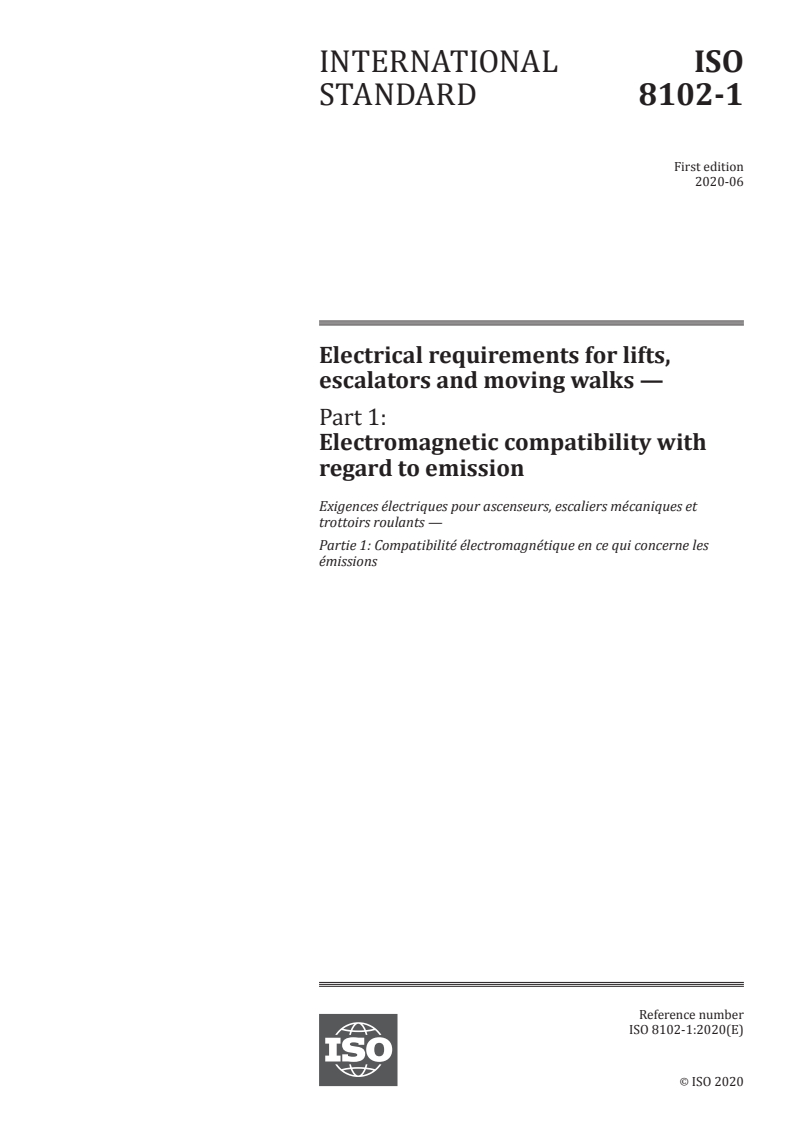
INTERNATIONAL ISO
STANDARD 8102-1
First edition
2020-06
Electrical requirements for lifts,
escalators and moving walks —
Part 1:
Electromagnetic compatibility with
regard to emission
Exigences électriques pour ascenseurs, escaliers mécaniques et
trottoirs roulants —
Partie 1: Compatibilité électromagnétique en ce qui concerne les
émissions
Reference number
©
ISO 2020
© ISO 2020
All rights reserved. Unless otherwise specified, or required in the context of its implementation, no part of this publication may
be reproduced or utilized otherwise in any form or by any means, electronic or mechanical, including photocopying, or posting
on the internet or an intranet, without prior written permission. Permission can be requested from either ISO at the address
below or ISO’s member body in the country of the requester.
ISO copyright office
CP 401 • Ch. de Blandonnet 8
CH-1214 Vernier, Geneva
Phone: +41 22 749 01 11
Fax: +41 22 749 09 47
Email: copyright@iso.org
Website: www.iso.org
Published in Switzerland
ii © ISO 2020 – All rights reserved
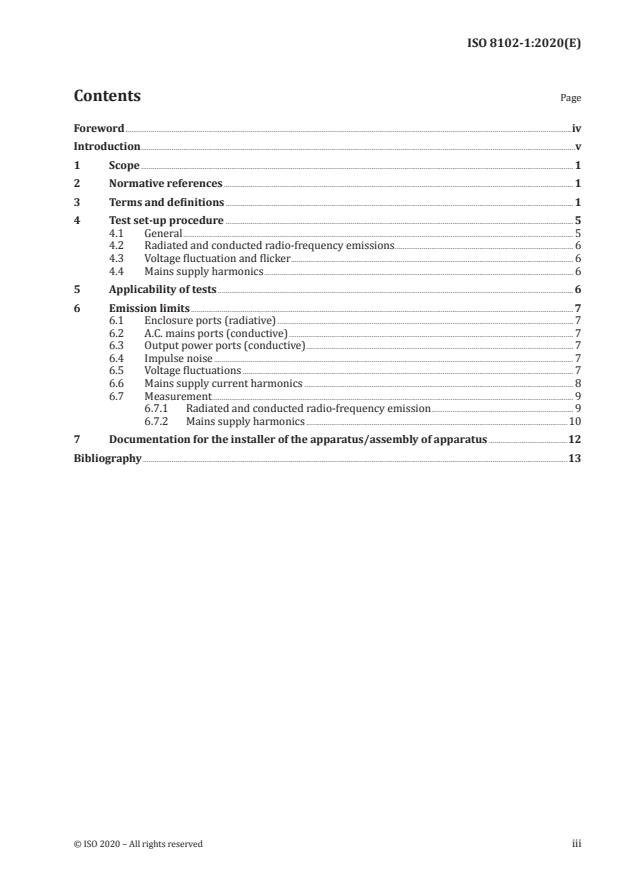
Contents Page
Foreword .iv
Introduction .v
1 Scope . 1
2 Normative references . 1
3 Terms and definitions . 1
4 Test set-up procedure . 5
4.1 General . 5
4.2 Radiated and conducted radio-frequency emissions. 6
4.3 Voltage fluctuation and flicker . 6
4.4 Mains supply harmonics . 6
5 Applicability of tests . 6
6 Emission limits . 7
6.1 Enclosure ports (radiative) . 7
6.2 A.C. mains ports (conductive) . 7
6.3 Output power ports (conductive) . 7
6.4 Impulse noise . 7
6.5 Voltage fluctuations . 7
6.6 Mains supply current harmonics . 8
6.7 Measurement . 9
6.7.1 Radiated and conducted radio-frequency emission . 9
6.7.2 Mains supply harmonics .10
7 Documentation for the installer of the apparatus/assembly of apparatus .12
Bibliography .13
Foreword
ISO (the International Organization for Standardization) is a worldwide federation of national standards
bodies (ISO member bodies). The work of preparing International Standards is normally carried out
through ISO technical committees. Each member body interested in a subject for which a technical
committee has been established has the right to be represented on that committee. International
organizations, governmental and non-governmental, in liaison with ISO, also take part in the work.
ISO collaborates closely with the International Electrotechnical Commission (IEC) on all matters of
electrotechnical standardization.
The procedures used to develop this document and those intended for its further maintenance are
described in the ISO/IEC Directives, Part 1. In particular the different approval criteria needed for the
different types of ISO documents should be noted. This document was drafted in accordance with the
editorial rules of the ISO/IEC Directives, Part 2 (see www .iso .org/ directives).
Attention is drawn to the possibility that some of the elements of this document may be the subject of
patent rights. ISO shall not be held responsible for identifying any or all such patent rights. Details of
any patent rights identified during the development of the document will be in the Introduction and/or
on the ISO list of patent declarations received (see www .iso .org/ patents).
Any trade name used in this document is information given for the convenience of users and does not
constitute an endorsement.
For an explanation on the voluntary nature of standards, the meaning of ISO specific terms and
expressions related to conformity assessment, as well as information about ISO's adherence to the
World Trade Organization (WTO) principles in the Technical Barriers to Trade (TBT) see the following
URL: www .iso .org/ iso/ foreword .html.
This document was prepared by Technical Committee ISO/TC 178, Lifts, escalators and moving walks.
This first edition of ISO 8102-1 cancels and replaces ISO 22199:2009 which has been technically revised.
iv © ISO 2020 – All rights reserved
Introduction
This document is a type-C standard as stated in ISO 12100.
This document is of relevance, in particular, for the following stakeholder groups representing the
market players with regard to machinery safety:
— machine manufacturers (small, medium and large enterprises);
— health and safety bodies (regulators, accident prevention organisations, market surveillance etc.)
Others can be affected by the level of machinery safety achieved with the means of the document by the
above-mentioned stakeholder groups:
— machine users/employers (small, medium and large enterprises);
— machine users/employees (e.g. trade unions, organizations for people with special needs);
— service providers, e. g. for maintenance (small, medium and large enterprises);
— consumers (in case of machinery intended for use by consumers).
The above-mentioned stakeholder groups have been given the possibility to participate at the drafting
process of this document.
The machinery concerned and the extent to which hazards, hazardous situations or hazardous events
are covered are indicated in the Scope of this document.
When requirements of this type-C standard are different from those which are stated in type-A or
type-B standards, the requirements of this type-C standard take precedence over the requirements of
the other standards for machines that have been designed and built according to the requirements of
this type-C standard.
This document is based on EN 12015:2020.
The requirements of this document have been specified so as to ensure a level of electromagnetic
emission that causes minimal disturbance to other equipment. The limits given in this document
recognize that:
— the product family covers a total range of lifts, escalators and moving walks used in residential
buildings, offices, hospitals, hotels, industrial plants, etc.; and
— lifts, escalators and passenger conveyors are deemed to have their own dedicated power supply and
be connected with the consent of the supply authority to a low impedance source.
This document is the product family standard for the electromagnetic compatibility of lifts, escalators
and moving walks (emission). It takes precedence over all aspects of IEC 61000-6-x. The emission
limits given are on the basis that equipment of the product family range is installed both indoors and
outdoors in all types of building, involves the switching of heavy currents and high inductive loads and,
generally, is connected to a low-voltage system.
The levels, however, do not cover the following cases where:
a) the probability of an occurrence likely to produce emissions in excess of those which are normally
experienced is extremely low, e.g. the emergency stopping of a lift, escalator or passenger conveyor
under a fault condition;
b) highly susceptible apparatus is used in the close proximity of the equipment covered by this
document, in which case further measures can be necessary to:
1) reduce the electromagnetic emission to below the levels specified in this document; or
2) increase the immunity of the affected apparatus.
The related EMC product family standard for immunity is ISO 8102-2:2017.
vi © ISO 2020 – All rights reserved
INTERNATIONAL STANDARD ISO 8102-1:2020(E)
Electrical requirements for lifts, escalators and moving
walks —
Part 1:
Electromagnetic compatibility with regard to emission
1 Scope
This document specifies the emission limits in relation to electromagnetic disturbances and test
conditions for lifts, escalators and moving walks, which are intended to be permanently installed in
buildings. It is possible, however, that these limits do not provide full protection against disturbances
caused to radio and TV reception when such equipment is used within distances given in Table 1.
This document is not applicable for apparatus which are manufactured before the date of its publication
2 Normative references
The following documents are referred to in the text in such a way that some or all of their content
constitutes requirements of this document. For dated references, only the edition cited applies. For
undated references, the latest edition of the referenced document (including any amendments) applies.
CISPR 11, Industrial, scientific and medical — Radio-frequency disturbance characteristic — Limits and
methods of measurement
CISPR 14-1:2016+COR1: 2016, Electromagnetic compatibility — Requirements for household appliances,
electric tools and similar apparatus — Part 1: Emission
IEC 61000-3-11, Electromagnetic compatibility (EMC) — Part 3 11: Limits — Limitation of voltage changes,
voltage fluctuations and flicker in public low-voltage supply systems for equipment with rated current up to
75 A and subject to conditional connection
IEC 61000-3-12, Electromagnetic compatibility (EMC) — Part 3-12: Limits — Limits for harmonic
currents produced by equipment connected to public low-voltage systems with input current > 16 A and ≤
75 A per phase
IEC 61000-6-3, Electromagnetic compatibility (EMC) — Part 6-3: Generic standards — Emission standard
for residential, commercial and light-industrial environments
IEC 61000-6-4, Electromagnetic compatibility (EMC) — Par 6-4: Generic standards — Emission standard
for industrial environments
3 Terms and definitions
For the purposes of this document, the terms and definitions given in IEC 61000-6-3, IEC 61000-6-4 and
the following apply.
ISO and IEC maintain terminological databases for use in standardization at the following addresses:
— ISO Online browsing platform: available at https:// www .iso .org/ obp
— IEC Electropedia: available at http:// www .electropedia .org/
3.1
apparatus
assembly of components with an intrinsic function as defined by its manufacturer
Note 1 to entry: See Figure 1 and Figure 2.
Key
assembly of apparatus
1 machinery space 7 landings
2 main control/control cabinet 8 system boundary
3 machine 9 A.C. – and/or D.C. power ports
4 door control 10 main switch
5 lift car 11 output power port
6 apparatus installed at the landing (e.g. push 12 ports for monitoring and remote alarm systems
buttons, indicators)
Figure 1 — EMC model example (emission) for lift systems
2 © ISO 2020 – All rights reserved
Key
assembly of apparatus
1 control panels 6 machine
2 machinery space (see 4 to 10) 7 A.C. and/or D.C. power ports
3 system boundary 8 main switch
4 machinery space 9 output power port
5 main control/control cabinet 10 ports for monitoring
NOTE The machinery space can also be an external room.
Figure 2 — EMC model example (emission) for escalator and moving walk systems
3.2
assembly of apparatus
arrangement of interconnected apparatus, which can be tested together
EXAMPLE See Figure 1 and Figure 2.
3.3
balanced three-phase system (equipment)
three-phase system which is connected to the three line conductors of a three-phase supply and in
which the three line or phase currents are designed to be identical in amplitude and wave-shape, each
being displaced from the other two by one-third of a fundamental period
[SOURCE: IEC 61000-3-12:2011, 3.7]
3.4
enclosure port
physical boundary of the apparatus/assembly of apparatus through which electromagnetic fields can
radiate or impinge
Note 1 to entry: See Figure 3.
Key
1 AC power port 5 ground port
2 DC power port 6 signal/control port
3 enclosure port 7 machine/motor port
4 apparatus/assembly of apparatus
Figure 3 — Examples of ports
3.5
hybrid equipment
combination of a balanced three-phase load and one or more loads connected between phase and
neutral or between phases
[SOURCE: IEC 61000-3-12:2011, 3.9]
3.6
machine/motor port
A.C./D.C. power supply port of the apparatus/assembly of apparatus containing active electronic
circuits connected to the machine/motor
Note 1 to entry: Active electronic circuits comprise electronic components such as transistors, thyristors, digital
ICs, microprocessors, and oscillators switching at a variable or fixed rate (switching/clock frequency). An LED
display circuit connected to a battery is not an active electronic circuit if the current is limited only by a resistor
or by a transistor operating linearly, but it is an active electronic circuit if the current is pulsed.
Note 2 to entry: Controlled speed drive motor supply output is an active electronic circuit. Direct on line or star-
delta starting of motors, hoisting and hydraulic pump motors are not active electronic circuits.
Note 3 to entry: Controlled speed drive motor supply output is a machine/motor port. Brake coil is not machine/
motor port.
3.7
partial weighted harmonic current
PWHC
total r.m.s. value of a selected group of higher order harmonic current components (in this document
from order 14 to order 40), weighted with the harmonic order h, calculated as:
hI⋅
∑
h
h=14
Note 1 to entry: The partial weighted harmonic current is employed in order to ensure that the effects of the
higher order harmonic currents on the results are reduced sufficiently and individual limits need not be specified.
4 © ISO 2020 – All rights reserved
[SOURCE: IEC 61000-3-12:2011, 3.2, modified – In the definition, "calculated as" has been added. The
abbreviated term has been unitalicized.]
3.8
port
particular interface of the specified apparatus/assembly of apparatus with the external electromagnetic
environment
Note 1 to entry: See Figure 3.
3.9
reference current
I
ref
value of the r.m.s. input current of the system (equipment) determined according to IEC 61000-3-12, 4.1,
and used to establish emission limits
[SOURCE: IEC 61000-3-12:2011, 3.12, modified – The term “system” and reference to “IEC 61000-3-12,
4.1” have been added.]
3.10
root mean square
r.m.s.
effective value of the current
3.11
short circuit ratio
R
sce
ratio of the short circuit power of the source to the apparent power of the load(s)
[SOURCE: IEC 61000-3-12:2011, 3.14]
3.1
...
INTERNATIONAL ISO
STANDARD 8102-1
First edition
2020-06
Electrical requirements for lifts,
escalators and moving walks —
Part 1:
Electromagnetic compatibility with
regard to emission
Exigences électriques pour ascenseurs, escaliers mécaniques et
trottoirs roulants —
Partie 1: Compatibilité électromagnétique en ce qui concerne les
émissions
Reference number
©
ISO 2020
© ISO 2020
All rights reserved. Unless otherwise specified, or required in the context of its implementation, no part of this publication may
be reproduced or utilized otherwise in any form or by any means, electronic or mechanical, including photocopying, or posting
on the internet or an intranet, without prior written permission. Permission can be requested from either ISO at the address
below or ISO’s member body in the country of the requester.
ISO copyright office
CP 401 • Ch. de Blandonnet 8
CH-1214 Vernier, Geneva
Phone: +41 22 749 01 11
Fax: +41 22 749 09 47
Email: copyright@iso.org
Website: www.iso.org
Published in Switzerland
ii © ISO 2020 – All rights reserved
Contents Page
Foreword .iv
Introduction .v
1 Scope . 1
2 Normative references . 1
3 Terms and definitions . 1
4 Test set-up procedure . 5
4.1 General . 5
4.2 Radiated and conducted radio-frequency emissions. 6
4.3 Voltage fluctuation and flicker . 6
4.4 Mains supply harmonics . 6
5 Applicability of tests . 6
6 Emission limits . 7
6.1 Enclosure ports (radiative) . 7
6.2 A.C. mains ports (conductive) . 7
6.3 Output power ports (conductive) . 7
6.4 Impulse noise . 7
6.5 Voltage fluctuations . 7
6.6 Mains supply current harmonics . 8
6.7 Measurement . 9
6.7.1 Radiated and conducted radio-frequency emission . 9
6.7.2 Mains supply harmonics .10
7 Documentation for the installer of the apparatus/assembly of apparatus .12
Bibliography .13
Foreword
ISO (the International Organization for Standardization) is a worldwide federation of national standards
bodies (ISO member bodies). The work of preparing International Standards is normally carried out
through ISO technical committees. Each member body interested in a subject for which a technical
committee has been established has the right to be represented on that committee. International
organizations, governmental and non-governmental, in liaison with ISO, also take part in the work.
ISO collaborates closely with the International Electrotechnical Commission (IEC) on all matters of
electrotechnical standardization.
The procedures used to develop this document and those intended for its further maintenance are
described in the ISO/IEC Directives, Part 1. In particular the different approval criteria needed for the
different types of ISO documents should be noted. This document was drafted in accordance with the
editorial rules of the ISO/IEC Directives, Part 2 (see www .iso .org/ directives).
Attention is drawn to the possibility that some of the elements of this document may be the subject of
patent rights. ISO shall not be held responsible for identifying any or all such patent rights. Details of
any patent rights identified during the development of the document will be in the Introduction and/or
on the ISO list of patent declarations received (see www .iso .org/ patents).
Any trade name used in this document is information given for the convenience of users and does not
constitute an endorsement.
For an explanation on the voluntary nature of standards, the meaning of ISO specific terms and
expressions related to conformity assessment, as well as information about ISO's adherence to the
World Trade Organization (WTO) principles in the Technical Barriers to Trade (TBT) see the following
URL: www .iso .org/ iso/ foreword .html.
This document was prepared by Technical Committee ISO/TC 178, Lifts, escalators and moving walks.
This first edition of ISO 8102-1 cancels and replaces ISO 22199:2009 which has been technically revised.
iv © ISO 2020 – All rights reserved
Introduction
This document is a type-C standard as stated in ISO 12100.
This document is of relevance, in particular, for the following stakeholder groups representing the
market players with regard to machinery safety:
— machine manufacturers (small, medium and large enterprises);
— health and safety bodies (regulators, accident prevention organisations, market surveillance etc.)
Others can be affected by the level of machinery safety achieved with the means of the document by the
above-mentioned stakeholder groups:
— machine users/employers (small, medium and large enterprises);
— machine users/employees (e.g. trade unions, organizations for people with special needs);
— service providers, e. g. for maintenance (small, medium and large enterprises);
— consumers (in case of machinery intended for use by consumers).
The above-mentioned stakeholder groups have been given the possibility to participate at the drafting
process of this document.
The machinery concerned and the extent to which hazards, hazardous situations or hazardous events
are covered are indicated in the Scope of this document.
When requirements of this type-C standard are different from those which are stated in type-A or
type-B standards, the requirements of this type-C standard take precedence over the requirements of
the other standards for machines that have been designed and built according to the requirements of
this type-C standard.
This document is based on EN 12015:2020.
The requirements of this document have been specified so as to ensure a level of electromagnetic
emission that causes minimal disturbance to other equipment. The limits given in this document
recognize that:
— the product family covers a total range of lifts, escalators and moving walks used in residential
buildings, offices, hospitals, hotels, industrial plants, etc.; and
— lifts, escalators and passenger conveyors are deemed to have their own dedicated power supply and
be connected with the consent of the supply authority to a low impedance source.
This document is the product family standard for the electromagnetic compatibility of lifts, escalators
and moving walks (emission). It takes precedence over all aspects of IEC 61000-6-x. The emission
limits given are on the basis that equipment of the product family range is installed both indoors and
outdoors in all types of building, involves the switching of heavy currents and high inductive loads and,
generally, is connected to a low-voltage system.
The levels, however, do not cover the following cases where:
a) the probability of an occurrence likely to produce emissions in excess of those which are normally
experienced is extremely low, e.g. the emergency stopping of a lift, escalator or passenger conveyor
under a fault condition;
b) highly susceptible apparatus is used in the close proximity of the equipment covered by this
document, in which case further measures can be necessary to:
1) reduce the electromagnetic emission to below the levels specified in this document; or
2) increase the immunity of the affected apparatus.
The related EMC product family standard for immunity is ISO 8102-2:2017.
vi © ISO 2020 – All rights reserved
INTERNATIONAL STANDARD ISO 8102-1:2020(E)
Electrical requirements for lifts, escalators and moving
walks —
Part 1:
Electromagnetic compatibility with regard to emission
1 Scope
This document specifies the emission limits in relation to electromagnetic disturbances and test
conditions for lifts, escalators and moving walks, which are intended to be permanently installed in
buildings. It is possible, however, that these limits do not provide full protection against disturbances
caused to radio and TV reception when such equipment is used within distances given in Table 1.
This document is not applicable for apparatus which are manufactured before the date of its publication
2 Normative references
The following documents are referred to in the text in such a way that some or all of their content
constitutes requirements of this document. For dated references, only the edition cited applies. For
undated references, the latest edition of the referenced document (including any amendments) applies.
CISPR 11, Industrial, scientific and medical — Radio-frequency disturbance characteristic — Limits and
methods of measurement
CISPR 14-1:2016+COR1: 2016, Electromagnetic compatibility — Requirements for household appliances,
electric tools and similar apparatus — Part 1: Emission
IEC 61000-3-11, Electromagnetic compatibility (EMC) — Part 3 11: Limits — Limitation of voltage changes,
voltage fluctuations and flicker in public low-voltage supply systems for equipment with rated current up to
75 A and subject to conditional connection
IEC 61000-3-12, Electromagnetic compatibility (EMC) — Part 3-12: Limits — Limits for harmonic
currents produced by equipment connected to public low-voltage systems with input current > 16 A and ≤
75 A per phase
IEC 61000-6-3, Electromagnetic compatibility (EMC) — Part 6-3: Generic standards — Emission standard
for residential, commercial and light-industrial environments
IEC 61000-6-4, Electromagnetic compatibility (EMC) — Par 6-4: Generic standards — Emission standard
for industrial environments
3 Terms and definitions
For the purposes of this document, the terms and definitions given in IEC 61000-6-3, IEC 61000-6-4 and
the following apply.
ISO and IEC maintain terminological databases for use in standardization at the following addresses:
— ISO Online browsing platform: available at https:// www .iso .org/ obp
— IEC Electropedia: available at http:// www .electropedia .org/
3.1
apparatus
assembly of components with an intrinsic function as defined by its manufacturer
Note 1 to entry: See Figure 1 and Figure 2.
Key
assembly of apparatus
1 machinery space 7 landings
2 main control/control cabinet 8 system boundary
3 machine 9 A.C. – and/or D.C. power ports
4 door control 10 main switch
5 lift car 11 output power port
6 apparatus installed at the landing (e.g. push 12 ports for monitoring and remote alarm systems
buttons, indicators)
Figure 1 — EMC model example (emission) for lift systems
2 © ISO 2020 – All rights reserved
Key
assembly of apparatus
1 control panels 6 machine
2 machinery space (see 4 to 10) 7 A.C. and/or D.C. power ports
3 system boundary 8 main switch
4 machinery space 9 output power port
5 main control/control cabinet 10 ports for monitoring
NOTE The machinery space can also be an external room.
Figure 2 — EMC model example (emission) for escalator and moving walk systems
3.2
assembly of apparatus
arrangement of interconnected apparatus, which can be tested together
EXAMPLE See Figure 1 and Figure 2.
3.3
balanced three-phase system (equipment)
three-phase system which is connected to the three line conductors of a three-phase supply and in
which the three line or phase currents are designed to be identical in amplitude and wave-shape, each
being displaced from the other two by one-third of a fundamental period
[SOURCE: IEC 61000-3-12:2011, 3.7]
3.4
enclosure port
physical boundary of the apparatus/assembly of apparatus through which electromagnetic fields can
radiate or impinge
Note 1 to entry: See Figure 3.
Key
1 AC power port 5 ground port
2 DC power port 6 signal/control port
3 enclosure port 7 machine/motor port
4 apparatus/assembly of apparatus
Figure 3 — Examples of ports
3.5
hybrid equipment
combination of a balanced three-phase load and one or more loads connected between phase and
neutral or between phases
[SOURCE: IEC 61000-3-12:2011, 3.9]
3.6
machine/motor port
A.C./D.C. power supply port of the apparatus/assembly of apparatus containing active electronic
circuits connected to the machine/motor
Note 1 to entry: Active electronic circuits comprise electronic components such as transistors, thyristors, digital
ICs, microprocessors, and oscillators switching at a variable or fixed rate (switching/clock frequency). An LED
display circuit connected to a battery is not an active electronic circuit if the current is limited only by a resistor
or by a transistor operating linearly, but it is an active electronic circuit if the current is pulsed.
Note 2 to entry: Controlled speed drive motor supply output is an active electronic circuit. Direct on line or star-
delta starting of motors, hoisting and hydraulic pump motors are not active electronic circuits.
Note 3 to entry: Controlled speed drive motor supply output is a machine/motor port. Brake coil is not machine/
motor port.
3.7
partial weighted harmonic current
PWHC
total r.m.s. value of a selected group of higher order harmonic current components (in this document
from order 14 to order 40), weighted with the harmonic order h, calculated as:
hI⋅
∑
h
h=14
Note 1 to entry: The partial weighted harmonic current is employed in order to ensure that the effects of the
higher order harmonic currents on the results are reduced sufficiently and individual limits need not be specified.
4 © ISO 2020 – All rights reserved
[SOURCE: IEC 61000-3-12:2011, 3.2, modified – In the definition, "calculated as" has been added. The
abbreviated term has been unitalicized.]
3.8
port
particular interface of the specified apparatus/assembly of apparatus with the external electromagnetic
environment
Note 1 to entry: See Figure 3.
3.9
reference current
I
ref
value of the r.m.s. input current of the system (equipment) determined according to IEC 61000-3-12, 4.1,
and used to establish emission limits
[SOURCE: IEC 61000-3-12:2011, 3.12, modified – The term “system” and reference to “IEC 61000-3-12,
4.1” have been added.]
3.10
root mean square
r.m.s.
effective value of the current
3.11
short circuit ratio
R
sce
ratio of the short circuit power of the source to the apparent power of the load(s)
[SOURCE: IEC 61000-3-12:2011, 3.14]
3.1
...