

ISO 20474-1:2017
(Main)Earth-moving machinery — Safety — Part 1: General requirements
General Information
- Abstract
ISO 20474-1:2017 specifies the general safety requirements for earth-moving machinery as defined in ISO 6165, each of these requirements being common to two or more earth-moving machine families. It is also applicable to machine attachments, and to derivative machinery designed primarily for equipment used to excavate, load, transport, drill, spread, compact or trench earth, rock, and other materials. It is intended to be used in conjunction with the other parts of ISO 20474, which give the provisions that are specific to particular machine families. Those specific requirements take precedence over the requirements of this document for the machines concerned. For multipurpose machinery, all of those parts of ISO 20474 whose requirements cover the functions and applications of such machines are applicable. EXAMPLE For a compact loader also used as a trencher, the relevant requirements of ISO 20474‑1, ISO 20474‑3 and ISO 20474‑10 are applicable. ISO 20474-1:2017 deals with all significant hazards, hazardous situations and events relevant to the earth-moving machinery within its scope (see Annex A) when used as intended or under conditions of misuse reasonably foreseeable by the manufacturer. It specifies the appropriate technical measures for eliminating or reducing risks arising from relevant hazards, hazardous situations or events during commissioning, operation and maintenance. Specific requirements related to autonomous machines are covered in ISO 17757. ISO 20474-1:2017 is not applicable to machines manufactured before the date of its publication.
- Status
- Published
- Publication Date
- 06-Jul-2017
- Technical Committee
- ISO/TC 127/SC 2 - Safety, ergonomics and general requirements
- Drafting Committee
- ISO/TC 127/SC 2 - Safety, ergonomics and general requirements
- Parallel Committee
- ISO/TC 23/SC 15 - Machinery for forestry
- Current Stage
- 9093 - International Standard confirmed
- Start Date
- 06-Dec-2022
- Completion Date
- 29-Aug-2026

Overview
ISO 20474-1:2017 - "Earth-moving machinery - Safety - Part 1: General requirements" is the general safety standard for earth-moving machinery defined in ISO 6165. It specifies common safety requirements that apply across two or more earth-moving machine families and to machine attachments and derivative equipment used to excavate, load, transport, drill, spread, compact or trench earth, rock and other materials. The standard addresses all significant hazards, hazardous situations and events relevant to machines within its scope when used as intended or under reasonably foreseeable misuse, and defines technical measures to eliminate or reduce risks during commissioning, operation and maintenance.
Key topics and technical requirements
ISO 20474-1 consolidates general safety provisions used across the ISO 20474 series. Major topics include:
- Operator protection and access: design of operator’s stations, cabs, seats, access systems and protective structures (including falling-object protection).
- Controls and indicators: safe layout and prevention of inadvertent activation, starting/stopping systems, emergency lowering and remote control considerations.
- Steering, braking and stability: requirements that address wheeled and tracked machines, brake systems and overall machine stability.
- Visibility and lighting: operator field of view, lighting, signalling and reflector requirements for safe operation.
- Attachments and object handling: safe attachment identification, instructions, quick couplers and lifting devices.
- Protective measures: guards for moving parts, hot part protection, fenders, sharp edges and articulated frame locks.
- Electrical, electronic and pressurized systems: degree of protection, connectors, over-current protection, batteries, hydraulic lines and hose assembly safety.
- Fuel, hydraulic tanks and fire protection: tank design, filler openings and fire extinguisher/fire-resistance provisions.
- Noise and measurement: requirements for noise reduction and noise emission measurement.
- Maintenance, retrieval and transport: safe access for routine maintenance, support devices, towing and lifting/tying-down procedures.
- Verification and documentation: procedures for verification of safety requirements and information for use.
Practical applications - who uses this standard
ISO 20474-1 is essential for:
- Manufacturers and OEMs designing earth-moving machinery and attachments
- Product safety and compliance engineers preparing certification and conformity assessment
- Design teams conducting risk assessments and specifying protective measures
- Test laboratories and regulatory authorities assessing safety compliance
- Fleet owners, procurement and maintenance teams creating safe operation and maintenance procedures
The standard is used for product design, technical specifications, procurement requirements, operator manuals and safety training materials.
Related standards
- ISO 6165 - Definitions of earth-moving machinery
- ISO 20474 series - machine-family specific parts (e.g., ISO 20474-3, ISO 20474-10 as applicable)
- ISO 17757 - Specific requirements for autonomous machines
Note: ISO 20474-1:2017 applies from its publication date and is not applicable to machines manufactured before that date.
Relations
- Effective Date
- 09-Feb-2026
- Referred By
EN ISO 19296:2018 - Mining - Mobile machines working underground - Machine safety (ISO 19296:2018) - Effective Date
- 09-Feb-2026
- Effective Date
- 03-Nov-2011
Frequently Asked Questions
ISO 20474-1:2017 is a standard published by the International Organization for Standardization (ISO). Its full title is "Earth-moving machinery — Safety — Part 1: General requirements". This standard covers: ISO 20474-1:2017 specifies the general safety requirements for earth-moving machinery as defined in ISO 6165, each of these requirements being common to two or more earth-moving machine families. It is also applicable to machine attachments, and to derivative machinery designed primarily for equipment used to excavate, load, transport, drill, spread, compact or trench earth, rock, and other materials. It is intended to be used in conjunction with the other parts of ISO 20474, which give the provisions that are specific to particular machine families. Those specific requirements take precedence over the requirements of this document for the machines concerned. For multipurpose machinery, all of those parts of ISO 20474 whose requirements cover the functions and applications of such machines are applicable. EXAMPLE For a compact loader also used as a trencher, the relevant requirements of ISO 20474‑1, ISO 20474‑3 and ISO 20474‑10 are applicable. ISO 20474-1:2017 deals with all significant hazards, hazardous situations and events relevant to the earth-moving machinery within its scope (see Annex A) when used as intended or under conditions of misuse reasonably foreseeable by the manufacturer. It specifies the appropriate technical measures for eliminating or reducing risks arising from relevant hazards, hazardous situations or events during commissioning, operation and maintenance. Specific requirements related to autonomous machines are covered in ISO 17757. ISO 20474-1:2017 is not applicable to machines manufactured before the date of its publication.
ISO 20474-1:2017 specifies the general safety requirements for earth-moving machinery as defined in ISO 6165, each of these requirements being common to two or more earth-moving machine families. It is also applicable to machine attachments, and to derivative machinery designed primarily for equipment used to excavate, load, transport, drill, spread, compact or trench earth, rock, and other materials. It is intended to be used in conjunction with the other parts of ISO 20474, which give the provisions that are specific to particular machine families. Those specific requirements take precedence over the requirements of this document for the machines concerned. For multipurpose machinery, all of those parts of ISO 20474 whose requirements cover the functions and applications of such machines are applicable. EXAMPLE For a compact loader also used as a trencher, the relevant requirements of ISO 20474‑1, ISO 20474‑3 and ISO 20474‑10 are applicable. ISO 20474-1:2017 deals with all significant hazards, hazardous situations and events relevant to the earth-moving machinery within its scope (see Annex A) when used as intended or under conditions of misuse reasonably foreseeable by the manufacturer. It specifies the appropriate technical measures for eliminating or reducing risks arising from relevant hazards, hazardous situations or events during commissioning, operation and maintenance. Specific requirements related to autonomous machines are covered in ISO 17757. ISO 20474-1:2017 is not applicable to machines manufactured before the date of its publication.
ISO 20474-1:2017 is classified under the following ICS (International Classification for Standards) categories: 53.100 - Earth-moving machinery. The ICS classification helps identify the subject area and facilitates finding related standards.
ISO 20474-1:2017 has the following relationships with other standards: It is inter standard links to EN ISO 19472-2:2022, EN ISO 19296:2018, ISO 20474-1:2008. Understanding these relationships helps ensure you are using the most current and applicable version of the standard.
ISO 20474-1:2017 is available in PDF format for immediate download after purchase. The document can be added to your cart and obtained through the secure checkout process. Digital delivery ensures instant access to the complete standard document.
Standards Content (Sample)
INTERNATIONAL ISO
STANDARD 20474-1
Second edition
2017-07
Earth-moving machinery — Safety —
Part 1:
General requirements
Engins de terrassement — Sécurité —
Partie 1: Sécurité
Reference number
©
ISO 2017
© ISO 2017, Published in Switzerland
All rights reserved. Unless otherwise specified, no part of this publication may be reproduced or utilized otherwise in any form
or by any means, electronic or mechanical, including photocopying, or posting on the internet or an intranet, without prior
written permission. Permission can be requested from either ISO at the address below or ISO’s member body in the country of
the requester.
ISO copyright office
Ch. de Blandonnet 8 • CP 401
CH-1214 Vernier, Geneva, Switzerland
Tel. +41 22 749 01 11
Fax +41 22 749 09 47
copyright@iso.org
www.iso.org
ii © ISO 2017 – All rights reserved
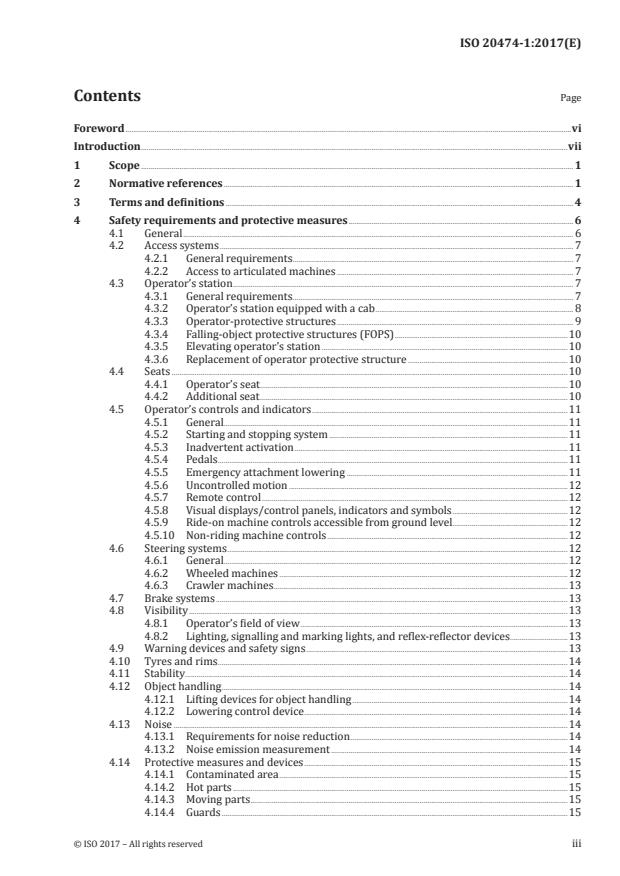
Contents Page
Foreword .vi
Introduction .vii
1 Scope . 1
2 Normative references . 1
3 Terms and definitions . 4
4 Safety requirements and protective measures . 6
4.1 General . 6
4.2 Access systems . 7
4.2.1 General requirements . 7
4.2.2 Access to articulated machines . 7
4.3 Operator’s station . 7
4.3.1 General requirements . 7
4.3.2 Operator’s station equipped with a cab . 8
4.3.3 Operator-protective structures . 9
4.3.4 Falling-object protective structures (FOPS) .10
4.3.5 Elevating operator’s station .10
4.3.6 Replacement of operator protective structure .10
4.4 Seats .10
4.4.1 Operator’s seat .10
4.4.2 Additional seat .10
4.5 Operator’s controls and indicators .11
4.5.1 General.11
4.5.2 Starting and stopping system .11
4.5.3 Inadvertent activation .11
4.5.4 Pedals .11
4.5.5 Emergency attachment lowering .11
4.5.6 Uncontrolled motion .12
4.5.7 Remote control .12
4.5.8 Visual displays/control panels, indicators and symbols .12
4.5.9 Ride-on machine controls accessible from ground level.12
4.5.10 Non-riding machine controls .12
4.6 Steering systems .12
4.6.1 General.12
4.6.2 Wheeled machines .12
4.6.3 Crawler machines.13
4.7 Brake systems .13
4.8 Visibility .13
4.8.1 Operator’s field of view .13
4.8.2 Lighting, signalling and marking lights, and reflex-reflector devices .13
4.9 Warning devices and safety signs .13
4.10 Tyres and rims .14
4.11 Stability .14
4.12 Object handling .14
4.12.1 Lifting devices for object handling .14
4.12.2 Lowering control device .14
4.13 Noise .14
4.13.1 Requirements for noise reduction .14
4.13.2 Noise emission measurement .14
4.14 Protective measures and devices .15
4.14.1 Contaminated area .15
4.14.2 Hot parts .15
4.14.3 Moving parts .15
4.14.4 Guards .15
4.14.5 Articulated frame lock . .15
4.14.6 Sharp edges and acute angles .15
4.14.7 Fenders .15
4.15 Retrieval, transportation, lifting and towing .16
4.15.1 Common use .16
4.15.2 Retrieval .16
4.15.3 Tying-down.16
4.15.4 Lifting . .16
4.15.5 Off-road towing .16
4.15.6 Transportation .16
4.16 Electrical and electronic systems .16
4.16.1 General.16
4.16.2 Degree of protection .17
4.16.3 Electrical connections .17
4.16.4 Over-current protective devices .17
4.16.5 Batteries .17
4.16.6 Battery disconnection .17
4.16.7 Electrical connectors for auxiliary starting aids.17
4.16.8 Electric sockets for lighting .17
4.17 Pressurized systems .18
4.17.1 General requirements .18
4.17.2 Hydraulic lines .18
4.17.3 Hydraulic hose assemblies .18
4.17.4 Air pressure vessels .18
4.18 Fuel tanks, diesel emission fluid tanks and hydraulic oil tanks .18
4.18.1 General requirements .18
4.18.2 Filler openings .18
4.18.3 Fuel tanks .19
4.19 Fire protection .19
4.19.1 Fire resistance .19
4.19.2 Fire extinguisher .19
4.20 Attachments .19
4.20.1 General.19
4.20.2 Identification .19
4.20.3 Instructions .19
4.20.4 Quick couplers .19
4.20.5 Lifting devices .19
4.21 Maintenance .20
4.21.1 General.20
4.21.2 Routine maintenance .20
4.21.3 Support devices .20
4.21.4 Access to the engine compartment .20
4.21.5 Tiltable cab support device .20
4.22 Underground operation in non-explosive atmosphere.20
4.23 Rear-mounted winch .21
4.23.1 Mounting .21
4.23.2 Controls .21
4.23.3 Protection .21
4.24 Speed limit for non-riding machines .21
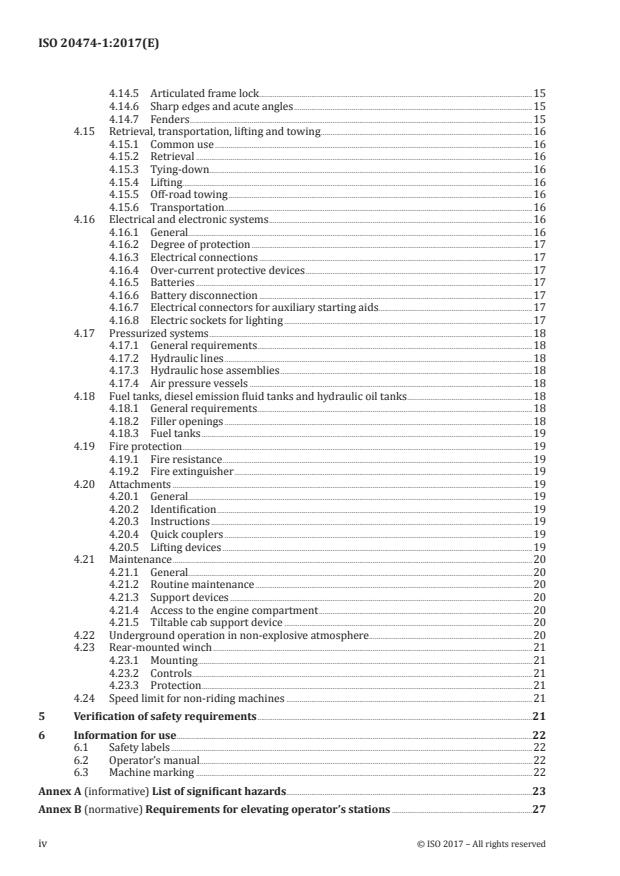
5 Verification of safety requirements .21
6 Information for use .22
6.1 Safety labels .22
6.2 Operator’s manual.22
6.3 Machine marking .22
Annex A (informative) List of significant hazards.23
Annex B (normative) Requirements for elevating operator’s stations .27
iv © ISO 2017 – All rights reserved
Annex C (normative) Requirements for lifting devices used in object handling .29
Annex D (normative) Requirements for earth-moving machinery used underground in
non-explosive atmospheres .35
Bibliography .37
Foreword
ISO (the International Organization for Standardization) is a worldwide federation of national standards
bodies (ISO member bodies). The work of preparing International Standards is normally carried out
through ISO technical committees. Each member body interested in a subject for which a technical
committee has been established has the right to be represented on that committee. International
organizations, governmental and non-governmental, in liaison with ISO, also take part in the work.
ISO collaborates closely with the International Electrotechnical Commission (IEC) on all matters of
electrotechnical standardization.
The procedures used to develop this document and those intended for its further maintenance are
described in the ISO/IEC Directives, Part 1. In particular the different approval criteria needed for the
different types of ISO documents should be noted. This document was drafted in accordance with the
editorial rules of the ISO/IEC Directives, Part 2 (see www .iso .org/ directives).
Attention is drawn to the possibility that some of the elements of this document may be the subject of
patent rights. ISO shall not be held responsible for identifying any or all such patent rights. Details of
any patent rights identified during the development of the document will be in the Introduction and/or
on the ISO list of patent declarations received (see www .iso .org/ patents).
Any trade name used in this document is information given for the convenience of users and does not
constitute an endorsement.
For an explanation on the voluntary nature of standards, the meaning of ISO specific terms and
expressions related to conformity assessment, as well as information about ISO’s adherence to the
World Trade Organization (WTO) principles in the Technical Barriers to Trade (TBT) see the following
URL: w w w . i s o .org/ iso/ foreword .html
This document was prepared by Technical Committee ISO/TC 127, Earth-moving machinery,
Subcommittee SC 2, Safety, ergonomics and general requirements.
This second edition cancels and replaces the first edition (ISO 20474-1:2008), which has been technically
revised with the following changes:
— normative references have been updated;
— references to national and regional provisions in the withdrawn ISO/TS 20474-14 have been deleted;
— new safety requirements and protective measures have been added, including the normative
annexes, requirements for elevating operator’s stations, for lifting devices used in object handling
and for earth-moving machinery used underground in non-explosive atmospheres.
It is intended to be used in conjunction with the other parts of ISO 20474.
A list of all parts in the ISO 20474 series, published under the general title, Earth-moving machinery —
Safety, can be found on the ISO website.
vi © ISO 2017 – All rights reserved
Introduction
This document is a type-C standard as stated in ISO 12100.
The machinery concerned and the extent to which hazards, hazardous situations or hazardous events
are covered are indicated in the Scope of this document.
When requirements of this type-C standard are different from those which are stated in type-A or B
standards, the requirements of this type-C standard take precedence over the requirements of the
other standards for machines that have been designed and built according to the requirements of this
type-C standard.
ISO 20474 provides acceptable safety requirements for earth-moving machinery. This standard does
not necessarily provide requirements to meet all national and regional regulatory provisions, e.g. Japan
does not allow object handling with earth-moving machinery.
INTERNATIONAL STANDARD ISO 20474-1:2017(E)
Earth-moving machinery — Safety —
Part 1:
General requirements
1 Scope
This document specifies the general safety requirements for earth-moving machinery as defined in
ISO 6165, each of these requirements being common to two or more earth-moving machine families. It is
also applicable to machine attachments, and to derivative machinery designed primarily for equipment
used to excavate, load, transport, drill, spread, compact or trench earth, rock, and other materials.
It is intended to be used in conjunction with the other parts of ISO 20474, which give the provisions
that are specific to particular machine families. Those specific requirements take precedence over the
requirements of this document for the machines concerned. For multipurpose machinery, all of those
parts of ISO 20474 whose requirements cover the functions and applications of such machines are
applicable.
EXAMPLE For a compact loader also used as a trencher, the relevant requirements of ISO 20474-1,
ISO 20474-3 and ISO 20474-10 are applicable.
This document deals with all significant hazards, hazardous situations and events relevant to the
earth-moving machinery within its scope (see Annex A) when used as intended or under conditions of
misuse reasonably foreseeable by the manufacturer. It specifies the appropriate technical measures
for eliminating or reducing risks arising from relevant hazards, hazardous situations or events during
commissioning, operation and maintenance.
Specific requirements related to autonomous machines are covered in ISO 17757.
This document is not applicable to machines manufactured before the date of its publication.
2 Normative references
The following documents are referred to in the text in such a way that some or all of their content
constitutes requirements of this document. For dated references, only the edition cited applies. For
undated references, the latest edition of the referenced document (including any amendments) applies.
ISO 2860, Earth-moving machinery — Minimum access dimensions
ISO 2867, Earth-moving machinery — Access systems
ISO 3164, Earth-moving machinery — Laboratory evaluations of protective structures — Specifications for
deflection-limiting volume
ISO 3411:2007, Earth-moving machinery — Physical dimensions of operators and minimum operator space
envelope
ISO 3449, Earth-moving machinery — Falling-object protective structures — Laboratory tests and
performance requirements
ISO 3450, Earth-moving machinery — Wheeled or high-speed rubber-tracked machines — Performance
requirements and test procedures for brake systems
ISO 3457:2003, Earth-moving machinery — Guards — Definitions and requirements
ISO 3471:2008, Earth-moving machinery — Roll-over protective structures — Laboratory tests and
performance requirements
ISO 3795, Road vehicles, and tractors and machinery for agriculture and forestry — Determination of
burning behaviour of interior materials
ISO 3864-1, Graphical symbols — Safety colours and safety signs — Part 1: Design principles for safety
signs and safety markings
ISO 3864-2, Graphical symbols — Safety colours and safety signs — Part 2: Design principles for product
safety labels
ISO 4250-3, Earth-mover tyres and rims — Part 3: Rims
ISO 4413, Hydraulic fluid power — General rules and safety requirements for systems and their components
ISO 4871, Acoustics — Declaration and verification of noise emission values of machinery and equipment
ISO 5006, Earth-moving machinery — Operator’s field of view — Test method and performance criteria
ISO 5010, Earth-moving machinery — Rubber-tyred machines — Steering requirements
ISO 6011, Earth-moving machinery — Visual display of machine operation
ISO 6014, Earth-moving machinery — Determination of ground speed
ISO 6165, Earth-moving machinery — Basic types — Identification and terms and definitions
ISO 6395, Earth-moving machinery — Determination of sound power level — Dynamic test conditions
ISO 6396, Earth-moving machinery — Determination of emission sound pressure level at operator’s
position — Dynamic test conditions
ISO 6405-1, Earth-moving machinery — Symbols for operator controls and other displays — Part 1:
Common symbols
ISO 6405-2, Earth-moving machinery — Symbols for operator controls and other displays — Part 2: Specific
symbols for machines, equipment and accessories
ISO 6682, Earth-moving machinery — Zones of comfort and reach for controls
ISO 6683, Earth-moving machinery — Seat belts and seat belt anchorages — Performance requirements
and tests
ISO 6750, Earth-moving machinery — Operator’s manual — Content and format
ISO 7096:2000, Earth-moving machinery — Laboratory evaluation of operator seat vibration
ISO 8643, Earth-moving machinery — Hydraulic excavator and backhoe loader boom-lowering control
device — Requirements and tests
ISO 9244, Earth-moving machinery — Machine safety labels — General principles
ISO 9533, Earth-moving machinery — Machine-mounted audible travel alarms and forward horns — Test
methods and performance criteria
ISO 10263-2, Earth-moving machinery — Operator enclosure environment — Part 2: Air filter element
test method
ISO 10263-3, Earth-moving machinery — Operator enclosure environment — Part 3: Pressurization
test method
ISO 10263-4:2009, Earth-moving machinery — Operator enclosure environment — Part 4: Heating,
ventilating and air conditioning (HVAC) test method and performance
2 © ISO 2017 – All rights reserved
ISO 10264, Earth-moving machinery — Key-locked starting systems
ISO 10265, Earth-moving machinery — Crawler machines — Performance requirements and test
procedures for braking systems
ISO 10532, Earth-moving machinery — Machine-mounted retrieval device — Performance requirements
ISO 10533, Earth-moving machinery — Lift-arm support devices
ISO 10570, Earth-moving machinery — Articulated frame lock — Performance requirements
ISO 10968, Earth-moving machinery — Operator’s controls
ISO 11112:1995, Earth-moving machinery — Operator’s seat — Dimensions and requirements
ISO 11862, Earth-moving machinery — Auxiliary starting aid electrical connector
ISO 12100, Safety of machinery — General principles for design — Risk assessment and risk reduction
ISO 12508, Earth-moving machinery — Operator station and maintenance areas — Bluntness of edges
ISO 12509, Earth-moving machinery — Lighting, signalling and marking lights, and reflex-reflector devices
ISO 12509:2004, Earth-moving machinery — Lighting, signalling and marking lights, and reflex-
reflector devices
ISO 13031, Earth-moving machinery — Quick couplers — Safety
ISO 13333, Earth-moving machinery — Dumper body support and operator’s cab tilt support devices
ISO 13459, Earth-moving machinery — Trainer seat — Deflection limiting volume, space envelope and
performance requirements
ISO 13766 (all parts), Earth-moving machinery — Electromagnetic compatibility
ISO 13849-1, Safety of machinery — Safety-related parts of control systems — Part 1: General principles
for design
ISO 13857, Safety of machinery — Safety distances to prevent hazard zones being reached by upper and
lower limbs
ISO 14401-1, Earth-moving machinery — Field of vision of surveillance and rear-view mirrors — Part 1:
Test methods
ISO 14401-2, Earth-moving machinery — Field of vision of surveillance and rear-view mirrors — Part 2:
Performance criteria
ISO 14990-1, Earth-moving machinery — Electrical safety of machines utilizing electric drives and related
components and systems — Part 1: General requirements
ISO 14990-2, Earth-moving machinery — Electrical safety of machines utilizing electric drives and related
components and systems — Part 2: Particular requirements for externally-powered machines
ISO 14990-3, Earth-moving machinery — Electrical safety of machines utilizing electric drives and related
components and systems — Part 3: Particular requirements for self-powered machines
ISO 15817, Earth-moving machinery — Safety requirements for remote operator control systems
ISO 15818, Earth-moving machinery — Lifting and tying-down attachment points — Performance
requirements
ISO 15998, Earth-moving machinery — Machine-control systems (MCS) using electronic components —
Performance criteria and tests for functional safety
ISO 16001, Earth-moving machinery — Object detection systems and visibility aids – Performance
requirements and tests
ISO 16528-1, Boilers and pressure vessels — Part 1: Performance requirements
ISO 16528-2, Boilers and pressure vessels — Part 2: Procedures for fulfilling the requirements of ISO 16528-1
ISO 17063, Earth-moving machinery — Braking systems of pedestrian-controlled machines — Performance
requirements and test procedures
1)
ISO 19014-1 , Earth-moving machinery — Safety — Part 1: Methodology to determine safety-related parts
of the control system and performance requirements
1)
ISO 19014-3 , Earth-moving machinery — Safety — Part 3: Environmental performance and test
requirements of electronic and electrical components used in safety-related parts of the control system
ISO 21507, Earth-moving machinery — Performance requirements for non-metallic fuel tanks
IEC 60529, Degrees of protection provided by enclosures (IP Code)
EN 1677-2:2000+A1: 2008, Components for slings — Safety — Part 2: Forged steel lifting hooks with
latch, Grade 8
EN 1679-1, Reciprocating internal combustion engines — Safety — Part 1: Compression ignition engines
3 Terms and definitions
For the purposes of this document, the terms and definitions given in ISO 12100 and ISO 6165, and the
following, apply.
ISO and IEC maintain terminological databases for use in standardization at the following addresses:
— ISO Online browsing platform: available at http:// www .iso .org/ obp
— IEC Electropedia: available at http:// www .electropedia .org/
3.1
earth-moving machinery
self-propelled or towed machine on wheels, crawlers or legs, having equipment (3.3) or attachment
(3.2), or both, primarily designed to perform excavation, loading, transportation, drilling, spreading,
compacting or trenching of earth, rock and other materials
Note 1 to entry: Earth-moving machinery can be of a type either directly controlled by an operator riding or not
riding on the machine, or can be remotely controlled by wired or wireless means with or without direct view on
the working area
[SOURCE: ISO 6165:2012, 3.1]
3.1.1
compact machine
earth-moving machinery (3.1), except for compact excavators and compact loaders, having an operating
mass (3.8) of 4 500 kg or less
[SOURCE: ISO 6165:2012, 3.1.1]
1) Under preparation.
4 © ISO 2017 – All rights reserved
3.1.2
derivative earth-moving machinery
earth-moving machinery (3.1) that is a combination of features from other earth-moving machine
families, creating a different configuration or arrangement
EXAMPLE Machine having the front-mounted equipment of a loader and a non-self-loading, rear-mounted
dumper body.
[SOURCE: ISO 6165:2012, 3.11.1]
3.2
attachment
working tool
assembly of components that can be mounted onto the base machine (3.15) or equipment (3.3) for
specific use
[SOURCE: ISO 6746-2:2003, 3.5]
3.3
equipment
set of components mounted onto the base machine (3.15) that allows an attachment (3.2) to perform the
primary design function of the machine
[SOURCE: ISO 6746-2:2003, 3.4]
3.4
quick coupler
quick hitch
attachment bracket
device mounted on the earth-moving machinery (3.1) to allow the quick interchange of attachments (3.2)
[SOURCE: ISO 13031:2016, 3.1]
3.5
object handling
application of earth-moving machinery (3.1) comprising lifting, lowering and transporting of a load by
use of lifting accessories, whereby the assistance of a person or the operator of the machine is required
for hooking, unhooking or stabilizing (while transporting) the load
Note 1 to entry: If the load is picked up by a self-acting device and no assistance of a person is required for
hooking, unhooking and stabilizing the load, this work is considered as a usual earth-moving application.
Note 2 to entry: Lifting accessories include wire ropes, chains or textile straps; loads in object handling
applications include pipes and vessels; examples of self-acting devices are grabs, clamshell buckets, log clamps,
vacuum lifting devices, magnetic plates and forks.
3.6
maximum rated operating capacity
maximum rated lift capacity
maximum load which can be lifted in at least one position of the working range
as specified by the manufacturer (e.g. on the rated object handling capacity table) in the most stable
configuration (such as with outriggers down)
Note 1 to entry: A definition of rated operating capacity for loaders given in ISO 14397-1 is used in ISO 20474-3
and ISO 20474-4.
Note 2 to entry: Rated lift capacity forms the subject of ISO 10567 and is the term used in ISO 20474-5.
3.7
routine maintenance
maintenance that is specified in the periodic maintenance schedule of the operator’s manual for
performing scheduled daily/weekly/monthly maintenance on the machine
3.8
operating mass
mass of the base machine (3.15), with equipment (3.3) and empty attachment (3.2) in the most usual
configuration as specified by the manufacturer, and with the operator (75 kg), full fuel tank and all
fluid systems (i.e. hydraulic oil, transmission oil, engine oil, engine coolant) at the levels specified by the
manufacturer and, when applicable, with sprinkler water tank(s) half full
[SOURCE: ISO 6016:2008, 3.2.1, modified — Notes to the definition have not been included.]
3.9
relevant hazard
hazard which is identified as being present at, or associated with, the machine
[SOURCE: ISO 12100:2010, 3.7]
3.10
significant hazard
hazard which has been identified as relevant and which requires specific action by the designer to
eliminate or to reduce the risk according to the risk assessment
[SOURCE: ISO 12100:2010, 3.8]
3.11
lifting device
device fixed or incorporated to the attachment/working tool (3.2) or equipment (3.3) of the earth-moving
machinery (3.1) used for object handling, excluding attachable hook (3.14)
3.12
sling
assembly of slinging components, e.g. chain, wire rope or textile material, joined to upper or lower
terminals suitable for attaching loads to the lifting point
3.13
rated lifting load
RLL
maximum mass for which the lifting device (3.11) is designed
Note 1 to entry: The RLL can be different from the rated operating capacity/lift capacity of the machine.
3.14
attachable hook
component intended to be fixed to the attachment (3.2) (working tool) or the equipment (3.3) of the
earth-moving machinery (3.1), either welded or bolted
3.15
base machine
earth-moving machinery (3.1) with a cab or canopy and operator protective structures if required,
without equipment (3.3) or attachments (3.2) but possessing the necessary mountings for such
equipment (3.3) and attachments (3.2)
[SOURCE: ISO 6016:2008, 3.1.1]
4 Safety requirements and protective measures
4.1 General
Machinery shall comply with the safety requirements of this clause, in as far as those are not modified
by the specific requirements of another part of ISO 20474.
In addition, the machine shall be designed according to the principles of ISO 12100.
6 © ISO 2017 – All rights reserved
4.2 Access systems
4.2.1 General requirements
Access systems shall be provided to the operator’s station and to routine maintenance points. Access
systems shall comply with ISO 2867.
4.2.2 Access to articulated machines
On machines with articulated frames and in the fully articulated steering position, a minimum clearance
of 150 mm shall be provided between firm structures and components with relative movement in the
path of the access systems to the operator’s station, as illustrated in Figure 1.
Dimension in millimetres
Figure 1 — Minimum clearance for access to operator’s station on machines with articulated
steering
4.3 Operator’s station
4.3.1 General requirements
4.3.1.1 Machinery equipment
The operator’s station of ride-on machines should be fitted with a cab.
Machines with an operating mass greater than 1 500 kg and a seated operator shall have the possibility
of being fitted with a cab. A cab is not required for machines with a mass of less than 1 500 kg.
Earth-moving machinery shall be designed so that adequate protection can be fitted when they are
intended to be used for applications (e.g. operation with a hydraulic- or demolition-hammer) where
there is a risk of projection of fractured materials
4.3.1.2 Minimum space
The minimum space available to the operator shall be as defined in ISO 3411.
The minimum space and location of the controls at the operator’s station shall meet the requirements
of ISO 6682.
4.3.1.3 Moving parts
Measures shall be taken to avoid accidental contact from the operating position with moving parts (e.g.
wheels, tracks or working equipment or attachments) in accordance with the relevant subclauses of 4.14.
4.3.1.4 Engine exhaust
The engine exhaust system shall release the exhaust gas away from the operator and the air inlet of
the cab.
4.3.1.5 Instruction storage
A space intended for the safekeeping of the operator’s manual and other instructions shall be provided
near the operator’s station. The space shall be lockable, unless the space is inside the operator’s station,
and the operator’s station can be locked.
4.3.1.6 Sharp edges
The operator’s working space within the operator’s station (e.g. ceiling, inner walls, instrument panels
and access to the operator’s station) shall not present any sharp exposed edges or acute angles/corners.
The radius of corners and the bluntness of edges shall comply with ISO 12508, in order to avoid sharp
edges (see also 4.14.6).
4.3.2 Operator’s station equipped with a cab
4.3.2.1 Climatic conditions
The cab shall protect the operator against foreseeable adverse climatic conditions. Provisions shall be
made to install a ventilation system, an adjustable heating system and a system for defrosting windows.
For details, see 4.3.2.5 to 4.3.2.7.
4.3.2.2 Pipes and hoses
Pipes and hoses that contain fluids at pressures exceeding 5 MPa or temperatures above 60 °C located
inside the cab shall be guarded in accordance with ISO 3457:2003, Clause 9. See also 4.17.3.
Parts or components placed between pipes or hoses and the operator, which divert a hazardous spray
of fluid, can be considered as a sufficient protection device.
4.3.2.3 Primary opening
A primary access opening shall be provided. The dimensi
...