

ISO 8468:2007
(Main)Ships and marine technology — Ship's bridge layout and associated equipment — Requirements and guidelines
General Information
- Abstract
ISO 8468:2007 specifies the functional requirements for bridge configuration, bridge arrangement, bridge workstations and bridge environment. Guidelines have been drawn up for the methods and solutions to meet the functional requirements. The requirements in ISO 8468:2007 apply to all bridge functions. The purpose of ISO 8468:2007 is to assist the operator(s) and pilot by providing a workplace that is conducive to safe and effective operation. It also aims to specify bridge requirements, which will secure safe and efficient operation of the ship berth-to-berth regardless of the watchkeeping arrangement in place at a particular time. ISO 8468:2007 should be used in support of the aims in SOLAS Chapter V Regulation 15. Requirements and guidance on the human element aspects of the bridge system (e.g. training, procedures) are not given. The main use of ISO 8468:2007 will be for designing ships' bridges. ISO 8468:2007 will also be useful to specifiers and procurers of ships and bridge equipment, operators, and owners for ensuring that changes made to the bridge through the life of a ship continue to conform to these requirements. ISO 8468:2007 is applicable to seagoing ships. Annex A of ISO 8468:2007 applies to high speed craft.
- Status
- Published
- Publication Date
- 03-Jul-2007
- Technical Committee
- ISO/TC 8/SC 6 - Navigation and ship operations
- Drafting Committee
- ISO/TC 8/SC 6 - Navigation and ship operations
- Current Stage
- 9093 - International Standard confirmed
- Start Date
- 29-Sep-2023
- Completion Date
- 29-Aug-2026
Overview
ISO 8468:2007 - Ships and marine technology: Ship's bridge layout and associated equipment - Requirements and guidelines - defines functional requirements and guidance for the design and arrangement of a ship’s bridge. Applicable to seagoing ships (with Annex A specific to high speed craft), the standard aims to provide a safe, ergonomic and effective workplace for operators and pilots, supporting SOLAS Chapter V Regulation 15 and related IMO ergonomic guidance.
Key topics and technical requirements
- Bridge configuration and field of vision: requirements for primary conning position, navigation/manoeuvring, monitoring, docking (bridge wings) and helmsman workstations to ensure situational awareness.
- Workstations and consoles: ergonomic layout, dimensions, accessibility and location of dedicated and shared workstations for navigation, communication and voyage planning.
- Bridge equipment and distribution: placement, outer shape, illumination, individual lighting and power supply considerations for bridge equipment.
- Windows and sound reception: guidelines for window design and bridge audio systems to support acoustic awareness.
- Environmental requirements: lighting, vibration, noise, HVAC, interior surfaces and safety of personnel to maintain performance under operational conditions.
- Alarm systems and BNWAS: principles for alarm transfer, centralized alarm systems and the bridge navigational watch alarm system (BNWAS).
- Human factors and ergonomics: ergonomic principles for information presentation and control layout (training and procedures are out of scope).
- Reliability and safety analysis: failure mode and effects analysis (FMEA) methodology for bridge systems.
- Documentation: stowage, user information from integrators and owners, and supplemental documentation for operational use and modifications.
Practical applications and users
ISO 8468:2007 is primarily intended for:
- Naval architects and ship designers - to design compliant, ergonomic bridge layouts.
- Shipowners, operators and ship managers - to specify bridge equipment, evaluate retrofits and ensure ongoing conformity during a ship’s life.
- Bridge integrators and equipment manufacturers - to inform product layout, interfaces and installation.
- Inspectors and port/policy authorities - to assess bridge arrangements in relation to SOLAS and IMO ergonomic guidance.
Practical uses include new-build bridge design, retrofit/upgrade planning, procurement specifications, risk assessments (FMEA) and alarm/ergonomics audits.
Related standards and references
- SOLAS Chapter V Regulation 15 (navigational safety and bridge arrangements)
- IMO resolution(s) on ergonomic criteria for bridge equipment
- Note: ISO 8468:2007 does not replace performance standards for specific bridge equipment.
Keywords: ISO 8468:2007, ship's bridge layout, bridge configuration, bridge workstations, bridge equipment, SOLAS, ergonomics, human factors, high speed craft, BNWAS.
Relations
- Effective Date
- 15-Apr-2008
- Effective Date
- 15-Apr-2008
Get Certified
Connect with accredited certification bodies for this standard

DNV
DNV is an independent assurance and risk management provider.

Lloyd's Register
Lloyd's Register is a global professional services organisation specialising in engineering and technology.

FSC International
Forest Stewardship Council certification.
Sponsored listings
Frequently Asked Questions
ISO 8468:2007 is a standard published by the International Organization for Standardization (ISO). Its full title is "Ships and marine technology — Ship's bridge layout and associated equipment — Requirements and guidelines". This standard covers: ISO 8468:2007 specifies the functional requirements for bridge configuration, bridge arrangement, bridge workstations and bridge environment. Guidelines have been drawn up for the methods and solutions to meet the functional requirements. The requirements in ISO 8468:2007 apply to all bridge functions. The purpose of ISO 8468:2007 is to assist the operator(s) and pilot by providing a workplace that is conducive to safe and effective operation. It also aims to specify bridge requirements, which will secure safe and efficient operation of the ship berth-to-berth regardless of the watchkeeping arrangement in place at a particular time. ISO 8468:2007 should be used in support of the aims in SOLAS Chapter V Regulation 15. Requirements and guidance on the human element aspects of the bridge system (e.g. training, procedures) are not given. The main use of ISO 8468:2007 will be for designing ships' bridges. ISO 8468:2007 will also be useful to specifiers and procurers of ships and bridge equipment, operators, and owners for ensuring that changes made to the bridge through the life of a ship continue to conform to these requirements. ISO 8468:2007 is applicable to seagoing ships. Annex A of ISO 8468:2007 applies to high speed craft.
ISO 8468:2007 specifies the functional requirements for bridge configuration, bridge arrangement, bridge workstations and bridge environment. Guidelines have been drawn up for the methods and solutions to meet the functional requirements. The requirements in ISO 8468:2007 apply to all bridge functions. The purpose of ISO 8468:2007 is to assist the operator(s) and pilot by providing a workplace that is conducive to safe and effective operation. It also aims to specify bridge requirements, which will secure safe and efficient operation of the ship berth-to-berth regardless of the watchkeeping arrangement in place at a particular time. ISO 8468:2007 should be used in support of the aims in SOLAS Chapter V Regulation 15. Requirements and guidance on the human element aspects of the bridge system (e.g. training, procedures) are not given. The main use of ISO 8468:2007 will be for designing ships' bridges. ISO 8468:2007 will also be useful to specifiers and procurers of ships and bridge equipment, operators, and owners for ensuring that changes made to the bridge through the life of a ship continue to conform to these requirements. ISO 8468:2007 is applicable to seagoing ships. Annex A of ISO 8468:2007 applies to high speed craft.
ISO 8468:2007 is classified under the following ICS (International Classification for Standards) categories: 47.020.10 - Hulls and their structure elements. The ICS classification helps identify the subject area and facilitates finding related standards.
ISO 8468:2007 has the following relationships with other standards: It is inter standard links to ISO 8468:1990, ISO 14612:2004. Understanding these relationships helps ensure you are using the most current and applicable version of the standard.
ISO 8468:2007 is available in PDF format for immediate download after purchase. The document can be added to your cart and obtained through the secure checkout process. Digital delivery ensures instant access to the complete standard document.
Standards Content (Sample)
INTERNATIONAL ISO
STANDARD 8468
Third edition
2007-07-15
Ships and marine technology — Ship's
bridge layout and associated
equipment — Requirements and
guidelines
Navires et technologie maritime — Aménagement de la passerelle d'un
navire et disposition de ses équipements annexes — Exigences et
directives
Reference number
©
ISO 2007
PDF disclaimer
This PDF file may contain embedded typefaces. In accordance with Adobe's licensing policy, this file may be printed or viewed but
shall not be edited unless the typefaces which are embedded are licensed to and installed on the computer performing the editing. In
downloading this file, parties accept therein the responsibility of not infringing Adobe's licensing policy. The ISO Central Secretariat
accepts no liability in this area.
Adobe is a trademark of Adobe Systems Incorporated.
Details of the software products used to create this PDF file can be found in the General Info relative to the file; the PDF-creation
parameters were optimized for printing. Every care has been taken to ensure that the file is suitable for use by ISO member bodies. In
the unlikely event that a problem relating to it is found, please inform the Central Secretariat at the address given below.
© ISO 2007
All rights reserved. Unless otherwise specified, no part of this publication may be reproduced or utilized in any form or by any means,
electronic or mechanical, including photocopying and microfilm, without permission in writing from either ISO at the address below or
ISO's member body in the country of the requester.
ISO copyright office
Case postale 56 • CH-1211 Geneva 20
Tel. + 41 22 749 01 11
Fax + 41 22 749 09 47
E-mail copyright@iso.org
Web www.iso.org
Published in Switzerland
ii © ISO 2007 – All rights reserved
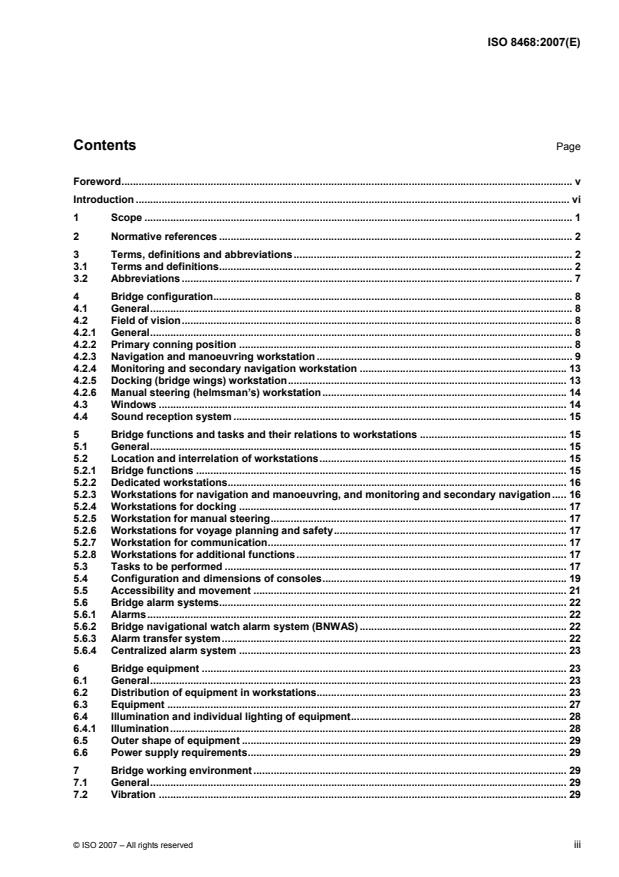
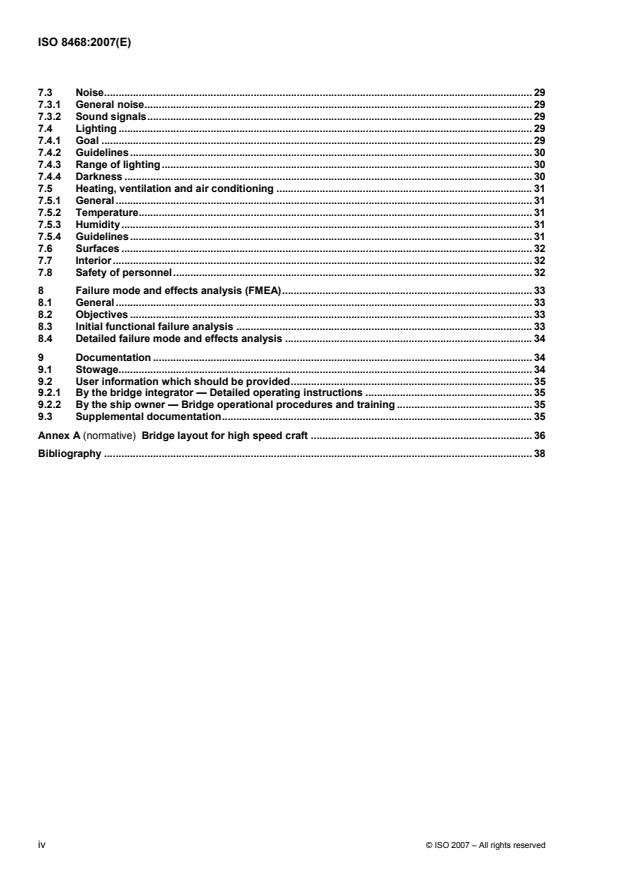
Contents Page
Foreword. v
Introduction . vi
1 Scope . 1
2 Normative references . 2
3 Terms, definitions and abbreviations. 2
3.1 Terms and definitions. 2
3.2 Abbreviations . 7
4 Bridge configuration. 8
4.1 General. 8
4.2 Field of vision. 8
4.2.1 General. 8
4.2.2 Primary conning position . 8
4.2.3 Navigation and manoeuvring workstation . 9
4.2.4 Monitoring and secondary navigation workstation . 13
4.2.5 Docking (bridge wings) workstation. 13
4.2.6 Manual steering (helmsman’s) workstation. 14
4.3 Windows . 14
4.4 Sound reception system . 15
5 Bridge functions and tasks and their relations to workstations . 15
5.1 General. 15
5.2 Location and interrelation of workstations.15
5.2.1 Bridge functions . 15
5.2.2 Dedicated workstations. 16
5.2.3 Workstations for navigation and manoeuvring, and monitoring and secondary navigation. 16
5.2.4 Workstations for docking . 17
5.2.5 Workstation for manual steering. 17
5.2.6 Workstations for voyage planning and safety. 17
5.2.7 Workstation for communication. 17
5.2.8 Workstations for additional functions. 17
5.3 Tasks to be performed . 17
5.4 Configuration and dimensions of consoles. 19
5.5 Accessibility and movement . 21
5.6 Bridge alarm systems. 22
5.6.1 Alarms. 22
5.6.2 Bridge navigational watch alarm system (BNWAS) . 22
5.6.3 Alarm transfer system. 22
5.6.4 Centralized alarm system . 23
6 Bridge equipment . 23
6.1 General. 23
6.2 Distribution of equipment in workstations.23
6.3 Equipment . 27
6.4 Illumination and individual lighting of equipment. 28
6.4.1 Illumination. 28
6.5 Outer shape of equipment . 29
6.6 Power supply requirements. 29
7 Bridge working environment . 29
7.1 General. 29
7.2 Vibration . 29
7.3 Noise. 29
7.3.1 General noise. 29
7.3.2 Sound signals. 29
7.4 Lighting . 29
7.4.1 Goal . 29
7.4.2 Guidelines. 30
7.4.3 Range of lighting. 30
7.4.4 Darkness . 30
7.5 Heating, ventilation and air conditioning . 31
7.5.1 General . 31
7.5.2 Temperature. 31
7.5.3 Humidity. 31
7.5.4 Guidelines. 31
7.6 Surfaces . 32
7.7 Interior . 32
7.8 Safety of personnel. 32
8 Failure mode and effects analysis (FMEA). 33
8.1 General . 33
8.2 Objectives . 33
8.3 Initial functional failure analysis . 33
8.4 Detailed failure mode and effects analysis .34
9 Documentation . 34
9.1 Stowage. 34
9.2 User information which should be provided. 35
9.2.1 By the bridge integrator — Detailed operating instructions . 35
9.2.2 By the ship owner — Bridge operational procedures and training . 35
9.3 Supplemental documentation. 35
Annex A (normative) Bridge layout for high speed craft . 36
Bibliography . 38
iv © ISO 2007 – All rights reserved
Foreword
ISO (the International Organization for Standardization) is a worldwide federation of national standards bodies
(ISO member bodies). The work of preparing International Standards is normally carried out through ISO
technical committees. Each member body interested in a subject for which a technical committee has been
established has the right to be represented on that committee. International organizations, governmental and
non-governmental, in liaison with ISO, also take part in the work. ISO collaborates closely with the
International Electrotechnical Commission (IEC) on all matters of electrotechnical standardization.
International Standards are drafted in accordance with the rules given in the ISO/IEC Directives, Part 2.
The main task of technical committees is to prepare International Standards. Draft International Standards
adopted by the technical committees are circulated to the member bodies for voting. Publication as an
International Standard requires approval by at least 75 % of the member bodies casting a vote.
Attention is drawn to the possibility that some of the elements of this document may be the subject of patent
rights. ISO shall not be held responsible for identifying any or all such patent rights.
ISO 8468 was prepared by Technical Committee ISO/TC 8, Ships and marine technology, Subcommittee
SC 5, Ships' bridge layout.
This third edition cancels and replaces the second edition (ISO 8468:1990) and ISO 14612:2004, which have
been technically revised.
Introduction
It has become common practice for operators (officers and crew) to move between shipping companies and
flag states and serve on a wide range of ships. Pilots too have to handle an increasing variety of ships and
equipment. This International Standard therefore, contains requirements and guidelines which aim to ensure
safe navigation by standardizing the bridge environment to provide watchkeepers with a consistent pattern of
equipment layout regardless of the ship type or the navigational systems fitted on the bridge.
The requirements in this International Standard take into account human factors, ergonomic principles and
advances in technology.
Functional requirements are outlined in general terms in order to prescribe the basic functionality, providing
the operator at each defined workstation with
⎯ the best possible overview of internally presented data,
⎯ easy and ergonomic operation of equipment,
⎯ adequate environmental conditions on the bridge.
All information made available to the operator from equipment, alarm systems and communication equipment
has to be suited for the purpose, and presented in accordance with ergonomic principles. Too much
information is stressing and may cause confusion.
Information and control facilities have to meet the needs of the operator and provide the level of performance
appropriate to particular workstations and procedures.
Safety aspects related to the crew, cargo, ship and the environment need to be addressed in detail.
Guidelines and figures give examples, ideal and/or alternative solutions, when such are well defined. Guiding
references and comments are added where applicable.
It should be noted that no specific layout presents the sole solution for a proper bridge fulfilling the
requirements laid down in this International Standard. This International Standard is parametric, and different
types of ships and operations have different optimum designs, even though basic safety requirements are
equal.
This International Standard is related to the IMO Resolution on ergonomic criteria for bridge equipment and
the general requirements in SOLAS Chapter V. Based on SOLAS Chapter IX (ISM-Code), dealing with
casualties attributed to the human element, this International Standard should reduce such casualties.
vi © ISO 2007 – All rights reserved
INTERNATIONAL STANDARD ISO 8468:2007(E)
Ships and marine technology — Ship's bridge layout and
associated equipment — Requirements and guidelines
1 Scope
This International Standard specifies the functional requirements for bridge configuration, bridge arrangement,
bridge workstations and bridge environment. Guidelines have been drawn up for the methods and solutions to
meet the functional requirements.
The requirements in this International Standard apply to all bridge functions.
The purpose of this International Standard is to assist the operator(s) and pilot by providing a workplace that is
conducive to safe and effective operation. It also aims to specify bridge requirements, which will secure safe
and efficient operation of the ship berth-to-berth regardless of the watchkeeping arrangement in place at a
particular time. This International Standard should be used in support of the aims in SOLAS Chapter V
Regulation 15.
Requirements and guidance on the human element aspects of the bridge system (e.g. training, procedures)
are not given. However, for safe and effective watchkeeping, these aspects will need to be addressed.
The main use of this International Standard will be for designing ships’ bridges. This International Standard
will also be useful to
⎯ specifiers and procurers of ships and bridge equipment,
⎯ operators, and
⎯ owners for ensuring that changes made to the bridge through the life of a ship continue to conform to
these requirements.
This International Standard is applicable to seagoing ships. Where there are physical limitations in applying
this International Standard, i.e. to small ships or to ships of unusual design, the general functional
requirements still apply.
Annex A of this International Standard applies to high speed craft.
This International Standard does not supersede performance standards for bridge equipment.
Users of this International Standard should note that while attempting to implement its requirements, they
should ensure compliance with such statutory requirements, rules and regulations as may be applicable to the
individual ship concerned.
Designers should consider future changes in the purpose of the ship, and availability of new equipments, in
their bridge designs.
2 Normative references
The following referenced documents are indispensable for the application of this document. For dated
references, only the edition cited applies. For undated references, the latest edition of the referenced
document (including any amendments) applies.
ISO 2412, Shipbuilding — Colours of indicator lights
ISO 3434, Shipbuilding and marine structures — Heated glass panes for ships' rectangular windows
ISO 3904, Shipbuilding and marine structures — Clear-view screens
IEC 60447, Basic and safety principles for man-machine interface, marking and identification — Actuating
principles
IMO MSC.97(73) 2000, International Code of Safety for High-Speed Craft, 2000 (2000 HSC Code)
IMO Resolution A.343(IX), Recommendation on methods of measuring noise levels at listening posts
IMO Resolution A.468(XII), Code on Noise Levels on Board Ships
IMO Resolution A.694(17), General requirements for shipbourne radio equipment forming part of the GMDSS
and for electronic navigational aids
International Convention for the Safety of Life at Sea (SOLAS)
3 Terms, definitions and abbreviations
3.1 Terms and definitions
For the purposes of this document, the following terms and definitions apply.
3.1.1
abnormal operating condition
condition created when internal technical system failures require operation of back-up systems on the bridge,
or when they occur under an irregular operating condition, or when the operator becomes unfit to perform his
duties and has not yet been replaced by another qualified officer
3.1.2
additional bridge functions
functions performed on the bridge, but not related to a primary bridge function
EXAMPLE Extended communication functions, monitoring and control of ballasting and cargo operations, monitoring
and control of machinery, monitoring and control of domestic systems, ship management.
3.1.3
alarm
audible and visual signal alerting a condition requiring immediate attention or user action
3.1.4
alarm transfer system
system which transfers an alarm from the bridge to the master and the back-up operator or any place(s)
assigned by the system in the case of any operator deficiency
3.1.5
alert
announcement of an abnormal situation or condition requiring attention
NOTE Alerts may consist of alarms, warnings and cautions.
2 © ISO 2007 – All rights reserved
3.1.6
back-up operator
qualified officer who has been designated by the ship's master to be on call if assistance is needed on the
navigation bridge
3.1.7
bridge
area from which the navigation and control of the ship is exercised, including the wheelhouse and bridge
wings
3.1.8
bridge arrangement
location and interrelation of workstations and equipment on the bridge
3.1.9
bridge configuration
shape of the bridge comprising the outer bulkheads and windows of the bridge area
3.1.10
bridge navigational watch alarm system
BNWAS
alarm system comprising watch monitoring and alarm transfer
3.1.11
bridge integrator
organization that takes overall responsibility for the design of the bridge
3.1.12
bridge system
total system for the performance of bridge functions, comprising bridge personnel, technical systems, man-
machine interface and procedures
3.1.13
bridge wing
part of the bridge, on both sides of the ship’s wheelhouse, which, in general, extends to the ship’s side
3.1.14
catwalk
extension to a deck outside the wheelhouse wide enough to allow the safe passage of a person
3.1.15
caution
visual alert of a condition which does not warrant an alarm or warning condition, but still requires attention out
of the ordinary, consideration of the situation, or of the given information
3.1.16
collision avoidance function
detection and plotting of ships and other moving and stationary objects; determination and execution of course
and speed deviations to avoid collision
3.1.17
commanding vision
view without obstructions which would interfere with the operator’s ability to perform his immediate task
3.1.18
communications workstation
workstation for operation and control of equipment for distress, safety and routine communications
3.1.19
conning position
place in the wheelhouse with commanding vision and which is used by operators when monitoring and
directing the ship’s movements
NOTE The conning position is frequently at the workstation for navigation and manoeuvring.
3.1.20
display
means by which a device presents visual information to the operator, including conventional instrumentation
3.1.21
docking
manoeuvring of the ship alongside a berth, another ship or other structure and controlling the mooring
operations
3.1.22
docking workstation
workstation from which the ship can be manoeuvred during docking, lock passage and other manoeuvres
requiring a view of the ship’s side
3.1.23
electronic navigational chart
ENC
database, standardized as to content, structure and format for use with the ECDIS on the authority of
government authorized hydrographic offices
NOTE The ENC contains all the chart information for safe navigation and may contain supplementary information in
addition to that contained in the paper chart (e.g. sailing directions) considered necessary for safe navigation.
3.1.24
electronic chart display and information system
ECDIS
navigation information system which with adequate back-up arrangements can be accepted as complying with
the up-to-date chart required by regulations V/19 and V/27 of the 2000-12-05 Amendments to SOLAS by
displaying selected information from a system electronic navigational chart (SENC) with positional information
from navigation sensors to assist the mariner in voyage planning and route monitoring, and if required
additional navigation-related information
3.1.25
ergonomics
study and design of working environments and their components, work practices, and work procedures for the
benefit of the worker’s productivity, health, comfort and safety
3.1.26
essential information
information which is necessary for the monitoring and control of primary bridge functions
3.1.27
field of vision
angular size of a scene that can be observed from a position on the ship’s bridge
3.1.28
failure mode and effects analysis
FMEA
method used for the identification of potential error types in order to define their effects on the examined
object or system, and to clarify the error types with regard to criticality or persistency
3.1.29
guideline
non-mandatory information leading to a compliant solution for the related requirement
4 © ISO 2007 – All rights reserved
3.1.30
helmsman
person who steers the ship under way
3.1.31
irregular condition
irregular operating condition
condition causing an excessive operator workload
3.1.32
lookout
activity carried out at all times by sight and hearing as well as by all available means appropriate in the
prevailing circumstances and conditions so as to make a full appraisal of the situation and of the risk of
collision
3.1.33
manoeuvring
operation of steering systems and propulsion machinery as required to move the ship in predetermined
directions or into predetermined positions or tracks
3.1.34
manual steering workstation
workstation from which the ship can be steered by a helmsman
3.1.35
master
ship’s captain and the person in overall charge of the ship
3.1.36
monitoring
act of periodically checking equipment and environment in order to detect any changes
3.1.37
monitoring and secondary navigation workstation
workstation for an assisting operator (secondary navigation) and monitoring
3.1.38
navigation
process of position-finding as well as planning, controlling and recording the movement of a ship from one
place to another
3.1.39
navigation workstations
any plurality of the navigation and manoeuvring workstation and monitoring and secondary navigation
workstation
3.1.40
operating compartment
bridge
3.1.41
operator
qualified officer navigating, operating bridge equipment and manoeuvring the ship
3.1.42
navigation and manoeuvring workstation
workstation with commanding vision used by operators when carrying out navigation, traffic surveillance and
manoeuvring functions
3.1.43
normal condition
normal operating condition
condition whereby all shipboard systems and equipment related to primary bridge functions operate within
design limits and external conditions (i.e. weather and traffic), or when the malfunction of position-fixing
systems does not cause excessive operator workloads
3.1.44
percentile
percentage of population
3.1.45
primary bridge function
function related to the determination, execution and maintenance of safe course, speed or position of the ship
in relation to the waters, traffic or weather conditions
EXAMPLE Voyage planning functions, navigation functions, collision avoidance functions, manoeuvring functions,
docking functions, monitoring of internal safety systems, external and internal communication related to safety in bridge
operation and distress situations.
3.1.46
radar plotting
whole process of target detection, tracking, calculation of parameters and display of information
3.1.47
route monitoring
periodic surveillance of the ship’s position, course and speed in relation to a pre-planned route and the
surrounding waters
3.1.48
safety workstation
workstation at which monitoring displays and operating elements serving safety are concentrated
3.1.49
screen
device used for presenting visual information based on one or several displays
3.1.50
seagoing ship
ship designed, equipped and certified to go to sea
1)
NOTE Another definition of this term, adapted from COLREGs , is “any vessel including non-displacement craft,
designed, equipped and certified for use as a means of transportation on the high seas and all waters connected thereto”.
3.1.51
ship management
administrative and miscellaneous activity such as maintaining spares and other stores, payrolls and other
activities not related to the manoeuvring of the ship
3.1.52
superstructure
decked structure, not including funnels, which is on or above the freeboard deck
3.1.53
system electronic navigational chart
SENC
database resulting from the transformation of the ENC by the ECDIS for appropriate use, updates to the ENC
by appropriate means and other data added by the mariner
NOTE It is the database that is actually accessed by the ECDIS for the display generation and other navigational
functions, and is the equivalent to an up-to-date paper chart. The SENC may also contain information from other sources.
1) Convention on the International Regulations for Preventing Collisions at Sea (COLREGs).
6 © ISO 2007 – All rights reserved
3.1.54
track monitoring
observing the position of own ship in relation to a planned route or existing track
3.1.55
tracking
process of observing the sequential changes in the position of a target, to establish its motion
3.1.56
traffic surveillance
observation of ship traffic within an area for the purpose of planning the movement of own ship in that area
3.1.57
visibility
fields and/or distance of vision to observe objects
3.1.58
voyage planning
pre-determination, from berth to berth, of courses, turns and speeds in relation to the waters to be navigated
3.1.59
voyage planning workstation
workstation at which the ship’s voyage is planned
3.1.60
warning
visual alert of a condition which is not immediately hazardous, but may become so, if no action is taken
3.1.61
wheelhouse
enclosed area of the bridge
3.1.62
workstation
combination of all job-related items, including a console, if provided, with all devices, equipment and furniture,
to fulfil certain tasks
3.2 Abbreviations
AIS automatic identification system
ARPA automatic radar plotting aid
BNWAS bridge navigational watch alarm system
ENC electronic navigational chart
ECDIS electronic chart display and information system
FMEA failure mode and effects analysis
GMDSS global maritime distress and safety system
IMO International Maritime Organization, a specialized agency of the United Nations devoted
exclusively to maritime matters
SENC system electronic navigational chart
SOLAS safety of life at sea
UHF ultra high frequency
VHF very high frequency
4 Bridge configuration
4.1 General
4.1.1 The bridge configuration shall be arranged with special attention to maximizing the field of vision and
audibility of sound signals at all workstations situated on the bridge and used during the watch under normal
operating conditions at sea.
4.1.2 Every effort shaII be made to place the bridge above all other superstructures.
4.2 Field of vision
4.2.1 General
4.2.1.1 It shall be possible to observe all objects necessary for navigation, such as ships and lighthouses,
in any direction from inside the wheelhouse or on the wings. Artificial means approved for this purpose may be
used to achieve the proper view. See 4.2.3.10.
4.2.1.2 Guidelines: There is to be a field of vision around the ship of 360° obtained by an observer
moving within the confines of the wheelhouse or on the wings. See Figure 1.
4.2.1.3 An operator shall be able to watch the area immediately in front of the bridge superstructure from
the wheelhouse.
4.2.1.4 Guidelines: There should be close physical access to at least one front window. The width of the
close access should be sufficient to accommodate two persons.
4.2.1.5 The field of vision for a seated operating position should be made from a seated eye reference
point. The field of vision for a standing operating position should allow for movement ability at that position.
Figure 1 — 360° field of vision
4.2.2 Primary conning position
4.2.2.1 The primary conning position is frequently at the workstation for navigation and manoeuvring (as
defined in 5.2.2). It shall be arranged to enable efficient and effective application of the principles of bridge
resource management and bridge teamwork procedures regardless of the watchkeeping arrangement in place
at a particular time. All relevant instrumentation and controls shall be easily visible, audible and accessible.
8 © ISO 2007 – All rights reserved
4.2.2.2 The view of the sea surface from the conning position shall not be obscured by more than two
ship lengths or 500 m, whichever is less, forward of the bow to 10° on either side irrespective of the ship’s
draught, trim and deck cargo (e.g. containers). See Figure 2.
Key
1 sea surface
a
Two ship lengths or 500 m, whichever is less.
Figure 2 — Forward view
4.2.2.3 At the navigation workstations and at the conning position (frequently the navigation and
manoeuvring workstation), the operator’s field of vision shall be sufficient to comply with SOLAS V/22,
2)
navigate and manoeuvre the ship safely, and enable compliance with Rule 5 of COLREGs .
4.2.3 Navigation and manoeuvring workstation
4.2.3.1 Blind sectors caused by cargo, cargo gear, divisions between windows and other obstructions
shall be minimized, and in no way hamper a safe lookout from the workstation for navigation and manoeuvring.
4.2.3.2 The total arc of blind sectors within the required 225° field of vision (from right ahead to 112,5° on
each side) shall not exceed 20°. Each individual blind sector shall not exceed 10°. Over an arc from dead
ahead to at least 10° on each side, each blind sector shall not exceed 5°. The clear sector between two blind
sectors shall not be less than the broadest blind sector on either side of the clear sector.
4.2.3.3 Guidelines: The field of vision from the navigation workstations should be such as to enable
observation of all objects which may affect the safe conning of the ship. The console should not obstruct the
view of the sea surface seen over the lower edge of the windows from the workstation for navigation and
manoeuvring within an arc of 10° to port and 112,5° to starboard of the bow. See Figure 3.
2) Rule 5 of COLREGs: “Every vessel shall at all times maintain a proper look-out by sight as well as by hearing as well
as by all available means appropriate in the prevailing circumstances and conditions so as to make a full appraisal of the
situation and of the risk of collision.”
Figure 3 — Primary field of vision from navigation workstations
4.2.3.4 The height of the lower edge of the front windows shall allow a forward view over the bow for a
person at any workstation, and in no case shall present an obstruction to the forward view described
elsewhere.
4.2.3.5 Guidelines: The height of the lower edge of the front windows above the deck should be kept as
low as possible, and should not, as far as practicable, be more than 1 000 mm.
4.2.3.6 The upper edge of the front windows shall allow a forward view of the horizon for a person in a
standing position with an eye height of 1 800 mm at the navigating and manoeuvring workstation when the
ship is pitching in heavy seas. The administration, if satisfied that a 1 800 mm eye height is unreasonable and
impractical, may allow reduction of the eye height, but not less than 1 600 mm.
4.2.3.7 Guidelines: The height of the upper edge of front windows above the deck should be as high as
practicable and at least allow a forward view of the horizon when the bow is 10° below its position on even
keel. The minimum height of the upper edge of front windows above the deck surface should be 2 000 mm.
See Figure 4.
The dimensions in Figure 4 are maxima, based upon an eye height of 1 800 mm, referring to a person of a
height of 1 900 mm, at a distance of 750 mm from the bridge front bulkhead.
For arrangements where the operator would normally stand further back from the bridge front bulkhead, the
same eye height should be used to determine the height of the upper edge of the front windows.
10 © ISO 2007 – All rights reserved
Dimensions in millimetres
Key
1 window
2 bulkhead
3 deck surface
Figure 4 — Example of the height of upper edge of front window in relation to eye height, distance
from front bulkhead, slanting of bulkheads, given a window slant of between 15° and 25°
4.2.3.8 Guidelines: The horizontal field of vision from the navigation and manoeuvring workstation and
from the conning position, if different, should at least extend over an arc from 22,5° abaft the beam on one
side, through forward, to 22,5° abaft the beam on the other side. See Figure 5.
Figure 5 — Navigation and manoeuvring workstation and conning position
4.2.3.9 From the workstations for navigating and manoeuvring, it shall be possible to use lights or marks
in line astern of the ship as reference for steering the ship.
4.2.3.10 Guidelines: The horizontal field of vision astern as seen from the workstations for navigating and
manoeuvring should extend over an arc from dead astern to at least 5° to each side. See Figures 6 and 7.
Artificial means approved for this purpose may be used to achieve the proper view. Artificial means should be
sufficiently dependable. Their ability to perform assigned tasks in a usable manner and in all conditions should
be assured. Artificial means should be assessed at a system level, e.g. including lighting, camera controls and
wiper.
Key
1 workstation for navigation and manoeuvring
2 funnel
Figure 6 — Field of vision astern with off centre funnel
Key
1 workstation for navigation and manoeuvring
2 funnel
Figure 7 — Field of vision astern with off centre workstation
12 © ISO 2007 – All rights reserved
4.2.4 Monitoring and secondary navigation workstation
From the monitoring and secondary navigation workstation, and the communications workstation, the field of
vision should extend at least over an arc from 90° on the port bow through forward, to 22,5° abaft the beam on
starboard. See Figure 8.
Figure 8 — Monitoring and secondary navigation workstation
4.2.5 Docking (bridge wings) workstation
4.2.5.1 The field of vision from a docking workstation, normally on the bridge wing, shall extend over an
arc from at least 45° on the opposite bow through dead ahead and then aft to 180° from dead ahead. See
Figure 9.
Figure 9 — Docking (bridge wing) workstation
4.2.5.2 The ship’s side shall always be visible from the bridge wing especially where tugs or pilot boats
come alongside and where the ship touches the jetty.
4.2.5.3 Guidelines: Bridge wings should be provided out to the maximum beam of the ship. The view
over the ship’s side should not be obstructed.
4.2.6 Manual steering (helmsman’s) workstation
4.2.6.1 The workstation for manual steering shall preferably be located on the ship’s centre-line. If the
workstation for manual steering is located off the centre-line, special steering references for use by day and
night shall be provided, e.g. sighting marks forward. The helmsman’s field of vision shall be sufficiently wide to
enable him to carry out his functions safely.
4.2.6.2 Guidelines: The helmsman’s field of vision from the workstation for manual steering should
extend over an arc from dead ahead to at least 60° on each side. See Figure 10. The total arc of blind sectors
within the required 60° field of vision should not exceed 20°. Each individual blind sector should not exceed
10°. Over an arc from dead ahead to at least 10° on each side, each blind sector should not exceed 5°. The
clear sector between two blind sectors should not be less than the broadest blind sector on either side of the
clear sector.
The workstation should not be placed immediately behind the windows in order to protect the required field of
vision of other workstations.
Figure 10 — Manual steering (helmsman’s) workstation
4.3 Windows
4.3.1 Divisions between windows shall be kept to a minimum. No division shall be installed immediately
forward of any workstation, including the centre-line. If stiffeners between windows are to be covered, this
shall not cause further obstructions of the field of vision from any position inside the wheelhouse.
4.3.2 Guidelines: Windows, especially on the centre-line, should be as wide as possible. The divisions
between front windows should not exceed 150 mm. If stiffeners are used, divisions should not exceed 100 mm
in width and 120 mm in depth.
NOTE The window frame width is designed based on the size of the ship, service area and material of the structure
and windows.
4.3.3 Bridge front windows shall be inclined from the vertical plane to avoid reflections. Bridge side and rear
windows should also be inclined.
4.3.4 Guidelines: As far as is practical, all bridge windows should be inclined from the vertical plane top out,
at an angle of not less than 10° and not more than 25°. Exceptions can be made for windows in bridge wing
doors.
4.3.5 A clear view through the windows shall be provided at all times. Neither polarized nor tinted glass
shall be fitted.
14 © ISO 2007 – All rights reserved
4.3.6 Guidelines: To ensure a clear view in bright sunshine, sunscreens with minimum colour distortion
should be provided at all windows in front of workstations. Such screens should be readily removable and not
permanently installed.
To ensure a clear view, heavy-duty wipers, preferably provided with an interval function and a fresh water
wash, are recommended for the majority of the front windows. Clear-view screens should be installed on at
least two windows, and should be in accordance with
...