

ISO/IEC 18013-1:2018
(Main)Information technology — Personal identification — ISO-compliant driving licence — Part 1: Physical characteristics and basic data set
General Information
- Abstract
This document establishes guidelines for the design format and data content of an ISO-compliant driving licence (IDL) in regard to both visual human-readable features and ISO machine-readable technologies. It creates a common basis for international use and mutual recognition of the IDL without impeding individual national/community/regional motor vehicle authorities in taking care of their specific needs. The design approach of the IDL ISO ID-1 size card is to establish a secure domestic driving permit (DDP) for both human verification and machine readability and accompanying booklet with sleeve insert pocket for international use instead of the international driving permit (IDP) paper document (see Annex G). The basic document design premises include: — A minimum common mandatory data element set. — A common layout for ease of recognition. — Minimum security requirements for both human and machine verification. — Interoperability of the machine-readable content. At the discretion of national/community/regional motor vehicle authorities it allows for: — Inclusion of supplementary optional data elements to meet the needs of specific national/community/regional requirements apart from the minimum common mandatory data element set. — Additional document physical security elements at the option of national/community/regional authorities, and facilitates international procurements. — Incorporation of ISO/IEC JTC1/SC17 machine-readable technologies including integrated circuit with contacts and contactless integrated circuit technology, and ISO/IEC JTC1/SC31 1-dimensional / 2-dimensional bar codes, at the option of national/community/regional authorities. — Incorporation of current and future technologies (including biometrics, cryptography, data compression) at the option of national/community/regional authorities. A major benefit of these design premises is that a single card may serve a dual purpose of both a national/community/regional licence as well as an internationally recognized licence. Therefore, one card, in most cases, can replace the need for two documents. Alternatively, those countries that choose to maintain their individual domestic design or not to use Latin characters on their domestic driving licence for example can issue a second card with or without ISO machine-readable technologies. This second card can serve as DDP to be used with the accompanying booklet with sleeve insert pocket for international use instead of the current IDP paper document. This new IDL design yields a document that: — Is more secure from counterfeiting and alteration than the previous DDP and IDP documents. — Allows authorities to verify the authenticity of the document. — Integrates the personal data into a secure ID-1 size medium. — Allows a more reliable identification of the licence holder. — Allows for machine-readable technologies. — Facilitates information exchange and mutual recognition among motor vehicle authorities. — Allows the IDL to serve simultaneously as a DDP and IDP when accompanied by the booklet. Issuing authorities may introduce other functions to an IDL provided that it does not interfere with the driving licence function and the requirements in this document are not compromised.
- Status
- Published
- Publication Date
- 19-Jul-2018
- Technical Committee
- ISO/IEC JTC 1/SC 17 - Cards and security devices for personal identification
- Current Stage
- 9093 - International Standard confirmed
- Start Date
- 19-Mar-2024
- Completion Date
- 29-Aug-2026
Buy Documents
ISO/IEC 18013-1:2018 - Information technology -- Personal identification -- ISO-compliant driving licence
ISO/IEC 18013-1:2018 - Information technology — Personal identification — ISO-compliant driving licence — Part 1: Physical characteristics and basic data set/20/2018
Overview
ISO/IEC 18013-1:2018 specifies guidelines for an ISO-compliant driving licence (IDL) covering both human-readable physical characteristics and ISO machine-readable technologies. The standard defines a common basis for international use and mutual recognition of driving licences while allowing national, regional or community authorities to address local requirements. Its design centers on an ID-1 size card that can serve as both a domestic driving permit (DDP) and - when accompanied by a booklet - an internationally recognized document replacing the traditional international driving permit (IDP).
Key technical topics and requirements
- Physical characteristics: Card format based on ISO ID-1 size and layout guidance to improve recognition and interoperability. (See Annex A.)
- Minimum basic data set: A mandatory common set of human‑readable data elements for international interchange, with optional supplementary fields for national needs.
- Human-readable and machine-readable balance: Requirements for visual presentation of data and machine-readable content to support automated validation.
- Machine-readable technologies: Supports ISO/IEC JTC1/SC17 and SC31 technologies - including integrated circuit chips (contact and contactless) and 1D/2D bar codes. (Magnetic stripe and optical memory are no longer supported in this edition.)
- Security requirements: Minimum security features for both human and machine verification; guidance on card body, security design, protective inks/pigments and protection of personalized data (Annex C).
- Interoperability and future-proofing: Data formats and layout aim to facilitate mutual recognition; the standard allows incorporation of biometrics, cryptography and data compression at the issuing authority’s option.
- Supporting documents: Normative and informative annexes cover card design, vehicle categories, booklet design for international use (Annex G), issuance procedures, durability and security processes.
Practical applications and who uses it
- Motor vehicle & licensing authorities: Implement national IDL issuance programs that meet international interoperability and security goals.
- Card manufacturers and personalization bureaus: Design and produce compliant ID‑1 cards and booklets, select security features and integrate contact/contactless ICs.
- Border control, police and enforcement agencies: Verify licence authenticity reliably using human and machine checks.
- System integrators and software developers: Build readers, validation systems and back‑end services that process the IDL machine-readable data.
- Policy makers and procurement teams: Use the standard to draft tender specifications and harmonize regional licensing approaches.
Related standards and references
- ISO/IEC 7810 (Identification cards - physical characteristics)
- ISO/IEC 19794‑5 (Biometric Face Image Data)
- UN Vienna/1949 Road Traffic Conventions (IDP/DDP context)
- ISO/IEC JTC1 SC17 / SC31 technologies (contact/contactless ICs, bar codes)
ISO/IEC 18013-1:2018 helps move driving licences toward a secure, interoperable ID card model that supports machine-assisted verification, improved anti‑fraud protections and streamlined international recognition.
Relations
- Effective Date
- 13-Apr-2013
Buy Documents
ISO/IEC 18013-1:2018 - Information technology -- Personal identification -- ISO-compliant driving licence
ISO/IEC 18013-1:2018 - Information technology — Personal identification — ISO-compliant driving licence — Part 1: Physical characteristics and basic data set/20/2018
Get Certified
Connect with accredited certification bodies for this standard

BSI Group
BSI (British Standards Institution) is the business standards company that helps organizations make excellence a habit.

NYCE
Mexican standards and certification body.
Sponsored listings
Frequently Asked Questions
ISO/IEC 18013-1:2018 is a standard published by the International Organization for Standardization (ISO). Its full title is "Information technology — Personal identification — ISO-compliant driving licence — Part 1: Physical characteristics and basic data set". This standard covers: This document establishes guidelines for the design format and data content of an ISO-compliant driving licence (IDL) in regard to both visual human-readable features and ISO machine-readable technologies. It creates a common basis for international use and mutual recognition of the IDL without impeding individual national/community/regional motor vehicle authorities in taking care of their specific needs. The design approach of the IDL ISO ID-1 size card is to establish a secure domestic driving permit (DDP) for both human verification and machine readability and accompanying booklet with sleeve insert pocket for international use instead of the international driving permit (IDP) paper document (see Annex G). The basic document design premises include: — A minimum common mandatory data element set. — A common layout for ease of recognition. — Minimum security requirements for both human and machine verification. — Interoperability of the machine-readable content. At the discretion of national/community/regional motor vehicle authorities it allows for: — Inclusion of supplementary optional data elements to meet the needs of specific national/community/regional requirements apart from the minimum common mandatory data element set. — Additional document physical security elements at the option of national/community/regional authorities, and facilitates international procurements. — Incorporation of ISO/IEC JTC1/SC17 machine-readable technologies including integrated circuit with contacts and contactless integrated circuit technology, and ISO/IEC JTC1/SC31 1-dimensional / 2-dimensional bar codes, at the option of national/community/regional authorities. — Incorporation of current and future technologies (including biometrics, cryptography, data compression) at the option of national/community/regional authorities. A major benefit of these design premises is that a single card may serve a dual purpose of both a national/community/regional licence as well as an internationally recognized licence. Therefore, one card, in most cases, can replace the need for two documents. Alternatively, those countries that choose to maintain their individual domestic design or not to use Latin characters on their domestic driving licence for example can issue a second card with or without ISO machine-readable technologies. This second card can serve as DDP to be used with the accompanying booklet with sleeve insert pocket for international use instead of the current IDP paper document. This new IDL design yields a document that: — Is more secure from counterfeiting and alteration than the previous DDP and IDP documents. — Allows authorities to verify the authenticity of the document. — Integrates the personal data into a secure ID-1 size medium. — Allows a more reliable identification of the licence holder. — Allows for machine-readable technologies. — Facilitates information exchange and mutual recognition among motor vehicle authorities. — Allows the IDL to serve simultaneously as a DDP and IDP when accompanied by the booklet. Issuing authorities may introduce other functions to an IDL provided that it does not interfere with the driving licence function and the requirements in this document are not compromised.
This document establishes guidelines for the design format and data content of an ISO-compliant driving licence (IDL) in regard to both visual human-readable features and ISO machine-readable technologies. It creates a common basis for international use and mutual recognition of the IDL without impeding individual national/community/regional motor vehicle authorities in taking care of their specific needs. The design approach of the IDL ISO ID-1 size card is to establish a secure domestic driving permit (DDP) for both human verification and machine readability and accompanying booklet with sleeve insert pocket for international use instead of the international driving permit (IDP) paper document (see Annex G). The basic document design premises include: — A minimum common mandatory data element set. — A common layout for ease of recognition. — Minimum security requirements for both human and machine verification. — Interoperability of the machine-readable content. At the discretion of national/community/regional motor vehicle authorities it allows for: — Inclusion of supplementary optional data elements to meet the needs of specific national/community/regional requirements apart from the minimum common mandatory data element set. — Additional document physical security elements at the option of national/community/regional authorities, and facilitates international procurements. — Incorporation of ISO/IEC JTC1/SC17 machine-readable technologies including integrated circuit with contacts and contactless integrated circuit technology, and ISO/IEC JTC1/SC31 1-dimensional / 2-dimensional bar codes, at the option of national/community/regional authorities. — Incorporation of current and future technologies (including biometrics, cryptography, data compression) at the option of national/community/regional authorities. A major benefit of these design premises is that a single card may serve a dual purpose of both a national/community/regional licence as well as an internationally recognized licence. Therefore, one card, in most cases, can replace the need for two documents. Alternatively, those countries that choose to maintain their individual domestic design or not to use Latin characters on their domestic driving licence for example can issue a second card with or without ISO machine-readable technologies. This second card can serve as DDP to be used with the accompanying booklet with sleeve insert pocket for international use instead of the current IDP paper document. This new IDL design yields a document that: — Is more secure from counterfeiting and alteration than the previous DDP and IDP documents. — Allows authorities to verify the authenticity of the document. — Integrates the personal data into a secure ID-1 size medium. — Allows a more reliable identification of the licence holder. — Allows for machine-readable technologies. — Facilitates information exchange and mutual recognition among motor vehicle authorities. — Allows the IDL to serve simultaneously as a DDP and IDP when accompanied by the booklet. Issuing authorities may introduce other functions to an IDL provided that it does not interfere with the driving licence function and the requirements in this document are not compromised.
ISO/IEC 18013-1:2018 is classified under the following ICS (International Classification for Standards) categories: 35.240.15 - Identification cards. Chip cards. Biometrics. The ICS classification helps identify the subject area and facilitates finding related standards.
ISO/IEC 18013-1:2018 has the following relationships with other standards: It is inter standard links to ISO/IEC 18013-1:2005. Understanding these relationships helps ensure you are using the most current and applicable version of the standard.
ISO/IEC 18013-1:2018 is available in PDF format for immediate download after purchase. The document can be added to your cart and obtained through the secure checkout process. Digital delivery ensures instant access to the complete standard document.
Standards Content (Sample)
INTERNATIONAL ISO/IEC
STANDARD 18013-1
Second edition
2018-08
Information technology — Personal
identification — ISO-compliant driving
licence —
Part 1:
Physical characteristics and basic
data set
Technologies de l'information — Identification des personnes —
Permis de conduire conforme à l'ISO —
Partie 1: Caractéristiques physiques et jeu de données de base
Reference number
©
ISO/IEC 2018
© ISO/IEC 2018
All rights reserved. Unless otherwise specified, or required in the context of its implementation, no part of this publication may
be reproduced or utilized otherwise in any form or by any means, electronic or mechanical, including photocopying, or posting
on the internet or an intranet, without prior written permission. Permission can be requested from either ISO at the address
below or ISO’s member body in the country of the requester.
ISO copyright office
CP 401 • Ch. de Blandonnet 8
CH-1214 Vernier, Geneva
Phone: +41 22 749 01 11
Fax: +41 22 749 09 47
Email: copyright@iso.org
Website: www.iso.org
Published in Switzerland
ii © ISO/IEC 2018 – All rights reserved
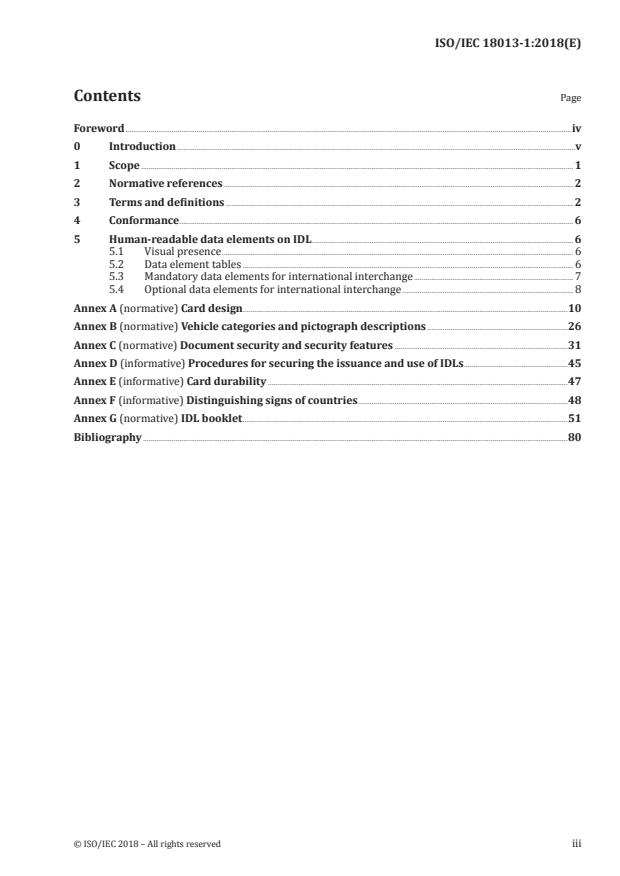
Contents Page
Foreword .iv
0 Introduction .v
1 Scope . 1
2 Normative references . 2
3 Terms and definitions . 2
4 Conformance . 6
5 Human-readable data elements on IDL . 6
5.1 Visual presence . 6
5.2 Data element tables . 6
5.3 Mandatory data elements for international interchange . 7
5.4 Optional data elements for international interchange . 8
Annex A (normative) Card design .10
Annex B (normative) Vehicle categories and pictograph descriptions .26
Annex C (normative) Document security and security features .31
Annex D (informative) Procedures for securing the issuance and use of IDLs .45
Annex E (informative) Card durability .47
Annex F (informative) Distinguishing signs of countries .48
Annex G (normative) IDL booklet .51
Bibliography .80
© ISO/IEC 2018 – All rights reserved iii
Foreword
ISO (the International Organization for Standardization) and IEC (the International Electrotechnical
Commission) form the specialized system for worldwide standardization. National bodies that are
members of ISO or IEC participate in the development of International Standards through technical
committees established by the respective organization to deal with particular fields of technical
activity. ISO and IEC technical committees collaborate in fields of mutual interest. Other international
organizations, governmental and non-governmental, in liaison with ISO and IEC, also take part in the
work. In the field of information technology, ISO and IEC have established a joint technical committee,
ISO/IEC JTC 1.
The procedures used to develop this document and those intended for its further maintenance are
described in the ISO/IEC Directives, Part 1. In particular the different approval criteria needed for
the different types of document should be noted. This document was drafted in accordance with the
editorial rules of the ISO/IEC Directives, Part 2 (see www .iso .org/directives).
Attention is drawn to the possibility that some of the elements of this document may be the subject
of patent rights. ISO and IEC shall not be held responsible for identifying any or all such patent
rights. Details of any patent rights identified during the development of the document will be in the
Introduction and/or on the ISO list of patent declarations received (see www .iso .org/patents).
Any trade name used in this document is information given for the convenience of users and does not
constitute an endorsement.
For an explanation on the voluntary nature of standards, the meaning of ISO specific terms and
expressions related to conformity assessment, as well as information about ISO's adherence to the
World Trade Organization (WTO) principles in the Technical Barriers to Trade (TBT) see the following
URL: www .iso .org/iso/foreword .html.
This document was prepared by ISO/IEC JTC 1, Information technology, SC 17, Cards and personal
identification.
This second edition cancels and replaces the first edition (ISO/IEC 18013-1:2005), which has been
technically revised.
The most significant changes are the following:
— Following the revision of ISO/IEC 18013-3, magnetic stripe and optical memory machine readable
technologies are no longer supported by this document.
— The vehicle categories in respect of which driving licence may be issued have been updated to
incorporate the contemplated amendments to the UN Conventions.
— The document security features have been restructured and grouped in accordance with the
nature of the features in respect of the card body, security design, inks/pigments and protection of
personalised data. The minimum number of mandatory and optional security features to be included
in the IDL from each of the groups is specified in respect of each type of fraud and security level.
— The content of the IDL Booklet has been revised in accordance with the contemplated amendments
to the UN Conventions.
A list of all the parts in the ISO/IEC 18013 series can be found on the ISO website.
iv © ISO/IEC 2018 – All rights reserved
0 Introduction
0.1 General
This document prescribes requirements for an ISO-compliant driving licence (IDL). The intent of the
document is to allow the issuance of one document to serve the purpose of both a domestic driving
permit (DDP) and an international driving permit (IDP).
Issuing authorities issuing domestic driving licences (DDLs) that do not conform to this document can
benefit from using parts of the document for their own domestic purpose. These issuing authorities
should continue to issue a second document that follows the requirements of the DDP and IDP for
international use.
0.2 Definition, function and requirements of International Driving Permit (IDP)
The United Nation Conventions on Road Traffic of 1949 Geneva and 1968 Vienna are the responsibility
of the Secretary General at the United Nations Headquarters, New York. The maintenance of the
1968 Convention has been assigned to UN/ECE-Transport Division, Geneva, Switzerland. The 1949
Convention is not being maintained and it continues to exist due to the fact that certain countries who
are signatories to the 1949 Convention have not acceded or ratified the 1968 Convention. The ultimate
goal of the Conventions is road safety. The Conventions prescribe provisions for both a DDP and an IDP.
The IDP serves as a means of mutual recognition in that it is issued by the holder’s home country
licensing authority requesting another country who has ratified the Conventions to allow the holder the
permission to operate a motor vehicle of authorized categories under specific conditions/restrictions.
The IDP is essentially a translation of the DDP except in a common worldwide-recognized standardized
format for global recognition and acceptance as specified in the Conventions. The IDP also makes
provision for a state to disqualify the holder of an IDP from driving in that country by recording such in
the designated area.
However, following the amendment of Clause 2 of Article 41 of the 1968 Convention on 29 March
2011 that the IDP only be recognized if accompanied by the DDP and that the DDP be recognised by
all Contracting Parties, the IDP is rendered as a translation of the DDP only by the 1968 Convention.
Furthermore, the 1968 Convention places all confidence in the integrity of the DDP, which according to
Annex 6 shall take the form of a document and may be made of plastic or paper, without detailing any
minimum requirements to protect the integrity of the document. Hence the DDP will become the focus
of the attention of forgers and criminal activity. In the case of many countries that issue a DDP which is
not in conformance with this document, such DDP will not be able to withstand the test of time.
0.3 Harmonisation and interoperability
The above general definition of a driving licence implies a human-readable document with the following
properties:
— The document contains sufficient information for the identification of the licence holder.
— The document conveys the driving privileges of the licence holder in a standardised manner for
consistent interpretation.
— The document is difficult to counterfeit.
— The document is secure to resist alteration.
In today’s worldwide freedom of movement, modern driving licence systems impose additional
requirements with the advent and need for machine-assisted storage, retrieval, reading and verification
technologies for facilitation of data protection and secure communication that the Conventions have
not addressed.
To achieve maximum global harmonisation and interoperability, standards are required to provide
common platforms for visual human-readable evidence as well as for machine-assisted storage,
© ISO/IEC 2018 – All rights reserved v
retrieval, reading and verification by the use of ISO data storage technologies incorporated into the
driving licence document.
0.4 Current limitations of International Driving Permit
The problems and concerns with the current IDP that have been reported include:
— Easily copied, altered, or simulated and difficult for law enforcement authorities to detect fraudulent
licences from genuine documents.
— Many non-government IDP issuing authorities do not query their respective government motor
vehicle agencies to establish if the DDP presented is still valid and still current.
— There is no register/directory of national motor vehicle agency addresses for the inquiry and
exchange of information among the agencies to verify the validity of a presented IDP.
— Does not incorporate the ISO machine-assisted data storage technologies.
— Suspension or cancellation of domestic driving licence (DDL) or domestic driving permit (DDP)
should result in an automatic suspension or cancellation of the IDP; however, the current system
does not facilitate that.
— The IDP holder may circumvent disqualifications entered on their original IDP by obtaining a new IDP.
— Validity of the IDP is currently limited to a maximum of 1 to 3 years, depending on the UN Convention
followed.
0.5 Replacement of International Driving Permit with ISO-compliant Driving Licence (IDL)
At one time, the Conventions contained specifications in regard to a mandatory “model” data element set
(particulars) and a mandatory design layout of defined dimensions for both DDP and IDP. Subsequently,
the 1968 Convention’s mandatory requirement for the defined design layout of the DDP was rescinded,
allowing contracting parties to produce the DDP in either paper or plastic and in the case of plastic in
the preferred format of an ISO ID-1 size card. Furthermore, the 1968 Convention requires all contracting
parties to recognise any DDP conforming to the provisions of Annex 6, yet it does not prescribe the
minimum properties of the document to ensure that the integrity of the DDP can be maintained.
Since the March 2011 amendment of the 1968 Convention effectively integrated the two documents
(DDP and IDP) into a single document, this document provides for the following minimum requirements:
— Layout and integrity properties of the DDP in the dimensions of an ISO ID-1 size card, allowing
the use of ISO machine-readable technologies at the option of motor vehicle authorities in the
contracting parties.
— Layout and dimensions of the paper document for the IDP translation of the DDP inclusive of the
language provisions of Annex 7 of the 1968 Convention.
Compliance with this document is at the discretion of the issuing authority.
vi © ISO/IEC 2018 – All rights reserved
INTERNATIONAL STANDARD ISO/IEC 18013-1:2018(E)
Information technology — Personal identification — ISO-
compliant driving licence —
Part 1:
Physical characteristics and basic data set
1 Scope
This document establishes guidelines for the design format and data content of an ISO-compliant driving
licence (IDL) in regard to both visual human-readable features and ISO machine-readable technologies.
It creates a common basis for international use and mutual recognition of the IDL without impeding
individual national/community/regional motor vehicle authorities in taking care of their specific needs.
The design approach of the IDL ISO ID-1 size card is to establish a secure domestic driving permit (DDP)
for both human verification and machine readability and accompanying booklet with sleeve insert
pocket for international use instead of the international driving permit (IDP) paper document (see
Annex G).
The basic document design premises include:
— A minimum common mandatory data element set.
— A common layout for ease of recognition.
— Minimum security requirements for both human and machine verification.
— Interoperability of the machine-readable content.
At the discretion of national/community/regional motor vehicle authorities it allows for:
— Inclusion of supplementary optional data elements to meet the needs of specific national/community/
regional requirements apart from the minimum common mandatory data element set.
— Additional document physical security elements at the option of national/community/regional
authorities, and facilitates international procurements.
— Incorporation of ISO/IEC JTC1/SC17 machine-readable technologies including integrated circuit
with contacts and contactless integrated circuit technology, and ISO/IEC JTC1/SC31 1-dimensional
/ 2-dimensional bar codes, at the option of national/community/regional authorities.
— Incorporation of current and future technologies (including biometrics, cryptography, data
compression) at the option of national/community/regional authorities.
A major benefit of these design premises is that a single card may serve a dual purpose of both a
national/community/regional licence as well as an internationally recognized licence. Therefore, one
card, in most cases, can replace the need for two documents. Alternatively, those countries that choose
to maintain their individual domestic design or not to use Latin characters on their domestic driving
licence for example can issue a second card with or without ISO machine-readable technologies. This
second card can serve as DDP to be used with the accompanying booklet with sleeve insert pocket for
international use instead of the current IDP paper document.
This new IDL design yields a document that:
— Is more secure from counterfeiting and alteration than the previous DDP and IDP documents.
— Allows authorities to verify the authenticity of the document.
© ISO/IEC 2018 – All rights reserved 1
— Integrates the personal data into a secure ID-1 size medium.
— Allows a more reliable identification of the licence holder.
— Allows for machine-readable technologies.
— Facilitates information exchange and mutual recognition among motor vehicle authorities.
— Allows the IDL to serve simultaneously as a DDP and IDP when accompanied by the booklet.
Issuing authorities may introduce other functions to an IDL provided that it does not interfere with the
driving licence function and the requirements in this document are not compromised.
2 Normative references
The following documents are referred to in the text in such a way that some or all of their content
constitutes requirements of this document. For dated references, only the edition cited applies. For
undated references, the latest edition of the referenced document (including any amendments) applies.
ISO/IEC 7810, Identification cards — Physical characteristics
ISO/IEC 19794-5:2011, Information Technology — Biometric Interchange Formats — Part 5: Face Image
Data, Annex A, B and C
European Commission Directive 2006/126/EC of 20 December 2006 O.J. EC No L 403/18, as amended or
supplemented by Commission Directive 2011/94/EU of 28 November 2011 and Commission Directive
EU 383/2012 of 4 May 2012
UN Convention on Road Traffic. Vienna, 8 November 1968, as amended by Amendment of UN
Convention on Road Traffic, Vienna of 29 March 2011
3 Terms and definitions
For the purposes of this document, the following terms and definitions apply.
ISO and IEC maintain terminological databases for use in standardization at the following addresses:
— IEC Electropedia: available at http: //www .electropedia .org/
— ISO Online browsing platform: available at http: //www .iso .org/obp
3.1
alphabetic character
A
hexadecimal ranges '41' – '5A' (Latin capital letters), '61' – '7A' (Latin small letters), 'C0' – 'D6', 'D8' – 'F6'
and 'F8' – 'FF' of ISO/IEC 8859-1
3.2
card
document with nominal dimensions in conformance with ISO/IEC 7810 ID-1
3.3
contracting party
country that is a signatory to the UN Convention Geneva 1949, or a country that has signed, ratified or
acceded to the provisions of the UN Convention Vienna 1968
3.4
country distinguishing sign
abbreviation for issuing country identified to the UN Secretary General in accordance with the UN
Conventions (1949 and 1968) for vehicles in international traffic (see Annex F), on the driving licence
(human-readable)
2 © ISO/IEC 2018 – All rights reserved
3.5
data element
item of data that may appear on the driving licence in either human or machine-readable form
Note 1 to entry: A distinction is made between static data elements and dynamic data elements.
3.5.1
static data element
data element associated with the issuing authority, and which is the same for all DLs issued on behalf of
or by that issuing authority
3.5.2
dynamic data element
data element associated with the licence holder and thus varies from one DL to the next for a particular
licensing authority, thus specifically excluding the issuing authority data element
3.6
document recognition
educational knowledge and ability to recognize the validity of the driving licence of both national
and international jurisdictions including data elements, formatting, visual biometrics (e.g. portrait,
signature), electronic readable features and document security features
3.7
driving licence
DL
document issued to a driving licence holder by an issuing authority granting the individual the privilege
to operate a motor vehicle within its jurisdiction
Note 1 to entry: The document may facilitate driving licence transactions and provide input data for such
transactions. This issued document incorporates several elements and qualifications regarding the licence
holder: positive identification of the individual; evidence of knowledge of laws and practices; practical driving
proficiency in specific motor vehicle class categories; and, the individual's health restrictions (e.g. corrective eye
lenses).
Note 2 to entry: Driving licences are classified into four types of documents, namely domestic driving licence,
domestic driving permit, ISO-compliant driving licence and international driving permit.
3.7.1
domestic driving licence
DDL
document conveying driving privilege for operating motor vehicles within country/community of
issuance, and which may partially only or may not be issued in conformance with ISO/IEC 18013
3.7.2
domestic driving permit
DDP
driving licence issued in conformance with the UN Convention Vienna 1968, annex 6
Note 1 to entry: The prescribed model for the domestic driving permit issued in conformance with UN Convention
Geneva 1949, annex 9 differs in format and dimensions from the DDP. Should the UN Convention Geneva 1949 be
amended in this regard to be similar to the UN Convention Vienna 1968, this definition would also apply to the
domestic driving permit issued in conformance with the UN Convention Geneva 1949. In practice the current
domestic driving permit issued by most of the signatories of the UN Convention Geneva 1949 and who have
not acceded to the UN Convention Vienna 1968 does not conform to the prescribed model of the UN Convention
Geneva 1949 but rather to the prescribed model of the UN Convention Vienna 1968.
3.7.3
ISO-compliant driving licence
IDL
DDP issued in conformance with ISO/IEC 18013, which may be used for both domestic and
international use
© ISO/IEC 2018 – All rights reserved 3
3.7.4
international driving permit
IDP
driving licence issued in conformance with the UN Convention Vienna 1968, annex 7
Note 1 to entry: The prescribed model for the international driving permit issued in conformance with UN
Convention Geneva 1949, annex 10 differs in format and dimensions from the IDP and does not have to be
accompanied by the domestic driving permit for it to be recognised by another contracting member of the UN
Convention Geneva 1949. However, a contracting member of the UN Convention Vienna 1968 may require that
the international driving permit issued in conformance with UN Convention Geneva 1949 be accompanied by
the domestic driving permit. Should the UN Convention Geneva 1949 be amended in this regard to be similar to
the UN Convention Vienna 1968, this definition would also apply to the international driving permit issued in
conformance with the UN Convention Geneva 1949.
3.8
first line inspection
cursory examination without tools or aids that involves easily identifiable visual or tactile features for
rapid inspection at point of usage
3.9
human-readable data / information
data or information that is printed or engraved that is visually present on a driving licence and designed
to be interpreted by a human
3.10
image
representation of the visual likeness of a subject
EXAMPLE Portrait, finger print, or signature.
Note 1 to entry: Images may be collected and stored digitally or otherwise, and rendered for visual inspection
using a variety of systems.
3.11
issuing authority
licensing authority, or issuing country if separate licensing authorities have not been authorised
3.12
issuing country
country according to Annex F which issued the DL or within which the licensing authority is located
3.13
jurisdiction
territory (country, state, province) within which the licensing authority has the mandate and
responsibility to apply motor vehicle laws/directives
3.14
licence holder
individual to whom a DL is issued, i.e. the legitimate holder of the driving privileges reflected on a DL
3.15
licensing authority
authorised agent organisation that issues a DL
EXAMPLE National, federal, state, provincial, regional, territorial or local Ministry of Transport, Department
of Motor Vehicles, or Police Agency.
3.16
machine-readable data / information
data or information that is encoded into a machine-readable medium, such as a bar code or
integrated circuit
4 © ISO/IEC 2018 – All rights reserved
3.17
mandatory element
element that shall be required
3.18
mutual recognition
privilege of citizens from two jurisdictions to drive an eligible vehicle under specified conditions/
restrictions in each other's jurisdictions without the requirement of undergoing additional practical
and/or written testing
Note 1 to entry: Mutual recognition is administered by way of agreements between the governments of the
jurisdictions.
3.19
non-portrait side of card
opposite face from the portrait side
3.20
numeric character
N
hexadecimal range '30' – '39' (digits 0 to 9) of ISO/IEC 8859-1
Note 1 to entry: In this definition ISO/IEC 8859-1 is used for identification of the character and not for encoding.
3.21
optional element
element that may be used, but that is not mandatory
3.22
pictograph
graphical representation associated with a specific value or instance of a predefined classification or
restriction, such as a vehicle category or medical condition
Note 1 to entry: See Annex B.
3.23
portrait
two or three dimensional representation of the face of a person in a minimum of full-face frontal pose
Note 1 to entry: See Annex A.
3.24
portrait side of card
face of the card carrying visual information containing the reproduction of the portrait of the
licence holder
3.25
second line inspection
examination by trained inspectors with simple equipment
EXAMPLE Simple equipment includes magnifying glass, UV light, machine-reading equipment such as
barcode reader or integrated circuit reader.
3.26
security element
distinct physical element or property of a document that contributes to at least one security feature
Note 1 to entry: Depending on the method of verification, one element may be designed to provide one or more
security features that may apply to the same or to different categories.
© ISO/IEC 2018 – All rights reserved 5
3.27
security feature
feature of a document that is linked to a specific method of verification and thus helps ensure the
document’s integrity and/or authenticity as a properly issued document, including that it has not been
tampered with
3.28
special character
S
hexadecimal ranges '20' – '2F' ( ! “ # $ % & ‘ ( ) * + , - . /), '3A' (:), '3C' – '40' (< = > ? @), '5B' – '60'
2 3
([ \ ] ^ _ `), '7B' – '7E' ({ | } ~), 'A1' – 'AC' (¡ ¢ £ ¤ ¥ ¦ § ¨ © ª « ¬), 'AE' – 'A5' (® ¯ ° ± ´ µ), and 'A7' – 'BF' (· ¸
° » ¼ ½ ¾ ¿) of ISO/IEC 8859-1
Note 1 to entry: The semicolon “;”, multiplication sign "×" and division sign "÷" are defined as delimiters and the
pilcrow sign "¶" is defined as the end-of-file character in the machine-readable data / information.
3.29
supranational
extending beyond or transcending established borders or spheres of influence held by separate nations
EXAMPLE This applies to entities such as the Economic Community of West African States, European Union
and Southern Africa Development Community.
3.30
text
human-readable A, N or S
3.31
third line inspection
inspection by forensic specialists conducting detailed examination which allows for more in-depth
evaluation and may require special equipment to provide true verification
4 Conformance
A driving licence is in conformance with this document if it meets all mandatory requirements specified
directly or by reference herein.
5 Human-readable data elements on IDL
5.1 Visual presence
Data elements other than those discussed in this document may be visually present on an IDL provided
that such elements do not interfere with the form, content and data elements specified in this document.
EXAMPLE 1 Data elements originating from domestic or regional driving licence requirements (see
Figure A.5).
EXAMPLE 2 IDL that conforms to ISO/IEC 18013-2 or ISO/IEC 18013-3 may include data elements used to
assist in the processing of the machine-readable data elements on the IDL, such as the scanning area identifier
(SAI) comprising one or more graphical elements that demarcate an input string (see Figure A.7 and A.14).
5.2 Data element tables
The tables in 5.3 and 5.4 specify the mandatory and optional elements that appear on the IDL.
Column 1 (Item #): serves as a reference indicator for citation elsewhere in this document.
Column 2 (Data field reference code on IDL): reference code shall be visibly included as text on the IDL
to identify the data element for purposes of interpreting the data and other international interchange
6 © ISO/IEC 2018 – All rights reserved
requirements. The reference code may be depicted on the IDL with punctuation or without punctuation
(as shown in Table 1 and Table 2).
EXAMPLE "1." or "1" may be used to reference the data element "Family name" and likewise "4c." or "4c" may
be used to reference the data element "Issuing authority". Informative examples with punctuation and without
punctuation are provided in A.8.
Column 3 (Card zone placement): indicates the location on the IDL where the data element shall be
placed. Location of the zones are specified in Annex A.
Column 4 (Data element name): common name or phrase that is used to refer to the accompanying
data element definition.
Column 5 (Definition): description of the data element, including any exceptions.
Column 6 (Field maximum length/type): valid field length (i.e., the number of characters) for each
data element. The nature of the field length is defined by F=fixed length and V=variable length.
5.3 Mandatory data elements for international interchange
All the data elements appearing in Table 1, except for item f, the issuing authority, are dynamic data
elements.
Table 1 — Mandatory data elements for international interchange
Item # Data field Card zone Data element Description/ Definition Field
reference placement name maxi-
code on IDL mum
length/
type
a 1 Zone II Family name Last name, surname, or primary identifi- V36AS
er, of the licence holder
b 2 Zone II Given names First name(s), other name(s), or second- V36AS
ary identifier, of the licence holder
c 3 Zone II Date of Birth Day, month, year on which the licence F8N
holder was born (if unknown, approxi-
mate Date of Birth)
d 4a Zone II Date of Issue Date licence document was issued (same F8N
format as Date of Birth)
e 4b Zone II Date of Expiry Date licence document expires (same F8N
format as Date of Birth)
f 4c Zone II Issuing Author- Abbreviations may be used (see 3.11) V65ANS
ity
g 5 Zone II Licence Number The number assigned or calculated by the V25AN
issuing authority
h 6 Zone III Portrait A reproduction of the licence holder’s (Image)
portrait
i 7 Zone II Signature A reproduction of the licence holder’s (Image)
signature, or usual mark, or thumb or
finger print
j 9 Zone II Categories of Vehicle types the licence holder is author- V3AN
Vehicles ised to operate
(may be (or Pic-
repeated in to-graphs)
Zone IV)
k 10 Zone II or IV Date of issue per The date of issue for a specific class of F8N
category vehicle if it is before the date of issue of
the licence document (same format as
Date of Birth)
© ISO/IEC 2018 – All rights reserved 7
Table 1 (continued)
Item # Data field Card zone Data element Description/ Definition Field
reference placement name maxi-
code on IDL mum
length/
type
l 11 Zone II or IV Date of expiry The date of expiry of the specific category F8N
per category if it expires before or after the date of
expiry of the licence document (same
format as Date of Birth)
m 12 Zone II or IV Restrictions Restrictions or conditions which apply V3AN
to the licence holder when operating a
(or Pic-
vehicle (shown as pictographs defined in
to-graphs)
the restriction codes)
n 12 Zone II or IV Conditions/ Any medical, administrative or legal limi- V3AN
Information tations applying to the licence holder and
not covered under the standard restric-
tion codes
5.4 Optional data elements for international interchange
All the data elements appearing in Table 2 are dynamic data elements.
Table 2 — Optional data elements for international interchange
Item # Data field Card zone Data element Description/ Definition Field
reference placement name maximum
code on length/
a
IDL type
o 3 Zone II Place of Birth Country and municipality or state/province V33A
where the licence holder was born
p 4d Zone II Administrative An audit control number assigned by the V25ANS
Number licensing authority
q 8 Zone II Permanent Place The place where the licence holder resides V108ANS
of Residence and/or may be contacted (street/house
number, municipality etc.)
r 15 Zone II Gender Licence holder’s gender: M for male, F F1A
for female
s 16 Zone II Height (cm) Licence holder’s height in centimetres, for F3N
example 187 cm would be rendered on the
card as 187
t 16a Zone II Height (ft/in) Licence holder’s height in feet and inches, F3N
for example 5ft 9in would be rendered on
the card as 509
u 17 Zone II Weight (kg) Licence holder’s weight in kilograms, for F3N
example 60 kg would be rendered on the
card as 060
NOTE Data field reference codes 13 and 14 are not used as they are designated for domestic use in the EC Directives and in
the amendments to the 1968 Convention.
a
The use of the reference code on the IDL is optional for the data elements in this table. However, if a reference code is
used, it shall be the reference code listed in this table.
8 © ISO/IEC 2018 – All rights reserved
Table 2 (continued)
Item # Data field Card zone Data element Description/ Definition Field
reference placement name maximum
code on length/
a
IDL type
v 17a Zone II Weight (lbs) Licence holder’s weight in pounds, for F3N
example 132 pounds would be rendered
on the card as 132
w 18 Zone II Eye Colour Licence holder’s eye colour: blue, brown, V12A
black, hazel, green, grey, pink, dichromatic
x 19 Zone II Hair Colour Licence holder’s hair colour: brown, black, V12A
blonde, grey, red/auburn, sandy, white, bald
NOTE Data field reference codes 13 and 14 are not used as they are designated for domestic use in the EC Directives and in
the amendments to the 1968 Convention.
a
The use of the reference code on the IDL is optional for the data elements in this table. However, if a reference code is
used, it shall be the reference code listed in this table.
© ISO/IEC 2018 – All rights reserved 9
Annex A
(normative)
Card design
A.1 Introduction
This annex contains the requirements with regard to the human-readable content and layout of the
data elements on the IDL.
The main ideology for defining the design of the IDL is the minimum acceptable set of requirements to
guarantee global interoperability. Sufficient freedom is afforded to the issuing authorities of driving
licences to meet their national (domestic) needs (existing standards, data contents, security elements, etc).
This annex defines the specifications of the card layout, together with informative examples for ease of
understanding.
A.2 Dimensions and character set
The nominal dimensions of the IDL shall be in conformance with ISO/IEC 7810 ID-1. Additional
specifications may apply depending upon the machine- readable technology incorporated on the card.
All mandatory human-readable data elements shall be printed in A, N or S characters.
A.3 Functions
The basis of the visual card design is to meet the minimum common mandatory set of data elements in
the following areas of function:
— Common recognition of the IDL by law enforcement agencies and users outside of the country of issue.
— Layout of the human-readable data elements and the machine-readable components.
— Text, images and/or pictographs of the human-readable data elements.
— Security of the card as a separate topic to avoid confusion between common recognition and
integrity issues.
A.4 Common recognition
To assist verification of a driving licence presented by a driver outside the country of issue as an IDL,
the following shall appear on the card:
— In addition to other colours that might be preferred by an issuing authority, the predominant colour
used in the background printing of Zone 1 shall be pink, matched as closely as possible to a 30 %
tint of Pantone 198. This match shall be achieved without the use of the CMYK colours, as defined in
Annex C.
— The reproduction of the portrait of the licence holder is depicted on the left side on the portrait side
of the card as shown by the position of Zone III in Figure A.1 as a mandatory requirement.
— Mandatory static data elements in Zone I of the card.
10 © ISO/IEC 2018 – All rights reserved
— Dynamic data elements and the issuing authority identified by data field reference codes (but for
the photograph) as a mandatory requirement.
A.5 Layout
Because there are many licensing authorities, more than the number of issuing countries involved, the
layout is not fixed to a single format. The layout is grouped by different zones and the various options
for the zones are depicted in Figures A.3 to A.20.
The portrait and non-portrait side of the card shall carry the following:
Portrait side
Data Element Set of text, reproduction of portrait and signature, usual mark or thumb/ finger print
of the licence holder (mandatory) and machine-readable technologies (optional).
Zones I, II and III.
Non-portrait side
Data Element Set of text (optional) and machine-readable technologies (optional).
Zones IV and V.
A.6 Contents of the zones
A.6.1 Data element placement
Mandatory and optional data elements are defined for each zone.
A.6.1.1 Zone I
Table A.1 — Zone I data elements
Mandatory/
Description
Optional
Text “DRIVING PERMIT” in the language or languages of the issuing country. M
Text or alternatively in the background graphic design, the words “DRIVING PERMIT” in one O
of the languages English (“DRIVING LICENCE”), French (“PERMIS DE CONDUIRE”) or Spanish
(“PERMISO DE CONDUCCIÓN”).
Distinguishing sign of the issuing country as identified to the UN Secretary General in accord- M
ance with the UN Conventions (1949 and 1968).
Annex F contains the current list of distinguishing signs identified to the UN Secretary General.
The name of the issuing country. O
The name or acronym of supranational entity. O
Other national signs, such as the flag or logo of the issuing country or supranational entity. O
© ISO/IEC 2018 – All rights reserved 11
A.6.1.2 Zone II
Table A.2 — Zone II data elements
Data field refer- Mandatory/
Description
ence code on IDL Optional
1 Family name of the licence holder. M
2 Given name or other names of the licence holder. M
3 Date of birth (mandatory) and place of birth O
4a Date of issue of the licence. M
4b Date of expiry of the licence. M
4c Name of the issuing authority. M
4d Administrative number, different from the one under reference code 5, O
for administrative purposes.
5 Number of the licence. M
7 Image of the signature or usual mark of the licence holder, or thumb or M
finger print.
8 Permanent place of residence, or postal address. O
9 (Sub)category(ies) of vehicle(s) the licence holder is entitled to drive. M
10 Date of first issue of each (sub)category of vehicles. M
11 Date of expiry of each (sub)category of vehicles. M
12 Additional information/ restrictions, in pictograph form, facing the M/O
subcategory of vehicles affected (pictographs stated in Annex B manda-
tory, restriction code optional).
13 Reserved for domestic information essential for administration of O
licence by issuing authority.
14 Reserved for domestic information related to road safety by issuing O
authority.
15 Gender of the licence holder. O
16 Height of the licence holder. O
16a Height of the licence holder in feet and inches. O
17 Weight of the licence holder. O
17a Weight of the licence holder in pounds. O
18 Eye colour of the licence holder. O
19 Hair colour of the licence holder. O
NOTE Data field reference codes 13 and 14 are designated for domestic use in the EC Directives and in the amendments to
the 1968 Convention.
Although the maximum field length for Data Field 4c is specified as V65ANS in Table 1, the ID-1
dimensions of the card does not allow more than V45ANS in Zone II adjacent to Zone III. Thus, if the
numerical order of data fields is maintained and field 4c is located adjacent to Zone II, field 4c shall be
maximum V45ANS in a 6pt font (shown in regular font (black) in Figure A.6). Alternatively, for up to
V65ANS data field 4c could be accommodated in a 6pt font at the bottom of the card (shown in italic font
(red) in Figure A.6).
This zone may also include other data fields for national (domestic) or regional purposes in human-
readable format (optional).
This zone may also include machine readable technologies (optional).
Alternatively, the data fields 10, 11, 12, 13 and 14 may be located in Zone IV and data field 9 may be
repeated in Zone IV.
12 © ISO/IEC 2018 – All rights reserved
A.6.1.3 Zone III
Table A.3 — Zone III data elements
Data field refer- Mandatory/
Description
ence code on IDL Optional
6 Image of the portrait of the licence holder. The portrait image is not denoted M
by its reference code on the card.
A.6.1.4 Zone IV
Table A.4 — Zone IV data elements
Data field refer- Mandatory/
Description
ence code on IDL Optional
9 (Sub)category(ies) of vehicle(s) the holder is entitled to drive (may be O
repeated from Zone II).
10 Date of first issue of each (sub)category of vehicles (mandatory if the M
(sub)categories are repeated from Zone II).
11 Date of expiry of each (sub)category of vehicles (mandatory if the (sub) M
categories are repeated from Zone II).
12 Additional information/ restrictions, in pictograph form, facing the M/O
sub-category of vehicles affected (pictograph mandatory, restriction
code optional).
13 Reserved for domestic information essential for administration of O
licence by issuing authority (optional).
14 Reserved for domestic information related to road safety by issuing O
authority (optional).
NOTE Data field reference codes 13 and 14 are designated for domestic use in the EC Directives and in the amendments to
the 1968 Convention.
Alternatively, the data fields 10, 11, 12, 13 and 14 may be located in Zone II.
This zone may also include nationa
...
INTERNATIONAL ISO/IEC
STANDARD 18013-1
Second edition
2018-08
Information technology — Personal
identification — ISO-compliant driving
licence —
Part 1:
Physical characteristics and basic
data set
Technologies de l'information — Identification des personnes —
Permis de conduire conforme à l'ISO —
Partie 1: Caractéristiques physiques et jeu de données de base
Reference number
©
ISO/IEC 2018
© ISO/IEC 2018
All rights reserved. Unless otherwise specified, or required in the context of its implementation, no part of this publication may
be reproduced or utilized otherwise in any form or by any means, electronic or mechanical, including photocopying, or posting
on the internet or an intranet, without prior written permission. Permission can be requested from either ISO at the address
below or ISO’s member body in the country of the requester.
ISO copyright office
CP 401 • Ch. de Blandonnet 8
CH-1214 Vernier, Geneva
Phone: +41 22 749 01 11
Fax: +41 22 749 09 47
Email: copyright@iso.org
Website: www.iso.org
Published in Switzerland
ii © ISO/IEC 2018 – All rights reserved
Contents Page
Foreword .iv
0 Introduction .v
1 Scope . 1
2 Normative references . 2
3 Terms and definitions . 2
4 Conformance . 6
5 Human-readable data elements on IDL . 6
5.1 Visual presence . 6
5.2 Data element tables . 6
5.3 Mandatory data elements for international interchange . 7
5.4 Optional data elements for international interchange . 8
Annex A (normative) Card design .10
Annex B (normative) Vehicle categories and pictograph descriptions .26
Annex C (normative) Document security and security features .31
Annex D (informative) Procedures for securing the issuance and use of IDLs .45
Annex E (informative) Card durability .47
Annex F (informative) Distinguishing signs of countries .48
Annex G (normative) IDL booklet .51
Bibliography .80
© ISO/IEC 2018 – All rights reserved iii
Foreword
ISO (the International Organization for Standardization) and IEC (the International Electrotechnical
Commission) form the specialized system for worldwide standardization. National bodies that are
members of ISO or IEC participate in the development of International Standards through technical
committees established by the respective organization to deal with particular fields of technical
activity. ISO and IEC technical committees collaborate in fields of mutual interest. Other international
organizations, governmental and non-governmental, in liaison with ISO and IEC, also take part in the
work. In the field of information technology, ISO and IEC have established a joint technical committee,
ISO/IEC JTC 1.
The procedures used to develop this document and those intended for its further maintenance are
described in the ISO/IEC Directives, Part 1. In particular the different approval criteria needed for
the different types of document should be noted. This document was drafted in accordance with the
editorial rules of the ISO/IEC Directives, Part 2 (see www .iso .org/directives).
Attention is drawn to the possibility that some of the elements of this document may be the subject
of patent rights. ISO and IEC shall not be held responsible for identifying any or all such patent
rights. Details of any patent rights identified during the development of the document will be in the
Introduction and/or on the ISO list of patent declarations received (see www .iso .org/patents).
Any trade name used in this document is information given for the convenience of users and does not
constitute an endorsement.
For an explanation on the voluntary nature of standards, the meaning of ISO specific terms and
expressions related to conformity assessment, as well as information about ISO's adherence to the
World Trade Organization (WTO) principles in the Technical Barriers to Trade (TBT) see the following
URL: www .iso .org/iso/foreword .html.
This document was prepared by ISO/IEC JTC 1, Information technology, SC 17, Cards and personal
identification.
This second edition cancels and replaces the first edition (ISO/IEC 18013-1:2005), which has been
technically revised.
The most significant changes are the following:
— Following the revision of ISO/IEC 18013-3, magnetic stripe and optical memory machine readable
technologies are no longer supported by this document.
— The vehicle categories in respect of which driving licence may be issued have been updated to
incorporate the contemplated amendments to the UN Conventions.
— The document security features have been restructured and grouped in accordance with the
nature of the features in respect of the card body, security design, inks/pigments and protection of
personalised data. The minimum number of mandatory and optional security features to be included
in the IDL from each of the groups is specified in respect of each type of fraud and security level.
— The content of the IDL Booklet has been revised in accordance with the contemplated amendments
to the UN Conventions.
A list of all the parts in the ISO/IEC 18013 series can be found on the ISO website.
iv © ISO/IEC 2018 – All rights reserved
0 Introduction
0.1 General
This document prescribes requirements for an ISO-compliant driving licence (IDL). The intent of the
document is to allow the issuance of one document to serve the purpose of both a domestic driving
permit (DDP) and an international driving permit (IDP).
Issuing authorities issuing domestic driving licences (DDLs) that do not conform to this document can
benefit from using parts of the document for their own domestic purpose. These issuing authorities
should continue to issue a second document that follows the requirements of the DDP and IDP for
international use.
0.2 Definition, function and requirements of International Driving Permit (IDP)
The United Nation Conventions on Road Traffic of 1949 Geneva and 1968 Vienna are the responsibility
of the Secretary General at the United Nations Headquarters, New York. The maintenance of the
1968 Convention has been assigned to UN/ECE-Transport Division, Geneva, Switzerland. The 1949
Convention is not being maintained and it continues to exist due to the fact that certain countries who
are signatories to the 1949 Convention have not acceded or ratified the 1968 Convention. The ultimate
goal of the Conventions is road safety. The Conventions prescribe provisions for both a DDP and an IDP.
The IDP serves as a means of mutual recognition in that it is issued by the holder’s home country
licensing authority requesting another country who has ratified the Conventions to allow the holder the
permission to operate a motor vehicle of authorized categories under specific conditions/restrictions.
The IDP is essentially a translation of the DDP except in a common worldwide-recognized standardized
format for global recognition and acceptance as specified in the Conventions. The IDP also makes
provision for a state to disqualify the holder of an IDP from driving in that country by recording such in
the designated area.
However, following the amendment of Clause 2 of Article 41 of the 1968 Convention on 29 March
2011 that the IDP only be recognized if accompanied by the DDP and that the DDP be recognised by
all Contracting Parties, the IDP is rendered as a translation of the DDP only by the 1968 Convention.
Furthermore, the 1968 Convention places all confidence in the integrity of the DDP, which according to
Annex 6 shall take the form of a document and may be made of plastic or paper, without detailing any
minimum requirements to protect the integrity of the document. Hence the DDP will become the focus
of the attention of forgers and criminal activity. In the case of many countries that issue a DDP which is
not in conformance with this document, such DDP will not be able to withstand the test of time.
0.3 Harmonisation and interoperability
The above general definition of a driving licence implies a human-readable document with the following
properties:
— The document contains sufficient information for the identification of the licence holder.
— The document conveys the driving privileges of the licence holder in a standardised manner for
consistent interpretation.
— The document is difficult to counterfeit.
— The document is secure to resist alteration.
In today’s worldwide freedom of movement, modern driving licence systems impose additional
requirements with the advent and need for machine-assisted storage, retrieval, reading and verification
technologies for facilitation of data protection and secure communication that the Conventions have
not addressed.
To achieve maximum global harmonisation and interoperability, standards are required to provide
common platforms for visual human-readable evidence as well as for machine-assisted storage,
© ISO/IEC 2018 – All rights reserved v
retrieval, reading and verification by the use of ISO data storage technologies incorporated into the
driving licence document.
0.4 Current limitations of International Driving Permit
The problems and concerns with the current IDP that have been reported include:
— Easily copied, altered, or simulated and difficult for law enforcement authorities to detect fraudulent
licences from genuine documents.
— Many non-government IDP issuing authorities do not query their respective government motor
vehicle agencies to establish if the DDP presented is still valid and still current.
— There is no register/directory of national motor vehicle agency addresses for the inquiry and
exchange of information among the agencies to verify the validity of a presented IDP.
— Does not incorporate the ISO machine-assisted data storage technologies.
— Suspension or cancellation of domestic driving licence (DDL) or domestic driving permit (DDP)
should result in an automatic suspension or cancellation of the IDP; however, the current system
does not facilitate that.
— The IDP holder may circumvent disqualifications entered on their original IDP by obtaining a new IDP.
— Validity of the IDP is currently limited to a maximum of 1 to 3 years, depending on the UN Convention
followed.
0.5 Replacement of International Driving Permit with ISO-compliant Driving Licence (IDL)
At one time, the Conventions contained specifications in regard to a mandatory “model” data element set
(particulars) and a mandatory design layout of defined dimensions for both DDP and IDP. Subsequently,
the 1968 Convention’s mandatory requirement for the defined design layout of the DDP was rescinded,
allowing contracting parties to produce the DDP in either paper or plastic and in the case of plastic in
the preferred format of an ISO ID-1 size card. Furthermore, the 1968 Convention requires all contracting
parties to recognise any DDP conforming to the provisions of Annex 6, yet it does not prescribe the
minimum properties of the document to ensure that the integrity of the DDP can be maintained.
Since the March 2011 amendment of the 1968 Convention effectively integrated the two documents
(DDP and IDP) into a single document, this document provides for the following minimum requirements:
— Layout and integrity properties of the DDP in the dimensions of an ISO ID-1 size card, allowing
the use of ISO machine-readable technologies at the option of motor vehicle authorities in the
contracting parties.
— Layout and dimensions of the paper document for the IDP translation of the DDP inclusive of the
language provisions of Annex 7 of the 1968 Convention.
Compliance with this document is at the discretion of the issuing authority.
vi © ISO/IEC 2018 – All rights reserved
INTERNATIONAL STANDARD ISO/IEC 18013-1:2018(E)
Information technology — Personal identification — ISO-
compliant driving licence —
Part 1:
Physical characteristics and basic data set
1 Scope
This document establishes guidelines for the design format and data content of an ISO-compliant driving
licence (IDL) in regard to both visual human-readable features and ISO machine-readable technologies.
It creates a common basis for international use and mutual recognition of the IDL without impeding
individual national/community/regional motor vehicle authorities in taking care of their specific needs.
The design approach of the IDL ISO ID-1 size card is to establish a secure domestic driving permit (DDP)
for both human verification and machine readability and accompanying booklet with sleeve insert
pocket for international use instead of the international driving permit (IDP) paper document (see
Annex G).
The basic document design premises include:
— A minimum common mandatory data element set.
— A common layout for ease of recognition.
— Minimum security requirements for both human and machine verification.
— Interoperability of the machine-readable content.
At the discretion of national/community/regional motor vehicle authorities it allows for:
— Inclusion of supplementary optional data elements to meet the needs of specific national/community/
regional requirements apart from the minimum common mandatory data element set.
— Additional document physical security elements at the option of national/community/regional
authorities, and facilitates international procurements.
— Incorporation of ISO/IEC JTC1/SC17 machine-readable technologies including integrated circuit
with contacts and contactless integrated circuit technology, and ISO/IEC JTC1/SC31 1-dimensional
/ 2-dimensional bar codes, at the option of national/community/regional authorities.
— Incorporation of current and future technologies (including biometrics, cryptography, data
compression) at the option of national/community/regional authorities.
A major benefit of these design premises is that a single card may serve a dual purpose of both a
national/community/regional licence as well as an internationally recognized licence. Therefore, one
card, in most cases, can replace the need for two documents. Alternatively, those countries that choose
to maintain their individual domestic design or not to use Latin characters on their domestic driving
licence for example can issue a second card with or without ISO machine-readable technologies. This
second card can serve as DDP to be used with the accompanying booklet with sleeve insert pocket for
international use instead of the current IDP paper document.
This new IDL design yields a document that:
— Is more secure from counterfeiting and alteration than the previous DDP and IDP documents.
— Allows authorities to verify the authenticity of the document.
© ISO/IEC 2018 – All rights reserved 1
— Integrates the personal data into a secure ID-1 size medium.
— Allows a more reliable identification of the licence holder.
— Allows for machine-readable technologies.
— Facilitates information exchange and mutual recognition among motor vehicle authorities.
— Allows the IDL to serve simultaneously as a DDP and IDP when accompanied by the booklet.
Issuing authorities may introduce other functions to an IDL provided that it does not interfere with the
driving licence function and the requirements in this document are not compromised.
2 Normative references
The following documents are referred to in the text in such a way that some or all of their content
constitutes requirements of this document. For dated references, only the edition cited applies. For
undated references, the latest edition of the referenced document (including any amendments) applies.
ISO/IEC 7810, Identification cards — Physical characteristics
ISO/IEC 19794-5:2011, Information Technology — Biometric Interchange Formats — Part 5: Face Image
Data, Annex A, B and C
European Commission Directive 2006/126/EC of 20 December 2006 O.J. EC No L 403/18, as amended or
supplemented by Commission Directive 2011/94/EU of 28 November 2011 and Commission Directive
EU 383/2012 of 4 May 2012
UN Convention on Road Traffic. Vienna, 8 November 1968, as amended by Amendment of UN
Convention on Road Traffic, Vienna of 29 March 2011
3 Terms and definitions
For the purposes of this document, the following terms and definitions apply.
ISO and IEC maintain terminological databases for use in standardization at the following addresses:
— IEC Electropedia: available at http: //www .electropedia .org/
— ISO Online browsing platform: available at http: //www .iso .org/obp
3.1
alphabetic character
A
hexadecimal ranges '41' – '5A' (Latin capital letters), '61' – '7A' (Latin small letters), 'C0' – 'D6', 'D8' – 'F6'
and 'F8' – 'FF' of ISO/IEC 8859-1
3.2
card
document with nominal dimensions in conformance with ISO/IEC 7810 ID-1
3.3
contracting party
country that is a signatory to the UN Convention Geneva 1949, or a country that has signed, ratified or
acceded to the provisions of the UN Convention Vienna 1968
3.4
country distinguishing sign
abbreviation for issuing country identified to the UN Secretary General in accordance with the UN
Conventions (1949 and 1968) for vehicles in international traffic (see Annex F), on the driving licence
(human-readable)
2 © ISO/IEC 2018 – All rights reserved
3.5
data element
item of data that may appear on the driving licence in either human or machine-readable form
Note 1 to entry: A distinction is made between static data elements and dynamic data elements.
3.5.1
static data element
data element associated with the issuing authority, and which is the same for all DLs issued on behalf of
or by that issuing authority
3.5.2
dynamic data element
data element associated with the licence holder and thus varies from one DL to the next for a particular
licensing authority, thus specifically excluding the issuing authority data element
3.6
document recognition
educational knowledge and ability to recognize the validity of the driving licence of both national
and international jurisdictions including data elements, formatting, visual biometrics (e.g. portrait,
signature), electronic readable features and document security features
3.7
driving licence
DL
document issued to a driving licence holder by an issuing authority granting the individual the privilege
to operate a motor vehicle within its jurisdiction
Note 1 to entry: The document may facilitate driving licence transactions and provide input data for such
transactions. This issued document incorporates several elements and qualifications regarding the licence
holder: positive identification of the individual; evidence of knowledge of laws and practices; practical driving
proficiency in specific motor vehicle class categories; and, the individual's health restrictions (e.g. corrective eye
lenses).
Note 2 to entry: Driving licences are classified into four types of documents, namely domestic driving licence,
domestic driving permit, ISO-compliant driving licence and international driving permit.
3.7.1
domestic driving licence
DDL
document conveying driving privilege for operating motor vehicles within country/community of
issuance, and which may partially only or may not be issued in conformance with ISO/IEC 18013
3.7.2
domestic driving permit
DDP
driving licence issued in conformance with the UN Convention Vienna 1968, annex 6
Note 1 to entry: The prescribed model for the domestic driving permit issued in conformance with UN Convention
Geneva 1949, annex 9 differs in format and dimensions from the DDP. Should the UN Convention Geneva 1949 be
amended in this regard to be similar to the UN Convention Vienna 1968, this definition would also apply to the
domestic driving permit issued in conformance with the UN Convention Geneva 1949. In practice the current
domestic driving permit issued by most of the signatories of the UN Convention Geneva 1949 and who have
not acceded to the UN Convention Vienna 1968 does not conform to the prescribed model of the UN Convention
Geneva 1949 but rather to the prescribed model of the UN Convention Vienna 1968.
3.7.3
ISO-compliant driving licence
IDL
DDP issued in conformance with ISO/IEC 18013, which may be used for both domestic and
international use
© ISO/IEC 2018 – All rights reserved 3
3.7.4
international driving permit
IDP
driving licence issued in conformance with the UN Convention Vienna 1968, annex 7
Note 1 to entry: The prescribed model for the international driving permit issued in conformance with UN
Convention Geneva 1949, annex 10 differs in format and dimensions from the IDP and does not have to be
accompanied by the domestic driving permit for it to be recognised by another contracting member of the UN
Convention Geneva 1949. However, a contracting member of the UN Convention Vienna 1968 may require that
the international driving permit issued in conformance with UN Convention Geneva 1949 be accompanied by
the domestic driving permit. Should the UN Convention Geneva 1949 be amended in this regard to be similar to
the UN Convention Vienna 1968, this definition would also apply to the international driving permit issued in
conformance with the UN Convention Geneva 1949.
3.8
first line inspection
cursory examination without tools or aids that involves easily identifiable visual or tactile features for
rapid inspection at point of usage
3.9
human-readable data / information
data or information that is printed or engraved that is visually present on a driving licence and designed
to be interpreted by a human
3.10
image
representation of the visual likeness of a subject
EXAMPLE Portrait, finger print, or signature.
Note 1 to entry: Images may be collected and stored digitally or otherwise, and rendered for visual inspection
using a variety of systems.
3.11
issuing authority
licensing authority, or issuing country if separate licensing authorities have not been authorised
3.12
issuing country
country according to Annex F which issued the DL or within which the licensing authority is located
3.13
jurisdiction
territory (country, state, province) within which the licensing authority has the mandate and
responsibility to apply motor vehicle laws/directives
3.14
licence holder
individual to whom a DL is issued, i.e. the legitimate holder of the driving privileges reflected on a DL
3.15
licensing authority
authorised agent organisation that issues a DL
EXAMPLE National, federal, state, provincial, regional, territorial or local Ministry of Transport, Department
of Motor Vehicles, or Police Agency.
3.16
machine-readable data / information
data or information that is encoded into a machine-readable medium, such as a bar code or
integrated circuit
4 © ISO/IEC 2018 – All rights reserved
3.17
mandatory element
element that shall be required
3.18
mutual recognition
privilege of citizens from two jurisdictions to drive an eligible vehicle under specified conditions/
restrictions in each other's jurisdictions without the requirement of undergoing additional practical
and/or written testing
Note 1 to entry: Mutual recognition is administered by way of agreements between the governments of the
jurisdictions.
3.19
non-portrait side of card
opposite face from the portrait side
3.20
numeric character
N
hexadecimal range '30' – '39' (digits 0 to 9) of ISO/IEC 8859-1
Note 1 to entry: In this definition ISO/IEC 8859-1 is used for identification of the character and not for encoding.
3.21
optional element
element that may be used, but that is not mandatory
3.22
pictograph
graphical representation associated with a specific value or instance of a predefined classification or
restriction, such as a vehicle category or medical condition
Note 1 to entry: See Annex B.
3.23
portrait
two or three dimensional representation of the face of a person in a minimum of full-face frontal pose
Note 1 to entry: See Annex A.
3.24
portrait side of card
face of the card carrying visual information containing the reproduction of the portrait of the
licence holder
3.25
second line inspection
examination by trained inspectors with simple equipment
EXAMPLE Simple equipment includes magnifying glass, UV light, machine-reading equipment such as
barcode reader or integrated circuit reader.
3.26
security element
distinct physical element or property of a document that contributes to at least one security feature
Note 1 to entry: Depending on the method of verification, one element may be designed to provide one or more
security features that may apply to the same or to different categories.
© ISO/IEC 2018 – All rights reserved 5
3.27
security feature
feature of a document that is linked to a specific method of verification and thus helps ensure the
document’s integrity and/or authenticity as a properly issued document, including that it has not been
tampered with
3.28
special character
S
hexadecimal ranges '20' – '2F' ( ! “ # $ % & ‘ ( ) * + , - . /), '3A' (:), '3C' – '40' (< = > ? @), '5B' – '60'
2 3
([ \ ] ^ _ `), '7B' – '7E' ({ | } ~), 'A1' – 'AC' (¡ ¢ £ ¤ ¥ ¦ § ¨ © ª « ¬), 'AE' – 'A5' (® ¯ ° ± ´ µ), and 'A7' – 'BF' (· ¸
° » ¼ ½ ¾ ¿) of ISO/IEC 8859-1
Note 1 to entry: The semicolon “;”, multiplication sign "×" and division sign "÷" are defined as delimiters and the
pilcrow sign "¶" is defined as the end-of-file character in the machine-readable data / information.
3.29
supranational
extending beyond or transcending established borders or spheres of influence held by separate nations
EXAMPLE This applies to entities such as the Economic Community of West African States, European Union
and Southern Africa Development Community.
3.30
text
human-readable A, N or S
3.31
third line inspection
inspection by forensic specialists conducting detailed examination which allows for more in-depth
evaluation and may require special equipment to provide true verification
4 Conformance
A driving licence is in conformance with this document if it meets all mandatory requirements specified
directly or by reference herein.
5 Human-readable data elements on IDL
5.1 Visual presence
Data elements other than those discussed in this document may be visually present on an IDL provided
that such elements do not interfere with the form, content and data elements specified in this document.
EXAMPLE 1 Data elements originating from domestic or regional driving licence requirements (see
Figure A.5).
EXAMPLE 2 IDL that conforms to ISO/IEC 18013-2 or ISO/IEC 18013-3 may include data elements used to
assist in the processing of the machine-readable data elements on the IDL, such as the scanning area identifier
(SAI) comprising one or more graphical elements that demarcate an input string (see Figure A.7 and A.14).
5.2 Data element tables
The tables in 5.3 and 5.4 specify the mandatory and optional elements that appear on the IDL.
Column 1 (Item #): serves as a reference indicator for citation elsewhere in this document.
Column 2 (Data field reference code on IDL): reference code shall be visibly included as text on the IDL
to identify the data element for purposes of interpreting the data and other international interchange
6 © ISO/IEC 2018 – All rights reserved
requirements. The reference code may be depicted on the IDL with punctuation or without punctuation
(as shown in Table 1 and Table 2).
EXAMPLE "1." or "1" may be used to reference the data element "Family name" and likewise "4c." or "4c" may
be used to reference the data element "Issuing authority". Informative examples with punctuation and without
punctuation are provided in A.8.
Column 3 (Card zone placement): indicates the location on the IDL where the data element shall be
placed. Location of the zones are specified in Annex A.
Column 4 (Data element name): common name or phrase that is used to refer to the accompanying
data element definition.
Column 5 (Definition): description of the data element, including any exceptions.
Column 6 (Field maximum length/type): valid field length (i.e., the number of characters) for each
data element. The nature of the field length is defined by F=fixed length and V=variable length.
5.3 Mandatory data elements for international interchange
All the data elements appearing in Table 1, except for item f, the issuing authority, are dynamic data
elements.
Table 1 — Mandatory data elements for international interchange
Item # Data field Card zone Data element Description/ Definition Field
reference placement name maxi-
code on IDL mum
length/
type
a 1 Zone II Family name Last name, surname, or primary identifi- V36AS
er, of the licence holder
b 2 Zone II Given names First name(s), other name(s), or second- V36AS
ary identifier, of the licence holder
c 3 Zone II Date of Birth Day, month, year on which the licence F8N
holder was born (if unknown, approxi-
mate Date of Birth)
d 4a Zone II Date of Issue Date licence document was issued (same F8N
format as Date of Birth)
e 4b Zone II Date of Expiry Date licence document expires (same F8N
format as Date of Birth)
f 4c Zone II Issuing Author- Abbreviations may be used (see 3.11) V65ANS
ity
g 5 Zone II Licence Number The number assigned or calculated by the V25AN
issuing authority
h 6 Zone III Portrait A reproduction of the licence holder’s (Image)
portrait
i 7 Zone II Signature A reproduction of the licence holder’s (Image)
signature, or usual mark, or thumb or
finger print
j 9 Zone II Categories of Vehicle types the licence holder is author- V3AN
Vehicles ised to operate
(may be (or Pic-
repeated in to-graphs)
Zone IV)
k 10 Zone II or IV Date of issue per The date of issue for a specific class of F8N
category vehicle if it is before the date of issue of
the licence document (same format as
Date of Birth)
© ISO/IEC 2018 – All rights reserved 7
Table 1 (continued)
Item # Data field Card zone Data element Description/ Definition Field
reference placement name maxi-
code on IDL mum
length/
type
l 11 Zone II or IV Date of expiry The date of expiry of the specific category F8N
per category if it expires before or after the date of
expiry of the licence document (same
format as Date of Birth)
m 12 Zone II or IV Restrictions Restrictions or conditions which apply V3AN
to the licence holder when operating a
(or Pic-
vehicle (shown as pictographs defined in
to-graphs)
the restriction codes)
n 12 Zone II or IV Conditions/ Any medical, administrative or legal limi- V3AN
Information tations applying to the licence holder and
not covered under the standard restric-
tion codes
5.4 Optional data elements for international interchange
All the data elements appearing in Table 2 are dynamic data elements.
Table 2 — Optional data elements for international interchange
Item # Data field Card zone Data element Description/ Definition Field
reference placement name maximum
code on length/
a
IDL type
o 3 Zone II Place of Birth Country and municipality or state/province V33A
where the licence holder was born
p 4d Zone II Administrative An audit control number assigned by the V25ANS
Number licensing authority
q 8 Zone II Permanent Place The place where the licence holder resides V108ANS
of Residence and/or may be contacted (street/house
number, municipality etc.)
r 15 Zone II Gender Licence holder’s gender: M for male, F F1A
for female
s 16 Zone II Height (cm) Licence holder’s height in centimetres, for F3N
example 187 cm would be rendered on the
card as 187
t 16a Zone II Height (ft/in) Licence holder’s height in feet and inches, F3N
for example 5ft 9in would be rendered on
the card as 509
u 17 Zone II Weight (kg) Licence holder’s weight in kilograms, for F3N
example 60 kg would be rendered on the
card as 060
NOTE Data field reference codes 13 and 14 are not used as they are designated for domestic use in the EC Directives and in
the amendments to the 1968 Convention.
a
The use of the reference code on the IDL is optional for the data elements in this table. However, if a reference code is
used, it shall be the reference code listed in this table.
8 © ISO/IEC 2018 – All rights reserved
Table 2 (continued)
Item # Data field Card zone Data element Description/ Definition Field
reference placement name maximum
code on length/
a
IDL type
v 17a Zone II Weight (lbs) Licence holder’s weight in pounds, for F3N
example 132 pounds would be rendered
on the card as 132
w 18 Zone II Eye Colour Licence holder’s eye colour: blue, brown, V12A
black, hazel, green, grey, pink, dichromatic
x 19 Zone II Hair Colour Licence holder’s hair colour: brown, black, V12A
blonde, grey, red/auburn, sandy, white, bald
NOTE Data field reference codes 13 and 14 are not used as they are designated for domestic use in the EC Directives and in
the amendments to the 1968 Convention.
a
The use of the reference code on the IDL is optional for the data elements in this table. However, if a reference code is
used, it shall be the reference code listed in this table.
© ISO/IEC 2018 – All rights reserved 9
Annex A
(normative)
Card design
A.1 Introduction
This annex contains the requirements with regard to the human-readable content and layout of the
data elements on the IDL.
The main ideology for defining the design of the IDL is the minimum acceptable set of requirements to
guarantee global interoperability. Sufficient freedom is afforded to the issuing authorities of driving
licences to meet their national (domestic) needs (existing standards, data contents, security elements, etc).
This annex defines the specifications of the card layout, together with informative examples for ease of
understanding.
A.2 Dimensions and character set
The nominal dimensions of the IDL shall be in conformance with ISO/IEC 7810 ID-1. Additional
specifications may apply depending upon the machine- readable technology incorporated on the card.
All mandatory human-readable data elements shall be printed in A, N or S characters.
A.3 Functions
The basis of the visual card design is to meet the minimum common mandatory set of data elements in
the following areas of function:
— Common recognition of the IDL by law enforcement agencies and users outside of the country of issue.
— Layout of the human-readable data elements and the machine-readable components.
— Text, images and/or pictographs of the human-readable data elements.
— Security of the card as a separate topic to avoid confusion between common recognition and
integrity issues.
A.4 Common recognition
To assist verification of a driving licence presented by a driver outside the country of issue as an IDL,
the following shall appear on the card:
— In addition to other colours that might be preferred by an issuing authority, the predominant colour
used in the background printing of Zone 1 shall be pink, matched as closely as possible to a 30 %
tint of Pantone 198. This match shall be achieved without the use of the CMYK colours, as defined in
Annex C.
— The reproduction of the portrait of the licence holder is depicted on the left side on the portrait side
of the card as shown by the position of Zone III in Figure A.1 as a mandatory requirement.
— Mandatory static data elements in Zone I of the card.
10 © ISO/IEC 2018 – All rights reserved
— Dynamic data elements and the issuing authority identified by data field reference codes (but for
the photograph) as a mandatory requirement.
A.5 Layout
Because there are many licensing authorities, more than the number of issuing countries involved, the
layout is not fixed to a single format. The layout is grouped by different zones and the various options
for the zones are depicted in Figures A.3 to A.20.
The portrait and non-portrait side of the card shall carry the following:
Portrait side
Data Element Set of text, reproduction of portrait and signature, usual mark or thumb/ finger print
of the licence holder (mandatory) and machine-readable technologies (optional).
Zones I, II and III.
Non-portrait side
Data Element Set of text (optional) and machine-readable technologies (optional).
Zones IV and V.
A.6 Contents of the zones
A.6.1 Data element placement
Mandatory and optional data elements are defined for each zone.
A.6.1.1 Zone I
Table A.1 — Zone I data elements
Mandatory/
Description
Optional
Text “DRIVING PERMIT” in the language or languages of the issuing country. M
Text or alternatively in the background graphic design, the words “DRIVING PERMIT” in one O
of the languages English (“DRIVING LICENCE”), French (“PERMIS DE CONDUIRE”) or Spanish
(“PERMISO DE CONDUCCIÓN”).
Distinguishing sign of the issuing country as identified to the UN Secretary General in accord- M
ance with the UN Conventions (1949 and 1968).
Annex F contains the current list of distinguishing signs identified to the UN Secretary General.
The name of the issuing country. O
The name or acronym of supranational entity. O
Other national signs, such as the flag or logo of the issuing country or supranational entity. O
© ISO/IEC 2018 – All rights reserved 11
A.6.1.2 Zone II
Table A.2 — Zone II data elements
Data field refer- Mandatory/
Description
ence code on IDL Optional
1 Family name of the licence holder. M
2 Given name or other names of the licence holder. M
3 Date of birth (mandatory) and place of birth O
4a Date of issue of the licence. M
4b Date of expiry of the licence. M
4c Name of the issuing authority. M
4d Administrative number, different from the one under reference code 5, O
for administrative purposes.
5 Number of the licence. M
7 Image of the signature or usual mark of the licence holder, or thumb or M
finger print.
8 Permanent place of residence, or postal address. O
9 (Sub)category(ies) of vehicle(s) the licence holder is entitled to drive. M
10 Date of first issue of each (sub)category of vehicles. M
11 Date of expiry of each (sub)category of vehicles. M
12 Additional information/ restrictions, in pictograph form, facing the M/O
subcategory of vehicles affected (pictographs stated in Annex B manda-
tory, restriction code optional).
13 Reserved for domestic information essential for administration of O
licence by issuing authority.
14 Reserved for domestic information related to road safety by issuing O
authority.
15 Gender of the licence holder. O
16 Height of the licence holder. O
16a Height of the licence holder in feet and inches. O
17 Weight of the licence holder. O
17a Weight of the licence holder in pounds. O
18 Eye colour of the licence holder. O
19 Hair colour of the licence holder. O
NOTE Data field reference codes 13 and 14 are designated for domestic use in the EC Directives and in the amendments to
the 1968 Convention.
Although the maximum field length for Data Field 4c is specified as V65ANS in Table 1, the ID-1
dimensions of the card does not allow more than V45ANS in Zone II adjacent to Zone III. Thus, if the
numerical order of data fields is maintained and field 4c is located adjacent to Zone II, field 4c shall be
maximum V45ANS in a 6pt font (shown in regular font (black) in Figure A.6). Alternatively, for up to
V65ANS data field 4c could be accommodated in a 6pt font at the bottom of the card (shown in italic font
(red) in Figure A.6).
This zone may also include other data fields for national (domestic) or regional purposes in human-
readable format (optional).
This zone may also include machine readable technologies (optional).
Alternatively, the data fields 10, 11, 12, 13 and 14 may be located in Zone IV and data field 9 may be
repeated in Zone IV.
12 © ISO/IEC 2018 – All rights reserved
A.6.1.3 Zone III
Table A.3 — Zone III data elements
Data field refer- Mandatory/
Description
ence code on IDL Optional
6 Image of the portrait of the licence holder. The portrait image is not denoted M
by its reference code on the card.
A.6.1.4 Zone IV
Table A.4 — Zone IV data elements
Data field refer- Mandatory/
Description
ence code on IDL Optional
9 (Sub)category(ies) of vehicle(s) the holder is entitled to drive (may be O
repeated from Zone II).
10 Date of first issue of each (sub)category of vehicles (mandatory if the M
(sub)categories are repeated from Zone II).
11 Date of expiry of each (sub)category of vehicles (mandatory if the (sub) M
categories are repeated from Zone II).
12 Additional information/ restrictions, in pictograph form, facing the M/O
sub-category of vehicles affected (pictograph mandatory, restriction
code optional).
13 Reserved for domestic information essential for administration of O
licence by issuing authority (optional).
14 Reserved for domestic information related to road safety by issuing O
authority (optional).
NOTE Data field reference codes 13 and 14 are designated for domestic use in the EC Directives and in the amendments to
the 1968 Convention.
Alternatively, the data fields 10, 11, 12, 13 and 14 may be located in Zone II.
This zone may also include nationa
...