

ISO 3691-4:2023
(Main)Industrial trucks — Safety requirements and verification — Part 4: Driverless industrial trucks and their systems
General Information
- Abstract
This document specifies safety requirements and the means for their verification for driverless industrial trucks (hereafter referred to as trucks) and their systems. Examples of driverless industrial trucks (trucks as defined in ISO 5053‑1:2020) include: “automated guided vehicle”, “autonomous mobile robot”, “bots”, “automated guided cart”, “tunnel tugger”, “under cart”, etc. This document is also applicable to driverless industrial trucks which are provided with: — automatic modes which either require operators’ action(s) to initiate or enable such automatic operations; — the capability to transport one or more riders (which are neither considered as drivers nor as operators); — additional manual modes which allow operators to operate the truck manually; or — a maintenance mode which allows manual operation of truck functions for maintenance reasons. This document is not applicable to trucks solely guided by mechanical means (rails, guides, etc.) or to remotely-controlled trucks, which are not considered to be driverless trucks. For the purposes of this document, a driverless industrial truck is a powered truck, which is designed to operate automatically. A driverless truck system comprises the control system, which can be part of the truck and/or separate from it, guidance means and power system. Requirements for power sources are not covered in this document. The condition of the operating zone has a significant effect on the safe operation of the driverless industrial truck. The preparations of the operating zone to eliminate the associated hazards are specified in Annex A. This document is applicable to all significant hazards, hazardous situations or hazardous events during all phases of the life of the truck (ISO 12100:2010, 5.4), as listed in Annex B, relevant to the applicable machines when it is used as intended and under conditions of misuse which are reasonably foreseeable by the manufacturer. In particular, this document does not apply to significant hazards related to: — noise; — vibrations; — ionising and non-ionising radiation; — laser radiation; — sales literature (commercial documents); — declaration of vibrations transmitted by mobile machinery. It does not apply to additional hazards that can occur: — during operation in severe conditions (e.g. extreme climates, freezer applications, strong magnetic fields); — during operation in nuclear environments; — from trucks intended to operate in public zones (see in particular ISO 13482:2014); — during operation on a public road; — during operation in potentially explosive environments; — during operation in military applications; — during operation with specific hygienic requirements; — during operation in ionizing radiation environments; — during the transportation of (a) person(s) other than (the) intended rider(s); — when handling loads the nature of which can lead to dangerous situations (e.g. molten metals, acids/bases, radiating materials); — for rider positions with elevation function higher than 1 200 mm from the floor/ground to the platform floor. This document does not contain safety requirements for trailer(s) being towed behind a truck. This document does not contain safety requirements for elevated operator trucks. This document does not apply to trucks manufactured before the date of its publication.
- Status
- Published
- Publication Date
- 11-Jun-2023
- Technical Committee
- ISO/TC 110/SC 2 - Safety of powered industrial trucks
- Drafting Committee
- ISO/TC 110/SC 2/WG 2 - Safety code
- Current Stage
- 9092 - International Standard to be revised
- Start Date
- 06-Dec-2023
- Completion Date
- 29-Aug-2026
Buy Documents



ISO 3691-4:2023 - Industrial trucks — Safety requirements and verification — Part 4: Driverless industrial trucks and their systems Released:12. 06. 2023



ISO 3691-4:2023 - Chariots de manutention — Exigences de sécurité et vérification — Partie 4: Chariots sans conducteur et leurs systemes Released:12. 06. 2023
Overview
ISO 3691-4:2023 - Industrial trucks - Safety requirements and verification - Part 4: Driverless industrial trucks and their systems specifies safety requirements and verification methods for powered driverless industrial trucks and their systems. It covers a broad family of automated vehicles - e.g., automated guided vehicles (AGVs), autonomous mobile robots (AMRs), automated guided carts, tuggers and similar “bots” - and the control, guidance and system elements that enable automatic operation. The standard addresses hazards throughout the truck life cycle (design, operation, maintenance) and includes normative guidance for preparing operating zones (Annex A) and a catalogue of significant hazards (Annex B).
Key technical topics and requirements
The standard focuses on practical safety and verification topics, including:
- Safety requirements and protective measures for design and components (electrical, stored energy, guards, access, foot protection).
- Safety-related control system expectations, including verification of functional safety and electromagnetic immunity.
- Detection of persons and obstacle sensing requirements and testing methods.
- Braking, speed control and overspeed detection, and stability requirements and tests (dynamic and structural).
- Modes of operation: automatic, manual, maintenance - and rules for transitions and enabling.
- Automatic battery charging, steering, load handling and conveyors fitted to trucks.
- Verification and testing: tests for person detection, stability tests, structural/dynamic fitness-for-purpose and specific verification procedures (Annex E).
- Information for use: required instruction handbook content, marking, commissioning and floor/ground condition details to ensure safe deployment.
- Normative exclusions: power source specification is outside scope; also excluded are trucks guided solely by mechanical means, remotely-controlled trucks, and operations in certain environments (explosive atmospheres, public roads, nuclear, extreme climates, etc.).
Practical applications and who uses it
ISO 3691-4:2023 is intended for organizations involved in the lifecycle of driverless industrial trucks:
- Manufacturers and integrators of AGVs/AMRs and driverless truck systems (design, control systems, safety features).
- Safety and compliance engineers preparing risk assessments, verification tests and commissioning procedures.
- System integrators and facility managers preparing operating zones, layouts and commissioning checklists.
- Test houses and notified bodies responsible for conformity assessment and verification against safety requirements.
- Procurement teams seeking spec-compliant driverless trucks for warehouses, manufacturing plants and intralogistics.
Using ISO 3691-4 helps ensure safer automated material handling, reduce collision and stability risks, and provide documented verification for regulatory or customer audits.
Related standards
- ISO 5053-1:2020 (definition of trucks referenced in scope)
- ISO 12100:2010 (general machine safety and risk assessment principles)
- ISO 13482:2014 (safety requirements for personal care robots - relevant for public-zone exclusions)
Keywords: ISO 3691-4:2023, driverless industrial trucks, automated guided vehicle safety, AMR safety standard, industrial truck verification, intralogistics safety.
Relations
- Referred By
EN ISO 3991:2025 - Agricultural machinery - Robotic feed systems - Safety (ISO 3991:2025) - Effective Date
- 09-Feb-2026
- Effective Date
- 12-Feb-2026
- Effective Date
- 06-Jun-2022
- Effective Date
- 26-Nov-2021
Buy Documents
ISO 3691-4:2023 - Industrial trucks — Safety requirements and verification — Part 4: Driverless industrial trucks and their systems Released:12. 06. 2023
ISO 3691-4:2023 - Chariots de manutention — Exigences de sécurité et vérification — Partie 4: Chariots sans conducteur et leurs systemes Released:12. 06. 2023
Frequently Asked Questions
ISO 3691-4:2023 is a standard published by the International Organization for Standardization (ISO). Its full title is "Industrial trucks — Safety requirements and verification — Part 4: Driverless industrial trucks and their systems". This standard covers: This document specifies safety requirements and the means for their verification for driverless industrial trucks (hereafter referred to as trucks) and their systems. Examples of driverless industrial trucks (trucks as defined in ISO 5053‑1:2020) include: “automated guided vehicle”, “autonomous mobile robot”, “bots”, “automated guided cart”, “tunnel tugger”, “under cart”, etc. This document is also applicable to driverless industrial trucks which are provided with: — automatic modes which either require operators’ action(s) to initiate or enable such automatic operations; — the capability to transport one or more riders (which are neither considered as drivers nor as operators); — additional manual modes which allow operators to operate the truck manually; or — a maintenance mode which allows manual operation of truck functions for maintenance reasons. This document is not applicable to trucks solely guided by mechanical means (rails, guides, etc.) or to remotely-controlled trucks, which are not considered to be driverless trucks. For the purposes of this document, a driverless industrial truck is a powered truck, which is designed to operate automatically. A driverless truck system comprises the control system, which can be part of the truck and/or separate from it, guidance means and power system. Requirements for power sources are not covered in this document. The condition of the operating zone has a significant effect on the safe operation of the driverless industrial truck. The preparations of the operating zone to eliminate the associated hazards are specified in Annex A. This document is applicable to all significant hazards, hazardous situations or hazardous events during all phases of the life of the truck (ISO 12100:2010, 5.4), as listed in Annex B, relevant to the applicable machines when it is used as intended and under conditions of misuse which are reasonably foreseeable by the manufacturer. In particular, this document does not apply to significant hazards related to: — noise; — vibrations; — ionising and non-ionising radiation; — laser radiation; — sales literature (commercial documents); — declaration of vibrations transmitted by mobile machinery. It does not apply to additional hazards that can occur: — during operation in severe conditions (e.g. extreme climates, freezer applications, strong magnetic fields); — during operation in nuclear environments; — from trucks intended to operate in public zones (see in particular ISO 13482:2014); — during operation on a public road; — during operation in potentially explosive environments; — during operation in military applications; — during operation with specific hygienic requirements; — during operation in ionizing radiation environments; — during the transportation of (a) person(s) other than (the) intended rider(s); — when handling loads the nature of which can lead to dangerous situations (e.g. molten metals, acids/bases, radiating materials); — for rider positions with elevation function higher than 1 200 mm from the floor/ground to the platform floor. This document does not contain safety requirements for trailer(s) being towed behind a truck. This document does not contain safety requirements for elevated operator trucks. This document does not apply to trucks manufactured before the date of its publication.
This document specifies safety requirements and the means for their verification for driverless industrial trucks (hereafter referred to as trucks) and their systems. Examples of driverless industrial trucks (trucks as defined in ISO 5053‑1:2020) include: “automated guided vehicle”, “autonomous mobile robot”, “bots”, “automated guided cart”, “tunnel tugger”, “under cart”, etc. This document is also applicable to driverless industrial trucks which are provided with: — automatic modes which either require operators’ action(s) to initiate or enable such automatic operations; — the capability to transport one or more riders (which are neither considered as drivers nor as operators); — additional manual modes which allow operators to operate the truck manually; or — a maintenance mode which allows manual operation of truck functions for maintenance reasons. This document is not applicable to trucks solely guided by mechanical means (rails, guides, etc.) or to remotely-controlled trucks, which are not considered to be driverless trucks. For the purposes of this document, a driverless industrial truck is a powered truck, which is designed to operate automatically. A driverless truck system comprises the control system, which can be part of the truck and/or separate from it, guidance means and power system. Requirements for power sources are not covered in this document. The condition of the operating zone has a significant effect on the safe operation of the driverless industrial truck. The preparations of the operating zone to eliminate the associated hazards are specified in Annex A. This document is applicable to all significant hazards, hazardous situations or hazardous events during all phases of the life of the truck (ISO 12100:2010, 5.4), as listed in Annex B, relevant to the applicable machines when it is used as intended and under conditions of misuse which are reasonably foreseeable by the manufacturer. In particular, this document does not apply to significant hazards related to: — noise; — vibrations; — ionising and non-ionising radiation; — laser radiation; — sales literature (commercial documents); — declaration of vibrations transmitted by mobile machinery. It does not apply to additional hazards that can occur: — during operation in severe conditions (e.g. extreme climates, freezer applications, strong magnetic fields); — during operation in nuclear environments; — from trucks intended to operate in public zones (see in particular ISO 13482:2014); — during operation on a public road; — during operation in potentially explosive environments; — during operation in military applications; — during operation with specific hygienic requirements; — during operation in ionizing radiation environments; — during the transportation of (a) person(s) other than (the) intended rider(s); — when handling loads the nature of which can lead to dangerous situations (e.g. molten metals, acids/bases, radiating materials); — for rider positions with elevation function higher than 1 200 mm from the floor/ground to the platform floor. This document does not contain safety requirements for trailer(s) being towed behind a truck. This document does not contain safety requirements for elevated operator trucks. This document does not apply to trucks manufactured before the date of its publication.
ISO 3691-4:2023 is classified under the following ICS (International Classification for Standards) categories: 53.060 - Industrial trucks. The ICS classification helps identify the subject area and facilitates finding related standards.
ISO 3691-4:2023 has the following relationships with other standards: It is inter standard links to EN ISO 3991:2025, EN ISO 3691-4:2023, ISO 24617-11:2021, ISO 3691-4:2020. Understanding these relationships helps ensure you are using the most current and applicable version of the standard.
ISO 3691-4:2023 is available in PDF format for immediate download after purchase. The document can be added to your cart and obtained through the secure checkout process. Digital delivery ensures instant access to the complete standard document.
Standards Content (Sample)
INTERNATIONAL ISO
STANDARD 3691-4
Second edition
2023-06
Industrial trucks — Safety
requirements and verification —
Part 4:
Driverless industrial trucks and their
systems
Chariots de manutention — Exigences de sécurité et vérification —
Partie 4: Chariots sans conducteur et leurs systèmes
Reference number
© ISO 2023
All rights reserved. Unless otherwise specified, or required in the context of its implementation, no part of this publication may
be reproduced or utilized otherwise in any form or by any means, electronic or mechanical, including photocopying, or posting on
the internet or an intranet, without prior written permission. Permission can be requested from either ISO at the address below
or ISO’s member body in the country of the requester.
ISO copyright office
CP 401 • Ch. de Blandonnet 8
CH-1214 Vernier, Geneva
Phone: +41 22 749 01 11
Email: copyright@iso.org
Website: www.iso.org
Published in Switzerland
ii
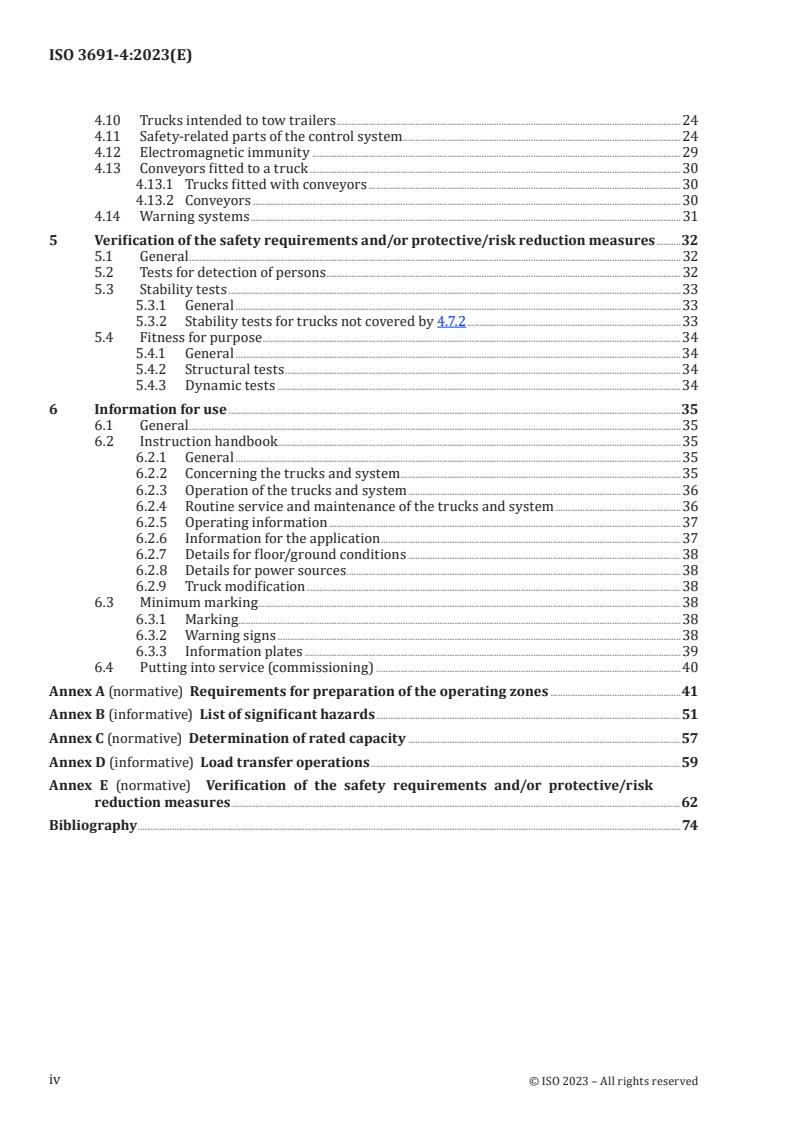
Contents Page
Foreword .v
Introduction . vi
1 Scope . 1
2 Normative references . 2
3 Terms and definitions . 4
4 Safety requirements and/or protective/risk reduction measures .10
4.1 General . 10
4.1.1 Overall requirements . 10
4.1.2 Normal climatic conditions . 10
4.1.3 Electrical requirements . 11
4.1.4 Stored energy components.12
4.1.5 Edges or angles .12
4.1.6 Guards .12
4.1.7 Interlocking devices for guards .12
4.1.8 Two-hand control devices .12
4.1.9 Transmission parts .12
4.1.10 Electro-sensitive protective equipment .12
4.1.11 Pressure-sensitive protective devices .12
4.1.12 Hydraulic systems .12
4.1.13 Pneumatic systems.13
4.1.14 Avoidance of automatic restart . 13
4.1.15 Foot protection . 13
4.1.16 Transport of the truck and removable attachments .13
4.1.17 Seats . . 14
4.1.18 Means of access . 14
4.1.19 High temperatures . 14
4.1.20 Exhaust emissions. 14
4.1.21 Access and emergency exit . 14
4.1.22 Driving position . 15
4.1.23 Electrostatic charges .15
4.1.24 Protective structures .15
4.1.25 Errors of fitting . 15
4.1.26 Normal stop .15
4.1.27 Operational stop . 16
4.2 Braking system . 16
4.3 Speed control . 16
4.3.1 Overspeed detection . 16
4.3.2 Speed and stability . 16
4.4 Automatic battery charging . 16
4.5 Load handling . 16
4.6 Steering . 17
4.7 Stability . 17
4.7.1 General . 17
4.7.2 Tilting platform stability test . 17
4.7.3 Stability requirements for trucks not covered by 4.7.2 . 18
4.8 Protective devices and complementary measures . 18
4.8.1 Emergency stop . 18
4.8.2 Detection of persons in the path . 19
4.9 Modes of operation . 21
4.9.1 General . 21
4.9.2 Automatic mode . 22
4.9.3 Manual mode . . 23
4.9.4 Maintenance mode . . . 24
iii
4.10 Trucks intended to tow trailers . 24
4.11 Safety-related parts of the control system . 24
4.12 Electromagnetic immunity . 29
4.13 Conveyors fitted to a truck . 30
4.13.1 Trucks fitted with conveyors .30
4.13.2 Conveyors . 30
4.14 Warning systems . 31
5 Verification of the safety requirements and/or protective/risk reduction measures .32
5.1 General . 32
5.2 Tests for detection of persons . 32
5.3 Stability tests . 33
5.3.1 General . 33
5.3.2 Stability tests for trucks not covered by 4.7.2 . 33
5.4 Fitness for purpose .34
5.4.1 General .34
5.4.2 Structural tests .34
5.4.3 Dynamic tests .34
6 Information for use .35
6.1 General . 35
6.2 Instruction handbook. 35
6.2.1 General . 35
6.2.2 Concerning the trucks and system . 35
6.2.3 Operation of the trucks and system .36
6.2.4 Routine service and maintenance of the trucks and system .36
6.2.5 Operating information . 37
6.2.6 Information for the application . 37
6.2.7 Details for floor/ground conditions .38
6.2.8 Details for power sources .38
6.2.9 Truck modification .38
6.3 Minimum marking . .38
6.3.1 Marking . .38
6.3.2 Warning signs .38
6.3.3 Information plates . 39
6.4 Putting into service (commissioning) .40
Annex A (normative) Requirements for preparation of the operating zones .41
Annex B (informative) List of significant hazards .51
Annex C (normative) Determination of rated capacity .57
Annex D (informative) Load transfer operations .59
Annex E (normative) Verification of the safety requirements and/or protective/risk
reduction measures .62
Bibliography .74
iv
Foreword
ISO (the International Organization for Standardization) is a worldwide federation of national standards
bodies (ISO member bodies). The work of preparing International Standards is normally carried out
through ISO technical committees. Each member body interested in a subject for which a technical
committee has been established has the right to be represented on that committee. International
organizations, governmental and non-governmental, in liaison with ISO, also take part in the work.
ISO collaborates closely with the International Electrotechnical Commission (IEC) on all matters of
electrotechnical standardization.
The procedures used to develop this document and those intended for its further maintenance are
described in the ISO/IEC Directives, Part 1. In particular, the different approval criteria needed for the
different types of ISO document should be noted. This document was drafted in accordance with the
editorial rules of the ISO/IEC Directives, Part 2 (see www.iso.org/directives).
ISO draws attention to the possibility that the implementation of this document may involve the use
of (a) patent(s). ISO takes no position concerning the evidence, validity or applicability of any claimed
patent rights in respect thereof. As of the date of publication of this document, ISO had not received
notice of (a) patent(s) which may be required to implement this document. However, implementers are
cautioned that this may not represent the latest information, which may be obtained from the patent
database available at www.iso.org/patents. ISO shall not be held responsible for identifying any or all
such patent rights.
Any trade name used in this document is information given for the convenience of users and does not
constitute an endorsement.
For an explanation of the voluntary nature of standards, the meaning of ISO specific terms and
expressions related to conformity assessment, as well as information about ISO's adherence to
the World Trade Organization (WTO) principles in the Technical Barriers to Trade (TBT), see
www.iso.org/iso/foreword.html.
This document was prepared by Technical Committee ISO/TC 110, Industrial trucks, Subcommittee SC 2,
Safety of powered industrial trucks, in collaboration with the European Committee for Standardization
(CEN) Technical Committee CEN/TC 150, Industrial Trucks - Safety, in accordance with the Agreement
on technical cooperation between ISO and CEN (Vienna Agreement).
This second edition cancels and replaces the first edition (ISO 3691-4:2020), which has been technically
revised.
The main changes are as follows:
— the Scope has been updated to include a list of significant hazards not covered;
— the list of normative references has been updated to include the most recent editions of documents;
— the term entries "active detection field" and "operational stop" have been added to Clause 3;
— Clause 4, Clause 5, Clause 6, Annex A, Annex B and Annex C have been updated, with new requirements
added in subclauses 4.1.16 to 4.1.27;
— the verification of the safety requirements lists in Annex E have been reworded.
A list of all parts in the ISO 3691 series can be found on the ISO website.
Any feedback or questions on this document should be directed to the user’s national standards body. A
complete listing of these bodies can be found at www.iso.org/members.html.
v
Introduction
This document is a type-C standard as stated in ISO 12100:2010.
This document is of relevance, in particular, for the following stakeholder groups representing the
market players with regard to machinery safety:
— machine manufacturers (small, medium and large enterprises);
— health and safety bodies (regulators, accident prevention organizations, market surveillance, etc.)
Others can be affected by the level of machinery safety achieved with the means of the document by the
above-mentioned stakeholder groups:
— machine users/employers (small, medium and large enterprises);
— machine users/employees (e.g. trade unions, organizations for people with special needs);
— service providers, e.g. for maintenance (small, medium and large enterprises);
— consumers (in case of machinery intended for use by consumers).
The above-mentioned stakeholder groups have been given the possibility to participate at the drafting
process of this document.
The machinery concerned and the extent to which hazards, hazardous situations or hazardous events
are covered are indicated in the Scope of this document.
When requirements of this type-C standard are different from those which are stated in type-A or
type-B standards, the requirements of this type-C standard take precedence over the requirements of
the other standards for machines that have been designed and built according to the requirements of
this type-C standard.
This document takes into consideration the current state of the art and especially:
— virtual bumper technology;
— hybrid (i.e. manual and automatic) mode trucks;
— performance level versus category;
— further specified clearances;
— guarding for specific zones.
vi
INTERNATIONAL STANDARD ISO 3691-4:2023(E)
Industrial trucks — Safety requirements and
verification —
Part 4:
Driverless industrial trucks and their systems
1 Scope
This document specifies safety requirements and the means for their verification for driverless
industrial trucks (hereafter referred to as trucks) and their systems.
Examples of driverless industrial trucks (trucks as defined in ISO 5053-1:2020) include: “automated
guided vehicle”, “autonomous mobile robot”, “bots”, “automated guided cart”, “tunnel tugger”, “under
cart”, etc.
This document is also applicable to driverless industrial trucks which are provided with:
— automatic modes which either require operators’ action(s) to initiate or enable such automatic
operations;
— the capability to transport one or more riders (which are neither considered as drivers nor as
operators);
— additional manual modes which allow operators to operate the truck manually; or
— a maintenance mode which allows manual operation of truck functions for maintenance reasons.
This document is not applicable to trucks solely guided by mechanical means (rails, guides, etc.) or to
remotely-controlled trucks, which are not considered to be driverless trucks.
For the purposes of this document, a driverless industrial truck is a powered truck, which is designed
to operate automatically. A driverless truck system comprises the control system, which can be part of
the truck and/or separate from it, guidance means and power system. Requirements for power sources
are not covered in this document.
The condition of the operating zone has a significant effect on the safe operation of the driverless
industrial truck. The preparations of the operating zone to eliminate the associated hazards are
specified in Annex A.
This document is applicable to all significant hazards, hazardous situations or hazardous events during
all phases of the life of the truck (ISO 12100:2010, 5.4), as listed in Annex B, relevant to the applicable
machines when it is used as intended and under conditions of misuse which are reasonably foreseeable
by the manufacturer.
In particular, this document does not apply to significant hazards related to:
— noise;
— vibrations;
— ionising and non-ionising radiation;
— laser radiation;
— sales literature (commercial documents);
— declaration of vibrations transmitted by mobile machinery.
It does not apply to additional hazards that can occur:
— during operation in severe conditions (e.g. extreme climates, freezer applications, strong magnetic
fields);
— during operation in nuclear environments;
— from trucks intended to operate in public zones (see in particular ISO 13482:2014);
— during operation on a public road;
— during operation in potentially explosive environments;
— during operation in military applications;
— during operation with specific hygienic requirements;
— during operation in ionizing radiation environments;
— during the transportation of (a) person(s) other than (the) intended rider(s);
— when handling loads the nature of which can lead to dangerous situations (e.g. molten metals, acids/
bases, radiating materials);
— for rider positions with elevation function higher than 1 200 mm from the floor/ground to the
platform floor.
This document does not contain safety requirements for trailer(s) being towed behind a truck.
This document does not contain safety requirements for elevated operator trucks.
This document does not apply to trucks manufactured before the date of its publication.
2 Normative references
The following documents are referred to in the text in such a way that some or all of their content
constitutes requirements of this document. For dated references, only the edition cited applies. For
undated references, the latest edition of the referenced document (including any amendments) applies.
ISO 2867:2011, Earth-moving machinery — Access systems
ISO 3691-1:2011 ISO 3691-1:2011/Amd 1:2020, Industrial trucks — Safety requirements and
verification — Part 1: Self-propelled industrial trucks, other than driverless trucks, variable-reach trucks
and burden-carrier trucks
ISO 3691-2:2023, Industrial trucks — Safety requirements and verification — Part 2: Self-propelled
variable-reach trucks
ISO 3691-6:2021, Industrial trucks — Safety requirements and verification — Part 6: Burden and personnel
carriers
ISO 4413:2010, Hydraulic fluid power — General rules and safety requirements for systems and their
components
ISO 4414:2010, Pneumatic fluid power — General rules and safety requirements for systems and their
components
ISO 5053-1:2020, Industrial trucks — Vocabulary — Part 1: Types of industrial trucks
ISO 7010:2019, ISO 7010:2019/Amd 1:2020, ISO 7010:2019/Amd 2:2020, ISO 7010:2019/Amd
3:2021, ISO 7010:2019/Amd 4:2021, ISO 7010:2019/Amd 5:2022 and ISO 7010:2019/Amd 6:2022,
Graphical symbols — Safety colours and safety signs — Registered safety signs
ISO 10896-1:2020, Rough-terrain trucks — Safety requirements and verification — Part 1: Variable-reach
trucks
ISO 10896-2:2016, Rough-terrain trucks — Safety requirements and verification — Part 2: Slewing trucks
ISO 12100:2010, Safety of machinery — General principles for design — Risk assessment and risk reduction
ISO 13849-1:2023, Safety of machinery — Safety-related parts of control systems — Part 1: General
principles for design
ISO 13849-2:2012, Safety of machinery — Safety-related parts of control systems — Part 2: Validation
ISO 13850:2015, Safety of machinery — Emergency stop function — Principles for design
ISO 13851:2019, Safety of machinery — Two-hand control devices — Principles for design and selection
ISO 13856-2:2013, Safety of machinery — Pressure-sensitive protective devices — Part 2: General
principles for design and testing of pressure-sensitive edges and pressure-sensitive bars
ISO 13856-3:2013, Safety of machinery — Pressure-sensitive protective devices — Part 3: General
principles for design and testing of pressure-sensitive bumpers, plates, wires and similar devices
ISO 13857:2019, Safety of machinery — Safety distances to prevent hazard zones being reached by upper
and lower limbs
ISO 14119:2013, Safety of machinery — Interlocking devices associated with guards — Principles for
design and selection
ISO 14120:2015, Safety of machinery — Guards — General requirements for the design and construction of
fixed and movable guards
ISO 14122-2:2016, Safety of machinery — Permanent means of access to machinery — Part 2: Working
platforms and walkways
ISO 15870:2000, Powered industrial trucks — Safety signs and hazard pictorials — General principles
ISO 22915-2:2018, Industrial trucks — Verification of stability — Part 2: Counterbalanced trucks with
mast
ISO 22915-3:2021, Industrial trucks — Verification of stability — Part 3: Reach and straddle trucks
ISO 22915-4:2018, Industrial trucks — Verification of stability — Part 4: Pallet stackers, double stackers
and order-picking trucks with operator position elevating up to and including 1 200 mm lift height
ISO 22915-5:2020, Industrial trucks — Verification of stability — Part 5: Single-side-loading trucks
ISO 22915-7:2016, Industrial trucks — Verification of stability — Part 7: Bidirectional and multidirectional
trucks
ISO 22915-8:2018, Industrial trucks — Verification of stability — Part 8: Additional stability test for trucks
operating in the special condition of stacking with mast tilted forward and load elevated
ISO 22915-9:2014, Industrial trucks — Verification of stability — Part 9: Counterbalanced trucks with
mast handling freight containers of 6 m (20 ft) length and longer
ISO 22915-10:2023, Industrial trucks — Verification of stability — Part 10: Additional stability test for
trucks operating in the special condition of stacking with load laterally displaced by powered devices
ISO 22915-11:2011, Industrial trucks — Verification of stability — Part 11: Industrial variable-reach trucks
ISO 22915-12:2015, Industrial trucks — Verification of stability — Part 12: Industrial variable-reach
trucks handling freight containers of 6 m (20 ft) length and longer
ISO 22915-13:2012, Industrial trucks — Verification of stability — Part 13: Rough-terrain trucks with mast
ISO 22915-14:2010, Industrial trucks — Verification of stability — Part 14: Rough-terrain variable-reach
trucks
ISO 22915-15:2020, Industrial trucks — Verification of stability — Part 15: Counterbalanced trucks with
articulated steering
ISO 22915-17:2020, Industrial trucks — Verification of stability — Part 17: Towing tractors, burden and
personnel carriers
ISO 22915-20:2023, Industrial trucks — Verification of stability — Part 20: Additional stability test for
trucks operating in the special condition of offset load, offset by utilization
ISO 22915-22:2014, Industrial trucks — Verification of stability — Part 22: Lateral- and front-stacking
trucks with and without elevating operator position
IEC 61496-2:2020, Safety of Machinery — Electro-sensitive protective equipment — Part 2: Particular
requirements for equipment using active opto-electronic protective devices (AOPDs)
IEC 61496-3:2018, Safety of machinery —Electro-sensitive protective equipment — Part 3: Particular
requirements for Active Opto-electronic Protective Devices responsive to Diffuse Reflection (AOPDDR)
IEC 60204-1:2016+AMD1: 2021, Safety of machinery — Electrical equipment of machines — Part 1: General
requirements
IEC 61558-1:2017, Safety of power transformers, power supply units, reactors and similar — Part 1: General
requirements and tests
IEC 62046:2018, Safety of machinery - Application of protective equipment to detect the presence of persons
EN 1175:2020, Safety of industrial trucks — Electrical/electronic requirements
EN 12895:2015+A1: 2019, Industrial trucks — Electromagnetic compatibility
3 Terms and definitions
For the purposes of this document, the terms and definitions given in ISO 5053-1:2020 and
ISO 12100:2010 and the following apply.
ISO and IEC maintain terminology databases for use in standardization at the following addresses:
— ISO Online browsing platform: available at https:// www .iso .org/ obp
— IEC Electropedia: available at https:// www .electropedia .org/
3.1
actuating force
force applied on the bumper that initiates a stop signal
3.2
authorized person
authorized personnel
authorized individual
person designated by the user, trained on specific hazards and if required, trained to operate or
maintain the truck or system
3.3
automatic mode
operating mode where no operator intervention is required for the operation
3.4
bumper
pressure-sensitive protective device (PSPD) fitted to the truck that generates a signal to stop the truck
upon physical contact
3.5
virtual bumper
electro sensitive (non-contact) protective equipment (ESPE) fitted to the truck, having one or more
detection zones that generates a signal for the truck to take further actions when actuated
Note 1 to entry: Further action can include stopping the truck or changing its path or speed.
EXAMPLE Active opto-electronic protective devices responsive to diffuse reflection (AOPDDRs).
3.6
driverless truck system
combination of one (or more) driverless truck(s) and ancillary components to control and manage the
automatic operation of the truck(s)
Note 1 to entry: Ancillary components can be integrated or external (e.g. guidance, traffic control, power system,
communication system, guarding, signs, warnings, floor marking).
3.7
driverless industrial truck
powered truck, designed to operate automatically to transport loads
3.8
escape route
space provided for a person to exit away from the hazard(s)
3.9
path
area swept by the truck with its load including trailer(s)
3.10
load
item intended to be handled by the truck
3.11
load handling
load lifting, lowering, conveying and manipulating
EXAMPLE Rotation, reach, tilting, clamping and towing.
3.12
manual mode
operating condition where all operations are under the control of an operator
3.13
static force
force applied by the bumper when an automatic stop is completed
3.14
rider
intended rider
person on the truck in automatic mode with a rider who can enable or disable functions of the truck
3.15
stopping device
control device that when actuated, generates a signal to stop all movements of the truck
3.16
emergency stop device
manually actuated control device used to initiate an emergency stop function
[SOURCE: ISO 13850:2015, 3.3]
3.17
direction of travel
one or more directions of travel based upon the operating conditions of the truck as specified by the
manufacturer
3.18
personnel detection means
system to detect persons in the path of a truck
3.19
rated speed
travel speed of the truck as specified by the manufacturer
3.20
automatic restart
resumption of the truck operation without outside input
Note 1 to entry: The truck starts only after the conditions which have stopped the truck have been cleared.
3.21
automatic mode with a rider
operating condition where (a) rider(s) is (are) present on the truck during automatic movement
3.22
confined zone
enclosed truck operating space that is intended to prevent access of persons
3.23
operating hazard zone
area of the operating zone in which a person can be exposed to a hazard
Note 1 to entry: This can be found in load transfer areas or low clearances.
Note 2 to entry: The operating hazard zone is considered a hazard zone according to ISO 12100:2010, 3.11.
3.24
operating zone
defined area in which a truck operates
Note 1 to entry: Examples of defined areas: areas signalled by navigation systems, signs, floor markings, fencings,
guarding.
3.25
public zone
space opened to all persons without specific training, instruction or awareness
3.26
restricted zone
enclosed truck operating space that is intended to prevent access of unauthorized persons
3.27
method statement
safe system of work
document that details the way a work task or process is to be completed and outlines the hazards
involved
Note 1 to entry: This can include a step by step guide on how to do the job safely and detail which control
measures have been introduced to ensure the safety of anyone who is affected by the task or process.
3.28
load transfer area
location where a load can be picked up or deposited by the truck
Note 1 to entry: The location can be on the floor/ground (e.g. rack, machines and conveyors).
3.29
operator
designated person, appropriately trained and authorized to operate the truck
[SOURCE: ISO 3691-1:2011 and ISO 3691-1:2011/Amd 1:2020, 3.7, modified — In the definition, “who
is responsible for the movement and load handling of an industrial truck” has been replaced with "to
operate the truck”. Notes 1 and 2 have been removed.]
3.30
rider designated position
position on the truck that is specified by the manufacturer for (a) person(s) to safely ride on the truck
3.31
belt conveyor
conveyor with one or more endless belt(s) acting as a carrying and traction element
Note 1 to entry: The belt is supported by rollers or slides on a surface.
Note 2 to entry: The carrying belt may also be made of flexible elements.
[SOURCE: EN 619:2022, 3.7, modified — The reference to the figure has been removed.]
3.32
roller conveyor
conveyor with rollers as carrying elements
[SOURCE: EN 619:2022, 3.8]
3.33
carrying-chain conveyor
conveyor with chains as traction and carrying elements, with or without tappets attached to the chains
[SOURCE: EN 619:2022, 3.9, modified — The reference to the figure has been removed.]
3.34
coordinate system of the truck
coordinate system (O – X – Y – Z ) referenced to one of the components which enables the locomotion
p p p p
of the truck
Note 1 to entry: ISO 9787:2013, 5.5, specifies a mobile platform coordinate system, (O – X – Y – Z ). The origin
p p p p
of the mobile platform coordinate system, O , is the mobile platform origin. The +X axis is normally taken in the
p p
forward direction of the mobile platform. The +Z axis is normally taken in the upward direction of the mobile
p
platform.
Note 2 to entry: See Figure 1.
Key
O origin of the referential
p
NOTE This figure is adapted from ISO 9787:2013, Figure 6.
Figure 1 — Coordinate system of the truck
3.35
forward direction
movement of the truck following +X axis
p
Note 1 to entry: See coordinate system of the truck (3.34).
Note 2 to entry: See Figure 1.
3.36
backward direction
movement of the truck following -X axis
p
Note 1 to entry: See coordinate system of the truck (3.34).
Note 2 to entry: See Figure 1.
3.37
lateral direction
movement of the truck following the Y axis
p
Note 1 to entry: See coordinate system of the truck (3.34).
Note 2 to entry: See Figure 1.
3.38
crabbing direction
combined movement of the truck following the X and Y axes without changing the orientation
p p
Note 1 to entry: See coordinate system of the truck (3.34).
Note 2 to entry: See Figure 1.
3.39
turning direction
movement that generates a change of the orientation of the truck coordinate system around the Z axis
p
combined with a movement of the truck following the X and/or Y axis
p p
Note 1 to entry: See coordinate system of the truck (3.34).
Note 2 to entry: See Figure 1.
3.40
pivoting direction
movement that generates a change of the orientation of the truck coordinate system around the Z axis,
p
without movement of the truck following the X and/or Y axis
p p
Note 1 to entry: See coordinate system of the truck (3.34).
Note 2 to entry: See Figure 1.
3.41
tiller
bar used by the operator on a truck for the purpose of steering
Note 1 to entry: It can incorporate other functions.
3.42
floor
ground
level, smooth, prepared surface to support the weight of a loaded truck
EXAMPLE Concrete, asphalt.
3.43
rated capacity
maximum load, expressed in kilograms, established by the manufacturer based on component strength
and truck stability, that the truck can carry, lift and stack to the standard lift height and at the standard
position of the centre of gravity
Note 1 to entry: For centre of gravity, see Annex C.
Note 2 to entry: If the lifting height of the mast is lower than the standard lift height H, the rated capacity is still
assessed at the standard lift height.
Note 3 to entry: The rated capacity is used to compare the capacity of different manufacturers' trucks and
to provide the break points used in technical standards and statistics. The operating limits for the truck are
specified by its actual capacity.
[SOURCE: ISO 3691-1:2011 and ISO 3691-1:2011/Amd 1:2020, 3.15, modified — "Annex A" changed to
"Annex C" in Note 1 to entry.]
3.44
actual capacity
maximum load, expressed in kilograms, established by the manufacturer based on component strength
and truck stability that a truck can carry, lift and stack to a specified height, at a specified load centre
distance and reach, if applicable, in normal operation
Note 1 to entry: The actual capacity depends on the configuration of the truck, including variables such as the
type and lift height of the mast fitted, the actual load centre and any attachments that might be fitted. This
actual capacity specifies the load-handling ability of the particular truck, as equipped. Additional actual capacity
ratings with removable attachments can also be established where permitted by the appropriate stability tests
or by calculation verified by empirical data.
[SOURCE: ISO 3691-1:2011 and ISO 3691-1:2011/Amd 1:2020, 3.14]
3.45
protective stop
safety-related stop function initiated by a protective device
3.46
truck speed
speed of the fastest moving point of the truck and its load(s)
3.47
braking system
combination of parts which fulfil one or more of the following functions:
— control (usually to reduce) a vehicle's speed,
— bring the vehicle to a halt or hold it stationary
[SOURCE: ISO 611:2003, 3.2]
3.48
fixed closed structure
structure acting as a guard and preventing persons from entering or reaching into the path
Note 1 to entry: This structure is mainly providing a peripheral guard, and composed of walls, panels, fences.
3.49
muting
temporary automatic suspension of a safety function
3.50
override
manual suspension of a safety function
3.51
deactivation
action to make a function
...
NORME ISO
INTERNATIONALE 3691-4
Deuxième édition
2023-06
Chariots de manutention — Exigences
de sécurité et vérification —
Partie 4:
Chariots sans conducteur et leurs
systèmes
Industrial trucks — Safety requirements and verification —
Part 4: Driverless industrial trucks and their systems
Numéro de référence
DOCUMENT PROTÉGÉ PAR COPYRIGHT
© ISO 2023
Tous droits réservés. Sauf prescription différente ou nécessité dans le contexte de sa mise en œuvre, aucune partie de cette
publication ne peut être reproduite ni utilisée sous quelque forme que ce soit et par aucun procédé, électronique ou mécanique,
y compris la photocopie, ou la diffusion sur l’internet ou sur un intranet, sans autorisation écrite préalable. Une autorisation peut
être demandée à l’ISO à l’adresse ci-après ou au comité membre de l’ISO dans le pays du demandeur.
ISO copyright office
Case postale 401 • Ch. de Blandonnet 8
CH-1214 Vernier, Genève
Tél.: +41 22 749 01 11
E-mail: copyright@iso.org
Web: www.iso.org
Publié en Suisse
ii
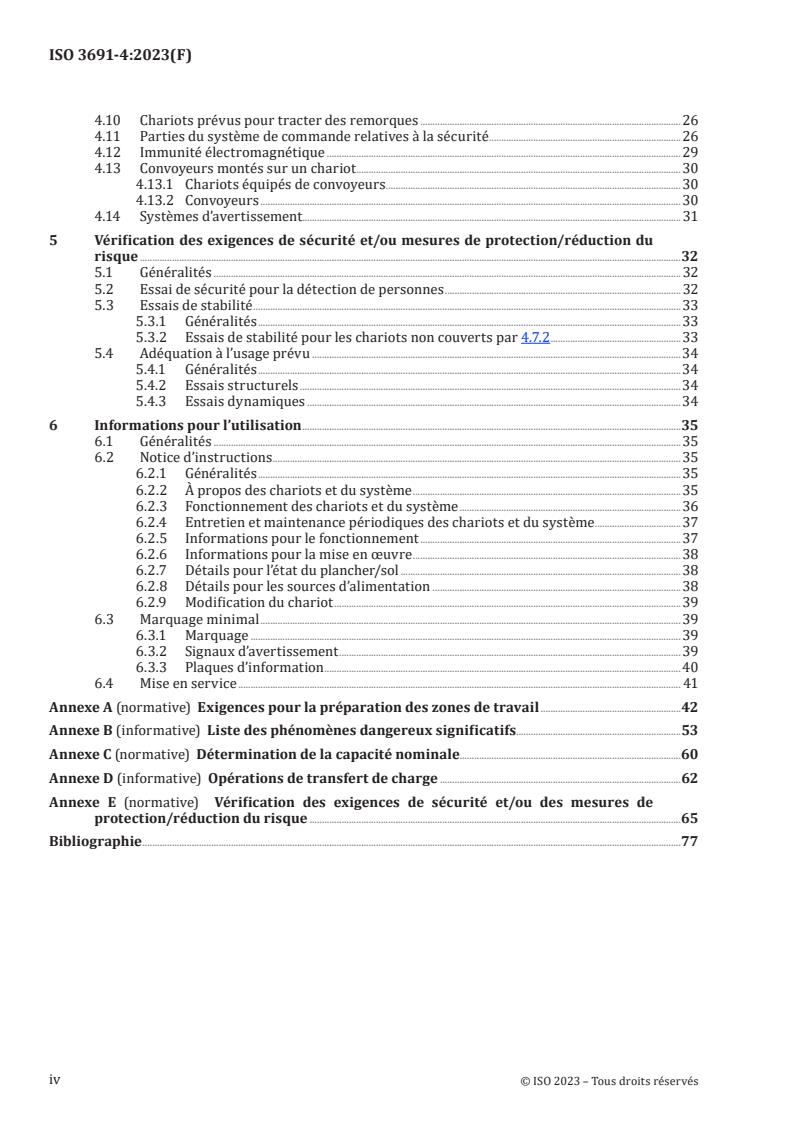
Sommaire Page
Avant-propos .v
Introduction .vii
1 Domaine d’application . 1
2 Références normatives .2
3 Termes et définitions . 5
4 Exigences de sécurité et/ou mesures de protection/réduction du risque .11
4.1 Généralités . 11
4.1.1 Exigences globales . 11
4.1.2 Conditions ambiantes normales . 11
4.1.3 Exigences électriques . 11
4.1.4 Composants à accumulation d’énergie . .12
4.1.5 Arêtes ou angles .13
4.1.6 Protecteurs . 13
4.1.7 Dispositifs de verrouillage pour les protecteurs .13
4.1.8 Dispositifs de commande bimanuelle . 13
4.1.9 Éléments de transmission . 13
4.1.10 Équipements de protection électrosensibles .13
4.1.11 Dispositifs de protection sensibles à la pression .13
4.1.12 Systèmes hydrauliques . 13
4.1.13 Systèmes pneumatiques .13
4.1.14 Prévention du redémarrage automatique .13
4.1.15 Protection du pied . . 14
4.1.16 Transport du chariot et des accessoires amovibles . 14
4.1.17 Sièges . 15
4.1.18 Moyens d’accès . 15
4.1.19 Hautes températures .15
4.1.20 Émissions de gaz d’échappement . 15
4.1.21 Accès et sortie de secours . 15
4.1.22 Poste de conduite . 15
4.1.23 Charges électrostatiques . 16
4.1.24 Structures de protection . 16
4.1.25 Erreurs de montage . 16
4.1.26 Arrêt normal . 16
4.1.27 Arrêt opérationnel . 17
4.2 Système de freinage . 17
4.3 Commande de la vitesse . 17
4.3.1 Détection de survitesse . 17
4.3.2 Vitesse et stabilité . 17
4.4 Charge automatique de la batterie . 17
4.5 Manutention de la charge . 18
4.6 Direction . 18
4.7 Stabilité . 18
4.7.1 Généralités . 18
4.7.2 Essai de stabilité de la plate-forme inclinable . 18
4.7.3 Exigences de stabilité pour les chariots non couverts par 4.7.2 . 19
4.8 Dispositifs de protection et mesures complémentaires . 19
4.8.1 Arrêt d’urgence . 19
4.8.2 Détection de personnes dans le circuit . 20
4.9 Modes de fonctionnement.22
4.9.1 Généralités .22
4.9.2 Mode automatique .23
4.9.3 Mode manuel . 24
4.9.4 Mode de maintenance .25
iii
4.10 Chariots prévus pour tracter des remorques . 26
4.11 Parties du système de commande relatives à la sécurité . 26
4.12 Immunité électromagnétique .29
4.13 Convoyeurs montés sur un chariot . 30
4.13.1 Chariots équipés de convoyeurs .30
4.13.2 Convoyeurs . 30
4.14 Systèmes d’avertissement. 31
5 Vérification des exigences de sécurité et/ou mesures de protection/réduction du
risque .32
5.1 Généralités . 32
5.2 Essai de sécurité pour la détection de personnes . 32
5.3 Essais de stabilité .33
5.3.1 Généralités . 33
5.3.2 Essais de stabilité pour les chariots non couverts par 4.7.2 .33
5.4 Adéquation à l’usage prévu .34
5.4.1 Généralités .34
5.4.2 Essais structurels .34
5.4.3 Essais dynamiques .34
6 Informations pour l’utilisation .35
6.1 Généralités . 35
6.2 Notice d’instructions . 35
6.2.1 Généralités . 35
6.2.2 À propos des chariots et du système . 35
6.2.3 Fonctionnement des chariots et du système .36
6.2.4 Entretien et maintenance périodiques des chariots et du système . 37
6.2.5 Informations pour le fonctionnement . 37
6.2.6 Informations pour la mise en œuvre .38
6.2.7 Détails pour l’état du plancher/sol .38
6.2.8 Détails pour les sources d’alimentation .38
6.2.9 Modification du chariot .39
6.3 Marquage minimal . 39
6.3.1 Marquage . 39
6.3.2 Signaux d’avertissement . 39
6.3.3 Plaques d’information .40
6.4 Mise en service . 41
Annexe A (normative) Exigences pour la préparation des zones de travail .42
Annexe B (informative) Liste des phénomènes dangereux significatifs.53
Annexe C (normative) Détermination de la capacité nominale.60
Annexe D (informative) Opérations de transfert de charge .62
Annexe E (normative) Vérification des exigences de sécurité et/ou des mesures de
protection/réduction du risque .65
Bibliographie .77
iv
Avant-propos
L'ISO (Organisation internationale de normalisation) est une fédération mondiale d'organismes
nationaux de normalisation (comités membres de l'ISO). L'élaboration des Normes internationales est
en général confiée aux comités techniques de l'ISO. Chaque comité membre intéressé par une étude
a le droit de faire partie du comité technique créé à cet effet. Les organisations internationales,
gouvernementales et non gouvernementales, en liaison avec l'ISO participent également aux travaux.
L'ISO collabore étroitement avec la Commission électrotechnique internationale (IEC) en ce qui
concerne la normalisation électrotechnique.
Les procédures utilisées pour élaborer le présent document et celles destinées à sa mise à jour sont
décrites dans les Directives ISO/IEC, Partie 1. Il convient, en particulier, de prendre note des différents
critères d'approbation requis pour les différents types de documents ISO. Le présent document a
été rédigé conformément aux règles de rédaction données dans les Directives ISO/IEC, Partie 2 (voir
www.iso.org/directives).
L’ISO attire l’attention sur le fait que la mise en application du présent document peut entraîner
l’utilisation d’un ou de plusieurs brevets. L’ISO ne prend pas position quant à la preuve, à la validité
et à l’applicabilité de tout droit de brevet revendiqué à cet égard. À la date de publication du présent
document, l’ISO n'avait pas reçu notification qu’un ou plusieurs brevets pouvaient être nécessaires à sa
mise en application. Toutefois, il y a lieu d’avertir les responsables de la mise en application du présent
document que des informations plus récentes sont susceptibles de figurer dans la base de données de
brevets, disponible à l'adresse www.iso.org/brevets. L’ISO ne saurait être tenue pour responsable de ne
pas avoir identifié tout ou partie de tels droits de propriété.
Les appellations commerciales éventuellement mentionnées dans le présent document sont données
pour information, par souci de commodité, à l’intention des utilisateurs et ne sauraient constituer un
engagement.
Pour une explication de la nature volontaire des normes, la signification des termes et expressions
spécifiques de l'ISO liés à l'évaluation de la conformité, ou pour toute information au sujet de l'adhésion
de l'ISO aux principes de l’Organisation mondiale du commerce (OMC) concernant les obstacles
techniques au commerce (OTC), voir www.iso.org/avant-propos.
Le présent document a été élaboré par le comité technique ISO/TC 110, Chariots de manutention, sous-
comité SC 2, Sécurité des chariots de manutention automoteurs, en collaboration avec le comité technique
CEN/TC 150, Chariots industriels – Sécurité, du Comité européen de normalisation (CEN) conformément
à l’Accord de coopération technique entre l’ISO et le CEN (Accord de Vienne).
Cette deuxième édition annule et remplace la première édition (ISO 3691-4:2020), qui a fait l’objet d’une
révision technique.
Les principales modifications sont les suivantes:
— le domaine d’application a été mis à jour pour inclure une liste des phénomènes dangereux
significatifs non couverts;
— la liste des références normatives a été mise à jour pour inclure les versions les plus récentes des
documents;
— les entrées de terme «champ de détection actif» et «arrêt opérationnel» ont été ajoutées à l'Article 3;
— l'Article 4, l'Article 5, l'Article 6, l'Annexe A, l'Annexe B et l'Annexe C ont été mis à jour avec les
nouvelles exigences ajoutées dans les paragraphes de 4.1.16 à 4.1.27,
— la vérification des listes d'exigences de sécurité de l'Annexe E a été reformulée.
Une liste de toutes les parties de la série ISO 3691 se trouve sur le site web de l’ISO.
v
Il convient que l’utilisateur adresse tout retour d’information ou toute question concernant le présent
document à l’organisme national de normalisation de son pays. Une liste exhaustive desdits organismes
se trouve à l’adresse www.iso.org/fr/members.html.
vi
Introduction
Le présent document est une norme de type C tel que mentionné dans l’ISO 12100:2010.
Le présent document concerne, en particulier, les groupes de parties prenantes suivants représentant
les acteurs du marché dans le domaine de la sécurité des machines:
— fabricants de machines (petites, moyennes et grandes entreprises);
— organismes de santé et de sécurité (autorités réglementaires, organismes de prévention des risques
professionnels, surveillance du marché, etc.).
D’autres partenaires peuvent être concernés par le niveau de sécurité des machines atteint à l’aide du
document par les groupes de parties prenantes mentionnées ci-dessus:
— utilisateurs de machines/employeurs (petites, moyennes et grandes entreprises);
— utilisateurs de machines/salariés (par exemple, syndicats de salariés, organisations représentant
des personnes ayant des besoins particuliers);
— prestataires de services, par exemple, sociétés de maintenance (petites, moyennes et grandes
entreprises);
— consommateurs (dans le cas de machines destinées à être utilisées par des consommateurs).
Les groupes de parties prenantes mentionnés ci-dessus ont eu la possibilité de participer à l'élaboration
du présent document.
Les machines concernées et l’étendue des phénomènes dangereux, situations dangereuses ou
évènements dangereux couverts sont indiquées dans le domaine d’application du présent document.
Lorsque des exigences de la présente norme de type C sont différentes de celles énoncées dans
les normes de type A ou de type B, les exigences de la présente norme de type C ont priorité sur les
exigences des autres normes, pour les machines ayant été conçues et fabriquées conformément aux
exigences de la présente norme de type C.
Le présent document prend en considération l’état de l’art du moment, et spécialement:
— la technologie de pare-chocs virtuel;
— les chariots en mode hybride (c’est-à-dire, manuel et automatique);
— le niveau de performance par rapport à la catégorie;
— la spécification d’autres dégagements;
— la protection pour des zones spécifiques.
vii
NORME INTERNATIONALE ISO 3691-4:2023(F)
Chariots de manutention — Exigences de sécurité et
vérification —
Partie 4:
Chariots sans conducteur et leurs systèmes
1 Domaine d’application
Le présent document spécifie les exigences de sécurité et les moyens de les vérifier pour les chariots de
manutention sans conducteur (ci-après dénommés chariots) et leurs systèmes.
Des exemples de chariots de manutention sans conducteur (chariots tels que définis dans
l’ISO 5053-1:2020) comprennent: «véhicule autoguidé», «robot mobile autonome», «robot», «chariot
autoguidé», «tunnel tugger», «under cart», etc.
Le présent document est également applicable aux chariots de manutention sans conducteur qui sont
équipés de:
— modes automatiques qui requièrent une ou des actions de l’opérateur pour initier ou activer de
telles opérations automatiques;
— la capacité de transporter un ou plusieurs accompagnateurs (qui ne sont considérés ni comme des
conducteurs, ni comme des opérateurs);
— des modes manuels supplémentaires qui permettent aux opérateurs de faire fonctionner le chariot
manuellement; ou
— un mode de maintenance qui permet le fonctionnement manuel des fonctions du chariot pour des
raisons de maintenance.
Le présent document ne s’applique pas aux chariots guidés uniquement par des moyens mécaniques
(rails, guides, etc.) ni aux chariots commandés à distance, qui ne sont pas considérés comme des
chariots sans conducteur.
Pour les besoins du présent document, un chariot de manutention sans conducteur est un chariot
motorisé, qui est conçu pour fonctionner automatiquement. Un système de chariots sans conducteur
comprend le système de commande, qui peut faire partie du chariot et/ou en être séparé, des dispositifs
de guidage et un système d’alimentation. Les exigences pour les sources d’alimentation ne sont pas
couvertes par le présent document.
Les conditions de la zone de travail ont un effet significatif sur la sécurité de fonctionnement du chariot
de manutention sans conducteur. Les aménagements de la zone de travail pour éliminer les phénomènes
dangereux associés sont spécifiés à l’Annexe A.
Le présent document est applicable à tous les phénomènes dangereux significatifs, situations
dangereuses ou évènements dangereux, pendant toutes les phases de la vie du chariot (ISO 12100:2010,
5.4), tels qu’énumérés dans l’Annexe B, pertinents pour les machines couvertes lorsqu’elles sont utilisées
normalement ou dans les conditions de mauvaise utilisation raisonnablement prévisibles prévues par
le fabricant.
En particulier, le présent document ne s’applique pas aux phénomènes dangereux significatifs relatifs:
— au bruit;
— aux vibrations;
— aux rayonnements ionisant et non ionisant;
— au rayonnement laser;
— à la documentation commerciale (documents commerciaux);
— à la déclaration des vibrations transmises par des machines mobiles.
Il ne s’applique pas aux exigences pour les phénomènes dangereux supplémentaires qui peuvent
survenir:
— pendant le fonctionnement dans des conditions sévères (par exemple, climats extrêmes, applications
frigorifiques, champs magnétiques intenses);
— pendant le fonctionnement dans des environnements nucléaires;
— pour des chariots destinés à fonctionner dans des zones publiques (voir en particulier
l’ISO 13482:2014);
— pendant le fonctionnement sur une voie publique;
— pendant le fonctionnement dans des environnements explosibles;
— pendant le fonctionnement dans des applications militaires;
— pendant le fonctionnement avec des exigences d’hygiène spécifiques;
— pendant le fonctionnement dans des environnements exposés à des rayonnements ionisants;
— pendant le transport d’une ou de plusieurs personnes autres que le ou les accompagnateurs prévus;
— lors de la manutention de charges dont la nature peut conduire à des situations dangereuses (par
exemple, métaux en fusion, acides/bases, matériaux émetteurs de radiations);
— pour des postes d’accompagnateur ayant une fonction élévation supérieure à 1 200 mm depuis le
plancher/sol jusqu’au plancher de la plate-forme.
Le présent document ne contient pas d’exigences de sécurité pour les remorques tractées derrière un
chariot.
Le présent document ne contient pas d’exigences de sécurité pour les chariots à opérateur élevé.
Le présent document ne s’applique pas aux chariots fabriqués avant la date de sa publication.
2 Références normatives
Les documents suivants sont cités dans le texte de sorte qu’ils constituent, pour tout ou partie de leur
contenu, des exigences du présent document. Pour les références datées, seule l’édition citée s’applique.
Pour les références non datées, la dernière édition du document de référence s'applique (y compris les
éventuels amendements).
ISO 2867:2011, Engins de terrassement — Moyens d'accès
ISO 3691-1:2011ISO 3691-1:2011/Amd 1:2020, Chariots de manutention — Exigences de sécurité et
vérification — Partie 1: Chariots de manutention automoteurs, autres que les chariots sans conducteur, les
chariots à portée variable et les chariots transporteurs de charges
ISO 3691-2:2023, Chariots de manutention — Exigences de sécurité et vérification — Partie 2: Chariots
automoteurs à portée variable
ISO 3691-6:2021, Chariots de manutention — Exigences de sécurité et vérification — Partie 6:
Transporteurs de charges et de personnel
ISO 4413:2010, Transmissions hydrauliques — Règles générales et exigences de sécurité relatives aux
systèmes et leurs composants
ISO 4414:2010, Transmissions pneumatiques — Règles générales et exigences de sécurité pour les systèmes
et leurs composants
ISO 5053-1:2020, Chariots de manutention — Vocabulaire — Partie 1: Types de chariots de manutention
ISO 7010:2019, ISO 7010:2019/Amd 1:2020, ISO 7010:2019/Amd 2:2020, ISO 7010:2019/Amd
3:2021, ISO 7010:2019/Amd 4:2021, ISO 7010:2019/Amd 5:2022 et ISO 7010:2019/Amd 6:2022,
Symboles graphiques — Couleurs de sécurité et signaux de sécurité — Signaux de sécurité enregistrés
ISO 10896-1:2020, Chariots tout-terrain — Exigences de sécurité et vérification — Partie 1: Chariots à
portée variable
ISO 10896-2:2016, Chariots tout-terrain — Exigences de sécurité et vérifications — Partie 2:
Chariots rotatifs
ISO 12100:2010, Sécurité des machines — Principes généraux de conception — Appréciation du risque et
réduction du risque
ISO 13849-1:2023, Sécurité des machines — Parties des systèmes de commande relatives à la sécurité —
Partie 1: Principes généraux de conception
ISO 13849-2:2012, Sécurité des machines — Parties des systèmes de commande relatives à la sécurité
— Partie 2: Validation
ISO 13850:2015, Sécurité des machines — Fonction d'arrêt d'urgence — Principes de conception
ISO 13851:2019, Sécurité des machines — Dispositifs de commande bimanuelle — Principes de
conception et de choix
ISO 13856-2:2013, Sécurité des machines — Dispositifs de protection sensibles à la pression — Partie 2:
Principes généraux de conception et d'essai des bords et barres sensibles à la pression
ISO 13856-3:2013, Sécurité des machines — Dispositifs de protection sensibles à la pression — Partie 3:
Principes généraux de conception et d'essai des pare-chocs, plaques, câbles et dispositifs analogues sensibles
à la pression
ISO 13857:2019, Sécurité des machines — Distances de sécurité empêchant les membres supérieurs
et inférieurs d'atteindre les zones dangereuses
ISO 14119:2013, Sécurité des machines — Dispositifs de verrouillage associés à des protecteurs —
Principes de conception et de choix
ISO 14120:2015, Sécurité des machines — Protecteurs — Prescriptions générales pour la conception et la
construction des protecteurs fixes et mobiles
ISO 14122-2:2016, Sécurité des machines — Moyens d'accès permanents aux machines — Partie 2:
Plates-formes de travail et passerelles
ISO 15870:2000, Chariots de manutention automoteurs — Signaux de sécurité et de danger —
Principes généraux
ISO 22915-2:2018, Chariots de manutention — Vérification de la stabilité — Partie 2: Chariots en porte-
à-faux à mât
ISO 22915-3:2021, Chariots de manutention — Vérification de la stabilité — Partie 3: Chariots rétractables
et à fourche entre longerons
ISO 22915-4:2018, Chariots de manutention — Vérification de la stabilité — Partie 4: Chariots à fourche
recouvrante, chariots à double fourche et chariots préparateurs de commandes avec un poste de conduite
élevable ayant une hauteur de levée de 1 200 mm inclus
ISO 22915-5:2020, Chariots de manutention — Vérification de la stabilité — Partie 5: Chariots à
chargement latéral
ISO 22915-7:2016, Chariots de manutention — Vérification de la stabilité — Partie 7: Chariots
bidirectionnels et multidirectionnels
ISO 22915-8:2018, Chariots de manutention — Vérification de la stabilité — Partie 8: Essai de stabilité
supplémentaire pour les chariots travaillant dans des conditions de gerbage spéciales avec le mât incliné en
avant et la charge élevée
ISO 22915-9:2014, Chariots de manutention — Vérification de la stabilité — Partie 9: Chariots travaillant
en porte-à-faux avec mât manutentionnant des conteneurs de 6 m (20 ft) de long et plus
ISO 22915-10:2023, Chariots de manutention — Vérification de la stabilité — Partie 10: Essai de stabilité
supplémentaire pour les chariots travaillant dans des conditions de gerbage spéciales avec la charge
décentrée latéralement par des dispositifs à moteur
ISO 22915-11:2011, Chariots de manutention — Vérification de la stabilité — Partie 11: Chariots de
manutention à portée variable
ISO 22915-12:2015, Chariots de manutention — Vérification de la stabilité — Partie 12: Chariots à portée
variable manutentionnant des conteneurs de 6 m (20 ft) de long et plus
ISO 22915-13:2012, Chariots de manutention — Vérification de la stabilité — Partie 13: Chariots tout-
terrain à mât
ISO 22915-14:2010, Chariots de manutention — Vérification de la stabilité — Partie 14: Chariots tout-
terrain à portée variable
ISO 22915-15:2020, Chariots de manutention — Vérification de la stabilité — Partie 15: Chariots avec
dispositif de direction articulé travaillant en porte-à-faux
ISO 22915-17:2020, Chariots de manutention — Vérification de la stabilité — Partie 17: Tracteurs,
transporteurs de charges et de personnel
ISO 22915-20:2023, Chariots de manutention — Vérification de la stabilité — Partie 20: Essai de stabilité
supplémentaire pour les chariots travaillant dans des conditions de gerbage spéciales avec une charge
déportée, déport par utilisation
ISO 22915-22:2014, Chariots de manutention — Vérification de la stabilité — Partie 22: Chariots à prise
latérale - et frontale - avec et sans poste de conduite élevable
IEC 61496-2:2020, Sécurité des machines — Équipements de protection électrosensibles — Partie 2:
Exigences particulières à un équipement utilisant des appareils protecteurs optoélectroniques actifs (AOPD)
IEC 61496-3:2018, Sécurité des machines — Équipements de protection électrosensibles — Partie 3:
Exigences particulières pour les équipements utilisant des dispositifs protecteurs optoélectroniques actifs
sensibles aux réflexions diffuses (AOPDDR)
I EC 6 020 4 -1:2016 +A M D1: 2021, Sécurité des machines — Équipement électrique des machines — Partie 1:
Exigences générales
IEC 61558-1:2017, Sécurité des transformateurs, bobines d’inductance, blocs d’alimentation et des
combinaisons de ces éléments — Partie 1: Exigences générales et essais
IEC 62046:2018, Sécurité des machines — Application des équipements de protection à la détection de la
présence de personnes
EN 1175:2020, Sécurité des chariots de manutention — Prescriptions électriques/électroniques
E N 128 95:2015+A 1: 2019, Chariots de manutention — Compatibilité électromagnétique
3 Termes et définitions
Pour les besoins du présent document, les termes et les définitions de l’ISO 5053-1:2020 et
l’ISO 12100:2010 ainsi que les suivants s’appliquent.
L’ISO et l’IEC tiennent à jour des bases de données terminologiques destinées à être utilisées en
normalisation, consultables aux adresses suivantes:
— ISO Online browsing platform: disponible à l’adresse https:// www .iso .org/ obp
— IEC Electropedia: disponible à l’adresse https:// www .electropedia .org/
3.1
force d’actionnement
force appliquée sur le pare-chocs qui déclenche un signal d’arrêt
3.2
personne autorisée
personnel autorisé
individu autorisé
personne désignée par l’utilisateur, formée aux phénomènes dangereux spécifiques et, si exigé, formée
pour manipuler ou entretenir le chariot ou le système
3.3
mode automatique
mode de fonctionnement où aucune intervention de l’opérateur n’est requise pour le fonctionnement
3.4
pare-chocs
dispositif de protection sensible à la pression (PSPD), monté sur le chariot, qui génère un signal pour
arrêter le chariot sur un contact physique
3.5
pare-chocs virtuel
équipement de protection (sans contact) électrosensible (ESPE), monté sur le chariot, ayant une ou
plusieurs zones de détection, qui génère un signal pour que le chariot exécute d’autres actions lorsqu’il
est actionné
Note 1 à l'article: Les autres actions peuvent comprendre l’arrêt du chariot ou le changement de sa trajectoire ou
de sa vitesse.
EXEMPLE Dispositifs de protection optoélectroniques actifs sensibles aux réflexions diffuses (AOPDDRS).
3.6
système de chariots sans conducteur
combinaison d’un ou de plusieurs chariots sans conducteur et de composants auxiliaires pour
commander et gérer le fonctionnement automatique du ou des chariots
Note 1 à l'article: Les composants auxiliaires peuvent être intégrés ou externes (par exemple, guidage, commande
du trafic, système d’alimentation, système de communication, protection, signaux, avertissements, marquage au
sol).
3.7
chariot de manutention sans conducteur
chariot motorisé, conçu pour fonctionner automatiquement pour transporter des charges
3.8
voie de dégagement
espace permettant à une personne de quitter le périmètre exposé au(x) phénomène(s) dangereux
3.9
circuit
zone balayée par le chariot avec sa charge y compris une ou des remorques
3.10
charge
élément prévu pour être manipulé par le chariot
3.11
manutention de la charge
levée, descente, transport et manipulation de la charge
EXEMPLE Rotation, portée, inclinaison, serrage et remorquage.
3.12
mode manuel
conditions de fonctionnement où toutes les opérations sont sous le contrôle d’un opérateur
3.13
force statique
force appliquée par le pare-chocs lorsqu’un arrêt automatique est effectué
3.14
accompagnateur
accompagnateur prévu
personne sur un chariot en mode automatique avec un accompagnateur, qui peut activer ou désactiver
des fonctions du chariot
3.15
dispositif d’arrêt
dispositif de commande qui, lorsqu’il est actionné, génère un signal pour arrêter tous les mouvements
du chariot
3.16
dispositif d’arrêt d’urgence
appareil de commande manœuvré manuellement et utilisé pour initier une fonction d’arrêt d’urgence
[SOURCE: ISO 13850:2015, 3.3]
3.17
sens de roulage
un ou plusieurs sens de roulage basés sur les conditions de fonctionnement du chariot telles que
spécifiées par le fabricant
3.18
moyens de détection de personnel
système pour détecter les personnes dans le circuit d’un chariot
3.19
vitesse nominale
vitesse de roulage du chariot telle que spécifiée par le fabricant
3.20
redémarrage automatique
reprise du fonctionnement du chariot sans intervention extérieure
Note 1 à l'article: Le chariot redémarre uniquement lorsqu’il a été remédié aux conditions ayant entraîné l’arrêt
du chariot.
3.21
mode automatique avec accompagnateur
conditions de fonctionnement où un ou des accompagnateurs sont présents sur le chariot pendant le
mouvement automatique
3.22
zone confinée
espace fermé d'évolution du chariot qui est conçu pour empêcher l’accès de personnes
3.23
zone dangereuse d'évolution
surface de la zone d'évolution dans laquelle une personne peut être exposée à un phénomène dangereux
Note 1 à l'article: Cela peut se produire dans les surfaces de transfert de charge ou en cas de dégagements
insuffisants.
Note 2 à l'article: La zone dangereuse d'évolution est considérée comme une zone dangereuse conformément à
l’ISO 12100:2010, 3.11.
3.24
zone d'évolution
surface définie dans laquelle un chariot fonctionne
Note 1 à l'article: Exemples de surfaces définies: les zones signalées par des systèmes de navigation, des signaux,
des marquages au sol, des clôtures, des protections.
3.25
zone publique
espace ouvert à toutes les personnes sans formation, instruction ou sensibilisation spécifique
3.26
zone restreinte
espace fermé de fonctionnement du chariot qui est conçu pour empêcher l’accès de personnes non
autorisées
3.27
énoncé de méthode
système sécurisé de fonctionnement
document qui détaille la façon dont une tâche ou un processus de travail doit être réalisé et qui décrit
les phénomènes dangereux encourus
Note 1 à l'article: Ceci peut comprendre un guide pas à pas sur la façon d’effectuer le travail en toute sécurité et
détailler quelles mesures de commande ont été introduites pour assurer la sécurité de toute personne qui est
affectée par la tâche ou le processus.
3.28
zone de transfert de charge
emplacement où une charge peut être prise ou déposée par le chariot
Note 1 à l'article: L’emplacement peut être sur le plancher/sol (par exemple, les rayonnages, les machines et les
convoyeurs).
3.29
opérateur
personne désignée de formation appropriée et autorisée à utiliser le chariot
[SOURCE: ISO 3691-1:2011 et ISO 3691-1:2011/Amd 1:2020, 3.7, modifiée — Dans la définition,
«responsable du déplacement et de la manutention de la charge d’un chariot de manutention» a été
remplacé par «à utiliser le chariot». Les Notes 1 et 2 ont été supprimées.]
3.30
poste désigné d’accompagnateur
poste sur le chariot qui est spécifié par le fabricant pour qu’une ou des personnes puissent accompagner
le chariot en toute sécurité
3.31
convoyeur à bande(s)
appareil de manutention continue dont l'élément porteur est constitué d’une ou de plusieurs bande(s)
ou courroie(s) sans fin, qui en assurent également la traction
Note 1 à l'article: Les bandes et les courroies peuvent soit reposer sur des rouleaux ou défiler sur une sole de
glissement.
Note 2 à l'article: La bande ou la courroie porteuse peut également être constituée d’éléments flexibles.
[SOURCE: EN 619:2022, 3.7, modifiée — La référence à la figure a été supprimée.]
3.32
convoyeur à rouleaux
convoyeur à rouleaux comme élément porteurs
[SOURCE: EN 619:2022, 3.8]
3.33
transporteur à chaînes porteuses (ou traîneuses)
appareil de manutention dont les éléments porteurs ou de traction sont des chaînes auxquelles sont
éventuellement fixés des poussoirs
[SOURCE: EN 619:2022, 3.9, modifiée — La référence à la figure a été supprimée.]
3.34
système de coordonnées du chariot
système de coordonnées (O – X – Y – Z ) rapporté à l’un des composants qui permet la locomotion du
p p p p
chariot
Note 1 à l'article: L’ISO 9787:2013, 5.5, spécifie un système de coordonnées de plate-forme mobile (O – X – Y –
p p p
Z ). L’origine du système de coordonnées de plate-forme mobile, O , est l’origine de la plate-forme mobile. L’axe
p p
+X est normalement pris dans la direction avant de la plate-forme mobile. L’axe +Z est normalement pris dans la
p p
direction verticale ascendante de la plate-forme mobile.
Note 2 à l'article: Voir la Figure 1.
Légende
O origine du référentiel
p
NOTE Cette figure est adaptée de l’ISO 9787:2013, Figure 6.
Figure 1 — Système de coordonnées du chariot
3.35
direction avant
mouvement du chariot suivant l’axe +X
p
Note 1 à l'article: Voir le système de coordonnées du chariot (3.34).
Note 2 à l'article: Voir la Figure 1.
3.36
direction arrière
mouvement du chariot suivant l’axe –X
p
Note 1 à l'article: Voir le système de coordo
...