

ISO/TR 11219:2012
(Main)Information and documentation - Qualitative conditions and basic statistics for library buildings — Space, function and design
General Information
- Abstract
ISO/TR 11219:2012 specifies data for the planning of library buildings. It also provides guidance on the selection of technical building equipment for the different functional areas of libraries. ISO/TR 11219:2012 is applicable to all types of libraries in all countries, but especially to academic and public libraries.
- Status
- Published
- Publication Date
- 23-Apr-2012
- Technical Committee
- ISO/TC 46/SC 8 - Quality - Statistics and performance evaluation
- Drafting Committee
- ISO/TC 46/SC 8 - Quality - Statistics and performance evaluation
- Current Stage
- 6060 - International Standard published
- Start Date
- 24-Apr-2012
- Completion Date
- 29-Aug-2026




Overview
ISO/TR 11219:2012 (identical to ISO/TR 11219:2012) is a Technical Report that provides guidance and data for planning library buildings. It covers qualitative conditions and basic statistics related to space, function and design for all types of libraries - with particular emphasis on academic and public libraries. The report supports decision-making for librarians, architects, planners and funding bodies involved in new construction, reconstruction or conversion of buildings for library use.
Key topics and technical requirements
The Technical Report organizes practical planning information across several core areas:
Space requirements and functional areas
- User areas (seating, reference, lending, training, meeting and exhibition spaces)
- Collection storage (book stacks, non‑book media, special collections)
- Back‑of‑house operations (processing, bindery, IT, management)
- Annex B: list of functional areas and rooms for plan completeness
Usable area guidance
- Detailed treatment of space allocation for user places, lending, reference services, events, collections and staff areas
- Tables and statistical data to estimate shelving, storage and room-size needs
Technical building equipment and systems
- Storage conditions and environmental control
- Load assumptions and floor loading for shelving and equipment
- Conveyor/transport systems for materials handling
- Security, fire safety and access control systems
- Lighting and recommended illumination levels
- Acoustic criteria and comfort levels
- Wiring, data infrastructure and signage systems
Accessibility and sustainability
- Barrier‑free design measures and signage
- Energy efficiency, resource conservation and sustainable building considerations
Supporting material
- Annex A on reconstruction/reorganisation of existing buildings
- Tables and figures (e.g., shelving capacity, recommended lighting, floor loads)
Practical applications and users
This Technical Report is intended for:
- Librarians and library directors planning new facilities or refurbishments
- Architects and building designers requiring library‑specific space data
- Facility managers and engineers specifying load, HVAC, lighting and security systems
- Funding agencies and public authorities assessing project scope and costs
- Consultants and planners preparing briefs, feasibility studies and functional programmes
Use cases include calculating required shelving and seating capacity, defining technical equipment, creating accessible layouts, and aligning sustainability targets with library operations.
Related standards and references
- ISO/TR 11219 is a Technical Report from ISO/TC 46 (Information and documentation). It complements national building codes and other ISO standards on information management, accessibility and building services. Check local regulations and applicable fire, electrical and accessibility standards when implementing designs.
Frequently Asked Questions
ISO/TR 11219:2012 is a technical report published by the International Organization for Standardization (ISO). Its full title is "Information and documentation - Qualitative conditions and basic statistics for library buildings — Space, function and design". This standard covers: ISO/TR 11219:2012 specifies data for the planning of library buildings. It also provides guidance on the selection of technical building equipment for the different functional areas of libraries. ISO/TR 11219:2012 is applicable to all types of libraries in all countries, but especially to academic and public libraries.
ISO/TR 11219:2012 specifies data for the planning of library buildings. It also provides guidance on the selection of technical building equipment for the different functional areas of libraries. ISO/TR 11219:2012 is applicable to all types of libraries in all countries, but especially to academic and public libraries.
ISO/TR 11219:2012 is classified under the following ICS (International Classification for Standards) categories: 01.140.20 - Information sciences. The ICS classification helps identify the subject area and facilitates finding related standards.
ISO/TR 11219:2012 is available in PDF format for immediate download after purchase. The document can be added to your cart and obtained through the secure checkout process. Digital delivery ensures instant access to the complete standard document.
Standards Content (Sample)
SLOVENSKI STANDARD
01-julij-2013
Informatika in dokumentacija - Kakovostni pogoji in osnovna statistika za zgradbe
knjižnic - Prostor, funkcija in oblikovanje
Information and documentation - Qualitative conditions and basic statistics for library
buildings -- Space, function and design
Information et documentation -- Conditions qualitatives et statistiques fondamentales
pour bâtiments de bibliothèques -- Espaces, fonctions et conception
Ta slovenski standard je istoveten z: ISO/TR 11219:2012
ICS:
01.140.20 Informacijske vede Information sciences
2003-01.Slovenski inštitut za standardizacijo. Razmnoževanje celote ali delov tega standarda ni dovoljeno.
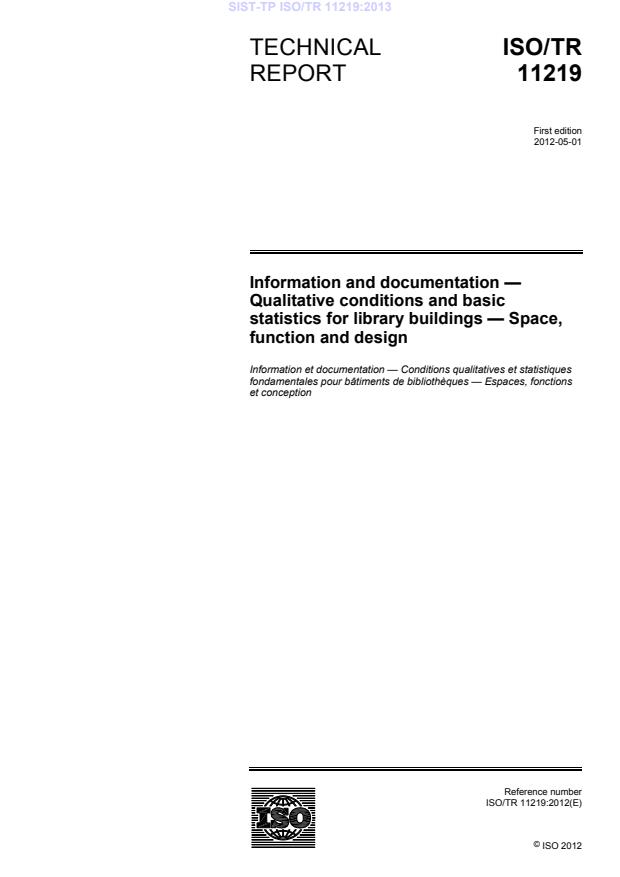
TECHNICAL ISO/TR
REPORT 11219
First edition
2012-05-01
Information and documentation —
Qualitative conditions and basic
statistics for library buildings — Space,
function and design
Information et documentation — Conditions qualitatives et statistiques
fondamentales pour bâtiments de bibliothèques — Espaces, fonctions
et conception
Reference number
©
ISO 2012
© ISO 2012
All rights reserved. Unless otherwise specified, no part of this publication may be reproduced or utilized in any form or by any means,
electronic or mechanical, including photocopying and microfilm, without permission in writing from either ISO at the address below or
ISO's member body in the country of the requester.
ISO copyright office
Case postale 56 CH-1211 Geneva 20
Tel. + 41 22 749 01 11
Fax + 41 22 749 09 47
E-mail copyright@iso.org
Web www.iso.org
Published in Switzerland
ii © ISO 2012 – All rights reserved
Contents Page
Foreword . vi
Introduction . vii
1 Scope . 1
2 Terms and definitions . 1
3 Planning library buildings . 13
3.1 First steps in planning . 13
3.2 Factors affecting library space requirements . 16
3.3 Special service areas . 19
3.4 Joint facilities . 27
4 Usable areas . 28
4.1 General . 28
4.2 Space for user places . 29
4.3 Space for events and exhibitions . 34
4.4 Space for lending . 35
4.5 Space for reference and information . 37
4.6 Space for other usage areas . 38
4.7 Space for collections . 40
4.8 Space for library staff . 66
4.9 Other spaces for library management and technical services . 69
5 Technical building issues . 76
5.1 Storage conditions . 76
5.2 Load assumption . 81
5.3 Conveyor systems . 85
5.4 Security and safety systems . 88
5.5 Light and lighting . 91
5.6 Acoustic conditions . 98
5.7 Floor construction and covering . 102
5.8 Wiring . 110
5.9 Sign system . 114
6 Outdoor space . 116
6.1 General . 116
6.2 Access . 116
6.3 Open spaces . 117
7 Barrier free construction . 118
7.1 General . 118
7.2 Measures for barrier free design . 118
7.3 Sign system . 119
7.4 Overview . 119
8 Sustainable building . 120
8.1 General . 120
8.2 Energy efficiency . 120
8.3 Conservation of natural resources . 121
Annex A (informative) Reconstruction and reorganisation of old buildings . 122
Annex B (informative) List of functional areas and rooms . 125
Bibliography . 129
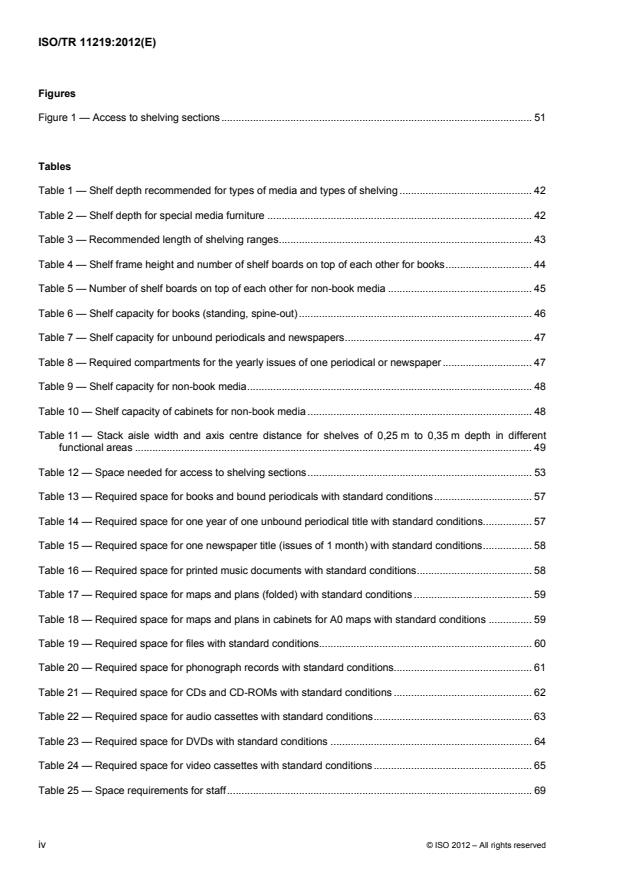
Figures
Figure 1 — Access to shelving sections . 51
Tables
Table 1 — Shelf depth recommended for types of media and types of shelving . 42
Table 2 — Shelf depth for special media furniture . 42
Table 3 — Recommended length of shelving ranges . 43
Table 4 — Shelf frame height and number of shelf boards on top of each other for books . 44
Table 5 — Number of shelf boards on top of each other for non-book media . 45
Table 6 — Shelf capacity for books (standing, spine-out) . 46
Table 7 — Shelf capacity for unbound periodicals and newspapers . 47
Table 8 — Required compartments for the yearly issues of one periodical or newspaper . 47
Table 9 — Shelf capacity for non-book media . 48
Table 10 — Shelf capacity of cabinets for non-book media . 48
Table 11 — Stack aisle width and axis centre distance for shelves of 0,25 m to 0,35 m depth in different
functional areas . 49
Table 12 — Space needed for access to shelving sections . 53
Table 13 — Required space for books and bound periodicals with standard conditions . 57
Table 14 — Required space for one year of one unbound periodical title with standard conditions. 57
Table 15 — Required space for one newspaper title (issues of 1 month) with standard conditions . 58
Table 16 — Required space for printed music documents with standard conditions . 58
Table 17 — Required space for maps and plans (folded) with standard conditions . 59
Table 18 — Required space for maps and plans in cabinets for A0 maps with standard conditions . 59
Table 19 — Required space for files with standard conditions. 60
Table 20 — Required space for phonograph records with standard conditions. 61
Table 21 — Required space for CDs and CD-ROMs with standard conditions . 62
Table 22 — Required space for audio cassettes with standard conditions . 63
Table 23 — Required space for DVDs with standard conditions . 64
Table 24 — Required space for video cassettes with standard conditions . 65
Table 25 — Space requirements for staff . 69
iv © ISO 2012 – All rights reserved
Table 26 — Overview of live load (rounded) . 85
Table 27 — Fire extinguishing systems . 91
Table 28 — Recommended lighting levels for specified areas . 92
Table 29 — Advantages and disadvantages of the light sources most used in libraries . 97
Table 30 — Recommended acoustic comfort levels for functional areas . 100
Table 31 — Types of flooring . 104
Foreword
ISO (the International Organization for Standardization) is a worldwide federation of national standards bodies
(ISO member bodies). The work of preparing International Standards is normally carried out through ISO
technical committees. Each member body interested in a subject for which a technical committee has been
established has the right to be represented on that committee. International organizations, governmental and
non-governmental, in liaison with ISO, also take part in the work. ISO collaborates closely with the
International Electrotechnical Commission (IEC) on all matters of electrotechnical standardization.
International Standards are drafted in accordance with the rules given in the ISO/IEC Directives, Part 2.
The main task of technical committees is to prepare International Standards. Draft International Standards
adopted by the technical committees are circulated to the member bodies for voting. Publication as an
International Standard requires approval by at least 75 % of the member bodies casting a vote.
In exceptional circumstances, when a technical committee has collected data of a different kind from that
which is normally published as an International Standard (“state of the art”, for example), it may decide by a
simple majority vote of its participating members to publish a Technical Report. A Technical Report is entirely
informative in nature and does not have to be reviewed until the data it provides are considered to be no
longer valid or useful.
Attention is drawn to the possibility that some of the elements of this document may be the subject of patent
rights. ISO shall not be held responsible for identifying any or all such patent rights.
ISO/TR 11219 was prepared by Technical Committee ISO/TC 46, Information and documentation,
Subcommittee SC 8, Quality — Statistics and performance evaluation.
vi © ISO 2012 – All rights reserved
Introduction
This Technical Report provides guidance for the planning of library buildings by identifying requirements of
space and technical equipment. It supports decision making for librarians, architects and financing institutions.
This Technical Report considers planning, both for new buildings and for the reconstruction of existing library
buildings or the conversion of other buildings for library use.
In order to plan new or reconstructed buildings, libraries need reliable data that can help them to calculate
their space requirements and to define the respective technical building equipment for housing the collections,
as well as for offering adequate user areas and background areas for the internal library operations. Such
data are not yet available in International Standards.
This Technical Report includes data and specifications for all types of libraries, but especially for academic
and public libraries. Its main topics are space requirements for:
user areas (user places, reference and information services, lending services, user training, recreation
and communication areas, meeting and exhibition areas);
collection storage areas (including non-book materials);
library operations (media processing, bindery, computing and management).
This Technical Report also covers technical aspects like security and safety systems, floor loading, transport
systems, acoustic conditions, lighting systems and wiring and the issues of barrier-free construction and
sustainability.
Annex A gives an overview of issues to consider when planning to reconstruct or reorganize existing buildings
for library purposes. Annex B provides a list of functional areas and rooms to be used when checking the
completeness of the plans.
Several clauses of this Technical Report are partly based on References [13] and [18].
TECHNICAL REPORT ISO/TR 11219:2012(E)
Information and documentation — Qualitative conditions and
basic statistics for library buildings — Space, function and
design
1 Scope
This Technical Report specifies data for the planning of library buildings. It also provides guidance on the
selection of technical building equipment for the different functional areas of libraries.
This Technical Report is applicable to all types of libraries in all countries, but especially to academic and
public libraries.
It does not include details on national, regional or local regulations that can affect the planning of library
buildings.
2 Terms and definitions
For the purposes of this document, the following terms and definitions apply.
2.1
academic library
library whose primary function is to cover the information needs of learning and research
Note 1 to entry: This includes libraries of institutions of higher education and general research libraries.
2.2
accession order
arrangement of books or other documents on shelves in the chronological and numerical order of their
addition to a specific category or class, as opposed to an arrangement based entirely on a classification
system
Note 1 to entry: Antonym: classified shelving.
2.3
area for events
floor space for events and exhibitions with special technical requirements as to acoustics, lighting, darkening,
climate and catering
2.4
art lending library
department of a public library with collections of art books, works of art (e.g. pictures, sculptures) and
reproductions, commissioned to lend those books and objects for a specified time period to users
2.5
audiovisual media
documents in which sound and/or pictures are prominent, and which require the use of special equipment to
be viewed and/or heard
Note 1 to entry: This includes audio documents, pictures and films on different physical carriers.
Note 2 to entry: Adapted from ISO 2789:2006.
2.6
automated storage
ASRS
high-density storage facility with retrieving function of library materials, generally called Automated Storage
and Retrieval System (ASRS)
Note 1 to entry: Advantages of this kind of storage are the efficient use of space and the speed of retrieving and
returning of materials.
2.7
axis centre distance
distance between centres of repeated or similar objects
Note 1 to entry: Such objects can be constructional elements or furniture in a row. For shelves, the axis centre
distance is the distance from centre post to centre post of two parallel single-sided (single-faced) or double-sided (double-
faced) shelves.
2.8
barrier-free access
universal access
accessibility of the library to users with physical requirements other than those of the average user, e.g. as to
the height of shelves, tables and equipment or as to working places for visually impaired persons
2.9
bindery
book binding studio
in-house workshop in a library that performs binding and repair of physical media, especially the daily work
such as repairs, binding in urgent cases, production of brochures for the institution’s own publications, etc.
2.10
book drop
slot, chute, bin or box with a collection container to which materials borrowed from a library can be returned,
especially during hours when the library is closed
Note 1 to entry: Book drops can be free-standing (usually outside the walls of the library) or built into the circulation
desk or an exterior wall.
Note 2 to entry: Book drops are often linked to the library system and/or a transport system.
2.11
book transport system
conveyor transporting media from closed stacks to the check-out or user area and back again after check-in
2.12
carrel
work space for information users in the reader area which is shielded against its surroundings but not
completely closed
Note 1 to entry: In a carrel, working papers can be kept for continuous research.
Note 2 to entry: Adapted from ISO 5127:2001.
2 © ISO 2012 – All rights reserved
2.13
cartographic document
map
conventional representation, on a reduced scale, of concrete or abstract phenomena which can be localized in
space and time
Note 1 to entry: This includes documents such as two- and three-dimensional maps, globes, plans, topographic
models, tactile maps and aerial representations, but excludes atlases and any other cartographic documents in codex,
micro, audiovisual and electronic form.
Note 2 to entry: Adapted from ISO 2789:2006.
2.14
catalogue
ordered list or bibliographic retrieval system allowing access to data and addresses of documents in one or
several collections
Note 1 to entry: Catalogues are for the most part offered in the form of online catalogues accessible via terminal or
workstation. Older forms are catalogues in book form on shelves and card catalogues sorted in drawers of catalogue
cabinets.
Note 2 to entry: Adapted from ISO 5127:2001.
2.15
children’s library
public library area offering special collections and services for children up to 13 years
2.16
circulation space
space needed for access to the rooms, in-house traffic and evacuation of the building in case of need
Note to entry 1: This includes, for example, floor space of corridors, stairway space, lift shafts and traffic area for
vehicles.
Note to entry 2: Movement areas in rooms that belong to the usable area are excluded.
[DIN 277-1:2005-02]
2.17
citizens’ service
service point of the local administration offering easy access for citizens to administrative services (e.g.
renewing passports or driving licences, paying dog licence fees)
Note 1 to entry: The service point can be located in a library.
2.18
classified shelving
storage of media in the order of a subject classification
Note 1 to entry: Classified shelving is usually applied in open-access stacks.
Note 2 to entry: Antonym: accession order (2.2).
2.19
closed stacks
stacks that are not accessible to users
Note 1 to entry: Antonym: open stacks (2.58).
2.20
compact shelving
shelves or cupboards which are movable on rails with manual or electric steerage and which can be moved
close to each other, thus maximizing the storage capacity of a given space
2.21
conservation
intervention techniques applied to prevent, arrest or delay deterioration
[ISO 5127:2001, definition 6.1.03]
2.22
cross-aisle
corridor or passageway that intersects at a 90-degree angle the shelving ranges and stack aisles in the stack
area of a library, allowing staff and users to move from one range to another without walking to the end of the
range
2.23
delivery entrance
entrance for the receipt or dispatch of library materials or other goods or for the pick-up of waste materials
2.24
desk sharing
policy for minimizing the floor space required for office rooms by which two or more persons share a desk and
equipment, especially useful when allocating background space for staff mainly working in contact with users
2.25
double-faced shelf
double-sided shelf
shelving unit with shelf boards on both long sides
2.26
ductwork
system of ducts for ventilation or the conveyance of liquids, gases, electricity, etc.
2.27
electronic collection
all resources in electronic form in the library collection
Note 1 to entry: The electronic collection includes databases, electronic serials and digital documents such as eBooks,
electronic patents and networked audiovisual documents.
Note 2 to entry: Adapted from ISO 2789:2006.
2.28
exhibition
time-limited display of objects, organized or co-organized by the library
Note 1 to entry: Exhibitions can take place inside or outside the library premises.
2.29
file
dossier
organized unit of documents grouped together either for current use by the creator or in the process of
archival arrangement, because they relate to the same subject, activity or transaction
Note 1 to entry: Adapted from ISO 5127:2001.
4 © ISO 2012 – All rights reserved
2.30
frontal display
face-out
method of displaying media face forward, especially in public libraries, which requires considerably more shelf
area
Note 1 to entry: Antonym: spine-out (2.87).
2.31
functional space
part of the gross floor area that houses the central operational equipment of a building
Note 1 to entry: This includes, for instance, sewage disposal, heating, conveyor technique.
2.32
gross floor area
sum of all floor areas of all levels of a building
Note 1 to entry: This includes the usable area, circulation space, functional space and space occupied by the
constructional elements of the building (pillars, walls, etc.).
2.33
group study place
workplace for joint studying by several users
Note 1 to entry: These places are usually constructed in a way that their use does not materially affect the other users.
2.34
inside width
distance between the inside margins of an object, without taking account of the marginal parts themselves
2.35
interactive spaces
spaces in buildings where ICT (Information and Communication Technology) is integrated in the furniture (e.g.
tables) and in the walls
2.36
interlibrary lending
loan of a document in its physical form or delivery of a document, or part of it, in copied form, from one library
to another which is not under the same administration
Note 1 to entry: Adapted from ISO 2789:2006.
2.37
IT-workplace
workplace equipped with information technology (personal computer, terminal or multimedia equipment, etc.)
2.38
kinderbox
special furniture for presenting large books (picture books, comics) or other media in frontal display
2.39
learning centre
information commons
library service area specially dedicated to learning purposes
Note 1 to entry: Usually, a learning centre integrates library and computer application services, in most cases with a
wireless network, equipment for multimedia use and support services for users by librarians and/or IT specialists.
Note 2 to entry: A learning centre can be a separate facility, inside or outside the library, or an integral part of the
library.
2.40
lending area
library service area for supplying and returning books and other media for loan
2.41
lending library
circulating library
library that offers collections for loan outside the library
2.42
library
organization, or part of an organization, the main aim of which is to facilitate the use of such information
resources, services and facilities as are required to meet the informational, research, educational, cultural or
recreational needs of its users
Note 1 to entry: The supply of the required information resources can be accomplished by building and maintaining a
collection and/or by organizing access to information resources.
Note 2 to entry: These are the basic requirements for a library and do not exclude any additional resources and
services incidental to its main purpose.
Note 3 to entry: Adapted from ISO 2789:2006.
2.43
linear metre
measure of shelf space for the net space on a shelf, without supporting construction
2.44
live load
variable or movable load of a building unit
Note 1 to entry: This includes persons, equipment (e.g. shelving or compact shelving, inclusive of books and other
media), light partition panels without load, machines and snow.
2.45
loading bay
area at the side of a building where goods are loaded on and off delivery vehicles
2.46
loading ramp
inclined plane between two levels for the passage of delivery vehicles
2.47
loan desk
circulation desk
service point at which media are checked in and out of a library, usually a long counter located near the
entrance or exit with one or more working places for staff
2.48
lounge
meeting and waiting space for users, offering relaxed seating
Note 1 to entry: See also staff lounge (2.91).
2.49
main aisle
stack aisle that serves as access to a larger unit or shelving section, in a room
Note 1 to entry: A stack aisle does not necessarily meet the requirements for a traffic route.
6 © ISO 2012 – All rights reserved
2.50
media centre
library service area providing audiovisual and multimedia documents, equipment and services, staffed to
assist users in using these collections
2.51
microform
photographic document requiring magnification when used
Note 1 to entry: Microforms are to be used with adequate reading devices. Special reader printers allow re-magnifying
of minimized texts and printing on paper.
Note 2 to entry: Adapted from ISO 5127:2001.
2.52
movement area
free area between storage areas or walls
Note 1 to entry: This includes the space which is necessary for usage or operation in front of equipment and functional
areas. Additionally, it includes space for doors that open into the room. Mandatory safety clearance is not included.
2.53
multimedia document
document combining different information media, text, graphics, photos, video, audio for interactive use, in
digital format
Note 1 to entry: Multimedia documents can be available on physical carriers such as CDs (compact disks) or DVDs
(digital versatile disks) or as networked publications.
Note 2 to entry: Adapted from ISO 2789:2006.
2.54
multimedia workplace
workstation with special hardware and software for using multimedia documents
Note 1 to entry: The characteristics of such workplaces are high capacity computers and large screens, as a result of
the contents, presentation and combination of electronic media (e.g. moving pictures simultaneously with text and audio).
Where appropriate, these places can also be equipped with headphones.
2.55
multi-touch technology
type of interface allowing interactive data processing by touch or motion, equipped either with a touch-
sensitive surface and/or with motion sensors.
Note 1 to entry: Multi-touch interfaces can be small, as used in smartphones, or large, as used in multi-touch
collaboration walls.
2.56
music library
department of a public library with collections of materials on music and musicians, including sheet music,
recorded music (CDs, audiocassettes, records, etc.), discographies and music reference material, offering
lending services and user places for listening to music
2.57
non-book material
library materials that have physical form but are not bound in codex form like a book, e.g. autographs, maps,
plans, microforms, audiovisual documents, games or pictures
Note 1 to entry: Electronic media are excluded.
Note 2 to entry: Some of these media need special furniture for presentation or special equipment for using them, e.g.
tables for consulting maps, a reader printer, etc.
2.58
open stacks
stacks that are accessible to users
Note 1 to entry: Antonym: closed stacks (2.19).
2.59
pay machine
machine for the paying of fees and fines that should, if possible, be linked with the automated library system
2.60
periodical stand
piece of display furniture, often with sloping shelves, used in libraries to display current issues of periodicals
face out
Note 1 to entry: This is not as compact as conventional shelving but it is more accessible to users for browsing.
Note 2 to entry: The shelves or cupboards usually have separate compartments for each periodical; the cases can be
hinged to allow a limited number of back issues to be stored on a flat shelf behind it.
2.61
plan cabinet
plan case
cabinet for flat storage, where the items are stored horizontally
Note 1 to entry: Plan cabinets are usually metallic.
2.62
population to be served
number of individuals for whom the library is set up to provide its services and materials
Note 1 to entry: For public libraries, this will normally be the population of the legal service area (authority); for libraries
of an institution of higher education, this will normally be the total of academic and professional staff plus students.
Note 2 to entry: Adapted from ISO 11620:2008.
2.63
presentation area
user area that serves for presenting media in a user-friendly way, e.g. by frontal display
Note 1 to entry: This type of media presentation requires more floor space than conventional methods.
2.64
preservation
all measures taken, including financial and strategic decisions, to maintain the integrity and extend the life of
documents or collections
[ISO 5127:2001, definition 6.1.01]
2.65
printed music document
document, the essential content of which is a representation of music, normally by means of notes
Note 1 to entry: Printed music documents can be in sheet or codex form.
[ISO 2789:2006, definition 3.2.35]
8 © ISO 2012 – All rights reserved
2.66
public library
library that offers collections and services for the general public
Note 1 to entry: Public libraries serve the information needs of the whole population of a local or regional community,
with emphasis on both formal and individual education, literacy, life-long learning, creative development, cultural and
recreational activities.
2.67
reading room
room for using books and other media in the library, which can also contain open stacks
2.68
record
phonograph record
thin, flat disk, usually made of vinyl, impressed on one or both sides with a continuous spiral groove in which
audible sound is recorded
Note 1 to entry: As the disk revolves on a playback machine, called a record player, the groove causes a stylus to
vibrate, producing electrical impulses in a cartridge that can be amplified as sound. The most common playing speed is 33
1/3 rpm (long-playing).
2.69
reference and information area
library space for reference and information services, generally including a reference desk, a reference library
and workstations
2.70
restoration
actions taken to return a document which has suffered deterioration or damage as closely as practicable to its
original state
Note 1 to entry: In archival restoration, no attempt is made to recreate missing text, etc., and all restoration work is
kept clearly evident.
[ISO 5127:2001, definition 6.1.04]
2.71
RFID
radio-frequency identification
electrical transponder which stores information that can then be used to identify an item to which the
transponder is attached, similar to the way in which a bar code on a label stores information that can be used
to identify the item to which the label is attached
Note 1 to entry: In libraries, RFID techniques are used for the identification of media and library cards, especially for
checking loans. Using RFID for self-service checking requires exit gates with adequate equipment.
Note 2 to entry: Adapted from ISO 18185-4:2007.
2.72
security case
frame in which videos, CDs and cassettes are presented in their original cover in free-access areas, but are
protected by the frame, preventing usage
Note 1 to entry: The frame can only be opened by means of mechanic or electronic equipment at the circulation desk.
2.73
security system for media
system that, by electromagnetic or RFID-controlled protection, secures media against theft
Note 1 to entry: The media are each equipped with an adequate RFID chip or magnetic strip. An electronic alarm
system is installed at the exit of a library to detect the unauthorized removal of media.
2.74
self-service terminal
self-service machine for users that automatically registers the check-out or check-in of media in the automated
system via scanner or RFID technique
2.75
sheet music
printed music issued without covers, whether actually printed on single sheets (pages) or not
[ISO 5127:2001, definition 2.4.18]
2.76
shelf
set of thin, flat pieces of rigid material placed horizontally at right angles into a frame or wall, to hold books
and similar items
2.77
shelf board
single board in a shelf
2.78
shelf capacity
average number of media that will fit on a shelf board, depending on the width of the shelf from upright to
upright, the average depth (thickness) per item, and the portion of each shelf left empty to facilitate re-shelving
2.79
shelf depth
depth of a single shelf (board), but also depth of shelving in a rack or range of shelving
Note 1 to entry: Shelf depth can vary depending on the formats of the media to be stored.
2.80
shelf height
vertical distance between two shelves
Note 1 to entry: Adjustable shelving allows the distance to be altered to accommodate items of varying height.
Note 2 to entry: Average shelf height is one of the factors determining stack capacity.
2.81
shelving range
component of a library stack, consisting of a row of two or more sections of single- or double-faced fixed or
adjustable shelving, with common uprights or shelf supports between sections
Note 1 to entry: The row can be free-standing or assembled against a wall.
2.82
shelving section
block of several shelving ranges with stack aisles between the ranges
2.83
sign system
signage
signposting for the users’ orientation in the building, showing the way to the individual service areas of the
library
2.84
single-faced shelf
single-sided shelf
shelving unit with shelf boards only on one long side and therefore accessible only from one aisle face
10 © ISO 2012 – All rights reserved
2.85
sorting system
machine for automatic sorting of returned media, whose number of sorting categories depends on the capacity
of the sorting system
2.86
special library
independent library covering one discipline or particular field of knowledge or a special regional interest
Note 1 to entry: The term “special library” includes libraries primarily serving a specific category of users, or primarily
devoted to a specific form of document, or libraries sponsored by an organization to serve its own work-related objectives.
Note 2 to entry: Adapted from ISO 2789:2006.
2.87
spine-out
books displayed on a shelf with their spines facing the front, usually one alongside the other with a bookend at
the end of the row to keep them upright
Note 1 to entry: The shelving method is used in the stacks of most libraries because it allows the spine title and call
number on each volume to be seen at a glance.
Note 2 to entry: Antonym: frontal display (2.30).
2.88
stack aisle
path between two shelf ranges for the retrieving and shelving of library materials, trafficable for book trolleys
2.89
stack capacity
amount of material that can be contained in the stack area of a library, expressed as the total linear metres or
metres squared of available shelving, or the maximum number of volumes or other physical units that can be
accommodated, sometimes calculated by means of a formula
2.90
stacks
areas in a library that serve for storing books and other media
2.91
staff lounge
room or area in a library usually equipped with comfortable furniture and a kitchenette, where staff members
can go when they are not on duty to eat, relax on a break, or meet informally
2.92
storage library
library whose primary function is to store less-used material from other administrative units
Note 1 to entry: Storage libraries that are part of, or administrated by, another library (e.g. national or regional library)
are excluded.
Note 2 to entry: Libraries whose stock remains the possession of the storing libraries are excluded. The collections
and their use are counted with the proprietary libraries.
Note 3 to entry: Adapted from ISO 2789:2006.
2.93
storage space
space requirement of facilities in the floor plan
2.94
study booth
lockable room, usually with one user workplace and shelves
2.95
sustainability
state in which components of the ecosystem and their functions are maintained for the present and future
generations
Note 1 to entry: Sustainability is the goal of sustainable development and can result from the application of the
concept of sustainable development.
Note 2 to entry: In building construction, it relates to how the attributes of the activities, products or services used in
the construction work, or the use of the construction works, contribute to the maintenance of ecosystem components and
functions for future generations.
Note 3 to entry: While the challenge of sustainability is global, the strategies for sustainability in building construction
are local and differ in context and content from region to region.
Note 4 to entry: “Components of the ecosystem” includes plants and animals, as well as humans and their physical
environment. For humans, this includes a balancing of key elements of human needs: the economic, environmental, social
and cultural conditions for societies’ existence.
[ISO 15392:2008, definition 3.20]
2.96
training room
classroom
room with workstations or laptops and presentation technology, where a group supported by a moderator can
work practically (hands-on use) on a specified topic
2.97
undergraduate library
libraries that are established, supported and maintained by institutions of higher education to serve the
information and research needs of undergraduate students and the instructional requirements of the
undergraduate curriculum
Note 1 to entry: Undergraduate libraries are either operated as branch libraries or as independent administrative units.
2.98
usable area
part of the gross floor area which serves the main purpose of the building
Note 1 to entry: This includes space for user services (including areas for recreation and communication), materials
storage, library management and technical services, events, exhibitions and meetings, equipment areas, aisles, toilets and
janitorial areas, and all other space used for library resources and services.
Note 2 to entry: This excludes circulation areas (corridors, stairway space, lift sh
...
TECHNICAL ISO/TR
REPORT 11219
First edition
2012-05-01
Information and documentation —
Qualitative conditions and basic
statistics for library buildings — Space,
function and design
Information et documentation — Conditions qualitatives et statistiques
fondamentales pour bâtiments de bibliothèques — Espaces, fonctions
et conception
Reference number
©
ISO 2012
© ISO 2012
All rights reserved. Unless otherwise specified, no part of this publication may be reproduced or utilized in any form or by any means,
electronic or mechanical, including photocopying and microfilm, without permission in writing from either ISO at the address below or
ISO's member body in the country of the requester.
ISO copyright office
Case postale 56 CH-1211 Geneva 20
Tel. + 41 22 749 01 11
Fax + 41 22 749 09 47
E-mail copyright@iso.org
Web www.iso.org
Published in Switzerland
ii © ISO 2012 – All rights reserved
Contents Page
Foreword . vi
Introduction . vii
1 Scope . 1
2 Terms and definitions . 1
3 Planning library buildings . 13
3.1 First steps in planning . 13
3.2 Factors affecting library space requirements . 16
3.3 Special service areas . 19
3.4 Joint facilities . 27
4 Usable areas . 28
4.1 General . 28
4.2 Space for user places . 29
4.3 Space for events and exhibitions . 34
4.4 Space for lending . 35
4.5 Space for reference and information . 37
4.6 Space for other usage areas . 38
4.7 Space for collections . 40
4.8 Space for library staff . 66
4.9 Other spaces for library management and technical services . 69
5 Technical building issues . 76
5.1 Storage conditions . 76
5.2 Load assumption . 81
5.3 Conveyor systems . 85
5.4 Security and safety systems . 88
5.5 Light and lighting . 91
5.6 Acoustic conditions . 98
5.7 Floor construction and covering . 102
5.8 Wiring . 110
5.9 Sign system . 114
6 Outdoor space . 116
6.1 General . 116
6.2 Access . 116
6.3 Open spaces . 117
7 Barrier free construction . 118
7.1 General . 118
7.2 Measures for barrier free design . 118
7.3 Sign system . 119
7.4 Overview . 119
8 Sustainable building . 120
8.1 General . 120
8.2 Energy efficiency . 120
8.3 Conservation of natural resources . 121
Annex A (informative) Reconstruction and reorganisation of old buildings . 122
Annex B (informative) List of functional areas and rooms . 125
Bibliography . 129
Figures
Figure 1 — Access to shelving sections . 51
Tables
Table 1 — Shelf depth recommended for types of media and types of shelving . 42
Table 2 — Shelf depth for special media furniture . 42
Table 3 — Recommended length of shelving ranges . 43
Table 4 — Shelf frame height and number of shelf boards on top of each other for books . 44
Table 5 — Number of shelf boards on top of each other for non-book media . 45
Table 6 — Shelf capacity for books (standing, spine-out) . 46
Table 7 — Shelf capacity for unbound periodicals and newspapers . 47
Table 8 — Required compartments for the yearly issues of one periodical or newspaper . 47
Table 9 — Shelf capacity for non-book media . 48
Table 10 — Shelf capacity of cabinets for non-book media . 48
Table 11 — Stack aisle width and axis centre distance for shelves of 0,25 m to 0,35 m depth in different
functional areas . 49
Table 12 — Space needed for access to shelving sections . 53
Table 13 — Required space for books and bound periodicals with standard conditions . 57
Table 14 — Required space for one year of one unbound periodical title with standard conditions. 57
Table 15 — Required space for one newspaper title (issues of 1 month) with standard conditions . 58
Table 16 — Required space for printed music documents with standard conditions . 58
Table 17 — Required space for maps and plans (folded) with standard conditions . 59
Table 18 — Required space for maps and plans in cabinets for A0 maps with standard conditions . 59
Table 19 — Required space for files with standard conditions. 60
Table 20 — Required space for phonograph records with standard conditions. 61
Table 21 — Required space for CDs and CD-ROMs with standard conditions . 62
Table 22 — Required space for audio cassettes with standard conditions . 63
Table 23 — Required space for DVDs with standard conditions . 64
Table 24 — Required space for video cassettes with standard conditions . 65
Table 25 — Space requirements for staff . 69
iv © ISO 2012 – All rights reserved
Table 26 — Overview of live load (rounded) . 85
Table 27 — Fire extinguishing systems . 91
Table 28 — Recommended lighting levels for specified areas . 92
Table 29 — Advantages and disadvantages of the light sources most used in libraries . 97
Table 30 — Recommended acoustic comfort levels for functional areas . 100
Table 31 — Types of flooring . 104
Foreword
ISO (the International Organization for Standardization) is a worldwide federation of national standards bodies
(ISO member bodies). The work of preparing International Standards is normally carried out through ISO
technical committees. Each member body interested in a subject for which a technical committee has been
established has the right to be represented on that committee. International organizations, governmental and
non-governmental, in liaison with ISO, also take part in the work. ISO collaborates closely with the
International Electrotechnical Commission (IEC) on all matters of electrotechnical standardization.
International Standards are drafted in accordance with the rules given in the ISO/IEC Directives, Part 2.
The main task of technical committees is to prepare International Standards. Draft International Standards
adopted by the technical committees are circulated to the member bodies for voting. Publication as an
International Standard requires approval by at least 75 % of the member bodies casting a vote.
In exceptional circumstances, when a technical committee has collected data of a different kind from that
which is normally published as an International Standard (“state of the art”, for example), it may decide by a
simple majority vote of its participating members to publish a Technical Report. A Technical Report is entirely
informative in nature and does not have to be reviewed until the data it provides are considered to be no
longer valid or useful.
Attention is drawn to the possibility that some of the elements of this document may be the subject of patent
rights. ISO shall not be held responsible for identifying any or all such patent rights.
ISO/TR 11219 was prepared by Technical Committee ISO/TC 46, Information and documentation,
Subcommittee SC 8, Quality — Statistics and performance evaluation.
vi © ISO 2012 – All rights reserved
Introduction
This Technical Report provides guidance for the planning of library buildings by identifying requirements of
space and technical equipment. It supports decision making for librarians, architects and financing institutions.
This Technical Report considers planning, both for new buildings and for the reconstruction of existing library
buildings or the conversion of other buildings for library use.
In order to plan new or reconstructed buildings, libraries need reliable data that can help them to calculate
their space requirements and to define the respective technical building equipment for housing the collections,
as well as for offering adequate user areas and background areas for the internal library operations. Such
data are not yet available in International Standards.
This Technical Report includes data and specifications for all types of libraries, but especially for academic
and public libraries. Its main topics are space requirements for:
user areas (user places, reference and information services, lending services, user training, recreation
and communication areas, meeting and exhibition areas);
collection storage areas (including non-book materials);
library operations (media processing, bindery, computing and management).
This Technical Report also covers technical aspects like security and safety systems, floor loading, transport
systems, acoustic conditions, lighting systems and wiring and the issues of barrier-free construction and
sustainability.
Annex A gives an overview of issues to consider when planning to reconstruct or reorganize existing buildings
for library purposes. Annex B provides a list of functional areas and rooms to be used when checking the
completeness of the plans.
Several clauses of this Technical Report are partly based on References [13] and [18].
TECHNICAL REPORT ISO/TR 11219:2012(E)
Information and documentation — Qualitative conditions and
basic statistics for library buildings — Space, function and
design
1 Scope
This Technical Report specifies data for the planning of library buildings. It also provides guidance on the
selection of technical building equipment for the different functional areas of libraries.
This Technical Report is applicable to all types of libraries in all countries, but especially to academic and
public libraries.
It does not include details on national, regional or local regulations that can affect the planning of library
buildings.
2 Terms and definitions
For the purposes of this document, the following terms and definitions apply.
2.1
academic library
library whose primary function is to cover the information needs of learning and research
Note 1 to entry: This includes libraries of institutions of higher education and general research libraries.
2.2
accession order
arrangement of books or other documents on shelves in the chronological and numerical order of their
addition to a specific category or class, as opposed to an arrangement based entirely on a classification
system
Note 1 to entry: Antonym: classified shelving.
2.3
area for events
floor space for events and exhibitions with special technical requirements as to acoustics, lighting, darkening,
climate and catering
2.4
art lending library
department of a public library with collections of art books, works of art (e.g. pictures, sculptures) and
reproductions, commissioned to lend those books and objects for a specified time period to users
2.5
audiovisual media
documents in which sound and/or pictures are prominent, and which require the use of special equipment to
be viewed and/or heard
Note 1 to entry: This includes audio documents, pictures and films on different physical carriers.
Note 2 to entry: Adapted from ISO 2789:2006.
2.6
automated storage
ASRS
high-density storage facility with retrieving function of library materials, generally called Automated Storage
and Retrieval System (ASRS)
Note 1 to entry: Advantages of this kind of storage are the efficient use of space and the speed of retrieving and
returning of materials.
2.7
axis centre distance
distance between centres of repeated or similar objects
Note 1 to entry: Such objects can be constructional elements or furniture in a row. For shelves, the axis centre
distance is the distance from centre post to centre post of two parallel single-sided (single-faced) or double-sided (double-
faced) shelves.
2.8
barrier-free access
universal access
accessibility of the library to users with physical requirements other than those of the average user, e.g. as to
the height of shelves, tables and equipment or as to working places for visually impaired persons
2.9
bindery
book binding studio
in-house workshop in a library that performs binding and repair of physical media, especially the daily work
such as repairs, binding in urgent cases, production of brochures for the institution’s own publications, etc.
2.10
book drop
slot, chute, bin or box with a collection container to which materials borrowed from a library can be returned,
especially during hours when the library is closed
Note 1 to entry: Book drops can be free-standing (usually outside the walls of the library) or built into the circulation
desk or an exterior wall.
Note 2 to entry: Book drops are often linked to the library system and/or a transport system.
2.11
book transport system
conveyor transporting media from closed stacks to the check-out or user area and back again after check-in
2.12
carrel
work space for information users in the reader area which is shielded against its surroundings but not
completely closed
Note 1 to entry: In a carrel, working papers can be kept for continuous research.
Note 2 to entry: Adapted from ISO 5127:2001.
2 © ISO 2012 – All rights reserved
2.13
cartographic document
map
conventional representation, on a reduced scale, of concrete or abstract phenomena which can be localized in
space and time
Note 1 to entry: This includes documents such as two- and three-dimensional maps, globes, plans, topographic
models, tactile maps and aerial representations, but excludes atlases and any other cartographic documents in codex,
micro, audiovisual and electronic form.
Note 2 to entry: Adapted from ISO 2789:2006.
2.14
catalogue
ordered list or bibliographic retrieval system allowing access to data and addresses of documents in one or
several collections
Note 1 to entry: Catalogues are for the most part offered in the form of online catalogues accessible via terminal or
workstation. Older forms are catalogues in book form on shelves and card catalogues sorted in drawers of catalogue
cabinets.
Note 2 to entry: Adapted from ISO 5127:2001.
2.15
children’s library
public library area offering special collections and services for children up to 13 years
2.16
circulation space
space needed for access to the rooms, in-house traffic and evacuation of the building in case of need
Note to entry 1: This includes, for example, floor space of corridors, stairway space, lift shafts and traffic area for
vehicles.
Note to entry 2: Movement areas in rooms that belong to the usable area are excluded.
[DIN 277-1:2005-02]
2.17
citizens’ service
service point of the local administration offering easy access for citizens to administrative services (e.g.
renewing passports or driving licences, paying dog licence fees)
Note 1 to entry: The service point can be located in a library.
2.18
classified shelving
storage of media in the order of a subject classification
Note 1 to entry: Classified shelving is usually applied in open-access stacks.
Note 2 to entry: Antonym: accession order (2.2).
2.19
closed stacks
stacks that are not accessible to users
Note 1 to entry: Antonym: open stacks (2.58).
2.20
compact shelving
shelves or cupboards which are movable on rails with manual or electric steerage and which can be moved
close to each other, thus maximizing the storage capacity of a given space
2.21
conservation
intervention techniques applied to prevent, arrest or delay deterioration
[ISO 5127:2001, definition 6.1.03]
2.22
cross-aisle
corridor or passageway that intersects at a 90-degree angle the shelving ranges and stack aisles in the stack
area of a library, allowing staff and users to move from one range to another without walking to the end of the
range
2.23
delivery entrance
entrance for the receipt or dispatch of library materials or other goods or for the pick-up of waste materials
2.24
desk sharing
policy for minimizing the floor space required for office rooms by which two or more persons share a desk and
equipment, especially useful when allocating background space for staff mainly working in contact with users
2.25
double-faced shelf
double-sided shelf
shelving unit with shelf boards on both long sides
2.26
ductwork
system of ducts for ventilation or the conveyance of liquids, gases, electricity, etc.
2.27
electronic collection
all resources in electronic form in the library collection
Note 1 to entry: The electronic collection includes databases, electronic serials and digital documents such as eBooks,
electronic patents and networked audiovisual documents.
Note 2 to entry: Adapted from ISO 2789:2006.
2.28
exhibition
time-limited display of objects, organized or co-organized by the library
Note 1 to entry: Exhibitions can take place inside or outside the library premises.
2.29
file
dossier
organized unit of documents grouped together either for current use by the creator or in the process of
archival arrangement, because they relate to the same subject, activity or transaction
Note 1 to entry: Adapted from ISO 5127:2001.
4 © ISO 2012 – All rights reserved
2.30
frontal display
face-out
method of displaying media face forward, especially in public libraries, which requires considerably more shelf
area
Note 1 to entry: Antonym: spine-out (2.87).
2.31
functional space
part of the gross floor area that houses the central operational equipment of a building
Note 1 to entry: This includes, for instance, sewage disposal, heating, conveyor technique.
2.32
gross floor area
sum of all floor areas of all levels of a building
Note 1 to entry: This includes the usable area, circulation space, functional space and space occupied by the
constructional elements of the building (pillars, walls, etc.).
2.33
group study place
workplace for joint studying by several users
Note 1 to entry: These places are usually constructed in a way that their use does not materially affect the other users.
2.34
inside width
distance between the inside margins of an object, without taking account of the marginal parts themselves
2.35
interactive spaces
spaces in buildings where ICT (Information and Communication Technology) is integrated in the furniture (e.g.
tables) and in the walls
2.36
interlibrary lending
loan of a document in its physical form or delivery of a document, or part of it, in copied form, from one library
to another which is not under the same administration
Note 1 to entry: Adapted from ISO 2789:2006.
2.37
IT-workplace
workplace equipped with information technology (personal computer, terminal or multimedia equipment, etc.)
2.38
kinderbox
special furniture for presenting large books (picture books, comics) or other media in frontal display
2.39
learning centre
information commons
library service area specially dedicated to learning purposes
Note 1 to entry: Usually, a learning centre integrates library and computer application services, in most cases with a
wireless network, equipment for multimedia use and support services for users by librarians and/or IT specialists.
Note 2 to entry: A learning centre can be a separate facility, inside or outside the library, or an integral part of the
library.
2.40
lending area
library service area for supplying and returning books and other media for loan
2.41
lending library
circulating library
library that offers collections for loan outside the library
2.42
library
organization, or part of an organization, the main aim of which is to facilitate the use of such information
resources, services and facilities as are required to meet the informational, research, educational, cultural or
recreational needs of its users
Note 1 to entry: The supply of the required information resources can be accomplished by building and maintaining a
collection and/or by organizing access to information resources.
Note 2 to entry: These are the basic requirements for a library and do not exclude any additional resources and
services incidental to its main purpose.
Note 3 to entry: Adapted from ISO 2789:2006.
2.43
linear metre
measure of shelf space for the net space on a shelf, without supporting construction
2.44
live load
variable or movable load of a building unit
Note 1 to entry: This includes persons, equipment (e.g. shelving or compact shelving, inclusive of books and other
media), light partition panels without load, machines and snow.
2.45
loading bay
area at the side of a building where goods are loaded on and off delivery vehicles
2.46
loading ramp
inclined plane between two levels for the passage of delivery vehicles
2.47
loan desk
circulation desk
service point at which media are checked in and out of a library, usually a long counter located near the
entrance or exit with one or more working places for staff
2.48
lounge
meeting and waiting space for users, offering relaxed seating
Note 1 to entry: See also staff lounge (2.91).
2.49
main aisle
stack aisle that serves as access to a larger unit or shelving section, in a room
Note 1 to entry: A stack aisle does not necessarily meet the requirements for a traffic route.
6 © ISO 2012 – All rights reserved
2.50
media centre
library service area providing audiovisual and multimedia documents, equipment and services, staffed to
assist users in using these collections
2.51
microform
photographic document requiring magnification when used
Note 1 to entry: Microforms are to be used with adequate reading devices. Special reader printers allow re-magnifying
of minimized texts and printing on paper.
Note 2 to entry: Adapted from ISO 5127:2001.
2.52
movement area
free area between storage areas or walls
Note 1 to entry: This includes the space which is necessary for usage or operation in front of equipment and functional
areas. Additionally, it includes space for doors that open into the room. Mandatory safety clearance is not included.
2.53
multimedia document
document combining different information media, text, graphics, photos, video, audio for interactive use, in
digital format
Note 1 to entry: Multimedia documents can be available on physical carriers such as CDs (compact disks) or DVDs
(digital versatile disks) or as networked publications.
Note 2 to entry: Adapted from ISO 2789:2006.
2.54
multimedia workplace
workstation with special hardware and software for using multimedia documents
Note 1 to entry: The characteristics of such workplaces are high capacity computers and large screens, as a result of
the contents, presentation and combination of electronic media (e.g. moving pictures simultaneously with text and audio).
Where appropriate, these places can also be equipped with headphones.
2.55
multi-touch technology
type of interface allowing interactive data processing by touch or motion, equipped either with a touch-
sensitive surface and/or with motion sensors.
Note 1 to entry: Multi-touch interfaces can be small, as used in smartphones, or large, as used in multi-touch
collaboration walls.
2.56
music library
department of a public library with collections of materials on music and musicians, including sheet music,
recorded music (CDs, audiocassettes, records, etc.), discographies and music reference material, offering
lending services and user places for listening to music
2.57
non-book material
library materials that have physical form but are not bound in codex form like a book, e.g. autographs, maps,
plans, microforms, audiovisual documents, games or pictures
Note 1 to entry: Electronic media are excluded.
Note 2 to entry: Some of these media need special furniture for presentation or special equipment for using them, e.g.
tables for consulting maps, a reader printer, etc.
2.58
open stacks
stacks that are accessible to users
Note 1 to entry: Antonym: closed stacks (2.19).
2.59
pay machine
machine for the paying of fees and fines that should, if possible, be linked with the automated library system
2.60
periodical stand
piece of display furniture, often with sloping shelves, used in libraries to display current issues of periodicals
face out
Note 1 to entry: This is not as compact as conventional shelving but it is more accessible to users for browsing.
Note 2 to entry: The shelves or cupboards usually have separate compartments for each periodical; the cases can be
hinged to allow a limited number of back issues to be stored on a flat shelf behind it.
2.61
plan cabinet
plan case
cabinet for flat storage, where the items are stored horizontally
Note 1 to entry: Plan cabinets are usually metallic.
2.62
population to be served
number of individuals for whom the library is set up to provide its services and materials
Note 1 to entry: For public libraries, this will normally be the population of the legal service area (authority); for libraries
of an institution of higher education, this will normally be the total of academic and professional staff plus students.
Note 2 to entry: Adapted from ISO 11620:2008.
2.63
presentation area
user area that serves for presenting media in a user-friendly way, e.g. by frontal display
Note 1 to entry: This type of media presentation requires more floor space than conventional methods.
2.64
preservation
all measures taken, including financial and strategic decisions, to maintain the integrity and extend the life of
documents or collections
[ISO 5127:2001, definition 6.1.01]
2.65
printed music document
document, the essential content of which is a representation of music, normally by means of notes
Note 1 to entry: Printed music documents can be in sheet or codex form.
[ISO 2789:2006, definition 3.2.35]
8 © ISO 2012 – All rights reserved
2.66
public library
library that offers collections and services for the general public
Note 1 to entry: Public libraries serve the information needs of the whole population of a local or regional community,
with emphasis on both formal and individual education, literacy, life-long learning, creative development, cultural and
recreational activities.
2.67
reading room
room for using books and other media in the library, which can also contain open stacks
2.68
record
phonograph record
thin, flat disk, usually made of vinyl, impressed on one or both sides with a continuous spiral groove in which
audible sound is recorded
Note 1 to entry: As the disk revolves on a playback machine, called a record player, the groove causes a stylus to
vibrate, producing electrical impulses in a cartridge that can be amplified as sound. The most common playing speed is 33
1/3 rpm (long-playing).
2.69
reference and information area
library space for reference and information services, generally including a reference desk, a reference library
and workstations
2.70
restoration
actions taken to return a document which has suffered deterioration or damage as closely as practicable to its
original state
Note 1 to entry: In archival restoration, no attempt is made to recreate missing text, etc., and all restoration work is
kept clearly evident.
[ISO 5127:2001, definition 6.1.04]
2.71
RFID
radio-frequency identification
electrical transponder which stores information that can then be used to identify an item to which the
transponder is attached, similar to the way in which a bar code on a label stores information that can be used
to identify the item to which the label is attached
Note 1 to entry: In libraries, RFID techniques are used for the identification of media and library cards, especially for
checking loans. Using RFID for self-service checking requires exit gates with adequate equipment.
Note 2 to entry: Adapted from ISO 18185-4:2007.
2.72
security case
frame in which videos, CDs and cassettes are presented in their original cover in free-access areas, but are
protected by the frame, preventing usage
Note 1 to entry: The frame can only be opened by means of mechanic or electronic equipment at the circulation desk.
2.73
security system for media
system that, by electromagnetic or RFID-controlled protection, secures media against theft
Note 1 to entry: The media are each equipped with an adequate RFID chip or magnetic strip. An electronic alarm
system is installed at the exit of a library to detect the unauthorized removal of media.
2.74
self-service terminal
self-service machine for users that automatically registers the check-out or check-in of media in the automated
system via scanner or RFID technique
2.75
sheet music
printed music issued without covers, whether actually printed on single sheets (pages) or not
[ISO 5127:2001, definition 2.4.18]
2.76
shelf
set of thin, flat pieces of rigid material placed horizontally at right angles into a frame or wall, to hold books
and similar items
2.77
shelf board
single board in a shelf
2.78
shelf capacity
average number of media that will fit on a shelf board, depending on the width of the shelf from upright to
upright, the average depth (thickness) per item, and the portion of each shelf left empty to facilitate re-shelving
2.79
shelf depth
depth of a single shelf (board), but also depth of shelving in a rack or range of shelving
Note 1 to entry: Shelf depth can vary depending on the formats of the media to be stored.
2.80
shelf height
vertical distance between two shelves
Note 1 to entry: Adjustable shelving allows the distance to be altered to accommodate items of varying height.
Note 2 to entry: Average shelf height is one of the factors determining stack capacity.
2.81
shelving range
component of a library stack, consisting of a row of two or more sections of single- or double-faced fixed or
adjustable shelving, with common uprights or shelf supports between sections
Note 1 to entry: The row can be free-standing or assembled against a wall.
2.82
shelving section
block of several shelving ranges with stack aisles between the ranges
2.83
sign system
signage
signposting for the users’ orientation in the building, showing the way to the individual service areas of the
library
2.84
single-faced shelf
single-sided shelf
shelving unit with shelf boards only on one long side and therefore accessible only from one aisle face
10 © ISO 2012 – All rights reserved
2.85
sorting system
machine for automatic sorting of returned media, whose number of sorting categories depends on the capacity
of the sorting system
2.86
special library
independent library covering one discipline or particular field of knowledge or a special regional interest
Note 1 to entry: The term “special library” includes libraries primarily serving a specific category of users, or primarily
devoted to a specific form of document, or libraries sponsored by an organization to serve its own work-related objectives.
Note 2 to entry: Adapted from ISO 2789:2006.
2.87
spine-out
books displayed on a shelf with their spines facing the front, usually one alongside the other with a bookend at
the end of the row to keep them upright
Note 1 to entry: The shelving method is used in the stacks of most libraries because it allows the spine title and call
number on each volume to be seen at a glance.
Note 2 to entry: Antonym: frontal display (2.30).
2.88
stack aisle
path between two shelf ranges for the retrieving and shelving of library materials, trafficable for book trolleys
2.89
stack capacity
amount of material that can be contained in the stack area of a library, expressed as the total linear metres or
metres squared of available shelving, or the maximum number of volumes or other physical units that can be
accommodated, sometimes calculated by means of a formula
2.90
stacks
areas in a library that serve for storing books and other media
2.91
staff lounge
room or area in a library usually equipped with comfortable furniture and a kitchenette, where staff members
can go when they are not on duty to eat, relax on a break, or meet informally
2.92
storage library
library whose primary function is to store less-used material from other administrative units
Note 1 to entry: Storage libraries that are part of, or administrated by, another library (e.g. national or regional library)
are excluded.
Note 2 to entry: Libraries whose stock remains the possession of the storing libraries are excluded. The collections
and their use are counted with the proprietary libraries.
Note 3 to entry: Adapted from ISO 2789:2006.
2.93
storage space
space requirement of facilities in the floor plan
2.94
study booth
lockable room, usually with one user workplace and shelves
2.95
sustainability
state in which components of the ecosystem and their functions are maintained for the present and future
generations
Note 1 to entry: Sustainability is the goal of sustainable development and can result from the application of the
concept of sustainable development.
Note 2 to entry: In building construction, it relates to how the attributes of the activities, products or services used in
the construction work, or the use of the construction works, contribute to the maintenance of ecosystem components and
functions for future generations.
Note 3 to entry: While the challenge of sustainability is global, the strategies for sustainability in building construction
are local and differ in context and content from region to region.
Note 4 to entry: “Components of the ecosystem” includes plants and animals, as well as humans and their physical
environment. For humans, this includes a balancing of key elements of human needs: the economic, environmental, social
and cultural conditions for societies’ existence.
[ISO 15392:2008, definition 3.20]
2.96
training room
classroom
room with workstations or laptops and presentation technology, where a group supported by a moderator can
work practically (hands-on use) on a specified topic
2.97
undergraduate library
libraries that are established, supported and maintained by institutions of higher education to serve the
information and research needs of undergraduate students and the instructional requirements of the
undergraduate curriculum
Note 1 to entry: Undergraduate libraries are either operated as branch libraries or as independent administrative units.
2.98
usable area
part of the gross floor area which serves the main purpose of the building
Note 1 to entry: This includes space for user services (including areas for recreation and communication), materials
storage, library management and technical services, events, exhibitions and meetings, equipment areas, aisles, toilets and
janitorial areas, and all other space used for library resources and services.
Note 2 to entry: This excludes circulation areas (corridors, stairway space, lift shafts and traffic area for vehicles).
Note 3 to entry: This excludes the functional space that houses the central operational equipment of a building (e.g.
sewage disposal, heating, conveyor technique).
2.99
user place
place provided for users for reading or studying, whether with or without seating or equipment
Note 1 to entry: This includes places in carrels, in seminar and study rooms and the audiovisual and children's
departments of the library, also places for relaxed seating of various types.
Note 2 to entry: This excludes seats in halls, lecture and auditory theatres intended for audiences of special events. It
also excludes floor space and cushions on which users can sit.
Note 3 to entry: Adapted from ISO 2789:2006
12 © ISO 2012 – All rights reserved
2.100
user service area
part of the library that is accessible to users
Note 1 to entry: This includes space for reading, studying, information delivery, and any other services delivered to
users, as well as open-access storage areas as integrated parts of user service areas, media centres, workplaces for staff
in these areas, and exhibition areas.
2.101
visually impaired
person whose sight makes using library materials in conventional formats difficult, if not impossible
2.102
workplace for blind and visually impaired persons
workplace with special equipment that allows persons with reading difficulties to unde
...