

ISO 16461:2018
(Main)Intelligent transport systems — Criteria for privacy and integrity protection in probe vehicle information systems
General Information
- Abstract
This document specifies the basic rules to be considered by service providers handling privacy in probe vehicle information services. This document is aimed at protecting the privacy as well as the intrinsic rights and interests of the probe data subjects specified in ISO 24100:2010. This document specifies the following items related to probe vehicle systems (PVS), i.e. systems collecting probe data from private vehicles and processing these probe data statistically towards useful information that can be provided to various end users: — architecture of the PVS in support of appropriate protection of data integrity and anonymity in the PVS; — security criteria and requirements for the PVS, specifically requirements for data integrity protection and privacy; — requirements for correct and anonymous generation and handling of probe data.
- Status
- Published
- Publication Date
- 18-Jul-2018
- Technical Committee
- ISO/TC 204 - Intelligent transport systems
- Drafting Committee
- ISO/TC 204/WG 16 - Communications
- Current Stage
- 9060 - Close of review
- Completion Date
- 04-Mar-2029


Overview
ISO 16461:2018 - "Intelligent transport systems - Criteria for privacy and integrity protection in probe vehicle information systems" - defines basic rules and evaluation criteria for protecting privacy and data integrity in systems that collect and process vehicle probe data. The standard targets probe vehicle systems (PVS) that gather sensor and location-derived probe data from private vehicles, process them statistically, and deliver traffic or mobility information to third‑party services and end users. ISO 16461:2018 emphasizes protecting the intrinsic rights and interests of data subjects referenced in ISO 24100:2010.
Key Topics and Technical Requirements
- Reference architecture & context model: extends the ISO 22837:2009 probe message model to include the full probe package (payload + communication/authentication data) and the functional elements in vehicle and land‑based centres required for privacy and integrity protection.
- Privacy evaluation framework: organized into families of privacy-relevant requirements (FPR), including:
- Anonymity (FPR_ANO)
- Pseudonymity (FPR_PSE)
- Unlinkability (FPR_UNL)
- Unobservability (FPR_UNO)
- Integrity requirements: covers protection of exported target-of-evaluation security functionality (FPT_ITI) and data integrity across probe creation, transfer and processing.
- Lifecycle requirements for probe data:
- Raw sensor data processing (RSDP) - conversion of sensor outputs to probe data.
- Probe data retention and processed data retention - rules for storing and protecting intermediate and final datasets.
- Probe message / package creation, reception and processing - requirements for correct, anonymous generation and handling of messages and packages.
- Security criteria: authentication, integrity protection, and interfaces that enable privacy-preserving acquisition and statistical processing of probe data.
Applications and Who Uses It
ISO 16461:2018 is practical for:
- ITS architects and system integrators designing privacy-aware probe vehicle information systems
- Vehicle OEMs and telematics providers implementing onboard data collection and anonymization
- Mobility service providers and traffic data aggregators handling probe data transfer, storage and analytics
- IT/security teams specifying integrity and authentication controls for probe pipelines
- Regulators and privacy officers assessing compliance with privacy principles in transport data services
Related Standards
- ISO 22837:2009 - Vehicle probe data for wide area communications (reference architecture for probe messages)
- ISO 24100:2010 - Vocabulary for ITS (data subject rights and terminology)
- Other ITS and data protection standards (refer to normative references in ISO 16461:2018)
This standard helps organizations implement privacy-preserving probe data flows and robust data integrity controls across intelligent transport systems.
Get Certified
Connect with accredited certification bodies for this standard

BSI Group
BSI (British Standards Institution) is the business standards company that helps organizations make excellence a habit.

Great Wall Tianjin Quality Assurance Center
Established 1993, first batch to receive national accreditation with IAF recognition.
Hong Kong Quality Assurance Agency (HKQAA)
Hong Kong's leading certification body.
Sponsored listings
Frequently Asked Questions
ISO 16461:2018 is a standard published by the International Organization for Standardization (ISO). Its full title is "Intelligent transport systems — Criteria for privacy and integrity protection in probe vehicle information systems". This standard covers: This document specifies the basic rules to be considered by service providers handling privacy in probe vehicle information services. This document is aimed at protecting the privacy as well as the intrinsic rights and interests of the probe data subjects specified in ISO 24100:2010. This document specifies the following items related to probe vehicle systems (PVS), i.e. systems collecting probe data from private vehicles and processing these probe data statistically towards useful information that can be provided to various end users: — architecture of the PVS in support of appropriate protection of data integrity and anonymity in the PVS; — security criteria and requirements for the PVS, specifically requirements for data integrity protection and privacy; — requirements for correct and anonymous generation and handling of probe data.
This document specifies the basic rules to be considered by service providers handling privacy in probe vehicle information services. This document is aimed at protecting the privacy as well as the intrinsic rights and interests of the probe data subjects specified in ISO 24100:2010. This document specifies the following items related to probe vehicle systems (PVS), i.e. systems collecting probe data from private vehicles and processing these probe data statistically towards useful information that can be provided to various end users: — architecture of the PVS in support of appropriate protection of data integrity and anonymity in the PVS; — security criteria and requirements for the PVS, specifically requirements for data integrity protection and privacy; — requirements for correct and anonymous generation and handling of probe data.
ISO 16461:2018 is classified under the following ICS (International Classification for Standards) categories: 03.220.01 - Transport in general; 35.240.60 - IT applications in transport. The ICS classification helps identify the subject area and facilitates finding related standards.
ISO 16461:2018 is available in PDF format for immediate download after purchase. The document can be added to your cart and obtained through the secure checkout process. Digital delivery ensures instant access to the complete standard document.
Standards Content (Sample)
INTERNATIONAL ISO
STANDARD 16461
First edition
2018-08
Intelligent transport systems —
Criteria for privacy and integrity
protection in probe vehicle
information systems
Systèmes intelligents de transport — Critères de confidentialité et de
protection d'intégrité
Reference number
©
ISO 2018
© ISO 2018
All rights reserved. Unless otherwise specified, or required in the context of its implementation, no part of this publication may
be reproduced or utilized otherwise in any form or by any means, electronic or mechanical, including photocopying, or posting
on the internet or an intranet, without prior written permission. Permission can be requested from either ISO at the address
below or ISO’s member body in the country of the requester.
ISO copyright office
CP 401 • Ch. de Blandonnet 8
CH-1214 Vernier, Geneva
Phone: +41 22 749 01 11
Fax: +41 22 749 09 47
Email: copyright@iso.org
Website: www.iso.org
Published in Switzerland
ii © ISO 2018 – All rights reserved
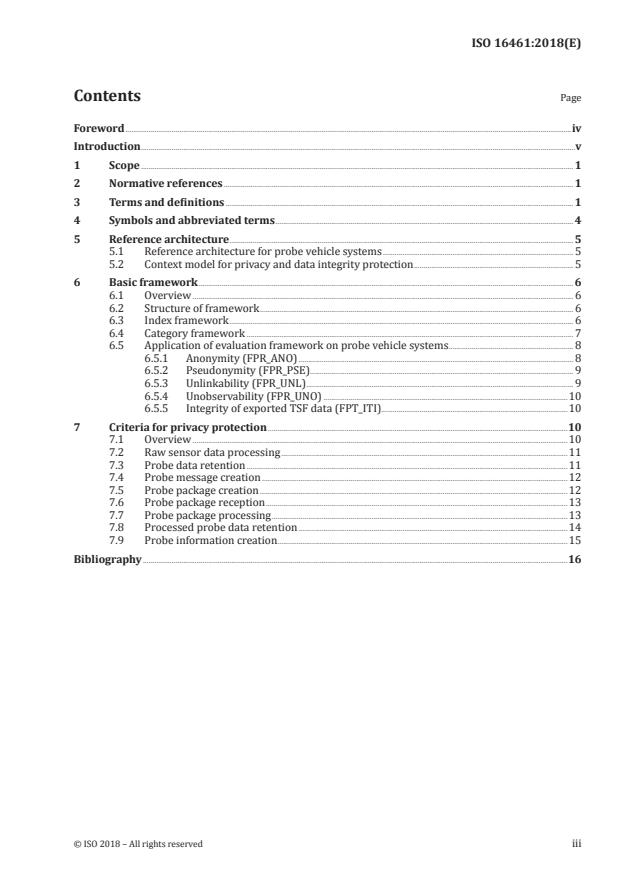
Contents Page
Foreword .iv
Introduction .v
1 Scope . 1
2 Normative references . 1
3 Terms and definitions . 1
4 Symbols and abbreviated terms . 4
5 Reference architecture . 5
5.1 Reference architecture for probe vehicle systems . 5
5.2 Context model for privacy and data integrity protection . 5
6 Basic framework . 6
6.1 Overview . 6
6.2 Structure of framework . 6
6.3 Index framework . 6
6.4 Category framework . 7
6.5 Application of evaluation framework on probe vehicle systems . 8
6.5.1 Anonymity (FPR_ANO) . 8
6.5.2 Pseudonymity (FPR_PSE) . 9
6.5.3 Unlinkability (FPR_UNL) . 9
6.5.4 Unobservability (FPR_UNO) .10
6.5.5 Integrity of exported TSF data (FPT_ITI).10
7 Criteria for privacy protection .10
7.1 Overview .10
7.2 Raw sensor data processing .11
7.3 Probe data retention .11
7.4 Probe message creation .12
7.5 Probe package creation .12
7.6 Probe package reception .13
7.7 Probe package processing .13
7.8 Processed probe data retention .14
7.9 Probe information creation .15
Bibliography .16
Foreword
ISO (the International Organization for Standardization) is a worldwide federation of national standards
bodies (ISO member bodies). The work of preparing International Standards is normally carried out
through ISO technical committees. Each member body interested in a subject for which a technical
committee has been established has the right to be represented on that committee. International
organizations, governmental and non-governmental, in liaison with ISO, also take part in the work.
ISO collaborates closely with the International Electrotechnical Commission (IEC) on all matters of
electrotechnical standardization.
The procedures used to develop this document and those intended for its further maintenance are
described in the ISO/IEC Directives, Part 1. In particular the different approval criteria needed for the
different types of ISO documents should be noted. This document was drafted in accordance with the
editorial rules of the ISO/IEC Directives, Part 2 (see www .iso .org/directives).
Attention is drawn to the possibility that some of the elements of this document may be the subject of
patent rights. ISO shall not be held responsible for identifying any or all such patent rights. Details of
any patent rights identified during the development of the document will be in the Introduction and/or
on the ISO list of patent declarations received (see www .iso .org/patents).
Any trade name used in this document is information given for the convenience of users and does not
constitute an endorsement.
For an explanation on the voluntary nature of standards, the meaning of ISO specific terms and
expressions related to conformity assessment, as well as information about ISO's adherence to the
World Trade Organization (WTO) principles in the Technical Barriers to Trade (TBT) see the following
URL: www .iso .org/iso/foreword .html.
This document was prepared by Technical Committee ISO/TC 204, Intelligent transport systems.
iv © ISO 2018 – All rights reserved
Introduction
More and more attention has been paid to safety, comfort, mitigation of impact on the environment, and
energy efficiency in transport systems. The use of probe data specified in ISO 22837:2009 is considered
to be a key factor of a solution for the above issues. Usage of probe data in probe vehicle systems (PVS),
defined in ISO 22837:2009, may be subject to privacy regulations. Consequently, there is a need for
protective measures and policies in PVS.
It is necessary to develop a basic concept for protecting privacy and integrity being gathered in the
PVS so that transmission of probe data can be done without violating the privacy regulations. This
document defines criteria for protection of the anonymity and integrity of probe data.
The following topics are addressed in this document:
— definition of security and privacy requirements for probe vehicle systems;
— specification of a common interface ensuring privacy and integrity in probe vehicle information
acquisition;
— definition of a scheme for protecting probe vehicle systems in terms of integrity and privacy.
INTERNATIONAL STANDARD ISO 16461:2018(E)
Intelligent transport systems — Criteria for privacy and
integrity protection in probe vehicle information systems
1 Scope
This document specifies the basic rules to be considered by service providers handling privacy in probe
vehicle information services. This document is aimed at protecting the privacy as well as the intrinsic
rights and interests of the probe data subjects specified in ISO 24100:2010.
This document specifies the following items related to probe vehicle systems (PVS), i.e. systems
collecting probe data from private vehicles and processing these probe data statistically towards useful
information that can be provided to various end users:
— architecture of the PVS in support of appropriate protection of data integrity and anonymity in
the PVS;
— security criteria and requirements for the PVS, specifically requirements for data integrity
protection and privacy;
— requirements for correct and anonymous generation and handling of probe data.
2 Normative references
The following documents are referred to in the text in such a way that some or all of their content
constitutes requirements of this document. For dated references, only the edition cited applies. For
undated references, the latest edition of the referenced document (including any amendments) applies.
ISO 22837:2009, Vehicle probe data for wide area communications
3 Terms and definitions
For the purposes of this document, the terms and definitions given in ISO 22837:2009 and the
following apply.
ISO and IEC maintain terminological databases for use in standardization at the following addresses:
— IEC Electropedia: available at http: //www .electropedia .org/
— ISO Online browsing platform: available at https: //www .iso .org/obp
3.1
authentication
proving or showing to be true, genuine, or valid
3.2
probe data
vehicle sensor information, formatted as probe data elements and/or probe messages, that is processed,
formatted, and transmitted to a land-based centre for processing to create a good understanding of the
driving environment
[SOURCE: ISO 22837:2009, 4.3]
3.3
probe data collector
function that receives probe messages from vehicles and creates probe information by fusing and
analysing probe messages and supplementary data from other data sources
3.4
probe data element
data item included in a probe message
[SOURCE: ISO 22837:2009, 4.4]
3.5
probe data retention
function which receives and stores probe data after they were processed by the raw sensor data
processing
3.6
probe information
information extracted from probe messages and data from other sources through the probe information
creation function
3.7
probe information application/service
entity that acts upon the received probe information and supplementary information into data input or
other action commands into the probe application or service
3.8
probe information creation
function which creates probe information from the probe data stored in processed probe message
retention according to a set of predefined rules and formats
3.9
probe information processing
function which receives probe information from the transmit probe information reception function,
and converts the received information into suitable formats for various probe information applications/
services, and then sends them to a processed probe information retention function for further
processing
3.10
probe information receiver
function which receives the probe information transmitted from a probe message collector and
provides probe information application/services
3.11
probe message
structured collation of data elements suitable for being delivered to the on-board communication
device for transmission to a land-based centre
[SOURCE: ISO 22837:2009, 4.6, modified — “to be” was changed to "for being" and the NOTE was
deleted.]
3.12
probe message creation
function which creates a probe message from probe data stored in probe data retention
3.13
probe message processing
function which receives probe messages from probe package reception and processes them so that they
are suitable to combine other data from various sources
2 © ISO 2018 – All rights reserved
3.14
probe package creation
function which arranges the probe data into packages (i.e. probe packages) for transferring to probe
data collector
Note 1 to entry: The following Figure illustrates a model for probe package (defined in ISO 24100:2010)
3.15
probe package reception
function which receives the probe packages transmitted by the probe package creation, extracts the
probe payload by excluding the probe header information and sends the probe payload to the probe
message processing
3.16
probe package transfer
function which transfers probe packages between a vehicle and a probe data collector through a
predefined communication channel
3.17
probe PDU creation
function which converts probe information into protocol data unit (PDU) format, including header and
payload, and is ready to be transmitted by probe information transfer function (undefined)
Note 1 to entry: Note to entry: A protocol data unit (PDU) is information that is transmitted as a single unit
among peer entities of a communication network.
3.18
probe PDU reception
function which receives the probe PDUs transmitted from transmit probe information creation,
extracts the probe information, and sends it to the probe information processing
3.19
probe PDU transfer
function which transfers probe PDU packets between a probe data collector and a probe information
receiver
3.20
probe vehicle system
PVS
system consisting of vehicles, which collects and transmits probe data, and land-based centres, which
collate and process data from many vehicles to build an accurate understanding of the overall roadway
and driving environment
[SOURCE: ISO 22837:2009, 4.1]
3.21
processed probe information retention
function which receives a probe information from probe information processing function and stores it
in the probe information retention
Note 1 to entry: Information from other sources may be stored as long as they are converted to a format
compatible with processed probe information.
3.22
processed probe message retention
function which stores the received probe messages systematically
3.23
raw sensor data
data produced by vehicle sensors and sent without further processing to the on-board data collection
system or to on-board applications, as appropriate
[SOURCE: ISO 22837:2009, E.3.3]
3.24
raw sensor data processing
data processing that receives raw sensor data from various vehicle sensors and converts them to probe
data and sends to probe data retention
3.25
vehicle sensor
device within a vehicle that senses conditions inside and/or outside the vehicle, or that detects actions
that the driver takes
[SOURCE: ISO 22837:2009, 4.2]
4 Symbols and abbreviated terms
FPR Family Privacy Relevant
FPR_ANO Anonymity FPR
FPR_PSE Pseudonymity FPR
FPR_UNL Unlinkability FPR
FPR_UNO Unobservability FPR
FPT_ITI Integrity of exported TSF FPR
ID Identifier
IP Internet Protocol
IT Information Technology
PDR Probe Data Retention
PIC Probe Information Creation
PKI Public Key Infrastructure
PMC Probe Message Creation
PMP Probe Message Processing
4 © ISO 2018 – All rights reserved
PPC Probe Package Creation
PPDR Processed Probe Data Retention
PPR Probe Package Reception
RSDP Raw Sensor Data Processing
TSF Target of evaluation Security Functionality
5 Reference architecture
5.1 Reference architecture for probe vehicle systems
The reference architecture for probe vehicle systems presents the initial categorization of system
components and the relationships among them from a conceptual viewpoint.
The reference architecture defined in ISO 22837:2009 shall form the basis for the reference architecture
in this document. The definition in ISO 22837:2009 pertains only to probe messages. This document
concerns all the data (probe package) transmitted from probe data senders to probe data collectors.
In addition to the probe message, a probe package includes data for effecting communication, such as
for authentication. In order to discuss the data in a probe package, it is necessary to have a reference
architecture that includes all the related concepts. The basis of this reference architecture is defined
in ISO 22837:2009. In order to define criteria for privacy and integrity protection, functional elements
within a vehicle and a probe data collector are necessary. For this purpose, a context model for probe
vehicle systems is defined in this document. The context model presents details of the general reference
architecture.
5.2 Context model for privacy and data integrity protection
Figure 1 presents the context model for privacy and data integrity protection in probe vehicle systems.
Figure 1 — Context model for privacy and data integrity protection
Figure 1 illustrates processing steps (functions) starting with raw sensor data processing in the vehicle,
and ending with processed probe information retention in the probe information receiver.
6 Basic framework
6.1 Overview
In this clause, the framework for the criterion for the privacy protection of the probe vehicle system is
presented.
6.2 Structure of framework
The basic criteria framework is illustrate
...