

ISO/IEC 22592-2:2024
(Main)Office equipment — Print quality measurement methods for colour prints — Part 2: Registration and magnification accuracy
General Information
- Abstract
This document specifies test methods as well as test charts to measure the geometric property attributes and those variations in duplex colour prints typically used in office environment. This document is applicable to duplex prints comprising several sheets which are printed colour images on both surfaces of a substrate. “Within-page variation” and “sheet-to-sheet variation” are also applicable for a simplex print set comprising several sheets, which are printed colour images on one surface of a substrate and no image on the other surface. Prints with four primary colourants other than cyan, magenta, yellow and black are outside the scope of this document. Included are digital prints formed by using a multifunction or single function printer. When a duplex print set is evaluated, duplex printers which are capable to print images on both sides of substrate automatically are applicable, while simplex printers which require a manual arrangement of substrates between the front side and back side printing to form duplex prints are out of scope of this document. The printers of the maximum applicable substrate size of A4 or larger are suitable for the measurements. The geometric property attributes included are registration and magnification of a print set. Microscopic geometrical density variations, such as graininess, mottle and line raggedness, are outside the scope of this document. The sources of variations considered are locations in a page, print side in a sheet, print order of sheets in a print set, and variations among primary colours.
- Status
- Published
- Publication Date
- 25-Jan-2024
- Technical Committee
- ISO/IEC JTC 1/SC 28 - Office equipment
- Drafting Committee
- ISO/IEC JTC 1/SC 28 - Office equipment
- Current Stage
- 6060 - International Standard published
- Start Date
- 26-Jan-2024
- Due Date
- 28-Jan-2024
- Completion Date
- 26-Jan-2024


Overview
ISO/IEC 22592-2:2024 specifies standardized test methods and digital test charts to measure geometric print quality for colour duplex print sets typically produced in office environments. The standard focuses on registration accuracy (positional alignment of colourants) and magnification accuracy (scale fidelity of printed images) across pages, sides and sheets. It applies to automatic duplex printers (A4 or larger) using the four primary colourants Cyan, Magenta, Yellow, Black (CMYK) and RGB-scanned images. Microscopic density effects (graininess, mottle, line raggedness) and prints with additional light or non‑CMYK colourants are outside the scope.
Key topics and requirements
- Test charts and digital patterns: Defined colour codes (sRGB) and page locations for repeatable registration and magnification measurements.
- Measurement scope: Within‑page variation, side‑to‑side (front/back) variation, and sheet‑to‑sheet variation for duplex print sets; some methods apply to simplex sets.
- Scanner conformance: Procedures, goal values, and compensation methods to ensure the RGB scanner used for measurement provides reliable positional accuracy and local magnification performance.
- Measurement procedures: Detailed print preparation, environmental conditioning, scanning procedures, and calculation methods for:
- Per‑colour registration
- Colour‑to‑colour registration variation
- Magnification (absolute and inter‑colour differences)
- Reporting requirements: Standardized items and format for reporting measurement results to enable consistent comparisons.
- Informative annexes: Guidance on print flatness, scanner compensation procedures and sample test charts.
Practical applications and users
ISO/IEC 22592-2 is intended for organizations that need objective, repeatable assessment of geometric print quality, including:
- Printer and multifunction device manufacturers (R&D and production QA)
- Independent test labs and certification bodies
- Print service providers and office IT managers (acceptance testing, procurement comparators)
- Standards organizations and conformance test developers
- Software vendors that implement automated print quality analysis and scanner calibration
Practical use cases include product benchmarking, quality control, acceptance testing of duplex printers, calibration of scanner-based measurement systems, and procurement specifications that require consistent registration and magnification metrics.
Related standards
- ISO/IEC 22592-1 - Colour consistency (related part in the same series)
- ISO/IEC 22592-3 - Image stability (under development)
- ISO/IEC 19799, ISO/IEC 24790, ISO/IEC 29112 - Existing print/image quality methods (gloss, density uniformity, sharpness)
- IEC 61966-2-1 - sRGB colour space (referenced for test chart colour definitions)
Keywords: ISO/IEC 22592-2, print quality measurement, registration accuracy, magnification accuracy, duplex prints, CMYK, scanner conformance, test charts, within‑page variation, sheet‑to‑sheet variation.
Frequently Asked Questions
ISO/IEC 22592-2:2024 is a standard published by the International Organization for Standardization (ISO). Its full title is "Office equipment — Print quality measurement methods for colour prints — Part 2: Registration and magnification accuracy". This standard covers: This document specifies test methods as well as test charts to measure the geometric property attributes and those variations in duplex colour prints typically used in office environment. This document is applicable to duplex prints comprising several sheets which are printed colour images on both surfaces of a substrate. “Within-page variation” and “sheet-to-sheet variation” are also applicable for a simplex print set comprising several sheets, which are printed colour images on one surface of a substrate and no image on the other surface. Prints with four primary colourants other than cyan, magenta, yellow and black are outside the scope of this document. Included are digital prints formed by using a multifunction or single function printer. When a duplex print set is evaluated, duplex printers which are capable to print images on both sides of substrate automatically are applicable, while simplex printers which require a manual arrangement of substrates between the front side and back side printing to form duplex prints are out of scope of this document. The printers of the maximum applicable substrate size of A4 or larger are suitable for the measurements. The geometric property attributes included are registration and magnification of a print set. Microscopic geometrical density variations, such as graininess, mottle and line raggedness, are outside the scope of this document. The sources of variations considered are locations in a page, print side in a sheet, print order of sheets in a print set, and variations among primary colours.
This document specifies test methods as well as test charts to measure the geometric property attributes and those variations in duplex colour prints typically used in office environment. This document is applicable to duplex prints comprising several sheets which are printed colour images on both surfaces of a substrate. “Within-page variation” and “sheet-to-sheet variation” are also applicable for a simplex print set comprising several sheets, which are printed colour images on one surface of a substrate and no image on the other surface. Prints with four primary colourants other than cyan, magenta, yellow and black are outside the scope of this document. Included are digital prints formed by using a multifunction or single function printer. When a duplex print set is evaluated, duplex printers which are capable to print images on both sides of substrate automatically are applicable, while simplex printers which require a manual arrangement of substrates between the front side and back side printing to form duplex prints are out of scope of this document. The printers of the maximum applicable substrate size of A4 or larger are suitable for the measurements. The geometric property attributes included are registration and magnification of a print set. Microscopic geometrical density variations, such as graininess, mottle and line raggedness, are outside the scope of this document. The sources of variations considered are locations in a page, print side in a sheet, print order of sheets in a print set, and variations among primary colours.
ISO/IEC 22592-2:2024 is classified under the following ICS (International Classification for Standards) categories: 37.100.10 - Reproduction equipment. The ICS classification helps identify the subject area and facilitates finding related standards.
ISO/IEC 22592-2:2024 is available in PDF format for immediate download after purchase. The document can be added to your cart and obtained through the secure checkout process. Digital delivery ensures instant access to the complete standard document.
Standards Content (Sample)
International
Standard
ISO/IEC 22592-2
First edition
Office equipment — Print quality
2024-01
measurement methods for colour
prints —
Part 2:
Registration and magnification
accuracy
Reference number
© ISO/IEC 2024
All rights reserved. Unless otherwise specified, or required in the context of its implementation, no part of this publication may
be reproduced or utilized otherwise in any form or by any means, electronic or mechanical, including photocopying, or posting on
the internet or an intranet, without prior written permission. Permission can be requested from either ISO at the address below
or ISO’s member body in the country of the requester.
ISO copyright office
CP 401 • Ch. de Blandonnet 8
CH-1214 Vernier, Geneva
Phone: +41 22 749 01 11
Email: copyright@iso.org
Website: www.iso.org
Published in Switzerland
© ISO/IEC 2024 – All rights reserved
ii
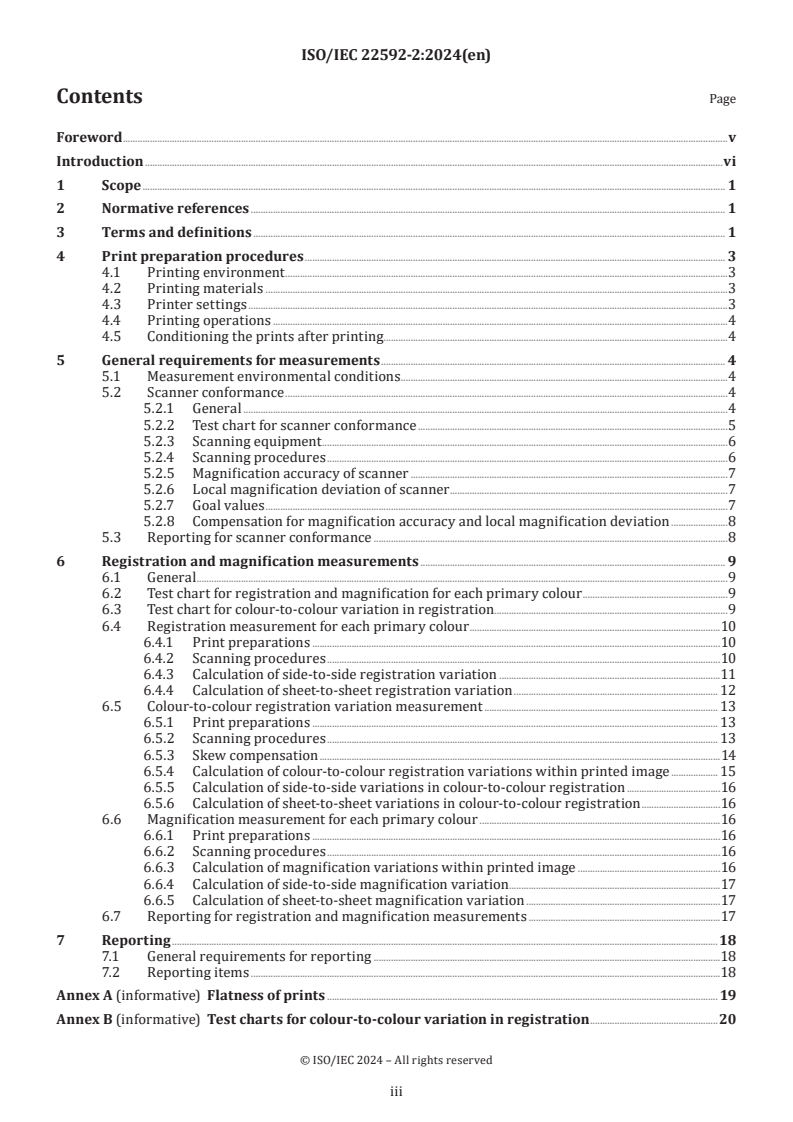
Contents Page
Foreword .v
Introduction .vi
1 Scope .1
2 Normative references .1
3 Terms and definitions .1
4 Print preparation procedures .3
4.1 Printing environment .3
4.2 Printing materials .3
4.3 Printer settings .3
4.4 Printing operations .4
4.5 Conditioning the prints after printing.4
5 General requirements for measurements . 4
5.1 Measurement environmental conditions .4
5.2 Scanner conformance .4
5.2.1 General .4
5.2.2 Test chart for scanner conformance .5
5.2.3 Scanning equipment .6
5.2.4 Scanning procedures .6
5.2.5 Magnification accuracy of scanner .7
5.2.6 Local magnification deviation of scanner .7
5.2.7 Goal values .7
5.2.8 Compensation for magnification accuracy and local magnification deviation .8
5.3 Reporting for scanner conformance .8
6 Registration and magnification measurements . 9
6.1 General .9
6.2 Test chart for registration and magnification for each primary colour .9
6.3 Test chart for colour-to-colour variation in registration .9
6.4 Registration measurement for each primary colour .10
6.4.1 Print preparations .10
6.4.2 Scanning procedures .10
6.4.3 Calculation of side-to-side registration variation .11
6.4.4 Calculation of sheet-to-sheet registration variation . 12
6.5 Colour-to-colour registration variation measurement . 13
6.5.1 Print preparations . 13
6.5.2 Scanning procedures . 13
6.5.3 Skew compensation .14
6.5.4 Calculation of colour-to-colour registration variations within printed image . 15
6.5.5 Calculation of side-to-side variations in colour-to-colour registration .16
6.5.6 Calculation of sheet-to-sheet variations in colour-to-colour registration .16
6.6 Magnification measurement for each primary colour .16
6.6.1 Print preparations .16
6.6.2 Scanning procedures .16
6.6.3 Calculation of magnification variations within printed image .16
6.6.4 Calculation of side-to-side magnification variation.17
6.6.5 Calculation of sheet-to-sheet magnification variation .17
6.7 Reporting for registration and magnification measurements .17
7 Reporting .18
7.1 General requirements for reporting .18
7.2 Reporting items .18
Annex A (informative) Flatness of prints . 19
Annex B (informative) Test charts for colour-to-colour variation in registration .20
© ISO/IEC 2024 – All rights reserved
iii
Annex C (normative) Compensation procedure for scanner conformance .21
Annex D (informative) Examples of local magnification measurement on flat bet scanning
systems .24
Bibliography .30
© ISO/IEC 2024 – All rights reserved
iv
Foreword
ISO (the International Organization for Standardization) and IEC (the International Electrotechnical
Commission) form the specialized system for worldwide standardization. National bodies that are
members of ISO or IEC participate in the development of International Standards through technical
committees established by the respective organization to deal with particular fields of technical activity.
ISO and IEC technical committees collaborate in fields of mutual interest. Other international organizations,
governmental and non-governmental, in liaison with ISO and IEC, also take part in the work.
The procedures used to develop this document and those intended for its further maintenance are described
in the ISO/IEC Directives, Part 1. In particular, the different approval criteria needed for the different types
of document should be noted. This document was drafted in accordance with the editorial rules of the ISO/
IEC Directives, Part 2 (see www.iso.org/directives or www.iec.ch/members_experts/refdocs).
ISO and IEC draw attention to the possibility that the implementation of this document may involve the
use of (a) patent(s). ISO and IEC take no position concerning the evidence, validity or applicability of any
claimed patent rights in respect thereof. As of the date of publication of this document, ISO and IEC had not
received notice of (a) patent(s) which may be required to implement this document. However, implementers
are cautioned that this may not represent the latest information, which may be obtained from the patent
database available at www.iso.org/patents and https://patents.iec.ch. ISO and IEC shall not be held
responsible for identifying any or all such patent rights.
Any trade name used in this document is information given for the convenience of users and does not
constitute an endorsement.
For an explanation of the voluntary nature of standards, the meaning of ISO specific terms and expressions
related to conformity assessment, as well as information about ISO's adherence to the World Trade
Organization (WTO) principles in the Technical Barriers to Trade (TBT) see www.iso.org/iso/foreword.html.
In the IEC, see www.iec.ch/understanding-standards.
This document was prepared by Joint Technical Committee ISO/IEC JTC 1, Information technology,
Subcommittee SC 28, Office equipment.
A list of all parts in the ISO/IEC 22592 series can be found on the ISO and IEC websites.
Any feedback or questions on this document should be directed to the user’s national standards
body. A complete listing of these bodies can be found at www.iso.org/members.html and
www.iec.ch/national-committees.
© ISO/IEC 2024 – All rights reserved
v
Introduction
Measurement methods that quantitatively evaluate geometric property attributes of duplex print sets need
to be standardized, as most of the office documents are currently printed as duplex print sets comprising
several sheets printed colour images on both surface of substrates.
There are several standard measurement methods to evaluate image quality attributes of printed images
formed by office equipment, i.e. colour reproductions, line reproductions, image structures of sharpness and
graininess, gloss properties. Included are ISO/IEC 19799, ISO/IEC 24790 and ISO/IEC 29112. ISO/IEC 24790
specifies the measurement methods for large area density uniformity of graininess, mottle and banding, as
well as line qualities. ISO/IEC 29112 specifies methods for measuring sharpness attributes of edge blurriness
and raggedness, special frequency response, etc. ISO/IEC 19799 specifies the methods for gloss uniformity.
By utilizing those documents, users can obtain consistent test results when they comply with the protocols
specified in the documents.
While there are no standard methods to measure colour reproduction consistencies and geometrical
accuracies in consecutive printing, and image stabilities in typical use case of print images formed by office
equipment and used in office environments. In the current state, each printer distributer and its user can
provide test results for those attributes measured by its own test methods and procedures, which are often
convenient for its product, resulting in misleading customers in the selection of a printing system suitable
for their use cases. The ISO/IEC 22592 series can provide standard methods and procedures for those print
image attributes: ISO/IEC 22592-1 for colour consistency, this document for geometrical accuracies, and
1)
ISO/IEC 22592-3 for image stabilities. By using these International Standards, consistent and comparable
test results suitable for typical use cases of office prints can be obtained independent of data providers.
The measurement methods described in this document are used to access geometric properties of a print
set formed by a printing system on a substrate. When test results are compared among various printing
systems, it is essential to use the same product of substrates and set equivalent printing conditions under
default printer settings among the printing systems.
As for the metrics for registration and magnification based on images captured by an RGB scanner,
prints with four primary colourants other than cyan, magenta, yellow and black are not suitable for the
measurement methods described in this document. For example, if a print includes a light colourant image of
a primary colour in addition to a standard colourant image, registration and magnification of this print will
not be measured correctly because the complementary colour channel of the primary in a scanned image of
the print includes two kinds of sources for registration and magnification.
Electrophotography, thermal inkjet, or piezoelectric inkjet technologies are commonly used to form such
prints. The main purpose of this document is to provide objective measurement methods for geometric
property attributes of duplex print sets, however, some attributes are also applicable for a set of simplex
prints.
This document prescribes the following:
— digital test charts for the measurements in which colour codes and locations in page to be measured are
specified,
— a test chart to measure the positional accuracy of a scanner,
— conformance requirements for the positional accuracy of a scanner to utilize registration and
magnification measurements,
— measurement methods relating to the registration including accuracy of printed positions to substrate
for each colour and printed position variations among colours,
— measurement methods relating to the magnification including absolute magnitude of printed size to
input and relative difference in the magnitude among colours,
1) Under preparation. Stage at the time of publication: ISO/IEC DIS 22592-3:2023.
© ISO/IEC 2024 – All rights reserved
vi
— measurement methods for the variations of the registration and magnification within a page (within-
page variation), between front and back sides (side-to-side variation), among the sheets in the same print
set (sheet-to-sheet variations).
Some attributes, such as the attribute “within a printed image”, “sheet-to-sheet variations”, are also
applicable for a simplex print set comprising several sheets which are printed colour images on one surface
of a substrate and no image on the other surface.
Some prints show uneven surfaces caused by thermal fusing process of electrophotographic printers or
drying process in ink jet printers as well as by storage humidity changes from a highly humid condition
to dry condition. Flatness of a print surface is an important aspect for print integrity. On the other hand,
there is no proper measure standardized corresponding well with visual impression of flatness. Annex A
describes one of the methods to quantify degree of flatness. A further study needed to include this method
into the scope of this document.
In this document, colour codes for the test charts are defined in sRGB colour space specified in IEC 61966-2-1
as is common in office documents.
© ISO/IEC 2024 – All rights reserved
vii
International Standard ISO/IEC 22592-2:2024(en)
Office equipment — Print quality measurement methods for
colour prints —
Part 2:
Registration and magnification accuracy
IMPORTANT — The electronic file of this document contains colours which are considered to be
useful for the correct understanding of this document. Users should therefore consider printing with
a colour printer.
1 Scope
This document specifies test methods as well as test charts to measure the geometric property attributes
and those variations in duplex colour prints typically used in office environment. This document is applicable
to duplex prints comprising several sheets which are printed colour images on both surfaces of a substrate.
“Within-page variation” and “sheet-to-sheet variation” are also applicable for a simplex print set comprising
several sheets, which are printed colour images on one surface of a substrate and no image on the other
surface.
Prints with four primary colourants other than cyan, magenta, yellow and black are outside the scope of this
document.
Included are digital prints formed by using a multifunction or single function printer. When a duplex print
set is evaluated, duplex printers which are capable to print images on both sides of substrate automatically
are applicable, while simplex printers which require a manual arrangement of substrates between the front
side and back side printing to form duplex prints are out of scope of this document. The printers of the
maximum applicable substrate size of A4 or larger are suitable for the measurements.
The geometric property attributes included are registration and magnification of a print set.
Microscopic geometrical density variations, such as graininess, mottle and line raggedness, are outside the
scope of this document.
The sources of variations considered are locations in a page, print side in a sheet, print order of sheets in a
print set, and variations among primary colours.
2 Normative references
There are no normative references in this document.
3 Terms and definitions
For the purposes of this document, the following terms and definitions apply.
ISO and IEC maintain terminology databases for use in standardization at the following addresses:
— ISO Online browsing platform: available at https:// www .iso .org/ obp
— IEC Electropedia: available at https:// www .electropedia .org/
© ISO/IEC 2024 – All rights reserved
3.1
back side
print side (3.9) corresponding to an even page of input data in a duplex print set (3.8)
3.2
cockle
local deformation of a sheet of print due to unequal shrinkage or swelling giving it a slightly crumpled
appearance
3.3
colour-to-colour variation
change in an attribute among the primary colours of the printer to evaluate
3.4
curl
deviation from a flat surface
3.5
fast scan direction
FSD
direction parallel to the sensor array of a scanner
3.6
front side
print side (3.9) corresponding to an odd page of input data in a duplex print set (3.8)
3.7
magnification
absolute magnitude of printed size to input
3.8
print set
set of sheets printed in a print operation
3.9
print side
one of the duplex print surfaces, either front side (3.6) or back side (3.1)
3.10
registration
accuracy of printed positions to substrate for each colour
3.11
slow scan direction
SSD
direction perpendicular to the sensor array of a scanner
3.12
sheet-to-sheet variation
change in an attribute at the same input data on the same print side (3.9), either the front side (3.6) or back
side (3.1), within a print set (3.8)
3.13
side-to-side variation
change in an attribute at the same input data in the same sheet between the front side (3.6) and back side
(3.1)
© ISO/IEC 2024 – All rights reserved
3.14
spots per inch
spi
spots per 25,4 mm
[SOURCE: ISO/IEC 24790:2017, 3.34]
3.15
within-page variation
change in an attribute by location within a page
3.16
waviness
geometrical distortion of the print, generally at high-density image area
4 Print preparation procedures
4.1 Printing environment
Printers shall be installed in the environment range of a temperature of (23 ± 5) °C, with a relative humidity
(RH) of (50 ± 10) % at least 2 h prior to print operations and the print operations shall be completed in the
same environment range. The substrate to be used shall be placed in a paper tray when the printers are
installed. Prior to the installation of printers, additional conditioning of papers under the same environment
for temperature and humidity described above for more than 24 h is recommended to stabilize the water
content of the papers which often affects image qualities of prints.
If a printer has not been used for a long period or if the environmental difference between storage and
evaluation area is large, it is recommended to install it 12 h prior to the test and to print 10 or more sheets
for warm up before the test.
4.2 Printing materials
An A4 size plain paper shall be used because it corresponds well with a typical usage case of office prints.
Coated papers for ink jet or lithography may be used for a specific usage case with a rational explanation
2 2
in reporting. The grammage of the paper shall be from 60 g/m to 90 g/m . Any other grammage for paper
may be used for a specific usage case with a rational explanation in reporting. The name, grammage and
supplier of the paper shall be reported.
It is recommended to measure the dimensions of the papers prior to tests and after printing.
Toner or ink materials recommended by the manufacturer of the printer to be tested shall be used. Any other
materials provided by the other suppliers than the printer manufacturer may be used as long as product
name and supplier are included in the report.
Any other printing materials, such as photoreceptors in electrophotographic printer, print head in ink
jet printer, shall be in accordance with the recommendations by the printer manufacturer. The printing
materials provided by the third-party suppliers may be used as long as product name and supplier are
included in the report.
4.3 Printer settings
No reduction or enlargement in printed size shall be made. Modifications in colour and tone reproduction,
sharpness enhancement, or noise reduction in the printer settings shall not be used. The printing mode by
which an input image is printed at the centre of a substrate shall be selected. No binding margin shall be
arranged.
Test prints shall be formed using driver and printer settings, except the parameters above mentioned,
that are appropriate for a typical usage case in office. Default settings for the substrate subjected to
evaluation, which correspond to initial settings when a printer shipped out recommended to be used. When
© ISO/IEC 2024 – All rights reserved
performances of printing systems are compared, the default settings for each printing system shall be
selected. The driver and printer settings used shall be described in the test report.
NOTE It is important to check if the size and position in a substrate are consistent. In some application viewers
or printer settings for PDF files, settings related to size modification or printed position in a substrate at the previous
print operation remain unchanged.
A4 size substrate shall be used. For the printers of the maximum applicable substrate size of A3 or larger,
the feed direction parallel to the short edge direction of A4 substrate shall be selected and the feed direction
perpendicular to the short edge direction of A4 substrate may optionally be selected. In the printers of the
maximum applicable substrate size of A4, the feed direction shall be in accordance with printer setting for
A4 size substrate. Long edge binding shall be selected in duplex printing.
4.4 Printing operations
Printing may be initiated under any operational mode defined in Reference [7], i.e. ‘On Mode’ (‘Active State’,
‘Ready State’), ‘Off Mode’ or ‘Sleep Mode’. In order to evaluate overall performance of a printing system, it
is recommended to carry out the tests under multiple operational modes. When performances of printing
systems are compared, the same operational mode shall be used. The operational mode selected shall be
included in the report.
It is recommended to prepare a duplicated print set for each measurement for backup, and to carry out
measurements with the duplicated sets for measurement of noise reduction.
4.5 Conditioning the prints after printing
Prior to measurements, each print set shall be conditioned in a controlled environment for at least 24 h after
printing to stabilize the dimension of sheet comprising the print set. The controlled environment shall be
the relative humidity between 30 % to 70 % and the temperature between 15 °C to 28 °C.
5 General requirements for measurements
5.1 Measurement environmental conditions
All measurements in this document shall be completed in a controlled environment of relative humidity
(50 ± 20) % and temperature (21,5 ± 6,5) °C.
In case that a high measurement accuracy is required, the relative humidity and temperature should be
(50 ± 10) % and (23 ± 5) °C, respectively, to mitigate the influence of dimension changes in the conformance
test chart and print samples with environment.
It is recommended to complete a series of measurements as a short duration as possible to prevent from the
change in dimensions of the conformance test chart and print samples with environmental changes.
5.2 Scanner conformance
5.2.1 General
In case a scanning system is used for the measurements, the scanning system shall meet the requirements
described in Clause 5.
A scanning system used for the measurements in this document shall be tested using the test chart described
in 5.2.2 and procedures specified in 5.2.4 to ensure the measurement results conform to the requirements
of this document.
The scanning system is calibrated suitably if it can obtain a value within acceptable tolerances of the goal
values given in 5.2.7 for each attribute of registration and magnification.
The conformance test shall be completed at least within six months prior to evaluations.
© ISO/IEC 2024 – All rights reserved
5.2.2 Test chart for scanner conformance
The outline of the test chart to evaluate positional accuracy of scanner is described in Figure 1. The size is
A4. Widths of line components are all 100 μm.
The substrate material shall be transparent PET with a coated layer of a high-γ photosensitive emulsion for
photolithographic process on its surface. The thickness of the PET film should be from 0,05 mm to 0,2 mm
considering handling and durability in scanning operations. A photolithographic process for such as colour
masks in a liquid crystal display shall be used to develop the image described in Figure 1 on the surface of
the substrate. Positional accuracy shall be 5 μm in a narrow area and 10 μm in page wide.
Information about one of the test charts complying with the requirements in this document can be obtained
at https:// standards .iso .org/ iso -iec/ 22592/ -2/ ed -1/ en.
a) Layout of test chart
© ISO/IEC 2024 – All rights reserved
b) Cross-mark pattern c) Horizontal lines pattern
d) Vertical lines pattern e) Fiducial mark
Figure 1 — Illustrated test chart for scanner conformance
5.2.3 Scanning equipment
The measurements of registration and magnification in this document shall be carried out with a scanning
system that has a minimum of 600 spi and 8 bits per pixel (256 gray levels), with a scanning field larger than
A4 area.
5.2.4 Scanning procedures
The test chart in 5.2.2 shall be placed on the platen of a scanner to be evaluated so that the orientation of
the test chart is the same as that in actual print evaluations, in which the unprinted side of the test chart
shall directly contact with the platen. Then, a diffuse white substrate, such as a blank plane paper, shall be
placed on the printed surface of the test chart additionally so that the surface of the diffused white substrate
contacts the printed surface. It is recommended to place additional sheets of substrates to have a sufficient
contact at the interfaces among the platen, the test chart and the white diffuse substrate.
The scanner settings shall be as following:
— scanning resolution: 600 spi,
— number of bits: 8 bit,
— colour mode: RGB,
— scanning speed: default,
— no spatial filter applied, and
© ISO/IEC 2024 – All rights reserved
— no colour or tone correction applied.
User may choose any scanner settings except for the above-mentioned settings if they are appropriate for
the objective of the measurement.
The above settings shall be maintained for all the scanning operations of the test prints in Clause 6.
Under the above conditions, the test chart shall be scanned to demonstrate that the scanned image satisfies
the conformance requirements.
NOTE The scanned images with this procedure are the mirror images of the original test chart.
5.2.5 Magnification accuracy of scanner
The magnification accuracy in each channel of primary colours of a scanner, i.e. scanner RGB shall be
evaluated using the four fiducial marks located at the four corners of the scanned images of the conformance
test chart in Figure 1.
The centre position of each fiducial mark shall be specified in term of the centre of gravity of each channel
signals of a cropped area including a whole fiducial mark, comprising a centre circle and a circle surrounding
it.
For each colour channel, four magnification values corresponding to the four edges of a scanned image shall
be calculated in terms of the ratio of a distance measured between two fiducial marks along an edge, to the
ideal distance of 277 mm or 190 mm depending on the placement of the test chart on the scanner platen.
The average values in two edges for each scan direction, minimum and maximum values among values with
four edges shall be specified to verify whether a scanner conforms to the requirements of the goal values
described in 5.2.7.
5.2.6 Local magnification deviation of scanner
The local magnification deviation for each primary colour channel of a scanner, i.e. scanner RGB, shall be
evaluated using the cross-marks arranged as a matrix of 26 × 18 in the test chart.
A centre position of each cross-mark of a channel shall be specified in the centre of gravity of the signals in
each channel for a cropped area including a cross-mark.
For each cross-mark in a primary colour channel, the distances between the centre positions of two cross-
marks next to each other shall be measured both for the fast and slow scan directions. A local magnification
deviation in millimetres for each direction shall be calculated as the standard deviation for the differences
of the measured distances from the ideal distance of 10 mm in the conformance test chart. The local
magnification deviation in percent shall be specified in terms of the ratio of the standard deviation in
millimetres to the ideal distance 10 mm.
5.2.7 Goal values
5.2.7.1 General
A scanning system conforming to the goal values below shall be used in the measurements described in
Clause 6. In case that a scanning system does not satisfy any goal values in 5.2.7.2 and 5.2.7.3, relative
comparisons can only be made within the test data obtained by using the same scanning system and it is
required to clearly state in the report that the test results can only be comparable within the report and
not be comparable with others due to inconsistency with the scanner conformance requirements in this
document.
© ISO/IEC 2024 – All rights reserved
5.2.7.2 Magnification accuracy
The magnification accuracy for all four edges of each colour channel shall be as following:
— (100 – 0,2) % < each difference in magnification < (100 + 0,2) %; and
— (100 – 0,1) % < average difference in magnification < (100 + 0,1) %.
5.2.7.3 Local magnification deviation
The local magnification deviations for each direction in each primary colour channel shall be as following:
— local magnification deviation <0,1 %.
5.2.8 Compensation for magnification accuracy and local magnification deviation
When a scanning system does not satisfy the goal values in 5.2.7 for the fast scan direction, the procedures
described in Annex C shall be carried out to compensate the measured results with 6.6.3.2 and 6.6.3.3.
Compensations shall only be effective for the deviations of measured coordinates from ideal ones for the
fast scan direction, which are mainly caused by aberrations of the optical unit to focus an image placed on
the scanner platen on the sensor plane, depend on the coordinates at the scanner platen for the fast scan
direction. While compensations shall not be made for the deviations in the slow scan direction, which are
mainly caused by unstable mechanical movements of a sensor unit, are independent of scanner coordinates
for the slow scan direction.
To make the compensations correctly, especially for local magnification measurements, users shall place
their test images in the measurements as close as possible to the position at the scanning plane where the
conformance test chart has been placed so that compensations may be applied at the closest coordinates
where compensation parameters, i.e. the magnification correction factor, the correlation function for local
magnification deviation, have been determined in the conformance test.
Measurements along the fast scan direction can be done without compensation if goal values for this
direction are met or with compensations for this direction if they are not met. If a scanner does not meet the
goal value requirements for slow scan direction, measurements along the slow scan direction cannot be done
because compensations are not allowed. Consequently, for alternative procedures for the measurements
along the slow scan direction at conformance test, users shall carry out measurements by placing their test
images arranging 90° rotated from the original arrangement in their conformance test.
To do alternative procedure correctly, users shall place their test images in the measurements to correct
their coordinates in the test images at scanning plane with the compensation parameter defined by the
original coordinates in their conformance test.
Examples of local magnification measurement and result of magnification compensation on flat bet scanning
systems are described in Annex D.
5.3 Reporting for scanner conformance
The following items shall be reported with regard to scanner conformance:
— date, place, temperature and humidity when the scanning carried out,
— scanner settings,
— orientation of the test chart on the platen,
— all the test results for the goal values in 5.2.7,
— conformance of the scanner to the goal values in 5.2.7, and
— necessity of compensations in 5.2.8 when any requirements in 5.2.7 not conformed.
© ISO/IEC 2024 – All rights reserved
6 Registration and magnification measurements
6.1 General
As mentioned in the Introduction, characteristics for registration and magnification of multi-colour prints
comprising more than four primary colours of cyan, magenta, yellow and black shall not be measured by the
measurement methods described in Clause 6.
6.2 Test chart for registration and magnification for each primary colour
The outline of the digital test chart to evaluate the registration and magnification for each primary colour
of a printer is the same as that shown in Figure 1. While, four digital test charts each comprising only single
primary colour, i.e. cyan, magenta, yellow or black, are prepared. The size of those test charts is A4.
Each component comprising the test charts shall be “vector graphics” and line width of 0,1 mm. The colour
codes of the digital test charts are encoded in standard sRGB, as defined in IEC 61966-2-1, which is commonly
used in office documents. The colour codes in sRGB for cyan, magenta, yellow and black lines are (0,255,255),
(255,0,255), (255,255,0), and (0,0,0), respectively.
Sample test charts in PDF complying with the requirements in this document can be obtained by accessing
https:// standards .iso .org/ iso -iec/ 22592/ -2/ ed -1/ en/ .
6.3 Test chart for colour-to-colour variation in registration
The outline of the test chart to evaluate the colour-to-colour variations in registration is described in
Figure 2. This layout has an advantage to mitigate the effect of inconsistent colour-to-colour registrations in
scanner, the variations in colour-to-colour registration for the primary colour image of a printing system, i.e.
cyan, magenta or yellow, are specified in terms of the positional deviation of a primary colour line from the
black line next to.
The size of the chart is A4. The colour codes of the digital test chart are encoded in standard sRGB, as defined
in IEC 61966-2-1, which is commonly used in office documents.
Each line component comprising the test chart shall be “vector graphics” of 0,1 mm in line width. The colour
codes in sRGB for cyan, magenta, yellow and black lines are (0,255,255), (255,0,255), (255,255,0), and (0,0,0),
respectively.
One of the test charts in PDF complying with the requirements in this document can be obtained by accessing
https:// standards .iso .org/ iso -iec/ 22592/ -2/ ed -1/ en/ .
© ISO/IEC 2024 – All rights reserved
b) Colour-to-colour variation measurement pat-
a) Layout of test chart
tern
Figure 2 — Test chart for colour-to-colour variation in registration
NOTE Test charts for a more detailed analysis of the colour-to-colour registration variations within a page are
shown in Annex B.
6.4 Registration measurement for each primary colour
6.4.1 Print preparations
A print set comprising ten sheets of a duplex print shall be printed continuously under the printing conditions
specified in Clause 4. The test chart described in 6.2 shall be used for the measurements of registration in
each primary colour of the sheets.
6.4.2 Scanning procedures
A scanner conforming with 5.2 shall be used.
A test print prepared in accordance with 6.4.1 shall be placed on the platen of the scanner in which the
printed image subjected to the measurement shall directly contact with the platen. The orientation of the
print shall be the same as the orientation of the test chart in the scanner conformance measurement. The two
edges of the print shall be set as accurately parallel as possible to the two edges of the platen with narrow
margins. Additionally, a sheet of black substrate whose size is sufficiently larger than that of the print shall
be placed on the backside of the print without margins at the two edges of the platen. Differences in the
margins at the edges of platen between the print and black substrate are utilized to detect the boundary
© ISO/IEC 2024 – All rights reserved
of the test print in the scanning area. It is recommended to place additional sheets of substrates to have a
sufficient contact between the platen and the printed image.
NOTE The positional inaccuracy in the test print placement on the platen causes a small error in defining the
position of the substrate corners. However, such inaccuracy does not affect the test results substantially if the
difference in the positions between the two substrate corners comprising a boundary from the closest scanning edge
is less than a few millimetres. The compensation coefficient to the position is estimated no larger than 4-minex as the
inclination of the substrate edge to the scanning edge is the order of one-hundredth radian.
The scanning shall be carried out under the same scanner settings and an equivalent environment condition
as in the scanner conformance test in 5.2.
6.4.3 Calculation of side-to-side registration variation
The side-to-side registration variation for each primary colour except black shall be evaluated using the four
fiducial marks located at the four corners in the complement colour channel to the primary of the scanned
image. In the case of black, those in green channel shall be used for the evaluation.
At least the first sheet and the tenth sheet shall be evaluated, and the other sheets should also be evaluated.
The centre position of each fiducial mark shall be specified in term of the gravity of the corresponding
scanned data for the fiducial mark, comprising the centre circle and the circle surrounding it.
The differences in the relative scanned positions of the four fiducial marks to the closest substrate corners
betwee
...