

ISO 21135:2024
(Main)Chemicals for the leather tanning industry — Determination of the total content of certain bisphenols
General Information
- Abstract
This document specifies a method for determining the total content (solvent extractable) of the following bisphenols in chemicals for the leather tanning industry: — bisphenol A; — bisphenol AF; — bisphenol B; — bisphenol F; — bisphenol S. This method requires the use of liquid chromatography (LC) with either a single quadrupole mass spectrometer (MS), a triple quadrupole mass spectrometer (MS/MS), an ultraviolet (UV) detector, a diode array detector (DAD) or a fluorescence detector (FLD) to identify and quantify the bisphenols. NOTE 1 This method can also be used for other bisphenols if they are validated by the laboratory. NOTE 2 Bisphenol S cannot be detected with FLD.
- Status
- Published
- Publication Date
- 14-May-2024
- Technical Committee
- IULTCS - International Union of Leather Technologists and Chemists Societies
- Current Stage
- 6060 - International Standard published
- Start Date
- 15-May-2024
- Due Date
- 08-Sep-2024
- Completion Date
- 15-May-2024
Buy Documents
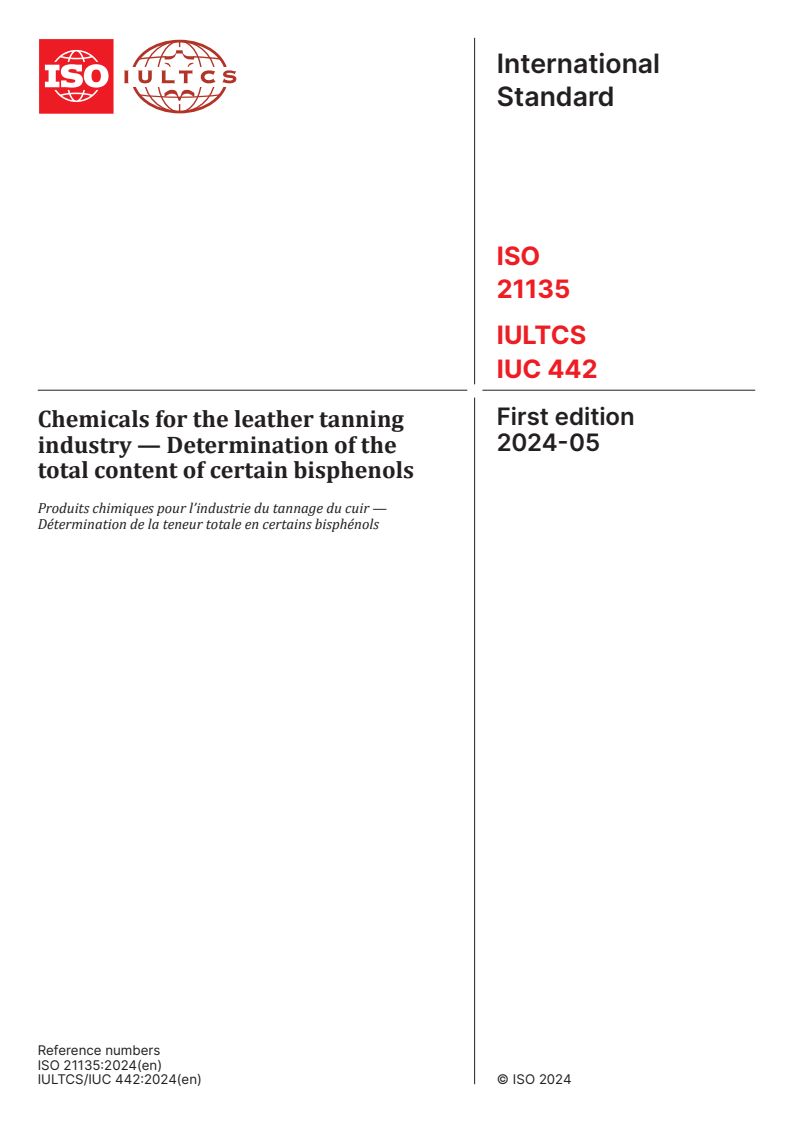
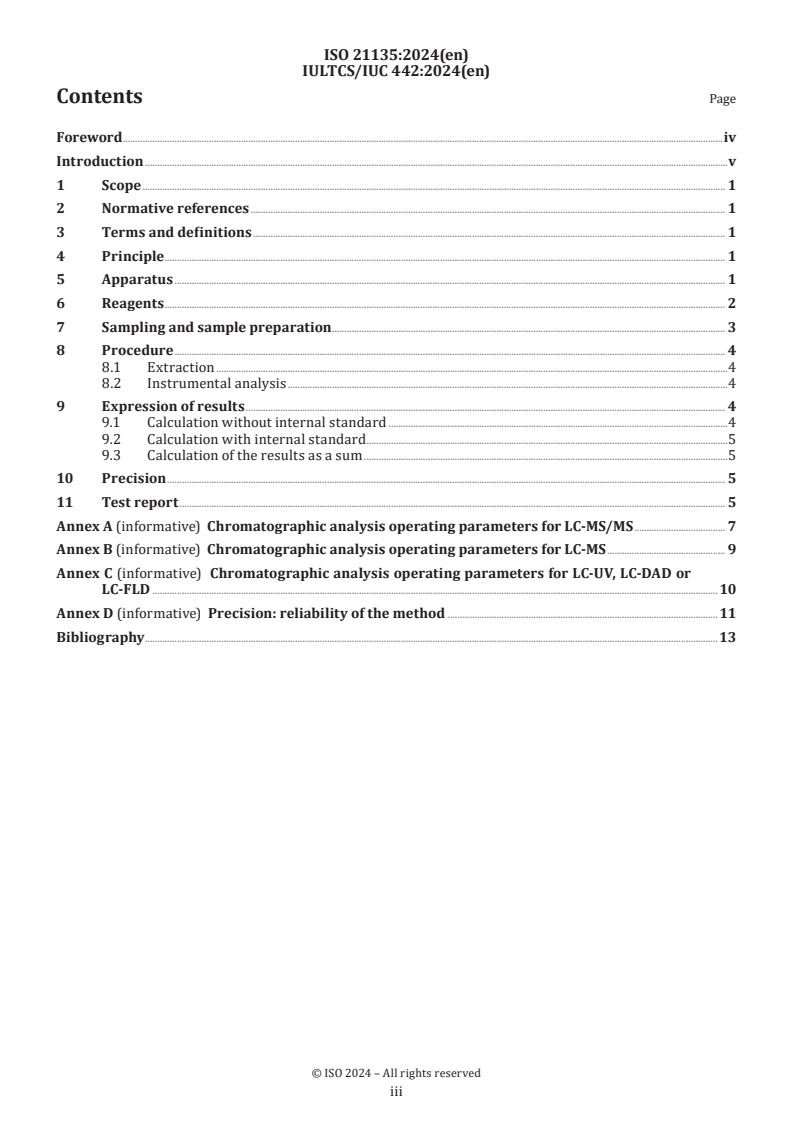
ISO 21135:2024 - Chemicals for the leather tanning industry — Determination of the total content of certain bisphenols Released:15. 05. 2024
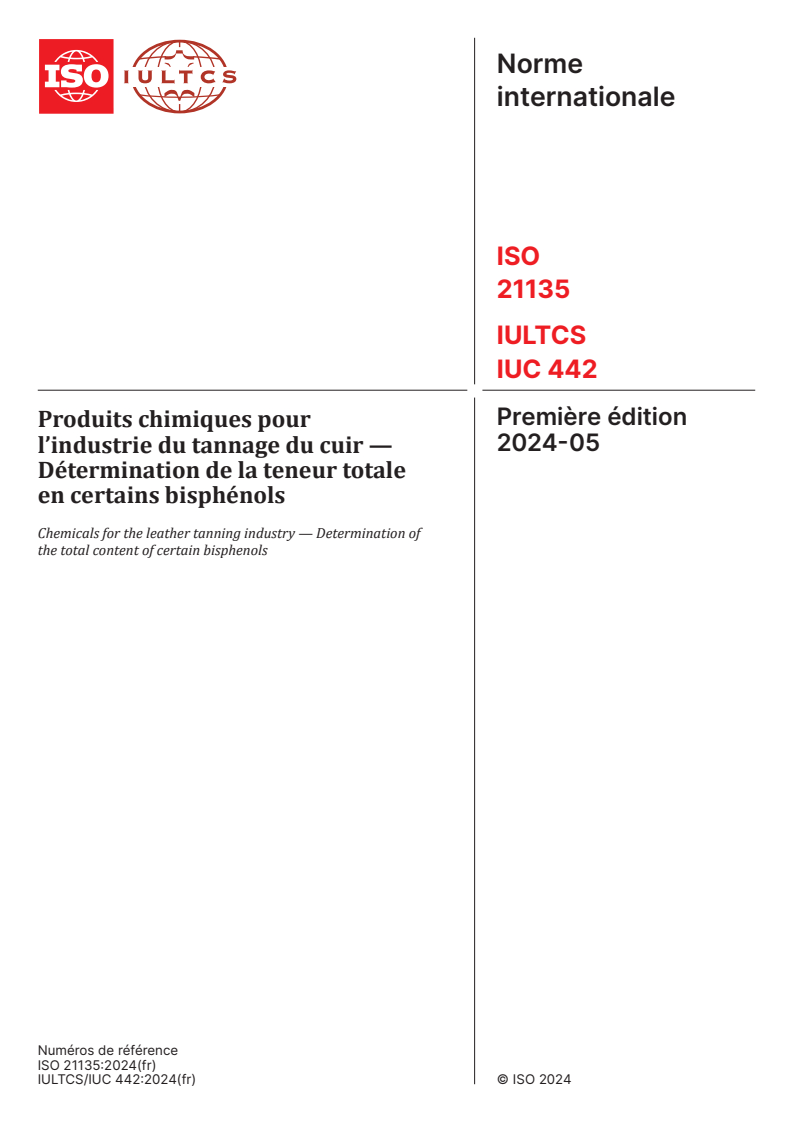
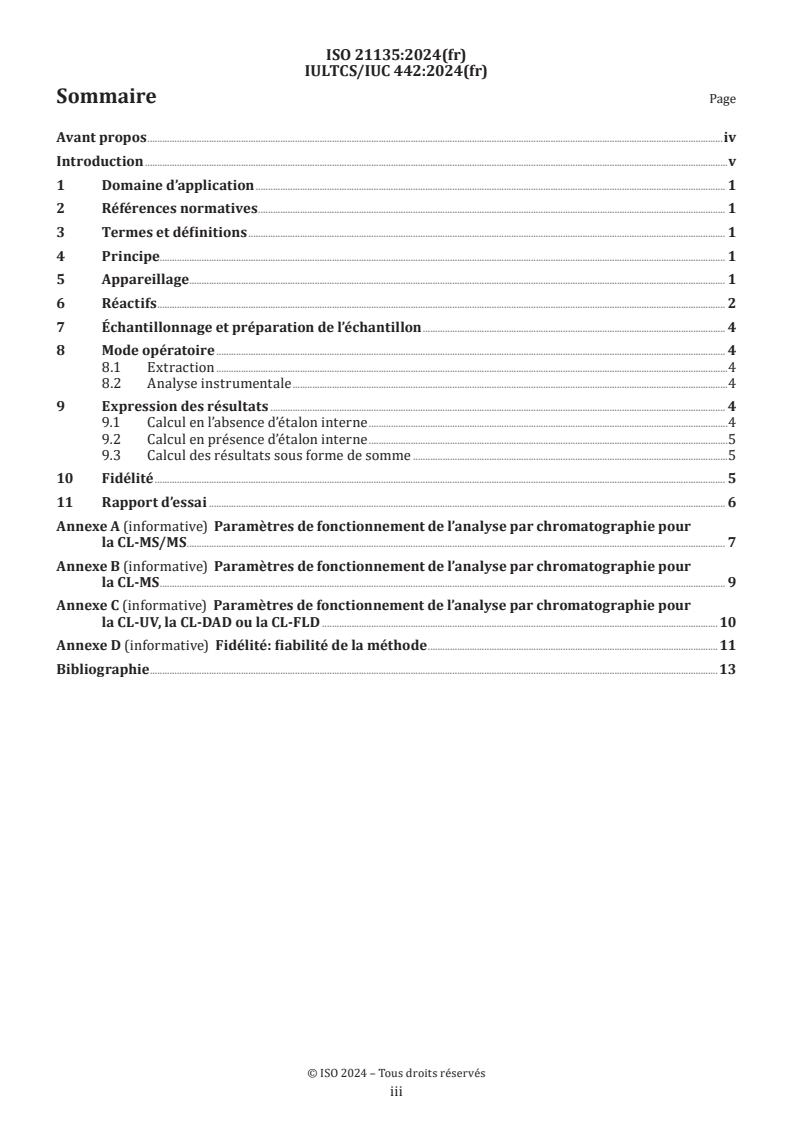
ISO 21135:2024 - Produits chimiques pour l’industrie du tannage du cuir — Détermination de la teneur totale en certains bisphénols Released:15. 05. 2024
Overview
ISO 21135:2024 specifies a solvent-extractable analytical method for the determination of the total content of selected bisphenols in chemicals used in the leather tanning industry. The method covers bisphenol A, AF, B, F and S and employs liquid chromatography (LC) coupled with a range of detectors - LC-MS/MS, LC-MS, LC‑UV, LC‑DAD or LC‑FLD - to identify and quantify target compounds. The procedure includes methanol extraction, optional centrifugation/filtration and calibrated instrumental analysis. Note: bisphenol S cannot be detected with FLD.
Key technical topics and requirements
- Scope: Total (solvent-extractable) content of bisphenol A, AF, B, F, S in leather-tanning chemicals. Method may be validated for other bisphenols by the laboratory.
- Sample extraction: Ultrasonic methanol extraction (sample example: 0.20 g ± 0.050 g with 20 mL methanol at 60 ± 5 °C for 60 ± 5 min), followed by centrifugation/filtration if needed.
- Instrumentation options:
- LC‑MS/MS (preferred for sensitivity and selectivity)
- LC‑MS
- LC‑UV, LC‑DAD or LC‑FLD (note FLD cannot detect bisphenol S)
- Calibration and quantification:
- Calibration ranges suggested for MS methods: 0.05–1 µg/mL.
- For UV/DAD/FLD: 0.5–20 µg/mL.
- Calculations provided with and without internal standards; use of mass-labelled internal standards (e.g., bisphenol A‑D8, B‑D8, AF‑13C12, F‑D10, S‑D8) is recommended to correct matrix effects.
- Reporting: Results expressed as mass fraction (mg/kg); procedures for dilution, detection limits and precision are included in the standard and annexes.
Practical applications and users
- Quality control laboratories testing raw chemicals, tanning agents and intermediates for bisphenol residues.
- Leather chemical manufacturers implementing supplier control and product safety checks.
- Independent testing labs offering compliance testing for customers in the leather and footwear supply chain.
- Regulatory and compliance bodies monitoring potentially hazardous bisphenols given their classification concerns (e.g., reproductive toxicity, endocrine disruption).
- Use cases include supplier qualification, incoming material inspection, product release testing and regulatory compliance testing for bisphenol contamination in tanning agents.
Related Standards and context
- This document was developed by the IULTCS Chemical Test Commission in collaboration with CEN/TC 289 (Leather) under ISO procedures.
- Normative references: none listed in the standard.
- Annexes provide example chromatographic parameters for LC‑MS/MS, LC‑MS and LC‑UV/DAD/FLD plus precision (reliability) information.
Keywords: ISO 21135:2024, bisphenol, leather tanning chemicals, LC‑MS/MS, LC‑UV, LC‑DAD, LC‑FLD, bisphenol A, bisphenol S, analytical method, extraction, quality control.
Relations
- Effective Date
- 12-Feb-2026
Buy Documents
ISO 21135:2024 - Chemicals for the leather tanning industry — Determination of the total content of certain bisphenols Released:15. 05. 2024
ISO 21135:2024 - Produits chimiques pour l’industrie du tannage du cuir — Détermination de la teneur totale en certains bisphénols Released:15. 05. 2024
Get Certified
Connect with accredited certification bodies for this standard

Control Union Certifications
Global certification for agriculture and sustainability.

Hohenstein Institut
Textile testing and certification.

Bureau Veritas Bangladesh
Bureau Veritas certification services in Bangladesh.
Sponsored listings
Frequently Asked Questions
ISO 21135:2024 is a standard published by the International Organization for Standardization (ISO). Its full title is "Chemicals for the leather tanning industry — Determination of the total content of certain bisphenols". This standard covers: This document specifies a method for determining the total content (solvent extractable) of the following bisphenols in chemicals for the leather tanning industry: — bisphenol A; — bisphenol AF; — bisphenol B; — bisphenol F; — bisphenol S. This method requires the use of liquid chromatography (LC) with either a single quadrupole mass spectrometer (MS), a triple quadrupole mass spectrometer (MS/MS), an ultraviolet (UV) detector, a diode array detector (DAD) or a fluorescence detector (FLD) to identify and quantify the bisphenols. NOTE 1 This method can also be used for other bisphenols if they are validated by the laboratory. NOTE 2 Bisphenol S cannot be detected with FLD.
This document specifies a method for determining the total content (solvent extractable) of the following bisphenols in chemicals for the leather tanning industry: — bisphenol A; — bisphenol AF; — bisphenol B; — bisphenol F; — bisphenol S. This method requires the use of liquid chromatography (LC) with either a single quadrupole mass spectrometer (MS), a triple quadrupole mass spectrometer (MS/MS), an ultraviolet (UV) detector, a diode array detector (DAD) or a fluorescence detector (FLD) to identify and quantify the bisphenols. NOTE 1 This method can also be used for other bisphenols if they are validated by the laboratory. NOTE 2 Bisphenol S cannot be detected with FLD.
ISO 21135:2024 is classified under the following ICS (International Classification for Standards) categories: 59.140.30 - Leather and furs. The ICS classification helps identify the subject area and facilitates finding related standards.
ISO 21135:2024 has the following relationships with other standards: It is inter standard links to EN ISO 21135:2024. Understanding these relationships helps ensure you are using the most current and applicable version of the standard.
ISO 21135:2024 is available in PDF format for immediate download after purchase. The document can be added to your cart and obtained through the secure checkout process. Digital delivery ensures instant access to the complete standard document.
Standards Content (Sample)
International
Standard
ISO
IULTCS
IUC 442
First edition
Chemicals for the leather tanning
2024-05
industry — Determination of the
total content of certain bisphenols
Produits chimiques pour l’industrie du tannage du cuir —
Détermination de la teneur totale en certains bisphénols
Reference numbers
IULTCS/IUC 442:2024(en) © ISO 2024
IULTCS/IUC 442:2024(en)
© ISO 2024
All rights reserved. Unless otherwise specified, or required in the context of its implementation, no part of this publication may
be reproduced or utilized otherwise in any form or by any means, electronic or mechanical, including photocopying, or posting on
the internet or an intranet, without prior written permission. Permission can be requested from either ISO at the address below
or ISO’s member body in the country of the requester.
ISO copyright office
CP 401 • Ch. de Blandonnet 8
CH-1214 Vernier, Geneva
Phone: +41 22 749 01 11
Email: copyright@iso.org
Website: www.iso.org
Published in Switzerland
ii
IULTCS/IUC 442:2024(en)
Contents Page
Foreword .iv
Introduction .v
1 Scope . 1
2 Normative references . 1
3 Terms and definitions . 1
4 Principle . 1
5 Apparatus . 1
6 Reagents . 2
7 Sampling and sample preparation . 3
8 Procedure . 4
8.1 Extraction .4
8.2 Instrumental analysis .4
9 Expression of results . 4
9.1 Calculation without internal standard .4
9.2 Calculation with internal standard .5
9.3 Calculation of the results as a sum .5
10 Precision . 5
11 Test report . 5
Annex A (informative) Chromatographic analysis operating parameters for LC-MS/MS . 7
Annex B (informative) Chromatographic analysis operating parameters for LC-MS . 9
Annex C (informative) Chromatographic analysis operating parameters for LC-UV, LC-DAD or
LC-FLD . 10
Annex D (informative) Precision: reliability of the method .11
Bibliography .13
iii
IULTCS/IUC 442:2024(en)
Foreword
ISO (the International Organization for Standardization) is a worldwide federation of national standards
bodies (ISO member bodies). The work of preparing International Standards is normally carried out through
ISO technical committees. Each member body interested in a subject for which a technical committee
has been established has the right to be represented on that committee. International organizations,
governmental and non-governmental, in liaison with ISO, also take part in the work. ISO collaborates closely
with the International Electrotechnical Commission (IEC) on all matters of electrotechnical standardization.
The procedures used to develop this document and those intended for its further maintenance are described
in the ISO/IEC Directives, Part 1. In particular, the different approval criteria needed for the different types
of ISO document should be noted. This document was drafted in accordance with the editorial rules of the
ISO/IEC Directives, Part 2 (see www.iso.org/directives).
ISO draws attention to the possibility that the implementation of this document may involve the use of (a)
patent(s). ISO takes no position concerning the evidence, validity or applicability of any claimed patent
rights in respect thereof. As of the date of publication of this document, ISO had not received notice of (a)
patent(s) which may be required to implement this document. However, implementers are cautioned that
this may not represent the latest information, which may be obtained from the patent database available at
www.iso.org/patents. ISO shall not be held responsible for identifying any or all such patent rights.
Any trade name used in this document is information given for the convenience of users and does not
constitute an endorsement.
For an explanation of the voluntary nature of standards, the meaning of ISO specific terms and expressions
related to conformity assessment, as well as information about ISO's adherence to the World Trade
Organization (WTO) principles in the Technical Barriers to Trade (TBT), see www.iso.org/iso/foreword.html.
IULTCS, originally formed in 1897, is a world-wide organization of professional leather societies to further
the advancement of leather science and technology. IULTCS has three Commissions, which are responsible
for establishing international methods for the sampling and testing of leather. ISO recognizes IULTCS as an
international standardizing body for the preparation of test methods for leather.
This document was prepared by the Chemical Test Commission of the International Union of Leather
Technologists and Chemists Societies (IUC Commission, IULTCS), in collaboration with the European
Committee for Standardization (CEN) Technical Committee CEN/TC 289, Leather, in accordance with the
Agreement on technical cooperation between ISO and CEN (Vienna Agreement).
Any feedback or questions on this document should be directed to the user’s national standards body. A
complete listing of these bodies can be found at www.iso.org/members.html.
iv
IULTCS/IUC 442:2024(en)
Introduction
This document includes a procedure for analysing certain bisphenols in leather tanning chemicals using
liquid chromatography (LC) equipment. With this analytical method, bisphenol A, bisphenol AF, bisphenol B,
bisphenol F and bisphenol S can be determined.
In the leather industry, bisphenol F can be an impurity in synthetic tanning agents. Bisphenol S is a monomer
that is used to manufacture synthetic tanning agents, which can lead to residues in the final product.
Bisphenol A is a synthetic organic chemical primarily used as a monomer in the manufacture of high-
performance plastics, other polymers, such as resins, and in the colour developer for thermoprint paper.
Bisphenol AF is a fluorinated organic compound that is an analogue of bisphenol A in which the two methyl
groups are replaced with trifluoromethyl groups. Bisphenol B is similar to bisphenol A and is used in the
manufacture of plastics and resins.
At present, the official European Chemicals Agency (ECHA) classification recognized in the European Union
(EU) is the following:
[1]
— bisphenol A as toxic to reproduction, skin sensitizer and endocrine disruptor;
[2]
— bisphenol B as endocrine disruptor;
[3]
— bisphenol S as toxic to reproduction and endocrine disruptor.
v
International Standard
IULTCS/IUC 442:2024(en)
Chemicals for the leather tanning industry — Determination
of the total content of certain bisphenols
1 Scope
This document specifies a method for determining the total content (solvent extractable) of the following
bisphenols in chemicals for the leather tanning industry:
— bisphenol A;
— bisphenol AF;
— bisphenol B;
— bisphenol F;
— bisphenol S.
This method requires the use of liquid chromatography (LC) with either a single quadrupole mass
spectrometer (MS), a triple quadrupole mass spectrometer (MS/MS), an ultraviolet (UV) detector, a diode
array detector (DAD) or a fluorescence detector (FLD) to identify and quantify the bisphenols.
NOTE 1 This method can also be used for other bisphenols if they are validated by the laboratory.
NOTE 2 Bisphenol S cannot be detected with FLD.
2 Normative references
There are no normative references in this document.
3 Terms and definitions
No terms and definitions are listed in this document.
ISO and IEC maintain terminology databases for use in standardization at the following addresses:
— ISO Online browsing platform: available at https:// www .iso .org/ obp
— IEC Electropedia: available at https:// www .electropedia .org/
4 Principle
The sample of the chemical is extracted in methanol using an ultrasonic bath. Subsequently, an aliquot of the
solution can be directly analysed, using LC-MS, LC-MS/MS or LC with a UV detector (LC-UV), DAD (LC-DAD)
or FLD (LC-FLD).
5 Apparatus
The usual laboratory apparatus and, in particular, the following shall be used:
5.1 Ultrasonic bath, with controllable heating capable of maintaining a temperature of (60 ± 5) °C.
IULTCS/IUC 442:2024(en)
5.2 Glass container with a screw cap, for example volume of 20 ml.
5.3 Suitable syringe membrane filters, for example PTFE with pore size 0,2 µm or PTFE-with pore size
0,45 µm.
5.4 Volumetric flasks, for example volume of 10 ml and 100 ml.
5.5 LC vials, with cap, for example volume of 2 ml.
5.6 Analytical balance, with a resolution of 0,1 mg.
5.7 Pipettes, various sizes, for example volume of 1 ml to 20 ml.
5.8 Instrumental equipment, LC-MS/MS.
5.9 Alternative instrumental equipment, LC-MS, LC-UV, LC-DAD or LC-FLD.
NOTE If two detectors are used, they can be arranged in series on the same LC system.
6 Reagents
If not otherwise specified, analytical reagent grade chemicals shall be used.
® 1)
6.1 Methanol, CAS Registry Number (CAS RN) 67-56-1. For LC-MS/MS it is necessary to have LC-MS
quality. HPLC quality methanol is suitable for LC-UV, LC-DAD or LC-FLD.
6.2 Water, deionised or distilled, ultra-pure quality for LC-MS and LC-MS/MS, HPLC grade for LC-DAD, UV
and FLD.
6.3 Bisphenol A, CAS RN 80-05-7, minimum 98,0 %.
6.4 Bisphenol AF, CAS RN 1478-61-1, minimum 98,0 %.
6.5 Bisphenol B, CAS RN 77-40-7, minimum 98,0 %.
6.6 Bisphenol F, CAS RN 620-92-8, minimum 98,0 %.
6.7 Bisphenol S, CA
...
Norme
internationale
ISO
IULTCS
IUC 442
Première édition
Produits chimiques pour
2024-05
l’industrie du tannage du cuir —
Détermination de la teneur totale
en certains bisphénols
Chemicals for the leather tanning industry — Determination of
the total content of certain bisphenols
Numéros de référence
IULTCS/IUC 442:2024(fr) © ISO 2024
IULTCS/IUC 442:2024(fr)
DOCUMENT PROTÉGÉ PAR COPYRIGHT
© ISO 2024
Tous droits réservés. Sauf prescription différente ou nécessité dans le contexte de sa mise en œuvre, aucune partie de cette
publication ne peut être reproduite ni utilisée sous quelque forme que ce soit et par aucun procédé, électronique ou mécanique,
y compris la photocopie, ou la diffusion sur l’internet ou sur un intranet, sans autorisation écrite préalable. Une autorisation peut
être demandée à l’ISO à l’adresse ci-après ou au comité membre de l’ISO dans le pays du demandeur.
ISO copyright office
Case postale 401 • Ch. de Blandonnet 8
CH-1214 Vernier, Genève
Tél.: +41 22 749 01 11
E-mail: copyright@iso.org
Web: www.iso.org
Publié en Suisse
ii
IULTCS/IUC 442:2024(fr)
Sommaire Page
Avant propos .iv
Introduction .v
1 Domaine d’application . 1
2 Références normatives . 1
3 Termes et définitions . 1
4 Principe. 1
5 Appareillage . 1
6 Réactifs . 2
7 Échantillonnage et préparation de l’échantillon . 4
8 Mode opératoire . 4
8.1 Extraction .4
8.2 Analyse instrumentale .4
9 Expression des résultats . 4
9.1 Calcul en l’absence d’étalon interne .4
9.2 Calcul en présence d’étalon interne .5
9.3 Calcul des résultats sous forme de somme .5
10 Fidélité . 5
11 Rapport d’essai . 6
Annexe A (informative) Paramètres de fonctionnement de l’analyse par chromatographie pour
la CL‑MS/MS . 7
Annexe B (informative) Paramètres de fonctionnement de l’analyse par chromatographie pour
la CL‑MS . 9
Annexe C (informative) Paramètres de fonctionnement de l’analyse par chromatographie pour
la CL‑UV, la CL‑DAD ou la CL‑FLD . 10
Annexe D (informative) Fidélité: fiabilité de la méthode .11
Bibliographie .13
iii
IULTCS/IUC 442:2024(fr)
Avant propos
L’ISO (Organisation internationale de normalisation) est une fédération mondiale d’organismes nationaux
de normalisation (comités membres de l’ISO). L’élaboration des Normes internationales est en général
confiée aux comités techniques de l’ISO. Chaque comité membre intéressé par une étude a le droit de faire
partie du comité technique créé à cet effet. Les organisations internationales, gouvernementales et non
gouvernementales, en liaison avec l’ISO participent également aux travaux. L’ISO collabore étroitement avec
la Commission électrotechnique internationale (IEC) en ce qui concerne la normalisation électrotechnique.
Les procédures utilisées pour élaborer le présent document et celles destinées à sa mise à jour sont
décrites dans les Directives ISO/IEC, Partie 1. Il convient, en particulier, de prendre note des différents
critères d’approbation requis pour les différents types de documents ISO. Le présent document
a été rédigé conformément aux règles de rédaction données dans les Directives ISO/IEC, Partie 2
(voir www.iso.org/directives).
L’ISO attire l’attention sur le fait que la mise en application du présent document peut entraîner l’utilisation
d’un ou de plusieurs brevets. L’ISO ne prend pas position quant à la preuve, à la validité et à l’applicabilité
de tout droit de brevet revendiqué à cet égard. À la date de publication du présent document, l’ISO n’avait
pas reçu notification qu’un ou plusieurs brevets pouvaient être nécessaires à sa mise en application.
Toutefois, il y a lieu d’avertir les responsables de la mise en application du présent document que des
informations plus récentes sont susceptibles de figurer dans la base de données de brevets, disponible à
l’adresse www.iso.org/brevets. L’ISO ne saurait être tenue pour responsable de ne pas avoir identifié tout ou
partie de tels droits de brevet.
Les appellations commerciales éventuellement mentionnées dans le présent document sont données pour
information, par souci de commodité, à l’intention des utilisateurs et ne sauraient constituer un engagement.
Pour une explication de la nature volontaire des normes, la signification des termes et expressions
spécifiques de l’ISO liés à l’évaluation de la conformité, ou pour toute information au sujet de l’adhésion de
l’ISO aux principes de l’Organisation mondiale du commerce (OMC) concernant les obstacles techniques au
commerce (OTC), voir www.iso.org/iso/fr/avant-propos.html.
L’IULTCS est une organisation mondiale de sociétés professionnelles des industries du cuir fondée en 1897
ayant pour mission de favoriser l’avancement des sciences et technologies du cuir. L’IULTCS a trois
commissions, qui sont responsables de l’établissement des méthodes internationales d’échantillonnage et
d’essai des cuirs. L’ISO reconnaît l’IULTCS en tant qu’organisme international à activités normatives pour
l’élaboration de méthodes d’essai relatives au cuir.
Le présent document a été élaboré par la Commission des essais chimiques de l’Union internationale des
sociétés de techniciens et chimistes du cuir (commission IUC, IULTCS), en collaboration avec le comité
technique CEN/TC 289, Cuir, du Comité européen de normalisation (CEN) conformément à l’Accord de
coopération technique entre l’ISO et le CEN (Accord de Vienne).
Il convient que l’utilisateur adresse tout retour d’information ou toute question concernant le présent
document à l’organisme national de normalisation de son pays. Une liste exhaustive desdits organismes se
trouve à l’adresse www.iso.org/fr/members.html.
iv
IULTCS/IUC 442:2024(fr)
Introduction
Le présent document décrit un mode opératoire permettant l’analyse de certains bisphénols présents dans
les produits chimiques utilisés pour le tannage du cuir, à l’aide d’un équipement de chromatographie en
phase liquide (CL). Le bisphénol A, le bisphénol AF, le bisphénol B, le bisphénol F et le bisphénol S peuvent
être déterminés au moyen de cette méthode d’analyse.
Dans l’industrie du cuir, le bisphénol F peut constituer une impureté dans les agents de tannage synthétiques.
Le bisphénol S est un monomère utilisé pour fabriquer des agents de tannage synthétiques, pouvant conduire
à la présence de résidus dans le produit final.
Le bisphénol A est un produit chimique organique de synthèse principalement utilisé comme monomère
dans la fabrication de plastiques de haute performance ou d’autres polymères, tels que les résines, ainsi que
dans les révélateurs de couleur pour papier thermique. Le bisphénol AF est un composé organique fluoré
qui est un analogue du bisphénol A dans lequel les deux groupes méthyle sont remplacés par des groupes
trifluorométhyle. Le bisphénol B est similaire au bisphénol A et est employé dans la fabrication de plastiques
et de résines.
Actuellement, la classification officielle de l’Agence européenne des produits chimiques (ECHA), reconnue au
sein de l’Union européenne (UE), est la suivante:
— le bisphénol A est classé comme toxique pour la reproduction, sensibilisant cutané et perturbateur
[1]
endocrinien ;
[2]
— le bisphénol B est classé comme perturbateur endocrinien ;
[3]
— le bisphénol S est classé comme toxique pour la reproduction et perturbateur endocrinien .
v
Norme internationale
IULTCS/IUC 442:2024(fr)
Produits chimiques pour l’industrie du tannage du cuir —
Détermination de la teneur totale en certains bisphénols
1 Domaine d’application
Le présent document spécifie une méthode de détermination de la teneur totale (extractible par solvant) des
bisphénols suivants dans les produits chimiques utilisés par l’industrie du tannage du cuir:
— le bisphénol A;
— le bisphénol AF;
— le bisphénol B;
— le bisphénol F;
— le bisphénol S.
Cette méthode nécessite de recourir à la chromatographie en phase liquide (CL), couplée soit à un
spectromètre de masse à simple quadripôle (MS), soit à un spectromètre de masse à triple quadripôle (MS/
MS), soit à un détecteur ultraviolet (UV), soit à un détecteur à barrettes de diodes (DAD) ou un détecteur de
fluorescence (FLD), afin d’identifier et de quantifier les bisphénols.
NOTE 1 Sous réserve de validation par le laboratoire, cette méthode peut également être utilisée pour d’autres
bisphénols.
NOTE 2 Le bisphénol S ne peut pas être détecté au moyen d’un FLD.
2 Références normatives
Le présent document ne contient aucune référence normative.
3 Termes et définitions
Aucun terme n’est défini dans le présent document.
L’ISO et l’IEC tiennent à jour des bases de données terminologiques destinées à être utilisées en normalisation,
consultables aux adresses suivantes:
— ISO Online browsing platform: disponible à l’adresse https:// www .iso .org/ obp
— IEC Electropedia: disponible à l’adresse https:// www .electropedia .org/
4 Principe
L’échantillon de produit chimique est soumis à une extraction au méthanol au moyen d’un bain à ultrasons.
Ensuite, une aliquote de la solution obtenue peut être directement analysée par CL-MS, CL-MS/MS ou par CL
couplée à un détecteur UV (CL-UV), à un DAD (CL-DAD) ou à un FLD (CL-FLD).
5 Appareillage
L’appareillage courant de laboratoire doit être utilisé et, en particulier, les éléments ci-après.
IULTCS/IUC 442:2024(fr)
5.1 Bain à ultrasons, avec système de contrôle du chauffage permettant de maintenir une température
de (60 ± 5) °C.
5.2 Récipient en verre muni d’un capuchon à vis, par exemple, d’un volume de 20 ml.
5.3 Filtres à membrane pour seringues appropriés, par exemple, en PTFE et de 0,2 µm ou de 0,45 µm
de taille de pore.
5.4 Fioles jaugées, par exemple, de volumes de 10 ml et de 100 ml.
5.5 Flacons pour chromatographie en phase liquide, munis d’un capuchon, par exemple, d’un volume
de 2 ml.
5.6 Balance analytique, disposant d’une résolution de 0,1 mg.
5.7 Pipettes, de dimensions variées, par exemple, de volumes de 1 ml à 20 ml.
5.8 Équipements d’instrumentation, CL-MS/MS.
5.9 Autres équipements d’instrumentation possibles, CL-MS, CL-UV, CL-DAD ou CL-FLD.
NOTE Si deux détecteurs sont utilisés, ils peuvent être montés en série sur le même système de chromatographie
en phase liquide.
6 Réactifs
Sauf spécification contraire, des réactifs chimiques de qualité analytique doivent être utilisés.
® 1)
6.1 Méthanol, numéro de registre CAS (CAS RN) 67-56-1. Pour la CL-MS/MS, il est nécessaire qu’il soit
de qualité CL-MS. Le méthanol de qualité CLHP (chromatographie en phase liquide à haute performance) est
approprié pour la CL-UV, la CL-DAD ou la CL-FLD.
6.2 Eau, déionisée ou distillée, de qualité ultrapure pour la CL-MS et la CL-MS/MS, de qualité CLHP pour la
CL-DAD, la CL-UV et la CL-FLD.
6.3 Bisphénol A, CAS RN 80-05-7, pureté minimale: 98,0 %.
6.4 Bisphénol AF, CAS RN 1478-61-1, pureté minimale: 98,0 %.
6.5 Bisphénol B, CAS RN 77-40-7, pureté minimale: 98,0 %.
6.6 Bisphénol F, CAS RN 620-92-8, pureté minimale: 98,0 %.
6.7 Bisphénol S, CAS RN 80-09-1, pureté minimale: 98,0
...