

ISO 4384-2:2022
(Main)Plain bearings — Hardness testing of bearing metals — Part 2: Solid materials
General Information
- Abstract
This document specifies parameters for the hardness testing of solid materials for plain bearings made from cast and wrought copper and aluminium alloys by machining and forming, of their wrought products and ingots, and of tin-based ingots. This document is a supplement to existing International Standards on hardness testing and, therefore, includes only the extensions and restrictions for observation compared to those publications. Owing to the heterogeneous structural composition of the majority of these bearing metals, a Brinell test is used.
- Status
- Published
- Publication Date
- 02-Jan-2022
- Current Stage
- 6060 - International Standard published
- Start Date
- 03-Jan-2022
- Due Date
- 14-Sep-2023
- Completion Date
- 03-Jan-2022
Overview
ISO 4384-2:2022 specifies parameters for hardness testing of solid materials used in plain bearings, focusing on cast and wrought copper and aluminium alloys, their wrought products and ingots, and tin‑based ingots. It is a supplement to existing hardness-testing standards and defines the extensions and restrictions needed for bearing metals. Because many bearing alloys are heterogeneous, the standard prescribes the Brinell test as the preferred method.
Key Topics
- Scope and applicability
- Solid plain‑bearing materials: cast/wrought Cu and Al alloys, tin‑based ingots, related wrought products and ingots.
- Test method
- Uses the Brinell hardness test (references ISO 6506-1) with specified combinations of indenter diameter, load and dwell time (HBW designations).
- Example notation explained: HBW 5/250/10 = 5 mm ball, 2 452 N test force, 10 s dwell (example provided in the standard).
- Specified test conditions
- Table of preferred HBW conditions for different forms and thicknesses (e.g., bars, tubes, cast alloys with porosity, and ingots).
- Flexibility: alternative indenter/load/duration combinations may be mutually agreed between supplier and customer if standard conditions produce indents that are too large or too small.
- Specimen preparation
- Test area must be metallic bright and conditioned without heating the material.
- Cast and wrought Cu/Al alloys: testing on turned or filed and subsequently prepared surfaces (except hot‑pressed parts).
- Grinding recommendations linked to surface roughness:
- Lead and tin alloys: total profile height R ≤ 6 µm - abrasive paper grain size P240 allowed.
- Copper and aluminium alloys: R ≤ 4 µm - abrasive paper grain size P320 recommended, using suitable lubricant.
- Orientation and anisotropy
- For strongly anisotropic materials, specimen orientation and position within the bearing shall be agreed between customer and supplier.
Applications
- Quality control and incoming inspection for plain bearing manufacturers and suppliers.
- Metallurgical testing in production of Cu/Al bearing alloys and tin‑based ingots.
- Procurement and supplier agreements where agreed test methods, orientation and acceptance criteria are required.
- Third‑party and materials testing laboratories performing Brinell hardness verification on bearing metals.
Related Standards
- ISO 6506-1 - Metallic materials - Brinell hardness test - Test method (normative reference).
- ISO 4287 - Surface texture: profile method (referenced for roughness parameters).
- ISO 4384 series - other parts for plain bearing testing and materials.
For complete test tables, procedural details and normative requirements, consult the full ISO 4384-2:2022 publication.
Relations
- Revises
ISO 4384-2:2011 - Plain bearings — Hardness testing of bearing metals — Part 2: Solid materials - Effective Date
- 23-Apr-2020
Frequently Asked Questions
ISO 4384-2:2022 is a standard published by the International Organization for Standardization (ISO). Its full title is "Plain bearings — Hardness testing of bearing metals — Part 2: Solid materials". This standard covers: This document specifies parameters for the hardness testing of solid materials for plain bearings made from cast and wrought copper and aluminium alloys by machining and forming, of their wrought products and ingots, and of tin-based ingots. This document is a supplement to existing International Standards on hardness testing and, therefore, includes only the extensions and restrictions for observation compared to those publications. Owing to the heterogeneous structural composition of the majority of these bearing metals, a Brinell test is used.
This document specifies parameters for the hardness testing of solid materials for plain bearings made from cast and wrought copper and aluminium alloys by machining and forming, of their wrought products and ingots, and of tin-based ingots. This document is a supplement to existing International Standards on hardness testing and, therefore, includes only the extensions and restrictions for observation compared to those publications. Owing to the heterogeneous structural composition of the majority of these bearing metals, a Brinell test is used.
ISO 4384-2:2022 is classified under the following ICS (International Classification for Standards) categories: 21.100.10 - Plain bearings. The ICS classification helps identify the subject area and facilitates finding related standards.
ISO 4384-2:2022 has the following relationships with other standards: It is inter standard links to ISO 4384-2:2011. Understanding these relationships helps ensure you are using the most current and applicable version of the standard.
ISO 4384-2:2022 is available in PDF format for immediate download after purchase. The document can be added to your cart and obtained through the secure checkout process. Digital delivery ensures instant access to the complete standard document.
Standards Content (Sample)
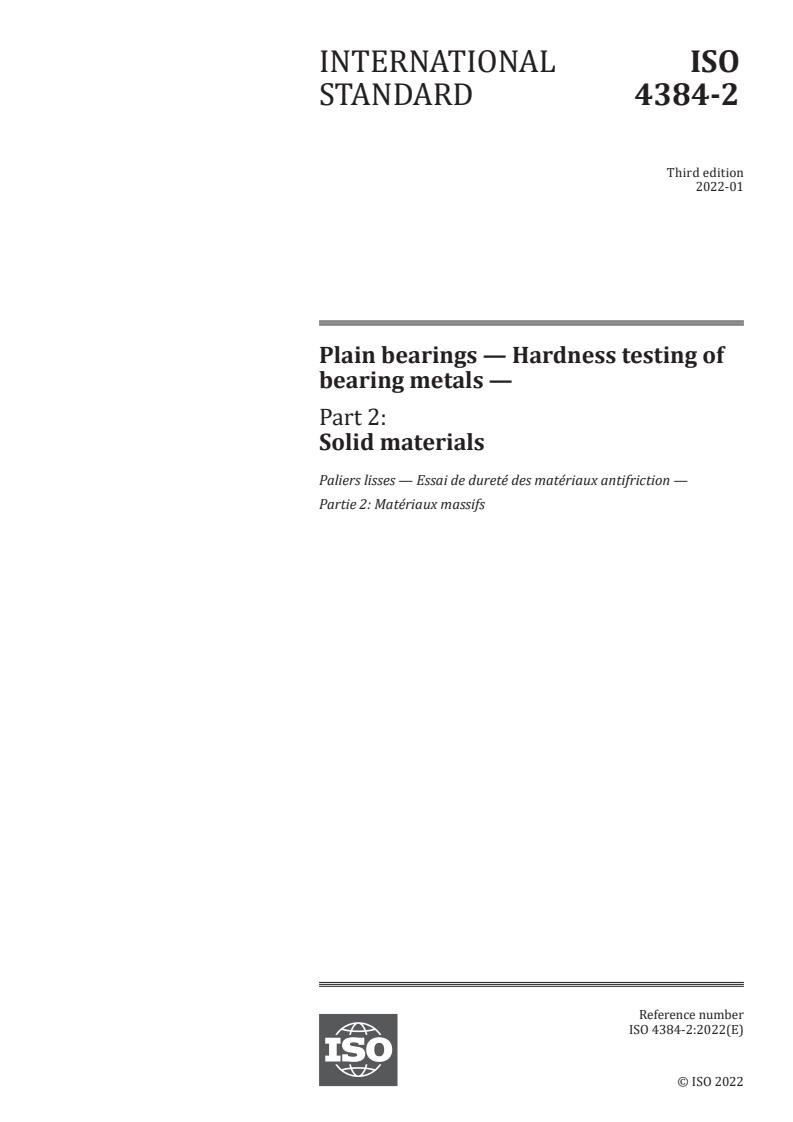
INTERNATIONAL ISO
STANDARD 4384-2
Third edition
2022-01
Plain bearings — Hardness testing of
bearing metals —
Part 2:
Solid materials
Paliers lisses — Essai de dureté des matériaux antifriction —
Partie 2: Matériaux massifs
Reference number
© ISO 2022
All rights reserved. Unless otherwise specified, or required in the context of its implementation, no part of this publication may
be reproduced or utilized otherwise in any form or by any means, electronic or mechanical, including photocopying, or posting on
the internet or an intranet, without prior written permission. Permission can be requested from either ISO at the address below
or ISO’s member body in the country of the requester.
ISO copyright office
CP 401 • Ch. de Blandonnet 8
CH-1214 Vernier, Geneva
Phone: +41 22 749 01 11
Email: copyright@iso.org
Website: www.iso.org
Published in Switzerland
ii
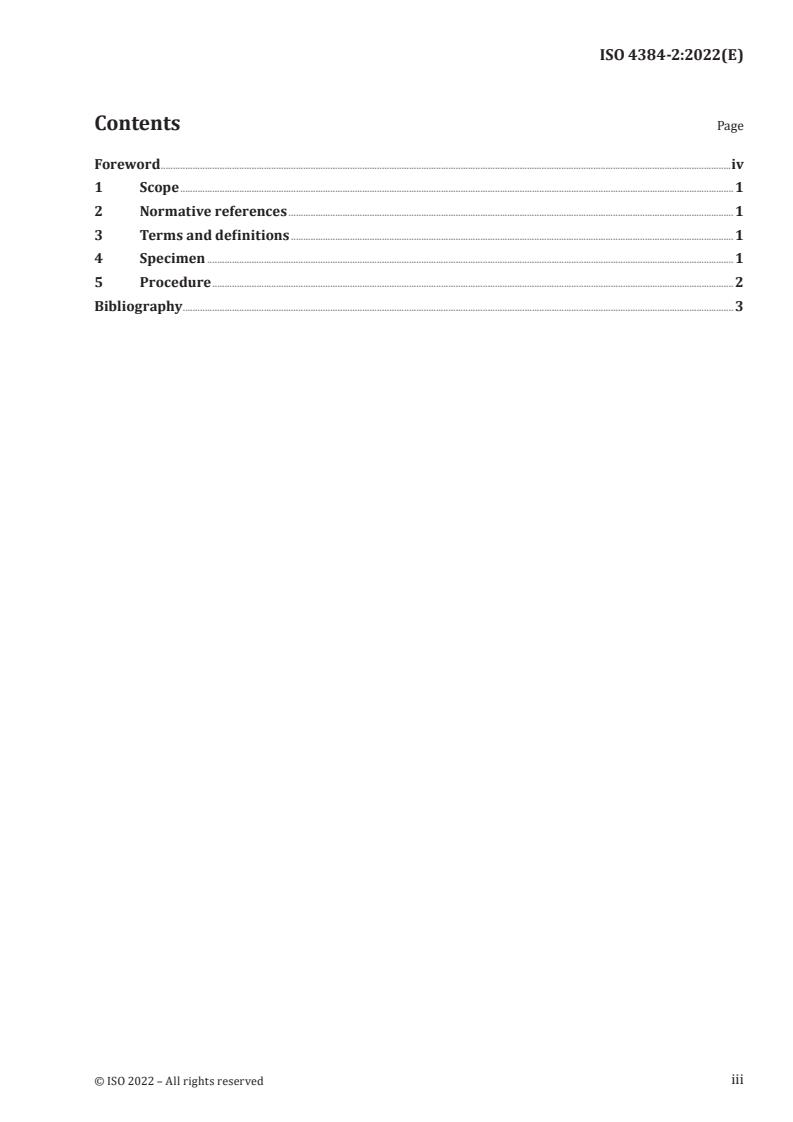
Contents Page
Foreword .iv
1 Scope . 1
2 Normative references . 1
3 Terms and definitions . 1
4 Specimen . 1
5 Procedure .2
Bibliography . 3
iii
Foreword
ISO (the International Organization for Standardization) is a worldwide federation of national standards
bodies (ISO member bodies). The work of preparing International Standards is normally carried out
through ISO technical committees. Each member body interested in a subject for which a technical
committee has been established has the right to be represented on that committee. International
organizations, governmental and non-governmental, in liaison with ISO, also take part in the work.
ISO collaborates closely with the International Electrotechnical Commission (IEC) on all matters of
electrotechnical standardization.
The procedures used to develop this document and those intended for its further maintenance are
described in the ISO/IEC Directives, Part 1. In particular, the different approval criteria needed for the
different types of ISO documents should be noted. This document was drafted in accordance with the
editorial rules of the ISO/IEC Directives, Part 2 (see www.iso.org/directives).
Attention is drawn to the possibility that some of the elements of this document may be the subject of
patent rights. ISO shall not be held responsible for identifying any or all such patent rights. Details of
any patent rights identified during the development of the document will be in the Introduction and/or
on the ISO list of patent declarations received (see www.iso.org/patents).
Any trade name used in this document is information given for the convenience of users and does not
constitute an endorsement.
For an explanation of the voluntary nature of standards, the meaning of ISO specific terms and
expressions related to conformity assessment, as well as information about ISO's adherence to
the World Trade Organization (WTO) principles in the Technical Barriers to Trade (TBT), see
www.iso.org/iso/foreword.html.
This document was prepared by Technical Committee ISO/TC 123, Plain bearings, Subcommittee SC 2,
Materials and lubricants, their properties, characteristics, test methods and testing conditions.
This third edition cancels and replaces the secon
...