

ISO/TS 19657:2017
(Main)Definitions and technical criteria for food ingredients to be considered as natural
General Information
- Abstract
ISO/TS 19657:2017 specifies definitions and technical criteria (acceptable sources, materials and processes) to be fulfilled for food ingredients to be considered as natural. ISO/TS 19657:2017 is applicable to food ingredients. ISO/TS 19657:2017 is applicable in business-to-business communication (B2B) only. It does not apply to product communication to consumers (i.e. voluntary and mandatory labelling). ISO/TS 19657:2017 does not apply to human safety, environmental safety, socio-economic considerations (e.g. fair trade) and the characteristics of packaging materials. ISO/TS 19657:2017 does not apply to the following: - flavourings[1]; however, it is possible to assess the non-flavouring components of flavourings according to the technical criteria defined in this document; - natural mineral waters[2]; - bottled drinking waters[3]. There are no requirements for genetic engineering nor for agricultural practices such as organic production in this document. However, these can be subject to regulations and/or other requirements.
- Status
- Published
- Publication Date
- 13-Dec-2017
- Technical Committee
- ISO/TC 34 - Food products
- Drafting Committee
- ISO/TC 34 - Food products
- Current Stage
- 9093 - International Standard confirmed
- Start Date
- 01-Aug-2025
- Completion Date
- 29-Aug-2026
Buy Documents
ISO/TS 19657:2017 - Definitions and technical criteria for food ingredients to be considered as natural Released:12/14/2017
ISO/TS 19657:2017 - Definitions and technical criteria for food ingredients to be considered as natural/14/2017
Overview
ISO/TS 19657:2017 - "Definitions and technical criteria for food ingredients to be considered as natural" provides a clear, industry-focused framework for determining when a food ingredient can be classified as natural in business‑to‑business (B2B) communications. The technical specification defines acceptable sources, materials and processing methods that food and beverage companies can use to assess and communicate ingredient status across the global supply chain. This document is not intended for consumer labelling or for addressing safety, environmental, socio‑economic or packaging characteristics.
Key topics and technical requirements
- Scope and purpose: Applies only to food ingredients and B2B communications; excludes flavourings (except non‑flavouring components can be assessed), natural mineral waters and bottled drinking waters.
- Acceptable sources: Ingredients must originate from plant, algae, fungi, animal, microorganism, mineral deposits or sea water. Fossil fuels are not allowed as a source.
- Allowed processing methods:
- Physical processing
- Enzymatic processing
- Microbiological processing (provided these processes do not deliberately produce substances that do not occur in nature)
- pH adjustment is permitted in these processes
- Exceptional processes: When no suitable physical/enzymatic/microbiological techniques exist, other processes may be used strictly to meet safety or regulatory needs, only if the ingredient’s constituting components are not altered.
- Compound ingredients: Each component of a compound food ingredient must individually meet the technical criteria to be considered natural.
- Additional clarifications: Use/incorporation of water and intentional removal of constituents during processing do not preclude an ingredient from being considered natural.
- Guidance tool: Annex A includes a decision tree to assist implementation.
Applications and users
ISO/TS 19657:2017 is practical for:
- Food manufacturers and ingredient suppliers defining supplier specifications
- Quality assurance, regulatory affairs and R&D teams assessing ingredient status
- Procurement and supply‑chain managers requiring consistent B2B definitions of “natural”
- Auditors and industry groups developing sector‑specific interpretations aligned with the ISO technical criteria
Benefits include harmonized B2B communications, clearer procurement specifications, and a level playing field for natural ingredient claims between businesses.
Related standards
Relevant references include Codex Alimentarius documents cited in ISO/TS 19657:2017:
- Codex Guidelines for the Use of Flavourings (CAC/GL 66‑2008)
- Codex Standard for Natural Mineral Waters (CODEX STAN 108‑1981)
- Codex Standard for Bottled/Packaged Drinking Waters (CODEX STAN 227‑2001)
- Codex General Standard for the Labelling of Prepackaged Food (CODEX STAN 1‑1985)
For implementation, organizations often create sector‑specific guidance consistent with ISO/TS 19657:2017 to reflect product or regional supply‑chain nuances.
Buy Documents
ISO/TS 19657:2017 - Definitions and technical criteria for food ingredients to be considered as natural Released:12/14/2017
ISO/TS 19657:2017 - Definitions and technical criteria for food ingredients to be considered as natural/14/2017
Get Certified
Connect with accredited certification bodies for this standard

BSI Group
BSI (British Standards Institution) is the business standards company that helps organizations make excellence a habit.

Bureau Veritas
Bureau Veritas is a world leader in laboratory testing, inspection and certification services.

DNV
DNV is an independent assurance and risk management provider.
Sponsored listings
Frequently Asked Questions
ISO/TS 19657:2017 is a technical specification published by the International Organization for Standardization (ISO). Its full title is "Definitions and technical criteria for food ingredients to be considered as natural". This standard covers: ISO/TS 19657:2017 specifies definitions and technical criteria (acceptable sources, materials and processes) to be fulfilled for food ingredients to be considered as natural. ISO/TS 19657:2017 is applicable to food ingredients. ISO/TS 19657:2017 is applicable in business-to-business communication (B2B) only. It does not apply to product communication to consumers (i.e. voluntary and mandatory labelling). ISO/TS 19657:2017 does not apply to human safety, environmental safety, socio-economic considerations (e.g. fair trade) and the characteristics of packaging materials. ISO/TS 19657:2017 does not apply to the following: - flavourings[1]; however, it is possible to assess the non-flavouring components of flavourings according to the technical criteria defined in this document; - natural mineral waters[2]; - bottled drinking waters[3]. There are no requirements for genetic engineering nor for agricultural practices such as organic production in this document. However, these can be subject to regulations and/or other requirements.
ISO/TS 19657:2017 specifies definitions and technical criteria (acceptable sources, materials and processes) to be fulfilled for food ingredients to be considered as natural. ISO/TS 19657:2017 is applicable to food ingredients. ISO/TS 19657:2017 is applicable in business-to-business communication (B2B) only. It does not apply to product communication to consumers (i.e. voluntary and mandatory labelling). ISO/TS 19657:2017 does not apply to human safety, environmental safety, socio-economic considerations (e.g. fair trade) and the characteristics of packaging materials. ISO/TS 19657:2017 does not apply to the following: - flavourings[1]; however, it is possible to assess the non-flavouring components of flavourings according to the technical criteria defined in this document; - natural mineral waters[2]; - bottled drinking waters[3]. There are no requirements for genetic engineering nor for agricultural practices such as organic production in this document. However, these can be subject to regulations and/or other requirements.
ISO/TS 19657:2017 is classified under the following ICS (International Classification for Standards) categories: 67.040 - Food products in general. The ICS classification helps identify the subject area and facilitates finding related standards.
ISO/TS 19657:2017 is available in PDF format for immediate download after purchase. The document can be added to your cart and obtained through the secure checkout process. Digital delivery ensures instant access to the complete standard document.
Standards Content (Sample)
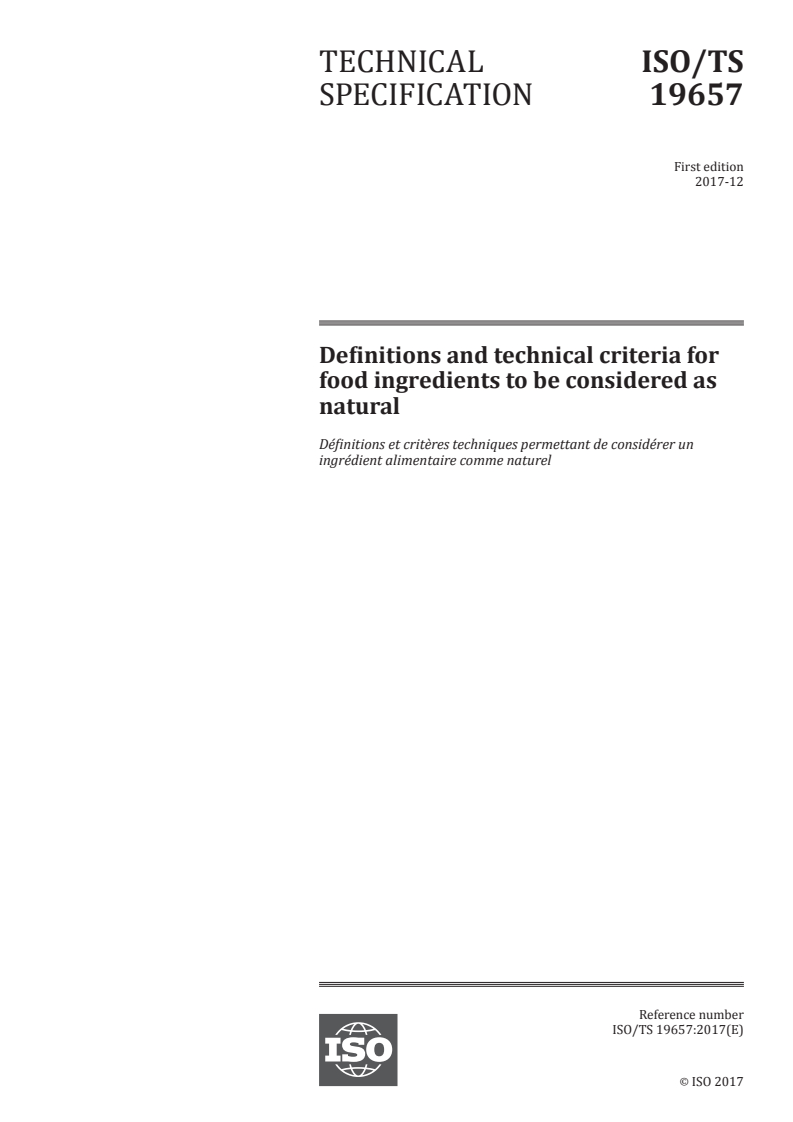
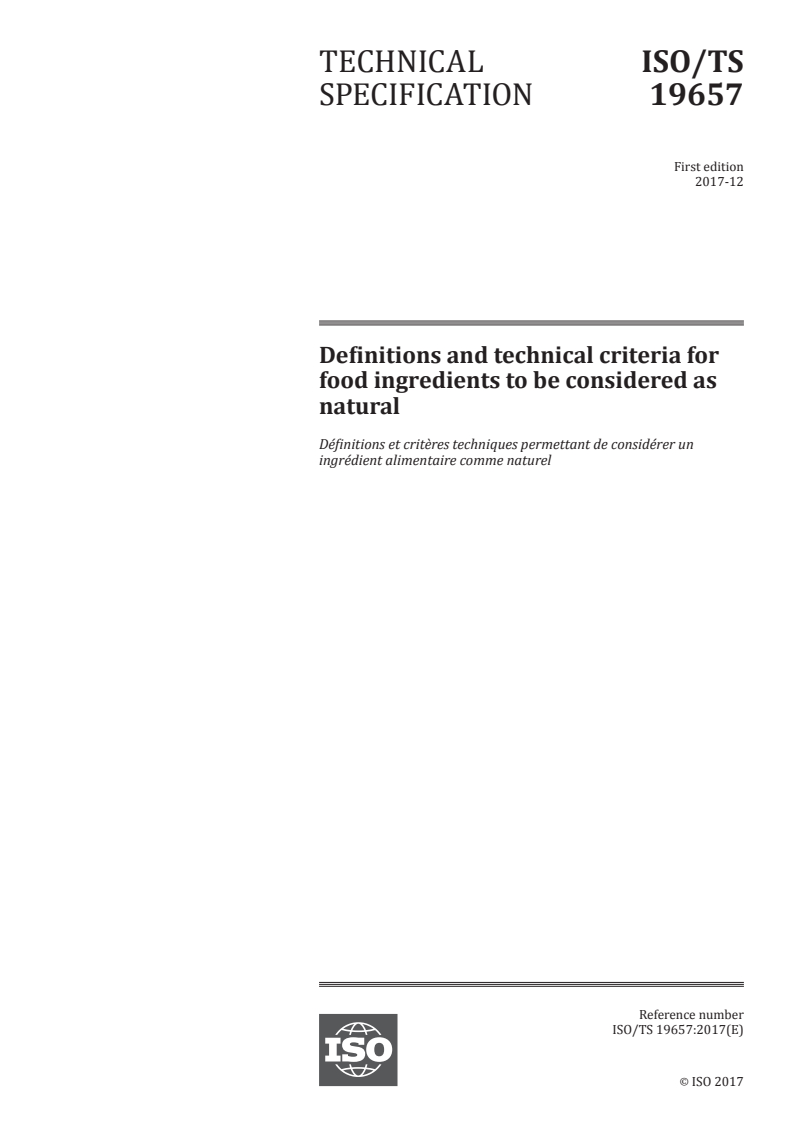
TECHNICAL ISO/TS
SPECIFICATION 19657
First edition
2017-12
Definitions and technical criteria for
food ingredients to be considered as
natural
Définitions et critères techniques permettant de considérer un
ingrédient alimentaire comme naturel
Reference number
©
ISO 2017
© ISO 2017, Published in Switzerland
All rights reserved. Unless otherwise specified, no part of this publication may be reproduced or utilized otherwise in any form
or by any means, electronic or mechanical, including photocopying, or posting on the internet or an intranet, without prior
written permission. Permission can be requested from either ISO at the address below or ISO’s member body in the country of
the requester.
ISO copyright office
Ch. de Blandonnet 8 • CP 401
CH-1214 Vernier, Geneva, Switzerland
Tel. +41 22 749 01 11
Fax +41 22 749 09 47
copyright@iso.org
www.iso.org
ii © ISO 2017 – All rights reserved
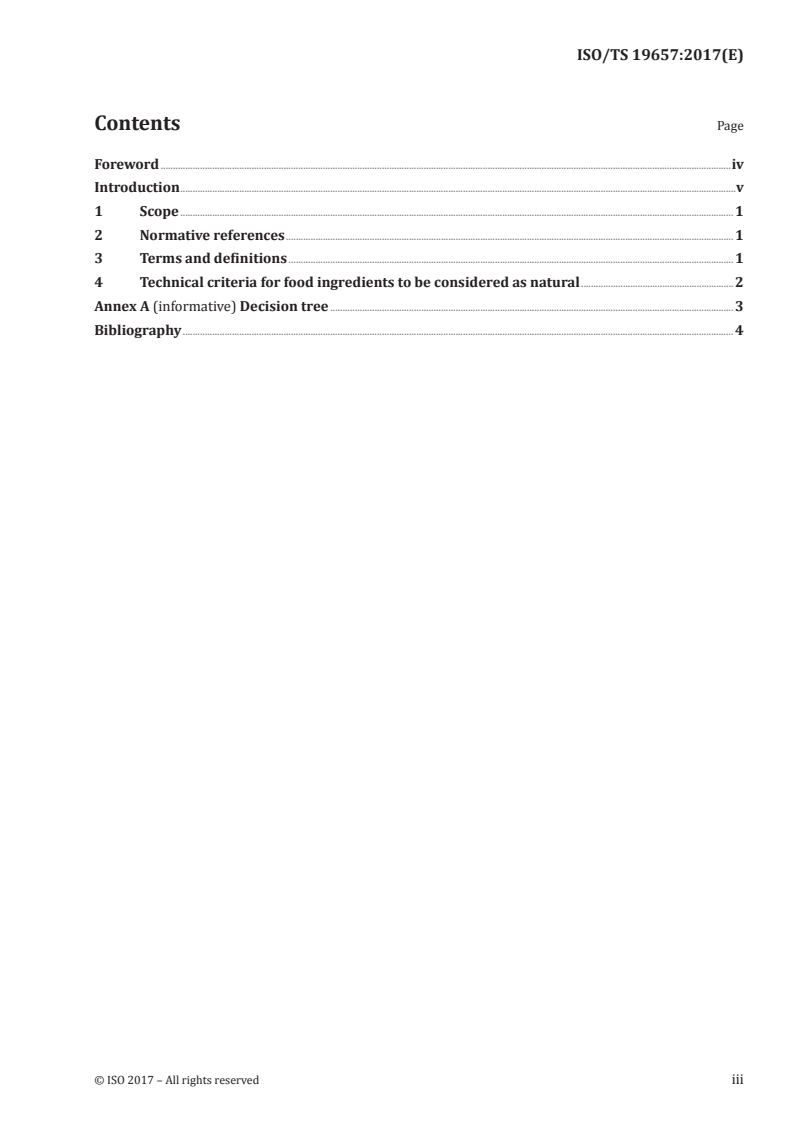
Contents Page
Foreword .iv
Introduction .v
1 Scope .1
2 Normative references .1
3 Terms and definitions .1
4 Technical criteria for food ingredients to be considered as natural .2
Annex A (informative) Decision tree .3
Bibliography .4
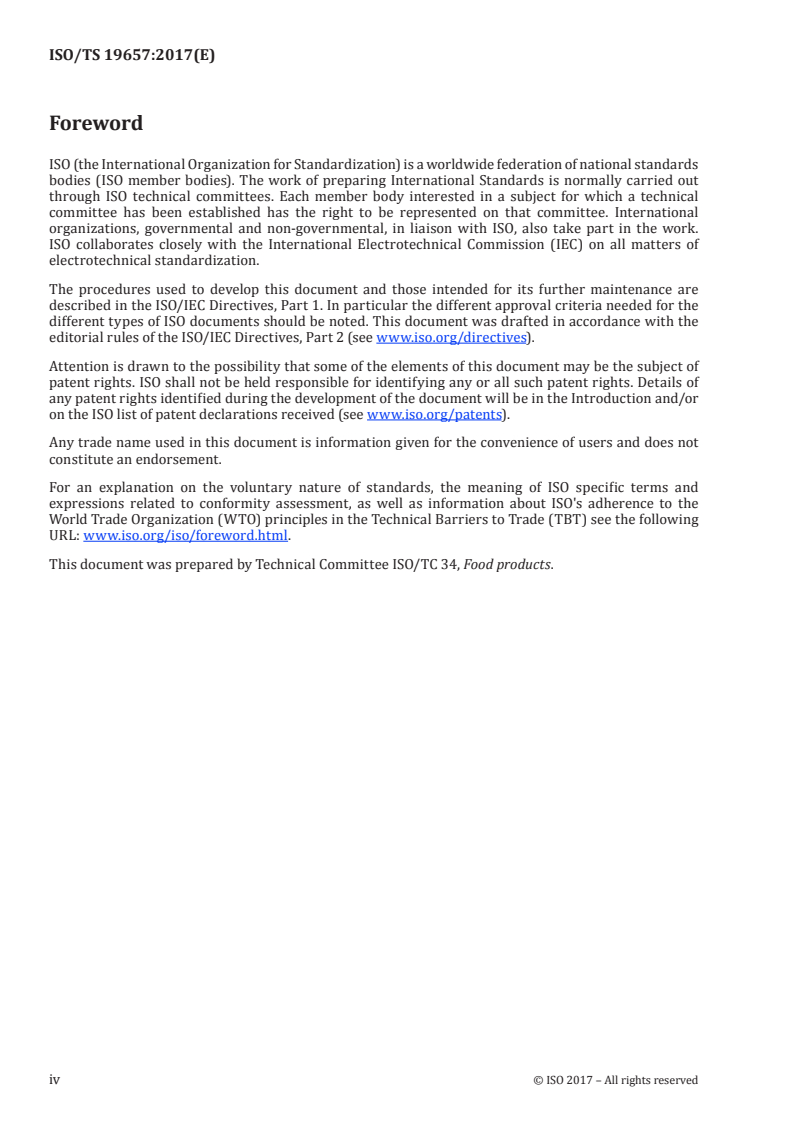
Foreword
ISO (the International Organization for Standardization) is a worldwide federation of national standards
bodies (ISO member bodies). The work of preparing International Standards is normally carried out
through ISO technical committees. Each member body interested in a subject for which a technical
committee has been established has the right to be represented on that committee. International
organizations, governmental and non-governmental, in liaison with ISO, also take part in the work.
ISO collaborates closely with the International Electrotechnical Commission (IEC) on all matters of
electrotechnical standardization.
The procedures used to develop this document and those intended for its further maintenance are
described in the ISO/IEC Directives, Part 1. In particular the different approval criteria needed for the
different types of ISO documents should be noted. This document was drafted in accordance with the
editorial rules of the ISO/IEC Directives, Part 2 (see www.iso.org/directives).
Attention is drawn to the possibility that some of the elements of this document may be the subject of
patent rights. ISO shall not be held responsible for identifying any or all such patent rights. Details of
any patent rights identified during the development of the document will be in the Introduction and/or
on the ISO list of patent declarations received (see www.iso.org/patents).
Any trade name used in this document is information given for the convenience of users and does not
constitute an endorsement.
For an explanation on the voluntary nature of standards, the meaning of ISO specific terms and
expressions related to conformity assessment, as well as information about ISO's adherence to the
World Trade Organization (WTO) principles in the Technical Barriers to Trade (TBT) see the following
URL: www.iso.org/iso/foreword.html.
This document was prepared by Technical Committee ISO/TC 34, Food products.
iv © ISO 2017 – All rights reserved
Introduction
The purpose of this document is to provide the technical criteria for food ingredients to be considered
as natural for use by the food and beverage industry at a global level.
The document offers technical criteria to all food and beverage companies, applicable to all
organizations, regardless of size or complexity. This document is intended for use in business-to-
business communications and relationships in the global food supply chain.
Conformity to this document helps to assure a level-playing field and fair practices in business-to-
business relationships.
This document is not intended to provide information to consumers about natural food ingredients as
consumer expectations vary widely around the world and from product to product.
NOTE Legally required information, claims o
...
TECHNICAL ISO/TS
SPECIFICATION 19657
First edition
2017-12
Definitions and technical criteria for
food ingredients to be considered as
natural
Définitions et critères techniques permettant de considérer un
ingrédient alimentaire comme naturel
Reference number
©
ISO 2017
© ISO 2017, Published in Switzerland
All rights reserved. Unless otherwise specified, no part of this publication may be reproduced or utilized otherwise in any form
or by any means, electronic or mechanical, including photocopying, or posting on the internet or an intranet, without prior
written permission. Permission can be requested from either ISO at the address below or ISO’s member body in the country of
the requester.
ISO copyright office
Ch. de Blandonnet 8 • CP 401
CH-1214 Vernier, Geneva, Switzerland
Tel. +41 22 749 01 11
Fax +41 22 749 09 47
copyright@iso.org
www.iso.org
ii © ISO 2017 – All rights reserved
Contents Page
Foreword .iv
Introduction .v
1 Scope .1
2 Normative references .1
3 Terms and definitions .1
4 Technical criteria for food ingredients to be considered as natural .2
Annex A (informative) Decision tree .3
Bibliography .4
Foreword
ISO (the International Organization for Standardization) is a worldwide federation of national standards
bodies (ISO member bodies). The work of preparing International Standards is normally carried out
through ISO technical committees. Each member body interested in a subject for which a technical
committee has been established has the right to be represented on that committee. International
organizations, governmental and non-governmental, in liaison with ISO, also take part in the work.
ISO collaborates closely with the International Electrotechnical Commission (IEC) on all matters of
electrotechnical standardization.
The procedures used to develop this document and those intended for its further maintenance are
described in the ISO/IEC Directives, Part 1. In particular the different approval criteria needed for the
different types of ISO documents should be noted. This document was drafted in accordance with the
editorial rules of the ISO/IEC Directives, Part 2 (see www.iso.org/directives).
Attention is drawn to the possibility that some of the elements of this document may be the subject of
patent rights. ISO shall not be held responsible for identifying any or all such patent rights. Details of
any patent rights identified during the development of the document will be in the Introduction and/or
on the ISO list of patent declarations received (see www.iso.org/patents).
Any trade name used in this document is information given for the convenience of users and does not
constitute an endorsement.
For an explanation on the voluntary nature of standards, the meaning of ISO specific terms and
expressions related to conformity assessment, as well as information about ISO's adherence to the
World Trade Organization (WTO) principles in the Technical Barriers to Trade (TBT) see the following
URL: www.iso.org/iso/foreword.html.
This document was prepared by Technical Committee ISO/TC 34, Food products.
iv © ISO 2017 – All rights reserved
Introduction
The purpose of this document is to provide the technical criteria for food ingredients to be considered
as natural for use by the food and beverage industry at a global level.
The document offers technical criteria to all food and beverage companies, applicable to all
organizations, regardless of size or complexity. This document is intended for use in business-to-
business communications and relationships in the global food supply chain.
Conformity to this document helps to assure a level-playing field and fair practices in business-to-
business relationships.
This document is not intended to provide information to consumers about natural food ingredients as
consumer expectations vary widely around the world and from product to product.
NOTE Legally required information, claims o
...