

ISO/IEC 19075-10:2024
(Main)Information technology — Guidance for the use of database language SQL — Part 10: SQL model (Guide/Model)
General Information
- Abstract
This document describes the model of database language SQL as defined in ISO/IEC 9075-1, ISO/IEC 9075-2, and ISO/IEC 9075-11. The meanings of and the relationships between various concepts of that model are described in text and illustrated graphically. Background in the form of some historical review and a brief overview of key SQL features is included. NOTE 2 — In spite of the fact that the names of the ISO/IEC 9075 series of standards contain the phrase “database language”, the standards do not use the word “database” to describe the thing that SQL creates and on which it operates. The word “database” is used in many different contexts and has meanings wholly unrelated to the intent of the ISO/IEC 9075 series. Consequently, a variety of other terms are defined and used by the ISO/IEC 9075 series. The word “database” is frequently used in this document informally to mean “a collection of data managed by an SQL-implementation at any given time.”
- Status
- Published
- Publication Date
- 14-Oct-2024
- Technical Committee
- ISO/IEC JTC 1/SC 32 - Data management and interchange
- Drafting Committee
- ISO/IEC JTC 1/SC 32 - Data management and interchange
- Current Stage
- 6060 - International Standard published
- Start Date
- 15-Oct-2024
- Due Date
- 10-Aug-2025
- Completion Date
- 15-Oct-2024
Overview
ISO/IEC 19075-10:2024 - "Information technology - Guidance for the use of database language SQL - Part 10: SQL model (Guide/Model)" is a guidance standard that describes the SQL model used across the ISO/IEC 9075 family. It explains the meanings and relationships of core SQL concepts (as defined in ISO/IEC 9075-1, -2 and -11), provides historical background and a high-level overview of key SQL features, and uses text plus graphical illustrations to clarify the model. Note: the ISO/IEC 9075 series avoids using the term “database” in a formal sense; this document nevertheless uses it informally to mean “a collection of data managed by an SQL-implementation at any given time.”
Key topics and technical coverage
This guide focuses on the conceptual and practical model of SQL and covers the following major topics:
- SQL model origin and components (relational model, syntax conventions, terminology)
- Data integrity (transactions, constraints, predicates, functional dependencies)
- Queries, expressions and statements (sets vs. multisets, query expressions, joins, subqueries, views)
- Data structure and metadata (definition schema, information schema, SQL descriptors)
- SQL environment and components (clients, servers, sessions, connections, client‑server model, cursors)
- Access methods (interactive SQL, module languages, embedded and dynamic SQL, Call-Level Interface)
- Active databases (referential integrity, referential actions, triggers)
- Transaction and security models (transaction isolation phenomena, user identification, privileges, owner/definer/invoker rights)
- Diagnostics and datatypes (SQLSTATE, diagnostics area, built-in and user-defined types)
- Schema creation/manipulation and conformance to ISO/IEC 9075
These topics are described conceptually and illustrated (tables, figures, examples) rather than prescribing implementation-specific details.
Practical applications and who should use it
ISO/IEC 19075-10:2024 is intended for:
- Database implementers and vendors building SQL-compliant products who need to align their internal models with ISO/IEC 9075 semantics.
- DBAs and system architects designing schemas, integrity constraints, and client-server deployments who require a formal model reference.
- Developers and integrators using embedded, dynamic or module-based SQL to understand interaction models and diagnostics.
- Standards writers, auditors and educators needing authoritative explanations of SQL concepts and terminology.
Use cases include clarifying integrity and transaction behavior, designing metadata or information-schema-aware tools, and documenting conformance requirements.
Related standards
- ISO/IEC 9075 series (SQL): especially parts 1, 2 and 11 referenced by this guide.
- Other ISO/IEC 19075 parts for SQL guidance as applicable.
Keywords: ISO/IEC 19075-10:2024, SQL model, SQL standard guidance, data integrity, transactions, embedded SQL, information schema, SQL diagnostics, ISO/IEC 9075.
Relations
- Effective Date
- 13-Aug-2022
- Effective Date
- 13-Aug-2022
Get Certified
Connect with accredited certification bodies for this standard

BSI Group
BSI (British Standards Institution) is the business standards company that helps organizations make excellence a habit.

NYCE
Mexican standards and certification body.
Sponsored listings
Frequently Asked Questions
ISO/IEC 19075-10:2024 is a standard published by the International Organization for Standardization (ISO). Its full title is "Information technology — Guidance for the use of database language SQL — Part 10: SQL model (Guide/Model)". This standard covers: This document describes the model of database language SQL as defined in ISO/IEC 9075-1, ISO/IEC 9075-2, and ISO/IEC 9075-11. The meanings of and the relationships between various concepts of that model are described in text and illustrated graphically. Background in the form of some historical review and a brief overview of key SQL features is included. NOTE 2 — In spite of the fact that the names of the ISO/IEC 9075 series of standards contain the phrase “database language”, the standards do not use the word “database” to describe the thing that SQL creates and on which it operates. The word “database” is used in many different contexts and has meanings wholly unrelated to the intent of the ISO/IEC 9075 series. Consequently, a variety of other terms are defined and used by the ISO/IEC 9075 series. The word “database” is frequently used in this document informally to mean “a collection of data managed by an SQL-implementation at any given time.”
This document describes the model of database language SQL as defined in ISO/IEC 9075-1, ISO/IEC 9075-2, and ISO/IEC 9075-11. The meanings of and the relationships between various concepts of that model are described in text and illustrated graphically. Background in the form of some historical review and a brief overview of key SQL features is included. NOTE 2 — In spite of the fact that the names of the ISO/IEC 9075 series of standards contain the phrase “database language”, the standards do not use the word “database” to describe the thing that SQL creates and on which it operates. The word “database” is used in many different contexts and has meanings wholly unrelated to the intent of the ISO/IEC 9075 series. Consequently, a variety of other terms are defined and used by the ISO/IEC 9075 series. The word “database” is frequently used in this document informally to mean “a collection of data managed by an SQL-implementation at any given time.”
ISO/IEC 19075-10:2024 is classified under the following ICS (International Classification for Standards) categories: 35.060 - Languages used in information technology. The ICS classification helps identify the subject area and facilitates finding related standards.
ISO/IEC 19075-10:2024 has the following relationships with other standards: It is inter standard links to ISO/IEC 19075-2:2021, ISO/IEC 19075-1:2021. Understanding these relationships helps ensure you are using the most current and applicable version of the standard.
ISO/IEC 19075-10:2024 is available in PDF format for immediate download after purchase. The document can be added to your cart and obtained through the secure checkout process. Digital delivery ensures instant access to the complete standard document.
Standards Content (Sample)
International
Standard
ISO/IEC 19075-10
First edition
Information technology —
2024-10
Guidance for the use of database
language SQL —
Part 10:
SQL model (Guide/Model)
Reference number
© ISO/IEC 2024
All rights reserved. Unless otherwise specified, or required in the context of its implementation, no part of this publication may
be reproduced or utilized otherwise in any form or by any means, electronic or mechanical, including photocopying, or posting on
the internet or an intranet, without prior written permission. Permission can be requested from either ISO at the address below
or ISO’s member body in the country of the requester.
ISO copyright office
CP 401 • Ch. de Blandonnet 8
CH-1214 Vernier, Geneva
Phone: +41 22 749 01 11
Email: copyright@iso.org
Website: www.iso.org
Published in Switzerland
© ISO/IEC 2024 – All rights reserved
ii
ISO/IEC19075-10:2024(en)
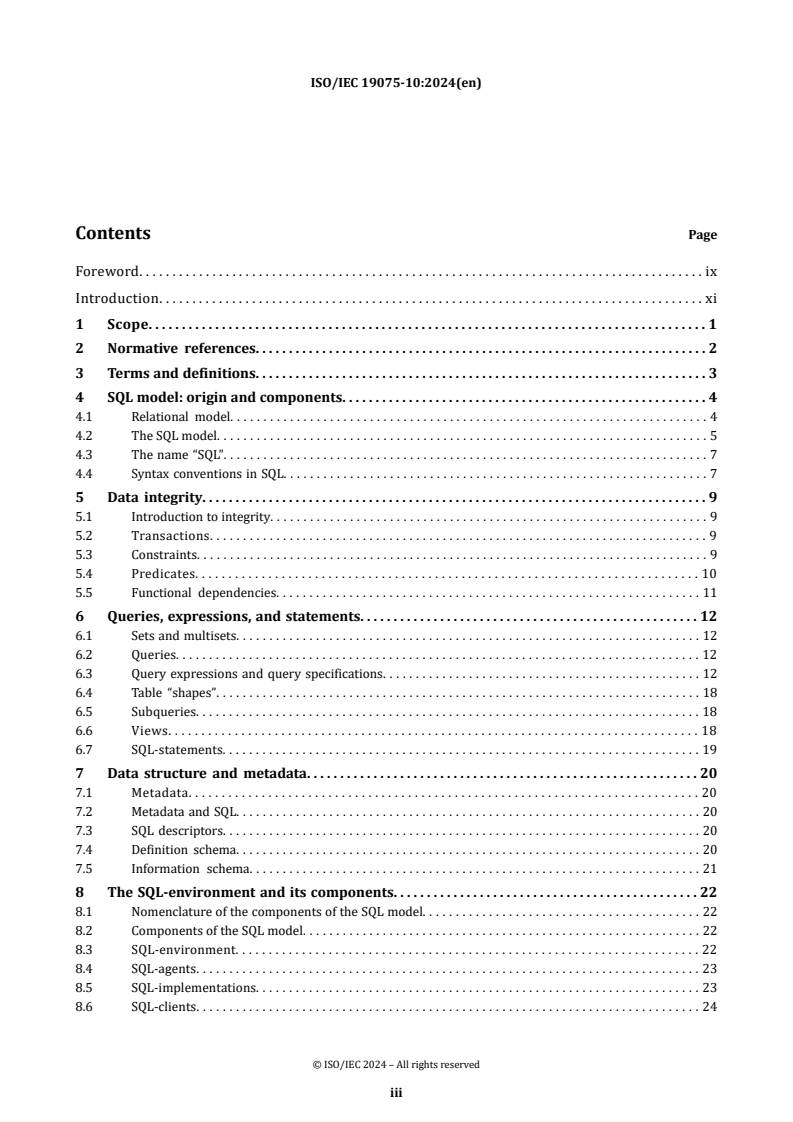
Contents Page
Foreword. . . . . . . . . . . . . . . . . . . . . . . . . . . . . . . . . . . . . . . . . . . . . . . . . . . . . . . . . . . . . . . . . . . . . . . . . . . . . . . . . . . . . ix
Introduction. . . . . . . . . . . . . . . . . . . . . . . . . . . . . . . . . . . . . . . . . . . . . . . . . . . . . . . . . . . . . . . . . . . . . . . . . . . . . . . . . . xi
1 Scope.1
2 Normativereferences.2
3 Termsanddefinitions.3
4 SQLmodel:originandcomponents.4
4.1 Relational model. . . . . . . . . . . . . . . . . . . . . . . . . . . . . . . . . . . . . . . . . . . . . . . . . . . . . . . . . . . . . . . . . . . . . . . . 4
4.2 The SQL model. . . . . . . . . . . . . . . . . . . . . . . . . . . . . . . . . . . . . . . . . . . . . . . . . . . . . . . . . . . . . . . . . . . . . . . . . . 5
4.3 The name “SQL”. . . . . . . . . . . . . . . . . . . . . . . . . . . . . . . . . . . . . . . . . . . . . . . . . . . . . . . . . . . . . . . . . . . . . . . . . 7
4.4 Syntax conventions in SQL. . . . . . . . . . . . . . . . . . . . . . . . . . . . . . . . . . . . . . . . . . . . . . . . . . . . . . . . . . . . . . . . 7
5 Dataintegrity.9
5.1 Introduction to integrity. . . . . . . . . . . . . . . . . . . . . . . . . . . . . . . . . . . . . . . . . . . . . . . . . . . . . . . . . . . . . . . . . . 9
5.2 Transactions. . . . . . . . . . . . . . . . . . . . . . . . . . . . . . . . . . . . . . . . . . . . . . . . . . . . . . . . . . . . . . . . . . . . . . . . . . . 9
5.3 Constraints. . . . . . . . . . . . . . . . . . . . . . . . . . . . . . . . . . . . . . . . . . . . . . . . . . . . . . . . . . . . . . . . . . . . . . . . . . . . . 9
5.4 Predicates. . . . . . . . . . . . . . . . . . . . . . . . . . . . . . . . . . . . . . . . . . . . . . . . . . . . . . . . . . . . . . . . . . . . . . . . . . . . 10
5.5 Functional dependencies. . . . . . . . . . . . . . . . . . . . . . . . . . . . . . . . . . . . . . . . . . . . . . . . . . . . . . . . . . . . . . . . 11
6 Queries,expressions,andstatements.12
6.1 Sets and multisets. . . . . . . . . . . . . . . . . . . . . . . . . . . . . . . . . . . . . . . . . . . . . . . . . . . . . . . . . . . . . . . . . . . . . . 12
6.2 Queries. . . . . . . . . . . . . . . . . . . . . . . . . . . . . . . . . . . . . . . . . . . . . . . . . . . . . . . . . . . . . . . . . . . . . . . . . . . . . . . 12
6.3 Query expressions and query specifications. . . . . . . . . . . . . . . . . . . . . . . . . . . . . . . . . . . . . . . . . . . . . . . . 12
6.4 Table “shapes”. . . . . . . . . . . . . . . . . . . . . . . . . . . . . . . . . . . . . . . . . . . . . . . . . . . . . . . . . . . . . . . . . . . . . . . . . 18
6.5 Subqueries. . . . . . . . . . . . . . . . . . . . . . . . . . . . . . . . . . . . . . . . . . . . . . . . . . . . . . . . . . . . . . . . . . . . . . . . . . . . 18
6.6 Views. . . . . . . . . . . . . . . . . . . . . . . . . . . . . . . . . . . . . . . . . . . . . . . . . . . . . . . . . . . . . . . . . . . . . . . . . . . . . . . . 18
6.7 SQL-statements. . . . . . . . . . . . . . . . . . . . . . . . . . . . . . . . . . . . . . . . . . . . . . . . . . . . . . . . . . . . . . . . . . . . . . . . 19
7 Datastructureandmetadata.20
7.1 Metadata. . . . . . . . . . . . . . . . . . . . . . . . . . . . . . . . . . . . . . . . . . . . . . . . . . . . . . . . . . . . . . . . . . . . . . . . . . . . . 20
7.2 Metadata and SQL. . . . . . . . . . . . . . . . . . . . . . . . . . . . . . . . . . . . . . . . . . . . . . . . . . . . . . . . . . . . . . . . . . . . . . 20
7.3 SQL descriptors. . . . . . . . . . . . . . . . . . . . . . . . . . . . . . . . . . . . . . . . . . . . . . . . . . . . . . . . . . . . . . . . . . . . . . . . 20
7.4 Definition schema. . . . . . . . . . . . . . . . . . . . . . . . . . . . . . . . . . . . . . . . . . . . . . . . . . . . . . . . . . . . . . . . . . . . . . 20
7.5 Information schema. . . . . . . . . . . . . . . . . . . . . . . . . . . . . . . . . . . . . . . . . . . . . . . . . . . . . . . . . . . . . . . . . . . . 21
8 TheSQL-environmentanditscomponents.22
8.1 Nomenclature of the components of the SQL model. . . . . . . . . . . . . . . . . . . . . . . . . . . . . . . . . . . . . . . . . . 22
8.2 Components of the SQL model. . . . . . . . . . . . . . . . . . . . . . . . . . . . . . . . . . . . . . . . . . . . . . . . . . . . . . . . . . . . 22
8.3 SQL-environment. . . . . . . . . . . . . . . . . . . . . . . . . . . . . . . . . . . . . . . . . . . . . . . . . . . . . . . . . . . . . . . . . . . . . . 22
8.4 SQL-agents. . . . . . . . . . . . . . . . . . . . . . . . . . . . . . . . . . . . . . . . . . . . . . . . . . . . . . . . . . . . . . . . . . . . . . . . . . . . 23
8.5 SQL-implementations. . . . . . . . . . . . . . . . . . . . . . . . . . . . . . . . . . . . . . . . . . . . . . . . . . . . . . . . . . . . . . . . . . . 23
8.6 SQL-clients. . . . . . . . . . . . . . . . . . . . . . . . . . . . . . . . . . . . . . . . . . . . . . . . . . . . . . . . . . . . . . . . . . . . . . . . . . . . 24
© ISO/IEC 2024 – All rights reserved
iii
ISO/IEC19075-10:2024(en)
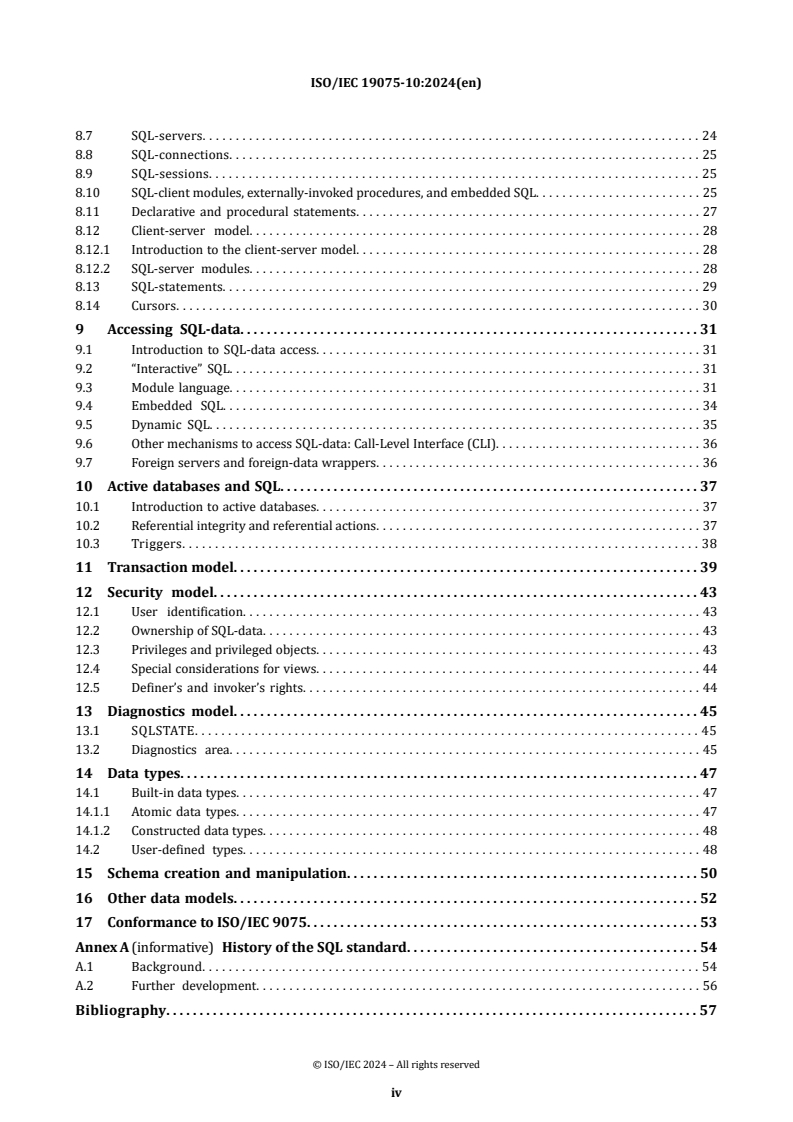
8.7 SQL-servers. . . . . . . . . . . . . . . . . . . . . . . . . . . . . . . . . . . . . . . . . . . . . . . . . . . . . . . . . . . . . . . . . . . . . . . . . . . 24
8.8 SQL-connections. . . . . . . . . . . . . . . . . . . . . . . . . . . . . . . . . . . . . . . . . . . . . . . . . . . . . . . . . . . . . . . . . . . . . . . 25
8.9 SQL-sessions. . . . . . . . . . . . . . . . . . . . . . . . . . . . . . . . . . . . . . . . . . . . . . . . . . . . . . . . . . . . . . . . . . . . . . . . . . 25
8.10 SQL-client modules, externally-invoked procedures, and embedded SQL. . . . . . . . . . . . . . . . . . . . . . . . . 25
8.11 Declarative and procedural statements. . . . . . . . . . . . . . . . . . . . . . . . . . . . . . . . . . . . . . . . . . . . . . . . . . . . 27
8.12 Client-server model. . . . . . . . . . . . . . . . . . . . . . . . . . . . . . . . . . . . . . . . . . . . . . . . . . . . . . . . . . . . . . . . . . . . 28
8.12.1 Introduction to the client-server model. . . . . . . . . . . . . . . . . . . . . . . . . . . . . . . . . . . . . . . . . . . . . . . . . . . . 28
8.12.2 SQL-server modules. . . . . . . . . . . . . . . . . . . . . . . . . . . . . . . . . . . . . . . . . . . . . . . . . . . . . . . . . . . . . . . . . . . . 28
8.13 SQL-statements. . . . . . . . . . . . . . . . . . . . . . . . . . . . . . . . . . . . . . . . . . . . . . . . . . . . . . . . . . . . . . . . . . . . . . . . 29
8.14 Cursors. . . . . . . . . . . . . . . . . . . . . . . . . . . . . . . . . . . . . . . . . . . . . . . . . . . . . . . . . . . . . . . . . . . . . . . . . . . . . . . 30
9 Accessing SQL-data.31
9.1 Introduction to SQL-data access. . . . . . . . . . . . . . . . . . . . . . . . . . . . . . . . . . . . . . . . . . . . . . . . . . . . . . . . . . 31
9.2 “Interactive” SQL. . . . . . . . . . . . . . . . . . . . . . . . . . . . . . . . . . . . . . . . . . . . . . . . . . . . . . . . . . . . . . . . . . . . . . . 31
9.3 Module language. . . . . . . . . . . . . . . . . . . . . . . . . . . . . . . . . . . . . . . . . . . . . . . . . . . . . . . . . . . . . . . . . . . . . . . 31
9.4 Embedded SQL. . . . . . . . . . . . . . . . . . . . . . . . . . . . . . . . . . . . . . . . . . . . . . . . . . . . . . . . . . . . . . . . . . . . . . . . 34
9.5 Dynamic SQL. . . . . . . . . . . . . . . . . . . . . . . . . . . . . . . . . . . . . . . . . . . . . . . . . . . . . . . . . . . . . . . . . . . . . . . . . . 35
9.6 Other mechanisms to access SQL-data: Call-Level Interface (CLI). . . . . . . . . . . . . . . . . . . . . . . . . . . . . . . 36
9.7 Foreign servers and foreign-data wrappers. . . . . . . . . . . . . . . . . . . . . . . . . . . . . . . . . . . . . . . . . . . . . . . . . 36
10 ActivedatabasesandSQL.37
10.1 Introduction to active databases. . . . . . . . . . . . . . . . . . . . . . . . . . . . . . . . . . . . . . . . . . . . . . . . . . . . . . . . . . 37
10.2 Referential integrity and referential actions. . . . . . . . . . . . . . . . . . . . . . . . . . . . . . . . . . . . . . . . . . . . . . . . . 37
10.3 Triggers. . . . . . . . . . . . . . . . . . . . . . . . . . . . . . . . . . . . . . . . . . . . . . . . . . . . . . . . . . . . . . . . . . . . . . . . . . . . . . 38
11 Transactionmodel.39
12 Security model.43
12.1 User identification. . . . . . . . . . . . . . . . . . . . . . . . . . . . . . . . . . . . . . . . . . . . . . . . . . . . . . . . . . . . . . . . . . . . . 43
12.2 Ownership of SQL-data. . . . . . . . . . . . . . . . . . . . . . . . . . . . . . . . . . . . . . . . . . . . . . . . . . . . . . . . . . . . . . . . . . 43
12.3 Privileges and privileged objects. . . . . . . . . . . . . . . . . . . . . . . . . . . . . . . . . . . . . . . . . . . . . . . . . . . . . . . . . . 43
12.4 Special considerations for views. . . . . . . . . . . . . . . . . . . . . . . . . . . . . . . . . . . . . . . . . . . . . . . . . . . . . . . . . . 44
12.5 Definer’s and invoker’s rights. . . . . . . . . . . . . . . . . . . . . . . . . . . . . . . . . . . . . . . . . . . . . . . . . . . . . . . . . . . . 44
13 Diagnosticsmodel.45
13.1 SQLSTATE. . . . . . . . . . . . . . . . . . . . . . . . . . . . . . . . . . . . . . . . . . . . . . . . . . . . . . . . . . . . . . . . . . . . . . . . . . . . 45
13.2 Diagnostics area. . . . . . . . . . . . . . . . . . . . . . . . . . . . . . . . . . . . . . . . . . . . . . . . . . . . . . . . . . . . . . . . . . . . . . . 45
14 Datatypes.47
14.1 Built-in data types. . . . . . . . . . . . . . . . . . . . . . . . . . . . . . . . . . . . . . . . . . . . . . . . . . . . . . . . . . . . . . . . . . . . . . 47
14.1.1 Atomic data types. . . . . . . . . . . . . . . . . . . . . . . . . . . . . . . . . . . . . . . . . . . . . . . . . . . . . . . . . . . . . . . . . . . . . . 47
14.1.2 Constructed data types. . . . . . . . . . . . . . . . . . . . . . . . . . . . . . . . . . . . . . . . . . . . . . . . . . . . . . . . . . . . . . . . . . 48
14.2 User-defined types. . . . . . . . . . . . . . . . . . . . . . . . . . . . . . . . . . . . . . . . . . . . . . . . . . . . . . . . . . . . . . . . . . . . . 48
15 Schemacreationandmanipulation.50
16 Otherdatamodels.52
17 ConformancetoISO/IEC9075.53
AnnexA (informative) HistoryoftheSQLstandard.54
A.1 Background. . . . . . . . . . . . . . . . . . . . . . . . . . . . . . . . . . . . . . . . . . . . . . . . . . . . . . . . . . . . . . . . . . . . . . . . . . . 54
A.2 Further development. . . . . . . . . . . . . . . . . . . . . . . . . . . . . . . . . . . . . . . . . . . . . . . . . . . . . . . . . . . . . . . . . . . 56
Bibliography.57
© ISO/IEC 2024 – All rights reserved
iv
ISO/IEC19075-10:2024(en)
Index.59
© ISO/IEC 2024 – All rights reserved
v
ISO/IEC19075-10:2024(en)
Tables
Table Page
1 Dirty read. . . . . . . . . . . . . . . . . . . . . . . . . . . . . . . . . . . . . . . . . . . . . . . . . . . . . . . . . . . . . . . . . . . . . . . . . . . . . . . . 39
2 Non-repeatable read. . . . . . . . . . . . . . . . . . . . . . . . . . . . . . . . . . . . . . . . . . . . . . . . . . . . . . . . . . . . . . . . . . . . . . . 40
3 Phantom read. . . . . . . . . . . . . . . . . . . . . . . . . . . . . . . . . . . . . . . . . . . . . . . . . . . . . . . . . . . . . . . . . . . . . . . . . . . . . 40
© ISO/IEC 2024 – All rights reserved
vi
ISO/IEC19075-10:2024(en)
Figures
Figure Page
1 Illustration of an SQL table. . . . . . . . . . . . . . . . . . . . . . . . . . . . . . . . . . . . . . . . . . . . . . . . . . . . . . . . . . . . . . . . . . . 6
2 Primary key — Foreign key relationships. . . . . . . . . . . . . . . . . . . . . . . . . . . . . . . . . . . . . . . . . . . . . . . . . . . . . . 10
3 Cartesian product. . . . . . . . . . . . . . . . . . . . . . . . . . . . . . . . . . . . . . . . . . . . . . . . . . . . . . . . . . . . . . . . . . . . . . . . . . 13
4 Filtering. . . . . . . . . . . . . . . . . . . . . . . . . . . . . . . . . . . . . . . . . . . . . . . . . . . . . . . . . . . . . . . . . . . . . . . . . . . . . . . . . . 15
5 Grouping. . . . . . . . . . . . . . . . . . . . . . . . . . . . . . . . . . . . . . . . . . . . . . . . . . . . . . . . . . . . . . . . . . . . . . . . . . . . . . . . . 16
6 Projection. . . . . . . . . . . . . . . . . . . . . . . . . . . . . . . . . . . . . . . . . . . . . . . . . . . . . . . . . . . . . . . . . . . . . . . . . . . . . . . . 17
7 First approximation of SQL-environment. . . . . . . . . . . . . . . . . . . . . . . . . . . . . . . . . . . . . . . . . . . . . . . . . . . . . . 24
8 Second approximation of SQL-environment. . . . . . . . . . . . . . . . . . . . . . . . . . . . . . . . . . . . . . . . . . . . . . . . . . . . 25
9 Relationship between SQL-client, SQL-client module, and SQL-statement. . . . . . . . . . . . . . . . . . . . . . . . . . . . 26
10 Transformation from embedded SQL to externally-invoked procedure. . . . . . . . . . . . . . . . . . . . . . . . . . . . . . 27
11 Minimizing client-server context changes. . . . . . . . . . . . . . . . . . . . . . . . . . . . . . . . . . . . . . . . . . . . . . . . . . . . . . 29
© ISO/IEC 2024 – All rights reserved
vii
ISO/IEC19075-10:2024(en)
Examples
Example Page
1 Search condition. . . . . . . . . . . . . . . . . . . . . . . . . . . . . . . . . . . . . . . . . . . . . . . . . . . . . . . . . . . . . . . . . . . . . . . . . . . 11
2 Query specification. . . . . . . . . . . . . . . . . . . . . . . . . . . . . . . . . . . . . . . . . . . . . . . . . . . . . . . . . . . . . . . . . . . . . . . . 12
3 Join based on equality. . . . . . . . . . . . . . . . . . . . . . . . . . . . . . . . . . . . . . . . . . . . . . . . . . . . . . . . . . . . . . . . . . . . . . 14
4 Subquery use. . . . . . . . . . . . . . . . . . . . . . . . . . . . . . . . . . . . . . . . . . . . . . . . . . . . . . . . . . . . . . . . . . . . . . . . . . . . . 18
5 Example of direct invocation. . . . . . . . . . . . . . . . . . . . . . . . . . . . . . . . . . . . . . . . . . . . . . . . . . . . . . . . . . . . . . . . . 31
6 Module language example: SQL code fragment. . . . . . . . . . . . . . . . . . . . . . . . . . . . . . . . . . . . . . . . . . . . . . . . . . 32
7 Module language example: COBOL code fragment. . . . . . . . . . . . . . . . . . . . . . . . . . . . . . . . . . . . . . . . . . . . . . . 32
8 Embedded SQL example. . . . . . . . . . . . . . . . . . . . . . . . . . . . . . . . . . . . . . . . . . . . . . . . . . . . . . . . . . . . . . . . . . . . 34
© ISO/IEC 2024 – All rights reserved
viii
ISO/IEC19075-10:2024(en)
Foreword
ISO (the International Organization for Standardization) and IEC (the International Electrotechnical
Commission) form the specialized system for worldwide standardization. National bodies that are
members of ISO or IEC participate in the development of International Standards through technical
committees established by the respective organization to deal with particular fields of technical activity.
ISO and IEC technical committees collaborate in fields of mutual interest. Other international organizations,
governmental and non-governmental, in liaison with ISO and IEC, also take part in the work.
The procedures used to develop this document and those intended for its further maintenance are
described in the ISO/IEC Directives, Part 1. In particular, the different approval criteria needed for the
different types of document should be noted. This document was drafted in accordance with the editorial
rules of the ISO/IEC Directives, Part 2 (seehttps://www.iso.org/directives or
https://www.iec.ch/members_experts/refdocs).
ISO and IEC draw attention to the possibility that the implementation of this document may involve the
use of (a) patent(s). ISO and IEC take no position concerning the evidence, validity or applicability of any
claimed patent rights in respect thereof. As of the date of publication of this document, ISO and IEC had
not received notice of (a) patent(s) which may be required to implement this document. However,
implementers are cautioned that this may not represent the latest information, which may be obtained
from the patent database available athttps://www.iso.org/patents andhttps://pat-
ents.iec.ch. ISO and IEC shall not be held responsible for identifying any or all such patent rights.
Any trade name used in this document is information given for the convenience of users and does not
constitute an endorsement.
For an explanation of the voluntary nature of standards, the meaning of ISO specific terms and expressions
related to conformity assessment, as well as information about ISO’s adherence to the World Trade
Organization (WTO) principles in the Technical Barriers to Trade (TBT) see
https://www.iso.org/iso/foreword.html. In the IEC, seehttps://www.iec.ch/under-
standing-standards.
This document was prepared by Joint Technical Committee ISO/IEC JTC 1,Informationtechnology, Sub-
committee SC 32,Datamanagementandinterchange.
This document is intended to be used in conjunction with the following editions of the parts of the ISO/IEC
9075 series:
— ISO/IEC 9075-1, sixth edition or later;
— ISO/IEC 9075-2, sixth edition or later;
— ISO/IEC 9075-3, sixth edition or later;
— ISO/IEC 9075-4, seventh edition or later;
— ISO/IEC 9075-9, fifth edition or later;
— ISO/IEC 9075-10, fifth edition or later;
— ISO/IEC 9075-11, fifth edition or later;
— ISO/IEC 9075-13, fifth edition or later;
— ISO/IEC 9075-14, sixth edition or later;
— ISO/IEC 9075-15, second edition or later;
— ISO/IEC 9075-16, first edition or later.
© ISO/IEC 2024 – All rights reserved
ix
ISO/IEC19075-10:2024(en)
A list of all parts in the ISO/IEC 19075 series can be found on the ISO and IEC websites.
Any feedback or questions on this document should be directed to the user’s national standards body. A
complete listing of these bodies can be found athttps://www.iso.org/members.html and
https://www.iec.ch/national-committees.
© ISO/IEC 2024 – All rights reserved
x
ISO/IEC19075-10:2024(en)
Introduction
This document describes the model of database language SQL, as defined primarily in ISO/IEC 9075-1
and ISO/IEC 9075-2. It supplies some background in the form of a brief history of the relational data
model, plus a brief overview of some SQL features relevant to the SQL model.
The SQL model, of course, existed from the initial definition of the language, but was not explicitly
recognized until the language became sufficiently complex that appropriate vocabulary and definitions
were required to accurately specify all capabilities required.
This document summarizes the result of hundreds of hours of discussion and analysis that were required
in order to create a coherent and useful definition of the SQL model of operation. This document briefly
outlines the Relational model popularized by E.F. Codd. However, the fundamental structure and content
of this document addresses SQL language facilities such as tables, column, relationships, and operations,
not the Relational model itself.
Since SQL’s adoption in 1986 as a database language standard, many extensions have been proposed,
defined, reviewed, modified, and adopted by members of SQL-related standards committees across the
world. While the SQL model herein addresses only a small subset of the SQL language’s data management
facilities, SQL’s overall scope includes non-relational data types, object classes, multi-level data structures,
and even DBMS-generated pointers to rows that appear as if they were user-based values. Supporting
all all these SQL capabilities, there exists extensive and formally-defined language constructs that (when
correctly implemented by SQL database implementers) provide a data definition and processing envir-
onment that is reliable and repeatable across all SQL standard-adherent implementations.
NOTE 1 — In this document, the terms “SQL” and “SQL language” are used as synonyms. The terms “SQL
standard”, “ISO/IEC 9075”, and “the ISO/IEC 9075 series” are used as synonyms and refer to the standard for
SQL [language], which is the ISO/IEC 9075 series of standards.
© ISO/IEC 2024 – All rights reserved
xi
InternationalStandard ISO/IEC19075-10:2024(en)
Informationtechnology—GuidancefortheuseofdatabaselanguageSQL—
Part 10:
SQLmodel(Guide/Model)
1 Scope
This document describes the model of database language SQL as defined in ISO/IEC 9075-1, ISO/IEC
9075-2, and ISO/IEC 9075-11. The meanings of and the relationships between various concepts of that
model are described in text and illustrated graphically. Background in the form of some historical review
and a brief overview of key SQL features is included.
NOTE 2 — In spite of the fact that the names of the ISO/IEC 9075 series of standards contain the phrase
“database language”, the standards do not use the word “database” to describe thething that SQL creates and
on which it operates. The word “database” is used in many different contexts and has meanings wholly unrelated
to the intent of the ISO/IEC 9075 series. Consequently, a variety of other terms are defined and used by the
ISO/IEC 9075 series. The word “database” is frequently used in this document informally to mean “a collection
of data managed by an SQL-implementation at any given time.”
© ISO/IEC 2024 – All rights reserved
ISO/IEC19075-10:2024(en)
2 Normativereferences
The following documents are referred to in the text in such a way that some or all of their content consti-
tutes requirements of this document. For dated references, only the edition cited applies. For undated
references, the latest edition of the referenced document (including any amendments) applies.
ISO/IEC 9075-1,Informationtechnology—Databaselanguages—SQL—Part1:Framework
(SQL/Framework)
ISO/IEC 9075-2,Informationtechnology—Databaselanguages—SQL—Part2:Foundation
(SQL/Foundation)
ISO/IEC 9075-11,Informationtechnology—Databaselanguages—SQL—Part11:Informationand
DefinitionSchemas(SQL/Schemata)
© ISO/IEC 2024 – All rights reserved
ISO/IEC19075-10:2024(en)
3 Termsanddefinitions
For the purposes of this document, the terms and definitions given in ISO/IEC 9075-1, ISO/IEC 9075-2,
and ISO/IEC 9075-11 apply.
ISO and IEC maintain terminological databases for use in standardization at the following addresses:
— ISO Online browsing platform: available athttps://www.iso.org/obp
— IEC Electropedia: available athttps://www.electropedia.org/
© ISO/IEC 2024 – All rights reserved
ISO/IEC19075-10:2024(en)
4 SQLmodel:originandcomponents
4.1 Relationalmodel
In 1970, Dr. E.F. Codd published Relational Model [32]. Dr. Codd’s premise was that “users of large data
banks must be protected from having to know how the data is organized in the machine”. The computer
industry had years of experience with database management systems such as:
— IBM’s Information Management System (IMS)™ that used a hierarchical model to organize data;
— The Conference/Committee on Data Systems Languages and its CODASYL data model that managed
relationships between data records using chains of “pointers” (often called a “network database
system”);
— The American National Standard ANSI X3.133:1986 [2] and its International Standard companion
ISO 8907:1987 [1], which was a standardized specification of a CODASYL-like language;
— Cincom System, Inc.’s TOTAL™, which was a database management system that combined hierarchical
and network data management techniques.
Such systems offered high-performance access to data, particularly data that was closely related to data
currently accessed, provided there were predefined, relevant links (or pointers) to that related data.
Unfortunately, those links werebuiltinto the data as stored in the database system and it was not possible
to easily reorganize them.
Codd’s belief was that it was not necessary for application programs and other users to have intimate
knowledge of the manner in which data was organized in persistent storage, nor to suffer the performance
problems caused by a change in application requirements that rendered existing data relationships
unhelpful.
Therelationalmodelofdata, as Codd’s work is universally known, separated the logical organization of
data from its physical organization and used straightforward mathematical definitions to identify rela-
tionships among data on demand by application requirements.
The relational model defines collections of closely-related data as “relations” (sets of tuples); each “tuple”
(set of elements) is therefore unique within its containing relation. Every relation is described by a
metadata structure called a “relation scheme”, which is a set of “attributes”. Each attribute is identified
by a unique name or by its ordinal position within the scheme, and has a datatype. In the relational model,
each element of a tuple is mapped to a scheme attribute, and every tuple has the same number of elements
as the scheme has attributes. Each element is therefore an “attribute value” that is defined by the data
type of its corresponding attribute.
The mathematical underpinnings of the relational model are based on the definition of a handful of
operations. There are two broad categories of these operations, commonly called “relational algebra”
and “relational calculus”.
The relational algebra specifies a number of simple operators, each of which transforms one or more
source relations to a result relation. The operators include:
— selection, which transforms a source relation into a result relation by eliminating tuples that do not
satisfy a specified predicate;
— projection, which transforms the source relation into a result relation by eliminating one or more
attributes (more precisely, the result relation incorporates only the attributes named by the projec-
tion operator);
© ISO/IEC 2024 – All rights reserved
ISO/IEC19075-10:2024(en)
4.1 Relationalmodel
— join (also known as “Cartesian product”), which combines two relations into a result relation by
combining every tuple in one relation with every tuple in the other relation.
There are numerous variations of join operation. Some of those variations are discussed briefly in
Subclause 6.3, “Query expressions and query specifications”.
Most resources, including Codd’s original paper, add a few more basic operators to those already listed.
They are:
— rename, which transforms the source relation into a result relation by changing the names of one
or more attributes to a specified name;
— setunion, which combines two relations into a result relation by copying all tuples that are found
in either or both relations;
— setdifference, which combines two relations into a result relation by copying all tuples of one relation
except those tuples that are found in the other relation.
Both set union and set difference require that the two relations be “union compatible”, meaning that they
must have the same number of attributes and the names of the respective attributes must be the same.
(Unstated, but implicit, the respective attributes must also be of the same, or a compatible, data type.)
Relational algebra has a kind of procedural aspect to it. Most application operations on a relational system
that use a relational algebraic approach will first combine relations (joins, unions, differences) to create
a new relation, then filter that new relation to eliminate tuples that fail to satisfy one or more predicates
to create yet another new relation, then project that relation onto the desired set of attributes and create
a final, result relation.
Relational calculus, by contrast, provides the ability for applications to express the desired result in a
non-procedural manner, allowing the underlying software to determine the most effective (and, presum-
ably, efficient) mechanisms to achieve that result.
Codd proved that relational algebra and relational calculus are logically equivalent and one can be
transformed into the other. The primary justification for the ostensibly less-precise structure of relational
calculus is to promote automaticoptimization of database operations. That is, a database system, when
presented with a relational calculus expression, can transform it into many possible equivalent relational
algebra expressions based on minimizing data access times, numbers of operations, and so forth.
4.2 TheSQLmodel
SQL is based on the relational model. However, SQL uses different terminology for its basic data structures,
for at least two reasons: first, those basic data structures have minor but important differences from
their relational model analogs; second, it was felt that the users of the language would prefer a less
“technical-sounding” nomenclature than the mathematical terminology used in the relational model.
SQL’s analog of the relational model’s “relation” is called atable. A table is made up ofcolumns androws,
corresponding respectively to the relational model’s attributes and tuples. Figure 1, “Illustration of an
SQL table”, illustrates an SQL table.
© ISO/IEC 2024 – All rights reserved
ISO/IEC19075-10:2024(en)
4.2 TheSQLmodel
EMPLOYEES
EMP_ID EMP_NAME DEPT_ID CATEGORY AMOUNT HIRE_DATE
E00147 John Philips ENG S 185300.00 2012-08-25
S00023 Stefan Schultz MFG H 23.00 2020-04-13
M00052 Marie Lacroix MGT S 224000.00 2008-11-10
F01598 Bill Hanson ENG S 106500.00 2014-04-30
… … … … … …
… … … … … …
… … … … … …
J00215 Willem Peshma MNT H 16.25 2021-02-15
D01284 Mike Johnston DES S 96000.00 2018-06-17
S00007 Juan Muñez ENG S 88750.00 2020-01-28
E02853 Kohji Fujita FAC H 14.80 2019-12-02
Figure1—IllustrationofanSQLtable
The most important — indeed, fundamental — differences between the relational model of data and the
SQL model are:
1) In the relational model, every tuple in a relation is unique; that is, no two tuples are permitted to
have the same value in every respective attribute. Relations are mathematicalsets. By contrast, SQL
permitsduplicaterows, in which any number of rows are permitted to have the same values in
respective columns.
2) The relational model requires that every attribute of a tuple have a (single) value of a specified data
type; if the value of an attribute for a given tuple is not yet known, unavailable, or irrelevant (consider
how the “year of marriage” of an unmarried person’s is recorded on a paper form), then some
indication, such as a “default” value, must be provided. However, there are situations in which no
such default value is sensible. Consequently, SQL defines a special kind of “value”, called anullvalue,
that can be assigned to columns of any data type in any row of a table to represent information
that is unknown for any reason.
3) Comparisons of data in the relational model always results in a known result, true or false; that is,
values are either equal or not equal, greater than or less than, one another. This is a direct result
of the fact that every data object has to have a known value of a specified data type. SQL accommod-
ates its null values by definingthree-valuedlogic, in which the results of a comparison can be either
true or false — or unknown. In SQL, if one compares a (non-null) value with a null value, the result
is always unknown. Three-valued logic sometimes leads to results that some people find counter-
intuitive, but it is mathematically provable to be correct; it also offers considerable computational
power for applications that use it properly.
In the relational model, there may be no sequence (or order) to the attributes of a relation, and the relation,
as a set of tuples, is by definition unordered. By contrast, in the SQL model there are circumstances in
which the sequence of columns in a table is important, and there are operations that will form an
application-specified sequence of the rows of a table.
SQL is a language that combines aspects of both relational algebra and relational calculus.
1 In SQL, columns can be defined to prohibit null values, if desired.
© ISO/IEC 2024 – All rights reserved
ISO/IEC19075-10:2024(en)
4.2 TheSQLmodel
As described in Clause 6, “Queries, expressions, and statements”, SQL definesqueryexpressions that for-
mulate requests to the database system to identify information of interest to applications. Just as operations
in the relational model accept one or more relations as sources and transform those operations to a new,
result relation, SQL’s operations accept one or more tables as sources and transform them to new, result
tables. Query expressions contain syntactic elements that correspond to the relational algebra operations
select, project, join, union, difference, and others; they also contain elements that more closely resemble
relational calculus.
In SQL,persistentbasetables are tables that are “stored” in persistent storage. SQL also providesvirtual
tables that are “computed” upon demand by the evaluation of query expressions. Persistent base tables
and virtual tables are both usable as sources to relational operations, usually without significant distinction;
the most important distinction between the two are that persistent base tables are known by persistent
names (table names), while virtual tables are often computed, used, and discarded without ever having
been given a name.
If a particular virtual table’s definition is used frequently — that is, there is frequent need to compute
the virtual table using an identical query expression — the definition is made persistent so that the virtual
table can be referenced by name in the same manner as a persistent base table. A virtual tables with a
persistent definition is called aview.
The SQL standard defines both the syntax and the semantics of the SQL language. The syntax is specified
in a particular dialect of “extended BNF” selected by the technical committees that defined the standard.
The dialect of BNF used is described in ISO/IEC 9075-1.
In the SQL standard’s specification of the semantics of the language, “general” rules describe an algorithm
(possibly not the most efficient algorithm) that, if implemented, would produce the desired results. SQL-
implementations are not required to implement that algorithm, as more efficient implementations are
usually possible. The standard uses the word “effectively” to indicate that the intent of the algorithm is
not to specify the actual implementation, but only the result that an implementation must achieve.
NOTE 3 — A brief history of the SQL language is provided in Annex A, “History of the SQL standard”.
4.3 Thename“SQL”
The name “SQL”, in the context of the ISO/IEC 9075 series, is not an acronym, but is properly pronounced
“ess cue ell”. Some products that implement the standard pronounce that sequence of letters in their
products’s names “sequel”; others use the phrase “structured query language” to describe their products.
The original developers of the language that eventually became the SQL standard named their language
“Structured English Query Language” and planned to use the shorter name “SEQUEL”, but discovered
that term had already been trademarked.
4.4 SyntaxconventionsinSQL
The syntax of SQL, like that of most programming languages, includes “keywords”, special characters
(“punctuation”), and identifiers (which are the names of data objects used in the language). Some keywords
are reserved, meaning that they cannot be used as the names of data objects; other keywords are not
reserved and are sometimes referred to as “noise” words (meaning that their use is not necessarily
required for proper analysis of the intent, but whose presence can improve the readability for users).
In SQL, all keywords (reserved or not) may be “spelled” using any combination of upper-case and lower-
case characters. For example, the reserved keyword “SELECT” may be written as “Select”, “select”, or
even “sElEcT” without affecting its meaning or the ability of the SQL implementation to determine its
usage. By convention in this document, keywords are usually spelled using all upper-case characters.
An identifier in SQL is either a “regular identifier” or a “delimited identifier”.
2 “BNF” is an initialism for “Backus Naur Form”, named for its inventors, John Backus and Peter Naur.
© ISO/IEC 2024 – All rights reserved
ISO/IEC19075-10:2024(en)
4.4 SyntaxconventionsinSQL
An ordinary identifier is required to start with a character that belongs to one of the Unicode character
categories “Lu”, “Ll”, “Lt”, “Lm”, “Lo”, or “Nl”. Those categories identify characters that are, respectively,
upper-case letters, lower-case letters, title-case letters, modifier letters, other letters, and “letter numbers”.
The remainder of an ordinary identifier is permitted to be one of the categories allowed for the initial
character, as well as characters that belong to one of the additional Unicode character categories “Mn”,
“Mc”, “Nd”, and “Pc”, which respectively identify characters that are non-spacing marks, spacing combining
marks, decimal numbers, and connector punctuations. In the SQL standard, lower-case alphabetic char-
acters contained in ordinary identifiers are implicitly transformed to their corresponding upper-case
characters.
For example, the ordinary identifier “street_name” may be written as “Street_Name”, “Street_name”,
or “street_Name”; all variations correctly identify the same SQL object, the canonical spelling of which
is “STREET_NAME”. All such spellings are interpreted in the SQL standard as representing the same SQL
object. In this document, identifiers are often spelled using only lower-case characters, but some text
uses mixed-case or only upper-case characters; the choice is usually determined by what concept the
text discusses and what it is desired to emphasize.
NOTE 4 — The transformation of lower-case alphabetic characters to their corresponding upper-case characters
is not necessarily a one-to-one transformation. For example, an identifier written by a German programmer
that is spelled “straßen_name” has a canonical spelling “STRASSEN_NAME”.
By contrast, a delimited identifier is a syntax element that begins and ends with a “double quote” character
“"” (equivalent to Unicode character U+0022 and contains a sequence of characters (other than a double
quote character); no character in that sequence is permitted to belong to any of the Unicode character
categories “Cc”, “Cf”, “Cn”, “Cs”, “Zl”, or “Zp”. (Those categories are, respectively, control characters,
formatting characters, unassigned characters, surrogates, line separators, and paragraph separators.) If
the name of an SQL object is required to incorporate a double quote character, that is represented as “""”
(two consecutive double quote characters).
NOTE 5 — In the SQL standard, identifiers must not exceed a maximum length (number of characters) that is
determined by the SQL-implementation. SQL-implementations must support identifiers of at least a minimum
number defined by the standard. That minimum number, in editions of the SQL standard from 1986 through
2023, is 18 characters. In future editions of the SQL standard, it is possible that the minimum length of identi-
fiers that implementations are required to support will be changed to some other value, such as 128 characters.
The names of SQL objects (identifiers) have additional restrictions placed on them. One restriction is that
certain names are “qualified” by the names of other objects. For example, the names of the columns of
an SQL table are implicitly qualified by the name of the table: thesalary column of theemployees table
is, in its qualified form,employees.salary. Table names are further qualified by the name of the “container”
in which tables are defined, called the “schema”. If theemployees table is contained in a schema named
headquarters, then the name of the table is effectivelyheadquarters.employees and the name of the
salary column is effectivelyheadquarters.employees.salary.
NOTE 6 — In the SQL standard, schemata are specified to exist in the context of another kind of SQL object,
called a “catalog”. Few SQL-implementations explicitly support catalogs; in practice, that means that the catalog
name cannot be specified as a qualifier for schema names (in effect, only a single, unnamed, catalog is implied).
© ISO/IEC 2024 – All rights reserved
ISO/IEC19075-10:2024(en)
5 Dataintegrity
5.1 Introductiontointegrity
In any database, including an SQL database, it is highly likely that much of the data relates closely to other
of the data. The value of that data is highly dependent on it being correct, or at least as correct as possible.
When two or more pieces of data are related to one another, it is imperative that their relationships and
correctness are correlated.
SQL provides a number of facilities to help ensure that data is correct, that it remains correct, and that
relationships between data remain correct. Among these capabilities are the implementation of transac-
tions and the provision of integrity constraints on data and their relationships.
5.2 Transactions
A transaction is defined in computer science to be an atomic unit of work that either succeeds entirely
or fails entirely. If any operation performed as part of a transaction fails, then all previous operations
performed as part of the same transaction are reversed, the failure is reported to the application, and
the data is restored to the values it had before the transaction was initiated.
The semantics of the SQL standard require that all changes made to data managed by an SQL-implement-
ation are done as part of a transaction. It also assumes that every transaction completes before another
transaction is initiated. When transactions behave in this manner, they are referred to as “serialized
...