


ISO 11076:2006
(Main)Aircraft — Ground-based de-icing/anti-icing methods with fluids
Aircraft — Ground-based de-icing/anti-icing methods with fluids
ISO 11076:2006 establishes the minimum requirements for aircraft de-icing/anti-icing methods on the ground, in accordance with the ICAO Manual of aircraft ground de-icing/anti-icing operations and relevant national regulations, to facilitate the safe operation of transport aircraft during icing conditions. This International Standard does not specify requirements for specific aircraft model types. Frost, ice or snow deposits, which can seriously affect the aerodynamic performance and/or controllability of an aircraft, are effectively removed by the application of the procedures specified in ISO 11076:2006. De-icing/anti-icing by mechanical means is not covered by this International Standard.
Aéronefs — Méthodes de dégivrage/d'antigivrage au sol à l'aide de liquides
General Information
- Status
- Withdrawn
- Publication Date
- 12-Nov-2006
- Withdrawal Date
- 12-Nov-2006
- Technical Committee
- ISO/TC 20/SC 9 - Air cargo and ground equipment
- Drafting Committee
- ISO/TC 20/SC 9 - Air cargo and ground equipment
- Current Stage
- 9599 - Withdrawal of International Standard
- Start Date
- 05-Nov-2012
- Completion Date
- 12-Feb-2026
Relations
- Effective Date
- 09-Feb-2026
- Effective Date
- 01-Aug-2009
- Effective Date
- 15-Apr-2008
Get Certified
Connect with accredited certification bodies for this standard

DEKRA North America
DEKRA certification services in North America.

Eagle Registrations Inc.
American certification body for aerospace and defense.

Element Materials Technology
Materials testing and product certification.
Sponsored listings
Frequently Asked Questions
ISO 11076:2006 is a standard published by the International Organization for Standardization (ISO). Its full title is "Aircraft — Ground-based de-icing/anti-icing methods with fluids". This standard covers: ISO 11076:2006 establishes the minimum requirements for aircraft de-icing/anti-icing methods on the ground, in accordance with the ICAO Manual of aircraft ground de-icing/anti-icing operations and relevant national regulations, to facilitate the safe operation of transport aircraft during icing conditions. This International Standard does not specify requirements for specific aircraft model types. Frost, ice or snow deposits, which can seriously affect the aerodynamic performance and/or controllability of an aircraft, are effectively removed by the application of the procedures specified in ISO 11076:2006. De-icing/anti-icing by mechanical means is not covered by this International Standard.
ISO 11076:2006 establishes the minimum requirements for aircraft de-icing/anti-icing methods on the ground, in accordance with the ICAO Manual of aircraft ground de-icing/anti-icing operations and relevant national regulations, to facilitate the safe operation of transport aircraft during icing conditions. This International Standard does not specify requirements for specific aircraft model types. Frost, ice or snow deposits, which can seriously affect the aerodynamic performance and/or controllability of an aircraft, are effectively removed by the application of the procedures specified in ISO 11076:2006. De-icing/anti-icing by mechanical means is not covered by this International Standard.
ISO 11076:2006 is classified under the following ICS (International Classification for Standards) categories: 49.100 - Ground service and maintenance equipment. The ICS classification helps identify the subject area and facilitates finding related standards.
ISO 11076:2006 has the following relationships with other standards: It is inter standard links to EN 12312-6:2004+A1:2009, ISO 11076:2012, ISO 11076:2000. Understanding these relationships helps ensure you are using the most current and applicable version of the standard.
ISO 11076:2006 is available in PDF format for immediate download after purchase. The document can be added to your cart and obtained through the secure checkout process. Digital delivery ensures instant access to the complete standard document.
Standards Content (Sample)
INTERNATIONAL ISO
STANDARD 11076
Fourth edition
2006-11-15
Aircraft — Ground-based de-icing/anti-
icing methods with fluids
Aéronefs — Méthodes de dégivrage/d'antigivrage au sol à l'aide de
liquides
Reference number
©
ISO 2006
PDF disclaimer
This PDF file may contain embedded typefaces. In accordance with Adobe's licensing policy, this file may be printed or viewed but
shall not be edited unless the typefaces which are embedded are licensed to and installed on the computer performing the editing. In
downloading this file, parties accept therein the responsibility of not infringing Adobe's licensing policy. The ISO Central Secretariat
accepts no liability in this area.
Adobe is a trademark of Adobe Systems Incorporated.
Details of the software products used to create this PDF file can be found in the General Info relative to the file; the PDF-creation
parameters were optimized for printing. Every care has been taken to ensure that the file is suitable for use by ISO member bodies. In
the unlikely event that a problem relating to it is found, please inform the Central Secretariat at the address given below.
© ISO 2006
All rights reserved. Unless otherwise specified, no part of this publication may be reproduced or utilized in any form or by any means,
electronic or mechanical, including photocopying and microfilm, without permission in writing from either ISO at the address below or
ISO's member body in the country of the requester.
ISO copyright office
Case postale 56 • CH-1211 Geneva 20
Tel. + 41 22 749 01 11
Fax + 41 22 749 09 47
E-mail copyright@iso.org
Web www.iso.org
Published in Switzerland
ii © ISO 2006 – All rights reserved
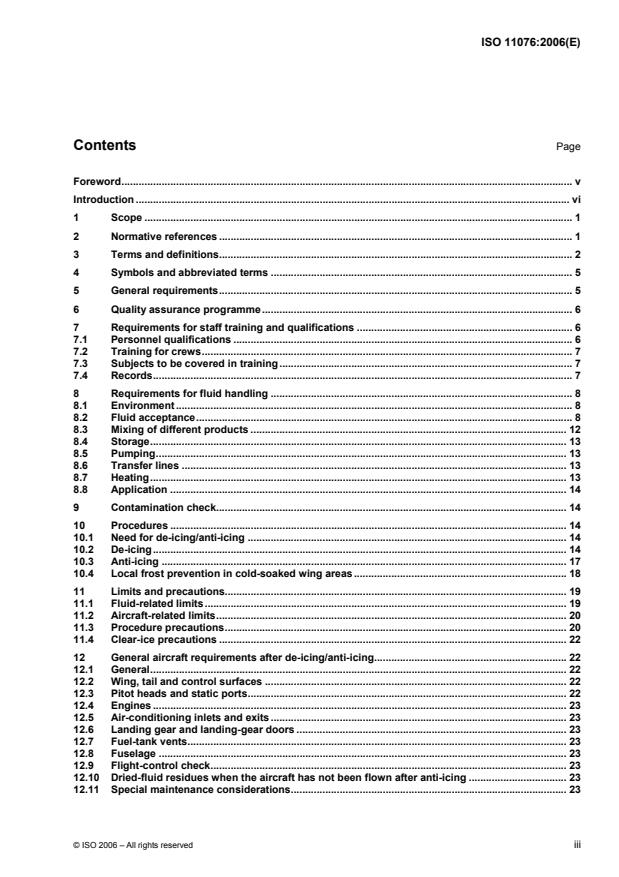
Contents Page
Foreword. v
Introduction . vi
1 Scope . 1
2 Normative references . 1
3 Terms and definitions. 2
4 Symbols and abbreviated terms . 5
5 General requirements. 5
6 Quality assurance programme . 6
7 Requirements for staff training and qualifications . 6
7.1 Personnel qualifications . 6
7.2 Training for crews. 7
7.3 Subjects to be covered in training. 7
7.4 Records. 7
8 Requirements for fluid handling . 8
8.1 Environment . 8
8.2 Fluid acceptance. 8
8.3 Mixing of different products . 12
8.4 Storage. 13
8.5 Pumping. 13
8.6 Transfer lines . 13
8.7 Heating. 13
8.8 Application . 14
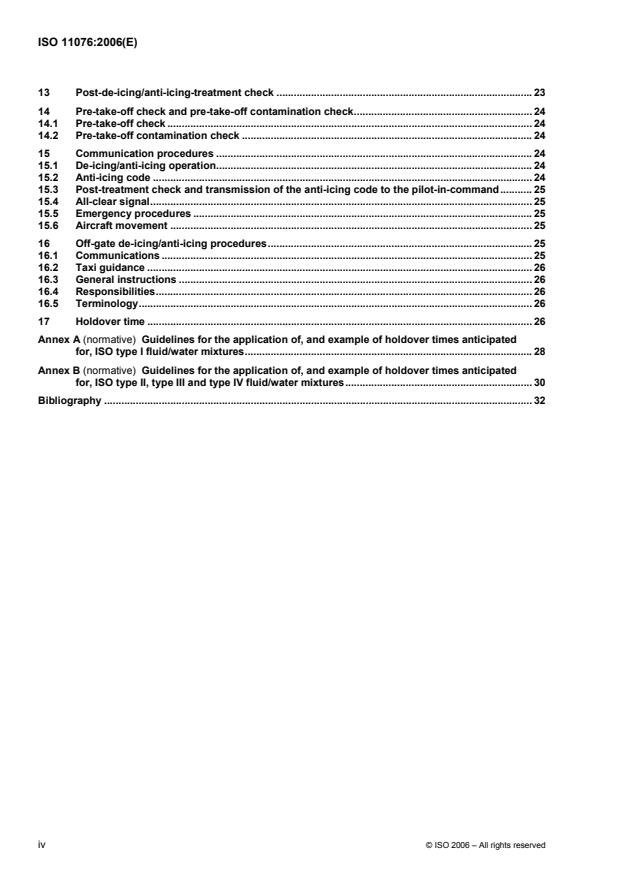
9 Contamination check. 14
10 Procedures . 14
10.1 Need for de-icing/anti-icing . 14
10.2 De-icing. 14
10.3 Anti-icing . 17
10.4 Local frost prevention in cold-soaked wing areas . 18
11 Limits and precautions. 19
11.1 Fluid-related limits. 19
11.2 Aircraft-related limits. 20
11.3 Procedure precautions. 20
11.4 Clear-ice precautions . 22
12 General aircraft requirements after de-icing/anti-icing. 22
12.1 General. 22
12.2 Wing, tail and control surfaces . 22
12.3 Pitot heads and static ports. 22
12.4 Engines . 23
12.5 Air-conditioning inlets and exits . 23
12.6 Landing gear and landing-gear doors . 23
12.7 Fuel-tank vents. 23
12.8 Fuselage . 23
12.9 Flight-control check. 23
12.10 Dried-fluid residues when the aircraft has not been flown after anti-icing . 23
12.11 Special maintenance considerations. 23
13 Post-de-icing/anti-icing-treatment check . 23
14 Pre-take-off check and pre-take-off contamination check. 24
14.1 Pre-take-off check . 24
14.2 Pre-take-off contamination check . 24
15 Communication procedures . 24
15.1 De-icing/anti-icing operation. 24
15.2 Anti-icing code . 24
15.3 Post-treatment check and transmission of the anti-icing code to the pilot-in-command. 25
15.4 All-clear signal. 25
15.5 Emergency procedures . 25
15.6 Aircraft movement . 25
16 Off-gate de-icing/anti-icing procedures. 25
16.1 Communications . 25
16.2 Taxi guidance . 26
16.3 General instructions . 26
16.4 Responsibilities. 26
16.5 Terminology. 26
17 Holdover time . 26
Annex A (normative) Guidelines for the application of, and example of holdover times anticipated
for, ISO type I fluid/water mixtures. 28
Annex B (normative) Guidelines for the application of, and example of holdover times anticipated
for, ISO type II, type III and type IV fluid/water mixtures. 30
Bibliography . 32
iv © ISO 2006 – All rights reserved
Foreword
ISO (the International Organization for Standardization) is a worldwide federation of national standards bodies
(ISO member bodies). The work of preparing International Standards is normally carried out through ISO
technical committees. Each member body interested in a subject for which a technical committee has been
established has the right to be represented on that committee. International organizations, governmental and
non-governmental, in liaison with ISO, also take part in the work. ISO collaborates closely with the
International Electrotechnical Commission (IEC) on all matters of electrotechnical standardization.
International Standards are drafted in accordance with the rules given in the ISO/IEC Directives, Part 2.
The main task of technical committees is to prepare International Standards. Draft International Standards
adopted by the technical committees are circulated to the member bodies for voting. Publication as an
International Standard requires approval by at least 75 % of the member bodies casting a vote.
Attention is drawn to the possibility that some of the elements of this document may be the subject of patent
rights. ISO shall not be held responsible for identifying any or all such patent rights.
ISO 11076 was prepared by Technical Committee ISO/TC 20, Aircraft and space vehicles, Subcommittee
SC 9, Air cargo and ground equipment.
This fourth edition cancels and replaces the third edition (ISO 11076:2000), which has been technically
revised.
Introduction
Annexes A and B of this International Standard provide guidelines for the application of different types of de-
icing/anti-icing fluids as a function of outside air temperature and of weather conditions. These data require
frequent updating. ISO/TC 20/SC 9 has agreed to delegating this task under its own guidance to the
Association of European Airlines (AEA) and the Society of Automotive Engineers (SAE), which are
organizations recognized as experts in the field of de-icing/anti-icing aircraft on the ground.
vi © ISO 2006 – All rights reserved
INTERNATIONAL STANDARD ISO 11076:2006(E)
Aircraft — Ground-based de-icing/anti-icing methods with fluids
1 Scope
This International Standard establishes the minimum requirements for aircraft de-icing/anti-icing methods on
the ground, in accordance with the ICAO Manual of aircraft ground de-icing/anti-icing operations
(Doc. 9640-AN/940) and relevant national regulations, to facilitate the safe operation of transport aircraft
during icing conditions. This International Standard does not specify requirements for specific aircraft model
types.
Aircraft manufacturers' published manuals, procedures or methods take precedence over the information in
this International standard.
Airlines' published manuals, procedures or methods supplement the information contained in this International
Standard.
Frost, ice or snow deposits, which can seriously affect the aerodynamic performance and/or controllability of
an aircraft, are effectively removed by the application of the procedures specified in this International Standard.
De-icing/anti-icing by mechanical means is not covered by this International Standard.
2 Normative references
The following referenced documents are indispensable for the application of this document. For dated
references, only the edition cited applies. For undated references, the latest edition of the referenced
document (including any amendments) applies.
ISO 9001:2000, Quality management systems — Requirements
ISO 11075, Aircraft de-icing/anti-icing fluids — ISO type I
ISO 11077, Aerospace — Self-propelled de-icing/anti-icing vehicles — Functional requirements
ISO 11078, Aircraft — De-icing/anti-icing fluids — ISO types II, III and IV
1)
ICAO doc 9640-AN/940 , Manual of aircraft ground de-icing/anti-icing operations
2)
JAR-OPS 1.035 , Quality system
2)
JAR-OPS 1.345 and ACJ 1.345 , Ice and other contaminants, ground procedures
3)
FAR Title 14 CFR Part 121, paragraph 121.629, Operation in icing conditions
1) Available from ICAO (International Civil Aviation Organization), 999 University Street, Montreal, Canada.
Phone: +1-514-954-8022 or e-mail: sales_unit@icao.int.
2) Available from JAA (Joint Aviation Authorities, Europe), P.O.Box 3000, 2130 KA Hoofddorp, The Netherlands.
3) Available from FAA (Federal Aviation Administration), USA. Website: http://www.faa.gov/, choose “regulations”.
4)
FAA Advisory Circular AC 120-60 , Ground de-icing and anti-icing program
5)
CAR (Canadian Aviation Regulation), Part VI, Subpart 2, Operating and flight rules, item 602.11, Aircraft
icing
5)
CAR (Canadian Aviation Regulation), Standard 622.11, Ground icing operations
4)
FAA Advisory Circular AC 120-59 , Air carriers internal evaluation programs
6)
SAE AIR9968 , Viscosity Test of Thickened Aircraft Deicing/Anti-Icing Fluids
3 Terms and definitions
For the purposes of this document, the following terms and definitions apply.
3.1
active frost
condition when frost is forming
NOTE Active frost occurs when aircraft surface temperature is u 0 °C (32 °F) and u dew point.
3.2
anti-icing
precautionary procedure which provides protection against the formation of frost or ice and accumulation of
snow or slush on treated surfaces of the aircraft for a limited period of time (holdover time)
3.3
anti-icing fluid (a)
ISO type I fluid, in accordance with ISO 11075, heated to 60 °C minimum at the spray nozzle
3.4
anti-icing fluid (b)
mixture of water and ISO type I fluid, heated to 60 °C minimum at the spray nozzle
3.5
anti-icing fluid (c)
ISO type II, III or IV fluids in accordance with ISO 11078
3.6
anti-icing fluid (d)
mixture of water and ISO type II, III or IV fluids
NOTE Anti-icing fluids types II, III and IV are normally applied unheated on clean aircraft surfaces but may be applied
heated.
3.7
check
examination of an item against a relevant standard by a trained and qualified person
4) Available from FAA (Federal Aviation Administration, USA).
Website: http://www.faa.gov/library/manuals/examiners_inspectors/8400/fsat/
5) Available from Transport Canada. Website: http://www.tc.gc.ca/civilaviation.
6) Available from SAE (Society of Automotive Engineers) Int'l, 400 Commonwealth Drive, Warrendale, PA 15096-0001,
USA. Website: http://www.sae.org/.
2 © ISO 2006 – All rights reserved
3.8
clear ice
layer of pure, transparent, homogeneous, hard and smooth ice bonded to a surface
3.9
cold-soaked wing
condition of the wings of aircraft when they have (partly) a very low temperature due to very cold fuel
(below 0 °C) in the wing tanks
NOTE This condition can result from having just landed after a flight at high altitude or from having been refuelled
with very cold fuel. The following factors contribute to cold-soaking: temperature and quantity of fuel in fuel tanks, type and
location of fuel cells, length of time at high altitude, temperature of refuelling fuel and time since refuelling.
3.10
contamination
all forms of frozen or semi-frozen moisture such as frost, snow, ice or slush
3.11
contamination check
check of aircraft surfaces for contamination to establish the need for de-icing
3.12
de-icing
procedure by which frost, ice, slush or snow is removed from an aircraft in order to provide clean surfaces
3.13
de-icing/anti-icing
combination of the de-icing and anti-icing procedures
NOTE It may be performed in one or two steps.
3.14
de-icing fluid (a)
heated water
3.15
de-icing fluid (b)
ISO type I fluid in accordance with ISO 11075
3.16
de-icing fluid (c)
mixture of water and ISO type I fluid
3.17
de-icing fluid (d)
ISO type II, III or IV fluids in accordance with ISO 11078
3.18
de-icing fluid (e)
mixture of water and ISO type II, III or IV fluids
NOTE De-icing fluid is normally applied heated in order to assure maximum efficiency.
3.19
freezing drizzle
fairly uniform precipitation composed exclusively of fine drops [diameter less than 0,5 mm (0,02 in)] very close
together which freezes upon impact with the ground or other exposed objects
3.20
freezing fog
suspension of numerous minute water droplets which freezes upon impact with ground or other exposed
objects
NOTE Freezing fog generally reduces the horizontal visibility at the earth's surface to less than 1 km (0,62 mile).
3.21
frost/hoarfrost
ice crystals that form from ice-saturated air at temperatures below 0 °C (32 °F) by direct sublimation on the
ground or other exposed objects
3.22
hail
precipitation of small balls or pieces of ice with a diameter ranging from 5 to > 50 mm (0,2 to > 2,0 in.) falling
either separately or agglomerated
3.23
holdover time
estimated time for which an anti-icing fluid will prevent the formation of frost or ice and the accumulation of
snow on the protected surfaces of an aircraft, under weather conditions as specified in the holdover time
guidelines
NOTE See annexes.
3.24
ice pellets
precipitation of transparent (grains of ice), or translucent (small hail) pellets of ice, which are spherical or
irregular, and which have a diameter of 5 mm (0,2 in.) or less
NOTE The pellets of ice usually bounce when hitting hard ground.
3.25
light freezing rain
precipitation of liquid water particles, which freezes upon impact with the ground or other exposed objects,
either in the form of drops of more than 0,5 mm (0,02 in) or smaller drops which, in contrast to drizzle, are
widely separated
NOTE Measured intensity of liquid water particles is up to 2,5 mm/h (0,10 in/h) or 25 g/dm /h with a maximum of
0,25 mm (0,010 in) in 6 min.
3.26
local frost build-up
limited formation of frost in local wing areas sub-cooled by cold fuel or large masses of cold metal
NOTE This type of frost does not cover the entire wing.
3.27
moderate and heavy freezing rain
precipitation of liquid water particles, either in the form of drops of more than 0,5 mm (0,02 inch) or smaller
drops which (in contrast to drizzle) are widely separated, which freezes upon impact with the ground
NOTE Measured intensity of liquid water particles is more than 2,5 mm/h (0,10 in/h) or 25 g/dm /h.
3.28
operator
“AOC-holder” (Air Operator Certificate holder) in accordance with civil aviation regulations
3.29
rain or high humidity (on cold-soaked wing)
water forming ice or frost on the wing surface, when the temperature of the aircraft wing surface is at or below
0 °C (32 °F)
4 © ISO 2006 – All rights reserved
3.30
rain and snow (mixture)
precipitation in the form of a mixture of rain and snow
3.31
slush
snow or ice that has been reduced to a soft watery mixture
3.32
snow
precipitation of ice crystals, most of which are branched, star-shaped or mixed with unbranched crystals
NOTE At temperatures higher than −5 °C (23 °F), the crystals are generally agglomerated into snowflakes.
3.33
snow grains
precipitation of very small white and opaque particles of ice that are fairly flat or elongated with a diameter of
less than 1 mm (0,04 in)
NOTE 1 When snow grains hit hard ground, they do not bounce or shatter.
NOTE 2 For holdover-time purposes, treat snow grains as snow.
3.34
snow pellets
precipitation of white, opaque particles of ice, round or sometimes conical, with a diameter range from about
2 mm to 5 mm (0,08 in to 0,2 in)
NOTE Snow pellets are brittle, easily crushed; they bounce and may break on hard ground.
4 Symbols and abbreviated terms
OAT outside air temperature
FP freezing point
5 General requirements
Aircraft ground de-icing/anti-icing methods shall comply with this International Standard, the ICAO Manual of
aircraft ground de-icing/anti-icing operations (Doc. 9640-AN/940), the applicable national civil aviation
regulations (CAR 602.11 and 622.11, JAR-OPS 1.345 and ACJ 1.345, FAR 14 CFR 121.629 and AC 120-60)
and any applicable local rules.
The various local rules concerning aircraft cold-weather operations are very specific and shall be strictly
adhered to.
A pilot shall not take off in an aircraft that has:
a) frost, snow, slush or ice present on any propeller, windscreen or power-plant installation or on airspeed,
altimeter, rate of climb or flight-altitude instrument systems;
b) snow, slush or ice adhering to the wings, stabilizers, control surfaces or fuselage, in gaps between the
airframe and control surfaces or in gaps between control surfaces and control tabs, or any frost on the
upper surfaces of wings, stabilizers or control surfaces.
For this reason a contamination check of the aircraft surfaces shall be performed prior to departure.
6 Quality assurance programme
Operators shall establish a quality assurance programme to ensure correct de-icing/anti-icing operations at all
stations where applicable.
This should be an approved programme which, in addition to the present, takes into account the requirements
of carriers’ internal evaluation programmes (JAR-OPS 1.035 or FAA AC 120-59) or, for non-airline
subcontractors and handling agencies, ISO 9001 or equivalent pertinent standards.
This programme shall include at least:
a) auditing;
b) training;
c) methods and procedures;
d) training records;
e) qualification;
f) publications;
g) equipment and fluids.
The auditing of all parts of the de-icing/anti-icing operation is required to check the ongoing conformance with
all regulations issued by authorities, operators, manufacturers and handling agents.
Training of all personnel involved in the de-icing/anti-icing operation is required to ensure the correct
performance of all tasks which have to be fulfilled.
Methods and procedures shall be defined to allow the clear and safe accomplishment of all tasks that are
necessary for de-icing/anti-icing an aircraft.
Training records of all de-icing/anti-icing personnel are required to guarantee that all requirements in the field of
training and skill are fulfilled.
Qualification of all de-icing/anti-icing personnel is required to assure correct performance of all tasks.
Written instructions are required for the aircraft de-icing/anti-icing operation to ensure the correct
accomplishment of all tasks.
Equipment and fluids have to be maintained in such a way that the correct quality is assured.
7 Requirements for staff training and qualifications
7.1 Personnel qualifications
De-icing/anti-icing procedures shall be carried out exclusively by personnel trained and qualified in this subject.
Companies providing de-icing/anti-icing services shall have both a training/qualification programme and a
quality assurance programme to monitor and maintain an acceptable level of competence.
6 © ISO 2006 – All rights reserved
7.2 Training for crews
Both initial and annual recurrent training for flight crews and ground crews shall be conducted to ensure that
all such crews obtain and retain a thorough knowledge of aircraft de-icing/anti-icing policies and procedures,
including new procedures and lessons learned.
Training success shall be proven by an examination/assessment which shall cover all training subjects listed
in 7.3.
The theoretical examination shall be in accordance with the latest local examination rules/requirements. The
pass mark shall be 75 % and only persons passing this examination can be qualified.
For personnel performing the actual de-icing/anti-icing treatment on aircraft, practical training with the de-
icing/anti-icing equipment shall be included.
7.3 Subjects to be covered in training
Training shall include the following items as a minimum:
a) effects of frost, ice, slush, snow and fluids on aircraft performance;
b) basic characteristics of aircraft de-icing/anti-icing fluids, including causes and consequences of fluid
degradation and residues;
c) general techniques for removing deposits of frost, ice, slush and snow from aircraft surfaces and for anti-
icing;
d) de-icing/anti-icing procedures in general and specific measures to be performed on different aircraft
types;
e) types of check required;
f) de-icing/anti-icing equipment and facilities operating procedures including actual operation;
g) safety precautions;
h) emergency procedures;
i) fluid application and limitations of holdover-time tables;
j) anti-icing codes and communication procedures;
k) special provisions and procedures for contract de-icing/anti-icing (if applicable);
l) environmental considerations, e.g. where to de-ice, spill reporting, hazardous-waste control;
m) new procedures and development, lessons learned from previous winters.
7.4 Records
Records of personnel training and qualifications shall be maintained for proof of qualification.
8 Requirements for fluid handling
8.1 Environment
De-icing/anti-icing fluid is a chemical product with environmental impact. During fluid handling, avoid any
unnecessary spillage and comply with local environmental and health laws and the manufacturer's safety data
sheet.
8.2 Fluid acceptance
8.2.1 General
Fluid acceptance will require the fluid manufacturer’s release documentation (e.g. certificate of conformance,
certificate of analysis) from the supplier, visual inspection and a verification to check if the correct fluid is
delivered.
It is recommended that the winter operations programme ensures and verifies that de-icing/anti-icing fluids are
not degraded beyond the fluid manufacturer’s limits.
8.2.2 Fluid sampling procedure for type II, type III, or type IV fluids
8.2.2.1 Introduction
To ensure that the necessary safety margins are maintained between the start of the de-icing/anti-icing
operation and take-off, the fluid used to both de-ice and anti-ice aircraft surfaces, shall be in an “ex-fluid
manufacturer's” condition and at the correct concentration. Due to the possible effect of vehicle/equipment
heating and/or delivery-system components on fluid condition, it is necessary for the sampling method to
simulate typical aircraft application.
This section therefore describes the approved methods for collecting samples of type II, III, and IV fluids,
sprayed from operational aircraft de-icing/anti-icing vehicles/equipment, prior to the necessary quality control
checks (see 8.2.3) being carried out.
8.2.2.2 Method
The application is made on a clean polythene sheet (approximately 2 m × 2 m) laid directly on the ground, or
on an aluminium plate with associated recovery system (an equivalent method may be used providing
correlating spraying tests are done). Depending on wind speed/direction at the time of sampling the polythene
sheet may require to be weighted down at the edges to prevent movement.
The distance between the spray nozzle and the surface shall be approximately 3 m and the fluid shall be
sprayed perpendicular to the surface.
Where different spray patterns and flow rates are used during routine de-icing/anti-icing operations, samples
shall be taken at typical nozzle settings (e.g. fine, medium or coarse) and flow rates for anti-icing.
8.2.2.3 Procedure
Select the required flow rate/spray pattern for the fluid to be sampled.
Spray the fluid to purge the lines and check the concentration of a sample, taken from the gun/nozzle after
purging.
Should the refractive index indicate that the lines have not been adequately purged, repeat previous step until
the concentration is correct for the fluid to be sampled (on certain vehicles it may be necessary to spray more
than 50 l of fluid before the lines are completely purged).
8 © ISO 2006 – All rights reserved
Direct the fluid on to the sampling surface and spray an adequate amount of fluid to allow for a 1 l sample to
be taken.
Where a polythene sheet is used for sampling purposes, carefully lift the corners of the sheet and collect 1 l of
the fluid in a clean and dry bottle.
8.2.2.4 Reference fluid
For reference purposes, take a 1 l sample of the base fluid from the storage facility and a 1 l sample from the
fluid tank of the de-icing/anti-icing equipment/vehicle being sampled.
8.2.2.5 Identification of samples
Attach to each sample a label carrying the following data:
⎯ brand name and type of the fluid (e.g. Kilfrost ABC-3/Type II, Clariant MPII 1951/Type II, etc.);
⎯ identification of de-icing/anti-icing equipment/vehicle (e.g. Elephant Beta DT04, Fixed Rig R001, etc.);
⎯ indicate flow rate and spray pattern;
⎯ detail where the sample was taken from (e.g. nozzle, storage tank or equipment/vehicle tank);
⎯ mixture strength (e.g. 100/0, 75/25, etc.);
⎯ station (e.g. BAK, etc.);
⎯ date sample was taken.
8.2.3 Checking procedure for aircraft de-icing/anti-icing fluids
8.2.3.1 Introduction
This checking procedure for aircraft de-icing/anti-icing fluids ensures that the required safety standards
concerning the de-icing/anti-icing fluids’ quality are maintained. When discrepancies are found, further
investigation has to be conducted prior to use of the fluid.
8.2.3.2 Delivery check for fluids
Before filling the tank with the de-icing/anti-icing fluid it shall be established that the brand name and the
concentration of the product mentioned in the packing list corresponds to the brand name and the
concentration mentioned on the storage tank.
A sample of the delivered product shall be taken and checked from each batch before the storage tank/vehicle
is filled.
Perform the delivery check for fluids as follows.
Type I fluid:
⎯ perform a visual contamination check according to 8.2.3.6.1;
⎯ perform a refractive-index check according to 8.2.3.6.2;
⎯ perform a pH-value check according to 8.2.3.6.3.
Type II, type III and type IV fluids:
⎯ perform a visual contamination check according to 8.2.3.6.1;
⎯ perform a refractive index check according to 8.2.3.6.2;
⎯ perform a pH-value check according to 8.2.3.6.3;
⎯ perform a field viscosity check according to 8.2.3.6.4.
8.2.3.3 De-icing/anti-icing vehicle fluid checks
8.2.3.3.1 Concentration checks
Fluids or fluid/water mixture samples shall be taken from the de-icing/anti-icing vehicle nozzles on a daily
basis when vehicles are in use. In addition, from trucks without a mixing system, mixture samples shall be
taken (after sufficient mixing/stirring to ensure a uniform mixture) each time the tanks are (re)filled with water
and/or de-icing/anti-icing fluid. The sample shall be protected against precipitation. Perform a refractive index
check according to 8.2.3.6.2.
For trucks without a mixing system, samples may be taken from the truck tank instead of the nozzle.
For trucks with proportional mixing systems, operational setting for flow and pressure shall be used. Allow the
selected fluid concentration to stabilize before taking sample (see also 8.2.2.3).
For trucks with an automated fluid mixture monitoring system, the interval for refractive index checks shall be
determined by the handling company in accordance with the system design.
8.2.3.3.2 Checks on (directly or indirectly) heated fluids
Fluid or fluid/water mixture samples shall be taken from the de-icing/anti-icing vehicle tanks. As a guideline,
the interval should not exceed two weeks, but it may be adjusted in accordance with local experience.
Perform a refractive index check in accordance with 8.2.3.6.2.
8.2.3.4 Laboratory checks for fluids
The laboratory checks shall be performed for the fluids at the start and in the middle of the de-icing season
and upon request by the airline. Fluid samples shall be taken from all de-icing/anti-icing vehicle spray nozzles
of all vehicles and from all storage tanks in use.
For thickened de-icing/anti-icing fluids, take the sample as described in fluid sampling procedure for type II,
type III, and type IV fluids (see 8.2.2).
Perform the laboratory check for fluids as follows.
Type I fluid:
⎯ perform a visual contamination check according to 8.2.3.6.1;
⎯ perform a refractive-index check according to 8.2.3.6.2;
⎯ perform a pH-value check according to 8.2.3.6.3.
10 © ISO 2006 – All rights reserved
Type II, type III and type IV fluids:
⎯ perform a visual contamination check according to 8.2.3.6.1;
⎯ perform a refractive-index check according to 8.2.3.6.2;
⎯ perform a pH-value check according to 8.2.3.6.3;
⎯ perform a laboratory viscosity check according to 8.2.3.6.5 (not applicable to samples
taken from spray nozzle(s) used for de-icing exclusively).
8.2.3.5 Field check for fluids
A field check for fluids shall always be made when station inspection is made. The samples shall be taken
from the storage tank and from the de-icing/anti-icing equipment nozzle.
For thickened de-icing/anti-icing fluids, take the sample as described in the fluid-sampling procedure for type II,
type III or type IV fluids (see 8.2.2).
Perform the field test for fluids as follows.
Type I fluid:
⎯ perform a visual contamination check according to 8.2.3.6.1;
⎯ perform a refractive-index check according to 8.2.3.6.2;
⎯ perform a pH-value check according to 8.2.3.6.3.
Type II, type III and type IV fluids:
⎯ perform a visual contamination check according to 8.2.3.6.1;
⎯ perform a refractive-index check according to 8.2.3.6.2;
⎯ perform a pH-value check according to 8.2.3.6.3;
⎯ perform a field viscosity check according to 8.2.3.6.4.
8.2.3.6 Fluid check methods
8.2.3.6.1 Visual contamination check
⎯ Put fluid from the sample into a clean glass bottle or equivalent;
⎯ check for any kind of contamination (e.g. rust particles, metallic debris, rubber parts, etc.);
⎯ the check can be made by any equivalent method.
8.2.3.6.2 Refractive-index check
⎯ Make sure the refractometer is calibrated and clean;
⎯ put a fluid drop taken from the sample or from the nozzle on to the test screen of the refractometer and
close the prism;
⎯ read the value on the internal scale and use the correction factor given by the manufacturer of the fluid in
case the temperature of the refractometer is not 20 °C;
⎯ compare the value with the figures from the fluid manufacturer;
⎯ clean the refractometer and return it into the protective cover;
⎯ the check can be made by any equivalent method.
8.2.3.6.3 pH-value check
⎯ Take a piece of pH paper and put it into the fluid so that the pH paper becomes wetted with the fluid;
⎯ remove the pH paper from the fluid and compare its colour with the colour of the table provided with the
pH paper and read the corresponding pH value;
⎯ compare the pH-value with the figures from the fluid manufacturer;
⎯ the check can be made by any equivalent method.
8.2.3.6.4 Field viscosity check
This check shall be made using a falling ball method, where, in two sealed tubes, the reference liquids
represent the minimum and maximum permitted viscosities of the tested product. A third empty tube is for the
sample:
⎯ put the sample into a clean sample tube;
⎯ insert the steel ball into the glass, fill it up completely and close it;
⎯ return the glass to the test tool, turn it vertically and let all steel balls reach the lower end of the test tubes;
⎯ after all three balls have reached the bottom of the tubes, turn the tool ± 180° to a full vertical position;
⎯ the balls will move downwards at different speeds;
⎯ the speed of the middle steel ball shall be between the speed of the two other balls or be equal to the
speed of one of them;
⎯ the check can be made by any equivalent method.
8.2.3.6.5 Laboratory viscosity check
⎯ Perform the viscosity check in accordance with SAE AIR 9968 or the fluid manufacturer’s specific
instructions, if different from AIR 9968;
−1
⎯ the measurements shall be carried out at rotation speeds of 0,005 s (0,3 rpm);
⎯ the temperatures at which the measurements are made and the spindle number shall be reported;
⎯ compare the viscosity values with figures from the fluid manufacturer;
⎯ the check can be made by any equivalent method.
8.3 Mixing of different products
Different products shall not be mixed without additional qualification testing.
12 © ISO 2006 – All rights reserved
8.4 Storage
8.4.1 Tanks dedicated to the storage of de-icing/anti-icing fluids shall be used.
8.4.2 Storage tanks shall be of materials compatible with the de-icing/anti-icing fluids, as specified by the
fluid manufacturer (corrosion-resistant steel, plastic, etc.). Care should be taken to avoid using dissimilar
metals in contact with each other, as galvanic couples may form and degrade thickened fluids.
8.4.3 Tanks shall be conspicuously labelled to avoid contamination.
8.4.4 Tanks shall be inspected annually for corrosion and/or contamination. If corrosion or contamination is
evident, tanks shall be maintained to standard or be replaced. To prevent corrosion at the liquid/vapour
interface and in the vapour space, a high liquid level in the tanks is recommended.
NOTE If the quality of the fluids is checked in accordance with 8.2.3, the inspection interval may be longer than one
year.
8.4.5 The storage temperature limits shall comply with the manufacturer's guidelines.
8.4.6 The stored fluid shall be checked routinely to insure that no degradation/contamination has taken
place.
8.5 Pumping
De-icing/anti-icing fluids can show degradation caused by excessive mechanical shearing. Therefore, only
compatible pumps and spraying nozzles shall be used. The design of the pumping systems shall be in
accordance with the fluid manufacturer's recommendations.
8.6 Transfer lines
Dedicated transfer lines shall be conspicuously labelled to prevent contamination and shall be compatible with
the de-icing/anti-icing fluids to be transferred.
8.7 Heating
De-icing/anti-icing fluids shall be heated according to the fluid manufacturer's guidelines.
For type I fluids, water loss may cause undesirable aerodynamic effects.
For type II, III and IV fluids thermal exposure and/or water loss may cause a reduction in fluid viscosity leading
to lower holdover times.
The fluids shall be checked periodically in accordance with 8.2.3.
CAUTION — Avoid unnecessary heating of fluid in vehicle tanks. Prolonged or repeated heating of
fluids (directly or indirectly) may result in loss of water which can lead to performance degradation of
the fluid.
Any of the following situations or a combination of them can accelerate the fluid performance degradation:
a) low fluid consumption;
b) trucks being in standby mode with heating system on for extended periods of time;
c) high temperatures in fluid tanks;
d) high temperatures in water tanks that are in direct contact with the fluid tanks (no insulation between
tanks).
8.8 Application
8.8.1 Application equipment shall meet the requirements of ISO 11077 and be cleaned thoroughly before
being initially filled with a de-icing/anti-icing fluid in order to prevent fluid contamination.
8.8.2 De-icing/anti-icing fluid in trucks shall not be heated in confined or poorly ventilated areas.
8.8.3 The quality of the fluid at the spray nozzle shall be checked periodically.
9 Contamination check
This is a check for the need to de-ice. This check shall include the areas mentioned in 12.1 to 12.8 and any
other as recommended by the aircraft manufacturer. It shall be performed from points offeri
...
Questions, Comments and Discussion
Ask us and Technical Secretary will try to provide an answer. You can facilitate discussion about the standard in here.
Loading comments...