


ISO 230-6:2002
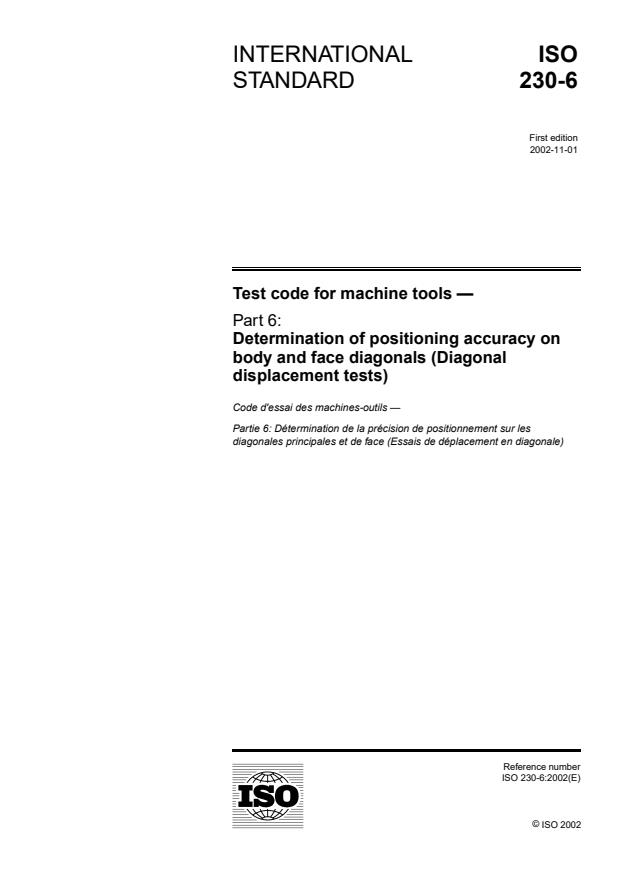
(Main)Test code for machine tools — Part 6: Determination of positioning accuracy on body and face diagonals (Diagonal displacement tests)
Test code for machine tools — Part 6: Determination of positioning accuracy on body and face diagonals (Diagonal displacement tests)
This part of ISO 230 specifies diagonal displacement tests which allow the estimation of the volumetric performance of a machine tool. Complete testing of the volumetric performance of a machine tool is a difficult and time-consuming process. Diagonal displacement tests reduce the time and cost associated with testing the volumetric performance. A diagonal displacement test is not in itself a diagnostic test, although conclusions of a diagnostic nature may sometimes be possible from the results. In particular, when face diagonal tests are included, a direct measurement of the axes squareness is possible. Diagonal displacement tests on body diagonals may be supplemented by tests in the face diagonals, by tests parallel to the machine axes in accordance with ISO 230-2, or by the evaluation of the contouring performance in the three coordinate planes as defined in ISO 230-4. Diagonal displacement tests may be used for acceptance purposes and as reassurance of machine performance where parameters of the test are used as comparison index.
Code d'essai des machines-outils — Partie 6: Détermination de la précision de positionnement sur les diagonales principales et de face (Essais de déplacement en diagonale)
L'ISO 230-6 spécifie des essais de déplacement en diagonale permettant l'évaluation des performances d'une machine-outil dans le volume. Le contrôle complet des performances d'une machine-outil dans le volume est une opération compliquée et fastidieuse. Les essais de déplacement en diagonale réduisent le temps et les coûts liés à l'exécution des essais de performance dans le volume. Les essais de déplacement en diagonale peuvent être utilisés pour des besoins de réception ainsi que pour confirmer les performances d'une machine lorsque les paramètres de l'essai sont utilisés comme indices de comparaison.
General Information
- Status
- Published
- Publication Date
- 07-Nov-2002
- Technical Committee
- ISO/TC 39/SC 2 - Test conditions for metal cutting machine tools
- Drafting Committee
- ISO/TC 39/SC 2 - Test conditions for metal cutting machine tools
- Current Stage
- 9093 - International Standard confirmed
- Start Date
- 12-Jun-2024
- Completion Date
- 12-Feb-2026
Overview - ISO 230-6:2002 (Diagonal displacement tests)
ISO 230-6:2002 is the part of the ISO 230 series that specifies diagonal displacement tests for machine tools to estimate their volumetric performance. Instead of measuring along single linear axes, this test measures positioning accuracy along the body diagonals and optionally face diagonals of the machine working volume. The method reduces time and cost compared with complete volumetric testing while providing key indices (bi-directional systematic deviation and reversal value) useful for acceptance testing and performance reassurance.
Key topics and technical requirements
- Scope and purpose
- Estimate volumetric performance of three- and two-axis machines using diagonal traverses.
- Not inherently diagnostic, though face diagonal tests can directly measure axes squareness.
- Test geometry
- Measurements along four body diagonals for 3-D machines; two face diagonals for 2-D machines. Additional face diagonals may be added by agreement.
- Target positions and sampling
- Minimum of five equally spaced targets per metre of diagonal length, with an overall minimum of five target positions.
- Each target position is attained five times in each travel direction.
- Measured parameters
- Diagonal bi-directional systematic deviation (E_d) and diagonal reversal value (B_d) for body diagonals; analogous E_d(ab) and B_d(ab) for face diagonals.
- Instrumentation and set-up
- Use of a laser interferometer or other measuring systems with comparable accuracy (Annex A provides a laser interferometer set-up procedure).
- Position of non-tested axes, temperature sensors and measurement uncertainty must be recorded.
- Test conditions
- Feed rate between targets agreed by supplier and user (not to exceed 20% of maximum feed).
- Consideration of warming-up, environmental temperature gradients and combined measurement uncertainty.
Practical applications and users
- Who uses ISO 230-6:
- Machine tool manufacturers and suppliers (acceptance testing)
- OEMs and production engineering teams (performance verification)
- Metrology labs, QA and maintenance teams (periodic reassurance, pre-delivery checks)
- Typical uses:
- Acceptance tests and contractual performance verification
- Quick estimation of volumetric accuracy for multi-axis machining
- Supplementary testing to ISO 230-2 (axis positioning/repeatability) and ISO 230-4 (contouring/circular tests)
- Direct squareness checks when face diagonals are included
Related standards
- ISO 230 series: ISO 230-1, ISO 230-2, ISO 230-3, ISO 230-4, ISO 230-7 - referenced for installation, instrumentation, thermal effects and contouring tests.
ISO 230-6 is a practical, time-efficient standard for evaluating multi-axis machine volumetric performance using diagonal displacement tests, providing clear procedures, reporting items and interfacing requirements with other ISO 230 parts.
Get Certified
Connect with accredited certification bodies for this standard

National Aerospace and Defense Contractors Accreditation Program (NADCAP)
Global cooperative program for special process quality in aerospace.
CARES (UK Certification Authority for Reinforcing Steels)
UK certification for reinforcing steels and construction.
DVS-ZERT GmbH
German welding certification society.
Sponsored listings
Frequently Asked Questions
ISO 230-6:2002 is a standard published by the International Organization for Standardization (ISO). Its full title is "Test code for machine tools — Part 6: Determination of positioning accuracy on body and face diagonals (Diagonal displacement tests)". This standard covers: This part of ISO 230 specifies diagonal displacement tests which allow the estimation of the volumetric performance of a machine tool. Complete testing of the volumetric performance of a machine tool is a difficult and time-consuming process. Diagonal displacement tests reduce the time and cost associated with testing the volumetric performance. A diagonal displacement test is not in itself a diagnostic test, although conclusions of a diagnostic nature may sometimes be possible from the results. In particular, when face diagonal tests are included, a direct measurement of the axes squareness is possible. Diagonal displacement tests on body diagonals may be supplemented by tests in the face diagonals, by tests parallel to the machine axes in accordance with ISO 230-2, or by the evaluation of the contouring performance in the three coordinate planes as defined in ISO 230-4. Diagonal displacement tests may be used for acceptance purposes and as reassurance of machine performance where parameters of the test are used as comparison index.
This part of ISO 230 specifies diagonal displacement tests which allow the estimation of the volumetric performance of a machine tool. Complete testing of the volumetric performance of a machine tool is a difficult and time-consuming process. Diagonal displacement tests reduce the time and cost associated with testing the volumetric performance. A diagonal displacement test is not in itself a diagnostic test, although conclusions of a diagnostic nature may sometimes be possible from the results. In particular, when face diagonal tests are included, a direct measurement of the axes squareness is possible. Diagonal displacement tests on body diagonals may be supplemented by tests in the face diagonals, by tests parallel to the machine axes in accordance with ISO 230-2, or by the evaluation of the contouring performance in the three coordinate planes as defined in ISO 230-4. Diagonal displacement tests may be used for acceptance purposes and as reassurance of machine performance where parameters of the test are used as comparison index.
ISO 230-6:2002 is classified under the following ICS (International Classification for Standards) categories: 25.080.01 - Machine tools in general. The ICS classification helps identify the subject area and facilitates finding related standards.
ISO 230-6:2002 is available in PDF format for immediate download after purchase. The document can be added to your cart and obtained through the secure checkout process. Digital delivery ensures instant access to the complete standard document.
Standards Content (Sample)
INTERNATIONAL ISO
STANDARD 230-6
First edition
2002-11-01
Test code for machine tools —
Part 6:
Determination of positioning accuracy on
body and face diagonals (Diagonal
displacement tests)
Code d'essai des machines-outils —
Partie 6: Détermination de la précision de positionnement sur les
diagonales principales et de face (Essais de déplacement en diagonale)
Reference number
PDF disclaimer
This PDF file may contain embedded typefaces. In accordance with Adobe's licensing policy, this file may be printed or viewed but shall not be
edited unless the typefaces which are embedded are licensed to and installed on the computer performing the editing. In downloading this file,
parties accept therein the responsibility of not infringing Adobe's licensing policy. The ISO Central Secretariat accepts no liability in this area.
Adobe is a trademark of Adobe Systems Incorporated.
Details of the software products used to create this PDF file can be found in the General Info relative to the file; the PDF-creation parameters
were optimized for printing. Every care has been taken to ensure that the file is suitable for use by ISO member bodies. In the unlikely event
that a problem relating to it is found, please inform the Central Secretariat at the address given below.
All rights reserved. Unless otherwise specified, no part of this publication may be reproduced or utilized in any form or by any means,
electronic or mechanical, including photocopying and microfilm, without permission in writing from either ISO at the address below or ISO's
member body in the country of the requester.
ISO copyright office
Case postale 56 CH-1211 Geneva 20
Tel. + 41 22 749 01 11
Fax + 41 22 749 09 47
E-mail copyright@iso.ch
Web www.iso.ch
Printed in Switzerland
©
ii ISO 2002 – All rights reserved
Contents Page
1 Scope . 1
2 Normative references . 1
3 Terms and definitions . 1
4 Preliminary remarks . 4
5 Test procedure, parameters, set-up procedure . 5
6 Evaluation of results . 7
7 Points to be agreed between supplier/manufacturer and user . 7
8 Presentation of the results . 7
Annex
A Set-up procedure for laser interferometer. 9
©
ISO 2002 – All rights reserved iii
Foreword
ISO (the International Organization for Standardization) is a worldwide federation of national standards bodies (ISO
member bodies). The work of preparing International Standards is normally carried out through ISO technical
committees. Each member body interested in a subject for which a technical committee has been established has
the right to be represented on that committee. International organizations, governmental and non-governmental, in
liaison with ISO, also take part in the work. ISO collaborates closely with the International Electrotechnical
Commission (IEC) on all matters of electrotechnical standardization.
International Standards are drafted in accordance with the rules given in the ISO/IEC Directives, Part 3.
Draft International Standards adopted by the technical committees are circulated to the member bodies for voting.
Publication as an International Standard requires approval by at least 75 % of the member bodies casting a vote.
Attention is drawn to the possibility that some of the elements of this part of ISO 230 may be the subject of patent
rights. ISO shall not be held responsible for identifying any or all such patent rights.
International Standard ISO 230-6 was prepared by Technical Committee ISO/TC 39, Machine tools, Subcommittee
SC 2, Test conditions for metal cutting machine tools.
ISO 230 consists of the following parts, under the general title Test code for machine tools:
— Part 1: Geometric accuracy of machines operating under no-load or finishing conditions
— Part 2: Determination of accuracy and repeatability of positioning numerically controlled axes
— Part 3: Determination of thermal effects
— Part 4: Circular tests for numerically controlled machine tools
— Part 5: Determination of the noise emission
— Part 6: Determination of positioning accuracy on body and face diagonals (Diagonal displacement tests)
— Part 7: Axes of rotation — Methods for specifying and testing
Annex A of this part of ISO 230 is for information only.
©
iv ISO 2002 – All rights reserved
INTERNATIONAL STANDARD ISO 230-6:2002(E)
Test code for machine tools —
Part 6:
Determination of positioning accuracy on body and face diagonals
(Diagonal displacement tests)
1 Scope
This part of ISO 230 specifies diagonal displacement tests which allow estimation of the volumetric performance of a
machine tool. Complete testing of the volumetric performance of a machine tool is a difficult and time-consuming
process. Diagonal displacement tests reduce the time and cost associated with testing the volumetric performance.
A diagonal displacement test is not in itself a diagnostic test, although conclusions of a diagnostic nature may
sometimes be possible from the results. In particular, when face diagonal tests are included, a direct measurement
of the axes squareness is possible. Diagonal displacement tests on body diagonals may be supplemented by tests in
the face diagonals, by tests parallel to the machine axes in accordance with ISO 230-2, or by the evaluation of the
contouring performance in the three coordinate planes as defined in ISO 230-4.
Diagonal displacement tests may be used for acceptance purposes and as reassurance of machine performance
where parameters of the test are used as comparison index.
2 Normative references
The following normative documents contain provisions which, through reference in this text, constitute provisions of
this part of ISO 230. For dated references, subsequent amendments to, or revisions of, any of these publications do
not apply. However, parties to agreements based on this part of ISO 230 are encouraged to investigate the possibility
of applying the most recent editions of the normative documents indicated below. For undated references, the latest
edition of the normative document referred to applies. Members of ISO and IEC maintain registers of currently valid
International Standards.
ISO 230-1:1996, Test code for machine tools — Part 1: Geometric accuracy of machines operating under no-load or
finishing conditions
ISO 230-2:1997, Test code for machine tools — Part 2: Determination of accuracy and repeatability of positioning
numerically controlled axes
ISO 230-3:2001, Test code for machine tools — Part 3: Determination of thermal effects
ISO 230-4:1996, Test code for machine tools — Part 4: Circular tests for numerically controlled machine tools
3 Terms and definitions
For the purposes of this part of ISO 230, the following terms and definitions apply.
3.1
working volume
volume defined by the travel of the machine linear axes for machining operations (not including those travels used for
auxiliary operations, e.g. tool change)
©
ISO 2002 – All rights reserved 1
3.2
body diagonal
D
space diagonal of a rectangular prism within the working volume of the machine tool
NOTE 1 Four body diagonals are defined by the working volume.
NOTE 2 The user may reference a body diagonal using its starting position, for example +X+Y–Z is the diagonal that goes from
+X+Y–Z to –X–Y+Z. An alternative nomenclature using NNP (for X positive, Y negative, Z positive, direction of travel) is also
acceptable.
See Figure 1.
Figure 1 — Four body diagonals of a rectangular prism
3.3
face diagonal
F
diagonal in a face plane of a rectangular prism within the working volume of a machine tool
NOTE 1 Six different types of face diagonal may be defined within the working volume. For each diagonal selected, it is
necessary to define further its location in the third axis. Ideally, the plane of the face diagonals should be either an external face or
a central slice, as shown in Figure 2.
NOTE 2 The user may reference a face diagonal using its start position, for example +X–Y is the diagonal that goes from +X–Y
to –X+Y. To define the third axis, the form +X –Y Z300 may be used to define an XY diagonal at Z = 300. An alternative
nomenclature using NP or NP300 (for X negative, Y positive, Z missing, directions of travel) is also acceptable.
NOTE 3 Face diagonals are usually selected in crossed pairs for each plane as shown in Figure 2.
See Figure 2.
©
2 ISO 2002 – All rights reserved
Figure 2 — Examples of face diagonals of a rectangular prism
3.4
diagonal systematic deviation of positioning
E
d
maximum bidirectional systematic deviation of positioning (in accordance with ISO 230-2) of the four body diagonals,
E , E , E , E (evaluation of E , see Figure 3)
1 2 3 4 i
E = max.[E], , , E E E
d 1 2 3 4
3.5
diagonal systematic deviation of positioning in face diagonals
E (ab)
d
maximum bidirectional systematic deviation of positioning (in accordance with ISO 230-2) of the two face diagonals,
E (ab), , E (ab)where “ab” defines the coordinate plane of measurement
1 2
EXAMPLE E (XY) = max. [E (XY), E (XY)] for the two face diagonals in the XY plane.
d 1 2
©
ISO 2002 – All rights reserved 3
3.6
diagonal reversal value
B
d
maximum reversal value (in accordance with ISO 230-2) of the four body diagonals, B , B , B , B (evaluation of
1 2 3 4
B see Figure 3)
i
B = max.[,B ,B ,B ]B
d 1 2 3 4
E B
Figure 3 — Evaluation of and
i i
3.7
diagonal reversal value for face diagonals
B (ab)
d
maximum reversal value (in accordance with ISO 230-2) in the two face diagonals, B (ab), B (ab), where “ab”
1 2
defines the coordinate plane of measurement
EXAMPLE B (XY) = max. [E (XY), E (XY)] for the two face diagonals in the XY plane.
d 1 2
3.8
volumetric performance
ability of a machine tool to perform the intended multi-axes functions anywhere within the working volume or a
smaller volume as agreed between manufacturer/supplier and user
NOTE Indication for reduced volume shall be by wording “reduced volume” after any parameter stated, e.g. E (reduced
d
volume) = 0,012 mm.
4 Preliminary remarks
4.1 Measuring units
In this part of ISO 230, all linear dimensions are expressed in millimetres.
4.2 Reference to ISO 230-1 and ISO 230-2
To apply this part of ISO 230, reference should be made to ISO 230-1, especially for the installation of the machine
before testing, warming-up of moving parts and recommended accuracy of test equipment.
Reference should also be made to ISO 230-2, especially for set-up and instrumentation, evaluation of results and
presentation of results.
©
4 ISO 2002 – All rights reserv
...
NORME ISO
INTERNATIONALE 230-6
Première édition
2002-11-01
Code d'essai des machines-outils —
Partie 6:
Détermination de la précision de
positionnement sur les diagonales
principales et de face (Essais de
déplacement en diagonale)
Test code for machine tools —
Part 6: Determination of positioning accuracy on body and face diagonals
(Diagonal displacement tests)
Numéro de référence
PDF — Exonération de responsabilité
Le présent fichier PDF peut contenir des polices de caractères intégrées. Conformément aux conditions de licence d'Adobe, ce fichier peut
être imprimé ou visualisé, mais ne doit pas être modifié à moins que l'ordinateur employé à cet effet ne bénéficie d'une licence autorisant
l'utilisation de ces polices et que celles-ci y soient installées. Lors du téléchargement de ce fichier, les parties concernées acceptent de fait la
responsabilité de ne pas enfreindre les conditions de licence d'Adobe. Le Secrétariat central de l'ISO décline toute responsabilité en la
matière.
Adobe est une marque déposée d'Adobe Systems Incorporated.
Les détails relatifs aux produits logiciels utilisés pour la création du présent fichier PDF sont disponibles dans la rubrique General Info du
fichier; les paramètres de création PDF ont été optimisés pour l'impression. Toutes les mesures ont été prises pour garantir l'exploitation de
ce fichier par les comités membres de l'ISO. Dans le cas peu probable où surviendrait un problème d'utilisation, veuillez en informer le
Secrétariat central à l'adresse donnée ci-dessous.
Droits de reproduction réservés. Sauf prescription différente, aucune partie de cette publication ne peut être reproduite ni utilisée sous
quelque forme que ce soit et par aucun procédé, électronique ou mécanique, y compris la photocopie et les microfilms, sans l'accord écrit de
l'ISO à l'adresse ci-après ou au comité membre de l'ISO dans le pays du demandeur.
ISO copyright office
Case postale 56 CH-1211 Geneva 20
Tel. + 41 22 749 01 11
Fax + 41 22 749 09 47
E-mail copyright@iso.ch
Web www.iso.ch
Imprimé en Suisse
©
ii ISO 2002 – Tous droits réservés
Sommaire Page
1 Domaine d'application . 1
2 Références normatives . 1
3 Termes et définitions . 1
4 Remarques préliminaires . 4
5 Procédure d'essai, paramètres, procédure de configuration . 5
6 Évaluation des résultats . 7
7 Points soumis à accord entre le fournisseur/fabricant et l'utilisateur . 7
8 Présentation des résultats . 7
Annexe
A Procédure de configuration pour l'interféromètre à laser. 9
©
ISO 2002 – Tous droits réservés iii
Avant-propos
L'ISO (Organisation internationale de normalisation) est une fédération mondiale d'organismes nationaux de
normalisation (comités membres de l'ISO). L'élaboration des Normes internationales est en général confiée aux
comités techniques de l'ISO. Chaque comité membre intéressé par une étude a le droit de faire partie du comité
technique créé à cet effet. Les organisations internationales, gouvernementales et non gouvernementales, en liaison
avec l'ISO participent également aux travaux. L'ISO collabore étroitement avec la Commission électrotechnique
internationale (CEI) en ce qui concerne la normalisation électrotechnique.
Les Normes internationales sont rédigées conformément aux règles données dans les Directives ISO/CEI, Partie 3.
Les projets de Normes internationales adoptés par les comités techniques sont soumis aux comités membres pour
vote. Leur publication comme Normes internationales requiert l'approbation de 75 % au moins des comités membres
votants.
L'attention est appelée sur le fait que certains des éléments de la présente partie de l'ISO 230 peuvent faire l'objet
de droits de propriété intellectuelle ou de droits analogues. L'ISO ne saurait être tenue pour responsable de ne pas
avoir identifié de tels droits de propriété et averti de leur existence.
La Norme internationale ISO 230-6 a été élaborée par le comité technique ISO/TC 39, Machines-outils, sous-comité
SC 2, Conditions de réception des machines travaillant par enlèvement de métal.
L'ISO 230 comprend les parties suivantes, présentées sous le titre général Code d'essai des machines-outils:
— Partie 1: Précision géométrique des machines fonctionnant à vide ou dans des conditions de finition
— Partie 2: Détermination de la précision et de la répétabilité de positionnement des axes en commande
numérique
— Partie 3: Évaluation des effets thermiques
— Partie 4: Essais de circularité des machines-outils à commande numérique
— Partie 5: Détermination de l'émission sonore
— Partie 6: Détermination de la précision de positionnement sur les diagonales principales et de face (Essais de
déplacement en diagonale)
— Partie 7: Axes de rotation — Méthodes pour spécification et essai
L'annexe A de la présente partie de l'ISO 230 est donnée uniquement à titre d'information.
©
iv ISO 2002 – Tous droits réservés
NORME INTERNATIONALE ISO 230-6:2002(F)
Code d'essai des machines-outils —
Partie 6:
Détermination de la précision de positionnement sur les diagonales
principales et de face (Essais de déplacement en diagonale)
1 Domaine d'application
La présente partie de l'ISO 230 spécifie les essais de déplacement en diagonale permettant l'évaluation des
performances d'une machine-outil dans le volume. Le contrôle complet des performances d'une machine-outil dans
le volume est une opération compliquée et fastidieuse. Les essais de déplacement en diagonale réduisent le temps
et les coûts liés à l'exécution des essais de performance dans le volume.
Un essai de déplacement en diagonale n'est pas un essai de diagnostique, bien que les conclusions en forme de
diagnostique puissent parfois être obtenues à partir des résultats. En particulier, lorsque des essais sur les
diagonales de faces sont réalisés, une mesure directe de la perpendicularité des axes est possible. Les essais de
déplacement en diagonale sur des diagonales principales peuvent être complétés par des essais sur les diagonales
de face, par des essais parallèlement aux axes de la machine, conformément à l'ISO 230-2, ou par l'évaluation des
performances en contournage dans les trois plans d'axes de coordonnées, comme défini dans l'ISO 230-4.
Les essais de déplacement en diagonale peuvent être utilisés pour des besoins de réception ainsi que pour
confirmer les performances d'une machine lorsque les paramètres de l'essai sont utilisés comme indices de
comparaison.
2Références normatives
Les documents normatifs suivants contiennent des dispositions qui, par suite de la référence qui y est faite,
constituent des dispositions valables pour la présente partie de l'ISO230. Pour les références datées, les
amendements ultérieurs ou les révisions de ces publications ne s'appliquent pas. Toutefois, les parties prenantes
aux accords fondés sur la présente partie de l'ISO 230 sont invitées à rechercher la possibilité d'appliquer les
éditions les plus récentes des documents normatifs indiqués ci-après. Pour les références non datées, la dernière
édition du document normatif en référence s'applique. Les membres de l'ISO et de la CEI possèdent le registre des
Normes internationales en vigueur.
ISO 230-1:1996, Code d'essai des machines-outils — Partie 1: Précision géométrique des machines fonctionnant à
vide ou dans des conditions de finition
ISO 230-2:1997, Code d'essai des machines-outils — Partie 2: Détermination de la précision et de la répétabilité de
positionnement des axes en commande numérique
ISO 230-3:2001, Code d'essai des machines-outils — Partie 3: Évaluation des effets thermiques
ISO 230-4:1996, Code d'essai des machines-outils — Partie4: Essais de circularité des machines-outils à
commande numérique
3 Termes et définitions
Pour les besoins de la présente partie de l'ISO 230, les termes et définitions suivants s'appliquent.
©
ISO 2002 – Tous droits réservés 1
3.1
espace de travail
volume défini par le déplacement d'axes linéaires de la machine pour les opérations d'usinage (n'incluant pas les
déplacements utilisés pour les opérations auxiliaires, par exemple le changement d'outils)
3.2
diagonale principale
D
diagonale située à l'intérieur d'un prisme rectangulaire positionné à l'intérieur de l'espace de travail de la machine-
outil
NOTE 1 Quatre diagonales principales peuvent être définies dans l'espace de travail.
NOTE 2 L'utilisateur peut spécifier une diagonale principale en utilisant sa position de départ, par exemple +X+Y–Z comme
diagonale allant de +X+Y–Z à –X–Y+Z. Une autre nomenclature utilisant NNP (pour X positif, Y négatif Z positif, sens du
mouvement) peut aussi convenir.
Voir Figure 1.
Figure 1 — Les quatre diagonales principales d'un prisme rectangulaire
3.3
diagonale de face
F
Diagonale située dans un plan d'un prisme rectangulaire positionné à l'intérieur de l'espace de travail de la machine-
outil
NOTE 1 Six types différents de diagonales de face peuvent être définis dans l'espace de travail. Pour chaque diagonale choisie
il est nécessaire de définir plus complètement sa position et le troisième axe. Idéalement, il convient que le plan des diagonales
de face soit une face externe ou un plan central, comme représenté à la Figure 2.
©
2 ISO 2002 – Tous droits réservés
NOTE 2 L'utilisateur peut spécifier une diagonale de face en utilisant sa position de départ, par exemple +X–Y comme diagonale
allant de +X–Y à –X+Y. Pour définir le troisième axe, la forme +X–Y Z300 peut être utilisée pour définir une diagonale XY à
Z = 300. Une autre nomenclature utilisant NP- ou NP 300 (pour X négatif, Y positif, Z absent, sens du mouvement) peut aussi
convenir.
NOTE 3 Les diagonales de face sont habituellement sélectionnées en paires croisées pour chaque plan comme représenté à la
Figure 2.
Voir Figure 2.
Figure 2 — Exemples de diagonales de face d'un prisme rectangulaire
3.4
écart de position systématique diagonal
E
d
écart de position systématique bidirectionnel maximum (conformément à l'ISO230-2) des quatre diagonales
principales, , , , E E E E(évaluation de E , voir Figure 3)
1 2 3 4 i
E = max. E E E E
[ , , , ]
d 1 2 3 4
3.5
écart de position systématique diagonal des diagonales de face
E (ab)
d
écart de position systématique bidirectionnel maximum (conformément à l'ISO 230-2) des deux diagonales de face,
E(ab), (aE b), où «ab» définit le plan d'axes de coordonnées de mesurage
1 2
©
ISO 2002 – Tous droits réservés 3
EXEMPLE E (XY) = max. [E (XY), E (XY)] pour les deux diagonales de face dans le plan XY.
d 1 2
3.6
valeur de réversibilité diagonale
B
d
valeur de réversibilité maximale (conformément à l'ISO 230-2) des quatre diagonales principales, B , B , B , B
1 2 3 4
(évaluation de B , voir Figure 3)
i
B = max.[,B ,B ,B ]B
d 1 2 3 4
Figure 3 —Évaluation de E et B
i i
3.7
valeur de réversibilité diagonale des diagonales de face
B (ab)
d
valeur de réversibilité maximale (conformément à l'ISO 230-2) des deux diagonales de face, B (ab), B (ab), où
1 2
«ab» définit le plan d'axes de coordonnées de mesurage
EXEMPLE B (XY) = max. [E (XY), E (XY)] pour les deux diagonales de face dans le plan XY.
d 1 2
3.8
performances dans le volume
capacité d'une machine-outil à réaliser les fonctions multi-axes prévues à n'importe quel endroit dans l'espace de
travail ou un espace plus petit défini par accord entre le constructeur/fournisseur et l'utilisateur
NOTE L'indication du volume réduit se fait par les termes «espace réduit» après tout paramètre indiqué, par exemple
E (espace réduit) = 0,012 mm.
d
4 Remarques préliminaires
4.1 Unités de mesure
Dans la présente partie de l'ISO 230, toutes les dimensions linéaires sont exprimées en millimètres.
4.2 Référence à l'ISO 230-1 et à l'ISO 230-2
Il convient de se référer à l'ISO 230-1 lors de l'application de la présente partie de l'ISO 230, notamment en ce qui
concerne l'installation des machines avant l'essai, la mise en température des parties mobiles, ainsi que la précision
recommandée des appareils de contrôle.
©
4 ISO 2002 – Tous droits réservés
Il convient également de se référer à l'ISO 230-2, notamment pour la configuration et l'instrumentation, l'évaluation
et la présentation des résultats.
4.3
...
Questions, Comments and Discussion
Ask us and Technical Secretary will try to provide an answer. You can facilitate discussion about the standard in here.
Loading comments...