


ISO/IEC 8825-5:2008
(Main)Information technology — ASN.1 encoding rules: Mapping W3C XML schema definitions into ASN.1 — Part 5:
Information technology — ASN.1 encoding rules: Mapping W3C XML schema definitions into ASN.1 — Part 5:
ISO/IEC 8825-5:2008 specifies two Versions of a mapping from any XSD Schema into an ASN.1 schema. The ASN.1 schema for both Versions support the same semantics and validate the same set of XML documents. ISO/IEC 8825-5:2008 specifies the final XER encoding instructions that are to be applied as part of the defined mapping to ASN.1 types, but does not specify which syntactic form is to be used for the specification of those final XER encoding instructions, or the order or manner of their assignment. There are different ways (syntactically) of assigning XER encoding instructions for use in EXTENDED-XER encodings (for example, use of ASN.1 type prefix encoding instructions or use of an XER encoding control section). The choice of these syntactic forms is a matter of style and is outside the scope of ISO/IEC 8825-5:2008.
Technologies de l'information — Règles de codage ASN.1: Mappage en ASN.1 des définitions de schéma XML du W3C — Partie 5:
General Information
- Status
- Withdrawn
- Publication Date
- 14-Dec-2008
- Withdrawal Date
- 14-Dec-2008
- Drafting Committee
- ISO/IEC JTC 1/SC 6/WG 7 - Network, transport and future network
- Current Stage
- 9599 - Withdrawal of International Standard
- Start Date
- 12-Nov-2015
- Completion Date
- 12-Feb-2026
Relations
- Referred By
EN 1546-4:1999 - Identification card systems - Inter-sector electronic purse - Part 4: Data objects - Effective Date
- 11-Feb-2026
- Effective Date
- 09-Feb-2026
- Effective Date
- 09-Feb-2026
- Effective Date
- 09-Feb-2026
- Effective Date
- 05-Nov-2015
- Effective Date
- 17-Mar-2009
- Effective Date
- 17-Mar-2009
Get Certified
Connect with accredited certification bodies for this standard

BSI Group
BSI (British Standards Institution) is the business standards company that helps organizations make excellence a habit.

NYCE
Mexican standards and certification body.
Sponsored listings
Frequently Asked Questions
ISO/IEC 8825-5:2008 is a standard published by the International Organization for Standardization (ISO). Its full title is "Information technology — ASN.1 encoding rules: Mapping W3C XML schema definitions into ASN.1 — Part 5:". This standard covers: ISO/IEC 8825-5:2008 specifies two Versions of a mapping from any XSD Schema into an ASN.1 schema. The ASN.1 schema for both Versions support the same semantics and validate the same set of XML documents. ISO/IEC 8825-5:2008 specifies the final XER encoding instructions that are to be applied as part of the defined mapping to ASN.1 types, but does not specify which syntactic form is to be used for the specification of those final XER encoding instructions, or the order or manner of their assignment. There are different ways (syntactically) of assigning XER encoding instructions for use in EXTENDED-XER encodings (for example, use of ASN.1 type prefix encoding instructions or use of an XER encoding control section). The choice of these syntactic forms is a matter of style and is outside the scope of ISO/IEC 8825-5:2008.
ISO/IEC 8825-5:2008 specifies two Versions of a mapping from any XSD Schema into an ASN.1 schema. The ASN.1 schema for both Versions support the same semantics and validate the same set of XML documents. ISO/IEC 8825-5:2008 specifies the final XER encoding instructions that are to be applied as part of the defined mapping to ASN.1 types, but does not specify which syntactic form is to be used for the specification of those final XER encoding instructions, or the order or manner of their assignment. There are different ways (syntactically) of assigning XER encoding instructions for use in EXTENDED-XER encodings (for example, use of ASN.1 type prefix encoding instructions or use of an XER encoding control section). The choice of these syntactic forms is a matter of style and is outside the scope of ISO/IEC 8825-5:2008.
ISO/IEC 8825-5:2008 is classified under the following ICS (International Classification for Standards) categories: 35.100.60 - Presentation layer. The ICS classification helps identify the subject area and facilitates finding related standards.
ISO/IEC 8825-5:2008 has the following relationships with other standards: It is inter standard links to EN 1546-4:1999, EN ISO 16484-5:2012, EN ISO 11073-10101:2005, EN ISO 16484-5:2014, ISO/IEC 8825-5:2015, ISO/IEC 8825-5:2004, ISO/IEC 8825-5:2004/Amd 1:2008. Understanding these relationships helps ensure you are using the most current and applicable version of the standard.
ISO/IEC 8825-5:2008 is available in PDF format for immediate download after purchase. The document can be added to your cart and obtained through the secure checkout process. Digital delivery ensures instant access to the complete standard document.
Standards Content (Sample)
INTERNATIONAL ISO/IEC
STANDARD 8825-5
Second edition
2008-12-15
Information technology — ASN.1
encoding rules: Mapping W3C XML
schema definitions into ASN.1
Technologies de l'information — Règles de codage ASN.1: Mappage en
ASN.1 des définitions de schéma XML du W3C
Reference number
©
ISO/IEC 2008
PDF disclaimer
This PDF file may contain embedded typefaces. In accordance with Adobe's licensing policy, this file may be printed or viewed but
shall not be edited unless the typefaces which are embedded are licensed to and installed on the computer performing the editing. In
downloading this file, parties accept therein the responsibility of not infringing Adobe's licensing policy. The ISO Central Secretariat
accepts no liability in this area.
Adobe is a trademark of Adobe Systems Incorporated.
Details of the software products used to create this PDF file can be found in the General Info relative to the file; the PDF-creation
parameters were optimized for printing. Every care has been taken to ensure that the file is suitable for use by ISO member bodies. In
the unlikely event that a problem relating to it is found, please inform the Central Secretariat at the address given below.
© ISO/IEC 2008
All rights reserved. Unless otherwise specified, no part of this publication may be reproduced or utilized in any form or by any means,
electronic or mechanical, including photocopying and microfilm, without permission in writing from either ISO at the address below or
ISO's member body in the country of the requester.
ISO copyright office
Case postale 56 • CH-1211 Geneva 20
Tel. + 41 22 749 01 11
Fax + 41 22 749 09 47
E-mail copyright@iso.org
Web www.iso.org
Published by ISO in 2009
Published in Switzerland
ii © ISO/IEC 2008 – All rights reserved
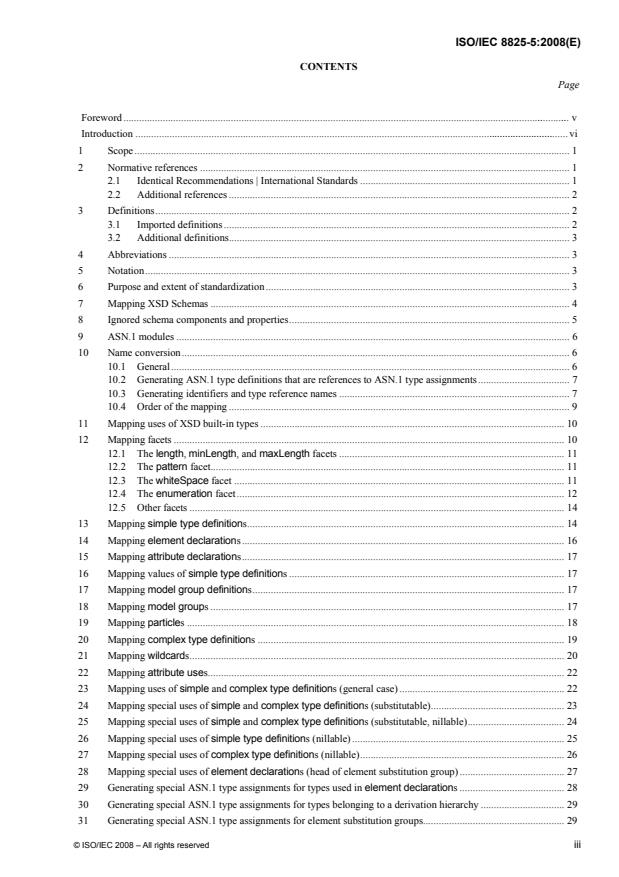
CONTENTS
Page
Foreword . v
Introduction . vi
1 Scope . 1
2 Normative references . 1
2.1 Identical Recommendations | International Standards . 1
2.2 Additional references . 2
3 Definitions. 2
3.1 Imported definitions. 2
3.2 Additional definitions. 3
4 Abbreviations . 3
5 Notation. 3
6 Purpose and extent of standardization . 3
7 Mapping XSD Schemas . 4
8 Ignored schema components and properties. 5
9 ASN.1 modules . 6
10 Name conversion. 6
10.1 General. 6
10.2 Generating ASN.1 type definitions that are references to ASN.1 type assignments. 7
10.3 Generating identifiers and type reference names . 7
10.4 Order of the mapping . 9
11 Mapping uses of XSD built-in types . 10
12 Mapping facets . 10
12.1 The length, minLength, and maxLength facets . 11
12.2 The pattern facet. 11
12.3 The whiteSpace facet . 11
12.4 The enumeration facet. 12
12.5 Other facets . 14
13 Mapping simple type definitions. 14
14 Mapping element declarations. 16
15 Mapping attribute declarations. 17
16 Mapping values of simple type definitions . 17
17 Mapping model group definitions. 17
18 Mapping model groups . 17
19 Mapping particles . 18
20 Mapping complex type definitions . 19
21 Mapping wildcards. 20
22 Mapping attribute uses. 22
23 Mapping uses of simple and complex type definitions (general case) . 22
24 Mapping special uses of simple and complex type definitions (substitutable). 23
25 Mapping special uses of simple and complex type definitions (substitutable, nillable). 24
26 Mapping special uses of simple type definitions (nillable) . 25
27 Mapping special uses of complex type definitions (nillable). 26
28 Mapping special uses of element declarations (head of element substitution group) . 27
29 Generating special ASN.1 type assignments for types used in element declarations . 28
30 Generating special ASN.1 type assignments for types belonging to a derivation hierarchy . 29
31 Generating special ASN.1 type assignments for element substitution groups. 29
© ISO/IEC 2008 – All rights reserved iii
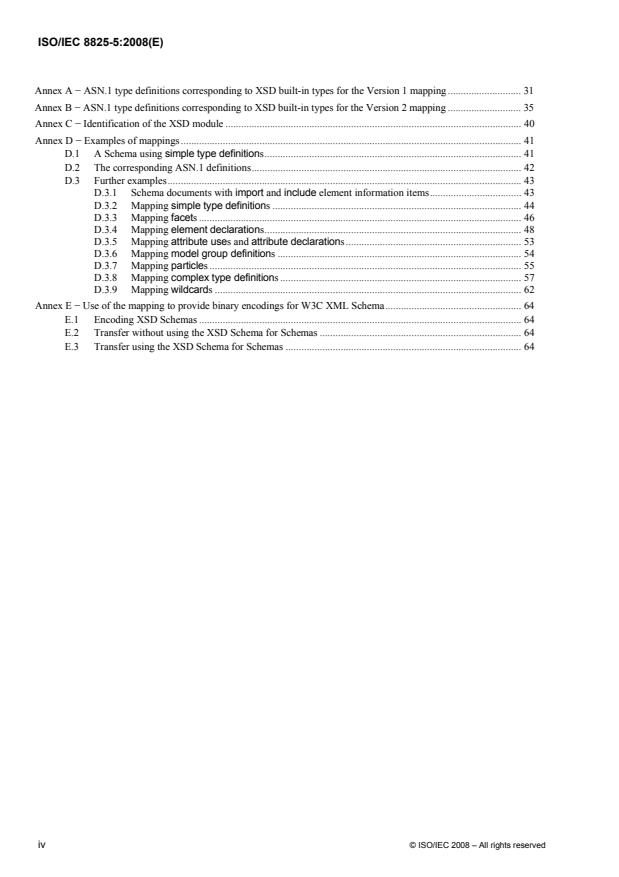
Annex A − ASN.1 type definitions corresponding to XSD built-in types for the Version 1 mapping . 31
Annex B − ASN.1 type definitions corresponding to XSD built-in types for the Version 2 mapping . 35
Annex C − Identification of the XSD module . 40
Annex D − Examples of mappings. 41
D.1 A Schema using simple type definitions. 41
D.2 The corresponding ASN.1 definitions. 42
D.3 Further examples. 43
D.3.1 Schema documents with import and include element information items. 43
D.3.2 Mapping simple type definitions . 44
D.3.3 Mapping facets . 46
D.3.4 Mapping element declarations. 48
D.3.5 Mapping attribute uses and attribute declarations. 53
D.3.6 Mapping model group definitions . 54
D.3.7 Mapping particles . 55
D.3.8 Mapping complex type definitions . 57
D.3.9 Mapping wildcards . 62
Annex E − Use of the mapping to provide binary encodings for W3C XML Schema. 64
E.1 Encoding XSD Schemas . 64
E.2 Transfer without using the XSD Schema for Schemas . 64
E.3 Transfer using the XSD Schema for Schemas . 64
iv © ISO/IEC 2008 – All rights reserved
Foreword
ISO (the International Organization for Standardization) and IEC (the International Electrotechnical
Commission) form the specialized system for worldwide standardization. National bodies that are members of
ISO or IEC participate in the development of International Standards through technical committees
established by the respective organization to deal with particular fields of technical activity. ISO and IEC
technical committees collaborate in fields of mutual interest. Other international organizations, governmental
and non-governmental, in liaison with ISO and IEC, also take part in the work. In the field of information
technology, ISO and IEC have established a joint technical committee, ISO/IEC JTC 1.
International Standards are drafted in accordance with the rules given in the ISO/IEC Directives, Part 2.
The main task of the joint technical committee is to prepare International Standards. Draft International
Standards adopted by the joint technical committee are circulated to national bodies for voting. Publication as
an International Standard requires approval by at least 75 % of the national bodies casting a vote.
Attention is drawn to the possibility that some of the elements of this document may be the subject of patent
rights. ISO and IEC shall not be held responsible for identifying any or all such patent rights.
ISO/IEC 8825-5 was prepared by Joint Technical Committee ISO/IEC JTC 1, Information technology,
Subcommittee SC 6, Telecommunications and information exchange between systems, in collaboration with
ITU-T. The identical text is published as ITU-T Rec. X.694 (11/2008).
This second edition cancels and replaces the first edition (ISO/IEC 8825-5:2004), which has been technically
revised. It also incorporates the Amendment ISO/IEC 8825-5:2004/Amd.1:2008 and the Technical
Corrigendum ISO/IEC 8825-5:2004/Cor.1:2006.
ISO/IEC 8825 consists of the following parts, under the general title Information technology — ASN.1
encoding rules:
⎯ Part 1: Specification of Basic Encoding Rules (BER), Canonical Encoding Rules (CER) and Distinguished
Encoding Rules (DER)
⎯ Part 2: Specification of Packed Encoding Rules (PER)
⎯ Part 3: Specification of Encoding Control Notation (ECN)
⎯ Part 4: XML Encoding Rules (XER)
⎯ Part 5: Mapping W3C XML schema definitions into ASN.1
⎯ Part 6: Registration and application of PER encoding instructions
© ISO/IEC 2008 – All rights reserved v
Introduction
This Recommendation | International Standard specifies Version 1 and Version 2 of a mapping from a W3C XML
Schema definition (an XSD Schema) into an ASN.1 schema. The mappings can be applied to any XSD Schema. Both
mappings specify the generation of one or more ASN.1 modules containing type definitions, together with ASN.1 XER
encoding instructions. These are jointly described as an ASN.1 schema for XML documents. This ASN.1 schema
(produced by either Version of the mapping), when used with the ASN.1 Extended XML Encoding Rules
(EXTENDED-XER), can be used to generate and to validate the same set of W3C XML 1.0 documents as the original
XSD Schema. The resulting ASN.1 types and encodings support the same semantic content as the XSD Schema. Thus
ASN.1 tools can be used interchangeably with XSD tools for the generation and processing of the specified XML
documents.
Other standardized ASN.1 encoding rules, such as the Distinguished Encoding Rules (DER) or the Packed Encoding
Rules (PER), can be used in conjunction with this standardized mapping, but produce encodings for Version 2 of the
mapping that differ from (and are less verbose than) those produced by Version 1 for XSD constructs involving dates
and times or wildcards.
The combination of this Recommendation | International Standard with ASN.1 Encoding Rules provides fully-
standardized and vendor-independent compact and canonical binary encodings for data originally defined using an XSD
Schema.
The ASN.1 schema provides a clear separation between the specification of the information content of messages (their
abstract syntax) and the precise form of the XML document (for example, use of attributes instead of elements). This
results in both a clearer and generally a less verbose schema than the original XSD Schema.
Annex A forms an integral part of this Recommendation | International Standard, and is an ASN.1 module containing a
set of ASN.1 type assignments that correspond to each of the XSD built-in types for Version 1 of the mapping.
Mappings of XSD Schemas into ASN.1 schemas either import the type reference names of those type assignments or
include the type definitions in-line.
Annex B also forms an integral part of this Recommendation | International Standard and provides the ASN.1 module
for Version 2 of the mapping.
Annex C does not form an integral part of this Recommendation | International Standard, and summarizes the object
identifier, OID internationalized resource identifier and object descriptor values assigned in this Recommendation |
International Standard.
Annex D does not form an integral part of this Recommendation | International Standard, and gives examples of the
mapping of XSD Schemas into ASN.1 schemas.
Annex E does not form an integral part of this Recommendation | International Standard, and describes the use of the
mapping defined in this Recommendation | International Standard, in conjunction with standardized ASN.1 Encoding
Rules, to provide compact and canonical encodings for data defined using an XSD Schema.
vi © ISO/IEC 2008 – All rights reserved
ISO/IEC 8825-5:2008 (E)
INTERNATIONAL STANDARD
ITU-T RECOMMENDATION
Information technology – ASN.1 encoding rules:
Mapping W3C XML schema definitions into ASN.1
1 Scope
This Recommendation | International Standard specifies two Versions of a mapping from any XSD Schema into an
ASN.1 schema. The ASN.1 schema for both Versions support the same semantics and validate the same set of XML
documents.
This Recommendation | International Standard specifies the final XER encoding instructions that are to be applied as
part of the defined mapping to ASN.1 types, but does not specify which syntactic form is to be used for the specification
of those final XER encoding instructions, or the order or manner of their assignment.
NOTE – Implementers of tools generating these mappings may choose any syntactic form or order of assignment that results in
the specified final XER encoding instructions being applied. Examples in this Recommendation | International Standard
generally use the type prefix form, but use of an XER Encoding Control Section may be preferred for the mapping of a complete
XSD Schema, as a matter of style.
There are different ways (syntactically) of assigning XER encoding instructions for use in EXTENDED-XER
encodings (for example, use of ASN.1 type prefix encoding instructions or use of an XER encoding control section).
The choice of these syntactic forms is a matter of style and is outside the scope of this Recommendation | International
Standard.
2 Normative references
The following Recommendations | International Standards and W3C specifications contain provisions which, through
reference in this text, constitute provisions of this Recommendation | International Standard. At the time of publication,
the editions indicated were valid. All Recommendations, International Standards and W3C specifications are subject to
revision, and parties to agreements based on this Recommendation | International Standard are encouraged to
investigate the possibility of applying the most recent edition of the Recommendations, International Standards and
W3C specifications listed below. Members of IEC and ISO maintain registers of currently valid International Standards.
The Telecommunication Standardization Bureau of the ITU maintains a list of currently valid ITU-T
Recommendations. The W3C maintains a list of currently valid W3C specifications. The reference to a document
within this Recommendation | International Standard does not give it, as a stand-alone document, the status of a
Recommendation or International Standard.
2.1 Identical Recommendations | International Standards
NOTE – The complete set of ASN.1 Recommendations | International Standards are listed below, as they can all be applicable in
particular uses of this Recommendation | International Standard. Where these are not directly referenced in the body of this
Recommendation | International Standard, a † symbol is added to the reference.
– ITU-T Recommendation X.680 (2008) | ISO/IEC 8824-1:2008, Information technology – Abstract
Syntax Notation One (ASN.1): Specification of basic notation.
– ITU-T Recommendation X.681 (2008) | ISO/IEC 8824-2:2008, Information technology – Abstract
Syntax Notation One (ASN.1): Information object specification. †
– ITU-T Recommendation X.682 (2008) | ISO/IEC 8824-3:2008, Information technology – Abstract
Syntax Notation One (ASN.1): Constraint specification.
– ITU-T Recommendation X.683 (2008) | ISO/IEC 8824-4:2008, Information technology – Abstract
Syntax Notation One (ASN.1): Parameterization of ASN.1 specifications. †
– ITU-T Recommendation X.690 (2008) | ISO/IEC 8825-1:2008, Information technology – ASN.1
encoding Rules: Specification of Basic Encoding Rules (BER), Canonical Encoding Rules (CER), and
Distinguished Encoding Rules (DER).
ITU-T Rec. X.694 (11/2008) 1
ISO/IEC 8825-5:2008 (E)
– ITU-T Recommendation X.691 (2008) | ISO/IEC 8825-2:2008, Information technology – ASN.1
encoding rules: Specification of Packed Encoding Rules (PER).
– ITU-T Recommendation X.692 (2008) | ISO/IEC 8825-3:2008, Information technology – ASN.1
encoding rules: Specification of Encoding Control Notation (ECN). †
– ITU-T Recommendation X.693 (2008) | ISO/IEC 8825-4:2008, Information technology – ASN.1
encoding rules: XML Encoding Rules (XER).
– ITU-T Recommendation X.891 (2005) | ISO/IEC 24824-1:2007, Information technology – Generic
Applications of ASN.1: Fast Infoset.
2.2 Additional references
– ISO 8601:2004, Data elements and interchange formats – Information interchange – Representation of
dates and times.
– ISO/IEC 10646:2003, Information technology – Universal Multiple-Octet Coded Character Set (UCS).
– W3C XML 1.0:2000, Extensible Markup Language (XML) 1.0 (Second Edition), W3C Recommendation,
Copyright © [6 October 2000] World Wide Web Consortium, (Massachusetts Institute of Technology,
Institut National de Recherche en Informatique et en Automatique, Keio University),
http://www.w3.org/TR/2000/REC-xml-20001006.
– W3C XML Namespaces:1999, Namespaces in XML, W3C Recommendation, Copyright © [14 January
1999] World Wide Web Consortium, (Massachusetts Institute of Technology, Institut National de
Recherche en Informatique et en Automatique, Keio University), http://www.w3.org/TR/1999/REC-xml-
names-19990114.
– W3C XML Information Set:2001, XML Information Set, W3C Recommendation, Copyright ©
[24 October 2001] World Wide Web Consortium (Massachusetts Institute of Technology, Institut
National de Recherche en Informatique et en Automatique, Keio University),
http://www.w3.org/TR/2001/REC-xml-infoset-20011024.
– W3C XML Schema:2001, XML Schema Part 1: Structures, W3C Recommendation, Copyright © [2 May
2001] World Wide Web Consortium, (Massachusetts Institute of Technology, Institut National de
Recherche en Informatique et en Automatique, Keio University), http://www.w3.org/TR/2001/REC-
xmlschema-1-20010502.
– W3C XML Schema:2001, XML Schema Part 2: Datatypes, W3C Recommendation, Copyright © [2 May
2001] World Wide Web Consortium, (Massachusetts Institute of Technology, Institut National de
Recherche en Informatique et en Automatique, Keio University), http://www.w3.org/TR/2001/REC-
xmlschema-2-20010502.
NOTE – When the reference "W3C XML Schema" is used in this Recommendation | International Standard, it
refers to W3C XML Schema Part 1 and W3C XML Schema Part 2.
– IETF RFC 2396 (1998), Uniform Resource Identifiers (URI): Generic Syntax.
– IETF RFC 1766 (1995), Tags for the Identification of Languages.
3 Definitions
3.1 Imported definitions
3.1.1 This Recommendation | International Standard uses the terms defined in ITU-T Rec. X.680 | ISO/IEC 8824-1
and in ITU-T Rec. X.693 | ISO/IEC 8825-4.
NOTE – In particular, the terms "final XER encoding instructions", "type prefix" and "XER encoding control section" are
defined in the above-mentioned Recommendations | International Standards.
3.1.2 This Recommendation | International Standard also uses the terms defined in W3C XML Schema and W3C
XML Information Set.
NOTE 1 – It is believed that these terms do not conflict with the terms referenced in 3.1.1. If such a conflict occurs, the
definition of the term in 3.1.1 applies.
NOTE 2 – In particular, the terms "schema component" and "property (of a schema component)" are defined in W3C XML
Schema, and the terms "element information item" and "attribute information item" are defined in W3C XML Information Set.
NOTE 3 – The terms "top-level simple type definition" and "top-level complex type definition" do not include XSD built-in types,
when used in this Recommendation | International Standard.
2 ITU-T Rec. X.694 (11/2008)
ISO/IEC 8825-5:2008 (E)
3.2 Additional definitions
For the purposes of this Recommendation | International Standard, the following additional definitions apply:
3.2.1 XSD namespace: A namespace with a URI of "http://www.w3.org/2001/XMLSchema".
3.2.2 XSI namespace: A namespace with a URI of "http://www.w3.org/2001/XMLSchema-instance".
3.2.3 XML namespace: A namespace with a URI of "http://www.w3.org/XML/1998/namespace".
4 Abbreviations
For the purposes of this Recommendation | International Standard, the following abbreviations apply:
ASN.1 Abstract Syntax Notation One
BER (ASN.1) Basic Encoding Rules
DER (ASN.1) Distinguished Encoding Rules
PER (ASN.1) Packed Encoding Rules
URI (IETF) Uniform Resource Identifier
XER (ASN.1) XML Encoding Rules
XML (W3C) Extensible Markup Language
XSD (W3C) XML Schema
5 Notation
5.1 This Recommendation | International Standard references the notation defined by ITU-T Rec. X.680 |
ISO/IEC 8824-1, ITU-T Rec. X.682 | ISO/IEC 8824-3, W3C XML 1.0 and W3C XML Schema.
5.2 When it is necessary in the body of this Recommendation | International Standard to specify, either formally
or in examples, the assignment of XER encoding instructions, the type prefix notation is generally used (but see 6.3
and 6.4). In Annex A, an XER encoding control section is used.
5.3 In this Recommendation | International Standard, bold Courier is used for ASN.1 notation and bold Arial is
used for XSD notation and for XSD terms and concepts.
5.4 The XSD Schemas used in the examples in this Recommendation | International Standard use the prefix xsd:
to identify the XSD namespace.
6 Purpose and extent of standardization
6.1 The mapping to ASN.1 that is specified in this Recommendation | International Standard ensures that:
a) any resulting ASN.1 modules generated by tools conforming to this Recommendation | International
Standard (from the same XSD Schema) define the same (structured) abstract values;
b) all BASIC-XER, CXER, EXTENDED-XER, and binary encodings of that resulting ASN.1 specification
will produce the same encodings (subject to encoder's options); and
c) all XML documents that conform to the source XSD Schema are valid EXTENDED-XER encodings of
abstract values of that ASN.1 specification.
6.2 There are many aspects of an ASN.1 definition (such as the use of white-space, or of encoding control
sections or type prefixes) that affect neither the abstract values being defined nor the XER or binary encodings of those
values. Such aspects of the ASN.1 definition are generally not standardized in this Recommendation | International
Standard.
6.3 There are many different ways in ASN.1 of assigning an XER encoding instruction to a type, including:
a) use of a type prefix for every encoding instruction to be assigned; or
b) use of an encoding control section, with a separate encoding instruction for each required assignment; or
c) use of an encoding control section, with a single encoding instruction making a global assignment,
possibly supplemented by use of a negating encoding instruction for specific types.
6.4 This Recommendation | International Standard specifies when a final XER encoding instruction shall be
present, and uses the syntax of 6.3 a) in most of its examples. However, the use of the different options in 6.3 is not
ITU-T Rec. X.694 (11/2008) 3
ISO/IEC 8825-5:2008 (E)
standardized, and conforming implementations of the mapping may choose any syntactic form (or a mixture of syntactic
forms) for the assignment of final XER encoding instructions.
NOTE – The choice among these options does not affect the final binary or XML encodings.
6.5 A formal specification of the required mapping is not provided.
6.6 This Recommendation | International Standard is concerned only with the mapping of XSD Schemas that
conform to W3C XML Schema.
NOTE – Such conformance can be either by the provision of one or more W3C XSD schema documents or by other means as
specified in W3C XML Schema.
7 Mapping XSD Schemas
7.1 A mapping is based on a source XSD Schema, which is a set of schema components (see W3C XML Schema
Part 1, 2.2). No particular representation of schema components or sets of schema components is required or assumed
for the mapping, although it is expected that the source XSD Schema will usually be provided as one or more XML
schema documents (see W3C XML Schema Part 1, 3.15.2).
NOTE 1 – The schema components represented in multiple XML schema documents become part of the same XSD Schema
through the use of the xsd:include, xsd:redefine, and xsd:import element information items.
NOTE 2 – Since the mapping is defined in terms of schema components (and not in terms of their XML representation), it is not
affected by details of the XML representation, such as the use of multiple schema documents linked by xsd:include and
xsd:redefine element information items, the placement of element information items in one or another schema documents, the
order of xsd:attribute element information items within a xsd:complexType element information item, and so on.
NOTE 3 – Two sets of schema documents that differ in many aspects but represent the same set of schema components generate
the same set of ASN.1 type assignments, with the same final encoding instructions assigned to them and to their components to
any depth.
7.2 The source XSD Schema shall meet all the constraints imposed by the XSD specification. If the source XSD
Schema is represented (in part or all) as a set of XML schema documents, each schema document shall be valid
according to the XSD Schema for Schemas (see W3C XML Schema Part 1, Appendix A).
7.3 One or more ASN.1 modules shall be generated for a source XSD Schema. The number of ASN.1 modules
generated is an implementation option. Each ASN.1 module shall contain zero or more type assignments corresponding
to top-level schema components (see 7.6), and zero or more special ASN.1 type assignments (see clauses 29, 30, and
31). The physical order of type assignments within each ASN.1 module is an implementation option. When multiple
ASN.1 modules are generated, the way the generated type assignments are distributed across those ASN.1 modules is
also an implementation option.
NOTE 1 – The inclusion in the same ASN.1 module of type assignments generated from XSD schema components with different
target namespaces is permitted by this subclause but not recommended. The preferred mapping is to generate one ASN.1 module
per namespace whenever possible. It is also recommended that each special ASN.1 type assignment be inserted in the same
ASN.1 module as its associated ASN.1 type assignment (see 29.5, 30.4, and 31.4).
NOTE 2 – The generation of ASN.1 type assignments (see 7.6 and 10.4) is not affected by the number of ASN.1 modules being
generated (except for the possible use of "ExternalTypeReference" as specified in 10.2.2), nor by the way the generated type
assignments are distributed across those modules, nor by the physical order of the type assignments within each module. In
particular, the type reference names of those type assignments are the same whatever mapping style is used by the
implementation.
NOTE 3 – A full description of the relationship between the namespace concept of W3C XML Namespaces and naming in
ASN.1 is provided in ITU-T Rec. X.693 | ISO/IEC 8825-4, clause 16. Type reference names and identifiers defined in an ASN.1
module are assigned a namespace by means of a NAMESPACE encoding instruction, and otherwise do not have a namespace. The
mapping generates NAMESPACE encoding instructions where needed.
7.4 All ASN.1 modules generated by the mapping shall contain (in the XER encoding control section) a GLOBAL-
DEFAULTS MODIFIED-ENCODINGS encoding instruction and a GLOBAL-DEFAULTS CONTROL-NAMESPACE encoding
instruction specifying the XSI namespace.
7.5 A source XSD Schema shall be processed as follows:
a) for each top-level element declaration, an ASN.1 type assignment shall be generated by applying
clause 14 to the element declaration;
b) for each top-level attribute declaration, an ASN.1 type assignment shall be generated by applying
clause 15 to the attribute declaration;
c) for each top-level simple type definition, an ASN.1 type assignment shall be generated by applying clause
13 to the simple type definition;
d) for each top-level complex type definition, an ASN.1 type assignment shall be generated by applying
clause 20 to the complex type definition;
4 ITU-T Rec. X.694 (11/2008)
ISO/IEC 8825-5:2008 (E)
e) for each model group definition whose model group has a compositor of sequence or choice, an ASN.1 type
assignment shall be generated by applying clause 17 to the model group definition.
NOTE 1 – The remaining schema components of the source XSD schema will be processed as a result of mapping these schema
components.
NOTE 2 – The order in which schema components are to be mapped is specified in 10.4. The order of the items of the list above
has no significance for the mapping.
7.6 Column 1 of Table 1 lists schema components. Column 2 gives the reference to the clause in W3C XML
Schema that defines the schema component. Column 3 lists the clause that defines the mapping of those schema
components into ASN.1.
Table 1 – Mapping of XSD schema components
XSD schema component W3C XML Schema reference Mapping defined by
attribute declaration Part 1, 3.2 Clause 15
element declaration Part 1, 3.3 Clause 14
complex type definition Part 1, 3.4 Clause 20
attribute use Part 1, 3.5 Clause 22
attribute group definition Part 1, 3.6 not mapped as such
model group definition Part 1, 3.7 Clause 17
model group Part 1, 3.8 Clause 18
particle Part 1, 3.9 Clause 19
wildcard Part 1, 3.10 Clause 21
identity-constraint definition Part 1, 3.11 ignored by the mapping
notation declaration Part 1, 3.12 ignored by the mapping
annotation Part 1, 3.13 ignored by the mapping
simple type definition Part 1, 3.14 Clauses 11, 13
schema Part 1, 3.15 Clause 9
ordered Part 2, 4.2.2.1 ignored by the mapping
bounded Part 2, 4.2.3.1 ignored by the mapping
cardinality Part 2, 4.2.4.1 ignored by the mapping
numeric Part 2, 4.2.5.1 ignored by the mapping
length Part 2, 4.3.1.1 Clause 12
minLength Part 2, 4.3.2.1 Clause 12
maxLength Part 2, 4.3.3.1 Clause 12
pattern Part 2, 4.3.4.1 Clause 12
enumeration Part 2, 4.3.5.1 Clause 12
whiteSpace Part 2, 4.3.6.1 Clause 12
maxInclusive Part 2, 4.3.7.1 Clause 12
maxExclusive Part 2, 4.3.8.1 Clause 12
minExclusive Part 2, 4.3.9.1 Clause 12
minInclusive Part 2, 4.3.10.1 Clause 12
totalDigits Part 2, 4.3.11.1 Clause 12
fractionDigits Part 2, 4.3.12.1 Clause 12
8 Ignored schema components and properties
8.1 The mapping shall ignore the schema components and properties that are listed in this clause.
8.2 All annotations (see W3C XML Schema Part 1, 3.13) shall be ignored.
NOTE – All attribute information items in a schema document with names qualified with namespaces other than the XSD
namespace (see W3C XML Schema Part 1, 3.13.1) are a property of annotations, and are ignored.
8.3 All identity-constraint definitions (see W3C XML Schema Part 1, 3.11) shall be ignored.
ITU-T Rec. X.694 (11/2008) 5
ISO/IEC 8825-5:2008 (E)
NOTE – The identity-constraint definition provides mechanisms for specifying referential constraints that can be required in a
valid instance. ASN.1 currently has no concept of such constraints, and such constraints cannot be mapped into a formal ASN.1
specification, but they may be included as normative comments that are binding on an application implementation.
8.4 All notation declarations (see W3C XML Schema Part 1, 3.12) shall be ignored.
8.5 All schema components that are the fundamental facets (ordered, bounded, cardinality, numeric) of simple type
definitions (see W3C XML Schema Part 2, 4.2) shall be ignored.
8.6 The properties identity-constraint definitions, substitution group exclusions and disallowed substitutions of element
declarations shall be ignored.
8.7 The properties final, abstract, and prohibited substitutions of complex type definitions shall be ignored.
8.8 The property process contents of wildcards shall be ignored.
NOTE – There is no support in ASN.1 for any action other than skip.
8.9 The properties fundamental facets and final of simple type definitions shall be ignored.
8.10 All value constraints that are present on any element declarations or attribute declarations whose type definition is
either xsd:QName or a simple type definition derived from xsd:QName or xsd:NOTATION shall be ignored.
8.11 All attribute group definitions shall be ignored.
NOTE – The attribute uses in an attribute group definition become part of the attribute uses of the complex type definitions whose XML
representation contains a reference to the attribute group definition.
9 ASN.1 modules
9.1 The mapping of an XSD Schema generates one or more ASN.1 modules (see 7.3).
9.2 The ASN.1 "ModuleIdentifier" (see ITU-T Rec. X.680 | ISO/IEC 8824-1, clause 13) to be generated by the
mapping is not standardized. Where IMPORTS statements are used, the ASN.1 module names and module identifiers in
the IMPORTS statements shall be those generated for the ASN.1 modules generated by the mapping.
NOTE – The choice of "ModuleIdentifier" does not affect the encodings in any of the standard encoding rules.
9.3 The ASN.1 modules shall have a "TagDefault" of AUTOMATIC TAGS.
9.4 In each ASN.1 module generated by a Version 1 mapping, there shall be an ASN.1 IMPORTS statement
importing the ASN.1 type reference names in the module named XSD {joint-iso-itu-t asn1(1)
specification(0) modules(0) xsd-module(2) version1(1)} specified in Annex A that are referenced in the
ASN.1 module.
9.5 In each ASN.1 module generated by a Version 2 mapping, there shall be an ASN.1 IMPORTS statement
importing the ASN.1 type reference names in the module named XSD {joint-iso-itu-t asn1(1)
specification(0) modules(0) xsd-module(2) version2(2)} specified in Annex B that are referenced in the
generated ASN.1 module.
NOTE – The term "XSD module" in this Recommendation | International Standard refers to the module defined in Annex A
(Version 1 mapping) or in Annex B (Version 2 mapping), according to the version of the mapping.
9.6 The IMPORTS statement shall also import the ASN.1 type reference names of type assignments that have been
placed (as a result of the mapping) in other ASN.1 modules but are referenced in this ASN.1 module.
9.7 There shall be no EXPORTS statement.
NOTE – This means that all ASN.1 type reference names in the ASN.1 module can be imported into other modules.
10 Name conversion
10.1 General
10.1.1 This Recommendation | International Standard specifies the generation of:
a) ASN.1 type reference names corresponding to the names of model group definitions, top-level element
declarations, top-level attribute declarations, top-level complex type definitions, and top-level simple type
definitions;
b) ASN.1 identifiers corresponding to the names of top-level element declarations, top-level attribute
declarations, local element declarations, and local attribute declarations;
6 ITU-T Rec. X.694 (11/2008)
ISO/IEC 8825-5:2008 (E)
c) ASN.1 identifiers for the mapping of certain simple type definitions with an enumeration facet (see 12.4.1
and 12.4.2);
d) ASN.1 type reference names of special type assignments (see clauses 29, 30, and 31); and
e) ASN.1 identifiers of certain sequence components introduced by the mapping (see clause 20).
10.1.2 All of these ASN.1 names are generated by applying 10.3 either to the name of the corresponding schema
component, or to a member of the value of an enumeration facet, or to a specified character string, as specified in the
relevant clauses of this Recommendation | International Standard.
10.2 Generating ASN.1 type definitions that are references to ASN.1 type assignments
10.2.1 This subclause applies as explicitly invoked by other clauses of this Recommendation | International Standard
to generate an ASN.1 type (a "DefinedType") definition that is a reference to an ASN.1 type assignment.
10.2.2 If a "DefinedType" is to be inserted in an ASN.1 module (M, say) other than the ASN.1 module where the
referenced ASN.1 type assignment is being inserted, then the "DefinedType" shall be either a "typereference" or an
"ExternalTypeReference" for that type assignment, as an implementation option. Otherwise, it shall be a
"typereference" for that type assignment.
NOTE – All ASN.1 "typereference"s created by the mapping are unique for any legal input schema, so a type defined in another
ASN.1 module does not need to be an "ExternalTypeReference".
10.3 Generating identifiers and type reference names
10.3.1 This subclause applies as explicitly invoked by other clauses of this Recommendation | International Standard
to generate an ASN.1 type reference name or identifier.
10.3.2 Names of attribute declarations, element declarations, model group definitions, top-level simple type definitions, and
top-level complex type definitions can be identical to ASN.1 reserved words or can contain characters not allowed in
ASN.1 identifiers or in ASN.1 type reference names. In addition, there are cases in which ASN.1 names are required to
be distinct where the names of the corresponding XSD schema components (from which the ASN.1 names are mapped)
are allowed to be identical.
10.3.3 The following transformations shall be applied, in order, to each character string being mapped to an ASN.1
name, where each transformation (except the first) is applied to the result of the previous transformation:
– the characters " " (SPACE), "." (FULL STOP), and "_" (LOW LINE) shall all be replaced by a "-"
(HYPHEN-MINUS); and
– any character except "A" to "Z" (LATIN CAPITAL LETTER A to LATIN CAPITAL LETTER Z), "a"
to "z" (LATIN SMALL LETTER A to LATIN SMALL LETTER Z), "0" to "9" (DIGIT ZERO to DIGIT
NINE), and "-" (HYPHEN-MINUS) shall be removed; and
– a sequence of two or more HYPHEN-MINUS characters shall be replaced with a single
HYPHEN-MINUS; and
– HYPHEN-MINUS characters occurring at the beginning or at the end of the name shall be removed; and
– if a character string that is to be used as a type reference name starts with a lower-case letter, the first
letter shall be capitalized (converted to upper-case); if it starts with a digit (DIGIT ZERO to DIGIT
NINE), it shall be prefixed with an "X" (LATIN CAPITAL LETTER X) character; and
– if a character string that is to be used as an identifier starts with an upper-case letter, the first letter shall
be uncapitalized (converted to lower-case); if it star
...
Questions, Comments and Discussion
Ask us and Technical Secretary will try to provide an answer. You can facilitate discussion about the standard in here.
Loading comments...