

ISO/IEC 26556:2018
(Main)Information technology — Software and systems engineering — Tools and methods for product line organizational management
General Information
- Abstract
This document, within the methods and tools of organizational management for software and systems product lines: — enables the users of this document to holistically understand, adopt and enact the processes, tools and methods for product line organizational management; — helps the users evaluate and select relevant tools and methods based on business and user-related criteria; — helps make product line engineers, developers and tool vendors informed about capabilities of tools and methods that are required for supporting product line implementation from organizational aspects; and — provides product line-specific processes and capabilities of tools and methods in organizational management. This document concerns processes and capabilities of methods and tools for organizational management for a family of products, not for a single system. NOTE System Architecture is a set of logical and physical principles used to achieve a mission within a given environment. Components that can be subsystems derived from System Architecture are: software products, human-based products such as crew or operators, or hardware products like mechanical structures, electronic boards and chemicals. The scope of this document spans from the system to subsystems and components. Both hardware-intensive and software-intensive systems are included, if they are part of a product family.
- Status
- Published
- Publication Date
- 07-Nov-2018
- Technical Committee
- ISO/IEC JTC 1/SC 7 - Software and systems engineering
- Drafting Committee
- ISO/IEC JTC 1/SC 7/WG 4 - Tools and environment
- Current Stage
- 9093 - International Standard confirmed
- Start Date
- 10-May-2024
- Completion Date
- 29-Aug-2026
Overview
ISO/IEC 26556:2018 - Information technology - Software and systems engineering - Tools and methods for product line organizational management - defines processes, capabilities and evaluation criteria for organizational management of product families. The standard helps organizations holistically adopt, enact and evaluate tools and methods that support product line engineering at the organizational level. Its scope covers system-to-subsystem concerns and includes both hardware‑intensive and software‑intensive product families.
Key topics and technical requirements
The standard provides a reference model and structured processes for organizational product line management. Major technical topics include:
- Reference model for product line organizational management - high‑level framework linking planning, enabling and management activities.
- Organizational-level product line planning - business opportunity analysis, market and technology forecasting, product roadmaps, success metrics and business case documentation.
- Customer relationship management - identifying stakeholder groups, aggregating requirements and managing long‑term customer relationships at the product line level.
- Sourcing strategy - contracting, ownership/data rights, continuity of support and evaluation criteria for suppliers and bidders.
- Deployment and innovation planning - organizational capability analysis, procedures, roles, schedules and pilot projects for adoption.
- Operations and value management - operational policies, metrics, monitoring, and value/benefit quantification for product line adoption.
- Product line evolution planning - processes for adapting to market and technology change over product family life cycles.
- Organizational enabling - structuring organization, defining decision‑making responsibilities, establishing infrastructure and managing effectiveness.
- Quality management for product families - policies, reuse‑oriented quality evaluation and corrective action mechanisms.
- Management processes - ongoing deployment, operations management, monitoring, tuning and institutionalization of product line practices.
The standard emphasizes tool capabilities and selection criteria so tool vendors, engineers and managers can assess how methods and tools support these processes.
Practical applications
ISO/IEC 26556:2018 is used to:
- Select and evaluate tools for product line engineering and organizational management.
- Define organizational roles, governance and infrastructure for product families.
- Create business cases, roadmaps and value metrics tied to product line investments.
- Design sourcing and supplier strategies that accommodate product family requirements.
- Establish quality, operations and evolution processes that span multiple products or subsystems.
Who should use this standard
- Product line engineers and architects
- Engineering managers and program directors
- Tool and method vendors
- Procurement and sourcing teams
- Quality, operations and product management professionals
Related standards
Refer to complementary ISO/IEC standards on software and systems engineering, system architecture, quality management and configuration management when implementing ISO/IEC 26556:2018 for a complete product line governance approach.
Get Certified
Connect with accredited certification bodies for this standard

BSI Group
BSI (British Standards Institution) is the business standards company that helps organizations make excellence a habit.
BSCIC Certifications Pvt. Ltd.
Established 2006, accredited by NABCB, JAS-ANZ, EIAC, IAS. CDSCO Notified Body.

Intertek India Pvt. Ltd.
Delivers Assurance, Testing, Inspection & Certification since 1993 with 26 labs and 32 offices.
Sponsored listings
Frequently Asked Questions
ISO/IEC 26556:2018 is a standard published by the International Organization for Standardization (ISO). Its full title is "Information technology — Software and systems engineering — Tools and methods for product line organizational management". This standard covers: This document, within the methods and tools of organizational management for software and systems product lines: — enables the users of this document to holistically understand, adopt and enact the processes, tools and methods for product line organizational management; — helps the users evaluate and select relevant tools and methods based on business and user-related criteria; — helps make product line engineers, developers and tool vendors informed about capabilities of tools and methods that are required for supporting product line implementation from organizational aspects; and — provides product line-specific processes and capabilities of tools and methods in organizational management. This document concerns processes and capabilities of methods and tools for organizational management for a family of products, not for a single system. NOTE System Architecture is a set of logical and physical principles used to achieve a mission within a given environment. Components that can be subsystems derived from System Architecture are: software products, human-based products such as crew or operators, or hardware products like mechanical structures, electronic boards and chemicals. The scope of this document spans from the system to subsystems and components. Both hardware-intensive and software-intensive systems are included, if they are part of a product family.
This document, within the methods and tools of organizational management for software and systems product lines: — enables the users of this document to holistically understand, adopt and enact the processes, tools and methods for product line organizational management; — helps the users evaluate and select relevant tools and methods based on business and user-related criteria; — helps make product line engineers, developers and tool vendors informed about capabilities of tools and methods that are required for supporting product line implementation from organizational aspects; and — provides product line-specific processes and capabilities of tools and methods in organizational management. This document concerns processes and capabilities of methods and tools for organizational management for a family of products, not for a single system. NOTE System Architecture is a set of logical and physical principles used to achieve a mission within a given environment. Components that can be subsystems derived from System Architecture are: software products, human-based products such as crew or operators, or hardware products like mechanical structures, electronic boards and chemicals. The scope of this document spans from the system to subsystems and components. Both hardware-intensive and software-intensive systems are included, if they are part of a product family.
ISO/IEC 26556:2018 is classified under the following ICS (International Classification for Standards) categories: 35.080 - Software. The ICS classification helps identify the subject area and facilitates finding related standards.
ISO/IEC 26556:2018 is available in PDF format for immediate download after purchase. The document can be added to your cart and obtained through the secure checkout process. Digital delivery ensures instant access to the complete standard document.
Standards Content (Sample)
INTERNATIONAL ISO/IEC
STANDARD 26556
First edition
2018-11
Information technology — Software
and systems engineering — Tools
and methods for product line
organizational management
Technologies de l'information — Ingénierie des systèmes et du logiciel
— Outils et méthodes pour le management organisationnel d'une
gamme de produits
Reference number
©
ISO/IEC 2018
© ISO/IEC 2018
All rights reserved. Unless otherwise specified, or required in the context of its implementation, no part of this publication may
be reproduced or utilized otherwise in any form or by any means, electronic or mechanical, including photocopying, or posting
on the internet or an intranet, without prior written permission. Permission can be requested from either ISO at the address
below or ISO’s member body in the country of the requester.
ISO copyright office
CP 401 • Ch. de Blandonnet 8
CH-1214 Vernier, Geneva
Phone: +41 22 749 01 11
Fax: +41 22 749 09 47
Email: copyright@iso.org
Website: www.iso.org
Published in Switzerland
ii © ISO/IEC 2018 – All rights reserved
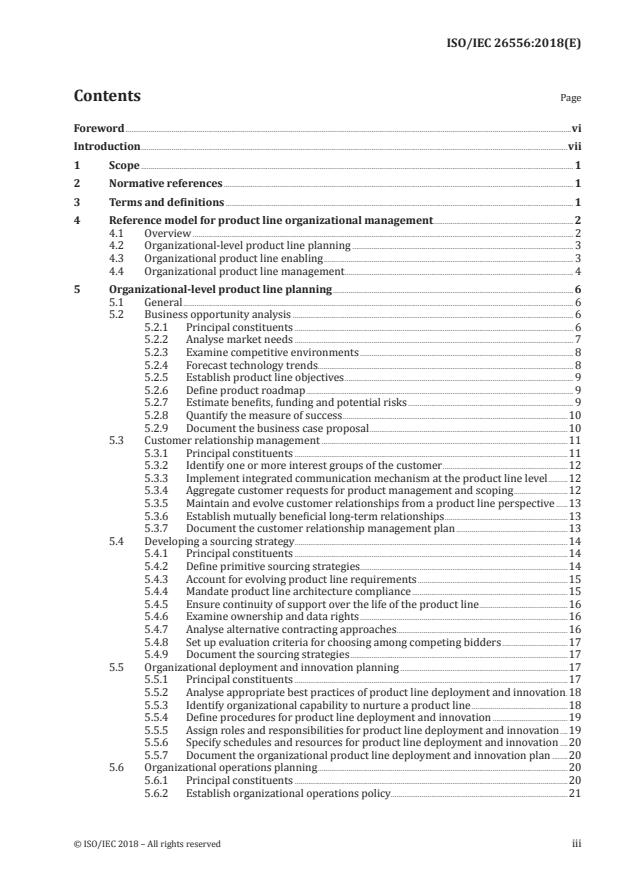
Contents Page
Foreword .vi
Introduction .vii
1 Scope . 1
2 Normative references . 1
3 Terms and definitions . 1
4 Reference model for product line organizational management .2
4.1 Overview . 2
4.2 Organizational-level product line planning . 3
4.3 Organizational product line enabling . 3
4.4 Organizational product line management . 4
5 Organizational-level product line planning . 6
5.1 General . 6
5.2 Business opportunity analysis . 6
5.2.1 Principal constituents . 6
5.2.2 Analyse market needs . 7
5.2.3 Examine competitive environments . 8
5.2.4 Forecast technology trends. 8
5.2.5 Establish product line objectives . 9
5.2.6 Define product roadmap . 9
5.2.7 Estimate benefits, funding and potential risks . 9
5.2.8 Quantify the measure of success .10
5.2.9 Document the business case proposal .10
5.3 Customer relationship management .11
5.3.1 Principal constituents .11
5.3.2 Identify one or more interest groups of the customer .12
5.3.3 Implement integrated communication mechanism at the product line level .12
5.3.4 Aggregate customer requests for product management and scoping .12
5.3.5 Maintain and evolve customer relationships from a product line perspective .13
5.3.6 Establish mutually beneficial long-term relationships .13
5.3.7 Document the customer relationship management plan .13
5.4 Developing a sourcing strategy .14
5.4.1 Principal constituents .14
5.4.2 Define primitive sourcing strategies .14
5.4.3 Account for evolving product line requirements .15
5.4.4 Mandate product line architecture compliance .15
5.4.5 Ensure continuity of support over the life of the product line .16
5.4.6 Examine ownership and data rights .16
5.4.7 Analyse alternative contracting approaches .16
5.4.8 Set up evaluation criteria for choosing among competing bidders .17
5.4.9 Document the sourcing strategies .17
5.5 Organizational deployment and innovation planning .17
5.5.1 Principal constituents .17
5.5.2 Analyse appropriate best practices of product line deployment and innovation .18
5.5.3 Identify organizational capability to nurture a product line .18
5.5.4 Define procedures for product line deployment and innovation .19
5.5.5 Assign roles and responsibilities for product line deployment and innovation .19
5.5.6 Specify schedules and resources for product line deployment and innovation .20
5.5.7 Document the organizational product line deployment and innovation plan .20
5.6 Organizational operations planning .20
5.6.1 Principal constituents .20
5.6.2 Establish organizational operations policy.21
© ISO/IEC 2018 – All rights reserved iii
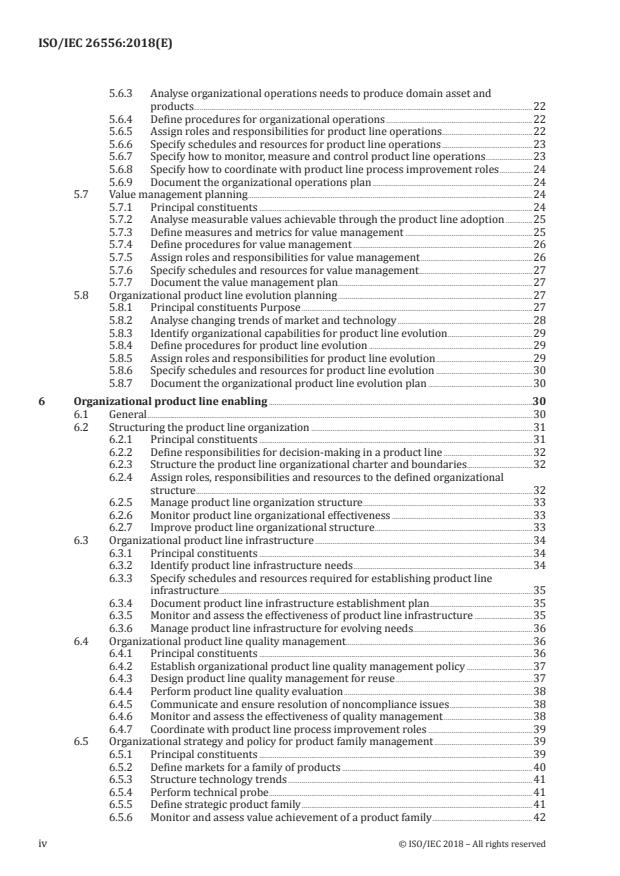
5.6.3 Analyse organizational operations needs to produce domain asset and
products.22
5.6.4 Define procedures for organizational operations .22
5.6.5 Assign roles and responsibilities for product line operations.22
5.6.6 Specify schedules and resources for product line operations .23
5.6.7 Specify how to monitor, measure and control product line operations .23
5.6.8 Specify how to coordinate with product line process improvement roles .24
5.6.9 Document the organizational operations plan .24
5.7 Value management planning.24
5.7.1 Principal constituents .24
5.7.2 Analyse measurable values achievable through the product line adoption .25
5.7.3 Define measures and metrics for value management .25
5.7.4 Define procedures for value management .26
5.7.5 Assign roles and responsibilities for value management .26
5.7.6 Specify schedules and resources for value management.27
5.7.7 Document the value management plan . .27
5.8 Organizational product line evolution planning .27
5.8.1 Principal constituents Purpose .27
5.8.2 Analyse changing trends of market and technology .28
5.8.3 Identify organizational capabilities for product line evolution .29
5.8.4 Define procedures for product line evolution .29
5.8.5 Assign roles and responsibilities for product line evolution .29
5.8.6 Specify schedules and resources for product line evolution .30
5.8.7 Document the organizational product line evolution plan .30
6 Organizational product line enabling .30
6.1 General .30
6.2 Structuring the product line organization .31
6.2.1 Principal constituents .31
6.2.2 Define responsibilities for decision-making in a product line .32
6.2.3 Structure the product line organizational charter and boundaries.32
6.2.4 Assign roles, responsibilities and resources to the defined organizational
structure . .32
6.2.5 Manage product line organization structure .33
6.2.6 Monitor product line organizational effectiveness .33
6.2.7 Improve product line organizational structure .33
6.3 Organizational product line infrastructure .34
6.3.1 Principal constituents .34
6.3.2 Identify product line infrastructure needs .34
6.3.3 Specify schedules and resources required for establishing product line
infrastructure . .35
6.3.4 Document product line infrastructure establishment plan .35
6.3.5 Monitor and assess the effectiveness of product line infrastructure .35
6.3.6 Manage product line infrastructure for evolving needs.36
6.4 Organizational product line quality management.36
6.4.1 Principal constituents .36
6.4.2 Establish organizational product line quality management policy .37
6.4.3 Design product line quality management for reuse .37
6.4.4 Perform product line quality evaluation .38
6.4.5 Communicate and ensure resolution of noncompliance issues .38
6.4.6 Monitor and assess the effectiveness of quality management .38
6.4.7 Coordinate with product line process improvement roles .39
6.5 Organizational strategy and policy for product family management .39
6.5.1 Principal constituents .39
6.5.2 Define markets for a family of products .40
6.5.3 Structure technology trends .41
6.5.4 Perform technical probe .41
6.5.5 Define strategic product family .41
6.5.6 Monitor and assess value achievement of a product family .42
iv © ISO/IEC 2018 – All rights reserved
6.5.7 Coordinate with deployment and innovation management roles.42
6.5.8 Coordinate with evolution management roles .42
6.5.9 Manage organization-wide product line engineering .42
7 Organizational product line management .43
7.1 General .43
7.2 Product line deployment and innovation management .43
7.2.1 Principal constituents .43
7.2.2 Tailor the organizational deployment and innovation plan .44
7.2.3 Build an awareness and advocacy .45
7.2.4 Conduct a pilot project.45
7.2.5 Monitor direction and performance .45
7.2.6 Perform tuning and improvement .46
7.2.7 Promote product line institutionalization .46
7.2.8 Evaluate product line deployment and innovation .46
7.3 Operations management .47
7.3.1 Principal constituents .47
7.3.2 Tailor the operations management portion of the organizational
operations plan .48
7.3.3 Specify guidance for shared responsibilities in product line engineering
and management .48
7.3.4 Manage operations against operations plan .49
7.3.5 Manage sourcing operations against sourcing strategy.49
7.3.6 Identify inconsistencies between plans and actual status .50
7.3.7 Provide appropriate feedback to product line operations planning roles .50
7.4 Organization-level product line monitoring and control .50
7.4.1 Principal constituents .50
7.4.2 Tailor the monitoring and control portion of organizational operations plan.51
7.4.3 Monitor operations for producing domain asset against planning .52
7.4.4 Monitor operations for producing member products against planning .52
7.4.5 Monitor sourcing against sourcing strategy.53
7.4.6 Take corrective actions .53
7.4.7 Measure monitoring and control plan versus actual status .53
7.4.8 Provide appropriate feedback to product line operations planning roles .54
7.5 Organizational product line risk management .54
7.5.1 Principal constituents .54
7.5.2 Identify risks for organizational implementation of product line
engineering and management .55
7.5.3 Assess the identified risks .55
7.5.4 Develop organizational risk mitigation plans .56
7.5.5 Execute the mitigation plan .56
7.5.6 Measure mitigation plan versus actual status .56
7.5.7 Provide appropriate feedback to organizational risk mitigation planning roles .57
7.6 Product line evolution management .57
7.6.1 Principal constituents .57
7.6.2 Tailor the organizational product line evolution plan .58
7.6.3 Produce the defined evolution outcomes .58
7.6.4 Achieve the defined evolution goals .58
7.6.5 Measure evolution plan versus actual status .59
7.6.6 Manage the evolution procedures .59
7.6.7 Provide appropriate feedback to product line evolution planning roles .60
Annex A (informative) Exemplar product line organizational structure .61
Annex B (informative) Mapping from ISO/IEC 26556 to ISO/IEC/IEEE 15288 and ISO/IEC/
IEEE 12207 .62
Bibliography .64
© ISO/IEC 2018 – All rights reserved v
Foreword
ISO (the International Organization for Standardization) and IEC (the International Electrotechnical
Commission) form the specialized system for worldwide standardization. National bodies that are
members of ISO or IEC participate in the development of International Standards through technical
committees established by the respective organization to deal with particular fields of technical
activity. ISO and IEC technical committees collaborate in fields of mutual interest. Other international
organizations, governmental and non-governmental, in liaison with ISO and IEC, also take part in the
work. In the field of information technology, ISO and IEC have established a joint technical committee,
ISO/IEC JTC 1.
The procedures used to develop this document and those intended for its further maintenance are
described in the ISO/IEC Directives, Part 1. In particular, the different approval criteria needed for
the different types of document should be noted. This document was drafted in accordance with the
editorial rules of the ISO/IEC Directives, Part 2 (see www .iso .org/directives).
Attention is drawn to the possibility that some of the elements of this document may be the subject
of patent rights. ISO and IEC shall not be held responsible for identifying any or all such patent
rights. Details of any patent rights identified during the development of the document will be in the
Introduction and/or on the ISO list of patent declarations received (see www .iso .org/patents).
Any trade name used in this document is information given for the convenience of users and does not
constitute an endorsement.
For an explanation of the voluntary nature of standards, the meaning of ISO specific terms and
expressions related to conformity assessment, as well as information about ISO's adherence to the
World Trade Organization (WTO) principles in the Technical Barriers to Trade (TBT) see www .iso
.org/iso/foreword .html.
This document was prepared by Technical Committee ISO/IEC JTC 1, Information technology,
Subcommittee SC 7, Software and systems engineering.
Any feedback or questions on this document should be directed to the user’s national standards body. A
complete listing of these bodies can be found at www .iso .org/members .html.
vi © ISO/IEC 2018 – All rights reserved
Introduction
The main purpose of this document is to deal with the capabilities of methods and tools of software
and systems product line (SSPL) organizational management. This document defines how the tools
and methods can support the software and systems product line-specific organizational management
processes. Since product lines deal with multiple products that have similarities, product lines have an
unprecedented level of organizational management complexities. This arises from several sources:
— there are inherent differences in organizational considerations because there are parallel
development processes (domain and application engineering) in a product line, and the two
processes are tightly related with each other around assets;
— the close relationships among domain engineering, application engineering and assets require the
highly matured managerial capabilities for addressing the relationships; and
— there is a lack of tools and methods to support the product line-specific organizational management.
Organizational management addresses the orchestration of the product line organization. Introduction
and institutionalization of the product line strategy in an organization requires ongoing preparation,
planning, execution and improvement efforts. Organizational management provides planning,
monitoring and control, and management for product line adoption, transition, operations, evolution
and organizational value achievement such as reusability, reducing cost and improving quality.
There are needs for defining product line-specific organizational management processes that
integrate the involved product line disciplines with those for a single product. Furthermore, support
of tools and methods are required so that a product line organization can perform organizational
management under the systematic control of complexities. This document addresses the product line-
specific processes in organizational management by dividing those into organizational-level product
line planning, organizational product line enabling, and organizational product line management areas
with the guidance of a set of tools and methods capabilities for supporting tasks for product line
organizational management.
This document is intended to benefit people who acquire, supply, develop, operate and maintain tools
and methods for product line organizational management. This document can be used in one or more of
the following modes:
— by an organization intended to implement product lines — to understand, adopt and enact the
processes, tools and methods for product line organizational management. This also helps the
organization to evaluate and select relevant tools and methods based on business and user-related
criteria; and
— by a tool vendor who facilitates or leverages product line engineering practices — to provide a set
of tool capabilities that should be embodied in a tool for supporting product line organizational
management.
The ISO/IEC 26550 family of standards addresses both engineering and management processes and
capabilities of methods and tools in terms of the key characteristics of product line development. This
document provides processes and capabilities of methods and tools for product line realization. Other
ISO/IEC 26550 family of standards are as follows: ISO/IEC 26550, ISO/IEC 26551, ISO/IEC 26555,
ISO/IEC 26557, ISO/IEC 26558 and ISO/IEC 26559 are published. ISO/IEC 26552, ISO/IEC 26553, ISO/
IEC 26554, ISO/IEC 26560, ISO/IEC 26561, ISO/IEC 26562 and ISO/IEC 26563 are planned International
Standards. The following list provides an overview of the family:
— processes and capabilities of methods and tools for domain requirements engineering and
application requirements engineering are provided in ISO/IEC 26551;
— processes and capabilities of methods and tools for domain design and application design are
provided in ISO/IEC 26552;
© ISO/IEC 2018 – All rights reserved vii
— processes and capabilities of methods and tools for domain realization and application realization
are provided in ISO/IEC 26553;
— processes and capabilities of methods and tools for domain testing and application testing are
provided in ISO/IEC 26554;
— processes and capabilities of methods and tools for technical management are provided in ISO/
IEC 26555;
— processes and capabilities of methods and tools for variability mechanisms are provided in ISO/
IEC 26557;
— processes and capabilities of methods and tools for variability modelling are provided in ISO/
IEC 26558;
— processes and capabilities of methods and tools for variability traceability are provided in ISO/
IEC 26559;
— processes and capabilities of methods and tools for product management are provided in ISO/
IEC 26560;
— processes and capabilities of methods and tools for technical probe are provided in ISO/IEC 26561;
— processes and capabilities of methods and tools for transition management are provided in ISO/
IEC 26562;
— processes and capabilities of methods and tools for configuration management of asset are provided
in ISO/IEC 26563; and
— others (ISO/IEC 26564 to ISO/IEC 26599) are to be developed.
viii © ISO/IEC 2018 – All rights reserved
INTERNATIONAL STANDARD ISO/IEC 26556:2018(E)
Information technology — Software and systems
engineering — Tools and methods for product line
organizational management
1 Scope
This document, within the methods and tools of organizational management for software and systems
product lines:
— enables the users of this document to holistically understand, adopt and enact the processes, tools
and methods for product line organizational management;
— helps the users evaluate and select relevant tools and methods based on business and user-related
criteria;
— helps make product line engineers, developers and tool vendors informed about capabilities of tools
and methods that are required for supporting product line implementation from organizational
aspects; and
— provides product line-specific processes and capabilities of tools and methods in organizational
management.
This document concerns processes and capabilities of methods and tools for organizational management
for a family of products, not for a single system.
NOTE System Architecture is a set of logical and physical principles used to achieve a mission within a given
environment. Components that can be subsystems derived from System Architecture are: software products,
human-based products such as crew or operators, or hardware products like mechanical structures, electronic
boards and chemicals. The scope of this document spans from the system to subsystems and components. Both
hardware-intensive and software-intensive systems are included, if they are part of a product family.
2 Normative references
There are no normative references in this document.
3 Terms and definitions
For the purposes of this document, the following terms and definitions apply.
ISO and IEC maintain terminological databases for use in standardization at the following addresses:
— ISO Online browsing platform: available at https: //www .iso .org/obp
— IEC Electropedia: available at https: //www .electropedia .org/
3.1
organizational risk
risks that inhibit the achievement of business values and product line objectives
Note 1 to entry: Risks related to domain asset development or member product development are dealt with in the
technical risk management sub process of ISO/IEC 26555.
© ISO/IEC 2018 – All rights reserved 1
3.2
product roadmap
timeline with high-level milestones for a product life cycle, particularly the timeline for productive
deployment of the product
4 Reference model for product line organizational management
4.1 Overview
Organizational management supports an entire product line effort. Introduction and institutionalization
of the product line approach is not a one-step phase, but requires preparation and planning followed by
execution and implementation.
The reference model specifies the structure of supporting processes and sub processes for product
line organizational management. The reference model for product line organizational management in
Figure 1 is structured into three processes, organizational-level product line planning, organizational
product line managing and organizational product line enabling. Each process is divided into sub
processes and each sub process is described in terms of the following attributes:
— the title of the sub process;
— the purpose of the sub process;
— the inputs to produce the outcomes;
— the tasks to achieve the outcomes;
— the outcomes of the sub process; and
— the capabilities of methods and tools required for performing the tasks effectively and efficiently.
NOTE 1 The process mapping results with ISO/IEC/IEEE 15288 and ISO/IEC/IEEE 12207 of Annex B can be
referred to differentiate this document from others.
NOTE 2 When the process, sub process, outcomes and tasks are listed or described in a sentence they are
italicized in order to increase their visibility.
Figure 1 — Product line organizational management reference model
2 © ISO/IEC 2018 – All rights reserved
4.2 Organizational-level product line planning
The organizational-level product line planning justifies the effort to adopt the product line approach
for developing domain assets and member products, and pertains to strategic or organizational-level
planning. This process should analyse the reduced time-to-market, improved product quality, reduced
costs and improved productivity achieved by adopting the product line approach. This process should
establish schemes for managing the aforementioned aspects of a product line. The organizational-level
product line planning shall serve to do the following:
— Business opportunity analysis in a product line establishes business opportunity by analysing market
trends, customer’s preference and technical trends for a family of products.
— Customer relationship management for a family of products identifies and helps ensure that customer
requests conferring with product management.
— Developing a sourcing strategy establishes a general plan for achieving domain assets though
outsourcing. Because domain assets should be reused for producing member products, development
of outsourced domain assets should also be governed under the strictly defined product line plans.
Even their development processes can be managed.
— Organizational deployment and innovation planning makes plans for deploying and innovating
product line approach. The role of deployment and innovation plan is to establish a capability
to populate and nurture a product line. Deployment and innovation plan includes resources (i.e.
organization, people and budget) and quantified objectives by stages. This process supports the
application of product line approaches. The current situation of an organization and the operating
status of a product line are identified and assessed, so that the product line practices meet the
individual organization’s needs.
— Organizational operations planning establishes product line operations plans including resources,
schedules, assigned responsibilities and procedure for producing domain assets and reusing them
for fielding member products of a product line. Operation plan includes which and how organizational
units are involved in production and evolution of a product line and how the organization develops
products by using domain assets to develop their products.
— Value management planning integrates and manages the progress of deployment and innovation
plans and the organizational-level objectives that should be achieved through product lines.
— Organizational product line evolution planning establishes plans for evolving a product line in
accordance with the market changes such as technologies, competitors and customer preferences.
A market analysis is conducted continuously to guide the evolution of a product line by introducing
new products into the product line.
NOTE 1 Product family is a group of products.
NOTE 2 Member products are an identification of each product in a product family.
NOTE 3 Product line means systems view of a product family and member products.
4.3 Organizational product line enabling
The organizational product line enabling supports infrastructures required for managing and operating
product lines, such as, structuring and training for the product line organization and collaboration
management among relevant organization members or organizational units. Organizational product
line enabling establishes a structure of authority and responsibilities for the product line and defines
the infrastructure and processes required by product line engineering. The organization structures
of a product line should be established and maintained before transitioning a product line. Once a
product line has been launched, a product line undergoes continuous technological and organizational
changes for a product line evolution. Therefore, training is a key process for both the initial time and
the long-term evolution of the product line. Product lines demand a great deal of coordination across
the boundaries of organizational units because a product line is installed across several organization
© ISO/IEC 2018 – All rights reserved 3
units of which roles for producing products within a product line are quite different. The organizational
product line enabling shall serve to do the following:
— Structuring the product line organization establishes and maintains organizations required for
product line deployment, innovation, operation and management. This process establishes and
maintains the structure of product line organization such as functional groups of organization units,
boundaries among them and inter-organizational unit relationships. This sub process allocates
resources and assigns responsibilities to each functional group. Organizational deployments
and innovations are also managed to improve organizational operations in accordance with the
effectiveness of organization structure.
— Organizational product line infrastructure helps ensure that the organizational units responsible for
creating, operating and evolving domain assets and member products have proper infrastructure
for each work role. Training activities should be coordinated with other activities involved in product
line adoption and evolution. The focus of training is on establishing a core competence for creating,
populating and evolving domain assets in order to help ensure that the relevant organizational
units have proper skills.
— Organizational quality management assures that product line organization adheres to the defined
product line processes and helps ensure whether the qualities of member products and domain/
application assets are maintained against the defined quality criteria from the organizational
perspective.
— Organizational governance through product family management provides the framework for attaining
an organization’s goals and objectives of product line engineering and management by employing
product family (or line) management since it performs governance responsibilities. Governance
responsibilities of product family management include (but are not limited to): market definition of
product family, technology scanning, technical probe, product family definition, value management
of a product family, organizational deployment and innovation management from legacy system to
SSPL, and product family evolution.
4.4 Organizational product line management
The organizational product line management provides managerial support for product line evolution,
innovation and risk management for taking actions for internal or external environmental changes. A
product line produces multiple products within the same line so the damages due to failure are greater
than those of single product development. Thus, the management of the internal and external possible
or occurred risks should be carefully performed. Moreover, the product line should continuously
evolve in line with the changes on business opportunities, and operations should reflect these changes.
Organizational product line management monitors and controls the product lines, defines and maintains
a production schedule based on a product line strategy, costs and a budget plan. Organizational product
line management also concerns a systematic evolution of an organization from a given state of product
line sophistication. The organizational product line managing shall serve to do the following:
— Deployment and innovation management establishes plans for operation improvements that should
be improved for achieving product line objectives and deploys the plans after pilots if necessary.
— Operations management provides managerial support for deploying the operations plan such as:
operations plan versus actual implementation, sourcing and inconsistencies in real operations
against plan.
— Organization-level
...