

ISO/TS 21957:2023
(Main)Road vehicles — Visibility — Specifications and test procedures for head-up displays (HUD)
General Information
- Abstract
This document provides a common framework of definitions and measurement methods for the design, and ergonomics testing of automotive head-up displays (HUDs) independent of technologies except where noted. Applications in both passenger cars (including sport utility vehicles and light trucks) and commercial vehicles (including heavy trucks and buses) are covered. This document does not include helmet-mounted HUDs or other head carried gear such as glasses. Areas covered in this document include: — guidance on how to establish reference points and representative viewing conditions based on vehicle coordinates and ranges of driver's/passenger's eye points; — descriptions of the HUD image geometry and optical properties measurements; — definitions of the HUD virtual image and driver vision measurements; — static and dynamic laboratory tests, and dynamic field operational assessments that include suggested vehicle setup procedures in order to measure HUD image attributes.
- Status
- Published
- Publication Date
- 24-Jul-2023
- Technical Committee
- ISO/TC 22/SC 35 - Lighting and visibility
- Drafting Committee
- ISO/TC 22/SC 35/WG 3 - Visibility
- Current Stage
- 9092 - International Standard to be revised
- Start Date
- 17-Feb-2026
- Completion Date
- 29-Aug-2026


Overview
ISO/TS 21957:2023 - "Road vehicles - Visibility - Specifications and test procedures for head-up displays (HUD)" provides a technology‑neutral framework of definitions, measurement methods and test procedures for automotive head‑up displays. It covers HUD design, ergonomics evaluation and verification for passenger cars, light trucks and commercial vehicles (including heavy trucks and buses). The specification excludes helmet‑mounted or head‑worn devices (e.g., glasses). Key goals are consistent measurement of HUD virtual image properties and standardized laboratory and dynamic field assessments.
Key topics and technical requirements
- Definitions and reference systems: Establishes vehicle coordinate systems, eyellipse and eyebox definitions to locate driver and passenger eye points for repeatable measurements. (Related: ISO 4130, ISO 4513.)
- HUD image geometry and optics: Procedures to measure virtual image distance (optical accommodation), image orientation, display field of view (DFoV), image location and aspect ratio deviation.
- Visual performance metrics: Measurement of luminance, luminance non‑uniformity, contrast ratio, chromaticity, resolution, ghost images, distortion and rotation.
- Spatial and ergonomic parameters: Look‑down angle (LDA), look‑over angle (LOA), image height adjustment ranges, and geometric adjustability relative to driver head position.
- Test environments and procedures: Static bench tests, laboratory assessments with vehicle setup and mannequin eye points, and dynamic field operational assessments including environmental test conditions and vehicle setup guidance.
- System behavior: Requirements and test procedures for display adjustability, automatic adjustment accuracy and latency.
- Annexes and informative guidance: Subjective evaluation methods (e.g., 3D HUD), environmental interference factors, and alternative image generation technologies.
Applications and who uses this standard
ISO/TS 21957:2023 is intended for:
- Automotive OEMs and integration engineers integrating HUD systems into vehicle cabins.
- HUD suppliers and optical engine manufacturers validating performance (luminance, contrast, DFoV, eyebox).
- Test laboratories and certification bodies performing repeatable lab and field assessments.
- Human factors and ergonomics teams ensuring visibility, sightline alignment and driver comfort.
- Regulatory and safety stakeholders referencing standardized measurements for visibility and in‑vehicle information design.
Practical uses include design validation, bench testing, dynamic performance verification, human‑machine interface (HMI) ergonomics studies, and documentation for procurement or compliance.
Related standards
- ISO 4513 - eyellipse method for driver eye location
- ISO 4130 - vehicle 3‑D reference system
- ISO 16750 (Parts 2–5) - environmental testing for electronic equipment
- SAE J1757‑1 / J1757‑2 and ISO 15008 - referenced for image readability and related visual performance metrics
Keywords: ISO TS 21957, head‑up display standard, HUD testing, HUD measurement, automotive HUD, eyellipse, eyebox, HUD luminance, HUD field of view, HUD ergonomics.
Get Certified
Connect with accredited certification bodies for this standard

TÜV Rheinland
TÜV Rheinland is a leading international provider of technical services.

TÜV SÜD
TÜV SÜD is a trusted partner of choice for safety, security and sustainability solutions.

DEKRA Certification Inc.
DEKRA US certification services.
Sponsored listings
Frequently Asked Questions
ISO/TS 21957:2023 is a technical specification published by the International Organization for Standardization (ISO). Its full title is "Road vehicles — Visibility — Specifications and test procedures for head-up displays (HUD)". This standard covers: This document provides a common framework of definitions and measurement methods for the design, and ergonomics testing of automotive head-up displays (HUDs) independent of technologies except where noted. Applications in both passenger cars (including sport utility vehicles and light trucks) and commercial vehicles (including heavy trucks and buses) are covered. This document does not include helmet-mounted HUDs or other head carried gear such as glasses. Areas covered in this document include: — guidance on how to establish reference points and representative viewing conditions based on vehicle coordinates and ranges of driver's/passenger's eye points; — descriptions of the HUD image geometry and optical properties measurements; — definitions of the HUD virtual image and driver vision measurements; — static and dynamic laboratory tests, and dynamic field operational assessments that include suggested vehicle setup procedures in order to measure HUD image attributes.
This document provides a common framework of definitions and measurement methods for the design, and ergonomics testing of automotive head-up displays (HUDs) independent of technologies except where noted. Applications in both passenger cars (including sport utility vehicles and light trucks) and commercial vehicles (including heavy trucks and buses) are covered. This document does not include helmet-mounted HUDs or other head carried gear such as glasses. Areas covered in this document include: — guidance on how to establish reference points and representative viewing conditions based on vehicle coordinates and ranges of driver's/passenger's eye points; — descriptions of the HUD image geometry and optical properties measurements; — definitions of the HUD virtual image and driver vision measurements; — static and dynamic laboratory tests, and dynamic field operational assessments that include suggested vehicle setup procedures in order to measure HUD image attributes.
ISO/TS 21957:2023 is classified under the following ICS (International Classification for Standards) categories: 43.040.15 - Car informatics. On board computer systems. The ICS classification helps identify the subject area and facilitates finding related standards.
ISO/TS 21957:2023 is available in PDF format for immediate download after purchase. The document can be added to your cart and obtained through the secure checkout process. Digital delivery ensures instant access to the complete standard document.
Standards Content (Sample)
TECHNICAL ISO/TS
SPECIFICATION 21957
First edition
2023-07
Road vehicles — Visibility —
Specifications and test procedures for
head-up displays (HUD)
Véhicules routiers — Visibilité — Spécifications et procédures d'essai
pour les affichages tête haute (HUD)
Reference number
© ISO 2023
All rights reserved. Unless otherwise specified, or required in the context of its implementation, no part of this publication may
be reproduced or utilized otherwise in any form or by any means, electronic or mechanical, including photocopying, or posting on
the internet or an intranet, without prior written permission. Permission can be requested from either ISO at the address below
or ISO’s member body in the country of the requester.
ISO copyright office
CP 401 • Ch. de Blandonnet 8
CH-1214 Vernier, Geneva
Phone: +41 22 749 01 11
Email: copyright@iso.org
Website: www.iso.org
Published in Switzerland
ii
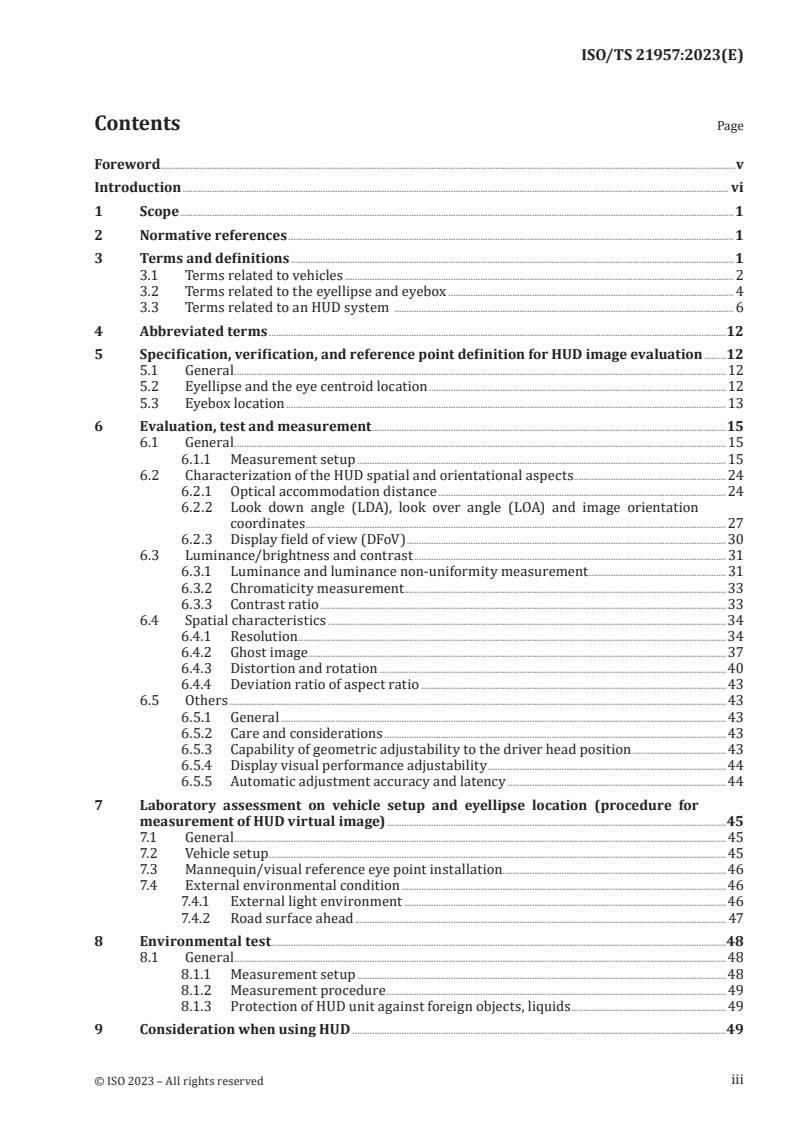
Contents Page
Foreword .v
Introduction . vi
1 Scope . 1
2 Normative references . 1
3 Terms and definitions . 1
3.1 Terms related to vehicles . 2
3.2 Terms related to the eyellipse and eyebox . 4
3.3 Terms related to an HUD system . 6
4 Abbreviated terms .12
5 Specification, verification, and reference point definition for HUD image evaluation .12
5.1 General .12
5.2 Eyellipse and the eye centroid location .12
5.3 Eyebox location . 13
6 Evaluation, test and measurement .15
6.1 General . 15
6.1.1 Measurement setup . 15
6.2 Characterization of the HUD spatial and orientational aspects . 24
6.2.1 Optical accommodation distance . 24
6.2.2 Look down angle (LDA), look over angle (LOA) and image orientation
coordinates . 27
6.2.3 Display field of view (DFoV) .30
6.3 Luminance/brightness and contrast . 31
6.3.1 Luminance and luminance non-uniformity measurement . 31
6.3.2 Chromaticity measurement . 33
6.3.3 Contrast ratio . 33
6.4 Spatial characteristics .34
6.4.1 Resolution .34
6.4.2 Ghost image . 37
6.4.3 Distortion and rotation .40
6.4.4 Deviation ratio of aspect ratio . 43
6.5 Others . 43
6.5.1 General . 43
6.5.2 Care and considerations . 43
6.5.3 Capability of geometric adjustability to the driver head position . 43
6.5.4 Display visual performance adjustability .44
6.5.5 Automatic adjustment accuracy and latency .44
7 Laboratory assessment on vehicle setup and eyellipse location (procedure for
measurement of HUD virtual image) .45
7.1 General . 45
7.2 Vehicle setup . 45
7.3 Mannequin/visual reference eye point installation . .46
7.4 External environmental condition .46
7.4.1 External light environment .46
7.4.2 Road surface ahead . 47
8 Environmental test .48
8.1 General .48
8.1.1 Measurement setup .48
8.1.2 Measurement procedure .49
8.1.3 Protection of HUD unit against foreign objects, liquids .49
9 Consideration when using HUD .49
iii
Annex A (informative) Eyellipse versus eyebox .50
Annex B (informative) Subjective evaluation for a 3D HUD .53
Annex C (informative) Environmental test of the HUD engine .65
Annex D (informative) Environmental interfering factors in HUD performance for
windscreen . .69
Annex E (informative) Consideration on additional factor affecting the HUD performance/
visibility .70
Annex F (informative) HUD using alternative image generation technologies .72
Bibliography .75
iv
Foreword
ISO (the International Organization for Standardization) is a worldwide federation of national standards
bodies (ISO member bodies). The work of preparing International Standards is normally carried out
through ISO technical committees. Each member body interested in a subject for which a technical
committee has been established has the right to be represented on that committee. International
organizations, governmental and non-governmental, in liaison with ISO, also take part in the work.
ISO collaborates closely with the International Electrotechnical Commission (IEC) on all matters of
electrotechnical standardization.
The procedures used to develop this document and those intended for its further maintenance are
described in the ISO/IEC Directives, Part 1. In particular, the different approval criteria needed for the
different types of ISO document should be noted. This document was drafted in accordance with the
editorial rules of the ISO/IEC Directives, Part 2 (see www.iso.org/directives).
ISO draws attention to the possibility that the implementation of this document may involve the use
of (a) patent(s). ISO takes no position concerning the evidence, validity or applicability of any claimed
patent rights in respect thereof. As of the date of publication of this document, ISO had not received
notice of (a) patent(s) which may be required to implement this document. However, implementers are
cautioned that this may not represent the latest information, which may be obtained from the patent
database available at www.iso.org/patents. ISO shall not be held responsible for identifying any or all
such patent rights.
Any trade name used in this document is information given for the convenience of users and does not
constitute an endorsement.
For an explanation of the voluntary nature of standards, the meaning of ISO specific terms and
expressions related to conformity assessment, as well as information about ISO's adherence to
the World Trade Organization (WTO) principles in the Technical Barriers to Trade (TBT), see
www.iso.org/iso/foreword.html.
This document was prepared by Technical Committee ISO/TC 22, Road vehicles, Subcommittee SC 35,
Lighting and visibility.
Any feedback or questions on this document should be directed to the user’s national standards body. A
complete listing of these bodies can be found at www.iso.org/members.html.
v
Introduction
This document outlines ergonomic specifications, evaluations and test methods for the design and
laboratory assessment measurement of head-up display (HUD) image qualities like virtual image
distance (X), aspect ratio (Y and Z), luminance, contrast and image height adjustment ranges.
This document also outlines procedures for measuring HUD images for the purpose of laboratory
assessments, as measured from observation areas defined by an eyebox, and provides the definition of
the eyebox from the locating the driver’s eyellipse (see ISO 4513).
This document also provides a standard measurement practice of HUD virtual images for HUD bench
testing, static and dynamic laboratory test, as well as methods for documenting HUD virtual image
attributes such as size, luminance, contrast, field of view, image location adjustment ranges and HUD
eyebox attributes using image readability standards from SAE J1757-1, SAE J1757-2, ISO 15008 or other
applicable standards where required.
vi
TECHNICAL SPECIFICATION ISO/TS 21957:2023(E)
Road vehicles — Visibility — Specifications and test
procedures for head-up displays (HUD)
1 Scope
This document provides a common framework of definitions and measurement methods for the design,
and ergonomics testing of automotive head-up displays (HUDs) independent of technologies except
where noted. Applications in both passenger cars (including sport utility vehicles and light trucks) and
commercial vehicles (including heavy trucks and buses) are covered. This document does not include
helmet-mounted HUDs or other head carried gear such as glasses.
Areas covered in this document include:
— guidance on how to establish reference points and representative viewing conditions based on
vehicle coordinates and ranges of driver's/passenger's eye points;
— descriptions of the HUD image geometry and optical properties measurements;
— definitions of the HUD virtual image and driver vision measurements;
— static and dynamic laboratory tests, and dynamic field operational assessments that include
suggested vehicle setup procedures in order to measure HUD image attributes.
2 Normative references
The following documents are referred to in the text in such a way that some or all of their content
constitutes requirements of this document. For dated references, only the edition cited applies. For
undated references, the latest edition of the referenced document (including any amendments) applies.
ISO 4130, Road vehicles — Three-dimensional reference system and fiducial marks — Definitions
ISO 4513, Road vehicles — Visibility — Method for establishment of eyellipses for driver's eye location
ISO 16750-2:2023, Road vehicles — Environmental conditions and testing for electrical and electronic
equipment — Part 2: Electrical loads
ISO 16750-3:2023, Road vehicles — Environmental conditions and testing for electrical and electronic
equipment — Part 3: Mechanical loads
ISO 16750-4:2023, Road vehicles — Environmental conditions and testing for electrical and electronic
equipment — Part 4: Climatic loads
ISO 16750-5:2023, Road vehicles — Environmental conditions and testing for electrical and electronic
equipment — Part 5: Chemical loads
3 Terms and definitions
For the purposes of this document, the following terms and definitions apply.
ISO and IEC maintain terminology databases for use in standardization at the following addresses:
— ISO Online browsing platform: available at https:// www .iso .org/ obp
— IEC Electropedia: available at https:// www .electropedia .org/
3.1 Terms related to vehicles
3.1.1
vehicular coordinate system
three-dimensional reference coordinate system showing the supporting surface of the vehicle as the
zero Z plane (horizontal zero plane), the zero Y plane (vertical longitudinal zero plane), and the zero X
plane (vertical transverse zero plane) at non-operational conditions
Note 1 to entry: It is defined on a right-handed coordinate system having the x-axis positive pointing opposite
of the forward movement direction, z-axis positive being orthogonal to the ground plane and pointing upwards,
and the y-axis positive pointing to the right seen in forward movement direction. (See also 3.1.2 for reference
grid under operational condition.)
3.1.2
three-dimensional reference grid
longitudinal plane X-Z, a horizontal plane X-Y and a vertical transverse plane Y-Z which are used to
determine the dimensional relationships between the positions of design points on drawings and their
positions on the actual vehicle when the vehicle coordinates is in operational condition
Note 1 to entry: There can be national regulation applicable which specifies the vehicle operation condition
affecting the three-dimensional reference grid which is used in the evaluation procedure of this document.
For example, in countries adopting Reference [22], the operation condition determining the three-dimension
reference grid is given in the Reference [22], 2.3 (see also 3.1.1).
3.1.3
V point
vision point positions in the passenger compartment determined as a function of vertical longitudinal
planes passing through the centres of the outermost designated seating positions on the front seat and
in relation to the "R" point and the design angle of the seat-back, and are used for verifying compliance
with driver's fields of view requirements
[SOURCE: Reference [22], 2.8]
3.1.4
H point
pivot centre of the torso and thigh of the 3-D H machine installed in the vehicle seat, and located in the
centre of the centre line of the device which is between the ‘H’ point sight buttons on either side of the
3-D H machine
Note 1 to entry: The H point is detailed in ISO 6549 and it is used to determine the location of the eyellipse (3.2.1).
The "H point" corresponds theoretically to the "R" point.
3.1.5
SgRP
seating reference point
R point
design point defined by the vehicle manufacturer for each seating position and established with respect
to the three-dimensional reference system
Note 1 to entry: The R point is detailed in ISO 6549 and it is used to determine the location of the eyellipse (3.2.1).
3.1.6
windscreen datum point
point situated at the intersection with the windscreen (3.3.13) of lines radiating forward from the V
points (3.1.3) to the outer surface of the windscreen
[SOURCE: Reference [22], 2.11]
3.1.7
P point
point about which the driver's head rotates when driver views objects on a horizontal plane at eye level
Note 1 to entry: Head-up display (HUD) (3.3.1) images are presented to the driver intended to be observed with
the head oriented in a forward direction (for P3 and P4, see Figure 7). Nevertheless, small head rotation may
occur while accessing device for indirect vision with some minor residual head turn around this point (for P1 and
P2, see Figure 7).
[SOURCE: Reference [22], 2.14, modified —Note 1 to entry was added.]
3.1.8
E point
point representing the centre of the driver's eyes and used to assess the extent to which "A" pillars
obscure the field of vision
Note 1 to entry: The E points' definition is adopted from UN Regulation 125 when observing the direction of "A"
pillar while the driver's ocular reference point (ORP) defined in 3.3.17 is the centre at forward-facing driver head
orientation. See Figure 1 for the correlation of E point to with P point (3.1.7).
Dimensions in millimetres
a) Plan view b) Side view
Key
E left eye
L
E right eye
R
P neck pivot point
1 driver head centre line
2 line, viewed end on, between E and E
L R
Figure 1 — Neck pivot point and associated eye points
3.1.9
seat-back angle
angle measured between a vertical line through the H point (3.1.4) and the torso line using the back-
angle quadrant on the 3-D H machine
[SOURCE: Reference [22], Annex 3, 2.6, modified — The term was originally "actual torso angle", and
supplemental information were removed from the definition.]
3.1.10
A pillar
roof support forward of the vertical transverse plane located 68 mm in front of the V points (3.1.3) and
includes non-transparent items such as windscreen (3.3.13) mouldings and door frames, attached or
contiguous to such a support
[SOURCE: Reference [22], 2.16]
3.2 Terms related to the eyellipse and eyebox
3.2.1
eyellipse
statistical distribution of eye locations in three-dimensional space located relative to defined vehicle
interior reference points
Note 1 to entry: Eyellipse is a term derived as a contraction of the words “eye” and “ellipse” and it is defined
in ISO 4513. Unless otherwise specified, the eyellipse space in this document refers to the specific eyellipse
th
representing the distribution of the 95 percentile of driver population as seated in the drive seat. Figure 2
shows an eyellipse model which would be located as shown in Figure 3.
Key
X, Y, Z ellipse axes
Figure 2 — Eyellipse
Key
A seat track rise TL seat track travel
19 23
AHP accelerator heel point W y-coordinate of the SgRP
BOFRP ball of foot reference point X x-coordinate of the eyellipse centroid location
c
H z-coordinate of the AHP Y mid-eye y-coordinate
8 cycl
H z distance of the SgRP (3.1.5) from the AHP Z z-coordinate of the eyellipse centroid location
30 c
L x-coordinate of the BOFRP β side view angle
L x distance from the steering wheel centre to 1 zero X grid
BOFRP
L x-coordinate of the SgRP 2 zero Y grid
SgRP seating reference point 3 zero Z grid
TH H-point vertical adjustment 4 H-point travel path
Figure 3 — Location of the eyellipse relative to driver packaging dimensions
[SOURCE: ISO 4513:2022, 3.1, modified — Explanation on "contraction of the words “eye” and “ellipse”
used to describe" has been deleted, Figure 3 was added and Note 1 to entry has been replaced.]
3.2.2
eyebox
simplified two-dimensional rectangular box model providing the representative distribution range of
the driver's eye reference point for evaluation, encapsulation and having its frame line tangential to the
eyellipse (3.2.1)
Note 1 to entry: The eyebox is an area covering the entire range of driver with different physical characteristics
and a device under test (DUT) (3.3.25) may not necessarily be capable of conveying visual information within the
entire eyebox range without personal adjustment. See also adjusted viewable HUD window (3.2.3). It is rather a
rectangular vertical plane defined at the centre of the eyellipse and actually it is not a three-dimensional box.
3.2.3
adjusted viewable HUD window
observation eyebox window at adjusted condition
range designed to convey the visual information to the viewer at adjusted condition, within which the
image generated by the device under test (DUT) (3.3.25) satisfies the required image quality condition
Note 1 to entry: The driver's eye position is expected to come somewhere within the eyellipse (3.2.1) range. A
head-up display (HUD) (3.3.1) system is often composed of a reflective device transferring image from the imaging
device towards the driver's eye, and its visibility is affected by the observation point. To satisfy needs of drivers
with different genders or anthropometric characteristics, a system may provide adjustability to satisfy those
different needs. A DUT adjusted to a specific eye position shall provide satisfactory image within an expect range
of driver head movement.
Note 2 to entry: An HUD system is a system expected to be capable of providing a uniform image quality to the
entire eyellipse range without deterioration of the image quality, and this implies to cover a certain acceptable
range of eye movement coverage while in operation that may not cause a drastical degradation on the perceived
image quality by the driver normal head movements within this specified window. The DUT shall be capable
of properly conveying the visual information to at least a defined range characterized according to this
constrained window once adjusted by each driver. This auxiliary observation eyebox (3.2.2) range is defined as
complementary range for image quality evaluation.
Note 3 to entry: If the quality of the image conveyed to the viewer drastically varies within this range, it may
induce discomfort. On the other hand, if the quality of the image gradually degrades with the driver head
displacement going beyond this adjusted viewable HUD window position, the degradation of the image caused
by the displacement of head position will motivate the driver to return his head position to within this window,
therefore, to enable such design strategy which may motivate the driver to return his head position within the
adjusted viewable HUD window, but it does not prevent to cause degradation when the driver may move his/
her eyes beyond this range as a mean to motivate the driver to maintain their head to a certain limited range to
be able to access to the visual information conveyed by the HUD. the image quality beyond this range does not
necessarily need to fulfil the same image quality as required with driver eye at nominal position.
3.2.4
eye position tracker
equipment to localize the dynamic positioning of the driver's eye
Note 1 to entry: The detected position of the eye serves to dynamically control and generate augmented reality
images of intended information according to geometrical positional configuration of the driver's eye point of
observation. Other adaptations or adjustments according to detected driver's eye position may apply.
3.3 Terms related to an HUD system
3.3.1
HUD
head-up display
information display system that enables the driver to access visual information within a driver's
direct field of view without requiring drivers to move their gaze orientation toward the traditional
information cluster panel display
Note 1 to entry: The nomenclature of head-up display (HUD) came from the use of this term to describe a type of
display system used in military avionics application, where information to the pilot was provided in a form not
requiring any deliberated head down movement to access the dynamic displayed information.
Note 2 to entry: The use of this term for automotive applications includes a variety of display systems that display
information such that drivers do not need to look down at traditional cluster displays.
3.3.2
HUD engine
PGU
picture generation unit
assembly which composes part of a head-up display (HUD) (3.3.1) system incorporating an image
generating device and optical components to guide the generated image onto the display combiner
(3.3.3)
Note 1 to entry: The visual information generated by the HUD engine is reflected by the combiner which directs
visual information to the observer.
Note 2 to entry: HUD systems may have compensation optics unit to extend the visual accommodation distance
of generated images by using a combination of transmissive and reflective optical elements.
Note 3 to entry: Many aftermarket HUDs often use a simple combiner with limited capability to project the
virtual image at a specified distance, which results in higher accommodation efforts when images are viewed by
the observer.
3.3.3
combiner
element or subcomponent of a head-up display (HUD) (3.3.1) system in which images generated on by
the HUD engine (3.3.2) are reflected to reach the observers eyes (retina)
Note 1 to entry: There are several types of HUD, and the use of combiners may differ according to the construction
design or technology adopted to create the HUD system. HUD systems using the front windscreen (3.3.13) itself to
act as combiner have their surface treated to properly reflect the image generated by the HUD engine.
Note 2 to entry: The HUD type using a separate transparent optical combiner to reflect the image generated
by the HUD engine is differentiated from an HUD in which the windscreen itself acts as combiner. These
HUDs have a separate physical combiner, so they are often called "combiner HUDs" to distinguish them from a
windscreen-type HUD. A benefit of combiner HUDs is their capability to apply different optical design curvature
on the combiner surface when compared the windscreen type which has its reflective surface restricted to the
curvatures of the vehicle windscreen design. Separate physical combiner components in a combiner type HUD
imposes bordering frames to the viewer.
Note 3 to entry: A combiner in HUD systems is a component that helps the system to combine and superimpose
the generated image on top of the actual driving scene image when an observer watches a roadway scene
through the combiner. A combiner does not be necessarily need to be a physically reflective element. Holographic
diffractive elements are an example of an element that is not reflective but still capable to deliver images as
combiner.
3.3.4
AR HUD
augmented reality head-up display
genre of head-up display (HUD) (3.3.1) where images displayed to the viewer are presented in driver
normal front gaze orientation requiring minimum movement of viewer gaze orientation to access to the
displayed information
Note 1 to entry: Presentation of the information in augment reality in many applications is intended to provide
the presented information superimposed on image of the real-world view scene, virtually creating, and displaying
symbols and signs as they might exist in the real world, but in a virtual visual manner.
3.3.5
C-HUD
combiner head-up display
genre of head-up display (HUD) (3.3.1) where image displayed to the viewer are reflected by a separate
combiner (3.3.3) which is located in between driver's eye and the windscreen (3.3.13)
3.3.6
W-HUD
windscreen head-up display
windshield head-up display
genre of head-up display (HUD) (3.3.1) where images displayed to the viewer are reflected by the
windscreen (3.3.13) itself and the windscreen acts as an integrated combiner (3.3.3)
3.3.7
2D HUD
two-dimensional head-up display
traditional head-up display (HUD) (3.3.1) that displays information on a flat focal plane at a virtual
distance from the observer
Note 1 to entry: This term is sometimes used to differentiate the traditional 2D HUD from the genre of HUDs that
have added functionality to display information with depth perceptibility (e.g. 3D HUD (3.3.8)). See Figure B.1.
3.3.8
3D HUD
three-dimensional head-up display
genre of head-up display (HUD) (3.3.1) where images are presented to the viewer with stereoscopy
aspects providing observers a sense of virtual depth
Note 1 to entry: While a classical augmented reality head-up display (AR HUD) (3.3.4) provides visual information
to the viewer image at the same gaze orientation to where the information is expected to be shown in three-
dimensional real-world space, the 3D HUD also provides the visual information by means of stereoscopy giving
the viewer an additional sense of depth perception. Figure B.1
Note 2 to entry: The three-dimensional sense of perception is achieved by different means and there exist multiple
techniques to achieve it. One technique is that the image viewer captures images for each eye with perspective.
3.3.9
HUD effective display area
active area in which the generated virtual image is effectively observable within the direct field of view
of the driver/observer
3.3.10
HUD absolute maximum luminance level
maximum luminance functional capability to display a virtual image by the device under test (DUT)
(3.3.25) regardless of ambient light condition
Note 1 to entry: The luminance level under night ambient condition may impose gaze disturbing the driver's
vision. A DUT may have an embedded function to adjust the maximum brightness level up to this maximum limit,
whether manually or automatically. Conditional maximum brightness level is defined in 3.3.11.
3.3.11
HUD conditional maximum brightness level
maximum luminance adjusted under detected ambient light condition in operation
Note 1 to entry: The head-up display (HUD) (3.3.1) illumination setting is typically automatically controlled
according to the detected external environment condition and avoids excessive bright display in night drive
environment as a use case example. Figure 4 is an example of linear gradation test image with brightest and HUD
ON darkest level (3.3.12).
Key
1 brightest display level (100 % signal level)
2 HUD ON darkest level (0 % signal level)
Figure 4 — Example of neutral colour luminance gradation test image
3.3.12
HUD ON darkest level
darkest luminance level when the head-up display (HUD) (3.3.1) is in operation, displaying a "numerically
absolute black signal" and capable to achieve when displayed as a virtual image by the device under test
(DUT) (3.3.25)
Note 1 to entry: Depending on the technology used, the darkest level achieved when a "numerically black signal"
does not reach an absolute zero. When pixel uses light-emitting devices, 0 level is likely to be achieved while back-
lit LCD or LCOS type devices have some extent of leak light even when displaying a "numerically black signal"
when the device is in operation mode.
3.3.13
windscreen
windshield
W/S
transparent structural component of a vehicle used to protect the vehicle's occupant from the wind and
alien objects reaching the occupant while traveling and at the same time providing necessary direct
frontal vision to the driver (in front of the driver through which the driver views the road ahead) to
access the visual scene to convey a safe driving manoeuvre task
Note 1 to entry: It is a protective laminar composite component often made as an assembly of at least two laminar
glass sheets with an intermediate plastic material which holds together when shattered, for improved safety.
Note 2 to entry: The windscreen has at least two reflective surfaces (outer/inner) and it is likely to have an
anisotropic curved surface relative to the driver seating positioning. In a W-HUD, its surface(s) acts as combiner
(3.3.3) element reflecting the projected image from the HUD engine (3.3.2) toward the driver's eye.
Note 3 to entry: Windscreen or windshield are common term largely used to refer to the safety "glazing"
component or material as defined under UN Regulation No. 43 or FMVSS SS571.205
3.3.14
depth of field
axial depth of the space on both sides of the image within which the image appears acceptably sharp,
while the positions (distance) of the object plane and of the objective of the camera are maintained
Note 1 to entry: In some publications, the term “depth of focus” is used to refer to object space. It is recommended
that, when the distinction is important, the full terms “depth of field (in object space)” and “depth of focus (in
image space)” be used.
Note 2 to entry: It is the range of observed distance of objects nearest and furthest from observer which are in
focus.
[SOURCE: ISO 10934:2020, 3.1.37, modified — The term was originally "depth of field", Notes 2 and 3 to
entry have been added.]
3.3.15
forward infinity-oriented setup
orientation of the evaluation equipment toward the vehicular forward infinity movement having as its
infinity the horizontal line on a straight road
3.3.16
driver's field of vision
horizontal and vertical field of vision provided through the windscreen (3.3.13) and extendable beyond
the A pillar (3.1.10) of a vehicle
3.3.17
driver's ORP
driver’s ocular reference point
cyclopean eye
middle point between the two ocular points of the driver
Key
a
X driver's binocular point
b
X driver’s ocular reference point
Unless otherwise indicated, the measurement is to be performed based on the driver’s ocular reference point.
Specific needs for stereoscopy measurement may require evaluation on each right and left eye with typical average
pupillary distance of 65 mm.
Figure 5 — Driver’s ocular reference point
Note 1 to entry: See Figure 5 for the difference of driver's binocular point and driver's reference ocular point. In
the case of 3D HUD (3.3.8), the perceptual depth is achieved by the stereoscopic perception and the eye position
is tracked to generate an image to be displayed on the device under test (DUT) (3.3.25) according to the detected
eye point.
Note 2 to entry: E point (3.1.8) is the term used to specifically refer to the eye point when the driver accesses the
area around an A pillar (3.1.10) as defined under ISO 4513 (see Note 1 to entry in 3.1.8).
[SOURCE: ISO 16505:2019, 3.1.4, modified — Notes 1 and 2 to entry and the admitted term "cyclopean
eye" have been added.]
3.3.18
transparent area
area of a vehicle windscreen (3.3.13) or other glazed surface whose light transmittance measured at
right angles to the surface is not less than 70 %, used by a driver to access the frontal field of vision
while performing the driving task
[SOURCE: Reference [22], 2.13, modified — Information about armoured vehicles removed and "used by
a driver to access the frontal field of vision while performing the driving task" added.]
3.3.19
transparency of HUD display combiner area
light transmittance measured at natural observation angle of the driver forward vision at a combiner
(3.3.3) area on a windscreen (3.3.13), given in comparison to light transmittance on an area other the
combiner dedicated area
Note 1 to entry: In case the combiner area of head-up display (HUD) (3.3.1) is a dedicated area which influences
the transmittance of frontal vision of the driver, the dedicated area shall be additionally evaluated to verify the
reduced transparency at the area dedicated as combiner. This applies specially when a separate combiner is
adopted as a mean to generate the HUD image, (a combiner head-up display (C-HUD) (3.3.5) usually adopts an
optical combiner element between the driver's eye and windscreen).
3.3.20
optical accommodation distance
optical distance of the projected virtual image from the driver's eye point where the best focus is
achieved
Note 1 to entry: In the absence of any astigmia aberration, the horizontal and vertical focusing distances are
same.
Note 2 to entry: The system may exhibit an astigmatism effect resulting in difference in optical accommodation
distance regarding horizontal resolution and vertical resolution. It is suggested to measure each accommodation
individually to better characterize the device under test (DUT) (3.3.25) properties.
3.3.21
binocular depth perception
brain perception of distance from image capture by the left and right eye of the observer and processed
in the brain
Note 1 to entry: In a stereoscopic 3D HUD (3.3.8), images with disparity are artificially created and displayed
by the head-up display (HUD) (3.3.1) unit to the left and right eye respectively, thus giving a sense of information
being superimposed on 3D real space at an intended depth (distance from observer).
3.3.22
luminance contrast ratio
ratio of displayed image luminance relative to the defined reference background scene
Note 1 to entry: The luminance contrast ratio is affected by multiple factors other than the background scene and
displayed image itself, and effects like haze and scene.
3.3.23
look down angle
LDA
amount of gaze down angle required to observe the centre of the virtual display image area, relative to
frontal infinity orientation
Note 1 to entry: See 6.2.2.1 and Figure 16.
3.3.24
look over angle
LOA
amount of the lateral gaze angle required to observe the centre of the virtual display image area,
relative to the vertical plane which contains the frontal infinity orientation from the ocular reference
point (ORP)
Note 1 to entry: See 6.2.2.2 and Figure 16.
3.3.25
DUT
device under test
single component or combination of multiple components that performs a function of the head-up
display (HUD) (3.3.1) as defined to be tested
4 Abbreviated terms
LDA look down angle
LOA look over angle
SgRP seating reference point
5 Specification, verification, and reference point definition for HUD image
evaluation
5.1 General
The images generated by the HUD engine unit are targeted to be observed by the driver. The driver's
eye positioning is one of the essential attributes determining the image performance as observed by
the driver. Therefore, this clause details on the procedure to determine these eyes positioning related
attributes which will be used during the following measurement procedure to access the HUD image
and the related quality evaluation. Annex A provides additional information for allocating the eyebox.
The windscreen datum point (3.1.6) is the intersecting point from V point (3.1.3) or the driver’s ocular
reference point (3.3.17) when the driver's gaze is towards forward infinity, according to forward
infinity-oriented setup (3.3.15). For evaluation procedures with the vehicle in operation condition,
the driver forward infinity gaze line will be intersecting the windscreen datum point (3.1.6), and
intersecting also the point indicated by key "I" in Figure 8.
The H point (3.1.4) and seat-back angle (3.1.9) are factors that influence the driver’s eye point but based
on several findings in the development of ISO 4513, they are directly factored into the calculation of the
eyellipse (see ISO 4513:2022, Clause F.2).
5.2 Eyellipse and the eye centroid location
The eyellipse is the three-dimensional statistical distribution space where the driver’s eye location
could come while driving. The eyellipse location within the vehicle is defined in ISO 4513. It establishes
the location of drivers’ eyes inside a vehicle. The quality of image conveyed by
...