

ISO 22326:2018
(Main)Security and resilience — Emergency management — Guidelines for monitoring facilities with identified hazards
General Information
- Abstract
This document gives guidelines for monitoring hazards within a facility as a part of an overall emergency management and continuity programme by establishing the process for hazard monitoring at facilities with identified hazards. It includes recommendations on how to develop and operate systems for the purpose of monitoring facilities with identified hazards. It covers the entire process of monitoring facilities. This document is generic and applicable to any organization. The application depends on the operating environment, the complexity of the organization and the type of identified hazards.
- Status
- Published
- Publication Date
- 02-Oct-2018
- Technical Committee
- ISO/TC 292 - Security and resilience
- Drafting Committee
- ISO/TC 292/WG 3 - Emergency management
- Current Stage
- 9093 - International Standard confirmed
- Start Date
- 14-Mar-2024
- Completion Date
- 29-Aug-2026
Buy Documents

ISO 22326:2018 - Security and resilience -- Emergency management -- Guidelines for monitoring facilities with identified hazards

ISO 22326:2018 - Security and resilience — Emergency management — Guidelines for monitoring facilities with identified hazards/3/2018
Overview - ISO 22326:2018 (Monitoring facilities with identified hazards)
ISO 22326:2018 is an international guideline within the security and resilience - emergency management series that defines how to establish and operate hazard monitoring at facilities with identified hazards. The standard describes the full monitoring lifecycle - from planning and implementation to operation, control and continual improvement - and supports emergency management, prevention, mitigation and response by delivering timely, reliable monitoring data.
Key topics and technical requirements
- Monitoring process: Defines the end-to-end process steps - receipt, integration, generation, analysis, transfer and output of monitoring data.
- Critical indicators: Identifying quantitative, qualitative or descriptive measures to detect hazard development and early signs of escalation.
- Data characteristics: Guidance to ensure data are accumulated at the facility, have agreed characteristics, are easily analysed, transmitted via secure channels and are integrable to support decisions.
- Data analysis & display: Requirements for prioritised, comprehensible displays (text, graphics, audio, video) so recent and relevant indicators are clearly visible to decision-makers.
- Progressive notification: Systems should support at least three escalation levels (normal, caution, emergency) to trigger pre-planned responses.
- Implementation & interoperability: Emphasis on agreed arrangements between facility owners, authorities and stakeholders; commissioning, testing and ensuring sender/receiver interoperability.
- Operation, training & security: Roles, qualifications, training, authorization and security clearances for personnel operating monitoring systems.
- Review & improvement: Use incident statistics and forecasting models to refine monitoring systems and preparedness.
Practical applications and users
ISO 22326:2018 is generic and applicable to any organization operating facilities with identified hazards. Typical users include:
- Facility owners and operators of plants, buildings, transport units and infrastructure
- Engineers, system integrators and contractors involved in design, installation and maintenance of monitoring systems
- Public authorities and emergency services responsible for prevention and incident response
- Insurers, regulators, legislators and researchers seeking standardized guidance on hazard monitoring and decision support
Practical uses: design of hazard-resistant monitoring systems, defining data sharing and escalation procedures, selecting critical indicators, testing commissioning processes, and integrating monitoring outputs into emergency response plans.
Related standards
- Normative reference: ISO 22300 - Security and resilience: Vocabulary
- Prepared under ISO/TC 292 (Security and resilience); complements other emergency management and continuity standards in the ISO 22300 series.
Keywords: ISO 22326:2018, hazard monitoring, monitoring facilities, emergency management, security and resilience, critical indicators, data analysis.
Relations
- Consolidated By
ISO 22476-4:2021 - Geotechnical investigation and testing — Field testing — Part 4: Prebored pressuremeter test by Ménard procedure - Effective Date
- 06-Jun-2022
Buy Documents
ISO 22326:2018 - Security and resilience -- Emergency management -- Guidelines for monitoring facilities with identified hazards
ISO 22326:2018 - Security and resilience — Emergency management — Guidelines for monitoring facilities with identified hazards/3/2018
Get Certified
Connect with accredited certification bodies for this standard

BSI Group
BSI (British Standards Institution) is the business standards company that helps organizations make excellence a habit.

Bureau Veritas
Bureau Veritas is a world leader in laboratory testing, inspection and certification services.

DNV
DNV is an independent assurance and risk management provider.
Sponsored listings
Frequently Asked Questions
ISO 22326:2018 is a standard published by the International Organization for Standardization (ISO). Its full title is "Security and resilience — Emergency management — Guidelines for monitoring facilities with identified hazards". This standard covers: This document gives guidelines for monitoring hazards within a facility as a part of an overall emergency management and continuity programme by establishing the process for hazard monitoring at facilities with identified hazards. It includes recommendations on how to develop and operate systems for the purpose of monitoring facilities with identified hazards. It covers the entire process of monitoring facilities. This document is generic and applicable to any organization. The application depends on the operating environment, the complexity of the organization and the type of identified hazards.
This document gives guidelines for monitoring hazards within a facility as a part of an overall emergency management and continuity programme by establishing the process for hazard monitoring at facilities with identified hazards. It includes recommendations on how to develop and operate systems for the purpose of monitoring facilities with identified hazards. It covers the entire process of monitoring facilities. This document is generic and applicable to any organization. The application depends on the operating environment, the complexity of the organization and the type of identified hazards.
ISO 22326:2018 is classified under the following ICS (International Classification for Standards) categories: 03.100.01 - Company organization and management in general. The ICS classification helps identify the subject area and facilitates finding related standards.
ISO 22326:2018 has the following relationships with other standards: It is inter standard links to ISO 22476-4:2021. Understanding these relationships helps ensure you are using the most current and applicable version of the standard.
ISO 22326:2018 is available in PDF format for immediate download after purchase. The document can be added to your cart and obtained through the secure checkout process. Digital delivery ensures instant access to the complete standard document.
Standards Content (Sample)
INTERNATIONAL ISO
STANDARD 22326
First edition
2018-10
Security and resilience — Emergency
management — Guidelines for
monitoring facilities with identified
hazards
Sécurité et résilience — Gestion des urgences — Lignes directrices
pour la surveillance des installations à risques identifiés
Reference number
©
ISO 2018
© ISO 2018
All rights reserved. Unless otherwise specified, or required in the context of its implementation, no part of this publication may
be reproduced or utilized otherwise in any form or by any means, electronic or mechanical, including photocopying, or posting
on the internet or an intranet, without prior written permission. Permission can be requested from either ISO at the address
below or ISO’s member body in the country of the requester.
ISO copyright office
CP 401 • Ch. de Blandonnet 8
CH-1214 Vernier, Geneva
Phone: +41 22 749 01 11
Fax: +41 22 749 09 47
Email: copyright@iso.org
Website: www.iso.org
Published in Switzerland
ii © ISO 2018 – All rights reserved
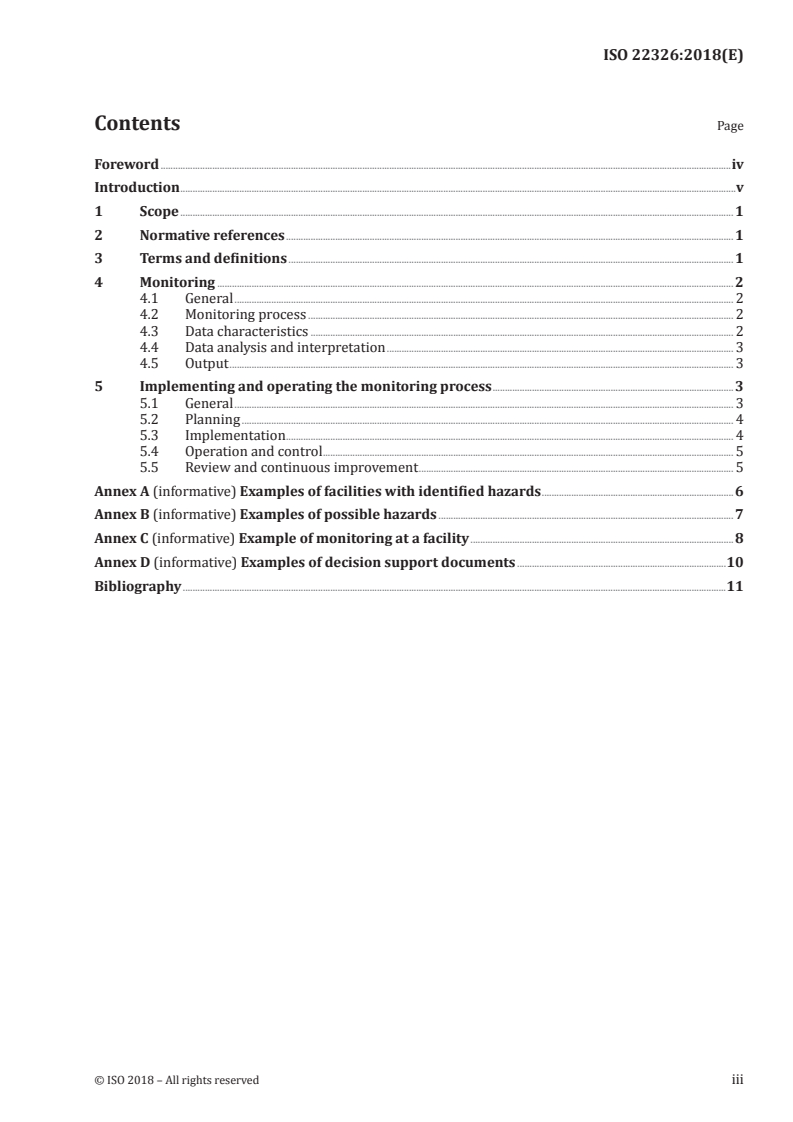
Contents Page
Foreword .iv
Introduction .v
1 Scope . 1
2 Normative references . 1
3 Terms and definitions . 1
4 Monitoring . 2
4.1 General . 2
4.2 Monitoring process . 2
4.3 Data characteristics . 2
4.4 Data analysis and interpretation . 3
4.5 Output . 3
5 Implementing and operating the monitoring process . 3
5.1 General . 3
5.2 Planning . 4
5.3 Implementation . 4
5.4 Operation and control . 5
5.5 Review and continuous improvement . 5
Annex A (informative) Examples of facilities with identified hazards . 6
Annex B (informative) Examples of possible hazards . 7
Annex C (informative) Example of monitoring at a facility . 8
Annex D (informative) Examples of decision support documents .10
Bibliography .11
Foreword
ISO (the International Organization for Standardization) is a worldwide federation of national standards
bodies (ISO member bodies). The work of preparing International Standards is normally carried out
through ISO technical committees. Each member body interested in a subject for which a technical
committee has been established has the right to be represented on that committee. International
organizations, governmental and non-governmental, in liaison with ISO, also take part in the work.
ISO collaborates closely with the International Electrotechnical Commission (IEC) on all matters of
electrotechnical standardization.
The procedures used to develop this document and those intended for its further maintenance are
described in the ISO/IEC Directives, Part 1. In particular, the different approval criteria needed for the
different types of ISO documents should be noted. This document was drafted in accordance with the
editorial rules of the ISO/IEC Directives, Part 2 (see www .iso .org/directives).
Attention is drawn to the possibility that some of the elements of this document may be the subject of
patent rights. ISO shall not be held responsible for identifying any or all such patent rights. Details of
any patent rights identified during the development of the document will be in the Introduction and/or
on the ISO list of patent declarations received (see www .iso .org/patents).
Any trade name used in this document is information given for the convenience of users and does not
constitute an endorsement.
For an explanation of the voluntary nature of standards, the meaning of ISO specific terms and
expressions related to conformity assessment, as well as information about ISO’s adherence to the
World Trade Organization (WTO) principles in the Technical Barriers to Trade (TBT) see www .iso
.org/iso/foreword .html.
This document was prepared by Technical Committee ISO/TC 292, Security and resilience.
Any feedback or questions on this document should be directed to the user’s national standards body. A
complete listing of these bodies can be found at www .iso .org/members .html.
iv © ISO 2018 – All rights reserved
Introduction
In recent years, there has been a growing awareness of the risks and consequences of natural and
industrial disasters. Monitoring hazards can reduce potential losses through improved prevention,
mitigation, preparedness and a more effective response to incidents resulting from the hazards.
Effective monitoring can provide public and private sector emergency management with ongoing,
timely, accurate, easily understood relevant monitoring data to support decision-making in emergency
management.
Security standards are continually evolving and improving. Advances in monitoring technology will
provide opportunities for further improvement of these guidelines and for development and application
of innovative monitoring solutions.
The purpose of this document is to contribute to an overall emergency management framework which
seeks to reduce the risk to people, operations, property and the environment.
This document provides guidelines for the entire process of hazard monitoring at facilities with
identified hazards, including planning, implementation, operation and control, and review and continual
improvement. This document is applicable to all facilities with identified hazards and may be used by
stakeholders and authorities responsible for safety and security, such as
— owners and operators of facilities,
— engineers, installers and contractors during facility planning, construction, and maintenance,
— public authorities responsible for emergency prevention activities and incident response,
— insurance companies and potentially affected residents,
— legislators, and
— the scientific community and researchers.
INTERNATIONAL STANDARD ISO 22326:2018(E)
Security and resilience — Emergency management —
Guidelines for monitoring facilities with identified hazards
1 Scope
This document gives guidelines for monitoring hazards within a facility as a part of an overall
emergency management and continuity programme by establishing the process for hazard monitoring
at facilities with identified hazards.
It includes recommendations on how to develop and operate systems for the purpose of monitoring
facilities with identified hazards. It covers the entire process of monitoring facilities.
This document is generic and applicable to any organization. The application depends on the operating
environment, the complexity of the organization and the type of identified hazards.
2 Normative references
The following documents are referred to in the text in such a way that some or all of their content
constitutes requirements of this document. For dated references, only the edition cited applies. For
undated references, the latest edition of the referenced document (including any amendments) applies.
ISO 22300, Security and resilience — Vocabulary
3 Terms and definitions
For the purposes of this document, the terms and definitions given in ISO 22300 and the following apply.
ISO and IEC maintain terminological databases for use in standardization at the following addresses:
— ISO Online browsing platform: available at https: //www .iso .org/obp
— IEC Electropedia: available at http: //www .electropedia .org/
3.1
data analysis
systematic investigation of relevant, evidence-based information obtained in the monitoring process
and its flow in a real or planned system
3.2
monitoring process owner
individual or legal entity responsible for receipt, integration, generation, analysis, transfer and
output of data
Note 1 to entry: A monitoring process or owner of a system within the monitoring process can be represented,
e.g. by a sub-contractor.
3.3
critical indicator
quantitative, qualitative or descriptive measure used to assess the hazard being monitored to identify
the potential for the development of an incident, accident or emergency
Note 1 to entry: Critical indicators provide information about the most important integral characteristics of the
structural state of a facility.
3.4
facility
plant, machinery, property, building, transportation units at sea/land/airport, and other items of
infrastructure or plant and related systems that have a distinct and quantifiable business function
of service
Note 1 to entry: A facility can have formal boundaries as defined by, for example, legislation.
4 Monitoring
4.1 General
Monitoring should identify dynamic hazard development at facilities with identified hazards that
can lead to incidents. This should include the provision of timely relevant and reliable data about the
hazards.
NOTE 1 Annex A provides examples of facilities with identified hazards.
The selection of hazards to be monitored should be based on the results of the hazard identification and
risk analysis.
NOTE 2 Annex B provides examples of possible hazards.
Monitoring should provide progressive notification as the incident escalates; at a minimum: normal,
caution and emergency.
Monitoring should reflect administrative and organizational considerations. It should include hardware
and software appropriate to the hazard to support the monitoring process described in 4.2.
NOTE 3 Annex C provides an example for monitoring a facility.
4.2 Monitoring process
The monitoring process involves receipt, integration, generation, analysis, transfer and output of
data. The process involves the facility owner, authorities responsible for safety and security and other
stakeholders intereste
...
INTERNATIONAL ISO
STANDARD 22326
First edition
2018-10
Security and resilience — Emergency
management — Guidelines for
monitoring facilities with identified
hazards
Sécurité et résilience — Gestion des urgences — Lignes directrices
pour la surveillance des installations à risques identifiés
Reference number
©
ISO 2018
© ISO 2018
All rights reserved. Unless otherwise specified, or required in the context of its implementation, no part of this publication may
be reproduced or utilized otherwise in any form or by any means, electronic or mechanical, including photocopying, or posting
on the internet or an intranet, without prior written permission. Permission can be requested from either ISO at the address
below or ISO’s member body in the country of the requester.
ISO copyright office
CP 401 • Ch. de Blandonnet 8
CH-1214 Vernier, Geneva
Phone: +41 22 749 01 11
Fax: +41 22 749 09 47
Email: copyright@iso.org
Website: www.iso.org
Published in Switzerland
ii © ISO 2018 – All rights reserved
Contents Page
Foreword .iv
Introduction .v
1 Scope . 1
2 Normative references . 1
3 Terms and definitions . 1
4 Monitoring . 2
4.1 General . 2
4.2 Monitoring process . 2
4.3 Data characteristics . 2
4.4 Data analysis and interpretation . 3
4.5 Output . 3
5 Implementing and operating the monitoring process . 3
5.1 General . 3
5.2 Planning . 4
5.3 Implementation . 4
5.4 Operation and control . 5
5.5 Review and continuous improvement . 5
Annex A (informative) Examples of facilities with identified hazards . 6
Annex B (informative) Examples of possible hazards . 7
Annex C (informative) Example of monitoring at a facility . 8
Annex D (informative) Examples of decision support documents .10
Bibliography .11
Foreword
ISO (the International Organization for Standardization) is a worldwide federation of national standards
bodies (ISO member bodies). The work of preparing International Standards is normally carried out
through ISO technical committees. Each member body interested in a subject for which a technical
committee has been established has the right to be represented on that committee. International
organizations, governmental and non-governmental, in liaison with ISO, also take part in the work.
ISO collaborates closely with the International Electrotechnical Commission (IEC) on all matters of
electrotechnical standardization.
The procedures used to develop this document and those intended for its further maintenance are
described in the ISO/IEC Directives, Part 1. In particular, the different approval criteria needed for the
different types of ISO documents should be noted. This document was drafted in accordance with the
editorial rules of the ISO/IEC Directives, Part 2 (see www .iso .org/directives).
Attention is drawn to the possibility that some of the elements of this document may be the subject of
patent rights. ISO shall not be held responsible for identifying any or all such patent rights. Details of
any patent rights identified during the development of the document will be in the Introduction and/or
on the ISO list of patent declarations received (see www .iso .org/patents).
Any trade name used in this document is information given for the convenience of users and does not
constitute an endorsement.
For an explanation of the voluntary nature of standards, the meaning of ISO specific terms and
expressions related to conformity assessment, as well as information about ISO’s adherence to the
World Trade Organization (WTO) principles in the Technical Barriers to Trade (TBT) see www .iso
.org/iso/foreword .html.
This document was prepared by Technical Committee ISO/TC 292, Security and resilience.
Any feedback or questions on this document should be directed to the user’s national standards body. A
complete listing of these bodies can be found at www .iso .org/members .html.
iv © ISO 2018 – All rights reserved
Introduction
In recent years, there has been a growing awareness of the risks and consequences of natural and
industrial disasters. Monitoring hazards can reduce potential losses through improved prevention,
mitigation, preparedness and a more effective response to incidents resulting from the hazards.
Effective monitoring can provide public and private sector emergency management with ongoing,
timely, accurate, easily understood relevant monitoring data to support decision-making in emergency
management.
Security standards are continually evolving and improving. Advances in monitoring technology will
provide opportunities for further improvement of these guidelines and for development and application
of innovative monitoring solutions.
The purpose of this document is to contribute to an overall emergency management framework which
seeks to reduce the risk to people, operations, property and the environment.
This document provides guidelines for the entire process of hazard monitoring at facilities with
identified hazards, including planning, implementation, operation and control, and review and continual
improvement. This document is applicable to all facilities with identified hazards and may be used by
stakeholders and authorities responsible for safety and security, such as
— owners and operators of facilities,
— engineers, installers and contractors during facility planning, construction, and maintenance,
— public authorities responsible for emergency prevention activities and incident response,
— insurance companies and potentially affected residents,
— legislators, and
— the scientific community and researchers.
INTERNATIONAL STANDARD ISO 22326:2018(E)
Security and resilience — Emergency management —
Guidelines for monitoring facilities with identified hazards
1 Scope
This document gives guidelines for monitoring hazards within a facility as a part of an overall
emergency management and continuity programme by establishing the process for hazard monitoring
at facilities with identified hazards.
It includes recommendations on how to develop and operate systems for the purpose of monitoring
facilities with identified hazards. It covers the entire process of monitoring facilities.
This document is generic and applicable to any organization. The application depends on the operating
environment, the complexity of the organization and the type of identified hazards.
2 Normative references
The following documents are referred to in the text in such a way that some or all of their content
constitutes requirements of this document. For dated references, only the edition cited applies. For
undated references, the latest edition of the referenced document (including any amendments) applies.
ISO 22300, Security and resilience — Vocabulary
3 Terms and definitions
For the purposes of this document, the terms and definitions given in ISO 22300 and the following apply.
ISO and IEC maintain terminological databases for use in standardization at the following addresses:
— ISO Online browsing platform: available at https: //www .iso .org/obp
— IEC Electropedia: available at http: //www .electropedia .org/
3.1
data analysis
systematic investigation of relevant, evidence-based information obtained in the monitoring process
and its flow in a real or planned system
3.2
monitoring process owner
individual or legal entity responsible for receipt, integration, generation, analysis, transfer and
output of data
Note 1 to entry: A monitoring process or owner of a system within the monitoring process can be represented,
e.g. by a sub-contractor.
3.3
critical indicator
quantitative, qualitative or descriptive measure used to assess the hazard being monitored to identify
the potential for the development of an incident, accident or emergency
Note 1 to entry: Critical indicators provide information about the most important integral characteristics of the
structural state of a facility.
3.4
facility
plant, machinery, property, building, transportation units at sea/land/airport, and other items of
infrastructure or plant and related systems that have a distinct and quantifiable business function
of service
Note 1 to entry: A facility can have formal boundaries as defined by, for example, legislation.
4 Monitoring
4.1 General
Monitoring should identify dynamic hazard development at facilities with identified hazards that
can lead to incidents. This should include the provision of timely relevant and reliable data about the
hazards.
NOTE 1 Annex A provides examples of facilities with identified hazards.
The selection of hazards to be monitored should be based on the results of the hazard identification and
risk analysis.
NOTE 2 Annex B provides examples of possible hazards.
Monitoring should provide progressive notification as the incident escalates; at a minimum: normal,
caution and emergency.
Monitoring should reflect administrative and organizational considerations. It should include hardware
and software appropriate to the hazard to support the monitoring process described in 4.2.
NOTE 3 Annex C provides an example for monitoring a facility.
4.2 Monitoring process
The monitoring process involves receipt, integration, generation, analysis, transfer and output of
data. The process involves the facility owner, authorities responsible for safety and security and other
stakeholders intereste
...