


ISO/IEC 9594-6:2005
(Main)Information technology — Open Systems Interconnection — The Directory: Selected attribute types — Part 6:
Information technology — Open Systems Interconnection — The Directory: Selected attribute types — Part 6:
ISO/IEC 9594-6:2005 provides specifications for how information about objects, e.g. persons, is organized, created, maintained and retrieved. It also gives provisions for protecting stored information through authentication and access control specifications. ISO/IEC 9594-6:2005 defines a number of attribute types, matching rules and context types which may be found useful across a range of applications of the Directory. One particular use for many of the attributes defined is in the formation of names, particularly for the classes of object defined in ISO/IEC 9594-7.
Technologies de l'information — Interconnexion de systèmes ouverts (OSI) — L'annuaire: Types d'attributs sélectionnés — Partie 6:
L'ISO/CEI 9594-6:2005 fournit des spécifications pour savoir comment l'information relative aux objets, par exemple les personnes, est organisée, créée, maintenue et récupérée. Elle fournit également des dispositions concernant la protection de l'information stockée grâce à des spécifications de contrôle d'accès et d'authentification. L'ISO/CEI 9594-6:2005 définit un certain nombre de types d'attributs et de règles de concordance pouvant s'avérer utiles dans différentes applications de l'annuaire. Nombre de ces attributs ainsi définis peuvent notamment servir à la formation de noms, en particulier pour les classes d'objets définies dans l'ISO/CEI 9594-7.
General Information
- Status
- Withdrawn
- Publication Date
- 14-Dec-2005
- Withdrawal Date
- 14-Dec-2005
- Current Stage
- 9599 - Withdrawal of International Standard
- Start Date
- 04-Jun-2012
- Completion Date
- 12-Feb-2026
Relations
- Effective Date
- 09-May-2020
- Effective Date
- 18-Dec-2008
- Effective Date
- 15-Apr-2008
- Effective Date
- 15-Apr-2008
ISO/IEC 9594-6:2005 - Information technology -- Open Systems Interconnection -- The Directory: Selected attribute types
ISO/IEC 9594-6:2005 - Technologies de l'information -- Interconnexion de systemes ouverts (OSI) -- L'annuaire: Types d'attributs sélectionnés
Get Certified
Connect with accredited certification bodies for this standard

BSI Group
BSI (British Standards Institution) is the business standards company that helps organizations make excellence a habit.

NYCE
Mexican standards and certification body.
Sponsored listings
Frequently Asked Questions
ISO/IEC 9594-6:2005 is a standard published by the International Organization for Standardization (ISO). Its full title is "Information technology — Open Systems Interconnection — The Directory: Selected attribute types — Part 6:". This standard covers: ISO/IEC 9594-6:2005 provides specifications for how information about objects, e.g. persons, is organized, created, maintained and retrieved. It also gives provisions for protecting stored information through authentication and access control specifications. ISO/IEC 9594-6:2005 defines a number of attribute types, matching rules and context types which may be found useful across a range of applications of the Directory. One particular use for many of the attributes defined is in the formation of names, particularly for the classes of object defined in ISO/IEC 9594-7.
ISO/IEC 9594-6:2005 provides specifications for how information about objects, e.g. persons, is organized, created, maintained and retrieved. It also gives provisions for protecting stored information through authentication and access control specifications. ISO/IEC 9594-6:2005 defines a number of attribute types, matching rules and context types which may be found useful across a range of applications of the Directory. One particular use for many of the attributes defined is in the formation of names, particularly for the classes of object defined in ISO/IEC 9594-7.
ISO/IEC 9594-6:2005 is classified under the following ICS (International Classification for Standards) categories: 35.100.70 - Application layer. The ICS classification helps identify the subject area and facilitates finding related standards.
ISO/IEC 9594-6:2005 has the following relationships with other standards: It is inter standard links to ISO/IEC 9594-6:2005/Cor 4:2012, ISO/IEC 9594-6:2008, ISO/IEC 9594-6:2001, ISO/IEC 9594-6:2001/Cor 1:2003. Understanding these relationships helps ensure you are using the most current and applicable version of the standard.
ISO/IEC 9594-6:2005 is available in PDF format for immediate download after purchase. The document can be added to your cart and obtained through the secure checkout process. Digital delivery ensures instant access to the complete standard document.
Standards Content (Sample)
INTERNATIONAL ISO/IEC
STANDARD 9594-6
Fifth edition
2005-12-15
Information technology — Open Systems
Interconnection — The Directory:
Selected attribute types
Technologies de l'information — Interconnexion de systèmes ouverts
(OSI) — L'annuaire: Types d'attributs sélectionnés
Reference number
©
ISO/IEC 2005
PDF disclaimer
This PDF file may contain embedded typefaces. In accordance with Adobe's licensing policy, this file may be printed or viewed but
shall not be edited unless the typefaces which are embedded are licensed to and installed on the computer performing the editing. In
downloading this file, parties accept therein the responsibility of not infringing Adobe's licensing policy. The ISO Central Secretariat
accepts no liability in this area.
Adobe is a trademark of Adobe Systems Incorporated.
Details of the software products used to create this PDF file can be found in the General Info relative to the file; the PDF-creation
parameters were optimized for printing. Every care has been taken to ensure that the file is suitable for use by ISO member bodies. In
the unlikely event that a problem relating to it is found, please inform the Central Secretariat at the address given below.
© ISO/IEC 2005
All rights reserved. Unless otherwise specified, no part of this publication may be reproduced or utilized in any form or by any means,
electronic or mechanical, including photocopying and microfilm, without permission in writing from either ISO at the address below or
ISO's member body in the country of the requester.
ISO copyright office
Case postale 56 • CH-1211 Geneva 20
Tel. + 41 22 749 01 11
Fax + 41 22 749 09 47
E-mail copyright@iso.org
Web www.iso.org
Published in ISO in 2006
Published in Switzerland
ii © ISO/IEC 2005 – All rights reserved
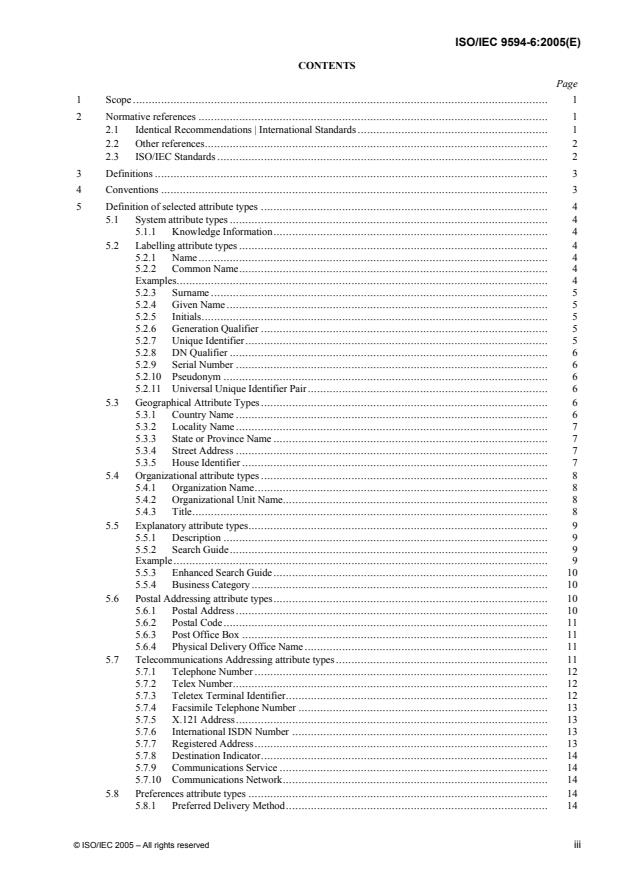
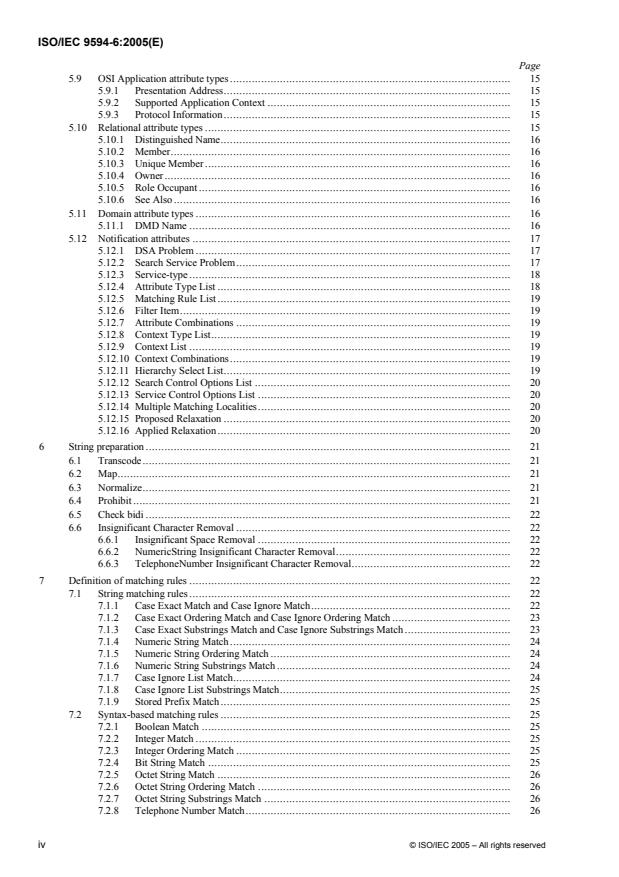
CONTENTS
Page
1 Scope. 1
2 Normative references . 1
2.1 Identical Recommendations | International Standards. 1
2.2 Other references. 2
2.3 ISO/IEC Standards . 2
3 Definitions . 3
4 Conventions . 3
5 Definition of selected attribute types . 4
5.1 System attribute types . 4
5.1.1 Knowledge Information. 4
5.2 Labelling attribute types . 4
5.2.1 Name. 4
5.2.2 Common Name. 4
Examples. 4
5.2.3 Surname . 5
5.2.4 Given Name. 5
5.2.5 Initials. 5
5.2.6 Generation Qualifier . 5
5.2.7 Unique Identifier. 5
5.2.8 DN Qualifier . 6
5.2.9 Serial Number . 6
5.2.10 Pseudonym . 6
5.2.11 Universal Unique Identifier Pair. 6
5.3 Geographical Attribute Types. 6
5.3.1 Country Name . 6
5.3.2 Locality Name. 7
5.3.3 State or Province Name . 7
5.3.4 Street Address . 7
5.3.5 House Identifier . 7
5.4 Organizational attribute types . 8
5.4.1 Organization Name. 8
5.4.2 Organizational Unit Name. 8
5.4.3 Title. 8
5.5 Explanatory attribute types. 9
5.5.1 Description . 9
5.5.2 Search Guide. 9
Example. 9
5.5.3 Enhanced Search Guide. 10
5.5.4 Business Category. 10
5.6 Postal Addressing attribute types. 10
5.6.1 Postal Address. 10
5.6.2 Postal Code. 11
5.6.3 Post Office Box . 11
5.6.4 Physical Delivery Office Name. 11
5.7 Telecommunications Addressing attribute types. 11
5.7.1 Telephone Number . 12
5.7.2 Telex Number. 12
5.7.3 Teletex Terminal Identifier. 12
5.7.4 Facsimile Telephone Number . 13
5.7.5 X.121 Address. 13
5.7.6 International ISDN Number . 13
5.7.7 Registered Address. 13
5.7.8 Destination Indicator. 14
5.7.9 Communications Service . 14
5.7.10 Communications Network. 14
5.8 Preferences attribute types . 14
5.8.1 Preferred Delivery Method. 14
© ISO/IEC 2005 – All rights reserved iii
Page
5.9 OSI Application attribute types. 15
5.9.1 Presentation Address. 15
5.9.2 Supported Application Context . 15
5.9.3 Protocol Information. 15
5.10 Relational attribute types . 15
5.10.1 Distinguished Name. 16
5.10.2 Member. 16
5.10.3 Unique Member. 16
5.10.4 Owner. 16
5.10.5 Role Occupant. 16
5.10.6 See Also. 16
5.11 Domain attribute types . 16
5.11.1 DMD Name . 16
5.12 Notification attributes . 17
5.12.1 DSA Problem . 17
5.12.2 Search Service Problem. 17
5.12.3 Service-type . 18
5.12.4 Attribute Type List . 18
5.12.5 Matching Rule List. 19
5.12.6 Filter Item. 19
5.12.7 Attribute Combinations . 19
5.12.8 Context Type List. 19
5.12.9 Context List . 19
5.12.10 Context Combinations. 19
5.12.11 Hierarchy Select List. 19
5.12.12 Search Control Options List . 20
5.12.13 Service Control Options List . 20
5.12.14 Multiple Matching Localities. 20
5.12.15 Proposed Relaxation . 20
5.12.16 Applied Relaxation. 20
6 String preparation. 21
6.1 Transcode. 21
6.2 Map. 21
6.3 Normalize. 21
6.4 Prohibit. 21
6.5 Check bidi . 22
6.6 Insignificant Character Removal . 22
6.6.1 Insignificant Space Removal . 22
6.6.2 NumericString Insignificant Character Removal. 22
6.6.3 TelephoneNumber Insignificant Character Removal. 22
7 Definition of matching rules . 22
7.1 String matching rules. 22
7.1.1 Case Exact Match and Case Ignore Match. 22
7.1.2 Case Exact Ordering Match and Case Ignore Ordering Match . 23
7.1.3 Case Exact Substrings Match and Case Ignore Substrings Match. 23
7.1.4 Numeric String Match. 24
7.1.5 Numeric String Ordering Match . 24
7.1.6 Numeric String Substrings Match. 24
7.1.7 Case Ignore List Match. 24
7.1.8 Case Ignore List Substrings Match. 25
7.1.9 Stored Prefix Match. 25
7.2 Syntax-based matching rules . 25
7.2.1 Boolean Match . 25
7.2.2 Integer Match . 25
7.2.3 Integer Ordering Match . 25
7.2.4 Bit String Match . 25
7.2.5 Octet String Match . 26
7.2.6 Octet String Ordering Match . 26
7.2.7 Octet String Substrings Match . 26
7.2.8 Telephone Number Match. 26
iv © ISO/IEC 2005 – All rights reserved
Page
7.2.9 Telephone Number Substrings Match. 26
7.2.10 Presentation Address Match . 27
7.2.11 Unique Member Match. 27
7.2.12 Protocol Information Match . 27
7.2.13 Facsimile Number Match. 27
7.2.14 Facsimile Number Substrings Match. 27
7.2.15 UUID Pair Match. 27
7.2.16 Component Match. 28
7.3 Time matching rules . 28
7.3.1 UTC Time Match. 28
7.3.2 UTC Time Ordering Match . 28
7.3.3 Generalized Time Match. 28
7.3.4 Generalized Time Ordering Match. 28
7.3.5 System Proposed Match . 29
7.4 First component matching rules . 29
7.4.1 Integer First Component Match. 29
7.4.2 Object Identifier First Component Match . 29
7.4.3 Directory String First Component Match . 29
7.5 Word matching rules. 29
7.5.1 Word Match. 29
7.5.2 Keyword Match . 30
7.5.3 General Word Match. 30
7.6 Approximate Matching Rules . 32
7.6.1 Approximate String Match. 32
7.7 Special Matching Rules. 32
7.7.1 Ignore if Absent Match. 32
7.7.2 Null Match. 32
7.8 Zonal Match. 32
8 Definition of Context Types . 36
8.1 Language Context . 36
8.2 Temporal Context . 36
Examples. 38
8.3 Locale Context . 39
8.4 LDAP Attribute Option Context. 39
Annex A – Selected attribute types in ASN.1. 41
Annex B – Summary of attribute types. 59
Annex C – Upper bounds. 60
Annex D – Alphabetical index of attributes, matching rules and contexts . 61
Annex E – Examples for zonal match matching rules . 63
Annex F – Amendments and corrigenda . 65
© ISO/IEC 2005 – All rights reserved v
Foreword
ISO (the International Organization for Standardization) and IEC (the International Electrotechnical
Commission) form the specialized system for worldwide standardization. National bodies that are members of
ISO or IEC participate in the development of International Standards through technical committees
established by the respective organization to deal with particular fields of technical activity. ISO and IEC
technical committees collaborate in fields of mutual interest. Other international organizations, governmental
and non-governmental, in liaison with ISO and IEC, also take part in the work. In the field of information
technology, ISO and IEC have established a joint technical committee, ISO/IEC JTC 1.
International Standards are drafted in accordance with the rules given in the ISO/IEC Directives, Part 2.
The main task of the joint technical committee is to prepare International Standards. Draft International
Standards adopted by the joint technical committee are circulated to national bodies for voting. Publication as
an International Standard requires approval by at least 75 % of the national bodies casting a vote.
Attention is drawn to the possibility that some of the elements of this document may be the subject of patent
rights. ISO and IEC shall not be held responsible for identifying any or all such patent rights.
ISO/IEC 9594-6 was prepared by Joint Technical Committee ISO/IEC JTC 1, Information technology,
Subcommittee SC 6, Telecommunications and information exchange between systems, in collaboration with
ITU-T. The identical text is published as ITU-T Rec. X.520.
This fifth edition of ISO/IEC 9594-6 constitutes a technical revision of the fourth edition (ISO/IEC 9594-6:2001),
which is provisionally retained in order to support implementations based on the fourth edition. It also
incorporates the Technical Corrigendum ISO/IEC 9594-6:2001/Cor.1:2003.
ISO/IEC 9594 consists of the following parts, under the general title Information technology — Open Systems
Interconnection — The Directory:
⎯ Part 1: Overview of concepts, models and services
⎯ Part 2: Models
⎯ Part 3: Abstract service definition
⎯ Part 4: Procedures for distributed operation
⎯ Part 5: Protocol specifications
⎯ Part 6: Selected attribute types
⎯ Part 7: Selected object classes
⎯ Part 8: Public-key and attribute certificate frameworks
⎯ Part 9: Replication
⎯ Part 10: Use of systems management for administration of the Directory
vi © ISO/IEC 2005 – All rights reserved
Introduction
This Recommendation | International Standard, together with other Recommendations | International Standards, has
been produced to facilitate the interconnection of information processing systems to provide directory services. A set of
such systems, together with the directory information that they hold, can be viewed as an integrated whole, called the
Directory. The information held by the Directory, collectively known as the Directory Information Base (DIB), is
typically used to facilitate communication between, with or about objects such as application entities, people, terminals,
and distribution lists.
The Directory plays a significant role in Open Systems Interconnection, whose aim is to allow, with a minimum of
technical agreement outside of the interconnection standards themselves, the interconnection of information processing
systems:
– from different manufacturers;
– under different managements;
– of different levels of complexity; and
– of different ages.
This Recommendation | International Standard defines a number of attribute types which may be found useful across a
range of applications of the Directory, as well as a number of standard attribute syntaxes and matching rules. One
particular use for many of the attributes defined herein is in the formation of names, particularly for the classes of object
defined in ITU-T Rec. X.521 | ISO/IEC 9594-7.
This Recommendation | International Standard provides the foundation frameworks upon which industry profiles can be
defined by other standards groups and industry forums. Many of the features defined as optional in these frameworks
may be mandated for use in certain environments through profiles. This fifth edition technically revises and enhances,
but does not replace, the fourth edition of this Recommendation | International Standard. Implementations may still
claim conformance to the fourth edition. However, at some point, the fourth edition will not be supported (i.e., reported
defects will no longer be resolved). It is recommended that implementations conform to this fifth edition as soon as
possible.
This fifth edition specifies versions 1 and 2 of the Directory protocols.
The first and second editions specified only version 1. Most of the services and protocols specified in this edition are
designed to function under version 1. However some enhanced services and protocols, e.g., signed errors, will not
function unless all Directory entities involved in the operation have negotiated version 2. Whichever version has been
negotiated, differences between the services and between the protocols defined in the five editions, except for those
specifically assigned to version 2, are accommodated using the rules of extensibility defined in ITU-T Rec. X.519 |
ISO/IEC 9594-5.
Annex A, which is an integral part of this Recommendation | International Standard, provides the ASN.1 notation for
the complete module which defines the attributes, attribute syntaxes, and matching rules.
Annex B, which is not an integral part of this Recommendation | International Standard, provides a table of attribute
types, for easy reference.
Annex C, which is not an integral part of this Recommendation | International Standard, provides suggested upper
bounds value constraints used in these Directory Specifications.
Annex D, which is not an integral part of this Recommendation | International Standard, lists alphabetically the
attributes and matching rules defined in this Directory Specification.
Annex E, which is not an integral part of this Recommendation | International Standard, gives examples relevant to the
definition of zonal matching.
Annex F, which is not an integral part of this Recommendation | International Standard, lists the amendments and defect
reports that have been incorporated to form this edition of this Recommendation | International Standard.
© ISO/IEC 2005 – All rights reserved vii
INTERNATIONAL STANDARD
ITU-T RECOMMENDATION
Information technology – Open Systems Interconnection –
The Directory: Selected attribute types
SECTION 1 – GENERAL
1 Scope
This Recommendation | International Standard defines a number of attribute types and matching rules which may be
found useful across a range of applications of the Directory.
Attribute types and matching rules fall into three categories, as described below.
Some attribute types and matching rules are used by a wide variety of applications or are understood and/or used by the
Directory itself.
NOTE – It is recommended that an attribute type or matching rule defined in this Recommendation | International Standard be
used, in preference to the generation of a new one, whenever it is appropriate for the application.
Some attribute types and matching rules are internationally standardized, but are application-specific. These are defined
in the standards associated with the application concerned.
Any administrative authority can define its own attribute types and matching rules for any purpose. These are not
internationally standardized, and are available to others beyond the administrative authority which created them only by
bilateral agreement.
2 Normative references
The following Recommendations and International Standards contain provisions which, through reference in this text,
constitute provisions of this Recommendation | International Standard. At the time of publication, the editions indicated
were valid. All Recommendations and Standards are subject to revision, and parties to agreements based on this
Recommendation | International Standard are encouraged to investigate the possibility of applying the most recent
edition of the Recommendations and Standards listed below. Members of IEC and ISO maintain registers of currently
valid International Standards. The Telecommunication Standardization Bureau of the ITU maintains a list of currently
valid ITU-T Recommendations.
2.1 Identical Recommendations | International Standards
– ITU-T Recommendation X.200 (1994) | ISO/IEC 7498-1:1994, Information technology – Open Systems
Interconnection – Basic Reference Model: The basic model.
– ITU-T Recommendation X.500 (2005) | ISO/IEC 9594-1:2005, Information technology – Open Systems
Interconnection – The Directory: Overview of concepts, models and services.
– ITU-T Recommendation X.501 (2005) | ISO/IEC 9594-2:2005, Information technology – Open Systems
Interconnection – The Directory: Models.
– ITU-T Recommendation X.509 (2005) | ISO/IEC 9594-8:2005, Information technology – Open Systems
Interconnection – The Directory: Public-key and attribute certificate frameworks.
– ITU-T Recommendation X.511 (2005) | ISO/IEC 9594-3:2005, Information technology – Open Systems
Interconnection – The Directory: Abstract service definition.
– ITU-T Recommendation X.518 (2005) | ISO/IEC 9594-4:2005, Information technology – Open Systems
Interconnection – The Directory: Procedures for distributed operation.
– ITU-T Recommendation X.519 (2005) | ISO/IEC 9594-5:2005, Information technology – Open Systems
Interconnection – The Directory: Protocol specifications.
ITU-T Rec. X.520 (08/2005) 1
– ITU-T Recommendation X.521 (2005) | ISO/IEC 9594-7:2005, Information technology – Open Systems
Interconnection – The Directory: Selected object classes.
– ITU-T Recommendation X.525 (2005) | ISO/IEC 9594-9:2005, Information technology – Open Systems
Interconnection – The Directory: Replication.
– ITU-T Recommendation X.530 (2005) | ISO/IEC 9594-10:2005, Information technology – Open Systems
Interconnection – The Directory: Use of systems management for administration of the Directory.
– ITU-T Recommendation X.667 (2004) | ISO/IEC 9834-8:2005, Information technology – Open Systems
Interconnection – Procedures for the operation of OSI Registration Authorities: Generation and
registration of Universally Unique Identifiers (UUIDs) and their use as ASN.1 object identifier
components.
– ITU-T Recommendation X.680 (2002) | ISO/IEC 8824-1:2002, Information technology – Abstract Syntax
Notation One (ASN.1): Specification of basic notation.
– ITU-T Recommendation X.681 (2002) | ISO/IEC 8824-2:2002, Information technology – Abstract Syntax
Notation One (ASN.1): Information object specification.
– ITU-T Recommendation X.682 (2002) | ISO/IEC 8824-3:2002, Information technology – Abstract Syntax
Notation One (ASN.1): Constraint specification.
– ITU-T Recommendation X.683 (2002) | ISO/IEC 8824-4:2002, Information technology – Abstract Syntax
Notation One (ASN.1): Parameterization of ASN.1 specifications.
2.2 Other references
– ITU-T Recommendation E.123 (2001), Notation for national and international telephone numbers, e-mail
addresses and Web addresses.
– ITU-T Recommendation E.164 (2005), The international public telecommunication numbering plan.
– ITU-T Recommendation F.1 (1998), Operational provisions for the international public telegram service.
– CCITT Recommendation F.31 (1988), Telegram retransmission system.
– CCITT Recommendation F.401 (1992), Message handling services: Naming and addressing for public
message handling services.
– ITU-T Recommendation T.30 (2005), Procedures for document facsimile transmission in the general
switched telephone network.
– ITU-T Recommendation T.62 (1993), Control procedures for teletex and Group 4 facsimile services.
– ITU-T Recommendation X.121 (2000), International numbering plan for public data networks.
– ISO 3166 (all parts), Codes for the representation of names of countries and their subdivisions.
– ISO 639-2:1998, Codes for the representation of names of languages – Part 2: Alpha-3 code.
– ISO/IEC 9945-2:2003, Information technology – Portable Operating System Interface (POSIX) – Part 2:
Shell and Utilities.
– IETF RFC 3377 (2002), Lightweight Directory Access Protocol (v3): Technical Specification.
– IETF RFC 3454 (2002), Preparation of Internationalized Strings (stringprep).
– The Unicode Consortium. The Unicode Standard, Version 4.0, defined by: The Unicode Standard,
Version 4.0 (Reading, MA, Addison-Wesley, 2003. ISBN 0-321-18578-1).
– Unicode Standard Annex #15: Unicode Normalization Forms, by Mark Davis and Martin Dürst. An
integral part of The Unicode Standard, Version 4.0.
2.3 ISO/IEC Standards
– ISO/IEC 10646:2003, Information technology – Universal Multiple-Octet Coded Character Set (UCS).
2 ITU-T Rec. X.520 (08/2005)
3 Definitions
For the purposes of this Recommendation | International Standard, the following definitions apply.
The following terms are defined in ITU-T Rec. X.501 | ISO/IEC 9594-2:
a) attribute type;
b) object class;
c) matching rule;
d) context.
4 Conventions
With minor exceptions this Directory Specification has been prepared according to the Rules for presentation of
ITU-T | ISO/IEC common text, November 2001.
The term "Directory Specification" (as in "this Directory Specification") shall be taken to mean ITU-T Rec. X.520 |
ISO/IEC 9594-6. The term "Directory Specifications" shall be taken to mean the X.500-series Recommendations and all
parts of ISO/IEC 9594.
This Directory Specification uses the term first edition systems to refer to systems conforming to the first edition of the
Directory Specifications, i.e., the 1988 edition of the series of CCITT X.500 Recommendations and the ISO/IEC
9594:1990 edition. This Directory Specification uses the term second edition systems to refer to systems conforming to
the second edition of the Directory Specifications, i.e., the 1993 edition of the series of ITU-T X.500 Recommendations
and the ISO/IEC 9594:1995 edition. This Directory Specification uses the term third edition systems to refer to systems
conforming to the third edition of the Directory Specifications, i.e., the 1997 edition of the series of ITU-T X.500
Recommendations and the ISO/IEC 9594:1998 edition. This Directory Specification uses the term fourth edition systems
to refer to systems conforming to the fourth edition of the Directory Specifications, i.e., the 2001 editions of ITU-T
Recs X.500, X.501, X.511, X.518, X.519, X.520, X.521, X.525, and X.530, the 2000 edition of ITU-T Rec. X.509, and
parts 1-10 of the ISO/IEC 9594:2001 edition.
This Directory Specification uses the term fifth edition systems to refer to systems conforming to the fifth edition of the
Directory Specifications, i.e., the 2005 editions of ITU-T Recs X.500, X.501, X.509, X.511, X.518, X.519, X.520,
X.521, X.525, and X.530 and parts 1-10 of the ISO/IEC 9594:2005 edition.
This Directory Specification presents ASN.1 notation in the bold Helvetica typeface. When ASN.1 types and values are
referenced in normal text, they are differentiated from normal text by presenting them in the bold Helvetica typeface.
The names of procedures, typically referenced when specifying the semantics of processing, are differentiated from
normal text by displaying them in bold Times. Access control permissions are presented in italicized Times.
If the items in a list are numbered (as opposed to using "–" or letters), then the items shall be considered steps in a
procedure.
Attribute types, matching rules and context types are defined in this Recommendation | International Standard by use of
the ATTRIBUTE, MATCHING-RULE and CONTEXT information object classes defined in ITU-T Rec. X.501 |
ISO/IEC 9594-2.
Examples of the use of the attribute types are described using an informal notation, where attribute type and value pairs
are represented by an acronym for the attribute type, followed by an equals sign ("="), followed by the example value for
the attribute.
ITU-T Rec. X.520 (08/2005) 3
SECTION 2 – SELECTED ATTRIBUTE TYPES
5 Definition of selected attribute types
This Directory Specification defines a number of attribute types which may be found useful across a range of
applications of the Directory.
Many of the attributes defined in this Directory Specification are based on a common ASN.1 syntax:
DirectoryString { INTEGER : maxSize } ::= CHOICE {
teletexString TeletexString (SIZE (1.maxSize)),
printableString PrintableString (SIZE (1.maxSize)),
bmpString BMPString (SIZE (1.maxSize)),
universalString UniversalString (SIZE (1.maxSize)),
uTF8String UTF8String (SIZE (1.maxSize)) }
Some implementations of the Directory may not support UniversalString, BMPString, or UTF8String, and may not be
able to generate, match, shadow, or display attributes with these syntax types.
5.1 System attribute types
5.1.1 Knowledge Information
The Knowledge Information attribute type specifies a human readable accumulated description of knowledge mastered
by a specific DSA.
NOTE – This attribute is now obsolete.
knowledgeInformation ATTRIBUTE ::= {
WITH SYNTAX DirectoryString {ub-knowledge-information}
EQUALITY MATCHING RULE caseIgnoreMatch
ID id-at-knowledgeInformation }
5.2 Labelling attribute types
These attributes type are concerned with information about objects which has been explicitly associated with the objects
by a labelling process.
5.2.1 Name
The Name attribute type is the attribute supertype from which string attribute types typically used for naming may be
formed.
name ATTRIBUTE ::= {
WITH SYNTAX DirectoryString {ub-name}
EQUALITY MATCHING RULE caseIgnoreMatch
SUBSTRINGS MATCHING RULE caseIgnoreSubstringsMatch
ID id-at-name }
5.2.2 Common Name
The Common Name attribute type specifies an identifier of an object. A Common Name is not a directory name; it is a
(possibly ambiguous) name by which the object is commonly known in some limited scope (such as an organization) and
conforms to the naming conventions of the country or culture with which it is associated.
An attribute value for common name is a string chosen either by the person or organization it describes or the
organization responsible for the object it describes for devices and application entities. For example, a typical name of a
person in an English-speaking country comprises a personal title (e.g., Mr., Ms., Rd, Professor, Sir, Lord), a first name,
middle name(s), last name, generation qualifier (if any, e.g., Jr.) and decorations and awards (if any, e.g., QC).
Examples
CN = "Mr. Robin Lachlan McLeod BSc(Hons) CEng MIEE";
CN = "Divisional Coordination Committee";
CN = "High Speed Modem".
Any variants should be associated with the named object as separate and alternative attribute values.
4 ITU-T Rec. X.520 (08/2005)
Other common variants should also be admitted, e.g., use of a middle name as a preferred first name; use of "Bill" in
place of "William", etc.
commonName ATTRIBUTE ::= {
SUBTYPE OF name
WITH SYNTAX DirectoryString {ub-common-name}
ID id-at-commonName }
5.2.3 Surname
The Surname attribute type specifies the linguistic construct which normally is inherited by an individual from the
individual's parent or assumed by marriage, and by which the individual is commonly known.
An attribute value for Surname is a string, e.g., "McLeod".
surname ATTRIBUTE ::= {
SUBTYPE OF name
WITH SYNTAX DirectoryString {ub-surname}
ID id-at-surname }
5.2.4 Given Name
The Given Name attribute type specifies the linguistic construct which is normally given to an individual by the
individual's parent, or is chosen by the individual, or by which the individual is commonly known.
An attribute value for Given Name is a string, e.g., "David", or "Jean Paul".
givenName ATTRIBUTE ::= {
SUBTYPE OF name
WITH SYNTAX DirectoryString {ub-name}
ID id-at-givenName }
5.2.5 Initials
The Initials attribute type contains the initials of some or all of an individual's names, but not the surname(s).
An attribute value for Initials is a string, e.g., "D" or "D." or "J.P.".
initials ATTRIBUTE ::= {
SUBTYPE OF name
WITH SYNTAX DirectoryString {ub-name}
ID id-at-initials }
5.2.6 Generation Qualifier
The Generation Qualifier attribute type contains a string which is used to provide generation information to qualify an
individual's name.
An attribute value for Generation Qualifier is a string, e.g., "Jr." or "II".
generationQualifier ATTRIBUTE ::= {
SUBTYPE OF name
WITH SYNTAX DirectoryString {ub-name}
ID id-at-generationQualifier }
5.2.7 Unique Identifier
The Unique Identifier attribute type specifies an identifier which may be used to distinguish between object references
when a distinguished name has been reused. It may be, for example, an encoded object identifier, certificate, date,
timestamp, or some other form of certification on the validity of the distinguished name.
An attribute value for Unique Identifier is a bit string.
uniqueIdentifier ATTRIBUTE ::= {
WITH SYNTAX UniqueIdentifier
EQUALITY MATCHING RULE bitStringMatch
ID id-at-uniqueIdentifier }
UniqueIdentifier ::= BIT STRING
ITU-T Rec. X.520 (08/2005) 5
5.2.8 DN Qualifier
The DN Qualifier attribute type specifies disambiguating information to add to the relative distinguished name of an
entry. It is intended to be used for entries held in multiple DSAs which would otherwise have the same name, and that its
value be the same in a given DSA for all entries to which this information has been added.
dnQualifier ATTRIBUTE ::= {
WITH SYNTAX PrintableString
EQUALITY MATCHING RULE caseIgnoreMatch
ORDERING MATCHING RULE caseIgnoreOrderingMatch
SUBSTRINGS MATCHING RULE caseIgnoreSubstringsMatch
ID id-at-dnQualifier }
5.2.9 Serial Number
The Serial Number attribute type specifies an identifier, the serial number of an object.
An attribute value for Seria
...
NORME ISO/CEI
INTERNATIONALE 9594-6
Cinquième édition
2005-12-15
Technologies de l'information —
Interconnexion de systèmes ouverts
(OSI) — L'annuaire: Types d'attributs
sélectionnés
Information technology — Open Systems Interconnection —
The Directory: Selected attribute types
Numéro de référence
ISO/CEI 9594-6:2005(F)
©
ISO/CEI 2005
ISO/CEI 9594-6:2005(F)
PDF – Exonération de responsabilité
Le présent fichier PDF peut contenir des polices de caractères intégrées. Conformément aux conditions de licence d'Adobe, ce fichier
peut être imprimé ou visualisé, mais ne doit pas être modifié à moins que l'ordinateur employé à cet effet ne bénéficie d'une licence
autorisant l'utilisation de ces polices et que celles-ci y soient installées. Lors du téléchargement de ce fichier, les parties concernées
acceptent de fait la responsabilité de ne pas enfreindre les conditions de licence d'Adobe. Le Secrétariat central de l'ISO décline toute
responsabilité en la matière.
Adobe est une marque déposée d'Adobe Systems Incorporated.
Les détails relatifs aux produits logiciels utilisés pour la création du présent fichier PDF sont disponibles dans la rubrique General Info
du fichier; les paramètres de création PDF ont été optimisés pour l'impression. Toutes les mesures ont été prises pour garantir
l'exploitation de ce fichier par les comités membres de l'ISO. Dans le cas peu probable où surviendrait un problème d'utilisation,
veuillez en informer le Secrétariat central à l'adresse donnée ci-dessous.
© ISO/CEI 2005
Droits de reproduction réservés. Sauf prescription différente, aucune partie de cette publication ne peut être reproduite ni utilisée sous
quelque forme que ce soit et par aucun procédé, électronique ou mécanique, y compris la photocopie et les microfilms, sans l'accord écrit
de l'ISO à l'adresse ci-après ou du comité membre de l'ISO dans le pays du demandeur.
ISO copyright office
Case postale 56 • CH-1211 Geneva 20
Tel. + 41 22 749 01 11
Fax. + 41 22 749 09 47
E-mail copyright@iso.org
Web www.iso.org
Version française parue en 2006
Publié en Suisse
ii © ISO/CEI 2005 – Tous droits réservés
ISO/CEI 9594-6:2005(F)
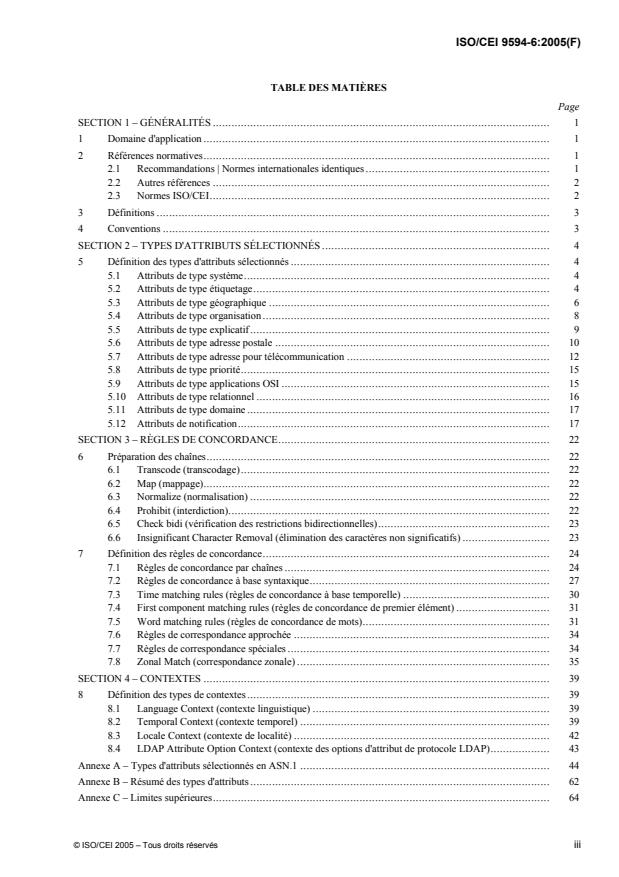
TABLE DES MATIÈRES
Page
SECTION 1 – GÉNÉRALITÉS . 1
1 Domaine d'application . 1
2 Références normatives. 1
2.1 Recommandations | Normes internationales identiques. 1
2.2 Autres références . 2
2.3 Normes ISO/CEI. 2
3 Définitions . 3
4 Conventions . 3
SECTION 2 – TYPES D'ATTRIBUTS SÉLECTIONNÉS . 4
5 Définition des types d'attributs sélectionnés . 4
5.1 Attributs de type système. 4
5.2 Attributs de type étiquetage. 4
5.3 Attributs de type géographique . 6
5.4 Attributs de type organisation. 8
5.5 Attributs de type explicatif. 9
5.6 Attributs de type adresse postale . 10
5.7 Attributs de type adresse pour télécommunication . 12
5.8 Attributs de type priorité. 15
5.9 Attributs de type applications OSI . 15
5.10 Attributs de type relationnel . 16
5.11 Attributs de type domaine. 17
5.12 Attributs de notification. 17
SECTION 3 – RÈGLES DE CONCORDANCE. 22
6 Préparation des chaînes. 22
6.1 Transcode (transcodage). 22
6.2 Map (mappage). 22
6.3 Normalize (normalisation) . 22
6.4 Prohibit (interdiction). 22
6.5 Check bidi (vérification des restrictions bidirectionnelles). 23
6.6 Insignificant Character Removal (élimination des caractères non significatifs) . 23
7 Définition des règles de concordance. 24
7.1 Règles de concordance par chaînes . 24
7.2 Règles de concordance à base syntaxique. 27
7.3 Time matching rules (règles de concordance à base temporelle) . 30
7.4 First component matching rules (règles de concordance de premier élément) . 31
7.5 Word matching rules (règles de concordance de mots). 31
7.6 Règles de correspondance approchée . 34
7.7 Règles de correspondance spéciales . 34
7.8 Zonal Match (correspondance zonale) . 35
SECTION 4 – CONTEXTES . 39
8 Définition des types de contextes. 39
8.1 Language Context (contexte linguistique) . 39
8.2 Temporal Context (contexte temporel) . 39
8.3 Locale Context (contexte de localité) . 42
8.4 LDAP Attribute Option Context (contexte des options d'attribut de protocole LDAP). 43
Annexe A – Types d'attributs sélectionnés en ASN.1 . 44
Annexe B – Résumé des types d'attributs. 62
Annexe C – Limites supérieures. 64
© ISO/CEI 2005 – Tous droits réservés iii
ISO/CEI 9594-6:2005(F)
Page
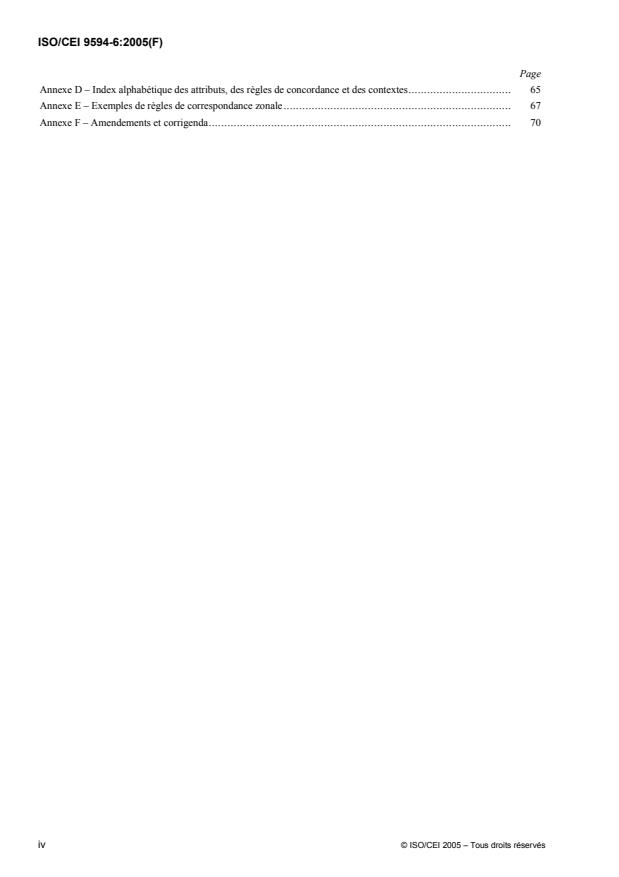
Annexe D – Index alphabétique des attributs, des règles de concordance et des contextes. 65
Annexe E – Exemples de règles de correspondance zonale. 67
Annexe F – Amendements et corrigenda. 70
iv © ISO/CEI 2005 – Tous droits réservés
ISO/CEI 9594-6:2005(F)
Avant-propos
L'ISO (Organisation internationale de normalisation) et la CEI (Commission électrotechnique internationale)
forment le système spécialisé de la normalisation mondiale. Les organismes nationaux membres de l'ISO ou
de la CEI participent au développement de Normes internationales par l'intermédiaire des comités techniques
créés par l'organisation concernée afin de s'occuper des domaines particuliers de l'activité technique. Les
comités techniques de l'ISO et de la CEI collaborent dans des domaines d'intérêt commun. D'autres
organisations internationales, gouvernementales et non gouvernementales, en liaison avec l'ISO et la CEI
participent également aux travaux. Dans le domaine des technologies de l'information, l'ISO et la CEI ont créé
un comité technique mixte, l'ISO/CEI JTC 1.
Les Normes internationales sont rédigées conformément aux règles données dans les Directives ISO/CEI,
Partie 2.
La tâche principale du comité technique mixte est d'élaborer les Normes internationales. Les projets de
Normes internationales adoptés par le comité technique mixte sont soumis aux organismes nationaux pour
vote. Leur publication comme Normes internationales requiert l'approbation de 75 % au moins des
organismes nationaux votants.
L'attention est appelée sur le fait que certains des éléments du présent document peuvent faire l'objet de
droits de propriété intellectuelle ou de droits analogues. L'ISO et la CEI ne sauraient être tenues pour
responsables de ne pas avoir identifié de tels droits de propriété et averti de leur existence.
L'ISO/CEI 9594-6 a été élaborée par le comité technique mixte ISO/CEI JTC 1, Technologies de l’information,
sous-comité SC 6, Téléinformatique, en collaboration avec l’UIT-T. Le texte identique est publié en tant que
Rec. UIT-T X.520.
Cette cinquième édition constitue une révision technique de la quatrième édition (ISO/CEI 9594-6:2001), qui
est provisoirement retenue pour soutenir les versions basées sur la quatrième édition. Elle incorpore aussi le
Rectificatif technique ISO/CEI 9594-6:2001/Cor.1:2003.
L'ISO/CEI 9594 comprend les parties suivantes, présentées sous le titre général Technologies de l'information
— Interconnexion de systèmes ouverts (OSI) — L'annuaire:
⎯ Partie 1: Aperçu général des concepts, modèles et services
⎯ Partie 2: Les modèles
⎯ Partie 3: Définition du service abstrait
⎯ Partie 4: Procédures pour le fonctionnement réparti
⎯ Partie 5: Spécification du protocole
⎯ Partie 6: Types d'attributs sélectionnés
⎯ Partie 7: Classes d'objets sélectionnées
⎯ Partie 8: Cadre général des certificats de clé publique et d'attribut
⎯ Partie 9: Duplication
⎯ Partie 10: Utilisation de la gestion-systèmes pour l'administration de l'annuaire
© ISO/CEI 2005 – Tous droits réservés v
ISO/CEI 9594-6:2005(F)
Introduction
La présente Recommandation | Norme internationale a été élaborée, ainsi que d'autres Recommandations | Normes
internationales, pour faciliter l'interconnexion des systèmes de traitement de l'information et permettre ainsi d'assurer
des services d'annuaire. L'ensemble de tous ces systèmes, avec les informations d'annuaire qu'ils contiennent, peut être
considéré comme un tout intégré, appelé annuaire. Les informations de l'annuaire, appelées collectivement base
d'informations d'annuaire (DIB), sont généralement utilisées pour faciliter la communication entre, avec ou à propos
d'objets tels que des entités d'application, des personnes, des terminaux et des listes de distribution.
L'annuaire joue un rôle important dans l'interconnexion des systèmes ouverts, dont le but est de permettre, moyennant
un minimum d'accords techniques en dehors des normes d'interconnexion proprement dites, l'interconnexion des
systèmes de traitement de l'information:
– provenant de divers fabricants;
– gérés différemment;
– de niveaux de complexité différents;
– de générations différentes.
La présente Recommandation | Norme internationale définit un certain nombre de types d'attribut qui peuvent être jugés
utiles dans une gamme d'applications de l'annuaire ainsi qu'un certain nombre de syntaxes d'attribut et de règles de
concordance normales. Un grand nombre des attributs ici définis sert en particulier à former des noms, notamment pour
les classes d'objets définies dans la Rec. UIT-T X.521 | ISO/CEI 9594-7.
Cette Recommandation | Norme internationale contient les structures de base sur lesquelles peuvent être définis les
profils industriels par d'autres groupes de normalisation et forums industriels. De nombreuses caractéristiques définies
comme étant facultatives dans ces structures peuvent être rendues obligatoires dans certains environnements par
l'intermédiaire des profils. La présente cinquième édition révise techniquement et améliore, mais ne remplace pas, la
quatrième édition de la présente Recommandation | Norme internationale. Les implémentations peuvent encore
revendiquer la conformité à la quatrième édition, mais celle-ci finira par ne plus être prise en compte (c'est-à-dire que
les erreurs signalées ne seront plus corrigées). Il est recommandé que les implémentations se conforment, dès que
possible, à la présente cinquième édition.
Cette cinquième édition spécifie les versions 1 et 2 des protocoles de l'annuaire.
Les première et deuxième éditions ne spécifiaient que la version 1. La plupart des services et protocoles spécifiés dans
la présente édition sont conçus pour fonctionner selon la version 1. Certains services et protocoles améliorés, comme les
erreurs signées, ne fonctionneront cependant pas avant que toutes les entités d'annuaire mises en jeu dans l'exploitation
aient négocié la version 2. Quelle que soit la version négociée, on a traité les différences entre les services et entre les
protocoles, définis dans les cinq éditions, à l'exception de ceux qui sont spécifiquement définis dans la version 2, en
utilisant les règles d'extensibilité définies dans la Rec. UIT-T X.519 | ISO/CEI 9594-5.
L'Annexe A, qui fait partie intégrante de la présente Recommandation | Norme internationale, fournit la notation ASN.1
du module complet qui définit les attributs, la syntaxe des attributs et les règles de concordance.
L'Annexe B, qui ne fait pas partie intégrante de la présente Recommandation | Norme internationale, propose un index
des types d'attributs qui facilitera les recherches.
L'Annexe C, qui ne fait pas partie intégrante de la présente Recommandation | Norme internationale, indique les valeurs
des limites supérieures proposées, utilisées dans les présentes Spécifications d'annuaire.
L'Annexe D, qui ne fait pas partie intégrante de la présente Recommandation | Norme internationale, donne une liste
alphabétique des attributs et des règles de concordance définis dans la présente Spécification d'annuaire.
L'Annexe E, qui ne fait pas partie intégrante de la présente Recommandation | Norme internationale, donne des
exemples adaptés à la définition de la correspondance zonale.
L'Annexe F, qui ne fait pas partie intégrante de la présente Recommandation | Norme internationale, donne une liste des
amendements et rapports de défauts qui ont été incorporés pour former l'édition de la présente Recommandation |
Norme internationale.
vi © ISO/CEI 2005 – Tous droits réservés
ISO/CEI 9594-6:2005 (F)
NORME INTERNATIONALE
RECOMMANDATION UIT-T
Technologies de l'information – Interconnexion des systèmes ouverts –
L'annuaire: types d'attributs sélectionnés
SECTION 1 – GÉNÉRALITÉS
1 Domaine d'application
La présente Recommandation | Norme internationale définit plusieurs types d'attributs et règles de concordance qui
peuvent être utiles dans une gamme d'applications de l'annuaire.
Les types d'attributs et les règles de concordance formeront trois catégories, comme indiqué ci-dessous.
Certains types d'attributs et règles de concordance sont utilisés dans une grande variété d'applications ou sont interprétés
ou utilisés par l'annuaire proprement dit.
NOTE – Il est recommandé d'utiliser les types d'attributs et règles de concordance définis dans la présente Recommandation |
Norme internationale, plutôt que d'en créer de nouveaux, chaque fois que cela convient pour l'application étudiée.
Certains types d'attributs et règles de concordance sont normalisés au niveau international mais sont propres à une
application. Ils sont définis dans les normes relatives à l'application en cause.
Toute autorité administrative peut définir ses propres types d'attributs et règles de concordance à une fin ou à une autre.
Ces conventions ne sont pas normalisées au niveau international et ne pourront être mises que par accord bilatéral à la
disposition d'autorités administratives autres que celles qui les aura créées.
2 Références normatives
Les Recommandations et Normes internationales suivantes contiennent des dispositions qui, par suite de la référence
qui y est faite, constituent des dispositions valables pour la présente Recommandation | Norme internationale. Au
moment de la publication, les éditions indiquées étaient en vigueur. Toutes Recommandations et Normes sont sujettes à
révision et les parties prenantes aux accords fondés sur la présente Recommandation | Norme internationale sont
invitées à rechercher la possibilité d'appliquer les éditions les plus récentes des Recommandations et Normes indiquées
ci-après. Les membres de la CEI et de l'ISO possèdent le registre des Normes internationales en vigueur. Le Bureau de
la normalisation des télécommunications de l'UIT tient à jour une liste des Recommandations de l'UIT-T en vigueur.
2.1 Recommandations | Normes internationales identiques
– Recommandation UIT-T X.200 (1994) | ISO/CEI 7498-1:1994, Technologies de l'information –
Interconnexion des systèmes ouverts – Modèle de référence de base: le modèle de référence de base.
– Recommandation UIT-T X.500 (2005) | ISO/CEI 9594-1:2005, Technologies de l'information –
Interconnexion des systèmes ouverts – L'annuaire: aperçu général des concepts, modèles et services.
– Recommandation UIT-T X.501 (2005) | ISO/CEI 9594-2:2005, Technologies de l'information –
Interconnexion des systèmes ouverts – L'annuaire: les modèles.
– Recommandation UIT-T X.509 (2005) | ISO/CEI 9594-8:2005, Technologies de l'information –
Interconnexion des systèmes ouverts – L'annuaire: cadre général des certificats de clé publique et
d'attribut.
– Recommandation UIT-T X.511 (2005) | ISO/CEI 9594-3:2005, Technologies de l'information –
Interconnexion des systèmes ouverts – L'annuaire: définition du service abstrait.
– Recommandation UIT-T X.518 (2005) | ISO/CEI 9594-4:2005, Technologies de l'information –
Interconnexion des systèmes ouverts – L'annuaire: procédures pour le fonctionnement réparti.
– Recommandation UIT-T X.519 (2005) | ISO/CEI 9594-5:2005, Technologies de l'information –
Interconnexion des systèmes ouverts – L'annuaire: spécification des protocoles.
Rec. UIT-T X.520 (08/2005) 1
ISO/CEI 9594-6:2005 (F)
– Recommandation UIT-T X.521 (2005) | ISO/CEI 9594-7:2005, Technologies de l'information –
Interconnexion des systèmes ouverts – L'annuaire: classes d'objets sélectionnées.
– Recommandation UIT-T X.525 (2005) | ISO/CEI 9594-9:2005, Technologies de l'information –
Interconnexion des systèmes ouverts – L'annuaire: duplication.
– Recommandation UIT-T X.530 (2005) | ISO/CEI 9594-10:2005, Technologies de l'information –
Interconnexion des systèmes ouverts – L'annuaire: utilisation de la gestion-systèmes pour
l'administration de l'annuaire.
– Recommandation UIT-T X.667 (2004) | ISO/CEI 9834-8:2005, Technologies de l'information –
Interconnexion des systèmes ouverts – Procédures opérationnelles des organismes d'enregistrement de
l'OSI: génération et enregistrement des identificateurs uniques universels (UUID) et utilisation de ces
identificateurs comme composants d'identificateurs d'objets ASN.1.
– Recommandation UIT-T X.680 (2002) | ISO/CEI 8824-1:2002, Technologies de l'information – Notation
de syntaxe abstraite numéro un: spécification de la notation de base.
– Recommandation UIT-T X.681 (2002) | ISO/CEI 8824-2:2002, Technologies de l'information – Notation
de syntaxe abstraite numéro un: spécification des objets informationnels.
– Recommandation UIT-T X.682 (2002) | ISO/CEI 8824-3:2002, Technologies de l'information – Notation
de syntaxe abstraite numéro un: spécification des contraintes.
– Recommandation UIT-T X.683 (2002) | ISO/CEI 8824-4:2002, Technologies de l'information – Notation
de syntaxe abstraite numéro un: paramétrage des spécifications de la notation de syntaxe abstraite
numéro un.
2.2 Autres références
– Recommandation UIT-T E.123 (2001), Notation des numéros téléphoniques nationaux et internationaux,
des adresses électroniques et des adresses web.
– Recommandation UIT-T E.164 (2005), Plan de numérotage des télécommunications publiques
internationales.
– Recommandation UIT-T F.1 (1998), Dispositions applicables à l'exploitation du service public
international des télégrammes.
– Recommandation CCITT F.31 (1988), Système à retransmission de télégrammes.
– Recommandation CCITT F.401 (1992), Services de messagerie: Dénomination et adressage pour les
services publics de messagerie.
– Recommandation UIT-T T.30 (2005), Procédures pour la transmission de documents par télécopie sur
le réseau téléphonique public commuté.
– Recommandation UIT-T T.62 (1993), Procédures de commande pour le service télétex et le service de
télécopie du Groupe 4.
– Recommandation UIT-T X.121 (2000), Plan de numérotage international pour les réseaux publics de
données.
– ISO 3166 (toutes les parties), Codes pour la représentation des noms de pays et de leurs subdivisions.
– ISO 639-2:1998, Codes pour la représentation des noms de langue – Partie 2: Code alpha-3.
– ISO/CEI 9945-2:1993, Technologies de l'information – Interface pour la portabilité des systèmes
(POSIX) – Partie 2: Enveloppe et services.
– IETF RFC 3377 (2002), Lightweight Directory Access Protocol (v3): Technical Specification.
– IETF RFC 3454 (2002), Preparation of Internationalized Strings ("stringprep").
– The Unicode Consortium. The Unicode Standard, Version 4.0, défini par: The Unicode Standard,
Version 4.0 (Reading, MA, Addison-Wesley, 2003. ISBN 0-321-18578-1).
– "Unicode Standard Annex #15: Unicode Normalization Forms", par Mark Davis et Martin Dürst. Une
partie intégrante de The Unicode Standard, Version 4.0.
2.3 Normes ISO/CEI
– ISO/CEI 10646:2003, Technologies de l'information – Jeu universel de caractères codés sur plusieurs
octets (JUC).
2 Rec. UIT-T X.520 (08/2005)
ISO/CEI 9594-6:2005 (F)
3 Définitions
Pour les besoins de la présente Recommandation | Norme internationale, les définitions suivantes s'appliquent.
Les termes suivants sont définis dans la Rec. UIT-T X.501 | ISO/CEI 9594-2:
a) type d'attribut;
b) classe d'objets;
c) règle de concordance;
d) contexte.
4 Conventions
A quelques exceptions mineures près, la présente Spécification d'annuaire a été élaborée conformément aux Règles de
présentation des textes communs UIT-T | ISO/CEI, novembre 2001.
Le terme "Spécification d'annuaire" (comme dans "la présente Spécification d'annuaire") s'entend selon l'acception de la
Rec. UIT-T X.520 | ISO/CEI 9594-6. Le terme "Spécifications d'annuaire" s'entend selon l'acception des
Recommandations de la série X.500 et de toutes les parties de l'ISO/CEI 9594.
La présente Spécification d'annuaire utilise le terme systèmes de la première édition pour désigner les systèmes
conformes à la première édition des Spécifications d'annuaire, c'est-à-dire à l'édition 1988 des Recommandations
CCITT de la série X.500 et de l'ISO/CEI 9594:1990. La présente Spécification d'annuaire utilise le terme systèmes de la
deuxième édition pour désigner les systèmes conformes à la deuxième édition des Spécifications d'annuaire, c'est-à-dire
à l'édition 1993 des Recommandations UIT-T de la série X.500 et de l'ISO/CEI 9594:1995. La présente Spécification
d'annuaire utilise le terme systèmes de la troisième édition pour désigner les systèmes conformes à la troisième édition
des Spécifications d'annuaire, c'est-à-dire à l'édition 1997 des Recommandations UIT-T de la série X.500 et de
l'ISO/CEI 9594:1998. La présente Spécification d'annuaire utilise le terme systèmes de la quatrième édition pour
désigner les systèmes conformes à la quatrième édition des Spécifications d'annuaire, c'est-à-dire à l'édition 2001 des
Recommandations UIT-T X.500, X.501, X.511, X.518, X.519, X.520, X.521, X.525 et X.530 et à l'édition 2000 de la
Rec. UIT-T X.509, et aux parties 1 à 10 de l'ISO/CEI 9594:2001.
La présente Spécification d'annuaire utilise le terme systèmes de la cinquième édition pour désigner les systèmes
conformes à la cinquième édition des Spécifications d'annuaire, c'est-à-dire à l'édition 2005 des Recommandations
UIT-T X.500, X.501, X.509, X.511, X.518, X.519, X.520, X.521, X.525 et X.530 et aux parties 1 à 10 de
l'ISO/CEI 9594:2005.
Cette Spécification d'annuaire présente la notation ASN.1 en caractères gras de la police Helvetica. Lorsque des types et
des valeurs ASN.1 sont cités dans le texte normal, ils en sont différenciés par leur présentation en caractères gras
Helvetica. Les noms des procédures, normalement cités lors de la spécification des sémantèmes de traitement, sont
différenciés du texte normal par une présentation en caractères gras de la police Times. Les autorisations de commande
d'accès sont présentées en caractères italiques de la police Times.
Si les éléments d'une liste sont numérotés (et non précédés d'un tiret "–"ou d'une lettre), on considérera que ces éléments
sont des étapes d'une marche à suivre.
Les types d'attributs, les règles de concordance et les types de contexte sont définis dans la présente Recommandation
| Norme internationale par les classes d'objets d'information ATTRIBUTE (attribut), MATCHING-RULE (règle de
concordance) et CONTEXT définies dans la Rec. UIT-T X.501 | ISO/CEI 9594-2.
Les exemples d'utilisation des types d'attributs font intervenir une notation non formelle dans laquelle les paires de types
et de valeurs d'attributs sont représentées par un acronyme désignant le type d'attribut, suivi d'un signe d'égalité (=) et de
la valeur de l'attribut donnée comme exemple.
Rec. UIT-T X.520 (08/2005) 3
ISO/CEI 9594-6:2005 (F)
SECTION 2 – TYPES D'ATTRIBUTS SÉLECTIONNÉS
5 Définition des types d'attributs sélectionnés
La présente Spécification d'annuaire définit un certain nombre de types d'attributs pouvant être utiles dans une large
gamme d'applications de l'annuaire.
Un grand nombre des attributs définis dans la présente Spécification d'annuaire sont fondés sur une syntaxe ASN.1
commune:
DirectoryString { INTEGER : maxSize } ::= CHOICE {
teletexString TeletexString (SIZE (1.maxSize)),
printableString PrintableString (SIZE (1.maxSize)),
bmpString BMPString (SIZE (1.maxSize)),
universalString UniversalString (SIZE (1.maxSize)),
uTF8String UTF8String (SIZE (1.maxSize)) }
Certaines implémentations de l'annuaire peuvent ne pas gérer les chaînes de type UniversalString, BMPString ou
UTF8String. Elles peuvent donc ne pas être en mesure de produire, de mettre en correspondance, de dupliquer ou
d'afficher les attributs ayant ces types de syntaxe.
5.1 Attributs de type système
5.1.1 Knowledge Information (informations de connaissance)
Le type d'attribut Knowledge Information spécifie une description accumulée, accessible en lecture par l'homme, d'une
connaissance maîtrisée par un DSA donné.
NOTE – Cet attribut n'est plus utilisé.
knowledgeInformation ATTRIBUTE ::= {
WITH SYNTAX DirectoryString {ub-knowledge-information}
EQUALITY MATCHING RULE caseIgnoreMatch
ID id-at-knowledgeInformation }
5.2 Attributs de type étiquetage
Ces types d'attributs concernent l'information relative à des objets qui a été explicitement associée à ces objets par un
processus d'étiquetage.
5.2.1 Name (nom)
Le type d'attribut Name est le supertype d'attribut à partir duquel on peut former les attributs de type chaîne
normalement utilisés pour la dénomination.
name ATTRIBUTE ::= {
WITH SYNTAX DirectoryString {ub-name}
EQUALITY MATCHING RULE caseIgnoreMatch
SUBSTRINGS MATCHING RULE caseIgnoreSubstringsMatch
ID id-at-name }
5.2.2 Common Name (nom commun)
Le type d'attribut Common Name spécifie l'identificateur d'un objet. Le Common Name n'est pas un nom d'annuaire,
mais le nom (parfois ambigu) sous lequel l'objet est généralement connu dans un cercle assez restreint (par exemple une
organisation). Il est conforme aux conventions de dénomination du pays ou de la culture auxquels il est associé.
Pour Common Name, une valeur d'attributs est une chaîne choisie par la personne ou par l'organisation qu'elle décrit, ou
par l'organisation responsable de l'objet décrit pour des dispositifs et des entités d'application. Par exemple, le nom
typique d'une personne se trouvant dans un pays anglophone comprend un titre personnel (par exemple Mr., Ms., Rd,
Professor, Sir, Lord), un prénom, un ou plusieurs autres prénoms, un nom de famille, une indication de génération (par
exemple, le cas échéant, Jr.), les titres et des décorations (par exemple, le cas échéant, QC).
4 Rec. UIT-T X.520 (08/2005)
ISO/CEI 9594-6:2005 (F)
Exemples
CN = "Mr. Robin Lachlan McLeod BSc(Hons) CEng MIEE";
CN = "Divisional Coordination Committee";
CN = "High Speed Modem".
Toutes les variantes doivent être associées à l'objet nommé sous la forme de valeurs d'attributs séparées et secondaires.
D'autres variantes communes doivent aussi être admises, par exemple l'emploi du second prénom au lieu du premier, le
remplacement de "William" par "Bill", etc.
commonName ATTRIBUTE ::= {
SUBTYPE OF name
WITH SYNTAX DirectoryString {ub-common-name}
ID id-at-commonName }
5.2.3 Surname (nom de famille)
Le type d'attribut Surname spécifie la construction linguistique dont une personne hérite en général de ses parents ou
qu'elle prend lors de son mariage et sous laquelle elle est généralement connue.
Pour Surname, une valeur d'attribut est une chaîne, par exemple "McLeod".
surname ATTRIBUTE ::= {
SUBTYPE OF name
WITH SYNTAX DirectoryString {ub-surname}
ID id-at-surname }
5.2.4 Given Name (prénom)
Le type d'attribut Given Name spécifie la forme linguistique normalement donnée à une personne par ses parents, ou
choisie par elle, ou encore par laquelle ladite personne est généralement connue.
Pour Given Name, une valeur d'attribut est une chaîne, par exemple "David" ou "Jean-Paul".
givenName ATTRIBUTE ::= {
SUBTYPE OF name
WITH SYNTAX DirectoryString {ub-name}
ID id-at-givenName }
5.2.5 Initials (initiales)
Le type d'attribut Initials contient les initiales de certains des noms d'une personne ou de tous ses noms à l'exclusion du
nom de famille.
Pour Initials, une valeur d'attribut est une chaîne, par exemple "D" ou "D." ou "J.P.".
initials ATTRIBUTE ::= {
SUBTYPE OF name
WITH SYNTAX DirectoryString {ub-name}
ID id-at-initials }
5.2.6 Generation Qualifier (qualificateur de génération)
Le type d'attribut Generation Qualifier contient une chaîne utilisée pour fournir des informations de génération
qualifiant le nom d'une personne.
Pour Generation Qualifier, une valeur d'attribut est une chaîne, par exemple "Jr." ou "II".
generationQualifier ATTRIBUTE ::= {
SUBTYPE OF name
WITH SYNTAX DirectoryString {ub-name}
ID id-at-generationQualifier }
5.2.7 Unique Identifier (identificateur unique)
Le type d'attribut Unique Identifier spécifie un identificateur qui peut être utilisé pour faire la distinction entre des
références d'objet lorsqu'un nom distinctif a été réutilisé. Il peut s'agir par exemple d'un identificateur d'objet, d'un
certificat, d'une date, d'un timbre ou de toute autre forme de certification, codé(e), de la validité du nom distinctif.
Pour Unique Identifier, une valeur d'attribut est une chaîne de bits.
Rec. UIT-T X.520 (08/2005) 5
ISO/CEI 9594-6:2005 (F)
uniqueIdentifier ATTRIBUTE ::= {
WITH SYNTAX UniqueIdentifier
EQUALITY MATCHING RULE bitStringMatch
ID id-at-uniqueIdentifier }
UniqueIdentifier ::= BIT STRING
5.2.8 DN Qualifier (qualificateur DN)
Le type d'attribut DN Qualifier spécifie des informations de levée d'ambiguïté à ajouter au nom distinctif relatif d'une
entrée. Il doit être utilisé pour des entrées relevant de DSA multiples qui autrement auraient le même nom et, dans un
DSA donné, doit avoir la même valeur pour toutes les entrées auxquelles ces informations ont été ajoutées.
dnQualifier ATTRIBUTE ::= {
WITH SYNTAX PrintableString
EQUALITY MATCHING RULE caseIgnoreMatch
ORDERING MATCHING RULE caseIgnoreOrderingMatch
SUBSTRINGS MATCHING RULE caseIgnoreSubstringsMatch
ID id-at-dnQualifier }
5.2.9 Serial Number (numéro de série)
Le type d'attribut Serial Number spécifie un identificateur, à savoir le numéro de série d'un objet.
Pour Serial Number, une valeur d'attribut est une chaîne imprimable.
serialNumber ATTRIBUTE ::= {
WITH SYNTAX PrintableString (SIZE (1.ub-serial-number))
EQUALITY MATCHING RULE caseIgnoreMatch
SUBSTRINGS MATCHING RULE caseIgnoreSubstringsMatch
ID id-at-serialNumber }
5.2.10 Pseudonyme
Le type d'attribut Pseudonym spécifie un pseudonyme pour un objet. Il sert à désigner un objet par un pseudonyme.
pseudonym ATTRIBUTE ::= {
SUBTYPE OF name
WITH SYNTAX DirectoryString {ub-pseudonym}
ID id-at-pseudonym }
5.2.11 Universal Unique Identifier Pair (paire d'identificateurs uniques universels)
Le type d'attribut Universal Unique Identifier Pair spécifie une paire d'identificateurs uniques universels (UUID), tels
qu'ils sont définis dans la Rec. UIT-T X.667 | ISO/CEI 9834-8. La paire représente collectivement une relation
émetteur/sujet, dont la nature sort du cadre de la présente spécification d'annuaire. L'identificateur UUID initial de la
paire représente l'émetteur tandis que le deuxième identificateur UUID de la paire représente le sujet de la relation
émetteur/sujet. A titre d'exemple d'une telle relation, on peut citer un compte d'utilisateur.
uUIDPair ATTRIBUTE ::= {
WITH SYNTAX UUIDPair
EQUALITY MATCHING RULE uUIDPairMatch
ID id-at-uuidpair }
UUIDPair ::= SEQUENCE {
issuerUUID UUID,
subjectUUID UUID }
UUID ::= OCTET STRING (SIZE(16)) -- UUID format seulement
5.3 Attributs de type géographique
Ces types d'attributs concernent les positions géographiques ou les régions auxquelles des objets sont associés.
5.3.1 Country Name (nom de pays)
Le type d'attribut Country Name spécifie un pays. Utilisé comme composant d'un nom d'annuaire, il identifie le pays
dans lequel l'objet nommé est situé physiquement ou auquel cet objet est associé d'une autre manière pertinente.
6 Rec. UIT-T X.520 (08/2005)
ISO/CEI 9594-6:2005 (F)
Pour Country Name, une valeur d'attribut est une chaîne choisie dans ISO 3166.
countryName ATTRIBUTE ::= {
SUBTYPE OF name
WITH SYNTAX CountryName
SINGLE VALUE TRUE
ID id-at-countryName }
CountryName ::= PrintableString (SIZE(2)) -- Codes ISO 3166 seulement
5.3.2 Locality Name (nom de localité)
Le type d'attribut Locality Name spécifie une localité. Utilisé comme composant d'un nom d'annuaire, il identifie une
zone géographique ou une localité dans laquelle l'objet nommé est situé physiquement ou à laquelle cet objet est associé
d'une autre manière pertinente.
Pour Locality Name, une valeur d'attribut est une chaîne, par exemple L = "Edinburgh".
localityName ATTRIBUTE ::= {
SUBTYPE OF name
WITH SYNTAX DirectoryString {ub-locality-name}
ID id-at-localityName }
Le type d'attribut Collective Locality Name spécifie un nom de localité pour un ensemble d'entrées.
collectiveLocalityName ATTRIBUTE ::= {
SUBTYPE OF localityName
COLLECTIVE TRUE
ID id-at-collectiveLocalityName }
5.3.3 State or Province Name (nom d'état ou de province)
Le type d'attribut State or Province Name spécifie un état ou une province. Utilisé comme composant d'un nom
d'annuaire, il identifie une subdivision géographique dans laquelle l'objet nommé est situé physiquement ou à laquelle
cet objet est associé d'une autre manière pertinente.
Pour State or Province Name, une valeur d'attribut est une chaîne, par exemple, S = "Ohio".
stateOrProvinceName ATTRIBUTE ::= {
SUBTYPE OF name
WITH SYNTAX DirectoryString {ub-state-name}
ID id-at-stateOrProvinceName }
Le type d'attribut Collective State or Province Name spécifie un nom d'état ou de province pour un ensemble d'entrées.
collectiveStateOrProvinceName ATTRIBUTE ::= {
SUBTYPE OF stateOrProvinceName
COLLECTIVE TRUE
ID id-at-collectiveStateOrProvinceName }
5.3.4 Street Address (adresse de rue)
Le type d'attribut Street Address spécifie un emplacement pour la distribution locale et la remise physique à une adresse
postale, c'est-à-dire le nom de la rue, de la place, ou de l'avenue et le numéro de la maison. Utilisé comme composant
d'un nom d'annuaire, il identifie l'adresse de la rue à laquelle l'objet nommé est situé ou à laquelle cet objet est associé
d'une autre manière pertinente.
Pour Street Address, une valeur d'attribut est une chaîne, par exemple " Arnulfstraße 60".
streetAddress ATTRIBUTE ::= {
WITH SYNTAX DirectoryString {ub-street-address}
EQUALITY MATCHING RULE caseIgnoreMatch
SUBSTRINGS MATCHING RULE caseIgnoreSubstringsMatch
ID id-at-streetAddress }
Le type d'attribut Collective Street Address spécifie une adresse de rue pour un ensemble d'entrées.
collectiveStreetAddress ATTRIBUTE ::= {
SUBTYPE OF streetAddress
COLLECTIVE TRUE
ID id-at-collectiveStreetAddress }
Rec. UIT-T X.520 (08/2005) 7
ISO/CEI 9594-6:2005 (F)
5.3.5 House Identifier (identificateur de domicile)
Le type d'attribut House Identifier spécifie une forme linguistique utilisée pour identifier un bâtiment, par exemple un
numéro ou un nom de maison par référence à une rue, une avenue, une agglomération ou une ville, etc.
Pour House Identifier, une valeur d'attribut est une chaîne, par exemple "14".
houseIdentifier ATTRIBUTE ::= {
WITH SYNTAX DirectoryString {ub-name}
EQUALITY MATCHING RULE caseIgnoreMatch
SUBSTRINGS MATCHING RULE caseIgnoreSubstringsMatch
ID id-at-houseIdentifier }
5.4 Attributs de type organisation
Ces types d'attributs concernent les organisations et peuvent servir à décrire des objets d'après les organisations
auxquelles ils sont associés.
5.4.1 OrganizationName (nom d'organisation)
Le type d'attribut OrganizationName spécifie une organisation. Utilisé comme composant d'un nom d'annuaire, il
identifie une organisation à laquelle l'objet nommé est affilié.
Pour OrganizationName, une valeur d'attribut est une chaîne choisie par l'organisation (par exemple 0 = "Scottish
Telecommunications plc"). Toute variante doit être associée à l'organisation nommée sous la forme de valeurs d'attribut
séparées et secondaires.
organizationName ATTRIBUTE ::= {
SUBTYPE OF name
WITH SYNTAX DirectoryString {ub-organization-name}
ID id-at-organizationName }
Le type d'attribut Collective Organization Name spécifie un nom d'organisation pour un ensemble d'entrées.
collectiveOrganizationName ATTRIBUTE ::= {
SUBTYPE OF organizationName
COLLECTIVE TRUE
ID id-at-collectiveOrganizationName }
5.4.2 Organizational Unit Name (nom d'unité d'organisation)
Le type d'attribut Organizational Unit Name spécifie une unité d'organisation. Utilisé comme composant d'un nom
d'annuaire, il identifie une unité d'organisation à laquelle l'objet nommé est affilié.
On considère que l'unité d'organisation désignée fait partie d'une organisation désignée par un attribut
organizationName. En conséquence, si un attribut Organizational Unit Name est utilisé dans un nom d'annuaire, il doit
être associé à un attribut organizationName.
Pour Organizational Unit Name, une valeur d'attribut est une chaîne choisie par l'organisation dont l'unité fait partie (par
exemple OU = "Technology Division"). On notera que l'abréviation "TD", communément utilisée, serait une valeur
d'attribut séparée et secondaire.
Exemple
O = "Scottel", OU = "TD"
organizationalUnitName ATTRIBUTE ::= {
SUBTYPE OF name
WITH SYNTAX DirectoryString {ub-organizational-unit-name}
ID id-at-organizationalUnitName }
Le type d'attribut Collective Organizational Unit Name spécifie un nom d'unité d'organisation pour un ensemble
d'entrées.
collectiveOrganizationalUnitName ATTRIBUTE ::= {
SUBTYPE OF organizationalUnitName
COLLECTIVE TRUE
ID id-at-collectiveOrganizationalUnitName }
8 Rec. UIT-T X.520 (08/2005)
ISO/CEI 9594-6:2005 (F)
5.4.3 Title (titre)
Le type d'attribut Title spécifie la position ou la fonction désignée de l'objet dans une organisation.
Pour Title, une valeur d'attribut est une chaîne.
Exemple
T = "Manager, Distributed Applications"
title ATTRIBUTE ::= {
SUBTYPE OF name
WITH SYNTAX DirectoryString {ub-title}
ID id-at-title }
5.5 Attributs de type explicatif
Ces types d'attributs expliquent (par exemple en langage naturel) quelque chose qui concerne un objet.
5.5.1 Description
Le type d'attribut Description spécifie un texte qui décrit l'objet associé.
Par exemple, à l'objet "participation aux normes" peut être associée la description "liste de distribution pour l'échange
d'information concernant l'élaboration des normes dans la compagnie".
Pour Description, une valeur d'attribut est une chaîne.
description ATTRIBUTE ::= {
WITH SYNTAX DirectoryString {ub-description}
EQUALITY MATCHING RULE caseIgnoreMatch
SUBSTRINGS MATCHING RULE caseIgnoreSubstringsMatch
ID id-at-description }
5.5.2 Search Guide (guide de recherche)
Le type d'attribut Search Guide spécifie l'information des critères de recherche suggérés. Ces critères peuvent être inclus
dans certaines entrées, considérées comme objets de base utiles pour l'opération de recherche, par exemple un pays ou
une organisation.
Les critères de recherche comprennent un identificateur facultatif pour le type d'objet recherché et des combinaisons de
types d'attributs et d'opérateurs logiques à utiliser pour la construction d'un filtre. Il est possible de spécifier, pour
chaque élément de critère de recherche, le niveau de concordance, par exemple une concordance approximative.
L'attribut Search Guide peut se répéter pour tenir compte des divers types de demande, par exemple une recherche de
Residential Person ou d'Organizational Person, qui peuvent être accomplis à partir de l'objet de base donné où Search
Guide est lu.
searchGuide ATTRIBUTE ::= {
WITH SYNTAX Guide
ID id-at-searchGuide }
Guide ::= SET {
objectClass [0] OBJECT-CLASS.&id OPTIONAL,
criteria [1] Criteria }
Criteria ::= CHOICE {
ty
...
Questions, Comments and Discussion
Ask us and Technical Secretary will try to provide an answer. You can facilitate discussion about the standard in here.
Loading comments...