


ISO/TS 21569-6
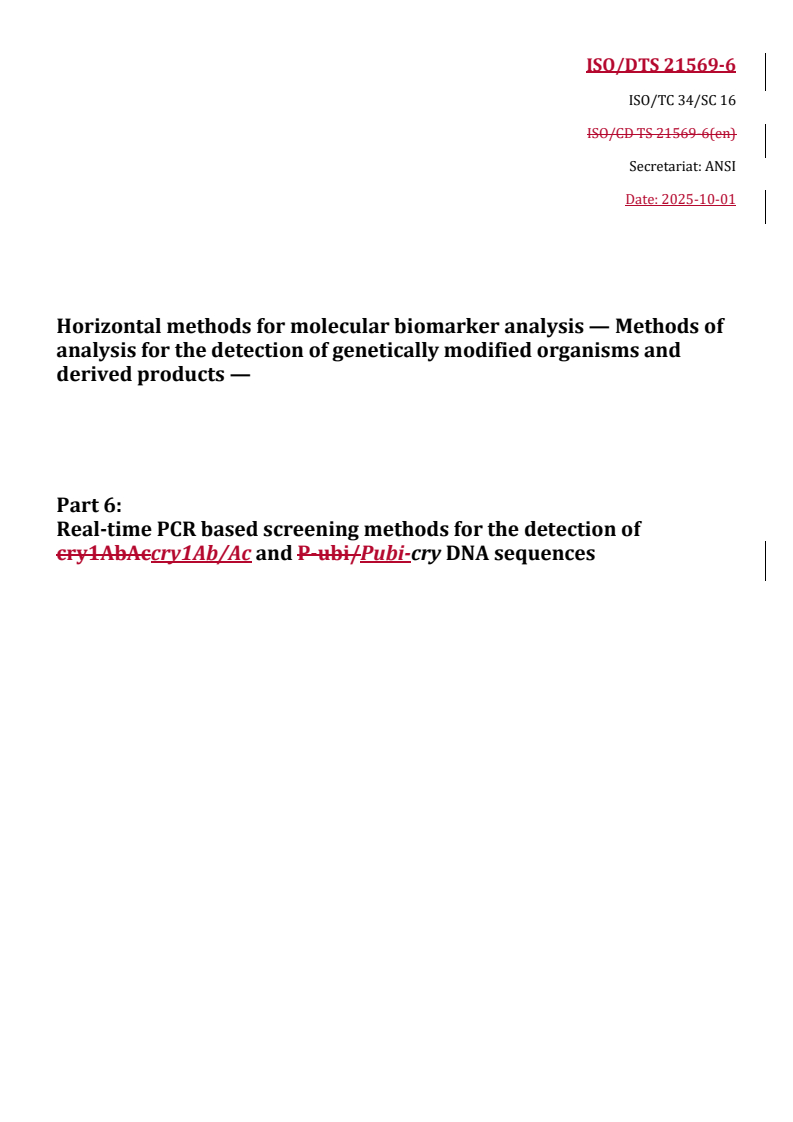
(Main)Horizontal methods for molecular biomarker analysis — Methods of analysis for the detection of genetically modified organisms and derived products — Part 6: Real-time PCR based screening methods for the detection of cry1Ab/Ac and Pubi-cry DNA sequences
Horizontal methods for molecular biomarker analysis — Methods of analysis for the detection of genetically modified organisms and derived products — Part 6: Real-time PCR based screening methods for the detection of cry1Ab/Ac and Pubi-cry DNA sequences
ISO/TS 21569-6:2016 specifies a procedure for the detection of a DNA sequence of the modified cry1Ab/Ac gene and a procedure for the detection of the DNA transition sequence between the maize ubiquitin promoter (Pubi) and the cry1Ab/Ac gene. The modified cry1Ab/Ac gene and the Pubi-cry construct are frequently found in genetically modified Bt plants. Both detection methods are based on real-time PCR and can be used for qualitative screening purposes. For identification and quantification of a specific genetically modified plant (event) a follow-up analysis has to be carried out. ISO/TS 21569-6:2016 is applicable for the analysis of DNA extracted from foodstuffs. It may also be suitable for the analysis of DNA extracted from other products such as feedstuffs and seeds. The application of these methods requires the extraction of an adequate amount of amplifiable DNA from the relevant matrix.
Méthodes horizontales d’analyse de biomarqueurs moléculaires — Méthodes d’analyse pour la détection des organismes génétiquement modifiés et des produits dérivés — Partie 6: Méthodes de criblage par PCR en temps réel pour la détection des séquences ADN cry1Ab/Ac et Pubi-cry
L'ISO/TS 21569-6:2016 spécifie une méthode de détection d'une séquence d'ADN du gène cry1Ab/Ac modifié et une méthode de détection de la séquence d'ADN de transition entre le promoteur de l'ubiquitine du maïs (Pubi) et le gène cry1Ab/Ac. Le gène cry1Ab/Ac modifié et le construit Pubi-cry sont fréquemment observés dans les plantes génétiquement modifiées contenant le gène Bt. Les deux méthodes sont basées sur une méthode par PCR en temps réel et peuvent être utilisées à des fins de criblage qualitatif. Pour l'identification et la quantification d'une plante génétiquement modifiée (événement) spécifique, une analyse complémentaire doit être effectuée. L'ISO/TS 21569-6:2016 est applicable à l'analyse de l'ADN extrait de produits alimentaires. Il peut être également utilisé pour analyser l'ADN extrait d'autres produits tels que des aliments pour animaux et des semences. L'application de ces méthodes exige qu'une quantité adéquate d'ADN amplifiable soit extraite de la matrice étudiée.
General Information
- Status
- Not Published
- Technical Committee
- ISO/TC 34/SC 16 - Horizontal methods for molecular biomarker analysis
- Drafting Committee
- ISO/TC 34/SC 16 - Horizontal methods for molecular biomarker analysis
- Current Stage
- 6000 - International Standard under publication
- Start Date
- 12-Dec-2025
- Completion Date
- 24-Jan-2026
Relations
- Effective Date
- 08-Jul-2024
Overview
ISO/TS 21569-6 (part of the ISO 21569 series) specifies real-time PCR based screening methods for detecting the modified cry1Ab/Ac gene and the Pubi‑cry junction commonly found in genetically modified (GM) Bt maize. Intended primarily for qualitative screening of DNA extracted from foodstuffs, the standard describes protocols, reagents, instrumentation and acceptance criteria to reliably detect these molecular biomarkers. For event‑level identification or quantification, follow‑up analyses are required.
Keywords: ISO/TS 21569-6, real-time PCR, cry1Ab/Ac, Pubi-cry, GMO detection, Bt plants, screening methods, DNA extraction.
Key topics and technical requirements
- Scope: Detection of the modified cry1Ab/Ac gene sequence and the maize ubiquitin promoter–cry1Ab/Ac transition (Pubi‑cry) using real‑time PCR for qualitative screening.
- Sample material: DNA extracted from foodstuffs; methods may also be suitable for feedstuffs and seeds. Extraction must yield an adequate amount of amplifiable DNA (see ISO 21571).
- Assay format:
- Reaction volume: 25 µl (typical method described).
- Sample input: 5 µl DNA (up to 200 ng).
- Thermal profile used in validation: Initial denaturation 95 °C 10 min; 45 cycles of 94 °C 15 s and 60 °C 60 s with fluorescence measurement during annealing/extension.
- Reagents and oligonucleotides: Specifies thermostable polymerase, buffer (MgCl2, dNTPs), and defined primer/probe sets (FAM/NFQ probes) for cry1Ab/Ac and Pubi‑cry detection. Equivalent reagents may be used if validated to give equal or better results.
- Equipment: A real‑time PCR instrument capable of fluorescent excitation/detection is required.
- Controls and criteria:
- Verification of DNA amplifiability (taxon‑specific PCR) before screening.
- Use of extraction blank, positive control and inhibition controls where needed.
- Interpretation based on sigmoid amplification curves and cycle threshold (Cq/Ct) values; accept/reject rules defined in the standard.
- Performance and validation: Sections cover robustness, collaborative trial data, sensitivity and specificity requirements.
Applications and users
- Laboratories performing GMO screening of food products, regulatory testing, quality control, and surveillance.
- Food testing labs, contract analytical service providers, feed/seed testing facilities, and research laboratories focused on Bt GMOs.
- Use cases: rapid qualitative screening to indicate presence/absence of cry1Ab/Ac or Pubi‑cry sequences prior to confirmatory event‑specific testing or quantification.
Related standards
- ISO 21569 (series) - horizontal methods for GMO detection
- ISO 21571 - nucleic acid extraction
- ISO 21570 - quantitative nucleic acid methods
- ISO 24276 - general requirements and definitions for GMO analysis
- ISO 16577 - molecular biomarker analysis vocabulary
This document provides a validated, harmonized screening workflow for laboratories needing standardized, reproducible real‑time PCR detection of cry1Ab/Ac and Pubi‑cry sequences in food and related matrices.
ISO/DTS 21569-6 - Horizontal methods for molecular biomarker analysis — Methods of analysis for the detection of genetically modified organisms and derived products — Part 6: Real-time PCR based screening methods for the detection of cry1Ab/Ac and Pubi-cry DNA sequences Released:10/2/2025
REDLINE ISO/DTS 21569-6 - Horizontal methods for molecular biomarker analysis — Methods of analysis for the detection of genetically modified organisms and derived products — Part 6: Real-time PCR based screening methods for the detection of cry1Ab/Ac and Pubi-cry DNA sequences Released:10/2/2025
Get Certified
Connect with accredited certification bodies for this standard

BSI Group
BSI (British Standards Institution) is the business standards company that helps organizations make excellence a habit.

Bureau Veritas
Bureau Veritas is a world leader in laboratory testing, inspection and certification services.

DNV
DNV is an independent assurance and risk management provider.
Sponsored listings
Frequently Asked Questions
ISO/TS 21569-6 is a draft published by the International Organization for Standardization (ISO). Its full title is "Horizontal methods for molecular biomarker analysis — Methods of analysis for the detection of genetically modified organisms and derived products — Part 6: Real-time PCR based screening methods for the detection of cry1Ab/Ac and Pubi-cry DNA sequences". This standard covers: ISO/TS 21569-6:2016 specifies a procedure for the detection of a DNA sequence of the modified cry1Ab/Ac gene and a procedure for the detection of the DNA transition sequence between the maize ubiquitin promoter (Pubi) and the cry1Ab/Ac gene. The modified cry1Ab/Ac gene and the Pubi-cry construct are frequently found in genetically modified Bt plants. Both detection methods are based on real-time PCR and can be used for qualitative screening purposes. For identification and quantification of a specific genetically modified plant (event) a follow-up analysis has to be carried out. ISO/TS 21569-6:2016 is applicable for the analysis of DNA extracted from foodstuffs. It may also be suitable for the analysis of DNA extracted from other products such as feedstuffs and seeds. The application of these methods requires the extraction of an adequate amount of amplifiable DNA from the relevant matrix.
ISO/TS 21569-6:2016 specifies a procedure for the detection of a DNA sequence of the modified cry1Ab/Ac gene and a procedure for the detection of the DNA transition sequence between the maize ubiquitin promoter (Pubi) and the cry1Ab/Ac gene. The modified cry1Ab/Ac gene and the Pubi-cry construct are frequently found in genetically modified Bt plants. Both detection methods are based on real-time PCR and can be used for qualitative screening purposes. For identification and quantification of a specific genetically modified plant (event) a follow-up analysis has to be carried out. ISO/TS 21569-6:2016 is applicable for the analysis of DNA extracted from foodstuffs. It may also be suitable for the analysis of DNA extracted from other products such as feedstuffs and seeds. The application of these methods requires the extraction of an adequate amount of amplifiable DNA from the relevant matrix.
ISO/TS 21569-6 is classified under the following ICS (International Classification for Standards) categories: 67.050 - General methods of tests and analysis for food products. The ICS classification helps identify the subject area and facilitates finding related standards.
ISO/TS 21569-6 has the following relationships with other standards: It is inter standard links to ISO/TS 21569-6:2016. Understanding these relationships helps ensure you are using the most current and applicable version of the standard.
ISO/TS 21569-6 is available in PDF format for immediate download after purchase. The document can be added to your cart and obtained through the secure checkout process. Digital delivery ensures instant access to the complete standard document.
Standards Content (Sample)
FINAL DRAFT
Technical
Specification
ISO/DTS 21569-6
ISO/TC 34/SC 16
Horizontal methods for molecular
Secretariat: ANSI
biomarker analysis — Methods
Voting begins on:
of analysis for the detection of
2025-10-16
genetically modified organisms and
Voting terminates on:
derived products —
2025-12-11
Part 6:
Real-time PCR based screening
methods for the detection of
cry1Ab/Ac and Pubi-cry DNA
sequences
RECIPIENTS OF THIS DRAFT ARE INVITED TO SUBMIT,
WITH THEIR COMMENTS, NOTIFICATION OF ANY
RELEVANT PATENT RIGHTS OF WHICH THEY ARE AWARE
AND TO PROVIDE SUPPOR TING DOCUMENTATION.
IN ADDITION TO THEIR EVALUATION AS
BEING ACCEPTABLE FOR INDUSTRIAL, TECHNO-
LOGICAL, COMMERCIAL AND USER PURPOSES, DRAFT
INTERNATIONAL STANDARDS MAY ON OCCASION HAVE
TO BE CONSIDERED IN THE LIGHT OF THEIR POTENTIAL
TO BECOME STAN DARDS TO WHICH REFERENCE MAY BE
MADE IN NATIONAL REGULATIONS.
Reference number
ISO/DTS 21569-6:2025(en) © ISO 2025
FINAL DRAFT
ISO/DTS 21569-6:2025(en)
Technical
Specification
ISO/DTS 21569-6
ISO/TC 34/SC 16
Horizontal methods for molecular
Secretariat: ANSI
biomarker analysis — Methods
Voting begins on:
of analysis for the detection of
genetically modified organisms and
Voting terminates on:
derived products —
Part 6:
Real-time PCR based screening
methods for the detection of
cry1Ab/Ac and Pubi-cry DNA
sequences
RECIPIENTS OF THIS DRAFT ARE INVITED TO SUBMIT,
WITH THEIR COMMENTS, NOTIFICATION OF ANY
RELEVANT PATENT RIGHTS OF WHICH THEY ARE AWARE
AND TO PROVIDE SUPPOR TING DOCUMENTATION.
© ISO 2025
IN ADDITION TO THEIR EVALUATION AS
All rights reserved. Unless otherwise specified, or required in the context of its implementation, no part of this publication may
BEING ACCEPTABLE FOR INDUSTRIAL, TECHNO-
LOGICAL, COMMERCIAL AND USER PURPOSES, DRAFT
be reproduced or utilized otherwise in any form or by any means, electronic or mechanical, including photocopying, or posting on
INTERNATIONAL STANDARDS MAY ON OCCASION HAVE
the internet or an intranet, without prior written permission. Permission can be requested from either ISO at the address below
TO BE CONSIDERED IN THE LIGHT OF THEIR POTENTIAL
or ISO’s member body in the country of the requester.
TO BECOME STAN DARDS TO WHICH REFERENCE MAY BE
MADE IN NATIONAL REGULATIONS.
ISO copyright office
CP 401 • Ch. de Blandonnet 8
CH-1214 Vernier, Geneva
Phone: +41 22 749 01 11
Email: copyright@iso.org
Website: www.iso.org
Published in Switzerland Reference number
ISO/DTS 21569-6:2025(en) © ISO 2025
ii
ISO/DTS 21569-6:2025(en)
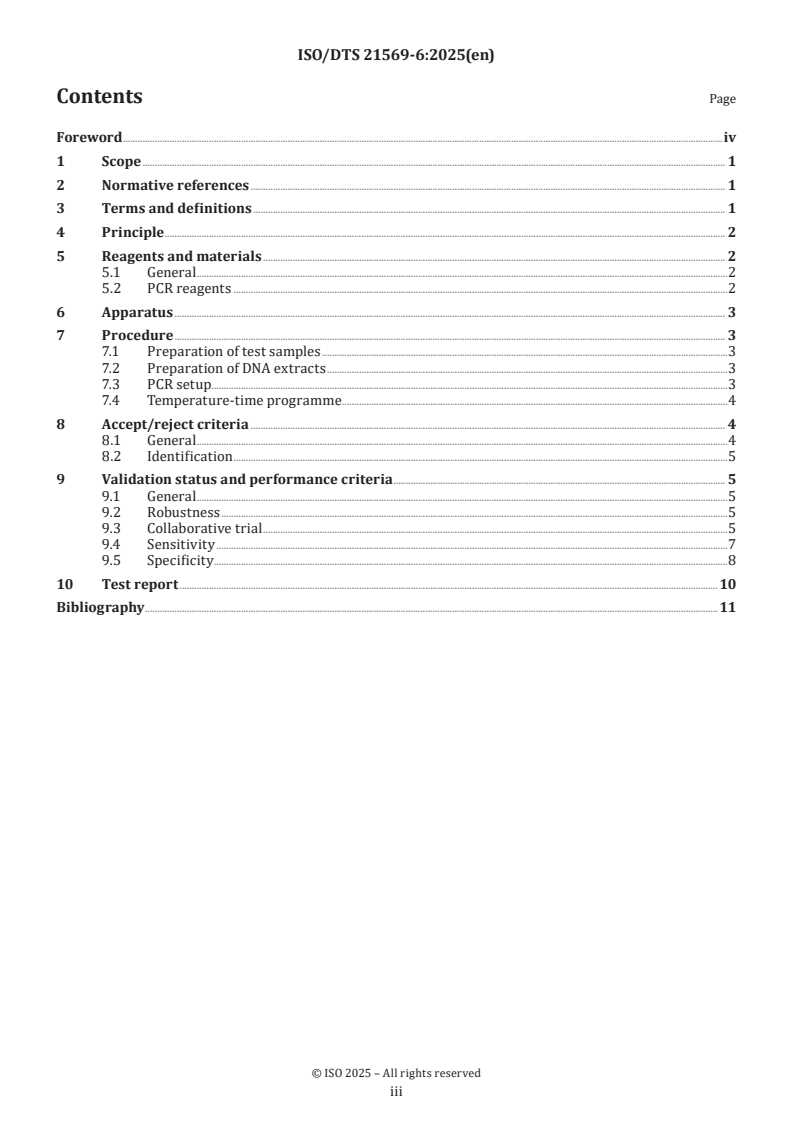
Contents Page
Foreword .iv
1 Scope . 1
2 Normative references . 1
3 Terms and definitions . 1
4 Principle . 2
5 Reagents and materials . 2
5.1 General .2
5.2 PCR reagents .2
6 Apparatus . 3
7 Procedure . 3
7.1 Preparation of test samples .3
7.2 Preparation of DNA extracts .3
7.3 PCR setup.3
7.4 Temperature-time programme.4
8 Accept/reject criteria . 4
8.1 General .4
8.2 Identification .5
9 Validation status and performance criteria . 5
9.1 General .5
9.2 Robustness .5
9.3 Collaborative trial .5
9.4 Sensitivity .7
9.5 Specificity .8
10 Test report . 10
Bibliography .11
iii
ISO/DTS 21569-6:2025(en)
Foreword
ISO (the International Organization for Standardization) is a worldwide federation of national standards
bodies (ISO member bodies). The work of preparing International Standards is normally carried out through
ISO technical committees. Each member body interested in a subject for which a technical committee
has been established has the right to be represented on that committee. International organizations,
governmental and non-governmental, in liaison with ISO, also take part in the work. ISO collaborates closely
with the International Electrotechnical Commission (IEC) on all matters of electrotechnical standardization.
The procedures used to develop this document and those intended for its further maintenance are described
in the ISO/IEC Directives, Part 1. In particular, the different approval criteria needed for the different types
of ISO document should be noted. This document was drafted in accordance with the editorial rules of the
ISO/IEC Directives, Part 2 (see www.iso.org/directives).
ISO draws attention to the possibility that the implementation of this document may involve the use of (a)
patent(s). ISO takes no position concerning the evidence, validity or applicability of any claimed patent
rights in respect thereof. As of the date of publication of this document, ISO had not received notice of (a)
patent(s) which may be required to implement this document. However, implementers are cautioned that
this may not represent the latest information, which may be obtained from the patent database available at
www.iso.org/patents. ISO shall not be held responsible for identifying any or all such patent rights.
Any trade name used in this document is information given for the convenience of users and does not
constitute an endorsement.
For an explanation of the voluntary nature of standards, the meaning of ISO specific terms and expressions
related to conformity assessment, as well as information about ISO’s adherence to the World Trade
Organization (WTO) principles in the Technical Barriers to Trade (TBT), see www.iso.org/iso/foreword.html.
This document was prepared by Technical Committee ISO/TC 34, Food products, Subcommittee SC 16,
Horizontal methods for molecular biomarker analysis.
This second edition cancels and replaces the first edition (ISO 21569-6:2016), which has been technically
revised.
The main changes are as follows:
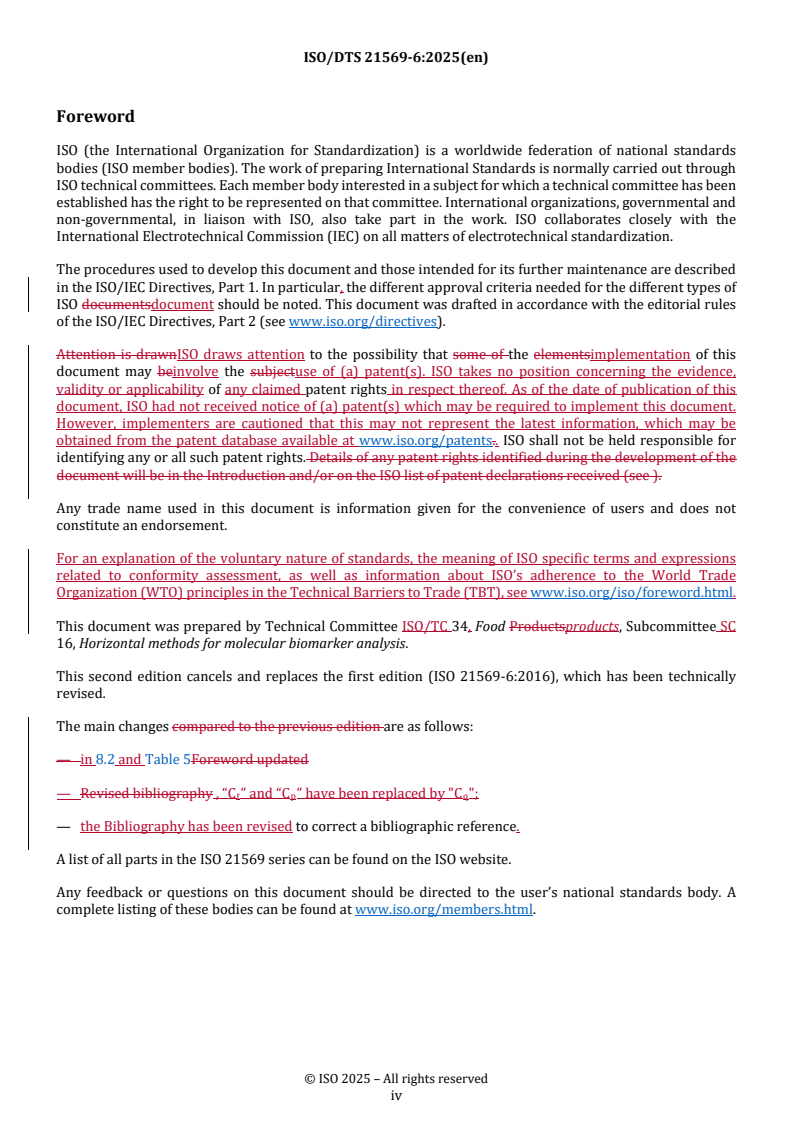
— in 8.2 and Table 5 , “C ” and “C ” have been replaced by "C ";
t p q
— the Bibliography has been revised to correct a bibliographic reference.
A list of all parts in the ISO 21569 series can be found on the ISO website.
Any feedback or questions on this document should be directed to the user’s national standards body. A
complete listing of these bodies can be found at www.iso.org/members.html.
iv
FINAL DRAFT Technical Specification ISO/DTS 21569-6:2025(en)
Horizontal methods for molecular biomarker analysis —
Methods of analysis for the detection of genetically modified
organisms and derived products —
Part 6:
Real-time PCR based screening methods for the detection of
cry1Ab/Ac and Pubi-cry DNA sequences
1 Scope
This document specifies a procedure for the detection of a DNA sequence of the modified cry1Ab/Ac gene
and a procedure for the detection of the DNA transition sequence between the maize ubiquitin promoter
(Pubi) and the cry1Ab/Ac gene. The modified cry1Ab/Ac gene and the Pubi-cry construct are frequently found
in genetically modified Bt plants. Both detection methods are based on real-time PCR and can be used for
qualitative screening purposes. For identification and quantification of a specific genetically modified plant
(event) a follow-up analysis has to be carried out.
This document is applicable to the analysis of DNA extracted from foodstuffs. It can also be suitable for
the analysis of DNA extracted from other products such as feedstuffs and seeds. The application of these
methods requires the extraction of an adequate amount of amplifiable DNA from the relevant matrix.
2 Normative references
The following documents are referred to in the text in such a way that some or all of their content constitutes
requirements of this document. For dated references, only the edition cited applies. For undated references,
the latest edition of the referenced document (including any amendments) applies.
ISO 16577, Molecular biomarker analysis — Vocabulary for molecular biomarker analytical methods in
agriculture and food production
ISO 21569:2005, Foodstuffs — Methods of analysis for the detection of genetically modified organisms and
derived products — Qualitative nucleic acid based methods
ISO 21571, Foodstuffs — Methods of analysis for the detection of genetically modified organisms and derived
products — Nucleic acid extraction
ISO 24276:2006, Foodstuffs — Methods of analysis for the detection of genetically modified organisms and
derived products — General requirements and definitions
ISO 24276, Foodstuffs — Methods of analysis for the detection of genetically modified organisms and derived
products — General requirements and definitions
3 Terms and definitions
For the purposes of this document, the terms and definitions given in ISO 16577 apply.
ISO and IEC maintain terminology databases for use in standardization at the following addresses:
— ISO Online browsing platform: available at https:// www .iso .org/ obp
— IEC Electropedia: available at https:// www .electropedia .org/ —
ISO/DTS 21569-6:2025(en)
4 Principle
[1]
DNA is extracted from the test portion applying a suitable method (see ISO 21571:2005 ). The DNA analysis
consists of two parts:
a) verification of the amount and amplifiability of the extracted DNA, e.g. by means of a target taxon-
[2] [3]
specific real-time PCR (according to ISO 21570:2005 , see also Reference ;
[4] [5]
b) detection of the cry1Ab/Ac and/or the Pubi-cry DNA sequence in a real-time PCR, see References and .
5 Reagents and materials
5.1 General
For the purpose of this document, only chemicals and water of recognized analytical grade, appropriate
for molecular biology shall be used. Unless stated otherwise, solutions should be prepared by dissolving
the corresponding reagents in water and be autoclaved. For all operations requiring gloves, it should be
ensured that these are powder-free. The use of aerosol-protected pipette tips as protection against cross
contamination is recommended.
5.2 PCR reagents
5.2.1 Thermostable DNA polymerase (for hot-start PCR).
5.2.2 PCR buffer solution, containing magnesium chloride and deoxyribonucleoside triphosphates
(dNTPs).
Ready-to-use reagent mixtures or mixes of individual components can be used. Reagents and polymerases
which lead to equal or better results may also be used.
5.2.3 Oligonucleotides (see Table 1 and Table 2).
Equivalent reporter dyes and/or quencher dyes may be used for the probe if they can be shown to yield
similar or better results.
Table 1 — Oligonucleotides for detection of cry1Ab/Ac
Final concentration
Name DNA sequence of the oligonucleotide
in the PCR
[4]
cry1Ab/Ac as target sequence :
Bt-F1(mod) 5ʹ-gAg gAA ATg CgT ATT CAA TTC AAC-3ʹ 400 nmol/l
Bt-R 5ʹ-TTC Tgg ACT gCg AAC AAT gg-3ʹ 400 nmol/l
Bt-P 5ʹ-(FAM)-ACA TgA ACA gCg CCT TgA CCA CAg C-(NFQ)-3ʹ 100 nmol/l
Key
FAM: 6-Carboxyfluorescein
NFQ: non-fluorescent quencher (dark quencher)
ISO/DTS 21569-6:2025(en)
Table 2 — Oligonucleotides for detection of Pubi-cry
Final concentration
Name DNA sequence of the oligonucleotide
in the PCR
[4]
Pubi-cry as target sequence :
Pubi-F2 5ʹ-ATT TgC TTg gTA CTg TTT CTT TTg TC-3ʹ 300 nmol/l
Cry-rr-R 5ʹ-TTg TTg TCC ATg gAT CCT CTA gAg T-3ʹ 600 nmol/l
a
Pubi-T2 5ʹ- (FAM)- ACC CTg TTg TTT ggT gTT ACT TCT gCA-(NFQ)-3ʹ 100 nmol/l
Key
FAM: 6-Carboxyfluorescein
NFQ: non-fluorescent quencher (dark quencher)
a [5]
The Pubi-T2 probe is three bases shorter than the probe described in Reference but identical specificity and sensitivity is
achieved.
6 Apparatus
Requirements concerning apparatus and materials shall be in accordance with ISO 21569:2005. In addition
to the usual laboratory equipment, the following equipment shall be used.
6.1 Real-time PCR device, suitable for the excitation of fluorescent molecules and the detection of
fluorescence signals generated during PCR.
7 Procedure
7.1 Preparation of test samples
It should be ensured that the test portion used for DNA extraction is representative of the laboratory
sample (e.g. by grinding or homogenizing of the samples). Measures and operational steps to be taken into
[1]
consideration should be as described in ISO ISO 21571:2005 and ISO 24276:2006.
7.2 Preparation of DNA extracts
Concerning the preparation of DNA from the test portion, the general instructions and measures described
in ISO 21571 shall be followed. It is recommended to choose one of the DNA extraction methods described in
[1]
ISO 21571:2005 , Annex A.
7.3 PCR setup
The method is described for a total volume of 25 μl per PCR. The reaction setup is given in Table 3.
Completely thaw reagents at room temperature. Each reagent should be carefully mixed and briefly
centrifuged immediately before pipetting. A PCR reagent mixture is prepared which contains all components
except for the sample DNA. The required amount of the PCR reagent mixture depends on the number of
reactions to be performed, including at least one additional reaction as a pipetting reserve. Add 5 µl of
sample DNA to each reaction.
ISO/DTS 21569-6:2025(en)
Table 3 — Reaction setup for the amplification
Description Set up
Total reaction volume 25 µl
Sample DNA (up to 200 ng) or controls 5 µl
a
PCR buffer solution (including MgCl , dNTP’s and hot-start DNA polymerase) 12,5 µl
Primers Bt-F1(mod) and Bt-R or primers Pubi-F2 and Cry-rr-R see Table 1 or Table 2
Probe Bt-P or probe Pubi-T2 see Table 1 or Table 2
Water add to obtain 25 µl
a TM
In the interlaboratory trial, TaqMan Universal PCR Mastermix (Life Technologies) was used as PCR buffer solution. This
information is given for convenience of users of this document and does not constitute an endorsement by ISO of the product
named. Equivalent products from other manufacturers may be used if they can be shown to give equivalent or better results. If
necessary, adapt the amounts of the reagents and the temperature-time programme.
Mix the PCR reagent mixture, centrifuge briefly and pipette 20 µl into each reaction vial. For
...
ISO/DTS 21569-6
ISO/TC 34/SC 16
ISO/CD TS 21569-6(en)
Secretariat: ANSI
Date: 2025-10-01
Horizontal methods for molecular biomarker analysis — Methods of
analysis for the detection of genetically modified organisms and
derived products —
Part 6:
Real-time PCR based screening methods for the detection of
cry1AbAccry1Ab/Ac and P-ubi/Pubi-cry DNA sequences
ISO/DTS 21569-6:2025(en)
All rights reserved. Unless otherwise specified, or required in the context of its implementation, no part of this publication
may be reproduced or utilized otherwise in any form or by any means, electronic or mechanical, including photocopying,
or posting on the internet or an intranet, without prior written permission. Permission can be requested from either ISO
at the address below or ISO’s member body in the country of the requester.
ISO copyright office
CP 401 • Ch. de Blandonnet 8
CH-1214 Vernier, Geneva
Phone: + 41 22 749 01 11
E-mail: copyright@iso.org
Website: www.iso.org
Published in Switzerland
ii
ISO/DTS 21569-6:2025(en)
Contents
Foreword . iv
1 Scope . 1
2 Normative references . 1
3 Terms and definitions . 1
4 Principle . 2
5 Reagents and materials . 2
5.1 General . 2
5.2 PCR reagents . 2
6 Apparatus . 3
7 Procedure . 4
7.1 Preparation of test samples . 4
7.2 Preparation of DNA extracts . 4
7.3 PCR setup . 4
7.4 Temperature-time programme . 4
8 Accept/reject criteria . 5
8.1 General . 5
8.2 Identification . 5
9 Validation status and performance criteria . 5
9.1 General . 5
9.2 Robustness . 6
9.3 Collaborative trial . 6
9.4 Sensitivity . 8
9.5 Specificity . 9
10 Test report . 11
Bibliography . 12
iii
ISO/DTS 21569-6:2025(en)
Foreword
ISO (the International Organization for Standardization) is a worldwide federation of national standards
bodies (ISO member bodies). The work of preparing International Standards is normally carried out through
ISO technical committees. Each member body interested in a subject for which a technical committee has been
established has the right to be represented on that committee. International organizations, governmental and
non-governmental, in liaison with ISO, also take part in the work. ISO collaborates closely with the
International Electrotechnical Commission (IEC) on all matters of electrotechnical standardization.
The procedures used to develop this document and those intended for its further maintenance are described
in the ISO/IEC Directives, Part 1. In particular, the different approval criteria needed for the different types of
ISO documentsdocument should be noted. This document was drafted in accordance with the editorial rules
of the ISO/IEC Directives, Part 2 (see www.iso.org/directives).
Attention is drawnISO draws attention to the possibility that some of the elementsimplementation of this
document may beinvolve the subjectuse of (a) patent(s). ISO takes no position concerning the evidence,
validity or applicability of any claimed patent rights in respect thereof. As of the date of publication of this
document, ISO had not received notice of (a) patent(s) which may be required to implement this document.
However, implementers are cautioned that this may not represent the latest information, which may be
obtained from the patent database available at www.iso.org/patents. ISO shall not be held responsible for
identifying any or all such patent rights. Details of any patent rights identified during the development of the
document will be in the Introduction and/or on the ISO list of patent declarations received (see ).
Any trade name used in this document is information given for the convenience of users and does not
constitute an endorsement.
For an explanation of the voluntary nature of standards, the meaning of ISO specific terms and expressions
related to conformity assessment, as well as information about ISO’s adherence to the World Trade
Organization (WTO) principles in the Technical Barriers to Trade (TBT), see www.iso.org/iso/foreword.html.
This document was prepared by Technical Committee ISO/TC 34, Food Productsproducts, Subcommittee SC
16, Horizontal methods for molecular biomarker analysis.
This second edition cancels and replaces the first edition (ISO 21569-6:2016), which has been technically
revised.
The main changes compared to the previous edition are as follows:
— in 8.2 and Table 5Foreword updated
— Revised bibliography , “C ” and “C ” have been replaced by "C ";
t p q
— the Bibliography has been revised to correct a bibliographic reference.
A list of all parts in the ISO 21569 series can be found on the ISO website.
Any feedback or questions on this document should be directed to the user’s national standards body. A
complete listing of these bodies can be found at www.iso.org/members.html.
iv
ISO/DTS 21569-6:2025(en)
Horizontal methods for molecular biomarker analysis — Methods of
analysis for the detection of genetically modified organisms and
derived products —
Part 6:
Real-time PCR based screening methods for the detection of
cry1AbAccry1Ab/Ac and P-ubi/Pubi-cry DNA sequences
1 Scope
This document specifies a procedure for the detection of a DNA sequence of the modified cry1Ab/Ac gene and
a procedure for the detection of the DNA transition sequence between the maize ubiquitin promoter (Pubi)
and the cry1Ab/Ac gene. The modified cry1Ab/Ac gene and the Pubi-cry construct are frequently found in
genetically modified Bt plants. Both detection methods are based on real-time PCR and can be used for
qualitative screening purposes. For identification and quantification of a specific genetically modified plant
(event) a follow-up analysis has to be carried out.
This document is applicable forto the analysis of DNA extracted from foodstuffs. It maycan also be suitable for
the analysis of DNA extracted from other products such as feedstuffs and seeds. The application of these
methods requires the extraction of an adequate amount of amplifiable DNA from the relevant matrix.
2 Normative references
The following documents are referred to in the text in such a way that some or all of their content constitutes
requirements of this document. For dated references, only the edition cited applies. For undated references,
the latest edition of the referenced document (including any amendments) applies.
ISO 16577, Molecular biomarker analysis — Vocabulary for molecular biomarker analytical methods in
agriculture and food production
ISO 21569:2005, Foodstuffs — Methods of analysis for the detection of genetically modified organisms and
derived products — Qualitative nucleic acid based methods
ISO 21570:2005, Foodstuffs — Methods of analysis for the detection of genetically modified organisms and
derived products — Quantitative nucleic acid based methods
ISO 21571:2005, Foodstuffs — Methods of analysis for the detection of genetically modified organisms and
derived products — Nucleic acid extraction
ISO 24276:2006, Foodstuffs — Methods of analysis for the detection of genetically modified organisms and
derived products — General requirements and definitions
ISO 24276, Foodstuffs — Methods of analysis for the detection of genetically modified organisms and derived
products — General requirements and definitions
3 Terms and definitions
For the purposes of this document, the terms and definitions given in ISO 16577 apply.
ISO and IEC maintain terminologicalterminology databases for use in standardization at the following
addresses:
ISO/DTS 21569-6:2025(en)
— IEC Electropedia: available at https://www.electropedia.org/
— ISO Online browsing platform: available at https://www.iso.org/obphttps://www.iso.org/obp
— IEC Electropedia: available at https://www.electropedia.org/
4 Principle
[1]
DNA is extracted from the test portion applying a suitable method (see ISO 21571:2005 ISO 21571:2005 ).).
The DNA analysis consists of two parts:
a) verification of the amount and amplifiability of the extracted DNA, e.g. by means of a target taxon-specific
[2] [13]
real-time PCR (according to ISO 21570:2005 ISO 21570:2005 ,, see also Reference ;
[4]
b) detection of the cry1Ab/Ac and/or the Pubi-cry DNA sequence in a real-time PCR, see References and
[35]
.
5 Reagents and materials
5.1 General
For the purpose of this document, only chemicals and water of recognized analytical grade, appropriate for
molecular biology shall be used. Unless stated otherwise, solutions should be prepared by dissolving the
corresponding reagents in water and be autoclaved. For all operations requiring gloves, it should be ensured
that these are powder-free. The use of aerosol-protected pipette tips as protection against cross
contamination is recommended.
5.2 PCR reagents
5.2.1 Thermostable DNA polymerase, (for hot-start PCR).
5.2.2 PCR buffer solution, containing magnesium chloride and deoxyribonucleoside triphosphates
(dNTPs).
Ready-to-use reagent mixtures or mixes of individual components can be used. Reagents and polymerases
which lead to equal or better results may also be used.
5.2.3 Oligonucleotides (see Table 1 and Table 2).
Table 1 — Oligonucleotides for detection of cry1Ab/Ac
Final concentration
Name DNA sequence of the oligonucleotide
in the PCR
[2]
cry1Ab/Ac as target sequence :
Bt-F1(mod) 5'-gAg gAA ATg CgT ATT CAA TTC AAC-3' 400 nmol/l
Bt-R 5'-TTC Tgg ACT gCg AAC AAT gg-3' 400 nmol/l
aa
Bt-P 5'-(FAM)-ACA TgA ACA gCg CCT TgA CCA CAg C-(NFQ)-3' 100 nmol/l
a
FAM: 6-Carboxyfluorescein, NFQ: non-fluorescent quencher (dark quencher).
ISO/DTS 21569-6:2025(en)
Table 2 — Oligonucleotides for detection of Pubi-cry
Final concentration
Name DNA sequence of the oligonucleotide
in the PCR
[2]
Pubi-cry as target sequence :
Pubi-F2 5'-ATT TgC TTg gTA CTg TTT CTT TTg TC-3' 300 nmol/l
Cry-rr-R 5'-TTg TTg TCC ATg gAT CCT CTA gAg T-3' 600 nmol/l
ab
Pubi-T2 5'- (FAM)- ACC CTg TTg TTT ggT gTT ACT TCT gCA-(NFQ)-3' 100 nmol/l
a
FAM: 6-Carboxyfluorescein, NFQ: non-fluorescent quencher (dark quencher).
b [3]
The Pubi-T2 probe is three bases shorter than the probe described in Reference but identical specificity and sensitivity is
achieved.
Equivalent reporter dyes and/or quencher dyes may be used for the probe if they can be shown to yield similar
or better results.
Table 1 — Oligonucleotides for detection of cry1Ab/Ac
Final concentration
Name DNA sequence of the oligonucleotide
in the PCR
[4]
cry1Ab/Ac as target sequence :
Bt-F1(mod) 5ʹ-gAg gAA ATg CgT ATT CAA TTC AAC-3ʹ 400 nmol/l
Bt-R 5ʹ-TTC Tgg ACT gCg AAC AAT gg-3ʹ 400 nmol/l
Bt-P 5ʹ-(FAM)-ACA TgA ACA gCg CCT TgA CCA CAg C-(NFQ)-3ʹ 100 nmol/l
Key
FAM: 6-Carboxyfluorescein
NFQ: non-fluorescent quencher (dark quencher)
Table 2 — Oligonucleotides for detection of Pubi-cry
Final concentration
Name DNA sequence of the oligonucleotide
in the PCR
[4]
Pubi-cry as target sequence :
Pubi-F2 5ʹ-ATT TgC TTg gTA CTg TTT CTT TTg TC-3ʹ 300 nmol/l
Cry-rr-R 5ʹ-TTg TTg TCC ATg gAT CCT CTA gAg T-3ʹ 600 nmol/l
a
Pubi-T2 5ʹ- (FAM)- ACC CTg TTg TTT ggT gTT ACT TCT gCA-(NFQ)-3ʹ 100 nmol/l
Key
FAM: 6-Carboxyfluorescein
NFQ: non-fluorescent quencher (dark quencher)
a [5]
The Pubi-T2 probe is three bases shorter than the probe described in Reference but identical specificity and sensitivity is
achieved.
6 Apparatus
Requirements concerning apparatus and materials shall be according toin accordance with ISO 21569:2005.
In addition to the usual laboratory equipment, the following equipment is requiredshall be used.
6.1 Real-time PCR device, suitable for the excitation of fluorescent molecules and the detection of
fluorescence signals generated during PCR.
ISO/DTS 21569-6:2025(en)
7 Procedure
7.1 Preparation of test samples
It should be ensured that the test portion used for DNA extraction is representative of the laboratory sample,
(e.g. by grinding or homogenizing of the samples.). Measures and operational steps to be taken into
[1]
consideration should be as described in ISO ISO 21571:2005 21571 and ISO 24276:2006.
7.2 Preparation of DNA extracts
Concerning the preparation of DNA from the test portion, the general instructions and measures described in
ISO 21571 shall be followed. It is recommended to choose one of the DNA extraction methods described in ISO
[1]
21571:2005 ISO 21571,, Annex A.
7.3 PCR setup
The method is described for a total volume of 25 μl per PCR. The reaction setup is given in Table 3.
Completely thaw reagents at room temperature. Each reagent should be carefully mixed and briefly
centrifuged immediately before pipetting. A PCR reagent mixture is prepared which contains all components
except for the sample DNA. The required amount of the PCR reagent mixture depends on the number of
reactions to be performed, including at least one additional reaction as a pipetting reserve. Add 5 µl of sample
DNA to each reaction.
Table 3 — Reaction setup for the amplification
Description Set up
Total reaction volume 25 µl
Sample DNA (up to 200 ng) or controls 5 µl
b a
PCR buffer solution solution (including MgCl , dNTP’s and hot-start DNA polymerase) 12,5 µl
Primers Bt-F1(mod) and Bt-R or primers Pubi-F2 and Cry-rr-R see Table 1 or Table 2
Probe Bt-P or probe Pubi-T2 see Table 1 or Table 2
Water add to obtain 25 µl
a
b TM
In the interlaboratory trial TaqMan®, TaqMan Universal PCR Mastermix (Life Technologies) was used as PCR buffer solution.
This information is given for convenience of users of this document and does not constitute an endorsement by ISO of the product
namesnamed. Equivalent products from other manufacturers may be used if they can be shown to give equivalent or better results.
If necessary, adapt the amounts of the reagents and the temperature-time programme.
Mix the PCR reagent mixture, centrifuge briefly and pipette 20 µl into each reaction vial. For the amplification
reagent control, add 5 µl of water into the respective reaction setup. Pipette either 5 µl of sample DNA or 5 µl
of the respective control solution (extraction blank control, positive DNA target control). If necessary, prepare
a PCR inhibition control as described in ISO 24276.
Transfer the reaction setups into the thermal cycler and start the temperature-time programme.
7.4 Temperature-time programme
The temperature-time programme as outlined in Table 4 has been used in the validation study. The use of
different reaction conditions and real-time PCR cyclers maycan require specific optimization. The time for
initial denaturation depends on the master mix used.
ISO/DTS 21569-6:2025(en)
Table 4 — Temperature-time programme
Step Parameter Temperature Time Fluorescence Cycles
measurement
1 Initial denaturation 95 °C 10 min no 1
Denatur
...
Questions, Comments and Discussion
Ask us and Technical Secretary will try to provide an answer. You can facilitate discussion about the standard in here.
Loading comments...