

ISO/TR 6037:2024
(Main)Automated liquid handling systems – Uncertainty of the measurement procedures
General Information
- Abstract
This document describes the measurement uncertainty analysis of the measurement procedures described in ISO 23783-2, following the approach described in ISO/IEC Guide 98-3. This document also includes the determination of other uncertainty components related to the liquid delivery process and the device under test (DUT) to estimate the overall measurement uncertainty of delivered volumes by an automated liquid handling system (ALHS).
- Status
- Published
- Publication Date
- 13-May-2024
- Technical Committee
- ISO/TC 48 - Laboratory equipment
- Drafting Committee
- ISO/TC 48 - Laboratory equipment
- Current Stage
- 6060 - International Standard published
- Start Date
- 14-May-2024
- Completion Date
- 14-May-2024


Overview
ISO/TR 6037:2024 provides a Technical Report for assessing the measurement uncertainty of volume delivery by automated liquid handling systems (ALHS). It adopts the ISO/IEC Guide 98-3 (GUM) approach and supports the measurement procedures described in ISO 23783-2. The report separates uncertainty into components associated with the measuring system, the device under test (ALHS), and the liquid delivery process and includes informative annexes for common volume measurement procedures.
Key topics and technical requirements
- GUM-based uncertainty workflow: defines the steps to model the measurand, estimate input quantities, calculate sensitivity coefficients, combine uncertainties, determine effective degrees of freedom and select a coverage factor k to obtain expanded uncertainty.
- Uncertainty component structure:
- Measuring system components (detailed per procedure in Annex A–C).
- ALHS-specific components (resolution, air cushion, system liquid effects, exchangeable tips, environmental and electrostatic effects).
- Liquid delivery process components (repeatability, reproducibility).
- Procedure-specific modelling: Annex A - dual‑dye ratiometric photometric; Annex B - gravimetric; Annex C - optical image analysis of droplets. Each annex gives guidance on estimating type A and type B uncertainties for that technique.
- Resolution uncertainty: includes an explicit expression for resolution-related standard uncertainty:
u(res) = Δres / √12 (where Δres is the volume selection resolution). - Optional thermal corrections: guidance on uncertainty from cubic expansion coefficients and how thermal effects (including air cushions) can influence uncertainty estimates.
- Practical calculation elements: covariance consideration between inputs, combined standard uncertainty of the mean volume, sensitivity coefficients, coverage factor selection and reporting expanded uncertainty. Examples and sample calculations are provided in Clause 13.
Practical applications - who uses this standard
- Calibration laboratories validating and calibrating ALHS performance and issuing uncertainty budgets.
- Manufacturers and R&D teams designing, qualifying and documenting ALHS performance claims.
- Quality assurance and regulatory teams in clinical, pharmaceutical and biotech labs requiring traceable uncertainty statements for volumetric workflows.
- Lab managers and method validation specialists using uncertainty estimates to evaluate assay robustness, liquid transfer accuracy and transfer reproducibility.
- Typical applications: routine calibration of pipetting robots, verification of dispensed volumes for high-throughput screening, method development for assay volume control, and conformity assessment against ISO 23783 series.
Related standards
- ISO 23783-1 (vocabulary and general requirements)
- ISO 23783-2 (measurement procedures for ALHS)
- ISO/IEC Guide 98-3 (GUM - expression of uncertainty)
- ISO/IEC Guide 99 (VIM - metrology vocabulary)
Keywords: ISO TR 6037, automated liquid handling systems, measurement uncertainty, ALHS calibration, volume measurement, gravimetric, photometric, uncertainty budget, GUM.
Get Certified
Connect with accredited certification bodies for this standard

ECOCERT
Organic and sustainability certification.

BSMI (Bureau of Standards, Metrology and Inspection)
Taiwan's standards and inspection authority.

Eurofins Food Testing Global
Global leader in food, environment, and pharmaceutical product testing.
Sponsored listings
Frequently Asked Questions
ISO/TR 6037:2024 is a technical report published by the International Organization for Standardization (ISO). Its full title is "Automated liquid handling systems – Uncertainty of the measurement procedures". This standard covers: This document describes the measurement uncertainty analysis of the measurement procedures described in ISO 23783-2, following the approach described in ISO/IEC Guide 98-3. This document also includes the determination of other uncertainty components related to the liquid delivery process and the device under test (DUT) to estimate the overall measurement uncertainty of delivered volumes by an automated liquid handling system (ALHS).
This document describes the measurement uncertainty analysis of the measurement procedures described in ISO 23783-2, following the approach described in ISO/IEC Guide 98-3. This document also includes the determination of other uncertainty components related to the liquid delivery process and the device under test (DUT) to estimate the overall measurement uncertainty of delivered volumes by an automated liquid handling system (ALHS).
ISO/TR 6037:2024 is classified under the following ICS (International Classification for Standards) categories: 17.060 - Measurement of volume, mass, density, viscosity; 71.040.20 - Laboratory ware and related apparatus. The ICS classification helps identify the subject area and facilitates finding related standards.
ISO/TR 6037:2024 is available in PDF format for immediate download after purchase. The document can be added to your cart and obtained through the secure checkout process. Digital delivery ensures instant access to the complete standard document.
Standards Content (Sample)
Technical
Report
ISO/TR 6037
First edition
Automated liquid handling systems
2024-05
– Uncertainty of the measurement
procedures
Systèmes automatisés de manipulation de liquides – Incertitude
des modes opératoires de mesure
Reference number
© ISO 2024
All rights reserved. Unless otherwise specified, or required in the context of its implementation, no part of this publication may
be reproduced or utilized otherwise in any form or by any means, electronic or mechanical, including photocopying, or posting on
the internet or an intranet, without prior written permission. Permission can be requested from either ISO at the address below
or ISO’s member body in the country of the requester.
ISO copyright office
CP 401 • Ch. de Blandonnet 8
CH-1214 Vernier, Geneva
Phone: +41 22 749 01 11
Email: copyright@iso.org
Website: www.iso.org
Published in Switzerland
ii
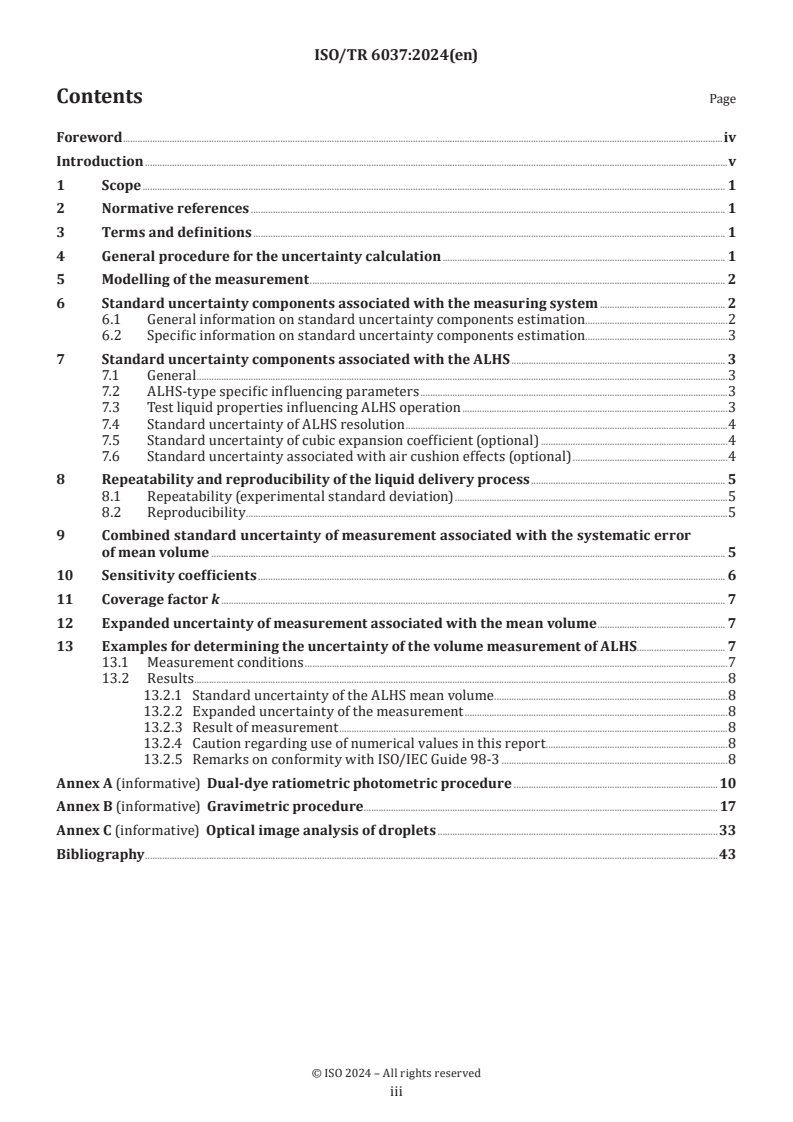
Contents Page
Foreword .iv
Introduction .v
1 Scope . 1
2 Normative references . 1
3 Terms and definitions . 1
4 General procedure for the uncertainty calculation . 1
5 Modelling of the measurement . 2
6 Standard uncertainty components associated with the measuring system . 2
6.1 General information on standard uncertainty components estimation.2
6.2 Specific information on standard uncertainty components estimation.3
7 Standard uncertainty components associated with the ALHS . 3
7.1 General .3
7.2 ALHS-type specific influencing parameters .3
7.3 Test liquid properties influencing ALHS operation .3
7.4 Standard uncertainty of ALHS resolution .4
7.5 Standard uncertainty of cubic expansion coefficient (optional) .4
7.6 Standard uncertainty associated with air cushion effects (optional) .4
8 Repeatability and reproducibility of the liquid delivery process . 5
8.1 Repeatability (experimental standard deviation) .5
8.2 Reproducibility .5
9 Combined standard uncertainty of measurement associated with the systematic error
of mean volume . 5
10 Sensitivity coefficients . 6
11 Coverage factor k . 7
12 Expanded uncertainty of measurement associated with the mean volume . 7
13 Examples for determining the uncertainty of the volume measurement of ALHS. 7
13.1 Measurement conditions .7
13.2 Results . .8
13.2.1 Standard uncertainty of the ALHS mean volume .8
13.2.2 Expanded uncertainty of the measurement .8
13.2.3 Result of measurement .8
13.2.4 Caution regarding use of numerical values in this report .8
13.2.5 Remarks on conformity with ISO/IEC Guide 98-3 .8
Annex A (informative) Dual-dye ratiometric photometric procedure .10
Annex B (informative) Gravimetric procedure . 17
Annex C (informative) Optical image analysis of droplets .33
Bibliography .43
iii
Foreword
ISO (the International Organization for Standardization) is a worldwide federation of national standards
bodies (ISO member bodies). The work of preparing International Standards is normally carried out through
ISO technical committees. Each member body interested in a subject for which a technical committee
has been established has the right to be represented on that committee. International organizations,
governmental and non-governmental, in liaison with ISO, also take part in the work. ISO collaborates closely
with the International Electrotechnical Commission (IEC) on all matters of electrotechnical standardization.
The procedures used to develop this document and those intended for its further maintenance are described
in the ISO/IEC Directives, Part 1. In particular, the different approval criteria needed for the different types
of ISO document should be noted. This document was drafted in accordance with the editorial rules of the
ISO/IEC Directives, Part 2 (see www.iso.org/directives).
ISO draws attention to the possibility that the implementation of this document may involve the use of (a)
patent(s). ISO takes no position concerning the evidence, validity or applicability of any claimed patent
rights in respect thereof. As of the date of publication of this document, ISO had not received notice of (a)
patent(s) which may be required to implement this document. However, implementers are cautioned that
this may not represent the latest information, which may be obtained from the patent database available at
www.iso.org/patents. ISO shall not be held responsible for identifying any or all such patent rights.
Any trade name used in this document is information given for the convenience of users and does not
constitute an endorsement.
For an explanation of the voluntary nature of standards, the meaning of ISO specific terms and expressions
related to conformity assessment, as well as information about ISO's adherence to the World Trade
Organization (WTO) principles in the Technical Barriers to Trade (TBT), see www.iso.org/iso/foreword.html.
This document was prepared by Technical Committee ISO/TC 48, Laboratory Equipment.
Any feedback or questions on this document should be directed to the user’s national standards body. A
complete listing of these bodies can be found at www.iso.org/members.html.
iv
Introduction
The examples given in this document are informative and support the requirement found in the ISO 23783
series to perform an estimation of measurement uncertainty when calibrating automated liquid handling
systems (ALHS) according to the measurement procedures described in ISO 23783-2. The examples in this
document are based on the principles of ISO/IEC Guide 98-3.
v
Technical Report ISO/TR 6037:2024(en)
Automated liquid handling systems – Uncertainty of the
measurement procedures
1 Scope
This document describes the measurement uncertainty analysis of the measurement procedures described
in ISO 23783-2, following the approach described in ISO/IEC Guide 98-3.
This document also includes the determination of other uncertainty components related to the liquid
delivery process and the device under test (DUT) to estimate the overall measurement uncertainty of
delivered volumes by an automated liquid handling system (ALHS).
2 Normative references
ISO 23783-1, Automated liquid handling systems — Part 1: Vocabulary and general requirements
ISO/IEC Guide 98-3, Uncertainty of measurement — Part 3: Guide to the expression of uncertainty in
me a s ur ement (GUM: 1995)
ISO/IEC Guide 99, International vocabulary of metrology — Basic and general concepts and associated terms (VIM)
3 Terms and definitions
For the purposes of this document, the terms and definitions given in ISO 23783-1, ISO/IEC Guide 98-3, and
ISO/IEC Guide 99 apply.
ISO and IEC maintain terminology databases for use in standardization at the following addresses:
— ISO Online browsing platform: available at https:// www .iso .org/ obp
— IEC Electropedia: available at https:// www .electropedia .org/
4 General procedure for the uncertainty calculation
The evaluation of measurement uncertainty in this document follows the ISO/IEC Guide 98-3 “Guide to the
Expression of Uncertainty in Measurement (GUM).” The method has the following steps:
a) Expressing, in mathematical terms, the relationship between the measurand and its input quantities.
b) Determining the expected value of each input quantity.
c) Determining the standard uncertainty of each input quantity.
d) Determining the degree of freedom for each input quantity.
e) Determining all covariance between the input quantities.
f) Calculating the expected value for the measurand.
g) Calculating the sensitivity coefficient of each input quantity.
h) Calculating the combined standard uncertainty of the measurand.
i) Calculating the effective degrees of freedom of the combined standard uncertainty.
j) Choosing an appropriate coverage factor, k, to achieve the required confidence level.
k) Calculating the expanded uncertainty.
In this document, the uncertainty of the measurement procedure is separated in three different clauses:
— the uncertainty components associated with the measuring system, see Clause 6;
— the uncertainty components associated with the device under test (ALHS), see Clause 7;
— the uncertainty components associated with the liquid delivery process, see Clause 8.
5 Modelling of the measurement
Each measurement procedure has specific uncertainty components associated with the measuring system.
These uncertainty components are described in the respective annex for each procedure. See Annex A for
the dual-dye ratiometric photometric procedure, Annex B for the gravimetric procedure, and Annex C for
the optical image analysis of droplets.
6 Standard uncertainty components associated with the measuring system
6.1 General information on standard uncertainty components estimation
It is possible to experimentally estimate the standard uncertainty of measurement, u(x), for a quantity x, by
performing multiple measurements of x under repeatability conditions. This is called a type A evaluation
according to ISO/IEC Guide 98-3. The standard deviation of the obtained values is a measure of the
repeatability of the measurement. The standard uncertainty associated with x can be a standard deviation
based on previous experience (in the case where a single measurement of x is made), or the standard
deviation of the mean equal to stdev(x)/sqrt(n) (in the case where x is the average of n readings).
See ISO Guide 98-3:2008, 4.2 for more information on type A evaluation of standard uncertainty.
In addition to repeated measurements, the systematic component of the uncertainty of measurement for a
quantity x is estimated by other means. This is called a type B evaluation according to ISO/IEC Guide 98-3.
For example, one can obtain information for that estimation by considering the manufacturer’s specifications
of the ALHS (e.g., resolution, linearity, drift, temperature dependence).
Often the manufacturer’s specifications are given in the form of an interval covering the measurement value,
with no additional information regarding distribution or coverage. In those cases, the measurement can be
assumed to follow a uniform or rectangular distribution. This distribution is characterised by a constant
probability inside the interval while the probability outside the interval is zero.
The interval can be used in a type B evaluation to give the variance of x in the form shown in Formula (1):
()aa−
2 +−
ux()= (1)
where
u (x) is the variance of the variable x;
a and a give the upper and lower limits of the interval of the variable x.
+ −
The standard uncertainty, u(x), is given as the square root of the variance.
In addition to uniform rectangular, other distributions are also possible when performing type B evaluations.
See ISO/IEC Guide 98-3:2008, 4.3 for more information on type B evaluations of standard uncertainty.
6.2 Specific information on standard uncertainty components estimation
Specific information regarding standard uncertainty components particular to the dual-dye ratiometric
photometric, gravimetric, and optical volume measurement procedures is given in Annex A, Annex B and
Annex C, respectively.
7 Standard uncertainty components associated with the ALHS
7.1 General
Subclauses 7.2 and 7.3 describe uncertainty components, which can influence the operation and performance
of the ALHS. Depending on the specific type of ALHS and liquid used, additional uncertainty components can
be identified.
7.2 ALHS-type specific influencing parameters
The following parameters can impact the liquid delivery process, depending on the type of ALHS used:
— exchangeable components, e.g., type of tips and others (see ISO 23783-1:2022, 6.8);
— air cushion effects (if applicable, e.g., for air-displacement or liquid-filled piston-operated ALHS with an
air gap);
— system liquid effects:
— dissolved gases in the system liquid,
— internal dilution effect of the sample with system liquid,
— temperature sensitivity of the system liquid;
— environmental effects on the deck of the ALHS:
— rate of air flow,
— air temperature,
— relative humidity,
— barometric pressure;
— vibration effects;
— electrostatic effects.
7.3 Test liquid properties influencing ALHS operation
— surface tension;
— viscosity;
— density;
— content of dissolved gas in the test liquid (formation of micro-bubbles);
— vapor pressure;
— Weber number (contact-free dispensing), see Reference [1].
7.4 Standard uncertainty of ALHS resolution
The standard uncertainty related to the resolution can be determined according to Formula (2):
Δres
ur()es = (2)
where
u(res) is the standard uncertainty related to the resolution of the ALHS volume selection device;
Δres is the actual or estimated resolution of the volume selection device of the ALHS.
NOTE 1 The uncertainty related to the resolution of the ALHS is included in the uncertainty budget when the
measurements are dependent on the direct reading of the output volume. The uncertainty of the resolution is also
included when estimating the uncertainty of the systematic error e .
S
NOTE 2 The physical resolution of an ALHS is not necessarily the resolution displayed in the ALHS’ software. For
example, different syringe sizes can be mounted on the same stepper motor. The resolution of the stepper motor will
translate into various volume resolutions, depending on the size of the syringe mounted on the motor.
7.5 Standard uncertainty of cubic expansion coefficient (optional)
The correction of a measured volume at test temperature to a reference temperature is optional, see
ISO 23783-2:2022, Clause 7. If this correction is performed, this subclause applies.
The standard uncertainty related to the cubic expansion coefficient γ is dependent on knowledge of the
actual material of the artefact and on the source of the data, which provides an appropriate value. Data from
the literature or manufacturer can be used for the expansion coefficient, and this value would be expected
to have a relative standard uncertainty of 5 % to 10 % of the expansion coefficient, see Reference [2].
For devices with an air cushion, the thermal effects on the cubic expansion coefficient and the air cushion
are entangled and need to be considered in tandem or determined experimentally. The details of this
entanglement are beyond the scope of this document.
7.6 Standard uncertainty associated with air cushion effects (optional)
If applicable, the standard uncertainty related to the air cushion effect u(ΔV ) depends on the size of the
cush
air cushion that is related to the lifting height in the pipette tip and can be calculated according to
Formula (3), which is based on the information given in DKD-R 8-1:2011, 8.7, see Reference [3]:
uV()ΔΔ=×uV()pc +×uV()ΔΔhc +×uV()tc (3)
()
() ()
cush VpΔΔrV hVL Δt
r L
where
u(ΔV ) is the standard uncertainty related to the air cushion effect;
cush
u(VΔp) is the standard uncertainty attributed to air pressure variation during the tests;
u(VΔh ) is the standard uncertainty attributed to the humidity variation during the tests;
r
u(VΔt ) is the standard uncertainty caused by variation between the test liquid temperature, air tem-
L
perature and temperature of the ALHS under calibration;
c are the sensitivity coefficients related to each uncertainty component.
i
The variations of each parameter are determined experimentally during the test, and only apply to ALHS
which have an air cushion. Variations of these parameters are influenced by the size of the air cushion
relative to the volume of the aspirated test liquid, the test liquid’s vapor pressure, and whether the tip has
been pre-wetted or not.
The sensitivity coefficients c related to the air cushion effect from pressure, relative humidity and
i
temperature can be derived from DKD-R 8-1, see Reference [3].
8 Repeatability and reproducibility of the liquid delivery process
8.1 Repeatability (experimental standard deviation)
Annexes A, B and C allow the determination of the standard uncertainties associated with the respective
measurement procedure. To derive the standard uncertainty associated with the liquid delivery process, the
experimental standard deviation needs to be included. When the mean delivered volume is the measurand,
the standard deviation s is divided by the square root of the number of repeated measurements n, as shown
r
in Formula (4):
s
r
sV()= (4)
r
n
where
sV() is the standard deviation of the mean volume V ;
r
s is the repeatability standard deviation;
r
n is the number replicate measurements.
8.2 Reproducibility
The uncertainty related to the reproducibility of V (from one test of the ALHS to the next test) also needs to
be included. There are several methods to determine this uncertainty contribution:
a) A laboratory can perform experimental studies where the ALHS test is performed multiple times under
different reproducibility conditions (see also ISO 23783-1:2022, 3.40 “reproducibility” and
ISO 23783-3:2022, 5.3.2 “experiment”) and the reproducibility standard deviation of the measurement
result V is calculated, symbol s (V );
d
b) If no such information is available, a value for reproducibility of the selected volume can be provided
by ALHS manufacturers or third parties. As no further information on the variation of individual
measurements is taken into account, a rectangular distribution is suggested.
NOTE Sometimes, the value for reproducibility can be inferred from the declared “accuracy” or “systematic
error” of the ALHS. For example, an ALHS with a 5 % specification for accuracy (systematic error) can be used to
estimate the reproducibility as 2,9 % according to Formula (1).
The influence of environmental conditions on the reproducibility of ALHS performance can vary depending
on the type of ALHS used and needs to be determined experimentally.
9 Combined standard uncertainty of measurement associated with the systematic
error of mean volume
According to ISO/IEC Guide 98-3, when the errors of input quantities are uncorrelated, the variance
characterising the uncertainty of measurement can be written according to Formula (5):
22 2
uc=×ux() (5)
∑ i i
i
where:
u is the variance characterizing the uncertainty of measurement;
are the variances associated with each input quantity which contributes to the final result
ux()
i
(described by the model);
are the squares of the sensitivity coefficients giving the degree of influence of each individual
c
i
standard uncertainty.
The sensitivity coefficients can be determined by evaluating the partial derivatives of the measurement
equation, by numerical simulations, or by physical experiment. In the case of this technical report, it is
possible to obtain explicit functions for many sensitivity coefficients by evaluating the partial derivatives as
shown in Clause 10.
In this document, the uncertainty components are described in groups corresponding to Clauses 6, 7 and 8.
For the mean volume of a calibration or test, Formula (6) applies.
22 22
uV()=+uV() uV()+uV() (6)
MS ALHS LDP
where
is the variance characterising the uncertainty of the mean volume in a test or calibration;
uV()
is the variance characterising the uncertainty due to the measuring system;
uV()
MS
is the variance characterising the uncertainty due to the ALHS;
uV()
ALHS
is the variance characterising the uncertainty due to the liquid delivery process.
uV()
LDP
When reporting uncertainty of the mean delivered volume (n replicates), the two liquid delivery process
variances (see Clause 8) are combined as shown in Formula (7).
s
2 r 2
uV()=+sV() (7)
LDP d
n
where
s is the repeatability standard deviation;
r
is the variance of the mean volume due to the repeatability of the ALHS;
s
r
n
is the variance of the mean volume due to test process reproducibility.
sV()
d
10 Sensitivity coefficients
The sensitivity coefficients for the measurement procedure can be derived using any of the following
approaches:
a) from the mathematical model of the measurement;
b) experimentally from comparison studies;
c) derived and reported as relative values as percent of the measurand (e.g., EURAMET cg-18 for air
density, Reference [4]);
d) available from literature values;
e) numerical simulation.
Sensitivity coefficients specific to each type of measurement procedure (photometric, gravimetric and
optical) are given in Annex A, Annex B and Annex C, respectively.
11 Coverage factor k
In order to calculate an appropriate coverage factor k for a 95 % confidence level (see ISO/IEC Guide 98-3:2008,
Annex G), the effective degrees of freedom ν are estimated by means of the Welch-Satterthwaite equation
eff
as shown in Formula (8):
u
V
ν = (8)
eff
n
u
i
∑
ν
i
i=1
where
ν are the effective degrees of freedom for the measurement;
eff
u is the combined standard uncertainty of the measured volume;
V
u is the standard uncertainty of each component;
i
ν are the degrees of freedom of each component.
i
For 10 or more measurements, k can be calculated or k = 2 can be used if the individual standard uncertainty
values have a similar weight in the combined uncertainty. For less than 10 measurements, k is calculated.
12 Expanded uncertainty of measurement associated with the mean volume
The expanded uncertainty of the mean volume V is expressed according to Formula (9), where the standard
uncertainty is multiplied by the coverage factor k.
UV()=×uV() k (9)
where
UV() is the expanded uncertainty of the mean volume;
uV() is the standard uncertainty of the mean volume;
k is the coverage factor.
13 Examples for determining the uncertainty of the volume measurement of ALHS
13.1 Measurement conditions
When reporting measurement results and the associated uncertainty information, it is necessary to
understand and interpret the report. A comprehensive list of required and recommended information to be
included in the reports is found in ISO 23783-3:2022, Clause 6. The uncertainty related to the reproducibility
of V (see 8.2) also needs to be included.
For each example in this document, measurement conditions are described in appropriate sub-clauses
within the Annexes.
13.2 Results
13.2.1 Standard uncertainty of the ALHS mean volume
The standard uncertainty of the mean delivered volume is calculated according to Formula (10):
22 2
uV()=+uV() uV()+uV() (10)
MS ALHS LDP
13.2.2 Expanded uncertainty of the measurement
The expanded uncertainty of the measurement is calculated by multiplying the standard uncertainty of the
measurement by the coverage factor k, according to Formula (11). The numerical value of k is reported as
part of the result.
UV()=×uV() kk ()=x (11)
k
where x is the value of k used in the calculation of the expanded uncertainty of the mean volume.
k
NOTE 1 This expanded uncertainty is the measurement uncertainty of the calibration as described in
ISO 23783-3:2022, 6.1.3 a).
13.2.3 Result of measurement
The overall result of the measurement, including the expanded uncertainty of measurement, can be
expressed as shown in Formula (12).
VV=±UV() (kx= ) (12)
M k
V = 5,014 µl ± 0,012 µl (k = 2)
M
where V is the overall result of the measurement including the expanded uncertainty.
M
NOTE The numerical values are given for illustration only. The particular values for each example are given in
each Annex.
13.2.4 Caution regarding use of numerical values in this report
The numerical values of the quantity estimation, standard uncertainty, and sensitivity coefficients are
applicable to the specific situation described in each example and are often volume dependent. It is not
appropriate to use the values given in this technical report for other situations or volumes.
13.2.5 Remarks on conformity with ISO/IEC Guide 98-3
The term “random error” as used in the ISO 23783 series is equivalent to the term “experimental standard
deviation” used in ISO/IEC Guide 98-3.
There is no direct equivalent to “systematic error” e as used in the ISO 23783 series that is found within
S
ISO/IEC Guide 98-3.
NOTE 1 The term “instrumental bias” is found in ISO/IEC Guide 99 and is similar to “systematic error of
measurement” provided the ALHS is considered a liquid measuring instrument and care is taken regarding a positive
or negative numerical sign in the result.
To evaluate the uncertainty of the systematic error of measurement, a volume difference V can be defined,
D
as shown in Formula (13).
VV=−V (13)
DS
where
V
is the volume difference between the selected volume and the average of all delivered volumes;
D
V
is the selected volume, the volume intended to be delivered;
S
V is the average of all measured volumes.
The uncertainty of this volume difference V will include the uncertainty associated with the mean volume
D
V and possibly an uncertainty associated with the resolution or setting of the selected volume V (see 7.4).
S
The uncertainty of the “volume difference” uV() and the uncertainty of the “systematic error of
D
measurement” ue() are identical provided that the uncertainty intervals are symmetric, as is the case in
S
the examples of this document.
NOTE 2 The “systematic error” eV=−V used within the ISO 23783 series is reversed in sign compared to the
S S
volume difference V , the “measurement error”, and the “instrumental bias” as defined in ISO/IEC Guide 99.
D
Annex A
(informative)
Dual-dye ratiometric photometric procedure
A.1 Description of the measurement
Absorbance measurements are made in either 96-well or 384-well microplates using a microplate
absorbance reader. Typically, the wells of a 96-well microplate have a round cross-section, while those of
384-well microplates have a square-shaped cross section.
Absorbance per unit path length values of the Ponceau S test liquid and copper(II) chloride solutions are
determined in cuvettes with 10 mm optical path length using a reference grade spectrophotometer.
The Ponceau S test liquids used in this procedure contain the same concentration of CuCl as the CuCl
2 2
solution used as diluent.
The unknown volume of Ponceau S test liquid is delivered into the wells of a microplate. Depending on the
amount of Ponceau S test liquid, a non-quantitative amount of CuCl can be added to the well. The microplate
containing test liquid in its wells is placed on a plate shaker to mix the two liquids and level the meniscus in
each well. The microplate is then placed in the absorbance plate reader, and the absorbance at 520 nm and
730 nm is determined for each well. The volume of delivered Ponceau S test liquid is calculated according to
Formulae (A.1) to (A.4).
A.2 Modelling the measurement
The amount of test liquid delivered into one well of the microplate is calculated in three steps, according to
Formulae (A.1), (A.2) or (A.3), and (A.4).
a) The fill height of the well is equal to the optical path length of the absorbance measurement and is
calculated according to Formula (A.1).
A
l= (A.1)
a
b
where
l is the optical path length (fill height of the well);
A is the measured absorbance at 730 nm;
a is the absorbance per unit path length at 730 nm of the CuCl solution.
b 2
b) The well geometry of a round well in a microplate can be described by the shape of a truncated cone.
The liquid volume contained in such a round well is calculated according to Formula (A.2).
2 2
D tantθ an θ
Vl=×ππ×+ ××Dl ×+π××l (A.2)
W
42 3
where
V is the total liquid volume in the well;
W
D is the diameter of the well bottom;
θ is the side wall taper angle.
The well geometry of a square-shaped well in a microplate can be described by the shape of a truncated
square pyramid. The liquid volume contained in such a square-shaped well is calculated according to
Formula (A.3).
23 2
lw××()ww− lw×−()w
2 BT BT B
Vl=×w + + (A.3)
WB
h
3×h
where
w is the bottom width of the well;
B
w is the top width of the well;
T
h is the height of the well.
c) The volume of delivered Ponceau S test liquid is calculated according to Formula (A.4).
a A
b 520
VV=× × (A.4)
TW
a A
r 730
where
V is the volume of dispensed test liquid;
T
a is the absorbance per unit path length at 520 nm of the test liquid,
r
A is the measured absorbance at 520 nm.
For measurements in round wells forming truncated cones, Formulae (A.1), (A.2), and (A.4) contain six
input variables. Four of these inputs are absorbance values, and two are related to the well geometry in the
microplate.
For measurements in square-shaped wells, Formulae (A.1), (A.3), and (A.4) contain seven input variables.
Four of these inputs are absorbance values, and three are related to the well geometry in the microplate.
A.3 Standard uncertainty components associated with the input quantities to the
dual-dye ratiometric photometric procedure
A.3.1 Absorbance per unit path length of CuCl solution (a )
2 b
This solution is prepared according to ISO 23783-2:2022, B.3.4.2 and the absorbance per unit path length
will be approximately 0,61 AU/cm (0,061 AU/mm).
According to ISO 23783-2:2022, Table B.1, the spectrophotometer used to measure the absorbance per
unit path length has a minimum resolution of 0,000 1 AU, repeatability of 0,000 15 AU, and linearity of
0,000 25 AU. A cuvette of known path length is used, typically 10 mm. For this example, the uncertainty in
the knowledge of the cuvette path length is 0,005 mm.
Treating all these uncertainty sources as rectangular distributions, the combined relative standard
uncertainty of a is 0,002 89 AU/mm for the example given in Table A.1 of this Annex.
b
A.3.2 Absorbance per unit path length of Ponceau S test liquid (a )
r
Ponceau S test liquids are prepared according to ISO 23783-2:2022, B.3.4.3 and the absorbance per unit path
length will vary depending on which of the six test liquids are prepared. For this example, measurements at
1,0 µl, test liquid No. 5 is used, and the absorbance per unit path length will be approximately 185 AU/cm
(18,5 AU/mm).
The spectrophotometer used to measure this absorbance has the same resolution, repeatability and linearity
as described in A.3.1. The uncertainty of cuvette path length is also the same as in A.3.1. For measurements
of high absorbance, a dilution is prepared, with a relative standard uncertainty of 0,007 1 %.
Combining all these uncertainty sources, the relative standard uncertainty of a is 0,003 17 AU/mm for the
r
example given in Table A.1 of this Annex.
A.3.3 Measured absorbance at 520 nm (A )
Absorbance at 520 nm is measured using an absorbance microplate reader with the minimum performance
requirements of ISO 23783-2:2022, Table 4. Photometric resolution is 0,001 AU with trueness of 0,005 AU in
the range of 0 AU to 1,0 AU.
In this example, the measured absorbance at 520 nm is 0,593 AU with a standard uncertainty of 0,002 94 AU.
A.3.4 Measured absorbance at 730 nm (A )
Absorbance at 730 nm is measured using the same absorbance microplate reader described in A.3.3.
In this example, the measured absorbance at 730 nm is 0,369 AU with a standard uncertainty of 0,002 94 AU.
A.3.5 Uncertainty components of the geometric dimensions of microplate wells (D, ϴ)
Geometric dimensions of the microplates are needed so that the path length of a filled well can be used to calculate
the total volume in each well of the microplate. Geometric dimensions can be obtained from manufacturer’s
drawings, direct measurement of plates (e.g., by a coordinate measuring machine), or other means.
In this example, a 96-well microplate is used, and Formula (A.2) applies. The well diameter D and taper angle
ϴ each carry uncertainty.
In this example, the diameter D is 6,359 mm and the taper angle ϴ is 0,021 6 radians. The experimentally
determined uncertainty in D is 0,010 5 mm and the uncertainty in ϴ is 0,000 855 radians.
A.3.6 Other uncertainty components
The fill height l is calculated according to Formula (A.1) and the uncertainty in fill height is based on A
(see A.3.4.) and a (see A.3.1). Uncertainty in the fill height is included as part of the mathematical analysis of
b
the contribution from these two input variables (A and a ) and the sensitivity components in A.4, so there
730 b
is no need to include fill height as a row in Table A.1.
The natural constant π is found in Formula (A.2). In principle, the uncertainty of this constant is zero. In
practice, the uncertainty of π is limited by internal rounding within the calculator. With modern software,
the uncertainty contribution due to internal digital rounding is negligible.
A.4 Sensitivity coefficients
For the example provided in Table A.1, there are six input variables. Sensitivity of each input variable can be
expressed as a formula which is derived from an analysis of partial derivatives for the Formulae in A.2. The
variables found in these formulae are all described in A.2.
The sensitivity of the test volume to errors in A is given in Formula (A.5):
∂V V
TT
= (A.5)
∂A A
520 520
Formula (A.6) gives the sensitivity of the test volume to errors in the absorbance per unit path length of the
Ponceau S test liquid.
∂V −V
T T
= (A.6)
∂a a
r r
The sensitivity of the test volume to errors in A is given in Formula (A.7):
2 2
DA××tantθθan ×A
D
730 730
+ +
4 a
∂V V b a
TT b
=× −1 (A.7)
2 2
∂A A
DA××tantθθan ×A
730 730 D
730 730
+ +
442×a
3×a
b
b
Formula (A.8) gives the sensitivity of the test volume to errors in the absorbance per unit path length at
730 nm of the CuCl solution.
2 2 2
DA××tantθθan ×A
D
730 730
+ +
4 a
∂V V a
b
T T b
=× 1− (A.8)
2 2
∂a a
DDA××tantθθan ×A
b b D
730 730
+ +
4 2×a
b 3×a
b
Formulae (A.9) and (A.10) are sensitivities of the test volume to the bottom diameter D and taper angle θ of
microplates which form a truncated cone.
∂V A A ×tanθ
π
T 520 730
=× ×+D (A.9)
∂D 2 a a
rb
∂V A A 2××A tanθ
D
T 520 730 2 730
=πθ×××sec ×+ (A.10)
∂θ a a 2 3×a
rb b
NOTE The symbol sec refers to the trigonometric function secant which is the multiplicative inverse of the cosine.
A.5 Example for determining the uncertainty of the volume measurement of an ALHS
with the dual-dye ratiometric photometric procedure
A.5.1 Measurement conditions
The measurement conditions for this example are as follows:
— twelve-fold measurement of a selected volume V of 1 µl of test liquid (Ponceau S test liquid No. 5,
S
according to ISO 23783-2:2022, Annex B), delivered by a single-channel pipetting ALHS;
NOTE Twelve replicates were used in this test to fill one row of a 96-well microplate.
— spectrophotometer meeting the minimum requirements of ISO 23783-2:2022, Table B.1;
— absorbance microplate reader meeting the minimum requirements of ISO 23783-2:2022, Table 4;
— thermometer and other measuring instruments meeting the requirements of ISO 23783-2:2022, Table 5;
— mean volume: V = 1,060 µl;
— random error of measurement (standard deviation, n = 12): s = 0,025 9 µl;
r
— standard deviation of the mean sV =s 12 = 0,007 5 µl;
()
rr
— systematic error of measurement: e = V - V = +0,060 µl.
S S
The determination of the uncertainty for these conditions is given in Tables A.1 and A.2. Contributions from
the optional uncertainty components described in 7.5 and 7.6 are not included in this example.
Table A.1 — Measuring system standard uncertainty
Uncertainty Unit Sym- Estima- Distribu- Standard Sensitiv- Uncertainty Degrees Per-
component bol tion tion uncertain- ity contribution of free- cent
ty coeffi- dom contri-
µl
cient bution
%
-3 -1 -3
Absorbance AU/ a 0,061 normal 2,89×10 7,05×10 2,04×10 ∞ 8,9
b
per path CuCl mm
-3 -2 -4
Absorbance AU/ a 18,5 normal 3,17×10 5,73×10 1,82×10 ∞ 0,1
r
per path mm
Ponceau S
-3 -3
Absorbance at AU A 0,593 rectangular 2,94×10 1,79 5,26×10 ∞ 59,4
520 nm of mix-
ture in well
-3 -1 -4
Absorbance at AU A 0,369 rectangular 2,94×10 1,16×10 3,43×10 ∞ 0,3
730 nm of mix-
ture in well
-2 -1 -3
Well diameter mm D 6,359 normal 1,05×10 3,27×10 3,43×10 3 167 25,2
-4 -3
Taper angle radi- ϴ 0,021 6 normal 8,55×10 1,99 1,70×10 3 167 6,2
ans
-3
Measuring µl u 6,83×10 >10 000 100
MS
system stand-
ard uncer-
a
tainty
a
Measuring system standard uncertainty is the square root of a summation of all values in this table according to Formula (5).
Table A.2 — Combined standard uncertainty of the mean volume
Uncertainty Unit Symbol Distribution Standard Sensitivity Uncertainty Degrees Percent
component uncertainty coefficient contribution of free- contri-
dom bution
µl
%
-3 -3
Measuring sys- µl u normal 6,83×10 1 6,83×10 10 000 3
MS
tem standard
a
uncertainty
ALHS standard u see footnote b
ALHS
b
uncertainty
-3 -3
Experimental µl normal 7,48×10 1 7,48×10 11 3
s (V )
r
standard de-
viation of the
c
mean
-2 -2
Reproduci- µl normal 4,14×10 1 4,14×10 5 94
s (V )
d
bility of the
c
calibration
-2
Standard µl normal n/a n/a 4,26×10 6 100
u(V )
uncertainty
of the mean
delivered
volume
a
Measuring system standard uncertainty is taken from Table A.1.
b
Included in the reproducibility of the calibration s (V ). The reproducibility study was performed over the course of several
d
days and captured the uncertainty components described in Clause 7.
c
Standard deviation of the mean and reproducibility of the calibration are described in Clause 8. Values for both are from
unpublished experimental data provided by Artel. These components describe the standard uncertainty of the liquid delivery
-2
process, u , which has a value of 4,20×10 µl in this example [see also Formula (7)].
LDP
A.5.2 Results
A.5.2.1 Standard uncertainty of the ALHS mean volume
The standard uncertainty of the mean delivered volume is calculated according to Formula (10):
uV()= 0,042 6 μl
NOTE See Table A.2 for the source of the 0,042 6 µl value.
A.5.2.2 Expanded uncertainty of the measurement
The expanded uncertainty of the measurement is calculated by multiplying the standard uncertainty of the
measurement by the coverage factor k, a
...