


ISO/ASTM 52116:2013
(Main)Practice for dosimetry for a self-contained dry-storage gamma irradiator
Practice for dosimetry for a self-contained dry-storage gamma irradiator
ISO/ASTM 52116:2013 outlines dosimetric procedures to be followed with self-contained dry-storage gamma irradiators. For irradiators used for routine processing, procedures are given to ensure that product processed will receive absorbed doses within prescribed limits.
Pratique de la dosimétrie appliquée à un irradiateur gamma renfermant une source auto-protégée entreposée à sec
General Information
- Status
- Published
- Publication Date
- 21-Mar-2013
- Current Stage
- 9599 - Withdrawal of International Standard
- Start Date
- 04-Apr-2025
- Completion Date
- 12-Feb-2026
Relations
- Consolidated By
ISO 22442-1:2015 - Medical devices utilizing animal tissues and their derivatives — Part 1: Application of risk management - Effective Date
- 06-Jun-2022
- Revises
ISO/ASTM 52116:2002 - Practice for dosimetry for a self-contained dry-storage gamma-ray irradiator - Effective Date
- 06-Aug-2011
Overview
ISO/ASTM 52116:2013 - Practice for dosimetry for a self-contained dry‑storage gamma irradiator - provides dosimetric procedures and quality‑assurance practices for shielded, self‑contained gamma irradiators (typically using Cobalt‑60 or Cesium‑137 sources). The standard describes how to establish and maintain accurate absorbed‑dose delivery for routine processing and research applications so that products and samples receive doses within prescribed limits.
Key topics and technical requirements
- Scope and terminology: Defines terms relevant to irradiator dosimetry such as absorbed‑dose mapping, dose uniformity ratio, transit dose, and measurement management system.
- Radiation source characteristics: Covers sealed gamma sources (Co‑60 and Cs‑137). Notes photon energies (~1.17 & 1.33 MeV for Co‑60; ~0.662 MeV for Cs‑137) and that activity changes by radioactive decay.
- Dosimetry systems: Guidance on selecting and using dosimeters and reference‑standard systems (e.g., ionization chambers for reference dosimetry) and on minimizing measurement errors.
- Qualification and validation:
- Installation Qualification (IQ) - document equipment location, configuration, and calibration plans.
- Operational Qualification (OQ) - test equipment and instruments under expected operating conditions.
- Performance Qualification (PQ) - verify dose delivery to product geometries and routine loads.
- Dose mapping and uniformity: Procedures for mapping absorbed dose in the irradiation chamber and assessing dose uniformity and transit doses.
- Calibration and routine checks: Implement documented calibration schedules for timers, positioning systems, and dosimetry instruments; re‑test after any changes.
- Measurement uncertainty and recordkeeping: Address uncertainty estimation and maintain traceable records to support dose claims.
Practical applications
- Establishing validated dosimetry for research irradiations (biological samples, materials testing).
- Routine batch processing where reproducible absorbed doses are required (e.g., laboratory sterilization, radiation effects studies).
- Calibration and quality assurance of dosimetry systems used with self‑contained dry‑storage gamma irradiators.
Who should use this standard
- Radiation processing engineers and technicians
- Dosimetrists and metrology laboratories
- Facility managers of self‑contained gamma irradiators
- Regulatory and quality assurance personnel involved in radiation processing validation
Related standards
- ISO/ASTM Guide 51261 - calibration of routine dosimetry systems
- ASTM E2628 - Practice for Dosimetry in Radiation Processing
- ISO/ASTM 51900 / 51939 - dosimetry for food/agricultural products and blood irradiation
- ANSI/HPS N43.7 - safe design and use of self‑contained gamma irradiators
- JCGM 100 (GUM) - uncertainty of measurement
Keywords: ISO/ASTM 52116:2013, dosimetry, self‑contained dry‑storage gamma irradiator, Cobalt‑60, Cesium‑137, absorbed dose, dose mapping, calibration, IQ/OQ/PQ, measurement uncertainty.
Get Certified
Connect with accredited certification bodies for this standard

BSMI (Bureau of Standards, Metrology and Inspection)
Taiwan's standards and inspection authority.
Sponsored listings
Frequently Asked Questions
ISO/ASTM 52116:2013 is a standard published by the International Organization for Standardization (ISO). Its full title is "Practice for dosimetry for a self-contained dry-storage gamma irradiator". This standard covers: ISO/ASTM 52116:2013 outlines dosimetric procedures to be followed with self-contained dry-storage gamma irradiators. For irradiators used for routine processing, procedures are given to ensure that product processed will receive absorbed doses within prescribed limits.
ISO/ASTM 52116:2013 outlines dosimetric procedures to be followed with self-contained dry-storage gamma irradiators. For irradiators used for routine processing, procedures are given to ensure that product processed will receive absorbed doses within prescribed limits.
ISO/ASTM 52116:2013 is classified under the following ICS (International Classification for Standards) categories: 17.240 - Radiation measurements. The ICS classification helps identify the subject area and facilitates finding related standards.
ISO/ASTM 52116:2013 has the following relationships with other standards: It is inter standard links to ISO 22442-1:2015, ISO/ASTM 52116:2002. Understanding these relationships helps ensure you are using the most current and applicable version of the standard.
ISO/ASTM 52116:2013 is available in PDF format for immediate download after purchase. The document can be added to your cart and obtained through the secure checkout process. Digital delivery ensures instant access to the complete standard document.
Standards Content (Sample)
INTERNATIONAL ISO/ASTM
STANDARD 52116
Second edition
2013-04-15
Practice for dosimetry for a self-
contained dry-storage gamma irradiator
Pratique de la dosimétrie appliquée à un irradiateur gamma
renfermant une source auto-protégée entreposée à sec
Reference number
© ISO/ASTM International 2013
ISO/ASTM52116:2013(E)
PDF disclaimer
ThisPDFfilemaycontainembeddedtypefaces.InaccordancewithAdobe’slicensingpolicy,thisfilemaybeprintedorviewedbutshall
not be edited unless the typefaces which are embedded are licensed to and installed on the computer performing the editing. In
downloading this file, parties accept therein the responsibility of not infringing Adobe’s licensing policy. Neither the ISO Central
Secretariat nor ASTM International accepts any liability in this area.
Adobe is a trademark of Adobe Systems Incorporated.
Details of the software products used to create this PDF file can be found in the General Info relative to the file; the PDF-creation
parameters were optimized for printing. Every care has been taken to ensure that the file is suitable for use by ISO member bodies
and ASTM members. In the unlikely event that a problem relating to it is found, please inform the ISO Central Secretariat or ASTM
International at the addresses given below.
© ISO/ASTM International 2013
Allrightsreserved.Unlessotherwisespecified,nopartofthispublicationmaybereproducedorutilizedinanyformorbyanymeans,electronicormechanical,
including photocopying and microfilm, without permission in writing from either ISO at the address below or ISO’s member body in the country of the
requester. In the United States, such requests should be sent to ASTM International.
ISO copyright office ASTM International, 100 Barr Harbor Drive, PO Box C700,
Case postale 56 • CH-1211 Geneva 20 West Conshohocken, PA 19428-2959, USA
Tel. +41 22 749 01 11 Tel. +610 832 9634
Fax +41 22 749 09 47 Fax +610 832 9635
E-mail copyright@iso.org E-mail khooper@astm.org
Web www.iso.org Web www.astm.org
Published in the United States
ii © ISO/ASTM International 2013 – All rights reserved
ISO/ASTM52116:2013(E)
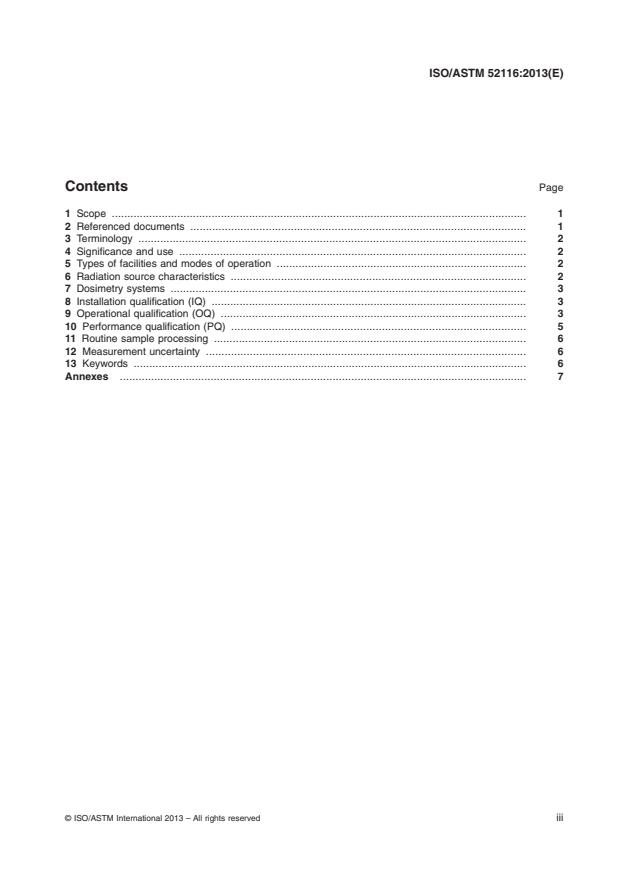
Contents Page
1 Scope . 1
2 Referenced documents . 1
3 Terminology . 2
4 Significance and use . 2
5 Types of facilities and modes of operation . 2
6 Radiation source characteristics . 2
7 Dosimetry systems . 3
8 Installation qualification (IQ) . 3
9 Operational qualification (OQ) . 3
10 Performance qualification (PQ) . 5
11 Routine sample processing . 6
12 Measurement uncertainty . 6
13 Keywords . 6
Annexes . 7
© ISO/ASTM International 2013 – All rights reserved iii
ISO/ASTM52116:2013(E)
Foreword
ISO(theInternationalOrganizationforStandardization)isaworldwidefederationofnationalstandardsbodies
(ISO member bodies). The work of preparing International Standards is normally carried out through ISO
technical committees. Each member body interested in a subject for which a technical committee has been
established has the right to be represented on that committee. International organizations, governmental and
non-governmental, in liaison with ISO, also take part in the work. ISO collaborates closely with the
International Electrotechnical Commission (IEC) on all matters of electrotechnical standardization.
Draft International Standards adopted by the technical committees are circulated to the member bodies for
voting. Publication as an International Standard requires approval by at least 75% of the member bodies
casting a vote.
ASTM International is one of the world’s largest voluntary standards development organizations with global
participation from affected stakeholders. ASTM technical committees follow rigorous due process balloting
procedures.
A pilot project between ISO and ASTM International has been formed to develop and maintain a group of
ISO/ASTM radiation processing dosimetry standards. Under this pilot project, ASTM Committee E61,
Radiation Processing, is responsible for the development and maintenance of these dosimetry standards with
unrestricted participation and input from appropriate ISO member bodies.
Attention is drawn to the possibility that some of the elements of this document may be the subject of patent
rights. Neither ISO nor ASTM International shall be held responsible for identifying any or all such patent
rights.
International Standard ISO/ASTM 52116 was developed by ASTM Committee E61, Radiation Processing,
through Subcommittee E61.04, Specialty Application, and by Technical Committee ISO/TC 85, Nuclear
energy, nuclear technologies and radiological protection.
iv © ISO/ASTM International 2013 – All rights reserved
An American National Standard
Standard Practice for
Dosimetry for a Self-Contained Dry-Storage Gamma
Irradiator
This standard is issued under the fixed designation ISO/ASTM 52116; the number immediately following the designation indicates the
year of original adoption or, in the case of revision, the year of last revision.
1. Scope 2. Referenced documents
1.1 This practice outlines dosimetric procedures to be fol- 2.1 ASTM Standards:
lowed with self-contained dry-storage gamma irradiators. For E170 TerminologyRelatingtoRadiationMeasurementsand
irradiators used for routine processing, procedures are given to Dosimetry
ensure that product processed will receive absorbed doses E1249 Practice for Minimizing Dosimetry Errors in Radia-
within prescribed limits. tion Hardness Testing of Silicon Electronic Devices Using
1.2 This practice covers dosimetry in the use of dry-storage Co-60 Sources
gamma irradiators, namely self-contained dry-storage Cs or E2628 Practice for Dosimetry in Radiation Processing
60Co irradiators (shielded freestanding irradiators). It does not E2701 Guide for Performance Characterization of Dosim-
cover underwater pool sources, panoramic gamma sources, nor eters and Dosimetry Systems for Use in Radiation Process-
does it cover self-contained bremsstrahlung X-ray units. ing
1.3 The absorbed-dose range for the use of the dry-storage 2.2 ISO/ASTM Standards:
self-contained gamma irradiators covered by this practice is 51261 Practice for Calibration of Routine Dosimetry Sys-
typically 1 to 10 Gy, depending on the application. The tems for Radiation Processing
–2 3
absorbed-dose rate range typically is from 10 to 10 Gy/min. 51539 Guide for Use of Radiation-Sensitive Indicators
1.4 For irradiators supplied for specific applications, spe- 51707 Guide for Estimating Uncertainties in Dosimetry for
cific ISO/ASTM or ASTM practices and guides provide Radiation Processing
dosimetric procedures for the application. For procedures 51900 Guide for Dosimetry in Radiation Research on Food
specific to dosimetry in blood irradiation, see ISO/ASTM and Agricultural Products
Practice 51939. For procedures specific to dosimetry in radia- 51939 Practice for Blood Irradiation Dosimetry
tionresearchonfoodandagriculturalproducts,seeISO/ASTM 51940 Guide for Dosimetry for Sterile Insects Release
Practice 51900. For procedures specific to radiation hardness Programs
testing, see ASTM Practice E1249. For procedures specific to 2.3 International Commission on Radiation Units and
the dosimetry in the irradiation of insects for sterile release Measurements (ICRU) Reports:
programs,seeISO/ASTMGuide51940.Inthosecasescovered ICRU 85a Fundamental Quantities and Units for Ionizing
by ISO/ASTM 51939, 51900, 51940, or ASTM E1249, those Radiation
standards take precedence. 2.4 ANSI Standards:
1.5 This document is one of a set of standards that provides ANSI/HPS N43.7 Safe Design and Use of Self-Contained,
recommendations for properly implementing and utilizing Dry Source Storage Gamma Irradiators (Category I)
dosimetry in radiation processing. It is intended to be read in 2.5 Joint Committee for Guides in Metrology (JCGM)
conjunction with ASTM E2628, “Practice for Dosimetry in Reports:
Radiation Processing”. JCGM 100:2008, GUM 1995 with minor corrections,
1.6 This standard does not purport to address all of the Evaluation of measurement data – Guide to the Expres-
safety concerns, if any, associated with its use. It is the sion of Uncertainty in Measurement
responsibility of the user of this standard to establish appro-
priate safety and health practices and determine the applica-
bility of regulatory limitations prior to use.
For referenced ASTM and ISO/ASTM standards, visit the ASTM website,
www.astm.org, or contact ASTM Customer Service at service@astm.org. For
Annual Book of ASTM Standards volume information, refer to the standard’s
This practice is under the jurisdiction of ASTM Committee E61 on Radiation Document Summary page on the ASTM website.
Processing and is the direct responsibility of Subcommittee E61.04 on Specialty International Commission on Radiation Units and Measurements (ICRU), 7910
Application, and is also under the jurisdiction of ISO/TC 85/WG 3. Woodmont Ave., Suite 800, Bethesda, MD 20810, U.S.A.
Current edition approved by Aug. 16, 2012. Published April 2013. Originally Available from the Health Physics Society, http://hps.org.
published as ASTM E 2116–00. Last previous edition ASTM E 2116–00. The Document produced by Working Group 1 of the Joint Committee for Guides in
presentInternationalStandardISO/ASTM52116:2013(E)replacesE2116-00andis Metrology (JCGM/WG 1). Available free of charge at the BIPM website (http://
a major revision of the last previous edition ISO/ASTM 52116:2002:(E). www.bipm.org).
© ISO/ASTM International 2013 – All rights reserved
ISO/ASTM52116:2013
JCGM 100:2008, VIM International vocabulary of metrol- system, for example, irradiator drawer, rotor, or irradiator
ogy – Basis and general concepts and associated terms turntable, as part of the irradiation device.
4.3 Self-contained dry-storage gamma irradiators can be
3. Terminology
used for many radiation processing applications, including the
3.1 Definitions: calibration irradiation of dosimeters; studies of dosimeter
3.1.1 absorbed-dose mapping—measurement of absorbed influence quantities; radiation effects studies, and irradiation of
dose within an irradiated product to produce a one-, two-, or materials or biological samples for process compatibility
three-dimensionaldistributionofabsorbeddose,thusrendering studies; batch irradiations of microbiological, botanical, or
a map of absorbed-dose values. in-vitro samples; irradiation of small animals; radiation “hard-
3.1.2 calibration—[VIM, 6.11] set of operations under ness” testing of electronics components and other materials;
specified conditions, which establishes the relationship be- and batch radiation processing of containers of samples.
tween values indicated by a measuring instrument or measur-
NOTE 1—Self-containeddry-storagegammairradiatorscontainasealed
ing system, and the corresponding values realised by standards
radiation source, or an array of sealed radiation sources securely held in a
traceable to a nationally or internationally recognised labora-
dry container constructed of solid materials. The sealed radiation sources
tory.
are shielded at all times, and human access to the chamber undergoing
irradiation is not physically possible due to the irradiator’s design
3.1.2.1 Discussion—Calibration conditions include envi-
configuration (see ANSI/HPS N43.7).
ronmental and irradiation conditions present during irradiation,
NOTE 2—For reference–standard dosimetry, the absorbed dose and
storageandmeasurementofthedosimetersthatareusedforthe
absorbed-dose rate can be expressed in water or other material which has
generation of a calibration curve. To achieve stable environ-
similarradiationabsorptionpropertiestothatofthesamplesordosimeters
mental conditions, it may be necessary to condition the
being irradiated. In some cases, the reference-standard dosimetry may be
dosimeters before performing the calibration procedure.
performed using ionization chambers, and may be calibrated in terms of
3.1.3 dose uniformity ratio—ratio of the maximum to the –1
exposure (C kg ), or absorbed dose to air, water or tissue (Gy).
minimum absorbed dose within the irradiated product.
Measurements performed in terms of exposure apply to ionization in air,
3.1.4 measurement management system—set of interrelated and care should be taken to apply that measurement to the sample being
irradiated.
or interacting elements necessary to achieve metrological
confirmation and continual control of measurement processes.
5. Types of facilities and modes of operation
3.1.5 transit dose—absorbed dose delivered to a product (or
a dosimeter) while it travels between the non-irradiation 5.1 Facility Types—Typical self-contained dry-storage
position and the irradiation position, or in the case of a gamma irradiators are illustrated in Annex A1. These irradia-
movable source while the source moves into and out of its tors house the radiation source(s) in a protective lead shield (or
irradiation position. other appropriate material), and usually have a sample posi-
3.2 Definitions of other terms used in this standard that tioning mechanism tied to an accurate calibrated reset timer to
pertain to radiation measurement and dosimetry may be found lowerorrotatethesampleholderfromtheload/unloadposition
in ASTM Terminology E170. Definitions in ASTM Terminol- to the irradiation position and back to the load/unload position.
ogy E170 are compatible with ICRU 85a; that document, Details on the calibration of dosimetry systems and dose
therefore, may be used as an alternative reference. mapping in such irradiators may be found, respectively in
ISO/ASTM Guide 51261 and in this practice. Details on the
4. Significance and use
designs of such irradiators and on safety considerations in the
4.1 The design and operation of a self-contained irradiator use of such irradiators may be found in ANSI/HPS N43.7.
should ensure that reproducible absorbed doses are obtained 5.2 Modes of Operation—Three common modes of opera-
when the same irradiation parameters are used. Dosimetry is
tion are described. This does not purport to include all modes
performedtodeterminetherelationshipbetweentheirradiation of operation.
parameters and the absorbed dose.
5.2.1 One method of use is to rotate the sample holder on an
4.1.1 For most applications, the absorbed dose is expressed
irradiator turntable in front of the source such that the only
as absorbed dose to water (see ISO/ASTM Practice 51261).
pointsthatremainafixeddistancefromthesourcearealongan
For conversion of absorbed dose to water to that to other
axis of rotation (ANSI/HPS N43.7).
materials, for example, silicon, see Annex A1 of ISO/ASTM
5.2.2 A second method is to distribute the source in an
Practice 51261.
annular array, resulting in a relatively uniform absorbed-dose
4.2 Self-contained dry-storage gamma irradiators contain
distribution. In this design, the irradiator turntable normally
properly shielded radioactive sources, namely Cs
would not be necessary.
or Co, that emit ionizing electromagnetic radiation (gamma
5.2.3 A third method is to use opposed sources with
radiation). These irradiators have an enclosed, accessible
appropriate beam flattening to obtain a uniform dose through-
irradiatorsamplechamberconnectedwithasamplepositioning
out the sample.
6. Radiation source characteristics
Document produced by Working Group 2 of the Joint Committee for Guides in
6.1 The radiation sources used in the irradiation devices
Metrology (JCGM/WG 2). Available free of charge at the BIPM website (http://
www.bipm.org). considered in this practice consist of sealed elements of Co
© ISO/ASTM International 2013 – All rights reserved
ISO/ASTM52116:2013
or Cs, which are typically linear rods or pencils arranged 8.2.2 A description of the location of the irradiator within
singly or in a planar array or cylindrical array. the operator’s premises,
6.2 Cobalt-60 emits photons with energies of approximately 8.2.3 Operating instructions and standard operating proce-
1.17 and 1.33 MeV in nearly equal proportions; cesium-137 dures for the irradiator and associated measurement instru-
emits photons with energies of approximately 0.662 MeV. ments,
60 137
6.3 The radioactive decay half-lives for Co and Cs are 8.2.4 Licensing and safety documents and procedures, in-
regularly reviewed and updated. The most recent publication cluding those required by regulatory and occupational health
by the National Institute of Standards and Technology gave and safety agencies,
values of 1925.20 (6 0.25) days for Co and 11018.3 (6 9.5) 8.2.5 A description of a calibration program to ensure that
137 137
days for Cs. In addition, the Cs radiation source may all processing equipment that may influence absorbed-dose
containradioimpuritieswhichshouldbequalifiedbythesource delivery is calibrated periodically (for example, the timer
manufacturer. mechanism),
60 137
6.4 For pure Co and Cs gamma sources, the only 8.2.6 Operating procedures and calibration procedures for
variation in the source strength is the known reduction in the associated measurement instruments or systems.
activity caused by radioactive decay. The reduction in the 8.3 Equipment Testing and Calibration—Test all processing
source strength and the required increase in the irradiation time equipment and instrumentation that may influence absorbed
to deliver the same dose may be calculated or obtained from dose in order to verify satisfactory operation of the irradiator
tables provided by the irradiator manufacturer. within the design specifications.
8.3.1 Implement a documented calibration program to en-
7. Dosimetry systems
sure that all processing equipment and instrumentation that
7.1 The basic requirements that apply when making ab-
may influence absorbed-dose delivery are calibrated periodi-
sorbed dose measurements are given in ASTM E2628. ASTM
cally.
E2628 also provides guidance on the selection of dosimetry
8.3.2 If any modification or change is made to the irradiator
systems and describes the classification of dosimeters based on
equipment or measurement instruments during the installation
two criteria. Users are directed to other standards that provide
qualification phase, they shall be re-tested.
specific information on individual dosimetry systems, calibra-
8.4 For self-contained irradiators, some IQ may begin prior
tion methods, and uncertainty estimation.
to the shipment of the irradiator to the customer’s site.
NOTE 3—The operation of a self-contained dry-storage irradiator,
9. Operational qualification (OQ)
absorbed-dose measurements made in the sample under controlled envi-
9.1 Objective—The purpose of operational qualification
ronmentalandgeometricalconditionsofcalibration,testing,orprocessing
provide an independent quality control record. (OQ) of an irradiation facility is to establish baseline data for
evaluating irradiator effectiveness, predictability, and repro-
8. Installation qualification (IQ)
ducibility for the range of conditions of operation for key
8.1 Objective—The purpose of an installation qualification
processing parameters that affect absorbed dose in the product.
(IQ) program is to obtain and document evidence that the
As part of this process, dosimetry may be performed to: (1)
irradiator and measurement instruments have been delivered
establish relationships between the absorbed dose for a repro-
and installed in accordance with their specifications. IQ in-
ducible geometry and the process parameters of the irradiator,
cludesdocumentationoftheirradiatorequipmentandmeasure-
(2) measure absorbed-dose distributions in product (dose
ment instruments; establishment of testing, operation and
mapping), (3) characterize absorbed dose variations when
calibration procedures for their use; and verification that the
irradiator and processing parameters fluctuate statistically
installed irradiator equipment and measurement instruments
through normal operations, and (4) measure the absorbed-dose
operate according to specification.
rate at a reference position within the holder filled with
product.
NOTE 4—Table A2.1 gives some recommended steps in the following
9.1.1 For self-contained irradiators, OQ may begin prior to
areas: installation qualification, operational qualification, performance
the shipment of the irradiator to the customer’s site.As part of
qualification, and routine product processing.
release-for-shipment criteria, the irradiator manufacturer may
8.2 Equipment Documentation—Establish and document an
perform absorbed-dose mapping to establish baseline data.
IQ program that includes descriptions of the instrumentation
After the unit is installed at the user’s site, OQ is performed as
and equipment installed at the facility. This documentation
part of the user’s quality assurance plan.
shall be retained for the life of the facility. At a minimum, it
9.2 Dosimetry Systems—Calibrate the routine dosimetry
shall include:
system to be used at the facility.
8.2.1 A description of the irradiator’s specifications, char-
9.3 Irradiator Characterization—The absorbed dose re-
acteristics and parameters, including any modifications made
ceived by any portion of product depends on the irradiator
during or after installation,
parameters (such as the source activity at the time of irradia-
tion,thegeometryofthesource,thesource-to-productdistance
Unterweger, M. P., Hoppes, D. D., Schima, F. J., and Coursey, J. S.,
and the irradiation geometry) and the processing parameters
“Radionuclide Half-Life Measurements,” National Institute of Standards and
(such as the irradiation time, the product composition and
Technology, available online at http://physics.nist.gov/Halflife (updated October 5,
2010). density and the loading configuration).
© ISO/ASTM International 2013 – All rights reserved
ISO/ASTM52116:2013
9.3.1 Absorbed-Dose Rate—A reference- or transfer- measuring the transit dose. Thus, it may be necessary to utilize
standard dosimetry system, traceable to nationally or interna- a different dosimetry system for measuring the transit dose.
tionally recognized standards, shall be used to measure the
9.3.4 Timer Setting Calculation—An important calculation
absorbed-dose rate within product or simulated product at a
in the use of gamma sources is the correction for radioactive
reference position (such as the center of the product or
decay. For a pure radionuclide source, the reduction in activity
simulated product volume). For a defined irradiation geometry,
with time is exponential. For an initial activity ofA (at time =
the absorbed-dose rate at the reference position should have a
0 which is usually specified as the date of the last reference
reproducibleanddocumentedrelationshiptotheabsorbed-dose
dose-rate measurement), the activity at some later time, t,is
rate at locations of maximum (D ) and minimum (D ) dose
given by:
max min
rate.
2lt
A 5 A · e (1)
t 0
9.3.1.1 Most manufacturers of irradiators use a reference-
where A isthesourceactivityattime t,andthedecayconstant,
standard dosimetry system to measure abs
...
Questions, Comments and Discussion
Ask us and Technical Secretary will try to provide an answer. You can facilitate discussion about the standard in here.
Loading comments...