


ISO 9298:2017
(Main)Rubber compounding ingredients — Zinc oxide — Test methods
Rubber compounding ingredients — Zinc oxide — Test methods
ISO 9298:2017 specifies the methods to be used for the evaluation of zinc oxide for use in the rubber industry. The analytical methods are applicable to all commercial zinc oxides, for example: - direct type (American process); - indirect type (French process); - other types produced by different chemical methods, i.e. precipitation and calcination. Zinc oxide can also be coated with organic materials, such as fatty acids, oil, wetting agents, etc., in order to improve the dispersion in rubber.
Ingrédients de mélange du caoutchouc — Oxyde de zinc — Méthodes d'essai
L'ISO 9298:2017 spécifie les méthodes à utiliser pour l'évaluation de l'oxyde de zinc destiné à l'industrie du caoutchouc. Les méthodes analytiques sont applicables à toutes les classes commerciales d'oxyde de zinc, par exemple: - type direct (procédé américain); - type indirect (procédé français); - d'autres types produits par différentes méthodes chimiques, c'est-à-dire par précipitation et calcination. L'oxyde de zinc peut aussi être enrobé de matériaux organiques, tels que acides gras, huile, agents mouillants, etc., pour améliorer la dispersion dans le caoutchouc.
General Information
- Status
- Published
- Publication Date
- 07-Mar-2017
- Drafting Committee
- ISO/TC 45/SC 3/WG 3 - Carbon black, silica and rubber chemicals
- Current Stage
- 9093 - International Standard confirmed
- Start Date
- 01-Jul-2022
- Completion Date
- 12-Feb-2026
Relations
- Effective Date
- 12-Dec-2015
Overview
ISO 9298:2017 - Rubber compounding ingredients - Zinc oxide - Test methods - specifies laboratory methods for evaluating zinc oxide used in the rubber industry. The standard applies to commercial zinc oxides (direct/American, indirect/French, precipitated, calcined) and to surface‑coated grades (fatty acids, oils, wetting agents). ISO 9298:2017 defines required tests, sampling reference, and reporting elements to ensure consistent quality control of zinc oxide raw materials.
Key topics and technical requirements
- Scope and sampling: Sampling for dry zinc oxide powders is referenced to ISO 1124.
- Mandatory test suite (Table 1):
- Matter volatile at 105 °C (ISO 787‑2)
- Water‑soluble matter (ISO 787‑8)
- Acidity/alkalinity of aqueous extract (ISO 787‑4)
- Residue on sieve (ISO 787‑7)
- Nitrogen‑adsorption surface area (NSA, ISO 18852) - reported in m2/g
- Zinc oxide content (Annex A) - EDTA titration procedure and standardization using high‑purity zinc
- Trace metals (Annex B) - determination of lead, cadmium, copper and manganese by atomic absorption spectroscopy (specified wavelengths)
- Acid‑insoluble matter (Annex C)
- Surface‑coated materials: Evaluation of coated zinc oxides is performed without prior calcination or extraction so that coatings remain intact for meaningful dispersion assessment.
- Classification and typical values: Annex D describes types used in rubber compounding and typical properties.
- Test report requirements: The standard lists required report items (reference to ISO 9298, sample ID, ZnO content, metal contents, water‑solubles, acidity/alkalinity, sieve residue, surface area, acid‑insoluble matter, test dates, deviations).
Practical applications and users
- Quality control labs in rubber and tire manufacturing: incoming inspection and batch release testing for zinc oxide raw materials.
- Raw material suppliers: product specification, certification, and production control for different ZnO grades (direct/indirect/precipitated).
- Materials testing laboratories: standardized methods for comparability of results and trace metal determination.
- Product development and compounding engineers: selecting ZnO grades based on surface area, coatings and purity to optimize dispersion, vulcanization and performance.
- Procurement and compliance teams: verify supplier claims, regulatory limits for heavy metals, and ensure consistent compounding ingredients.
Related standards
- ISO 1124 - Sampling for dry powders (carbon black shipment sampling procedures referenced)
- ISO 787 series - Test methods for pigments and extenders (volatile matter, acidity/alkalinity, water‑solubles, sieve residue)
- ISO 18852 - Determination of multipoint nitrogen surface area (NSA / STSA)
ISO 9298:2017 provides a clear, referenced framework for zinc oxide test methods in rubber compounding, enabling reproducible quality control, regulatory compliance and informed material selection.

ISO 9298:2017 - Rubber compounding ingredients -- Zinc oxide -- Test methods

ISO 9298:2017 - Ingrédients de mélange du caoutchouc -- Oxyde de zinc -- Méthodes d'essai
Get Certified
Connect with accredited certification bodies for this standard

Smithers Quality Assessments
US management systems and product certification.

DIN CERTCO
DIN Group product certification.
Sponsored listings
Frequently Asked Questions
ISO 9298:2017 is a standard published by the International Organization for Standardization (ISO). Its full title is "Rubber compounding ingredients — Zinc oxide — Test methods". This standard covers: ISO 9298:2017 specifies the methods to be used for the evaluation of zinc oxide for use in the rubber industry. The analytical methods are applicable to all commercial zinc oxides, for example: - direct type (American process); - indirect type (French process); - other types produced by different chemical methods, i.e. precipitation and calcination. Zinc oxide can also be coated with organic materials, such as fatty acids, oil, wetting agents, etc., in order to improve the dispersion in rubber.
ISO 9298:2017 specifies the methods to be used for the evaluation of zinc oxide for use in the rubber industry. The analytical methods are applicable to all commercial zinc oxides, for example: - direct type (American process); - indirect type (French process); - other types produced by different chemical methods, i.e. precipitation and calcination. Zinc oxide can also be coated with organic materials, such as fatty acids, oil, wetting agents, etc., in order to improve the dispersion in rubber.
ISO 9298:2017 is classified under the following ICS (International Classification for Standards) categories: 83.040.20 - Rubber compounding ingredients. The ICS classification helps identify the subject area and facilitates finding related standards.
ISO 9298:2017 has the following relationships with other standards: It is inter standard links to ISO 9298:1995. Understanding these relationships helps ensure you are using the most current and applicable version of the standard.
ISO 9298:2017 is available in PDF format for immediate download after purchase. The document can be added to your cart and obtained through the secure checkout process. Digital delivery ensures instant access to the complete standard document.
Standards Content (Sample)
INTERNATIONAL ISO
STANDARD 9298
Second edition
2017-03
Rubber compounding ingredients —
Zinc oxide — Test methods
Ingrédients de mélange du caoutchouc — Oxyde de zinc —
Méthodes d’essai
Reference number
©
ISO 2017
© ISO 2017, Published in Switzerland
All rights reserved. Unless otherwise specified, no part of this publication may be reproduced or utilized otherwise in any form
or by any means, electronic or mechanical, including photocopying, or posting on the internet or an intranet, without prior
written permission. Permission can be requested from either ISO at the address below or ISO’s member body in the country of
the requester.
ISO copyright office
Ch. de Blandonnet 8 • CP 401
CH-1214 Vernier, Geneva, Switzerland
Tel. +41 22 749 01 11
Fax +41 22 749 09 47
copyright@iso.org
www.iso.org
ii © ISO 2017 – All rights reserved
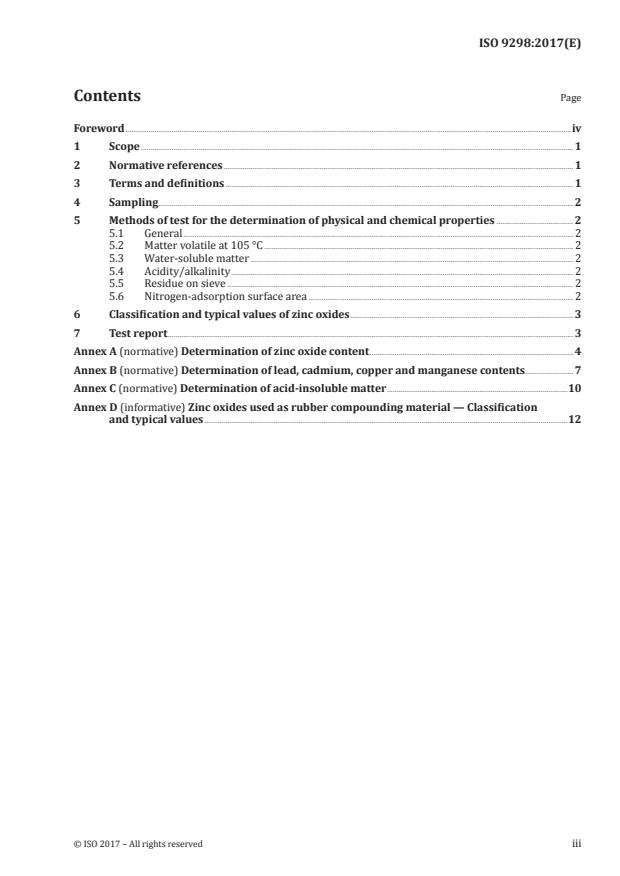
Contents Page
Foreword .iv
1 Scope . 1
2 Normative references . 1
3 Terms and definitions . 1
4 Sampling . 2
5 Methods of test for the determination of physical and chemical properties .2
5.1 General . 2
5.2 Matter volatile at 105 °C . 2
5.3 Water-soluble matter . 2
5.4 Acidity/alkalinity . 2
5.5 Residue on sieve . 2
5.6 Nitrogen-adsorption surface area . 2
6 Classification and typical values of zinc oxides . 3
7 Test report . 3
Annex A (normative) Determination of zinc oxide content . 4
Annex B (normative) Determination of lead, cadmium, copper and manganese contents .7
Annex C (normative) Determination of acid-insoluble matter .10
Annex D (informative) Zinc oxides used as rubber compounding material — Classification
and typical values .12
Foreword
ISO (the International Organization for Standardization) is a worldwide federation of national standards
bodies (ISO member bodies). The work of preparing International Standards is normally carried out
through ISO technical committees. Each member body interested in a subject for which a technical
committee has been established has the right to be represented on that committee. International
organizations, governmental and non-governmental, in liaison with ISO, also take part in the work.
ISO collaborates closely with the International Electrotechnical Commission (IEC) on all matters of
electrotechnical standardization.
The procedures used to develop this document and those intended for its further maintenance are
described in the ISO/IEC Directives, Part 1. In particular the different approval criteria needed for the
different types of ISO documents should be noted. This document was drafted in accordance with the
editorial rules of the ISO/IEC Directives, Part 2 (see www .iso .org/ directives).
Attention is drawn to the possibility that some of the elements of this document may be the subject of
patent rights. ISO shall not be held responsible for identifying any or all such patent rights. Details of
any patent rights identified during the development of the document will be in the Introduction and/or
on the ISO list of patent declarations received (see www .iso .org/ patents).
Any trade name used in this document is information given for the convenience of users and does not
constitute an endorsement.
For an explanation on the meaning of ISO specific terms and expressions related to conformity assessment,
as well as information about ISO’s adherence to the World Trade Organization (WTO) principles in the
Technical Barriers to Trade (TBT) see the following URL: www . i so .org/ iso/ foreword .html.
This document was prepared by Technical Committee ISO/TC 45, Rubber and rubber products,
Subcommittee SC 3, Raw materials (including latex) for use in the rubber industry.
This second edition cancels and replaces the first edition (ISO 9298:1995), which has been technically
revised. The main change is the reference to ISO 18852 as the method for the nitrogen adsorption to
determine the surface area.
iv © ISO 2017 – All rights reserved
INTERNATIONAL STANDARD ISO 9298:2017(E)
Rubber compounding ingredients — Zinc oxide — Test
methods
WARNING — Persons using this document should be familiar with normal laboratory practice.
This document does not purport to address all of the safety problems, if any, associated with its
use. It is the responsibility of the user to establish appropriate safety and health practices and to
ensure compliance with any national regulatory conditions.
1 Scope
This document specifies the methods to be used for the evaluation of zinc oxide for use in the rubber
industry.
The analytical methods are applicable to all commercial zinc oxides, for example:
— direct type (American process);
— indirect type (French process);
— other types produced by different chemical methods, i.e. precipitation and calcination.
Zinc oxide can also be coated with organic materials, such as fatty acids, oil, wetting agents, etc., in
order to improve the dispersion in rubber.
2 Normative references
The following documents are referred to in the text in such a way that some or all of their content
constitutes requirements of this document. For dated references, only the edition cited applies. For
undated references, the latest edition of the referenced document (including any amendments) applies.
ISO 787-2, General methods of test for pigments and extenders — Part 2: Determination of matter volatile
at 105 °C
ISO 787-4, General methods of test for pigments and extenders — Part 4: Determination of acidity or
alkalinity of the aqueous extract
ISO 787-7, General methods of test for pigments and extenders — Part 7: Determination of residue on
sieve — Water method — Manual procedure
ISO 787-8, General methods of test for pigments and extenders — Part 8: Determination of matter soluble
in water — Cold extraction method
ISO 1124, Rubber compounding ingredients — Carbon black shipment sampling procedures
ISO 18852, Rubber compounding ingredients — Determination of multipoint nitrogen surface area (NSA)
and statistical thickness surface area (STSA)
3 Terms and definitions
No terms and definitions are listed in this document.
ISO and IEC maintain terminological databases for use in standardization at the following addresses:
— IEC Electropedia: available at http:// www .electropedia .org/
— ISO Online browsing platform: available at http:// www .iso .org/ obp
4 Sampling
Sampling shall be carried out in accordance with ISO 1124 for dry powders.
5 Methods of test for the determination of physical and chemical properties
5.1 General
Surface-coated zinc oxides shall be evaluated by the methods specified in Table 1.
This evaluation shall be done without prior calcination or extraction, since there is little purpose in
determining volatile-matter content, content of water-soluble matter or acidity if the coating is removed.
Table 1 — Methods for the evaluation of surface-coated zinc oxides
Property Units Test method
Matter volatile at 105 °C % (m/m) ISO 787-2
Water-soluble matter % (m/m) ISO 787-8
Acidity/alkalinity (H SO equiv.) g H SO /100 g ISO 787-4
2 4 2 4
Residue on sieve % (m/m) ISO 787-7
Nitrogen-adsorption surface area m /g ISO 18852
Zinc oxide % (m/m) Annex A
Lead % (m/m) Annex B
Cadmium % (m/m) Annex B
Copper % (m/m) Annex B
Manganese % (m/m) Annex B
Acid-insoluble matter % (m/m) Annex C
5.2 Matter volatile at 105 °C
Determine the loss on heating at 105 °C in accordance with ISO 787-2.
5.3 Water-soluble matter
Determine the percentage of water-soluble matter in accordance with ISO 787-8.
5.4 Acidity/alkalinity
3 3
Determine the acidity/alkalinity, in cm of 0,1 mol/dm standard volumetric solution per 100 g of
sample, in accordance with ISO 787-4. The result shall be expressed in grams of sulfuric acid per 100 g
-3
(g H SO /100 g) by multiplying the result by 4,9 × 10 .
2 4
5.5 Residue on sieve
Determine the sieve residue in accordance with ISO 787-7.
5.6 Nitrogen-adsorption surface area
Determine the surface area in accordance with ISO 18852. The test portion shall be 0,7 g to 1,0 g, or
more if indicated by the initial test or past experience.
2 © ISO 2017 – All rights reserved
6 Classification and typical values of zinc oxides
Three types of zinc oxide are used in the rubber industry and are described in Annex D.
Typical values for some of the various types of zinc oxide are given in Annex D.
7 Test report
The test report shall include the following:
a) a reference to this document, i.e. ISO 9298;
b) all details necessary for the identification of the sample;
c) the zinc oxide content of the sample;
d) the lead, cadmium, copper and manganese contents of the sample;
e) the water-soluble matter content of the sample;
f) the acidity/alkalinity of the sample;
g) the residue on sieve;
h) the surface area by nitrogen adsorption;
i) the acid-insoluble matter;
j) the dates of the tests;
k) details of any deviation from the procedures specified in this document.
Annex A
(normative)
Determination of zinc oxide content
A.1 Reagents
Use only reagents of recognized analytical grade and distilled, deionized or distilled/deionized water
for sample preparation and required dilutions.
A.1.1 Nitric acid, 65 % (m/m), d ≈ 1,4 Mg/m .
A.1.2 Hydrochloric acid, 20 % (m/m), d ≈ 1,1 Mg/m .
A.1.3 Ammonia solution, 25 % (m/m), d ≈ 0,91 Mg/m .
A.1.4 Hydrogen peroxide solution, 3 % (m/m).
A.1.5 Iron(III) solution.
Dissolve 86 g of iron(III) ammonium sulfate in water and dilute to 1 000 cm .
A.1.6 Ammonium chloride solution.
Dissolve 250 g of ammonium chloride in water and dilute to 1 000 cm .
A.1.7 Masking solution.
Dissolve 30 g of ammonium fluoride, 100 g of ammonium thiosulfate and 250 g of ammonium acetate in
water and dilute to 1 000 cm .
A.1.8 Bromothymol blue solution.
Dissolve 0,1 g of bromothymol blue in 100 cm of ethanol.
A.1.9 Xylenol orange solution.
Dissolve 0,2 g of xylenol orange, tetrasodium salt, in 100 cm of water.
A.1.10 EDTA, standard volumetric solution, c(EDTA) = 0,1 mol/dm .
Dissolve 37,225 g of ethylenedinitrilotetraacetic acid, disodium salt (Na EDTA), in water in a 1 000 cm
one-mark volumetric flask, dilute to the mark and mix well. Alternatively, commercially available
standard solutions may be used.
A.1.11 Zinc metal, of minimum purity 99,995 % (m/m).
A.2 Apparatus
The usual laboratory apparatus and, in particular, the following.
4 © ISO 2017 – All rights reserved
3 3 3
A.2.1 Volumetric flasks, class A, of capacity 250 cm , 500 cm and 1 000 cm .
3 3
A.2.2 Pipettes, class A, of capacity 50 cm and 100 cm .
A.2.3 Burette, class A, of capacity 50 cm .
A.2.4 Balance, of capacity 250 g, weighing
...
NORME ISO
INTERNATIONALE 9298
Deuxième édition
2017-03
Ingrédients de mélange du
caoutchouc — Oxyde de zinc —
Méthodes d’essai
Rubber compounding ingredients — Zinc oxide — Test methods
Numéro de référence
©
ISO 2017
DOCUMENT PROTÉGÉ PAR COPYRIGHT
© ISO 2017, Publié en Suisse
Droits de reproduction réservés. Sauf indication contraire, aucune partie de cette publication ne peut être reproduite ni utilisée
sous quelque forme que ce soit et par aucun procédé, électronique ou mécanique, y compris la photocopie, l’affichage sur
l’internet ou sur un Intranet, sans autorisation écrite préalable. Les demandes d’autorisation peuvent être adressées à l’ISO à
l’adresse ci-après ou au comité membre de l’ISO dans le pays du demandeur.
ISO copyright office
Ch. de Blandonnet 8 • CP 401
CH-1214 Vernier, Geneva, Switzerland
Tel. +41 22 749 01 11
Fax +41 22 749 09 47
copyright@iso.org
www.iso.org
ii © ISO 2017 – Tous droits réservés
Sommaire Page
Avant-propos .iv
1 Domaine d’application . 1
2 Références normatives . 1
3 Termes et définitions . 1
4 Échantillonnage . 2
5 Méthodes d’essai pour la détermination des caractéristiques physiques et chimiques .2
5.1 Généralités . 2
5.2 Matières volatiles à 105 °C. 2
5.3 Matières solubles dans l’eau . 2
5.4 Acidité/alcalinité . 2
5.5 Refus sur tamis . 2
5.6 Surface spécifique par adsorption d’azote . 3
6 Classification et valeurs types des oxydes de zinc . 3
7 Rapport d’essai . 3
Annexe A (normative) Détermination de la teneur en oxyde de zinc . 4
Annexe B (normative) Détermination de la teneur en plomb, en cadmium, en cuivre et
en manganèse . 7
Annexe C (normative) Détermination des matières insolubles dans l’acide .10
Annexe D (informative) Oxydes de zinc utilisés comme ingrédients de mélange du
caoutchouc — Classification et valeurs types .12
Avant-propos
L’ISO (Organisation internationale de normalisation) est une fédération mondiale d’organismes
nationaux de normalisation (comités membres de l’ISO). L’élaboration des Normes internationales est
en général confiée aux comités techniques de l’ISO. Chaque comité membre intéressé par une étude
a le droit de faire partie du comité technique créé à cet effet. Les organisations internationales,
gouvernementales et non gouvernementales, en liaison avec l’ISO participent également aux travaux.
L’ISO collabore étroitement avec la Commission électrotechnique internationale (IEC) en ce qui
concerne la normalisation électrotechnique.
Les procédures utilisées pour élaborer le présent document et celles destinées à sa mise à jour sont
décrites dans les Directives ISO/IEC, Partie 1. Il convient, en particulier de prendre note des différents
critères d’approbation requis pour les différents types de documents ISO. Le présent document a été
rédigé conformément aux règles de rédaction données dans les Directives ISO/IEC, Partie 2 (voir www
.iso .org/ directives).
L’attention est appelée sur le fait que certains des éléments du présent document peuvent faire l’objet de
droits de propriété intellectuelle ou de droits analogues. L’ISO ne saurait être tenue pour responsable
de ne pas avoir identifié de tels droits de propriété et averti de leur existence. Les détails concernant
les références aux droits de propriété intellectuelle ou autres droits analogues identifiés lors de
l’élaboration du document sont indiqués dans l’Introduction et/ou dans la liste des déclarations de
brevets reçues par l’ISO (voir www .iso .org/ brevets).
Les appellations commerciales éventuellement mentionnées dans le présent document sont données
pour information, par souci de commodité, à l’intention des utilisateurs et ne sauraient constituer un
engagement.
Pour une explication de la nature volontaire des normes, la signification des termes et expressions
spécifiques de l’ISO liés à l’évaluation de la conformité, ou pour toute information au sujet de l’adhésion
de l’ISO aux principes de l’Organisation mondiale du commerce (OMC) concernant les obstacles
techniques au commerce (OTC), voir le lien suivant: w w w . i s o .org/ iso/ fr/ avant -propos .html
Le présent document a été élaboré par le comité technique ISO/TC 45, Élastomères et produits à base
d’élastomères, sous-comité SC 3, Matières premières (y compris le latex) à l’usage de l’industrie des
élastomères.
Cette deuxième édition annule et remplace la première édition (ISO 9298:1995), qui a fait l’objet d’une
révision technique. La principale modification est la référence à l’ISO 18852 en tant que méthode pour
l’adsorption d’azote pour déterminer la surface spécifique.
iv © ISO 2017 – Tous droits réservés
NORME INTERNATIONALE ISO 9298:2017(F)
Ingrédients de mélange du caoutchouc — Oxyde de zinc —
Méthodes d’essai
AVERTISSEMENT — Il convient que l’utilisateur du présent document connaisse bien les
pratiques courantes de laboratoire. Le présent document n’a pas pour but de traiter tous les
problèmes de sécurité qui sont, le cas échéant, liés à son utilisation. Il incombe à l’utilisateur
d’établir des pratiques appropriées en matière d’hygiène et de sécurité, et de s’assurer de la
conformité à la réglementation nationale en vigueur.
1 Domaine d’application
Le présent document spécifie les méthodes à utiliser pour l’évaluation de l’oxyde de zinc destiné à
l’industrie du caoutchouc.
Les méthodes analytiques sont applicables à toutes les classes commerciales d’oxyde de zinc, par
exemple:
— type direct (procédé américain);
— type indirect (procédé français);
— d’autres types produits par différentes méthodes chimiques, c’est-à-dire par précipitation et
calcination.
L’oxyde de zinc peut aussi être enrobé de matériaux organiques, tels que acides gras, huile, agents
mouillants, etc., pour améliorer la dispersion dans le caoutchouc.
2 Références normatives
Les documents suivants cités dans le texte constituent, pour tout ou partie de leur contenu, des
exigences du présent document. Pour les références datées, seule l’édition citée s’applique. Pour les
références non datées, la dernière édition du document de référence s’applique (y compris les éventuels
amendements).
ISO 787-2, Méthodes générales d’essai des pigments et matières de charge — Partie 2: Détermination des
matières volatiles à 105 °C
ISO 787-4, Méthodes générales d’essai des pigments et matières de charge — Partie 4: Détermination de
l’acidité ou de l’alcalinité de l’extrait aqueux
ISO 787-7, Méthodes générales d’essai des pigments et matières de charge — Partie 7: Détermination du
refus sur tamis — Méthode à l’eau — Méthode manuelle
ISO 787-8, Méthodes générales d’essai des pigments et matières de charge — Partie 8: Détermination des
matières solubles dans l’eau — Méthode par extraction à froid
ISO 1124, Ingrédients de mélange du caoutchouc — Procédures d’échantillonnage sur des livraisons de noir
de carbone
ISO 18852, Ingrédients de mélange du caoutchouc — Détermination de la surface par adsorption d’azote
(NSA) et de la surface par épaisseur statistique (STSA) par méthode multipoints
3 Termes et définitions
Aucun terme n’est défini dans le présent document.
L’ISO et l’IEC tiennent à jour des bases de données terminologiques destinées à être utilisées en
normalisation, consultables aux adresses suivantes:
— IEC Electropedia: disponible à l’adresse http:// www .electropedia .org/
— ISO Online browsing platform: disponible à l’adresse http:// www .iso .org/ obp
4 Échantillonnage
L’échantillonnage doit être réalisé conformément à l’ISO 1124 pour les poudres sèches.
5 Méthodes d’essai pour la détermination des caractéristiques physiques et
chimiques
5.1 Généralités
Les oxydes de zinc enrobés doivent être évalués selon les méthodes spécifiées dans le Tableau 1.
Cette évaluation doit être faite sans calcination ou extraction préalable, car il n’est pas utile d’éliminer
l’enrobage pour la détermination des matières volatiles, des matières solubles dans l’eau ou de l’acidité.
Tableau 1 — Méthodes pour l’évaluation de la surface des oxydes de zinc enrobés
Caractéristiques Unités Méthode d’essai
Matières volatiles à 105 °C % (m/m) ISO 787-2
Matières solubles dans l’eau % (m/m) ISO 787-8
Acidité/alcalinité (équivalent H SO ) g H SO /100 g ISO 787-4
2 4 2 4
Refus sur tamis % (m/m) ISO 787-7
Surface spécifique par adsorption d’azote m /g ISO 18852
Oxyde de zinc % (m/m) Annexe A
Plomb % (m/m) Annexe B
Cadmium % (m/m) Annexe B
Cuivre % (m/m) Annexe B
Manganèse % (m/m) Annexe B
Matières insolubles dans l’acide % (m/m) Annexe C
5.2 Matières volatiles à 105 °C
Déterminer la perte au chauffage à 105 °C conformément à l’ISO 787-2.
5.3 Matières solubles dans l’eau
Déterminer le pourcentage de matières solubles dans l’eau conformément à l’ISO 787-8.
5.4 Acidité/alcalinité
3 3
Déterminer l’acidité/l’alcalinité, en cm de de solution titrée à 0,1 mol/dm par 100 g d’échantillon,
conformément à l’ISO 787-4. Le résultat doit être exprimé en grammes d’acide sulfurique par 100 g
−3
(g H SO /100 g) en multipliant le résultat par 4,9 × 10 .
2 4
5.5 Refus sur tamis
Déterminer le refus sur tamis conformément à l’ISO 787-7.
2 © ISO 2017 – Tous droits réservés
5.6 Surface spécifique par adsorption d’azote
Déterminer la surface spécifique conformément à l’ISO 18852. La prise d’essai doit être comprise entre
0,7 g et 1,0 g, ou plus selon les indications de l’essai initial ou de l’expérience acquise.
6 Classification et valeurs types des oxydes de zinc
Trois types d’oxyde de zinc sont utilisés dans l’industrie du caoutchouc et sont décrits dans l’Annexe D.
Des valeurs types pour certains des différents types d’oxyde de zinc sont données dans l’Annexe D.
7 Rapport d’essai
Le rapport d’essai doit contenir ce qui suit:
a) une référence au présent document, c’est-à-dire ISO 9298;
b) tous les détails nécessaires à l’identification de l’échantillon;
c) la teneur en oxyde de zinc de l’échantillon;
d) la teneur en plomb, en cadmium, en cuivre et en manganèse de l’échantillon;
e) la teneur en matières solubles dans l’eau de l’échantillon;
f) l’acidité/alcalinité de l’échantillon;
g) le refus sur tamis;
h) la surface spécifique par adsorption d’azote;
i) la teneur en matières insolubles dans l’acide;
j) les dates des essais;
k) les détails relatifs à tout écart par rapport aux modes opératoires spécifiés dans le présent
document.
Annexe A
(normative)
Détermination de la teneur en oxyde de zinc
A.1 Réactifs
Utiliser uniquement des réactifs de qualité analytique reconnue et de l’eau distillée, déionisée ou
distillée/déionisée pour la préparation des échantillons et des dilutions requises.
A.1.1 Acide nitrique, à 65 % (m/m), d ≈ 1,4 Mg/m .
A.1.2 Acide chlorhydrique, à 20 % (m/m), d ≈ 1,1 Mg/m .
A.1.3 Ammoniaque, solution à 25 % (m/m), d ≈ 0,91 Mg/m .
A.1.4 Peroxyde d’hydrogène, solution à 3 % (m/m).
A.1.5 Fer(III), solution.
Dissoudre 86 g de sulfate d’ammonium et de fer(III) dans de l’eau et diluer à 1 000 cm .
A.1.6 Chlorure d’ammonium, solution.
Dissoudre 250 g de chlorure d’ammonium dans de l’eau et diluer à 1 000 cm .
A.1.7 Solution complexante.
Dissoudre 30 g de fluorure d’ammonium, 100 g de thiosulfate d’ammonium et 250 g d’acétate
d’ammonium dans de l’eau et diluer à 1 000 cm .
A.1.8 Bleu de bromothymol, solution.
Dissoudre 0,1 g de bleu de bromothymol dans 100 cm d’éthanol.
A.1.9 Xylénolorange, solution.
Dissoudre 0,2 g de sel tétrasodique de xylénolorange dans 100 cm d’eau.
A.1.10 EDTA, solution titrée, c(EDTA) = 0,1 mol/dm .
Dissoudre 37,225 g de sel disodique de l’acide éthylènedinitrilotétraacétique (Na EDTA), dans de l’eau
dans une fiole jaugée de 1 000 cm , diluer jusqu’au trait repère et homogénéiser. En alternative, des
solutions étalons commerciales peuvent être utilisées.
A.1.11 Zinc métallique, de pureté minimale 99,995 % (m/m).
A.2 Appareillage
Appareillage usuel de laboratoire et, en particulier, ce qui suit.
4 © ISO 2017 – Tous droits réservés
3 3 3
A.2.1 Fioles jaugées, de classe A, de capacité 250 cm , 500 cm e 1 000 cm .
3 3
A.2.2 Pipettes, de classe A, de capacité 50 cm et 100 cm .
A.2.3 Burette, de classe A, de capacité 50 cm .
A.2.4 Balance, de capacité 250 g, avec une précision minimale de ±1 mg.
A.2.5 Dispositif de chauffage, par exemple plaque chauffante.
A.2.6 Papier filtre, lavé à l’acide et
...
Questions, Comments and Discussion
Ask us and Technical Secretary will try to provide an answer. You can facilitate discussion about the standard in here.
Loading comments...