

ISO 21001:2025
(Main)Educational organizations — Management systems for educational organizations — Requirements with guidance for use
General Information
- Abstract
This document specifies requirements and provides guidance for a management system for educational organizations (EOMS) when such an organization: a) needs to demonstrate its ability to support the acquisition and development of competence through teaching, learning or research; b) aims to enhance satisfaction of learners, other beneficiaries and staff through the effective application of its EOMS, including processes for improvement of the system and assurance of conformity to the requirements of learners and other beneficiaries. All requirements of this document are generic and intended to be applicable to any educational organization that uses a curriculum to support the development of competence through teaching, learning, training or research, regardless of the type, size or method of delivery. This document can be applied to educational organizations within larger organizations whose core business is not education, such as professional training departments. This document also provides guidance for the use of a EOMS. This document does not apply to organizations that only produce or manufacture educational products.
- Status
- Published
- Publication Date
- 06-Jul-2025
- Technical Committee
- ISO/TC 232 - Education and learning services
- Drafting Committee
- ISO/TC 232 - Education and learning services
- Current Stage
- 6060 - International Standard published
- Start Date
- 07-Jul-2025
- Due Date
- 19-Apr-2026
- Completion Date
- 07-Jul-2025
Buy Documents



ISO 21001:2025 - Educational organizations — Management systems for educational organizations — Requirements with guidance for use Released:7/7/2025

ISO 21001:2025 - Organismes d'éducation/formation — Systemes de management des organismes d'éducation/formation — Exigences et recommandations pour leur application Released:7/7/2025
Overview
ISO 21001:2025 - Educational organizations - Management systems for educational organizations - Requirements with guidance for use specifies requirements and provides guidance for an Educational Organization Management System (EOMS). The standard helps organizations demonstrate their ability to support the acquisition and development of competence through teaching, learning or research, and to improve satisfaction of learners, other beneficiaries and staff. ISO 21001:2025 is generic and applicable to any organization that uses a curriculum to deliver education, training or research - regardless of type, size or delivery method. It does not apply to organizations that only produce or manufacture educational products.
Key topics and technical requirements
ISO 21001:2025 structures requirements across the common management-system lifecycle (clauses 4–10). Major topics include:
- Context of the organization (Clause 4): understanding internal/external factors and interested parties that affect educational outcomes.
- Leadership (Clause 5): governance, commitment, learner focus and roles/responsibilities. Includes additional requirements for special needs education.
- Planning (Clause 6): actions to address risks/opportunities, objectives and change planning.
- Support (Clause 7): resources, facilities, organizational knowledge, competence, communication and documented information.
- Operation (Clause 8): design and delivery of educational products/services, control of external providers, learner data protection (Clause 8.5.5), traceability and nonconforming outputs.
- Performance evaluation (Clause 9): monitoring, measurement, learner/staff satisfaction, internal audits and management review.
- Improvement (Clause 10): continual improvement, corrective actions and opportunities for enhancement.
- Annexes: supplemental guidance including early childhood education, principles of EOMS, communication with interested parties, health & safety, and mapping to regional standards.
Practical applications and who uses it
ISO 21001:2025 is designed for practical implementation across the education sector:
- Schools, colleges and universities
- Vocational and professional training providers
- Corporate learning and professional development departments within larger organizations
- Research institutions that use curricula to develop competence
- NGOs and community education programs
Organizations use ISO 21001:2025 to align educational processes with learner outcomes, strengthen governance and transparency, manage risk, protect learner data, and demonstrate continual improvement.
Benefits and SEO keywords
Adopting ISO 21001:2025 improves quality in education, supports educational organization management systems (EOMS), enhances learner satisfaction, and provides a framework for competency-based teaching, learning and research. Keywords: ISO 21001, EOMS, management systems for educational organizations, educational standards, curriculum-based competence, learner satisfaction.
Related standards (if applicable)
ISO 21001:2025 is typically implemented alongside broader quality and regulatory frameworks such as national education regulations and other management-system standards (for example, quality management systems) to create an integrated approach to institutional quality and continuous improvement.
Relations
- Effective Date
- 30-Aug-2025
- Effective Date
- 22-Apr-2023
Buy Documents
ISO 21001:2025 - Educational organizations — Management systems for educational organizations — Requirements with guidance for use Released:7/7/2025
ISO 21001:2025 - Organismes d'éducation/formation — Systemes de management des organismes d'éducation/formation — Exigences et recommandations pour leur application Released:7/7/2025
Get Certified
Connect with accredited certification bodies for this standard

BSI Group
BSI (British Standards Institution) is the business standards company that helps organizations make excellence a habit.

Bureau Veritas
Bureau Veritas is a world leader in laboratory testing, inspection and certification services.

DNV
DNV is an independent assurance and risk management provider.
Sponsored listings
Frequently Asked Questions
ISO 21001:2025 is a standard published by the International Organization for Standardization (ISO). Its full title is "Educational organizations — Management systems for educational organizations — Requirements with guidance for use". This standard covers: This document specifies requirements and provides guidance for a management system for educational organizations (EOMS) when such an organization: a) needs to demonstrate its ability to support the acquisition and development of competence through teaching, learning or research; b) aims to enhance satisfaction of learners, other beneficiaries and staff through the effective application of its EOMS, including processes for improvement of the system and assurance of conformity to the requirements of learners and other beneficiaries. All requirements of this document are generic and intended to be applicable to any educational organization that uses a curriculum to support the development of competence through teaching, learning, training or research, regardless of the type, size or method of delivery. This document can be applied to educational organizations within larger organizations whose core business is not education, such as professional training departments. This document also provides guidance for the use of a EOMS. This document does not apply to organizations that only produce or manufacture educational products.
This document specifies requirements and provides guidance for a management system for educational organizations (EOMS) when such an organization: a) needs to demonstrate its ability to support the acquisition and development of competence through teaching, learning or research; b) aims to enhance satisfaction of learners, other beneficiaries and staff through the effective application of its EOMS, including processes for improvement of the system and assurance of conformity to the requirements of learners and other beneficiaries. All requirements of this document are generic and intended to be applicable to any educational organization that uses a curriculum to support the development of competence through teaching, learning, training or research, regardless of the type, size or method of delivery. This document can be applied to educational organizations within larger organizations whose core business is not education, such as professional training departments. This document also provides guidance for the use of a EOMS. This document does not apply to organizations that only produce or manufacture educational products.
ISO 21001:2025 is classified under the following ICS (International Classification for Standards) categories: 03.100.70 - Management systems; 03.180 - Education. The ICS classification helps identify the subject area and facilitates finding related standards.
ISO 21001:2025 has the following relationships with other standards: It is inter standard links to ISO 21001:2018/Amd 1:2024, ISO 21001:2018. Understanding these relationships helps ensure you are using the most current and applicable version of the standard.
ISO 21001:2025 is available in PDF format for immediate download after purchase. The document can be added to your cart and obtained through the secure checkout process. Digital delivery ensures instant access to the complete standard document.
Standards Content (Sample)
SLOVENSKI STANDARD
01-september-2025
Nadomešča:
SIST ISO 21001:2019
Izobraževalne organizacije - Sistemi vodenja za izobraževalne organizacije -
Zahteve z napotki za uporabo
Educational organizations — Management systems for educational organizations —
Requirements with guidance for use
Organismes d'éducation/formation — Systèmes de management des organismes
d'éducation/formation — Exigences et recommandations pour leur application
Ta slovenski standard je istoveten z: ISO 21001:2025
ICS:
03.100.70 Sistemi vodenja Management systems
03.180 Vzgoja in izobraževanje Education
2003-01.Slovenski inštitut za standardizacijo. Razmnoževanje celote ali delov tega standarda ni dovoljeno.
International
Standard
ISO 21001
Second edition
Educational organizations —
2025-07
Management systems for
educational organizations —
Requirements with guidance for use
Organismes d'éducation/formation — Systèmes de management
des organismes d'éducation/formation — Exigences et
recommandations pour leur application
Reference number
© ISO 2025
All rights reserved. Unless otherwise specified, or required in the context of its implementation, no part of this publication may
be reproduced or utilized otherwise in any form or by any means, electronic or mechanical, including photocopying, or posting on
the internet or an intranet, without prior written permission. Permission can be requested from either ISO at the address below
or ISO’s member body in the country of the requester.
ISO copyright office
CP 401 • Ch. de Blandonnet 8
CH-1214 Vernier, Geneva
Phone: +41 22 749 01 11
Email: copyright@iso.org
Website: www.iso.org
Published in Switzerland
ii
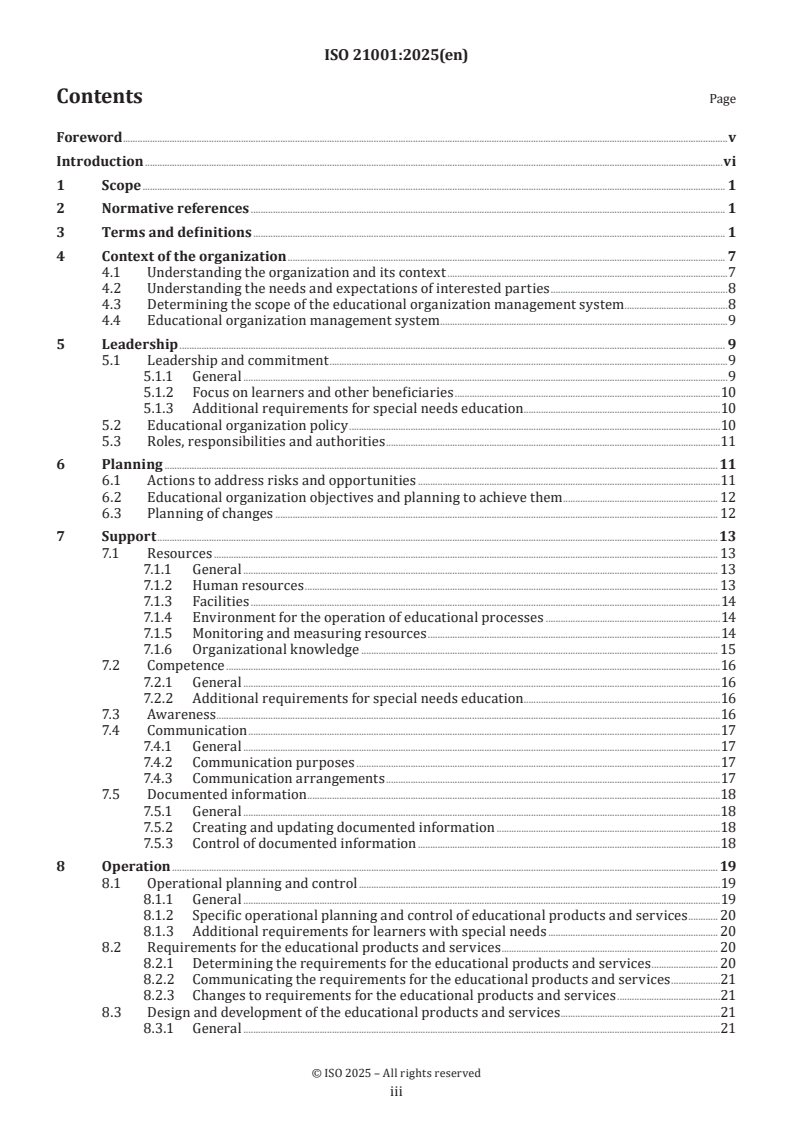
Contents Page
Foreword .v
Introduction .vi
1 Scope . 1
2 Normative references . 1
3 Terms and definitions . 1
4 Context of the organization . 7
4.1 Understanding the organization and its context .7
4.2 Understanding the needs and expectations of interested parties .8
4.3 Determining the scope of the educational organization management system .8
4.4 Educational organization management system .9
5 Leadership . 9
5.1 Leadership and commitment .9
5.1.1 General .9
5.1.2 Focus on learners and other beneficiaries .10
5.1.3 Additional requirements for special needs education .10
5.2 Educational organization policy .10
5.3 Roles, responsibilities and authorities .11
6 Planning .11
6.1 Actions to address risks and opportunities .11
6.2 Educational organization objectives and planning to achieve them . 12
6.3 Planning of changes . 12
7 Support .13
7.1 Resources . 13
7.1.1 General . 13
7.1.2 Human resources . 13
7.1.3 Facilities .14
7.1.4 Environment for the operation of educational processes .14
7.1.5 Monitoring and measuring resources .14
7.1.6 Organizational knowledge . 15
7.2 Competence .16
7.2.1 General .16
7.2.2 Additional requirements for special needs education .16
7.3 Awareness .16
7.4 Communication .17
7.4.1 General .17
7.4.2 Communication purposes .17
7.4.3 Communication arrangements .17
7.5 Documented information .18
7.5.1 General .18
7.5.2 Creating and updating documented information .18
7.5.3 Control of documented information .18
8 Operation . 19
8.1 Operational planning and control .19
8.1.1 General .19
8.1.2 Specific operational planning and control of educational products and services . 20
8.1.3 Additional requirements for learners with special needs . 20
8.2 Requirements for the educational products and services . 20
8.2.1 Determining the requirements for the educational products and services . 20
8.2.2 Communicating the requirements for the educational products and services .21
8.2.3 Changes to requirements for the educational products and services .21
8.3 Design and development of the educational products and services .21
8.3.1 General .21
iii
8.3.2 Design and development planning . 22
8.3.3 Design and development inputs . 22
8.3.4 Design and development controls . 22
8.3.5 Design and development outputs .24
8.3.6 Design and development changes .24
8.4 Control of externally provided processes, products and services .24
8.4.1 General .24
8.4.2 Type and extent of control . 25
8.4.3 Information for external providers . 25
8.5 Delivery of the educational products and services . 26
8.5.1 Control of delivery of the educational products and services . 26
8.5.2 Identification and traceability . 28
8.5.3 Property belonging to interested parties . 28
8.5.4 Preservation . 29
8.5.5 Protection and transparency of learners’ data . 29
8.5.6 Control of changes in the educational products and services . 29
8.6 Release of the educational products and services . 29
8.7 Control of the educational nonconforming outputs . 30
9 Performance evaluation .30
9.1 Monitoring, measurement, analysis and evaluation . . 30
9.1.1 General . 30
9.1.2 Satisfaction of learners, other beneficiaries and staff .31
9.1.3 Other monitoring and measuring needs .31
9.1.4 Methods for monitoring, measurement, analysis and evaluation .32
9.1.5 Analysis and evaluation .32
9.2 Internal audit . 33
9.2.1 General . 33
9.2.2 Internal audit programme . 33
9.3 Management review . 33
9.3.1 General . 33
9.3.2 Management review inputs . 33
9.3.3 Management review results . 34
10 Improvement .34
10.1 Continual improvement . 34
10.2 Nonconformity and corrective action . 34
10.3 Opportunities for improvement . 35
Annex A (normative) Additional requirements for early childhood education .36
Annex B (informative) Principles for an educational organization management system .39
Annex C (informative) Classification of interested parties in educational organizations .49
Annex D (informative) Guidelines for communication with interested parties .51
Annex E (informative) Processes, measures and tools in educational organizations .55
Annex F (informative) Example of mapping to regional standards .58
Annex G (informative) Health and safety considerations for educational organizations . 61
Bibliography .62
iv
Foreword
ISO (the International Organization for Standardization) is a worldwide federation of national standards
bodies (ISO member bodies). The work of preparing International Standards is normally carried out through
ISO technical committees. Each member body interested in a subject for which a technical committee
has been established has the right to be represented on that committee. International organizations,
governmental and non-governmental, in liaison with ISO, also take part in the work. ISO collaborates closely
with the International Electrotechnical Commission (IEC) on all matters of electrotechnical standardization.
The procedures used to develop this document and those intended for its further maintenance are described
in the ISO/IEC Directives, Part 1. In particular, the different approval criteria needed for the different types
of ISO document should be noted. This document was drafted in accordance with the editorial rules of the
ISO/IEC Directives, Part 2 (see www.iso.org/directives).
ISO draws attention to the possibility that the implementation of this document may involve the use of (a)
patent(s). ISO takes no position concerning the evidence, validity or applicability of any claimed patent
rights in respect thereof. As of the date of publication of this document, ISO had not received notice of (a)
patent(s) which may be required to implement this document. However, implementers are cautioned that
this may not represent the latest information, which may be obtained from the patent database available at
www.iso.org/patents. ISO shall not be held responsible for identifying any or all such patent rights.
Any trade name used in this document is information given for the convenience of users and does not
constitute an endorsement.
For an explanation of the voluntary nature of standards, the meaning of ISO specific terms and expressions
related to conformity assessment, as well as information about ISO's adherence to the World Trade
Organization (WTO) principles in the Technical Barriers to Trade (TBT), see www.iso.org/iso/foreword.html.
This document was prepared by Technical Committee ISO/TC 232, Education and learning services.
This second edition cancels and replaces the first edition (ISO 21001:2018), which has been technically
revised.
The main changes are as follows: assessment related text has been revised to reflect current best practices
in educational assessment.
Any feedback or questions on this document should be directed to the user’s national standards body. A
complete listing of these bodies can be found at www.iso.org/members.html.
v
Introduction
0.1 General
This document provides a common management tool for organizations providing educational products and
services capable of meeting learners' and other beneficiaries' requirements.
0.2 Relevance
There is a critical and continuous need for educational organizations to evaluate the degree to which they
meet the requirements of learners and other beneficiaries, as well as other relevant interested parties and
to improve their ability to continue to do so.
NOTE 1 A classification of interested parties in educational organizations is provided in Annex C.
Although educational organizations and learners worldwide are the main beneficiaries of this document, all
interested parties will benefit from standardized management systems in educational organizations.
EXAMPLE Employers who sponsor and encourage staff to participate in educational services can also benefit
from this document.
The potential benefits to an organization of implementing an educational organizations management system
(EOMS) based on this document are:
a) better alignment of objectives and activities with policy (including mission and vision);
b) enhanced social responsibility by providing inclusive and equitable quality education for all;
c) more personalized learning and effective response to all learners and particularly to learners with
special education needs, distance learners and lifelong learning opportunities;
d) consistent processes and evaluation tools to demonstrate and increase effectiveness and efficiency;
e) increased credibility of the organization;
f) a means that enables educational organizations to demonstrate their commitment to effective
educational management practices;
g) a culture for educational organization improvement;
h) harmonization of regional, national, open, proprietary and other standards within an international
framework;
i) widened participation of interested parties;
j) stimulation of excellence and innovation.
k) continual improvement of the design and development of study programs to ensure the development of
the competencies of learners to meet the needs of all interested parties
0.3 Relationship between this document and other International Standards
This document is a stand-alone management system standard, aligned with ISO 9001. It focuses on the
management systems of educational organizations as well as the impact of these on learners and other
relevant interested parties.
This document conforms to ISO’s requirements for management system standards. These requirements
include a high level structure, identical core text, and common terms with core definitions, designed to
benefit users implementing multiple ISO management system standards.
vi
This document can be implemented alongside regional, national, open, proprietary and other standards or
related documents.
NOTE 2 Annex F provides an example of how to implement this document alongside the European Quality Assurance
Framework for Vocational Education and Training (EQAVET).
0.4 Principles for an EOMS
The EOMS entails the following management principles:
a) focus on learners and other beneficiaries;
b) visionary leadership;
c) engagement of people;
d) process approach;
e) improvement;
f) evidence-based decisions;
g) relationship management;
h) social responsibility;
i) accessibility and equity;
j) ethical conduct in education;
k) data security and protection.
NOTE 3 The details of these principles are analysed in Annex B.
0.5 Process approach
0.5.1 General
This document promotes the adoption of a process approach when developing, implementing and improving
the effectiveness of an EOMS, to enhance learner and other beneficiary satisfaction by meeting learner and
other beneficiary requirements. Specific requirements considered essential to the adoption of a process
approach are included in 4.4.
Understanding and managing interrelated processes as a system contributes to the educational
organization’s effectiveness and efficiency in achieving its intended results. This approach enables the
educational organization to control the interrelationships and interdependencies among the processes of
the system, so that the overall performance of the educational organization can be enhanced.
The process approach involves the systematic definition and management of processes, and their
interactions, so as to achieve the intended results in accordance with the policy, objectives and strategic
plan of the educational organization. Management of the processes and the system as a whole can be
achieved using the Plan-Do-Check-Act (PDCA) cycle (see 0.5.2) with an overall focus on risk-based thinking
(see 0.5.3) aimed at taking advantage of opportunities and preventing undesirable results. The application
of the process approach in an EOMS enables:
— understanding and consistency in meeting requirements;
— the consideration of processes in terms of added value;
— achievement of effective process performance;
— improvement of processes based on continuous evaluation of data and information.
vii
Figure 1 gives a schematic representation of any process (such as assessment of the educational effectiveness
process) and shows the interaction of its elements. The monitoring and measuring check points, which are
necessary for control, are specific to each process and will vary depending on the related risks.
Figure 1 — Schematic representation of the elements of a single process (assessment of the
educational effectiveness process)
0.5.2 Plan-Do-Check-Act cycle
The Plan-Do-Check-Act (PDCA) cycle can be applied to all processes and to the EOMS as a whole. Figure 2
illustrates how Clauses 4 to 10 can be grouped in relation to the PDCA cycle.
NOTE Numbers in brackets refer to clauses in this document.
Figure 2 — Representation of the structure of this document in the PDCA cycle
viii
The PDCA cycle can be briefly described as follows:
— Plan: establish the objectives of the system and its processes, and the resources needed to deliver results
in accordance with learners' and other beneficiaries' requirements and the educational organization’s
policies, and identify and address risks and opportunities;
— Do: implement what was planned;
— Check: monitor and (where applicable) measure processes and the resulting products and services
against policies, objectives, requirements and planned activities, and report the results;
— Act: take actions to improve performance, as necessary.
0.5.3 Risk-based thinking
Risk-based thinking is essential for achieving an effective EOMS. To conform to the requirements of
this document, an educational organization needs to plan and implement actions to address risks and
opportunities. Addressing both risks and opportunities establishes a basis for increasing the effectiveness
of the quality management system, achieving improved results and preventing negative effects.
Opportunities can arise as a result of a situation favourable to achieving an intended result, e.g. a set of
circumstances that allow the educational organization to attract learners and other beneficiaries, develop
new products and services, reduce waste or improve productivity. Actions to address opportunities can also
include consideration of associated risks. Risk is the effect of uncertainty and any such uncertainty can have
positive or negative effects. A positive deviation arising from a risk can provide an opportunity, but not all
positive effects of risk result in opportunities.
0.6 Educational organization mission, vision and strategy
Figure 3 illustrates EOMS strategy as related to mission and vision.
Figure 3 — EOMS strategy as related to mission and vision
The EOMS policy statements are framed by the educational organization’s culture (the complete set of beliefs
and values that condition its behaviour) and by the EOMS principles. In turn, the EOMS policy statements
provide the framework for the establishment of the EOMS objectives, which are periodically revised to
ensure the educational organization’s mission is effectively and efficiently accomplished while walking the
continuous path towards the achievement of the educational organization’s vision.
0.7 Additional requirements and guidance
Annex A specifies additional requirements for early childhood education for educational organizations that
provide this service.
Annex B outlines the principles for an EOMS.
Annex C provides a classification of interested parties.
Annex D provides guidelines for communication with interested parties.
ix
Annex E provides guidance on processes, measures and tools in educational organizations.
Annex F gives an example of mapping to regional standards.
Annex G outlines health and safety considerations for educational organizations.
x
International Standard ISO 21001:2025(en)
Educational organizations — Management systems
for educational organizations — Requirements with
guidance for use
1 Scope
This document specifies requirements and provides guidance for a management system for educational
organizations (EOMS) when such an organization:
a) needs to demonstrate its ability to support the acquisition and development of competence through
teaching, learning or research;
b) aims to enhance satisfaction of learners, other beneficiaries and staff through the effective application
of its EOMS, including processes for improvement of the system and assurance of conformity to the
requirements of learners and other beneficiaries.
All requirements of this document are generic and intended to be applicable to any educational organization
that uses a curriculum to support the development of competence through teaching, learning, training or
research, regardless of the type, size or method of delivery.
This document can be applied to educational organizations within larger organizations whose core business
is not education, such as professional training departments.
This document also provides guidance for the use of a EOMS.
This document does not apply to organizations that only produce or manufacture educational products.
2 Normative references
There are no normative references in this document.
3 Terms and definitions
For the purposes of this document, the following terms and definitions apply.
ISO and IEC maintain terminology databases for use in standardization at the following addresses:
— ISO Online browsing platform: available at https:// www .iso .org/ obp
— IEC Electropedia: available at https:// www .electropedia .org/
3.1
organization
person or group of people that has its own functions with responsibilities, authorities and relationships to
achieve its objectives (3.6)
Note 1 to entry: The concept of organization includes, but is not limited to, sole-trader, company, corporation, firm,
enterprise, authority, partnership, charity or institution, or part or combination thereof, whether incorporated or not,
public or private.
Note 2 to entry: If the organization is part of a larger entity, the term “organization” refers only to the part of the larger
entity that is within the scope of the educational organization management system (3.4).
3.2
interested party
stakeholder
person or organization (3.1) that can affect, be affected by, or perceive itself to be affected by a decision or
activity
3.3
top management
person or group of people who directs and controls an organization (3.1) at the highest level
Note 1 to entry: Top management has the power to delegate authority and provide resources within the organization.
Note 2 to entry: If the scope of the management system (3.4) covers only part of an organization, then top management
refers to those who direct and control that part of the organization.
3.4
management system
set of interrelated or interacting elements of an organization (3.1) to establish policies (3.5) and objectives
(3.6), as well as processes (3.8) to achieve those objectives
Note 1 to entry: A management system can address a single discipline or several disciplines.
Note 2 to entry: The management system elements include the organization’s structure, roles and responsibilities,
planning and operation.
Note 3 to entry: The scope of a management system may include the whole of the organization, specific and identified
functions of the organization, specific and identified sections of the organization, or one or more functions across a
group of organizations.
3.5
policy
intentions and direction of an organization (3.1) as formally expressed by its top management (3.3)
3.6
objective
result to be achieved
Note 1 to entry: An objective can be strategic, tactical, or operational.
Note 2 to entry: Objectives can relate to different disciplines (such as finance, health and safety, and environment).
They can be, for example, organization-wide or specific to a project, product or process (3.8).
Note 3 to entry: An objective can be expressed in other ways, e.g. as an intended result, as a purpose, as an operational
criterion, as an educational organization objective or by the use of other words with similar meaning (e.g. aim, goal, or
target).
Note 4 to entry: In the context of educational organization management systems (3.4), educational organization
objectives are set by the organization (3.1), consistent with the policy (3.5) of the educational organization (3.22)
management system, to achieve specific results.
3.7
risk
effect of uncertainty
Note 1 to entry: An effect is a deviation from the expected — positive or negative.
Note 2 to entry: Uncertainty is the state, even partial, of deficiency of information related to, understanding or
knowledge of, an event, its consequence, or likelihood.
Note 3 to entry: Risk is often characterized by reference to potential events (as defined in ISO Guide 73) and
consequences (as defined in ISO Guide 73), or a combination of these.
Note 4 to entry: Risk is often expressed in terms of a combination of the consequences of an event (including changes
in circumstances) and the associated likelihood (as defined in ISO Guide 73) of occurrence.
3.8
process
set of interrelated or interacting activities that uses or transforms inputs to deliver a result
Note 1 to entry: Whether the result of a process is called an output, a product or a service depends on the context of
the reference.
3.9
competence
ability to apply knowledge and skills to achieve intended results
Note 1 to entry: The ability to apply knowledge and skills means that the learner (3.25) demonstrates appropriate
attitudes and behaviour in different contexts or situations with responsibility and autonomy.
3.10
documented information
information required to be controlled and maintained by an organization (3.1) and the medium on which it
is contained
Note 1 to entry: Documented information can be in any format and media and from any source.
Note 2 to entry: Documented information can refer to: the management system (3.4), including related processes (3.8);
information created in order for the organization to operate (documentation); evidence of results achieved (records).
3.11
performance
measurable result
Note 1 to entry: Performance can relate either to quantitative or qualitative findings.
Note 2 to entry: Performance can relate to managing activities, processes (3.8), products, services, systems or
organizations (3.1).
3.12
continual improvement
recurring activity to enhance performance (3.11)
3.13
effectiveness
extent to which planned activities are realized and planned results are achieved
3.14
requirement
need or expectation that is stated, generally implied or obligatory
Note 1 to entry: “Generally implied” means that it is custom or common practice for the organization (3.1) and
interested parties (3.2) that the need or expectation under consideration is implied.
Note 2 to entry: A specified requirement is one that is stated, e.g. in documented information (3.10).
3.15
conformity
fulfilment of a requirement (3.14)
3.16
nonconformity
non-fulfilment of a requirement (3.14)
3.17
corrective action
action to eliminate the cause(s) of a nonconformity (3.16) and to prevent recurrence
3.18
audit
systematic and independent process (3.8) for obtaining evidence and evaluating it objectively to determine
the extent to which the audit criteria are fulfilled
Note 1 to entry: An audit can be an internal audit (first party) or an external audit (second party or third party), and it
can be a combined audit (combining two or more disciplines).
Note 2 to entry: An internal audit is conducted by the organization (3.1) itself, or by an external party on its behalf.
Note 3 to entry: “Audit evidence” and “audit criteria” are defined in ISO 19011.
3.19
measurement
process (3.8) to determine a value
3.20
monitoring
determining the status of a system, a process (3.8) or an activity
Note 1 to entry: To determine the status, there can be a need to check, supervise or critically observe.
3.21
outsource
make an arrangement where an external organization (3.1) performs part of an organization’s function or
process (3.12)
Note 1 to entry: An external organization is outside the scope of the management system (3.4).
3.22
educational organization
organization (3.1) whose core business is the provision of educational products (3.24) and educational
services (3.23)
Note 1 to entry: An educational organization can be included within a larger organization whose core business is not
education, such as a professional training department.
3.23
educational service
process (3.12) that supports acquisition and development of learners' (3.25)competence (3.10) through
teaching (3.38), learning or research
3.24
educational product
learning resource
tangible or intangible goods used in pedagogical support of an educational service (3.23)
Note 1 to entry: Educational products can be either physical or digital and can include textbooks, workbooks,
worksheets, manipulatives (e.g. blocks, beads), flashcards, educator (3.27) workshops, non-fiction, books, posters,
educational games, applications, websites, software, online courses (3.33), activity books, graphic novels, reference
books, magazines and periodicals, study guides, educator guides, laboratories, models, movies, televisions shows,
webcasts, podcasts, maps and atlases, standards, technical specifications, and case studies.
Note 2 to entry: Educational products can be produced by any parties, including learners (3.25).
3.25
learner
beneficiary (3.26) acquiring and developing competence (3.9) using an educational service (3.23)
3.26
beneficiary
person (3.35) or group of people benefiting from the products and services of an educational organization
(3.22) and whom the educational organization is obliged to serve by virtue of its mission (3.31)
Note 1 to entry: Annex C includes a list of beneficiaries.
3.27
educator
person (3.35) who performs teaching (3.38) activities
Note 1 to entry: In different contexts, an educator is sometimes referred to as a teacher, a trainer, a coach, a facilitator,
a tutor, a consultant, an instructor, a lecturer or a mentor.
Note 2 to entry: Educators can be employees, volunteers or external providers.
3.28
curriculum
competence profile
competence referential
study programme
teaching plan
documented information (3.11) of what, why, how and how well learners (3.25) should learn in a systematic
and intentional way
Note 1 to entry: A curriculum can include, but is not limited to, the learning aims or objectives (3.6), content, learning
outcomes, teaching (3.38) and learning methods, performance (3.13) indicators, assessment methods or research plan
that are related to learning.
3.29
social responsibility
responsibility of an organization (3.1) for the impacts of its decisions and activities on society and the
environment, through transparent and ethical behaviour that
— contributes to sustainable development, including health and the welfare of society;
— takes into account the expectations of interested parties (3.2);
— is in compliance with applicable law and consistent with international norms of behaviour; and
— is integrated throughout the organization and practised in its relationships
Note 1 to entry: Activities include products, services and processes (3.8).
Note 2 to entry: Relationships refer to an organization's activities within its sphere of influence.
[SOURCE: ISO 26000:2010, 2.18, modified — the word “stakeholders” has been replaced by “interested
parties”.]
3.30
vision
aspirations of an organization (3.1) in relation to its desired future condition and duly aligned with its
mission (3.31)
3.31
mission
reason for being, mandate and scope of an organization (3.1), translated into the context in which it operates
3.32
strategy
plan to accomplish the organization’s (3.1)mission (3.31) and achieve the organization’s vision (3.30)
3.33
course
credit-unit
subject
distinct set of teaching (3.38) and learning activities, designed to meet defined learning objectives (3.6) or
learning outcomes
3.34
programme
consistent set of courses (3.33) designed to meet defined learning objectives (3.6) or learning outcomes, and
leading to recognition
Note 1 to entry: Recognition can take the form of a degree, a certificate of completion, participation or achievement, a
badge, a diploma and other forms.
3.35
...
International
Standard
ISO 21001
Second edition
Educational organizations —
2025-07
Management systems for
educational organizations —
Requirements with guidance for use
Organismes d'éducation/formation — Systèmes de management
des organismes d'éducation/formation — Exigences et
recommandations pour leur application
Reference number
© ISO 2025
All rights reserved. Unless otherwise specified, or required in the context of its implementation, no part of this publication may
be reproduced or utilized otherwise in any form or by any means, electronic or mechanical, including photocopying, or posting on
the internet or an intranet, without prior written permission. Permission can be requested from either ISO at the address below
or ISO’s member body in the country of the requester.
ISO copyright office
CP 401 • Ch. de Blandonnet 8
CH-1214 Vernier, Geneva
Phone: +41 22 749 01 11
Email: copyright@iso.org
Website: www.iso.org
Published in Switzerland
ii
Contents Page
Foreword .v
Introduction .vi
1 Scope . 1
2 Normative references . 1
3 Terms and definitions . 1
4 Context of the organization . 7
4.1 Understanding the organization and its context .7
4.2 Understanding the needs and expectations of interested parties .8
4.3 Determining the scope of the educational organization management system .8
4.4 Educational organization management system .9
5 Leadership . 9
5.1 Leadership and commitment .9
5.1.1 General .9
5.1.2 Focus on learners and other beneficiaries .10
5.1.3 Additional requirements for special needs education .10
5.2 Educational organization policy .10
5.3 Roles, responsibilities and authorities .11
6 Planning .11
6.1 Actions to address risks and opportunities .11
6.2 Educational organization objectives and planning to achieve them . 12
6.3 Planning of changes . 12
7 Support .13
7.1 Resources . 13
7.1.1 General . 13
7.1.2 Human resources . 13
7.1.3 Facilities .14
7.1.4 Environment for the operation of educational processes .14
7.1.5 Monitoring and measuring resources .14
7.1.6 Organizational knowledge . 15
7.2 Competence .16
7.2.1 General .16
7.2.2 Additional requirements for special needs education .16
7.3 Awareness .16
7.4 Communication .17
7.4.1 General .17
7.4.2 Communication purposes .17
7.4.3 Communication arrangements .17
7.5 Documented information .18
7.5.1 General .18
7.5.2 Creating and updating documented information .18
7.5.3 Control of documented information .18
8 Operation . 19
8.1 Operational planning and control .19
8.1.1 General .19
8.1.2 Specific operational planning and control of educational products and services . 20
8.1.3 Additional requirements for learners with special needs . 20
8.2 Requirements for the educational products and services . 20
8.2.1 Determining the requirements for the educational products and services . 20
8.2.2 Communicating the requirements for the educational products and services .21
8.2.3 Changes to requirements for the educational products and services .21
8.3 Design and development of the educational products and services .21
8.3.1 General .21
iii
8.3.2 Design and development planning . 22
8.3.3 Design and development inputs . 22
8.3.4 Design and development controls . 22
8.3.5 Design and development outputs .24
8.3.6 Design and development changes .24
8.4 Control of externally provided processes, products and services .24
8.4.1 General .24
8.4.2 Type and extent of control . 25
8.4.3 Information for external providers . 25
8.5 Delivery of the educational products and services . 26
8.5.1 Control of delivery of the educational products and services . 26
8.5.2 Identification and traceability . 28
8.5.3 Property belonging to interested parties . 28
8.5.4 Preservation . 29
8.5.5 Protection and transparency of learners’ data . 29
8.5.6 Control of changes in the educational products and services . 29
8.6 Release of the educational products and services . 29
8.7 Control of the educational nonconforming outputs . 30
9 Performance evaluation .30
9.1 Monitoring, measurement, analysis and evaluation . . 30
9.1.1 General . 30
9.1.2 Satisfaction of learners, other beneficiaries and staff .31
9.1.3 Other monitoring and measuring needs .31
9.1.4 Methods for monitoring, measurement, analysis and evaluation .32
9.1.5 Analysis and evaluation .32
9.2 Internal audit . 33
9.2.1 General . 33
9.2.2 Internal audit programme . 33
9.3 Management review . 33
9.3.1 General . 33
9.3.2 Management review inputs . 33
9.3.3 Management review results . 34
10 Improvement .34
10.1 Continual improvement . 34
10.2 Nonconformity and corrective action . 34
10.3 Opportunities for improvement . 35
Annex A (normative) Additional requirements for early childhood education .36
Annex B (informative) Principles for an educational organization management system .39
Annex C (informative) Classification of interested parties in educational organizations .49
Annex D (informative) Guidelines for communication with interested parties .51
Annex E (informative) Processes, measures and tools in educational organizations .55
Annex F (informative) Example of mapping to regional standards .58
Annex G (informative) Health and safety considerations for educational organizations . 61
Bibliography .62
iv
Foreword
ISO (the International Organization for Standardization) is a worldwide federation of national standards
bodies (ISO member bodies). The work of preparing International Standards is normally carried out through
ISO technical committees. Each member body interested in a subject for which a technical committee
has been established has the right to be represented on that committee. International organizations,
governmental and non-governmental, in liaison with ISO, also take part in the work. ISO collaborates closely
with the International Electrotechnical Commission (IEC) on all matters of electrotechnical standardization.
The procedures used to develop this document and those intended for its further maintenance are described
in the ISO/IEC Directives, Part 1. In particular, the different approval criteria needed for the different types
of ISO document should be noted. This document was drafted in accordance with the editorial rules of the
ISO/IEC Directives, Part 2 (see www.iso.org/directives).
ISO draws attention to the possibility that the implementation of this document may involve the use of (a)
patent(s). ISO takes no position concerning the evidence, validity or applicability of any claimed patent
rights in respect thereof. As of the date of publication of this document, ISO had not received notice of (a)
patent(s) which may be required to implement this document. However, implementers are cautioned that
this may not represent the latest information, which may be obtained from the patent database available at
www.iso.org/patents. ISO shall not be held responsible for identifying any or all such patent rights.
Any trade name used in this document is information given for the convenience of users and does not
constitute an endorsement.
For an explanation of the voluntary nature of standards, the meaning of ISO specific terms and expressions
related to conformity assessment, as well as information about ISO's adherence to the World Trade
Organization (WTO) principles in the Technical Barriers to Trade (TBT), see www.iso.org/iso/foreword.html.
This document was prepared by Technical Committee ISO/TC 232, Education and learning services.
This second edition cancels and replaces the first edition (ISO 21001:2018), which has been technically
revised.
The main changes are as follows: assessment related text has been revised to reflect current best practices
in educational assessment.
Any feedback or questions on this document should be directed to the user’s national standards body. A
complete listing of these bodies can be found at www.iso.org/members.html.
v
Introduction
0.1 General
This document provides a common management tool for organizations providing educational products and
services capable of meeting learners' and other beneficiaries' requirements.
0.2 Relevance
There is a critical and continuous need for educational organizations to evaluate the degree to which they
meet the requirements of learners and other beneficiaries, as well as other relevant interested parties and
to improve their ability to continue to do so.
NOTE 1 A classification of interested parties in educational organizations is provided in Annex C.
Although educational organizations and learners worldwide are the main beneficiaries of this document, all
interested parties will benefit from standardized management systems in educational organizations.
EXAMPLE Employers who sponsor and encourage staff to participate in educational services can also benefit
from this document.
The potential benefits to an organization of implementing an educational organizations management system
(EOMS) based on this document are:
a) better alignment of objectives and activities with policy (including mission and vision);
b) enhanced social responsibility by providing inclusive and equitable quality education for all;
c) more personalized learning and effective response to all learners and particularly to learners with
special education needs, distance learners and lifelong learning opportunities;
d) consistent processes and evaluation tools to demonstrate and increase effectiveness and efficiency;
e) increased credibility of the organization;
f) a means that enables educational organizations to demonstrate their commitment to effective
educational management practices;
g) a culture for educational organization improvement;
h) harmonization of regional, national, open, proprietary and other standards within an international
framework;
i) widened participation of interested parties;
j) stimulation of excellence and innovation.
k) continual improvement of the design and development of study programs to ensure the development of
the competencies of learners to meet the needs of all interested parties
0.3 Relationship between this document and other International Standards
This document is a stand-alone management system standard, aligned with ISO 9001. It focuses on the
management systems of educational organizations as well as the impact of these on learners and other
relevant interested parties.
This document conforms to ISO’s requirements for management system standards. These requirements
include a high level structure, identical core text, and common terms with core definitions, designed to
benefit users implementing multiple ISO management system standards.
vi
This document can be implemented alongside regional, national, open, proprietary and other standards or
related documents.
NOTE 2 Annex F provides an example of how to implement this document alongside the European Quality Assurance
Framework for Vocational Education and Training (EQAVET).
0.4 Principles for an EOMS
The EOMS entails the following management principles:
a) focus on learners and other beneficiaries;
b) visionary leadership;
c) engagement of people;
d) process approach;
e) improvement;
f) evidence-based decisions;
g) relationship management;
h) social responsibility;
i) accessibility and equity;
j) ethical conduct in education;
k) data security and protection.
NOTE 3 The details of these principles are analysed in Annex B.
0.5 Process approach
0.5.1 General
This document promotes the adoption of a process approach when developing, implementing and improving
the effectiveness of an EOMS, to enhance learner and other beneficiary satisfaction by meeting learner and
other beneficiary requirements. Specific requirements considered essential to the adoption of a process
approach are included in 4.4.
Understanding and managing interrelated processes as a system contributes to the educational
organization’s effectiveness and efficiency in achieving its intended results. This approach enables the
educational organization to control the interrelationships and interdependencies among the processes of
the system, so that the overall performance of the educational organization can be enhanced.
The process approach involves the systematic definition and management of processes, and their
interactions, so as to achieve the intended results in accordance with the policy, objectives and strategic
plan of the educational organization. Management of the processes and the system as a whole can be
achieved using the Plan-Do-Check-Act (PDCA) cycle (see 0.5.2) with an overall focus on risk-based thinking
(see 0.5.3) aimed at taking advantage of opportunities and preventing undesirable results. The application
of the process approach in an EOMS enables:
— understanding and consistency in meeting requirements;
— the consideration of processes in terms of added value;
— achievement of effective process performance;
— improvement of processes based on continuous evaluation of data and information.
vii
Figure 1 gives a schematic representation of any process (such as assessment of the educational effectiveness
process) and shows the interaction of its elements. The monitoring and measuring check points, which are
necessary for control, are specific to each process and will vary depending on the related risks.
Figure 1 — Schematic representation of the elements of a single process (assessment of the
educational effectiveness process)
0.5.2 Plan-Do-Check-Act cycle
The Plan-Do-Check-Act (PDCA) cycle can be applied to all processes and to the EOMS as a whole. Figure 2
illustrates how Clauses 4 to 10 can be grouped in relation to the PDCA cycle.
NOTE Numbers in brackets refer to clauses in this document.
Figure 2 — Representation of the structure of this document in the PDCA cycle
viii
The PDCA cycle can be briefly described as follows:
— Plan: establish the objectives of the system and its processes, and the resources needed to deliver results
in accordance with learners' and other beneficiaries' requirements and the educational organization’s
policies, and identify and address risks and opportunities;
— Do: implement what was planned;
— Check: monitor and (where applicable) measure processes and the resulting products and services
against policies, objectives, requirements and planned activities, and report the results;
— Act: take actions to improve performance, as necessary.
0.5.3 Risk-based thinking
Risk-based thinking is essential for achieving an effective EOMS. To conform to the requirements of
this document, an educational organization needs to plan and implement actions to address risks and
opportunities. Addressing both risks and opportunities establishes a basis for increasing the effectiveness
of the quality management system, achieving improved results and preventing negative effects.
Opportunities can arise as a result of a situation favourable to achieving an intended result, e.g. a set of
circumstances that allow the educational organization to attract learners and other beneficiaries, develop
new products and services, reduce waste or improve productivity. Actions to address opportunities can also
include consideration of associated risks. Risk is the effect of uncertainty and any such uncertainty can have
positive or negative effects. A positive deviation arising from a risk can provide an opportunity, but not all
positive effects of risk result in opportunities.
0.6 Educational organization mission, vision and strategy
Figure 3 illustrates EOMS strategy as related to mission and vision.
Figure 3 — EOMS strategy as related to mission and vision
The EOMS policy statements are framed by the educational organization’s culture (the complete set of beliefs
and values that condition its behaviour) and by the EOMS principles. In turn, the EOMS policy statements
provide the framework for the establishment of the EOMS objectives, which are periodically revised to
ensure the educational organization’s mission is effectively and efficiently accomplished while walking the
continuous path towards the achievement of the educational organization’s vision.
0.7 Additional requirements and guidance
Annex A specifies additional requirements for early childhood education for educational organizations that
provide this service.
Annex B outlines the principles for an EOMS.
Annex C provides a classification of interested parties.
Annex D provides guidelines for communication with interested parties.
ix
Annex E provides guidance on processes, measures and tools in educational organizations.
Annex F gives an example of mapping to regional standards.
Annex G outlines health and safety considerations for educational organizations.
x
International Standard ISO 21001:2025(en)
Educational organizations — Management systems
for educational organizations — Requirements with
guidance for use
1 Scope
This document specifies requirements and provides guidance for a management system for educational
organizations (EOMS) when such an organization:
a) needs to demonstrate its ability to support the acquisition and development of competence through
teaching, learning or research;
b) aims to enhance satisfaction of learners, other beneficiaries and staff through the effective application
of its EOMS, including processes for improvement of the system and assurance of conformity to the
requirements of learners and other beneficiaries.
All requirements of this document are generic and intended to be applicable to any educational organization
that uses a curriculum to support the development of competence through teaching, learning, training or
research, regardless of the type, size or method of delivery.
This document can be applied to educational organizations within larger organizations whose core business
is not education, such as professional training departments.
This document also provides guidance for the use of a EOMS.
This document does not apply to organizations that only produce or manufacture educational products.
2 Normative references
There are no normative references in this document.
3 Terms and definitions
For the purposes of this document, the following terms and definitions apply.
ISO and IEC maintain terminology databases for use in standardization at the following addresses:
— ISO Online browsing platform: available at https:// www .iso .org/ obp
— IEC Electropedia: available at https:// www .electropedia .org/
3.1
organization
person or group of people that has its own functions with responsibilities, authorities and relationships to
achieve its objectives (3.6)
Note 1 to entry: The concept of organization includes, but is not limited to, sole-trader, company, corporation, firm,
enterprise, authority, partnership, charity or institution, or part or combination thereof, whether incorporated or not,
public or private.
Note 2 to entry: If the organization is part of a larger entity, the term “organization” refers only to the part of the larger
entity that is within the scope of the educational organization management system (3.4).
3.2
interested party
stakeholder
person or organization (3.1) that can affect, be affected by, or perceive itself to be affected by a decision or
activity
3.3
top management
person or group of people who directs and controls an organization (3.1) at the highest level
Note 1 to entry: Top management has the power to delegate authority and provide resources within the organization.
Note 2 to entry: If the scope of the management system (3.4) covers only part of an organization, then top management
refers to those who direct and control that part of the organization.
3.4
management system
set of interrelated or interacting elements of an organization (3.1) to establish policies (3.5) and objectives
(3.6), as well as processes (3.8) to achieve those objectives
Note 1 to entry: A management system can address a single discipline or several disciplines.
Note 2 to entry: The management system elements include the organization’s structure, roles and responsibilities,
planning and operation.
Note 3 to entry: The scope of a management system may include the whole of the organization, specific and identified
functions of the organization, specific and identified sections of the organization, or one or more functions across a
group of organizations.
3.5
policy
intentions and direction of an organization (3.1) as formally expressed by its top management (3.3)
3.6
objective
result to be achieved
Note 1 to entry: An objective can be strategic, tactical, or operational.
Note 2 to entry: Objectives can relate to different disciplines (such as finance, health and safety, and environment).
They can be, for example, organization-wide or specific to a project, product or process (3.8).
Note 3 to entry: An objective can be expressed in other ways, e.g. as an intended result, as a purpose, as an operational
criterion, as an educational organization objective or by the use of other words with similar meaning (e.g. aim, goal, or
target).
Note 4 to entry: In the context of educational organization management systems (3.4), educational organization
objectives are set by the organization (3.1), consistent with the policy (3.5) of the educational organization (3.22)
management system, to achieve specific results.
3.7
risk
effect of uncertainty
Note 1 to entry: An effect is a deviation from the expected — positive or negative.
Note 2 to entry: Uncertainty is the state, even partial, of deficiency of information related to, understanding or
knowledge of, an event, its consequence, or likelihood.
Note 3 to entry: Risk is often characterized by reference to potential events (as defined in ISO Guide 73) and
consequences (as defined in ISO Guide 73), or a combination of these.
Note 4 to entry: Risk is often expressed in terms of a combination of the consequences of an event (including changes
in circumstances) and the associated likelihood (as defined in ISO Guide 73) of occurrence.
3.8
process
set of interrelated or interacting activities that uses or transforms inputs to deliver a result
Note 1 to entry: Whether the result of a process is called an output, a product or a service depends on the context of
the reference.
3.9
competence
ability to apply knowledge and skills to achieve intended results
Note 1 to entry: The ability to apply knowledge and skills means that the learner (3.25) demonstrates appropriate
attitudes and behaviour in different contexts or situations with responsibility and autonomy.
3.10
documented information
information required to be controlled and maintained by an organization (3.1) and the medium on which it
is contained
Note 1 to entry: Documented information can be in any format and media and from any source.
Note 2 to entry: Documented information can refer to: the management system (3.4), including related processes (3.8);
information created in order for the organization to operate (documentation); evidence of results achieved (records).
3.11
performance
measurable result
Note 1 to entry: Performance can relate either to quantitative or qualitative findings.
Note 2 to entry: Performance can relate to managing activities, processes (3.8), products, services, systems or
organizations (3.1).
3.12
continual improvement
recurring activity to enhance performance (3.11)
3.13
effectiveness
extent to which planned activities are realized and planned results are achieved
3.14
requirement
need or expectation that is stated, generally implied or obligatory
Note 1 to entry: “Generally implied” means that it is custom or common practice for the organization (3.1) and
interested parties (3.2) that the need or expectation under consideration is implied.
Note 2 to entry: A specified requirement is one that is stated, e.g. in documented information (3.10).
3.15
conformity
fulfilment of a requirement (3.14)
3.16
nonconformity
non-fulfilment of a requirement (3.14)
3.17
corrective action
action to eliminate the cause(s) of a nonconformity (3.16) and to prevent recurrence
3.18
audit
systematic and independent process (3.8) for obtaining evidence and evaluating it objectively to determine
the extent to which the audit criteria are fulfilled
Note 1 to entry: An audit can be an internal audit (first party) or an external audit (second party or third party), and it
can be a combined audit (combining two or more disciplines).
Note 2 to entry: An internal audit is conducted by the organization (3.1) itself, or by an external party on its behalf.
Note 3 to entry: “Audit evidence” and “audit criteria” are defined in ISO 19011.
3.19
measurement
process (3.8) to determine a value
3.20
monitoring
determining the status of a system, a process (3.8) or an activity
Note 1 to entry: To determine the status, there can be a need to check, supervise or critically observe.
3.21
outsource
make an arrangement where an external organization (3.1) performs part of an organization’s function or
process (3.12)
Note 1 to entry: An external organization is outside the scope of the management system (3.4).
3.22
educational organization
organization (3.1) whose core business is the provision of educational products (3.24) and educational
services (3.23)
Note 1 to entry: An educational organization can be included within a larger organization whose core business is not
education, such as a professional training department.
3.23
educational service
process (3.12) that supports acquisition and development of learners' (3.25)competence (3.10) through
teaching (3.38), learning or research
3.24
educational product
learning resource
tangible or intangible goods used in pedagogical support of an educational service (3.23)
Note 1 to entry: Educational products can be either physical or digital and can include textbooks, workbooks,
worksheets, manipulatives (e.g. blocks, beads), flashcards, educator (3.27) workshops, non-fiction, books, posters,
educational games, applications, websites, software, online courses (3.33), activity books, graphic novels, reference
books, magazines and periodicals, study guides, educator guides, laboratories, models, movies, televisions shows,
webcasts, podcasts, maps and atlases, standards, technical specifications, and case studies.
Note 2 to entry: Educational products can be produced by any parties, including learners (3.25).
3.25
learner
beneficiary (3.26) acquiring and developing competence (3.9) using an educational service (3.23)
3.26
beneficiary
person (3.35) or group of people benefiting from the products and services of an educational organization
(3.22) and whom the educational organization is obliged to serve by virtue of its mission (3.31)
Note 1 to entry: Annex C includes a list of beneficiaries.
3.27
educator
person (3.35) who performs teaching (3.38) activities
Note 1 to entry: In different contexts, an educator is sometimes referred to as a teacher, a trainer, a coach, a facilitator,
a tutor, a consultant, an instructor, a lecturer or a mentor.
Note 2 to entry: Educators can be employees, volunteers or external providers.
3.28
curriculum
competence profile
competence referential
study programme
teaching plan
documented information (3.11) of what, why, how and how well learners (3.25) should learn in a systematic
and intentional way
Note 1 to entry: A curriculum can include, but is not limited to, the learning aims or objectives (3.6), content, learning
outcomes, teaching (3.38) and learning methods, performance (3.13) indicators, assessment methods or research plan
that are related to learning.
3.29
social responsibility
responsibility of an organization (3.1) for the impacts of its decisions and activities on society and the
environment, through transparent and ethical behaviour that
— contributes to sustainable development, including health and the welfare of society;
— takes into account the expectations of interested parties (3.2);
— is in compliance with applicable law and consistent with international norms of behaviour; and
— is integrated throughout the organization and practised in its relationships
Note 1 to entry: Activities include products, services and processes (3.8).
Note 2 to entry: Relationships refer to an organization's activities within its sphere of influence.
[SOURCE: ISO 26000:2010, 2.18, modified — the word “stakeholders” has been replaced by “interested
parties”.]
3.30
vision
aspirations of an organization (3.1) in relation to its desired future condition and duly aligned with its
mission (3.31)
3.31
mission
reason for being, mandate and scope of an organization (3.1), translated into the context in which it operates
3.32
strategy
plan to accomplish the organization’s (3.1)mission (3.31) and achieve the organization’s vision (3.30)
3.33
course
credit-unit
subject
distinct set of teaching (3.38) and learning activities, designed to meet defined learning objectives (3.6) or
learning outcomes
3.34
programme
consistent set of courses (3.33) designed to meet defined learning objectives (3.6) or learning outcomes, and
leading to recognition
Note 1 to entry: Recognition can take the form of a degree, a certificate of completion, participation or achievement, a
badge, a diploma and other forms.
3.35
person
individual
human being, i.e. a natural person, who acts as a distinct indivisible entity or is considered as such
[SOURCE: ISO/IEC 15944-1:2025, 3.28, modified — “person” has been added as the preferred term,
“individual” has become an admitted term and “person who is a” has been removed before “human being” at
the start of the definition.]
3.36
staff
persons (3.35) who work for and within an organization (3.1)
3.37
accessibility
usability of a product, service, environment, or facility by people within the widest range of capabilities
[SOURCE: ISO 13131:2021, 3.1.1, modified — the example has been removed.]
3.38
teach,verb
work with learners (3.25) to assist and support them with learning
Note 1 to entry: Working with learners implies designing, leading and following up on learning activities.
Note 2 to entry: Teaching can combine different roles: content delivery, facilitation, mentorship, community builder
and, to a certain extent, counsellor and academic guidance provider.
3.39
lifelong learning
provision or use of learning opportunities throughout people's lives in order to foster their continuous
development
3.40
skill
set of know-how that allows a person (3.
...
Norme
internationale
ISO 21001
Deuxième édition
Organismes d'éducation/
2025-07
formation — Systèmes de
management des organismes
d'éducation/formation — Exigences
et recommandations pour leur
application
Educational organizations — Management systems for
educational organizations — Requirements with guidance for use
Numéro de référence
DOCUMENT PROTÉGÉ PAR COPYRIGHT
© ISO 2025
Tous droits réservés. Sauf prescription différente ou nécessité dans le contexte de sa mise en œuvre, aucune partie de cette
publication ne peut être reproduite ni utilisée sous quelque forme que ce soit et par aucun procédé, électronique ou mécanique,
y compris la photocopie, ou la diffusion sur l’internet ou sur un intranet, sans autorisation écrite préalable. Une autorisation peut
être demandée à l’ISO à l’adresse ci-après ou au comité membre de l’ISO dans le pays du demandeur.
ISO copyright office
Case postale 401 • Ch. de Blandonnet 8
CH-1214 Vernier, Genève
Tél.: +41 22 749 01 11
E-mail: copyright@iso.org
Web: www.iso.org
Publié en Suisse
ii
Sommaire Page
Avant-propos .v
Introduction .vi
1 Domaine d’application . 1
2 Références normatives . 1
3 Termes et définitions . 1
4 Contexte de l’organisme . 8
4.1 Compréhension de l’organisme et de son contexte .8
4.2 Compréhension des besoins et attentes des parties intéressées .8
4.3 Détermination du périmètre d’application du système de management de l’organisme
d’éducation/formation .8
4.4 Système de management de l’organisme d’éducation/formation .9
5 Leadership . 10
5.1 Leadership et engagement .10
5.1.1 Généralités .10
5.1.2 Orientation apprenants et autres bénéficiaires .10
5.1.3 Exigences supplémentaires relatives à l’éducation spécialisée .11
5.2 Politique de l’organisme d’éducation/formation .11
5.3 Rôles, responsabilités et autorités .11
6 Planification.12
6.1 Actions à mettre en œuvre face aux risques et opportunités . 12
6.2 Objectifs de l’organisme d’éducation/formation et planification des actions pour
les atteindre . 13
6.3 Planification des modifications . 13
7 Support . 14
7.1 Ressources .14
7.1.1 Généralités .14
7.1.2 Ressources humaines .14
7.1.3 Installations .14
7.1.4 Environnement pour la mise en œuvre des processus éducatifs . 15
7.1.5 Ressources pour la surveillance et la mesure . 15
7.1.6 Connaissances organisationnelles .16
7.2 Compétences . . .17
7.2.1 Généralités .17
7.2.2 Exigences supplémentaires relatives à l’éducation spécialisée .17
7.3 Sensibilisation .17
7.4 Communication .18
7.4.1 Généralités .18
7.4.2 Buts de la communication .18
7.4.3 Moyens de communication .18
7.5 Informations documentées .19
7.5.1 Généralités .19
7.5.2 Création et mise à jour des informations documentées .19
7.5.3 Maîtrise des informations documentées . 20
8 Réalisation des activités opérationnelles .20
8.1 Planification et maîtrise opérationnelles . 20
8.1.1 Généralités . 20
8.1.2 Planification et maîtrise opérationnelles spécifiques des produits et services
éducatifs .21
8.1.3 Exigences supplémentaires pour les apprenants ayant des besoins particuliers .21
8.2 Exigences relatives aux produits et services éducatifs . 22
8.2.1 Détermination des exigences relatives aux produits et services éducatifs . 22
8.2.2 Communication des exigences relatives aux produits et services éducatifs . 22
iii
8.2.3 Modification des exigences relatives aux produits et services éducatifs . 23
8.3 Conception et développement des produits et services éducatifs . 23
8.3.1 Généralités . 23
8.3.2 Planification de la conception et du développement . 23
8.3.3 Éléments d’entrée de la conception et du développement .24
8.3.4 Maîtrise de la conception et du développement .24
8.3.5 Éléments de sortie de la conception et du développement . 25
8.3.6 Modifications de la conception et du développement . 26
8.4 Maîtrise des processus, produits et services fournis par des prestataires externes . 26
8.4.1 Généralités . 26
8.4.2 Type et étendue de la maîtrise . 26
8.4.3 Informations à l’attention des prestataires externes .27
8.5 Délivrance des produits et prestation de services éducatifs .27
8.5.1 Maîtrise de la délivrance des produits et de la prestation de services éducatifs .27
8.5.2 Identification et traçabilité . 30
8.5.3 Propriété des parties intéressées . 30
8.5.4 Préservation . 30
8.5.5 Protection et transparence des données relatives aux apprenants .31
8.5.6 Maîtrise des modifications des produits et services éducatifs .31
8.6 Libération des produits et services éducatifs .31
8.7 Maîtrise des éléments de sortie des produits et des services éducatifs non conformes .32
9 Évaluation des performances .32
9.1 Surveillance, mesure, analyse et évaluation .32
9.1.1 Généralités .32
9.1.2 Satisfaction des apprenants, des autres bénéficiaires et du personnel . 33
9.1.3 Autres besoins pour la surveillance et la mesure . 33
9.1.4 Méthodes de surveillance, de mesure, d’analyse et d’évaluation . 34
9.1.5 Analyse et évaluation . 34
9.2 Audit interne . . 35
9.2.1 Généralités . 35
9.2.2 Programme d’audit interne . 35
9.3 Revue de direction . 35
9.3.1 Généralités . 35
9.3.2 Éléments d’entrée de la revue de direction . 36
9.3.3 Résultats de la revue de direction . 36
10 Amélioration .36
10.1 Amélioration continue . 36
10.2 Non-conformité et actions correctives .37
10.3 Opportunités d’amélioration.37
Annexe A (normative) Exigences supplémentaires relatives à l’éducation des très jeunes enfants .38
Annexe B (informative) Principes d’un système de management de l’organisme d’éducation/
formation . 41
Annexe C (informative) Classification des parties intéressées en rapport avec les
organismes d’éducation/formation .52
Annexe D (informative) Lignes directrices relatives à la communication avec les parties
intéressées.54
Annexe E (informative) Processus, mesures et outils des organismes d’éducation/formation .59
Annexe F (informative) Exemple de mise en correspondance avec des normes régionales .62
Annexe G (informative) Aspects de santé et sécurité concernant les organismes d’éducation/
formation .66
Bibliographie . 67
iv
Avant-propos
L'ISO (Organisation internationale de normalisation) est une fédération mondiale d'organismes nationaux
de normalisation (comités membres de l'ISO). L'élaboration des Normes internationales est en général
confiée aux comités techniques de l'ISO. Chaque comité membre intéressé par une étude a le droit de faire
partie du comité technique créé à cet effet. Les organisations internationales, gouvernementales et non
gouvernementales, en liaison avec l'ISO participent également aux travaux. L'ISO collabore étroitement avec
la Commission électrotechnique internationale (IEC) en ce qui concerne la normalisation électrotechnique.
Les procédures utilisées pour élaborer le présent document et celles destinées à sa mise à jour sont
décrites dans les Directives ISO/IEC, Partie 1. Il convient, en particulier, de prendre note des différents
critères d'approbation requis pour les différents types de documents ISO. Le présent document a
été rédigé conformément aux règles de rédaction données dans les Directives ISO/IEC, Partie 2 (voir
www.iso.org/directives).
L’ISO attire l’attention sur le fait que la mise en application du présent document peut entraîner l’utilisation
d’un ou de plusieurs brevets. L’ISO ne prend pas position quant à la preuve, à la validité et à l’applicabilité
de tout droit de brevet revendiqué à cet égard. À la date de publication du présent document, l’ISOn'avait
pasreçu notification qu’un ou plusieurs brevets pouvaient être nécessaires à sa mise en application.
Toutefois, il y a lieu d’avertir les responsables de la mise en application du présent document que des
informations plus récentes sont susceptibles de figurer dans la base de données de brevets, disponible à
l'adresse www.iso.org/brevets. L’ISO ne saurait être tenue pour responsable de ne pas avoir identifié tout ou
partie de tels droits de propriété.
Les appellations commerciales éventuellement mentionnées dans le présent document sont données pour
information, par souci de commodité, à l’intention des utilisateurs et ne sauraient constituer un engagement.
Pour une explication de la nature volontaire des normes, la signification des termes et expressions
spécifiques de l'ISO liés à l'évaluation de la conformité, ou pour toute information au sujet de l'adhésion de
l'ISO aux principes de l’Organisation mondiale du commerce (OMC) concernant les obstacles techniques au
commerce (OTC), voir www.iso.org/avant-propos.
Le présent document a été élaboré par le comité technique ISO/TC 232, Éducation et services de formation.
Cette deuxième édition annule et remplace la première édition (ISO 21001:2018), qui a fait l’objet d’une
révision technique.
Les principales modifications sont les suivantes: le texte relatif à l’évaluation a été révisé pour refléter
les meilleures pratiques actuelles en matière d’évaluation de l’éducation.
Il convient que l’utilisateur adresse tout retour d’information ou toute question concernant le présent
document à l’organisme national de normalisation de son pays. Une liste exhaustive desdits organismes se
trouve à l’adresse www.iso.org/fr/members.html.
v
Introduction
0.1 Généralités
Le présent document fournit un outil de management commun pour les organismes proposant des produits
et services éducatifs capables de satisfaire aux exigences des apprenants et autres bénéficiaires.
0.2 Pertinence
Les organismes d’éducation/formation ont un besoin crucial et continu d’évaluer le niveau de satisfaction
des exigences des apprenants et autres bénéficiaires ainsi que des autres parties intéressées et d’améliorer
leur aptitude à maintenir un tel niveau de satisfaction.
NOTE 1 Une classification des parties intéressées en rapport avec les organismes d’éducation/formation est fournie
à l’Annexe C.
Bien que les organismes d’éducation/formation et les apprenants dans le monde entier soient les principaux
bénéficiaires du présent document, toutes les parties intéressées tireront profit de systèmes de management
normalisés dans les organismes d’éducation/formation.
EXEMPLE Les employeurs qui offrent des services éducatifs et encouragent leur personnel à y participer peuvent
également tirer profit du présent document.
La mise en œuvre par un organisme d’un système de management des organismes d’éducation/formation
(SMOE) fondé sur le présent document offre les avantages potentiels suivants:
a) un meilleur alignement des objectifs et des activités (y compris la mission et la vision) avec la politique;
b) un renforcement de la responsabilité sociétale par l’offre d’une éducation/formation de qualité, inclusive
et équitable pour tous;
c) un apprentissage plus personnalisé et une réponse plus efficace pour tous les apprenants, notamment
les apprenants ayant des besoins particuliers en matière d’éducation et les apprenants à distance, ainsi
que des opportunités d’apprentissage tout au long de la vie;
d) des processus et des outils d’évaluation cohérents pour démontrer et accroître l’efficacité et l’efficience;
e) une crédibilité accrue de l’organisme;
f) un moyen permettant aux organismes d’éducation/formation de démontrer leur engagement à respecter
des pratiques efficaces de management éducatif;
g) une culture d’amélioration de l’organisme d’éducation/formation;
h) une harmonisation des normes régionales, nationales, ouvertes, propriétaires et autres dans un cadre
international;
i) une plus grande participation des parties intéressées;
j) une stimulation de l’excellence et de l’innovation;
k) une amélioration continue dans la conception et l’élaboration des programmes d’étude afin d’assurer
le développement des compétences des apprenants dans le but de satisfaire les besoins de toutes
les parties intéressées.
0.3 Relations entre le présent document et d’autres normes internationales
Le présent document est une norme autonome de système de management alignée sur l’ISO 9001. Elle
porte sur les systèmes de management des organismes d’éducation/formation ainsi que sur l’impact de ces
systèmes sur les apprenants et les autres parties intéressées pertinentes.
Le présent document est conforme aux exigences de l’ISO relatives aux normes de systèmes de management.
Ces exigences incluent une structure de niveau supérieur, un texte de base identique, des termes et
vi
définitions de base communs destinés à aider les utilisateurs mettant en œuvre plusieurs normes de
systèmes de management de l’ISO.
Le présent document peut être mis en œuvre conjointement avec des normes régionales, nationales,
ouvertes, propriétaires et autres ou avec des documents connexes.
NOTE 2 L’Annexe F donne un exemple de mise en œuvre du présent document en parallèle avec le cadre européen
de référence pour l’assurance de la qualité dans l’enseignement et la formation professionnels (CERAQ).
0.4 Principes d’un SMOE
Le SMOE implique les principes de management suivants:
a) orientation apprenants et autres bénéficiaires;
b) leadership visionnaire;
c) implication des personnes;
d) approche processus;
e) amélioration;
f) décisions fondées sur des preuves;
g) management des relations avec les parties intéressées;
h) responsabilité sociétale;
i) accessibilité et équité;
j) conduite éthique dans l’éducation/formation;
k) sécurité et protection des données.
NOTE 3 Les détails de ces principes sont analysés dans l’Annexe B.
0.5 Approche processus
0.5.1 Généralités
Le présent document promeut l’adoption d’une approche processus lors du développement, de la mise
en œuvre et de l’amélioration de l’efficacité d’un SMOE, afin d’accroître la satisfaction des apprenants et
autres bénéficiaires par le respect de leurs exigences. Des exigences spécifiques jugées essentielles pour
l’adoption d’une approche processus sont incluses en 4.4.
Comprendre et piloter des processus en interaction comme un système contribue à l’efficacité et l’efficience de
l’organisme d’éducation/formation par l’atteinte des résultats prévus. Cette approche permet à l’organisme
d’éducation/formation de maîtriser les interactions et interdépendances entre les processus du système
de sorte que les performances globales de l’organisme d’éducation/formation puissent être améliorées.
L’approche processus s’appuie sur une identification systématique et un management des processus et
de leurs interactions de manière à obtenir les résultats prévus conformément à la politique, aux objectifs et
au plan stratégique de l’organisme d’éducation/formation. Le management des processus et du système dans
son ensemble peut être réalisé en appliquant le cycle PDCA (Plan-Do-Check-Act: planifier-réaliser-vérifier-
agir) (voir 0.5.2), en lui intégrant globalement une approche s’appuyant sur les risques (voir 0.5.3) visant à
tirer profit des opportunités et à prévenir et limiter les résultats indésirables. L’application de l’approche
processus dans le cadre d’un SMOE permet:
— la compréhension et la satisfaction permanentes des exigences;
— une prise en compte des processus en fonction de leur valeur ajoutée;
— l’obtention d’une performance effective des processus;
vii
— l’amélioration des processus sur la base d’une évaluation continue de données et d’informations.
La Figure 1 donne une représentation schématique de tout processus (tel qu’un processus d’évaluation
de l’efficacité de l’éducation/formation) et montre l’interaction de ses éléments. Les points de surveillance
et de mesure, qui sont nécessaires à la maîtrise, sont spécifiques à chaque processus et varieront selon les
risques associés.
Figure 1 — Représentation schématique des éléments d’un processus
(processus d’évaluation de l’efficacité de l’éducation/formation)
0.5.2 Cycle PDCA (Plan-Do-Check-Act: planifier-réaliser-vérifier-agir)
Le cycle PDCA peut s’appliquer à tous les processus et au SMOE dans son ensemble. La Figure 2 illustre la
façon dont les Articles 4 à 10 peuvent être regroupés par rapport au cycle PDCA.
viii
NOTE Les nombres entre parenthèses font référence aux articles du présent document.
Figure 2 — Représentation de la structure du présent document dans le cycle PDCA
Le cycle PDCA peut être décrit succinctement comme suit:
— Planifier: établir les objectifs du système, ses processus ainsi que les ressources nécessaires pour fournir
des résultats correspondant aux exigences des apprenants et autres bénéficiaires et aux politiques
de l’organisme d’éducation/formation, et identifier et traiter les risques et opportunités;
— Réaliser: mettre en œuvre ce qui a été planifié;
— Vérifier: surveiller et (le cas échéant) mesurer les processus et les produits et services obtenus par
rapport aux politiques, objectifs, exigences et activités planifiées, et rendre compte des résultats;
— Agir: entreprendre les actions pour améliorer les performances, en fonction des besoins.
0.5.3 Approche fondée sur les risques
L’approche fondée sur les risques est essentielle à l’obtention d’un SMOE efficace. Pour se conformer aux
exigences du présent document, un organisme d’éducation/formation doit planifier et mettre en œuvre
des actions face aux risques et opportunités. La prise en compte à la fois des risques et des opportunités sert
de base pour améliorer l’efficacité du système de management de la qualité, obtenir de meilleurs résultats et
prévenir les effets négatifs.
Des opportunités peuvent naître d’une situation favorable à l’obtention d’un résultat attendu, par exemple
un ensemble de circonstances permettant à l’organisme d’éducation/formation d’attirer des apprenants et
autres bénéficiaires, de développer de nouveaux produits et services, de réduire les rebuts ou d’améliorer
la productivité. Les actions à mettre en œuvre face aux opportunités peuvent également inclure la prise
en compte des risques associés. Le risque est l’effet de l’incertitude et une telle incertitude peut avoir des
effets positifs ou négatifs. Un écart positif engendré par un risque peut offrir une opportunité, mais les effets
positifs d’un risque ne se traduisent pas tous par des opportunités.
0.6 Mission, vision et stratégie de l’organisme d’éducation/formation
La Figure 3 illustre la stratégie du SMOE en relation avec la mission et la vision.
ix
Figure 3 — Stratégie du SMOE en relation avec la mission et la vision
Les déclarations de politique du SMOE sont encadrées par la culture de l’organisme d’éducation/formation
(ensemble des convictions et des valeurs qui conditionnent son comportement) et par les principes du
SMOE. À leur tour, les déclarations de politique du SMOE fournissent le cadre pour l’établissement des
objectifs du SMOE, qui sont périodiquement revus pour s’assurer que la mission de l’organisme d’éducation/
formation est accomplie de manière efficace et efficiente tout en gardant le cap de la réalisation de la vision
de l’organisme d’éducation/formation.
0.7 Exigences et recommandations supplémentaires
L’Annexe A spécifie des exigences supplémentaires concernant l’éducation des très jeunes enfants,
applicables aux organismes d’éducation/formation fournissant cette prestation.
L’Annexe B énonce les principes présidant à un SMOE.
L’Annexe C fournit une classification des parties intéressées.
L’Annexe D fournit des lignes directrices concernant la communication avec les parties intéressées.
L’Annexe E fournit des recommandations sur les processus, les mesures et les outils des organismes
d’éducation/formation.
L’Annexe F fournit un exemple de mise en correspondance avec des normes régionales.
L’Annexe G expose des aspects liés à la santé et à la sécurité concernant les organismes d’éducation/
formation.
x
Norme internationale ISO 21001:2025(fr)
Organismes d'éducation/formation — Systèmes de
management des organismes d'éducation/formation —
Exigences et recommandations pour leur application
1 Domaine d’application
Le présent document spécifie des exigences et fournit des recommandations pour un système de management
pour les organismes d’éducation/formation (SMOE) lorsqu’un tel organisme:
a) doit démontrer son aptitude à favoriser l’acquisition et le développement de compétences par le biais
de l’éducation, de la formation, de l’apprentissage ou de la recherche;
b) vise à accroître la satisfaction des apprenants, des autres bénéficiaires et du personnel par l’application
efficace de son SMOE, y compris les processus pour l’amélioration du système et l’assurance de la
conformité aux exigences des apprenants et des autres bénéficiaires.
Toutes les exigences du présent document sont génériques et prévues pour s’appliquer à tout organisme
d’éducation/formation qui utilise un programme d’études pour favoriser le développement de compétences
par le biais de l’éducation, de la formation, de l’apprentissage ou de la recherche, quels que soient son type,
sa taille ou les méthodes de prestation.
Le présent document peut s’appliquer à des organismes d’éducation/formation au sein d’organismes de plus
grande taille dont l’activité principale n’est pas l’éducation, tels que des services de formation professionnelle.
Le présent document fournit également des recommandations pour l’utilisation d’un SMOE.
Le présent document ne s’applique pas aux organismes qui produisent ou fabriquent uniquement des
produits éducatifs.
2 Références normatives
Le présent document ne contient aucune référence normative.
3 Termes et définitions
Pour les besoins du présent document, les termes et définitions suivants s’appliquent.
L’ISO et l’IEC tiennent à jour des bases de données terminologiques destinées à être utilisées en normalisation,
consultables aux adresses suivantes:
— ISO Online browsing platform: disponible à l’adresse https:// www .iso .org/ obp
— IEC Electropedia: disponible à l’adresse https:// www .electropedia .org/
3.1
organisme
personne ou groupe de personnes ayant un rôle avec les responsabilités, l’autorité et les relations lui
permettant d’atteindre ses objectifs (3.6)
Note 1 à l'article: Le concept d’organisme englobe, sans s’y limiter, les travailleurs indépendants, les compagnies,
les sociétés, les firmes, les entreprises, les administrations, les partenariats, les organisations caritatives ou
les institutions, ou bien une partie ou une combinaison des entités précédentes, à responsabilité limitée ou ayant un
autre statut, de droit public ou privé.
Note 2 à l'article: Si l’organisme fait partie d’une entité de plus grande taille, le terme «organisme» se réfère uniquement
à la partie de l’entité de plus grande taille qui entre dans le périmètre d’application du système de management (3.4)
de l’organisme d’éducation/formation.
3.2
partie intéressée
partie prenante
personne ou organisme (3.1) qui peut soit influer sur une décision ou une activité, soit être influencé(e)
ou s’estimer influencé(e) par une décision ou une activité
3.3
direction
personne ou groupe de personnes qui oriente et dirige un organisme (3.1) au plus haut niveau
Note 1 à l'article: La direction a le pouvoir de déléguer son autorité et de fournir des ressources au sein de l’organisme.
Note 2 à l'article: Si le périmètre du système de management (3.4) ne couvre qu’une partie de l’organisme, alors la
direction s’adresse à ceux qui orientent et dirigent cette partie de l’organisme.
3.4
système de management
ensemble d’éléments corrélés ou en interaction d’un organisme (3.1), utilisés pour établir des politiques (3.5)
et des objectifs (3.6), ainsi que des processus (3.8) de façon à atteindre lesdits objectifs
Note 1 à l'article: Un système de management peut traiter d’un seul ou de plusieurs domaines.
Note 2 à l'article: Les éléments du système de management comprennent la structure, les rôles et responsabilités,
la planification et le fonctionnement de l’organisme.
Note 3 à l'article: Le périmètre d’application d’un système de management peut comprendre l’ensemble de l’organisme,
des fonctions ou des sections spécifiques et identifiées de l’organisme, ou une ou plusieurs fonctions dans un groupe
d’organismes.
3.5
politique
intentions et orientations d’un organisme (3.1), telles qu’elles sont officiellement formulées par sa direction (3.3)
3.6
objectif
résultat à atteindre
Note 1 à l'article: Un objectif peut être stratégique, tactique ou opérationnel.
Note 2 à l'article: Les objectifs peuvent se rapporter à différents domaines (tels que l’éducation, la finance, la santé
et la sécurité et l’environnement). Ils peuvent s’appliquer, par exemple, à l’organisme dans son ensemble ou plus
spécifiquement à un projet, un produit ou un processus (3.8).
Note 3 à l'article: Un objectif peut être exprimé de différentes manières, par exemple comme un résultat escompté,
comme un besoin, comme un critère opérationnel, comme un objectif de l’organisme d’éducation/formation ou par
l’utilisation d’autres termes ayant la même signification (par exemple finalité, but ou cible).
Note 4 à l'article: Dans le contexte des systèmes de management (3.4) des organismes d’éducation/formation,
les objectifs d’un organisme d’éducation/formation sont fixés par l’organisme (3.1), en cohérence avec la politique (3.5)
définie dans le système de management de l’organisme d’éducation/formation (3.22), en vue d’obtenir des résultats
spécifiques.
3.7
risque
effet de l’incertitude
Note 1 à l'article: Un effet est un écart, positif ou négatif, par rapport à une attente.
Note 2 à l'article: L’incertitude est l’état, même partiel, de manque d’information qui entrave la compréhension ou
la connaissance d’un événement, de ses conséquences ou de sa vraisemblance.
Note 3 à l'article: Un risque est souvent caractérisé par référence à des événements potentiels (tels que définis dans
le Guide ISO 73) et à des conséquences potentielles (telles que définies dans le Guide ISO 73) , ou par référence à une
combinaison des deux.
Note 4 à l'article: Un risque est souvent exprimé en termes de combinaison des conséquences d’un événement
(y compris des changements de circonstances) et de la vraisemblance de son occurrence (telle que définie dans le
Guide ISO 73) .
3.8
processus
ensemble d’activités corrélées ou en interaction qui utilise ou transforme des éléments d’entrée afin de
produire un résultat
Note 1 à l'article: Que le résultat d’un processus soit appelé élément de sortie, produit ou service dépend du contexte
de référence.
3.9
compétence
capacité à mettre en pratique des connaissances et des aptitudes pour obtenir les résultats escomptés
Note 1 à l'article: La capacité à mettre en pratique des connaissances et des aptitudes implique que l’apprenant (3.25)
fait preuve d’un comportement et d’attitudes appropriés dans différents contextes ou différentes situations impliquant
responsabilité et autonomie.
3.10
information documentée
information devant être maîtrisée et tenue à jour par un organisme (3.1) ainsi que le support sur lequel elle figure
Note 1 à l'article: Les informations documentées peuvent se présenter sous n’importe quel format et sur tous supports
et peuvent provenir de toute source.
Note 2 à l'article: Les informations documentées peuvent se rapporter: au système de management (3.4), y compris
les processus (3.8) connexes; aux informations créées en vue du fonctionnement de l’organisme (documentation);
aux preuves des résultats obtenus (enregistrements).
3.11
performance
résultat mesurable
Note 1 à l'article: Les performances peuvent être liées à des résultats quantitatifs ou qualitatifs.
Note 2 à l'article: Les performances peuvent concerner la gestion d’activités, de processus (3.8), de produits, de
services, de systèmes ou d’organismes (3.1).
3.12
amélioration continue
activité récurrente menée pour améliorer les performances (3.11)
3.13
efficacité
niveau de réalisation des activités planifiées et d’obtention des résultats escomptés
3.14
exigence
besoin ou attente formulé, généralement implicite ou obligatoire
Note 1 à l'article: «Généralement implicite» signifie qu’il est habituel ou courant, pour l’organisme (3.1) et les parties
intéressées (3.2), que le besoin ou l’attente en question soit implicite.
Note 2 à l'article: Une exigence spécifiée est une exigence formulée, par exemple dans une information documentée (3.10).
3.15
conformité
satisfaction d’une exigence (3.14)
3.16
non-conformité
non-satisfaction d’une exigence (3.14)
3.17
action corrective
action visant à éliminer la ou les causes d’une non-conformité (3.16) et à éviter qu’elle ne réapparaisse
3.18
audit
processus (3.8) méthodique et indépendant, permettant d’obtenir des preuves et de les évaluer de manière
objective pour déterminer dans quelle mesure les critères d’audit sont satisfaits
Note 1 à l'article: Un audit peut être interne (de première partie) ou externe (de seconde ou tierce partie), et il peut être
combiné (s’il associe deux domaines ou plus).
Note 2 à l'article: Un audit interne est réalisé par l’organisme (3.1) lui-même ou par une partie externe pour le compte
de celui-ci.
Note 3 à l'article: Les termes «preuves d’audit» et «critères d’audit» sont définis dans l’ISO 19011.
3.19
mesure
processus (3.8) visant à déterminer une valeur
3.20
surveillance
détermination de l’état d’un système, d’un processus (3.8) ou d’une activité
Note 1 à l'article: Pour déterminer cet état, il peut être nécessaire de recourir à la vérification, à la supervision ou
à l’observation critique.
3.21
externaliser
passer un accord selon lequel un organisme (3.1) externe assure une partie de la fonction ou met en œuvre
une partie du processus (3.12) d’un organisme
Note 1 à l'article: Un organisme externe n’entre pas dans le périmètre d’application du système de management (3.4).
3.22
organisme d’éducation/formation
organisme (3.1) dont l’activité principale est la fourniture de produits éducatifs (3.24) et la prestation
de services éducatifs (3.23)
Note 1 à l'article: Un organisme d’éducation/formation peut être inclus au sein d’un organisme de plus grande taille
dont l’activité principale n’est pas l’enseignement, tel qu’un service de formation professionnelle.
3.23
service éducatif
processus (3.12) venant à l’appui de l’acquisition et du développement des compétences (3.10) des apprenants
(3.25) par le biais de l’éducation, de la formation (3.38), de l’apprentissage ou de la recherche
3.24
produit éducatif
ressource pour l’apprentissage
bien tangible ou immatériel utilisé dans un but pédagogique lors de la prestation d’un service éducatif (3.23)
Note 1 à l'article: Les produits éducatifs peuvent être physiques ou numériques et peuvent comprendre des manuels,
des cahiers d’exercices, des fiches de travail, du matériel de manipulation (par exemple blocs, perles), des cartes
mémoire, des ateliers pédagogiques encadrés par un enseignant (3.27), des ouvrages documentaires, de
...