

ISO 23460:2023
(Main)Space projects — Programme management — Dependability assurance requirements
General Information
- Abstract
This document specifies the requirements for a dependability (reliability, availability and maintainability) assurance programme for space projects. It defines the dependability requirements for space products as well as for system functions implemented in software, and the interaction between hardware and software. This document is applicable to all programme phases.
- Status
- Published
- Publication Date
- 31-May-2023
- Technical Committee
- ISO/TC 20/SC 14 - Space systems and operations
- Drafting Committee
- ISO/TC 20/SC 14 - Space systems and operations
- Current Stage
- 6060 - International Standard published
- Start Date
- 01-Jun-2023
- Due Date
- 25-Feb-2024
- Completion Date
- 01-Jun-2023

Overview
ISO 23460:2023 - "Space projects - Programme management - Dependability assurance requirements" specifies requirements for a dependability assurance programme across all phases of space projects. The standard covers dependability as the combined discipline of reliability, availability and maintainability (RAM) for space products, including system functions implemented in software and the interaction between hardware and software. It sets expectations for planning, organization, risk control, analyses, testing, data collection and lessons learned to optimize mission success within technical, schedule and cost constraints.
Key topics and technical requirements
- Dependability programme management
- Implement dependability as part of product assurance
- Produce and maintain a dependability plan covering all programme phases
- Tailor requirements to project context and consequence severity
- Document requirements via a Document Requirement List (DRL)
- Dependability critical items
- Identify and control critical items through analyses and risk assessment
- Apply design, manufacturing and test documentation reviews for critical items
- Risk reduction and control
- Identify and classify undesirable events and failure scenarios
- Assess criticality of functions/products and define risk-reduction actions
- Record risk decisions and verify mitigation effectiveness
- Dependability engineering
- Integrate dependability into system engineering and technical specifications
- Define design criteria such as consequence categories, failure tolerance and design approach
- Participate in test definition and verification activities
- Dependability analyses
- Use analytical methods for reliability, maintainability and availability
- Maintain classification of design characteristics and a critical items list
- Testing, demonstration and data
- Perform dependability testing, demonstrations and structured data collection
- Monitor dependability growth and feed lessons learned back into the programme
Practical applications
- Developing a project-wide dependability plan and DRL for a satellite or payload programme
- Classifying and controlling dependability critical items during design, procurement and production
- Conducting analytical studies to support RAM requirements and to prioritize mitigation actions
- Defining verification and test campaigns to demonstrate reliability and maintainability targets
- Managing subcontractor inputs and audits to ensure dependability requirements flow down and are verified
Who should use ISO 23460:2023
- Space programme managers and systems engineers
- Dependability, reliability and maintainability engineers
- Product assurance and quality managers
- Software architects for space systems
- Contractors, suppliers and subcontractor control teams
- Certification and audit teams engaged in space project compliance
Related standards
Normative references include:
- ISO 10795 (Space systems - Vocabulary)
- ISO 15865 (Space systems - Qualification assessment)
- ISO 16192 (Lessons learned in space projects)
- ISO 17666 (Space systems - Risk management)
ISO 23460:2023 provides a structured framework for integrating dependability (RAM) into space project lifecycle processes, helping teams reduce mission risk and improve system availability and maintainability.
Relations
- Revises
ISO 23460:2011 - Space projects — Programme management — Dependability assurance requirements - Effective Date
- 06-Jun-2022
Get Certified
Connect with accredited certification bodies for this standard

BUREAU VERITAS Certification Germany
Bureau Veritas certification in Germany.

Element Materials Technology
Materials testing and product certification.

AQMS Ltd.
AQMS provides ISO certification to SMEs across the UK.
Sponsored listings
Frequently Asked Questions
ISO 23460:2023 is a standard published by the International Organization for Standardization (ISO). Its full title is "Space projects — Programme management — Dependability assurance requirements". This standard covers: This document specifies the requirements for a dependability (reliability, availability and maintainability) assurance programme for space projects. It defines the dependability requirements for space products as well as for system functions implemented in software, and the interaction between hardware and software. This document is applicable to all programme phases.
This document specifies the requirements for a dependability (reliability, availability and maintainability) assurance programme for space projects. It defines the dependability requirements for space products as well as for system functions implemented in software, and the interaction between hardware and software. This document is applicable to all programme phases.
ISO 23460:2023 is classified under the following ICS (International Classification for Standards) categories: 49.140 - Space systems and operations. The ICS classification helps identify the subject area and facilitates finding related standards.
ISO 23460:2023 has the following relationships with other standards: It is inter standard links to ISO 23460:2011. Understanding these relationships helps ensure you are using the most current and applicable version of the standard.
ISO 23460:2023 is available in PDF format for immediate download after purchase. The document can be added to your cart and obtained through the secure checkout process. Digital delivery ensures instant access to the complete standard document.
Standards Content (Sample)
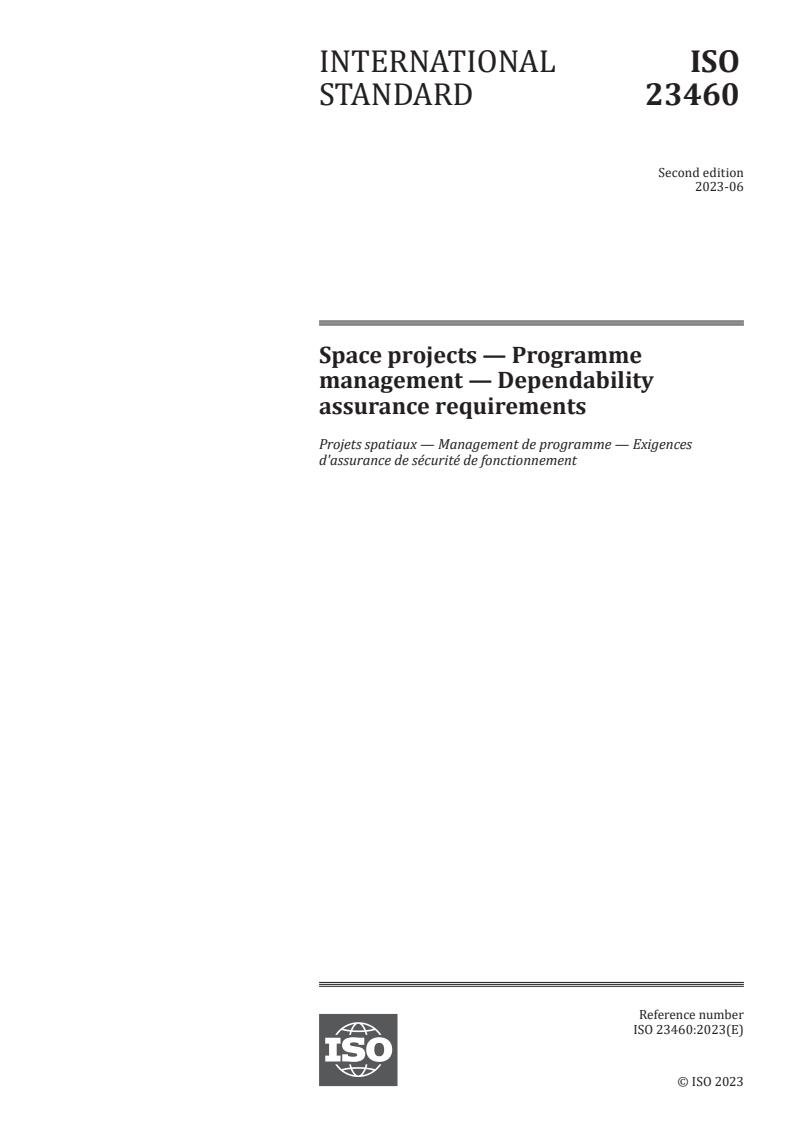
INTERNATIONAL ISO
STANDARD 23460
Second edition
2023-06
Space projects — Programme
management — Dependability
assurance requirements
Projets spatiaux — Management de programme — Exigences
d'assurance de sécurité de fonctionnement
Reference number
© ISO 2023
All rights reserved. Unless otherwise specified, or required in the context of its implementation, no part of this publication may
be reproduced or utilized otherwise in any form or by any means, electronic or mechanical, including photocopying, or posting on
the internet or an intranet, without prior written permission. Permission can be requested from either ISO at the address below
or ISO’s member body in the country of the requester.
ISO copyright office
CP 401 • Ch. de Blandonnet 8
CH-1214 Vernier, Geneva
Phone: +41 22 749 01 11
Email: copyright@iso.org
Website: www.iso.org
Published in Switzerland
ii
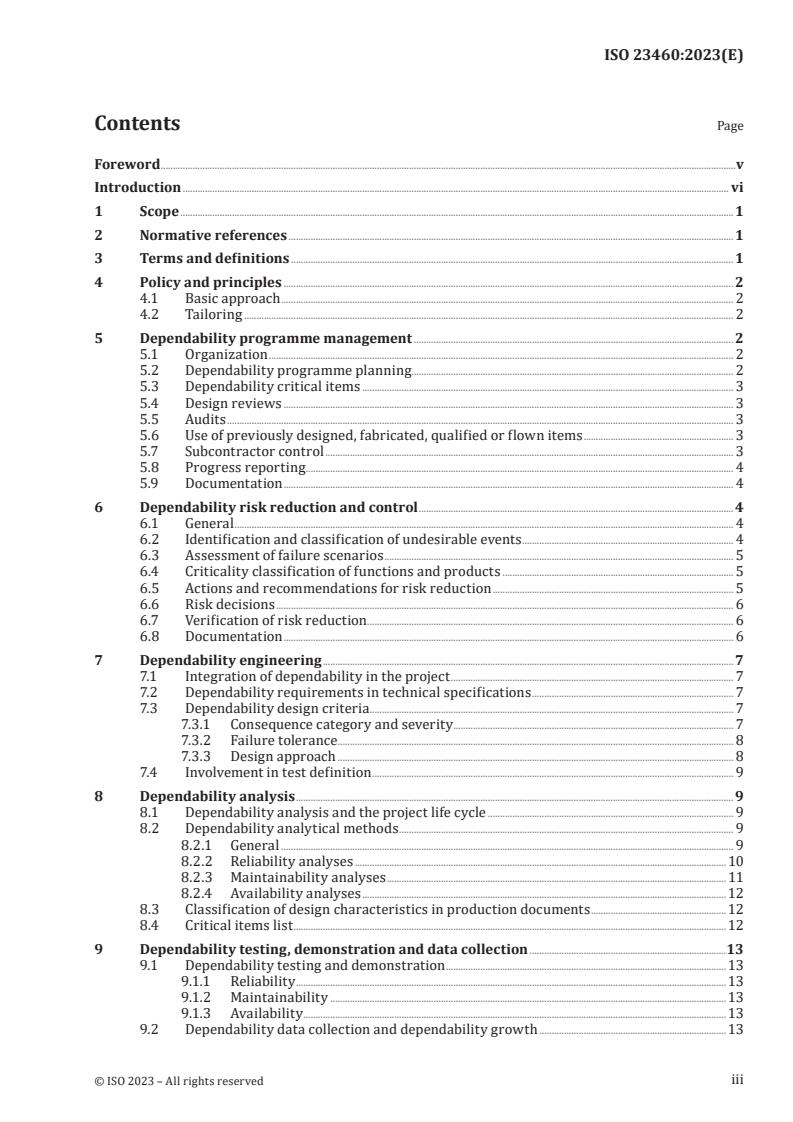
Contents Page
Foreword .v
Introduction . vi
1 Scope . 1
2 Normative references . 1
3 Terms and definitions . 1
4 Policy and principles . 2
4.1 Basic approach . 2
4.2 Tailoring . 2
5 Dependability programme management . 2
5.1 Organization . 2
5.2 Dependability programme planning. 2
5.3 Dependability critical items . 3
5.4 Design reviews . 3
5.5 Audits . 3
5.6 Use of previously designed, fabricated, qualified or flown items . 3
5.7 Subcontractor control . 3
5.8 Progress reporting . 4
5.9 Documentation . 4
6 Dependability risk reduction and control . 4
6.1 General . 4
6.2 Identification and classification of undesirable events . 4
6.3 Assessment of failure scenarios . 5
6.4 Criticality classification of functions and products . 5
6.5 Actions and recommendations for risk reduction . 5
6.6 Risk decisions . 6
6.7 Verification of risk reduction . 6
6.8 Documentation . 6
7 Dependability engineering .7
7.1 Integration of dependability in the project . 7
7.2 Dependability requirements in technical specifications . 7
7.3 Dependability design criteria . 7
7.3.1 Consequence category and severity . 7
7.3.2 Failure tolerance . 8
7.3.3 Design approach . 8
7.4 Involvement in test definition . 9
8 Dependability analysis . 9
8.1 Dependability analysis and the project life cycle . 9
8.2 Dependability analytical methods . 9
8.2.1 General . 9
8.2.2 Reliability analyses . 10
8.2.3 Maintainability analyses . 11
8.2.4 Availability analyses .12
8.3 Classification of design characteristics in production documents .12
8.4 Critical items list .12
9 Dependability testing, demonstration and data collection .13
9.1 Dependability testing and demonstration . 13
9.1.1 Reliability . 13
9.1.2 Maintainability . 13
9.1.3 Availability . 13
9.2 Dependability data collection and dependability growth .13
iii
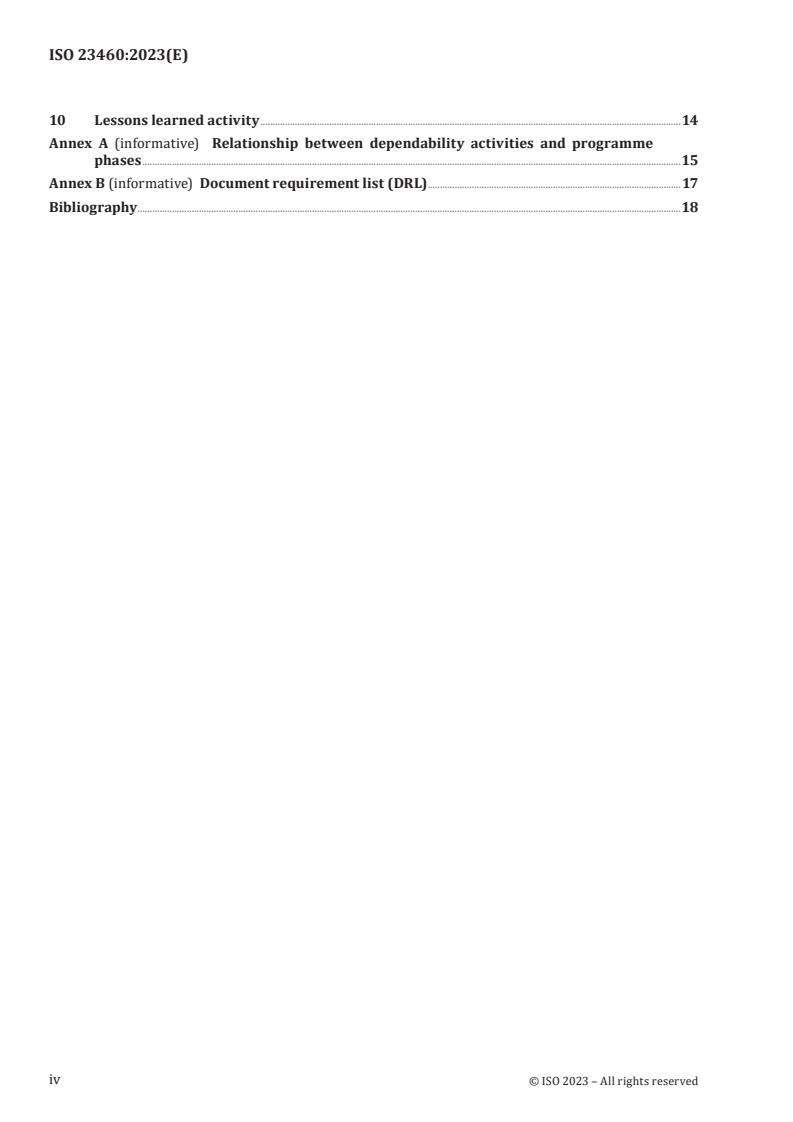
10 Lessons learned activity .14
Annex A (informative) Relationship between dependability activities and programme
phases .15
Annex B (informative) Document requirement list (DRL) .17
Bibliography .18
iv
Foreword
ISO (the International Organization for Standardization) is a worldwide federation of national standards
bodies (ISO member bodies). The work of preparing International Standards is normally carried out
through ISO technical committees. Each member body interested in a subject for which a technical
committee has been established has the right to be represented on that committee. International
organizations, governmental and non-governmental, in liaison with ISO, also take part in the work.
ISO collaborates closely with the International Electrotechnical Commission (IEC) on all matters of
electrotechnical standardization.
The procedures used to develop this document and those intended for its further maintenance are
described in the ISO/IEC Directives, Part 1. In particular, the different approval criteria needed for the
different types of ISO documents should be noted. This document was drafted in accordance with the
editorial rules of the ISO/IEC Directives, Part 2 (see www.iso.org/directives).
Attention is drawn to the possibility that some of the elements of this document may be the subject of
patent rights. ISO shall not be held responsible for identifying any or all such patent rights. Details of
any patent rights identified during the development of the document will be in the Introduction and/or
on the ISO list of patent declarations received (see www.iso.org/patents).
Any trade name used in this document is information given for the convenience of users and does not
constitute an endorsement.
For an explanation of the voluntary nature of standards, the meaning of ISO specific terms and
expressions related to conformity assessment, as well as information about ISO's adherence to
the World Trade Organization (WTO) principles in the Technical Barriers to Trade (TBT), see
www.iso.org/iso/foreword.html.
This document was prepared by Technical Committee ISO/TC 20, Aircraft and space vehicles,
Subcommittee SC 14, Space systems and operations.
This second edition cancels and replaces the first edition (ISO 23460:2011), which has been technically
revised.
The main changes are as follows:
— updating of normative references and related terms and definitions;
— minor changes on tables.
Any feedback or questions on this document should be directed to the user’s national standards body. A
complete listing of these bodies can be found at www.iso.org/members.html.
v
Introduction
The objective of dependability assurance is to ensure a successful mission by optimizing the system
dependability within all competing technical, scheduling and financial constraints.
Dependability assurance is a continuous and iterative process throughout the project life cycle, using
quantitative and qualitative approaches, with the aim of ensuring conformity to reliability, availability
and maintainability requirements.
vi
INTERNATIONAL STANDARD ISO 23460:2023(E)
Space projects — Programme management —
Dependability assurance requirements
1 Scope
This document specifies the requirements for a dependability (reliability, availability and
maintainability) assurance programme for space projects.
It defines the dependability requirements for space products as well as for system functions
implemented in software, and the interaction between hardware and software.
This document is applicable to all programme phases.
2 Normative references
The following documents are referred to in the text in such a way that some or all of their content
constitutes requirements of this document. For dated references, only the edition cited applies. For
undated references, the latest edition of the referenced document (including any amendments) applies.
ISO 10795, Space systems — Programme management and quality — Vocabulary
ISO 15865, Space systems — Qualification assessment
ISO 16192, Space systems — Experience gained in space projects (lessons learned) — Principles and
guidelines
ISO 17666, Space systems — Risk management
3 Terms and definitions
For the purposes of this document, the terms and definitions given in ISO 10795 and the following apply.
ISO and IEC maintain terminology databases for use in standardization at the following addresses:
— ISO Online browsing platform: available at https:// www .iso .org/ obp
— IEC Electropedia: available at https:// www .electropedia .org/
3.1
criticality
classification of a function or of a software, hardware or operation according to the severity of the
consequences of its potential failures
Note 1 to entry: This notion of criticality, applied to a function or a software, hardware or operation, considers
only severity, differently from the criticality of a failure or failure mode (or a risk), which also considers the
likelihood or probability of occurrence.
3.2
failure scenario
conditions and sequence of events leading from the initial root cause to an end failure
4 Policy and principles
4.1 Basic approach
To achieve the objectives of dependability, dependability assurance is implemented according to a
logical process.
This process starts in the conceptual design phase at the highest level of the functional tree with a
top-down definition of tasks and requirements to be implemented. Results achieved at all levels of the
functional tree are controlled and used in a bottom-up approach so as to consolidate dependability
assurance of the product. The relationship between dependability activities and programme phases are
provided in Annex A.
This process includes the following types of activities:
a) definition, organization and implementation of the dependability programme, as defined in
Clause 5;
b) dependability risk identification, reduction and control, as defined in Clause 6;
c) dependability engineering, as defined in Clause 7;
d) dependability analyses, as defined in Clause 8;
e) dependability testing, demonstration and data collection, as defined in Clause 9.
4.2 Tailoring
When viewed from the perspective of a specific project context, the requirements defined in
this document should be tailored to match the genuine requirements of a particular profile and
circumstances of a project.
5 Dependability programme management
5.1 Organization
The contractor shall implement the dependability (reliability, availability and maintainability)
assurance as an integral part of the product assurance discipline.
5.2 Dependability programme planning
The contractor shall develop, maintain and implement a dependability plan for all programme phases
that describes how conformity with the dependability programme requirements is demonstrated. The
plan shall address the applicable requirements of this document.
The content of document requirement list (DRL) used as dependability programme input to the overall
project DR, is provided in Annex B.
For each product, the extent to which dependability assurance is applied shall be adapted to the severity
(as defined in 7.3.1) of the consequences of failures at system level. For this purpose, products shall be
classified into appropriate categories that are defined in accordance with the risk policy of the project.
The contractor shall identify a failure as nonconformity and shall perform a series of control activities
such as reporting, analyses, and prevention consistently with nonconforming item control system in
quality management system.
5.3 Dependability critical items
Dependability critical items are identified by dependability analyses carried out to support the risk
reduction and control process performed on the project. The criteria for identifying dependability
critical items are given in 6.4.
Dependability critical items shall be subject to risk assessment and critical items control.
The control measures shall include:
a) a review of all design, manufacturing and test documentation related to critical functions, critical
items and procedures, to ensure that appropriate measures are taken to control the item having a
bearing on its criticality;
b) dependability participation on nonconformity review boards (NRB), failure review boards,
configuration control boards and test review boards (TRB), and the approval process for waivers
and deviations, to ensure that dependability critical items are disposed with due regard to their
criticality.
The dependability aspects shall be considered within the entire verification process for dependability
critical items until close out.
5.4 Design reviews
The contractor should establish and conduct a formal programme of scheduled and documented design
reviews using ISO 21349 for guidance.
The contractor shall ensure that all dependability data for a design review is complete to a level of
detail consistent with the objectives of the review and are presented to the customer in accordance
with the project review schedule.
The contractor shall ensure that dependability aspects are duly considered in all design reviews.
All dependability data submitted shall clearly indicate the design baseline upon which it is based and
shall be coherent with all other supporting technical documentation.
All design changes shall be assessed for their impact on dependability and a reassessment of the
dependability shall be performed on the modified design where necessary.
5.5 Audits
The audits shall include the dependability activities to verify conformity to the project dependability
plan and requirements.
5.6 Use of previously designed, fabricated, qualified or flown items
Where the contractor proposes to take advantage of previously designed, manufactured, qualified or
flown elements in the system, she/he shall demonstrate that the proposed elements conform to the
dependability assurance requirements of the design specification.
Nonconformity to dependability assurance requirements shall be identified and the rationale for
retention of unresolved nonconformity shall be provided by a waiver request.
5.7 Subcontractor control
The contractor shall be responsible for ensuring that products obtained from subcontractors meet the
dependability requirements specified for the overall system.
5.8 Progress reporting
The contractor shall report dependability progress to the customer as part of product assurance.
5.9 Documentation
The contractor shall maintain all data used for the dependability programme. The file shall contain the
following as a minimum:
a) dependability analyses, lists, reports and input data;
b) dependability recommendation status log.
In accordance with the business agreement, the customer shall have access to project dependability
data upon request.
6 Dependability risk reduction and control
6.1 General
As part of the risk management process implemented on the project in accordance with ISO 17666, the
contractor shall analyse, reduce and control all dependability risks that lead to the nonconformity of
dependability requirements, i.e. all risks of degradation or loss of technical performance required for
the product.
Dependability risk analysis reduction and control shall include the following steps:
a) identification and classification of undesirable events according to the severity of their
consequences;
b) analysis of failure scenarios, determination of related failure modes, failure origins or causes;
c) classification of functions and associated products into criticality categories, allowing definition of
appropriate tailoring of risk reduction efforts in relation to their criticality;
d) definition of actions and recommendations for detailed risk assessment, risk elimination, or risk
reduction and control to an acceptable level;
e) implementation of risk reduction;
f) decisions on risk reduction and risk acceptance;
g) verification of risk reduction, assessment of residual risks.
6.2 Identification and classification of undesirable events
The contractor shall provide identification of undesirable events leading to the loss or degradation of
technical performance, together with their classification into categories related to the severity of their
consequences (see 7.3.1).
Preliminary identification and classification of undesirable events shall be determined from an analysis
of criteria for mission success, during conceptual and preliminary design phases. The undesirable
events to be considered at the highest product level (overall system including space and ground
segments) shall all be events whose occurrence can jeopardize, compromise, or degrade the success
of the mission. At lower levels of the product tree (space segment, ground segment, sub-assemblies
and equipment), the undesirable events to be considered shall be the product failure effects which can
induce the undesirable events identified for the highest product level.
Identification and classification of undesirable events shall be consolidated after assessment of failure
scenarios (see 6.3).
6.3 Assessment of failure scenarios
The contractor shall investigate the possible scenarios leading to the occurrence of undesirable events,
and shall identify related failure modes, failure origins and causes, and detailed failure effects.
In conceptual and preliminary design phases, the following analyses shall be performed for preliminary
determination and assessment of the failure scenarios.
a) Analysis of functional failures (i.e. failures of the functions involved in the realization of the product
mission) using functional failure modes effects analysis (FMEA), as defined in 8.2.2, which enables
the determination of the effects (induced risks) for each function: loss, degradation and untimely
occurrence. The functions shall be defined in advance (the functional analysis can be used for this
purpose).
b) Analysis of the functional failure to be conducted for each phase of the product life cycle considering
all modes of operations in their actual sequence of implementation throughout the mission with
the purpose of identifying undesirable events induced by erroneous sequencing (e.g. loss of
synchronism and untimely operations).
c) Analysis of the potential propagation of failures between different functions to be investigated.
d) Analysis of failure modes associated with the human factor in performance of operations.
e) Analysis of potential application to the product of typical failure modes already observed from past
experience on similar products or missions.
In the detailed design phase, the assessment of failure scenarios shall be consolidated by considering
the following additional contributions:
— analysis of specific failure modes and failure effects induced by the selected design which cannot be
detected by the analysis of functional failure;
— analysis for detection of potential failure propagation paths induced by proximity of elements.
6.4 Criticality classification of functions and products
During the preliminary design phase, the contractor shall classify functions, operations and products
into criticality categories.
The criticality category of functions and operations shall be directly related to the severity of the
consequences resulting from failure of the function or operation (e.g. a function whose failure induces a
catastrophic consequence shall be classified with the highest criticality level).
The criticality category of products (hardware and software) shall be the highest criticality category of
the functions associated to the product.
The criticality classification shall be used to focus efforts on the most critical areas.
6.5 Actions and recommendations for risk reduction
The contractor shall define actions and recommendations for risk reduction up to an acceptable level.
In the context of risk reduction, the following measures shall be considered:
a) detailed risk assessment based on the performance of dedicated dependability analyses, and in
specific cases, performance of dependability tests; a selection and tailoring of the dependability
analyses presented in Clause 8 shall be defined according to the nature and the criticality category
of the product;
b) elimination of failure causes, reduction of failure occurrence probability, reduction of failure
effects, monitoring and control of the failure scenarios by specifications on the design or operations
...