

ISO 2629:1973
(Main)Basic mode control procedures — Conversational information message transfer
General Information
- Abstract
- Status
- Published
- Publication Date
- 31-Jan-1973
- Drafting Committee
- ISO/IEC JTC 1/SC 6/WG 1 - Physical and data link layers
- Current Stage
- 9093 - International Standard confirmed
- Start Date
- 13-Jan-2005
- Completion Date
- 29-Aug-2026
Buy Documents

ISO 2629:1973 - Basic mode control procedures — Conversational information message transfer Released:2/1/1973

ISO 2629:1973 - Basic mode control procedures — Conversational information message transfer Released:2/1/1973
Overview - ISO 2629:1973 (Basic mode control procedures: Conversational information message transfer)
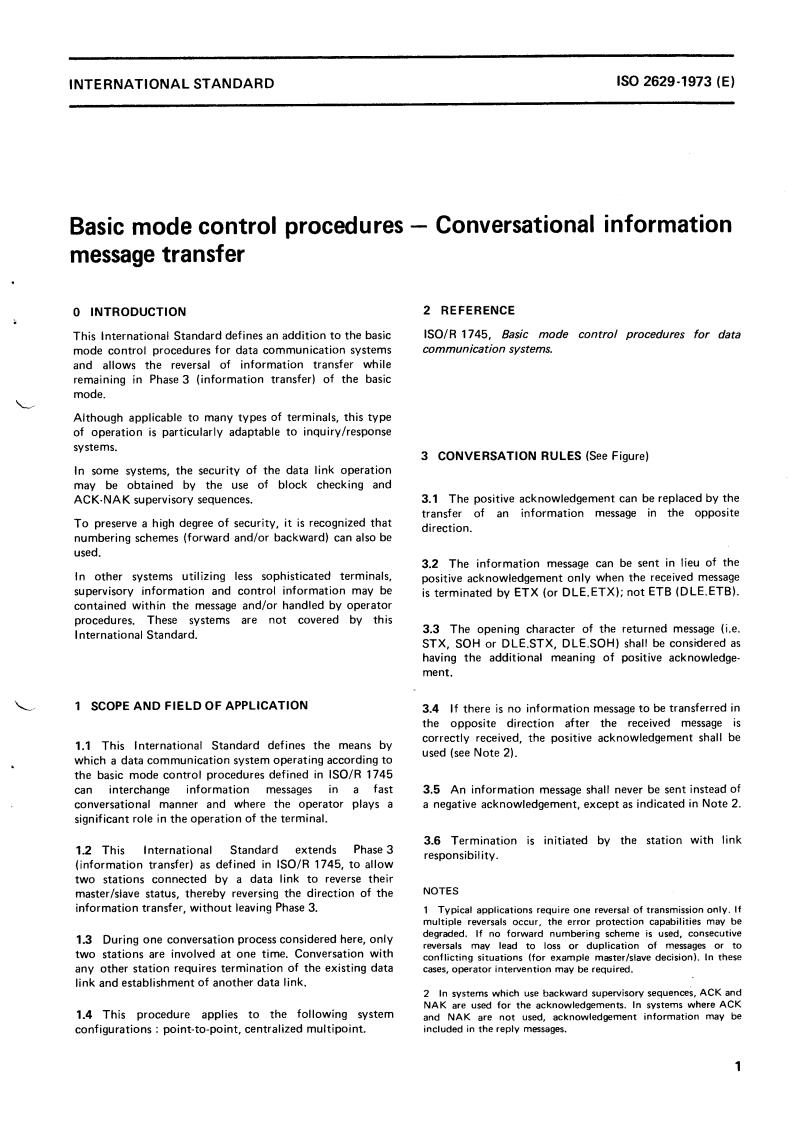
ISO 2629:1973 is a short International Standard that extends the basic mode control procedures described in ISO/R 1745 to support fast, conversational information transfer between two terminals while remaining in Phase 3 (information transfer). Published in 1973, it defines how two stations on a data link can reverse master/slave roles and exchange information messages in an inquiry/response style interaction without re-establishing the link.
Key topics and technical requirements
- Phase 3 extension: Allows reversal of information transfer direction (master/slave reversal) while remaining in Phase 3 of the basic mode.
- Conversation rules:
- An information message sent in the opposite direction may replace a positive acknowledgement (ACK) under controlled conditions.
- Replacement is permitted only when the received message is terminated by ETX (or DLE ETX), not ETB (DLE ETB).
- The opening character of the returned message (e.g., STX, SOH, DLE STX, DLE SOH) is treated as a positive acknowledgement.
- An information message must never substitute for a negative acknowledgement (NAK).
- Security and error control:
- Systems may use block checking and ACK/NAK supervisory sequences to preserve link integrity.
- Numbering schemes (forward and/or backward) are recommended to avoid duplication or loss when reversals occur.
- Recovery procedures:
- If no reply or an invalid reply is received, the sender should repeat the information message or send ENQ to request a retransmission.
- Repeated transmissions can cause block duplication; robust numbering is necessary to detect and correct duplicates.
- Applicability limits:
- Intended for terminals where an operator plays a role (conversational/inquiry-response systems).
- Systems that embed supervisory/control information within messages or rely on operator procedures are not covered.
Applications and who uses it
ISO 2629 is applicable to designers and implementers of legacy and constrained data-communication systems that require:
- Conversational, half-duplex or reversible data exchange without leaving an established information-transfer phase.
- Inquiry/response terminal interactions (e.g., remote terminals, transaction inquiry systems).
- Protocol designers implementing basic-mode control behavior consistent with ISO/R 1745.
Typical users: standards engineers, protocol implementers, telecommunications equipment designers, and system integrators working with archival or standards-compliant data link procedures.
Related standards
- ISO/R 1745 - Basic mode control procedures for data communication systems (the foundational standard extended by ISO 2629:1973).
Buy Documents
ISO 2629:1973 - Basic mode control procedures — Conversational information message transfer Released:2/1/1973
ISO 2629:1973 - Basic mode control procedures — Conversational information message transfer Released:2/1/1973
Get Certified
Connect with accredited certification bodies for this standard

BSI Group
BSI (British Standards Institution) is the business standards company that helps organizations make excellence a habit.

NYCE
Mexican standards and certification body.
Sponsored listings
Frequently Asked Questions
ISO 2629:1973 is a standard published by the International Organization for Standardization (ISO). Its full title is "Basic mode control procedures — Conversational information message transfer". This standard covers: Basic mode control procedures — Conversational information message transfer
Basic mode control procedures — Conversational information message transfer
ISO 2629:1973 is classified under the following ICS (International Classification for Standards) categories: 35.100.20 - Data link layer. The ICS classification helps identify the subject area and facilitates finding related standards.
ISO 2629:1973 is available in PDF format for immediate download after purchase. The document can be added to your cart and obtained through the secure checkout process. Digital delivery ensures instant access to the complete standard document.
Standards Content (Sample)
,en!!
INTERNATIONAL STANDARD @ '*=e 2629
INTERNATIONAL ORGANIZATION FOR STANDARDIZATION .MElAYHAPOJlHAII OPTAHHSALLHR II0 CTAHDAFTH3AUHH .ORGANISATION INTERNATIONALE DE NORMALISATION
L
Basic mode control procedures - Conversational information
message transfer
First edition - 1973-02- 15
L
Ref. No. IS0 2629-1973 (E)
UDC 681.14
Descriptors : data processing, data transmission, control procedures.
Price based on 2 pages
FOREWORD
IS0 (the International Organization for Standardization) is a worldwide federation
of national standards institutes (IS0 Member Bodies). The work of developing
International Standards is carried out through IS0 Technical Committees. Every
Member Body interested in a subject for which a Technical Committee has been set
up has the right to be represented on that Committee. International organizations,
governmental and non-governmental, in liaison with KO, also take part in the work.
Draft International Standards adopted by the Technical Committees are circulated
as International
to the Member Bodies for approval before their acceptance
Standards by the IS0 Council.
International Standard IS0 2629 was drawn up by Technical Committee
Computers and information processing.
ISOITC 97,
It was approved in September 1972 by the Member Bodies of the following
countries :
Australia Germany South Africa, Rep. of
Belgium Ireland Spain
Brazil Italy Sweden
Canada Japan Switzerland
Netherlands
Czec hosl ova k ia Thailand
New Zealand United Kingdom
Denmark
Portugal
Egypt, Arab Rep. of U.S.A.
Romania R.
France U.S.S.
Y'
No Member Body expressed disapproval of the document.
O International Organization for Standardization, 1973 O
Printed in Switzerland
IS0 2629-1973 (E)
INTERNATIONAL STAN DARD
Basic mode control procedures - Conversational information
message transfer
2 REFERENCE
O INTRODUCTION
ISO/R 1745, Basic mode control procedures for data
This International Standard defines an addition to the basic
comrnunica tion systems.
mode control procedures for data communication systems
and allows the reversal of information transfer while
remaining in Phase 3 (information transfer) of the basic
mode.
c
Although applicable to many types of terminals, this type
of operation is particularly adaptable to inquiry/response
systems.
3 CONVERSATION RULES (See Figure)
In some systems, the security of the data link operation
may be obtained by the use of block checking and
ACK-NAK supervisory sequences. 3.1 The positive acknowledgement can be replaced by the
transfer of an information message in the opposite
To preserve a high degree of security, it is recognized that
direction.
numbering schemes (forward and/or backward) can also be
used.
3.2 The information message can be sent in lieu of the
In other systems utilizing less sophisticated terminals,
positive acknowledgement only when the received message
supervisory information and control information may be
is terminated by E
...
INTERNATIONAL ORGANIZATION FOR STANDARDIZATION .MEXCnYHAPOnHAff OPrAHH3AUHR II0 CTAHLIAFTH3AUHH *ORGANISATION INTERNATIONALE DE NORMALISATION
Procedures de commande en mode de base - Transfert
conversationnel de message d'information
Première édition - 1973-02-15
~
I
U
Ref. NO : IS0 2629-1973 (FI
CDU 681.14
-
Descripteurs : traitement de l'information, transmission de données, procédure de commande.
$2
CD
N
Prix basé sur 2 pages
s
AVANT-PROPOS
IS0 (Organisation Internationale de Normalisation) est une fédération mondiale
d'organismes nationaux de normalisation (Comités Membres ISO). L'élaboration de
Normes Internationales est confiée aux Comités Techniques ISO. Chaque Comité
Membre intéressé par une étude a le droit de faire partie du Comité Technique
correspondant. Les organisations internationales, gouvernementales et non
gouvernementales, en liaison avec I'ISO, participent également aux travaux.
Les Projets de Normes Internationales adoptés par les Comités Techniques sont
soumis aux Comités Membres pour approbation, avant leur acceptation comme
Normes Internationales par le Conseil de I'ISO.
La Norme Internationale IS0 2629 a été établie par le Comité Technique
ISOKC 97, Calculateurs et traitement de I'information.
Elle fut approuvée en septembre 1972 par les Comités Membres des pays suivants :
Afrique du Sud, Rép. d'
Espagne Roumanie
Allemagne France Royaume- Uni
Australie Irlande Suède
Belgique Italie Suisse
Brésil Japon Tchécoslovaquie
Canada Nouvel le-Zélande Thaïlande
Danemark Pays-Bas U.R.S.S.
Egypte, Rép. arabe d' Portugal U.S.A.
Aucun Comité Membre n'a désapprouvé le document.
O Organisation Internationale de Normalisation, 1973 O
Imprimé en Suisse
NORME INTERNATIONALE IS0 2629-1973 (F)
Procédures de commande en mode de base - Transfert
conversationnel de message d'information
O INTRODUCTION 2 RÉFÉRENCE
La présente Norme Internationale définit un complément ISO/R 1745, Procédure de commande pour transmission de
aux procédures de commande en mode de base destiné aux
données en mode de base,
systèmes de transmission de données. II permet l'inversion
du sens de transfert des informations, tout en restant dans
la Phase 3 (transfert d'information) du mode de base.
Bien que s'appliquant à plusieurs sortes de terminaux, ce
type d'opération est particulièrement adapté aux terminaux
3 REGLES DE DIALOGUE (Voir Figure)
d'interrogation.
Pour certains systèmes, la sécurité de fonctionnement du
3.1 L'accusé de réception positif peut être remplacé par le
chaînon peut être obtenue à l'aide d'un contrôle par bloc et
transfert d'un message dans la direction opposée.
des séquences de supervision ACK-NAK.
Pour garantir lin niveau élevé de sécurité, des systèmes de
3.2 Le message d'information ne peut être envoyé à la
numérotation (dans un sens et dans l'autre) peuvent aussi
place de l'accusé de réception positif que si le message r,eçu
être utilisés.
se termine par ETX (ou DLE.ETX), et non par ETB
(D LE.ETB).
Pour d'autres systèmes, utilisant des terminaux moins
perfectionnés, les informations de supervision et celles des
procédures de contrôle peuvent se trouver à l'intérieur du
...