

ISO/TS 8000-65:2020
(Main)Data quality — Part 65: Data quality management: Process measurement questionnaire
General Information
- Abstract
This document specifies a questionnaire to audit the performance of the processes specified by the process reference model in ISO 8000‑61. NOTE 1 This questionnaire is applicable to all types of business process, technology, information system, data and data processing. This questionnaire can be used as part of a continuous improvement process. The following are within the scope of this document: — guiding principles for generating questions from the process outcomes specified by ISO 8000‑61; — one or more questions for each outcome of every process in ISO 8000‑61; — a measurement method based on a simple indicator and measurement scale for each question; — guidance on how to present the results generated by the questionnaire. NOTE 2 The questions and corresponding indicators in this document conform to the requirements of ISO 8000‑63. The following is outside the scope of this document: — defining how the questions relate to models of organizational process maturity. NOTE 3 Such models define an overall scale by which to understand the degree to which an organization is performing effectively and efficiently. EXAMPLE ISO 8000‑62 and ISO 8000‑64 [1]specify how to use maturity models with ISO 8000‑61. [1] Under preparation.
- Status
- Published
- Publication Date
- 24-Jun-2020
- Technical Committee
- ISO/TC 184/SC 4 - Industrial data
- Drafting Committee
- ISO/TC 184/SC 4/WG 13 - Industrial Data Quality
- Current Stage
- 9093 - International Standard confirmed
- Start Date
- 06-Dec-2023
- Completion Date
- 29-Aug-2026
Buy Documents

ISO/TS 8000-65:2020 - Data quality — Part 65: Data quality management: Process measurement questionnaire Released:6/25/2020

ISO/TS 8000-65:2020 - Data quality — Part 65: Data quality management: Process measurement questionnaire/25/2020
Overview
ISO/TS 8000-65:2020 - Data quality - Part 65: Data quality management: Process measurement questionnaire - provides a standardized questionnaire to audit and measure the performance of the data quality management processes defined in ISO 8000‑61. The technical specification is applicable to all types of business processes, technologies, information systems, data and data processing and is intended to support continuous improvement of data quality practices.
Key SEO keywords: ISO/TS 8000-65:2020, data quality, process measurement questionnaire, ISO 8000-61, data quality management, audit, data governance, data quality assessment.
Key Topics
- Scope and purpose
- A questionnaire mapped to every outcome of the ISO 8000‑61 process reference model to enable a high-level assessment of implemented data quality processes.
- Applicable across industries and data types (master data, transaction data, product data).
- Question generation principles
- Questions are derived from ISO 8000‑61 process outcomes and aligned with the requirements of ISO 8000‑63.
- Measurement method
- Simple indicators with a binary measurement scale: Yes / No.
- “Yes” answers require supporting evidence (document number, title, version) to create a reproducible baseline.
- Questionnaire coverage
- Addresses higher-level processes: data quality planning, control, assurance, improvement, data-related support, and resource provision.
- Reporting and visualization
- Guidance included for weighting, measurement scales, and presenting results to highlight organizational capabilities that need improvement (e.g., data exchange, data exploitation, HR, standardization).
- What's out of scope
- The standard does not define how questionnaire results map to organizational maturity models (see ISO 8000‑62 / 8000‑64 for maturity model usage).
Applications
- Data governance and quality teams - to audit current data quality processes and gather evidence for compliance.
- Quality managers and auditors - to perform repeatable assessments and track improvements over time.
- IT, MDM and data operations - to verify implementation of specifications, data transfer and processing controls.
- Continuous improvement programs - to identify gaps, prioritize remediation and validate corrective actions.
- Useful in supplier assessments, internal audits, pre-implementation reviews and benchmarking of data quality practices.
Related Standards
- ISO 8000‑61 - Data quality management: Process reference model (primary reference).
- ISO 8000‑63 - Requirements for indicators used in this questionnaire.
- ISO 8000‑62 / ISO 8000‑64 - Guidance on using maturity models with ISO 8000‑61 (related for maturity mapping).
ISO/TS 8000‑65:2020 is a practical, evidence-based tool for organizations seeking consistent, auditable measurement of data quality management processes and for embedding data quality into governance and continuous improvement workflows.
Buy Documents
ISO/TS 8000-65:2020 - Data quality — Part 65: Data quality management: Process measurement questionnaire Released:6/25/2020
ISO/TS 8000-65:2020 - Data quality — Part 65: Data quality management: Process measurement questionnaire/25/2020
Get Certified
Connect with accredited certification bodies for this standard

DVS-ZERT GmbH
German welding certification society.
CARES (UK Certification Authority for Reinforcing Steels)
UK certification for reinforcing steels and construction.
EWF/IIW (European/International Welding Federation)
International welding personnel certification.
Sponsored listings
Frequently Asked Questions
ISO/TS 8000-65:2020 is a technical specification published by the International Organization for Standardization (ISO). Its full title is "Data quality — Part 65: Data quality management: Process measurement questionnaire". This standard covers: This document specifies a questionnaire to audit the performance of the processes specified by the process reference model in ISO 8000‑61. NOTE 1 This questionnaire is applicable to all types of business process, technology, information system, data and data processing. This questionnaire can be used as part of a continuous improvement process. The following are within the scope of this document: — guiding principles for generating questions from the process outcomes specified by ISO 8000‑61; — one or more questions for each outcome of every process in ISO 8000‑61; — a measurement method based on a simple indicator and measurement scale for each question; — guidance on how to present the results generated by the questionnaire. NOTE 2 The questions and corresponding indicators in this document conform to the requirements of ISO 8000‑63. The following is outside the scope of this document: — defining how the questions relate to models of organizational process maturity. NOTE 3 Such models define an overall scale by which to understand the degree to which an organization is performing effectively and efficiently. EXAMPLE ISO 8000‑62 and ISO 8000‑64 [1]specify how to use maturity models with ISO 8000‑61. [1] Under preparation.
This document specifies a questionnaire to audit the performance of the processes specified by the process reference model in ISO 8000‑61. NOTE 1 This questionnaire is applicable to all types of business process, technology, information system, data and data processing. This questionnaire can be used as part of a continuous improvement process. The following are within the scope of this document: — guiding principles for generating questions from the process outcomes specified by ISO 8000‑61; — one or more questions for each outcome of every process in ISO 8000‑61; — a measurement method based on a simple indicator and measurement scale for each question; — guidance on how to present the results generated by the questionnaire. NOTE 2 The questions and corresponding indicators in this document conform to the requirements of ISO 8000‑63. The following is outside the scope of this document: — defining how the questions relate to models of organizational process maturity. NOTE 3 Such models define an overall scale by which to understand the degree to which an organization is performing effectively and efficiently. EXAMPLE ISO 8000‑62 and ISO 8000‑64 [1]specify how to use maturity models with ISO 8000‑61. [1] Under preparation.
ISO/TS 8000-65:2020 is classified under the following ICS (International Classification for Standards) categories: 25.040.40 - Industrial process measurement and control. The ICS classification helps identify the subject area and facilitates finding related standards.
ISO/TS 8000-65:2020 is available in PDF format for immediate download after purchase. The document can be added to your cart and obtained through the secure checkout process. Digital delivery ensures instant access to the complete standard document.
Standards Content (Sample)
TECHNICAL ISO/TS
SPECIFICATION 8000-65
First edition
2020-06
Data quality —
Part 65:
Data quality management: Process
measurement questionnaire
Reference number
©
ISO 2020
© ISO 2020
All rights reserved. Unless otherwise specified, or required in the context of its implementation, no part of this publication may
be reproduced or utilized otherwise in any form or by any means, electronic or mechanical, including photocopying, or posting
on the internet or an intranet, without prior written permission. Permission can be requested from either ISO at the address
below or ISO’s member body in the country of the requester.
ISO copyright office
CP 401 • Ch. de Blandonnet 8
CH-1214 Vernier, Geneva
Phone: +41 22 749 01 11
Email: copyright@iso.org
Website: www.iso.org
Published in Switzerland
ii © ISO 2020 – All rights reserved
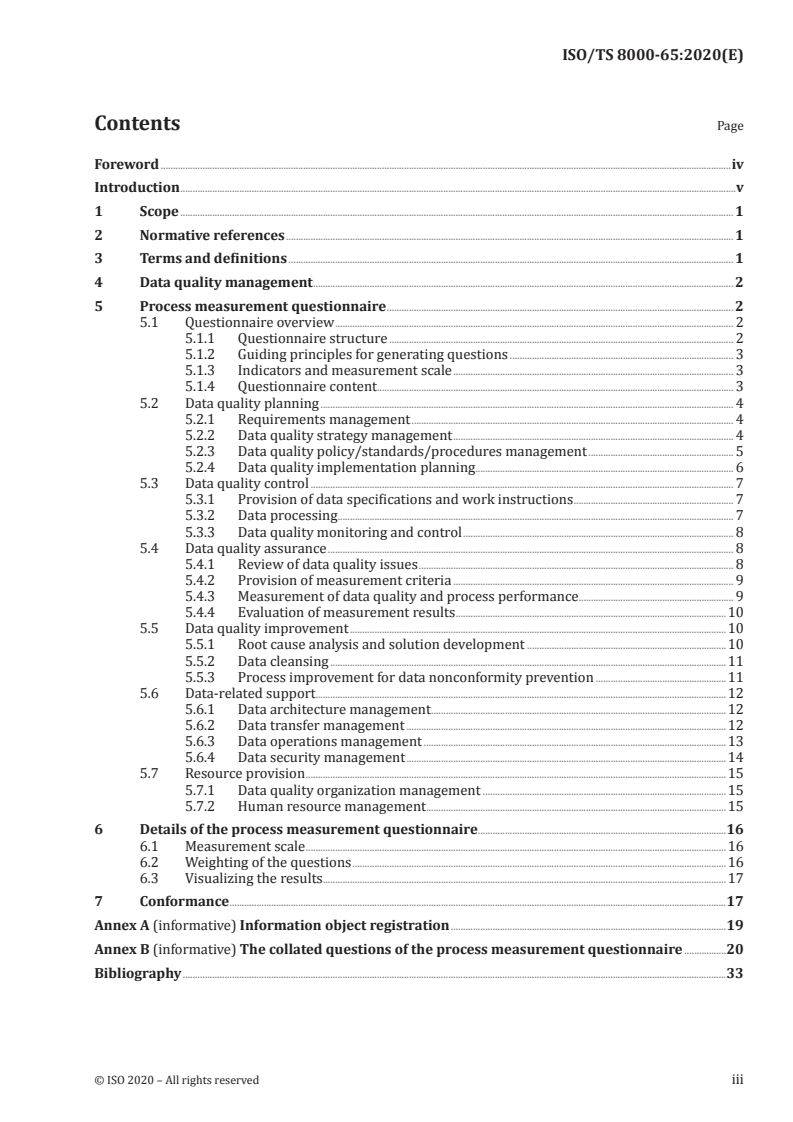
Contents Page
Foreword .iv
Introduction .v
1 Scope . 1
2 Normative references . 1
3 Terms and definitions . 1
4 Data quality management . 2
5 Process measurement questionnaire . 2
5.1 Questionnaire overview . 2
5.1.1 Questionnaire structure . 2
5.1.2 Guiding principles for generating questions . 3
5.1.3 Indicators and measurement scale . 3
5.1.4 Questionnaire content . . . 3
5.2 Data quality planning . 4
5.2.1 Requirements management . 4
5.2.2 Data quality strategy management . 4
5.2.3 Data quality policy/standards/procedures management . 5
5.2.4 Data quality implementation planning . . 6
5.3 Data quality control . 7
5.3.1 Provision of data specifications and work instructions . 7
5.3.2 Data processing . 7
5.3.3 Data quality monitoring and control . 8
5.4 Data quality assurance . 8
5.4.1 Review of data quality issues . 8
5.4.2 Provision of measurement criteria . 9
5.4.3 Measurement of data quality and process performance . 9
5.4.4 Evaluation of measurement results .10
5.5 Data quality improvement .10
5.5.1 Root cause analysis and solution development .10
5.5.2 Data cleansing .11
5.5.3 Process improvement for data nonconformity prevention .11
5.6 Data-related support.12
5.6.1 Data architecture management .12
5.6.2 Data transfer management .12
5.6.3 Data operations management .13
5.6.4 Data security management .14
5.7 Resource provision .15
5.7.1 Data quality organization management .15
5.7.2 Human resource management .15
6 Details of the process measurement questionnaire .16
6.1 Measurement scale .16
6.2 Weighting of the questions .16
6.3 Visualizing the results .17
7 Conformance .17
Annex A (informative) Information object registration .19
Annex B (informative) The collated questions of the process measurement questionnaire .20
Bibliography .33
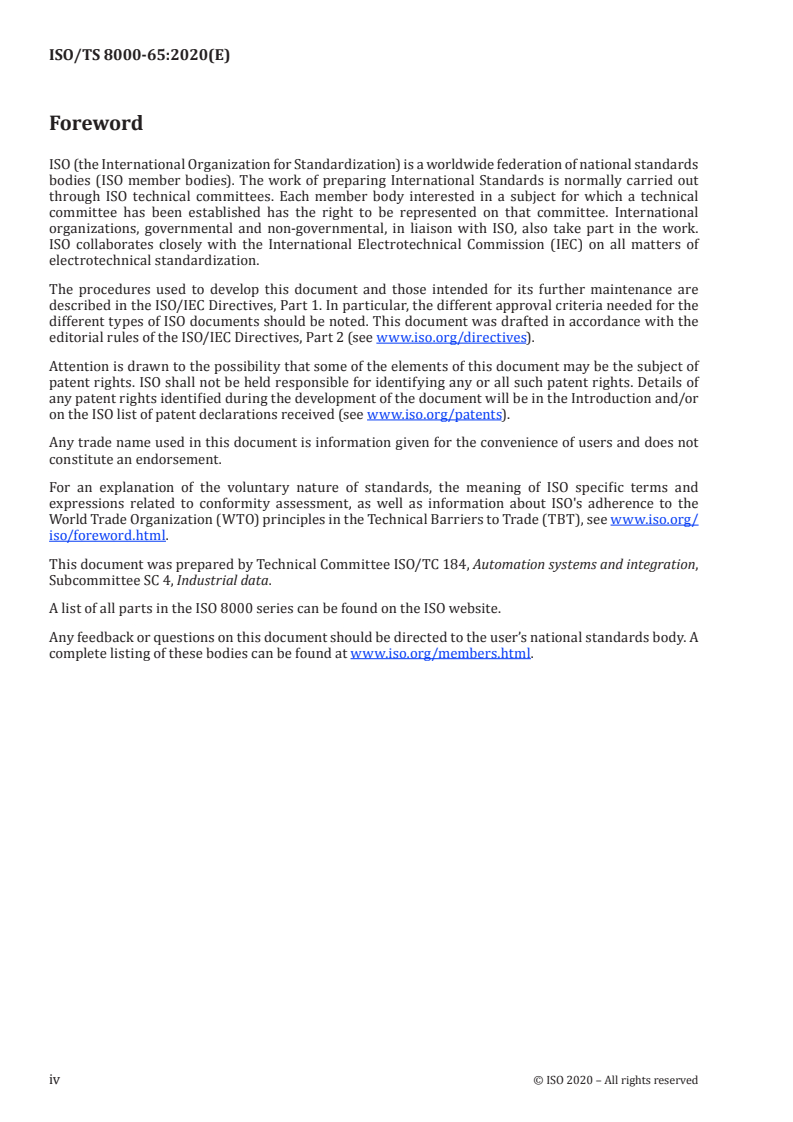
Foreword
ISO (the International Organization for Standardization) is a worldwide federation of national standards
bodies (ISO member bodies). The work of preparing International Standards is normally carried out
through ISO technical committees. Each member body interested in a subject for which a technical
committee has been established has the right to be represented on that committee. International
organizations, governmental and non-governmental, in liaison with ISO, also take part in the work.
ISO collaborates closely with the International Electrotechnical Commission (IEC) on all matters of
electrotechnical standardization.
The procedures used to develop this document and those intended for its further maintenance are
described in the ISO/IEC Directives, Part 1. In particular, the different approval criteria needed for the
different types of ISO documents should be noted. This document was drafted in accordance with the
editorial rules of the ISO/IEC Directives, Part 2 (see www .iso .org/ directives).
Attention is drawn to the possibility that some of the elements of this document may be the subject of
patent rights. ISO shall not be held responsible for identifying any or all such patent rights. Details of
any patent rights identified during the development of the document will be in the Introduction and/or
on the ISO list of patent declarations received (see www .iso .org/ patents).
Any trade name used in this document is information given for the convenience of users and does not
constitute an endorsement.
For an explanation of the voluntary nature of standards, the meaning of ISO specific terms and
expressions related to conformity assessment, as well as information about ISO's adherence to the
World Trade Organization (WTO) principles in the Technical Barriers to Trade (TBT), see www .iso .org/
iso/ foreword .html.
This document was prepared by Technical Committee ISO/TC 184, Automation systems and integration,
Subcommittee SC 4, Industrial data.
A list of all parts in the ISO 8000 series can be found on the ISO website.
Any feedback or questions on this document should be directed to the user’s national standards body. A
complete listing of these bodies can be found at www .iso .org/ members .html.
iv © ISO 2020 – All rights reserved
Introduction
The ability to create, collect, store, maintain, transfer, process and present data to support business
processes in a timely and cost effective manner requires both an understanding of the characteristics
of the data that determine its quality, and an ability to measure, manage and report on data quality.
ISO 8000 defines characteristics that can be tested by any organization in the data supply chain to
objectively determine conformance of the data to ISO 8000.
ISO 8000 provides frameworks for improving data quality for specific kinds of data. The frameworks
can be used independently or in conjunction with quality management systems.
ISO 8000 covers industrial data quality characteristics throughout the product life cycle from
conception to disposal. ISO 8000 addresses specific kinds of data including, but not limited to, master
data, transaction data, and product data.
This document establishes a simple measurement method, based on the high-level reference processes
of ISO 8000-61. Evaluating the data quality management implementation of an organization. Each
question has been derived from the outcomes of every process in ISO 8000-61.
Annex A contains an identifier that unambiguously identifies this document in an open information
system.
TECHNICAL SPECIFICATION ISO/TS 8000-65:2020(E)
Data quality —
Part 65:
Data quality management: Process measurement
questionnaire
1 Scope
This document specifies a questionnaire to audit the performance of the processes specified by the
process reference model in ISO 8000-61.
NOTE 1 This questionnaire is applicable to all types of business process, technology, information system, data
and data processing. This questionnaire can be used as part of a continuous improvement process.
The following are within the scope of this document:
— guiding principles for generating questions from the process outcomes specified by ISO 8000-61;
— one or more questions for each outcome of every process in ISO 8000-61;
— a measurement method based on a simple indicator and measurement scale for each question;
— guidance on how to present the results generated by the questionnaire.
NOTE 2 The questions and corresponding indicators in this document conform to the requirements of
ISO 8000-63.
The following is outside the scope of this document:
— defining how the questions relate to models of organizational process maturity.
NOTE 3 Such models define an overall scale by which to understand the degree to which an organization is
performing effectively and efficiently.
1)
EXAMPLE ISO 8000-62 and ISO 8000-64 specify how to use maturity models with ISO 8000-61.
2 Normative references
The following documents are referred to in the text in such a way that some or all of their content
constitutes requirements of this document. For dated references, only the edition cited applies. For
undated references, the latest edition of the referenced document (including any amendments) applies.
ISO 8000-2, Data quality — Part 2: Vocabulary
ISO 8000-61, Data quality — Part 61: Data quality management: Process reference model
3 Terms and definitions
For the purposes of this document, the terms and definitions given in ISO 8000-2 apply.
ISO and IEC maintain terminological databases for use in standardization at the following addresses:
— ISO Online browsing platform: available at https:// www .iso .org/ obp
1) Under preparation.
— IEC Electropedia: available at http:// www .electropedia .org/
4 Data quality management
The processes for data quality management specified by ISO 8000-61 shall be followed. This document
specifies a process measurement questionnaire based on those processes (see Figure 1).
Figure 1 — Data quality management as specified by ISO 8000-61
5 Process measurement questionnaire
5.1 Questionnaire overview
5.1.1 Questionnaire structure
For each of the ISO 8000-61 processes and associated outcomes, the questionnaire provides a set of
questions. These questions enable an initial high-level assessment of the maturity of the data quality
management processes that have been implemented by an organization.
Each question addresses a particular organizational capability (see Table 1). These capabilities deliver
the totality of the operational effect of the organization.
When the organization analyses the results from using the questionnaire, the organizational capabilities
are a useful way in which to present the results and provide evidence as to which capabilities are most
in need of improvement.
2 © ISO 2020 – All rights reserved
Table 1 — Organizational capabilities
Organizational capability Description
Data exchange Moving data between different systems, either internally or with an
external organization.
Data exploitation Delivering value to the organization from data.
Good practice deployment Adopting processes and supporting elements that have been proven by
other organizations to be effective and efficient.
Human resource management Appointing and supporting the right people to meet the needs of the
organization.
Health and safety executive and risk Ensuring the organization mitigates threats and exploits opportunities
management in respect of health, safety and the environment.
Knowledge and skills Exploiting opportunities to improve the capability of people to perform
the responsibilities of their allocated roles.
Legal management Managing the implications of legislation on the activities of the organ-
ization.
Partner and contract management Establishing and monitoring effective relationships with other organi-
zations.
Performance improvement Monitoring performance and identifying opportunities to become more
effective or more efficient.
Standardization and computerization Implementing consistent processes that include appropriate automa-
tion to remove repetitive activities for human operators.
Leadership and strategy set-up Establishing the overall framework within which the organization un-
derstands the direction and targets for achieving collective success.
5.1.2 Guiding principles for generating questions
The ISO 8000-61 outcomes are used to generate questions for the questionnaire.
5.1.3 Indicators and measurement scale
The measurement scale for each question is “Yes” or “No”.
When the answer to a question is “Yes”, proof of the answer is necessary.
When the proof is provided by referencing an existing document, the following supporting data is
necessary:
— document number;
— document title;
— document version.
This data provides a baseline for future assessments.
5.1.4 Questionnaire content
The questionnaire addresses each of the following higher-level processes from ISO 8000-61:
— data quality planning (see 5.2);
— data quality control (see 5.3);
— data quality assurance (see 5.4);
— data quality improvement (see 5.5);
— data-related support (see 5.6);
— resource provision (see 5.7).
5.2 Data quality planning
5.2.1 Requirements management
The purpose of requirements management is to establish the basis for creating or for refining a data
quality strategy that aligns with the needs and expectations of stakeholders.
The outcomes of requirements management are as follows and are the basis for the questions about
requirements management (see Table 2).
— The needs and expectations of stakeholders with respect to data are collected.
— The needs and expectations are refined into data requirements.
NOTE This refinement can include structuring and classifying requirements to improve understanding
of the interdependencies of those requirements.
— Requirements are analysed to determine their feasibility in terms of technology, cost, manpower,
and schedule.
— Requirements are prioritized and approved.
— The needs of different parts of the organization are balanced and an agreed common set of
requirements is achieved.
Table 2 — Questions about requirements management
Organizational
Question Example of proof
capability
Data exchange Do you collect and classify data requirements Existence of a data requirements report
from stakeholders or business partners?
Data exploitation Do you prioritize and validate data require- Existence of a document signed by the
ments with stakeholders? stakeholders
NOTE Annex B collates all the questions of the questionnaire in a single table.
5.2.2 Data quality strategy management
The purpose of data quality strategy management is to establish the long-term goals for data quality
across the organization, and short-term objectives to achieve those goals.
The outcomes of data quality strategy management are as follows and are the basis for the questions
about data quality strategy management (see Table 3).
— Top management is committed to the improvement of data quality to agreed levels at the
organizational level.
— A data quality strategy is created, describing the vision, long-term goals, an implementation
roadmap and short-term objectives, which are defined in terms of quantitative outcomes.
— A framework is created for establishing and reviewing the data quality strategy.
— Results are evaluated to determine the performance of the data quality strategy, leading to the
strategy being updated as necessary.
— The data quality strategy is communicated throughout the organization.
4 © ISO 2020 – All rights reserved
Table 3 — Questions about data quality strategy management
Organizational
Question Example of proof
capability
Leadership and Do you commit top management to the continual improve- Existence of a data quality
strategy set-up ment of data quality? chapter in the quality manual
or
Existence of committees with
top management on data quality
or
Existence of a Chief Data Officer
and/or a data quality sponsor
in top management
Leadership and Did you create a data quality strategy, describing the Document distributed and
strategy set-up vision, long-term goals, an implementation roadmap and applied with respect to data
short-term objectives, which are defined in terms of quan- quality strategy
titative outcomes? Do you communicate the data quality
strategy throughout the organization?
Good practice Are you using a framework for establishing and reviewing Existence of a framework
deployment the data quality strategy?
Leadership and Do you evaluate results to determine the performance of Existence of a process perfor-
strategy set-up the data quality strategy? mance report
Leadership and Do you update the strategy according to those results Existence of process perfor-
strategy set-up through consultation with stakeholders? mance method and an improve-
ment cycle
Data exploitation In the organization, are there indicators that can be used Existence of impact measure-
to measure the impact of data quality on delivering the ment indicators for data quality
mission of the organization? management
5.2.3 Data quality policy/standards/procedures management
The purpose of data quality policy/standards/procedures management is to capture rules that apply
to performing the processes data quality control, data quality assurance, data quality improvement,
data-related support and resource provision consistently across the organization.
The outcomes of data quality policy/standards/procedures management are as follows and are the
basis for the questions about data quality policy/standards/procedures management (see Table 4).
— Policies are defined in terms of fundamental intentions and rules that guide the organization as to
which actions are appropriate and which are inappropriate in performing data quality management.
— Standards are defined to support data quality management.
NOTE These standards include those covering formats for expressing data requirements, measurement
methods, how to sustain data quality when changing supporting technology, and the infrastructure of
computer hardware and software systems.
— Procedures are defined to specify in detail how the organization performs data quality management.
— Policies, standards and procedures are communicated throughout the organization, covering the
consistent application to data quality management.
Table 4 — Questions about data quality policy/standards/procedures management
Organizational
Question Example of proof
capability
Standardization Are appropriate policies for data quality specified, Existence of a document with funda-
and computeriza- published, known and applied? Are these policies mental intentions and rules for data
tion coherent with the data quality strategy? quality management in the organiza-
tion
Standardization Are applicable standards specified, known and Existence of a list of standards with
and computeriza- applied? which to conform
tion
Standardization Are procedures related to data quality specified, Existence of business process model
and computeriza- published, known and applied? for data quality management
tion
5.2.4 Data quality implementation planning
The purpose of data quality implementation planning is to identify the resources and sequencing by
which to perform the processes data quality control, data quality assurance, data quality improvement,
data-related support and resource provision across the organization.
The outcomes of data quality implementation planning are as follows and are the basis for the questions
about data quality implementation planning (see Table 5).
— A scope and target are defined for data quality in accordance with the data quality objectives.
— Implementation plans are established in detail.
— Manpower, financial and technology resources are allocated and managed to ensure successful
execution of the implementation plans.
— Roles, responsibilities and authorities are allocated and controlled to cover all aspects of data
quality management.
2)
NOTE ISO 8000-150 provides detail on roles and responsibilities that contribute to effective and
efficient data quality management.
— Progress is monitored against implementation plans to achieve improved data quality.
— Performance results are evaluated to report to top management on the effectiveness of the
implementation plans, with those plans being updated as necessary based on the results.
Table 5 — Questions about data quality implementation planning
Organizational
Question Example of proof
capability
Good practice Do you have an implementation roadmap of your Existence of implementation roadm-
deployment data quality processes? ap as a Gantt chart
Leadership and Do you monitor and update your progress against Improvement measures using the
strategy set-up implementations plans? initial roadmap
Leadership and Do you have a master data integration strategy for Existence of a strategy document on
strategy set-up the organization? data integration
2) Under preparation.
6 © ISO 2020 – All rights reserved
5.3 Data quality control
5.3.1 Provision of data specifications and work instructions
The purpose of provision of data specifications and work instructions is to establish the basis on which
to perform data processing and data quality monitoring and control, taking account of the outcomes of
the data quality planning, the data-related support and the resource provision processes.
The outcomes of provision of data specifications and work instructions are as follows and are the basis
for the questions about provision of data specifications and work instructions (see Table 6).
— Data specifications are defined to describe the required characteristics of data for data processing
and data quality monitoring and control.
— Work instructions are defined to specify the approach to data processing.
— Work instructions are defined to specify the approach to data quality monitoring and control.
NOTE Work instructions for data quality monitoring and control include methods to measure data
nonconformities and process performance.
Table 6 — Questions about provision of data specifications and work instructions
Organizational
Question Example of proof
capability
Partner and con- Do you define your data specifications for all providers or Existence of documented data
tract management partners? specifications or the names of
used standards
Good practice Do you define your work instructions to specify the ap- Existence of up-to-date work
deployment proach to data processing for data users or operators? instructions
NOTE Work instructions are lists of actions.
5.3.2 Data processing
The purpose of data processing is, by following applicable work instructions, to deliver data that meet
requirements in the corresponding data specification.
The outcomes of data processing are as follows and are the basis for the questions about data processing
(see Table 7).
— Data processing has conformed to the applicable work instructions.
NOTE 1 Data processing is an integral part of many different types of process across the organization.
— Data meets the applicable data specification.
— Records are kept of all data processing activity, whether performed by people or by software
applications.
NOTE 2 Data logging takes place to a degree that is appropriate to the benefit achieved for the associated
processing cost.
Table 7 — Questions about data processing
Organizational
Question Example of proof
capability
Legal Do you keep a log of all data operations performed by data Existence of a data operations
users or applications? log
5.3.3 Data quality monitoring and control
The purpose of data quality monitoring and control is, by following applicable work instructions, to
identify and respond when data processing fails to deliver data that meet the requirements in the
corresponding data specification.
The outcomes of data quality monitoring and control are as follows and are the basis for the questions
about data quality monitoring and control (see Table 8).
— Risks are identified and quantified against the applicable data specifications, covering the
corresponding impacts on the organization or other stakeholders.
— Priorities are identified with respect to monitoring and controlling of risks.
— Records are kept for comparing performance with planned results for processes monitored with
respect to identified risks.
NOTE The comparison of performance can take place at intervals or continuously.
— End users are notified when planned results are not achieved for processes, seeking those users to
follow data specifications and work instructions more effectively in implementing and maintaining
the processes.
— Data nonconformities are identified, classified and corrected.
— Records are kept of actions taken to address data nonconformities.
— Stakeholders are notified of actions taken to address data nonconformities.
— Guidelines, rules and procedures are refined and applied to prevent recurrence of data
nonconformities.
Table 8 — Questions about data quality monitoring and control
Organizational
Question Example of proof
capability
Health and safety Do you identify, quantify and prioritize risks against data Existence of a risk assessment
executive and risk specifications? report
management
Data exploitation Can you measure the impact of data quality issues in Existence of a business impact
terms of turnover or reduced operational capability? report
Performance im- Do you identify, analyse, and validate data nonconformi- Existence of list of nonconform-
provement ties? Do you list their recurrence? ities, associated corrections
and any recurrences
Legal Do you keep logs of actions taken to address data noncon- Existence of a log explaining
formities? actions
Performance im- Do you refine and apply guidelines, rules and procedures Update of data quality business
provement to prevent recurrence of data nonconformities? process model
5.4 Data quality assurance
5.4.1 Review of data quality issues
The purpose of review of data quality issues is to identify the starting point for deciding to measure
data quality levels and process performance with the potential to generate opportunities to improve
data quality.
8 © ISO 2020 – All rights reserved
The outcomes of review of data quality issues are as follows and are the basis for the questions about
review of data quality issues (see Table 9).
— Data quality assurance is initiated in response to issues arising as a result of data quality planning
or data quality control.
NOTE Various types of issue are possible, including unresolved data nonconformities, indications of the
recurrence of particular types of nonconformity, stakeholders indicating their expectations have not been
met, and reports of possible problems with data requirements or the methods for conformance testing of data.
— A set of related data nonconformities is identified as triggering the need for appropriate measurement
of data quality levels and process performance as part of data quality assurance.
Table 9 — Questions about review of data quality issues
Organizational
Question Example of proof
capability
Good practice Do you review data quality issues? Issues have been assigned and
deployment considered by the right people
5.4.2 Provision of measurement criteria
The purpose of provision of measurement criteria is to establish the basis on which to perform
measurement of data quality and process performance with respect to the set of data nonconformities
output by the review of data quality issues process.
The outcomes of provision of measurement criteria are as follows and are the basis for the questions
about provision of measurement criteria (see Table 10).
— A scope is defined for the data and processes to be the subject of measuring.
— Measurement scale are defined relating to the characteristics of data and the performance of the
processes.
— Measurement methods are defined by which to determine values for the identified measurement
scale.
Table 10 — Questions about provision of measurement criteria
Organizational
Question Example of proof
capability
Good practice Do you set the basis (quality indicators) on which to Existence of a data quality
deployment perform measurement of data quality and process per- report framework
formance?
5.4.3 Measurement of data quality and process performance
The purpose of measurement of data quality and process performance is, in accordance with the outputs
of the provision of measurement criteria process, to generate input for the evaluation of measurement
results process.
The outcomes of measurement of data quality and process performance are as follows and are the basis
for the questions about measurement of data quality and process performance (see Table 11).
— A plan is established by which to conduct measurement of data quality and process performance.
— Appropriate resources are deployed for the measurement.
— Values are measured for data quality and process performance.
Table 11 — Questions about measurement of data quality and process performance
Organizational
Question Example of proof
capability
Performance Do you measure data quality and process performance Existence of a data quality
improvement levels? report
Good practice Across the organization, have you systemized measure- Description of the measure-
deployment ment of data quality? ment procedure
5.4.4 Evaluation of measurement results
The purpose of evaluation of measurement results is to establish the priorities for performing data
quality improvement.
The outcomes of evaluation of measurement results are as follows and are the basis for the questions
about evaluation of measurement results (see Table 12).
— Measurement results are analysed to provide a quantitative perspective on identified data
nonconformities.
— An impact is evaluated, indicating the effect of poor levels of data quality or poor process performance
on the organization or other stakeholders.
Table 12 — Questions about evaluation of measurement results
Organizational
Question Example of proof
capability
Data exploitation Do you analyse measurement results to evaluate the im- Risk evaluation for each item
pact and to prioritize the necessary response? (e.g. financial, health/safety/
environmental)
5.5 Data quality improvement
5.5.1 Root cause analysis and solution development
The purpose of root cause analysis and solution development is to establish, in accordance with the
data quality strategy and with the priorities identified by data quality assurance, the basis on which to
perform data cleansing or process improvement for data nonconformity prevention.
The outcomes of root cause analysis and solution development are as follows and are the basis for the
questions about root cause analysis and solution development (see Table 13).
— Root causes and associated impacts are analysed for each identified data quality issue, based on the
results from the data quality assurance process and taking account of the data quality strategy.
— Solutions are proposed involving data cleansing and process improvements to prevent recurrence
of identified root causes.
— The cost-effectiveness is analysed for each identified solution.
— The priority is determined for each identified solution.
— A plan is established to implement the identified solutions.
10 © ISO 2020 – All rights reserved
Table 13 — Questions about root cause analysis and solution development
Organizational
Question Example of proof
capability
Performance Do you analyse root causes and develop improvement Root cause analysis and solu-
improvement solutions to eliminate them? tions with a feasibility
or
Evaluation using cost-benefit
analysis
5.5.2 Data cleansing
The purpose of data cleansing is to ensure, in response to the results of root cause analysis and solution
development, the organization can access data sets that contain no nonconformities capable of causing
unacceptable disruption to the effectiveness and efficiency of decision making using those data.
The outcomes of data cleansing are as follows and are the basis for the questions about data cleansing
(see Table 14).
— A detailed specification is developed for data cleansing to correct each identified data nonconformity.
NOTE Cleansing can involve both human interventions to correct data values and the use of automated
tools to perform systematic actions on data sets.
— A schedule is developed and implemented in consultation with stakeholders to execute the required
data cleansing.
— A record is kept of all corrections made to the data.
— Actions are developed to prevent the recurrence of actual or the occurrence of potential data
nonconformities.
Table 14 — Questions about data cleansing
Organizational
Question Example of proof
capability
Good practice Do you correct data nonconformities and related data? Detailed specification for data
deployment cleansing
or
Schedule validated with
stakeholders
or
Log of all corrections made
to the data
Performance Do you act to prevent their recurrence? Positive trends in the data
improvement quality indicators
5.5.3 Process improvement for data nonconformity prevention
The purpose of process improvement for data nonconformity prevention is to transform processes,
taking account of the results of root cause analysis and solution development, and to increase the extent
to which the organization achieves a systematic and systemic approach to achieving data quality.
The outcomes of process improvement for data nonconformity prevention are as follows and are the
basis for the questions about process improvement for data nonconformity prevention (see Table 15).
— Proposals are produced in detail for process improvements.
NOTE 1 The process improvements can be either improvements of existing processes or suggestions of
planned future processes. The process that needs an improvement can be a constituent of the data quality
management process, a data management process or any business process performed in the organization.
NOTE 2 Improvements of organization, people, architecture, hardware and software can be specified in
the detailed proposals for process improvements.
— A schedule is agreed with stakeholders for implementation of the process improvements.
— The agreed schedule is carried out.
— The effectiveness is evaluated for the process improvements that are implemented.
NOTE 3 This evaluation takes place by measuring the extent to which data nonconformities are reduced
compared to before implementation of the improvements.
— The efficiency is evaluated for the process improvements that are implemented.
NOTE 4 This evaluation takes place by measuring the extent to which the resources used are reduced
compared to before implementation of the improvements.
Table 15 — Questions about process improvement for data nonconformity prevention
Organizational
Question Example of proof
capability
Performance Do you measure the efficiency of your processes? Positive trends in the data qual-
improvement ity indicators
5.6 Data-related support
5.6.1 Data architecture management
The purpose of data architecture management is to ensure data quality control, data quality assurance,
data quality improvement, data transfer management and data operations management can re-use
consistent structures and meanings for data across the organization.
The outcomes of data architecture management are as follows and are the basis for the questions about
data architecture management (see Table 16).
— Data models are defined to share data among different software applications and different parts of
the organization.
— Transport mechanisms are implemented for common data to enable data exchange and sharing.
— Data-related artefacts are created and maintained for common use across the organization.
NOTE These artefacts include master and reference data, naming rules for data, data modelling
methods, database designs and data architectures. These artefacts can be based on existing, externally
defined standards.
— The data architecture is extended as necessary to support new data requirements.
5.6.2 Data transfer management
The purpose of data transfer management is to support data quality control, data quality assurance and
data quality improvement by ensuring the traceability of all data that flows within, into and out from
the organization.
The outcomes of data transfer management are as follows and are the basis for the questions about
data transfer management (see Table 17).
— Records are kept of all data transfers.
12 © ISO 2020 – All rights reserved
— The data is tracked to identify those transferred data sets that result in data nonconformities.
— Data transfer is monitored and controlled according to applicable data specifications and work
instructions.
Table 16 — Questions about data architecture management
Organizational
Question Example of proof
capability
Data exchange Do you define data models to exchange data among differ- Existence of data models
ent applications and different parts of the organization?
Good practice Do you have a dictionary that is accessible for everyone? Existence of a data dictionary
deployment
Good practice Do you give the data life cycle when defining data? Existence of a data model
deployment lifecycle or CRUD (Create, Read,
Update and Delete) or SIPOC
(Supplier, Input, Process,
Output, Customer)
Standardization Do you have common data modelling rules and tools Existence of a data modelling
and computeriza- across the organization? structure (rules and tools)
tion
Standardization Across the organization (or at project level when appro- Existence of a control process
and computeriza- priate), is there a control process covering enrichment of
tion a common data dictionary, and definition of the life cycles,
when creating a new project or deleting an application?
Standardization When data changes, have processes been implemented Existence of data models’
and computeriza- across the organization (or at project level when appropri- conversion processes
tion ate) to convert the data models concerned?
Standardization Are your data management tools (including extract/ Existence of data management
and computeriza- transform/load) connected to data dictionaries and tools connected
...
TECHNICAL ISO/TS
SPECIFICATION 8000-65
First edition
2020-06
Data quality —
Part 65:
Data quality management: Process
measurement questionnaire
Reference number
©
ISO 2020
© ISO 2020
All rights reserved. Unless otherwise specified, or required in the context of its implementation, no part of this publication may
be reproduced or utilized otherwise in any form or by any means, electronic or mechanical, including photocopying, or posting
on the internet or an intranet, without prior written permission. Permission can be requested from either ISO at the address
below or ISO’s member body in the country of the requester.
ISO copyright office
CP 401 • Ch. de Blandonnet 8
CH-1214 Vernier, Geneva
Phone: +41 22 749 01 11
Email: copyright@iso.org
Website: www.iso.org
Published in Switzerland
ii © ISO 2020 – All rights reserved
Contents Page
Foreword .iv
Introduction .v
1 Scope . 1
2 Normative references . 1
3 Terms and definitions . 1
4 Data quality management . 2
5 Process measurement questionnaire . 2
5.1 Questionnaire overview . 2
5.1.1 Questionnaire structure . 2
5.1.2 Guiding principles for generating questions . 3
5.1.3 Indicators and measurement scale . 3
5.1.4 Questionnaire content . . . 3
5.2 Data quality planning . 4
5.2.1 Requirements management . 4
5.2.2 Data quality strategy management . 4
5.2.3 Data quality policy/standards/procedures management . 5
5.2.4 Data quality implementation planning . . 6
5.3 Data quality control . 7
5.3.1 Provision of data specifications and work instructions . 7
5.3.2 Data processing . 7
5.3.3 Data quality monitoring and control . 8
5.4 Data quality assurance . 8
5.4.1 Review of data quality issues . 8
5.4.2 Provision of measurement criteria . 9
5.4.3 Measurement of data quality and process performance . 9
5.4.4 Evaluation of measurement results .10
5.5 Data quality improvement .10
5.5.1 Root cause analysis and solution development .10
5.5.2 Data cleansing .11
5.5.3 Process improvement for data nonconformity prevention .11
5.6 Data-related support.12
5.6.1 Data architecture management .12
5.6.2 Data transfer management .12
5.6.3 Data operations management .13
5.6.4 Data security management .14
5.7 Resource provision .15
5.7.1 Data quality organization management .15
5.7.2 Human resource management .15
6 Details of the process measurement questionnaire .16
6.1 Measurement scale .16
6.2 Weighting of the questions .16
6.3 Visualizing the results .17
7 Conformance .17
Annex A (informative) Information object registration .19
Annex B (informative) The collated questions of the process measurement questionnaire .20
Bibliography .33
Foreword
ISO (the International Organization for Standardization) is a worldwide federation of national standards
bodies (ISO member bodies). The work of preparing International Standards is normally carried out
through ISO technical committees. Each member body interested in a subject for which a technical
committee has been established has the right to be represented on that committee. International
organizations, governmental and non-governmental, in liaison with ISO, also take part in the work.
ISO collaborates closely with the International Electrotechnical Commission (IEC) on all matters of
electrotechnical standardization.
The procedures used to develop this document and those intended for its further maintenance are
described in the ISO/IEC Directives, Part 1. In particular, the different approval criteria needed for the
different types of ISO documents should be noted. This document was drafted in accordance with the
editorial rules of the ISO/IEC Directives, Part 2 (see www .iso .org/ directives).
Attention is drawn to the possibility that some of the elements of this document may be the subject of
patent rights. ISO shall not be held responsible for identifying any or all such patent rights. Details of
any patent rights identified during the development of the document will be in the Introduction and/or
on the ISO list of patent declarations received (see www .iso .org/ patents).
Any trade name used in this document is information given for the convenience of users and does not
constitute an endorsement.
For an explanation of the voluntary nature of standards, the meaning of ISO specific terms and
expressions related to conformity assessment, as well as information about ISO's adherence to the
World Trade Organization (WTO) principles in the Technical Barriers to Trade (TBT), see www .iso .org/
iso/ foreword .html.
This document was prepared by Technical Committee ISO/TC 184, Automation systems and integration,
Subcommittee SC 4, Industrial data.
A list of all parts in the ISO 8000 series can be found on the ISO website.
Any feedback or questions on this document should be directed to the user’s national standards body. A
complete listing of these bodies can be found at www .iso .org/ members .html.
iv © ISO 2020 – All rights reserved
Introduction
The ability to create, collect, store, maintain, transfer, process and present data to support business
processes in a timely and cost effective manner requires both an understanding of the characteristics
of the data that determine its quality, and an ability to measure, manage and report on data quality.
ISO 8000 defines characteristics that can be tested by any organization in the data supply chain to
objectively determine conformance of the data to ISO 8000.
ISO 8000 provides frameworks for improving data quality for specific kinds of data. The frameworks
can be used independently or in conjunction with quality management systems.
ISO 8000 covers industrial data quality characteristics throughout the product life cycle from
conception to disposal. ISO 8000 addresses specific kinds of data including, but not limited to, master
data, transaction data, and product data.
This document establishes a simple measurement method, based on the high-level reference processes
of ISO 8000-61. Evaluating the data quality management implementation of an organization. Each
question has been derived from the outcomes of every process in ISO 8000-61.
Annex A contains an identifier that unambiguously identifies this document in an open information
system.
TECHNICAL SPECIFICATION ISO/TS 8000-65:2020(E)
Data quality —
Part 65:
Data quality management: Process measurement
questionnaire
1 Scope
This document specifies a questionnaire to audit the performance of the processes specified by the
process reference model in ISO 8000-61.
NOTE 1 This questionnaire is applicable to all types of business process, technology, information system, data
and data processing. This questionnaire can be used as part of a continuous improvement process.
The following are within the scope of this document:
— guiding principles for generating questions from the process outcomes specified by ISO 8000-61;
— one or more questions for each outcome of every process in ISO 8000-61;
— a measurement method based on a simple indicator and measurement scale for each question;
— guidance on how to present the results generated by the questionnaire.
NOTE 2 The questions and corresponding indicators in this document conform to the requirements of
ISO 8000-63.
The following is outside the scope of this document:
— defining how the questions relate to models of organizational process maturity.
NOTE 3 Such models define an overall scale by which to understand the degree to which an organization is
performing effectively and efficiently.
1)
EXAMPLE ISO 8000-62 and ISO 8000-64 specify how to use maturity models with ISO 8000-61.
2 Normative references
The following documents are referred to in the text in such a way that some or all of their content
constitutes requirements of this document. For dated references, only the edition cited applies. For
undated references, the latest edition of the referenced document (including any amendments) applies.
ISO 8000-2, Data quality — Part 2: Vocabulary
ISO 8000-61, Data quality — Part 61: Data quality management: Process reference model
3 Terms and definitions
For the purposes of this document, the terms and definitions given in ISO 8000-2 apply.
ISO and IEC maintain terminological databases for use in standardization at the following addresses:
— ISO Online browsing platform: available at https:// www .iso .org/ obp
1) Under preparation.
— IEC Electropedia: available at http:// www .electropedia .org/
4 Data quality management
The processes for data quality management specified by ISO 8000-61 shall be followed. This document
specifies a process measurement questionnaire based on those processes (see Figure 1).
Figure 1 — Data quality management as specified by ISO 8000-61
5 Process measurement questionnaire
5.1 Questionnaire overview
5.1.1 Questionnaire structure
For each of the ISO 8000-61 processes and associated outcomes, the questionnaire provides a set of
questions. These questions enable an initial high-level assessment of the maturity of the data quality
management processes that have been implemented by an organization.
Each question addresses a particular organizational capability (see Table 1). These capabilities deliver
the totality of the operational effect of the organization.
When the organization analyses the results from using the questionnaire, the organizational capabilities
are a useful way in which to present the results and provide evidence as to which capabilities are most
in need of improvement.
2 © ISO 2020 – All rights reserved
Table 1 — Organizational capabilities
Organizational capability Description
Data exchange Moving data between different systems, either internally or with an
external organization.
Data exploitation Delivering value to the organization from data.
Good practice deployment Adopting processes and supporting elements that have been proven by
other organizations to be effective and efficient.
Human resource management Appointing and supporting the right people to meet the needs of the
organization.
Health and safety executive and risk Ensuring the organization mitigates threats and exploits opportunities
management in respect of health, safety and the environment.
Knowledge and skills Exploiting opportunities to improve the capability of people to perform
the responsibilities of their allocated roles.
Legal management Managing the implications of legislation on the activities of the organ-
ization.
Partner and contract management Establishing and monitoring effective relationships with other organi-
zations.
Performance improvement Monitoring performance and identifying opportunities to become more
effective or more efficient.
Standardization and computerization Implementing consistent processes that include appropriate automa-
tion to remove repetitive activities for human operators.
Leadership and strategy set-up Establishing the overall framework within which the organization un-
derstands the direction and targets for achieving collective success.
5.1.2 Guiding principles for generating questions
The ISO 8000-61 outcomes are used to generate questions for the questionnaire.
5.1.3 Indicators and measurement scale
The measurement scale for each question is “Yes” or “No”.
When the answer to a question is “Yes”, proof of the answer is necessary.
When the proof is provided by referencing an existing document, the following supporting data is
necessary:
— document number;
— document title;
— document version.
This data provides a baseline for future assessments.
5.1.4 Questionnaire content
The questionnaire addresses each of the following higher-level processes from ISO 8000-61:
— data quality planning (see 5.2);
— data quality control (see 5.3);
— data quality assurance (see 5.4);
— data quality improvement (see 5.5);
— data-related support (see 5.6);
— resource provision (see 5.7).
5.2 Data quality planning
5.2.1 Requirements management
The purpose of requirements management is to establish the basis for creating or for refining a data
quality strategy that aligns with the needs and expectations of stakeholders.
The outcomes of requirements management are as follows and are the basis for the questions about
requirements management (see Table 2).
— The needs and expectations of stakeholders with respect to data are collected.
— The needs and expectations are refined into data requirements.
NOTE This refinement can include structuring and classifying requirements to improve understanding
of the interdependencies of those requirements.
— Requirements are analysed to determine their feasibility in terms of technology, cost, manpower,
and schedule.
— Requirements are prioritized and approved.
— The needs of different parts of the organization are balanced and an agreed common set of
requirements is achieved.
Table 2 — Questions about requirements management
Organizational
Question Example of proof
capability
Data exchange Do you collect and classify data requirements Existence of a data requirements report
from stakeholders or business partners?
Data exploitation Do you prioritize and validate data require- Existence of a document signed by the
ments with stakeholders? stakeholders
NOTE Annex B collates all the questions of the questionnaire in a single table.
5.2.2 Data quality strategy management
The purpose of data quality strategy management is to establish the long-term goals for data quality
across the organization, and short-term objectives to achieve those goals.
The outcomes of data quality strategy management are as follows and are the basis for the questions
about data quality strategy management (see Table 3).
— Top management is committed to the improvement of data quality to agreed levels at the
organizational level.
— A data quality strategy is created, describing the vision, long-term goals, an implementation
roadmap and short-term objectives, which are defined in terms of quantitative outcomes.
— A framework is created for establishing and reviewing the data quality strategy.
— Results are evaluated to determine the performance of the data quality strategy, leading to the
strategy being updated as necessary.
— The data quality strategy is communicated throughout the organization.
4 © ISO 2020 – All rights reserved
Table 3 — Questions about data quality strategy management
Organizational
Question Example of proof
capability
Leadership and Do you commit top management to the continual improve- Existence of a data quality
strategy set-up ment of data quality? chapter in the quality manual
or
Existence of committees with
top management on data quality
or
Existence of a Chief Data Officer
and/or a data quality sponsor
in top management
Leadership and Did you create a data quality strategy, describing the Document distributed and
strategy set-up vision, long-term goals, an implementation roadmap and applied with respect to data
short-term objectives, which are defined in terms of quan- quality strategy
titative outcomes? Do you communicate the data quality
strategy throughout the organization?
Good practice Are you using a framework for establishing and reviewing Existence of a framework
deployment the data quality strategy?
Leadership and Do you evaluate results to determine the performance of Existence of a process perfor-
strategy set-up the data quality strategy? mance report
Leadership and Do you update the strategy according to those results Existence of process perfor-
strategy set-up through consultation with stakeholders? mance method and an improve-
ment cycle
Data exploitation In the organization, are there indicators that can be used Existence of impact measure-
to measure the impact of data quality on delivering the ment indicators for data quality
mission of the organization? management
5.2.3 Data quality policy/standards/procedures management
The purpose of data quality policy/standards/procedures management is to capture rules that apply
to performing the processes data quality control, data quality assurance, data quality improvement,
data-related support and resource provision consistently across the organization.
The outcomes of data quality policy/standards/procedures management are as follows and are the
basis for the questions about data quality policy/standards/procedures management (see Table 4).
— Policies are defined in terms of fundamental intentions and rules that guide the organization as to
which actions are appropriate and which are inappropriate in performing data quality management.
— Standards are defined to support data quality management.
NOTE These standards include those covering formats for expressing data requirements, measurement
methods, how to sustain data quality when changing supporting technology, and the infrastructure of
computer hardware and software systems.
— Procedures are defined to specify in detail how the organization performs data quality management.
— Policies, standards and procedures are communicated throughout the organization, covering the
consistent application to data quality management.
Table 4 — Questions about data quality policy/standards/procedures management
Organizational
Question Example of proof
capability
Standardization Are appropriate policies for data quality specified, Existence of a document with funda-
and computeriza- published, known and applied? Are these policies mental intentions and rules for data
tion coherent with the data quality strategy? quality management in the organiza-
tion
Standardization Are applicable standards specified, known and Existence of a list of standards with
and computeriza- applied? which to conform
tion
Standardization Are procedures related to data quality specified, Existence of business process model
and computeriza- published, known and applied? for data quality management
tion
5.2.4 Data quality implementation planning
The purpose of data quality implementation planning is to identify the resources and sequencing by
which to perform the processes data quality control, data quality assurance, data quality improvement,
data-related support and resource provision across the organization.
The outcomes of data quality implementation planning are as follows and are the basis for the questions
about data quality implementation planning (see Table 5).
— A scope and target are defined for data quality in accordance with the data quality objectives.
— Implementation plans are established in detail.
— Manpower, financial and technology resources are allocated and managed to ensure successful
execution of the implementation plans.
— Roles, responsibilities and authorities are allocated and controlled to cover all aspects of data
quality management.
2)
NOTE ISO 8000-150 provides detail on roles and responsibilities that contribute to effective and
efficient data quality management.
— Progress is monitored against implementation plans to achieve improved data quality.
— Performance results are evaluated to report to top management on the effectiveness of the
implementation plans, with those plans being updated as necessary based on the results.
Table 5 — Questions about data quality implementation planning
Organizational
Question Example of proof
capability
Good practice Do you have an implementation roadmap of your Existence of implementation roadm-
deployment data quality processes? ap as a Gantt chart
Leadership and Do you monitor and update your progress against Improvement measures using the
strategy set-up implementations plans? initial roadmap
Leadership and Do you have a master data integration strategy for Existence of a strategy document on
strategy set-up the organization? data integration
2) Under preparation.
6 © ISO 2020 – All rights reserved
5.3 Data quality control
5.3.1 Provision of data specifications and work instructions
The purpose of provision of data specifications and work instructions is to establish the basis on which
to perform data processing and data quality monitoring and control, taking account of the outcomes of
the data quality planning, the data-related support and the resource provision processes.
The outcomes of provision of data specifications and work instructions are as follows and are the basis
for the questions about provision of data specifications and work instructions (see Table 6).
— Data specifications are defined to describe the required characteristics of data for data processing
and data quality monitoring and control.
— Work instructions are defined to specify the approach to data processing.
— Work instructions are defined to specify the approach to data quality monitoring and control.
NOTE Work instructions for data quality monitoring and control include methods to measure data
nonconformities and process performance.
Table 6 — Questions about provision of data specifications and work instructions
Organizational
Question Example of proof
capability
Partner and con- Do you define your data specifications for all providers or Existence of documented data
tract management partners? specifications or the names of
used standards
Good practice Do you define your work instructions to specify the ap- Existence of up-to-date work
deployment proach to data processing for data users or operators? instructions
NOTE Work instructions are lists of actions.
5.3.2 Data processing
The purpose of data processing is, by following applicable work instructions, to deliver data that meet
requirements in the corresponding data specification.
The outcomes of data processing are as follows and are the basis for the questions about data processing
(see Table 7).
— Data processing has conformed to the applicable work instructions.
NOTE 1 Data processing is an integral part of many different types of process across the organization.
— Data meets the applicable data specification.
— Records are kept of all data processing activity, whether performed by people or by software
applications.
NOTE 2 Data logging takes place to a degree that is appropriate to the benefit achieved for the associated
processing cost.
Table 7 — Questions about data processing
Organizational
Question Example of proof
capability
Legal Do you keep a log of all data operations performed by data Existence of a data operations
users or applications? log
5.3.3 Data quality monitoring and control
The purpose of data quality monitoring and control is, by following applicable work instructions, to
identify and respond when data processing fails to deliver data that meet the requirements in the
corresponding data specification.
The outcomes of data quality monitoring and control are as follows and are the basis for the questions
about data quality monitoring and control (see Table 8).
— Risks are identified and quantified against the applicable data specifications, covering the
corresponding impacts on the organization or other stakeholders.
— Priorities are identified with respect to monitoring and controlling of risks.
— Records are kept for comparing performance with planned results for processes monitored with
respect to identified risks.
NOTE The comparison of performance can take place at intervals or continuously.
— End users are notified when planned results are not achieved for processes, seeking those users to
follow data specifications and work instructions more effectively in implementing and maintaining
the processes.
— Data nonconformities are identified, classified and corrected.
— Records are kept of actions taken to address data nonconformities.
— Stakeholders are notified of actions taken to address data nonconformities.
— Guidelines, rules and procedures are refined and applied to prevent recurrence of data
nonconformities.
Table 8 — Questions about data quality monitoring and control
Organizational
Question Example of proof
capability
Health and safety Do you identify, quantify and prioritize risks against data Existence of a risk assessment
executive and risk specifications? report
management
Data exploitation Can you measure the impact of data quality issues in Existence of a business impact
terms of turnover or reduced operational capability? report
Performance im- Do you identify, analyse, and validate data nonconformi- Existence of list of nonconform-
provement ties? Do you list their recurrence? ities, associated corrections
and any recurrences
Legal Do you keep logs of actions taken to address data noncon- Existence of a log explaining
formities? actions
Performance im- Do you refine and apply guidelines, rules and procedures Update of data quality business
provement to prevent recurrence of data nonconformities? process model
5.4 Data quality assurance
5.4.1 Review of data quality issues
The purpose of review of data quality issues is to identify the starting point for deciding to measure
data quality levels and process performance with the potential to generate opportunities to improve
data quality.
8 © ISO 2020 – All rights reserved
The outcomes of review of data quality issues are as follows and are the basis for the questions about
review of data quality issues (see Table 9).
— Data quality assurance is initiated in response to issues arising as a result of data quality planning
or data quality control.
NOTE Various types of issue are possible, including unresolved data nonconformities, indications of the
recurrence of particular types of nonconformity, stakeholders indicating their expectations have not been
met, and reports of possible problems with data requirements or the methods for conformance testing of data.
— A set of related data nonconformities is identified as triggering the need for appropriate measurement
of data quality levels and process performance as part of data quality assurance.
Table 9 — Questions about review of data quality issues
Organizational
Question Example of proof
capability
Good practice Do you review data quality issues? Issues have been assigned and
deployment considered by the right people
5.4.2 Provision of measurement criteria
The purpose of provision of measurement criteria is to establish the basis on which to perform
measurement of data quality and process performance with respect to the set of data nonconformities
output by the review of data quality issues process.
The outcomes of provision of measurement criteria are as follows and are the basis for the questions
about provision of measurement criteria (see Table 10).
— A scope is defined for the data and processes to be the subject of measuring.
— Measurement scale are defined relating to the characteristics of data and the performance of the
processes.
— Measurement methods are defined by which to determine values for the identified measurement
scale.
Table 10 — Questions about provision of measurement criteria
Organizational
Question Example of proof
capability
Good practice Do you set the basis (quality indicators) on which to Existence of a data quality
deployment perform measurement of data quality and process per- report framework
formance?
5.4.3 Measurement of data quality and process performance
The purpose of measurement of data quality and process performance is, in accordance with the outputs
of the provision of measurement criteria process, to generate input for the evaluation of measurement
results process.
The outcomes of measurement of data quality and process performance are as follows and are the basis
for the questions about measurement of data quality and process performance (see Table 11).
— A plan is established by which to conduct measurement of data quality and process performance.
— Appropriate resources are deployed for the measurement.
— Values are measured for data quality and process performance.
Table 11 — Questions about measurement of data quality and process performance
Organizational
Question Example of proof
capability
Performance Do you measure data quality and process performance Existence of a data quality
improvement levels? report
Good practice Across the organization, have you systemized measure- Description of the measure-
deployment ment of data quality? ment procedure
5.4.4 Evaluation of measurement results
The purpose of evaluation of measurement results is to establish the priorities for performing data
quality improvement.
The outcomes of evaluation of measurement results are as follows and are the basis for the questions
about evaluation of measurement results (see Table 12).
— Measurement results are analysed to provide a quantitative perspective on identified data
nonconformities.
— An impact is evaluated, indicating the effect of poor levels of data quality or poor process performance
on the organization or other stakeholders.
Table 12 — Questions about evaluation of measurement results
Organizational
Question Example of proof
capability
Data exploitation Do you analyse measurement results to evaluate the im- Risk evaluation for each item
pact and to prioritize the necessary response? (e.g. financial, health/safety/
environmental)
5.5 Data quality improvement
5.5.1 Root cause analysis and solution development
The purpose of root cause analysis and solution development is to establish, in accordance with the
data quality strategy and with the priorities identified by data quality assurance, the basis on which to
perform data cleansing or process improvement for data nonconformity prevention.
The outcomes of root cause analysis and solution development are as follows and are the basis for the
questions about root cause analysis and solution development (see Table 13).
— Root causes and associated impacts are analysed for each identified data quality issue, based on the
results from the data quality assurance process and taking account of the data quality strategy.
— Solutions are proposed involving data cleansing and process improvements to prevent recurrence
of identified root causes.
— The cost-effectiveness is analysed for each identified solution.
— The priority is determined for each identified solution.
— A plan is established to implement the identified solutions.
10 © ISO 2020 – All rights reserved
Table 13 — Questions about root cause analysis and solution development
Organizational
Question Example of proof
capability
Performance Do you analyse root causes and develop improvement Root cause analysis and solu-
improvement solutions to eliminate them? tions with a feasibility
or
Evaluation using cost-benefit
analysis
5.5.2 Data cleansing
The purpose of data cleansing is to ensure, in response to the results of root cause analysis and solution
development, the organization can access data sets that contain no nonconformities capable of causing
unacceptable disruption to the effectiveness and efficiency of decision making using those data.
The outcomes of data cleansing are as follows and are the basis for the questions about data cleansing
(see Table 14).
— A detailed specification is developed for data cleansing to correct each identified data nonconformity.
NOTE Cleansing can involve both human interventions to correct data values and the use of automated
tools to perform systematic actions on data sets.
— A schedule is developed and implemented in consultation with stakeholders to execute the required
data cleansing.
— A record is kept of all corrections made to the data.
— Actions are developed to prevent the recurrence of actual or the occurrence of potential data
nonconformities.
Table 14 — Questions about data cleansing
Organizational
Question Example of proof
capability
Good practice Do you correct data nonconformities and related data? Detailed specification for data
deployment cleansing
or
Schedule validated with
stakeholders
or
Log of all corrections made
to the data
Performance Do you act to prevent their recurrence? Positive trends in the data
improvement quality indicators
5.5.3 Process improvement for data nonconformity prevention
The purpose of process improvement for data nonconformity prevention is to transform processes,
taking account of the results of root cause analysis and solution development, and to increase the extent
to which the organization achieves a systematic and systemic approach to achieving data quality.
The outcomes of process improvement for data nonconformity prevention are as follows and are the
basis for the questions about process improvement for data nonconformity prevention (see Table 15).
— Proposals are produced in detail for process improvements.
NOTE 1 The process improvements can be either improvements of existing processes or suggestions of
planned future processes. The process that needs an improvement can be a constituent of the data quality
management process, a data management process or any business process performed in the organization.
NOTE 2 Improvements of organization, people, architecture, hardware and software can be specified in
the detailed proposals for process improvements.
— A schedule is agreed with stakeholders for implementation of the process improvements.
— The agreed schedule is carried out.
— The effectiveness is evaluated for the process improvements that are implemented.
NOTE 3 This evaluation takes place by measuring the extent to which data nonconformities are reduced
compared to before implementation of the improvements.
— The efficiency is evaluated for the process improvements that are implemented.
NOTE 4 This evaluation takes place by measuring the extent to which the resources used are reduced
compared to before implementation of the improvements.
Table 15 — Questions about process improvement for data nonconformity prevention
Organizational
Question Example of proof
capability
Performance Do you measure the efficiency of your processes? Positive trends in the data qual-
improvement ity indicators
5.6 Data-related support
5.6.1 Data architecture management
The purpose of data architecture management is to ensure data quality control, data quality assurance,
data quality improvement, data transfer management and data operations management can re-use
consistent structures and meanings for data across the organization.
The outcomes of data architecture management are as follows and are the basis for the questions about
data architecture management (see Table 16).
— Data models are defined to share data among different software applications and different parts of
the organization.
— Transport mechanisms are implemented for common data to enable data exchange and sharing.
— Data-related artefacts are created and maintained for common use across the organization.
NOTE These artefacts include master and reference data, naming rules for data, data modelling
methods, database designs and data architectures. These artefacts can be based on existing, externally
defined standards.
— The data architecture is extended as necessary to support new data requirements.
5.6.2 Data transfer management
The purpose of data transfer management is to support data quality control, data quality assurance and
data quality improvement by ensuring the traceability of all data that flows within, into and out from
the organization.
The outcomes of data transfer management are as follows and are the basis for the questions about
data transfer management (see Table 17).
— Records are kept of all data transfers.
12 © ISO 2020 – All rights reserved
— The data is tracked to identify those transferred data sets that result in data nonconformities.
— Data transfer is monitored and controlled according to applicable data specifications and work
instructions.
Table 16 — Questions about data architecture management
Organizational
Question Example of proof
capability
Data exchange Do you define data models to exchange data among differ- Existence of data models
ent applications and different parts of the organization?
Good practice Do you have a dictionary that is accessible for everyone? Existence of a data dictionary
deployment
Good practice Do you give the data life cycle when defining data? Existence of a data model
deployment lifecycle or CRUD (Create, Read,
Update and Delete) or SIPOC
(Supplier, Input, Process,
Output, Customer)
Standardization Do you have common data modelling rules and tools Existence of a data modelling
and computeriza- across the organization? structure (rules and tools)
tion
Standardization Across the organization (or at project level when appro- Existence of a control process
and computeriza- priate), is there a control process covering enrichment of
tion a common data dictionary, and definition of the life cycles,
when creating a new project or deleting an application?
Standardization When data changes, have processes been implemented Existence of data models’
and computeriza- across the organization (or at project level when appropri- conversion processes
tion ate) to convert the data models concerned?
Standardization Are your data management tools (including extract/ Existence of data management
and computeriza- transform/load) connected to data dictionaries and tools connected
...