

ISO 15630-3:2025
(Main)Steel for the reinforcement and prestressing of concrete — Test methods — Part 3: Prestressing steel
General Information
- Abstract
This document specifies test methods applicable to prestressing steel (bar, wire or strand) for concrete. This document does not cover the sampling conditions that are dealt with in the product standards.
- Status
- Published
- Publication Date
- 11-Jun-2025
- Technical Committee
- ISO/TC 17/SC 16 - Steels for the reinforcement and prestressing of concrete
- Current Stage
- 6060 - International Standard published
- Start Date
- 12-Jun-2025
- Due Date
- 05-Apr-2025
- Completion Date
- 12-Jun-2025
Buy Documents
ISO 15630-3:2025 - Steel for the reinforcement and prestressing of concrete — Test methods — Part 3: Prestressing steel Released:12. 06. 2025
ISO 15630-3:2025 - Aciers pour l'armature et la précontrainte du béton — Méthodes d'essai — Partie 3: Aciers de précontrainte Released:12. 06. 2025
Overview
ISO 15630-3:2025 - “Steel for the reinforcement and prestressing of concrete - Test methods - Part 3: Prestressing steel” (Fourth edition, 2025) specifies standardized test methods for prestressing steel in the form of bars, wire or strands used with concrete. The standard defines how to prepare test pieces, what equipment to use, and how to carry out and interpret a range of mechanical, durability and geometric tests. It does not cover sampling conditions, which are handled in product standards.
Key topics and requirements
ISO 15630-3:2025 focuses on practical, laboratory-level test procedures and includes, among others:
- Tensile tests (including determination of modulus of elasticity) - test pieces, equipment and procedures.
- Bend, reverse-bend and wrapping tests - procedures and interpretation for ductility and surface behavior.
- Isothermal stress relaxation test - principle, test-piece provisions, frame, force and length measurement, anchorage, load application and recording requirements.
- Axial force fatigue test - fatigue test principle, equipment and validity criteria.
- Stress-corrosion testing (thiocyanate solution) - cell and solution requirements, force maintenance and lifetime determination.
- Deflected tensile test - test arrangement, anchorages, mandrel and procedure for stranded elements.
- Chemical analysis and measurement of geometrical characteristics - rib and indentation measurements, strand lay length and other dimensional checks.
- General provisions covering sample preparation, test-piece dimensions and data recording frequency and duration for time-dependent tests.
The standard provides detailed instructions on test-piece preparation, instrumentation (force transducers, extensometers), environmental conditions (temperature control), and how to record and interpret results.
Applications and practical value
- Quality control in manufacturing of prestressing steel (bars, wires, strands).
- Performance verification for designers and contractors assessing relaxation, fatigue and corrosion susceptibility of prestressing components.
- Product development and R&D when evaluating new alloying, surface treatments or strand constructions.
- Third‑party testing and certification laboratories using consistent, internationally recognized procedures.
- Specification and compliance in procurement and structural specifications for prestressed concrete elements.
Using ISO 15630-3:2025 ensures reproducible, comparable test results that underpin safe design and long-term performance of prestressed concrete structures.
Related standards
- Other parts of the ISO 15630 series address test methods for reinforcing steel and complementary topics.
- Product standards and national regulations cover sampling procedures and acceptance criteria; ISO 15630-3 deliberately excludes sampling details.
Relations
- Effective Date
- 12-Feb-2026
- Consolidates
ISO/IEC 23531:2020 - Systems and software engineering — Capabilities of issue management tools - Effective Date
- 06-Jun-2022
- Effective Date
- 06-Jun-2022
Buy Documents
ISO 15630-3:2025 - Steel for the reinforcement and prestressing of concrete — Test methods — Part 3: Prestressing steel Released:12. 06. 2025
ISO 15630-3:2025 - Aciers pour l'armature et la précontrainte du béton — Méthodes d'essai — Partie 3: Aciers de précontrainte Released:12. 06. 2025
Get Certified
Connect with accredited certification bodies for this standard

Element Materials Technology
Materials testing and product certification.

Inštitut za kovinske materiale in tehnologije
Institute of Metals and Technology. Materials testing, metallurgical analysis, NDT.
Sponsored listings
Frequently Asked Questions
ISO 15630-3:2025 is a standard published by the International Organization for Standardization (ISO). Its full title is "Steel for the reinforcement and prestressing of concrete — Test methods — Part 3: Prestressing steel". This standard covers: This document specifies test methods applicable to prestressing steel (bar, wire or strand) for concrete. This document does not cover the sampling conditions that are dealt with in the product standards.
This document specifies test methods applicable to prestressing steel (bar, wire or strand) for concrete. This document does not cover the sampling conditions that are dealt with in the product standards.
ISO 15630-3:2025 is classified under the following ICS (International Classification for Standards) categories: 77.140.15 - Steels for reinforcement of concrete. The ICS classification helps identify the subject area and facilitates finding related standards.
ISO 15630-3:2025 has the following relationships with other standards: It is inter standard links to EN ISO 15630-3:2025, ISO/IEC 23531:2020, ISO 15630-3:2019. Understanding these relationships helps ensure you are using the most current and applicable version of the standard.
ISO 15630-3:2025 is available in PDF format for immediate download after purchase. The document can be added to your cart and obtained through the secure checkout process. Digital delivery ensures instant access to the complete standard document.
Standards Content (Sample)
International
Standard
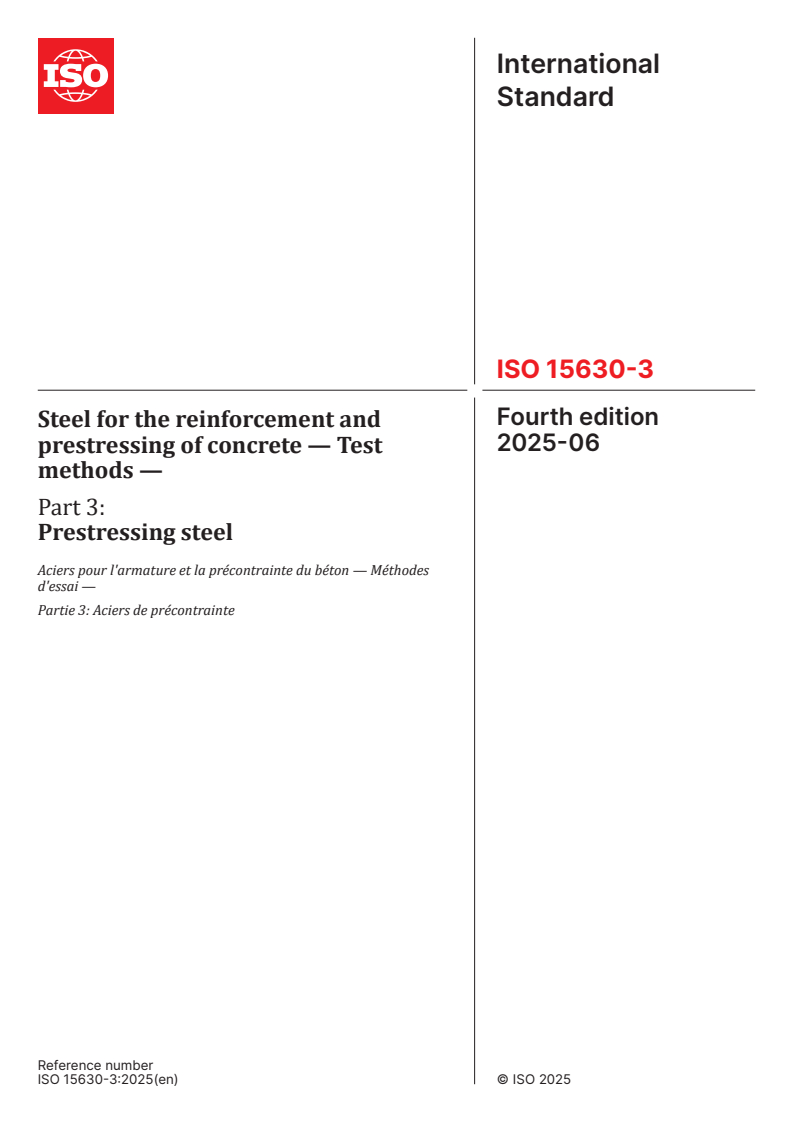
ISO 15630-3
Fourth edition
Steel for the reinforcement and
2025-06
prestressing of concrete — Test
methods —
Part 3:
Prestressing steel
Aciers pour l'armature et la précontrainte du béton — Méthodes
d'essai —
Partie 3: Aciers de précontrainte
Reference number
© ISO 2025
All rights reserved. Unless otherwise specified, or required in the context of its implementation, no part of this publication may
be reproduced or utilized otherwise in any form or by any means, electronic or mechanical, including photocopying, or posting on
the internet or an intranet, without prior written permission. Permission can be requested from either ISO at the address below
or ISO’s member body in the country of the requester.
ISO copyright office
CP 401 • Ch. de Blandonnet 8
CH-1214 Vernier, Geneva
Phone: +41 22 749 01 11
Email: copyright@iso.org
Website: www.iso.org
Published in Switzerland
ii
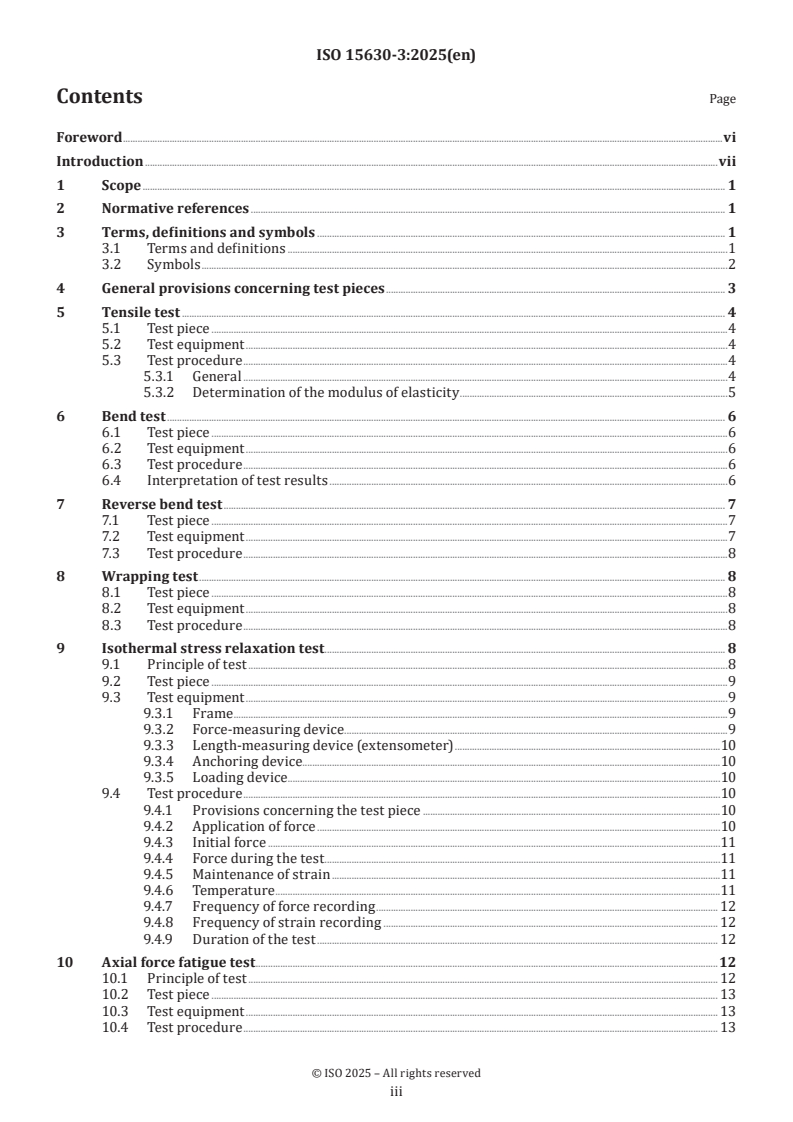
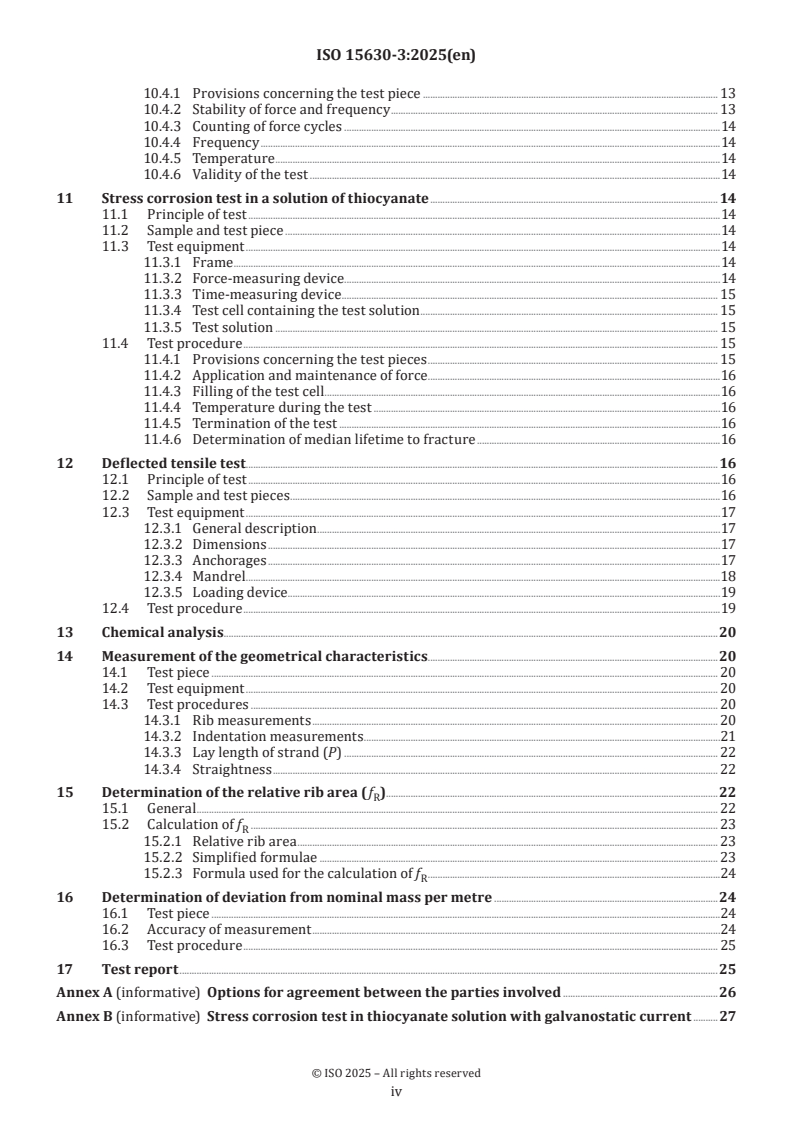
Contents Page
Foreword .vi
Introduction .vii
1 Scope . 1
2 Normative references . 1
3 Terms, definitions and symbols . 1
3.1 Terms and definitions .1
3.2 Symbols .2
4 General provisions concerning test pieces . 3
5 Tensile test . 4
5.1 Test piece .4
5.2 Test equipment .4
5.3 Test procedure .4
5.3.1 General .4
5.3.2 Determination of the modulus of elasticity .5
6 Bend test . 6
6.1 Test piece .6
6.2 Test equipment .6
6.3 Test procedure .6
6.4 Interpretation of test results .6
7 Reverse bend test . 7
7.1 Test piece .7
7.2 Test equipment .7
7.3 Test procedure .8
8 Wrapping test . 8
8.1 Test piece .8
8.2 Test equipment .8
8.3 Test procedure .8
9 Isothermal stress relaxation test . . 8
9.1 Principle of test .8
9.2 Test piece .9
9.3 Test equipment .9
9.3.1 Frame .9
9.3.2 Force-measuring device . .9
9.3.3 Length-measuring device (extensometer) .10
9.3.4 Anchoring device.10
9.3.5 Loading device . . .10
9.4 Test procedure .10
9.4.1 Provisions concerning the test piece .10
9.4.2 Application of force .10
9.4.3 Initial force .11
9.4.4 Force during the test .11
9.4.5 Maintenance of strain .11
9.4.6 Temperature .11
9.4.7 Frequency of force recording . 12
9.4.8 Frequency of strain recording . 12
9.4.9 Duration of the test . 12
10 Axial force fatigue test .12
10.1 Principle of test . 12
10.2 Test piece . 13
10.3 Test equipment . 13
10.4 Test procedure . 13
iii
10.4.1 Provisions concerning the test piece . 13
10.4.2 Stability of force and frequency . 13
10.4.3 Counting of force cycles .14
10.4.4 Frequency .14
10.4.5 Temperature .14
10.4.6 Validity of the test .14
11 Stress corrosion test in a solution of thiocyanate . 14
11.1 Principle of test .14
11.2 Sample and test piece .14
11.3 Test equipment .14
11.3.1 Frame .14
11.3.2 Force-measuring device . . .14
11.3.3 Time-measuring device . 15
11.3.4 Test cell containing the test solution . 15
11.3.5 Test solution . 15
11.4 Test procedure . 15
11.4.1 Provisions concerning the test pieces . 15
11.4.2 Application and maintenance of force .16
11.4.3 Filling of the test cell .16
11.4.4 Temperature during the test .16
11.4.5 Termination of the test .16
11.4.6 Determination of median lifetime to fracture .16
12 Deflected tensile test.16
12.1 Principle of test .16
12.2 Sample and test pieces .16
12.3 Test equipment .17
12.3.1 General description . .17
12.3.2 Dimensions .17
12.3.3 Anchorages .17
12.3.4 Mandrel .18
12.3.5 Loading device . . .19
12.4 Test procedure .19
13 Chemical analysis . .20
14 Measurement of the geometrical characteristics .20
14.1 Test piece . 20
14.2 Test equipment . 20
14.3 Test procedures . 20
14.3.1 Rib measurements . 20
14.3.2 Indentation measurements .21
14.3.3 Lay length of strand (P) . 22
14.3.4 Straightness . 22
15 Determination of the relative rib area (f ) .22
R
15.1 General . 22
15.2 Calculation of f . 23
R
15.2.1 Relative rib area . 23
15.2.2 Simplified formulae . 23
15.2.3 Formula used for the calculation of f .24
R
16 Determination of deviation from nominal mass per metre .24
16.1 Test piece .24
16.2 Accuracy of measurement .24
16.3 Test procedure . 25
17 Test report .25
Annex A (informative) Options for agreement between the parties involved .26
Annex B (informative) Stress corrosion test in thiocyanate solution with galvanostatic current .27
iv
Annex C (informative) Stress corrosion test in distilled water .33
Bibliography .38
v
Foreword
ISO (the International Organization for Standardization) is a worldwide federation of national standards
bodies (ISO member bodies). The work of preparing International Standards is normally carried out through
ISO technical committees. Each member body interested in a subject for which a technical committee
has been established has the right to be represented on that committee. International organizations,
governmental and non-governmental, in liaison with ISO, also take part in the work. ISO collaborates closely
with the International Electrotechnical Commission (IEC) on all matters of electrotechnical standardization.
The procedures used to develop this document and those intended for its further maintenance are described
in the ISO/IEC Directives, Part 1. In particular, the different approval criteria needed for the different types
of ISO document should be noted. This document was drafted in accordance with the editorial rules of the
ISO/IEC Directives, Part 2 (see www.iso.org/directives).
ISO draws attention to the possibility that the implementation of this document may involve the use of (a)
patent(s). ISO takes no position concerning the evidence, validity or applicability of any claimed patent
rights in respect thereof. As of the date of publication of this document, ISO had not received notice of (a)
patent(s) which may be required to implement this document. However, implementers are cautioned that
this may not represent the latest information, which may be obtained from the patent database available at
www.iso.org/patents. ISO shall not be held responsible for identifying any or all such patent rights.
Any trade name used in this document is information given for the convenience of users and does not
constitute an endorsement.
For an explanation of the voluntary nature of standards, the meaning of ISO specific terms and expressions
related to conformity assessment, as well as information about ISO's adherence to the World Trade
Organization (WTO) principles in the Technical Barriers to Trade (TBT), see www.iso.org/iso/foreword.html.
This document was prepared by Technical Committee ISO/TC 17, Steel, Subcommittee SC 16, Steels for the
reinforcement and prestressing of concrete,in collaboration with the European Committee for Standardization
(CEN) Technical Committee CEN/TC 459/SC 4, ECISS - European Committee for Iron and Steel Standardization,
in accordance with the Agreement on technical cooperation between ISO and CEN (Vienna Agreement).
This fourth edition cancels and replaces the third edition (ISO 15630-3:2019), which has been technically
revised.
The main changes are as follows:
— addition of the informative Annex B which specifies a stress corrosion test in thiocyanate solution with
galvanostatic current;
— addition of the informative Annex C which specifies a stress corrosion test in distilled water.
A list of all parts in the ISO 15360 series can be found on the ISO website.
Any feedback or questions on this document should be directed to the user’s national standards body. A
complete listing of these bodies can be found at www.iso.org/members.html.
vi
Introduction
The aim of the ISO 15630 series is to provide all relevant test methods for reinforcing and prestressing
steels in one standard series.
This document covers standard test methods, as well as specialized test methods that are not commonly
used in routine testing and that should only be considered where relevant (or specified) in the applicable
product standard.
Reference is made to International Standards on the testing of metals, in general, as they are applicable.
Complementary provisions have been given if needed.
A list of options for agreement between the parties involved is provided in Annex A.
vii
International Standard ISO 15630-3:2025(en)
Steel for the reinforcement and prestressing of concrete —
Test methods —
Part 3:
Prestressing steel
1 Scope
This document specifies test methods applicable to prestressing steel (bar, wire or strand) for concrete.
This document does not cover the sampling conditions that are dealt with in the product standards.
2 Normative references
The following documents are referred to in the text in such a way that some or all of their content constitutes
requirements of this document. For dated references, only the edition cited applies. For undated references,
the latest edition of the referenced document (including any amendments) applies.
ISO 4957, Tool steels
ISO 4965-1, Metallic materials — Dynamic force calibration for uniaxial fatigue testing — Part 1: Testing systems
ISO 4965-2, Metallic materials — Dynamic force calibration for uniaxial fatigue testing — Part 2: Dynamic
calibration device (DCD) instrumentation
ISO 6508-1, Metallic materials — Rockwell hardness test — Part 1: Test method
ISO 6892-1, Metallic materials — Tensile testing — Part 1: Method of test at room temperature
ISO 7500-1, Metallic materials — Calibration and verification of static uniaxial testing machines — Part 1:
Tension/compression testing machines — Calibration and verification of the force-measuring system
ISO 7801, Metallic materials — Wire — Reverse bend test
ISO 7802, Metallic materials — Wire — Wrapping test
ISO 9513, Metallic materials — Calibration of extensometer systems used in uniaxial testing
ISO 16020, Steel for the reinforcement and prestressing of concrete — Vocabulary
3 Terms, definitions and symbols
3.1 Terms and definitions
For the purposes of this document, the terms and definitions given in ISO 16020 apply.
ISO and IEC maintain terminological databases for use in standardization at the following addresses:
— ISO Online browsing platform: available at https:// www .iso .org/ obp
— IEC Electropedia: available at https:// www .electropedia .org/
3.2 Symbols
For the purposes of this document, the following symbols apply.
Symbol Unit Description Reference
a mm Rib height at the mid-point 14.3, 15.2
m
a mm Maximum height of rib or depth of indentation 14.3
max
a mm Average height of a portion i of a rib subdivided into p parts of length Δl 15.2
s,i
a mm Rib height at the quarter-point 14.3, 15.2
1/4
a mm Rib height at the three-quarters point 14.3, 15.2
3/4
A % Percentage elongation after fracture 5.1, 5.3
A % Percentage total extension at maximum force Clause 5
gt
A % Percentage uniform elongation after fracture 5.3
r
b mm Width of transverse rib at the mid-point 14.3.1.6
c mm Rib or indentation spacing 14.3
C mm Groove width at nominal diameter of the mandrel, d , used for the deflected 12.3.4
a
tensile test
d mm Nominal diameter of the bar, wire or strand 5.3.1, 7.2, Table 3,
10.4.6, Table 4
d mm Nominal diameter of the mandrel used for the deflected tensile test 12.3.4
a
d mm Diameter to be obtained after placing two gauge cylinders in the groove of the 12.3.4
b
mandrel used for the deflected tensile test
d mm Diameter of the gauge cylinder used for the deflected tensile test 12.3.4
e
d mm Diameter of guide hole 7.2
g
d mm Inner diameter of the groove of the mandrel used for the deflected tensile test 12.3.4
i
D % Average coefficient of reduction of the maximum force in the deflected tensile 12.2, 12.4
test
D mm Inner diameter of the test cell in the stress corrosion test 11.3.4
c
D % Individual percentage of reduction of the maximum force in the deflected 12.4
i
tensile test
D mm Diameter of the mandrel of the bending device in the bend test Figure 2
m
e mm Average gap between two adjacent ribs or indentation rows 14.3.1.4, 14.3.2.5
E MPa Modulus of elasticity 5.2, 5.3
f Hz Frequency of force cycles in the axial force fatigue test 10.1, 10.4.2
f — Relative rib area Clause 15
R
F N Individual breaking force in the deflected tensile test 12.4
a,i
F N Maximum force in the tensile test 5.3
m
N Mean value of the maximum force 9.2, 11.2, 12.2,
F
m
12.4
F N 0,1 % proof force, plastic extension 5.2, 5.3
p0,1
F N 0,2 % proof force, plastic extension 5.2, 5.3
p0,2
F N Force range in the axial force fatigue test Figure 6, 10.3,
r
10.4.2
F N Residual force in the test piece at time t in the isothermal stress relaxation 9.1
rt
test
ΔF N Force loss in the test piece at time t in the isothermal stress relaxation test 9.1
rt
F mm Area of longitudinal section of one rib 15.2
R
F N Upper force in the axial force fatigue test Figure 6, 10.3,
up
10.4.2
Symbol Unit Description Reference
F N Initial force in the isothermal stress relaxation test and the stress corrosion 9.1, 9.2, 9.3, 9.4,
test 11.1, 11.2, 11.4.2
G mm Depth of the groove of the mandrel used for the deflected tensile test 12.3.4
h mm Distance from the top tangential plane of cylindrical supports to the bottom 7.2
face of the guide
h mm Bow height in the plane of the bow 14.3.4
b
l mm Length of indentation 14.3.2.4
L mm Length of the test piece in the stress corrosion test 11.2
t
L mm Gauge length (without force on the test piece) in the isothermal stress relaxa- 9.1, 9.3, 9.4
tion test
11.2, 11.3.4,
Length of the test piece in contact with the solution in the stress corrosion 11.4.1, 11.4.3,
test 11.4.5
L mm Length of the passive side in the deflected tensile test 12.3.2
L mm Length of the active side in the deflected tensile test 12.3.2
m, n — Coefficients or numbers 9.4.9, 14.3, 15.2
P mm Lay length of a strand 14.3.3
ρ % Relaxation 9.4.9
r mm Radius of cylindrical supports 7.2
R mm Radius at the base of the mandrel used for the deflected tensile test 12.3.4
r mm Distance between the grips and the gauge length for the manual measure- 5.3
ment of A
gt
r mm Distance between the fracture and the gauge length for the manual measure- 5.3
ment of A
gt
R µm Surface roughness of the mandrel used for the deflected tensile test 12.3.4
a
S mm Nominal cross-sectional area of the test piece 5.3.2
n
t h Time for relaxation test 9.4.9
t h Maximum agreed time for the stress corrosion test 11.4.5
a
t h Individual lifetime to fracture in the stress corrosion test 11.4.5
f,i
t h Median lifetime to fracture in the stress corrosion test 11.4.6
f,m
t s Starting time in the isothermal stress relaxation test and in the stress corro- 9.4.2, 11.4
sion test
y mm Distance from a plane, defined by the axes of the cylindrical supports, to the Figure 3
nearest point of contact with the test piece
V mm Volume of test solution to fill the test cell in the stress corrosion test 11.4.3
Z % Percentage reduction of area 5.3.1
α ° Angle of deviation in the deflected tensile test 12.3.2
β ° Rib or indentation angle to the bar or wire axis 14.3
— Value of the strain for a force equal to x F 5.3.2
ε
m
xF
m
ρ % Relaxation 9.4.9
14.3.1.4, 14.3.2.5,
∑e mm Part of the circumference without indentation or rib
i
15.2
NOTE 1 MPa = 1 N/mm .
4 General provisions concerning test pieces
Unless otherwise agreed or specified in the product standard, the samples shall be taken from the finished
product before packaging.
Special care should be taken when samples are taken from the packaged product (e.g. coil or bundle) in order
to avoid plastic deformation, which can change the properties of the samples used to provide the test pieces.
Specific complementary provisions concerning the test pieces are indicated in the relevant clauses of this
document, if needed.
5 Tensile test
5.1 Test piece
In addition to the general provisions given in Clause 4, the free length of the test piece shall be sufficient for
the determination of the percentage total extension at maximum force (A ) in accordance with 5.3.1.
gt
If the percentage elongation after fracture (A) is determined manually, the test piece shall be marked in
accordance with ISO 6892-1.
If the percentage total extension at maximum force (A ) is determined by the manual method for a bar or
gt
wire, equidistant marks shall be made on the free length of the test piece (see ISO 6892-1). The distance
between the marks shall be 20 mm, 10 mm or 5 mm, depending on the test piece diameter.
5.2 Test equipment
The test equipment shall be verified and calibrated in accordance with ISO 7500-1 and shall be at least of
class 1.
If an extensometer is used, it shall be of class 1 in accordance with ISO 9513 for the determination of E, F
p0,1
or F ; for the determination of A , a class 2 extensometer (see ISO 9513) may be used.
p0,2 gt
Grips shall be such as to avoid breaks in or very near the grips.
5.3 Test procedure
5.3.1 General
The tensile test for the determination of the modulus of elasticity (E), 0,1 % and 0,2 % proof force (F and
p0,1
F ), maximum force (F ), percentage total extension at maximum force (A ) and/or percentage elongation
p0,2 m gt
after fracture (A) and percentage reduction of area (Z) shall be performed in accordance with ISO 6892-1.
An extensometer shall be used for the determination of the modulus of elasticity (E), 0,1 % and 0,2 % proof
force (F and F ) and percentage total extension at maximum force (A ). The extensometer gauge
p0,1 p0,2 gt
length shall be as specified in the relevant product standard.
Accurate values of A can only be obtained with an extensometer. If it is not possible to leave the
gt
extensometer on the test piece to fracture or until the maximum force has been passed, the extension may
be measured as follows.
— Continue loading until the extensometer records an extension just greater than the extension
corresponding to F , at which the extensometer is removed; the distance between the testing machine
p0,2
crossheads is noted. The loading is continued until fracture occurs. The final distance between the
crossheads is noted.
— The difference between the crosshead measurements is calculated as a percentage of the original distance
between the cross-heads and this value is added to the percentage obtained by the extensometer.
For wire and bars, it is also permissible to determine A by the manual method. If A is determined by the
gt gt
manual method after fracture, A shall be calculated from Formula (1):
gt
AA=+R /2000 (1)
gt rm
where A is the percentage uniform elongation after fracture.
r
The measurement of A shall be made, as the measurement of A (see ISO 6892-1), on the longer of the two
r
fractured parts of the test piece on a gauge length of 100 mm, as close as possible to the fracture but at a
distance, r , of at least 50 mm or 2 d (whichever is the greater) away from the fracture. This measurement
may be considered as invalid if the distance, r , between the grips and the gauge length is less than 20 mm or
d (whichever is the greater). See Figure 1.
a
Grip length.
b
Gauge length 100 mm.
Figure 1 — Measurement of A by the manual method
gt
It is preferable to apply a preliminary force to the test piece, e.g. to about 10 % of the expected maximum
force before placing the extensometer.
If A is not completely determined with an extensometer, this shall be indicated in the test report.
gt
For routine tests conducted by prestressing steel producers, the test information should be described within
internal documentation.
Tensile properties (F , F , F ) are recorded in force units.
p0,1 p0,2 m
For the determination of percentage elongation after fracture (A), the original gauge length shall be
eight times the nominal diameter (d), unless otherwise specified in the relevant product standard. In case of
dispute, A shall be determined manually.
If the fracture occurs within a distance of 3 mm from the grips, the test shall, in principle, be considered as
invalid and it shall be permissible to perform a retest. However, it shall be permitted to take into account the
test results if all values meet the relevant specified values.
5.3.2 Determination of the modulus of elasticity
The modulus of elasticity (E) shall be determined from the slope of the linear portion of the force-extension
diagram divided by the nominal cross-sectional area of the test piece (S ).
n
In general, for cold-drawn prestressing products (e.g. strands and plain wires), the slope can be determined
in the range between 0,2F and 0,7F , as shown by Formula (2):
m m
EF=−(,07 02, FS)/(εε− )/ (2)
mm 07,,FF02 n
mm
The slope may be calculated either by a linear regression of the measured data stored in a data storage
facility or by a best-fit visual technique over the above-defined portion of the recorded curve.
In some special cases, e.g. hot-rolled and stretched bars, the above-mentioned method cannot be applied; a
secant modulus between 0,05F and 0,7F may then be determined as shown by Formula (3):
m m
(,07FF−−00, 5 )/(εε )/S (3)
mm 07,,FF005 n
mm
In addition to the provisions given in 5.3.1, it shall be ensured that the stress rate is not changed within the
force range over which the modulus of elasticity is determined.
6 Bend test
6.1 Test piece
The general provisions given in Clause 4 apply.
6.2 Test equipment
6.2.1 A bending device, the principle of which is shown in Figure 2, shall be used.
NOTE Figure 2 shows a configuration where the mandrel and support rotate and the carrier is locked. It is also
possible that the carrier rotates and the support or mandrel is locked.
Key
1 mandrel
2 support
3 carrier
Figure 2 — Principle of a bending device
6.2.2 The bend test may also be performed using a device with supports and a mandrel (e.g. see ISO 7438).
6.3 Test procedure
The bend test shall be performed at a temperature between 10 °C and 35 °C. The test piece shall be bent over
a mandrel.
The angle of bend and the diameter of the mandrel shall be in accordance with the relevant product standard.
6.4 Interpretation of test results
The interpretation of the bend test results shall be made in accordance with the requirements of the relevant
product standard.
If requirements are not specified in the relevant product standard, the absence of cracks visible to a person
with normal or corrected vision shall be considered as evidence that the test piece has withstood the bend test.
A superficial ductile tear may occur at the base of the ribs or indentations and shall not be considered as a
failure. The tear may be considered superficial when the depth of the tear is not greater than the width of
the tear.
7 Reverse bend test
7.1 Test piece
In addition to the general provisions given in Clause 4, the test piece shall conform to ISO 7801.
7.2 Test equipment
The test equipment shall conform to ISO 7801.
For wire of nominal diameter 10 mm < d ≤ 12,5 mm, the following conditions apply to the test equipment as
defined by Figure 3: r = (30 ± 1) mm, h = 125 mm, d = 11 mm or 13 mm.
g
Key
a d g
Nearest point of contact with test piece. Guide. Gripping faces of supports.
b e h
Test piece. Pivoting axis of the bending arm. Supports.
c f
Bending arm. Cylindrical supports.
Figure 3 — Schematic of the test equipment for the reverse bend test
7.3 Test procedure
The reverse bend test shall be performed in accordance with ISO 7801.
8 Wrapping test
8.1 Test piece
In addition to the general provisions given in Clause 4, the test piece shall conform to ISO 7802.
8.2 Test equipment
The test equipment shall conform to ISO 7802.
8.3 Test procedure
The wrapping test shall be performed in accordance with ISO 7802.
9 Isothermal stress relaxation test
9.1 Principle of test
The isothermal stress relaxation test consists of measuring, at a given temperature (generally fixed at 20 °C
unless otherwise agreed), the variations of force of a test piece maintained at constant length (L + ΔL ),
0 0
from an initial force (F ) (see Figure 4).
The loss in force is expressed as a percentage of the initial force for a given period of time.
Key
t time
L length
F force
Figure 4 — Principle of the isothermal stress relaxation test
9.2 Test piece
The general provisions given in Clause 4 apply.
The test piece for the isothermal stress relaxation test shall be maintained in a straight condition. The free
length of the test piece between the grips shall not be subjected to any mechanical deformation or treatment
of any kind.
When the initial force (F ) is expressed as a percentage of F , e.g. 70 % × F , then two test pieces adjacent
m m
to the test pieces for the stress relaxation test shall be taken for the determination of the mean value of
maximum force ( F ).
m
9.3 Test equipment
9.3.1 Frame
Any deformation of the frame shall be within such limits that it does not influence the results of the test.
9.3.2 Force-measuring device
The force shall be measured either by a coaxial force cell or another appropriate device (e.g. lever loading
system).
--
...
Norme
internationale
ISO 15630-3
Quatrième édition
Aciers pour l'armature et la
2025-06
précontrainte du béton — Méthodes
d'essai —
Partie 3:
Aciers de précontrainte
Steel for the reinforcement and prestressing of concrete — Test
methods —
Part 3: Prestressing steel
Numéro de référence
DOCUMENT PROTÉGÉ PAR COPYRIGHT
© ISO 2025
Tous droits réservés. Sauf prescription différente ou nécessité dans le contexte de sa mise en œuvre, aucune partie de cette
publication ne peut être reproduite ni utilisée sous quelque forme que ce soit et par aucun procédé, électronique ou mécanique,
y compris la photocopie, ou la diffusion sur l’internet ou sur un intranet, sans autorisation écrite préalable. Une autorisation peut
être demandée à l’ISO à l’adresse ci-après ou au comité membre de l’ISO dans le pays du demandeur.
ISO copyright office
Case postale 401 • Ch. de Blandonnet 8
CH-1214 Vernier, Genève
Tél.: +41 22 749 01 11
E-mail: copyright@iso.org
Web: www.iso.org
Publié en Suisse
ii
Sommaire Page
Avant-propos .vi
Introduction .vii
1 Domaine d’application . 1
2 Références normatives . 1
3 Termes, définitions et symboles . 1
3.1 Termes et définitions .1
3.2 Symboles .2
4 Dispositions générales concernant les éprouvettes . 4
5 Essai de traction . 4
5.1 Éprouvette .4
5.2 Matériel d’essai .4
5.3 Mode opératoire d’essai . .4
5.3.1 Généralités .4
5.3.2 Détermination du module d’élasticité .6
6 Essai de pliage . 6
6.1 Éprouvette .6
6.2 Matériel d’essai .6
6.3 Mode opératoire d’essai . .7
6.4 Interprétation des résultats d’essai .7
7 Essai de pliage alterné . 7
7.1 Éprouvette .7
7.2 Matériel d’essai .7
7.3 Mode opératoire d’essai .8
8 Essai d’enroulement . 8
8.1 Éprouvette .8
8.2 Matériel d’essai .8
8.3 Mode opératoire d’essai . .9
9 Essai de relaxation isotherme . 9
9.1 Principe de l’essai .9
9.2 Éprouvette .9
9.3 Matériel d’essai .10
9.3.1 Bâti .10
9.3.2 Dispositif de mesure de force .10
9.3.3 Dispositif de mesure de longueur (extensomètre).10
9.3.4 Dispositif d’ancrage .10
9.3.5 Dispositif de chargement .10
9.4 Mode opératoire d’essai .10
9.4.1 Dispositions concernant l’éprouvette .10
9.4.2 Application de la force .10
9.4.3 Force initiale .11
9.4.4 Force pendant l’essai . 12
9.4.5 Maintien de la déformation . 12
9.4.6 Température . 12
9.4.7 Fréquence d’enregistrement de la force . 12
9.4.8 Fréquence d’enregistrement de la déformation . 12
9.4.9 Durée de l’essai . 12
10 Essai de fatigue par force axiale . .13
10.1 Principe de l’essai . 13
10.2 Éprouvette . 13
10.3 Matériel d’essai . 13
10.4 Mode opératoire d’essai . .14
iii
10.4.1 Dispositions concernant l’éprouvette .14
10.4.2 Stabilité de la force et de la fréquence .14
10.4.3 Comptage des cycles de force .14
10.4.4 Fréquence .14
10.4.5 Température .14
10.4.6 Validité de l’essai .14
11 Essai de corrosion sous contrainte dans une solution de thiocyanate . 14
11.1 Principe de l’essai .14
11.2 Échantillon et éprouvette .14
11.3 Matériel d’essai . 15
11.3.1 Bâti . 15
11.3.2 Dispositif de mesure de force . 15
11.3.3 Dispostitif de mesure de temps . 15
11.3.4 Cellule d’essai contenant la solution d’essai . 15
11.3.5 Solution d’essai . 15
11.4 Mode opératoire d’essai . .16
11.4.1 Dispositions relatives aux éprouvettes .16
11.4.2 Application et maintien de la force .16
11.4.3 Remplissage de la cellule d’essai .16
11.4.4 Température pendant l’essai .16
11.4.5 Fin de l’essai .16
11.4.6 Détermination de la valeur médiane de la durée de vie jusqu’à rupture .17
12 Essai de traction déviée . . 17
12.1 Principe de l’essai .17
12.2 Échantillon et éprouvettes .17
12.3 Matériel d’essai .17
12.3.1 Description générale .17
12.3.2 Dimensions .17
12.3.3 Ancrages .18
12.3.4 Mandrin .19
12.3.5 Dispositif de chargement . 20
12.4 Mode opératoire d’essai . . 20
13 Analyse chimique .21
14 Mesure des caractéristiques géométriques .21
14.1 Éprouvette .21
14.2 Matériel d’essai .21
14.3 Modes opératoires d’essai .21
14.3.1 Mesures relatives aux verrous .21
14.3.2 Mesures des empreintes . 22
14.3.3 Pas de toronnage (P) . 23
14.3.4 Rectitude . 23
15 Détermination de la surface relative des verrous (f ) .23
R
15.1 Généralités . 23
15.2 Calcul de f .24
R
15.2.1 Surface relative des verrous .24
15.2.2 Formules simplifiées .24
15.2.3 Formule utilisée pour le calcul de f . 25
R
16 Détermination de l’écart par rapport à la masse linéique nominale .25
16.1 Éprouvette . 25
16.2 Exactitude des mesures . 25
16.3 Mode opératoire d’essai . . 26
17 Rapport d’essai .26
Annexe A (informative) Options pouvant faire l'objet d'un accord entre les parties concernées .27
iv
Annexe B (informative) Corrosion sous contrainte dans une solution de thiocyanate avec
courant galvanostatique.28
Annexe C (informative) Essai de corrosion sous contrainte dans l'eau distillée .34
Bibliographie .39
v
Avant-propos
L'ISO (Organisation internationale de normalisation) est une fédération mondiale d'organismes nationaux
de normalisation (comités membres de l'ISO). L'élaboration des Normes internationales est en général
confiée aux comités techniques de l'ISO. Chaque comité membre intéressé par une étude a le droit de faire
partie du comité technique créé à cet effet. Les organisations internationales, gouvernementales et non
gouvernementales, en liaison avec l'ISO participent également aux travaux. L'ISO collabore étroitement avec
la Commission électrotechnique internationale (IEC) en ce qui concerne la normalisation électrotechnique.
Les procédures utilisées pour élaborer le présent document et celles destinées à sa mise à jour sont
décrites dans les Directives ISO/IEC, Partie 1. Il convient, en particulier, de prendre note des différents
critères d'approbation requis pour les différents types de documents ISO. Le présent document a
été rédigé conformément aux règles de rédaction données dans les Directives ISO/IEC, Partie 2 (voir
www.iso.org/directives).
L’ISO attire l’attention sur le fait que la mise en application du présent document peut entraîner l’utilisation
d’un ou de plusieurs brevets. L’ISO ne prend pas position quant à la preuve, à la validité et à l’applicabilité de
tout droit de brevet revendiqué à cet égard. À la date de publication du présent document, l’ISO n'avait pas
reçu notification qu’un ou plusieurs brevets pouvaient être nécessaires à sa mise en application. Toutefois,
il y a lieu d’avertir les responsables de la mise en application du présent document que des informations
plus récentes sont susceptibles de figurer dans la base de données de brevets, disponible à l'adresse
www.iso.org/brevets. L’ISO ne saurait être tenue pour responsable de ne pas avoir identifié tout ou partie de
tels droits de propriété.
Les appellations commerciales éventuellement mentionnées dans le présent document sont données pour
information, par souci de commodité, à l’intention des utilisateurs et ne sauraient constituer un engagement.
Pour une explication de la nature volontaire des normes, la signification des termes et expressions
spécifiques de l'ISO liés à l'évaluation de la conformité, ou pour toute information au sujet de l'adhésion de
l'ISO aux principes de l’Organisation mondiale du commerce (OMC) concernant les obstacles techniques au
commerce (OTC), voir www.iso.org/avant-propos.
Le présent document a été élaboré par le comité technique ISO/TC 17, Acier, sous-comité SC 16, Aciers pour
le renforcement et la précontrainte du béton, en collaboration avec le comité technique CEN/TC 459/SC 4,
ECISS - Comité européen de normalisation du fer et de l'acier, du Comité européen de normalisation (CEN)
conformément à l’Accord de coopération technique entre l’ISO et le CEN (Accord de Vienne).
Cette quatrième édition annule et remplace la troisième édition (ISO 156303-3:2019), qui a fait l'objet d'une
révision technique.
Les principales modifications sont les suivantes:
— ajout de l’Annexe B informative qui spécifie un essai de corrosion sous contrainte dans une solution de
thiocyanate avec courant galvanostatique;
— ajout de l’Annexe C informative qui spécifie un essai de corrosion sous contrainte dans l’eau distillée.
Une liste de toutes les parties de la série ISO 15360 se trouve sur le site web de l’ISO.
Il convient que l’utilisateur adresse tout retour d’information ou toute question concernant le présent
document à l’organisme national de normalisation de son pays. Une liste exhaustive desdits organismes se
trouve à l’adresse www.iso.org/fr/members.html.
vi
Introduction
L’objet de la série ISO 15630 est de rassembler toutes les méthodes d’essai pertinentes aux aciers pour béton
armé et aux aciers de précontrainte dans une seule série de normes.
Le présent document couvre les méthodes d’essai usuelles et les méthodes d’essai spéciales qui ne sont pas
couramment utilisées pour les essais de contrôle habituels et qu’il convient de considérer lorsque cela est
pertinent (ou spécifié) dans la norme de produit applicable.
Il est fait référence aux Normes internationales relatives aux essais de métaux, en général, lorsqu’elles sont
applicables. Des dispositions complémentaires ont été données si nécessaire.
Une liste d'options en vue d'un accord entre les parties concernées figure à l'Annexe A.
vii
Norme internationale ISO 15630-3:2025(fr)
Aciers pour l'armature et la précontrainte du béton —
Méthodes d'essai —
Partie 3:
Aciers de précontrainte
1 Domaine d’application
Le présent document spécifie les méthodes d’essai applicables aux aciers de précontrainte (barres, fils ou
torons) pour le béton.
Le présent document ne couvre pas les conditions d’échantillonnage qui sont spécifiées dans les normes de
produit.
2 Références normatives
Les documents suivants sont cités dans le texte de sorte qu’ils constituent, pour tout ou partie de leur
contenu, des exigences du présent document. Pour les références datées, seule l’édition citée s’applique. Pour
les références non datées, la dernière édition du document de référence s'applique (y compris les éventuels
amendements).
ISO 4957, Aciers à outils
ISO 4965-1, Matériaux métalliques — Étalonnage de la force dynamique uniaxiale pour les essais de fatigue —
Partie 1: Systèmes d'essai
ISO 4965-2, Matériaux métalliques — Étalonnage de la force dynamique uniaxiale pour les essais de fatigue —
Partie 2: Instrumentation pour équipement d'étalonnage dynamique
ISO 6508-1, Matériaux métalliques — Essai de dureté Rockwell — Partie 1: Méthode d'essai
ISO 6892-1, Matériaux métalliques — Essai de traction — Partie 1: Méthode d'essai à température ambiante
ISO 7500-1, Matériaux métalliques — Étalonnage et vérification des machines pour essais statiques uniaxiaux —
Partie 1: Machines d'essai de traction/compression — Étalonnage et vérification du système de mesure de force
ISO 7801, Matériaux métalliques — Fils — Essai de pliage alterné
ISO 7802, Matériaux métalliques — Fils — Essai d'enroulement
ISO 9513, Matériaux métalliques — Étalonnage des chaînes extensométriques utilisées lors d'essais uniaxiaux
ISO 16020, Aciers pour l'armature et la précontrainte du béton — Vocabulaire
3 Termes, définitions et symboles
3.1 Termes et définitions
Pour les besoins du présent document, les termes et les définitions de l'ISO 16020 s’appliquent.
L'ISO et l'IEC tiennent à jour des bases de données terminologiques destinées à être utilisées en normalisation,
consultables aux adresses suivantes:
— ISO Online browsing platform: disponible à l'adresse https:// www .iso .org/ obp
— IEC Electropedia: disponible à l'adresse https:// www .electropedia .org/
3.2 Symboles
Pour les besoins du présent document, les symboles suivants s'appliquent.
Symbole Unité Description Référence
a mm Hauteur des verrous en leur milieu 14.3, 15.2
m
a mm Hauteur maximale des verrous ou profondeur maximale des empreintes 14.3
max
a mm Hauteur moyenne d'une portion i d'un verrou subdivisé en p parties de lon- 15.2
s,i
gueur Δl
a mm Hauteur des verrous au quart de leur longueur 14.3, 15.2
1/4
a mm Hauteur des verrous aux trois quarts de leur longueur 14.3, 15.2
3/4
A % Pourcentage d'allongement après rupture 5.1, 5.3
A % Pourcentage d’extension totale à la force maximale Article 5
gt
A % Pourcentage d'allongement uniforme après rupture 5.3
r
b mm Largeur des verrous en leur milieu 14.3.1.6
c mm Espacement des verrous ou des empreintes 14.3
C mm Largeur de la gorge au diamètre nominal, d , du mandrin utilisé pour l’essai 12.3.4
a
de traction déviée
d mm Diamètre nominal de la barre, du fil ou du toron 5.3.1, 7.2,
Tableau 3, 10.4.6,
Tableau 4
d mm Diamètre nominal du mandrin utilisé pour l'essai de traction déviée 12.3.4
a
d mm Diamètre à obtenir après avoir placé deux calibres cylindriques dans la gorge 12.3.4
b
du mandrin utilisé pour l'essai de traction déviée
d mm Diamètre du calibre cylindrique utilisé pour l'essai de traction déviée 12.3.4
e
d mm Diamètre du trou de guidage 7.2
g
d mm Diamètre intérieur de la gorge du mandrin utilisé pour l'essai de traction 12.3.4
i
déviée
D % Coefficient moyen de réduction de la force maximale pour l’essai de traction 12.2, 12.4
déviée
D mm Diamètre intérieur de la cellule d'essai pour l’essai de corrosion sous 11.3.4
c
contrainte
D % Valeur individuelle du pourcentage de réduction de la force maximale pour 12.4
i
l’essai de traction déviée
D mm Diamètre du mandrin du dispositif de pliage pour l’essai de pliage Figure 2
m
e mm Espace moyen entre deux rangées contiguës de verrous ou d’empreintes 14.3.1.4, 14.3.2.5
E MPa Module d'élasticité 5.2, 5.3
f Hz Fréquence des cycles de force pour l'essai de fatigue par force axiale 10.1, 10.4.2
f — Surface relative des verrous Article 15
R
F N Force de rupture individuelle pour l'essai de traction déviée 12.4
a,i
F N Force maximale lors de l'essai de traction 5.3
m
N Valeur moyenne de la force maximale 9.2, 11.2, 12.2,
F
m
12.4
F N Force à la limite conventionnelle d’élasticité à 0,1 % d’extension plastique 5.2, 5.3
p0,1
F N Force à la limite conventionnelle d’élasticité à 0,2 % d’extension plastique 5.2, 5.3
p0,2
Symbole Unité Description Référence
F N Étendue de variation de la force pour l’essai de fatigue par force axiale Figure 6, 10.3,
r
10.4.2
F N Force résiduelle dans l'éprouvette au temps t pour l’essai de relaxation iso- 9.1
rt
therme
ΔF N Perte de force dans l'éprouvette au temps t pour l’essai de relaxation iso- 9.1
rt
therme
F mm Surface d'une section longitudinale d'un verrou 15.2
R
F N Force supérieure lors de l’essai de fatigue par force axiale Figure 6, 10.3,
up
10.4.2
F N Force initiale pour l’essai de relaxation isotherme et l’essai de corrosion sous 9.1, 9.2, 9.3, 9.4,
contrainte 11.1, 11.2, 11.4.2
G mm Profondeur de la gorge du mandrin utilisé pour l’essai de traction déviée 12.3.4
h mm Distance entre le plan supérieur tangent aux appuis cylindriques et la face 7.2
inférieure du guide
h mm Flèche dans le plan de la courbure 14.3.4
b
l mm Longueur d'empreinte 14.3.2.4
L mm Longueur de l’éprouvette pour l’essai de corrosion sous contrainte 11.2
t
L mm Longueur de base (sans force sur l’éprouvette) pour l’essai de relaxation iso- 9.1, 9.3, 9,4
therme
11.2, 11.3.4,
Longueur de l’éprouvette en contact avec la solution pour l’essai de corrosion 11.4.1, 11.4.3,
sous contrainte 11.4.5
L mm Longueur du côté passif pour l’essai de traction déviée 12.3.2
L mm Longueur du côté actif pour l’essai de traction déviée 12.3.2
m, n — Coefficients ou nombres 9.4.9, 14.3, 15.2
P mm Pas de toronnage 14.3.3
ρ % Relaxation 9.4.9
r mm Rayon des appuis cylindriques 7.2
R mm Rayon à la base du mandrin utilisé pour l’essai de traction déviée 12.3.4
r mm Distance entre les mâchoires et la longueur entre repères pour la mesure 5.3
manuelle de A
gt
r mm Distance entre la rupture et la longueur entre repères pour la mesure 5.3
manuelle de A
gt
R µm Rugosité de surface du mandrin utilisé pour l’essai de traction déviée 12.3.4
a
S mm Aire nominale de la section transversale de l'éprouvette 5.3.2
n
t h Temps pour l’essai de relaxation 9.4.9
t h Temps limite convenu pour l’essai de corrosion sous contrainte 11.4.5
a
t h Valeur individuelle de la durée de vie jusqu’à rupture pour l’essai de corrosion 11.4.5
f,i
sous contrainte
t h Valeur médiane de la durée de vie jusqu’à rupture pour l’essai de corrosion 11.4.6
f,m
sous contrainte
t s Temps au commencement de l’essai de relaxation isotherme et de l’essai de 9.4.2, 11.4
corrosion sous contrainte
y mm Distance d'un plan, défini par les axes des appuis cylindriques, au point de Figure 3
contact le plus proche de l'éprouvette
V mm Volume de la solution d’essai pour remplir la cellule d’essai pour l’essai de 11.4.3
corrosion sous contrainte
Z % Coefficient de striction 5.3.1
α ° Angle de déviation pour l’essai de traction déviée 12.3.2
β ° Angle des verrous ou empreintes par rapport à l’axe de la barre ou du fil 14.3
Symbole Unité Description Référence
ε — Valeur de la déformation pour une force égale à x F 5.3.2
m
xF
m
ρ % Relaxation 9.4.9
14.3.1.4, 14.3.2.5,
∑e mm Partie de la circonférence sans empreinte ou sans verrou
i
15.2
NOTE 1 MPa = 1 N/mm .
4 Dispositions générales concernant les éprouvettes
Sauf accord ou spécification contraire dans la norme de produit, les échantillons doivent être prélevés dans
le produit fini avant conditionnement.
Il convient d’être particulièrement soigneux lorsque les échantillons sont prélevés dans un produit
conditionné (par exemple couronne ou fardeau), de façon à éviter une déformation plastique qui peut
modifier les caractéristiques des échantillons destinés à fournir les éprouvettes.
Des dispositions complémentaires particulières concernant les éprouvettes sont indiquées dans les articles
concernés du présent document, le cas échéant.
5 Essai de traction
5.1 Éprouvette
En complément des dispositions générales indiquées à l’Article 4, la longueur libre de l’éprouvette doit être
suffisante pour la détermination du pourcentage d'extension totale à la force maximale (A ) conformément
gt
au 5.3.1.
Si le pourcentage d’allongement après rupture (A) est déterminé de manière manuelle, l’éprouvette doit être
marquée conformément à l’ISO 6892-1.
Si le pourcentage d'extension totale à la force maximale (A ) est déterminé par la méthode manuelle pour
gt
une barre ou un fil, des marques équidistantes doivent être faites sur la longueur libre de l’éprouvette (voir
l’ISO 6892-1). La distance entre les marques doit être de 20 mm, 10 mm ou 5 mm, en fonction du diamètre de
l’éprouvette.
5.2 Matériel d’essai
Le matériel d’essai doit être vérifié et étalonné conformément à l’ISO 7500-1 et doit être au moins de classe 1.
Lorsqu'un extensomètre est utilisé, il doit être de classe 1 conformément à l’ISO 9513 pour la détermination
de E, F ou F ; pour la détermination de A , un extensomètre de classe 2 (voir l’ISO 9513) peut être
p0,1 p0,2 gt
utilisé.
Des mors adaptés doivent être utilisés pour éviter les ruptures dans les mors ou à proximité de ceux-ci.
5.3 Mode opératoire d’essai
5.3.1 Généralités
L’essai de traction pour la détermination du module d'élasticité (E), des forces à la limite conventionnelle
d’élasticité à 0,1 % et à 0,2 % (F et F ), de la force maximale (F ), du pourcentage d'extension totale à la
p0,1 p0,2 m
force maximale (A ) et/ou du pourcentage d'allongement après rupture (A) et du coefficient de striction (Z)
gt
doit être réalisé conformément à l’ISO 6892-1.
Un extensomètre doit être utilisé pour la détermination du module d’élasticité (E), des forces à la limite
conventionnelle d’élasticité à 0,1 % et à 0,2 % (F et F ) et du pourcentage d'extension totale à la force
p0,1 p0,2
maximale (A ). La longueur de base de l’extensomètre doit être telle qu’indiquée dans la norme de produit
gt
pertinente.
Des valeurs précises d’A ne peuvent être obtenues qu’au moyen d'un extensomètre. S’il n’est pas possible de
gt
laisser l’extensomètre sur l’éprouvette jusqu’à rupture ou jusqu'à ce que la force maximale ait été dépassée,
l’extension peut être mesurée de la manière suivante.
— Poursuivre le chargement jusqu’à ce que l’extensomètre enregistre une extension juste supérieure à
l'extension correspondant à F , enlever alors l’extensomètre et noter la distance entre les traverses de la
p0,2
machine d’essai. Le chargement est poursuivi jusqu’à rupture. La distance finale entre les traverses est notée.
— La différence entre les mesures relatives aux traverses est calculée sous forme de pourcentage de la
distance initiale d’essai entre les traverses et cette valeur est ajoutée au pourcentage obtenu par
l’extensomètre.
— Pour les fils et les barres, il est également permis de déterminer A par la méthode manuelle. Si A est
gt gt
déterminé par la méthode manuelle après rupture, A doit être calculé à partir de la Formule (1):
gt
AA=+R /2000 (1)
gt rm
où A est le pourcentage d'allongement uniforme après rupture.
r
La mesure de A doit être réalisée comme la mesure de A (voir l’ISO 6892-1), sur la plus longue des deux
r
parties rompues de l'éprouvette sur une longueur entre repères de 100 mm aussi près que possible de la
rupture mais à une distance de la rupture, r , d'au moins 50 mm ou 2d (la plus grande des deux valeurs
étant retenue). Cette mesure peut être considérée comme non valable si la distance, r , entre les mâchoires
et la longueur entre repères est inférieure à 20 mm ou à d (la plus grande des deux valeurs étant retenue).
Voir Figure 1.
a
Longueur prise dans les mâchoires.
b
Longueur entre repères de 100 mm.
Figure 1 — Mesure de A par la méthode manuelle
gt
Il est préférable d’appliquer une force préliminaire à l’éprouvette, par exemple environ égale à 10 % de la
force maximale escomptée, avant de mettre en place l’extensomètre.
Si A n’est pas complètement déterminé au moyen d’un extensomètre, cela doit être indiqué dans le rapport
gt
d’essai.
Pour les essais de contrôle habituels réalisés par les producteurs d'aciers de précontrainte, il convient que
les informations relatives aux essais soient contenues dans la documentation interne.
Les caractéristiques de traction (F , F , F ) sont enregistrées en unités de force.
p0,1 p0,2 m
Pour la détermination du pourcentage d'allongement après rupture (A), la longueur initiale entre repères
doit être égale à huit fois le diamètre nominal (d), sauf spécification contraire dans la norme de produit
pertinente. En cas de litige, A doit être déterminé par la méthode manuelle.
Si la rupture survient à une distance inférieure ou égale à 3 mm des mors, l’essai doit, en principe, être
considéré comme non valable, et il doit être permis de réaliser un contre-essai. Toutefois, il doit être permis
de prendre en considération les résultats de l’essai si toutes les valeurs satisfont aux valeurs spécifiées
correspondantes.
5.3.2 Détermination du module d’élasticité
Le module d’élasticité (E) doit être déterminé à partir de la pente de la partie linéaire du diagramme force-
extension divisée par l'aire nominale de la section transversale de l’éprouvette (S ).
n
En général, pour les produits de précontrainte tréfilés à froid (par exemple, torons et fils lisses), la pente
peut être déterminée dans l’intervalle entre 0,2F et 0,7F , comme indiqué dans la Formule (2):
m m
EF=−07,,02FS//εε− (2)
()
()
mm 07,,FF02 n
mm
La pente peut être calculée soit par une régression linéaire des données mesurées, stockées dans une base
de données, soit par une technique visuelle d’ajustement sur la partie mentionnée ci-dessus de la courbe
enregistrée.
Dans certains cas particuliers, par exemple barres laminées à chaud et étirées, la méthode mentionnée ci-
dessus ne peut pas être appliquée; un module sécant entre 0,05F et 0,7F peut alors être déterminé comme
m m
indiqué dans la Formule (3):
()07,,FF−005 //εε− S (3)
()
mm 07,,FF005 n
mm
En complément des dispositions indiquées en 5.3.1, il doit être garanti que le taux de mise en charge n’est
pas modifié dans l’intervalle de force sur lequel le module d’élasticité est déterminé.
6 Essai de pliage
6.1 Éprouvette
Les dispositions générales de l’Article 4 s’appliquent.
6.2 Matériel d’essai
6.2.1 Un dispositif de pliage, dont le principe est illustré à la Figure 2, doit être utilisé.
NOTE La Figure 2 montre une configuration où le mandrin et l’appui peuvent tourner et où le bras d’entraînement
est bloqué. Il est également possible que le bras d’entraînement pivote et l’appui ou le mandrin soit bloqué.
Légende
1 mandrin
2 appui
3 bras d’entraînement
Figure 2 — Principe d'un dispositif de pliage
6.2.2 L’essai de pliage peut également être réalisé au moyen d’un dispositif avec des appuis et un mandrin
(par exemple voir l’ISO 7438).
6.3 Mode opératoire d’essai
L’essai de pliage doit être réalisé à une température comprise entre 10 °C et 35 °C. L’éprouvette doit être
pliée sur un mandrin.
L’angle de pliage et le diamètre du mandrin doivent être conformes à la norme de produit pertinente.
6.4 Interprétation des résultats d’essai
L’interprétation des résultats de l’essai de pliage doit être faite conformément aux exigences de la norme de
produit.
Si des exigences ne sont pas spécifiées dans la norme de produit pertinente, l’absence de fissures visibles
pour une personne dotée d’une vision normale ou corrigée doit être considérée comme la preuve que
l’éprouvette a satisfait à l’essai de pliage.
Un arrachement ductile superficiel peut se produire à la base des verrous ou des empreintes et ne doit pas
être considéré comme une rupture. L’arrachement peut être considéré comme superficiel si la profondeur de
la déchirure n’est pas supérieure à la largeur de celle-ci.
7 Essai de pliage alterné
7.1 Éprouvette
En complément des dispositions générales de l’Article 4, l’éprouvette doit être conforme à l’ISO 7801.
7.2 Matériel d’essai
Le matériel d’essai doit être conforme à l’ISO 7801.
Pour les fils de diamètre nominal 10 mm < d ≤ 12,5 mm, les conditions suivantes s'appliquent au matériel
d'essai défini par la Figure
...