

ISO 22014:2024
(Main)Library objects for architecture, engineering, construction and use
General Information
- Abstract
This document specifies requirements for defining structure and content for library objects to support project inception, brief, design, tendering, construction, operations, use and demolition, supporting the development of information throughout the process, in connection with building information modelling (BIM) and the organization of the objects into libraries. This document does the following: Establishes requirements for defining template objects, generic objects and product objects in data-driven library and design processes. Establishes requirements for graphical symbols and other graphic conventions for use on drawings for the built environment, giving principles and definitions for the symbolic and simplified visual presentation of objects. It also describes a rationale of symbolism which establishes rules for the design of graphical symbols and other graphic conventions and gives recommendations for the application of those rules and the ways in which symbolism should be used. Defines the purposes of characterizing the shape and measurement of library objects. Defines the purposes of specifying and assessing properties for library objects. It defines the information appropriate for specific uses, including specification of the desired outcome (typically by designers and engineers) and the selection of identified products (typically by contractors and subcontractors). It also gives recommendations for the application of assemblies in integrated BIM working. Refers to the Industry Foundation Classes (IFC) schema as a common object model. This document is applicable to all professionals and service providers who produce and use library objects with generic and product-specific information. This group includes, but is not limited to, product manufacturers and suppliers, library authors, designers and engineers, contractors, owners, maintainers and commissioners.
- Status
- Published
- Publication Date
- 30-Apr-2024
- Technical Committee
- ISO/TC 10/SC 8 - Construction documentation
- Drafting Committee
- ISO/TC 10/SC 8 - Construction documentation
- Current Stage
- 6060 - International Standard published
- Start Date
- 01-May-2024
- Due Date
- 07-Dec-2023
- Completion Date
- 01-May-2024
Buy Documents

ISO 22014:2024 - Library objects for architecture, engineering, construction and use Released:1. 05. 2024

ISO 22014:2024 - Objets de bibliotheque pour l’architecture, l’ingénierie, la construction et l’utilisation Released:1. 05. 2024
Overview
ISO 22014:2024 is an international standard established by ISO that defines the structure, content, and use of library objects for architecture, engineering, construction, and building operations. This standard provides a unified approach to the creation, management, and application of digital library objects in connection with Building Information Modelling (BIM). ISO 22014:2024 ensures accurate and consistent information exchange throughout the life cycle of built assets-from project inception and design to operation, maintenance, and demolition.
By structuring requirements for template objects, generic objects, and product objects, as well as graphical symbols and conventions, this standard addresses the needs of professionals and organizations who develop, share, and use library objects in the built environment. Application of ISO 22014:2024 streamlines communication, boosts efficiency, and fosters interoperability across digital workflows.
Keywords: BIM libraries, library objects, construction data, digital modelling, graphical symbols, ISO 22014:2024, information management, standardization, asset lifecycle
Key Topics
Library Object Structure
ISO 22014:2024 establishes requirements for three key library object types:- Template Objects: Base objects providing classification structures and property templates.
- Generic Objects: General representations to be refined as project details develop.
- Product Objects: Manufacturer-specific digital representations for use in detailed design and construction.
Graphical Symbols and Conventions
The standard outlines principles and recommendations for using graphical symbols and simplified representations in the built environment. It prescribes rules for the design and application of symbols to ensure cross-platform, multi-language clarity in documentation and models.Properties and Data Management
Detailed guidelines help define and specify properties for library objects to support specification, selection, performance evaluation, costing, sustainability analysis, and asset management. This ensures that relevant information is available at each stage of the asset’s life cycle.Integration with BIM Workflows
ISO 22014:2024 aligns with the Industry Foundation Classes (IFC) schema, promoting interoperability in BIM environments. This facilitates the seamless exchange and reuse of object data among various stakeholders and software platforms.Assemblies and Complex Objects
Recommendations are provided for handling assemblies, allowing combinations of objects into reusable, coordinated groups-supporting modular design, prefabrication, and streamlined documentation.
Applications
ISO 22014:2024 delivers measurable benefits across the architecture, engineering, and construction (AEC) sector, as well as in asset management and facility operations. Typical applications include:
BIM Content Creation
Developers and manufacturers generate reusable digital content-templates, generic objects, and product-specific data-that can be standardized and integrated into BIM systems.Project Documentation & Coordination
Consistently defined library objects and graphical symbols enhance clarity in drawings, schedules, and models, facilitating better coordination between project teams.Specification and Procurement
Clear property definitions and object data support specification writing, tendering, product selection, and procurement processes, reducing ambiguity and rework.Lifecycle Asset Management
Throughout operations, maintenance, and eventual decommissioning, standardized object information supports efficient asset tracking, maintenance planning, and replacement scheduling.Regulatory Compliance & Information Exchange
The standard eases compliance with local, national, and international BIM requirements, and supports data exchange between various software tools and organizations.
Related Standards
ISO 22014:2024 references and complements several other international standards important for BIM, construction documentation, and data management, including:
- ISO 16739-1: Industry Foundation Classes (IFC) for data sharing in construction and facility management
- ISO 13567-1, ISO 13567-2: Organization and naming of layers for CAD
- ISO 23386, ISO 23387: Methodology and templates for construction object properties and data dictionaries
- ISO 7817-1: Levels of information need in BIM
- ISO 19650 series: Organization and digitization of information about buildings and civil engineering works, including information management using BIM
- ISO 80000-1: Quantities and units
Together, these standards provide a robust framework for digital information management and interoperability in the AEC industry.
By applying ISO 22014:2024, organizations unlock efficiencies, enhance collaboration, and future-proof digital information assets throughout the built environment lifecycle.
Relations
- Consolidates
EN ISO 22014:2024 - Library objects for architecture, engineering, construction and use (ISO 22014:2024) - Effective Date
- 12-Feb-2026
Buy Documents
ISO 22014:2024 - Library objects for architecture, engineering, construction and use Released:1. 05. 2024
ISO 22014:2024 - Objets de bibliotheque pour l’architecture, l’ingénierie, la construction et l’utilisation Released:1. 05. 2024
Get Certified
Connect with accredited certification bodies for this standard

BSI Group
BSI (British Standards Institution) is the business standards company that helps organizations make excellence a habit.

DIBt (Deutsches Institut für Bautechnik)
German Institute for Building Technology.
DIN CERTCO
DIN Group product certification.
Sponsored listings
Frequently Asked Questions
ISO 22014:2024 is a standard published by the International Organization for Standardization (ISO). Its full title is "Library objects for architecture, engineering, construction and use". This standard covers: This document specifies requirements for defining structure and content for library objects to support project inception, brief, design, tendering, construction, operations, use and demolition, supporting the development of information throughout the process, in connection with building information modelling (BIM) and the organization of the objects into libraries. This document does the following: Establishes requirements for defining template objects, generic objects and product objects in data-driven library and design processes. Establishes requirements for graphical symbols and other graphic conventions for use on drawings for the built environment, giving principles and definitions for the symbolic and simplified visual presentation of objects. It also describes a rationale of symbolism which establishes rules for the design of graphical symbols and other graphic conventions and gives recommendations for the application of those rules and the ways in which symbolism should be used. Defines the purposes of characterizing the shape and measurement of library objects. Defines the purposes of specifying and assessing properties for library objects. It defines the information appropriate for specific uses, including specification of the desired outcome (typically by designers and engineers) and the selection of identified products (typically by contractors and subcontractors). It also gives recommendations for the application of assemblies in integrated BIM working. Refers to the Industry Foundation Classes (IFC) schema as a common object model. This document is applicable to all professionals and service providers who produce and use library objects with generic and product-specific information. This group includes, but is not limited to, product manufacturers and suppliers, library authors, designers and engineers, contractors, owners, maintainers and commissioners.
This document specifies requirements for defining structure and content for library objects to support project inception, brief, design, tendering, construction, operations, use and demolition, supporting the development of information throughout the process, in connection with building information modelling (BIM) and the organization of the objects into libraries. This document does the following: Establishes requirements for defining template objects, generic objects and product objects in data-driven library and design processes. Establishes requirements for graphical symbols and other graphic conventions for use on drawings for the built environment, giving principles and definitions for the symbolic and simplified visual presentation of objects. It also describes a rationale of symbolism which establishes rules for the design of graphical symbols and other graphic conventions and gives recommendations for the application of those rules and the ways in which symbolism should be used. Defines the purposes of characterizing the shape and measurement of library objects. Defines the purposes of specifying and assessing properties for library objects. It defines the information appropriate for specific uses, including specification of the desired outcome (typically by designers and engineers) and the selection of identified products (typically by contractors and subcontractors). It also gives recommendations for the application of assemblies in integrated BIM working. Refers to the Industry Foundation Classes (IFC) schema as a common object model. This document is applicable to all professionals and service providers who produce and use library objects with generic and product-specific information. This group includes, but is not limited to, product manufacturers and suppliers, library authors, designers and engineers, contractors, owners, maintainers and commissioners.
ISO 22014:2024 is classified under the following ICS (International Classification for Standards) categories: 01.100.30 - Construction drawings; 35.240.67 - IT applications in building and construction industry; 91.010.01 - Construction industry in general. The ICS classification helps identify the subject area and facilitates finding related standards.
ISO 22014:2024 has the following relationships with other standards: It is inter standard links to EN ISO 22014:2024. Understanding these relationships helps ensure you are using the most current and applicable version of the standard.
ISO 22014:2024 is available in PDF format for immediate download after purchase. The document can be added to your cart and obtained through the secure checkout process. Digital delivery ensures instant access to the complete standard document.
Standards Content (Sample)
International
Standard
ISO 22014
First edition
Library objects for architecture,
2024-05
engineering, construction and use
Objets de bibliothèque pour l’architecture, l’ingénierie, la
construction et l’utilisation
Reference number
© ISO 2024
All rights reserved. Unless otherwise specified, or required in the context of its implementation, no part of this publication may
be reproduced or utilized otherwise in any form or by any means, electronic or mechanical, including photocopying, or posting on
the internet or an intranet, without prior written permission. Permission can be requested from either ISO at the address below
or ISO’s member body in the country of the requester.
ISO copyright office
CP 401 • Ch. de Blandonnet 8
CH-1214 Vernier, Geneva
Phone: +41 22 749 01 11
Email: copyright@iso.org
Website: www.iso.org
Published in Switzerland
ii
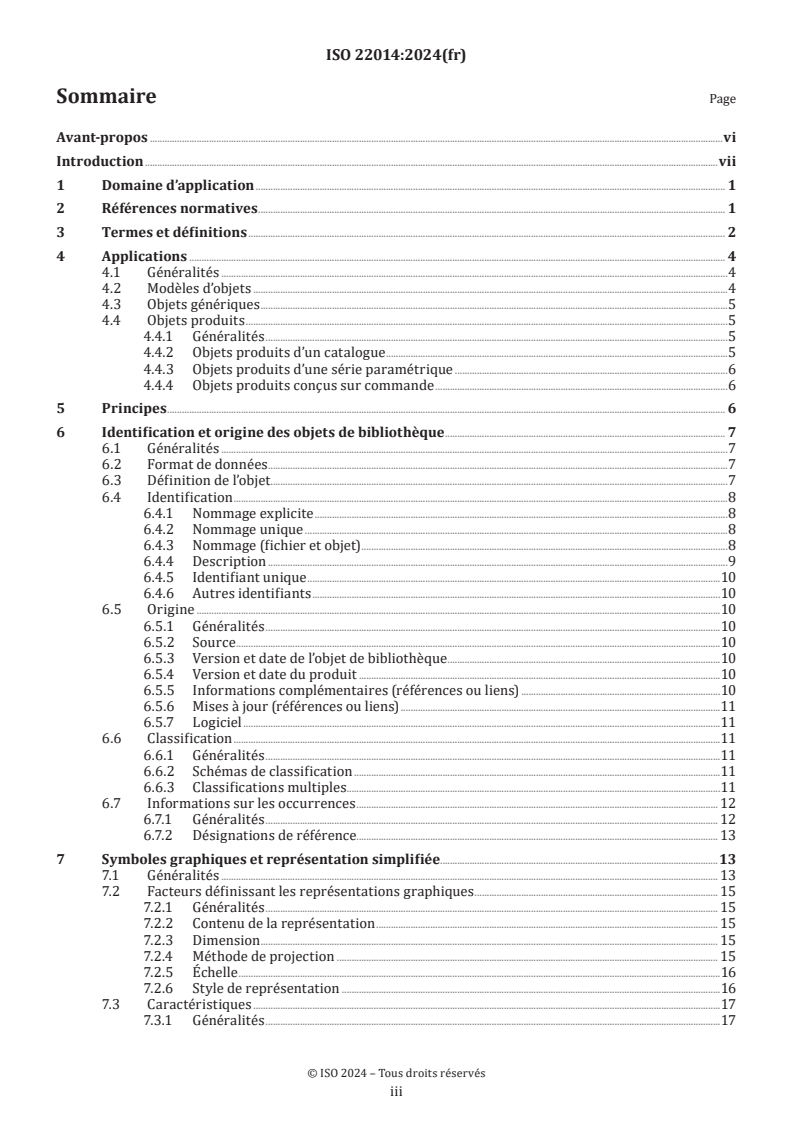
Contents Page
Foreword .vi
Introduction .vii
1 Scope . 1
2 Normative references . 1
3 Terms and definitions . 2
4 Applications . 4
4.1 General .4
4.2 Template objects .4
4.3 Generic objects .4
4.4 Product objects .5
4.4.1 General .5
4.4.2 Catalogue product objects .5
4.4.3 Parametric series product objects .5
4.4.4 Engineered-to-order product objects .5
5 Principles . 6
6 Identification and origination of library objects . 7
6.1 General .7
6.2 Data format .7
6.3 Object definition .7
6.4 Identification .7
6.4.1 Clear naming .7
6.4.2 Unique naming .7
6.4.3 Naming (file and object) .8
6.4.4 Description .9
6.4.5 Unique identifier .9
6.4.6 Other identifiers.9
6.5 Origination .9
6.5.1 General .9
6.5.2 Source .9
6.5.3 Library object version and date .10
6.5.4 Product version and date .10
6.5.5 Further information (references or links) .10
6.5.6 Updates (references or links) .10
6.5.7 Software . .10
6.6 Classification .10
6.6.1 General .10
6.6.2 Classification schemes.10
6.6.3 Multiple classifications .11
6.7 Occurrence information .11
6.7.1 General .11
6.7.2 Reference designations . . 12
7 Graphical symbols and simplified representation .12
7.1 General . 12
7.2 Defining factors for graphical presentations .14
7.2.1 General .14
7.2.2 Presentation contents .14
7.2.3 Dimension .14
7.2.4 Projection method .14
7.2.5 Scale . 15
7.2.6 Presentation style . 15
7.3 Features .16
7.3.1 General .16
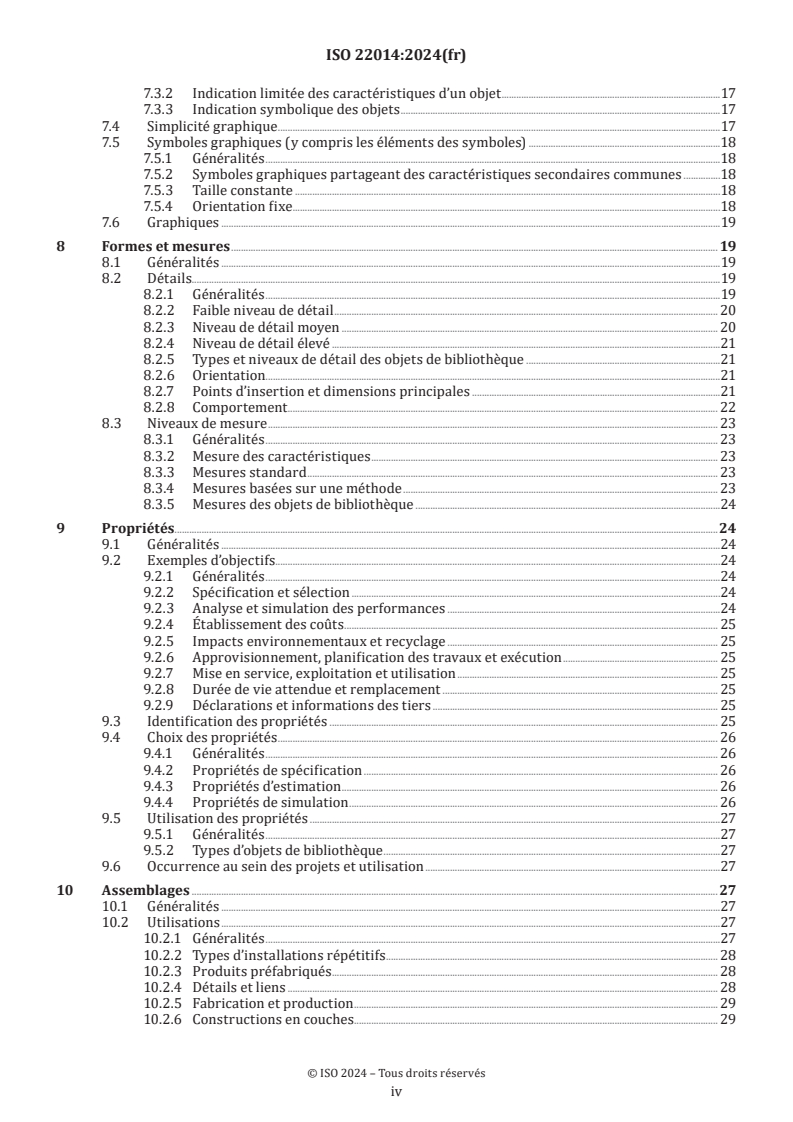
iii
7.3.2 Limited indication of the features of an object .16
7.3.3 Symbolic indication of objects .16
7.4 Graphic simplicity .16
7.5 Graphical symbols (including elements of symbols) .17
7.5.1 General .17
7.5.2 Graphical symbols sharing common subsidiary features .17
7.5.3 Constant size .17
7.5.4 Fixed orientation .17
7.6 Graphics .17
8 Shapes and measurements .18
8.1 General .18
8.2 Detail .18
8.2.1 General .18
8.2.2 Low detail .19
8.2.3 Medium detail .19
8.2.4 High detail .19
8.2.5 Library object types and detail .19
8.2.6 Orientation.19
8.2.7 Insertion points and principal dimensions . 20
8.2.8 Behaviour .21
8.3 Levels of measurement .21
8.3.1 General .21
8.3.2 Characteristic measurement .21
8.3.3 Standard measurement .21
8.3.4 Method-based measurement .21
8.3.5 Measurements for library objects . 22
9 Properties .22
9.1 General . 22
9.2 Example purposes . 22
9.2.1 General . 22
9.2.2 Specification and selection . 22
9.2.3 Performance analysis and simulation . 23
9.2.4 Costing . 23
9.2.5 Environmental impacts and recycling . 23
9.2.6 Procurement, work planning and execution . 23
9.2.7 Commissioning, operation and use . 23
9.2.8 Expected life and replacement . . 23
9.2.9 Declarations and third-party information . 23
9.3 Property identification . 23
9.4 Choice of properties .24
9.4.1 General .24
9.4.2 Specification properties.24
9.4.3 Assessment properties .24
9.4.4 Simulation properties .24
9.5 Use of properties . 25
9.5.1 General . 25
9.5.2 Library object types . 25
9.6 Occurrence within projects and use . 25
10 Assemblies .25
10.1 General . 25
10.2 Uses . 25
10.2.1 General . 25
10.2.2 Repetitive facility types . 26
10.2.3 Prefabricated products . 26
10.2.4 Details and connections . 26
10.2.5 Fabrication and manufacturing .27
10.2.6 Layered constructions .27
iv
10.3 Processes .27
10.3.1 Preparation and publication .27
10.3.2 Design and development .27
10.3.3 Measurement .27
10.3.4 Use in asset management.27
10.4 Implementation . . 28
10.5 Identification and grouping of assemblies . 28
10.5.1 General . 28
10.5.2 Graphical symbols . 28
10.5.3 Shape and measurement . 29
10.5.4 Properties . 29
10.5.5 Composition . 29
Annex A (informative) Examples .30
Annex B (informative) Localization .35
Bibliography .36
v
Foreword
ISO (the International Organization for Standardization) is a worldwide federation of national standards
bodies (ISO member bodies). The work of preparing International Standards is normally carried out through
ISO technical committees. Each member body interested in a subject for which a technical committee
has been established has the right to be represented on that committee. International organizations,
governmental and non-governmental, in liaison with ISO, also take part in the work. ISO collaborates closely
with the International Electrotechnical Commission (IEC) on all matters of electrotechnical standardization.
The procedures used to develop this document and those intended for its further maintenance are described
in the ISO/IEC Directives, Part 1. In particular, the different approval criteria needed for the different types
of ISO document should be noted. This document was drafted in accordance with the editorial rules of the
ISO/IEC Directives, Part 2 (see www.iso.org/directives).
ISO draws attention to the possibility that the implementation of this document may involve the use of (a)
patent(s). ISO takes no position concerning the evidence, validity or applicability of any claimed patent
rights in respect thereof. As of the date of publication of this document, ISO had not received notice of (a)
patent(s) which may be required to implement this document. However, implementers are cautioned that
this may not represent the latest information, which may be obtained from the patent database available at
www.iso.org/patents. ISO shall not be held responsible for identifying any or all such patent rights.
Any trade name used in this document is information given for the convenience of users and does not
constitute an endorsement.
For an explanation of the voluntary nature of standards, the meaning of ISO specific terms and expressions
related to conformity assessment, as well as information about ISO’s adherence to the World Trade
Organization (WTO) principles in the Technical Barriers to Trade (TBT), see www.iso.org/iso/foreword.html.
This document was prepared by Technical Committee ISO/TC 10, Technical product documentation,
Subcommittee SC 8, Construction documentation, in collaboration with the European Committee for
Standardization (CEN) Technical Committee CEN/TC 442, Building Information Modelling (BIM), in
accordance with the Agreement on technical cooperation between ISO and CEN (Vienna Agreement).
Any feedback or questions on this document should be directed to the user’s national standards body. A
complete listing of these bodies can be found at www.iso.org/members.html.
vi
Introduction
0.1 General
This document describes best practice for the development and application of library objects to support
building information modelling (BIM)-based design, specification, construction and operational processes,
including giving additional recommendations for specific use cases such as assemblies.
A library object is intended for reuse within project teams and across organizations. This serves to improve
accuracy and constructability of designs and to improve the handover of information through the supply
chain to the owner or operator. Objects in a digital format combining properties, shape and graphical
symbols offer scope for greater accuracy and efficiency.
This document includes principles and definitions for the symbolic and simplified visual presentation of
library objects in connection with BIM and their organization into libraries.
0.2 Purpose and justification
The purpose of this document is to offer a standard for developers, library providers, designers and
manufacturers to improve the exchange and reuse of library objects.
Library objects and their corresponding graphical symbols are now commonly provided in a digital format
by model authoring software. Traditional paper-based methods for graphical symbols have therefore
become less useful and are in some cases outdated. Several national standards have been withdrawn due to
lack of maintenance and conflicting International Standards. Still, documentation of complex entities such
as buildings and civil engineering works requires clear and uniform presentation so as to be legible and
easily understood. This document is intended to give a framework for the presentation of library objects,
with respect to those purposes, and also the structuring of graphical symbols into libraries.
Library objects, by combining properties, shape and graphical symbols, offer scope for greater accuracy
and efficiency. Current technology gives the opportunity to adjust the views of library objects (content and
visual presentation) to the many purposes that occur during the life cycle of a information model and to
connect symbol graphics to library objects.
0.3 Relationship to other standards
The increased adoption of data dictionaries, along with ISO 23386 and ISO 23387, is expected to facilitate the
preparation of data templates with properties for the non-graphical aspects of library objects and ISO 7817-1
to facilitate specifying the level of information need for geometrical and alphanumerical information and
documentation.
The ISO 7817-1 concepts and principles can be applied for a general information exchange and, while
in progress, for a generally agreed way of information exchange between parties in a collaborative work
process, as well as for an appointment with specified information delivery. Therefore, ISO 7817-1 concepts
and principles support the preparation of libraries outside of any individual project and are applied in this
document.
This document recommends that ISO 16739-1 is used as a basis for the naming of objects.
Project and asset information references provided by the appointing party, such as object libraries, are
covered in ISO 19650-2:2018, 5.1.6, and ISO 19650-3:2020, 5.1.8.
Guidance on graphical presentation for specific types of objects is provided by ISO 7519-1.
vii
International Standard ISO 22014:2024(en)
Library objects for architecture, engineering,
construction and use
1 Scope
This document specifies requirements for defining structure and content for library objects to support
project inception, brief, design, tendering, construction, operations, use and demolition, supporting the
development of information throughout the process, in connection with building information modelling
(BIM) and the organization of the objects into libraries.
This document does the following:
— Establishes requirements for defining template objects, generic objects and product objects in data-
driven library and design processes.
— Establishes requirements for graphical symbols and other graphic conventions for use on drawings for the
built environment, giving principles and definitions for the symbolic and simplified visual presentation
of objects. It also describes a rationale of symbolism which establishes rules for the design of graphical
symbols and other graphic conventions and gives recommendations for the application of those rules
and the ways in which symbolism should be used.
— Defines the purposes of characterizing the shape and measurement of library objects.
— Defines the purposes of specifying and assessing properties for library objects. It defines the information
appropriate for specific uses, including specification of the desired outcome (typically by designers and
engineers) and the selection of identified products (typically by contractors and subcontractors). It also
gives recommendations for the application of assemblies in integrated BIM working.
— Refers to the Industry Foundation Classes (IFC) schema as a common object model.
This document is applicable to all professionals and service providers who produce and use library
objects with generic and product-specific information. This group includes, but is not limited to, product
manufacturers and suppliers, library authors, designers and engineers, contractors, owners, maintainers
and commissioners.
2 Normative references
The following documents are referred to in the text in such a way that some or all of their content constitutes
requirements of this document. For dated references, only the edition cited applies. For undated references,
the latest edition of the referenced document (including any amendments) applies.
ISO 13567-1, Technical product documentation — Organization and naming of layers for CAD — Part 1:
Overview and principles
ISO 13567-2, Technical product documentation — Organization and naming of layers for CAD — Part 2:
Concepts, format and codes used in construction documentation
ISO 16739-1, Industry Foundation Classes (IFC) for data sharing in the construction and facility management
industries — Part 1: Data schema
ISO 23386, Building information modelling and other digital processes used in construction — Methodology to
describe, author and maintain properties in interconnected data dictionaries
ISO 23387, Building information modelling (BIM) — Data templates for construction objects used in the life
cycle of built assets — Concepts and principles
ISO 80000-1, Quantities and units — Part 1: General
3 Terms and definitions
For the purposes of this document, the following terms and definitions apply.
ISO and IEC maintain terminology databases for use in standardization at the following addresses:
— ISO Online browsing platform: available at https:// www .iso .org/ obp
— IEC Electropedia: available at https:// www .electropedia .org/
3.1
library object
type object
representation of an object, being maintained as part of a collection with common features
Note 1 to entry: A library object can be a template object (3.2), generic object (3.3) or product object (3.4).
Note 2 to entry: A library object is independent of any occurrence and has no placement in space.
Note 3 to entry: A library object can be referred to as a type object or class.
Note 4 to entry: See Figure 1.
Figure 1 — Relationship between library objects
3.2
template object
library object (3.1) used as a guide to produce generic objects (3.3) and product objects (3.4)
Note 1 to entry: A template object typically provides schedules of classification values and a minimum set of properties.
The measurement type (e.g. “area”) of properties (e.g. “Effective Area”) are specified, but the values and units (e.g.
“0,300” and “m ”) are not.
Note 2 to entry: Data templates containing recommended properties and set(s) of properties can be available to
support the development of template objects.
3.3
generic object
library object (3.1) used as a generalization
Note 1 to entry: A generic object is intended for use prior to being resolved into a product (3.5).
Note 2 to entry: Typically, shape and graphical symbols (3.6) will be provided and some property values with units.
3.4
product object
library object (3.1) used to represent a product (3.5)
Note 1 to entry: A product object is specific to a manufacturer and model identity.
3.5
product
item manufactured or processed for incorporation into construction works
[SOURCE: ISO 6707-3:2022, 3.3.1, modified — Admitted term “construction product” deleted. Note 1 to entry
deleted.]
3.6
graphical symbol
visually perceptible figure with a particular meaning used to transmit information independently of
language
Note 1 to entry: The graphical symbol may represent objects of interest, such as products (3.5), functions or
requirements for manufacturing, quality control, etc.
Note 2 to entry: A graphical symbol is not to be confused with the simplified representation (3.10) of products which is
normally drawn to scale and which can look like a graphical symbol.
Note 3 to entry: Typically, a graphical symbol is a graphic entity independent of scale, used:
a) on a drawing to indicate the occurrence and/or location of a library object (3.1);
b) in an annotation to indicate one or more of the properties (3.9) of a library object.
[SOURCE: ISO 81714-1:2010, 3.1, modified — Note 3 to entry added.]
3.7
graphical symbol element
part of a graphical symbol (3.6) with a particular meaning
[SOURCE: ISO 22727:2007, 3.5]
3.8
assembly
set of related types or components attached to each other
Note 1 to entry: Typically, an assembly is a partial model where both the overall assembly and the constituent parts
are managed during design, construction or use, and the constituent parts are located relative to the overall assembly.
[SOURCE: ISO 6707-1:2020, 3.3.5.5, modified — “types or” and Note 1 to entry added.]
3.9
property
data element for the computer-sensible description of a property, a relation or a class
3.10
simplified representation
representation drawn in accordance with the valid rules of projection and on which individual elements of
the product (3.5) are not shown, provided this does not present difficulties in understanding the drawing
[SOURCE: ISO/TS 128-71:2010, 3.2]
4 Applications
4.1 General
Library objects shall support the entire life cycle of the digital representation of the asset.
Use of consistent template, generic and product objects can add efficiency and reduce risks associated with
information loss or misinterpretation. See Figure 2 for an example upgrade process.
Figure 2 — Example of upgrading a library object
4.2 Template objects
Template objects shall be:
— created and shared, to guide library developers;
— used to illustrate best practice, define expectations for completeness and test generic and product library
objects.
Template objects provide guidance for developers of generic objects and product objects and should contain
only identification information and, wherever possible, properties without value. Shape and symbolic
presentations are optional. Priority should be given to template objects created by international and
regional bodies, professional and trade associations, and other consensus-based bodies, in particular those
which conform to ISO 23386, ISO 23387 and ISO 12006-3.
4.3 Generic objects
Generic objects shall be:
— based on published template objects, where available;
— created and shared, for example, by application vendors and in-house application support teams;
— used from the earlier stages of design and specification;
— used to answer the level of information need of each information deliverable according to its purpose;
— replaced with or upgraded to product objects when decided.
NOTE Generic objects support initial design and engineering and so contain at least identification and specifying
information to support the later selection of product library objects.
4.4 Product objects
4.4.1 General
Product objects shall be:
— based on published generic objects, where available;
— created and shared by manufacturers and third parties;
— used to validate design intent;
— used as the basis for quantification and procurement;
— used to document as-installed information to support operations, maintenance and replacement;
— used to answer the level of information need of each information deliverable according to its purpose:
— able to support economic, functional and environmental assessments.
NOTE 1 Product objects support the remaining stages of the project and built asset life cycle by representing
procured products and materials.
NOTE 2 Data templates for environmental product declarations are specified in ISO 22057.
4.4.2 Catalogue product objects
Catalogue product objects, representing a specific product with fixed properties available from a catalogue,
shall be designed to be:
— accessed and used directly by applications;
— associated to unique product identifiers.
NOTE Catalogue product objects represent off-the-shelf products and commodity materials.
4.4.3 Parametric series product objects
Parametric series product objects, representing a controlled range or series of generic or product objects
with variable properties, shall be designed to be:
— accessed and configured to suit the level of information need of each information deliverable according
to its purpose during the entire life cycle;
— associated to unique series identifiers.
NOTE Parametric series product objects represent configurable variants defined in standards and manufacturers’
catalogues.
4.4.4 Engineered-to-order product objects
Engineered-to-order product objects, representing a specific product, either as a requirement specification
or a resolved solution that can be manufactured, shall be designed to be:
— accessed and configured to document the level of information need of each information deliverable
according to its purpose during the entire life cycle;
— used as the basis for requests for engineered solutions from suppliers and manufacturers;
— upgraded to engineered solutions supplied by a supplier or manufacturer.
NOTE Engineered-to-order product objects represent specified configurations, which are then substituted by
specific solutions provided by a manufacturer.
5 Principles
Library objects shall support the following purposes:
— identification of the product, its physical and virtual source, its classification and type (see Clauses 4 and
6) and its representation in schedules and quantity take-offs;
— use in the production of conventional drawings and projections (see Clause 7);
— use in 3D projections, spatial coordination or clash detection, use simulation and visualizations, quantity
take-off (see Clause 8);
— use in specification, estimating and functional, environmental and economic analysis (see Clause 9);
— use in assemblies, where relevant (see Clause 10).
The information provided shall be of sufficient quality for these purposes; it shall be consistent and non-
conflicting, and minimal but sufficient for the anticipated purposes. The library object, its graphical symbols,
shape and properties shall be associated to a consistent system o
...
Norme
internationale
ISO 22014
Première édition
Objets de bibliothèque pour
2024-05
l’architecture, l’ingénierie, la
construction et l’utilisation
Library objects for architecture, engineering, construction and use
Numéro de référence
DOCUMENT PROTÉGÉ PAR COPYRIGHT
© ISO 2024
Tous droits réservés. Sauf prescription différente ou nécessité dans le contexte de sa mise en œuvre, aucune partie de cette
publication ne peut être reproduite ni utilisée sous quelque forme que ce soit et par aucun procédé, électronique ou mécanique,
y compris la photocopie, ou la diffusion sur l’internet ou sur un intranet, sans autorisation écrite préalable. Une autorisation peut
être demandée à l’ISO à l’adresse ci-après ou au comité membre de l’ISO dans le pays du demandeur.
ISO copyright office
Case postale 401 • Ch. de Blandonnet 8
CH-1214 Vernier, Genève
Tél.: +41 22 749 01 11
E-mail: copyright@iso.org
Web: www.iso.org
Publié en Suisse
ii
Sommaire Page
Avant-propos .vi
Introduction .vii
1 Domaine d’application . 1
2 Références normatives . 1
3 Termes et définitions . 2
4 Applications . 4
4.1 Généralités .4
4.2 Modèles d’objets .4
4.3 Objets génériques .5
4.4 Objets produits .5
4.4.1 Généralités .5
4.4.2 Objets produits d’un catalogue .5
4.4.3 Objets produits d’une série paramétrique .6
4.4.4 Objets produits conçus sur commande .6
5 Principes . 6
6 Identification et origine des objets de bibliothèque . 7
6.1 Généralités .7
6.2 Format de données .7
6.3 Définition de l’objet.7
6.4 Identification .8
6.4.1 Nommage explicite .8
6.4.2 Nommage unique .8
6.4.3 Nommage (fichier et objet) .8
6.4.4 Description .9
6.4.5 Identifiant unique .10
6.4.6 Autres identifiants .10
6.5 Origine .10
6.5.1 Généralités .10
6.5.2 Source .10
6.5.3 Version et date de l’objet de bibliothèque .10
6.5.4 Version et date du produit .10
6.5.5 Informations complémentaires (références ou liens) .10
6.5.6 Mises à jour (références ou liens) .11
6.5.7 Logiciel .11
6.6 Classification .11
6.6.1 Généralités .11
6.6.2 Schémas de classification .11
6.6.3 Classifications multiples . . .11
6.7 Informations sur les occurrences . 12
6.7.1 Généralités . 12
6.7.2 Désignations de référence . . 13
7 Symboles graphiques et représentation simplifiée.13
7.1 Généralités . 13
7.2 Facteurs définissant les représentations graphiques . 15
7.2.1 Généralités . 15
7.2.2 Contenu de la représentation . 15
7.2.3 Dimension . 15
7.2.4 Méthode de projection . 15
7.2.5 Échelle .16
7.2.6 Style de représentation .16
7.3 Caractéristiques .17
7.3.1 Généralités .17
iii
7.3.2 Indication limitée des caractéristiques d’un objet .17
7.3.3 Indication symbolique des objets .17
7.4 Simplicité graphique .17
7.5 Symboles graphiques (y compris les éléments des symboles) .18
7.5.1 Généralités .18
7.5.2 Symboles graphiques partageant des caractéristiques secondaires communes .18
7.5.3 Taille constante .18
7.5.4 Orientation fixe . .18
7.6 Graphiques .19
8 Formes et mesures . 19
8.1 Généralités .19
8.2 Détails.19
8.2.1 Généralités .19
8.2.2 Faible niveau de détail . 20
8.2.3 Niveau de détail moyen . 20
8.2.4 Niveau de détail élevé .21
8.2.5 Types et niveaux de détail des objets de bibliothèque .21
8.2.6 Orientation.21
8.2.7 Points d’insertion et dimensions principales .21
8.2.8 Comportement . 22
8.3 Niveaux de mesure . 23
8.3.1 Généralités . 23
8.3.2 Mesure des caractéristiques . 23
8.3.3 Mesures standard . 23
8.3.4 Mesures basées sur une méthode . 23
8.3.5 Mesures des objets de bibliothèque .24
9 Propriétés . .24
9.1 Généralités .24
9.2 Exemples d’objectifs.24
9.2.1 Généralités .24
9.2.2 Spécification et sélection .24
9.2.3 Analyse et simulation des performances .24
9.2.4 Établissement des coûts . 25
9.2.5 Impacts environnementaux et recyclage . 25
9.2.6 Approvisionnement, planification des travaux et exécution . 25
9.2.7 Mise en service, exploitation et utilisation . 25
9.2.8 Durée de vie attendue et remplacement . 25
9.2.9 Déclarations et informations des tiers . 25
9.3 Identification des propriétés . 25
9.4 Choix des propriétés . 26
9.4.1 Généralités . 26
9.4.2 Propriétés de spécification . 26
9.4.3 Propriétés d’estimation . 26
9.4.4 Propriétés de simulation . 26
9.5 Utilisation des propriétés .27
9.5.1 Généralités .27
9.5.2 Types d’objets de bibliothèque .27
9.6 Occurrence au sein des projets et utilisation .27
10 Assemblages .27
10.1 Généralités .27
10.2 Utilisations .27
10.2.1 Généralités .27
10.2.2 Types d’installations répétitifs . 28
10.2.3 Produits préfabriqués . 28
10.2.4 Détails et liens . 28
10.2.5 Fabrication et production . 29
10.2.6 Constructions en couches . 29
iv
10.3 Processus . 29
10.3.1 Préparation et publication . 29
10.3.2 Conception et développement . 29
10.3.3 Mesure . 29
10.3.4 Utilisation dans la gestion d’actifs . 29
10.4 Mise en œuvre . 30
10.5 Identification et regroupement des assemblages . 30
10.5.1 Généralités . 30
10.5.2 Symboles graphiques . . . 30
10.5.3 Forme et mesure .31
10.5.4 Propriétés .31
10.5.5 Composition .31
Annexe A (informative) Exemples .32
Annexe B (informative) Localisation .37
Bibliographie .38
v
Avant-propos
L’ISO (Organisation internationale de normalisation) est une fédération mondiale d’organismes nationaux
de normalisation (comités membres de l’ISO). L’élaboration des Normes internationales est en général
confiée aux comités techniques de l’ISO. Chaque comité membre intéressé par une étude a le droit de faire
partie du comité technique créé à cet effet. Les organisations internationales, gouvernementales et non
gouvernementales, en liaison avec l’ISO participent également aux travaux. L’ISO collabore étroitement avec
la Commission électrotechnique internationale (IEC) en ce qui concerne la normalisation électrotechnique.
Les procédures utilisées pour élaborer le présent document et celles destinées à sa mise à jour sont
décrites dans les Directives ISO/IEC, Partie 1. Il convient, en particulier, de prendre note des différents
critères d’approbation requis pour les différents types de documents ISO. Le présent document a
été rédigé conformément aux règles de rédaction données dans les Directives ISO/IEC, Partie 2 (voir
www.iso.org/directives).
L’ISO attire l’attention sur le fait que la mise en application du présent document peut entraîner l’utilisation
d’un ou de plusieurs brevets. L’ISO ne prend pas position quant à la preuve, à la validité et à l’applicabilité de
tout droit de brevet revendiqué à cet égard. À la date de publication du présent document, l’ISO n’avait pas
reçu notification qu’un ou plusieurs brevets pouvaient être nécessaires à sa mise en application. Toutefois,
il y a lieu d’avertir les responsables de la mise en application du présent document que des informations
plus récentes sont susceptibles de figurer dans la base de données de brevets, disponible à l’adresse
www.iso.org/brevets. L’ISO ne saurait être tenue pour responsable de ne pas avoir identifié tout ou partie de
tels droits de propriété.
Les appellations commerciales éventuellement mentionnées dans le présent document sont données pour
information, par souci de commodité, à l’intention des utilisateurs et ne sauraient constituer un engagement.
Pour une explication de la nature volontaire des normes, la signification des termes et expressions
spécifiques de l’ISO liés à l’évaluation de la conformité, ou pour toute information au sujet de l’adhésion de
l’ISO aux principes de l’Organisation mondiale du commerce (OMC) concernant les obstacles techniques au
commerce (OTC), voir www.iso.org/avant-propos.
Le présent document a été élaboré par le comité technique ISO/TC 10, Documentation technique de produits,
sous-comité SC 8, Documentation de construction, en collaboration avec le comité technique CEN/TC 442,
Modélisation des informations de la construction (BIM), du Comité européen de normalisation (CEN)
conformément à l’Accord de coopération technique entre l’ISO et le CEN (Accord de Vienne).
Il convient que l’utilisateur adresse tout retour d’information ou toute question concernant le présent
document à l’organisme national de normalisation de son pays. Une liste exhaustive desdits organismes se
trouve à l’adresse www.iso.org/fr/members.html.
vi
Introduction
0.1 Généralités
Le présent document décrit les meilleures pratiques pour le développement et l’application d’objets de
bibliothèque destinés à faciliter la modélisation des informations de la construction (BIM) reposant sur
les processus de conception, de spécification, de construction et d’exploitation. Il fournit également des
recommandations supplémentaires pour des cas d’utilisation spécifiques tels que les assemblages.
Un objet de bibliothèque est destiné à être réutilisé au sein des équipes de projets et dans les organisations
afin d’améliorer, d’une part, la précision et la constructibilité des modèles et, d’autre part, le transfert
d’informations dans toute la chaîne logistique jusqu’au propriétaire ou jusqu’à l’exploitant. Les objets
au format numérique combinant propriétés, forme et symboles graphiques accroissent les possibilités en
matière de précision et d’efficacité.
Le présent document spécifie les principes et les définitions pour la représentation symbolique et la
représentation visuelle simplifiée des objets de bibliothèque en lien avec le BIM, ainsi que leur organisation
en bibliothèques.
0.2 Objectif et justification
Le présent document a pour objectif d’offrir aux développeurs, fournisseurs de bibliothèques, concepteurs et
fabricants une norme pour améliorer l’échange et la réutilisation des objets de bibliothèque.
Les logiciels de modélisation actuels utilisent généralement des objets de bibliothèque et leurs symboles
graphiques correspondants au format numérique. Les méthodes traditionnelles de représentation papier
des symboles graphiques ont donc perdu de leur utilité et sont dans certains cas démodées. Plusieurs normes
nationales ont été annulées en raison de l’absence de mise à jour et de conflit avec les Normes internationales.
De plus, la documentation des entités complexes telles que les bâtiments et les ouvrages de génie civil
nécessite une présentation claire et uniforme de manière à être lisible et facilement compréhensible. Le
présent document est destiné à fournir un cadre pour la présentation des objets de bibliothèque, en lien avec
ces objectifs, tout en structurant les symboles graphiques en bibliothèques.
Les objets de bibliothèque, en combinant propriétés, forme et symboles graphiques, accroissent les
possibilités en matière de précision et d’efficacité. Les technologies actuelles donnent la possibilité d’ajuster
les vues des objets de bibliothèque (contenu et présentation visuelle) en fonction de nombreux objectifs qui
apparaissent au cours du cycle de vie d’un modèle d’informations, et d’associer des symboles graphiques à
des objets de bibliothèque.
0.3 Relation avec d’autres normes
Il est attendu que l’adoption croissante des dictionnaires de données et des normes, ainsi que de l’ISO 23386
et de l’ISO 23387, facilite la préparation des modèles de données avec des propriétés pour les aspects non
graphiques des objets de bibliothèque, et que celle de l’ISO 7817-1 facilite la spécification du niveau du besoin
d’information pour les informations géométriques et alphanumériques ainsi que la documentation.
Les concepts et les principes de l’ISO 7817-1 peuvent s’appliquer à un échange général d’informations et, dans
le même temps, à un mode communément accepté d’échange d’informations entre des parties dans le cadre
d’un processus de travail collaboratif, ainsi qu’à la désignation d’une livraison d’informations spécifiée. Par
conséquent, les concepts et les principes de l’ISO 7817-1 s’appliquent à la préparation de bibliothèques en
dehors de tout projet individuel et sont appliqués au présent document.
Le présent document recommande d’utiliser l’ISO 16739-1 comme base pour le nommage des objets.
Les références des informations sur les projets et les actifs fournies par la partie désignante, telles que les
bibliothèques d’objets, sont traitées dans l’ISO 19650-2:2018, 5.1.6, et l’ISO 19650-3:2020, 5.1.8.
Des recommandations concernant la représentation graphique de types d’objets spécifiques sont fournies
dans l’ISO 7519-1.
vii
Norme internationale ISO 22014:2024(fr)
Objets de bibliothèque pour l’architecture, l’ingénierie, la
construction et l’utilisation
1 Domaine d’application
Le présent document spécifie des exigences pour définir la structure et le contenu des objets de bibliothèque
destinés à faciliter le démarrage du projet, la préparation, la conception, l’appel d’offre, la construction,
l’exploitation, l’utilisation et la démolition, en soutenant le développement de l’information tout au long du
processus, en liaison avec la modélisation des informations sur la construction (BIM) et l’organisation des
objets en bibliothèques.
Le présent document:
— établit les exigences relatives à la définition des modèles d’objets, des objets génériques et des objets
produits dans les bibliothèques et les processus de conception axés sur les données;
— établit les exigences applicables aux symboles graphiques et aux autres conventions graphiques à
utiliser pour les représentations visuelles du cadre bâti, et expose des principes et des définitions pour
la représentation symbolique et la représentation visuelle simplifiée des objets. Il décrit également
les raisons sous-jacentes au symbolisme qui établissent des règles pour la conception des symboles
graphiques et des autres conventions graphiques, et fournit des recommandations pour l’application de
ces règles et la façon dont il convient d’employer ce symbolisme;
— a pour but de caractériser la forme et les dimensions des objets de bibliothèque;
— vise à spécifier et analyser les propriétés des objets de bibliothèque. Il définit les informations
appropriées pour des utilisations spécifiques, y compris la spécification du résultat attendu (en général
par les concepteurs et les ingénieurs) et le choix des produits identifiés (en général par les entrepreneurs
et les sous-traitants). Il donne également des recommandations pour l’application des assemblages dans
les processus BIM;
— fait référence au schéma des classes IFC en tant que modèle d’objet commun.
Le présent document est destiné à tous les professionnels et prestataires de services qui produisent et
utilisent des objets de bibliothèque contenant des informations génériques et des informations produits. Ce
groupe d’utilisateurs comprend, mais sans s’y limiter, les fabricants et fournisseurs de produits, les créateurs
de bibliothèques, les concepteurs et ingénieurs, les propriétaires, les exploitants et les responsables de la
mise en service.
2 Références normatives
Les documents suivants sont cités dans le texte de sorte qu’ils constituent, pour tout ou partie de leur
contenu, des exigences du présent document. Pour les références datées, seule l’édition citée s’applique. Pour
les références non datées, la dernière édition du document de référence s’applique (y compris les éventuels
amendements).
ISO 13567-1, Documentation technique de produits — Organisation et dénomination des couches de CAO —
Partie 1: Vue d’ensemble et principes
ISO 13567-2, Documentation technique de produits — Organisation et dénomination des couches de CAO —
Partie 2: Concepts, format et codes utilisés dans la documentation pour la construction
ISO 16739-1, Classes IFC pour le partage des données dans le secteur de la construction et de la gestion de
patrimoine — Partie 1: Schéma de données
ISO 23386, Modélisation des informations de la construction et autres processus numériques utilisés en
construction — Méthodologie de description, de création et de gestion des propriétés dans les dictionnaires de
données interconnectés
ISO 23387, Modélisation des informations de la construction (BIM) — Modèles de données pour les objets de
construction utilisés durant le cycle de vie des biens construits — Concepts et principes
ISO 80000-1, Grandeurs et unités — Partie 1: Généralités
3 Termes et définitions
Pour les besoins du présent document, les termes et définitions suivants s’appliquent.
L’ISO et l’IEC tiennent à jour des bases de données terminologiques destinées à être utilisées en normalisation,
consultables aux adresses suivantes:
— ISO Online browsing platform: disponible à l’adresse https:// www .iso .org/ obp
— IEC Electropedia: disponible à l’adresse https:// www .electropedia .org/
3.1
objet de bibliothèque
type d’objet
représentation d’un objet, gérée en tant que partie d’une collection présentant des caractéristiques
communes
Note 1 à l'article: Un objet de bibliothèque peut être un modèle d’objet (3.2), un objet générique (3.3) ou un objet produit (3.4).
Note 2 à l'article: Un objet de bibliothèque est indépendant de toute occurrence et n’a aucun placement dans l’espace.
Note 3 à l'article: Un objet de bibliothèque peut être référencé comme un type d’objet ou une classe.
Note 4 à l'article: Voir Figure 1.
Figure 1 — Relations entre les objets de bibliothèque
3.2
modèle d’objet
objet de bibliothèque (3.1) utilisé comme guide pour produire des objets génériques (3.3) et des objets
produits (3.4)
Note 1 à l'article: Un modèle d’objet fournit généralement des listes de valeurs de classification et un ensemble minimal
de propriétés. Les types de mesures (par exemple «surface») des propriétés (par exemple «surface effective») sont
spécifiés, mais les valeurs et unités (par «0,300» et «m ») ne le sont pas.
Note 2 à l'article: Des modèles de données contenant des propriétés recommandées et un (plusieurs) ensemble(s) de
propriétés peuvent être disponibles pour faciliter le développement de modèles d’objets.
3.3
objet générique
objet de bibliothèque (3.1) utilisé pour une description conceptuelle
Note 1 à l'article: Un objet générique est destiné à être utilisé avant d’être transformé en produit (3.5).
Note 2 à l'article: Une forme et des symboles graphiques (3.6) seront généralement fournis, ainsi que plusieurs valeurs
de propriétés avec des unités.
3.4
objet produit
objet de bibliothèque (3.1) utilisé pour représenter un produit (3.5)
Note 1 à l'article: Un objet produit est spécifique à un fabricant et à une identité de modèle.
3.5
produit
élément fabriqué ou traité en vue d’être intégré dans des travaux de construction
[SOURCE: ISO 6707-3:2022, 3.3.1, modifié — Le terme admis «produit de construction» a été supprimé. La
Note 1 à l’article a été supprimée]
3.6
symbole graphique
figure visuellement perceptible, ayant une signification particulière et utilisée pour transmettre des
informations indépendamment de la langue
Note 1 à l'article: Le symbole graphique peut représenter des objets présentant un intérêt, tels que des produits (3.5),
des fonctions ou des exigences de fabrication, de contrôle qualité, etc.
Note 2 à l'article: Un symbole graphique ne doit pas être confondu avec la représentation simplifiée (3.10) des produits
qui est normalement dessinée à l’échelle et qui peut ressembler à un symbole graphique.
Note 3 à l'article: En général, un symbole graphique est une entité graphique indépendante de l’échelle et utilisée:
a) sur un dessin pour indiquer l’occurrence et/ou l’emplacement d’un objet de bibliothèque (3.1);
b) dans une annotation pour indiquer une ou plusieurs propriétés (3.9) d’un objet de bibliothèque.
[SOURCE: ISO 81714-1:2010, 3.1, modifié — La Note 3 à l’article a été ajoutée]
3.7
élément de symbole graphique
partie d’un symbole graphique (3.6) ayant une signification particulière
[SOURCE: ISO 22727:2007, 3.5]
3.8
assemblage
ensemble de types apparentés ou de composants liés les uns aux autres
Note 1 à l'article: En général, un assemblage est un modèle partiel où l’assemblage global et les parties constitutives
sont gérés pendant la conception, la construction ou l’utilisation, et les parties constitutives sont positionnées par
rapport à l’assemblage global.
[SOURCE: ISO 6707-1:2020, 3.3.5.5, modifié — «de types ou» et la Note 1 à l’article ont été ajoutés]
3.9
propriété
élément de donnée pour la description informatiquement pertinente d’une propriété, d’une relation ou
d’une classe
3.10
représentation simplifiée
représentation dessinée selon les règles de projection applicables et dont les éléments individuels du produit
(3.5) sont absents, sous réserve que cette absence ne nuise pas à la compréhension du dessin
[SOURCE: ISO/TS 128-71:2010, 3.2]
4 Applications
4.1 Généralités
Les objets de bibliothèque doivent prendre en charge l’ensemble du cycle de vie de la représentation
numérique de l’actif.
L’utilisation de modèles d’objets, d’objets génériques et d’objets produits cohérents peut accroître l’efficacité
et réduire les risques associés à la perte d’informations ou à une mauvaise interprétation des données. La
Figure 2 donne un exemple de processus de mise à niveau.
Figure 2 — Exemple de mise à niveau d’un objet de bibliothèque
4.2 Modèles d’objets
Les modèles d’objets doivent être:
— créés et partagés afin de guider les développeurs de bibliothèques;
— utilisés pour illustrer les meilleures pratiques, définir les attentes en matière d’exhaustivité et contrôler
les objets génériques et les objets des bibliothèques de produits.
Les modèles d’objets fournissent des recommandations aux développeurs d’objets génériques et d’objets
produits et il convient qu’ils ne contiennent que des informations d’identification et, dans la mesure du
possible, des propriétés sans valeur. Les représentations symboliques et de forme sont facultatives. Il
convient de privilégier les modèles d’objets créés par les organismes internationaux et régionaux, les
associations professionnelles et commerciales et d’autres organismes à caractère consensuel, en particulier
ceux conformes à l’ISO 23386, l’ISO 23387 et l’ISO 12006-3.
4.3 Objets génériques
Les objets génériques doivent être:
— fondés sur des modèles d’objets publiés, le cas échéant;
— créés et partagés par exemple par des éditeurs de logiciels et des équipes de support d’applications
internes;
— utilisés dès les premières étapes de la conception et de la spécification;
— utilisés pour répondre au niveau du besoin d’information de chaque livrable d’information en fonction de
sa finalité;
— remplacés ou mis à niveau par des objets produits une fois la décision prise.
NOTE Les objets génériques facilitent la conception initiale et l’ingénierie, et contiennent donc au moins des
informations d’identification et de spécification qui facilitent la sélection ultérieure des objets des bibliothèques de
produits.
4.4 Objets produits
4.4.1 Généralités
Les objets produits doivent être:
— fondés sur des objets génériques publiés, le cas échéant;
— créés et partagés par les fabricants et les tiers;
— utilisés pour valider l’idée du concepteur;
— utilisés comme base pour la quantification et les achats;
— utilisés pour documenter les informations conformes à l’installation afin de faciliter l’exploitation,
la maintenance et le remplacement;
— utilisés pour répondre au niveau du besoin d’information de chaque livrable d’information en fonction de
sa finalité;
— en mesure d’assister les évaluations économiques, fonctionnelles et environnementales.
NOTE 1 Les objets produits prennent en charge les étapes restantes du cycle de vie du projet et des actifs bâtis en
représentant les produits et matériaux achetés.
NOTE 2 Les modèles de données pour les déclarations environnementales des produits sont spécifiés dans
l’ISO 22057.
4.4.2 Objets pro
...