

ISO 8426-2:2025
(Main)Hydraulic fluid power — Determination of derived displacement of positive displacement pumps and motors — Part 2: Zero-pressure intercept method
General Information
- Abstract
This document specifies the zero-pressure intercept method for the determination of the derived displacement of hydraulic fluid power positive displacement pumps and motors under steady state conditions. A single value for the derived displacement is determined from measurements at a single shaft speed.
- Status
- Published
- Publication Date
- 11-Aug-2025
- Technical Committee
- ISO/TC 131/SC 8 - Product testing
- Drafting Committee
- ISO/TC 131/SC 8 - Product testing
- Current Stage
- 6060 - International Standard published
- Start Date
- 12-Aug-2025
- Due Date
- 21-Sep-2025
- Completion Date
- 12-Aug-2025
Overview
ISO 8426-2:2025 - Hydraulic fluid power - Determination of derived displacement of positive displacement pumps and motors - Part 2: Zero-pressure intercept method - defines a standardized test and calculation method to determine the derived displacement (also called derived capacity) of positive displacement pumps and motors under steady‑state conditions. The standard specifies obtaining a single derived displacement value from measurements at a single shaft speed by extrapolating high‑pressure flow to zero differential pressure using the zero‑pressure intercept method.
Key topics and technical requirements
- Scope: Applies to positive displacement pumps and motors tested under steady‑state conditions; produces one derived displacement value per set of test conditions (shaft speed, fluid temperature, displacement setting).
- Measurements: Record high‑pressure flow rates (qve,i), inlet/outlet/case pressures, differential pressures (Δp), shaft speed (n) and inlet temperature (θ1) in accordance with ISO 4409:2019 test practices.
- Data points: A minimum of five steady‑state differential pressures is recommended, increased in equal increments from minimum to maximum differential pressure.
- Special cases:
- Variable displacement units: follow ISO 4409:2019 subsections for variable units.
- Reverse flow: if displacement depends on flow direction, determine derived displacement for each direction.
- Pump vs motor mode: test in the intended mode; values can differ between modes.
- Calculation:
- Use linear regression (ordinary least squares) on qve versus Δp to determine the zero‑pressure intercept qve,0.
- Convert intercept to derived displacement: V = qve,0 / n.
- Reporting: Test report must include test ID, unit description, shaft speed and pressure ranges, test circuit diagram, fluid properties, measurement accuracy, measured and derived values (including correlation coefficients) and reference to ISO 8426-2:2025.
Applications and who uses it
- Hydraulic component manufacturers use ISO 8426-2:2025 for product characterization, performance data sheets and quality control.
- Test laboratories and certification bodies apply the method to produce repeatable, comparable displacement measurements.
- System designers and engineers use derived displacement figures for sizing, simulation and troubleshooting of hydraulic circuits.
- R&D and validation teams rely on the zero‑pressure intercept method for performance benchmarking and correlation with volumetric efficiency.
Related standards
- ISO 4409:2019 - Methods of testing pumps, motors and transmissions (referenced for measurement procedures)
- ISO 5598 - Fluid power vocabulary (terms and definitions)
- ISO 1219‑1, ISO 4391 - Graphical symbols and parameter symbols (referenced for symbols/units)
Keywords: ISO 8426-2:2025, hydraulic fluid power, derived displacement, zero‑pressure intercept method, positive displacement pump testing, hydraulic testing standards.
Relations
- Effective Date
- 02-Jul-2022
Get Certified
Connect with accredited certification bodies for this standard

Institut za varilstvo d.o.o. (Welding Institute)
Slovenia's leading welding institute since 1952. ISO 3834, EN 1090, pressure equipment certification, NDT personnel, welder qualification. Only IIW Au
Sponsored listings
Frequently Asked Questions
ISO 8426-2:2025 is a standard published by the International Organization for Standardization (ISO). Its full title is "Hydraulic fluid power — Determination of derived displacement of positive displacement pumps and motors — Part 2: Zero-pressure intercept method". This standard covers: This document specifies the zero-pressure intercept method for the determination of the derived displacement of hydraulic fluid power positive displacement pumps and motors under steady state conditions. A single value for the derived displacement is determined from measurements at a single shaft speed.
This document specifies the zero-pressure intercept method for the determination of the derived displacement of hydraulic fluid power positive displacement pumps and motors under steady state conditions. A single value for the derived displacement is determined from measurements at a single shaft speed.
ISO 8426-2:2025 is classified under the following ICS (International Classification for Standards) categories: 23.100.10 - Pumps and motors. The ICS classification helps identify the subject area and facilitates finding related standards.
ISO 8426-2:2025 has the following relationships with other standards: It is inter standard links to ISO 8426:2008. Understanding these relationships helps ensure you are using the most current and applicable version of the standard.
ISO 8426-2:2025 is available in PDF format for immediate download after purchase. The document can be added to your cart and obtained through the secure checkout process. Digital delivery ensures instant access to the complete standard document.
Standards Content (Sample)
International
Standard
ISO 8426-2
First edition
Hydraulic fluid power —
2025-08
Determination of derived
displacement of positive
displacement pumps and motors —
Part 2:
Zero-pressure intercept method
Transmissions hydrauliques — Détermination de la cylindrée
calculée des pompes et moteurs volumétriques —
Partie 2: Méthode d'interception à pression nulle
Reference number
© ISO 2025
All rights reserved. Unless otherwise specified, or required in the context of its implementation, no part of this publication may
be reproduced or utilized otherwise in any form or by any means, electronic or mechanical, including photocopying, or posting on
the internet or an intranet, without prior written permission. Permission can be requested from either ISO at the address below
or ISO’s member body in the country of the requester.
ISO copyright office
CP 401 • Ch. de Blandonnet 8
CH-1214 Vernier, Geneva
Phone: +41 22 749 01 11
Email: copyright@iso.org
Website: www.iso.org
Published in Switzerland
ii
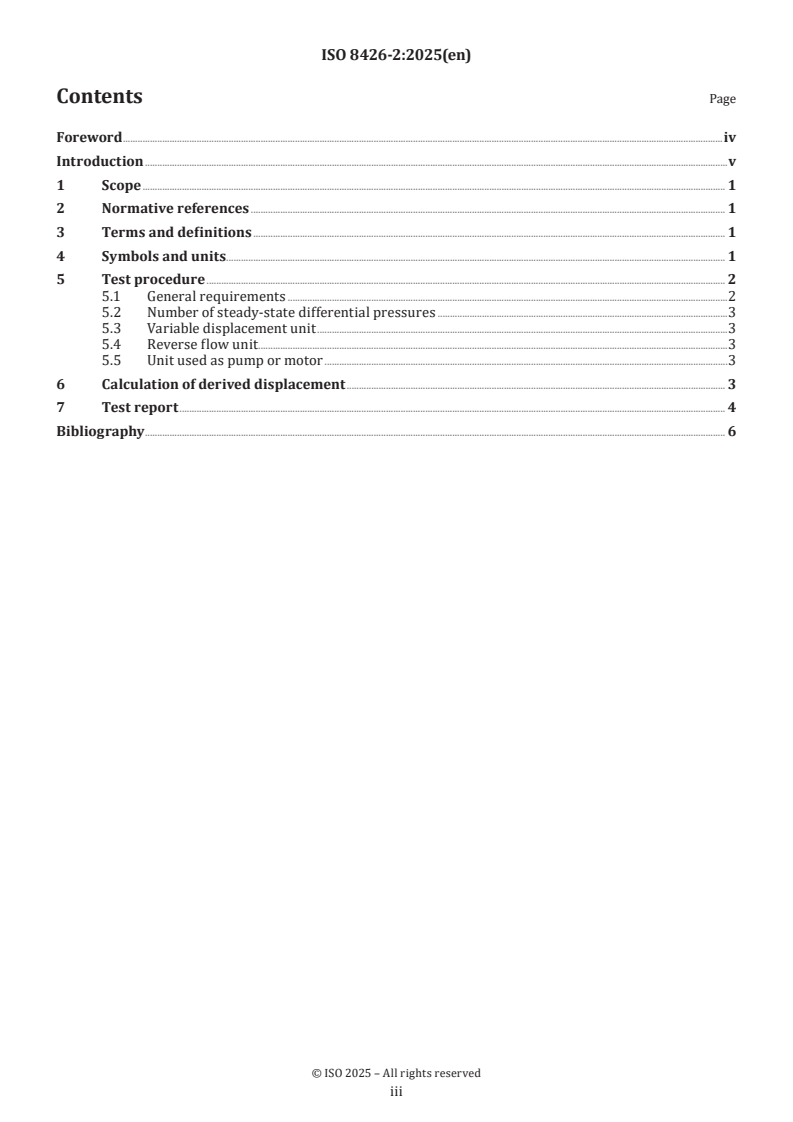
Contents Page
Foreword .iv
Introduction .v
1 Scope . 1
2 Normative references . 1
3 Terms and definitions . 1
4 Symbols and units. 1
5 Test procedure . 2
5.1 General requirements .2
5.2 Number of steady-state differential pressures .3
5.3 Variable displacement unit .3
5.4 Reverse flow unit .3
5.5 Unit used as pump or motor .3
6 Calculation of derived displacement . 3
7 Test report . 4
Bibliography . 6
iii
Foreword
ISO (the International Organization for Standardization) is a worldwide federation of national standards
bodies (ISO member bodies). The work of preparing International Standards is normally carried out through
ISO technical committees. Each member body interested in a subject for which a technical committee
has been established has the right to be represented on that committee. International organizations,
governmental and non-governmental, in liaison with ISO, also take part in the work. ISO collaborates closely
with the International Electrotechnical Commission (IEC) on all matters of electrotechnical standardization.
The procedures used to develop this document and those intended for its further maintenance are described
in the ISO/IEC Directives, Part 1. In particular, the different approval criteria needed for the different types
of ISO documents should be noted. This document was drafted in accordance with the editorial rules of the
ISO/IEC Directives, Part 2 (see www.iso.org/directives).
ISO draws attention to the possibility that the implementation of this document may involve the use of (a)
patent(s). ISO takes no position concerning the evidence, validity or applicability of any claimed patent
rights in respect thereof. As of the date of publication of this document, ISO had not received notice of (a)
patent(s) which may be required to implement this document. However, implementers are cautioned that
this may not represent the latest information, which may be obtained from the patent database available at
www.iso.org/patents. ISO shall not be held responsible for identifying any or all such patent rights.
Any trade name used in this document is information given for the convenience of users and does not
constitute an endorsement.
For an explanation of the voluntary nature of standards, the meaning of ISO specific terms and expressions
related to conformity assessment, as well as information about ISO's adherence to the World Trade
Organization (WTO) principles in the Technical Barriers to Trade (TBT), see www.iso.org/iso/foreword.html.
This document was prepared by Technical Committee ISO/TC 131, Fluid power systems, Subcommittee SC 8,
Product testing.
This first edition of ISO 8426-2 cancels and replaces the second edition (ISO 8426:2008), which has been
technically revised.
A list of all parts in the ISO 8426 series can be found on the ISO website.
Any feedback or questions on this document should be directed to the user’s national standards body. A
complete listing of these bodies can be found at www.iso.org/members.html.
iv
Introduction
In hydraulic fluid power systems, power is transmitted and controlled through a liquid under pressure
within an enclosed circuit. Two types of components of such systems are the positive displacement pumps
and motors. One of the technical parameters of these components is the derived displacement, also known as
derived capacity. This document is intended to describe the zero-pressure intercept method for determining
the derived displacement of hydraulic fluid power positive displacement pumps and motors. The term
derived displacement is preferred over derived capacity.
...