

ISO 11326:2024
(Main)Ships and marine technology — Test procedures for liquid hydrogen storage tank of hydrogen ships
General Information
- Abstract
This document specifies general inspection and test requirements for liquid hydrogen cargo tanks on board hydrogen carrier ships. In the cases of liquefied hydrogen containment systems, the testing activity depends strictly on the type of storage containment technology identified by the International Code for the Construction and Equipment of Ships Carrying Liquefied Gases in Bulk (IGC Code).[1] This document is applicable to Type C independent metallic double wall type tanks with vacuum insulation having a capacity of not more than 1 000 cubic metres (m3). It is also applicable to liquid hydrogen cargo tanks which are designed to transport pure para-hydrogen (not less than 95 % content).
- Status
- Published
- Publication Date
- 31-Oct-2024
- Technical Committee
- ISO/TC 8/SC 3 - Piping and machinery
- Drafting Committee
- ISO/TC 8/SC 3 - Piping and machinery
- Current Stage
- 6060 - International Standard published
- Start Date
- 01-Nov-2024
- Due Date
- 22-Dec-2024
- Completion Date
- 01-Nov-2024


Overview
ISO 11326:2024 - Ships and marine technology - Test procedures for liquid hydrogen storage tank of hydrogen ships - establishes general inspection and test requirements for liquid hydrogen (LH2) cargo tanks on hydrogen carrier ships. It applies specifically to Type C independent metallic double‑wall tanks with vacuum insulation up to 1 000 m3 and to tanks designed to carry pure para‑hydrogen (≥95% content). The standard defines design appraisal, material and welding inspection, hydrostatic and pneumatic testing, tightness and insulation checks, cold‑spot assessment, visual inspection, marking and test reporting.
Key topics and technical requirements
- Scope and applicability: Type C independent tanks, vacuum‑insulated, capacity ≤1 000 m3; testing aligned with IGC Code containment technology requirements.
- Design appraisal: Submission and approval of tank drawings and material specifications by owner or classification society; example drawing lists in Annex C.
- Material inspection: Material property testing across service temperature range (normally up to ~45 °C and down to at least 5 °C below minimum design temperature); hydrogen embrittlement and compatibility testing per ISO 11114‑4.
- Welding inspection: Shell and dome butt welds to be full‑penetration where practicable; mandatory non‑destructive testing (radiography per ISO 17636‑1/2). Where radiography is not possible, use penetrant (ISO 3452‑1), magnetic particle (ISO 9934‑1) or approved ultrasonic methods.
- Hydrostatic and pneumatic tests: Hydrostatic test at ≥1.5× design pressure with water temperature at least 30 °C above material nil‑ductility transition temperature; hold time 2 h per 25 mm thickness (minimum 2 h). Pneumatic tests (when required) at 1.25× MAWP with special safety considerations.
- Other tests: Tightness, insulation performance, cold‑spot tests, visual inspection, marking and comprehensive test reporting. Annexes A–E provide guidance, procedures, report templates and example tank concepts.
Practical applications and users
ISO 11326:2024 is intended for stakeholders in maritime hydrogen logistics and ship construction:
- Shipowners and cargo operators planning hydrogen carrier vessels
- Classification societies and flag administrations assessing conformity and approving designs
- Shipyards and tank manufacturers producing Type C vacuum‑insulated LH2 tanks
- Testing authorities and surveyors conducting type tests, NDT and hydrostatic/pneumatic tests
- Regulatory bodies and maritime safety professionals implementing safe hydrogen transport practices
Implementing ISO 11326 helps ensure safe, consistent testing of liquid hydrogen storage tanks, supporting maritime decarbonization initiatives and commercial deployment of hydrogen shipping.
Related standards
Normative references include: ISO 11114‑4, ISO 17636‑1, ISO 17636‑2, ISO 3452‑1, ISO 9934‑1, ISO 23208. The standard should be used alongside the IGC Code and relevant IMO guidance.
Get Certified
Connect with accredited certification bodies for this standard

DNV
DNV is an independent assurance and risk management provider.

Lloyd's Register
Lloyd's Register is a global professional services organisation specialising in engineering and technology.

FSC International
Forest Stewardship Council certification.
Sponsored listings
Frequently Asked Questions
ISO 11326:2024 is a standard published by the International Organization for Standardization (ISO). Its full title is "Ships and marine technology — Test procedures for liquid hydrogen storage tank of hydrogen ships". This standard covers: This document specifies general inspection and test requirements for liquid hydrogen cargo tanks on board hydrogen carrier ships. In the cases of liquefied hydrogen containment systems, the testing activity depends strictly on the type of storage containment technology identified by the International Code for the Construction and Equipment of Ships Carrying Liquefied Gases in Bulk (IGC Code).[1] This document is applicable to Type C independent metallic double wall type tanks with vacuum insulation having a capacity of not more than 1 000 cubic metres (m3). It is also applicable to liquid hydrogen cargo tanks which are designed to transport pure para-hydrogen (not less than 95 % content).
This document specifies general inspection and test requirements for liquid hydrogen cargo tanks on board hydrogen carrier ships. In the cases of liquefied hydrogen containment systems, the testing activity depends strictly on the type of storage containment technology identified by the International Code for the Construction and Equipment of Ships Carrying Liquefied Gases in Bulk (IGC Code).[1] This document is applicable to Type C independent metallic double wall type tanks with vacuum insulation having a capacity of not more than 1 000 cubic metres (m3). It is also applicable to liquid hydrogen cargo tanks which are designed to transport pure para-hydrogen (not less than 95 % content).
ISO 11326:2024 is classified under the following ICS (International Classification for Standards) categories: 47.020.85 - Cargo spaces. The ICS classification helps identify the subject area and facilitates finding related standards.
ISO 11326:2024 is available in PDF format for immediate download after purchase. The document can be added to your cart and obtained through the secure checkout process. Digital delivery ensures instant access to the complete standard document.
Standards Content (Sample)
International
Standard
ISO 11326
First edition
Ships and marine technology — Test
2024-11
procedures for liquid hydrogen
storage tank of hydrogen ships
Reference number
© ISO 2024
All rights reserved. Unless otherwise specified, or required in the context of its implementation, no part of this publication may
be reproduced or utilized otherwise in any form or by any means, electronic or mechanical, including photocopying, or posting on
the internet or an intranet, without prior written permission. Permission can be requested from either ISO at the address below
or ISO’s member body in the country of the requester.
ISO copyright office
CP 401 • Ch. de Blandonnet 8
CH-1214 Vernier, Geneva
Phone: +41 22 749 01 11
Email: copyright@iso.org
Website: www.iso.org
Published in Switzerland
ii
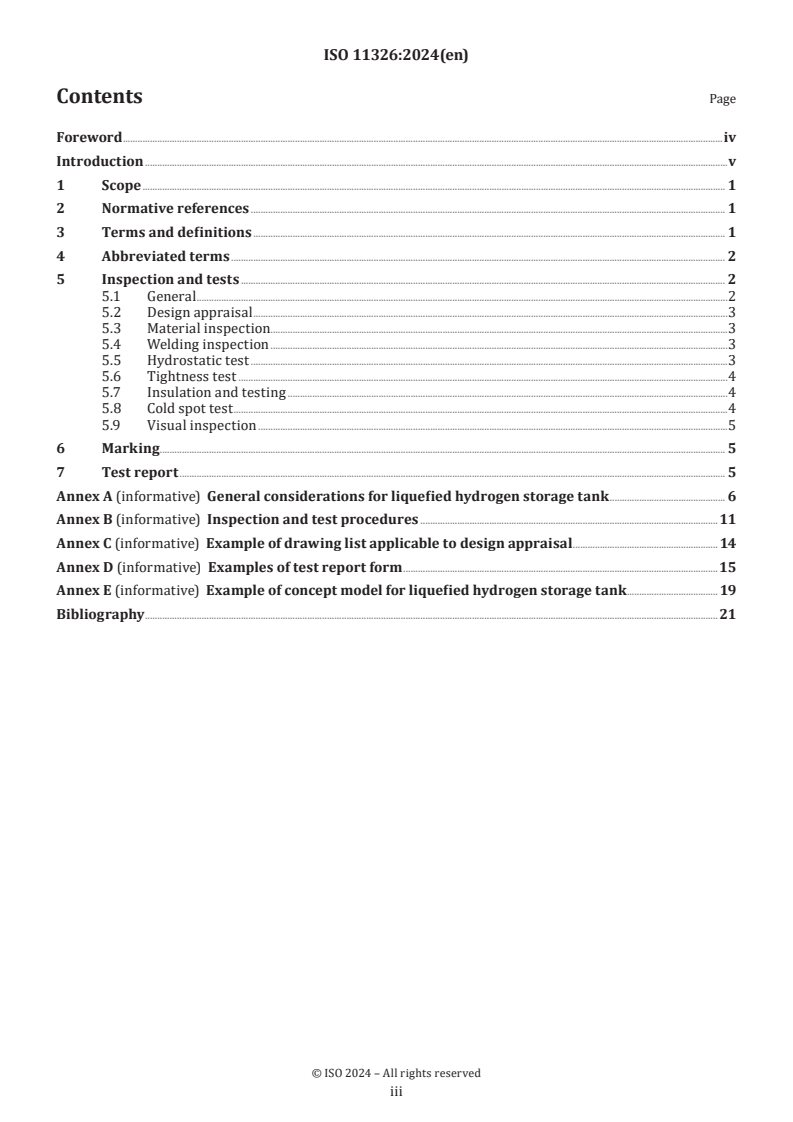
Contents Page
Foreword .iv
Introduction .v
1 Scope . 1
2 Normative references . 1
3 Terms and definitions . 1
4 Abbreviated terms . 2
5 Inspection and tests . 2
5.1 General .2
5.2 Design appraisal .3
5.3 Material inspection.3
5.4 Welding inspection .3
5.5 Hydrostatic test .3
5.6 Tightness test .4
5.7 Insulation and testing .4
5.8 Cold spot test .4
5.9 Visual inspection .5
6 Marking . . 5
7 Test report . 5
Annex A (informative) General considerations for liquefied hydrogen storage tank . 6
Annex B (informative) Inspection and test procedures .11
Annex C (informative) Example of drawing list applicable to design appraisal . 14
Annex D (informative) Examples of test report form .15
Annex E (informative) Example of concept model for liquefied hydrogen storage tank . 19
Bibliography .21
iii
Foreword
ISO (the International Organization for Standardization) is a worldwide federation of national standards
bodies (ISO member bodies). The work of preparing International Standards is normally carried out through
ISO technical committees. Each member body interested in a subject for which a technical committee
has been established has the right to be represented on that committee. International organizations,
governmental and non-governmental, in liaison with ISO, also take part in the work. ISO collaborates closely
with the International Electrotechnical Commission (IEC) on all matters of electrotechnical standardization.
The procedures used to develop this document and those intended for its further maintenance are described
in the ISO/IEC Directives, Part 1. In particular, the different approval criteria needed for the different types
of ISO document should be noted. This document was drafted in accordance with the editorial rules of the
ISO/IEC Directives, Part 2 (see www.iso.org/directives).
ISO draws attention to the possibility that the implementation of this document may involve the use of (a)
patent(s). ISO takes no position concerning the evidence, validity or applicability of any claimed patent
rights in respect thereof. As of the date of publication of this document, ISO had not received notice of (a)
patent(s) which may be required to implement this document. However, implementers are cautioned that
this may not represent the latest information, which may be obtained from the patent database available at
www.iso.org/patents. ISO shall not be held responsible for identifying any or all such patent rights.
Any trade name used in this document is information given for the convenience of users and does not
constitute an endorsement.
For an explanation of the voluntary nature of standards, the meaning of ISO specific terms and expressions
related to conformity assessment, as well as information about ISO's adherence to the World Trade
Organization (WTO) principles in the Technical Barriers to Trade (TBT), see www.iso.org/iso/foreword.html.
This document was prepared by Technical Committee ISO/TC 8, Ships and marine technology, Subcommittee
SC 3, Piping and machinery.
Any feedback or questions on this document should be directed to the user’s national standards body. A
complete listing of these bodies can be found at www.iso.org/members.html.
iv
Introduction
Hydrogen offers a reliable way to decarbonise a variety of sectors including the maritime industry, where
it has been historically difficult to meaningfully reduce CO emissions despite the commitments by
governments and the implementation of regulatory measures.
There are technologies available that enable hydrogen to be produced, stored, transported and used as
energy in different ways. Various materials can be produced by hydrogen, including renewable energy,
natural gas, coal and oil. Hydrogen can be transported as a gas by pipelines or in liquid form by ship, much
like liquid natural gas (LNG), and transformed into electric energy to provide homes or industry with power
and also into fuels for cars, trucks, ships and planes.
However, the safe and wide use of hydrogen in marine industry faces several challenges, in particular
the absence of applicable international standards on the safety testing of hydrogen systems. All system
components should be designed and tested for the safety and reliability in handling liquid hydrogen and
thereby the facilitation of decarbonisation with the transition into hydrogen-based clean energy.
In this regard, this document sets up a general test requirement for the liquid hydrogen cargo tank of
hydrogen carrier ships. It is expected that useful information can be provided to the marine industry
stakeholders including ship owners, classification societies and shipyards. Finally, this document aims to
contribute to the growth of relevant industries and benefit all related stakeholders.
v
International Standard ISO 11326:2024(en)
Ships and marine technology — Test procedures for liquid
hydrogen storage tank of hydrogen ships
1 Scope
This document specifies general inspection and test requirements for liquid hydrogen cargo tanks on
board hydrogen carrier ships. In the cases of liquefied hydrogen containment systems, the testing activity
depends strictly on the type of storage containment technology identified by the International Code for
[1]
the Construction and Equipment of Ships Carrying Liquefied Gases in Bulk (IGC Code). This document is
applicable to Type C independent metallic double wall type tanks with vacuum insulation having a capacity
of not more than 1 000 cubic metres (m ). It is also applicable to liquid hydrogen cargo tanks which are
designed to transport pure para-hydrogen (not less than 95 % content).
2 Normative references
The following documents are referred to in the text in such a way that some or all of their content constitutes
requirements of this document. For dated references, only the edition cited applies. For undated references,
the latest edition of the referenced document (including any amendments) applies.
ISO 11114-4, Transportable gas cylinders — Compatibility of cylinder and valve materials with gas contents —
Part 4: Test methods for selecting steels resistant to hydrogen embrittlement
ISO 17636-1, Non-destructive testing of welds — Radiographic testing — Part 1: X- and gamma-ray techniques
with film
ISO 17636-2, Non-destructive testing of welds — Radiographic testing — Part 2: X- and gamma-ray techniques
with digital detectors
ISO 3452-1, Non-destructive testing — Penetrant testing — Part 1: General principles
ISO 9934-1, Non-destructive testing — Magnetic particle testing — Part 1: General principles
ISO 23208, Cryogenic vessels — Cleanliness for cryogenic service
3 Terms and definitions
For the purposes of this document, the following terms and definitions apply.
ISO and IEC maintain terminology databases for use in standardization at the following addresses:
— ISO Online browsing platform: available at https:// www .iso .org/ obp
— IEC Electropedia: available at https:// www .electropedia .org/
3.1
design pressure
pressure used to determine minimum scantlings of the liquefied hydrogen (LH ) (3.3) storage tank
3.2
maximum allowable working pressure
MAWP
maximum pressure of a storage tank determined by the tank design code
Note 1 to entry: MAWP should not be less than the design pressure (3.1).
3.3
liquefied hydrogen
LH
hydrogen that has been cooled and condensed into liquid form
Note 1 to entry: LH is a cryogenic liquid having a temperature typically around −253 ° Celsius under normal
atmospheric pressure.
3.4
para-hydrogen
one of the two isomers of the hydrogen molecule where the nuclear spins of the two atoms are opposed
3.5
independent tank
self-supporting tank that does not form part of the ship’s hull and is not essential to the hull strength
Note 1 to entry: The design basis for type C independent tanks is based on pressure vessel criteria modified to include
fracture mechanics and crack propagation criteria.
3.6
cold spot
part of the hull or thermal insulation surface where a localized temperature decrease occurs with respect to
the allowable minimum temperature of the hull or its adjacent hull structure, or design capabilities of cargo
pressure and temperature control systems
4 Abbreviated terms
For the purpose of this document, the following abbreviated terms apply
IMO International Maritime Organization
MSC Maritime Safety Committee
IGC Code International Code for the Construction and Equipment of Ships Carrying Liquefied Gases in Bulk
IACS International Association of Classification Societies
ASME American Society of Mechanical Engineers
5 Inspection and tests
5.1 General
Tests shall be conducted on new design Type C independent tanks for liquid hydrogen storage on hydrogen
carrier ships. All tanks subjected to type tests shall be made unusable after the tests are completed.
The LH storage tank provider shall preserve the type test results for the intended life of the storage tank
design. The test result shall also document the tank specification.
Annex B gives an example of general inspection and test procedures. The liquid hydrogen storage tank may
be subjected to inspection and tests specified in Annex B, under mutual agreement between owner and the
LH storage tank provider.
Annex E provides an example figure of the design and installation arrangements of a vacuum-insulated LH
cargo tank, with various piping and instrumentation normally attached to the tank.
Annex A provides information regarding other potential hazards and safety considerations associated with
the storage and containment of liquefied hydrogen.
5.2 Design appraisal
Liquid hydrogen storage tank drawings and material specifications shall be submitted to the owner or
classification society for written approval before test implementation. The owner or classification society
shall approve of the drawings.
An example of the drawings which can be submitted are listed in Annex C.
5.3 Material inspection
Material property testing of liquid hydrogen storage tanks, which are required for the acceptance of use by
the classification society or ship owner where the minimum design temperature is less than −196 °C, shall
be carried out with the appropriate medium within the range between the maximum design temperature in
service (normally taken as 45 °C) and the temperature lower than the minimum design temperature by at
least 5 °C.
The hydrogen embrittlement test shall be carried out and materials shall be selected to ensure the safety
of liquid hydrogen cargo tanks. Reference should also be made to the “Guide to Safety of Hydrogen and
[3]
Hydrogen systems” published by the American Institute of Aeronautics and Astronautics (AIAA), as
[22]
referenced in IMO Resolution MSC. 420(97).
The hydrogen embrittlement test shall be carried out to provide evidence that the metallic double wall type
hydrogen storage tank is not susceptible to hydrogen embrittlement. In hydrogen storage tanks that are
subject to frequent evaporated gaseous form, conditions can lead to local fatigue, and the initiation and
propagation of fatigue cracks induced by ship motion in the liquid hydrogen cargo tanks. The hydrogen
compatibility shall be tested in accordance with ISO 11114-4.
Test results should show that the selected materials for liquid hydrogen storage tanks are suitable for their
specific operating conditions and environment, taking into account factors such as design temperature,
pressure, working stress and other environmental conditions.
5.4 Welding inspection
All welded joints of the shells and domes to shell of liquid hydrogen storage tanks shall be of the butt weld
full penetration type to prevent leakage of hydrogen. For nozzle or other penetration connections, either
fillet welds or the full penetration type may be used depending on the results of the tests carried out, after
getting approval of the welding procedure. Otherwise, if the nozzle or other penetration is made of forgings
with an integral forged ring to match the contour of the dome or shell, the joint shall use full penetration
butt welds.
All welded points of the liquid hydrogen storage tank between the inner tank and outer tank shall be
subjected to non-destructive test inspection. All butt welds of liquid hydrogen storage tanks shall be
subjected to radiographic testing in accordance with ISO 17636-1 and ISO 17636-2. Where welding points of
the liquid hydrogen storage tank cannot be radiographed, these welds shall be subjected to penetrant testing
in accordance with ISO 3452-1, magnetic particle testing in accordance with ISO 9934-1, and approved
ultrasonic testing.
5.5 Hydrostatic test
A hydrostatic test shall be carried out at a pressure measured at the top of tank.
The test pressure shall be at least 1,5 times the design pressure. At no point during the pressure test shall
the calculated primary membrane stress exceed 90 % of the yield stress of the material. To ensure that this
condition is satisfied where calculations indicate that this stress will exceed 0,75 times the yield strength,
the type test shall be monitored using strain gauges or other suitable equipment in pressure vessels, other
than simple cylindrical and spherical pressure vessels.
The temperature of the water used for the test shall be at least 30 °C above the nil-ductility transition
temperature of the material, as fabricated. The pressure shall be held for 2 h per 25 mm of thickness, but in
no case less than 2 h.
Where necessary, a pneumatic test may be carried out in cases where the liquid hydrogen storage tank is
produced or supported such that it cannot be safely filled with water. The pneumatic test procedures may
be specially considered by the relevant testing authority, and the test pressure for a pneumatic test shall
be 1,25 times the maximum allowable working pressure (MAWP). Special considerations shall be given to
the stored energy involved with a pneumatic test, and it shall be carried out where adequate facilities and
procedures are employed to ensure the safety of inspectors and the public.
Upon completion of the hydrostatic test, the inner tank shall be cleaned and dried in accordance with
ISO 23208.
5.6 Tightness test
For the liquid hydrogen cargo tank tightness test, helium or a mixture of 5 % hydrogen and 95 % nitrogen
should be used as the test medium instead of air, with dedicated detectors employed since the permeability
of hydrogen is high.
The tightness check for the inner vessel can be completed after the hydrostatic test by reducing the pressure
to the design pressure with an appropriate tracer gas. The helium leak test can be completed by a sniffer
method with appropriate calibration at every 10 m of weld. When the LH tank design includes wear plates
or support plates covering the inner vessel weld, then appropriate leak testing to test these welds shall be
done before the completion of the inner vessel.
The outer vessel vacuum integrity should be confirmed by injecting helium into the space between the inner
and annular outer vessel weld/sealing surfaces and placing a detector appropriately on the vacuum port.
The standard leak calibrator shall be connected to the vacuum port to establish the delay time and set the
speed of the helium spray on the outer vessel welds. During the operation of this test, the inner vessel can be
maintained at design pressure with helium tracer gas and nitrogen mixture to complete the test.
The helium leak testing procedure should be confirmed according to ISO 20485 and ISO 20486, ASME
Section VIII Div 2, JIS Z 2331 or other suitable standards. Tests shall confirm that there are no leaks larger
than the limit acceptable criteria.
Consideration should be given to using oxygen-free nitrogen with a small molecule tracer gas, such as
helium, as the test medium and an electronic leak detector for identifying leaks.
If the above test medium is not practical, test mediums other than helium or a mixture of 5 % hydrogen
and 95 % nitrogen can be used to conduct the test, upon mutual agreement between the owner and the LH
storage tank provider.
5.7 Insulation and testing
The insulation performance testing should be conducted in accordance with ISO 21014. The test can be
confirmed in the fully loaded condition at the proper vacuum level.
5.8 Cold spot test
Cold spot tests aim to verify:
— the results of thermal calculation for the adjacent structures of storage tanks such as fixed supports,
saddle, nozzle, gauge points or tank holding space bulkheads;
— the possible failure of vacuum insulation system of storage tank.
A cold spot test failure occurs if icing is detected at the cold spot test area. The loading of LH generally
improves the vacuum, thereby enhancing the insulation performance. However, there can be cold spots from
support structures between the outer and inner walls of the tank.
5.9 Visual inspection
The outer surfa
...