

ISO 10848-4:2017
(Main)Acoustics — Laboratory and field measurement of flanking transmission for airborne, impact and building service equipment sound between adjoining rooms — Part 4: Application to junctions with at least one Type A element
General Information
- Abstract
ISO 10848 (all parts) specifies measurement methods to characterize the flanking transmission of one or several building components. ISO 10848-4:2017 specifies laboratory and field measurements of buildings where at least one of the elements that form the construction under test is a Type A element (defined in ISO 10848‑1). Laboratory measurements are used to quantify the performance of the junction with suppressed flanking transmission from the laboratory structure. Field measurements are used to characterize the in situ performance and it is not usually possible to suppress unwanted flanking transmission sufficiently; hence, the results are primarily representative of the performance of that junction when installed in that particular building structure. The measured quantities can be used to compare different products, or to express a requirement, or as input data for prediction methods, such as ISO 12354‑1 and ISO 12354‑2.
- Status
- Published
- Publication Date
- 13-Sep-2017
- Technical Committee
- ISO/TC 43/SC 2 - Building acoustics
- Drafting Committee
- ISO/TC 43/SC 2 - Building acoustics
- Current Stage
- 9093 - International Standard confirmed
- Start Date
- 15-May-2023
- Completion Date
- 29-Aug-2026
Buy Documents

ISO 10848-4:2017 - Acoustics -- Laboratory and field measurement of flanking transmission for airborne, impact and building service equipment sound between adjoining rooms

ISO 10848-4:2017 - Acoustics — Laboratory and field measurement of flanking transmission for airborne, impact and building service equipment sound between adjoining rooms — Part 4: Application to junctions with at least one Type A element/14/2017

ISO 10848-4:2017 - Acoustique -- Mesurage en laboratoire et sur site des transmissions latérales du bruit aérien, des bruits de choc et du bruit d'équipement technique de bâtiment entre des pieces adjacentes

ISO 10848-4:2017 - Acoustique — Mesurage en laboratoire et sur site des transmissions latérales du bruit aérien, des bruits de choc et du bruit d'équipement technique de bâtiment entre des pièces adjacentes — Partie 4: Application aux jonctions ayant au moins un élément de Type A/12/2017
Overview
ISO 10848-4:2017 - part of the ISO 10848 series on building acoustics - specifies laboratory and field measurement methods for characterizing flanking transmission of airborne, impact and building-service-equipment sound across junctions where at least one element is a Type A element (see ISO 10848-1). The standard defines how to measure the vibration reduction index (Kij) for junctions, how to report results, and how to interpret laboratory (suppressed flanking) versus field (in‑situ) measurements. Measured data are suitable for product comparison, specification limits, or as input to prediction methods such as ISO 12354-1 and ISO 12354-2.
Key topics and requirements
- Measured quantity: Vibration reduction index, Kij, reported by frequency (one‑third octave bands) and as single‑number ratings per ISO 10848-1.
- Scope: Applies when at least one junction element is a Type A element (influenced by boundary conditions and modal behavior).
- Laboratory vs field:
- Laboratory tests aim to suppress unwanted flanking paths to quantify the junction itself.
- Field tests characterize in‑situ performance; unwanted flanking is often unavoidable and results are representative of that specific building installation.
- Instrumentation & test arrangement: Equipment and general facility requirements follow ISO 10848‑1. Installation details differ for Type A and Type B elements.
- Modal considerations: For Type A elements the mode count and modal overlap factor (M) are critical for measurement accuracy. M should be ≥ 1 at 250 Hz and above where possible; results where M < 0.25 must be flagged and treated with caution. Achieving 5+ modes per one‑third octave band is often recommended.
- Results and reporting: Kij values to one decimal place, plotted vs frequency on a logarithmic scale. Guidance is given for converting one‑third octave results to octave bands and for reporting structural reverberation times and test conditions.
- Precision & verification: Repeatability and uncertainty assessment per ISO 12999‑1; inter‑laboratory comparisons recommended.
Applications and users
- Compare junction designs and products (acoustic connectors, wall/floor junctions)
- Set contractual or regulatory requirements for flanking paths
- Provide input data for prediction models (ISO 12354 series) used in performance‑based design
- Typical users: acoustical consultants, test laboratories, product manufacturers, façade and building designers, and certification bodies
Related standards
- ISO 10848-1:2017 (frame document)
- ISO 12354-1 and ISO 12354-2 (prediction methods)
- ISO 12999-1 (measurement uncertainties)
- ISO 10140 series (report formats and plotting guidance)
This standard is essential for accurate assessment of flanking transmission where Type A elements (plate-like or modal-sensitive components) influence junction performance and overall sound insulation in buildings.
Relations
- Effective Date
- 12-Feb-2026
- Effective Date
- 16-Aug-2014
Buy Documents
ISO 10848-4:2017 - Acoustics -- Laboratory and field measurement of flanking transmission for airborne, impact and building service equipment sound between adjoining rooms
ISO 10848-4:2017 - Acoustics — Laboratory and field measurement of flanking transmission for airborne, impact and building service equipment sound between adjoining rooms — Part 4: Application to junctions with at least one Type A element/14/2017
ISO 10848-4:2017 - Acoustique -- Mesurage en laboratoire et sur site des transmissions latérales du bruit aérien, des bruits de choc et du bruit d'équipement technique de bâtiment entre des pieces adjacentes
ISO 10848-4:2017 - Acoustique — Mesurage en laboratoire et sur site des transmissions latérales du bruit aérien, des bruits de choc et du bruit d'équipement technique de bâtiment entre des pièces adjacentes — Partie 4: Application aux jonctions ayant au moins un élément de Type A/12/2017
Get Certified
Connect with accredited certification bodies for this standard

DIBt (Deutsches Institut für Bautechnik)
German Institute for Building Technology.
DIN CERTCO
DIN Group product certification.

Aboma Certification B.V.
Specialized in construction, metal, and transport sectors.
Sponsored listings
Frequently Asked Questions
ISO 10848-4:2017 is a standard published by the International Organization for Standardization (ISO). Its full title is "Acoustics — Laboratory and field measurement of flanking transmission for airborne, impact and building service equipment sound between adjoining rooms — Part 4: Application to junctions with at least one Type A element". This standard covers: ISO 10848 (all parts) specifies measurement methods to characterize the flanking transmission of one or several building components. ISO 10848-4:2017 specifies laboratory and field measurements of buildings where at least one of the elements that form the construction under test is a Type A element (defined in ISO 10848‑1). Laboratory measurements are used to quantify the performance of the junction with suppressed flanking transmission from the laboratory structure. Field measurements are used to characterize the in situ performance and it is not usually possible to suppress unwanted flanking transmission sufficiently; hence, the results are primarily representative of the performance of that junction when installed in that particular building structure. The measured quantities can be used to compare different products, or to express a requirement, or as input data for prediction methods, such as ISO 12354‑1 and ISO 12354‑2.
ISO 10848 (all parts) specifies measurement methods to characterize the flanking transmission of one or several building components. ISO 10848-4:2017 specifies laboratory and field measurements of buildings where at least one of the elements that form the construction under test is a Type A element (defined in ISO 10848‑1). Laboratory measurements are used to quantify the performance of the junction with suppressed flanking transmission from the laboratory structure. Field measurements are used to characterize the in situ performance and it is not usually possible to suppress unwanted flanking transmission sufficiently; hence, the results are primarily representative of the performance of that junction when installed in that particular building structure. The measured quantities can be used to compare different products, or to express a requirement, or as input data for prediction methods, such as ISO 12354‑1 and ISO 12354‑2.
ISO 10848-4:2017 is classified under the following ICS (International Classification for Standards) categories: 91.120.20 - Acoustics in building. Sound insulation. The ICS classification helps identify the subject area and facilitates finding related standards.
ISO 10848-4:2017 has the following relationships with other standards: It is inter standard links to EN ISO 10848-4:2017, ISO 10848-4:2010. Understanding these relationships helps ensure you are using the most current and applicable version of the standard.
ISO 10848-4:2017 is available in PDF format for immediate download after purchase. The document can be added to your cart and obtained through the secure checkout process. Digital delivery ensures instant access to the complete standard document.
Standards Content (Sample)
INTERNATIONAL ISO
STANDARD 10848-4
Second edition
2017-09
Acoustics — Laboratory and field
measurement of flanking transmission
for airborne, impact and building
service equipment sound between
adjoining rooms —
Part 4:
Application to junctions with at least
one Type A element
Acoustique — Mesurage en laboratoire et sur le terrain des
transmissions latérales du bruit aérien, des bruits de choc et du bruit
d’équipement technique de bâtiment entre des pièces —
Partie 4: Application aux jonctions ayant au moins un élément de
Type A
Reference number
©
ISO 2017
COPYRIGHT PROTECTED DOCUMENT
© ISO 2017, Published in Switzerland
All rights reserved. Unless otherwise specified, no part of this publication may be reproduced or utilized otherwise in any form
or by any means, electronic or mechanical, including photocopying, or posting on the internet or an intranet, without prior
written permission. Permission can be requested from either ISO at the address below or ISO’s member body in the country of
the requester.
ISO copyright office
Ch. de Blandonnet 8 • CP 401
CH-1214 Vernier, Geneva, Switzerland
Tel. +41 22 749 01 11
Fax +41 22 749 09 47
copyright@iso.org
www.iso.org
ii © ISO 2017 – All rights reserved
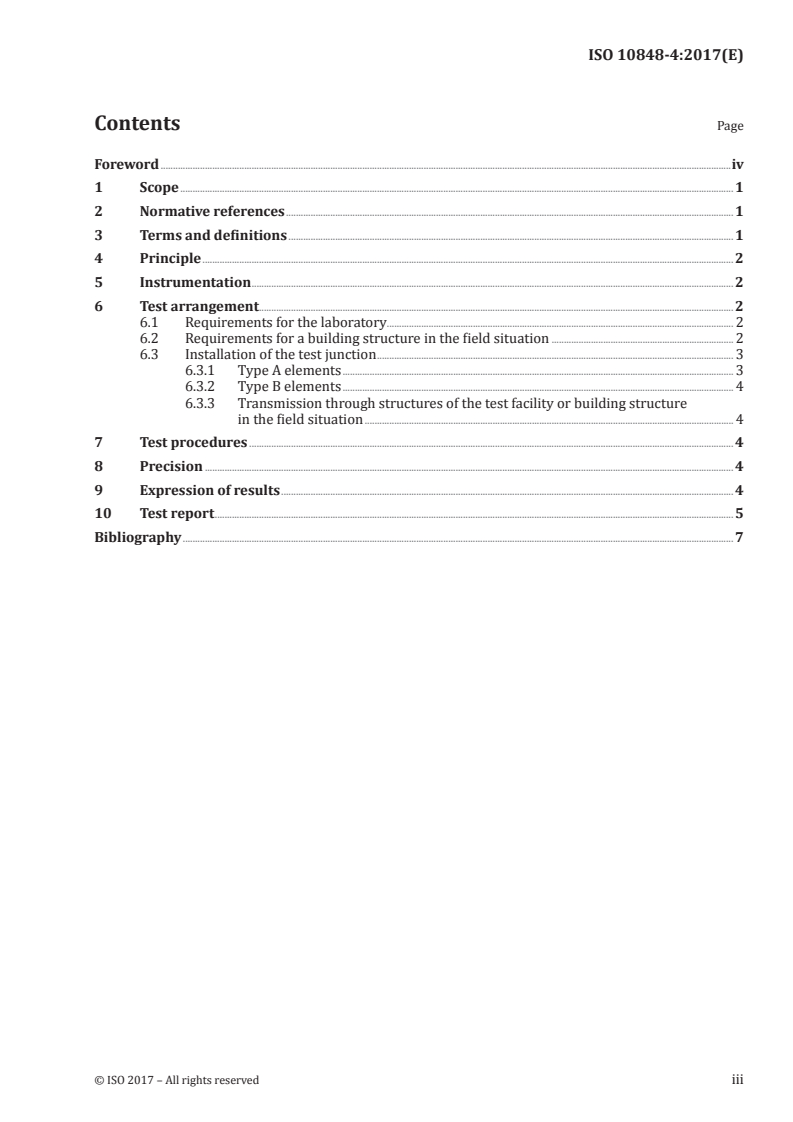
Contents Page
Foreword .iv
1 Scope . 1
2 Normative references . 1
3 Terms and definitions . 1
4 Principle . 2
5 Instrumentation . 2
6 Test arrangement . 2
6.1 Requirements for the laboratory . 2
6.2 Requirements for a building structure in the field situation . 2
6.3 Installation of the test junction . 3
6.3.1 Type A elements . 3
6.3.2 Type B elements . 4
6.3.3 Transmission through structures of the test facility or building structure
in the field situation . 4
7 Test procedures . 4
8 Precision . 4
9 Expression of results . 4
10 Test report . 5
Bibliography . 7
Foreword
ISO (the International Organization for Standardization) is a worldwide federation of national standards
bodies (ISO member bodies). The work of preparing International Standards is normally carried out
through ISO technical committees. Each member body interested in a subject for which a technical
committee has been established has the right to be represented on that committee. International
organizations, governmental and non-governmental, in liaison with ISO, also take part in the work.
ISO collaborates closely with the International Electrotechnical Commission (IEC) on all matters of
electrotechnical standardization.
The procedures used to develop this document and those intended for its further maintenance are
described in the ISO/IEC Directives, Part 1. In particular the different approval criteria needed for the
different types of ISO documents should be noted. This document was drafted in accordance with the
editorial rules of the ISO/IEC Directives, Part 2 (see www .iso .org/ directives).
Attention is drawn to the possibility that some of the elements of this document may be the subject of
patent rights. ISO shall not be held responsible for identifying any or all such patent rights. Details of
any patent rights identified during the development of the document will be in the Introduction and/or
on the ISO list of patent declarations received (see www .iso .org/ patents).
Any trade name used in this document is information given for the convenience of users and does not
constitute an endorsement.
For an explanation on the voluntary nature of standards, the meaning of ISO specific terms and
expressions related to conformity assessment, as well as information about ISO’s adherence to the
World Trade Organization (WTO) principles in the Technical Barriers to Trade (TBT) see the following
URL: w w w . i s o .org/ iso/ foreword .html.
This document was prepared by Technical Committee ISO/TC 43, Acoustics, Subcommittee SC 2, Building
acoustics.
This second edition cancels and replaces the first edition (ISO 10848-4:2010), which has been
technically revised. The main change is the extension to field measurements.
A list of all the parts in the ISO 10848 series can be found on the ISO website.
iv © ISO 2017 – All rights reserved
INTERNATIONAL STANDARD ISO 10848-4:2017(E)
Acoustics — Laboratory and field measurement of flanking
transmission for airborne, impact and building service
equipment sound between adjoining rooms —
Part 4:
Application to junctions with at least one Type A element
1 Scope
ISO 10848 (all parts) specifies measurement methods to characterize the flanking transmission of one
or several building components.
This document specifies laboratory and field measurements of buildings where at least one of the
elements that form the construction under test is a Type A element (defined in ISO 10848-1).
Laboratory measurements are used to quantify the performance of the junction with suppressed
flanking transmission from the laboratory structure. Field measurements are used to characterize
the in situ performance and it is not usually possible to suppress unwanted flanking transmission
sufficiently; hence, the results are primarily representative of the performance of that junction when
installed in that particular building structure.
The measured quantities can be used to compare different products, or to express a requirement, or as
input data for prediction methods, such as ISO 12354-1 and ISO 12354-2.
2 Normative references
The following documents are referred to in the text in such a way that some or all of their content
constitutes requirements of this document. For dated references, only the edition cited applies. For
undated references, the latest edition of the referenced document (including any amendments) applies.
ISO 10848-1:2017, Acoustics — Laboratory and field measurement of flanking transmission for airborne,
impact and building service equipment sound between adjoining rooms — Part 1: Frame document
ISO 12999-1, Acoustics — Determination and application of measurement uncertainties in building
acoustics — Part 1: Sound insulation
3 Terms and definitions
For the purposes of this document, the following terms and definitions apply.
ISO and IEC maintain terminological databases for use in standardization at the following addresses:
— IEC Electropedia: available at http:// www .electropedia .org/
— ISO Online browsing platform: available at http:// www .iso .org/ obp
3.1
vibration reduction index
K
ij
direction-averaged velocity level difference between two elements across a junction that is normalised
to the junction length and the equivalent sound absorption length of both elements as follows
l
ij
KD=+10lg
ij vi, j
aa
ij
where
is the direction-averaged velocity level difference between elements i and j, in dB;
D
v,ij
l is the junction length between elements i and j, in m;
ij
a , a are the equivalent absorption lengths of elements i and j, in m.
i j
Note 1 to entry: This quantity is expressed in decibels.
Note 2 to entry: K can be obtained from measurements of the velocity level difference in both directions across
ij
the junction and the structural reverberation time of the two elements i and j.
4 Principle
The relevant quantity to be measured is selected in accordance with ISO 10848-1:2017, 4.5. The
performance of the building components is expressed as the vibration reduction index, K , which, in
ij
principle, is an invariant quantity.
5 Instrumentation
The eq
...
INTERNATIONAL ISO
STANDARD 10848-4
Second edition
2017-09
Acoustics — Laboratory and field
measurement of flanking transmission
for airborne, impact and building
service equipment sound between
adjoining rooms —
Part 4:
Application to junctions with at least
one Type A element
Acoustique — Mesurage en laboratoire et sur le terrain des
transmissions latérales du bruit aérien, des bruits de choc et du bruit
d’équipement technique de bâtiment entre des pièces —
Partie 4: Application aux jonctions ayant au moins un élément de
Type A
Reference number
©
ISO 2017
COPYRIGHT PROTECTED DOCUMENT
© ISO 2017, Published in Switzerland
All rights reserved. Unless otherwise specified, no part of this publication may be reproduced or utilized otherwise in any form
or by any means, electronic or mechanical, including photocopying, or posting on the internet or an intranet, without prior
written permission. Permission can be requested from either ISO at the address below or ISO’s member body in the country of
the requester.
ISO copyright office
Ch. de Blandonnet 8 • CP 401
CH-1214 Vernier, Geneva, Switzerland
Tel. +41 22 749 01 11
Fax +41 22 749 09 47
copyright@iso.org
www.iso.org
ii © ISO 2017 – All rights reserved
Contents Page
Foreword .iv
1 Scope . 1
2 Normative references . 1
3 Terms and definitions . 1
4 Principle . 2
5 Instrumentation . 2
6 Test arrangement . 2
6.1 Requirements for the laboratory . 2
6.2 Requirements for a building structure in the field situation . 2
6.3 Installation of the test junction . 3
6.3.1 Type A elements . 3
6.3.2 Type B elements . 4
6.3.3 Transmission through structures of the test facility or building structure
in the field situation . 4
7 Test procedures . 4
8 Precision . 4
9 Expression of results . 4
10 Test report . 5
Bibliography . 7
Foreword
ISO (the International Organization for Standardization) is a worldwide federation of national standards
bodies (ISO member bodies). The work of preparing International Standards is normally carried out
through ISO technical committees. Each member body interested in a subject for which a technical
committee has been established has the right to be represented on that committee. International
organizations, governmental and non-governmental, in liaison with ISO, also take part in the work.
ISO collaborates closely with the International Electrotechnical Commission (IEC) on all matters of
electrotechnical standardization.
The procedures used to develop this document and those intended for its further maintenance are
described in the ISO/IEC Directives, Part 1. In particular the different approval criteria needed for the
different types of ISO documents should be noted. This document was drafted in accordance with the
editorial rules of the ISO/IEC Directives, Part 2 (see www .iso .org/ directives).
Attention is drawn to the possibility that some of the elements of this document may be the subject of
patent rights. ISO shall not be held responsible for identifying any or all such patent rights. Details of
any patent rights identified during the development of the document will be in the Introduction and/or
on the ISO list of patent declarations received (see www .iso .org/ patents).
Any trade name used in this document is information given for the convenience of users and does not
constitute an endorsement.
For an explanation on the voluntary nature of standards, the meaning of ISO specific terms and
expressions related to conformity assessment, as well as information about ISO’s adherence to the
World Trade Organization (WTO) principles in the Technical Barriers to Trade (TBT) see the following
URL: w w w . i s o .org/ iso/ foreword .html.
This document was prepared by Technical Committee ISO/TC 43, Acoustics, Subcommittee SC 2, Building
acoustics.
This second edition cancels and replaces the first edition (ISO 10848-4:2010), which has been
technically revised. The main change is the extension to field measurements.
A list of all the parts in the ISO 10848 series can be found on the ISO website.
iv © ISO 2017 – All rights reserved
INTERNATIONAL STANDARD ISO 10848-4:2017(E)
Acoustics — Laboratory and field measurement of flanking
transmission for airborne, impact and building service
equipment sound between adjoining rooms —
Part 4:
Application to junctions with at least one Type A element
1 Scope
ISO 10848 (all parts) specifies measurement methods to characterize the flanking transmission of one
or several building components.
This document specifies laboratory and field measurements of buildings where at least one of the
elements that form the construction under test is a Type A element (defined in ISO 10848-1).
Laboratory measurements are used to quantify the performance of the junction with suppressed
flanking transmission from the laboratory structure. Field measurements are used to characterize
the in situ performance and it is not usually possible to suppress unwanted flanking transmission
sufficiently; hence, the results are primarily representative of the performance of that junction when
installed in that particular building structure.
The measured quantities can be used to compare different products, or to express a requirement, or as
input data for prediction methods, such as ISO 12354-1 and ISO 12354-2.
2 Normative references
The following documents are referred to in the text in such a way that some or all of their content
constitutes requirements of this document. For dated references, only the edition cited applies. For
undated references, the latest edition of the referenced document (including any amendments) applies.
ISO 10848-1:2017, Acoustics — Laboratory and field measurement of flanking transmission for airborne,
impact and building service equipment sound between adjoining rooms — Part 1: Frame document
ISO 12999-1, Acoustics — Determination and application of measurement uncertainties in building
acoustics — Part 1: Sound insulation
3 Terms and definitions
For the purposes of this document, the following terms and definitions apply.
ISO and IEC maintain terminological databases for use in standardization at the following addresses:
— IEC Electropedia: available at http:// www .electropedia .org/
— ISO Online browsing platform: available at http:// www .iso .org/ obp
3.1
vibration reduction index
K
ij
direction-averaged velocity level difference between two elements across a junction that is normalised
to the junction length and the equivalent sound absorption length of both elements as follows
l
ij
KD=+10lg
ij vi, j
aa
ij
where
is the direction-averaged velocity level difference between elements i and j, in dB;
D
v,ij
l is the junction length between elements i and j, in m;
ij
a , a are the equivalent absorption lengths of elements i and j, in m.
i j
Note 1 to entry: This quantity is expressed in decibels.
Note 2 to entry: K can be obtained from measurements of the velocity level difference in both directions across
ij
the junction and the structural reverberation time of the two elements i and j.
4 Principle
The relevant quantity to be measured is selected in accordance with ISO 10848-1:2017, 4.5. The
performance of the building components is expressed as the vibration reduction index, K , which, in
ij
principle, is an invariant quantity.
5 Instrumentation
The eq
...
NORME ISO
INTERNATIONALE 10848-4
Deuxième édition
2017-09
Acoustique — Mesurage en
laboratoire et sur site des
transmissions latérales du bruit
aérien, des bruits de choc et du bruit
d'équipement technique de bâtiment
entre des pièces adjacentes —
Partie 4:
Application aux jonctions ayant au
moins un élément de Type A
Acoustics — Laboratory and field measurement of flanking
transmission for airborne, impact and building service equipment
sound between adjoining rooms —
Part 4: Application to junctions with at least one Type A element
Numéro de référence
©
ISO 2017
DOCUMENT PROTÉGÉ PAR COPYRIGHT
© ISO 2017, Publié en Suisse
Droits de reproduction réservés. Sauf indication contraire, aucune partie de cette publication ne peut être reproduite ni utilisée
sous quelque forme que ce soit et par aucun procédé, électronique ou mécanique, y compris la photocopie, l’affichage sur
l’internet ou sur un Intranet, sans autorisation écrite préalable. Les demandes d’autorisation peuvent être adressées à l’ISO à
l’adresse ci-après ou au comité membre de l’ISO dans le pays du demandeur.
ISO copyright office
Ch. de Blandonnet 8 • CP 401
CH-1214 Vernier, Geneva, Switzerland
Tel. +41 22 749 01 11
Fax +41 22 749 09 47
copyright@iso.org
www.iso.org
ii © ISO 2017 – Tous droits réservés
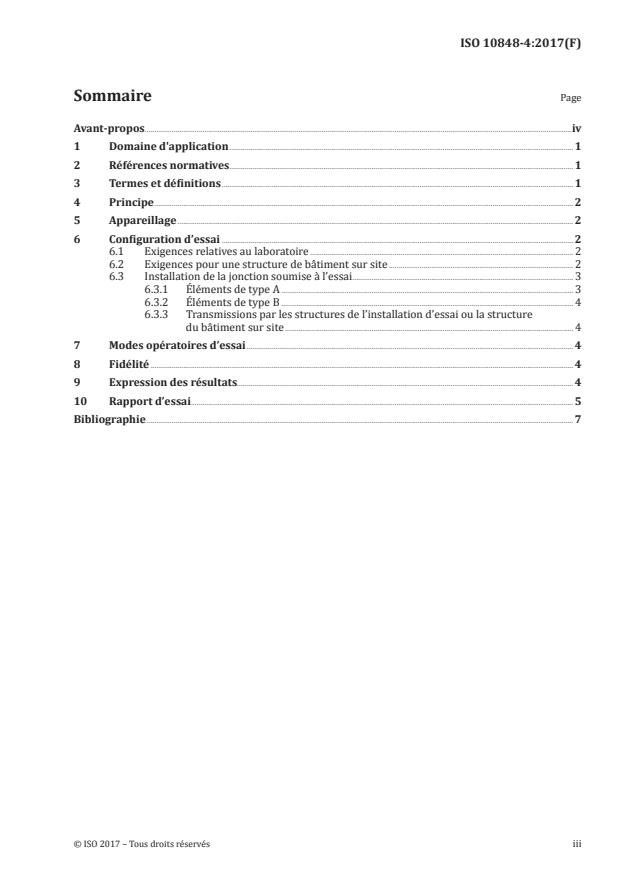
Sommaire Page
Avant-propos .iv
1 Domaine d'application . 1
2 Références normatives . 1
3 Termes et définitions . 1
4 Principe . 2
5 Appareillage . 2
6 Configuration d’essai . 2
6.1 Exigences relatives au laboratoire . 2
6.2 Exigences pour une structure de bâtiment sur site . 2
6.3 Installation de la jonction soumise à l’essai . 3
6.3.1 Éléments de type A . 3
6.3.2 Éléments de type B . 4
6.3.3 Transmissions par les structures de l’installation d’essai ou la structure
du bâtiment sur site . 4
7 Modes opératoires d’essai . 4
8 Fidélité . 4
9 Expression des résultats. 4
10 Rapport d’essai . 5
Bibliographie . 7
Avant-propos
L'ISO (Organisation internationale de normalisation) est une fédération mondiale d'organismes
nationaux de normalisation (comités membres de l'ISO). L'élaboration des Normes internationales est
en général confiée aux comités techniques de l'ISO. Chaque comité membre intéressé par une étude
a le droit de faire partie du comité technique créé à cet effet. Les organisations internationales,
gouvernementales et non gouvernementales, en liaison avec l'ISO participent également aux travaux.
L'ISO collabore étroitement avec la Commission électrotechnique internationale (IEC) en ce qui
concerne la normalisation électrotechnique.
Les procédures utilisées pour élaborer le présent document et celles destinées à sa mise à jour sont
décrites dans les Directives ISO/IEC, Partie 1. Il convient, en particulier de prendre note des différents
critères d'approbation requis pour les différents types de documents ISO. Le présent document a été
rédigé conformément aux règles de rédaction données dans les Directives ISO/IEC, Partie 2 (voir www.
iso.org/directives).
L'attention est attirée sur le fait que certains des éléments du présent document peuvent faire l'objet de
droits de propriété intellectuelle ou de droits analogues. L'ISO ne saurait être tenue pour responsable
de ne pas avoir identifié de tels droits de propriété et averti de leur existence. Les détails concernant
les références aux droits de propriété intellectuelle ou autres droits analogues identifiés lors de
l'élaboration du document sont indiqués dans l'Introduction et/ou dans la liste des déclarations de
brevets reçues par l'ISO (voir www.iso.org/brevets).
Les appellations commerciales éventuellement mentionnées dans le présent document sont données
pour information, par souci de commodité, à l’intention des utilisateurs et ne sauraient constituer un
engagement.
Pour une explication de la nature volontaire des normes, la signification des termes et expressions
spécifiques de l'ISO liés à l'évaluation de la conformité, ou pour toute information au sujet de l'adhésion
de l'ISO aux principes de l’Organisation mondiale du commerce (OMC) concernant les obstacles
techniques au commerce (OTC), voir le lien suivant: www.iso.org/avant-propos.
Le présent document a été élaboré par le comité technique ISO/TC 43, Acoustique, sous-comité SC 2,
Acoustique des bâtiments.
Cette deuxième édition annule et remplace la première édition (ISO 10848-4:2010), qui a fait l’objet
d’une révision technique. La principale modification est l’extension aux mesurages sur site.
Une liste de toutes les parties de la série ISO 10848 est disponible sur le site Internet de l’ISO.
iv © ISO 2017 – Tous droits réservés
NORME INTERNATIONALE ISO 10848-4:2017(F)
Acoustique — Mesurage en laboratoire et sur site des
transmissions latérales du bruit aérien, des bruits de choc
et du bruit d'équipement technique de bâtiment entre des
pièces adjacentes —
Partie 4:
Application aux jonctions ayant au moins un élément de
Type A
1 Domaine d'application
L’ISO 10848 (toutes les parties) spécifie les méthodes de mesure pour la caractérisation des
transmissions latérales d’un ou de plusieurs éléments de construction.
Le présent document spécifie les mesurages en laboratoire et les mesurages sur site des bâtiments dont
au moins un des éléments qui constituent la construction soumise à l’essai est un élément de type A
(défini dans l’ISO 10848-1).
Les mesurages en laboratoire sont utilisés pour quantifier la performance de la jonction avec suppression
des transmissions latérales de la structure du laboratoire. Les mesurages sur site sont utilisés pour
caractériser la performance in situ et il n’est généralement pas possible de supprimer suffisamment
les transmissions latérales parasites; les résultats sont donc principalement représentatifs de la
performance de cette jonction si elle est installée dans cette structure de bâtiment particulière.
Les grandeurs mesurées peuvent être utilisées pour comparer différents produits, pour exprimer
une exigence ou comme données d’entrée des méthodes de prévision telles que l’ISO 12354-1 et
l’ISO 12354-2.
2 Références normatives
Les documents suivants cités dans le texte constituent, pour tout ou partie de leur contenu, des
exigences du présent document. Pour les références datées, seule l’édition citée s’applique. Pour les
références non datées, la dernière édition du document de référence s’applique (y compris les éventuels
amendements).
ISO 10848-1:2017, Acoustique — Mesurage en laboratoire et sur site des transmissions latérales du bruit
aérien, des bruits de choc et du bruit d’équipement technique de bâtiment entre des pièces adjacentes —
Partie 1: Document cadre
ISO 12999-1, Acoustique — Détermination et application des incertitudes de mesure dans l’acoustique des
bâtiments — Partie 1: Isolation acoustique
3 Termes et définitions
Pour les besoins du présent document, les termes et définitions suivants s’appliquent.
L’ISO et l’IEC tiennent à jour des bases de données terminologiques destinées à être utilisées en
normalisation, consultables aux adresses suivantes:
— IEC Electropedia: disponible à l’adresse http://www.electropedia.org/
— ISO Online browsing platform: disponible à l’adresse https://www.iso.org/obp
3.1
indice d’affaiblissement vibratoire
Kij
isolement vibratoire bidirectionnel entre deux éléments sur une jonction normalisée à la longueur de
jonction et à la longueur d’absorption équivalente des deux éléments, exprimé par:
l
ij
KD=+10lg
ij vi, j
aa
ij
où
est l’isolement vibratoire bidirectionnel entre un élément i et un élément j, en dB;
D
v,ij
l est la longueur de la jonction entre les éléments i et j, en m;
ij
a , a sont les longueurs d’absorption équivalentes des éléments i et j, en m
i j
Note 1 à l'article: Cette grandeur est exprimée en décibels.
Note 2 à l'article: K peut être obtenu par mesurages de l’isolement vibratoire dans les deux directions sur la
ij
jonction et de la durée de réverbération structurale des deux éléments i et j.
4 Principe
La grandeur pertinente à mesurer est choisie conformément à l’ISO 10848-1:2017, 4.5. Les performances
des éléments de construction sont exprimées en tant qu’indice d’affaiblissement vibratoire, K , qui, en
ij
principe, est une grandeur invariante.
5 Appareillage
L’appareillage de mesure doit satisfaire aux exigences de l’ISO 10848-1:2017, Article 5.
6 Configuration d’essai
6.1 Exigences relatives au laboratoire
Les exigences générales relatives à l’installation d’essai doivent être satisfaites conformément à
l’ISO 10848-1:2017, 6.1.
Pour le mesurage de l’indice d’affaibli
...
NORME ISO
INTERNATIONALE 10848-4
Deuxième édition
2017-09
Acoustique — Mesurage en
laboratoire et sur site des
transmissions latérales du bruit
aérien, des bruits de choc et du bruit
d'équipement technique de bâtiment
entre des pièces adjacentes —
Partie 4:
Application aux jonctions ayant au
moins un élément de Type A
Acoustics — Laboratory and field measurement of flanking
transmission for airborne, impact and building service equipment
sound between adjoining rooms —
Part 4: Application to junctions with at least one Type A element
Numéro de référence
©
ISO 2017
DOCUMENT PROTÉGÉ PAR COPYRIGHT
© ISO 2017, Publié en Suisse
Droits de reproduction réservés. Sauf indication contraire, aucune partie de cette publication ne peut être reproduite ni utilisée
sous quelque forme que ce soit et par aucun procédé, électronique ou mécanique, y compris la photocopie, l’affichage sur
l’internet ou sur un Intranet, sans autorisation écrite préalable. Les demandes d’autorisation peuvent être adressées à l’ISO à
l’adresse ci-après ou au comité membre de l’ISO dans le pays du demandeur.
ISO copyright office
Ch. de Blandonnet 8 • CP 401
CH-1214 Vernier, Geneva, Switzerland
Tel. +41 22 749 01 11
Fax +41 22 749 09 47
copyright@iso.org
www.iso.org
ii © ISO 2017 – Tous droits réservés
Sommaire Page
Avant-propos .iv
1 Domaine d'application . 1
2 Références normatives . 1
3 Termes et définitions . 1
4 Principe . 2
5 Appareillage . 2
6 Configuration d’essai . 2
6.1 Exigences relatives au laboratoire . 2
6.2 Exigences pour une structure de bâtiment sur site . 2
6.3 Installation de la jonction soumise à l’essai . 3
6.3.1 Éléments de type A . 3
6.3.2 Éléments de type B . 4
6.3.3 Transmissions par les structures de l’installation d’essai ou la structure
du bâtiment sur site . 4
7 Modes opératoires d’essai . 4
8 Fidélité . 4
9 Expression des résultats. 4
10 Rapport d’essai . 5
Bibliographie . 7
Avant-propos
L'ISO (Organisation internationale de normalisation) est une fédération mondiale d'organismes
nationaux de normalisation (comités membres de l'ISO). L'élaboration des Normes internationales est
en général confiée aux comités techniques de l'ISO. Chaque comité membre intéressé par une étude
a le droit de faire partie du comité technique créé à cet effet. Les organisations internationales,
gouvernementales et non gouvernementales, en liaison avec l'ISO participent également aux travaux.
L'ISO collabore étroitement avec la Commission électrotechnique internationale (IEC) en ce qui
concerne la normalisation électrotechnique.
Les procédures utilisées pour élaborer le présent document et celles destinées à sa mise à jour sont
décrites dans les Directives ISO/IEC, Partie 1. Il convient, en particulier de prendre note des différents
critères d'approbation requis pour les différents types de documents ISO. Le présent document a été
rédigé conformément aux règles de rédaction données dans les Directives ISO/IEC, Partie 2 (voir www.
iso.org/directives).
L'attention est attirée sur le fait que certains des éléments du présent document peuvent faire l'objet de
droits de propriété intellectuelle ou de droits analogues. L'ISO ne saurait être tenue pour responsable
de ne pas avoir identifié de tels droits de propriété et averti de leur existence. Les détails concernant
les références aux droits de propriété intellectuelle ou autres droits analogues identifiés lors de
l'élaboration du document sont indiqués dans l'Introduction et/ou dans la liste des déclarations de
brevets reçues par l'ISO (voir www.iso.org/brevets).
Les appellations commerciales éventuellement mentionnées dans le présent document sont données
pour information, par souci de commodité, à l’intention des utilisateurs et ne sauraient constituer un
engagement.
Pour une explication de la nature volontaire des normes, la signification des termes et expressions
spécifiques de l'ISO liés à l'évaluation de la conformité, ou pour toute information au sujet de l'adhésion
de l'ISO aux principes de l’Organisation mondiale du commerce (OMC) concernant les obstacles
techniques au commerce (OTC), voir le lien suivant: www.iso.org/avant-propos.
Le présent document a été élaboré par le comité technique ISO/TC 43, Acoustique, sous-comité SC 2,
Acoustique des bâtiments.
Cette deuxième édition annule et remplace la première édition (ISO 10848-4:2010), qui a fait l’objet
d’une révision technique. La principale modification est l’extension aux mesurages sur site.
Une liste de toutes les parties de la série ISO 10848 est disponible sur le site Internet de l’ISO.
iv © ISO 2017 – Tous droits réservés
NORME INTERNATIONALE ISO 10848-4:2017(F)
Acoustique — Mesurage en laboratoire et sur site des
transmissions latérales du bruit aérien, des bruits de choc
et du bruit d'équipement technique de bâtiment entre des
pièces adjacentes —
Partie 4:
Application aux jonctions ayant au moins un élément de
Type A
1 Domaine d'application
L’ISO 10848 (toutes les parties) spécifie les méthodes de mesure pour la caractérisation des
transmissions latérales d’un ou de plusieurs éléments de construction.
Le présent document spécifie les mesurages en laboratoire et les mesurages sur site des bâtiments dont
au moins un des éléments qui constituent la construction soumise à l’essai est un élément de type A
(défini dans l’ISO 10848-1).
Les mesurages en laboratoire sont utilisés pour quantifier la performance de la jonction avec suppression
des transmissions latérales de la structure du laboratoire. Les mesurages sur site sont utilisés pour
caractériser la performance in situ et il n’est généralement pas possible de supprimer suffisamment
les transmissions latérales parasites; les résultats sont donc principalement représentatifs de la
performance de cette jonction si elle est installée dans cette structure de bâtiment particulière.
Les grandeurs mesurées peuvent être utilisées pour comparer différents produits, pour exprimer
une exigence ou comme données d’entrée des méthodes de prévision telles que l’ISO 12354-1 et
l’ISO 12354-2.
2 Références normatives
Les documents suivants cités dans le texte constituent, pour tout ou partie de leur contenu, des
exigences du présent document. Pour les références datées, seule l’édition citée s’applique. Pour les
références non datées, la dernière édition du document de référence s’applique (y compris les éventuels
amendements).
ISO 10848-1:2017, Acoustique — Mesurage en laboratoire et sur site des transmissions latérales du bruit
aérien, des bruits de choc et du bruit d’équipement technique de bâtiment entre des pièces adjacentes —
Partie 1: Document cadre
ISO 12999-1, Acoustique — Détermination et application des incertitudes de mesure dans l’acoustique des
bâtiments — Partie 1: Isolation acoustique
3 Termes et définitions
Pour les besoins du présent document, les termes et définitions suivants s’appliquent.
L’ISO et l’IEC tiennent à jour des bases de données terminologiques destinées à être utilisées en
normalisation, consultables aux adresses suivantes:
— IEC Electropedia: disponible à l’adresse http://www.electropedia.org/
— ISO Online browsing platform: disponible à l’adresse https://www.iso.org/obp
3.1
indice d’affaiblissement vibratoire
Kij
isolement vibratoire bidirectionnel entre deux éléments sur une jonction normalisée à la longueur de
jonction et à la longueur d’absorption équivalente des deux éléments, exprimé par:
l
ij
KD=+10lg
ij vi, j
aa
ij
où
est l’isolement vibratoire bidirectionnel entre un élément i et un élément j, en dB;
D
v,ij
l est la longueur de la jonction entre les éléments i et j, en m;
ij
a , a sont les longueurs d’absorption équivalentes des éléments i et j, en m
i j
Note 1 à l'article: Cette grandeur est exprimée en décibels.
Note 2 à l'article: K peut être obtenu par mesurages de l’isolement vibratoire dans les deux directions sur la
ij
jonction et de la durée de réverbération structurale des deux éléments i et j.
4 Principe
La grandeur pertinente à mesurer est choisie conformément à l’ISO 10848-1:2017, 4.5. Les performances
des éléments de construction sont exprimées en tant qu’indice d’affaiblissement vibratoire, K , qui, en
ij
principe, est une grandeur invariante.
5 Appareillage
L’appareillage de mesure doit satisfaire aux exigences de l’ISO 10848-1:2017, Article 5.
6 Configuration d’essai
6.1 Exigences relatives au laboratoire
Les exigences générales relatives à l’installation d’essai doivent être satisfaites conformément à
l’ISO 10848-1:2017, 6.1.
Pour le mesurage de l’indice d’affaibli
...