

ISO 15001:2010
(Main)Anaesthetic and respiratory equipment — Compatibility with oxygen
General Information
- Abstract
ISO 15001:2010 specifies requirements for the oxygen compatibility of materials, components and devices for anaesthetic and respiratory applications, which can come into contact with oxygen in normal condition or in single fault condition at gas pressures greater than 50 kPa. Additionally, ISO 15001:2010 gives general guidelines for the selection of materials and components based on available data on their oxygen compatibility, and for carrying out a risk analysis, including addressing the toxicity of products of combustion and/or decomposition. Aspects of compatibility that are addressed by ISO 15001:2010 include cleanliness, resistance to ignition and the toxicity of products of combustion and/or decomposition at the design, manufacturing, maintenance and disposal stages. ISO 15001:2010 is applicable to anaesthetic and respiratory equipment that is within the scope of ISO/TC 121, e.g. medical gas pipeline systems, pressure regulators, terminal units, medical supply units, flexible connections, flow-metering devices, anaesthetic workstations and lung ventilators.
- Status
- Published
- Publication Date
- 19-May-2010
- Technical Committee
- ISO/TC 121/SC 6 - Medical gas supply systems
- Drafting Committee
- ISO/TC 121/SC 6 - Medical gas supply systems
- Current Stage
- 9093 - International Standard confirmed
- Start Date
- 11-Mar-2022
- Completion Date
- 29-Aug-2026
Buy Documents
ISO 15001:2010 - Anaesthetic and respiratory equipment — Compatibility with oxygen Released:5/20/2010
ISO 15001:2010 - Matériel d'anesthésie et de réanimation respiratoire — Compatibilité avec l'oxygene Released:5/20/2010
ISO 15001:2010 - Anaesthetic and respiratory equipment — Compatibility with oxygen Released:12/12/2012
Overview
ISO 15001:2010 - Anaesthetic and respiratory equipment - Compatibility with oxygen specifies requirements and guidance for ensuring materials, components and devices used with oxygen (or oxygen-enriched mixtures) are compatible and safe. The standard applies where contact with oxygen can occur in normal or single-fault conditions at gas pressures greater than 50 kPa. It addresses design, manufacture, cleaning, testing and risk analysis to reduce fire, ignition and toxic combustion hazards in anaesthetic and respiratory equipment.
Key topics and technical requirements
- Scope and applicability
- Applicable to equipment in the ISO/TC 121 domain (e.g., medical gas pipeline systems, pressure regulators, terminal units, flexible connections, flow‑metering devices, anaesthetic workstations and lung ventilators).
- Not intended for biocompatibility assessment.
- Cleanliness
- Surfaces contacting oxygen must meet defined hydrocarbon contamination limits for oxygen service:
- 50 kPa to 3 000 kPa: maximum hydrocarbon contamination specified (document cites 550 mg/m² as guidance).
- > 3 000 kPa: stricter hydrocarbon limit (document cites 220 mg/m²) and particle size ≤ 100 µm.
- Manufacturers must provide identification, packaging and handling to maintain oxygen-clean status and validate cleaning methods (Annexes A and B give examples).
- Surfaces contacting oxygen must meet defined hydrocarbon contamination limits for oxygen service:
- Resistance to ignition
- Devices designed for pressures > 3 000 kPa shall not ignite under pneumatic impact testing at 1.2 × nominal inlet pressure. Lubricated devices must be tested as used.
- Annex C covers design considerations that reduce ignition risk.
- Risk management and toxicity
- Manufacturers shall implement a risk management process in accordance with ISO 14971, addressing oxygen fire hazards, ignition resistance, cleaning, material selection and toxicity of combustion/decomposition products (Annexes D and E provide material selection guidance and combustion-product analysis).
- Supporting guidance
- Informative annexes A–F include cleaning procedures, validation methods, design considerations, selection of materials, combustion analysis methods and rationale.
Practical applications - who uses ISO 15001:2010
- Medical device manufacturers designing or producing anaesthetic and respiratory equipment intended for oxygen service
- Product and mechanical engineers specifying materials, lubricants and seals for oxygen systems
- Quality, cleaning-validation and manufacturing professionals responsible for oxygen‑clean processes
- Regulatory bodies, notified bodies and testing laboratories assessing oxygen compatibility and safety
- Maintenance teams and hospital biomedical engineers managing equipment in oxygen-enriched environments
Related standards
- ISO 14971 - Medical devices - Application of risk management
- Device and test standards referenced for pneumatic impact testing (e.g., ISO 10524 series, ISO 10297, ISO 21969, ISO 7291)
- References and industry guidance such as ASTM and EIGA documents are cited in the standard for contamination and test criteria.
ISO 15001:2010 is essential for reducing ignition and toxic hazards in oxygen service and for demonstrating robust cleaning, design and risk-management practices for anaesthetic and respiratory equipment.
Relations
- Effective Date
- 15-Jul-2026
- Effective Date
- 09-Feb-2026
- Effective Date
- 09-Feb-2026
- Effective Date
- 09-Feb-2026
- Effective Date
- 09-Feb-2026
- Effective Date
- 09-Feb-2026
- Effective Date
- 09-Feb-2026
- Effective Date
- 09-Feb-2026
- Effective Date
- 09-Feb-2026
- Effective Date
- 09-Feb-2026
- Effective Date
- 09-Feb-2026
- Effective Date
- 09-Feb-2026
- Consolidates
EN ISO 15001:2011 - Anaesthetic and respiratory equipment - Compatibility with oxygen (ISO 15001:2010) - Effective Date
- 12-Feb-2026
- Effective Date
- 15-Apr-2008
Buy Documents
ISO 15001:2010 - Anaesthetic and respiratory equipment — Compatibility with oxygen Released:5/20/2010
ISO 15001:2010 - Matériel d'anesthésie et de réanimation respiratoire — Compatibilité avec l'oxygene Released:5/20/2010
ISO 15001:2010 - Anaesthetic and respiratory equipment — Compatibility with oxygen Released:12/12/2012
Get Certified
Connect with accredited certification bodies for this standard

BSI Group
BSI (British Standards Institution) is the business standards company that helps organizations make excellence a habit.

TÜV Rheinland
TÜV Rheinland is a leading international provider of technical services.

TÜV SÜD
TÜV SÜD is a trusted partner of choice for safety, security and sustainability solutions.
Sponsored listings
Frequently Asked Questions
ISO 15001:2010 is a standard published by the International Organization for Standardization (ISO). Its full title is "Anaesthetic and respiratory equipment — Compatibility with oxygen". This standard covers: ISO 15001:2010 specifies requirements for the oxygen compatibility of materials, components and devices for anaesthetic and respiratory applications, which can come into contact with oxygen in normal condition or in single fault condition at gas pressures greater than 50 kPa. Additionally, ISO 15001:2010 gives general guidelines for the selection of materials and components based on available data on their oxygen compatibility, and for carrying out a risk analysis, including addressing the toxicity of products of combustion and/or decomposition. Aspects of compatibility that are addressed by ISO 15001:2010 include cleanliness, resistance to ignition and the toxicity of products of combustion and/or decomposition at the design, manufacturing, maintenance and disposal stages. ISO 15001:2010 is applicable to anaesthetic and respiratory equipment that is within the scope of ISO/TC 121, e.g. medical gas pipeline systems, pressure regulators, terminal units, medical supply units, flexible connections, flow-metering devices, anaesthetic workstations and lung ventilators.
ISO 15001:2010 specifies requirements for the oxygen compatibility of materials, components and devices for anaesthetic and respiratory applications, which can come into contact with oxygen in normal condition or in single fault condition at gas pressures greater than 50 kPa. Additionally, ISO 15001:2010 gives general guidelines for the selection of materials and components based on available data on their oxygen compatibility, and for carrying out a risk analysis, including addressing the toxicity of products of combustion and/or decomposition. Aspects of compatibility that are addressed by ISO 15001:2010 include cleanliness, resistance to ignition and the toxicity of products of combustion and/or decomposition at the design, manufacturing, maintenance and disposal stages. ISO 15001:2010 is applicable to anaesthetic and respiratory equipment that is within the scope of ISO/TC 121, e.g. medical gas pipeline systems, pressure regulators, terminal units, medical supply units, flexible connections, flow-metering devices, anaesthetic workstations and lung ventilators.
ISO 15001:2010 is classified under the following ICS (International Classification for Standards) categories: 11.040.10 - Anaesthetic, respiratory and reanimation equipment. The ICS classification helps identify the subject area and facilitates finding related standards.
ISO 15001:2010 has the following relationships with other standards: It is inter standard links to EN ISO 18777-1:2026, EN ISO 11114-2:2021, EN ISO 5359:2014, EN ISO 7396-3:2025, EN ISO 9170-1:2020, EN ISO 15002:2024, EN ISO 7396-1:2016, EN ISO 14246:2014, EN ISO 10524-2:2019, EN ISO 10524-3:2019, EN ISO 27427:2019, EN ISO 10524-1:2019, EN ISO 15001:2011, ISO 15001:2003. Understanding these relationships helps ensure you are using the most current and applicable version of the standard.
ISO 15001:2010 is available in PDF format for immediate download after purchase. The document can be added to your cart and obtained through the secure checkout process. Digital delivery ensures instant access to the complete standard document.
Standards Content (Sample)
INTERNATIONAL ISO
STANDARD 15001
Second edition
2010-06-01
Anaesthetic and respiratory equipment —
Compatibility with oxygen
Matériel d'anesthésie et de réanimation respiratoire — Compatibilité
avec l'oxygène
Reference number
©
ISO 2010
PDF disclaimer
This PDF file may contain embedded typefaces. In accordance with Adobe's licensing policy, this file may be printed or viewed but
shall not be edited unless the typefaces which are embedded are licensed to and installed on the computer performing the editing. In
downloading this file, parties accept therein the responsibility of not infringing Adobe's licensing policy. The ISO Central Secretariat
accepts no liability in this area.
Adobe is a trademark of Adobe Systems Incorporated.
Details of the software products used to create this PDF file can be found in the General Info relative to the file; the PDF-creation
parameters were optimized for printing. Every care has been taken to ensure that the file is suitable for use by ISO member bodies. In
the unlikely event that a problem relating to it is found, please inform the Central Secretariat at the address given below.
© ISO 2010
All rights reserved. Unless otherwise specified, no part of this publication may be reproduced or utilized in any form or by any means,
electronic or mechanical, including photocopying and microfilm, without permission in writing from either ISO at the address below or
ISO's member body in the country of the requester.
ISO copyright office
Case postale 56 • CH-1211 Geneva 20
Tel. + 41 22 749 01 11
Fax + 41 22 749 09 47
E-mail copyright@iso.org
Web www.iso.org
Published in Switzerland
ii © ISO 2010 – All rights reserved
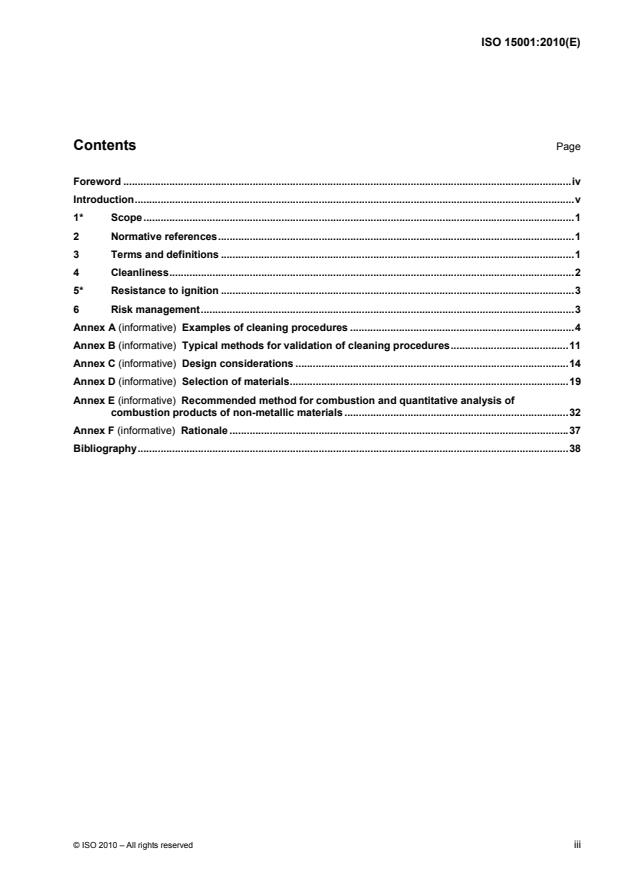
Contents Page
Foreword .iv
Introduction.v
1* Scope.1
2 Normative references.1
3 Terms and definitions .1
4 Cleanliness.2
5* Resistance to ignition .3
6 Risk management.3
Annex A (informative) Examples of cleaning procedures .4
Annex B (informative) Typical methods for validation of cleaning procedures.11
Annex C (informative) Design considerations .14
Annex D (informative) Selection of materials.19
Annex E (informative) Recommended method for combustion and quantitative analysis of
combustion products of non-metallic materials .32
Annex F (informative) Rationale .37
Bibliography.38
Foreword
ISO (the International Organization for Standardization) is a worldwide federation of national standards bodies
(ISO member bodies). The work of preparing International Standards is normally carried out through ISO
technical committees. Each member body interested in a subject for which a technical committee has been
established has the right to be represented on that committee. International organizations, governmental and
non-governmental, in liaison with ISO, also take part in the work. ISO collaborates closely with the
International Electrotechnical Commission (IEC) on all matters of electrotechnical standardization.
International Standards are drafted in accordance with the rules given in the ISO/IEC Directives, Part 2.
The main task of technical committees is to prepare International Standards. Draft International Standards
adopted by the technical committees are circulated to the member bodies for voting. Publication as an
International Standard requires approval by at least 75 % of the member bodies casting a vote.
Attention is drawn to the possibility that some of the elements of this document may be the subject of patent
rights. ISO shall not be held responsible for identifying any or all such patent rights.
ISO 15001 was prepared by Technical Committee ISO/TC 121, Anaesthetic and respiratory equipment,
Subcommittee SC 6, Medical gas systems.
This second edition cancels and replaces the first edition (ISO 15001:2003), subclauses of which have been
technically revised.
iv © ISO 2010 – All rights reserved
Introduction
Oxygen, pure or mixed with other medical gases, is widely used in medical applications. Because patients and
clinical personnel are often in close proximity to devices used with oxygen, the risk of serious injury is high if a
fire occurs in an oxygen-enriched atmosphere. A common cause of fire is the heat produced by adiabatic
compression, and the presence of hydrocarbon and particulate contaminants facilitates ignition. Some
combustion products, especially some non-metals (e.g. plastics, elastomers and lubricants) are toxic and thus
patients remote from that equipment and who are receiving oxygen from a medical gas pipeline system might
be injured when a problem occurs. Other equipment which is in close proximity to the equipment using oxygen,
or that utilizes oxygen as its source of power, can be damaged or fail to function properly if there is a problem
with the oxygen equipment.
Reduction or avoidance of these risks depends on the choice of appropriate materials, cleaning procedures
and correct design and construction of equipment so that it is compatible with oxygen under the conditions of
use.
This International Standard gives recommendations for the selection of materials and the cleaning of
components made from them, for use in oxygen and oxygen-enriched atmospheres.
Annex F contains rationale statements for some of the requirements of this International Standard. It is
included to provide additional insight into the reasoning that led to the requirements and recommendations
that have been incorporated into this International Standard. The clauses and subclauses marked with an
asterisk (*) after their number have corresponding rationale contained in Annex F. It is considered that
knowledge of the reasons for the requirements will not only facilitate the proper application of this International
Standard, but will expedite any subsequent revisions.
It is expected that particular device standards will make reference to this horizontal International Standard and
may, if appropriate, strengthen these minimum requirements.
Particular device standards may specify that some requirements of this International Standard may apply for
medical gases other than oxygen.
INTERNATIONAL STANDARD ISO 15001:2010(E)
Anaesthetic and respiratory equipment — Compatibility with
oxygen
1* Scope
This International Standard specifies requirements for the oxygen compatibility of materials, components and
devices for anaesthetic and respiratory applications, which can come into contact with oxygen in normal
condition or in single fault condition at gas pressures greater than 50 kPa.
Additionally, this International Standard gives general guidelines for the selection of materials and
components based on available data on their oxygen compatibility, and for carrying out a risk analysis,
including addressing the toxicity of products of combustion and/or decomposition.
Aspects of compatibility that are addressed by this International Standard include cleanliness, resistance to
ignition and the toxicity of products of combustion and/or decomposition at the design, manufacturing,
maintenance and disposal stages.
This International Standard does not apply to biocompatibility.
This International Standard is applicable to anaesthetic and respiratory equipment that is within the scope of
ISO/TC 121, e.g. medical gas pipeline systems, pressure regulators, terminal units, medical supply units,
flexible connections, flow-metering devices, anaesthetic workstations and lung ventilators.
2 Normative references
The following referenced documents are indispensable for the application of this document. For dated
references, only the edition cited applies. For undated references, the latest edition of the referenced
document (including any amendments) applies.
ISO 14971, Medical devices — Application of risk management to medical devices
3 Terms and definitions
For the purposes of this document, the following terms and definitions apply.
3.1
adiabatic compression
compression process that occurs without transfer of heat into or out of a system
3.2
auto-ignition temperature
temperature at which a material will spontaneously ignite under specified conditions
3.3
lethal concentration
LC
concentration of a gas (or a gas mixture) in air, administered by a single exposure during a short period of
time (24 h or less) to a group of young adult albino rats (males and females) which leads to the death of half of
the animals in at least 14 d
[ISO 10298:2010, definition 3.1]
3.4
oxygen index
minimum concentration of oxygen by volume percentage in a mixture of oxygen and nitrogen introduced at
(23 ± 2) °C that will just support combustion of a material under specified test conditions
[ISO 4589-2:1996, definition 3.1]
3.5
qualified technical person
person who by virtue of education, training or experience knows how to apply physical and chemical principles
involved in the reactions between oxygen and other materials
3.6
single fault condition
condition in which a single means for reducing a risk is defective or a single abnormal condition is present
[IEC 60601-1:2009, definition 3.116]
3.7
threshold limit value
TLV
concentration in air to which nearly all workers may be exposed during an 8 h working day and a 40 h working
week without adverse effect according to the current knowledge
3.8
oxygen-enriched mixture
mixture that contains more than 23,5 % volume fraction of oxygen
4 Cleanliness
4.1* Unless otherwise specified in particular device standards, surfaces of components that come into
contact with oxygen during normal operation or single fault condition shall:
a)* for applications in the pressure range of 50 kPa to 3 000 kPa, not have a level of hydrocarbon
contamination greater than 550 mg/m .
The manufacturer shall determine and ensure that the level of particle contamination is suitable for the
intended application(s);
b)* for applications at pressures greater than 3 000 kPa:
⎯ not have a level of hydrocarbon contamination greater than 220 mg/m ;
⎯ not have particles of size greater than 100 µm.
These requirements shall be met either by an appropriate method of manufacture or by use of an appropriate
cleaning procedure. Compliance shall be checked either by verification of the cleanliness of the components
or by validation of the cleaning procedure or the manufacturing process.
2 © ISO 2010 – All rights reserved
This International Standard does not specify quantifiable cleaning procedures or validation methods for them
in relation to the values in a) and b) above. However, Annex A gives examples of known cleaning procedures
and Annex B gives examples of methods for validation of cleaning procedures.
2 2 [21]
NOTE The values of 550 mg/m and 220 mg/m for hydrocarbon contamination are taken from ASTM G93-03 and
[49]
the value of 3 000 kPa is taken from EIGA IGC 33/06/E .
4.2 Means to identify components and devices that have been cleaned for oxygen service in accordance
with this International Standard shall be provided.
4.3 Cleaning compounds and methods shall be compatible with the materials, components and devices to
be cleaned.
Evidence of compliance shall be provided by the manufacturer upon request.
NOTE Regional or national regulations can require the provision of evidence to a notified body or competent authority
upon request.
4.4 Means (e.g. packaging and information supplied by the manufacturer) shall be provided to maintain the
cleanliness of components and devices that have been cleaned for oxygen service in accordance with this
International Standard.
5* Resistance to ignition
Devices designed for pressures greater than 3 000 kPa shall not ignite when submitted to a pneumatic impact
test according to procedures described in the relevant product standards at a test pressure of 1,2 × the
nominal inlet pressure.
If lubricants are used, the lubricated device shall be tested.
[5] [6] [7] [3]
NOTE 1 Pneumatic impact test methods are given in ISO 10524-1 , ISO 10524-2 , ISO 10524-3 , ISO 10297 ,
[54] [2]
ISO 21969 and ISO 7291 and can be used for similar devices where a device standard does not exist or does not
include such a test.
NOTE 2 In the case of pure oxygen, the risk of ignition increases with the pressure. In the case of gas mixtures
containing oxygen, the risk of ignition increases with the partial pressure of oxygen.
6 Risk management
6.1 The manufacturer of medical devices shall carry out a risk management process in accordance with
ISO 14971. This should include oxygen fire hazards (see Annexes C and D), resistance to ignition
(see Clause 5) and toxicity (see Annex E), cleaning procedures (see Annex A), design considerations
(see Annex C) and selection of materials (see Annex D).
[20]
NOTE 1 ASTM G88-05 gives an example of oxygen fire hazard and risk analysis.
[16] [22]
NOTE 2 Examples of oxygen fire hazards are given in ASTM G63-99 and ASTM G94-05 .
NOTE 3 Typical “oxygen-compatible” lubricants can generate toxic products during combustion or decomposition.
NOTE 4 Annexes D and E contain information on toxicity.
6.2 The specific hazards of toxic products of combustion or decomposition from non-metallic materials
(including lubricants, if used) and potential contaminants shall be addressed. Some potential products of
combustion and/or decomposition for some commonly available non-metallic materials are listed in Table D.7.
Annex A
(informative)
Examples of cleaning procedures
A.1 General
A.1.1 General guidelines
A cleaning programme that results in an increase in the degree of cleanliness of the component after each
cleaning operation should be selected. It then becomes a matter of processing the component through a
series of cleaning methods, or several cycles within a single cleaning method, or both, in order to achieve the
desired final degree of cleanliness.
It may be possible to obtain the desired degree of cleanliness in a single operation, but many cleaning
methods must progress in several stages, such as initial cleaning, intermediate cleaning and final cleaning. It
is essential that each stage be isolated from previous stages by appropriate rinsing, drying and purging
operations.
Of particular importance is the removal of lint, dust and organic matter such as oil and grease. These
contaminants are relatively easily ignited in oxygen and oxygen-enriched atmospheres.
It is essential that cleaning, washing and draining methods ensure that dead-end passages and possible traps
are adequately cleaned.
A.1.2 Initial cleaning
Initial cleaning should be used to remove gross contaminants such as excessive oxide or scale build-up, large
quantities of oil, grease and particulate matter.
Initial cleaning reduces the quantity of contaminants, thereby increasing the useful life and effectiveness of the
cleaning solutions used in subsequent cleaning operations.
A.1.3 Intermediate cleaning
Intermediate cleaning generally consists of subjecting the part to caustic or acid-cleaning solutions to remove
solvent residues and residual contaminants. The cleaning environment and handling procedures used for
intermediate cleaning operations are more critical than those used for initial cleaning. It is essential that the
cleaning environment and solutions be appropriately controlled in order to maximize solution efficiency and to
minimize the introduction of contaminants that might compromise subsequent cleaning operations.
A.1.4 Final cleaning
A.1.4.1 When components are required to meet very high degrees of cleanliness, they should be
subjected to a final cleaning. Final cleaning is generally performed using chemical cleaning methods. At this
stage, protection from recontamination by the cleaning solutions or the environment becomes critical and may
require strict controls, such as those found in classified clean rooms.
A.1.4.2 The final cleaning stage involves drying and purging operations followed by sealing to protect
against recontamination and packaging to prevent damage during storage and transportation.
4 © ISO 2010 – All rights reserved
A.2 Selection of cleaning methods
In order to decide on the most practicable methods of cleaning, the following factors should be considered:
a) the type (e.g. organic, inorganic) and form (e.g. particulate, film, fluid) of contaminants;
b) the configuration of the part to be cleaned;
c) the base material or coating of the part to be cleaned;
d) initial condition of the part to be cleaned;
e) the required final cleanliness of the part to be cleaned;
f) environmental impact and lawful disposal of hazardous waste products generated by the cleaning
method;
g) effects of the selected cleaning methods on the mechanical, chemical and thermal properties of the part
to be cleaned.
A.3 Cleaning methods
A.3.1 General
It is essential that the cleaning method ensure that all surfaces of the component are cleaned. The methods
described are applicable to most metallic materials. However, special precautions may be necessary for non-
metallic components.
A.3.2 Categories
Cleaning methods can be categorized as mechanical, chemical or both. Some cleaning operations are
enhanced by combining mechanical and chemical methods, such as mechanical agitation of a chemical
solution.
Some mechanical cleaning methods such as abrasive blasting, tumbling, grinding and wire brushing on
finished machine components can damage surfaces, remove protective coatings and work-harden metals. It is
essential that sensitive surfaces of the component be protected before such methods are used on that
component.
Chemical cleaning methods can cause damage. Corrosion, embrittlement or other surface modifications can
occur. Crevice corrosion can occur, particularly in brazed or welded assemblies. Solvent cleaning solutions
are often damaging to non-metals. The supplier of the non-metals should be consulted or samples should be
tested to ensure that the solvent will not cause damage. If acidic or caustic chemical cleaners are used, it is
essential that the chemical residue on the components be neutralized and/or removed immediately after
cleaning.
A.3.3 Mechanical cleaning
A.3.3.1 General
Mechanical cleaning methods use mechanically-generated forces to remove contaminants from the
components. Examples of mechanical cleaning methods are rinsing, abrasive blasting, tumbling and blowing.
Details of these and other methods are discussed in A.3.3.2 to A.3.3.8.
A.3.3.2 Abrasive blast cleaning
A.3.3.2.1 Abrasive blast cleaning entails the forceful impingement of abrasive particles against the surfaces
to be cleaned in order to remove scale, rust, paint and other foreign matter. The abrasive particles are
entrained in a gas or liquid stream. A variety of systems can be used to propel the abrasive particles, e.g.
airless abrasive blast blades or vane-type wheels, pressure blast nozzles or suction (induction) blast nozzles.
Propellant gases should be oil-free.
A.3.3.2.2 Typical abrasive particle materials include metallic grit and shot, natural sands, manufactured
oxide grit, carbide grit, walnut shells and glass beads. The specific abrasive particle material used should be
suitable for performing the intended cleaning without depositing contaminants that cannot be removed by
additional operations, such as high velocity blowing, vacuuming and purging.
A.3.3.2.3 Care needs to be taken to minimize the removal of material from the component parent metal.
This cleaning method might not be suitable for components or systems with critical surface finishes or
dimensional tolerances.
A.3.3.3 Wire brush or grinding cleaning
A.3.3.3.1 Wire brushing or grinding methods generally use a power-driven wire brush, a non-metallic
fibre-filled brush or an abrasive wheel. These are used to remove scale, weld slag, rust, oxide films and other
surface contaminants. Wire brushes can be used dry or wet. The wet condition results when brushes are used
in conjunction with caustic cleaning solutions or cold water rinses.
A.3.3.3.2 These mechanical methods can imbed brush or grinding material particles in the surface being
cleaned. The selection of cleaning brushes depends upon the component or parent material. Non-metallic
brushes are suitable for most materials to be cleaned. Carbon steel brushes should not be used on aluminium,
copper or stainless steel alloys. Any wire brushes previously used on carbon steel components should not be
used subsequently on aluminium or stainless steel. Wire brushing and grinding can affect dimensions,
tolerances and surface finishes.
A.3.3.4 Tumbling
This method involves rolling or agitation of parts within a rotating barrel or vibratory tub. An abrasive or
cleaning solution is added to the container. The container action (rotation or vibration) imparts relative motion
between the components to be cleaned and the abrasive medium or cleaning solution. This method can be
performed with dry or wet abrasives. The component size may vary from a large casting to a delicate
instrument component, but mixing different components in one container should be avoided. Damage can
occur from one component impacting on another. Tumbling can be used for descaling, deburring, burnishing
and general washing. Some factors to be considered in barrel cleaning are the component size and shape,
type of abrasive, abrasive size, load size, barrel rotational speed and ease of component/abrasive separation.
A.3.3.5 Swab, spray and dip cleaning
These are three methods of applying cleaning solutions to the component surfaces. Each method has its
particular advantages. Swabbing is generally used only to clean small selected areas. Spraying and dipping
are used for overall cleaning. These methods are generally employed with caustic, acid or solvent cleaning
methods, all of which are discussed in A.3.4.5, A.3.4.6 and A.3.4.8.
A.3.3.6 Vacuuming and blowing
These methods remove contaminants using currents of clean, dry, oil-free air or nitrogen. These methods can
be used to remove loose dirt, slag, scale and various particles, but they are not suitable for the removal of
surface oxides, greases and oils.
6 © ISO 2010 – All rights reserved
A.3.3.7 Pig cleaning
Long continuous pipelines can be cleaned in situ using pigs. A pig is a piston-like cylinder with peripheral
seals that can be pushed through a pipeline using compressed gas, typically nitrogen. The pig can be
equipped with scrapers and wire brushes. Pairs of pigs can carry slugs of liquid cleaning agents between
them. Hence, a train of pigs can transport isolated slugs of liquids through a pipeline to produce various levels
of cleanliness and rinsing. The mechanical and chemical suitability of the solvents, scrapers and wire brushes
should be ensured.
A.3.3.8 Ultrasonic cleaning
Ultrasonic energy can be used in conjunction with a variety of chemical cleaning agents to produce intimate
contact between the components and the cleaning agent to aid the removal of lightly adhering or embedded
particles from solid surfaces. It is generally employed in solvent cleaning of small components, precious
metals and components requiring a very high degree of cleanliness.
A.3.4 Chemical cleaning
A.3.4.1 General
The methods described in A.3.4.2 to A.3.4.9 are based on achieving an interaction between the cleaning
solution and the surface of the component to aid the removal of the contaminant by subsequent mechanical
methods. The interaction can involve surface activation, contaminant breakdown, oxide conversion and
hydrophobic or hydrophilic transformations.
A.3.4.2 Hot water cleaning
Hot water cleaning is used to remove gross organic and particulate contamination from components by the
use of low to moderate heat, detergent and some mechanical agitation. Equipment used during hot water
cleaning consists of a spray system or a cleaning vat with or without suitable agitation of the solution. Hot
water cleaning with detergent can be used where steam is not necessary to free and fluidize contaminants.
Consideration should be given to the size, shape and the number of components to assure adequate contact
between surfaces of the components and the solution. The solution temperature should be that recommended
by the manufacturer of the detergent. Water-soluble contaminants are removed by prompt flushing with
sufficient quantities of clean water before the cleaning agents have had time to precipitate. The components
are then dried by blowing with dry, oil-free air or nitrogen, which can be heated to shorten the drying time.
A.3.4.3 Detergent cleaning
This method relates to the cleaning of vessels, piping systems or components either externally or internally.
Detergents are supplied in powder, crystal or concentrated liquid form. They are prepared for use by mixing
with water to form aqueous solutions. Prepared solutions can be used in static tanks or vessels for the
immersion of components, or the solution can be re-circulated by pump or jetted on to or through the
component. Some types of detergent are toxic and/or corrosive. Properties of detergent materials should be
checked with their manufacturer or supplier.
A.3.4.4 Steam cleaning
Steam cleaning is used to remove contaminants, especially organic and particulate, from components by the
use of pressure, heat and sometimes detergents. Some organic contaminants are removed by decreasing
their viscosity or thinning them with steam heat. A detergent that disperses and emulsifies the organic
contaminants, allowing the rinsing off of the contaminants by the condensed steam, can be added. The
system should provide control over the flows of the steam, water and detergent to maximize the efficiency of
the detergent's chemical action, the heating effect of the steam and the scrubbing action of the steam jet.
A.3.4.5 Caustic cleaning
A.3.4.5.1 Caustic cleaning uses solutions of high alkalinity for the removal of organic contaminants, such as
hydrocarbons, oils, greases and waxes. There are many effective cleaning products available for caustic
cleaning. The water used for rinsing should be free from substances or impurities that may cause reactions
with the caustic cleaner. It is recommended that distilled water be used to minimize problems. The cleaning
solution can be applied by spraying, immersing or swabbing. Usually, caustic cleaning solutions are applied at
temperatures up to 80 °C. It is important that the cleaning solution reach all areas of the components to be
cleaned. The cleaning solution can be re-used until it becomes ineffective, as determined by pH measurement
or contaminant concentration analysis. Experience will establish a contaminant level of the cleaning solution
above which a surface cannot be acceptably cleaned.
A.3.4.5.2 It is essential that the cleaning solution be thoroughly rinsed from the component to prevent the
cleaning solution and contaminants from re-depositing on the surface. The surface should not be allowed to
dry between the cleaning phase and the rinsing phase. Frequently, some form of water rinsing helps to
remove the cleaning solution and aids the drying process. A method of determining when the rinsing is
complete is to monitor the used rinse water until a pH of ±0,2 of that of the starting pH is achieved. Drying, if
required, can be accomplished with heated or unheated dry, oil-free air or nitrogen.
A.3.4.6 Acid cleaning
A.3.4.6.1 Acid cleaning is a process in which a solution of a mineral acid, organic acid or acid salt (often in
combination with a wetting agent and detergent) is used to remove oxides, oils and other contaminants from
components with or without the application of heat. It is essential that acid cleaning be carefully controlled to
avoid damage to the surface of components, such as undesired etching or pickling. The type of cleaning agent
selected will depend in most cases on the material or component to be cleaned. A general guide to the use of
acid cleaning is given in A.3.4.6.2 to A.3.4.6.5.
A.3.4.6.2 Phosphoric acid cleaning agents can be used for most metals. These agents will remove oxides,
rust, soils and fluxes.
A.3.4.6.3 Hydrochloric acid cleaning agents are recommended for carbon and low-alloy steels only. These
agents will remove rust, scale and oxide coatings and will strip chromium, zinc and cadmium platings. Certain
acidic solutions, including hydrochloric or nitric acids, should contain an inhibitor to prevent harmful attacks on
base metals. Hydrochloric acid should not be used on stainless steel because it may cause stress corrosion or
stress-corrosion cracking.
A.3.4.6.4 Chromic acid and nitric acid cleaning compounds are recommended for aluminium, copper and
their alloys. These compounds are not true cleaning agents, but are used for deoxidizing, brightening, and for
removing the black residue that forms during cleaning with a caustic solution. Some compounds are available
as liquids and others as powders. They are mixed in concentrations of 5 % to 50 % volume fraction in water,
depending on the cleaning agent and the amount of oxide or scale to be removed.
NOTE Chromic acid is classified as carcinogenic, mutagenic, very toxic to aquatic organisms and may cause long-
term adverse effects in the aquatic environment.
A.3.4.6.5 A storage or immersion tank, recirculation pump, associated piping and valves compatible with
the cleaning solution are required. Common techniques for acid cleaning are immersion, swabbing and
spraying. Acid cleaning compounds should not be used unless their application and performance are known
or are discussed with the cleaning compound manufacturer. The manufacturer's recommendations regarding
concentration and temperature should be followed. After acid cleaning, it is essential that the surfaces be
thoroughly rinsed with water to remove all traces of the acid and thoroughly dried after the final rinse. To
minimize staining, surfaces should not be permitted to dry between successive steps of the acid cleaning and
rinsing procedure.
A neutralizing treatment may be necessary under some conditions. It is essential that neutralization be
followed by repeated water rinsing to remove all traces of the neutralizing agent. If drying is required, it can be
completed with heated or unheated dry, oil-free air or nitrogen.
8 © ISO 2010 – All rights reserved
A.3.4.7 Emulsion cleaning
Emulsion cleaning is a process for removing contamination from the surface of components by using organic
solvents dispersed in an aqueous medium by an emulsifying agent. Emulsion cleaners are composed of
petroleum-derived solvents and surfactants. The cleaning action of emulsion cleaners combines the
advantages of both the aqueous and organic phases. A variety of emulsion cleaners is available. Some
emulsion cleaners tend to separate into individual solutions if left standing for extended periods of time, so it
may be necessary to agitate the cleaner periodically. Emulsion cleaners are normally applied to components
by methods such as immersion, spraying or swabbing. It is essential that emulsion cleaners be removed by
rinsing and subsequent cleaning operations.
A.3.4.8 Solvent cleaning
A.3.4.8.1 Solvent cleaning or degreasing is considered to be the principal procedure for the removal of
soluble organic contaminants from components to be used in oxygen service and is suitable for use with most
metals.
However, many of the solvents that have been used for this method of cleaning are now banned under the
“Montreal Protocol”. Alternative cleaning methods that use acceptable solvents should be identified and put
into practice as soon as possible.
Solvent cleaning is limited by the ability of the solvent to reach and dissolve any contaminants present. Before
starting a solvent cleaning procedure, a portion of fresh clean solvent should be set aside to be used as a
reference. At intervals throughout the procedure, aliquots of used solvent can be compared with the reference
to determine the level of contamination and the effectiveness of the cleaning. Clean glass bottles should be
used to store the reference and used solvents. Methods for determining the concentration of hydrocarbon
contaminants are discussed in Annex B.
A.3.4.8.2 After the completion of any method of solvent cleaning, it is essential that all gross residual
cleaning fluid be drained from the component to prevent it drying in pools. The component should then be
purged and dried with warm, dry, oil-free air or nitrogen. Small components can be air-dried if appropriate.
A.3.4.8.3 Solvent cleaning can be performed using methods such as swabbing and spraying. Cleaning can
also be effected by immersing the component in a tank of solvent and applying a means of agitation.
Disassembled components can be cleaned using this method. The process may be improved by the use of
ultrasonic cleaning techniques. Cleaning by forced circulation of the solvent through the component can also
be carried out. Cleaning by circulation should be continued, using clean solvent, until the used solvent
emerges from the component as clean as the reference sample.
A.3.4.8.4 Solvents frequently require inhibitors to control corrosive reactions. The addition of inhibitors may
require monitoring to ensure continued effectiveness of the inhibitor. This method is often applied to
assemblies that cannot be disassembled, to large components and to prefabricated circuits, pipeworks, etc.
A.3.4.9 Vapour degreasing
Vapour degreasing is the removal of soluble organic materials and subsequent washing of the surfaces of
components by the continuous condensation of solvent vapour on the cold component. Vapour degreasing
equipment consists essentially of a vaporizer for generating clean vapour from a contaminated solvent and a
container for holding the components in the vapour. Refrigerant grade solvents should not be used because
they have been known to contain oils. Some of these solvents are inflammable in air under certain conditions
and have various degrees of toxicity; caution should therefore be exercised in their use. It is essential that the
temperature of the component be below the boiling point of the solvent, so that the solvent vapours will
condense and wash down by gravity over the surfaces of the component. The component should be
positioned and connected so that the condensate will drain freely from the ports. Continuous circulation of the
condensate and its transport back into the vaporizer will carry the dissolved contaminants into the vaporizer
where they will remain. No further cleaning will occur after the temperature of the component reaches the
temperature of the vapour.
A.3.4.10 Purging
A.3.4.10.1 It is very important to purge the component to ensure that all residues from the previous cleaning
operation(s) are removed before subsequent cleaning operations or final packaging is performed. This can be
achieved by rinsing, drying and blowing. Rinsing is dependent upon the cleaning solutions used, but in most
cases water of suitable quality can be used. Drying can be achieved by the application of heat to the
component using ovens or infrared lights, or by blowing with clean, oil-free, dry air. Under no circumstances
should compressed air for pneumatic tools be used for drying, since it can contain traces of oil or other
contaminants. Removal of solvents at elevated temperatures requires additional attention, because the
solvents are more likely to attack the component surfaces or to decompose and deposit undesirable films on
the component. It is important that the purging medium have a better cleanliness level than the desired
cleanliness level of the component.
A.3.4.10.2 A more effective purging can be performed using clean, dry, oil-free nitrogen. This can require
dryness verification by measuring the dewpoint of the effluent drying gas. The duration of the purge, the
number of purging operations, and the type of purging operations depend upon the component to be cleaned,
the cleaning methods employed and the final application.
A.3.4.11 Low-pressure plasma cleaning
The components to be cleaned are placed in a vacuum chamber into which a gas is introduced at a pressure
between 0,5 hPa and 2 hPa. This gas is transformed into an ionized state by applying a high-frequency
alternating voltage. During the gas discharge, chemical radicals are formed that react with the component
surface. The volatile compounds developed during this reaction are removed by a vacuum pump. When
oxygen is applied as the reaction gas, the oxygen plasma reacts with organic contaminants, such as oil and
grease, and burns them to form CO and water vapour. Because low-pressure plasma cleaning can remove
only organic substances, inorganic residues arising from the treatment of the components shall be removed
by suitable cleaning and washing methods before cleaning with low-pressure plasma.
A.4 Environmental considerations
A.4.1 It is essential that devices intended for oxygen service be handled carefully during all phases of the
cleaning procedure. The environment should be clean and dust-free. Nearby grinding, welding and sanding
should be prohibited. Components should not be allowed to stand. Care should be taken to avoid oil deposits
from rotating machinery or oil aerosols in the air. Surfaces that will be in contact with oxygen should not be
touched except with clean gloves or handling devices.
A.4.2 In some cases, laminar-flow cleanrooms in which the entire room is purged with filtered air are
necessary. In horizontal-flow cleanrooms, components are cleaned and verified in a sequence that employs
successive cleaning operations at locations progressively closer to the filtered air source, so that the
component and the environment both become steadily cleaner. In laminar-flow cleanrooms, the layout of the
successive cleaning operations is not critical.
10 © ISO 2010 – All rights reserved
Annex B
(informative)
Typical methods for validation of cleaning procedures
B.1 General
The selection of the test method should take into consideration parameters such as the method of
manufacture, the type and size of the device to be checked, and the level of accuracy required.
B.2 Typical methods
B.2.1 Direct visual inspection (white light)
This is the most common test method used to detect the presence of contaminants such as preservatives,
moisture, corrosion products, weld slag, scale filings and chips, and other foreign matter. The component is
observed for the absence of contaminants with normal or corrected-to-normal vision under strong white light.
This method will detect particulate matter of size in excess of 50 µm, moisture and hydrocarbon contamination
down to 500 mg/m .
B.2.2 Direct visual inspection (ultraviolet light)
WARNING — Avoid prolonged exposure to ultraviolet light because it is hazardous to eyes and to
unprotected skin.
Ultraviolet light causes many common hydrocarbon or organic oils or greases to fluoresce and become visible
when they cannot be detected by other visual means. Therefore, the ultraviolet light test is the most commonly
used test to detect the presence of hydrocarbon or organic oils or greases. The surface is observed in
darkness or subdued light using a source radiating ultraviolet light of wavelength between 0,32 µm and
0,37 µm. Ultraviolet light inspection should be able to indicate that cleaned surfaces are free of any
hydrocarbon fluorescence. However, not all organic oils fluoresce and some materials, such as cotton lint, that
fluoresce are acceptable unless present in excessive amounts.
If fluorescence appears as a blotch, smear, smudge or film, the fluorescing area should be re-cleaned.
Accumulations of lint or dust that are visible under ultraviolet light should be removed by blowing with dry, oil-
free air or nitrogen, wiping with a clean lint-free cloth or vacuuming.
B.2.3 Wipe test
This test can be used to detect contaminants on visually inaccessible areas as a supplement to the visual
inspections described in B.2.1 and B.2.2. The surface is rubbed lightly with a clean white paper or lint-free
cloth which is examined under white and ultraviolet lights. The area should not be rubbed hard enough to
remove any oxide film, as this material could be confused with normal surface contamination. No paper or
cloth particles should be left on the surface.
B.2.4 Water break test
This test can be used to detect oily residues not found by other means. The surface is wetted with a spray of
clean water. This should form a thin layer and remain unbroken for at least 5 s. Beading of the water droplets
indicates the presence of oil contaminants. This method is generally limited to horizontal surfaces.
B.2.5 Solvent extraction test
Solvent extraction can be used to supplement visual techniques and to check inaccessible surfaces. The
procedure is limited by the ability of the liquid solvent to reach, dissolve and dislodge the contaminants
present, without attacking the components themselves and giving erroneous results. In quantitative terms, its
usefulness is limited to surfaces whose dimensions can be readily calculated, e.g. flat surfaces and the inside
of tubing. In qualitative terms, however, repetition of the procedure with fresh solvent will incrementally reduce
contamination to an acceptably low level.
In general terms, the surface of the component is flushed, rinsed or immersed in a known volume of
low
...
NORME ISO
INTERNATIONALE 15001
Deuxième édition
2010-06-01
Matériel d'anesthésie et de réanimation
respiratoire — Compatibilité avec
l'oxygène
Anaesthetic and respiratory equipment — Compatibility with oxygen
Numéro de référence
©
ISO 2010
PDF – Exonération de responsabilité
Le présent fichier PDF peut contenir des polices de caractères intégrées. Conformément aux conditions de licence d'Adobe, ce fichier
peut être imprimé ou visualisé, mais ne doit pas être modifié à moins que l'ordinateur employé à cet effet ne bénéficie d'une licence
autorisant l'utilisation de ces polices et que celles-ci y soient installées. Lors du téléchargement de ce fichier, les parties concernées
acceptent de fait la responsabilité de ne pas enfreindre les conditions de licence d'Adobe. Le Secrétariat central de l'ISO décline toute
responsabilité en la matière.
Adobe est une marque déposée d'Adobe Systems Incorporated.
Les détails relatifs aux produits logiciels utilisés pour la création du présent fichier PDF sont disponibles dans la rubrique General Info
du fichier; les paramètres de création PDF ont été optimisés pour l'impression. Toutes les mesures ont été prises pour garantir
l'exploitation de ce fichier par les comités membres de l'ISO. Dans le cas peu probable où surviendrait un problème d'utilisation,
veuillez en informer le Secrétariat central à l'adresse donnée ci-dessous.
DOCUMENT PROTÉGÉ PAR COPYRIGHT
© ISO 2010
Droits de reproduction réservés. Sauf prescription différente, aucune partie de cette publication ne peut être reproduite ni utilisée sous
quelque forme que ce soit et par aucun procédé, électronique ou mécanique, y compris la photocopie et les microfilms, sans l'accord écrit
de l'ISO à l'adresse ci-après ou du comité membre de l'ISO dans le pays du demandeur.
ISO copyright office
Case postale 56 • CH-1211 Geneva 20
Tel. + 41 22 749 01 11
Fax + 41 22 749 09 47
E-mail copyright@iso.org
Web www.iso.org
Publié en Suisse
ii © ISO 2010 – Tous droits réservés
Sommaire Page
Avant-propos .iv
Introduction.v
1* Domaine d'application .1
2 Références normatives.1
3 Termes et définitions .1
4 Propreté.2
5* Résistance à l'inflammation .3
6 Gestion des risques .3
Annexe A (informative) Exemples de modes opératoires de nettoyage .5
Annexe B (informative) Méthodes habituelles de validation des modes de nettoyage.13
Annexe C (informative) Conception .16
Annexe D (informative) Choix des matériaux.22
Annexe E (informative) Méthode d'essai recommandée pour la combustion et l'analyse
quantitative des produits de combustion de matériaux non métalliques .35
Annexe F (informative) Justification .40
Bibliographie.41
Avant-propos
L'ISO (Organisation internationale de normalisation) est une fédération mondiale d'organismes nationaux de
normalisation (comités membres de l'ISO). L'élaboration des Normes internationales est en général confiée
aux comités techniques de l'ISO. Chaque comité membre intéressé par une étude a le droit de faire partie du
comité technique créé à cet effet. Les organisations internationales, gouvernementales et non
gouvernementales, en liaison avec l'ISO participent également aux travaux. L'ISO collabore étroitement avec
la Commission électrotechnique internationale (CEI) en ce qui concerne la normalisation électrotechnique.
Les Normes internationales sont rédigées conformément aux règles données dans les Directives ISO/CEI,
Partie 2.
La tâche principale des comités techniques est d'élaborer les Normes internationales. Les projets de Normes
internationales adoptés par les comités techniques sont soumis aux comités membres pour vote. Leur
publication comme Normes internationales requiert l'approbation de 75 % au moins des comités membres
votants.
L'attention est appelée sur le fait que certains des éléments du présent document peuvent faire l'objet de
droits de propriété intellectuelle ou de droits analogues. L'ISO ne saurait être tenue pour responsable de ne
pas avoir identifié de tels droits de propriété et averti de leur existence.
L'ISO 15001 a été élaborée par le comité technique ISO/TC 121, Matériel d'anesthésie et de réanimation
respiratoire, sous-comité SC 6, Systèmes de gaz médicaux.
Cette deuxième édition annule et remplace la première édition (ISO 15001:2003), qui a fait l'objet d'une
révision technique.
iv © ISO 2010 – Tous droits réservés
Introduction
L'utilisation de l'oxygène, pur ou mélangé à d'autres gaz médicaux, est largement répandue pour les
dispositifs médicaux. Les patients et le personnel médical se trouvent souvent à proximité immédiate de
dispositifs utilisant de l'oxygène, c'est pourquoi le risque de blessure grave est élevé en cas d'incendie
provoqué par l'oxygène. L'incendie a couramment pour origine la chaleur dégagée par la compression
adiabatique et la présence d'hydrocarbures et de particules contaminantes qui favorisent l'inflammation.
Certains produits de combustion sont toxiques, notamment les produits non métalliques (par exemple les
plastiques, les élastomères et les lubrifiants), aussi l'alimentation des patients en oxygène par un dispositif
médical relié à un système de distribution de gaz médicaux présente-t-elle un risque de blessure en cas de
combustion. D'autres dispositifs situés à proximité immédiate des dispositifs utilisant de l'oxygène ou
alimentés en oxygène peuvent subir des dommages ou des dysfonctionnements en cas de problème avec le
dispositif à oxygène.
La réduction ou l'élimination de ces risques dépend du choix des matériaux appropriés, des modes de
nettoyage, ainsi que de la conception et de la fabrication correctes des dispositifs, afin d'assurer leur
compatibilité avec l'oxygène dans les conditions d'utilisation.
La présente Norme internationale donne des recommandations pour la sélection de matériaux et le nettoyage
des composants provenant de ceux-ci, pour l'utilisation dans l'oxygène et dans les atmosphères enrichies en
oxygène.
L'Annexe F contient des déclarations de justification pour certaines des exigences de la présente Norme
internationale. Elle est incluse pour fournir un point de vue supplémentaire dans le raisonnement qui a mené
aux exigences et aux recommandations qui ont été incorporées dans la présente Norme internationale. Les
articles et paragraphes marqués d'un (*), après leur numérotation, ont une justification correspondante dans
l'Annexe F. Il est considéré que la connaissance des raisons concernant les exigences facilitera non
seulement l'application rigoureuse de la présente Norme internationale, mais accélérera également toute
révision ultérieure.
Il est prévu que les normes relatives aux dispositifs spécifiques fassent référence à la présente Norme
internationale horizontale et qu'elles puissent, si nécessaire, renforcer ces exigences minimales.
Les normes relatives aux dispositifs spécifiques peuvent spécifier que certaines exigences de la présente
Norme internationale peuvent s'appliquer aux gaz médicaux autres que l'oxygène.
NORME INTERNATIONALE ISO 15001:2010(F)
Matériel d'anesthésie et de réanimation respiratoire —
Compatibilité avec l'oxygène
1* Domaine d'application
La présente Norme internationale spécifie les exigences relatives à la compatibilité de l'oxygène des
matériaux, des composants et des appareils pour les applications anesthésiques et respiratoires qui peuvent
entrer en contact avec l'oxygène en condition normale ou en condition de premier défaut à des pressions de
gaz supérieures à 50 kPa.
De plus, la présente Norme internationale donne des lignes directrices générales pour la sélection des
matériaux et des composants fondées sur des données disponibles sur leur compatibilité d'oxygène, et pour
effectuer une analyse de risque, y compris l'adressage de la toxicité des produits de la combustion et/ou de la
décomposition.
Les aspects de la compatibilité qui sont abordés dans la présente Norme internationale incluent la propreté, la
résistance à l'inflammation et la toxicité des produits de combustion et/ou de décomposition lors de la
conception, de la fabrication, de la maintenance et des étapes d'élimination.
La présente Norme internationale ne s'applique pas à la biocompatibilité.
La présente Norme internationale est applicable aux équipements anesthésiques et respiratoires qui entrent
dans le champ d'application de l'ISO/TC 121, par exemple les systèmes de distribution de gaz médicaux, les
détendeurs, les prises murales, les gaines techniques pour usage médical, les flexibles haute pression, les
débitmètres, les systèmes d'anesthésie et les ventilateurs pulmonaires.
2 Références normatives
Les documents de référence suivants sont indispensables pour l'application du présent document. Pour les
références datées, seule l'édition citée s'applique. Pour les références non datées, la dernière édition du
document de référence s'applique (y compris les éventuels amendements).
ISO 14971, Dispositifs médicaux — Application de la gestion des risques aux dispositifs médicaux
3 Termes et définitions
Pour les besoins du présent document, les termes et définitions suivants s'appliquent.
3.1
compression adiabatique
processus de compression qui se produit sans transfert de chaleur à l'intérieur ou vers l'extérieur d'un
système
3.2
température d'auto-inflammation
température à laquelle un matériau s'enflamme spontanément dans des conditions d'essai spécifiées
3.3
concentration létale
LC
concentration d'un gaz (ou d'un mélange de gaz) dans l'air, administré en une seule exposition pendant une
courte période de temps (24 h ou moins) à un groupe de jeunes rats albinos adultes (mâles et femelles), qui
provoque la mort de la moitié des animaux en au moins 14 jours
[ISO 10298:2010, définition 3.1]
3.4
indice d'oxygène
concentration minimale d'oxygène, exprimée en pourcentage par volume, dans un mélange d'oxygène et
d'azote introduit à (23 ± 2) °C, qui supporte la combustion d'un matériau dans des conditions d'essai
spécifiées
NOTE Adapté de l'ISO 4589-2:1996, définition 3.1.
3.5
personnel technique qualifié
personne qui de par ses études, sa formation ou son expérience connaît l'application des principes physiques
et chimiques impliqués dans les réactions entre l'oxygène et d'autres matériaux
3.6
condition de premier défaut
condition par laquelle un seul moyen de protection contre un risque de l'appareil est défectueux ou lorsqu'une
seule condition anormale est présente
[CEI 60601-1:2009, définition 3.116]
3.7
concentration maximale admissible
CMA
concentration dans l'air à laquelle la quasi-totalité du personnel est susceptible d'être exposée au cours d'une
journée de travail de 8 h et d'une semaine de 40 h sans subir d'effets nocifs selon les connaissances actuelles
3.8
mélange enrichi à l'oxygène
mélange qui contient plus de 23,5 % de fraction volumique d'oxygène
4 Propreté
4.1* Sauf spécification contraire dans les normes relatives aux dispositifs spécifiques, les surfaces des
composants en contact avec l'oxygène en fonctionnement normal ou en condition de premier défaut doivent,
a) *pour les applications dans une plage de pression de 50 kPa à 3 000 kPa, ne pas avoir un niveau de
contamination en hydrocarbures supérieur à 550 mg/m ;
Le fabricant doit déterminer et garantir que le niveau de contamination des particules est adapté à
l'utilisation ou aux utilisations prévue(s).
b) *pour les applications à une pression supérieure à 3 000 kPa,
⎯ ne pas avoir un niveau de contamination en hydrocarbures supérieur à 220 mg/m , et
⎯ ne pas avoir de particules dont la taille est supérieure à 100 µm.
2 © ISO 2010 – Tous droits réservés
Ces exigences doivent être satisfaites soit par une méthode appropriée de fabrication, soit par l'utilisation de
modes opératoires de nettoyage appropriés. La conformité doit être contrôlée soit par vérification de la
propreté des composants, soit par validation du mode opératoire de nettoyage ou du processus de fabrication.
La présente Norme internationale ne spécifie pas de procédures de nettoyage quantifiables ni des méthodes
de validation pour ces procédures en relation avec les valeurs données en a) et b) ci-dessus. Cependant,
l'Annexe A comporte des exemples de modes de nettoyage et l'Annexe B donne des exemples de méthodes
de validation des modes de nettoyage.
2 2
NOTE Les valeurs de 550 mg/m et de 220 mg/m pour la contamination en hydrocarbures proviennent de
[21] [49]
l'ASTM G93-03 et la valeur de 3 000 kPa provient de l'EIGA IGC 33/06/E .
4.2 Des moyens doivent être fournis pour identifier les composants et les dispositifs qui ont été nettoyés
pour l'utilisation de l'oxygène conformément à la présente Norme internationale.
4.3 Les produits et les méthodes de nettoyage doivent être compatibles avec les matériaux, les
composants et les appareils à nettoyer.
Une preuve de conformité doit être fournie par le fabricant sur demande.
NOTE La réglementation régionale ou nationale peut exiger la fourniture de la preuve de conformité à un organisme
certifié ou à une autorité compétente sur demande.
4.4 Des moyens (par exemple emballage et informations donnés par le fabricant) doivent être fournis pour
maintenir la propreté des composants et dispositifs qui ont été nettoyés pour une utilisation d'oxygène
conformément à la présente Norme internationale.
5* Résistance à l'inflammation
Les dispositifs conçus pour fonctionner à des pressions supérieures à 3 000 kPa ne doivent pas s'enflammer
lorsqu'ils sont soumis à un essai de choc pneumatique, conformément aux normes de produits
correspondantes, à la pression d'essai de 1,2 fois la pression nominale d'entrée.
Si des lubrifiants sont utilisés, le dispositif lubrifié doit être soumis à essai.
NOTE 1 Des méthodes d'essai de choc pneumatique sont donnés dans l'ISO 7291, l'ISO 10297, l'ISO 10524-1,
l'ISO 10524-2, l'ISO 10524-3 et l'ISO 21969, et peuvent être utilisés pour des dispositifs semblables où une norme de
dispositif n'existe pas ou n'inclut pas un tel essai.
NOTE 2 Dans le cas de l'oxygène pur, le risque d'inflammation augmente avec la pression. Dans le cas des mélanges
de gaz contenant de l'oxygène le risque d'inflammation augmente avec la pression partielle de l'oxygène.
6 Gestion des risques
6.1 Le fabricant des dispositifs médicaux doit réaliser un processus de gestion des risques conformément à
l'ISO 14971. Il convient que celle-ci comprenne les risques d'inflammation à l'oxygène (voir Annexes C et D),
la résistance à l'inflammation (voir Article 5) et la toxicité (voir Annexe E), les modes de nettoyage
(voir Annexe A), les caractéristiques de conception (voir Annexe C) et le choix des matériaux (voir Annexe D).
[20]
NOTE 1 L'ASTM G88-05 donne un exemple de risque d'inflammation à l'oxygène et d'analyse des risques.
[16]
NOTE 2 Des exemples de risques d'inflammation à l'oxygène sont donnés dans l'ASTM G63-99 et
[22]
l'ASTM G94-05 .
NOTE 3 Les lubrifiants courants compatibles avec l'oxygène peuvent générer des produits toxiques lors de la
combustion ou de la décomposition.
NOTE 4 Les Annexes D et E contiennent des informations sur la toxicité.
6.2 Les risques spécifiques des produits toxiques issus de la combustion et/ou de la décomposition de
matériaux non métalliques utilisés (dont les lubrifiants) et des contaminants potentiels doivent être évalués.
Les produits potentiels de la combustion et/ou de la décomposition pour les matériaux non métalliques
couramment disponibles sont énumérés dans le Tableau D.7.
4 © ISO 2010 – Tous droits réservés
Annexe A
(informative)
Exemples de modes opératoires de nettoyage
A.1 Généralités
A.1.1 Ligne directrices générales
Il convient de choisir un programme de nettoyage qui assure une augmentation du degré de propreté du
composant après chaque opération de nettoyage. Il s'agit donc de traiter le composant en appliquant une
série de méthodes de nettoyage, plusieurs cycles en une seule méthode, ou bien encore les deux, et ce, afin
d'atteindre le degré final de propreté.
Un tel degré de propreté peut éventuellement être obtenu en une seule opération, cependant de nombreuses
opérations de nettoyage sont nécessaires pour procéder en plusieurs étapes, telles qu'un prénettoyage, une
étape de nettoyage intermédiaire et une étape de nettoyage final. Il est indispensable que chaque étape de
nettoyage soit séparée des étapes précédentes par des opérations appropriées de rinçage, de séchage et de
purge.
Le retrait des peluches, de la poussière et des matières organiques telles que les huiles et la graisse est
particulièrement important. Ces contaminants s'enflamment relativement facilement dans les atmosphères
enrichies en oxygène et dans l'oxygène.
Il est essentiel que les méthodes de nettoyage, de lavage et d'évacuation garantissent que les passages en
cul-de-sac et les pièges possibles soient nettoyés de manière adéquate.
A.1.2 Nettoyage initial
Il convient d'utiliser le prénettoyage pour éliminer les particules contaminantes de grande taille, telles qu'une
accumulation excessive d'oxyde ou de dépôts, de grandes quantités d'huile, de graisse et de particules.
Le prénettoyage permet de réduire la quantité de contaminants, augmentant ainsi la durée de vie utile et
l'efficacité des solutions de nettoyage utilisées dans les opérations de nettoyage suivantes.
A.1.3 Nettoyage intermédiaire
L'étape de nettoyage intermédiaire consiste généralement à soumettre la pièce à des solutions de nettoyage
caustique ou acide, destinées à éliminer les résidus de solvant et les contaminants résiduels.
L'environnement de nettoyage et les processus de manipulation utilisés dans les opérations de nettoyage
intermédiaire sont plus critiques que ceux qui relèvent du prénettoyage. Il est indispensable que
l'environnement de nettoyage et les solutions soient soumis à un contrôle approprié afin d'optimiser l'efficacité
de la solution et de réduire l'introduction de matières contaminantes susceptibles de compromettre les
opérations de nettoyage ultérieures.
A.1.4 Nettoyage final
A.1.4.1 Lorsque des composants sont nécessaires pour respecter des degrés de propreté très exigeants,
il convient de les soumettre à une étape de nettoyage finale. L'étape finale de nettoyage requiert
généralement la mise en application de méthodes de nettoyage chimique. À ce stade, la protection contre
toute nouvelle contamination par les solutions de nettoyage ou l'environnement devient critique et peut
nécessiter des contrôles stricts de l'environnement de nettoyage comme ceux décrits pour les salles blanches
classées.
A.1.4.2 L'étape finale de nettoyage comprend les opérations de séchage et de purge suivies d'une
obturation pour empêcher toute nouvelle contamination et d'un emballage pour éviter tout dommage pendant
le stockage et le transport.
A.2 Sélection des méthodes de nettoyage
Afin de déterminer les méthodes les plus appropriées de nettoyage, il convient que les facteurs suivants
soient pris en compte:
a) le type (par exemple inorganique ou organique) et la forme (par exemple particulaire, en pellicule ou
fluide) des contaminants;
b) la configuration de la pièce à nettoyer;
c) le matériau de base ou le revêtement de la pièce à nettoyer;
d) l'état initial de la pièce à nettoyer;
e) la propreté finale requise pour la pièce à nettoyer;
f) l'impact sur l'environnement et les dispositions légales portant sur le rejet de déchets dangereux générés
par la méthode de nettoyage;
g) les effets des méthodes de nettoyage choisies sur les caractéristiques mécaniques, chimiques et
thermiques de la pièce à nettoyer.
A.3 Méthodes de nettoyage
A.3.1 Généralités
La méthode de nettoyage doit avant tout permettre d'assurer la propreté de toutes les surfaces d'un
composant. Les méthodes décrites s'appliquent à la plupart des matériaux métalliques. Toutefois, il peut être
nécessaire d'accorder une attention particulière aux composants non métalliques.
A.3.2 Catégories
Les méthodes de nettoyage peuvent être réparties comme mécaniques, chimiques ou les deux. L'efficacité
d'un certain nombre d'opérations de nettoyage se trouve améliorée en combinant les méthodes mécaniques
et chimiques, telles que l'agitation mécanique d'une solution chimique.
Un certain nombre de méthodes de nettoyage mécanique, comme le grenaillage, le tonnelage, le meulage et
le brossage des composants après les étapes de fabrication, risque d'endommager les surfaces d'étanchéité,
d'éliminer les revêtements de protection et les métaux durcis à froid. Il est indispensable que les surfaces
sensibles du composant soient protégées avant d'utiliser de telles méthodes sur ce composant.
Les méthodes de nettoyage chimique peuvent provoquer des dommages. Des phénomènes de corrosion, de
fragilisation ou autres modifications de surface risquent de se produire. Une corrosion caverneuse risque de
se produire, notamment sur des parties brasées ou soudées. Bien souvent, les solutions de nettoyage par
solvant endommagent les pièces non métalliques. Il convient de consulter le fournisseur de pièces non
métalliques ou de soumettre à essai des échantillons pour s'assurer que le solvant ne provoque pas de
dommages. En cas d'utilisation de produits nettoyants chimiques acides ou caustiques, il est indispensable de
neutraliser et/ou d'éliminer immédiatement après nettoyage les produits chimiques résiduels sur les
composants.
6 © ISO 2010 – Tous droits réservés
A.3.3 Nettoyage mécanique
A.3.3.1 Généralités
Les méthodes de nettoyage mécanique mettent en œuvre des forces générées mécaniquement pour éliminer
les produits contaminants des composants. Le rinçage, le grenaillage, le tonnelage et le soufflage sont des
exemples de méthodes de nettoyage mécanique. Les détails de certaines méthodes sont donnés de A.3.3.2 à
A.3.3.8.
A.3.3.2 Nettoyage par grenaillage
A.3.3.2.1 Le nettoyage par grenaillage consiste à provoquer la collision forcée de particules abrasives
contre les surfaces à nettoyer dans le but d'éliminer les écailles, la rouille, la peinture et tout autre corps
étranger. Ces particules abrasives sont entraînées dans un flux de gaz ou de liquide. Différents systèmes sont
utilisés pour propulser les particules abrasives, par exemple des pales de grenaillage sans air ou des roues à
ailettes, des buses de grenaillage sous pression ou des buses de grenaillage à aspiration (induction). Il
convient que les gaz de propulsion ne contiennent pas d'huile.
A.3.3.2.2 Les exemples types de matériaux à particules abrasives sont la grenaille métallique, les sables
naturels, la grenaille d'oxyde artificielle, la grenaille à base de carbures, les coquilles de noix et les billes de
verre. Il convient que le matériau abrasif spécifique utilisé soit adapté à la réalisation du nettoyage prévu et
qu'il n'entraîne pas de dépôt de particules contaminantes que l'on ne peut éliminer par des opérations
supplémentaires telles que le soufflage à haute vitesse, l'obtention du vide et la purge.
A.3.3.2.3 Une attention particulière doit être apportée afin de réduire au minimum l'élimination du matériau
de base du composant. Cette méthode de nettoyage peut s'avérer inappropriée pour les composants ou
systèmes qui présentent des finitions de surface ou des tolérances dimensionnelles critiques.
A.3.3.3 Nettoyage par brossage ou par meulage
A.3.3.3.1 Les méthodes de brossage ou de meulage impliquent généralement l'utilisation d'un fil
mécanique, d'une brosse à fibres non métalliques ou d'une molette abrasive. Ces éléments servent à éliminer
l'excès d'écailles, de scories de soudure, de rouille, de pellicules d'oxyde et autres contaminants de surface. Il
est admis d'utiliser des brosses sèches ou humides. L'humidité s'applique quand les brosses sont utilisées
avec des solutions de nettoyage caustiques ou des rinçages à l'eau froide.
A.3.3.3.2 Ces méthodes mécaniques risquent de faire pénétrer des particules provenant de la brosse ou
des matériaux de meulage dans la surface nettoyée. Le choix des brosses de nettoyage dépend du
composant ou du matériau de base. Les brosses non métalliques conviennent à la plupart des matériaux à
nettoyer. Il convient de ne pas utiliser des brosses en acier au carbone sur des alliages d'aluminium, de cuivre
et d'acier inoxydable. Il convient de ne plus utiliser toutes les brosses précédemment utilisées sur des
composants ou des systèmes en acier au carbone sur de l'aluminium ou de l'acier inoxydable. Le brossage et
le meulage risquent d'affecter les dimensions, les tolérances et les finitions de surface.
A.3.3.4 Tonnelage
Cette méthode implique le roulage ou l'agitation des pièces dans un tonneau en rotation ou dans des tubes en
vibration. Une solution abrasive ou de nettoyage est ajoutée dans le conteneur. L'action du conteneur
(rotation ou vibration) transmet le mouvement relatif entre les composants à nettoyer et l'abrasif ou la solution
de nettoyage. Il est possible d'appliquer cette méthode avec des abrasifs secs ou humides. La taille des
composants peut varier d'un produit moulé de grande taille à un composant d'instrument sensible, toutefois il
convient d'éviter le mélange de différents composants dans un même tonneau. Des dommages risquent d'être
provoqués par l'impact d'un composant avec un autre. Il est possible d'utiliser le dégraissage au tonneau pour
le décalaminage, l'élimination des bavures, le brunissage et le lavage général. Pour le dégraissage au
tonneau, tenir compte de certains facteurs tels que la taille et la forme du composant, le type d'abrasif, la taille
des abrasifs, les dimensions de la charge, la vitesse de rotation du tonneau et la facilité de séparation entre le
composant et l'abrasif.
A.3.3.5 Nettoyage par tamponnage, pulvérisation et immersion
Il s'agit de trois méthodes d'application de solutions de nettoyage sur les surfaces des composants. Chaque
méthode présente un avantage particulier. L'application par tampon ne sert généralement qu'à nettoyer de
petites zones bien déterminées. La pulvérisation et l'immersion servent au nettoyage global. Ces méthodes
sont généralement utilisées avec les méthodes de nettoyage par solution caustique, acide ou par solvant
traitées en A.3.4.5, en A.3.4.6 et en A.3.4.8.
A.3.3.6 Nettoyage par le vide et par soufflage
Ces méthodes servent à éliminer les éléments contaminants par courants d'air ou d'azote propre, sec et sans
huile. Bien qu'elles puissent servir à éliminer la poussière, les scories, les écailles et les différentes particules,
ces méthodes ne conviennent pas à l'élimination des oxydes en surface, des graisses et des huiles.
A.3.3.7 Nettoyage au racleur
Il est possible de nettoyer des conduits longs et continus sur place à l'aide de racleurs. Un racleur est un
cylindre en forme de piston équipé de joints périphériques qui peut être poussé dans un réseau de distribution
par du gaz comprimé, généralement de l'azote. Il peut être équipé de joints racleurs et de brosses. Des paires
de racleurs peuvent faire circuler des pièces contenant des agents de nettoyage liquides. Ainsi, un train de
racleurs peut faire circuler des pièces de liquide isolées dans un réseau de distribution afin d'atteindre
différents niveaux de propreté et de rinçage. Il convient d'assurer l'adaptabilité mécanique et chimique des
solvants, des joints racleurs et des brosses.
A.3.3.8 Nettoyage aux ultrasons
Il est possible d'utiliser les ultrasons conjointement aux différents agents de nettoyage chimiques pour
optimiser l'interaction entre les composants et l'agent de nettoyage afin de faciliter l'élimination des particules
adhérant ou pénétrant légèrement sur les surfaces solides. Cette méthode sert généralement au nettoyage
par solvant de petits composants, de métal précieux et de composants qui requièrent un degré de propreté
très avancé.
A.3.4 Nettoyage chimique
A.3.4.1 Généralités
Les méthodes décrites de A.3.4.2 à A.3.4.9 sont fondées sur l'obtention d'une interaction entre la solution de
nettoyage et la surface du composant pour faciliter l'élimination ultérieure des contaminants par des méthodes
mécaniques. Il peut s'agir de l'activation de la surface, de l'éclatement des contaminants, de la conversion de
l'oxyde et des transformations hydrophobes ou hydrophiles.
A.3.4.2 Nettoyage à l'eau chaude
Le nettoyage à l'eau chaude sert à éliminer la contamination par matières organiques et particules de grande
taille provenant de composants par l'utilisation d'une chaleur faible à modérée, d'un détergent et d'une
agitation mécanique. Les appareils utilisés pour le nettoyage à l'eau chaude comprennent un système de
pulvérisation ou une cuve de nettoyage avec ou sans agitation appropriée de la solution. Le nettoyage à l'eau
chaude avec du détergent peut être utilisé lorsque la vapeur n'est pas nécessaire pour détacher et fluidifier
les contaminants. Il convient de tenir compte de la taille, de la forme et du nombre de composants pour
assurer un contact adéquat entre les surfaces des composants et la solution. Concernant la température de la
solution, il convient qu'elle soit équivalente à celle recommandée par le fabricant de l'agent de nettoyage.
L'élimination des contaminants hydrosolubles s'avère plus simple grâce au rinçage rapide et à l'utilisation de
quantités suffisantes d'eau propre chaude ou froide avant que les agents de nettoyage n'aient eu le temps de
précipiter. Les composants sont ensuite séchés par soufflage avec de l'air sec sans huile ou de l'azote, qui
peut être chauffé pour raccourcir le temps de séchage.
8 © ISO 2010 – Tous droits réservés
A.3.4.3 Nettoyage aux détergents
Cette méthode a trait au nettoyage des récipients, des réseaux de distribution ou des composants de manière
externe ou interne. Les détergents se présentent sous forme de poudre, de cristaux ou de liquide concentré.
Leur formule permet le mélange avec de l'eau chaude pour obtenir des solutions aqueuses. Les solutions
préparées peuvent être utilisées dans des réservoirs ou des récipients statiques pour permettre l'immersion
des composants, la remise en circulation de la solution par une pompe ou par injection sur ou dans le
composant. Certains types de détergents sont toxiques et/ou corrosifs. Il convient de vérifier les
caractéristiques des matériaux du détergent auprès du fabricant ou du fournisseur.
A.3.4.4 Nettoyage à la vapeur
Le nettoyage à la vapeur sert à éliminer les contaminants organiques et sous forme de particules des
composants par l'utilisation de la pression, de la chaleur et parfois de détergents. L'élimination de certains
contaminants organiques s'effectue par réduction de leur viscosité ou rétrécissement par la chaleur de la
vapeur. L'ajout d'un détergent est possible afin de disperser et d'émulsifier les contaminants organiques, ce
qui permet le rinçage des contaminants par la vapeur condensée. Il convient que le système permette de
contrôler les flux de vapeur, d'eau et de détergent pour optimiser l'efficacité de l'action chimique du détergent,
l'effet de chauffage de la vapeur et l'action nettoyante du jet de vapeur.
A.3.4.5 Nettoyage par solution caustique
A.3.4.5.1 Le nettoyage par solution caustique utilise des solutions dont l'alcalinité est élevée de façon à
éliminer la contamination organique, comme les hydrocarbures, les huiles, les graisses et les cires. De
nombreux produits de nettoyage efficaces sont disponibles pour cette méthode de nettoyage. Il convient que
l'eau utilisée pour le rinçage ne contienne aucune substance ni impureté inopportune susceptible d'entraîner
des réactions avec le nettoyant caustique. Pour minimiser ces risques, il est recommandé d'utiliser de l'eau
distillée. La solution de nettoyage peut être appliquée par pulvérisation, immersion ou tamponnage. En
principe, l'application des solutions de nettoyage caustiques est réalisée jusqu'à une température de 80 °C. Il
est important que la solution de nettoyage atteigne toutes les parties des composants à nettoyer. Il est
possible de réutiliser la solution de nettoyage jusqu'à ce qu'elle perde de son efficacité, comme cela est
déterminé par le mesurage du pH ou l'analyse de la concentration en contaminants. L'expérience permettra
d'établir le niveau de contamination de la solution de nettoyage au-delà duquel une surface ne peut être
convenablement nettoyée.
A.3.4.5.2 Il est indispensable de rincer soigneusement le composant pour éliminer la solution de nettoyage,
et ce, afin d'empêcher celle-ci associée au contaminant de se redéposer sur la surface. Il est recommandé de
ne pas laisser sécher la surface entre la phase de nettoyage et la phase de rinçage. Bien souvent, un certain
type de rinçage à l'eau facilite l'élimination de la solution de nettoyage et favorise le processus de séchage.
L'une des méthodes qui permet de déterminer la fin de l'opération de rinçage consiste à surveiller l'eau de
rinçage jusqu'à l'obtention d'un pH de ±0,2 par rapport au pH de l'eau de départ. Si nécessaire, le séchage
peut être réalisé avec de l'air chauffé ou non chauffé, sec et sans huile ou de l'azote.
A.3.4.6 Nettoyage à l'acide
A.3.4.6.1 Le nettoyage à l'acide est un processus par lequel une solution d'un acide minéral, d'acide
organique ou de sel acide (souvent combinée à un agent mouillant et à un détergent) sert à éliminer les
oxydes, les huiles et d'autres contaminants des composants, avec ou sans application de chaleur. Il est
indispensable de contrôler soigneusement cette méthode de nettoyage pour éviter d'endommager la surface
des composants (traces de corrosion ou de décapage inopportunes). Dans la plupart des cas, le type d'agent
de nettoyage choisi dépend du matériau ou du composant à nettoyer. Un guide général d'utilisation du
nettoyage à l'acide est donné de A.3.4.6.2 à A.3.4.6.5.
A.3.4.6.2 Il est possible d'utiliser des agents de nettoyage à l'acide phosphorique sur la plupart des métaux.
Ces agents permettent d'éliminer les oxydes, la rouille, les dépôts et décapants.
A.3.4.6.3 Il est recommandé de n'utiliser les agents de nettoyage à l'acide chlorhydrique que pour les
aciers au carbone et les aciers doux. Ces agents permettent d'éliminer la rouille, les écailles, les couches
d'oxyde et d'ôter le chrome, le zinc et les cadmiages. Il convient que certaines solutions acides, y compris les
acides chlorhydriques et nitriques, contiennent un inhibiteur pour éviter les attaques nocives sur les métaux
de base. Il n'y a pas lieu d'utiliser de l'acide chlorhydrique sur de l'acier inoxydable, car cela risque de générer
une corrosion ou des fissures de corrosion sous contrainte.
A.3.4.6.4 Il est recommandé d'utiliser des produits de nettoyage à l'acide chromique et à l'acide nitrique sur
de l'aluminium, du cuivre et leurs alliages. Bien que ces produits ne soient pas de véritables agents de
nettoyage, ils servent à désoxyder, à polir et à éliminer les résidus noirs qui se forment au cours du nettoyage
avec une solution caustique. Certains produits sont disponibles sous forme de liquides, et d'autres, sous
forme de poudres. Leur mélange dans l'eau s'effectue à des fractions volumiques comprises entre 5 % et
50 %, en fonction de l'agent de nettoyage et de la quantité d'oxyde ou d'écailles à éliminer.
NOTE L'acide chromique est classé comme étant cancérigène, mutagène, très toxique aux organismes aquatiques
et peut causer des effets défavorables à long terme dans l'environnement aquatique.
A.3.4.6.5 Il est nécessaire de disposer d'un réservoir de stockage ou d'immersion, d'une pompe de
recirculation, de réseaux de distribution connexes et de vannes compatibles avec la solution de nettoyage.
Les techniques les plus courantes de nettoyage à l'acide sont l'immersion, le tamponnage et la pulvérisation.
Il convient de n'utiliser les produits de nettoyage à l'acide que si leur application et leur performance sont
connues ou abordées avec le fabricant dudit produit. Il convient de se conformer aux recommandations du
fabricant concernant la concentration et la température pour manipuler l'agent de nettoyage en toute sécurité.
Une fois le nettoyage à l'acide réalisé, il est indispensable de rincer soigneusement à l'eau les surfaces afin
d'éliminer toutes traces d'acide, puis de les sécher soigneusement après la dernière opération de rinçage à
l'eau. Pour réduire le phénomène de tache, il convient de ne pas laisser sécher les surfaces entre les
différentes étapes du nettoyage à l'acide et le mode opératoire de rinçage.
Un traitement de neutralisation peut s'avérer nécessaire dans certaines conditions. Il est indispensable de
faire suivre la neutralisation par des rinçages successifs à l'eau, et ce, afin d'éliminer toutes traces d'agent
neutralisant. Si le séchage s'avère nécessaire, celui-ci peut être complété par l'envoi d'air chauffé ou non
chauffé, sec, sans huile ou d'azote.
A.3.4.7 Nettoyage par émulsion
Le nettoyage par émulsion est un processus qui consiste à éliminer une contamination importante de la
surface des composants à l'aide de solvants organiques dispersés dans un milieu aqueux au moyen d'un
agent émulsifiant. Les produits de nettoyage par émulsion sont à base de solvants dérivés du pétrole et de
dérivés tensio-actifs qui permettent l'émulsion. Le nettoyage par émulsion offre l'avantage d'allier les phases
aqueuses et organiques. Plusieurs de ces produits sont disponibles dans le commerce. Il se peut que certains
produits se séparent en deux solutions distinctes s'ils sont stockés pendant longtemps, aussi peut-il s'avérer
nécessaire d'agiter régulièrement le produit. Les produits de nettoyage par émulsion sont généralement
appliqués sur les composants par trempage, pulvérisation ou tamponnage. Il est indispensable de les éliminer
par rinçage suivi de plusieurs opérations de nettoyage.
A.3.4.8 Nettoyage par solvant
A.3.4.8.1 La méthode de nettoyage ou de dégraissage par solvant est considérée comme la principale
méthode servant à éliminer les contaminants solubles organiques des composants utilisés avec de l'oxygène.
Son utilisation convient à la plupart des métaux.
Cependant, de nombreux solvants utilisés pour cette méthode de nettoyage sont maintenant interdits par le
«protocole de Montréal». Il convient d'identifier d'autres méthodes de nettoyage qui n'impliquent pas
l'utilisation de ces solvants et de les mettre en pratique le plus tôt possible.
Cette méthode se trouve limitée par l'aptitude du solvant à atteindre et dissoudre la totalité des contaminants
en présence. Avant d'entamer toute opération de nettoyage, il est recommandé de prélever un échantillon du
solvant neuf pour qu'il serve de référence ultérieurement. Ainsi, pendant le déroulement du mode opératoire
et à intervalles réguliers, il est possible de comparer des échantillons de solvant usagé à l'échantillon de
référence afin de déterminer le niveau de contamination et de l'efficacité de nettoyage. Il est recommandé
d'utiliser des bouteilles en verre propres pour conserver ces échantillons. Les méthodes permettant de
déterminer la concentration de contaminants aux hydrocarbures sont traitées dans l'Annexe B.
10 © ISO 2010 – Tous droits réservés
A.3.4.8.2 Une fois toutes les méthodes de nettoyage par solvant réalisées, il est indispensable d'éliminer le
reste du liquide de nettoyage du composant pour éviter qu'il ne sèche dans les réservoirs. Il est alors
recommandé de nettoyer le composant puis de le sécher avec de l'air comprimé sec et sans huile ou de
l'azote. Il est possible de sécher à l'air de petits composants si cela s'avère approprié.
A.3.4.8.3 Il est possible de réaliser le nettoyage par solvant à l'aide des méthodes telles que le
tamponnage et la pulvérisation. Il est également possible de le réaliser en immergeant le composant dans un
réservoir de solvant et en utilisant un dispositif d'agitation. Cette méthode permet de nettoyer les composants
démontés. Ce processus peut se voir amélioré par la mise en œuvre de techniques de nettoyage aux
ultrasons. Il est également possible de réaliser un nettoyage par circulation forcée de solvant dans le
composant. Il est recommandé de poursuivre ce type de nettoyage à l'aide d'un solvant propre jusqu'à ce que
le solvant utilisé soit aussi propre que l'échantillon de référence.
A.3.4.8.4 Il est fréquemment nécessaire d'utiliser un ou plusieurs inhibiteurs avec les solvants pour
maîtriser les réactions corrosives. Il se peut que l'ajout d'un ou de plusieurs inhibiteurs exige une surveillance
pour s'assurer de l'efficacité constante de l'inhibiteur. Cette méthode s'applique souvent aux ensembles qui ne
peuvent être démontés, aux grands composants, aux circuits préfabriqués, aux réseaux de distribution, etc.
A.3.4.9 Dégraissage à la vapeur
Le dégraissage à la vapeur consiste à éliminer les matériaux solubles organiques puis à rincer
successivement les surfaces des composants par condensation constante de vapeur de solvants sur le
composant froid. Le matériel consiste essentiellement en un vaporisateur qui produit des vapeurs propres à
partir d'un solvant contaminé et un conteneur qui maintient les composants exposés à la vapeur. Il est
recommandé de ne pas utiliser de solvants de type réfrigérant car ces derniers avaient la réputation de
contenir des huiles. Certains de ces solvants sont inflammables avec l'air sous certaines conditions et
présentent divers degrés de toxicité, aussi convient-il de les utiliser avec précaution. Il est indispensable que
la température du composant soit inférieure au point d'ébullition du solvant, ainsi la vapeur de solvant se
condensera et sera évacuée par gravité le long des surfaces du composant. Il est recommandé de disposer et
de raccorder ce dernier afin que les vapeurs condensées s'é
...
МЕЖДУНАРОДНЫЙ ISO
СТАНДАРТ 15001
Второе издание
2010-06-01
Оборудование для анестезии и
искусственного дыхания.
Совместимость с кислородом
Anaesthetic and respiratory equipment — Compatibility with oxygen
Ответственность за подготовку русской версии несёт GOST R
(Российская Федерация) в соответствии со статьёй 18.1 Устава ISO
Ссылочный номер
©
ISO 2010
Отказ от ответственности при работе в PDF
Настоящий файл PDF может содержать интегрированные шрифты. В соответствии с условиями лицензирования, принятыми
фирмой Adobe, этот файл можно распечатать или смотреть на экране, но его нельзя изменить, пока не будет получена
лицензия на интегрированные шрифты и они не будут установлены на компьютере, на котором ведется редактирование. В
случае загрузки настоящего файла заинтересованные стороны принимают на себя ответственность за соблюдение
лицензионных условий фирмы Adobe. Центральный секретариат ISO не несет никакой ответственности в этом отношении.
Adobe - торговый знак фирмы Adobe Systems Incorporated.
Подробности, относящиеся к программным продуктам, использованные для создания настоящего файла PDF, можно найти в
рубрике General Info файла; параметры создания PDF были оптимизированы для печати. Были приняты во внимание все
меры предосторожности с тем, чтобы обеспечить пригодность настоящего файла для использования комитетами-членами
ISO. В редких случаях возникновения проблемы, связанной со сказанным выше, просьба проинформировать Центральный
секретариат по адресу, приведенному ниже.
ДОКУМЕНТ ЗАЩИЩЕН АВТОРСКИМ ПРАВОМ
Все права сохраняются. Если не указано иное, никакую часть настоящей публикации нельзя копировать или использовать в
какой-либо форме или каким-либо электронным или механическим способом, включая фотокопии и микрофильмы, без
предварительного письменного согласия ISO по адресу ниже или представительства ISO в соответствующей стране.
Бюро авторского права ISO
Почтовый ящик 56 • CH-1211 Женева 20
Тел. + 41 22 749 01 11
Факс + 41 22 749 09 47
E-mail copyright@iso.org
Web www.iso.org
Опубликовано в Швейцарии
ii © ISO 2010 – Все права сохраняются
Содержание Страница
Предисловие .iv
Введение .v
1* Область применения .1
2 Нормативные ссылки .1
3 Термины и определения .1
4 Чистота .2
5* Устойчивость к возгоранию.3
6 Менеджмент риска.3
Приложение A (информативное) Примеры процедур очистки .4
Приложение B (информативное) Типичные методы валидации процедур очистки .13
Приложение C (информативное) Особенности конструкции .16
Приложение D (информативное) Выбор материалов.21
Приложение E (информативное) Рекомендуемые методы сжигания и количественного
анализа продуктов горения неметаллических материалов .34
Приложение F (информативное) Обоснование .39
Библиография.40
Предисловие
Международная организация по стандартизации (ISO) является всемирной федерацией национальных
организаций по стандартизации (комитетов-членов ISO). Разработка международных стандартов
обычно осуществляется техническими комитетами ISO. Каждый комитет-член, заинтересованный в
деятельности, для которой был создан технический комитет, имеет право быть представленным в этом
комитете. Международные правительственные и неправительственные организации, имеющие связи с
ISO, также принимают участие в работах. Что касается стандартизации в области электротехники, то
ISO работает в тесном сотрудничестве с Международной электротехнической комиссией (IEC).
Проекты международных стандартов разрабатываются в соответствии с правилами Директив ISO/IEC,
Часть 2.
Основная задача технических комитетов заключается в подготовке международных стандартов.
Проекты международных стандартов, принятые техническими комитетами, рассылаются комитетам-
членам на голосование. Их опубликование в качестве международных стандартов требует одобрения
не менее 75 % комитетов-членов, принимающих участие в голосовании.
Следует иметь в виду, что некоторые элементы настоящего международного стандарта могут быть
объектом патентных прав. ISO не может нести ответственность за идентификацию какого-либо одного
или всех патентных прав.
ISO 15001 был подготовлен Техническим Комитетом ISO/TC 121, Оборудование для анестезии и
искусственного дыхания, Подкомитетом SC 6, Медицинские системы газоснабжения.
Настоящее второе издание отменяет и заменяет первое издание (ISO 15001:2003), подразделы
которого были технически пересмотрены.
iv © ISO 2010 – Все права сохраняются
Введение
Кислород, в чистом виде или смешанный с другими медицинскими газами, широко используется в
медицинской практике. Т.к. пациенты и медицинский персонал часто находятся в непосредственной
близости с устройствами, использующими кислород, существует высокий риск серьезных повреждений
при возникновении пожара в атмосфере, обогащенной кислородом. Частой причиной пожара является
нагрев, вызванный адиабатическим сжатием, и присутствие углеводорода и частиц загрязнения,
способствующие воспламенению. Некоторые продукты горения, особенно некоторых неметаллов
(например, пластмасс, эластомеров и смазочных веществ), являются токсичными и, следовательно,
пациенты удалены от этого оборудования и лица, получающие кислород через медицинские
газопроводы, могут получить повреждение при возникновении проблем. Другое оборудование,
находящееся в непосредственной близости к оборудованию, использующему кислород или
применяющему кислород в качестве источника энергии, при возникновении проблем с кислородным
оборудованием может быть повреждено или перестать корректно функционировать.
Снижение или предотвращение этих рисков зависит от выбора соответствующих материалов,
процедур очистки и от корректной разработки и проектирования оборудования таким образом, чтобы
оно было совместимо с кислородом в условиях использования.
В данном международном даны рекомендации по выбору материалов и чистке компонентов,
выполненных из них, для использования в кислороде и в атмосфере, обогащенной кислородом.
В Приложении F содержится обоснование некоторых требований данного международного стандарта.
Оно включено для обеспечения дополнительного понимания причин, приведших к формированию
требований и рекомендаций, включенных в данный международный стандарт. Разделы и подразделы,
маркированные звездочкой (*) после их номера, имеют соответствующее обоснование в Приложении F.
Считается, что знание причин требований не только облегчит корректное применения данного
международного стандарта, но и облегчит любые последующие пересмотры.
Ожидается, что стандарты на конкретные устройства буду ссылаться на данный горизонтальный
международный стандарт и могут, при необходимости, усиливать эти минимальные требования.
Стандарты на конкретные устройства могут определять, что некоторые требования данного
международного стандарта могут применяться к медицинским газам, отличным от кислорода.
МЕЖДУНАРОДНЫЙ СТАНДАРТ ISO 15001:2010(R)
Оборудование для анестезии и искусственного дыхания.
Совместимость с кислородом
1* Область применения
В данном международном стандарте определены требования к совместимости с кислородом
материалов, компонентов и устройств, применяющихся при анестезии и искусственном дыхании,
которые могут вступить в контакт с кислородом при нормальных условиях и условиях единичного
отказа при давлениях газа более 50 кПа.
Дополнительно, в данном международном стандарте даны общие руководства по выбору материалов
и компонентов, основываясь на доступных данных по их совместимости с кислородом, и по
проведению анализа рисков, включая учет токсичности продуктов горения и/или распада.
Вопросы совместимости, затронутые в данном международном стандарте, включают чистку,
устойчивость к воспламенению и токсичность продуктов горения и/или распада на этапах разработки,
производства, обслуживания и утилизации.
Данный международный стандарт не применяется к биосовместимости.
Данный международный стандарт применим к оборудованию для анестезии и искусственного дыхания,
находящемуся в области применения ISO/TC 121, например, медицинские газопроводы, регуляторы
давления, оконечные устройства, медицинские блоки питания, гибкие соединители, устройства для
измерения потока, рабочие станции для анестезии и аппараты искусственной вентиляции лёгких.
2 Нормативные ссылки
Ссылка на следующие документы обязательна при использовании данного документа. Для жестких ссылок
применяются только указанное по тексту издание. Для плавающих ссылок необходимо использовать самое
последнее издание нормативного ссылочного документа (включая любые изменения).
ISO 14971, Изделия медицинские. Применение менеджмента риска к медицинским изделиям
3 Термины и определения
В рамках данного документа применяются следующие термины и определения.
3.1
адиабатическое сжатие
adiabatic compression
процесс сжатия, проходящий без переноса тепла в или из системы
3.2
температура самовозгорания
auto-ignition temperature
температура, при которой при определенных условиях материал спонтанно воспламеняется
3.3
смертельная концентрация
lethal concentration
LC
концентрация газа (или смеси газов) в воздухе, полученная в результате единичного воздействия в
течение короткого периода времени (24 ч или менее) группой молодых белых крыс (мужского и
женского пола), приводящая к смерти половины животных в течение, по крайней мере, 14 д.
[ISO 10298:2010, определение 3.1]
3.4
кислородный индекс
oxygen index
минимальная концентрация кислорода в процентах по объему в смеси кислорода и азота, вводимой
при (23 ± 2) °C, поддерживающая горение материала при определенных условиях испытания
[ISO 4589-2:1996, определение 3.1]
3.5
квалифицированный технический персонал
qualified technical person
лицо, которое благодаря обучению, подготовке или опыту знает как использовать физические и
химические принципы, участвующие в реакции между кислородом и другими материалами
3.6
условия единичного отказа
single fault condition
условия, при которых неисправно одно средство снижения риска или присутствует одно ненормальное условие
[IEC 60601-1:2009, определение 3.116]
3.7
предельно допустимая концентрация
threshold limit value
TLV
концентрация в воздухе, воздействию которой на основании текущих знаний могут подвергаться почти
все рабочие при 8-часовом рабочем дне и 40-часовой рабочей неделе без негативного влияния
3.8
смесь, обогащенная кислородом
oxygen-enriched mixture
смесь, с объемной долей кислорода более 23,5 %
4 Чистота
4.1* Если в стандартах на конкретные устройства не определено иное, поверхности компонентов,
контактирующие с кислородом при нормальной работе и условия единичного отказа должны:
a)* при применении в диапазоне давлений от 50 кПа до 3 000 кПа иметь уровень загрязнения
углеводородом не более 550 мг/м .
Производитель должен определять и подтверждать, что уровень загрязнения частицами
соответствует предполагаемому применению (применениям);
b)* при применении при давлениях более 3 000 кПа:
⎯ иметь уровень загрязнения углеводородом не более 220 мг/м ;
⎯ не иметь частиц размером более 100 мкм.
Эти требования должны выполняться либо за счет соответствующих методов производства, либо за
счет использования соответствующих процедур очистки. Соответствие проверяется либо
верификацией чистоты компонентов, либо валидацией процедур очистки или процесса производства.
2 © ISO 2010 – Все права сохраняются
В данном международном стандарте не определены количественно процедуры очистки или методы их
валидации в зависимости от значений в a) и b), указанных выше. Тем не менее, в Приложении А
приведены примеры известных процедур очистки и в Приложении В приведены примеры методов
валидации процедур очистки.
2 2 [21]
ПРИМЕЧАНИЕ Значения в 550 мг/м и 220 мг/м для загрязнения углеводородом взяты из ASTM G93-03 ,
[49]
значение 3 000 кПа взято из EIGA IGC 33/06/E .
4.2 Должны быть обеспечены средства идентификации компонентов и устройств, которые были
очищены для использования с кислородом в соответствии с данным международным стандартом.
4.3 Составы и методы очистки должны быть совместимы с очищаемыми материалами,
компонентами и устройствами.
Доказательства соответствия должны быть предоставлены производителем по требованию.
ПРИМЕЧАНИЕ Региональные и национальные нормативные документы могут требовать предоставления
доказательств уполномоченным органам или компетентным органам по требованию.
4.4 Должны быть предусмотрены средства (например, упаковка и информация, предоставляемая
производителем) для поддержания чистоты компонентов и устройств, которые были очищены для
использования с кислородом в соответствии с данным международным стандартом.
5* Устойчивость к возгоранию
Устройства, разработанные для давлений более 3 000 кПа не должны воспламеняться в ходе испытания
на воздействие пневматического удара в соответствии с процедурами, описанными в соответствующих
стандартах на продукт, при испытательном давлении 1,2 × номинальное входное давление.
Если используется смазка, должно испытываться смазанное устройство.
[5] [6]
ПРИМЕЧАНИЕ 1 Методы испытания на пневматический удар приведены в ISO 10524-1 , ISO 10524-2 ,
[7] [3] [54] [2]
ISO 10524-3 , ISO 10297 , ISO 21969 и ISO 7291 и могут использоваться для сходных устройств, если не
существует стандартов на устройство или в него не включено данное испытание.
ПРИМЕЧАНИЕ 2 В случае чистого кислорода, риск возгорания увеличивается с давлением. В случае смеси газов,
содержащей кислород, риск возгорания увеличивается с парциальным давлением кислорода.
6 Менеджмент риска
6.1 Производитель медицинских изделий должен выполнять процессы менеджмента риска в
соответствии с ISO 14971. Они должны включать опасности горения кислорода (см. Приложения C и D),
устойчивость к возгоранию (см. Раздел 5) и токсичность (см. Приложение E), процедуры чистки
(см. Приложение A), особенности конструкции (см. Приложение C) и выбор материалов
(см. Приложение D).
[20]
ПРИМЕЧАНИЕ 1 В ASTM G88-05 приведены примеры опасностей горения кислорода и анализ риска.
[16] [22]
ПРИМЕЧАНИЕ 2 Примеры опасностей горения кислорода приведены в ASTM G63-99 и ASTM G94-05 .
ПРИМЕЧАНИЕ 3 Типичные смазки, “совместимые с кислородом” могут выделять токсичные вещества при
горении или распаде.
ПРИМЕЧАНИЕ 4 Приложения D и E содержат информацию по токсичности.
6.2 Необходимо учитывать специфические опасности от токсичных продуктов горения или распада
неметаллических материалов (включая смазки, если используются) и опасности вероятного
загрязнения. Некоторые возможные продукты горения и/или распада для некоторых общедоступных
неметаллических материалов перечислены в Таблице D.7.
Приложение A
(информативное)
Примеры процедур очистки
A.1 Общие положения
A.1.1 Общие руководства
Должна быть выбрана программа очистки, которая приводит к увеличению уровня чистоты компонента
после каждой операции очистки. Она становится основанием для обработки компонентов с
использованием серии методов очистки, или нескольких циклов одного метода очистки, или и того и
другого для достижения требуемого конечного уровня чистоты.
Может быть возможно получить требуемый уровень чистоты в ходе одной операции, однако многие
методы очистки должны реализоваться в несколько этапов, таких как начальная очистка,
промежуточная очистка и конечная очистка. Важно, чтобы каждый этап был изолирован от
предыдущего этапа соответствующими операциями полоскания, сушки и продувки.
Особенно важно удалять пух, пыль и органические вещества, такие как масло и жир. Эти загрязнители
относительно легко воспламеняются в кислороде и в атмосфере, обогащенной кислородом.
Важно, чтобы методы чистки, мытья и сушки обеспечивали адекватную чистку глухих концов и
возможных ловушек.
A.1.2 Начальная очистка
Для удаления объемного загрязнения, такого как накопление оксидов или окалины, большое
количество масла, жира и дисперсных веществ должна использоваться начальная очистка.
Начальная очистка снижает количество загрязнения, тем самым увеличивая срок службы и
эффективность чистящих растворов, используемых при последующих чистящих операциях.
A.1.3 Промежуточная очистка
Промежуточная очистка обычно состоит из воздействия на часть щелочных или кислотных чистящих
растворов для удаления растворимых остаточных веществ и остаточного загрязнения. Среда для
очистки и процедуры обслуживания, используемые при процедурах промежуточной очистки, более
критичны, чем используемые при начальной очистке. Важно, чтобы среда для очистки и растворы для
очистки контролировались соответствующим образом для того, чтобы эффективность растворов была
максимальной, а введение загрязнения, которое может повлиять на последующие операции очистки,
минимальным.
A.1.4 Конечная очистка
A.1.4.1 Если для компонентов требуется очень высокий уровень чистоты, они должны
подвергаться конечной очистке. Конечная очистка обычно проводится, используя химические методы
очистки. На этом этапе защита от повторного загрязнения чистящими растворами или средой
становится критической и может потребовать жесткого контроля, такого как в классифицированных
чистых комнатах.
4 © ISO 2010 – Все права сохраняются
A.1.4.2 Этап конечной очистки включает операции по сушке и продувке после изоляции для
защиты от повторного загрязнения и упаковке для предотвращения повреждения во время хранения и
транспортировки.
A.2 Выбор методов очистки
Для принятия решения о наиболее практичном методе очистки следует учитывать следующие
факторы:
a) тип (например, органическое или неорганическое) и форма (например, частицы, пленка, жидкость)
загрязнения;
b) конфигурация очищаемой части;
c) основной материал и покрытие очищаемой части;
d) исходное состояние очищаемой части;
e) необходимость конечной очистки очищаемой части;
f) влияние на окружающую среду и законные методы утилизации опасных отходов, получаемых при
данном методе очистки;
g) влияние выбранного метода очистки на механические, химические и термические свойства
очищаемой части.
A.3 Методы очистки
A.3.1 Общие положения
Важно, что метод очистки обеспечивал очистку всех поверхностей компонента. Описанные методы
применимы к большинству металлических материалов. Тем не менее, могут потребоваться
специальные меры предосторожности для неметаллических компонентов.
A.3.2 Категории
Методы очистки можно разделить на категории как механические, химические или общие. Некоторые
операции по очистке улучшаются при комбинировании механических и химических методов, таком как
механическое перемешивание химического раствора.
Некоторые механические методы очистки, такие как пескоструйное шлифование, шлифование в барабане,
сухое шлифование и очистка проволочными щетками конечных деталей машин могут повреждать
поверхности, удалять защитные покрытия и наклепывать металлы. Важно, чтобы чувствительные
поверхности компонентов были защищены до использования на компонентах таких методов.
Химические методы очистки могут вызывать повреждения. Может возникать коррозия, повышение
хрупкости и другие поверхностные изменения. Может возникать контактная коррозия, особенно в
паяных или сваренных сборках. Чистящие растворы-растворители часто повреждают неметаллы.
Необходимо консультироваться с поставщиком неметаллов или испытывать образцы для
подтверждения, что растворы не приводят к повреждениям. Если используются кислотные или
щелочные чистящие вещества, важно, чтобы химические остаточные вещества на компонентах
нейтрализовались и/или удалялись сразу после очистки.
A.3.3 Механическая очистка
A.3.3.1 Общие положения
Методы механической очистки используют механические силы для удаления загрязнений с
компонентов. Примерами методов механической очистки являются промывка, пескоструйное
шлифование, шлифование в барабане и сухое шлифование. Подробности этих методов описаны в
A.3.3.2 – A.3.3.8.
A.3.3.2 Очистка методом пескоструйного шлифования
A.3.3.2.1 Очистка методом пескоструйного шлифования использует нагнетание под напором
абразивных частиц на очищаемую поверхность для удаления окалины, ржавчины, краски и других
инородных веществ. Абразивные частицы вовлечены в поток газа или жидкости. Для продвижения
абразивных частиц могут использоваться различные системы, например, лопасти безвоздушного
абразивного вентилятора или барабан лопастного типа, сопло для пескоструйной обработки под
давлением или всасывающее (засасывающее) сопло для пескоструйной обработки. Газы,
обеспечивающие движение, не должны содержать масло.
A.3.3.2.2 Типичные материалы абразивных частиц включают металлическую крошку и дробь,
искусственную оксидную крошку, карбидную крошку, скорлупу грецких орехов и стеклянную дробь.
Специальные используемые материалы абразивных частиц должны подходить для выполнения
предполагаемой очистки не нанося загрязнения, которое не может быть удалено дополнительными
операциями, такими как высокоскоростная продувка, вакуумирование и промывка.
A.3.3.2.3 Необходимо быть осторожным для минимизации удаления материала с основного металла
компонента. Этот метод очистки не подходит для компонентов или систем с критическими
шероховатостями поверхности или допусками размеров.
A.3.3.3 Очистка с использованием проволочных щеток или шлифование
A.3.3.3.1 Методы с использованием проволочных щеток или шлифования обычно используют
проволочные щетки, неметаллические волоконные щетки или шлифовальный круг с механическим
приводом. Они используются для удаления окалины, шлака от сварки, ржавчины, оксидных пленок и
других поверхностных загрязнений. Проволочные щетки могут использоваться в сухом и влажном виде.
Влажные условия достигаются, если щетки используются совместно со щелочными чистящими
растворами или холодной водой для промывки.
A.3.3.3.2 Эти механические методы могут оставлять частицы щетки или абразивного материала на
очищаемой поверхности. Выбор чистящих щеток зависит от компонента и основного материала.
Неметаллические щетки подходят для большинства очищаемых материалов. Не следует использовать
щетки из углеродистой стали со сплавами алюминия, меди или нержавеющей стали. Не следует
использовать любые проволочные щетки, использованные до этого на компонентах из углеродистой
стали, с алюминием или нержавеющей сталью. Очистка с использованием проволочных щеток или
шлифование могут влиять на размеры, допуски и шероховатость поверхности.
6 © ISO 2010 – Все права сохраняются
A.3.3.4 Обработка во вращающемся барабане
Этот метод включает вращение или перемешивание частей в пределах крутящегося барабана или
вибрирующей ванны. В контейнер добавляются абразивные или чистящие растворы. Движения
контейнера (вибрация или вращение) приводит к относительному смещению очищаемых компонентов
и абразивных веществ или чистящего раствора. Этот метод может реализоваться с сухими и
влажными абразивами. Размер компонентов может меняться от больших отливок до тонких
компонентов инструментов, однако следует избегать перемешивания различных компонентов в одном
контейнере. Может возникнуть повреждение при ударе одного компонента об другой. Обработка во
вращающемся барабане может использоваться для удаления окалины, снятия заусениц, шлифовки и
общей промывки. Некоторые факторы, которые необходимо учитывать при чистке с использованием
вращающегося барабана включают размер и форму компонентов, тип абразива, размер абразива,
размер загрузки, скорость вращения барабана, и легкость разделения компонента/абразива.
A.3.3.5 Очистка протиранием, распылением и погружением
Это три метода применения чистящих растворов на поверхностях компонентов. Каждый метод имеет
свои особые преимущества. Протирание обычно используется только для очистки небольших
выбранных областей. Распыление и погружение используются для общей очистки. Эти методы обычно
используются с методами очистки щелочами, кислотами или растворителями, каждый из которых
рассмотрен в A.3.4.5, A.3.4.6 и A.3.4.8.
A.3.3.6 Вакуумирование и продувание
Эти методы удаляют загрязнение, используя поток чистого, сухого воздуха или азота, не содержащего
масло. Эти методы могут использоваться для удаления грязи, шлаков, окалины и различных частиц,
однако они не подходят для удаления поверхностных оксидов, жиров и масел.
A.3.3.7 Очистка с использованием поршня
Длинные трубопроводы могут быть очищены in situ, используя поршень. Поршень – это поршневой
цилиндр с периферической изоляцией, который можно протолкнуть по трубопроводу, используя
сжатый газ, обычно азот. Поршень может быть снабжен скребками и проволочными щетками. Пара
поршней может между собой проносить порцию жидкого чистящего вещества. Таким образом, цепь
поршней может переносить изолированные порции жидкостей по трубопроводу для обеспечения
различных уровней чистоты и промывки. Необходимо убедиться в том, что растворители, скребки и
проволочные щетки механически и химически подходят.
A.3.3.8 Ультразвуковая чистка
Совместно с различными химическими чистящими веществами может использоваться ультразвуковая
энергия для обеспечения плотного контакта между компонентами и чистящими веществами для
помощи в удалении немного прилипших или вкрапленных частиц с твердых поверхностей. Она обычно
применяется при очистке растворителями маленьких компонентов, благородных металлов и
компонентов, требующих очень высокого уровня чистоты.
A.3.4 Химическая очистка
A.3.4.1 Общие положения
Методы, описанные в A.3.4.2 – A.3.4.9 основаны на достижении взаимодействия между чистящими
растворами и поверхностями компонента для помощи в удалении загрязнения последующими
механическими методами. Взаимодействие может включать активирование поверхности, дробление
загрязнения, оксидная конверсия и гидрофобные и гидрофильные трансформации.
A.3.4.2 Очистка горячей водой
Очистка горячей водой используется для удаления объемно органического загрязнения и загрязнения
частицами с компонентов, используя нагрев от низкого до умеренного, чистящие вещества и некоторое
механическое перемешивание. Оборудование, используемое во время очистки горячей водой, состоит
из системы распыления или бака для очистки с или без соответствующего перемешивания раствора.
Очистка горячей водой с чистящими веществами может использоваться, если не требуется пар для
высвобождения и разжижения загрязнения. Для обеспечения адекватного контакта между
поверхностями компонента и раствора следует учитывать размер, форму и число компонентов.
Температура раствора должна быть такой, как рекомендует производитель чистящих веществ.
Загрязнения, растворенные в воде, удаляются немедленным промыванием достаточным количеством
чистой воды до того, как у чистящих веществ будет достаточно времени для выпадения в осадок.
Затем компоненты высушиваются продувкой сухим, не содержащим масло воздухом или азотом,
которые могут быть нагреты для уменьшения времени сушки.
A.3.4.3 Чистка с использованием чистящих средств
Этот метод касается чистки сосудов, систем или компонентов трубопроводов, как внутри, так и
снаружи. Чистящие средства поставляются в виде порошка, кристаллов или концентрированных
жидкостей. Они приготавливаются для использования смешиванием с водой для образования водных
растворов. Подготовленные растворы могут использоваться в неподвижной емкости или сосуде для
погружения компонентов или раствор может рециркулировать с использованием насоса или
разбрызгиваться на или через компонент. Некоторые типы чистящих веществ токсичны и/или
вызывают коррозию. Свойства чистящих веществ должны согласоваться с их производителями или
поставщиками.
A.3.4.4 Очистка паром
Очистка паром используется для удаления загрязнения, особенно органического и загрязнения
частицами, с компонентов, используя давление, нагрев и иногда чистящие вещества. Некоторые
органические загрязнения удаляются за счет снижения их вязкости или разжижения их за счет нагрева
паром. Могут быть добавлены чистящие вещества, которые диспергируют и эмульгируют органическое
загрязнение, позволяя вымыть загрязнение конденсированным паром. Система должна обеспечивать
контроль потока пара, воды и чистящих веществ для увеличения эффективности химического влияния
чистящих веществ, влияния нагрева паром и очищающего действия струи пара.
A.3.4.5 Очистка щелочью
A.3.4.5.1 При очистке щелочью используются растворы с высокой щелочностью для удаления
органического загрязнения, такого как углеводороды, масла, жиры и воск. Доступно множество
эффективных чистящих веществ для очистки щелочью. Вода, используемая для промывки, должна
быть свободна от веществ или примесей, которые могут реагировать с щелочным чистящим
веществом. Для минимизации проблем рекомендуется использовать дистиллированную воду.
Чистящий раствор может применяться распылением, погружением или протиранием. Обычно,
щелочное чистящее вещество применяется при температурах до 80 °C. Важно, чтобы чистящий
раствор достигал всех областей очищаемого компонента. Чистящий раствор может использоваться
повторно, пока он не станет неэффективным, что определяется измерением pH или анализом
концентрации загрязнителей. На основании опыта устанавливается уровень загрязнителей в чистящем
растворе, выше которого поверхность не может быть приемлемо очищена.
8 © ISO 2010 – Все права сохраняются
A.3.4.5.2 Важно, чтобы чистящий раствор был тщательно вымыт из компонента для
предотвращения повторного осаждения чистящего раствора и загрязнения на поверхность. Не следует
давать поверхности возможность высохнуть между фазой очистки и фазой промывки. Часто,
некоторые виды промывки водой помогают удалить чистящий раствор и помогают в процессе сушки.
Методом определения того, что промывка завершена, является контроль использованной водой для
промывки, пока ее pH не станет ±0,2 от исходного pH. Сушка, если она требуется, выполняется
методом сушки с нагревом или без нагрева не содержащим масла воздухом или азотом.
A.3.4.6 Очистка кислотой
A.3.4.6.1 Очистка кислотой – это процесс, в котором раствор минеральных кислот, органических
кислот или солей кислот (часто в комбинации с поверхностно-активными веществами и чистящими
веществами) используется для удаления оксидов, масел и других загрязнений с компонентов с или без
применения тепла. Важно, чтобы очистка кислотой тщательно контролировалась для предотвращения
повреждения поверхностей компонентов, такого как нежелательное травление или морение. Тип
выбранного чистящего вещества зависит в большинстве случаев от очищаемого материала или
компонента. Общее руководство по использованию очистки кислотой дано в A.3.4.6.2 – A.3.4.6.5.
A.3.4.6.2 Чистящие вещества на основе ортофосфорной кислоты может использоваться для
большинства металлов. Эти вещества удаляют оксиды, ржавчину, грязь и гудрон.
A.3.4.6.3 Чистящие вещества на основе соляной кислоты рекомендуется только для углеродистых и
низколегированных сталей. Эти вещества удаляют ржавчину, окалину и оксидные покрытия и сдирают
покрытия хрома, цинка и кадмия. Некоторые растворы кислот, включая соляную и азотную кислоты,
должны содержать ингибиторы для предотвращения вредного воздействия на основной металл.
Соляная кислота не должна использоваться на нержавеющих сталях, т.к. она может вызвать коррозию
под напряжением или коррозионное растрескивание под напряжением.
A.3.4.6.4 Чистящие составы на основе хромовой кислоты и азотной кислоты рекомендуются для
алюминия, меди и их сплавов. Эти составы не являются истинными чистящими веществами, но
используются для удаления окисных плёнок, придания блеска и для удаления темных остаточных
веществ, которые образуются во время чистки щелочными растворами. Некоторые составы доступны
в виде жидкостей, а другие – в виде порошка. Они смешиваются в концентрациях от 5 % до 50 % по
объему в воде, в зависимости от чистящего вещества и количества удаляемых оксидов или окалины.
ПРИМЕЧАНИЕ Хромовая кислота классифицируется как канцерогенная, мутагенная, очень токсичная для
водных организмов, она может вызвать долговременное негативное влияние на водную среду.
A.3.4.6.5 Требуются емкости для хранения или замачивания, насосы для рециркуляции, связанные
трубы и клапаны, совместимые с чистящими растворами. Общими методами очистки кислотой
является погружение, протирание и распыление. Не следует использовать чистящие растворы на
основании кислот, пока не станет известно их применение и рабочие характеристики или не будет
проведено обсуждение с производителем чистящих растворов. Следует выполнять рекомендации
производителя поп концентрации и температуре. После чистке кислотой важно, чтобы поверхности
были тщательно промыты водой для удаления всех следов кислоты и тщательно высушены после
окончательной промывки. Для минимизации потускнения, не следует допускать высыхания
поверхности между успешным этапом очистки кислотой и процедурой промывки.
В некоторых условиях необходима нейтрализующая обработка. Важно, чтобы после нейтрализации
повторилась промывка водой для удаления всех следов нейтрализующего вещества. Если требуется
сушка, она выполняется методом сушки с нагревом или без нагрева не содержащим масла воздухом
или азотом.
A.3.4.7 Очистка эмульсией
Очистка эмульсией – это процесс удаления загрязнения с поверхности компонентов, используя
органические растворители, распределенные в водной среде с использованием эмульгирующих
веществ. Чистящие вещества на основании эмульсий состоят из растворителей, полученных из нефти,
и поверхностно-активных веществ. Чистящее действие чистящих веществ на основании эмульсий
объединяет преимущества как водной, так и органической фазы. Доступно большое разнообразие
чистящих веществ на основании эмульсий. Некоторые чистящие вещества на основании эмульсий
имеют тенденцию к разделению на отдельные растворы при оставлении на продолжительный период
времени, поэтому может быть необходимо взбалтывать чистящее вещество. Чистящие вещества на
основании эмульсий обычно применяются к компонентам с использованием таких методов, как
погружение, распыление или протирание. Важно, чтобы чистящие вещества на основании эмульсий
удалялись посредством полоскания и последующих операций по очистке.
A.3.4.8 Очистка растворителями
A.3.4.8.1 Очистка или обезжиривание растворителями считается принципиальной процедурой для
удаления растворимых органических загрязнений с компонентов, используемых с кислородом; они
подходят для использования с большинством металлов.
Тем не менее, многие растворители, используемые для данного метода очистки, в настоящее время
запрещены “Монреальским протоколом”. Должно быть определены и внедрены в практику настолько
быстро, насколько возможно, альтернативные методы очистки, использующие приемлемые
растворители.
Очистка растворителями ограничена возможностью растворителей достигать и растворять любые
присутствующие загрязнения. Перед началом процедуры очистки растворителями, должна быть
отложена порция свежего чистого растворителя для использования в качестве эталона. Через
определенные интервалы внутри процедуры, определенное количество используемого растворителя
может сравниваться с эталоном для определения уровня загрязнения и эффективности очистки.
Должны использоваться чистые стеклянные бутыли для хранения эталонного и используемого
растворов. Методы определения концентрации углеводородного загрязнения обсуждаются в
Приложении B.
A.3.4.8.2 После завершения любого метода очистки растворителями, важно, чтобы все объемные
остатки чистящих жидкостей были слиты из компонентов для предотвращения их высыхания. Затем
компонент должен быть промыт и высушен теплым сухим, не содержащим масло воздухом или азотом.
Маленькие компоненты могут сушиться на воздухе, если применимо.
A.3.4.8.3 Очистка растворителями может проводиться, используя такие методы как протирание и
распыление. Очистка также может быть эффективной при погружении компонента в емкость с
растворителем и применении средств для перемешивания. Таким методом могут чиститься
рассоединенные компоненты. Процесс может быть улучшен, используя ультразвуковые методы
очистки. Также может проводиться чистка принудительной циркуляцией растворителя по компоненту.
Чистка циркуляцией должна продолжаться, используя чистый растворитель, пока использованный
растворитель, выходящий из компонента, не будет таким же чистым, как и эталонный образец.
A.3.4.8.4 Для растворителей часто требуются ингибиторы для контроля коррозионных реакций.
Добавление ингибиторов может потребовать контроля для подтверждения того, что эффективность
ингибитора остается непрерывной. Этот метод часто применяется к сборкам, которые нельзя
разобрать, к большим компонентам и к заводским цепям, трубопроводам и т.д.
10 © ISO 2010 – Все права сохраняются
A.3.4.9 Обезжиривание паром
Обезжиривание паром – это удаление растворимых органических материалов и последующее мытье
поверхностей компонентов непрерывной конденсацией паров растворителя на холодном компоненте.
Оборудование для обезжиривания паром состоит, главным образом из испарителя для создания
чистого пара из загрязненного растворителя и контейнера для удержания компонентов в паре.
Охлажденные растворители не используются, т.к. известно, что они содержат масла. Некоторые из
этих растворителей воспламеняются в воздухе при некоторых условиях и имеют различный уровень
токсичности; следовательно, при их использовании должны быть приняты меры предосторожности.
Важно, чтобы температура компонента была ниже точки кипения растворителя, чтобы пары
растворителя конденсировались и стекали под действием силы тяжести по поверхности компонента.
Компонент должен быть расположен и подсоединен так, чтобы конденсат свободно стекал через
отверстия. Непрерывная циркуляция конденсата и его перенос обратно в испаритель переносит
растворенные загрязнения в испаритель, в котором они и остаются. При достижении температурой
компоненты температуры пара не происходит дальнейшей очистки.
A.3.4.10 Промывка
A.3.4.10.1 Очень важно промывать компонент, чтобы гарантировать, что все остаточные вещества
предыдущей операции (операций) очистки удалены перед выполнением последующей операции
очистки или конечной упаковки. Это может быть достигнуто промыванием, сушкой и продувкой.
Промывание зависит от используемого чистящего раствора, но в большинстве случаев используется
вода соответствующего качества. Сушка может быть достигнута применением к компоненту тепла,
используя духовой шкаф или инфракрасные лампы, или продуванием чистым, не содержащим масло,
сухим воздухом. Ни при каких обстоятельствах для сушки не должен использоваться сжатый воздух
для пневматических инструментов, т.к. он может содержать следы масла или других загрязнителей.
Удаление растворителей при повышенных температурах требует дополнительного внимания, т.к.
более вероятно, что растворители будут воздействовать на поверхности компонентов или расщеплять
и образовывать нежелательные пленки на компоненте. Важно, чтобы среда для промывки имела боле
высокий уровень чистоты, чем требуемый уровень чистоты компонента.
A.3.4.10.2 Более эффективная промывка может быть реализована, используя чистый, сухой, не
содержащий масла азот. Это может потребовать верификации сухости определением точки
насыщения выходящего газа. Продолжительность промывки, число операций промывки, тип операций
промывки зависит от очищаемых компонентов, используемых методов очистки и конечного
применения.
A.3.4.11 Очистка плазмой низкого давления
Очищаемые компоненты помещаются в вакуумную камеру, в которую вводится газ под давлением
между 0,5 гПа и 2 гПа. Этот газ переходит в ионизированное состояние за счет применения
высокочастотного переменного напряжения. Во время газового разряда, формируются химические
радикалы, которые реагируют с поверхностью компонента. Летучие соединения, образованные во
время этой реакции удаляются вакуумным насосом. Если в качестве газа для реакции используется
кислород, кислородная плазма реагирует с органическими загрязнениями, такими как масло и жир, и
сжигает их до образования CO2 и паров воды. Т.к. очистка плазмой низкого давления может удалять
только органические соединения, неорганические остаточные вещества, возникающие при обработке
компонентов, должны удаляться соответствующими методами очистки и мытья до очистки плазмой
низкого давления.
A.4 Факторы среды
A.4.1 Важно, чтобы устройства, предназначенные для использования с кислородом, обслуживались
аккуратно на протяжении всех фаз процедур очистки. Среда должна быть чистой и защищенной от
пыли. Следует запретить выполнение точения, сварки и шлифования в ближайшей области. Не
следует разрешать постановку компонентов. Следует позаботиться о том, чтобы избежать попадания
масла из вращающихся машин или масляных аэрозолей в воздух. До поверхностей, которые будут
контактировать с кислородом, не следует дотрагиваться без чистых перчаток или фиксирующих
устройств.
A.4.2 В некоторых случаях, требуется чистая комната с ламинарным потоком, в которой вся комната
продувается фильтрованным воздухом. В чистых комнатах с горизонтальным потоком компоненты
очищаются и верифицируются в такой последовательности, что успешные операции по очистке
выполняются в областях, которые все ближе к источнику фильтрованного воздуха так, что и
компоненты, и среда неизменно становятся все чище. В чистых комнатах с ламинарным потоком,
порядок успешных операций по очистке не так критичен.
12 © ISO 2010 – Все права сохраняются
Приложение B
(информативное)
Типичные методы валидации процедур очистки
B.1 Общие положения
При выборе метода испытания необходимо учитывать такие параметры, как метод производства, тир и
размер проверяемого устройства, и требуемый уровень точности.
B.2 Типовые методы
B.2.1 Прямой визуальный контроль (белый свет)
Это наиболее общий метод испытания, используемый для выявления наличия загрязнения, такого как
консерванты, влага, продукты коррозии, шлаки от сварки, стружка и обломки окалины, и другие
инородные м
...