

ISO 23512:2021
(Main)Plastics — Joining of thermoplastic moulded components — Specification of variables for thermal joining processes
General Information
- Abstract
This document specifies the minimum essential variables in order to produce a component of the required consistency and quality for the following thermal joining processes: — ultrasonic welding/staking/spot welding; — infrared welding; — hot gas convection welding; — linear vibration welding; — orbital vibration welding; — spin welding; — laser welding; — hot plate welding; — heat staking: hot air; — heat staking: electrical; and — heat staking: infrared (IR). This document defines the thermal joining process specification (TJPS) for each of the thermal joining processes listed above, to ensure that all the essential variables are properly considered, including the qualified range of each variable, in order to establish and maintain component quality at an acceptable level. NOTE Standards on joining of plastic pipes, fittings, valves and/or auxiliary equipment, and the assessment of the properties of the resulting joints are developed and maintained by ISO/TC 138.
- Status
- Published
- Publication Date
- 07-Mar-2021
- Technical Committee
- ISO/TC 61 - Plastics
- Drafting Committee
- ISO/TC 61/WG 4 - Plastics joining
- Current Stage
- 9093 - International Standard confirmed
- Start Date
- 08-Jun-2026
- Completion Date
- 29-Aug-2026
Buy Documents




ISO 23512:2021 - Plastics -- Joining of thermoplastic moulded components -- Specification of variables for thermal joining processes

ISO 23512:2021 - Plastics — Joining of thermoplastic moulded components — Specification of variables for thermal joining processes/8/2021
Overview
ISO 23512:2021 - Plastics - Joining of thermoplastic moulded components specifies the minimum essential variables required to produce consistent, high-quality joints for a wide range of thermal joining processes. The standard defines a Thermal Joining Process Specification (TJPS) for each process, ensuring essential variables and their qualified ranges are recorded, controlled and maintained to achieve repeatable component quality.
Key thermal joining processes covered:
- Ultrasonic welding / staking / spot welding
- Infrared welding
- Hot gas convection welding
- Linear and orbital vibration welding
- Spin welding
- Laser welding
- Hot plate welding
- Heat staking (hot air, electrical, infrared)
Key topics and technical requirements
- Thermal Joining Process Specification (TJPS): A qualified document that lists all essential variables and their qualified ranges to ensure process repeatability.
- Essential variables: Conditions that directly influence joint quality and require qualification (examples include frequency, power, amplitude, tool temperature, force, melt/collapse displacement, welding time, cooling time).
- Common requirements: Joint preparation, ambient and sub‑component temperature, dimensional and process reports, visual acceptance criteria.
- Joining Process Qualification Record (JPQR): Record of mechanical test results and qualified ranges used to validate a TJPS.
- Sub-component controls: Material supplier, material designation, moisture content, regrind/masterbatch percentages, dimensional report and process report.
- Organization responsibilities: Identification and documented approval of the joining organization and authorized signatory for TJPS.
- Annexes and templates: Annex A–K provide TJPS templates per process; Annex L–M offer worked examples for hot plate welding and electrical heat staking.
Applications
ISO 23512 is practical for any organization that needs controlled, repeatable thermal joining of thermoplastic moulded parts. Typical uses include:
- Production process documentation and control for manufacturers of consumer products, electronics, automotive components, medical devices and appliances
- Development and qualification of joining procedures to meet quality and regulatory requirements
- Supplier/customer quality agreements specifying production joining criteria
Who should use this standard
- Process engineers and manufacturing engineers developing plastic-joining processes
- Quality managers implementing process control and documentation for welding/staking operations
- Product designers and suppliers establishing joining requirements in component specifications
Related standards
- ISO 472 (Plastics - Vocabulary) is normatively referenced.
- Note: Standards specific to joining plastic pipes, fittings and assessment of resulting joints are developed by ISO/TC 138.
Keywords: ISO 23512:2021, thermal joining process specification, TJPS, thermoplastic welding, ultrasonic welding, laser welding, heat staking, JPQR, quality control.
Buy Documents
ISO 23512:2021 - Plastics -- Joining of thermoplastic moulded components -- Specification of variables for thermal joining processes
ISO 23512:2021 - Plastics — Joining of thermoplastic moulded components — Specification of variables for thermal joining processes/8/2021
Get Certified
Connect with accredited certification bodies for this standard

DIN CERTCO
DIN Group product certification.

Smithers Quality Assessments
US management systems and product certification.
Sponsored listings
Frequently Asked Questions
ISO 23512:2021 is a standard published by the International Organization for Standardization (ISO). Its full title is "Plastics — Joining of thermoplastic moulded components — Specification of variables for thermal joining processes". This standard covers: This document specifies the minimum essential variables in order to produce a component of the required consistency and quality for the following thermal joining processes: — ultrasonic welding/staking/spot welding; — infrared welding; — hot gas convection welding; — linear vibration welding; — orbital vibration welding; — spin welding; — laser welding; — hot plate welding; — heat staking: hot air; — heat staking: electrical; and — heat staking: infrared (IR). This document defines the thermal joining process specification (TJPS) for each of the thermal joining processes listed above, to ensure that all the essential variables are properly considered, including the qualified range of each variable, in order to establish and maintain component quality at an acceptable level. NOTE Standards on joining of plastic pipes, fittings, valves and/or auxiliary equipment, and the assessment of the properties of the resulting joints are developed and maintained by ISO/TC 138.
This document specifies the minimum essential variables in order to produce a component of the required consistency and quality for the following thermal joining processes: — ultrasonic welding/staking/spot welding; — infrared welding; — hot gas convection welding; — linear vibration welding; — orbital vibration welding; — spin welding; — laser welding; — hot plate welding; — heat staking: hot air; — heat staking: electrical; and — heat staking: infrared (IR). This document defines the thermal joining process specification (TJPS) for each of the thermal joining processes listed above, to ensure that all the essential variables are properly considered, including the qualified range of each variable, in order to establish and maintain component quality at an acceptable level. NOTE Standards on joining of plastic pipes, fittings, valves and/or auxiliary equipment, and the assessment of the properties of the resulting joints are developed and maintained by ISO/TC 138.
ISO 23512:2021 is classified under the following ICS (International Classification for Standards) categories: 83.080.20 - Thermoplastic materials. The ICS classification helps identify the subject area and facilitates finding related standards.
ISO 23512:2021 is available in PDF format for immediate download after purchase. The document can be added to your cart and obtained through the secure checkout process. Digital delivery ensures instant access to the complete standard document.
Standards Content (Sample)
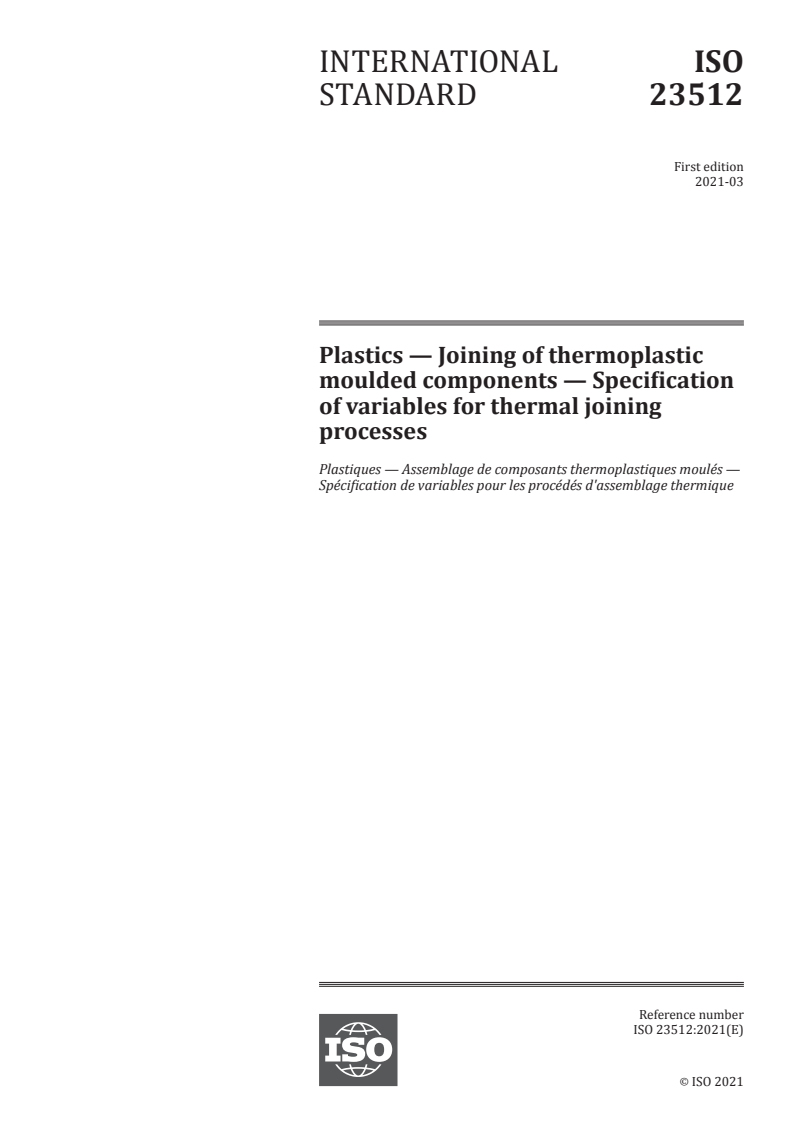
INTERNATIONAL ISO
STANDARD 23512
First edition
2021-03
Plastics — Joining of thermoplastic
moulded components — Specification
of variables for thermal joining
processes
Plastiques — Assemblage de composants thermoplastiques moulés —
Spécification de variables pour les procédés d'assemblage thermique
Reference number
©
ISO 2021
© ISO 2021
All rights reserved. Unless otherwise specified, or required in the context of its implementation, no part of this publication may
be reproduced or utilized otherwise in any form or by any means, electronic or mechanical, including photocopying, or posting
on the internet or an intranet, without prior written permission. Permission can be requested from either ISO at the address
below or ISO’s member body in the country of the requester.
ISO copyright office
CP 401 • Ch. de Blandonnet 8
CH-1214 Vernier, Geneva
Phone: +41 22 749 01 11
Email: copyright@iso.org
Website: www.iso.org
Published in Switzerland
ii © ISO 2021 – All rights reserved
Contents Page
Foreword .iv
Introduction .v
1 Scope . 1
2 Normative references . 1
3 Terms and definitions . 1
4 Technical content of thermal joining process specification (TJPS) . 3
4.1 General . 3
4.2 Related to the joining organization . 3
4.3 Related to the sub-component(s) . 3
4.4 Common to all joining processes . 3
4.5 Specific to a joining process . 4
4.5.1 Ultrasonic welding/staking/spot welding . 4
4.5.2 Infrared welding . 4
4.5.3 Hot gas convection welding . 5
4.5.4 Linear vibration welding . 5
4.5.5 Orbital vibration welding . 5
4.5.6 Spin welding . 5
4.5.7 Laser welding. 6
4.5.8 Hot plate welding . 7
4.5.9 Heat staking – hot air . 7
4.5.10 Heat staking – electrical . 7
4.5.11 Heat staking – infrared . 7
Annex A (informative) Template for TJPS: Ultrasonic welding/staking/spot welding .9
Annex B (informative) Template for TJPS: Infrared welding .11
Annex C (informative) Template for TJPS: Hot gas convection welding .13
Annex D (informative) Template for TJPS: Linear vibration welding.15
Annex E (informative) Template for TJPS: Orbital vibration welding .17
Annex F (informative) Template for TJPS: Spin welding .19
Annex G (informative) Template for TJPS: Laser welding .21
Annex H (informative) Template for TJPS: Hot plate welding .23
Annex I (informative) Template for TJPS: Heat staking – hot air .25
Annex J (informative) Template for TJPS: Heat staking – electrical .27
Annex K (informative) Template for TJPS: Heat staking – infrared .29
Annex L (informative) Worked example for TJPS: Hot plate welding .30
Annex M (informative) Worked example for TJPS: Heat staking – electrical .33
Bibliography .37
Foreword
ISO (the International Organization for Standardization) is a worldwide federation of national standards
bodies (ISO member bodies). The work of preparing International Standards is normally carried out
through ISO technical committees. Each member body interested in a subject for which a technical
committee has been established has the right to be represented on that committee. International
organizations, governmental and non-governmental, in liaison with ISO, also take part in the work.
ISO collaborates closely with the International Electrotechnical Commission (IEC) on all matters of
electrotechnical standardization.
The procedures used to develop this document and those intended for its further maintenance are
described in the ISO/IEC Directives, Part 1. In particular, the different approval criteria needed for the
different types of ISO documents should be noted. This document was drafted in accordance with the
editorial rules of the ISO/IEC Directives, Part 2 (see www .iso .org/ directives).
Attention is drawn to the possibility that some of the elements of this document may be the subject of
patent rights. ISO shall not be held responsible for identifying any or all such patent rights. Details of
any patent rights identified during the development of the document will be in the Introduction and/or
on the ISO list of patent declarations received (see www .iso .org/ patents).
Any trade name used in this document is information given for the convenience of users and does not
constitute an endorsement.
For an explanation of the voluntary nature of standards, the meaning of ISO specific terms and
expressions related to conformity assessment, as well as information about ISO's adherence to the
World Trade Organization (WTO) principles in the Technical Barriers to Trade (TBT), see www .iso .org/
iso/ foreword .html.
This document was prepared by Technical Committee ISO/TC 61, Plastics.
Any feedback or questions on this document should be directed to the user’s national standards body. A
complete listing of these bodies can be found at www .iso .org/ members .html.
iv © ISO 2021 – All rights reserved
Introduction
This document has been developed to help organizations better understand and implement controls
with thermal joining processes through the use of thermal joining process specifications.
INTERNATIONAL STANDARD ISO 23512:2021(E)
Plastics — Joining of thermoplastic moulded components
— Specification of variables for thermal joining processes
1 Scope
This document specifies the minimum essential variables in order to produce a component of the
required consistency and quality for the following thermal joining processes:
— ultrasonic welding/staking/spot welding;
— infrared welding;
— hot gas convection welding;
— linear vibration welding;
— orbital vibration welding;
— spin welding;
— laser welding;
— hot plate welding;
— heat staking: hot air;
— heat staking: electrical; and
— heat staking: infrared (IR).
This document defines the thermal joining process specification (TJPS) for each of the thermal joining
processes listed above, to ensure that all the essential variables are properly considered, including
the qualified range of each variable, in order to establish and maintain component quality at an
acceptable level.
NOTE Standards on joining of plastic pipes, fittings, valves and/or auxiliary equipment, and the assessment
of the properties of the resulting joints are developed and maintained by ISO/TC 138.
2 Normative references
The following documents are referred to in the text in such a way that some or all of their content
constitutes requirements of this document. For dated references, only the edition cited applies. For
undated references, the latest edition of the referenced document (including any amendments) applies.
ISO 472, Plastics — Vocabulary
3 Terms and definitions
For the purposes of this document, the terms and definitions given in ISO 472 and the following apply.
ISO and IEC maintain terminological databases for use in standardization at the following addresses:
— ISO Online browsing platform: available at https:// www .iso .org/ obp
— IEC Electropedia: available at http:// www .electropedia .org/
3.1
dimensional report
full measurement report on product before welding including flatness at weld joint
3.2
essential variable
joining condition that influences the quality of the joint and requires qualification
3.3
joining organization
organization responsible for the serial production joining and maintenance of quality
3.4
joining procedure
specified course of action to be followed in making a joint, including the joining process(es) (3.5),
reference to materials, preparation, pre-heating (if necessary), control of process parameters and
necessary equipment to be used
3.5
joining process
method of softening or melting to obtain a permanent joint (3.7)
3.6
joining process qualification record
JPQR
record comprising all data of mechanical test results for the specified range of each essential variable
(3.2) needed for qualification of a TJPS, used by the joining organization (3.3) as part of the sign-off
documentation
3.7
joint
junction of two sub-components
3.8
moisture content
amount of moisture content in parent material at the time of welding (3.12)
3.9
process report
document confirming that the sub-component has been manufactured using the correct moulding
process parameters, conditions, material grade, masterbatch reference, masterbatch percentage, and
regrind percentage
3.10
thermal joining process specification
TJPS
document that has been qualified and provides the required variables of the joining procedure (3.4) to
ensure repeatability during production
3.11
visual examination acceptance criteria document
document specifying imperfections on sub-components that affect the functionality of the joint, such
as weld lines, burn marks, surface contamination
3.12
welding
process of uniting softened surfaces of materials, generally with the aid of heat
3.13
work instruction
simplified TJPS, suitable for joining process (3.5) owner
2 © ISO 2021 – All rights reserved
4 Technical content of thermal joining process specification (TJPS)
4.1 General
A TJPS shall provide the minimum information specified in 4.2 to 4.5 required to make a joint of
acceptable quality, as part of the component manufacturing quality agreement between the joining
organization and the customer.
TJPSs cover a certain range for each essential variable. The range of each essential variable shall
be qualified using a JPQR, and the procedure for measuring each variable shall conform to agreed
specifications.
When completing the TJPS the technical support/manual/documentation of the joining process
equipment manufacturer or service supplier may be consulted.
NOTE 1 Example templates of TJPSs are given in Annex A to Annex K. Worked example TJPSs for hot plate
welding and heat staking: electrical are given in Annex L and Annex M, respectively.
NOTE 2 A work instruction can be prepared for each specific, applicable TJPS as part of detailed production
planning.
4.2 Related to the joining organization
a) identification of the joining organization;
b) TJPS reference number/revision;
c) signature of the person responsible for approval, appointed by the joining organization.
NOTE The responsibilities, knowledge, skills and competence for the person responsible for approval are set
[1]
out in PD CEN/TR 16862 .
4.3 Related to the sub-component(s)
a) sub-component material:
1) material supplier name;
2) designation of the material(s) and reference standard(s), if any, or an alternative identification
if a reference standard does not exist;
3) moisture content;
4) regrind percentage;
5) masterbatch reference and masterbatch percentage;
b) dimensional report;
c) process report;
d) customer component/part number;
e) supplier component/part number;
f) visual examination acceptance criteria document number.
4.4 Common to all joining processes
a) joint preparation;
b) ambient temperature;
c) sub-component temperature;
d) joining process qualification record (JPQR).
4.5 Specific to a joining process
4.5.1 Ultrasonic welding/staking/spot welding
a) joining process(es): welding, staking or spot welding;
b) machine type (fixed or handheld);
c) frequency;
d) power rating;
e) maximum tool temperature;
f) tool face amplitude/amplitude profile;
g) down speed;
h) trigger force (if applicable)/(not handheld);
i) pre-trigger/touch (yes/no) (not handheld);
j) pre-trigger amplitude (if applicable)/(not handheld);
k) joining force/force profile (if applicable)/(not handheld);
l) meltdown/collapse/weld displacement (if applicable)/(not handheld);
m) joining or welding time;
n) hold/cooling time;
o) weld energy.
NOTE A template for the TJPS for ultrasonic welding/staking/spot welding is given in Annex A.
4.5.2 Infrared welding
a) emitter condition;
b) distance of sub-components from IR source;
c) pre-heat/soak temperature (or power);
d) pre-heat/soak time;
e) full heat temperature/power;
f) full heat time;
g) removal of heating to sub-component contact time/changeover time;
h) welding force;
i) meltdown/collapse/weld displacement;
j) cooling time.
NOTE A template for the TJPS for infrared welding is given in Annex B.
4 © ISO 2021 – All rights reserved
4.5.3 Hot gas convection welding
a) gas flow rate;
b) gas temperature;
c) gas feed type;
d) distance between sub-components and tool;
e) heating time;
f) removal of heating to sub-component contact time/changeover time;
g) welding force;
h) meltdown/collapse/weld displacement;
i) cooling time.
NOTE A template for the TJPS for hot gas convection welding is given in Annex C.
4.5.4 Linear vibration welding
a) frequency;
b) amplitude/amplitude profile;
c) IR pre-heat time (if applicable);
d) IR pre-heat power (if applicable);
e) IR pre-heat changeover time (if applicable);
f) welding force/force profile;
g) meltdown/collapse/weld displacement;
h) welding time;
i) hold/cooling time.
NOTE A template for the TJPS for linear vibration welding is given in Annex D.
4.5.5 Orbital vibration welding
a) frequency;
b) amplitude/amplitude profile;
c) welding force/force profile;
d) meltdown/collapse/weld displacement;
e) welding time;
f) hold/cooling time.
NOTE A template for the TJPS for orbital vibration welding is given in Annex E.
4.5.6 Spin welding
a) machine type (servo-drive/inertia);
b) head mass (inertia machines only);
c) run-up time (inertia machines only);
d) rotational speed;
e) down speed;
f) welding force/force profile;
g) welding time;
h) number of rotations (if applicable);
i) meltdown/collapse/weld displacement;
j) hold/cooling time;
k) final angular position (if applicable).
NOTE A template for the TJPS for spin welding is given in Annex F.
4.5.7 Laser welding
a) wavelength;
b) laser power;
c) peak power (pulse lasers only);
d) pulse energy (pulse lasers only);
e) pulse duration and repetition rate (pulse lasers only);
f) beam delivery (contour);
g) focal length of focusing lens;
h) beam energy profile/dimensions;
i) power density;
j) laser transmission of lower sub-component;
k) laser transmission of upper sub-component;
l) laser absorber type (if applicable);
m) welding/clamping force;
n) scan speed (if applicable);
o) number of passes (if applicable);
p) weld time (if applicable);
q) meltdown/collapse/weld displacement;
r) temperature close/loop (if applicable);
s) power mapping/zoning (if applicable);
t) hold/cooling time.
NOTE A template for the TJPS for laser welding is given in Annex G.
6 © ISO 2021 – All rights reserved
4.5.8 Hot plate welding
a) plate temperature;
b) hot plate surface coating (if applicable);
c) melting force;
d) heating time;
e) meltdown/collapse/displacement;
f) removal of heating to part contact time/changeover time;
g) welding force;
h) weld collapse/displacement;
i) hold/cooling time.
NOTE A template for the TJPS for hot plate welding is given in Annex H.
4.5.9 Heat staking – hot air
a) hot air temperature;
b) airflow;
c) distance of stake pin from end of nozzle;
d) heating time;
e) changeover time;
f) cold stake tool/platen force;
g) cold stake tool contact time;
h) final cold tool position/dead stop (if applicable).
NOTE A template for the TJPS for heat staking - hot air is given in Annex I.
4.5.10 Heat staking – electrical
a) heated tool temperature/temperature profile;
b) heating time (if no temperature profile);
c) tool/platen force;
d) cooling time (if no temperature profile);
e) release temperature (if no temperature profile);
f) final tool position/dead stop (if applicable).
NOTE A template for the TJPS for heat staking - electrical is given in Annex J.
4.5.11 Heat staking – infrared
a) IR power;
b) distance of stake pin from heat source;
c) heating time;
d) cold stake tool/platen force;
e) cold stake tool contact time.
NOTE A template for the TJPS for heat staking - infrared is given in Annex K.
8 © ISO 2021 – All rights reserved
Annex A
(informative)
Template for TJPS: Ultrasonic welding/staking/spot welding
Thermal joining process specification (TJPS): Ultrasonic welding/staking/spot welding
Joining organization: TJPS reference number/revision:
Component name:
Customer component/ Supplier component/
part number part number
JPQR number:
*
Sub-component A : Sub-component B:
Material type/designation: Material type/designation:
Material supplier name Material supplier name
Material grade Material grade
Masterbatch reference Masterbatch reference
Masterbatch percentage Masterbatch percentage
Regrind (%) Regrind (%)
Moisture content range (%) Moisture content range (%)
Dimensional report number Dimensional report number
Process report number Process report number
Visual examination acceptance Visual examination acceptance
criteria document number criteria document number
* Sub-component A is the part in initial contact with the sonotrode/horn
Joining process (welding/staking/spot welding):
Machine characteristics
Machine type (fixed/handheld):
Frequency (kHz):
Power rating (kW):
Joining parameters Value/tolerance or range
Ambient temperature (°C)
Sub-component temperature (°C)
Tool temperature (°C)
Tool face amplitude (µm) / amplitude profile
Down speed (mm/s) (not handheld)
Trigger force (N) (if applicable) (not handheld)
Pre-trigger /
...
INTERNATIONAL ISO
STANDARD 23512
First edition
2021-03
Plastics — Joining of thermoplastic
moulded components — Specification
of variables for thermal joining
processes
Plastiques — Assemblage de composants thermoplastiques moulés —
Spécification de variables pour les procédés d'assemblage thermique
Reference number
©
ISO 2021
© ISO 2021
All rights reserved. Unless otherwise specified, or required in the context of its implementation, no part of this publication may
be reproduced or utilized otherwise in any form or by any means, electronic or mechanical, including photocopying, or posting
on the internet or an intranet, without prior written permission. Permission can be requested from either ISO at the address
below or ISO’s member body in the country of the requester.
ISO copyright office
CP 401 • Ch. de Blandonnet 8
CH-1214 Vernier, Geneva
Phone: +41 22 749 01 11
Email: copyright@iso.org
Website: www.iso.org
Published in Switzerland
ii © ISO 2021 – All rights reserved
Contents Page
Foreword .iv
Introduction .v
1 Scope . 1
2 Normative references . 1
3 Terms and definitions . 1
4 Technical content of thermal joining process specification (TJPS) . 3
4.1 General . 3
4.2 Related to the joining organization . 3
4.3 Related to the sub-component(s) . 3
4.4 Common to all joining processes . 3
4.5 Specific to a joining process . 4
4.5.1 Ultrasonic welding/staking/spot welding . 4
4.5.2 Infrared welding . 4
4.5.3 Hot gas convection welding . 5
4.5.4 Linear vibration welding . 5
4.5.5 Orbital vibration welding . 5
4.5.6 Spin welding . 5
4.5.7 Laser welding. 6
4.5.8 Hot plate welding . 7
4.5.9 Heat staking – hot air . 7
4.5.10 Heat staking – electrical . 7
4.5.11 Heat staking – infrared . 7
Annex A (informative) Template for TJPS: Ultrasonic welding/staking/spot welding .9
Annex B (informative) Template for TJPS: Infrared welding .11
Annex C (informative) Template for TJPS: Hot gas convection welding .13
Annex D (informative) Template for TJPS: Linear vibration welding.15
Annex E (informative) Template for TJPS: Orbital vibration welding .17
Annex F (informative) Template for TJPS: Spin welding .19
Annex G (informative) Template for TJPS: Laser welding .21
Annex H (informative) Template for TJPS: Hot plate welding .23
Annex I (informative) Template for TJPS: Heat staking – hot air .25
Annex J (informative) Template for TJPS: Heat staking – electrical .27
Annex K (informative) Template for TJPS: Heat staking – infrared .29
Annex L (informative) Worked example for TJPS: Hot plate welding .30
Annex M (informative) Worked example for TJPS: Heat staking – electrical .33
Bibliography .37
Foreword
ISO (the International Organization for Standardization) is a worldwide federation of national standards
bodies (ISO member bodies). The work of preparing International Standards is normally carried out
through ISO technical committees. Each member body interested in a subject for which a technical
committee has been established has the right to be represented on that committee. International
organizations, governmental and non-governmental, in liaison with ISO, also take part in the work.
ISO collaborates closely with the International Electrotechnical Commission (IEC) on all matters of
electrotechnical standardization.
The procedures used to develop this document and those intended for its further maintenance are
described in the ISO/IEC Directives, Part 1. In particular, the different approval criteria needed for the
different types of ISO documents should be noted. This document was drafted in accordance with the
editorial rules of the ISO/IEC Directives, Part 2 (see www .iso .org/ directives).
Attention is drawn to the possibility that some of the elements of this document may be the subject of
patent rights. ISO shall not be held responsible for identifying any or all such patent rights. Details of
any patent rights identified during the development of the document will be in the Introduction and/or
on the ISO list of patent declarations received (see www .iso .org/ patents).
Any trade name used in this document is information given for the convenience of users and does not
constitute an endorsement.
For an explanation of the voluntary nature of standards, the meaning of ISO specific terms and
expressions related to conformity assessment, as well as information about ISO's adherence to the
World Trade Organization (WTO) principles in the Technical Barriers to Trade (TBT), see www .iso .org/
iso/ foreword .html.
This document was prepared by Technical Committee ISO/TC 61, Plastics.
Any feedback or questions on this document should be directed to the user’s national standards body. A
complete listing of these bodies can be found at www .iso .org/ members .html.
iv © ISO 2021 – All rights reserved
Introduction
This document has been developed to help organizations better understand and implement controls
with thermal joining processes through the use of thermal joining process specifications.
INTERNATIONAL STANDARD ISO 23512:2021(E)
Plastics — Joining of thermoplastic moulded components
— Specification of variables for thermal joining processes
1 Scope
This document specifies the minimum essential variables in order to produce a component of the
required consistency and quality for the following thermal joining processes:
— ultrasonic welding/staking/spot welding;
— infrared welding;
— hot gas convection welding;
— linear vibration welding;
— orbital vibration welding;
— spin welding;
— laser welding;
— hot plate welding;
— heat staking: hot air;
— heat staking: electrical; and
— heat staking: infrared (IR).
This document defines the thermal joining process specification (TJPS) for each of the thermal joining
processes listed above, to ensure that all the essential variables are properly considered, including
the qualified range of each variable, in order to establish and maintain component quality at an
acceptable level.
NOTE Standards on joining of plastic pipes, fittings, valves and/or auxiliary equipment, and the assessment
of the properties of the resulting joints are developed and maintained by ISO/TC 138.
2 Normative references
The following documents are referred to in the text in such a way that some or all of their content
constitutes requirements of this document. For dated references, only the edition cited applies. For
undated references, the latest edition of the referenced document (including any amendments) applies.
ISO 472, Plastics — Vocabulary
3 Terms and definitions
For the purposes of this document, the terms and definitions given in ISO 472 and the following apply.
ISO and IEC maintain terminological databases for use in standardization at the following addresses:
— ISO Online browsing platform: available at https:// www .iso .org/ obp
— IEC Electropedia: available at http:// www .electropedia .org/
3.1
dimensional report
full measurement report on product before welding including flatness at weld joint
3.2
essential variable
joining condition that influences the quality of the joint and requires qualification
3.3
joining organization
organization responsible for the serial production joining and maintenance of quality
3.4
joining procedure
specified course of action to be followed in making a joint, including the joining process(es) (3.5),
reference to materials, preparation, pre-heating (if necessary), control of process parameters and
necessary equipment to be used
3.5
joining process
method of softening or melting to obtain a permanent joint (3.7)
3.6
joining process qualification record
JPQR
record comprising all data of mechanical test results for the specified range of each essential variable
(3.2) needed for qualification of a TJPS, used by the joining organization (3.3) as part of the sign-off
documentation
3.7
joint
junction of two sub-components
3.8
moisture content
amount of moisture content in parent material at the time of welding (3.12)
3.9
process report
document confirming that the sub-component has been manufactured using the correct moulding
process parameters, conditions, material grade, masterbatch reference, masterbatch percentage, and
regrind percentage
3.10
thermal joining process specification
TJPS
document that has been qualified and provides the required variables of the joining procedure (3.4) to
ensure repeatability during production
3.11
visual examination acceptance criteria document
document specifying imperfections on sub-components that affect the functionality of the joint, such
as weld lines, burn marks, surface contamination
3.12
welding
process of uniting softened surfaces of materials, generally with the aid of heat
3.13
work instruction
simplified TJPS, suitable for joining process (3.5) owner
2 © ISO 2021 – All rights reserved
4 Technical content of thermal joining process specification (TJPS)
4.1 General
A TJPS shall provide the minimum information specified in 4.2 to 4.5 required to make a joint of
acceptable quality, as part of the component manufacturing quality agreement between the joining
organization and the customer.
TJPSs cover a certain range for each essential variable. The range of each essential variable shall
be qualified using a JPQR, and the procedure for measuring each variable shall conform to agreed
specifications.
When completing the TJPS the technical support/manual/documentation of the joining process
equipment manufacturer or service supplier may be consulted.
NOTE 1 Example templates of TJPSs are given in Annex A to Annex K. Worked example TJPSs for hot plate
welding and heat staking: electrical are given in Annex L and Annex M, respectively.
NOTE 2 A work instruction can be prepared for each specific, applicable TJPS as part of detailed production
planning.
4.2 Related to the joining organization
a) identification of the joining organization;
b) TJPS reference number/revision;
c) signature of the person responsible for approval, appointed by the joining organization.
NOTE The responsibilities, knowledge, skills and competence for the person responsible for approval are set
[1]
out in PD CEN/TR 16862 .
4.3 Related to the sub-component(s)
a) sub-component material:
1) material supplier name;
2) designation of the material(s) and reference standard(s), if any, or an alternative identification
if a reference standard does not exist;
3) moisture content;
4) regrind percentage;
5) masterbatch reference and masterbatch percentage;
b) dimensional report;
c) process report;
d) customer component/part number;
e) supplier component/part number;
f) visual examination acceptance criteria document number.
4.4 Common to all joining processes
a) joint preparation;
b) ambient temperature;
c) sub-component temperature;
d) joining process qualification record (JPQR).
4.5 Specific to a joining process
4.5.1 Ultrasonic welding/staking/spot welding
a) joining process(es): welding, staking or spot welding;
b) machine type (fixed or handheld);
c) frequency;
d) power rating;
e) maximum tool temperature;
f) tool face amplitude/amplitude profile;
g) down speed;
h) trigger force (if applicable)/(not handheld);
i) pre-trigger/touch (yes/no) (not handheld);
j) pre-trigger amplitude (if applicable)/(not handheld);
k) joining force/force profile (if applicable)/(not handheld);
l) meltdown/collapse/weld displacement (if applicable)/(not handheld);
m) joining or welding time;
n) hold/cooling time;
o) weld energy.
NOTE A template for the TJPS for ultrasonic welding/staking/spot welding is given in Annex A.
4.5.2 Infrared welding
a) emitter condition;
b) distance of sub-components from IR source;
c) pre-heat/soak temperature (or power);
d) pre-heat/soak time;
e) full heat temperature/power;
f) full heat time;
g) removal of heating to sub-component contact time/changeover time;
h) welding force;
i) meltdown/collapse/weld displacement;
j) cooling time.
NOTE A template for the TJPS for infrared welding is given in Annex B.
4 © ISO 2021 – All rights reserved
4.5.3 Hot gas convection welding
a) gas flow rate;
b) gas temperature;
c) gas feed type;
d) distance between sub-components and tool;
e) heating time;
f) removal of heating to sub-component contact time/changeover time;
g) welding force;
h) meltdown/collapse/weld displacement;
i) cooling time.
NOTE A template for the TJPS for hot gas convection welding is given in Annex C.
4.5.4 Linear vibration welding
a) frequency;
b) amplitude/amplitude profile;
c) IR pre-heat time (if applicable);
d) IR pre-heat power (if applicable);
e) IR pre-heat changeover time (if applicable);
f) welding force/force profile;
g) meltdown/collapse/weld displacement;
h) welding time;
i) hold/cooling time.
NOTE A template for the TJPS for linear vibration welding is given in Annex D.
4.5.5 Orbital vibration welding
a) frequency;
b) amplitude/amplitude profile;
c) welding force/force profile;
d) meltdown/collapse/weld displacement;
e) welding time;
f) hold/cooling time.
NOTE A template for the TJPS for orbital vibration welding is given in Annex E.
4.5.6 Spin welding
a) machine type (servo-drive/inertia);
b) head mass (inertia machines only);
c) run-up time (inertia machines only);
d) rotational speed;
e) down speed;
f) welding force/force profile;
g) welding time;
h) number of rotations (if applicable);
i) meltdown/collapse/weld displacement;
j) hold/cooling time;
k) final angular position (if applicable).
NOTE A template for the TJPS for spin welding is given in Annex F.
4.5.7 Laser welding
a) wavelength;
b) laser power;
c) peak power (pulse lasers only);
d) pulse energy (pulse lasers only);
e) pulse duration and repetition rate (pulse lasers only);
f) beam delivery (contour);
g) focal length of focusing lens;
h) beam energy profile/dimensions;
i) power density;
j) laser transmission of lower sub-component;
k) laser transmission of upper sub-component;
l) laser absorber type (if applicable);
m) welding/clamping force;
n) scan speed (if applicable);
o) number of passes (if applicable);
p) weld time (if applicable);
q) meltdown/collapse/weld displacement;
r) temperature close/loop (if applicable);
s) power mapping/zoning (if applicable);
t) hold/cooling time.
NOTE A template for the TJPS for laser welding is given in Annex G.
6 © ISO 2021 – All rights reserved
4.5.8 Hot plate welding
a) plate temperature;
b) hot plate surface coating (if applicable);
c) melting force;
d) heating time;
e) meltdown/collapse/displacement;
f) removal of heating to part contact time/changeover time;
g) welding force;
h) weld collapse/displacement;
i) hold/cooling time.
NOTE A template for the TJPS for hot plate welding is given in Annex H.
4.5.9 Heat staking – hot air
a) hot air temperature;
b) airflow;
c) distance of stake pin from end of nozzle;
d) heating time;
e) changeover time;
f) cold stake tool/platen force;
g) cold stake tool contact time;
h) final cold tool position/dead stop (if applicable).
NOTE A template for the TJPS for heat staking - hot air is given in Annex I.
4.5.10 Heat staking – electrical
a) heated tool temperature/temperature profile;
b) heating time (if no temperature profile);
c) tool/platen force;
d) cooling time (if no temperature profile);
e) release temperature (if no temperature profile);
f) final tool position/dead stop (if applicable).
NOTE A template for the TJPS for heat staking - electrical is given in Annex J.
4.5.11 Heat staking – infrared
a) IR power;
b) distance of stake pin from heat source;
c) heating time;
d) cold stake tool/platen force;
e) cold stake tool contact time.
NOTE A template for the TJPS for heat staking - infrared is given in Annex K.
8 © ISO 2021 – All rights reserved
Annex A
(informative)
Template for TJPS: Ultrasonic welding/staking/spot welding
Thermal joining process specification (TJPS): Ultrasonic welding/staking/spot welding
Joining organization: TJPS reference number/revision:
Component name:
Customer component/ Supplier component/
part number part number
JPQR number:
*
Sub-component A : Sub-component B:
Material type/designation: Material type/designation:
Material supplier name Material supplier name
Material grade Material grade
Masterbatch reference Masterbatch reference
Masterbatch percentage Masterbatch percentage
Regrind (%) Regrind (%)
Moisture content range (%) Moisture content range (%)
Dimensional report number Dimensional report number
Process report number Process report number
Visual examination acceptance Visual examination acceptance
criteria document number criteria document number
* Sub-component A is the part in initial contact with the sonotrode/horn
Joining process (welding/staking/spot welding):
Machine characteristics
Machine type (fixed/handheld):
Frequency (kHz):
Power rating (kW):
Joining parameters Value/tolerance or range
Ambient temperature (°C)
Sub-component temperature (°C)
Tool temperature (°C)
Tool face amplitude (µm) / amplitude profile
Down speed (mm/s) (not handheld)
Trigger force (N) (if applicable) (not handheld)
Pre-trigger /
...