

ISO 4266-3:2024
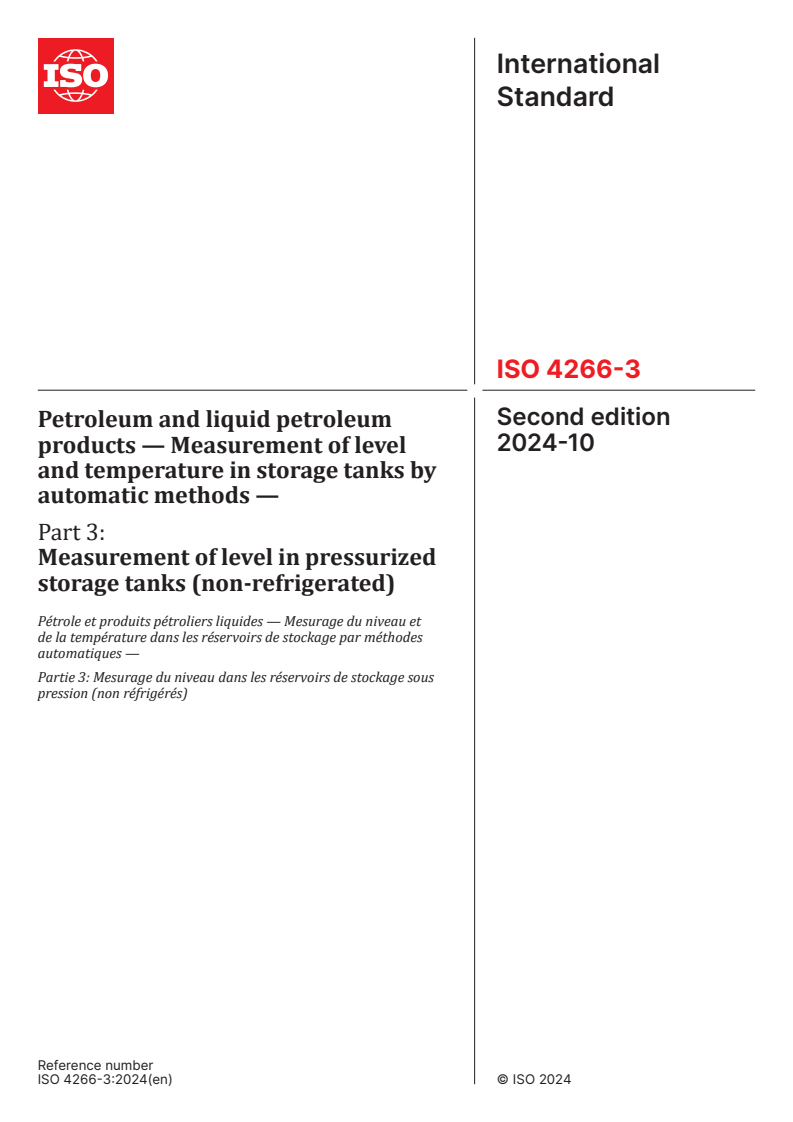
(Main)Petroleum and liquid petroleum products — Measurement of level and temperature in storage tanks by automatic methods — Part 3: Measurement of level in pressurized storage tanks (non-refrigerated)
General Information
- Abstract
This document gives requirements and guidance on the accuracy, installation, commissioning, calibration and verification of automatic level gauges (ALGs) both intrusive and non-intrusive, for measuring the level of petroleum and petroleum products having a vapour pressure less than 4 MPa, stored in pressurized storage tanks. This document gives guidance on the use of ALGs in custody transfer application. This document is not applicable to the measurement of level in caverns and refrigerated storage tanks with ALG equipment.
- Status
- Published
- Publication Date
- 09-Oct-2024
- Technical Committee
- ISO/TC 28/SC 2 - Measurement of petroleum and related products
- Drafting Committee
- ISO/TC 28/SC 2 - Measurement of petroleum and related products
- Current Stage
- 6060 - International Standard published
- Start Date
- 10-Oct-2024
- Due Date
- 10-Aug-2025
- Completion Date
- 10-Oct-2024
Buy Documents

ISO 4266-3:2024 - Petroleum and liquid petroleum products — Measurement of level and temperature in storage tanks by automatic methods — Part 3: Measurement of level in pressurized storage tanks (non-refrigerated) Released:10. 10. 2024
Overview
ISO 4266-3:2024 - Petroleum and liquid petroleum products: Measurement of level and temperature in storage tanks by automatic methods - Part 3 covers requirements and guidance for measuring liquid level in pressurized (non-refrigerated) storage tanks using automatic level gauges (ALGs). It applies to both intrusive and non‑intrusive ALGs used with petroleum and liquid petroleum products having a vapour pressure less than 4 MPa. The standard addresses accuracy, installation, commissioning, calibration and verification and gives specific guidance for custody/fiscal transfer applications. It does not apply to caverns or refrigerated storage tanks.
Key topics and technical requirements
- Types of ALGs covered: intrusive (e.g., float/servo) and non‑intrusive (e.g., microwave or radar) devices; innage vs ullage measurement concepts are defined.
- Accuracy and calibration: requirements on intrinsic ALG error, calibration prior to installation, errors introduced by installation/operating conditions, and rules for overall accuracy - with specific attention to custody transfer tolerances.
- Installation guidance: mounting location, manufacturer instructions, still‑well design and placement, guide wires, and requirements for non‑intrusive units (including radar/microwave on still‑wells).
- Commissioning and verification: procedures for initial setting and field verification (checking critical distances, free movement of sensing elements, effects of vapour/liquid properties), record keeping, and frequency/procedure for subsequent verifications and adjustments.
- Precautions and safety: hazardous‑area certification, material and electrical potential precautions, equipment suitability for design pressure/temperature, and manufacturer maintenance recommendations.
- Data communication: guidance on data transfer and receiving from ALGs to downstream systems.
- Terminology: clear definitions for datum plate, gauging reference point, ullage, still‑well, etc., aligned with ISO 1998 terminology.
Practical applications - who uses this standard
- Tank terminal operators and refinery storage managers implementing automated level monitoring.
- Custody transfer parties and commercial traders requiring verifiable, auditable level measurements.
- Metrology labs, calibration service providers and inspection bodies performing ALG type approval, installation verification and ongoing testing.
- Instrument manufacturers and system integrators designing, installing and certifying ALGs for pressurized tanks.
- Regulatory and national measurement organizations responsible for legal-for-trade approvals.
Related standards and references
- ISO 4266 series (other parts) for broader tank measurement topics.
- ISO 1998 (Petroleum industry - Terminology) for consistent definitions.
Keywords: ISO 4266-3:2024, automatic level gauge, ALG, measurement of level, pressurized storage tanks, petroleum products, custody transfer, installation, calibration, verification, still‑well, intrusive, non‑intrusive, radar, microwave.
Relations
- Effective Date
- 13-Aug-2022
Buy Documents
ISO 4266-3:2024 - Petroleum and liquid petroleum products — Measurement of level and temperature in storage tanks by automatic methods — Part 3: Measurement of level in pressurized storage tanks (non-refrigerated) Released:10. 10. 2024
Get Certified
Connect with accredited certification bodies for this standard

Element Materials Technology
Materials testing and product certification.

ABS Group Brazil
ABS Group certification services in Brazil.

ABS Quality Evaluations Inc.
American Bureau of Shipping quality certification.
Sponsored listings
Frequently Asked Questions
ISO 4266-3:2024 is a standard published by the International Organization for Standardization (ISO). Its full title is "Petroleum and liquid petroleum products — Measurement of level and temperature in storage tanks by automatic methods — Part 3: Measurement of level in pressurized storage tanks (non-refrigerated)". This standard covers: This document gives requirements and guidance on the accuracy, installation, commissioning, calibration and verification of automatic level gauges (ALGs) both intrusive and non-intrusive, for measuring the level of petroleum and petroleum products having a vapour pressure less than 4 MPa, stored in pressurized storage tanks. This document gives guidance on the use of ALGs in custody transfer application. This document is not applicable to the measurement of level in caverns and refrigerated storage tanks with ALG equipment.
This document gives requirements and guidance on the accuracy, installation, commissioning, calibration and verification of automatic level gauges (ALGs) both intrusive and non-intrusive, for measuring the level of petroleum and petroleum products having a vapour pressure less than 4 MPa, stored in pressurized storage tanks. This document gives guidance on the use of ALGs in custody transfer application. This document is not applicable to the measurement of level in caverns and refrigerated storage tanks with ALG equipment.
ISO 4266-3:2024 is classified under the following ICS (International Classification for Standards) categories: 75.180.30 - Volumetric equipment and measurements. The ICS classification helps identify the subject area and facilitates finding related standards.
ISO 4266-3:2024 has the following relationships with other standards: It is inter standard links to ISO 4266-3:2002. Understanding these relationships helps ensure you are using the most current and applicable version of the standard.
ISO 4266-3:2024 is available in PDF format for immediate download after purchase. The document can be added to your cart and obtained through the secure checkout process. Digital delivery ensures instant access to the complete standard document.
Standards Content (Sample)
International
Standard
ISO 4266-3
Second edition
Petroleum and liquid petroleum
2024-10
products — Measurement of level
and temperature in storage tanks by
automatic methods —
Part 3:
Measurement of level in pressurized
storage tanks (non-refrigerated)
Pétrole et produits pétroliers liquides — Mesurage du niveau et
de la température dans les réservoirs de stockage par méthodes
automatiques —
Partie 3: Mesurage du niveau dans les réservoirs de stockage sous
pression (non réfrigérés)
Reference number
© ISO 2024
All rights reserved. Unless otherwise specified, or required in the context of its implementation, no part of this publication may
be reproduced or utilized otherwise in any form or by any means, electronic or mechanical, including photocopying, or posting on
the internet or an intranet, without prior written permission. Permission can be requested from either ISO at the address below
or ISO’s member body in the country of the requester.
ISO copyright office
CP 401 • Ch. de Blandonnet 8
CH-1214 Vernier, Geneva
Phone: +41 22 749 01 11
Email: copyright@iso.org
Website: www.iso.org
Published in Switzerland
ii
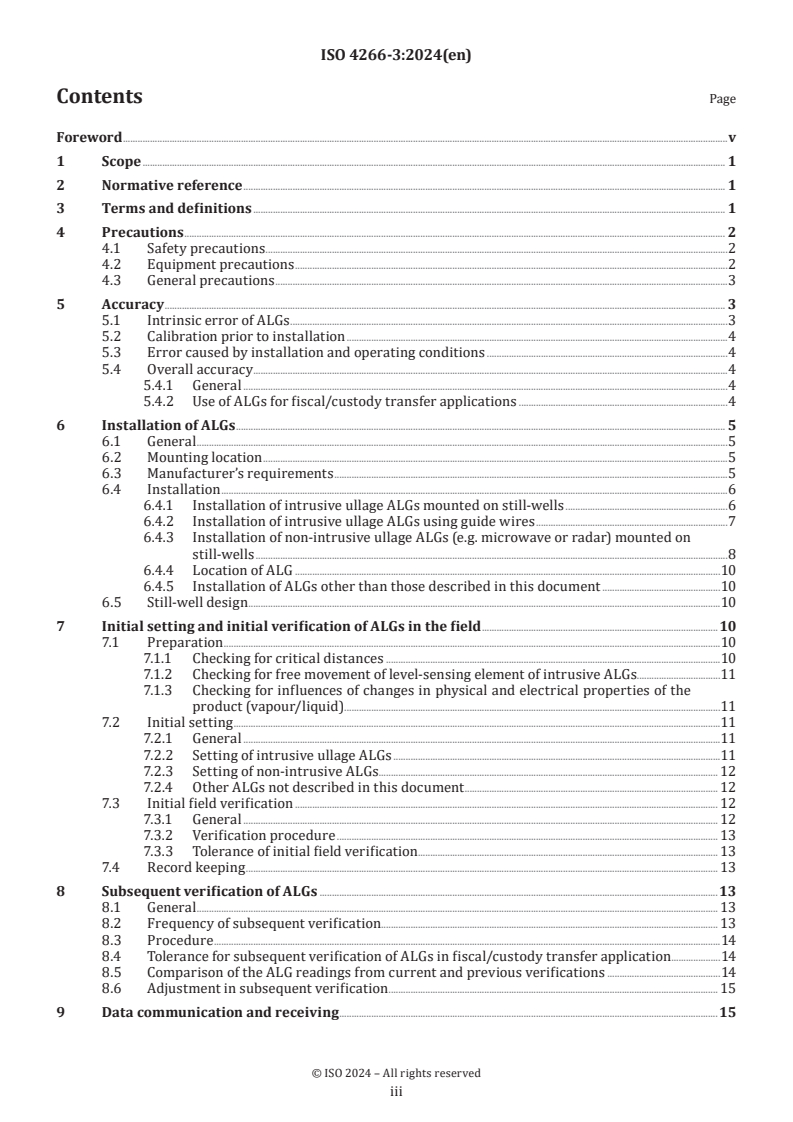
Contents Page
Foreword .v
1 Scope . 1
2 Normative reference . 1
3 Terms and definitions . 1
4 Precautions . 2
4.1 Safety precautions .2
4.2 Equipment precautions .2
4.3 General precautions .3
5 Accuracy . 3
5.1 Intrinsic error of ALGs .3
5.2 Calibration prior to installation .4
5.3 Error caused by installation and operating conditions .4
5.4 Overall accuracy .4
5.4.1 General .4
5.4.2 Use of ALGs for fiscal/custody transfer applications .4
6 Installation of ALGs . 5
6.1 General .5
6.2 Mounting location .5
6.3 Manufacturer’s requirements .5
6.4 Installation .6
6.4.1 Installation of intrusive ullage ALGs mounted on still-wells .6
6.4.2 Installation of intrusive ullage ALGs using guide wires .7
6.4.3 Installation of non-intrusive ullage ALGs (e.g. microwave or radar) mounted on
still-wells .8
6.4.4 Location of ALG .10
6.4.5 Installation of ALGs other than those described in this document .10
6.5 Still-well design .10
7 Initial setting and initial verification of ALGs in the field .10
7.1 Preparation .10
7.1.1 Checking for critical distances .10
7.1.2 Checking for free movement of level-sensing element of intrusive ALGs.11
7.1.3 Checking for influences of changes in physical and electrical properties of the
product (vapour/liquid) . . . .11
7.2 Initial setting .11
7.2.1 General .11
7.2.2 Setting of intrusive ullage ALGs .11
7.2.3 Setting of non-intrusive ALGs. 12
7.2.4 Other ALGs not described in this document . 12
7.3 Initial field verification . 12
7.3.1 General . 12
7.3.2 V erification procedure . 13
7.3.3 Tolerance of initial field verification. 13
7.4 Record keeping . 13
8 Subsequent verification of ALGs .13
8.1 General . 13
8.2 Frequency of subsequent verification. 13
8.3 Procedure .14
8.4 Tolerance for subsequent verification of ALGs in fiscal/custody transfer application .14
8.5 Comparison of the ALG readings from current and previous verifications .14
8.6 Adjustment in subsequent verification . 15
9 Data communication and receiving .15
iii
Bibliography .16
iv
Foreword
ISO (the International Organization for Standardization) is a worldwide federation of national standards
bodies (ISO member bodies). The work of preparing International Standards is normally carried out through
ISO technical committees. Each member body interested in a subject for which a technical committee
has been established has the right to be represented on that committee. International organizations,
governmental and non-governmental, in liaison with ISO, also take part in the work. ISO collaborates closely
with the International Electrotechnical Commission (IEC) on all matters of electrotechnical standardization.
The procedures used to develop this document and those intended for its further maintenance are described
in the ISO/IEC Directives, Part 1. In particular, the different approval criteria needed for the different types
of ISO document should be noted. This document was drafted in accordance with the editorial rules of the
ISO/IEC Directives, Part 2 (see www.iso.org/directives).
ISO draws attention to the possibility that the implementation of this document may involve the use of (a)
patent(s). ISO takes no position concerning the evidence, validity or applicability of any claimed patent
rights in respect thereof. As of the date of publication of this document, ISO had not received notice of (a)
patent(s) which may be required to implement this document. However, implementers are cautioned that
this may not represent the latest information, which may be obtained from the patent database available at
www.iso.org/patents. ISO shall not be held responsible for identifying any or all such patent rights.
Any trade name used in this document is information given for the convenience of users and does not
constitute an endorsement.
For an explanation of the voluntary nature of standards, the meaning of ISO specific terms and expressions
related to conformity assessment, as well as information about ISO's adherence to the World Trade
Organization (WTO) principles in the Technical Barriers to Trade (TBT), see www.iso.org/iso/foreword.html.
This document was prepared by Technical Committee ISO/TC 28, Petroleum and related products, fuels
and lubricants from natural or synthetic sources, Subcommittee SC 2, Measurement of petroleum and related
products.
This second edition cancels and replaces the first edition (ISO 4266-3:2002), which has been technically
revised.
The main changes are as follows:
— terms and definitions in Clause 3 have been updated;
— in 4.3.2, the level that is measured and recorded simultaneously with the temperatures has been clarified;
— in 5.2, the information on calibration prior to installation has been updated;
— in Clause 6, the design requirements for still-wells have been clarified and the limitation of non-perforated
still-wells removed.
A list of all parts in the ISO 4266 series can be found on the ISO website.
Any feedback or questions on this document should be directed to the user’s national standards body. A
complete listing of these bodies can be found at www.iso.org/members.html.
v
International Standard ISO 4266-3:2024(en)
Petroleum and liquid petroleum products — Measurement
of level and temperature in storage tanks by automatic
methods —
Part 3:
Measurement of level in pressurized storage tanks (non-
refrigerated)
1 Scope
This document gives requirements and guidance on the accuracy, installation, commissioning, calibration
and verification of automatic level gauges (ALGs) both intrusive and non-intrusive, for measuring the level
of petroleum and petroleum products having a vapour pressure less than 4 MPa, stored in pressurized
storage tanks.
This document gives guidance on the use of ALGs in custody transfer application.
This document is not applicable to the measurement of level in caverns and refrigerated storage tanks with
ALG equipment.
2 Normative reference
The following documents are referred to in the text in such a way that some or all of their content constitutes
requirements of this document. For dated references, only the edition cited applies. For undated references,
the latest edition of the referenced document (including any amendments) applies.
ISO 1998 (all parts), Petroleum industry — Terminology
3 Terms and definitions
For the purposes of this document, the terms and definitions given in the ISO 1998 series and the following apply.
ISO and IEC maintain terminology databases for use in standardization at the following addresses:
— ISO Online browsing platform: available at https:// www .iso .org/ obp
— IEC Electropedia: available at https:// www .electropedia .org/
3.1
automatic level gauge
ALG
automatic tank gauge
ATG
instrument that continuously measures liquid height (i.e. dip or ullage (3.8)) in storage tanks
3.2
datum plate
datum point dip-plate
dipping datum plate
horizontal metal plate located directly below the gauging reference point to provide a fixed contact surface
from which manual liquid-depth measurements are made
3.3
gauging reference point
reference gauge point
point clearly defined on the gauge hatch directly above the dipping datum point to indicate the position (and
upper datum) from which manual dipping or ullaging should be carried out
3.4
innage automatic level gauge
innage ALG
automatic level gauge (3.1) designed and installed to measure liquid, with an integral reference point at or
close to the tank bottom, referenced to the datum plate (3.2)
3.5
intrusive automatic level gauge
automatic level gauge (3.1) where the level-sensing device intrudes within the tank and makes physical
contact with the liquid, e.g. float and servo-operated-type automatic level gauges
3.6
non-intrusive automatic level gauge
non-intrusive ullage automatic level gauge
automatic level gauge (3.1) where the level-sensing device can intrude within the tank, but does not make
physical contact with the liquid
EXAMPLE Microwave or radar-type automatic level gauges.
3.7
still-well
stilling-well
still-pipe
guide pole
vertical, perforated pipe built into a tank to reduce measurement errors arising from liquid turbulence,
surface flow or agitation of the liquid
3.8
ullage
outage
distance between the liquid level and the gauging reference point, measured along the vertical
measurement axis
3.9
ullage automatic level gauge
ullage ALG
automatic level gauge (3.1) designed and installed to measure the ullage (3.8) distance from the upper
automatic level gauge reference point to the liquid surface
4 Precautions
4.1 Safety precautions
Relevant international standards on safety and material-compatibility precautions should be followed when
using ALG equipment. The manufacturers' recommendations on the use and installation of the equipment
should be followed. It is presupposed that all regulations covering entry into hazardous areas are observed.
4.2 Equipment precautions
4.2.1 All of the ALG equipment should be capable of withstanding the pressure, temperature, operating
and environmental conditions likely to be encountered in service.
4.2.2 ALGs should be certified for use in the hazardous-area classification which is appropriate to their
installation.
4.2.3 Precautions should be taken to ensure that all exposed metal parts of the ALG should have the same
electrical potential as the tank.
4.2.4 All ALG equipment should be maintained in safe operating condition and the manufacturer’s
maintenance instructions should be complied with.
NOTE 1 The design and installation of ALGs can be subject to the approval of a national measurement organization,
who will normally have issued a type approval for the design of the ALG for the particular service for which it is to be
employed. Type approval is normally issued after an ALG has been subjected to a specific series of tests and is subject
to the ALG being installed in an approved manner.
NOTE 2 Type-approval tests can include the following: visual inspection, performance, vibration, humidity, dry
heat, inclination, fluctuations in power supplies, insulation, resistance, electromagnetic compatibility, and high
voltage.
4.3 General precautions
4.3.1 The general precautions given in 4.3.2 to 4.3.9 affect the accuracy and performance of all types of
ALGs and should be observed where they are applicable.
4.3.2 Product temperatures and vapour pressure should be measured and recorded simultaneously, or as
close as practical, while the tank level is measured. The temperature should be representative of the tank
contents and should be measured as described in ISO 4266-6.
4.3.3 All data measured for bulk transfer should be recorded promptly when they are taken.
4.3.4 Whenever determinations of the contents of a tank are made before the movement of a bulk quantity
of liquid (opening gauge) and after the movement of a bulk quantity of liquid (closing gauge), the same
procedures should be used to measure the tank level.
4.3.5 All parts of the ALG in contact with the product or its vapour should be chemically compatible with
the product, to avoid both product contamination and corrosion of the ALG.
4.3.6 ALGs should have sufficient dynamic response to track the liquid level during maximum tank filling
or emptying rates.
4.3.7 Following the transfer of product, the tank should be allowed to settle before the tank level is
measured.
4.3.8 Following a rapid change in the ambient conditions, the liquid surface can show temporary instability.
The level-measuring equipment should be capable of either detecting this phenomenon or counteracting the
effect of level instability.
4.3.9 ALGs should provide security to prevent unauthorized adjustment or tampering. ALGs used in fiscal/
custody transfer application should provide facilities to allow sealing for calibration adjustment.
5 Accuracy
5.1 Intrinsic error of ALGs
The level measurement accuracy of all ALGs is affected by the intrinsic error of the ALG, i.e. the error of the
ALG when tested under controlled conditions as specified by the manufacturers.
5.2 Calibration prior to installation
The reading of the ALG to be used in a fiscal/custody transfer application should agree with a certified
reference (e.g. a certified gauge tape) within ±1 mm over the entire range of the ALG. It is presupposed that
the certified reference is traceable to national standards. The certified reference should be provided with a
calibration record.
NOTE Metrological requirements for the uncertainty of the calibration reference can be more stringent than the
certified reference.
5.3 Error caused by installation and operating conditions
The error caused by installation and operating conditions on the ALGs used in fiscal/custody transfer
pressurized applications should not exceed ±3 mm, provided that the operating conditions are within the
limits specified by the ALG manufacturer.
The accuracy of measurements using ullage ALGs is affected by vertical movement of the gauging reference
point used to calibrate the ALG, or by vertical movement of the ALG top mounting point during tank transfers.
Accuracy can also be affected by tank tilt, hydrostatic pressure and vapour pressure.
The accuracy of measurements by innage ALGs can be affected by vertical movement of the ALG bottom
mounting point either during tank transfers or variation of pressure, or both.
Volume measurements using tanks are limited by the following installed accuracy limitations, regardless
of the ALG used. These limitations can have a significant effect on the overall accuracy of both manual level
gauging and of all types of automatic level gauges, and on the accuracy of the quantity of the content in the
tank. These limitations include:
a) tank capacity table accuracy (including the effect of tank tilt and hydrostatic pressure);
b) changes of tank geometry due to temperature;
c) random and systematic errors in level, liquid, vapour density, pressure and temperature measurement;
d) operational procedures used in the transfer;
e) minimum difference between opening and closing levels (parcel size).
Consideration should be given to volume or mass measurements (or both) in pressurized tanks with respect
to the amount of product present in the vapour space of the tank.
5.4 Overall accuracy
5.4.1 General
The overall accuracy of level measurement by ALGs, as installed, is affected by the intrinsic error of the ALG,
the effect of installation, and the effect of changes in the operating conditions.
NOTE Depending on the overall accuracy of the ALG as installed (“installed accuracy”), ALGs can be used in fiscal/
custody transfer applications. The use of ALGs in fiscal/custody transfer applications calls for the highest possible
accuracy.
...