

ISO 21308-1:2018
(Main)Road vehicles — Product data exchange between chassis and bodywork manufacturers (BEP) — Part 1: General principles
General Information
- Abstract
This document series describes a generic system for the exchange of data between truck chassis manufacturers and bodywork manufacturers. It applies to commercial vehicles as defined in ISO 3833, having a maximum gross vehicle mass above 3 500 kg. The process of exchanging product data can involve: — chassis manufacturer; — chassis importer; — chassis dealer; — one or more bodywork manufacturers; and — bodywork component suppliers, e.g. manufacturers of demountable bodies, cranes and loading equipment, tipping equipment. This document describes the general principles and provides an overview and recommendations to assist the parties implementing BEP codes for their communication process. The recommendations cover different ways to communicate and present the BEP codes. In particular, the application of XML for communication of BEP codes in an unambiguous way is described.
- Status
- Published
- Publication Date
- 20-Sep-2018
- Current Stage
- 9093 - International Standard confirmed
- Start Date
- 21-Dec-2023
- Completion Date
- 29-Aug-2026
Buy Documents

ISO 21308-1:2018 - Road vehicles -- Product data exchange between chassis and bodywork manufacturers (BEP)

ISO 21308-1:2018 - Road vehicles — Product data exchange between chassis and bodywork manufacturers (BEP) — Part 1: General principles/21/2018
Overview
ISO 21308-1:2018 - Road vehicles - Product data exchange between chassis and bodywork manufacturers (BEP) - Part 1: General principles defines the general principles for a generic system to exchange product data between truck chassis manufacturers and bodywork manufacturers. It applies to commercial vehicles (ISO 3833) with a maximum gross vehicle mass above 3 500 kg. The standard introduces the BEP coding system and recommends communication methods and representation formats (including XML and STEP) to ensure unambiguous, efficient data exchange.
Key topics
- BEP coding principles: structured identifier format (example format: BEP-ppMccc.n.p.q.s.t) that distinguishes chassis vs. bodywork categories and denotes measure type (e.g., coordinates, mass, force, angle, administrative).
- Units and value conventions: preferred units - dimensions and coordinates in millimetres (mm), masses in kilograms (kg), forces in Newtons (N), moments in Newton-metres (Nm), and angles in degrees (°).
- Communication methods and formats:
- Methods: e-mail, website/STEP browser, online databases, IT networks, internal PDM systems.
- Formats: plain text, CSV, spreadsheets (Excel templates available via ISO maintenance), XML (with normative guidance and XSD schema in Annexes A and B), and STEP (per ISO/TS 21308‑4).
- Benefits and objectives: reduce lead time, enable prefabrication, improve documentation and quality, reduce order changes and conflicts, and facilitate homologation and inspections.
- XML representation: Annex A/B provide rules and schema for well-formed, valid BEP XML documents to transmit BEP codes and values unambiguously.
Applications
ISO 21308-1:2018 is practical for:
- Specifying chassis-to-bodywork interfaces and dimensional data for design and production.
- Enabling bodywork prefabrication based on reliable chassis information.
- Integrating BEP data into PDM/ERP systems, online configurators and STEP-based CAD workflows.
- Extracting legally relevant vehicle data for homologation and periodic inspection.
- Creating unambiguous technical drawings, sales specifications and parts documentation.
Practical example: communicating a fifth-wheel height with BEP code and unit - e.g., “BEP-H079 Fifth-wheel coupling above ground, laden, lowest position = 1 230 mm”.
Who should use it
- Chassis manufacturers, importers and dealers
- Bodywork and component manufacturers (e.g., demountable bodies, cranes, loading/tipping equipment)
- Homologation authorities and inspection bodies
- OEM engineering, design and supply-chain teams integrating PDM/ERP/CAD workflows
Related standards
- ISO 21308 series (Parts 2–7 for dimensional, mass/administrative parameters and bodywork-type coding)
- ISO/TS 21308-4 (mapping to STEP AP239)
- ISO 3833, ISO 612 and ISO 7656 (referenced terminology and definitions)
For XSD schema files, templates and further parts of the ISO 21308 series see the ISO Standards Maintenance website (standards.iso.org/iso/21308).
Relations
- Effective Date
- 21-Dec-2013
Buy Documents
ISO 21308-1:2018 - Road vehicles -- Product data exchange between chassis and bodywork manufacturers (BEP)
ISO 21308-1:2018 - Road vehicles — Product data exchange between chassis and bodywork manufacturers (BEP) — Part 1: General principles/21/2018
Get Certified
Connect with accredited certification bodies for this standard

TÜV Rheinland
TÜV Rheinland is a leading international provider of technical services.

TÜV SÜD
TÜV SÜD is a trusted partner of choice for safety, security and sustainability solutions.

DEKRA Certification Inc.
DEKRA US certification services.
Sponsored listings
Frequently Asked Questions
ISO 21308-1:2018 is a standard published by the International Organization for Standardization (ISO). Its full title is "Road vehicles — Product data exchange between chassis and bodywork manufacturers (BEP) — Part 1: General principles". This standard covers: This document series describes a generic system for the exchange of data between truck chassis manufacturers and bodywork manufacturers. It applies to commercial vehicles as defined in ISO 3833, having a maximum gross vehicle mass above 3 500 kg. The process of exchanging product data can involve: — chassis manufacturer; — chassis importer; — chassis dealer; — one or more bodywork manufacturers; and — bodywork component suppliers, e.g. manufacturers of demountable bodies, cranes and loading equipment, tipping equipment. This document describes the general principles and provides an overview and recommendations to assist the parties implementing BEP codes for their communication process. The recommendations cover different ways to communicate and present the BEP codes. In particular, the application of XML for communication of BEP codes in an unambiguous way is described.
This document series describes a generic system for the exchange of data between truck chassis manufacturers and bodywork manufacturers. It applies to commercial vehicles as defined in ISO 3833, having a maximum gross vehicle mass above 3 500 kg. The process of exchanging product data can involve: — chassis manufacturer; — chassis importer; — chassis dealer; — one or more bodywork manufacturers; and — bodywork component suppliers, e.g. manufacturers of demountable bodies, cranes and loading equipment, tipping equipment. This document describes the general principles and provides an overview and recommendations to assist the parties implementing BEP codes for their communication process. The recommendations cover different ways to communicate and present the BEP codes. In particular, the application of XML for communication of BEP codes in an unambiguous way is described.
ISO 21308-1:2018 is classified under the following ICS (International Classification for Standards) categories: 43.080.01 - Commercial vehicles in general. The ICS classification helps identify the subject area and facilitates finding related standards.
ISO 21308-1:2018 has the following relationships with other standards: It is inter standard links to ISO/PAS 21308-1:2007. Understanding these relationships helps ensure you are using the most current and applicable version of the standard.
ISO 21308-1:2018 is available in PDF format for immediate download after purchase. The document can be added to your cart and obtained through the secure checkout process. Digital delivery ensures instant access to the complete standard document.
Standards Content (Sample)
INTERNATIONAL ISO
STANDARD 21308-1
First edition
2018-09
Road vehicles — Product data
exchange between chassis and
bodywork manufacturers (BEP) —
Part 1:
General principles
Véhicules routiers — Échange de données de produit entre les
fabricants de châssis et de carrosseries (BEP) —
Partie 1: Principes généraux
Reference number
©
ISO 2018
© ISO 2018
All rights reserved. Unless otherwise specified, or required in the context of its implementation, no part of this publication may
be reproduced or utilized otherwise in any form or by any means, electronic or mechanical, including photocopying, or posting
on the internet or an intranet, without prior written permission. Permission can be requested from either ISO at the address
below or ISO’s member body in the country of the requester.
ISO copyright office
CP 401 • Ch. de Blandonnet 8
CH-1214 Vernier, Geneva
Phone: +41 22 749 01 11
Fax: +41 22 749 09 47
Email: copyright@iso.org
Website: www.iso.org
Published in Switzerland
ii © ISO 2018 – All rights reserved
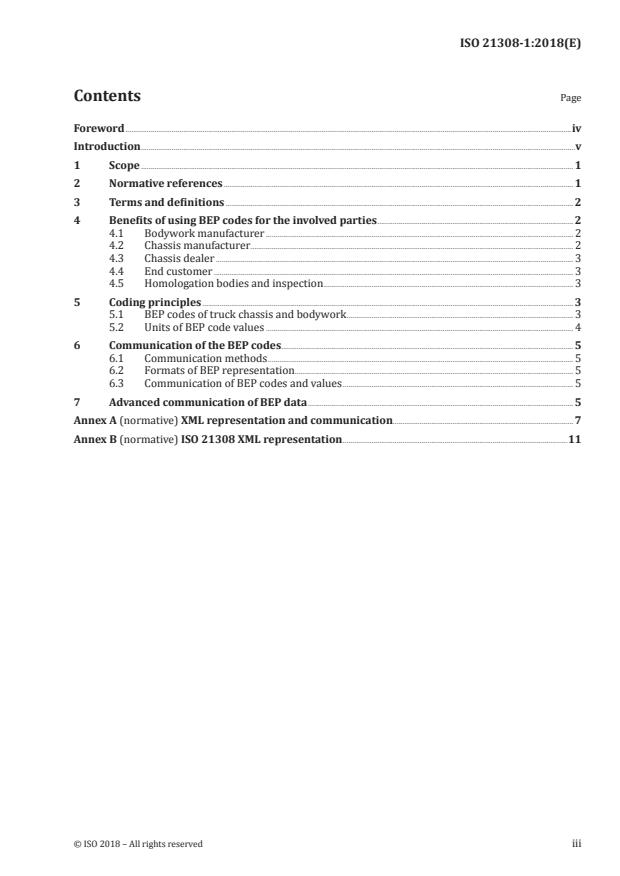
Contents Page
Foreword .iv
Introduction .v
1 Scope . 1
2 Normative references . 1
3 Terms and definitions . 2
4 Benefits of using BEP codes for the involved parties . 2
4.1 Bodywork manufacturer . 2
4.2 Chassis manufacturer . 2
4.3 Chassis dealer . 3
4.4 End customer . 3
4.5 Homologation bodies and inspection . 3
5 Coding principles . 3
5.1 BEP codes of truck chassis and bodywork . 3
5.2 Units of BEP code values . 4
6 Communication of the BEP codes . 5
6.1 Communication methods . 5
6.2 Formats of BEP representation. 5
6.3 Communication of BEP codes and values . 5
7 Advanced communication of BEP data . 5
Annex A (normative) XML representation and communication. 7
Annex B (normative) ISO 21308 XML representation .11
Foreword
ISO (the International Organization for Standardization) is a worldwide federation of national standards
bodies (ISO member bodies). The work of preparing International Standards is normally carried out
through ISO technical committees. Each member body interested in a subject for which a technical
committee has been established has the right to be represented on that committee. International
organizations, governmental and non-governmental, in liaison with ISO, also take part in the work.
ISO collaborates closely with the International Electrotechnical Commission (IEC) on all matters of
electrotechnical standardization.
The procedures used to develop this document and those intended for its further maintenance are
described in the ISO/IEC Directives, Part 1. In particular the different approval criteria needed for the
different types of ISO documents should be noted. This document was drafted in accordance with the
editorial rules of the ISO/IEC Directives, Part 2 (see www .iso .org/directives).
Attention is drawn to the possibility that some of the elements of this document may be the subject of
patent rights. ISO shall not be held responsible for identifying any or all such patent rights. Details of
any patent rights identified during the development of the document will be in the Introduction and/or
on the ISO list of patent declarations received (see www .iso .org/patents).
Any trade name used in this document is information given for the convenience of users and does not
constitute an endorsement.
For an explanation on the voluntary nature of standards, the meaning of ISO specific terms and
expressions related to conformity assessment, as well as information about ISO's adherence to the
World Trade Organization (WTO) principles in the Technical Barriers to Trade (TBT) see the following
URL: www .iso .org/iso/foreword .html.
This document was prepared by Technical Committee ISO/TC 22, Road vehicles, Subcommittee SC 40,
Specific aspects for light and heavy commercial vehicles, busses and trailers.
This first edition of ISO 21308-1 cancels and replaces ISO/PAS 21308-1:2007, which has been technically
revised. The main changes compared to the previous edition are:
— an update of the BEP coding principles in Table 1; and
— the addition of new Annexes A and B.
A list of all parts in the ISO 21308 series can be found on the ISO website.
iv © ISO 2018 – All rights reserved
Introduction
Truck chassis manufacturers deal with configuration of chassis in infinite numbers of possible
combinations, and bodywork manufacturers produce highly customised superstructures on these chassis.
Bodywork manufacturers build their superstructures on chassis of several different truck brands.
The production efficiency of a specific truck chassis and its body combinations can be greatly improved
by achieving the correct technical and commercial information about the specific chassis communicated
with the bodywork manufacturer in advance. The information has to be reliable and give the bodywork
manufacturer confidence to prefabricate the body or the superstructure before the chassis is delivered.
With uniform conditions, unambiguous dimensions and supplementary information can be established,
transferred and correctly interpreted by the receiver. Increased information efficiency will improve
the quality and reduce the lead times.
ISO 21308 specifies a system of codes to exchange specific data between chassis and bodywork
manufacturers, providing a platform for efficient communication between the parties. The process of
exchanging data according to this document is irrelevant of IT sophistication degree.
Exchanging codes according to ISO 21308 is useful in various situations, e.g. for the design and
manufacturing, technical specifications, technical drawings and leaflets.
ISO 21308 uses the applicable definitions from the related ISO 612 and ISO 7656 and adds a number of
dimensional codes, together with general, mass and administrative codes.
INTERNATIONAL STANDARD ISO 21308-1:2018(E)
Road vehicles — Product data exchange between chassis
and bodywork manufacturers (BEP) —
Part 1:
General principles
1 Scope
This document series describes a generic system for the exchange of data between truck chassis
manufacturers and bodywork manufacturers. It applies to commercial vehicles as defined in ISO 3833,
having a maximum gross vehicle mass above 3 500 kg.
The process of exchanging product data can involve:
— chassis manufacturer;
— chassis importer;
— chassis dealer;
— one or more bodywork manufacturers; and
— bodywork component suppliers, e.g. manufacturers of demountable bodies, cranes and loading
equipment, tipping equipment.
This document describes the general principles and provides an overview and recommendations to
assist the parties implementing BEP codes for their communication process. The recommendations
cover different ways to communicate and present the BEP codes. In particular, the application of XML
for communication of BEP codes in an unambiguous way is described.
2 Normative references
The following documents are referred to in the text in such a way that some or all of their content
constitutes requirements of this document. For dated references, only the edition cited applies. For
undated references, the latest edition of the referenced document (including any amendments) applies.
ISO 21308-2, Road vehicles — Product data exchange between chassis and bodywork manufacturers (BEP)
— Part 2: Dimensional exchange parameters
ISO 21308-3, Road vehicles — Product data exchange between chassis and bodywork manufacturers
(BEP) — Part 3: General, mass and administrative exchange parameters
ISO/TS 21308-4, Road vehicles — Product data exchange between chassis and bodywork manufacturers
(BEP) — Part 4: Mapping to STEP application protocol 239
ISO 21308-5, Road vehicles — Product data exchange between chassis and body work manufacturers
(BEP) — Part 5: Coding of loader crane bodywork
ISO 21308-6, Road vehicles — Product data exchange between chassis and bodywork manufacturers (BEP)
— Part 6: Coding of hook loader bodywork
ISO 21308-7, Road vehicles — Product data exchange between chassis and bodywork manufacturers (BEP)
— Part 7: Coding of skip loader bodywork
3 Terms and definitions
For the purposes of this document, the terms and definitions given in ISO 612, ISO 7656 and
ISO 21308-2 apply.
ISO and IEC maintain terminological databases for use in standardization at the following addresses:
— IEC Electropedia: available at http: //www .electropedia .org/
— ISO Online browsing platform: available at https: //www .iso .org/obp
4 Benefits of using BEP codes for the involved parties
4.1 Bodywork manufacturer
The bodywork manufacturer's use of the BEP system will provide the following benefits:
— clear understanding;
— prefabrication;
— internal time reduction;
— reliable documentation and information;
— less conflicts between chassis and body parts;
— detailed information for re-production (additional copies of the bodywork);
— simplified feedback process;
— less late changes and order modifications;
— easier to work with several different chassis manufacturers; and
— possibilities for outsourcing parts of the job.
4.2 Chassis manufacturer
The chassis manufacturer's use of the BEP system will provide the following benefits:
— clear understanding;
— cut in lead time, better cash flow;
— communication of chassis features and interfaces;
— bi-directional communication;
— less late changes and order modifications;
— internal communication between the departments involved;
— higher quality of the complete work;
— cost reductions;
— documentation of the complete vehicle; and
— data for homologation type approval.
2 © ISO 2018 – All rights reserved
4.3 Chassis dealer
For the chassis dealer, use of the BEP system will provide the following benefits:
— clear understanding;
— cut in lead time;
— cost savings as a result of cut in turnaround time;
— clear specifications and information to/from the customer;
— less late changes and order modifications; and
— improved quality of the complete vehicle.
4.4 End customer
The end customer will benefit from:
— improved quality;
— clear specifications and information;
— shorter delivery time; and
— cost savings.
4.5 Homologation bodies and inspection
For homologation parties, the following benefits can be obtained:
— BEP data related to the legal requirements could be extracted; and
— periodical technical inspection would be facilitated.
5 Coding principles
5.1 BEP codes of truck chassis and bodywork
Each characteristic, related to truck chassis and bodywork, is assigned a code composed of the items
given below. A prefix “BEP”, followed by a dash (-), shall be used to avoid confusion with other coding
systems.
BEP codes are formatted according to the principles in Table 1.
Table 1 — BEP coding principles
BEP-ppMccc.n.p.q.s.t
Item Assignment Description
pp Bodywork category pp = None or 00 for codes related to vehicle chassis (ISO 21308-2 and
ISO 21308−3)
pp = 01 for codes related to loader cranes (ISO 21308-5)
pp = 02 for codes related to hook loaders (ISO 21308-6)
pp = 03 for codes related to skip loaders (ISO 21308-7)
Future parts of the ISO 21308 series may introduce new pp numbers.
M Measure type A capital letter, which denotes the type of code:
H = Z direction, coordinate system in accordance with ISO 4130
L = X direction, coordinate system in accordance with ISO 4130
W = Y direction, coordinate system in accordance with ISO 4130
C = Coordinate (x,y) or (x,y,z) in the Cartesian coordinate system
M = Mass (m), or mass point (m,x,y,z)
F = Force (static or dynamic)
T = Moment (static or dynamic)
R = Radius
V = Angle
G = General
A = Administrative
ccc BEP code number Code number given by the standard
.n Index number .n is used to designate object number n
.p Entity number .p is used to designate a certain set of object characteristics or entities (e.g.
dimensions, coordinates, address information)
Where both .n and .p are specified, they are given in the .n .p order.
.q Corner number .q is used to designate contour corner index number
.s Side designator L or R
.t Type designator Optional coding to describe the object type (e.g. fuel tank)
5.2 Units of BEP code values
The following units are preferred when reporting values related to BEP codes:
— dimensions (L, W, H, R) and coordinates (x,y,z) in millimetres (mm);
— masses in kilograms (kg);
— forces in Newtons (N), or kN;
— moments in Newtonmetres (Nm), or kNm; and
— angles in degrees (°).
Guidance on units is shown in the unit column of the respective BEP code. BEP codes are not restricted
to the use of SI units, however if non-recommended units are used, this should be clearly defined in the
representation format used.
4 © ISO 2018 – All rights reserved
6 Communication of the BEP codes
6.1 Communication methods
Examples are given below:
— e-mail;
— website (which could include e.g. a STEP browser, and drawing information);
— online databases, IT networks; and
— internal PDM systems.
6.2 Formats of BEP representation
— plain text;
— comma-separated text (simplest form of structured information);
1)TM
— spreadsheets (Excel forms for parts 2 and 3 are available at the ISO Standards Maintenance
website: http: //standards .iso .org/iso/21308); and
— XML, which shall be written according to the indication in Annexes A and B (xsd schema files
are available are available at the ISO Standards Maintenance website: http: //standards .iso
.org/iso/21308);
— STEP file (or information derived from a STEP file), shall be prepared according to ISO/TS 21308-4.
6.3 Communication of BEP codes and values
It is recommended to use the following simple rules:
— BEP code to the left; value to the right (see Table 1); and
— Unit should be specified (see Table 1);
Table 2 — Example of communication of a BEP code
BEP code Description Value Unit
BEP-H079 Fifth-wheel coupling above ground,
1 230 mm
laden, lowest position
— In drawings, the BEP code relation to the measurement value should be clearly indicated.
7 Advanced communication of BEP data
Advanced communication of BEP data according to Figure 1, with the use of STEP, shall be handled as
stated in in ISO/TS 21308-4.
TM
1) Excel is the trademark of a product supplied by Microsoft . This information is given for the convenience of
users of this document and does not constitute an endorsement by ISO of the product named. Equivalent products
may be used if they can be shown to lead to the same results.
Figure 1 — Communication of BEP data between chassis manufacturer and bodywork
manufacturer
6 © ISO 2018 – All rights reserved
Annex A
(normative)
XML representation and communication
A.1 General
A flexible way to exchange data is provided by XML files. XML stands for Extensible Markup Language.
Markup languages describe how the contents of a document should be interpreted.
XML can be created manually or by computer programs. XML can be read using a standard text
processor, can be displayed by any Web browser and can be processed by computer programs.
Every XML file shall be well-formed and shall be valid. A document is well-formed when the rules,
specified in the latest version of the XML language, are followed.
A document is valid when the content complies with a defined structure. The structure may be defined
in a document type definition (DTD) or in a schema. A schema is a more powerful DTD. Among other
features, the data type of individual elements can be specified in a schema.
This document describes the schema for creating valid ISO 21308 BEP XML-documents and shows how
XML can be displayed in a web browser.
The complete and validated xsd schema files are available at the ISO Standards Maintenance web site,
at the following URL: http: //standards .iso .org/iso/21308.
A.2 Creating well-formed documents
In an XML document, information is packed into an element.
An element consists of a start tag and of an end tag . An element can contain data:
Low
An element can also contain other elements:
In this case, element
single elements.
An element can be an “empty”:
This means that the element contains neither data nor elements. In this case, the element carries data
in attributes.
A well-formed constraint is that each combination of attributes may appear only once in a document.
This means that
is valid, but
is not. Note that the attribute values are enclosed in quotes. This means that attribute values cannot
contain quotation marks themselves. Quotes and other reserved characters can be embedded using
entity references.
The most frequently used entity references are
& the & character,
< the < character,
> the > character,
' the ‘ character,
" the “ character,
Note that numerous other entity references exist.
Attribute values are case sensitive. This means that and are different
elements.
A.3 Creating valid documents
The layout of the ISO 21308 file must respect the key features of XML. This means that the content shall
be structured in a way that allows for automatic validation. Within XML, this is only possible if BEP
codes and BEP denotations are either XML elements or XML attributes.
Test
XML element with data
Test
XML element with an attribute and
data
A comment
XML elements without an attribute cannot be separated from other elements at the same level. This
format can be used if an element only occurs once or when there is no relation to other elements at the
same level.
XML elements with an attribute can be related to other elements or can be distinguished from other
elements at the same level.
XML comments are meant for documentation only. They are ignored by XML parser
...
INTERNATIONAL ISO
STANDARD 21308-1
First edition
2018-09
Road vehicles — Product data
exchange between chassis and
bodywork manufacturers (BEP) —
Part 1:
General principles
Véhicules routiers — Échange de données de produit entre les
fabricants de châssis et de carrosseries (BEP) —
Partie 1: Principes généraux
Reference number
©
ISO 2018
© ISO 2018
All rights reserved. Unless otherwise specified, or required in the context of its implementation, no part of this publication may
be reproduced or utilized otherwise in any form or by any means, electronic or mechanical, including photocopying, or posting
on the internet or an intranet, without prior written permission. Permission can be requested from either ISO at the address
below or ISO’s member body in the country of the requester.
ISO copyright office
CP 401 • Ch. de Blandonnet 8
CH-1214 Vernier, Geneva
Phone: +41 22 749 01 11
Fax: +41 22 749 09 47
Email: copyright@iso.org
Website: www.iso.org
Published in Switzerland
ii © ISO 2018 – All rights reserved
Contents Page
Foreword .iv
Introduction .v
1 Scope . 1
2 Normative references . 1
3 Terms and definitions . 2
4 Benefits of using BEP codes for the involved parties . 2
4.1 Bodywork manufacturer . 2
4.2 Chassis manufacturer . 2
4.3 Chassis dealer . 3
4.4 End customer . 3
4.5 Homologation bodies and inspection . 3
5 Coding principles . 3
5.1 BEP codes of truck chassis and bodywork . 3
5.2 Units of BEP code values . 4
6 Communication of the BEP codes . 5
6.1 Communication methods . 5
6.2 Formats of BEP representation. 5
6.3 Communication of BEP codes and values . 5
7 Advanced communication of BEP data . 5
Annex A (normative) XML representation and communication. 7
Annex B (normative) ISO 21308 XML representation .11
Foreword
ISO (the International Organization for Standardization) is a worldwide federation of national standards
bodies (ISO member bodies). The work of preparing International Standards is normally carried out
through ISO technical committees. Each member body interested in a subject for which a technical
committee has been established has the right to be represented on that committee. International
organizations, governmental and non-governmental, in liaison with ISO, also take part in the work.
ISO collaborates closely with the International Electrotechnical Commission (IEC) on all matters of
electrotechnical standardization.
The procedures used to develop this document and those intended for its further maintenance are
described in the ISO/IEC Directives, Part 1. In particular the different approval criteria needed for the
different types of ISO documents should be noted. This document was drafted in accordance with the
editorial rules of the ISO/IEC Directives, Part 2 (see www .iso .org/directives).
Attention is drawn to the possibility that some of the elements of this document may be the subject of
patent rights. ISO shall not be held responsible for identifying any or all such patent rights. Details of
any patent rights identified during the development of the document will be in the Introduction and/or
on the ISO list of patent declarations received (see www .iso .org/patents).
Any trade name used in this document is information given for the convenience of users and does not
constitute an endorsement.
For an explanation on the voluntary nature of standards, the meaning of ISO specific terms and
expressions related to conformity assessment, as well as information about ISO's adherence to the
World Trade Organization (WTO) principles in the Technical Barriers to Trade (TBT) see the following
URL: www .iso .org/iso/foreword .html.
This document was prepared by Technical Committee ISO/TC 22, Road vehicles, Subcommittee SC 40,
Specific aspects for light and heavy commercial vehicles, busses and trailers.
This first edition of ISO 21308-1 cancels and replaces ISO/PAS 21308-1:2007, which has been technically
revised. The main changes compared to the previous edition are:
— an update of the BEP coding principles in Table 1; and
— the addition of new Annexes A and B.
A list of all parts in the ISO 21308 series can be found on the ISO website.
iv © ISO 2018 – All rights reserved
Introduction
Truck chassis manufacturers deal with configuration of chassis in infinite numbers of possible
combinations, and bodywork manufacturers produce highly customised superstructures on these chassis.
Bodywork manufacturers build their superstructures on chassis of several different truck brands.
The production efficiency of a specific truck chassis and its body combinations can be greatly improved
by achieving the correct technical and commercial information about the specific chassis communicated
with the bodywork manufacturer in advance. The information has to be reliable and give the bodywork
manufacturer confidence to prefabricate the body or the superstructure before the chassis is delivered.
With uniform conditions, unambiguous dimensions and supplementary information can be established,
transferred and correctly interpreted by the receiver. Increased information efficiency will improve
the quality and reduce the lead times.
ISO 21308 specifies a system of codes to exchange specific data between chassis and bodywork
manufacturers, providing a platform for efficient communication between the parties. The process of
exchanging data according to this document is irrelevant of IT sophistication degree.
Exchanging codes according to ISO 21308 is useful in various situations, e.g. for the design and
manufacturing, technical specifications, technical drawings and leaflets.
ISO 21308 uses the applicable definitions from the related ISO 612 and ISO 7656 and adds a number of
dimensional codes, together with general, mass and administrative codes.
INTERNATIONAL STANDARD ISO 21308-1:2018(E)
Road vehicles — Product data exchange between chassis
and bodywork manufacturers (BEP) —
Part 1:
General principles
1 Scope
This document series describes a generic system for the exchange of data between truck chassis
manufacturers and bodywork manufacturers. It applies to commercial vehicles as defined in ISO 3833,
having a maximum gross vehicle mass above 3 500 kg.
The process of exchanging product data can involve:
— chassis manufacturer;
— chassis importer;
— chassis dealer;
— one or more bodywork manufacturers; and
— bodywork component suppliers, e.g. manufacturers of demountable bodies, cranes and loading
equipment, tipping equipment.
This document describes the general principles and provides an overview and recommendations to
assist the parties implementing BEP codes for their communication process. The recommendations
cover different ways to communicate and present the BEP codes. In particular, the application of XML
for communication of BEP codes in an unambiguous way is described.
2 Normative references
The following documents are referred to in the text in such a way that some or all of their content
constitutes requirements of this document. For dated references, only the edition cited applies. For
undated references, the latest edition of the referenced document (including any amendments) applies.
ISO 21308-2, Road vehicles — Product data exchange between chassis and bodywork manufacturers (BEP)
— Part 2: Dimensional exchange parameters
ISO 21308-3, Road vehicles — Product data exchange between chassis and bodywork manufacturers
(BEP) — Part 3: General, mass and administrative exchange parameters
ISO/TS 21308-4, Road vehicles — Product data exchange between chassis and bodywork manufacturers
(BEP) — Part 4: Mapping to STEP application protocol 239
ISO 21308-5, Road vehicles — Product data exchange between chassis and body work manufacturers
(BEP) — Part 5: Coding of loader crane bodywork
ISO 21308-6, Road vehicles — Product data exchange between chassis and bodywork manufacturers (BEP)
— Part 6: Coding of hook loader bodywork
ISO 21308-7, Road vehicles — Product data exchange between chassis and bodywork manufacturers (BEP)
— Part 7: Coding of skip loader bodywork
3 Terms and definitions
For the purposes of this document, the terms and definitions given in ISO 612, ISO 7656 and
ISO 21308-2 apply.
ISO and IEC maintain terminological databases for use in standardization at the following addresses:
— IEC Electropedia: available at http: //www .electropedia .org/
— ISO Online browsing platform: available at https: //www .iso .org/obp
4 Benefits of using BEP codes for the involved parties
4.1 Bodywork manufacturer
The bodywork manufacturer's use of the BEP system will provide the following benefits:
— clear understanding;
— prefabrication;
— internal time reduction;
— reliable documentation and information;
— less conflicts between chassis and body parts;
— detailed information for re-production (additional copies of the bodywork);
— simplified feedback process;
— less late changes and order modifications;
— easier to work with several different chassis manufacturers; and
— possibilities for outsourcing parts of the job.
4.2 Chassis manufacturer
The chassis manufacturer's use of the BEP system will provide the following benefits:
— clear understanding;
— cut in lead time, better cash flow;
— communication of chassis features and interfaces;
— bi-directional communication;
— less late changes and order modifications;
— internal communication between the departments involved;
— higher quality of the complete work;
— cost reductions;
— documentation of the complete vehicle; and
— data for homologation type approval.
2 © ISO 2018 – All rights reserved
4.3 Chassis dealer
For the chassis dealer, use of the BEP system will provide the following benefits:
— clear understanding;
— cut in lead time;
— cost savings as a result of cut in turnaround time;
— clear specifications and information to/from the customer;
— less late changes and order modifications; and
— improved quality of the complete vehicle.
4.4 End customer
The end customer will benefit from:
— improved quality;
— clear specifications and information;
— shorter delivery time; and
— cost savings.
4.5 Homologation bodies and inspection
For homologation parties, the following benefits can be obtained:
— BEP data related to the legal requirements could be extracted; and
— periodical technical inspection would be facilitated.
5 Coding principles
5.1 BEP codes of truck chassis and bodywork
Each characteristic, related to truck chassis and bodywork, is assigned a code composed of the items
given below. A prefix “BEP”, followed by a dash (-), shall be used to avoid confusion with other coding
systems.
BEP codes are formatted according to the principles in Table 1.
Table 1 — BEP coding principles
BEP-ppMccc.n.p.q.s.t
Item Assignment Description
pp Bodywork category pp = None or 00 for codes related to vehicle chassis (ISO 21308-2 and
ISO 21308−3)
pp = 01 for codes related to loader cranes (ISO 21308-5)
pp = 02 for codes related to hook loaders (ISO 21308-6)
pp = 03 for codes related to skip loaders (ISO 21308-7)
Future parts of the ISO 21308 series may introduce new pp numbers.
M Measure type A capital letter, which denotes the type of code:
H = Z direction, coordinate system in accordance with ISO 4130
L = X direction, coordinate system in accordance with ISO 4130
W = Y direction, coordinate system in accordance with ISO 4130
C = Coordinate (x,y) or (x,y,z) in the Cartesian coordinate system
M = Mass (m), or mass point (m,x,y,z)
F = Force (static or dynamic)
T = Moment (static or dynamic)
R = Radius
V = Angle
G = General
A = Administrative
ccc BEP code number Code number given by the standard
.n Index number .n is used to designate object number n
.p Entity number .p is used to designate a certain set of object characteristics or entities (e.g.
dimensions, coordinates, address information)
Where both .n and .p are specified, they are given in the .n .p order.
.q Corner number .q is used to designate contour corner index number
.s Side designator L or R
.t Type designator Optional coding to describe the object type (e.g. fuel tank)
5.2 Units of BEP code values
The following units are preferred when reporting values related to BEP codes:
— dimensions (L, W, H, R) and coordinates (x,y,z) in millimetres (mm);
— masses in kilograms (kg);
— forces in Newtons (N), or kN;
— moments in Newtonmetres (Nm), or kNm; and
— angles in degrees (°).
Guidance on units is shown in the unit column of the respective BEP code. BEP codes are not restricted
to the use of SI units, however if non-recommended units are used, this should be clearly defined in the
representation format used.
4 © ISO 2018 – All rights reserved
6 Communication of the BEP codes
6.1 Communication methods
Examples are given below:
— e-mail;
— website (which could include e.g. a STEP browser, and drawing information);
— online databases, IT networks; and
— internal PDM systems.
6.2 Formats of BEP representation
— plain text;
— comma-separated text (simplest form of structured information);
1)TM
— spreadsheets (Excel forms for parts 2 and 3 are available at the ISO Standards Maintenance
website: http: //standards .iso .org/iso/21308); and
— XML, which shall be written according to the indication in Annexes A and B (xsd schema files
are available are available at the ISO Standards Maintenance website: http: //standards .iso
.org/iso/21308);
— STEP file (or information derived from a STEP file), shall be prepared according to ISO/TS 21308-4.
6.3 Communication of BEP codes and values
It is recommended to use the following simple rules:
— BEP code to the left; value to the right (see Table 1); and
— Unit should be specified (see Table 1);
Table 2 — Example of communication of a BEP code
BEP code Description Value Unit
BEP-H079 Fifth-wheel coupling above ground,
1 230 mm
laden, lowest position
— In drawings, the BEP code relation to the measurement value should be clearly indicated.
7 Advanced communication of BEP data
Advanced communication of BEP data according to Figure 1, with the use of STEP, shall be handled as
stated in in ISO/TS 21308-4.
TM
1) Excel is the trademark of a product supplied by Microsoft . This information is given for the convenience of
users of this document and does not constitute an endorsement by ISO of the product named. Equivalent products
may be used if they can be shown to lead to the same results.
Figure 1 — Communication of BEP data between chassis manufacturer and bodywork
manufacturer
6 © ISO 2018 – All rights reserved
Annex A
(normative)
XML representation and communication
A.1 General
A flexible way to exchange data is provided by XML files. XML stands for Extensible Markup Language.
Markup languages describe how the contents of a document should be interpreted.
XML can be created manually or by computer programs. XML can be read using a standard text
processor, can be displayed by any Web browser and can be processed by computer programs.
Every XML file shall be well-formed and shall be valid. A document is well-formed when the rules,
specified in the latest version of the XML language, are followed.
A document is valid when the content complies with a defined structure. The structure may be defined
in a document type definition (DTD) or in a schema. A schema is a more powerful DTD. Among other
features, the data type of individual elements can be specified in a schema.
This document describes the schema for creating valid ISO 21308 BEP XML-documents and shows how
XML can be displayed in a web browser.
The complete and validated xsd schema files are available at the ISO Standards Maintenance web site,
at the following URL: http: //standards .iso .org/iso/21308.
A.2 Creating well-formed documents
In an XML document, information is packed into an element.
An element consists of a start tag and of an end tag . An element can contain data:
Low
An element can also contain other elements:
In this case, element
single elements.
An element can be an “empty”:
This means that the element contains neither data nor elements. In this case, the element carries data
in attributes.
A well-formed constraint is that each combination of attributes may appear only once in a document.
This means that
is valid, but
is not. Note that the attribute values are enclosed in quotes. This means that attribute values cannot
contain quotation marks themselves. Quotes and other reserved characters can be embedded using
entity references.
The most frequently used entity references are
& the & character,
< the < character,
> the > character,
' the ‘ character,
" the “ character,
Note that numerous other entity references exist.
Attribute values are case sensitive. This means that and are different
elements.
A.3 Creating valid documents
The layout of the ISO 21308 file must respect the key features of XML. This means that the content shall
be structured in a way that allows for automatic validation. Within XML, this is only possible if BEP
codes and BEP denotations are either XML elements or XML attributes.
Test
XML element with data
Test
XML element with an attribute and
data
A comment
XML elements without an attribute cannot be separated from other elements at the same level. This
format can be used if an element only occurs once or when there is no relation to other elements at the
same level.
XML elements with an attribute can be related to other elements or can be distinguished from other
elements at the same level.
XML comments are meant for documentation only. They are ignored by XML parser
...