

ISO 17442-1:2020
(Main)Financial services — Legal entity identifier (LEI) — Part 1: Assignment
General Information
- Abstract
This document specifies the minimum elements of an unambiguous legal entity identifier (LEI) scheme to identify the legal entities relevant to any financial transaction. It is applicable to "legal entities", which include, but are not limited to, unique parties that are legally or financially responsible for the performance of financial transactions or have the legal right in their jurisdiction to enter independently into legal contracts, regardless of whether they are incorporated or constituted in some other way (e.g. trust, partnership, contractual). It includes governmental organizations, supranationals and individuals when acting in a business capacity[1], but excludes natural persons. It also includes international branches as defined in 3.5. The LEI is designed for automated processing. It can also be conveniently used in other media interchange when appropriate (e.g. paper document exchange). NOTE Examples of eligible legal entities include, without limitation: — all financial intermediaries; — banks and finance companies; — international branches; — all entities that issue equity, debt or other securities for other capital structures; — all entities listed on an exchange; — all entities that trade financial instruments or are otherwise parties to financial transactions, including business entities, pension funds and investment vehicles such as collective investment funds (at umbrella and sub-fund level) and other special purpose vehicles that have a legal form; — all entities under the purview of a financial regulator and their affiliates, subsidiaries and holding companies; — sole traders (as an example of individuals acting in a business capacity); — counterparties to financial transactions. [1] As stated by the LEI Regulatory Oversight Committee on 30 September 2015.
- Status
- Published
- Publication Date
- 17-Aug-2020
- Technical Committee
- ISO/TC 68/SC 8 - Reference data for financial services
- Drafting Committee
- ISO/TC 68/SC 8 - Reference data for financial services
- Current Stage
- 9093 - International Standard confirmed
- Start Date
- 21-Jan-2026
- Completion Date
- 29-Aug-2026
Buy Documents
ISO 17442-1:2020 - Financial services -- Legal entity identifier (LEI)
ISO 17442-1:2020 - Financial services — Legal entity identifier (LEI) — Part 1: Assignment/18/2020
Overview
ISO 17442-1:2020 defines the assignment rules for the Legal Entity Identifier (LEI) used in financial services. The standard specifies the minimum elements of an unambiguous global LEI scheme to identify legal entities involved in financial transactions. The LEI is intended for automated processing and straight-through processing (STP) yet is also suitable for other media (e.g., paper). The standard covers eligible entities (corporates, funds, banks, international branches, governmental and supranational bodies, and individuals acting in a business capacity) and explicitly excludes natural persons.
Key topics and technical requirements
- LEI format: a 20-character code - 18 alphanumeric characters followed by a 2-digit check digit pair (format: 18!c2!n).
- Check digit calculation: based on ISO/IEC 7064 (MOD 97-10). Letters are converted to digit pairs (A=10 … Z=35), two zeros appended, divided by 97; remainder subtracted from 98 gives the check digit pair. Valid pairs are in the range 02–98 (00, 01 and 99 are invalid). Correctly formed LEIs will yield a remainder of “1” when processed per the standard.
- LEI data record: mandatory reference attributes to ensure unambiguous identification, including:
- legal entity name and registry identifier
- legal form (as per ISO 20275)
- address of legal formation and jurisdiction (ISO 3166)
- creation date, first LEI assignment date, last update and effective dates (ISO 8601)
- headquarters or branch address, international branch linkage
- direct and ultimate parent identification (or explanation why absent)
- investment-fund-specific attributes (fund manager, umbrella/master links)
- status of legal registration and of the LEI data record (validation/publication/updating)
- Design principles: LEI contains no embedded intelligence, is persistent, interoperable, extensible, and free for use and redistribution.
Applications and who uses it
- Regulators and supervisory bodies for transaction and exposure reporting, market oversight and systemic risk analysis.
- Banks, brokers, asset managers, exchanges and custodians for KYC, trade reporting, counterparty identification and STP.
- Investment funds and fund managers to link sub-funds, master-feeder structures and management entities.
- Fintechs, data providers and risk management teams for entity resolution, credit risk, AML/CFT compliance and aggregation of cross-border exposures.
- LEI issuing organizations and data registries that implement assignment, validation and publication workflows.
Related standards
- ISO/IEC 7064 (check character systems - MOD 97-10)
- ISO 3166 (country and subdivision codes)
- ISO 8601 (date/time representation)
- ISO 20275 (entity legal forms - ELF)
ISO 17442-1:2020 is part of the ISO 17442 series and provides the foundational assignment rules and data model necessary for robust, global legal entity identification in financial services.
Relations
- Effective Date
- 23-Apr-2020
Buy Documents
ISO 17442-1:2020 - Financial services -- Legal entity identifier (LEI)
ISO 17442-1:2020 - Financial services — Legal entity identifier (LEI) — Part 1: Assignment/18/2020
Get Certified
Connect with accredited certification bodies for this standard

Great Wall Tianjin Quality Assurance Center
Established 1993, first batch to receive national accreditation with IAF recognition.
Hong Kong Quality Assurance Agency (HKQAA)
Hong Kong's leading certification body.

Innovative Quality Certifications Pvt. Ltd. (IQCPL)
Known for integrity, providing ethical & impartial Assessment & Certification. CMMI Institute Partner.
Sponsored listings
Frequently Asked Questions
ISO 17442-1:2020 is a standard published by the International Organization for Standardization (ISO). Its full title is "Financial services — Legal entity identifier (LEI) — Part 1: Assignment". This standard covers: This document specifies the minimum elements of an unambiguous legal entity identifier (LEI) scheme to identify the legal entities relevant to any financial transaction. It is applicable to "legal entities", which include, but are not limited to, unique parties that are legally or financially responsible for the performance of financial transactions or have the legal right in their jurisdiction to enter independently into legal contracts, regardless of whether they are incorporated or constituted in some other way (e.g. trust, partnership, contractual). It includes governmental organizations, supranationals and individuals when acting in a business capacity[1], but excludes natural persons. It also includes international branches as defined in 3.5. The LEI is designed for automated processing. It can also be conveniently used in other media interchange when appropriate (e.g. paper document exchange). NOTE Examples of eligible legal entities include, without limitation: — all financial intermediaries; — banks and finance companies; — international branches; — all entities that issue equity, debt or other securities for other capital structures; — all entities listed on an exchange; — all entities that trade financial instruments or are otherwise parties to financial transactions, including business entities, pension funds and investment vehicles such as collective investment funds (at umbrella and sub-fund level) and other special purpose vehicles that have a legal form; — all entities under the purview of a financial regulator and their affiliates, subsidiaries and holding companies; — sole traders (as an example of individuals acting in a business capacity); — counterparties to financial transactions. [1] As stated by the LEI Regulatory Oversight Committee on 30 September 2015.
This document specifies the minimum elements of an unambiguous legal entity identifier (LEI) scheme to identify the legal entities relevant to any financial transaction. It is applicable to "legal entities", which include, but are not limited to, unique parties that are legally or financially responsible for the performance of financial transactions or have the legal right in their jurisdiction to enter independently into legal contracts, regardless of whether they are incorporated or constituted in some other way (e.g. trust, partnership, contractual). It includes governmental organizations, supranationals and individuals when acting in a business capacity[1], but excludes natural persons. It also includes international branches as defined in 3.5. The LEI is designed for automated processing. It can also be conveniently used in other media interchange when appropriate (e.g. paper document exchange). NOTE Examples of eligible legal entities include, without limitation: — all financial intermediaries; — banks and finance companies; — international branches; — all entities that issue equity, debt or other securities for other capital structures; — all entities listed on an exchange; — all entities that trade financial instruments or are otherwise parties to financial transactions, including business entities, pension funds and investment vehicles such as collective investment funds (at umbrella and sub-fund level) and other special purpose vehicles that have a legal form; — all entities under the purview of a financial regulator and their affiliates, subsidiaries and holding companies; — sole traders (as an example of individuals acting in a business capacity); — counterparties to financial transactions. [1] As stated by the LEI Regulatory Oversight Committee on 30 September 2015.
ISO 17442-1:2020 is classified under the following ICS (International Classification for Standards) categories: 03.060 - Finances. Banking. Monetary systems. Insurance. The ICS classification helps identify the subject area and facilitates finding related standards.
ISO 17442-1:2020 has the following relationships with other standards: It is inter standard links to ISO 17442:2019. Understanding these relationships helps ensure you are using the most current and applicable version of the standard.
ISO 17442-1:2020 is available in PDF format for immediate download after purchase. The document can be added to your cart and obtained through the secure checkout process. Digital delivery ensures instant access to the complete standard document.
Standards Content (Sample)
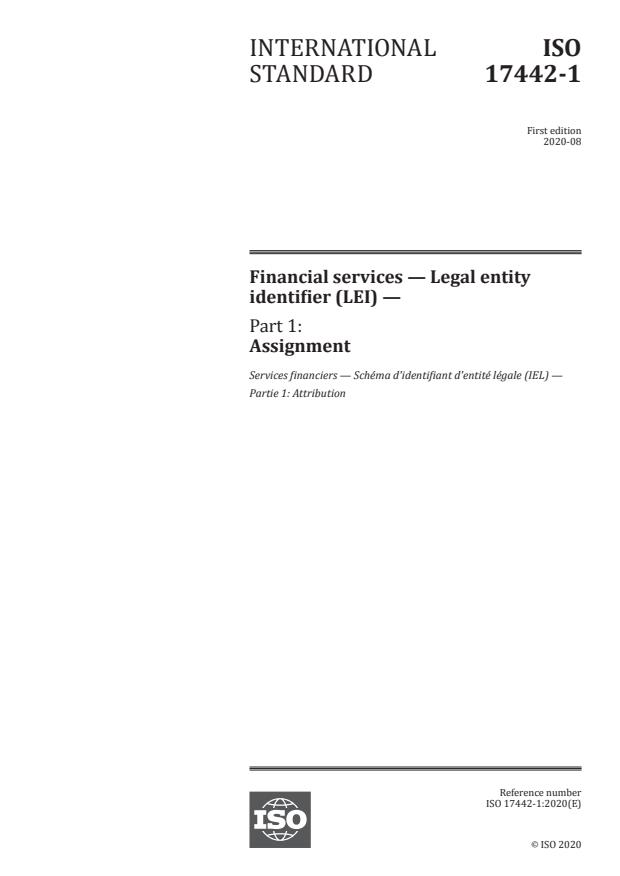
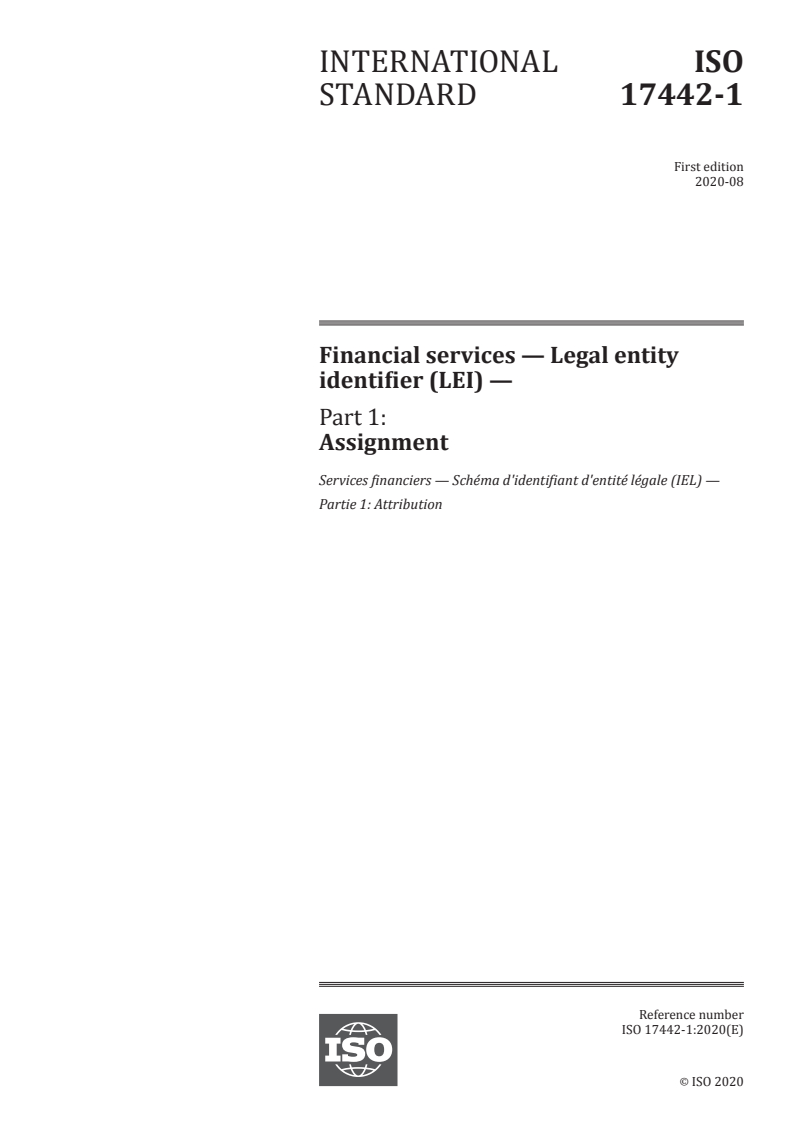
INTERNATIONAL ISO
STANDARD 17442-1
First edition
2020-08
Financial services — Legal entity
identifier (LEI) —
Part 1:
Assignment
Services financiers — Schéma d'identifiant d'entité légale (IEL) —
Partie 1: Attribution
Reference number
©
ISO 2020
© ISO 2020
All rights reserved. Unless otherwise specified, or required in the context of its implementation, no part of this publication may
be reproduced or utilized otherwise in any form or by any means, electronic or mechanical, including photocopying, or posting
on the internet or an intranet, without prior written permission. Permission can be requested from either ISO at the address
below or ISO’s member body in the country of the requester.
ISO copyright office
CP 401 • Ch. de Blandonnet 8
CH-1214 Vernier, Geneva
Phone: +41 22 749 01 11
Email: copyright@iso.org
Website: www.iso.org
Published in Switzerland
ii © ISO 2020 – All rights reserved
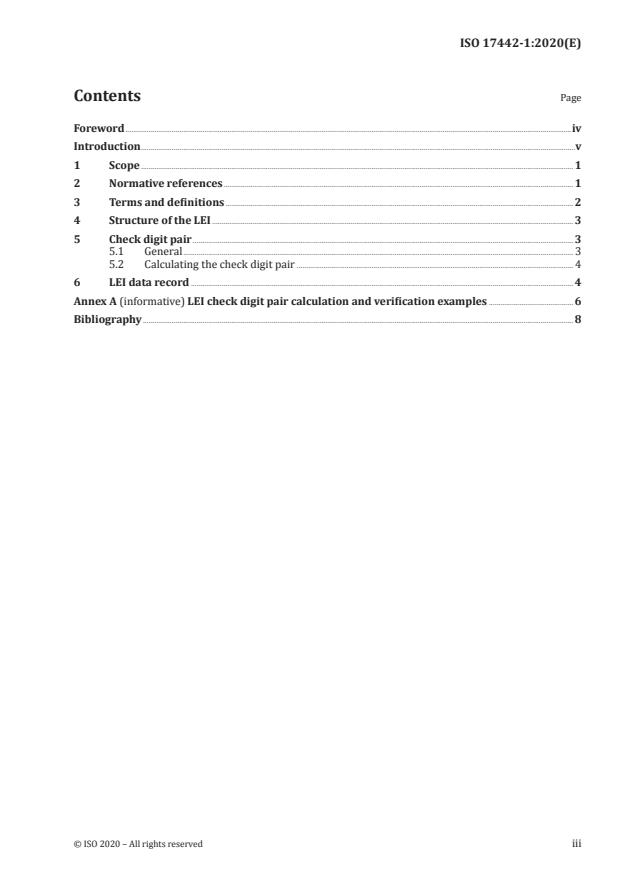
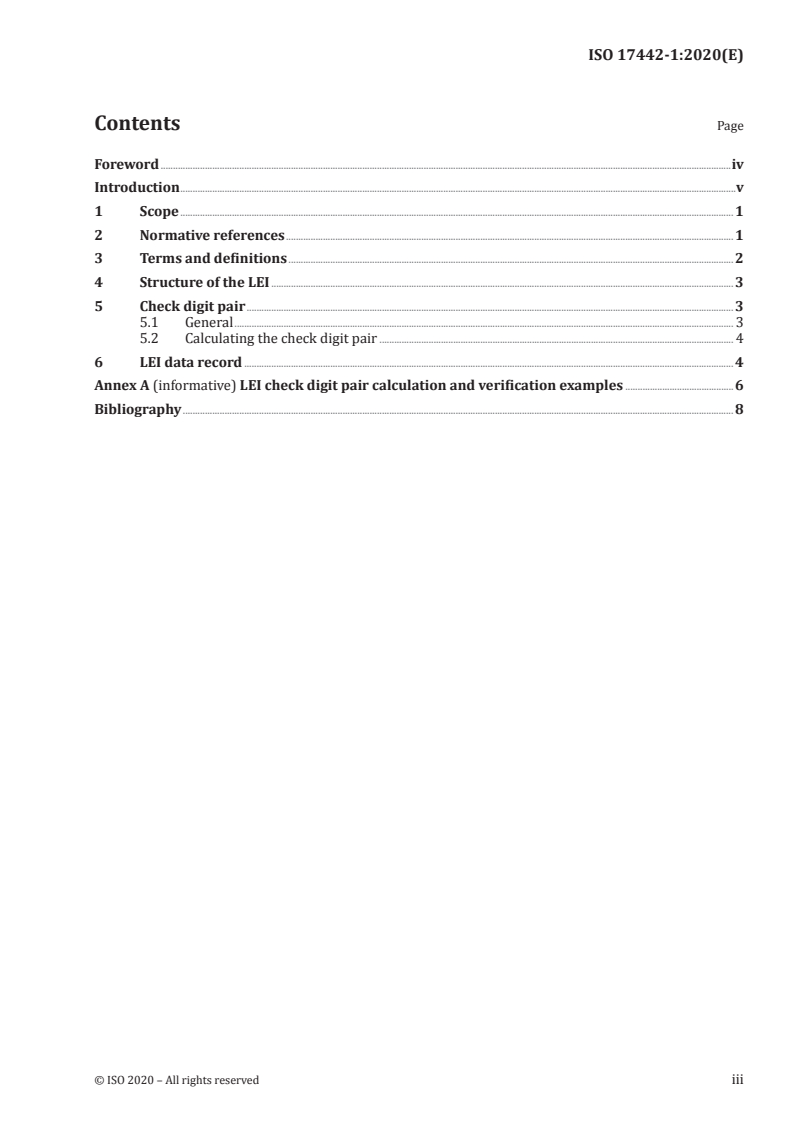
Contents Page
Foreword .iv
Introduction .v
1 Scope . 1
2 Normative references . 1
3 Terms and definitions . 2
4 Structure of the LEI . 3
5 Check digit pair . 3
5.1 General . 3
5.2 Calculating the check digit pair . 4
6 LEI data record . 4
Annex A (informative) LEI check digit pair calculation and verification examples .6
Bibliography . 8
Foreword
ISO (the International Organization for Standardization) is a worldwide federation of national standards
bodies (ISO member bodies). The work of preparing International Standards is normally carried out
through ISO technical committees. Each member body interested in a subject for which a technical
committee has been established has the right to be represented on that committee. International
organizations, governmental and non-governmental, in liaison with ISO, also take part in the work.
ISO collaborates closely with the International Electrotechnical Commission (IEC) on all matters of
electrotechnical standardization.
The procedures used to develop this document and those intended for its further maintenance are
described in the ISO/IEC Directives, Part 1. In particular, the different approval criteria needed for the
different types of ISO documents should be noted. This document was drafted in accordance with the
editorial rules of the ISO/IEC Directives, Part 2 (see www .iso .org/ directives).
Attention is drawn to the possibility that some of the elements of this document may be the subject of
patent rights. ISO shall not be held responsible for identifying any or all such patent rights. Details of
any patent rights identified during the development of the document will be in the Introduction and/or
on the ISO list of patent declarations received (see www .iso .org/ patents).
Any trade name used in this document is information given for the convenience of users and does not
constitute an endorsement.
For an explanation of the voluntary nature of standards, the meaning of ISO specific terms and
expressions related to conformity assessment, as well as information about ISO's adherence to the
World Trade Organization (WTO) principles in the Technical Barriers to Trade (TBT), see www .iso .org/
iso/ foreword .html.
This document was prepared by Technical Committee ISO/TC 68, Financial services, Subcommittee SC
8, Reference data for financial services.
This first edition of ISO 17442-1, along with ISO 17442-2, cancels and replaces ISO 17442:2019, which
has been technically revised.
The main changes to ISO 17442:2019 are as follows:
— clarification that international branches of entities that meet certain conditions may be assigned LEIs;
— addition of new attributes to the LEI data record concerning identification of the direct and ultimate
parent of a legal entity;
— addition of new attributes of the LEI data record concerning the status of the entity and the data
record, and events that cause the data record to change;
— addition of new attributes of the LEI data record in relation to investment funds;
— clarification regarding certain existing attributes of the LEI data record.
A list of all parts in the ISO 17442 series can be found on the ISO website.
Any feedback or questions on this document should be directed to the user’s national standards body. A
complete listing of these bodies can be found at www .iso .org/ members .html.
iv © ISO 2020 – All rights reserved
Introduction
Legal entity identification is an integrated and necessary component of financial transactions. Entering
into business relationships requires “know your customer” processes to be initiated and maintained for
the duration of these relationships and any longer-term data retention requirements to be addressed.
Parties involved in financial transactions need to be identified in the records of these transactions to
facilitate monitoring of the exposure to individual counterparties and the resulting concentration risk.
Moreover, financial institutions are subject to a variety of obligations to report transactions and
exposures to financial regulators in order for them to have effective oversight of financial markets and
risks in the financial system, at both national and global levels.
All of this needs to be achieved while the support for straight through processing (STP) is maintained.
This document fulfils the need for legal entity identification of the global financial services industry
and the regulatory community. Its key provisions are that it:
— enables unique identification globally of entities requiring a legal entity identifier (LEI);
— defines an LEI code that contains no embedded intelligence;
— defines an LEI code that is interoperable with other standards and existing reference data and can
be applied globally to support the financial services industry;
— leverages the expertise of ISO/TC 68 in defining and maintaining identifier standards;
— defines an LEI scheme that is reliable and an LEI code that is persistent;
— defines an LEI scheme that is extensible and free from limitation on use and redistribution.
It is important that the reference information described in Clause 6 of this document is kept up to date
at all times.
INTERNATIONAL STANDARD ISO 17442-1:2020(E)
Financial services — Legal entity identifier (LEI) —
Part 1:
Assignment
1 Scope
This document specifies the minimum elements of an unambiguous legal entity identifier (LEI) scheme
to identify the legal entities relevant to any financial transaction.
It is applicable to “legal entities”, which include, but are not limited to, unique parties that are legally
or financially responsible for the performance of financial transactions or have the legal right in their
jurisdiction to enter independently into legal contracts, regardless of whether they are incorporated
or constituted in some other way (e.g. trust, partnership, contractual). It includes governmental
1)
organizations, supranationals and individuals when acting in a business capacity , but excludes natural
persons. It also includes international branches as defined in 3.5.
The LEI is designed for automated processing. It can also be conveniently used in other media
interchange when appropriate (e.g. paper document exchange).
NOTE Examples of eligible legal entities include, without limitation:
— all financial intermediaries;
— banks and finance companies;
— international branches;
— all entities that issue equity, debt or other securities for other capital structures;
— all entities listed on an exchange;
— all entities that trade financial instruments or are otherwise parties to financial transactions, including
business entities, pension funds and investment vehicles such as collective investment funds (at umbrella
and sub-fund level) and other special purpose vehicles that have a legal form;
— all entities under the purview of a financial regulator and their affiliates, subsidiaries and holding companies;
— sole traders (as an example of individuals acting in a business capacity);
— counterparties to financial transactions.
2 Normative references
The following documents are referred to in the text in such a way that some or all of their content
constitutes requirements of this document. For dated references, only the edition cited applies. For
undated references, the latest edition of the referenced document (including any amendments) applies.
ISO 3166 (all parts), Codes for the representation of names of countries and their subdivisions
ISO/IEC 7064, Information technology — Security techniques — Check character systems
ISO 8601 (all parts), Data elements and interchange formats — Information interchange — Representation
of dates and times
1) As stated by the LEI Regulatory Oversight Committee on 30 September 2015.
ISO 20275, Financial services — Entity legal forms (ELF)
3 Terms and definitions
For the purposes of this document, the followin
...
INTERNATIONAL ISO
STANDARD 17442-1
First edition
2020-08
Financial services — Legal entity
identifier (LEI) —
Part 1:
Assignment
Services financiers — Schéma d'identifiant d'entité légale (IEL) —
Partie 1: Attribution
Reference number
©
ISO 2020
© ISO 2020
All rights reserved. Unless otherwise specified, or required in the context of its implementation, no part of this publication may
be reproduced or utilized otherwise in any form or by any means, electronic or mechanical, including photocopying, or posting
on the internet or an intranet, without prior written permission. Permission can be requested from either ISO at the address
below or ISO’s member body in the country of the requester.
ISO copyright office
CP 401 • Ch. de Blandonnet 8
CH-1214 Vernier, Geneva
Phone: +41 22 749 01 11
Email: copyright@iso.org
Website: www.iso.org
Published in Switzerland
ii © ISO 2020 – All rights reserved
Contents Page
Foreword .iv
Introduction .v
1 Scope . 1
2 Normative references . 1
3 Terms and definitions . 2
4 Structure of the LEI . 3
5 Check digit pair . 3
5.1 General . 3
5.2 Calculating the check digit pair . 4
6 LEI data record . 4
Annex A (informative) LEI check digit pair calculation and verification examples .6
Bibliography . 8
Foreword
ISO (the International Organization for Standardization) is a worldwide federation of national standards
bodies (ISO member bodies). The work of preparing International Standards is normally carried out
through ISO technical committees. Each member body interested in a subject for which a technical
committee has been established has the right to be represented on that committee. International
organizations, governmental and non-governmental, in liaison with ISO, also take part in the work.
ISO collaborates closely with the International Electrotechnical Commission (IEC) on all matters of
electrotechnical standardization.
The procedures used to develop this document and those intended for its further maintenance are
described in the ISO/IEC Directives, Part 1. In particular, the different approval criteria needed for the
different types of ISO documents should be noted. This document was drafted in accordance with the
editorial rules of the ISO/IEC Directives, Part 2 (see www .iso .org/ directives).
Attention is drawn to the possibility that some of the elements of this document may be the subject of
patent rights. ISO shall not be held responsible for identifying any or all such patent rights. Details of
any patent rights identified during the development of the document will be in the Introduction and/or
on the ISO list of patent declarations received (see www .iso .org/ patents).
Any trade name used in this document is information given for the convenience of users and does not
constitute an endorsement.
For an explanation of the voluntary nature of standards, the meaning of ISO specific terms and
expressions related to conformity assessment, as well as information about ISO's adherence to the
World Trade Organization (WTO) principles in the Technical Barriers to Trade (TBT), see www .iso .org/
iso/ foreword .html.
This document was prepared by Technical Committee ISO/TC 68, Financial services, Subcommittee SC
8, Reference data for financial services.
This first edition of ISO 17442-1, along with ISO 17442-2, cancels and replaces ISO 17442:2019, which
has been technically revised.
The main changes to ISO 17442:2019 are as follows:
— clarification that international branches of entities that meet certain conditions may be assigned LEIs;
— addition of new attributes to the LEI data record concerning identification of the direct and ultimate
parent of a legal entity;
— addition of new attributes of the LEI data record concerning the status of the entity and the data
record, and events that cause the data record to change;
— addition of new attributes of the LEI data record in relation to investment funds;
— clarification regarding certain existing attributes of the LEI data record.
A list of all parts in the ISO 17442 series can be found on the ISO website.
Any feedback or questions on this document should be directed to the user’s national standards body. A
complete listing of these bodies can be found at www .iso .org/ members .html.
iv © ISO 2020 – All rights reserved
Introduction
Legal entity identification is an integrated and necessary component of financial transactions. Entering
into business relationships requires “know your customer” processes to be initiated and maintained for
the duration of these relationships and any longer-term data retention requirements to be addressed.
Parties involved in financial transactions need to be identified in the records of these transactions to
facilitate monitoring of the exposure to individual counterparties and the resulting concentration risk.
Moreover, financial institutions are subject to a variety of obligations to report transactions and
exposures to financial regulators in order for them to have effective oversight of financial markets and
risks in the financial system, at both national and global levels.
All of this needs to be achieved while the support for straight through processing (STP) is maintained.
This document fulfils the need for legal entity identification of the global financial services industry
and the regulatory community. Its key provisions are that it:
— enables unique identification globally of entities requiring a legal entity identifier (LEI);
— defines an LEI code that contains no embedded intelligence;
— defines an LEI code that is interoperable with other standards and existing reference data and can
be applied globally to support the financial services industry;
— leverages the expertise of ISO/TC 68 in defining and maintaining identifier standards;
— defines an LEI scheme that is reliable and an LEI code that is persistent;
— defines an LEI scheme that is extensible and free from limitation on use and redistribution.
It is important that the reference information described in Clause 6 of this document is kept up to date
at all times.
INTERNATIONAL STANDARD ISO 17442-1:2020(E)
Financial services — Legal entity identifier (LEI) —
Part 1:
Assignment
1 Scope
This document specifies the minimum elements of an unambiguous legal entity identifier (LEI) scheme
to identify the legal entities relevant to any financial transaction.
It is applicable to “legal entities”, which include, but are not limited to, unique parties that are legally
or financially responsible for the performance of financial transactions or have the legal right in their
jurisdiction to enter independently into legal contracts, regardless of whether they are incorporated
or constituted in some other way (e.g. trust, partnership, contractual). It includes governmental
1)
organizations, supranationals and individuals when acting in a business capacity , but excludes natural
persons. It also includes international branches as defined in 3.5.
The LEI is designed for automated processing. It can also be conveniently used in other media
interchange when appropriate (e.g. paper document exchange).
NOTE Examples of eligible legal entities include, without limitation:
— all financial intermediaries;
— banks and finance companies;
— international branches;
— all entities that issue equity, debt or other securities for other capital structures;
— all entities listed on an exchange;
— all entities that trade financial instruments or are otherwise parties to financial transactions, including
business entities, pension funds and investment vehicles such as collective investment funds (at umbrella
and sub-fund level) and other special purpose vehicles that have a legal form;
— all entities under the purview of a financial regulator and their affiliates, subsidiaries and holding companies;
— sole traders (as an example of individuals acting in a business capacity);
— counterparties to financial transactions.
2 Normative references
The following documents are referred to in the text in such a way that some or all of their content
constitutes requirements of this document. For dated references, only the edition cited applies. For
undated references, the latest edition of the referenced document (including any amendments) applies.
ISO 3166 (all parts), Codes for the representation of names of countries and their subdivisions
ISO/IEC 7064, Information technology — Security techniques — Check character systems
ISO 8601 (all parts), Data elements and interchange formats — Information interchange — Representation
of dates and times
1) As stated by the LEI Regulatory Oversight Committee on 30 September 2015.
ISO 20275, Financial services — Entity legal forms (ELF)
3 Terms and definitions
For the purposes of this document, the followin
...