

ISO 5979:1982
(Main)Rubber or plastics coated fabrics — Determination of flexibility — Flat loop method
General Information
- Abstract
Specifies a method of characterizing the flexiblity. Not applicable to coated fabrics which are prone to rolling up or spiralling when they are cut into pieces of small dimensions, nor applicable when the coated fabric is too rigid to make a loop. The method can be carried out on the coated fabric as delivered and on a coated fabric which has undergone certain specified treatments. A figure shows the apparatus.
- Status
- Published
- Publication Date
- 31-Oct-1982
- Technical Committee
- ISO/TC 45/SC 4 - Products (other than hoses)
- Drafting Committee
- ISO/TC 45/SC 4/WG 13 - Coated fabrics
- Current Stage
- 9093 - International Standard confirmed
- Start Date
- 21-Jun-2024
- Completion Date
- 29-Aug-2026
Buy Documents
ISO 5979:1982 - Rubber or plastics coated fabrics — Determination of flexibility — Flat loop method Released:11/1/1982
ISO 5979:1982 - Supports textiles revetus de caoutchouc ou de plastique — Détermination de la souplesse — Méthode de la boucle plate Released:11/1/1982
ISO 5979:1982 - Supports textiles revetus de caoutchouc ou de plastique — Détermination de la souplesse — Méthode de la boucle plate Released:11/1/1982
Overview
ISO 5979:1982 specifies the flat loop method for characterizing the flexibility of some rubber- or plastics-coated fabrics. The standard defines how to form a flat loop from a rectangular test strip, measure the loop height, and interpret flexibility (loop height is inversely related to flexibility: lower height = greater flexibility). It is not applicable to coated fabrics that roll or spiral when cut to small pieces or to materials too rigid to form a loop.
Key topics and requirements
- Scope: Applies to many rubber or plastics coated fabrics as delivered or after specified treatments; excludes fabrics that roll up or are too rigid to loop.
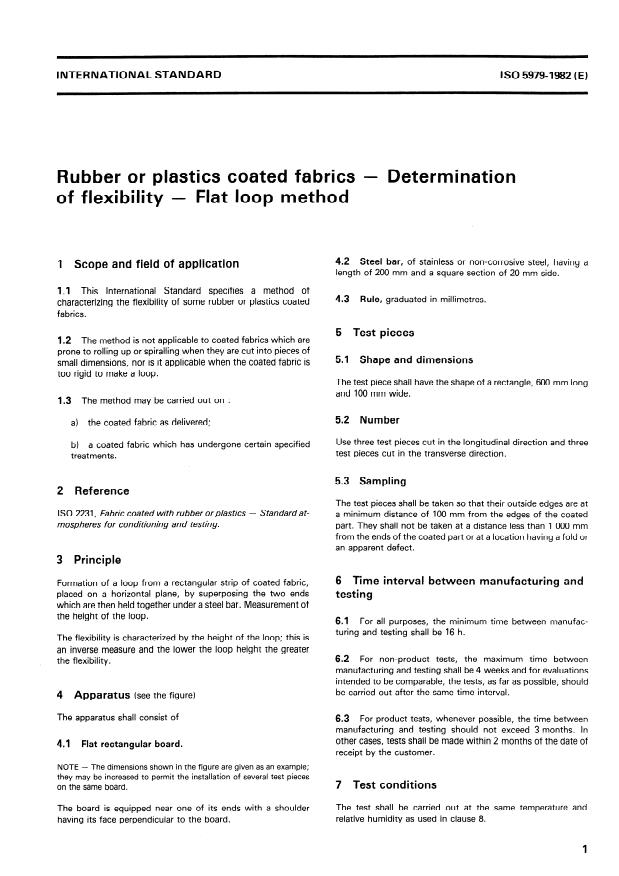
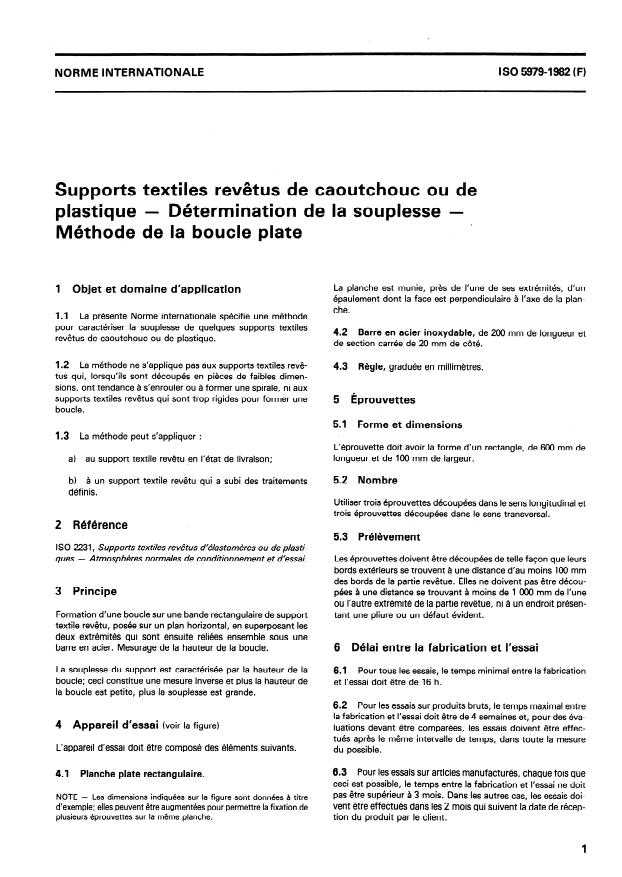
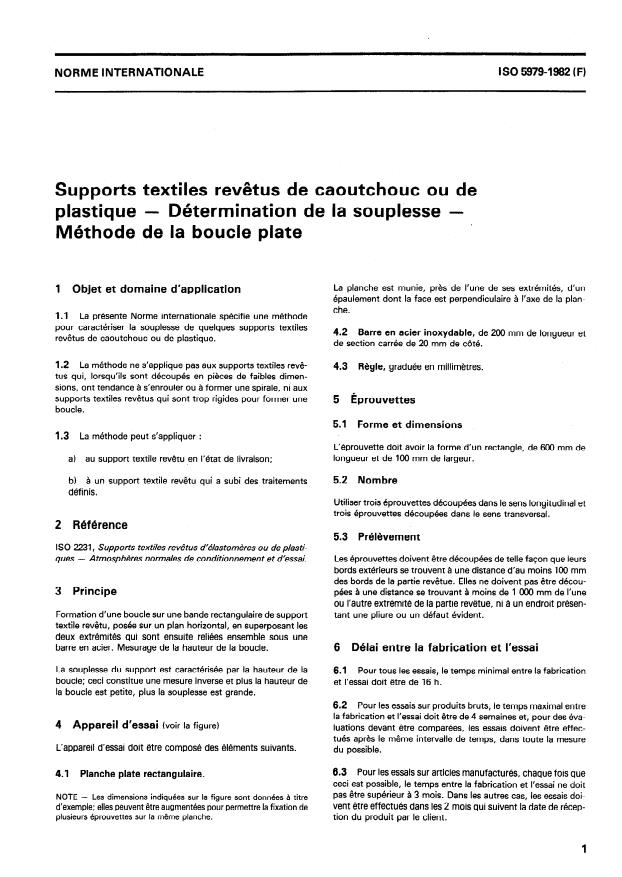
- Test pieces: Rectangular strips, 600 mm × 100 mm. Use three pieces cut in the longitudinal direction and three in the transverse direction.
- Sampling: Test pieces must be taken at least 100 mm from coated-part edges and not less than 1 000 mm from the ends; avoid folds or defects.
- Apparatus: A flat rectangular board with a perpendicular shoulder, a steel bar (200 mm long, square section 20 mm side), and a rule graduated in millimetres. The board surface is powdered (zinc stearate or French chalk) to prevent sticking.
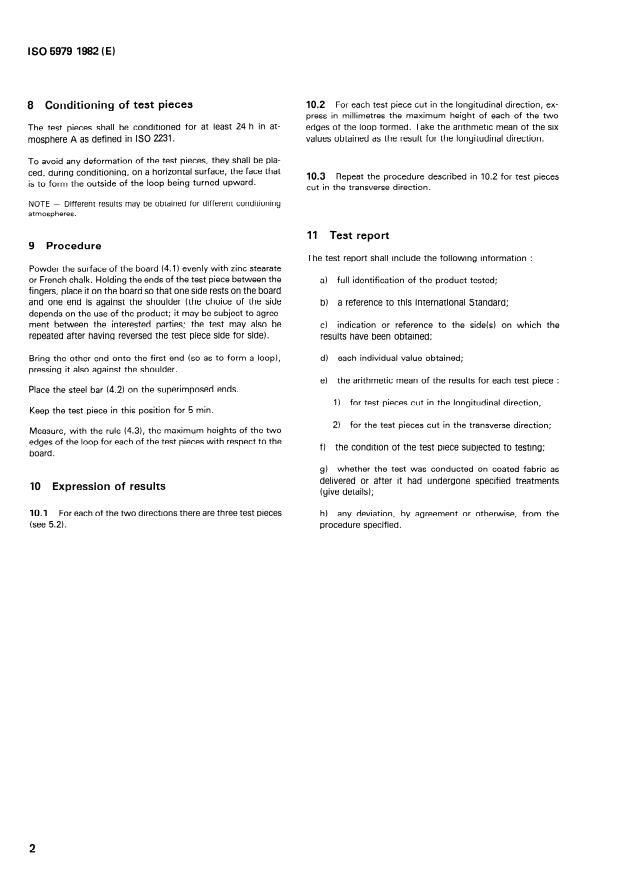
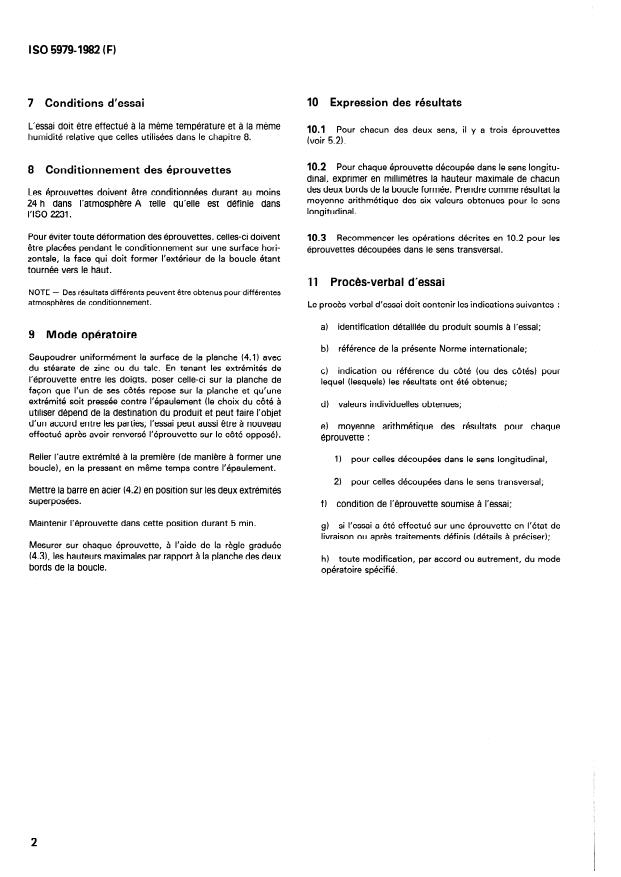
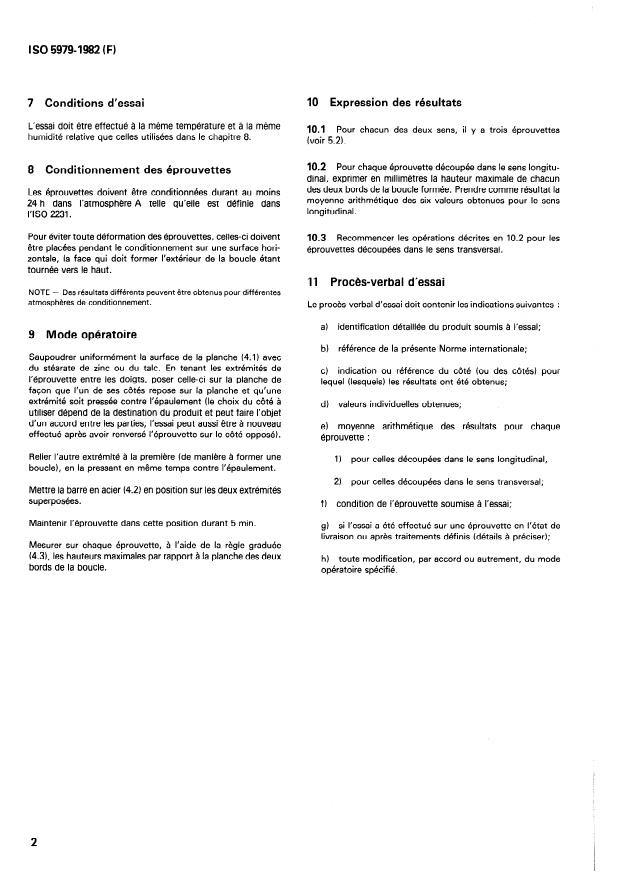
- Conditioning: Condition test pieces for at least 24 hours in atmosphere A as defined in ISO 2231; avoid deformation during conditioning.
- Procedure: Form a loop by superposing ends against the shoulder, place the steel bar on the overlapped ends and hold for 5 minutes, then measure the maximum heights of the two loop edges relative to the board.
- Expression of results: Record individual measurements, calculate arithmetic means (six values per direction), and report test conditions.
- Timing: Minimum 16 hours between manufacture and testing; guidance on maximum intervals for non-product and product tests (e.g., non-product: up to 4 weeks; product tests ideally within 3 months).
Applications and users
ISO 5979:1982 is useful for:
- Quality control in coated fabrics manufacturing (rubber or plastic coatings)
- Incoming inspection and batch acceptance by buyers and converters
- R&D and material comparison when assessing flexibility after treatments
- Textile and materials testing laboratories preparing conformity reports Typical users include coated-fabric manufacturers, product designers, procurement teams, and independent testing labs.
Related standards
- ISO 2231 - Fabric coated with rubber or plastics: standard atmospheres for conditioning and testing (referenced for conditioning requirements)
Keywords: ISO 5979:1982, flat loop method, coated fabrics testing, flexibility test, rubber coated fabric, plastics coated fabric, loop height measurement, textile testing.
Buy Documents
ISO 5979:1982 - Rubber or plastics coated fabrics — Determination of flexibility — Flat loop method Released:11/1/1982
ISO 5979:1982 - Supports textiles revetus de caoutchouc ou de plastique — Détermination de la souplesse — Méthode de la boucle plate Released:11/1/1982
ISO 5979:1982 - Supports textiles revetus de caoutchouc ou de plastique — Détermination de la souplesse — Méthode de la boucle plate Released:11/1/1982
Get Certified
Connect with accredited certification bodies for this standard

Control Union Certifications
Global certification for agriculture and sustainability.

Hohenstein Institut
Textile testing and certification.

Bureau Veritas Bangladesh
Bureau Veritas certification services in Bangladesh.
Sponsored listings
Frequently Asked Questions
ISO 5979:1982 is a standard published by the International Organization for Standardization (ISO). Its full title is "Rubber or plastics coated fabrics — Determination of flexibility — Flat loop method". This standard covers: Specifies a method of characterizing the flexiblity. Not applicable to coated fabrics which are prone to rolling up or spiralling when they are cut into pieces of small dimensions, nor applicable when the coated fabric is too rigid to make a loop. The method can be carried out on the coated fabric as delivered and on a coated fabric which has undergone certain specified treatments. A figure shows the apparatus.
Specifies a method of characterizing the flexiblity. Not applicable to coated fabrics which are prone to rolling up or spiralling when they are cut into pieces of small dimensions, nor applicable when the coated fabric is too rigid to make a loop. The method can be carried out on the coated fabric as delivered and on a coated fabric which has undergone certain specified treatments. A figure shows the apparatus.
ISO 5979:1982 is classified under the following ICS (International Classification for Standards) categories: 59.080.40 - Coated fabrics. The ICS classification helps identify the subject area and facilitates finding related standards.
ISO 5979:1982 is available in PDF format for immediate download after purchase. The document can be added to your cart and obtained through the secure checkout process. Digital delivery ensures instant access to the complete standard document.
Standards Content (Sample)
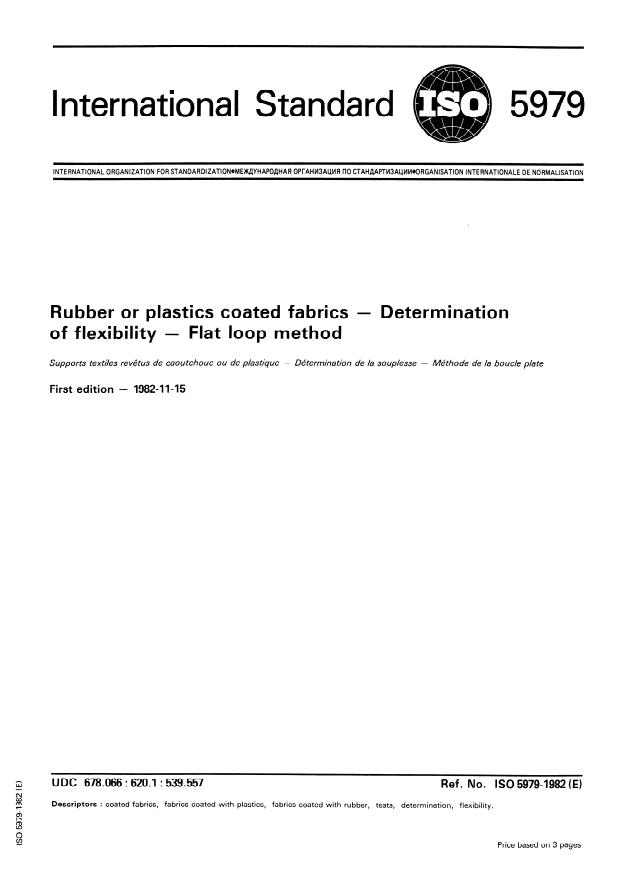
International Standard
INTERNATIONAL ORGANIZATION FOR STANDARDIZATIONWMEWYHAPOAHAR OPrAHM3AUMR fl0 CTAH~APTbI3A~MM.ORGANISATION INTERNATIONALE DE NORMALISATION
Rubber or plastics coated fabrics - Determination
of flexibility - Flat loop method
Determination de Ia souplesse - Mthode de Ia boucle plate
Supports textiles revhs de caoutchouc ou de plastique -
First edition - 1982-11-15
UDC 678.066 : 620.1 : 539.557 Ref. No. ISO 59794982 (E)
Descriptors : coated fabrics, fabrics coated with plastics, fabrics coated with rubber, tests, determination, flexibility.
Price based on 3 pages
BSO (the international Organization for Standardization) is a worldwide federatisn of
national standards institutes (EO member bedies). The work of developing Ilnter-
hatisnal Standards is carried out through ESO technical comnittees. Every member
body interested ih a subject for which a technical conmittee has been set up has the
right to be represented on that committee. International organizations, governmental
ahd -non-governmehtal, in liaissn with ISO, als0 take part in the wsrk.
Draft lnternatiohal Standards adopted by the technical comrnittees are circulated ts
the member bsdies fsr apprsval before their acceptance as International Standards by
the ISO C0uncil.
international Standard ISO 5979 was developed by Technical Csmmittee ISWTC 45,
Rubber and rubber productsf and was circulated ts the mernber bodies in
January 1981.
Bt has been approved by the member bodies 0% the following muntries :
Australia Bndia Romahia
Austria Italy South Africa, Rep. of
BeBgiurn Korea, Dem. P. Rep. sf
Spain
Brazil Kmea, Rep. sf Sri l-anka
Kanada Mexico Sweden
China Netherlands Thailand
Czechsslovakia Philippines United Kingdom
Denmark
Roland USA
France Portugal USSR
of the fsllowihg country expressed disapprsval sf the docurnent On
technical grounds
Gerrmahy, F. R.
0 International Organkation dsr Standardkation, 1982
Printed in Switzerland
INTERNATIONAL STANDARD ISO 5979-1982 (E)
Rubber or plastics coated fabrics - Determination
of flexibility - Flat loop method
4.2 Steel bar, of stainless or non-corrosive steel, having a
1 Scope and field of application
length of 200 mm and a Square section of 20 mm side.
1 .l This International Standard specifies a method of
4.3 Rule, graduated in millimetres.
characterizing the flexibility of some rubber or plastics coated
fabrics.
5 Test pieces
1.2 The method is not applicable to coated fabrics which are
prone to rolling up or spiralling when they are tut into pieces of
5.1 ahape and dimensions
small dimensions, nor is it applicable when the coated fabric is
too rigid to make a loop.
The test piece shall have the shape of a rectangle, 600 mm long
and 100 mm wide.
1.3 The method may be carried out on :
5.2 Number
a) the coated fabric as delivered;
Use three test pieces tut in the longitudinal direction and three
b) a coated fabric which has undergone certain specified
test pieces tut in the transverse direction.
treatments.
5.3 Sampling
2 Reference
The test pieces shall be taken so that their outside edges are at
ISO 2231, Fabric coated with rubber or plastics - Standard at-
a minimum distance of 100 mm from the edges of the coated
mospheres for conditioning and testing.
part. They shall not be taken at a distance less than 1 000 mm
from the ends of the coated part or at a location having a fold or
an apparent defect.
3 Principle
6 Time interval between manufacturing and
Formation of a loop from a rectangular Strip of coated fabric,
placed on a horizontal plane, by superposing the two ends
testing
which are then held together under a steel bar. Measurement of
the height of the loop.
6.1 For all purposes, the minimum time between manufac-
turing and testing shall be 16 h.
The flexibility is characterized by th
...
Norme internationale
INTERNATIONAL ORGANIZATION FOR STANDARDIZATIONWlE~YHAPO~HAR OPrAHM3A~MR Il0 CTAHJJAPTW3AL&lM~RGANISATION INTERNATIONALE DE NORMALISATION
Supports textiles revêtus de caoutchouc ou de
Détermination de la souplesse -
plastique -
Méthode de la boucle plate
- Determination of flexibility - Flat loop method
Rubber or plastics coated fabrics
Première édition - 1982-11-15
Réf. no : ISO 59794982 (FI
CDU 678.066: 620.1: 539.557
étoffe revêtue de plastique, étoffe revêtue de caoutchouc, essai, détermination, flexibilité.
Descripteurs : support textile revêtu,
Prix basé sur 3 pages
Avant-propos
L’ISO (Organisation internationale de normalisation) est une fédération mondiale
d’organismes nationaux de normalisation (comités membres de I’ISO). L’élaboration
des Normes internationales est confiée aux comités techniques de I’ISO. Chaque
comité membre intéressé par une étude a le droit de faire partie du comité technique
correspondant. Les organisations internationales, gouvernementales et non gouverne-
mentales, en liaison avec I’ISO, participent également aux travaux.
Les projets de Normes internationales adoptés par les comités techniques sont soumis
aux comités membres pour approbation, avant leur acceptation comme Normes inter-
nationales par le Conseil de I’ISO.
La Norme internationale ISO 5979 a été élaborée par le comité technique ISO/TC 45,
&astomères et produits à base d’élastomères, et a été soumise aux comités membres
en janvier 1981.
Les comités membres des pays suivants l’ont approuvée :
Afrique du Sud, Rép. d’ Danemark Portugal
Roumanie
Australie Espagne
Autriche France Royaume-Uni
Belgique Inde Sri Lanka
Italie Suede
Brésil
Canada Mexique Tchécoslovaquie
Chine Pays- Bas Thailande
Philippines URSS
Corée, Rép. de
Corée, Rép. dem. p. de Pologne USA
Le comité membre du pays suivant l’a désapprouvée pour des raisons techniques :
Allemagne, R. F.
@ Organisation internationale de normalisation, 1982 0
Imprimé en Suisse
ISO 59794982 (F)
NORME INTERNATIONALE
Supports textiles revêtus de caoutchouc ou de
Détermination de la souplesse -
plastique -
,
Méthode de la boucle plate
La planche est munie, près de l’une de ses extrémités, d’un
1 Objet et domaine d’application
épaulement dont la face est perpendiculaire à l’axe de la plan-
che.
1 .l La présente Norme internationale spécifie une méthode
pour caractériser la souplesse de quelques supports textiles
4.2 Barre en acier inoxydable, de 200 mm de longueur et
revêtus de caoutchouc ou de plastique.
de section carrée de 20 mm de coté.
1.2 La méthode ne s’applique pas aux supports textiles revê-
4.3 Règle, graduée en millimètres.
tus qui, lorsqu’ils sont découpés en pièces de faibles dimen-
sions, ont tendance à s’enrouler ou à former une spirale, ni aux
supports textiles revêtus qui sont trop rigides pour former une
5 Éprouvettes
boucle.
5.1 Forme et dimensions
1.3 La méthode peut s’appliquer :
L’éprouvette doit avoir la forme d’un rectangle, de 600 mm de
longueur et de 100 mm de largeur.
au support textile revêtu en l’état de livraison;
a)
5.2 Nombre
b) à un support textile revêtu qui a subi des traitements
définis.
Utiliser trois éprouvettes découpées dans le sens longitudinal et
trois éprouvettes découpées dans le sens transversal.
2 Référence
5.3 Prélèvement
ISO 2231, Supports textiles revêtus d’élastomères ou de plasti-
ques - Atmosphères normales de conditionnement et d’essai. Les éprouvettes doivent être découpées de telle facon que leurs
bords extérieurs se trouvent à une distance d’au moins 100 mm
des bords de la partie revêtue. Elles ne doivent pas être décou-
pées à une distance se trouvant à moins de 1 000 mm de l’une
3 Principe
ou l’autre extrémité de la partie revêtue, ni à un endroit présen-
Formation d’une boucle sur une bande rectangulaire de support tant une pliure ou un défaut évident.
textile revêtu, posée sur un plan horizontal, en superposant les
deux extrémités qui sont ensuite reliées ensemble sous une
6 Délai entre la fabrication et l’essai
barre en acier. Mesurage de la hauteur de la boucle.
La souplesse du support est caractérisée par la hauteur de la 6.1 Pour tous les essais, le temps minimal entre la fabrication
boucle; ceci
...
Norme internationale
INTERNATIONAL ORGANIZATION FOR STANDARDIZATIONWlE~YHAPO~HAR OPrAHM3A~MR Il0 CTAHJJAPTW3AL&lM~RGANISATION INTERNATIONALE DE NORMALISATION
Supports textiles revêtus de caoutchouc ou de
Détermination de la souplesse -
plastique -
Méthode de la boucle plate
- Determination of flexibility - Flat loop method
Rubber or plastics coated fabrics
Première édition - 1982-11-15
Réf. no : ISO 59794982 (FI
CDU 678.066: 620.1: 539.557
étoffe revêtue de plastique, étoffe revêtue de caoutchouc, essai, détermination, flexibilité.
Descripteurs : support textile revêtu,
Prix basé sur 3 pages
Avant-propos
L’ISO (Organisation internationale de normalisation) est une fédération mondiale
d’organismes nationaux de normalisation (comités membres de I’ISO). L’élaboration
des Normes internationales est confiée aux comités techniques de I’ISO. Chaque
comité membre intéressé par une étude a le droit de faire partie du comité technique
correspondant. Les organisations internationales, gouvernementales et non gouverne-
mentales, en liaison avec I’ISO, participent également aux travaux.
Les projets de Normes internationales adoptés par les comités techniques sont soumis
aux comités membres pour approbation, avant leur acceptation comme Normes inter-
nationales par le Conseil de I’ISO.
La Norme internationale ISO 5979 a été élaborée par le comité technique ISO/TC 45,
&astomères et produits à base d’élastomères, et a été soumise aux comités membres
en janvier 1981.
Les comités membres des pays suivants l’ont approuvée :
Afrique du Sud, Rép. d’ Danemark Portugal
Roumanie
Australie Espagne
Autriche France Royaume-Uni
Belgique Inde Sri Lanka
Italie Suede
Brésil
Canada Mexique Tchécoslovaquie
Chine Pays- Bas Thailande
Philippines URSS
Corée, Rép. de
Corée, Rép. dem. p. de Pologne USA
Le comité membre du pays suivant l’a désapprouvée pour des raisons techniques :
Allemagne, R. F.
@ Organisation internationale de normalisation, 1982 0
Imprimé en Suisse
ISO 59794982 (F)
NORME INTERNATIONALE
Supports textiles revêtus de caoutchouc ou de
Détermination de la souplesse -
plastique -
,
Méthode de la boucle plate
La planche est munie, près de l’une de ses extrémités, d’un
1 Objet et domaine d’application
épaulement dont la face est perpendiculaire à l’axe de la plan-
che.
1 .l La présente Norme internationale spécifie une méthode
pour caractériser la souplesse de quelques supports textiles
4.2 Barre en acier inoxydable, de 200 mm de longueur et
revêtus de caoutchouc ou de plastique.
de section carrée de 20 mm de coté.
1.2 La méthode ne s’applique pas aux supports textiles revê-
4.3 Règle, graduée en millimètres.
tus qui, lorsqu’ils sont découpés en pièces de faibles dimen-
sions, ont tendance à s’enrouler ou à former une spirale, ni aux
supports textiles revêtus qui sont trop rigides pour former une
5 Éprouvettes
boucle.
5.1 Forme et dimensions
1.3 La méthode peut s’appliquer :
L’éprouvette doit avoir la forme d’un rectangle, de 600 mm de
longueur et de 100 mm de largeur.
au support textile revêtu en l’état de livraison;
a)
5.2 Nombre
b) à un support textile revêtu qui a subi des traitements
définis.
Utiliser trois éprouvettes découpées dans le sens longitudinal et
trois éprouvettes découpées dans le sens transversal.
2 Référence
5.3 Prélèvement
ISO 2231, Supports textiles revêtus d’élastomères ou de plasti-
ques - Atmosphères normales de conditionnement et d’essai. Les éprouvettes doivent être découpées de telle facon que leurs
bords extérieurs se trouvent à une distance d’au moins 100 mm
des bords de la partie revêtue. Elles ne doivent pas être décou-
pées à une distance se trouvant à moins de 1 000 mm de l’une
3 Principe
ou l’autre extrémité de la partie revêtue, ni à un endroit présen-
Formation d’une boucle sur une bande rectangulaire de support tant une pliure ou un défaut évident.
textile revêtu, posée sur un plan horizontal, en superposant les
deux extrémités qui sont ensuite reliées ensemble sous une
6 Délai entre la fabrication et l’essai
barre en acier. Mesurage de la hauteur de la boucle.
La souplesse du support est caractérisée par la hauteur de la 6.1 Pour tous les essais, le temps minimal entre la fabrication
boucle; ceci
...