

ISO/IEC 30194:2024
(Main)Internet of things (IoT) and digital twin — Best practices for use case projects
General Information
- Abstract
This document describes best practices for use case projects in terms of projects, templates and plans, with the objective to improve the consistency of content across different use case projects and enable sharing of knowledge between projects. A long-term goal is to foster interoperability between tools supporting the collection and maintenance of use cases. This document is intended for developers of use case projects, including in the context of standardization. The document can be used to complement existing methodology standards such as IEC 62559.
- Status
- Published
- Publication Date
- 06-Dec-2024
- Technical Committee
- ISO/IEC JTC 1/SC 41 - Internet of things and digital twin
- Drafting Committee
- ISO/IEC JTC 1/SC 41 - Internet of things and digital twin
- Current Stage
- 6060 - International Standard published
- Start Date
- 07-Dec-2024
- Due Date
- 10-Jan-2026
- Completion Date
- 07-Dec-2024
Overview
ISO/IEC 30194:2024 - "Internet of things (IoT) and digital twin - Best practices for use case projects" is a Technical Report that documents best practices for creating, managing and sharing use case projects. Its objective is to improve consistency of content across use case projects, enable knowledge sharing, and foster long‑term interoperability between tools used to collect and maintain use cases. The report is intended for developers of use case projects, including those working in standardization.
Key Topics
- Conceptual model of a use case (Clause 5): introduces common definitions (actor, role, stakeholder, use case) and a shared conceptual model to align how use cases are described in IoT and digital twin contexts.
- Use case project types and purpose (Clause 6): describes different project objectives (example types include study, guidance, business, expectation, and system projects) and how use cases serve those purposes.
- Use case templates (Clause 7): guidance on designing structured templates that improve consistency - covering template structure, description blocks, predefined fields, authoring instructions and sample content to help uniform capture of requirements and scenarios.
- Project plans and processes (Clause 8): best practices for governance and lifecycle management, including use case initiative governance, template development and maintenance, and processes for developing and maintaining individual use cases.
- Examples and domains (Annex A): illustrative examples across IoT, digital twins, artificial intelligence and consumer privacy help ground the practices in real‑world contexts.
- No normative references: the TR is informative and complements existing methodologies rather than imposing mandatory requirements.
Applications and Who Should Use It
- IoT and digital twin practitioners: product managers, systems engineers, solution architects and technical writers creating use case repositories or requirements artifacts.
- Standards developers and working groups: teams developing interoperable specifications who need consistent, reusable use case artifacts across committees.
- Project and program leads: those setting governance, template and maintenance processes for multi‑project portfolios involving IoT, digital twin or AI initiatives.
- Tool vendors and integrators: organizations building repositories or tooling for capture, exchange and maintenance of use case data that aim for interoperability.
Practical benefits include faster onboarding, consistent stakeholder communications, reusable templates, and improved ability to share and aggregate use cases across organizations and tools.
Related Standards
- Complements existing use case methodology standards such as IEC 62559 and is aligned with other IoT, digital twin and AI standardization activities referenced in the report.
Get Certified
Connect with accredited certification bodies for this standard

BSI Group
BSI (British Standards Institution) is the business standards company that helps organizations make excellence a habit.

NYCE
Mexican standards and certification body.
Sponsored listings
Frequently Asked Questions
ISO/IEC 30194:2024 is a standard published by the International Organization for Standardization (ISO). Its full title is "Internet of things (IoT) and digital twin — Best practices for use case projects". This standard covers: This document describes best practices for use case projects in terms of projects, templates and plans, with the objective to improve the consistency of content across different use case projects and enable sharing of knowledge between projects. A long-term goal is to foster interoperability between tools supporting the collection and maintenance of use cases. This document is intended for developers of use case projects, including in the context of standardization. The document can be used to complement existing methodology standards such as IEC 62559.
This document describes best practices for use case projects in terms of projects, templates and plans, with the objective to improve the consistency of content across different use case projects and enable sharing of knowledge between projects. A long-term goal is to foster interoperability between tools supporting the collection and maintenance of use cases. This document is intended for developers of use case projects, including in the context of standardization. The document can be used to complement existing methodology standards such as IEC 62559.
ISO/IEC 30194:2024 is classified under the following ICS (International Classification for Standards) categories: 35.240.95 - Internet applications. The ICS classification helps identify the subject area and facilitates finding related standards.
ISO/IEC 30194:2024 is available in PDF format for immediate download after purchase. The document can be added to your cart and obtained through the secure checkout process. Digital delivery ensures instant access to the complete standard document.
Standards Content (Sample)
ISO/IEC TR 30194
Edition 1.0 2024-12
TECHNICAL
REPORT
Internet of things (IoT) and digital twin – Best practices for use case projects
ISO/IEC TR 30194:2024-12(en)
All rights reserved. Unless otherwise specified, no part of this publication may be reproduced or utilized in any form or
by any means, electronic or mechanical, including photocopying and microfilm, without permission in writing from either
IEC or IEC's member National Committee in the country of the requester. If you have any questions about ISO/IEC
copyright or have an enquiry about obtaining additional rights to this publication, please contact the address below or
your local IEC member National Committee for further information.
IEC Secretariat Tel.: +41 22 919 02 11
3, rue de Varembé info@iec.ch
CH-1211 Geneva 20 www.iec.ch
Switzerland
About the IEC
The International Electrotechnical Commission (IEC) is the leading global organization that prepares and publishes
International Standards for all electrical, electronic and related technologies.
About IEC publications
The technical content of IEC publications is kept under constant review by the IEC. Please make sure that you have the
latest edition, a corrigendum or an amendment might have been published.
IEC publications search - webstore.iec.ch/advsearchform IEC Products & Services Portal - products.iec.ch
The advanced search enables to find IEC publications by a Discover our powerful search engine and read freely all the
variety of criteria (reference number, text, technical publications previews, graphical symbols and the glossary.
committee, …). It also gives information on projects, replaced With a subscription you will always have access to up to date
and withdrawn publications. content tailored to your needs.
IEC Just Published - webstore.iec.ch/justpublished
Electropedia - www.electropedia.org
Stay up to date on all new IEC publications. Just Published
The world's leading online dictionary on electrotechnology,
details all new publications released. Available online and once
containing more than 22 500 terminological entries in English
a month by email.
and French, with equivalent terms in 25 additional languages.
Also known as the International Electrotechnical Vocabulary
IEC Customer Service Centre - webstore.iec.ch/csc
(IEV) online.
If you wish to give us your feedback on this publication or need
further assistance, please contact the Customer Service
Centre: sales@iec.ch.
ISO/IEC TR 30194
Edition 1.0 2024-12
TECHNICAL
REPORT
Internet of things (IoT) and digital twin – Best practices for use case projects
INTERNATIONAL
ELECTROTECHNICAL
COMMISSION
ICS 35.020 ISBN 978-2-8322-9968-5
– 2 – ISO/IEC TR 30194:2024 © ISO/IEC 2024
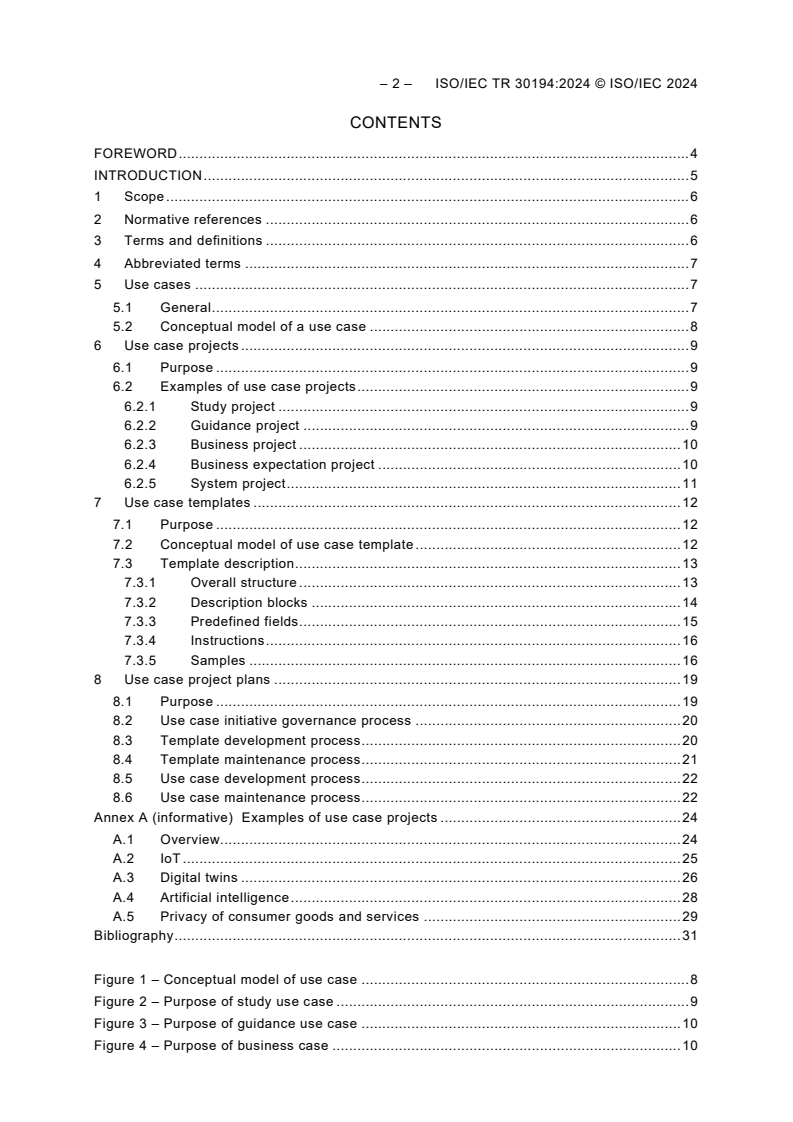
CONTENTS
FOREWORD . 4
INTRODUCTION . 5
1 Scope . 6
2 Normative references . 6
3 Terms and definitions . 6
4 Abbreviated terms . 7
5 Use cases . 7
5.1 General . 7
5.2 Conceptual model of a use case . 8
6 Use case projects . 9
6.1 Purpose . 9
6.2 Examples of use case projects . 9
6.2.1 Study project . 9
6.2.2 Guidance project . 9
6.2.3 Business project . 10
6.2.4 Business expectation project . 10
6.2.5 System project . 11
7 Use case templates . 12
7.1 Purpose . 12
7.2 Conceptual model of use case template . 12
7.3 Template description . 13
7.3.1 Overall structure . 13
7.3.2 Description blocks . 14
7.3.3 Predefined fields . 15
7.3.4 Instructions . 16
7.3.5 Samples . 16
8 Use case project plans . 19
8.1 Purpose . 19
8.2 Use case initiative governance process . 20
8.3 Template development process . 20
8.4 Template maintenance process . 21
8.5 Use case development process . 22
8.6 Use case maintenance process . 22
Annex A (informative) Examples of use case projects . 24
A.1 Overview. 24
A.2 IoT . 25
A.3 Digital twins . 26
A.4 Artificial intelligence . 28
A.5 Privacy of consumer goods and services . 29
Bibliography . 31
Figure 1 – Conceptual model of use case . 8
Figure 2 – Purpose of study use case . 9
Figure 3 – Purpose of guidance use case . 10
Figure 4 – Purpose of business case . 10
ISO/IEC TR 30194:2024 © ISO/IEC 2024 – 3 –
Figure 5 – Purpose of expectation use case . 11
Figure 6 – Purpose of system use case . 11
Figure 7 – Conceptual model of system use case . 12
Figure 8 – Conceptual model of a use case template . 13
Figure 9 – Structure of use case template . 14
Figure 10 – Description block example . 14
Figure 11 – Categorized description block example . 15
Figure 12 – Structure of a sample . 17
Figure A.1 – Rationale for a repository of use cases . 24
Table 1 – Examples of definitions of the concept of use case in standards . 8
Table 2 – Examples of vocabulary . 13
Table 3 – Examples of predefined fields . 16
Table 4 – Examples of instructions . 16
Table 5 – Examples of free text . 17
Table 6 – Examples of well-formed sentences . 18
Table 7 – Example of machine-readable diagram . 19
Table 8 – Use case initiative governance process . 20
Table 9 – Template development process . 21
Table 10 – Template maintenance process . 22
Table 11 – Use case development process . 22
Table 12 – Use case maintenance process . 23
– 4 – ISO/IEC TR 30194:2024 © ISO/IEC 2024
INTERNET OF THINGS (IoT) AND DIGITAL TWIN –
BEST PRACTICES FOR USE CASE PROJECTS
FOREWORD
1) ISO (the International Organization for Standardization) and IEC (the International Electrotechnical Commission)
form the specialized system for worldwide standardization. National bodies that are members of ISO or IEC
participate in the development of International Standards through technical committees established by the
respective organization to deal with particular fields of technical activity. ISO and IEC technical committees
collaborate in fields of mutual interest. Other international organizations, governmental and non-governmental,
in liaison with ISO and IEC, also take part in the work.
2) The formal decisions or agreements of IEC and ISO on technical matters express, as nearly as possible, an
international consensus of opinion on the relevant subjects since each technical committee has representation
from all interested IEC and ISO National bodies.
3) IEC and ISO documents have the form of recommendations for international use and are accepted by IEC and
ISO National bodies in that sense. While all reasonable efforts are made to ensure that the technical content of
IEC and ISO documents is accurate, IEC and ISO cannot be held responsible for the way in which they are used
or for any misinterpretation by any end user.
4) In order to promote international uniformity, IEC and ISO National bodies undertake to apply IEC and
ISO documents transparently to the maximum extent possible in their national and regional publications. Any
divergence between any IEC and ISO document and the corresponding national or regional publication shall be
clearly indicated in the latter.
5) IEC and ISO do not provide any attestation of conformity. Independent certification bodies provide conformity
assessment services and, in some areas, access to IEC and ISO marks of conformity. IEC and ISO are not
responsible for any services carried out by independent certification bodies.
6) All users should ensure that they have the latest edition of this document.
7) No liability shall attach to IEC and ISO or their directors, employees, servants or agents including individual
experts and members of its technical committees and IEC and ISO National bodies for any personal injury,
property damage or other damage of any nature whatsoever, whether direct or indirect, or for costs (including
legal fees) and expenses arising out of the publication, use of, or reliance upon, this ISO/IEC document or any
other IEC and ISO documents.
8) Attention is drawn to the Normative references cited in this document. Use of the referenced publications is
indispensable for the correct application of this document.
9) IEC and ISO draw attention to the possibility that the implementation of this document may involve the use of (a)
patent(s). IEC and ISO take no position concerning the evidence, validity or applicability of any claimed patent
rights in respect thereof. As of the date of publication of this document, IEC and ISO had not received notice of
(a) patent(s), which may be required to implement this document. However, implementers are cautioned that this
may not represent the latest information, which may be obtained from the patent database available at
https://patents.iec.ch and www.iso.org/patents. IEC and ISO shall not be held responsible for identifying any or
all such patent rights.
ISO/IEC TR 30194 has been prepared by subcommittee 41: Internet of Things and Digital Twin,
of ISO/IEC joint technical committee 1: Information technology. It is a Technical Report.
The text of this Technical Report is based on the following documents:
Draft Report on voting
JTC1-SC41/457/DTR JTC1-SC41/465/RVDTR
Full information on the voting for its approval can be found in the report on voting indicated in
the above table.
The language used for the development of this Technical Report is English.
This document was drafted in accordance with ISO/IEC Directives, Part 2, and developed in
accordance with ISO/IEC Directives, Part 1, and the ISO/IEC Directives, JTC 1 Supplement
available at www.iec.ch/members_experts/refdocs and www.iso.org/directives.
ISO/IEC TR 30194:2024 © ISO/IEC 2024 – 5 –
INTRODUCTION
The concept of use cases was introduced in the 1980s in system engineering by Ivar Jacobson
[1] to enable the capture and specification of the requirements of a system, using textual,
structural, and visual modelling techniques. The practice of providing use cases has been
widely used at research level [2]. It has been nearly systematically used at standardization level
as shown in the following examples:
– methodology for use cases from IEC 62559 [3], [4], [5];
– use cases in the ambient assisted living (AAL) domain [6];
– use cases in the big data domain [7], including three iterations from NIST [8], [9], [10];
– use cases in the IoT domain [11];
– use cases in the AI domain [12], including a companion standard on security and
privacy [13];
– use cases in the digital twin domain [14];
– use cases in the blockchain domain [15];
– use cases on privacy-by-design in the consumer domain [16];
This document describes best practices for use case projects. It is structured as follows:
– Clause 5 provides an introduction on existing definitions (5.1), and specifies a conceptual
model of use cases.
– Clause 6 explains the purpose of use case projects (6.1), and provides examples of use
case projects (6.2).
– Clause 7 explains the purpose of use case templates (7.1), providing a conceptual model of
a use case template (7.2), and describing the content of a template: description blocks,
predefined fields, instructions, and samples (7.3).
– Clause 8 explains the purpose of use case project plans (8.1), covering the use case
initiative governance process (8.2), the template development process (8.3), the template
maintenance process (8.4), the use case development process (8.5), and the use case
maintenance process (8.6).
– Annex A provides examples of use case projects on IoT (Clause A.2), digital twins
(Clause A.3), artificial intelligence (Clause A.4), and privacy for consumer goods and
services (Clause A.5).
Figure 9 use the Unified Modelling Language (UML) diagrams notation.
Figure 1 to
___________
Numbers in square brackets refer to the Bibliography.
– 6 – ISO/IEC TR 30194:2024 © ISO/IEC 2024
INTERNET OF THINGS (IoT) AND DIGITAL TWIN –
BEST PRACTICES FOR USE CASE PROJECTS
1 Scope
This document describes best practices for use case projects in terms of projects, templates
and plans, with the objective to improve the consistency of content across different use case
projects and enable sharing of knowledge between projects. A long-term goal is to foster
interoperability between tools supporting the collection and maintenance of use cases.
This document is intended for developers of use case projects, including in the context of
standardization.
The document can be used to complement existing methodology standards such as
IEC 62559 [3], [4], [5].
2 Normative references
There are no normative references in this document.
3 Terms and definitions
For the purposes of this document, the following terms and definitions apply.
ISO and IEC maintain terminology databases for use in standardization at the following
addresses:
• IEC Electropedia: available at https://www.electropedia.org/
• ISO Online browsing platform: available at https://www.iso.org/obp
3.1
actor
stakeholder involved in a use case (3.4)
3.2
role
function assumed or part played by an external actor (3.1) or party, in interaction with the
system under focus
Note 1 to entry: Parties include functions, systems, organizations, devices.
3.3
stakeholder
individual, team, organization, or classes thereof, affected by or affecting the use case (3.4)
directly or indirectly
3.4
use case
specification of a set of actions performed by a system, which yields an observable result that
is, typically, of value for one or more roles or other stakeholders (3.3) of the system
Note 1 to entry: Based on ISO/IEC 19505–2:2012, 16.3.6.
ISO/IEC TR 30194:2024 © ISO/IEC 2024 – 7 –
3.5
use case template
structured description of a use case (3.4) based on a set of predefined fields (3.7)
3.6
use case project
project involving the collection of use cases (3.4)
3.7
predefined field
agreed set of fields in relation to a domain
3.8
description block
group of predefined fields (3.7)
3.9
vocabulary
terminological dictionary that contains designations and definitions from one or more domains
or subjects
Note 1 to entry: A vocabulary favours re-use.
[SOURCE ISO 1087:2019, 3.7.5, modified – Note 1 to entry has been replaced.]
4 Abbreviated terms
UML Universal Modelling Language
5 Use cases
5.1 General
Table 1 shows a number of definitions which have been provided for the concept of use case
in standards
– 8 – ISO/IEC TR 30194:2024 © ISO/IEC 2024
Table 1 – Examples of definitions of the concept of use case in standards
Committee Standard Definition
ISO/IEC JTC 1/SC 7
ISO/IEC/IEEE 26513:2017, description of the behavioural requirements of a
(Software and system
3.46 system and its interaction with a user
engineering)
textual and graphical depiction of the actors and
ISO/TC 215 (Health operations that address information exchange in
ISO/TR 28380-1:2014, 2.13
informatics) the context of a set of specific tasks for a workflow
performed by different systems or devices
ISO/TC 10 (Technical description of behavioural requirements of a
ISO 10209:2022, 3.14.46
product documentation) system and its interaction with a user
specification of a sequence of actions, including
ISO/IEC TR 22417:2017, 3.2 variants, that a system (or other entity) can
perform, interacting with actors of the system
IoT use case
description of a hypothetically possible situation
where IoT concepts, products and services may be
ISO/IEC JTC 1/SC 41
specified as a set of actions associated with actors
(IoT and digital twin)
in an IoT system, which yields an observable result
that is, typically, of value for one or more actors or
ISO/IEC TR 22417:2017, 3.3
other stakeholders of the system
Note 1 to entry: The aim is to pictorially describe a
field of problems in a way that the artificial situation
makes IoT approaches to solutions evident in their
temporal, spatial as well as technical dimension.
5.2 Conceptual model of a use case
The conceptual model of a use case is shown in Figure 1:
– a use case can include several interaction scenarios,
– a scenario involves actors with specific roles,
– a scenario is about a system of interest, and
– a scenario describes how a goal is attained.
Figure 1 – Conceptual model of use case
ISO/IEC TR 30194:2024 © ISO/IEC 2024 – 9 –
6 Use case projects
6.1 Purpose
Use case projects collect use cases in order to serve different goals:
a) study;
b) guidance;
c) expectation;
d) business;
e) system;
f) a use case project providing both justifications on expectations, arguments on business
goals, and arguments on a solution.
Use case projects are often followed by other projects.
g) ISO/IEC TR 30172:2023 [14] collects use cases on digital twin. ISO/IEC TR 30172:2023 has
been followed by ISO/IEC 30173:2023 [17], which focuses on terms and concepts. A future
project, ISO/IEC 30188, focuses on reference architecture.
6.2 Examples of use case projects
6.2.1 Study project
In a study project, use cases describe real implementations. The purpose of a study use case
is to provide insight on important building blocks (Figure 2).
EXAMPLE 1 ISO/IEC TR 22417:2017 [11] provides insight on IoT.
EXAMPLE 2 ISO/IEC TR 30172:2023 [14] provides insight on digital twins.
Figure 2 – Purpose of study use case
6.2.2 Guidance project
In a guidance project, use cases are examples, real or invented. The purpose of a guidance
use case is to provide guidance on the use of requirements (Figure 3).
EXAMPLE ISO/TR 31700-2:2023 [16] provides examples on the use of ISO 31700-1:2023 [18].
– 10 – ISO/IEC TR 30194:2024 © ISO/IEC 2024
Figure 3 – Purpose of guidance use case
6.2.3 Business project
In a business project, a business use case aims at describing business processes and business
role interactions, while remaining solution agnostic (Figure 4).
Figure 4 – Purpose of business case
6.2.4 Business expectation project
In a business expectation project, use cases provide justifications on a specific expectation
(Figure 5).
ISO/IEC TR 30194:2024 © ISO/IEC 2024 – 11 –
Figure 5 – Purpose of expectation use case
The purpose of an expectation project is to provide guidance on some specific stakeholder
expectations in a system of interest.
EXAMPLE ISO/IEC TR 27563:2023 [13] provides expectations on security and privacy related to the artificial
intelligence use cases of ISO/IEC TR 24030:2021 [12].
6.2.5 System project
In a system project, a system use case provides arguments on a solution to meet the goals of
a use case (Figure 6). A system use case aims at describing functional implementations of a
solution to meet business use case objectives
Figure 6 – Purpose of system use case
The conceptual model of a system use case is shown in Figure 7:
– a system use case describes solutions,
– a solution involves architecture descriptions,
– a solution is about a system of interest, and
– a solution describes how a business goal is met.
– 12 – ISO/IEC TR 30194:2024 © ISO/IEC 2024
Figure 7 – Conceptual model of system use case
The purpose of a system use case is to describe a solution.
EXAMPLE Annex C of ISO/IEC 20547-4:2020 [19] describes a solution for security and privacy in an automotive
big data environment.
7 Use case templates
7.1 Purpose
Use case templates enable unified descriptions of a collection of use cases.
EXAMPLE 1 ISO/IEC TR 24030:2021 [12] includes 132 use cases.
NOTE There can be as many templates as situations.
Use case templates enforce the use of a vocabulary based on the conceptual model of use case
(Figure 1). The use of a common vocabulary enables in turn the sharing a description resources.
EXAMPLE 2 Roles, goals, and keywords are terms that allow external resources to be shared.
Use case templates provide information on a domain.
EXAMPLE 3 IoT [11], digital twin [14], AI [12], integration of IoT and DLT/Blockchains [15], big data [7], and AAL
[6].
Information is provided in predefined fields.
EXAMPLE 4 Identification, scope and objectives, narrative, key performance indicators, actors, issues, relation with
other use cases, referenced standards, scenarios, security, privacy, trustworthiness, conformity aspects, use case
diagram, data flow diagram, sequence diagram.
Use case templates are constructed to enable relationships between use cases.
EXAMPLE 5 Use case A includes use case B.
EXAMPLE 6 Use case A extends use case B.
EXAMPLE 7 Use case A is a specialization of use case B.
7.2 Conceptual model of use case template
Figure 8 shows the conceptual model of a use case template:
– a use case template shapes the description of a use case;
– a use case template focuses on a domain, on one or several intended goals and several
topics;
– a use case template is guided by instructions and samples; and
– samples use template, domain and topic vocabulary.
ISO/IEC TR 30194:2024 © ISO/IEC 2024 – 13 –
NOTE 1 The template vocabulary can be based on a standard vocabulary.
NOTE 2 When a standard vocabulary is used, profiles or agreed subsets can be used.
EXAMPLE IoT is a domain, interoperability is a topic.
Figure 8 – Conceptual model of a use case template
Table 2 shows examples of vocabulary.
Table 2 – Examples of vocabulary
Use case, actor, scope, objective, narrative, issues, referred standards, domain, role,
Template vocabulary
scenario
IoT, device, sensor, actuator, IoT system, IoT gateway, IoT
IoT domain
network, IoT application, IoT platform, digital connectivity
Domain vocabulary IoT role Sensor, actuator, operator, user
Digital twin, digital entity, target entity, digital domain, physical
Digital twin domain
domain, digital representation, digital modelling
Security and Confidentiality, integrity, availability, unlinkability, transparency,
privacy intervenability
Topic vocabulary Digital twin Visualization, optimization, simulation, monitoring, prediction,
application planning
Assurance Audit, conformity assessment, evidence, testing
7.3 Template description
7.3.1 Overall structure
Figure 9 shows the structure of a use case template:
– a use case template includes one or more description blocks;
– a description block can include nested description blocks;
– a description block includes a title;
– a description block includes one or more predefined fields;
– a predefined field consists of a title, possibly some instruction, and possibly samples.
– 14 – ISO/IEC TR 30194:2024 © ISO/IEC 2024
Figure 9 – Structure of use case template
NOTE The description block title and field title can use the template, domain, and the topic vocabulary.
7.3.2 Description blocks
Figure 10 shows an example of description block:
– the left part shows the description block container, and
– the right part shows the block title, as well as two descriptions fields.
Description block title
Instruction
Field title
Description block Samples
Instruction
Field title
Samples
Figure 10 – Description block example
NOTE A description block title can be considered as a class while the field titles are the attributes of the description
block class.
Some description blocks can be categories. Figure 11 shows an example of categorized
description blocks, using IEC 62559-2 [4] use case template:
– general information is an empty description block which categorizes three description blocks
(use case identification, version management, scope and objective);
– the left part shows one category element (general information) and three description blocks,
• use case identification,
• version management, and
• scope and objective; and
– the right part shows the content of the three description blocks.
ISO/IEC TR 30194:2024 © ISO/IEC 2024 – 15 –
Use case identification
Instruction
Idea
Samples
Use case identification description
Instruction
Area/ Domain(s)/
block
Zone(s)
Samples
Instruction
Name of use
case
Samples
Version management
Instruction
Version number
Samples
Instruction
Date
Samples
Version management description
Instruction
block
Name of authors
Samples
Instruction
Changes
Samples
Instruction
Approval status
Samples
Scope and objective
Instruction
Scope
Samples
Scope and objective description
Instruction
block
Objective(s)
Samples
Instruction
Related business
case(s)
Samples
Figure 11 – Categorized description block example
7.3.3 Predefined fields
Table 3 shows examples of description blocks and predefined fields. A template can include a
general information block as shown in Figure 11.
NOTE Description block titles can follow specific rules.
General information
category
General
information
– 16 – ISO/IEC TR 30194:2024 © ISO/IEC 2024
Table 3 – Examples of predefined fields
Description block title Predefined fields
Name of use case Id, Name
Version management Version, data, name of author or committee, approval status
Source(s), conditions of use, maturity of use case, regional or national
Basic information relation, vertical application area, well-known or related existing use
cases, keywords for classification
Scope of use case Scope of use case
Objective of use case Objective of use case
Narrative of use case Short description, description, link
Actors and roles Name, role, description, interaction
Issues Relevant standardization committees, relevant standards, standard status
Relation with other known use Known use case, source, relationship
case
General remarks General remarks
Data security, privacy and Data security requirements, privacy requirements, trustworthiness
trustworthiness requirements
Conformity aspects Conformity aspects
User requirements User requirements and interactions with other actors
7.3.4 Instructions
A template can provide instructions on a predefined field.
EXAMPLE Provide the name of the use case (in one line).
Instructions on a predefined field provide guidance to the use case developer on how to provide
content for the predefined field. Table 4 shows examples of instructions.
Table 4 – Examples of instructions
Domain Category Predefined field Instruction
Any General information Name of the use case Provide the name of the use case
Provide the role of the actor, using a
Any Stakeholders Actor role vocabulary that is commonly used in the
use case domain (e.g. big data)
Any Security and privacy Security assets Provide a list of security assets
7.3.5 Samples
7.3.5.1 Structure of a sample
This document uses the term sample to avoid confusion with the term example. The term sample
refers to examples in a template.
The structure of a sample is sh
...